

Acts 21:3
Greek (Tischendorf 8th ed.) Acts 21:3 appears in the Greek New Testament. The text above is from the Tischendorf 8th edition. Each word links to its Strong’s number and a concise gloss. Click any word for its full Thayer’s Greek Lexicon entry.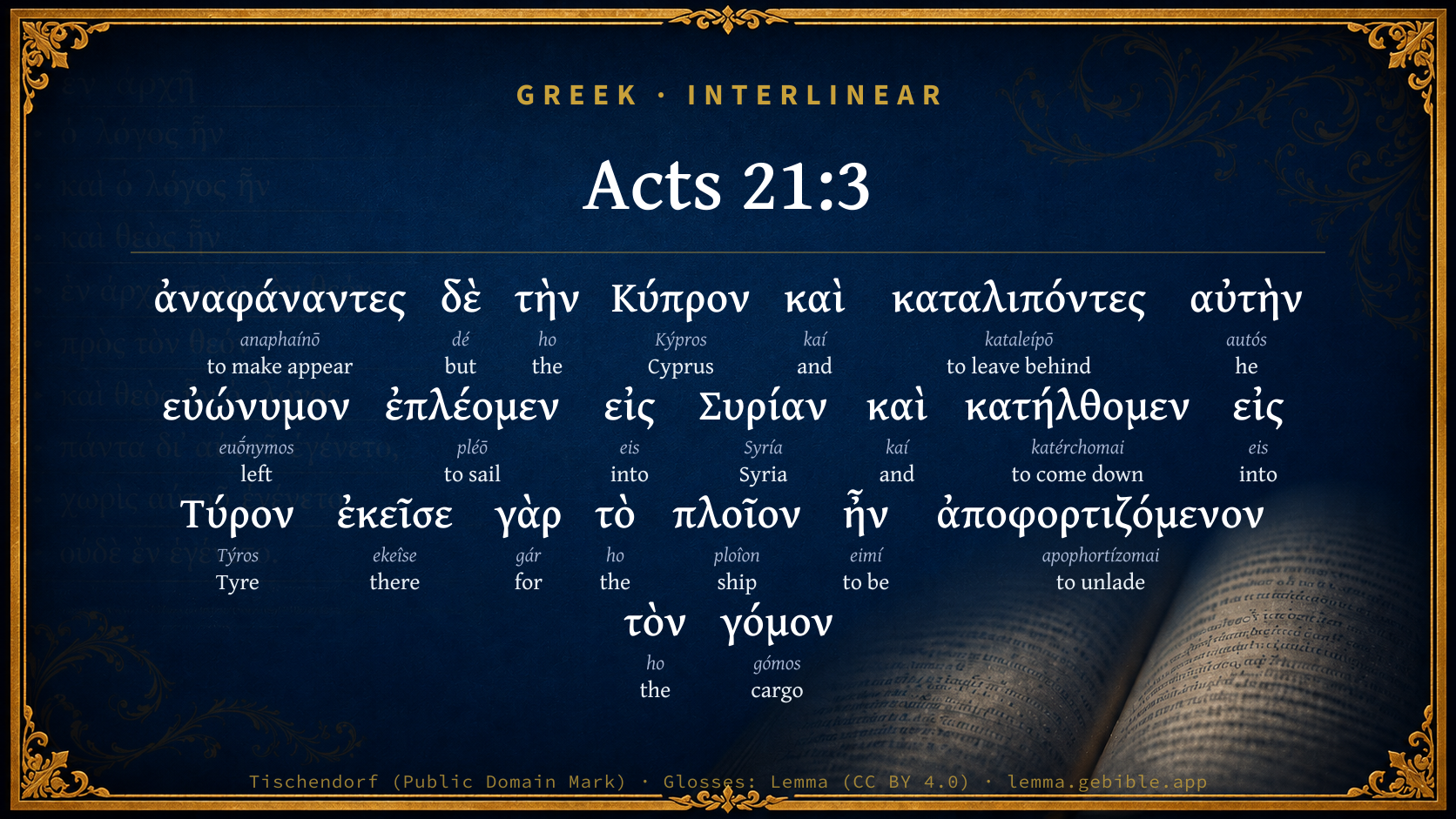
When we had come in sight of Cyprus, leaving it on the left hand, we sailed to Syria, and landed at Tyre, for there the ship was to unload her cargo.
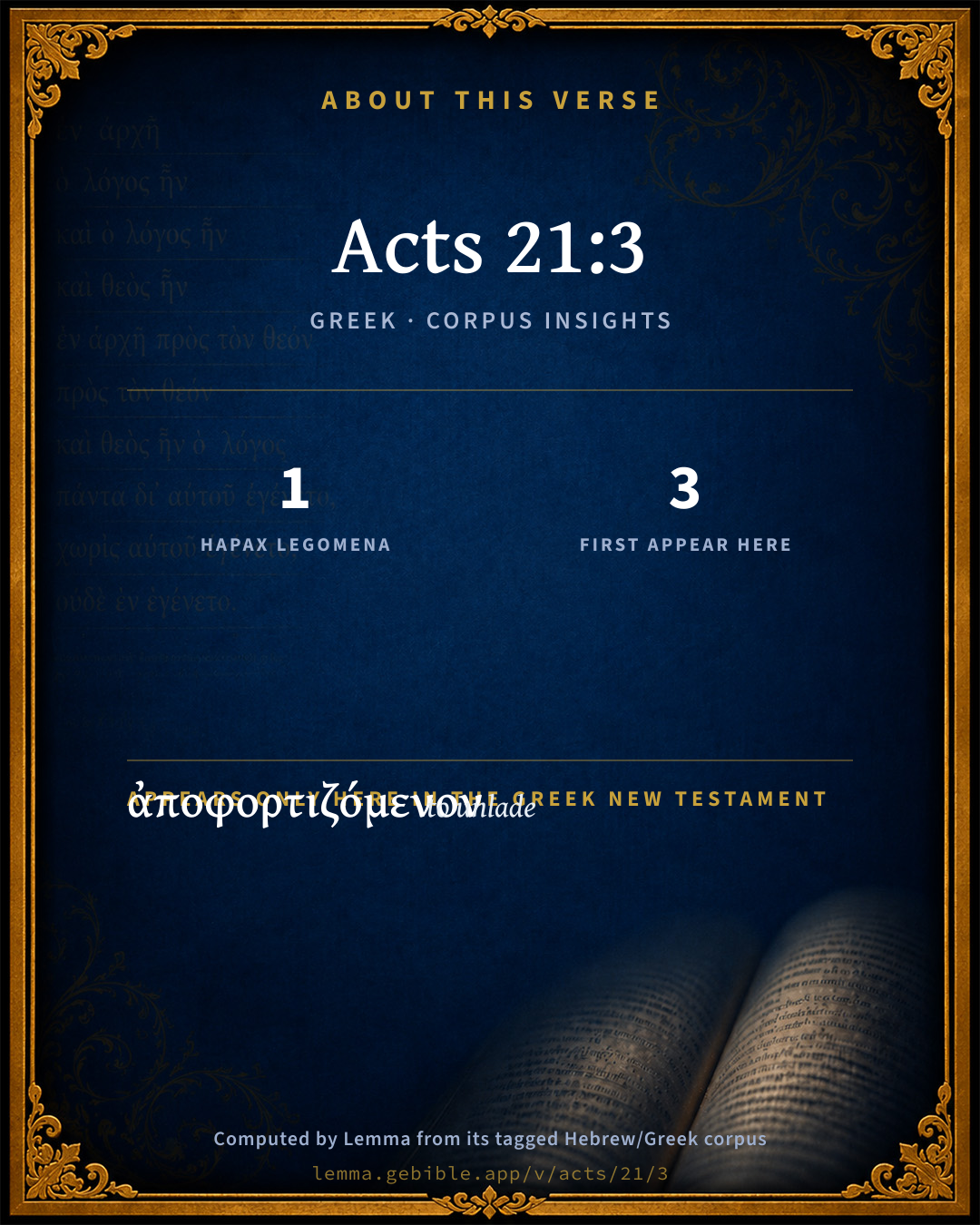
- 1 hapax legomenon — only here in the Greek New Testament
- 3 first appearances in the Greek New Testament
Download a study sheet
One document with this verse’s original text, its word-by-word gloss line, the meaning frame, cross-references with their text, attributed commentary, and full source and license credits — printable, and it pastes into notes with its structure intact.
This verse Autodidact and up
A passage Seminary Student
Up to 50 verses in one chapter. A passage sheet keeps up to 6 commentary sources and 12 cross-references per verse, in the order this page ranks them, and says so on the sheet whenever that leaves anything out. Ask for a single verse and you get the Autodidact verse sheet above.
Everything on this page stays free to read, with no account — the sheet is a download of what is already on screen, not access to it.
Compare translations 3
The same verse in 3 English versions, stacked beneath the original-language interlinear above. Click any original word for its lexicon entry.
Each is an independent rendering of the whole verse — the interlinear is not word-aligned to these translations.
Highlighted words mark where these versions differ — a whole-verse word diff, not a word-by-word alignment.
-
World English Bible Public Domain
When we had come in sight of Cyprus, leaving it on the left hand, we sailed to Syria, and landed at Tyre, for there the ship was to unload her cargo.
-
King James Version Public Domain
Now when we had discovered Cyprus, we left it on the left hand, and sailed into Syria, and landed at Tyre: for there the ship was to unlade her burden.
-
unfoldingWord Literal Text CC BY-SA 4.0
And having sighted Cyprus and having left it behind on the port side, we sailed to Syria and came down to Tyre, for there the ship was unloading cargo.
unfoldingWord Literal Text — © unfoldingWord, licensed CC BY-SA 4.0. Word-aligned USFM3 via Door43 (git.door43.org/unfoldingWord/en_ult).
Show all 19 translations
Every available English version of this verse, each an independent rendering of the whole verse.
-
World English Bible Public Domain
When we had come in sight of Cyprus, leaving it on the left hand, we sailed to Syria, and landed at Tyre, for there the ship was to unload her cargo.
-
Berean Standard Bible Public Domain
After sighting Cyprus and passing south of it, we sailed on to Syria and landed at Tyre, where the ship was to unload its cargo.
-
Majority Standard Bible Public Domain
After sighting Cyprus and passing south of it, we sailed on to Syria and landed at Tyre, where the ship was to unload its cargo.
-
King James Version Public Domain
Now when we had discovered Cyprus, we left it on the left hand, and sailed into Syria, and landed at Tyre: for there the ship was to unlade her burden.
-
American Standard Version (1901) Public Domain
And when we had come in sight of Cyprus, leaving it on the left hand, we sailed unto Syria, and landed at Tyre; for there the ship was to unlade her burden.
-
Revised Version (1885) Public Domain
And when we had come in sight of Cyprus, leaving it on the left hand, we sailed unto Syria, and landed at Tyre: for there the ship was to unlade her burden.
-
Geneva Bible (1599) Public Domain
And whe we had discouered Cyprus, we left it on the left hand, and sailed toward Syria, and arriued at Tyrus: for there the ship vnladed ye burden.
-
Douay-Rheims (1899) Public Domain
And when we had discovered Cyprus, leaving it on the left hand, we sailed into Syria, and came to Tyre: for there the ship was to unlade her burden.
-
Young's Literal Translation Public Domain
and having discovered Cyprus, and having left it on the left, we were sailing to Syria, and did land at Tyre, for there was the ship discharging the lading.
-
Literal Standard Version CC BY-SA 4.0
and having discovered Cyprus, and having left it on the left, we were sailing to Syria, and landed at Tyre, for there was the ship discharging the cargo.
-
Unlocked Literal Bible CC BY-SA 4.0
After sighting Cyprus, leaving it on the left side of the boat, we sailed on to Syria and landed at Tyre, where the ship was to unload its cargo.
-
unfoldingWord Literal Text CC BY-SA 4.0
And having sighted Cyprus and having left it behind on the port side, we sailed to Syria and came down to Tyre, for there the ship was unloading cargo.
-
Darby Bible Public Domain
and having sighted Cyprus, and left it on the left hand, we sailed to Syria, and made the land at Tyre, for there the ship was to discharge her cargo.
-
World Messianic Bible Public Domain
When we had come in sight of Cyprus, leaving it on the left hand, we sailed to Syria and landed at Tyre, for the ship was there to unload her cargo.
-
Webster's Bible Public Domain
Now when we had discovered Cyprus, we left it on the left hand, and sailed into Syria, and landed at Tyre: for there the ship was to unlade her burden.
-
Free Bible Version CC BY-SA 4.0
We passed within sight of Cyprus on the left, and continued on to Syria where we landed at Tyre, where the ship's cargo was to be unloaded.
-
Bible in Basic English Public Domain
And when we had come in view of Cyprus, going past it on our left, we went on to Syria, and came to land at Tyre: for there the goods which were in the ship had to be taken out.
-
Text-Critical English NT CC BY 4.0
After coming in sight of Cyprus, we passed it on the left, sailed to Syria, and arrived at Tyre, for there the ship was to unload its cargo.
-
Tyndale New Testament (1534) Public Domain
Then appered vnto vs Cyprus and we lefte it on the lefte honde and sayled vnto Syria and came vnto Tyre. For there the shyppe vnladed her burthen.
Literal Standard Version (2020), Covenant Press — licensed CC BY-SA 4.0. Text via the HelloAO Bible API (eBible.org). Unlocked Literal Bible (unfoldingWord) — licensed CC BY-SA 4.0. Text via the HelloAO Bible API (eBible.org). unfoldingWord Literal Text — © unfoldingWord, licensed CC BY-SA 4.0. Word-aligned USFM3 via Door43 (git.door43.org/unfoldingWord/en_ult). Free Bible Version, Dr. Jonathan Gallagher — licensed CC BY-SA 4.0. Text via the HelloAO Bible API (eBible.org).
Word by word
More ways to search: Search by grammar → Find every occurrence → Compare this word →
Practice this passage: Drill this verse → Learn its vocabulary →
- Appears 1× in the Greek New Testament
- First appears here
- Part of Speech
- Verb
- Tense
- Present
- Voice
- Middle or Passive deponent
- Mood
- Participle
- Case
- Nominative
- Number
- Singular
- Gender
- Neuter
Full Thayer's Definition
- ἀναφάναντες anaphaínō G398 “to make appear” Verb, Aorist, Active, Participle, Nominative, Plural, Masculine
- δὲ dé G1161 “but” Conjunction
- τὴν ho G3588 “the” Article, Accusative, Singular, Feminine
- Κύπρον Kýpros G2954 “Cyprus” Noun, Accusative, Singular, Feminine
- καὶ kaí G2532 “and” Conjunction
- καταλιπόντες kataleípō G2641 “to leave behind” Verb, Aorist, Active, Participle, Nominative, Plural, Masculine
- αὐτὴν autós G846 “he” Personal pronoun, Accusative, Singular, Feminine
- εὐώνυμον euṓnymos G2176 “left” Adjective, Accusative, Singular, Feminine
- ἐπλέομεν pléō G4126 “to sail” Verb, Imperfect, Active, Indicative, 1st person, Plural
- εἰς eis G1519 “into” Preposition
- Συρίαν Syría G4947 “Syria” Noun, Accusative, Singular, Feminine
- καὶ kaí G2532 “and” Conjunction
- κατήλθομεν katérchomai G2718 “to come down” Verb, Aorist, Active, Indicative, 1st person, Plural
- εἰς eis G1519 “into” Preposition
- Τύρον Týros G5184 “Tyre” Noun, Accusative, Singular, Feminine
- ἐκεῖσε ekeîse G1566 “there” Adverb
- γὰρ gár G1063 “for” Conjunction
- τὸ ho G3588 “the” Article, Nominative, Singular, Neuter
- πλοῖον ploîon G4143 “ship” Noun, Nominative, Singular, Neuter
- ἦν eimí G1510 “to be” Verb, Imperfect, Active, Indicative, 3rd person, Singular
- ἀποφορτιζόμενον apophortízomai G670 “to unlade” Verb, Present, Middle or Passive deponent, Participle, Nominative, Singular, Neuter
- τὸν ho G3588 “the” Article, Accusative, Singular, Masculine
- γόμον gómos G1117 “cargo” Noun, Accusative, Singular, Masculine
About this verse
These counts appear in no published source. They are computed here, from the morphology-tagged text and Lemma’s own curated glosses. What Lemma adds →
- 23
- words
- 19
- distinct lemmas
- Acts
- section
Notable vocabulary
1 hapax legomenon — a word that appears only here in the entire Greek New Testament:
- ἀποφορτιζόμενον to unlade G670
First appearance in Scripture
These words make their first canonical appearance in the Greek New Testament here:
Shared distinctive vocabulary
ἀναφάναντες to make appear G398 occurs in 2 verses of the Greek New Testament. Also found in:
Cross-references
20Topical passages linked to Acts 21:3 in the Treasury of Scripture Knowledge — connected by theme and wording, ordered by reader-vote popularity; previews shown in the World English Bible.
- Matthew 4:24 The report about him went out into all Syria. They brought to him all who were sick, afflicted with various diseases and torments, possessed with demons, epileptics, and paralytics; and he healed them.
- Acts 4:36 Joses, who by the apostles was surnamed Barnabas (which is, being interpreted, Son of Encouragement), a Levite, a man of Cyprus by race,
- Acts 12:20 Now Herod was very angry with the people of Tyre and Sidon. They came with one accord to him, and, having made Blastus, the king's chamberlain, their friend, they asked for peace, because their country depended on the king's country for food.
- Acts 21:16 Some of the disciples from Caesarea also went with us, bringing one Mnason of Cyprus, an early disciple, with whom we would stay.
- Acts 27:4 Putting to sea from there, we sailed under the lee of Cyprus, because the winds were contrary.
- Judges 10:6 The children of Israel again did that which was evil in the sight of Yahweh, and served the Baals, and the Ashtaroth, and the gods of Syria, and the gods of Sidon, and the gods of Moab, and the gods of the children of Ammon, and the gods of the Philistines; and they forsook Yahweh, and didn't serve him.
- 2 Samuel 8:6 Then David put garrisons in Syria of Damascus; and the Syrians became servants to David, and brought tribute. Yahweh gave victory to David wherever he went.
- Psalms 45:12 The daughter of Tyre comes with a gift. The rich among the people entreat your favor.
- Psalms 87:4 I will record Rahab and Babylon among those who acknowledge me. Behold, Philistia, Tyre, and also Ethiopia: "This one was born there."
- Isaiah 7:2 It was told the house of David, saying, "Syria is allied with Ephraim." His heart trembled, and the heart of his people, as the trees of the forest tremble with the wind.
- Isaiah 23:17–18 It shall happen after the end of seventy years, that Yahweh will visit Tyre, and she shall return to her hire, and shall play the prostitute with all the kingdoms of the world on the surface of the earth.
- Matthew 11:21 "Woe to you, Chorazin! Woe to you, Bethsaida! For if the mighty works had been done in Tyre and Sidon which were done in you, they would have repented long ago in sackcloth and ashes.
- Luke 2:2 This was the first enrollment made when Quirinius was governor of Syria.
- Luke 10:13 "Woe to you, Chorazin! Woe to you, Bethsaida! For if the mighty works had been done in Tyre and Sidon which were done in you, they would have repented long ago, sitting in sackcloth and ashes.
- Acts 11:19 They therefore who were scattered abroad by the oppression that arose about Stephen traveled as far as Phoenicia, Cyprus, and Antioch, speaking the word to no one except to Jews only.
- Acts 13:4 So, being sent out by the Holy Spirit, they went down to Seleucia. From there they sailed to Cyprus.
- Acts 15:23 They wrote these things by their hand: "The apostles, the elders, and the brothers, to the brothers who are of the Gentiles in Antioch, Syria, and Cilicia: greetings.
- Acts 15:39 Then the contention grew so sharp that they separated from each other. Barnabas took Mark with him, and sailed away to Cyprus,
- Acts 15:41 He went through Syria and Cilicia, strengthening the assemblies.
- Acts 18:18 Paul, having stayed after this many more days, took his leave of the brothers, and sailed from there for Syria, together with Priscilla and Aquila. He shaved his head in Cenchreae, for he had a vow.
Cross-references courtesy of OpenBible.info (CC BY 4.0).
Lesson kit
Teaching starters — assembled from the data on this page, not authored interpretation. Every prompt links to the verse data it draws on. Edit before teaching.
Acts, in the Acts, opens this verse with 23 words (19 distinct Greek lemmas). Its most distinctive word is apophortízomai (“to unlade”). A historical commentator’s framing appears above. Read the whole chapter for the surrounding context.
Discussion questions
- The word apophortízomai carries the sense “to unlade.” How does it shape the verse?
- 1 word here appears nowhere else in the Greek New Testament. Why might the author reach for such rare wording?
- 3 words make their first appearance in Scripture here. What does this debut establish?
- How does Luke 19:11, which shares the word «to make appear», read alongside this verse?
- What does the repetition of “into” (2× in this one verse) do in this verse?
- These translations render this verse differently; the difference is in the English rendering, not the original. What questions does that raise?
- Compare how Bengel's Gnomon and Meyer's Critical & Exegetical Commentary read this verse. Where do they agree or differ?
Things to notice
- 1 word in this verse appears nowhere else in the Greek New Testament.
- 3 words make their first canonical appearance in Scripture here.
- These translations choose different wording for 22 words in this verse.
- “into” occurs 2× in this single verse.
- 19 distinct Greek lemmas span 23 words in this verse.
Commentary
Notes on Acts 21:3 from classic Christian and Jewish commentators (each source and its license shown beneath its notes). The classic Christian expositions comment on the surrounding passage and are grouped to its opening verse, so a note may address several verses; the Jewish commentaries on the Tanakh (Rashi and others) are per-verse, so they appear only where the commentator wrote on this verse.
Lemma curates 59 commentaries, every one of them public domain or Creative Commons licensed, each selected and text-cleaned for this edition rather than reprinted as found. About our sources →
Bengel's Gnomon
Johann Albrecht Bengel
Bengel's Gnomon of the New Testament — English translation (T&T Clark, Edinburgh, 1860) — public domain. Text from a community e-Sword module.
Meyer's Critical & Exegetical Commentary
Heinrich August Wilhelm Meyer
Meyer — Critical and Exegetical Commentary on the New Testament — English translation by Peter Christie, edited by Frederick Crombie (T&T Clark, 1880) — public domain. Text from a community e-Sword module.
Expositor's Greek Testament
ed. W. Robertson Nicoll
The Expositor's Greek Testament, edited by W. Robertson Nicoll (1897–1910) — public domain. Text from a community e-Sword module.
Jamieson, Fausset & Brown
Robert Jamieson, A. R. Fausset & David Brown
Jamieson, Fausset & Brown — Commentary Critical and Explanatory on the Whole Bible (1871) — public domain (CC PDM 1.0). Text via the HelloAO Bible API.
Adam Clarke's Commentary
Adam Clarke's Commentary on the Bible (1810–1826) — public domain. Text from a community e-Sword/MySword module.
Ellicott's Commentary for English Readers
A Bible Commentary for English Readers, edited by Charles John Ellicott (1878–1897) — public domain. Text from a community e-Sword module.
The Cambridge Bible for Schools and Colleges
gen. ed. J. J. S. Perowne
The Cambridge Bible for Schools and Colleges (gen. ed. J. J. S. Perowne; Cambridge University Press, 1878–1918) — public domain. Text from a community e-Sword module.
John Gill's Exposition
John Gill's Exposition of the Whole Bible (1746–1763) — public domain (CC PDM 1.0). Text via the HelloAO Bible API.
Trapp's Complete Commentary
John Trapp
John Trapp, A Commentary or Exposition upon All the Books of the Old and New Testament (1647–1656) — public domain. Text from a community e-Sword module.
Albert Barnes' Notes on the Bible
Albert Barnes' Notes on the Bible (1834–1885) — public domain. Text from a community e-Sword/MySword module.
Haydock's Catholic Bible Commentary
George Leo Haydock (1774–1849), Haydock's Catholic Family Bible and Commentary, 1859 edition — public domain. Excludes Psalms (Douay-Rheims chapter numbering differs from Protestant) and Deuterocanonical books (Catholic canon only).
Matthew Poole's English Annotations
Matthew Poole's English Annotations on the Holy Bible (1683–1685) — public domain. Text from a community e-Sword/MySword module.
Whedon's Commentary on the Bible
Daniel D. Whedon
Daniel D. Whedon (gen. ed.), Commentary on the Old and New Testaments (1874–1909) — public domain. Text from a community e-Sword module.
The Pulpit Commentary
The Pulpit Commentary (1880–1919), ed. H.D.M. Spence-Jones & Joseph S. Exell — public domain. Text from a community e-Sword module.
John Wesley's Explanatory Notes
John Wesley, Explanatory Notes Upon the Whole Bible (1754–1765) — public domain. Text via the GEBible commentary corpus.
Burkitt's Expository Notes on the New Testament
William Burkitt
William Burkitt's Expository Notes on the New Testament (1700–1703) — public domain. Text from a community e-Sword module.
McGarvey & Pendleton's Commentaries
J. W. McGarvey
J. W. McGarvey (with Philip Y. Pendleton), Commentaries on the New Testament (The Fourfold Gospel, 1914; Acts; and the epistles) — public domain. Text from a community e-Sword/MySword module.
unfoldingWord translationNotes
Door43 World Missions Community
unfoldingWord translationNotes — © Distant Shores Media and the Door43 World Missions Community, licensed CC BY-SA 4.0. Source: git.door43.org/Door43/en_tn.
Cambridge Greek Testament for Schools and Colleges
Cambridge Greek Testament for Schools and Colleges (Cambridge University Press, 1896; 21 vols, various authors incl. Carr, Maclear, Plummer, Farrar, Lumby, Moule, M. R. James, Simcox) — public domain. Text from a community e-Sword module.
Alford’s Greek Testament
Henry Alford
Henry Alford, The Greek Testament (1849–1861) — public domain. Text from a community e-Sword module.
Vincent's Word Studies in the New Testament
Marvin R. Vincent
Marvin R. Vincent, Word Studies in the New Testament (1887–1900) — public domain. Text from a community e-Sword/MySword module.