
Acts 26:25

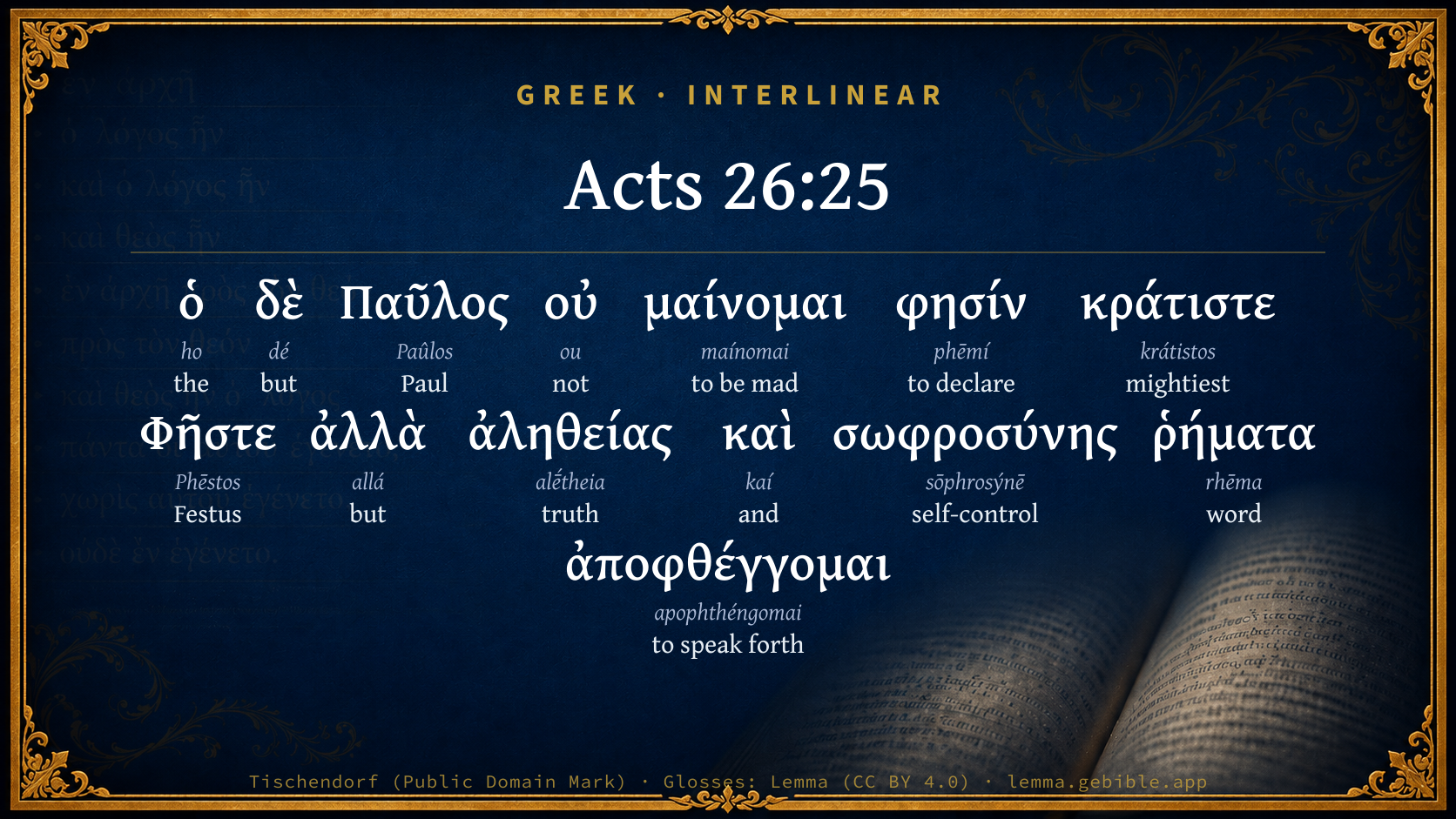
Greek (Tischendorf 8th ed.) Acts 26:25 appears in the Greek New Testament. The text above is from the Tischendorf 8th edition. Each word links to its Strong’s number and a concise gloss. Click any word for its full Thayer’s Greek Lexicon entry.
Download image
Cite this verse

Acts 26:25 (World English Bible). Public Domain. Lemma interlinear Bible study tool, https://lemma.gebible.app/v/acts/26/25.

Show BibTeX & RIS
BibTeX
RIS
English Translation
But he said, "I am not crazy, most excellent Festus, but boldly declare words of truth and reasonableness.
World English Bible · Public Domain
Highlights
  • 1 first appearance in the Greek New Testament
Full analysis ↓
Download a study sheet

One document with this verse’s original text, its word-by-word gloss line, the meaning frame, cross-references with their text, attributed commentary, and full source and license credits — printable, and it pastes into notes with its structure intact.

This verse Autodidact and up

Study sheet (.html) Plain text (.txt)

A passage Seminary Student

Up to 50 verses in one chapter. A passage sheet keeps up to 6 commentary sources and 12 cross-references per verse, in the order this page ranks them, and says so on the sheet whenever that leaves anything out. Ask for a single verse and you get the Autodidact verse sheet above.

Everything on this page stays free to read, with no account — the sheet is a download of what is already on screen, not access to it.

Want to remove ads? Support Godless Engineer
Compare translations 3

The same verse in 3 English versions, stacked beneath the original-language interlinear above. Click any original word for its lexicon entry.

Each is an independent rendering of the whole verse — the interlinear is not word-aligned to these translations.

Highlighted words mark where these versions differ — a whole-verse word diff, not a word-by-word alignment.

  • World English Bible Public Domain
    But he said, "I am not crazy, most excellent Festus, but boldly declare words of truth and reasonableness.
  • King James Version Public Domain
    But he said, I am not mad, most noble Festus; but speak forth the words of truth and soberness.
  • unfoldingWord Literal Text CC BY-SA 4.0
    But Paul says, “I am not insane, most excellent Festus, but I am speaking words of truth and of sanity.

unfoldingWord Literal Text — © unfoldingWord, licensed CC BY-SA 4.0. Word-aligned USFM3 via Door43 (git.door43.org/unfoldingWord/en_ult).

Versions to compare (up to 4)

3 of 4 selected

Show all 19 translations

Every available English version of this verse, each an independent rendering of the whole verse.

  • World English Bible Public Domain
    But he said, "I am not crazy, most excellent Festus, but boldly declare words of truth and reasonableness.
  • Berean Standard Bible Public Domain
    But Paul answered, “I am not insane, most excellent Festus; I am speaking words of truth and sobriety.
  • Majority Standard Bible Public Domain
    But he answered, “I am not insane, most excellent Festus; I am speaking words of truth and sobriety.
  • King James Version Public Domain
    But he said, I am not mad, most noble Festus; but speak forth the words of truth and soberness.
  • American Standard Version (1901) Public Domain
    But Paul saith, I am not mad, most excellent Festus; but speak forth words of truth and soberness.
  • Revised Version (1885) Public Domain
    But Paul saith, I am not mad, most excellent Festus; but speak forth words of truth and soberness.
  • Geneva Bible (1599) Public Domain
    But he said, I am not mad, O noble Festus, but I speake the wordes of trueth and sobernes.
  • Douay-Rheims (1899) Public Domain
    And Paul said: I am not mad, most excellent Festus, but I speak words of truth and soberness.
  • Young's Literal Translation Public Domain
    and he saith, `I am not mad, most noble Festus, but of truth and soberness the sayings I speak forth;
  • Literal Standard Version CC BY-SA 4.0
    And he says, “I am not mad, most noble Festus, but of truth and soberness I speak forth the sayings;
  • Unlocked Literal Bible CC BY-SA 4.0
    But Paul said, “I am not insane, most excellent Festus, but what I am declaring is true and rational.
  • unfoldingWord Literal Text CC BY-SA 4.0
    But Paul says, “I am not insane, most excellent Festus, but I am speaking words of truth and of sanity.
  • Darby Bible Public Domain
    But Paul said, I am not mad, most excellent Festus, but utter words of truth and soberness;
  • World Messianic Bible Public Domain
    But he said, “I am not crazy, most excellent Festus, but boldly declare words of truth and reasonableness.
  • Webster's Bible Public Domain
    But he said, I am not insane, most noble Festus; but speak forth the words of truth and soberness.
  • Free Bible Version CC BY-SA 4.0
    “I'm not mad, Festus your Excellency,” Paul replied. “What I am saying is true and makes sense.
  • Bible in Basic English Public Domain
    Then Paul said, I am not off my head, most noble Festus, but my words are true and wise.
  • Text-Critical English NT CC BY 4.0
    But Paul said, “I am not out of my mind, most excellent Festus, but I am speaking words of truth and good sense.
  • Tyndale New Testament (1534) Public Domain
    And Paul sayde: I am not mad most dere Festus: but speake the wordes of trueth and sobernes.

Literal Standard Version (2020), Covenant Press — licensed CC BY-SA 4.0. Text via the HelloAO Bible API (eBible.org). Unlocked Literal Bible (unfoldingWord) — licensed CC BY-SA 4.0. Text via the HelloAO Bible API (eBible.org). unfoldingWord Literal Text — © unfoldingWord, licensed CC BY-SA 4.0. Word-aligned USFM3 via Door43 (git.door43.org/unfoldingWord/en_ult). Free Bible Version, Dr. Jonathan Gallagher — licensed CC BY-SA 4.0. Text via the HelloAO Bible API (eBible.org).

Word by word

More ways to search: Search by grammar → Find every occurrence → Compare this word →

Practice this passage: Drill this verse → Learn its vocabulary →

σωφροσύνης
sōphrosýnē
G4997
“self-control”
Noun, Genitive, Singular, Feminine
Part of Speech
Noun
Case
Genitive
Number
Singular
Gender
Feminine
Full Thayer's Definition

Origin: from G4998

TDNT: 25:17,1

1. soundness of mind 2. self-control, sobriety
  1. ὁ ho G3588 “the” Article, Nominative, Singular, Masculine
  2. δὲ dé G1161 “but” Conjunction
  3. Παῦλος Paûlos G3972 “Paul” Noun, Nominative, Singular, Masculine
  4. οὐ ou G3756 “not” Particle, Negative
  5. μαίνομαι maínomai G3105 “to be mad” Verb, Present, Middle or Passive deponent, Indicative, 1st person, Singular
  6. φησίν phēmí G5346 “to declare” Verb, Present, Active, Indicative, 3rd person, Singular
  7. κράτιστε krátistos G2903 “mightiest” Adjective, Vocative, Singular, Masculine, Superlative
  8. Φῆστε Phēstos G5347 “Festus” Noun, Vocative, Singular, Masculine
  9. ἀλλὰ allá G235 “but” Conjunction
  10. ἀληθείας alḗtheia G225 “truth” Noun, Genitive, Singular, Feminine
  11. καὶ kaí G2532 “and” Conjunction
  12. ῥήματα rhēma G4487 “word” Noun, Accusative, Plural, Neuter
  13. ἀποφθέγγομαι apophthéngomai G669 “to speak forth” Verb, Present, Middle or Passive deponent, Indicative, 1st person, Singular

About this verse

These counts appear in no published source. They are computed here, from the morphology-tagged text and Lemma’s own curated glosses. What Lemma adds →

14
words
14
distinct lemmas
Acts
section

Notable vocabulary

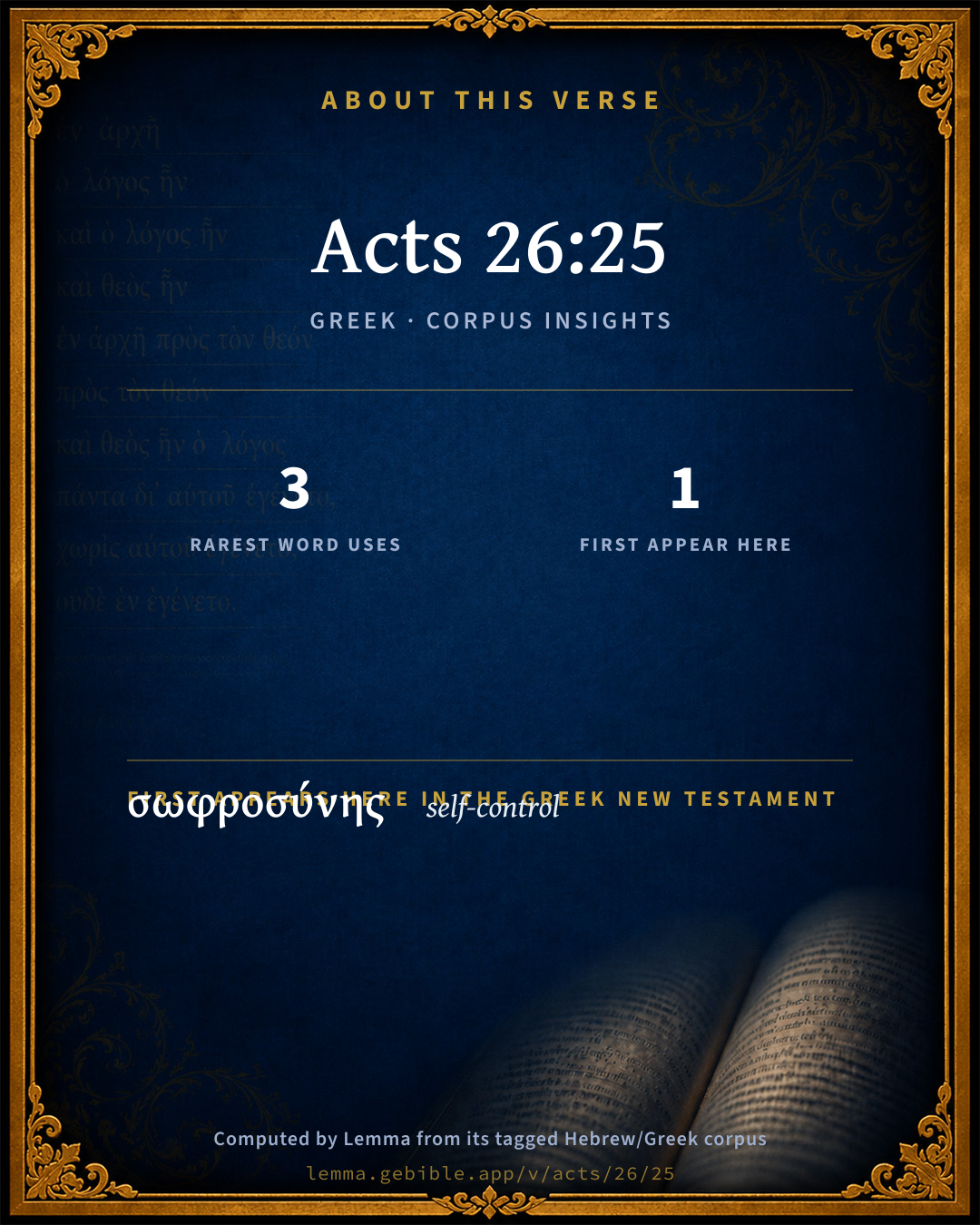
The rarest word here is σωφροσύνης self-control G4997 — appearing just 3 times in the whole Greek New Testament.

First appearance in Scripture

This word makes its first canonical appearance in the Greek New Testament here:

  • σωφροσύνης self-control G4997

Shared distinctive vocabulary

σωφροσύνης self-control G4997 occurs in 3 verses of the Greek New Testament. Also found in:
Cross-references

9

Topical passages linked to Acts 26:25 in the Treasury of Scripture Knowledge — connected by theme and wording, ordered by reader-vote popularity; previews shown in the World English Bible.

  • Acts 23:26 "Claudius Lysias to the most excellent governor Felix: Greetings.
  • Titus 1:9 holding to the faithful word which is according to the teaching, that he may be able to exhort in the sound doctrine, and to convict those who contradict him.
  • Titus 2:7–8 in all things showing yourself an example of good works; in your teaching showing integrity, seriousness, incorruptibility,
  • Luke 1:3 it seemed good to me also, having traced the course of all things accurately from the first, to write to you in order, most excellent Theophilus;
  • John 8:49 Jesus answered, "I don't have a demon, but I honor my Father, and you dishonor me.
  • Acts 24:3 we accept it in all ways and in all places, most excellent Felix, with all thankfulness.
  • 1 Peter 2:21–23 For to this you were called, because Christ also suffered for us, leaving you an example, that you should follow his steps,
  • 1 Peter 3:9 not rendering evil for evil, or reviling for reviling; but instead blessing; knowing that to this were you called, that you may inherit a blessing.
  • 1 Peter 3:15 But sanctify the Lord God in your hearts; and always be ready to give an answer to everyone who asks you a reason concerning the hope that is in you, with humility and fear:

Cross-references courtesy of OpenBible.info (CC BY 4.0).

Commentary

Notes on Acts 26:25 from classic Christian and Jewish commentators (each source and its license shown beneath its notes). The classic Christian expositions comment on the surrounding passage and are grouped to its opening verse, so a note may address several verses; the Jewish commentaries on the Tanakh (Rashi and others) are per-verse, so they appear only where the commentator wrote on this verse.

Lemma curates 59 commentaries, every one of them public domain or Creative Commons licensed, each selected and text-cleaned for this edition rather than reprinted as found. About our sources →

Joseph Benson's Commentary

Act 26:25-29. But he said — Calmly, and with a perfect command of himself, not in the least provoked by such an invidious imputation; I am not mad, most noble Festus — A title properly belonging to a Roman propretor. How inexpressibly beautiful is this reply! How strong! yet, how decent and respectful! Madmen seldom call men by their names and titles of honour. Thus, also, Paul refutes the charge. But utter the words of truth — Confirmed in the next verse; and soberness — The very reverse of madness. And both these remain, even when the men of God act with the utmost vehemence. For the king knoweth of these things — Is not an entire stranger to them. Paul, having refuted Festus, pursues his purpose, returning naturally, and as it were step by step, from him to Agrippa. Before whom also I speak freely — Imboldened by his permission, and assured of his candour. For I am persuaded that none of these things — Of which I have been speaking; are entirely hidden from him — No, not what I have related concerning my conversion to Christianity. Agrippa could not but have heard of it, having been so long conversant among the Jews. For this thing was not done in a corner — He seems to refer not merely to one particular fact, such as his conversion and commission to preach the gospel, but to include the other great facts of Christianity; and particularly the death and resurrection of Christ, and the miraculous powers conferred on his disciples, which were all matters open and notorious, of the truth of which thousands had opportunity of being certainly and thoroughly informed. King Agrippa, believest thou the prophets? — He that believes these, believes Paul, yea, and Christ. The apostle now comes close to his heart. What did Agrippa feel when he heard this? I know that thou believest — Them to be written by divine inspiration, and art aware of the weight of those arguments which are derived from the authority of their testimony. Paul, it seems, knew Agrippa to be of the sect of the Pharisees: for his father, being a zealous Jew, had educated him in the Jewish religion, according to the strictest form. Here Paul lays so fast hold on the king, that he can scarcely make any resistance. Then Agrippa said unto Paul, Almost thou persuadest me to be a Christian — Paul’s doctrine, concerning Jesus of Nazareth, appeared to Agrippa so conformable to the things written concerning the Messiah, by Moses and the prophets; and his testimony concerning the appearing of Jesus to him by the way, was rendered so probable by the total alteration of his sentiments and conduct, that Agrippa declared he was almost persuaded of the truth of the things which Paul affirmed concerning Jesus, and therefore to become a Christian. The meaning of his words is not, Thou persuadest me to be almost a Christian, or, to become an almost Christian; but, as it is here expressed, Thou almost persuadest me to be a Christian, a true Christian, that is, really to embrace the religion of Christ. See here, Festus, altogether a heathen; Paul, altogether a Christian; Agrippa, halting between both. Poor Agrippa! But almost persuaded! So near the mark, and yet to fall short! Another step, and thou art within the veil. Reader, stop not with Agrippa; but go on with Paul. And Paul — Powerfully struck with so remarkable an acknowledgment, said — With great fervency of spirit, and yet with perfect decency; I would to God that not only thou, &c. — Agrippa had spoken of being a Christian, as a thing wholly in his power. Paul gently corrects his mistake; intimating that to be a Christian is the gift and the work of God; but also all that hear me this day — It was modesty in Paul not to apply directly to them all; yet he looks upon them and observes them; were both almost and altogether such as I am — Christians indeed; full of righteousness, peace, and joy in the Holy Ghost. He speaks from a full sense of his own happiness, and an overflowing love to all. Except these bonds — For my afflictions I am willing to bear myself, till Providence shall release me from them, without desiring that any others should share with me in them. He wishes that they might all be happy Christians as he was, but not persecuted Christians; that they might taste as much as he did of the blessings that attended Christianity, but not so much of its crosses; that they might be in bonds to Christ, but not in bonds for Christ. Nothing surely could be said more tenderly, nor with better decorum.

Joseph Benson's Commentary on the Old and New Testaments (1811–1818) — public domain. Text from a community e-Sword module.

Bengel's Gnomon

Johann Albrecht Bengel

Act 26:25. Κράτιστε φῆστε, most noble Festus) Madmen do not use names and terms of respect. Thus also Paul refutes Festus.—ἀληθείας καὶ σωφροσὐνης, of truth and soberness) “Soberness” is opposed to madness: “truth” is confirmed in the following verse. Both remain still, even when men of GOD act with the greatest vehemence.—ἀποφθέγγομαι, I speak forth) A suitable word.

Bengel's Gnomon of the New Testament — English translation (T&T Clark, Edinburgh, 1860) — public domain. Text from a community e-Sword module.

Meyer's Critical & Exegetical Commentary

Heinrich August Wilhelm Meyer

Act_26:25. Ὁ δέ] μετὰ ἐπιεικείας ἀποκρινόμενος, Chrysostom.

ἀληθείας κ. σωφροσ. ῥήματα] words, to which truth and intelligence (sound discretion) belong. ἀλήθεια may doubtless accompany enthusiastic utterance, but it is a characteristic opposed to madness. For passages in the classics where σωφροσύνη is opposed to μανία, see Elsner and Raphel. Plat. Prot. p. 323 B: ὃ ἐκεῖ σωφροσύνην ἡγοῦντο εἶναι τἀληθῆ λέγειν, ἐνταῦθα μανίαν. Comp. also Luk_8:35; 2Co_5:13.

ἀποφθέγγομαι] aptum verbum, Bengel. See on Act_2:4.

Meyer — Critical and Exegetical Commentary on the New Testament — English translation by Peter Christie, edited by Frederick Crombie (T&T Clark, 1880) — public domain. Text from a community e-Sword module.

Expositor's Greek Testament

ed. W. Robertson Nicoll

Act 26:25 . Οὐ μαίνομαι κ . Φ .: whatever may have been the sense in which Festus addressed Paul, there is no doubt as to the courtesy of the Apostle’s answer, μετὰ ἐπιεικείας ἀποκρινόμενος , Chrys. κράτιστε : “most excellent,” R.V., see above, Act 1:1 . ἀληθ . καὶ σωφροσ .: veritas not veracitas , objective truth; no suspicion had been raised against St. Paul’s truthfulness of character ( cf. Joh 18:37 ); as our Lord stood before Pilate as a witness for the truth, so His Apostle stands face to face with a Roman sceptic as a witness to the existence of a world of real existences and not of mere shadows and unrealities (Bethge, p. 294). σωφρ .: the opposite of madness, cf. Plato, Protag. , 323 [404] (Xen., Mem. , i., 1, 16), ὃ ἐκεῖ σωφροσύνην ἡγοῦντο εἶναι τἀληθῆ λέγειν , ἐνταῦθα μανίαν . The two nouns are only found here in St. Luke’s writings, but cf. σωφρονεῖν , Luk 8:35 , Rom 12:3 , 2Co 5:13 ; cf. ῥήματα ζωῆς , chap. Act 5:20 . ἀποφθ ., cf. Act 2:4 ; Act 2:14 , of the Pentecostal utterances, and of the solemn utterances of St. Peter; “aptum verbum,” Bengel. St. Paul was speaking with boldness like St. Peter, and under the same divine inspiration; in LXX of the utterances of the prophets, cf. 1Ch 25:1 , of philosophers, and of oracular responses; like the Latin profari and pronuntiare , see above on Act 2:4 . and Grimm-Thayer, sub v.

[404] Codex Vaticanus (sæc. iv.), published in photographic facsimile in 1889 under the care of the Abbate Cozza-Luzi.

The Expositor's Greek Testament, edited by W. Robertson Nicoll (1897–1910) — public domain. Text from a community e-Sword module.

Jamieson, Fausset & Brown

Robert Jamieson, A. R. Fausset & David Brown

I am not mad, most noble Festus, but, &c.--Can anything surpass this reply, for readiness, self-possession, calm dignity? Every word of it refuted the rude charge, though Festus, probably, did not intend to hurt the prisoner's feelings.

Jamieson, Fausset & Brown — Commentary Critical and Explanatory on the Whole Bible (1871) — public domain (CC PDM 1.0). Text via the HelloAO Bible API.

Adam Clarke's Commentary

Verse 25. I am not mad, most noble Festus] This most sensible, appropriate, and modest answer, was the fullest proof he could give of his sound sense and discretion. The title, κρατιστε, most noble, or most excellent, which he gives to Festus, shows at once that he was far above indulging any sentiment of anger or displeasure at Festus, though he had called him a madman; and it shows farther that, with the strictest conscientiousness, even an apostle may give titles of respect to men in power, which taken literally, imply much more than the persons deserve to whom they are applied. κρατιστος, which implies most excellent, was merely a title which belonged to the office of Festus. St. Paul hereby acknowledges him as the governor; while, perhaps, moral excellence of any kind could with no propriety be attributed to him.

Speak forth the words of truth and soberness.] αληθειας και σωφροσυνης, Words of truth and of mental soundness. The very terms used by the apostle would at once convince Festus that he was mistaken. The σωφροσυνη of the apostle was elegantly opposed to the μανια of the governor: the one signifying mental derangement, the other mental sanity. Never was an answer, on the spur of the moment, more happily conceived.

Adam Clarke's Commentary on the Bible (1810–1826) — public domain. Text from a community e-Sword/MySword module.

John Calvin's Commentaries

25. I am not mad. Paul is not angry, neither doth he sharply reprehend Festus for his blasphemous speech; yea, he speaketh unto him with great submission. For it was no place for reprehension, and it became him to pardon the ignorance of the man, seeing he did not set himself face to face against God. Also, he had respect unto his person [office]. For though he were unworthy of honor, yet was he in authority. And yet for all that he doth not therefore give place to his blasphemy, but he defendeth the glory of the word of God. Whereby we do also see, that not caring for himself, he did only take thought for his doctrine. For he doth not vaunt of his wit; he doth not labor in defense of his wisdom; but he is content with this defense alone, that he teacheth nothing but that which is true and sober.

Furthermore, [the] truth is set against all manner [of] fallacies and fraud: sobriety against all manner [of] frivolous speculations and thorny subtilties, which are only seeds of contention. Paul doth, indeed, refute Festus’ error; yet we may gather by this, which is the best manner of teaching, to wit, that which is not only clean from all fallacies and deceit, but also doth not make the minds of men drunk with vain questions, and doth not nourish foolish curiosity, nor an intemperate desire to know more than is meet, but is moderate and good for sound edification.

John Calvin's Commentaries (1540-1563) — public domain. Text from the Calvin Translation Society English edition (1840s-50s) via the Christian Classics Ethereal Library (ccel.org). Calvin's coverage is partial (roughly two-thirds of the Bible); uncommented books and verses are honest gaps, never fabricated. The 19th-century editor's footnotes and remarks are omitted so the notes are faithfully Calvin's own voice.

Ellicott's Commentary for English Readers

(25) I am not mad, most noble Festus.—There is something characteristic in the union of a calm protest with the courtesy which gives to rulers the honour which is their due. Comp. the use of the same word by Tertullus (Act_24:3). The painful experience of Act_23:3 had, we may well believe, taught the Apostle to control his natural impulses, and to keep watch over his lips, so that no unguarded utterance might escape from them.

The words of truth and soberness.—The latter word was one of the favourite terms of Greek ethical writers, as having a higher meaning than the “temperance” of Act_24:25, to express the perfect harmony of impulses and reason (Aristot. Eth. Nicom. iii. 10). Here it is contrasted with the “madness” of which Festus had spoken, looking, as he did, on the Apostle as an enthusiastic dreamer. There was doubtless a deep-lying enthusiasm in his character, but it was an enthusiasm which had its root not in madness, but in truth.

A Bible Commentary for English Readers, edited by Charles John Ellicott (1878–1897) — public domain. Text from a community e-Sword module.

The Cambridge Bible for Schools and Colleges

gen. ed. J. J. S. Perowne

25. most noble [R. V. excellent] Festus] The same title of respect which is given to Felix (Act_23:26, Act_24:3). As St Chrysostom remarks the Apostle now answers with gentleness, not as to the high priest (Act_23:3).

soberness] The word, in classical Greek, is the opposite to that “madness” unto which Festus had said Paul was turned.

The Cambridge Bible for Schools and Colleges (gen. ed. J. J. S. Perowne; Cambridge University Press, 1878–1918) — public domain. Text from a community e-Sword module.

John Gill's Exposition

For the king knoweth of these things,.... Something of them, of the sufferings and resurrection of the Messiah, and of his showing light to Jews and Gentiles, as they are spoken of by Moses and the prophets, whose writings Agrippa was conversant with, and of these things as fulfilled in Jesus of Nazareth; at least he had heard the report of them, how that they were said to be accomplished in him.

Before whom also I speak freely; because of the knowledge he had of these things:

for I am persuaded that none of these things are hidden from him; as that Moses and the prophets have foretold then, and that they have had their fulfilment in Jesus;

for this thing was not done in a corner: the ministry of Jesus was, public, his miracles were done openly, his suffering the death of the cross under Pontius Pilate was generally known, and his resurrection from the dead was a well attested fact, and the ministration of his Gospel to Jews and Gentiles was notorious. The Arabic and Ethiopic versions refer this to Paul's words and actions, that what he had said and done were not private but public, and of which Agrippa had had, by one means or another, a full account; but the other sense is best.

John Gill's Exposition of the Whole Bible (1746–1763) — public domain (CC PDM 1.0). Text via the HelloAO Bible API.

Trapp's Complete Commentary

John Trapp

25 But he said, I am not mad, most noble Festus; but speak forth the words of truth and soberness.

Ver. 25. I am not mad] Paul rather pitieth his ignorance than blameth his blasphemy, and allegeth his own words for a proof of his non-madness; like as Sophocles produced a tragedy he had recently made, that was full of art and wit, when his sons would have begged him for a dotard. These real apologies are most powerful; when thus managed, especially, with "meekness of wisdom."

John Trapp, A Commentary or Exposition upon All the Books of the Old and New Testament (1647–1656) — public domain. Text from a community e-Sword module.

Albert Barnes' Notes on the Bible

I am not mad - I am not deranged. There are few more happy turns than what Paul gives to this accusation of Festus. He might have appealed to the course of his argument; he might have dwelt on the importance of the subject, and continued to reason; but he makes an appeal at once to Agrippa, and brings him in for a witness that he was not deranged. This would be far more likely to make an impression on the mind of Festus than anything that Paul could say in self-defense. The same reply, “I am not mad,” can be made by all Christians to the charge of derangement which the world brings against them. They have come, like the prodigal son Luk 15:17, to their right mind; and by beginning to act as if there were a God and Saviour, as if they were to die, as if there were a boundless eternity before them, they are conducting according to the dictates of reason. And as Paul appealed to Agrippa, who was not a Christian, for the reasonableness and soberness of his own views and conduct, so may all Christians appeal to sinners themselves as witnesses that they are acting as immortal beings should act. All people know that if there is an eternity, it is right to prepare for it; if there is a God, it is proper to serve him; if a Saviour died for us, we should love him; if a hell, we should avoid it; if a heaven, we should seek it. And even when they charge us with folly and derangement, we may turn at once upon them, and appeal to their own consciences, and ask them if all our anxieties, and prayers, and efforts, and self-denials are not right? One of the best ways of convicting sinners is to appeal to them just as Paul did to Agrippa. When so appealed to, they will usually acknowledge the force of the appeal, and will admit that the solicitude of Christians for their salvation is according to the dictates of reason.

Most noble Festus - This was the usual title of the Roman governor. Compare Act 24:3.

Of truth - In accordance with the predictions of Moses and the prophets, and the facts which have occurred in the death and resurrection of the Messiah. In proof of this he appeals to Agrippa, Act 26:26-27. Truth here stands opposed to delusion, imposture, and fraud.

And soberness - Soberness σωφροσύνη sōphrosunē, wisdom) stands opposed here to madness or derangement, and denotes “sanity of mind.” The words which I speak are those of a sane man, conscious of what he is saying, and impressed with its truth. They were the words, also, of a man who, under the charge of derangement, evinced the most perfect self-possession and command of his feelings, and who uttered sentiments deep, impressive, and worthy the attention of all mankind.

Albert Barnes' Notes on the Bible (1834–1885) — public domain. Text from a community e-Sword/MySword module.

Matthew Poole's English Annotations

St. Paul with all meekness makes his reply to the governer, and not taking notice of his sharp censuring of him, returns an answer in most respectful terms unto him; as his blessed Master, who, when he was reviled, reviled not again, 1Pe 2:23.

Soberness, in contradiction to madness; modestly waiving the reflection, and denying the charge Festus had laid upon him.

Matthew Poole's English Annotations on the Holy Bible (1683–1685) — public domain. Text from a community e-Sword/MySword module.

Whedon's Commentary on the Bible

Daniel D. Whedon

25. Most noble—His civil title.

Truth—In itself.

Soberness—Sanity in the individual. A reply at once most respectful and most firm.

Daniel D. Whedon (gen. ed.), Commentary on the Old and New Testaments (1874–1909) — public domain. Text from a community e-Sword module.

The Pulpit Commentary

Paul saith for he said, A.V. and T.R.; excellent for noble, A.V.; words for the words, A.V.. Most excellent (kratiste). It appears to be the proper title to give the procurator. (see Act_23:26 Act_24:3) St. Luke also applies it to Theophilus. (Luk_1:3) In classical Greek oiJ kratistoi are the aristocracy. Soberness (swfrosunh); sound or sober mindedness; just the opposite of the mania of which he was accused. See the use of swfronein Mar_5:15; Luk_8:35; 2Co_5:13, etc. and of swfronizein swfrwnismov swfrwn, etc. So also in Plato, swfrwsunh is opposed to mania.

The Pulpit Commentary (1880–1919), ed. H.D.M. Spence-Jones & Joseph S. Exell — public domain. Text from a community e-Sword module.

John Wesley's Explanatory Notes

I am not mad, most excellent Festus - The style properly belonging to a Roman propretor. How inexpressibly beautiful is this reply! How strong! yet how decent and respectful! Mad men seldom call men by their names, and titles of honour. Thus also St. Paul refutes the charge. But utter the words of truth (confirmed in the next verse) and sobriety - The very reverse of madness. And both these remain, even when the men of God act with the utmost vehemence.

John Wesley, Explanatory Notes Upon the Whole Bible (1754–1765) — public domain. Text via the GEBible commentary corpus.

Godbey's Commentary on the New Testament

William B. Godbey

25. “But,” says he, “I am not mad, most noble Festus, but speak the words of truth and soberness.” Well could Paul address him “most noble Festus.” His deportment in the Pauline trial, appeal and transportation is irreproachable. Though heathen, he was certainly a man having sterling qualities of head and heart. Paul now addresses King Agrippa in person, as he is his brother in the Jewish church; he is sanguinely hopeful, by proving to him clearly by Moses and the prophets that Jesus is the Christ, of converting him to Christianity.

William B. Godbey, Commentary on the New Testament (1896–1900) — public domain. Text from a community e-Sword module.

McGarvey & Pendleton's Commentaries

J. W. McGarvey

25. Paul saw at once, from the tone and manner of Festus, as well as from the admission of his great learning, that the charge of insanity was not intended as an insult; but that it was the sudden outburst of a conviction which had just seized the mind of the perplexed and astonished governor. His answer, therefore, was most respectful. (25) " But he said, I am not mad, most noble Festus, but speak forth words of truth and soberness. " He saw, however, that Festus was beyond the reach of conviction; for a man who could see in the foregoing portion of this speech only the ravings of a madman, could not easily be reached by the argument, or touched by the pathos of the gospel.

J. W. McGarvey (with Philip Y. Pendleton), Commentaries on the New Testament (The Fourfold Gospel, 1914; Acts; and the epistles) — public domain. Text from a community e-Sword/MySword module.

Cambridge Greek Testament for Schools and Colleges

25. ὁ δὲ Παῦλος with אABE. Vulg. ‘et Paulus.’

25. κράτιστε, most excellent. On this title cf. above, Act 23:26, Act 24:3. St Chrysostom remarks here that the Apostle now answers with gentleness, not as to the high-priest (Act 23:3).

σωφροσύνης, soberness. In classical Greek the word is the exact opposite of that μανία unto which Festus had just said St Paul was turned.

Cambridge Greek Testament for Schools and Colleges (Cambridge University Press, 1896; 21 vols, various authors incl. Carr, Maclear, Plummer, Farrar, Lumby, Moule, M. R. James, Simcox) — public domain. Text from a community e-Sword module.

Alford’s Greek Testament

Henry Alford

25.] ἀλήθεια may be spoken warmly and enthusiastically, but cannot be predicated of a madman’s words: σωφροσύνη) is directly opposed to μανία. So Xen. Mem. i. 16, recounting the subjects of Socrates’ discourses, τί δίκαιον, τί ἄδικον· τί σωφροσύνη, τί μανία· τί ἀνδρία, τί δειλία. The expression ἀληθείας &c. ῥήματα, though of course in sense = ῥήματα ἀληθῆ, &c., yet has a distinctive force of its own, and is never to be confounded with, or supposed to be put by a Hebraism for the other. Such forms occur in classic as well as Hellenistic writers, and indeed in all languages: the idea expressed by them being, the derivation of the quality predicated, from its source:—so here, words (not merely true and sober, but) of truth and soberness,—springing from, and indicative of, subjective truth and soberness.

Henry Alford, The Greek Testament (1849–1861) — public domain. Text from a community e-Sword module.

Vincent's Word Studies in the New Testament

Marvin R. Vincent

Speak forth [αποφθεγγομαι] . See on ch. Act 2:4.

Marvin R. Vincent, Word Studies in the New Testament (1887–1900) — public domain. Text from a community e-Sword/MySword module.

Lesson kit

Teaching starters — assembled from the data on this page, not authored interpretation. Every prompt links to the verse data it draws on. Edit before teaching.

Acts, in the Acts, opens this verse with 14 words (14 distinct Greek lemmas). Its most distinctive word is sōphrosýnē (“self-control”). A historical commentator’s framing appears above. Read the whole chapter for the surrounding context.

Discussion questions

  1. The word sōphrosýnē carries the sense “self-control.” How does it shape the verse?
  2. The word “self-control” first appears here in Scripture. What is being introduced at this debut?
  3. 1 Timothy 2:9 shares the word «self-control» with this verse. How do the two illuminate each other?
  4. These translations render this verse differently; the difference is in the English rendering, not the original. What questions does that raise?
  5. Reading how Joseph Benson's Commentary and Bengel's Gnomon read this verse, where do the two commentators agree and where do they part?

Things to notice

  • 1 word makes its first canonical appearance in Scripture here.
  • These translations choose different wording for 16 words in this verse.
  • 14 distinct Greek lemmas span 14 words in this verse.

Reading settings

Reading text

Shown beneath each verse's original-language words.

Old Testament
Old Testament edition

Read the OT as the Masoretic Hebrew (MT) or the Greek Septuagint (LXX).

English shown for the Greek Septuagint (in the Hebrew ↔ Greek comparison).

Comparing translations? Open the Compare panel on any verse page to stack up to four side by side.