
Acts 23:35

Greek (Tischendorf 8th ed.) Acts 23:35 appears in the Greek New Testament. The text above is from the Tischendorf 8th edition. Each word links to its Strong’s number and a concise gloss. Click any word for its full Thayer’s Greek Lexicon entry.
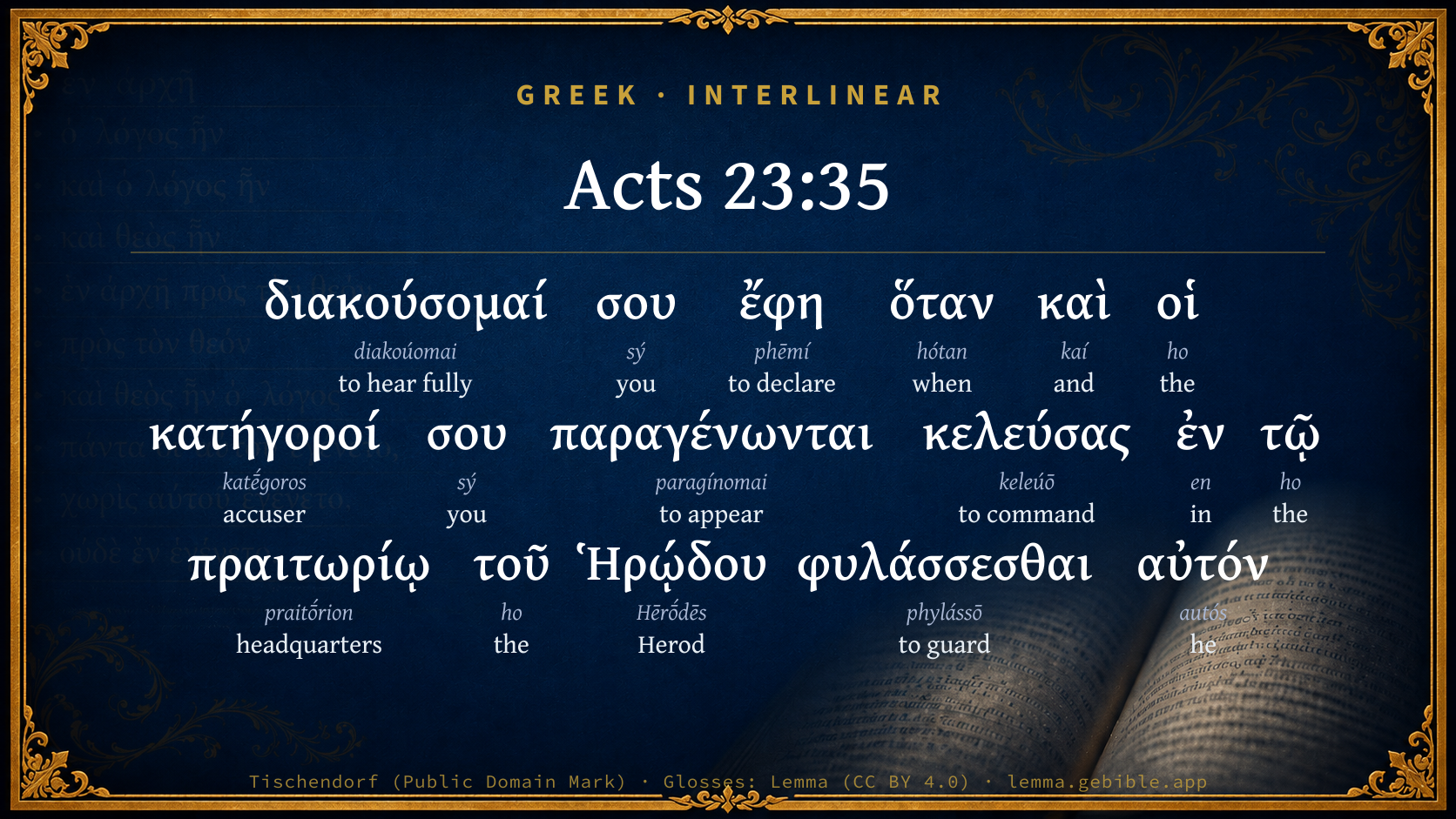
Download image
Cite this verse

Acts 23:35 (World English Bible). Public Domain. Lemma interlinear Bible study tool, https://lemma.gebible.app/v/acts/23/35.

Show BibTeX & RIS
BibTeX
RIS
English Translation
"I will hear you fully when your accusers also arrive." He commanded that he be kept in Herod's palace.
World English Bible · Public Domain
Highlights
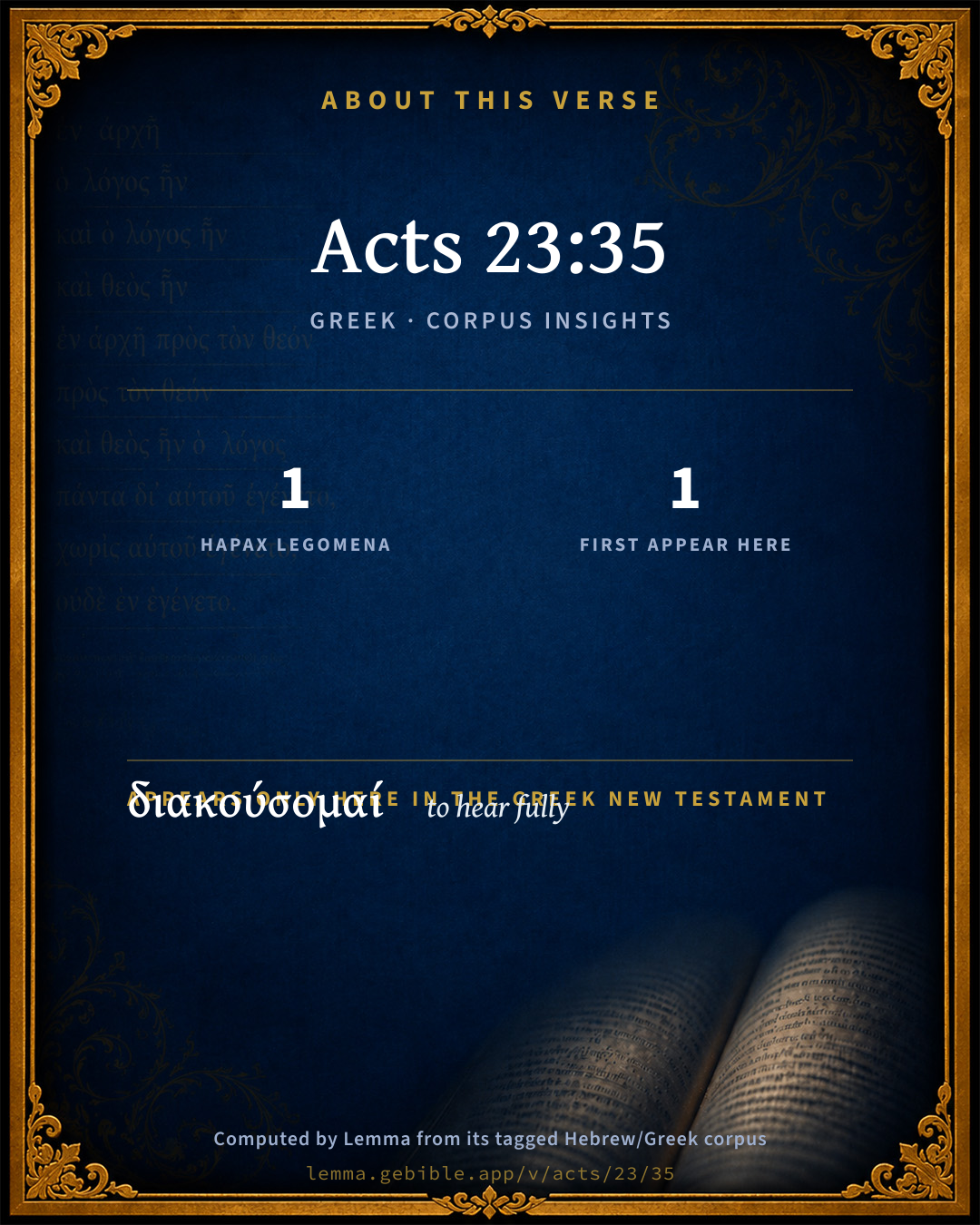
  • 1 hapax legomenon — only here in the Greek New Testament
  • 1 first appearance in the Greek New Testament
Full analysis ↓
Download a study sheet

One document with this verse’s original text, its word-by-word gloss line, the meaning frame, cross-references with their text, attributed commentary, and full source and license credits — printable, and it pastes into notes with its structure intact.

This verse Autodidact and up

Study sheet (.html) Plain text (.txt)

A passage Seminary Student

Up to 50 verses in one chapter. A passage sheet keeps up to 6 commentary sources and 12 cross-references per verse, in the order this page ranks them, and says so on the sheet whenever that leaves anything out. Ask for a single verse and you get the Autodidact verse sheet above.

Everything on this page stays free to read, with no account — the sheet is a download of what is already on screen, not access to it.

Want to remove ads? Support Godless Engineer
Compare translations 3

The same verse in 3 English versions, stacked beneath the original-language interlinear above. Click any original word for its lexicon entry.

Each is an independent rendering of the whole verse — the interlinear is not word-aligned to these translations.

Highlighted words mark where these versions differ — a whole-verse word diff, not a word-by-word alignment.

  • World English Bible Public Domain
    "I will hear you fully when your accusers also arrive." He commanded that he be kept in Herod's palace.
  • King James Version Public Domain
    I will hear thee, said he, when thine accusers are also come. And he commanded him to be kept in Herod's judgment hall.
  • unfoldingWord Literal Text CC BY-SA 4.0
    he said, “I will hear you fully when your accusers may also come,” commanding him to be guarded in the palace of Herod.

unfoldingWord Literal Text — © unfoldingWord, licensed CC BY-SA 4.0. Word-aligned USFM3 via Door43 (git.door43.org/unfoldingWord/en_ult).

Versions to compare (up to 4)

3 of 4 selected

Show all 19 translations

Every available English version of this verse, each an independent rendering of the whole verse.

  • World English Bible Public Domain
    "I will hear you fully when your accusers also arrive." He commanded that he be kept in Herod's palace.
  • Berean Standard Bible Public Domain
    he said, “I will hear your case when your accusers arrive.” Then he ordered that Paul be kept under guard in Herod’s Praetorium.
  • Majority Standard Bible Public Domain
    he said, “I will hear your case when your accusers arrive.” Then he ordered that Paul be kept under guard in Herod’s Praetorium.
  • King James Version Public Domain
    I will hear thee, said he, when thine accusers are also come. And he commanded him to be kept in Herod's judgment hall.
  • American Standard Version (1901) Public Domain
    I will hear thee fully, said he, when thine accusers also are come: and he commanded him to be kept in Herod's palace.
  • Revised Version (1885) Public Domain
    I will hear thy cause, said he, when thine accusers also are come: and he commanded him to be kept in Herod’s palace.
  • Geneva Bible (1599) Public Domain
    I will heare thee, said he, when thine accusers also are come, and commanded him to bee kept in Herods iudgement hall.
  • Douay-Rheims (1899) Public Domain
    I will hear thee, said he, when thy accusers come. And he commanded him to be kept in Herod's judgment hall.
  • Young's Literal Translation Public Domain
    `I will hear thee -- said he -- when thine accusers also may have come;' he also commanded him to be kept in the praetorium of Herod.
  • Literal Standard Version CC BY-SA 4.0
    “I will hear you,” he said, “when your accusers may also have come”; he also commanded him to be kept in the Praetorium of Herod.
  • Unlocked Literal Bible CC BY-SA 4.0
    he said, “I will hear you fully when your accusers come here.” Then he commanded him to be kept in Herod's government headquarters.
  • unfoldingWord Literal Text CC BY-SA 4.0
    he said, “I will hear you fully when your accusers may also come,” commanding him to be guarded in the palace of Herod.
  • Darby Bible Public Domain
    he said, I will hear thee fully when thine accusers also are arrived. And he commanded him to be kept in Herod's praetorium.
  • World Messianic Bible Public Domain
    “I will hear you fully when your accusers also arrive.” He commanded that he be kept in Herod’s palace.
  • Webster's Bible Public Domain
    I will hear thee, said he, when thy accusers also have come. And he commanded him to be kept in Herod's judgment-hall.
  • Free Bible Version CC BY-SA 4.0
    “I will investigate your case when your accusers arrive.” He ordered Paul detained in Herod's palace.
  • Bible in Basic English Public Domain
    I will give hearing to your cause, he said, when those who are against you have come. And he gave orders for him to be kept in Herod's Praetorium.
  • Text-Critical English NT CC BY 4.0
    he said, “I will give yoʋ a hearing once yoʋr accusers have arrived.” Then he gave orders for him to be kept at Herod's headquarters.
  • Tyndale New Testament (1534) Public Domain
    I will heare the (sayde he) when thyne accusars are come also: and commaunded him to be kepte in Herodes pallys.

Literal Standard Version (2020), Covenant Press — licensed CC BY-SA 4.0. Text via the HelloAO Bible API (eBible.org). Unlocked Literal Bible (unfoldingWord) — licensed CC BY-SA 4.0. Text via the HelloAO Bible API (eBible.org). unfoldingWord Literal Text — © unfoldingWord, licensed CC BY-SA 4.0. Word-aligned USFM3 via Door43 (git.door43.org/unfoldingWord/en_ult). Free Bible Version, Dr. Jonathan Gallagher — licensed CC BY-SA 4.0. Text via the HelloAO Bible API (eBible.org).

Word by word

More ways to search: Search by grammar → Find every occurrence → Compare this word →

Practice this passage: Drill this verse → Learn its vocabulary →

διακούσομαί
diakoúomai
G1251
“to hear fully”
Verb, Future, Middle deponent, Indicative, 1st person, Singular
Part of Speech
Verb
Tense
Future
Voice
Middle deponent
Mood
Indicative
Person
1st person
Number
Singular
Full Thayer's Definition

Origin: middle voice from G1223 and G191

TDNT: None

1. to hear one through, hear to the end, hear with care, hear fully
  1. σου sý G4771 “you” Personal pronoun, 2nd person, Genitive, Singular
  2. ἔφη phēmí G5346 “to declare” Verb, Imperfect, Active, Indicative, 3rd person, Singular
  3. ὅταν hótan G3752 “when” Conjunction
  4. καὶ kaí G2532 “and” Conjunction
  5. οἱ ho G3588 “the” Article, Nominative, Plural, Masculine
  6. κατήγοροί katḗgoros G2725 “accuser” Noun, Nominative, Plural, Masculine
  7. σου sý G4771 “you” Personal pronoun, 2nd person, Genitive, Singular
  8. παραγένωνται paragínomai G3854 “to appear” Verb, Aorist, Middle deponent, Subjunctive, 3rd person, Plural
  9. κελεύσας keleúō G2753 “to command” Verb, Aorist, Active, Participle, Nominative, Singular, Masculine
  10. ἐν en G1722 “in” Preposition
  11. τῷ ho G3588 “the” Article, Dative, Singular, Neuter
  12. πραιτωρίῳ praitṓrion G4232 “headquarters” Noun, Dative, Singular, Neuter
  13. τοῦ ho G3588 “the” Article, Genitive, Singular, Masculine
  14. Ἡρῴδου Hērṓdēs G2264 “Herod” Noun, Genitive, Singular, Masculine
  15. φυλάσσεσθαι phylássō G5442 “to guard” Verb, Present, Middle, Infinitive
  16. αὐτόν autós G846 “he” Personal pronoun, Accusative, Singular, Masculine

About this verse

These counts appear in no published source. They are computed here, from the morphology-tagged text and Lemma’s own curated glosses. What Lemma adds →

17
words
14
distinct lemmas
Acts
section

Notable vocabulary

1 hapax legomenon — a word that appears only here in the entire Greek New Testament:

  • διακούσομαί to hear fully G1251

First appearance in Scripture

This word makes its first canonical appearance in the Greek New Testament here:

  • διακούσομαί to hear fully G1251

Shared distinctive vocabulary

κατήγοροί accuser G2725 occurs in 6 verses of the Greek New Testament. Also found in:
Repetition

Words recur within this verse:

Cross-references

12

Topical passages linked to Acts 23:35 in the Treasury of Scripture Knowledge — connected by theme and wording, ordered by reader-vote popularity; previews shown in the World English Bible.

  • Acts 23:30 When I was told that the Jews lay in wait for the man, I sent him to you immediately, charging his accusers also to bring their accusations against him before you. Farewell."
  • Acts 25:16 To whom I answered that it is not the custom of the Romans to give up any man to destruction, before the accused has met the accusers face to face, and has had opportunity to make his defense concerning the matter laid against him.
  • Matthew 27:27 Then the governor's soldiers took Jesus into the Praetorium, and gathered the whole garrison together against him.
  • Matthew 2:1 Now when Jesus was born in Bethlehem of Judea in the days of Herod the king, behold, wise men from the east came to Jerusalem, saying,
  • Matthew 2:3 When Herod the king heard it, he was troubled, and all Jerusalem with him.
  • Matthew 2:16 Then Herod, when he saw that he was mocked by the wise men, was exceedingly angry, and sent out, and killed all the male children who were in Bethlehem and in all the surrounding countryside, from two years old and under, according to the exact time which he had learned from the wise men.
  • John 18:28 They led Jesus therefore from Caiaphas into the Praetorium. It was early, and they themselves didn't enter into the Praetorium, that they might not be defiled, but might eat the Passover.
  • Acts 24:1 After five days, the high priest, Ananias, came down with certain elders and an orator, one Tertullus. They informed the governor against Paul.
  • Acts 24:10 When the governor had beckoned to him to speak, Paul answered, "Because I know that you have been a judge of this nation for many years, I cheerfully make my defense,
  • Acts 24:19 They ought to have been here before you, and to make accusation, if they had anything against me.
  • Acts 24:22 But Felix, having more exact knowledge concerning the Way, deferred them, saying, "When Lysias, the commanding officer, comes down, I will decide your case."
  • Acts 24:24–27 But after some days, Felix came with Drusilla, his wife, who was a Jewess, and sent for Paul, and heard him concerning the faith in Christ Jesus.

Cross-references courtesy of OpenBible.info (CC BY 4.0).

Commentary

Notes on Acts 23:35 from classic Christian and Jewish commentators (each source and its license shown beneath its notes). The classic Christian expositions comment on the surrounding passage and are grouped to its opening verse, so a note may address several verses; the Jewish commentaries on the Tanakh (Rashi and others) are per-verse, so they appear only where the commentator wrote on this verse.

Lemma curates 59 commentaries, every one of them public domain or Creative Commons licensed, each selected and text-cleaned for this edition rather than reprinted as found. About our sources →

Tyndale Open Study Notes

Tyndale Open Resources

23:35 The governor followed the proper protocol and waited for Paul’s accusers to arrive before granting an official hearing. • Herod’s headquarters was Herod the Great’s palace at Caesarea; it subsequently became the residence of the Roman governors of Judea.

Tyndale Open Study Notes — © Tyndale Open Resources, licensed CC BY-SA 4.0. Text via the HelloAO Bible API.

Bengel's Gnomon

Johann Albrecht Bengel

Act 23:35. Διακούσομαι, I will hear) It would have been better to have heard the case as soon as possible.—φυλάσσεσθαι, to be kept) So a time was afforded to Paul in which he could pray and meditate in quiet.

Bengel's Gnomon of the New Testament — English translation (T&T Clark, Edinburgh, 1860) — public domain. Text from a community e-Sword module.

Meyer's Critical & Exegetical Commentary

Heinrich August Wilhelm Meyer

Act_23:35. Διακούσομαι] denotes the full and exact hearing (Xen. Oec. 11. 1, Cyrop. iv. 4. 1; Polyb. iii. 15. 4; Dorvill. ad Char. p. 670), in contrast to what was now held as merely preliminary.

τὸ πραιτώριον τοῦ Ἡρ.] was the name given to the palace which Herod the Great had formerly built for himself, and which now served as the residence of the procurators. From our passage it follows that the place, in which Paul was temporarily kept in custody, was no common prison (Act_5:18), but was within the praetorium. The determination of the manner of the custodia reorum depended on the procurator (L. 1, D. xlviii. 3), and the favourable elogium might have its influence in this respect.

Meyer — Critical and Exegetical Commentary on the New Testament — English translation by Peter Christie, edited by Frederick Crombie (T&T Clark, 1880) — public domain. Text from a community e-Sword module.

Expositor's Greek Testament

ed. W. Robertson Nicoll

Act 23:35 . διακούσομαί σου : “I will hear thy cause,” R.V., the word implies a judicial hearing ( cf. LXX, Deu 1:16 (Job 9:33 )), and so in classical Greek of hearing thoroughly. The word is used of a judicial hearing, Dio Cassius, xxxvi., 53 (36), and Deissmann, Neue Bibelstudien , p. 57, gives examples of similar usages on Egyptian papyri, 2nd to 3rd century A.D. πραιτωρίῳ : “palace,” R.V., Herod’s palace at Cæsarea, where the procurator resided; it was not only a palace but also a fortress, and would contain a guard-room in which Paul would be confined. The word “palace” might well express its meaning in all the passages in which it occurs in the Gospels and Acts (but on Phi 1:13 see Lightfoot, in loco ). The Romans thus appropriated palaces already existing, and formerly dwelt in by kings or princes, cf. Cicero, Verr. , ii., 5, 12, 30, Grimm-Thayer, sub v. , and Lightfoot, On a Fresh Revision of N.T. , p. 49. It seems from the context that the place could not have been far from the quarters occupied by Felix, since Paul could be easily sent for. φυλάσσεσθαι : the kind of custodia depended on the procurator, and no doubt the elogium had its effect; custodia satis levis (Blass).

The Expositor's Greek Testament, edited by W. Robertson Nicoll (1897–1910) — public domain. Text from a community e-Sword module.

Jamieson, Fausset & Brown

Robert Jamieson, A. R. Fausset & David Brown

I will hear thee--The word means, "give thee a full hearing."

to be kept in Herod's judgment hall--"prætorium," the palace built at Cæsarea by Herod, and now occupied by the Roman procurators; in one of the buildings attached to which Paul was ordered to be kept.

Next: Acts Chapter 24

Jamieson, Fausset & Brown — Commentary Critical and Explanatory on the Whole Bible (1871) — public domain (CC PDM 1.0). Text via the HelloAO Bible API.

Adam Clarke's Commentary

Verse 35. I will hear thee] διακουσομαι σου; I will give thee a fair, full, and attentive hearing when thy accusers are come; in whose presence thou shalt be permitted to defend thyself.

In Herod's judgment-hall.] εν τω πραιτωριω, In Herod's praetorium, so called because it was built by Herod the Great. The praetorium was the place where the Roman praetor had his residence; and it is probable that, in or near this place, there was a sort of guard room, where state prisoners were kept. Paul was lodged here till his accusers should arrive.

ON the preceeding chapter many useful observations may be made.

1. Paul, while acting contrary to the Gospel of Christ, pleaded conscience as his guide. Conscience is generally allowed to be the rule of human actions; but it cannot be a right rule, unless it be well informed. While it is unenlightened it may be a guide to the perdition of its professor, and the cause of the ruin of others. That conscience can alone be trusted in which the light of God's Spirit and God's truth dwells. An ill-informed conscience may burn even the saints for God's sake!

2. No circumstance in which a man can be placed can excuse him from showing respect and reverence to the authorities which God, in the course of his providence, has instituted for the benefit of civil or religious society. All such authorities come originally from God, and can never lose any of their rights on account of the persons who are invested with them. An evil can never be of use, and a good may be abused; but it loses not its character, essential qualities, or usefulness, because of this abuse.

3. Paul availed himself of the discordant sentiments of his judges, who had agreed to show him no justice, that he might rid himself out of their hands. To take advantage of the sentiments and dispositions of an audience, without deceiving it, and to raise dissension between the enemies of the truth, is an impotent artifice, when truth itself is not violated and when error is exposed thereby to public view.

4. The Pharisees and Sadducees strove together. God frequently raises up defenders of the principles of truth, even among those who, in practice, are its decided enemies. "Though," says one, "I do not like the truth, yet will I defend it." A man clothed with sovereign authority, vicious in his heart, and immoral in his life, fostered those principles of truth and righteousness by which error was banished from these lands, and pure and undefiled religion established among us for many generations.

5. The providence of God, and his management of the world, are in many respects great mysteries; but, as far as we are individually concerned, all is plain. Paul had the fullest assurance, from the mouth of Christ himself, that he should see Rome; and, consequently, that he should be extricated from all his present difficulties. Why then did he not quietly sit still, when his nephew informed him that forty men had conspired to murder him? Because he knew that God made use of the prudence with which he has endowed man as an agent in that very providence by which he is supported; and that to neglect the natural means of safety with which God provides us is to tempt and dishonour him, and induce him in judgment to use those means against us, which, in his mercy, he had designed for our comfort and salvation. Prudence is well associated even with an apostolical spirit. Every being that God has formed, he designs should accomplish those functions for which he has endowed it with the requisite powers.

6. Claudius Lysias sent Paul to Felix. "In the generality of human events," says one, "we do not often distinguish the designs of God from those of men. The design of Lysias, in preserving Paul from the rage of the Jews, was to render his own conduct free from exception: the design of God was, that he might bring Paul safely to Rome, that he might attack idolatry in its strongest fort, and there establish the Christian faith." God governs the world, and works by proper means; and counterworks evil or sinister devices, so as ultimately to accomplish the purposes of his will, and cause all things to work together for good to them that love Him.

7. Felix acted prudently when he would not even hear St. Paul till he had his accusers face to face. How many false judgments, evil surmises, and uncharitable censures would be avoided, did men always adopt this reasonable plan! Hear either side of a complaint separately, and the evil seems very great: hear both together, and the evil is generally lessened by one half. Audi et alteram partem-hear the other side, says a heathen: remember, if you have an ear for the first complainant, you have one also for the second.

Adam Clarke's Commentary on the Bible (1810–1826) — public domain. Text from a community e-Sword/MySword module.

Ellicott's Commentary for English Readers

(35) I will hear thee.—The Greek verb expresses the idea of a thorough hearing.

He commanded him to be kept in Herod’s judgment hall.—The Greek word is prætorium, a word somewhat elastic in its application, and ranging from a palace to a barrack. “Judgment hall” hardly gives the meaning here. The building had probably been intended by Herod for use as a royal residence, and was now used by the Roman procurator for himself and his troops. The Apostle had there a second experience of the life of a prætorium. At Rome he does not appear to have been in the prætorium, though the circumstances of his imprisonment brought him into contact with the soldiers who were quartered there. (Comp. Notes on Mat_27:27; Php_1:13.)

A Bible Commentary for English Readers, edited by Charles John Ellicott (1878–1897) — public domain. Text from a community e-Sword module.

The Cambridge Bible for Schools and Colleges

gen. ed. J. J. S. Perowne

35. I will hear thee] The verb implies a complete and thorough hearing of a case. “I will give thee a full hearing.” The Rev. Ver. renders “I will hear thy cause.”

when thine accusers are also come] Assuming that they would appear, since they had been bidden to do so by the chief captain, as he had explained in his letter. Of course Lysias had not said a word of this to the Jews when his letter was written, but intended to do so when Paul was safely on the road to Cæsarea.

to be kept in Herod’s judgment hall] The word rendered “judgment hall” is “prætorium,” and may signify either the palace of a prince, the tent of a general, or the barracks of the soldiery. Here it is probably the name of the palace which Herod had erected for himself, and which now was used as the governor’s residence. It seems (from Act_24:24-26) that it was close to the quarters of Felix himself, and that Paul could speedily be sent for. Render “Herod’s palace” (with Rev. Ver.). The verb employed in the sentence only implies that Paul was to be taken care of; he was not kept in close imprisonment. “A Roman and uncondemned” would not be subject to needless indignities, when his accusers were Jews who could make no such claim for consideration. Cf. Act_24:23.

The Cambridge Bible for Schools and Colleges (gen. ed. J. J. S. Perowne; Cambridge University Press, 1878–1918) — public domain. Text from a community e-Sword module.

Trapp's Complete Commentary

John Trapp

35 I will hear thee, said he, when thine accusers are also come. And he commanded him to be kept in Herod’s judgment hall.

Ver. 35. I will hear thee] Pergam te audire, et auditionem absolvam (so Beza rendereth the Greek, διακουσομαι), I will hear thee out, when thine accusers are come. In the mean while I will keep, ους αδιαβλητον, mine ear free. {a} I will not be prepossessed; nor hear one tale till I may hear both. This was well done of Felix, and judge like; qui

" Si statuat aliquid, parte inaudita altera,

Aequum licet statuerit, haud aequus fuerit."

At Rome, the accuser had six hours allotted him to accuse; the guilty or defendant had nine hours to make his answer. This Felix knew full well.

{a} καθαρον ους φυλαττω και αδιαβλητον, said Alexander.

John Trapp, A Commentary or Exposition upon All the Books of the Old and New Testament (1647–1656) — public domain. Text from a community e-Sword module.

Albert Barnes' Notes on the Bible

In Herod’s judgment hall - Greek: in the praetorium of Herod. The word used here denoted formerly “the tent of the Roman praetor”; and since that was the place where justice was administered, it came to be applied to “halls (courts) of justice.” This had been raised probably by Herod the Great as his palace, or as a place for administering justice. It is probable, also, that prisons, or places of security, would be attached to such places.

Albert Barnes' Notes on the Bible (1834–1885) — public domain. Text from a community e-Sword/MySword module.

Haydock's Catholic Bible Commentary

This was a palace erected by Herod the Great; in which the governors had taken up their habitation. (Bible de Vence)

George Leo Haydock (1774–1849), Haydock's Catholic Family Bible and Commentary, 1859 edition — public domain. Excludes Psalms (Douay-Rheims chapter numbering differs from Protestant) and Deuterocanonical books (Catholic canon only).

Matthew Poole's English Annotations

I will hear thee thoroughly, the whole matter, as the preposition δια, here used, does import; and as it is commanded unto all judges, Deu 1:16.

When thine accusers are also come; for this the dictate of nature did teach the very heathen, that both parties ought to be heard before anything were determined: Qui aliquid statuerit parte inaudita altera: That whosoever pronounced any sentence before both sides were fully heard, were the sentence never so just, yet the judge was unjust.

Herod’s judgment-hall; a palace where the governors were lodged, built by Herod the Great, when, in honour, or flattery, of Augustus, after he had fortified the city, he caused it to be called Cesarea.

Matthew Poole's English Annotations on the Holy Bible (1683–1685) — public domain. Text from a community e-Sword/MySword module.

Whedon's Commentary on the Bible

Daniel D. Whedon

35. Herod’s judgment hall—Rather, the pretorium of Herod. This was a palace built by Herod, and afterward occupied by the Roman procurators. Such edifices were furnished, like the old mediaeval palaces and baronial castles, with towers for keeping prisoners of state. Paul was, therefore, not confined in an ordinary prison, but resided in the very palace of Felix. The procurator was probably influenced by both Lysias’ pronouncing him innocent, and by his knowledge that the Christians were now a growing religious body. Under this honourable and gentle durance the apostle remained for two years—in a prison and a palace. He resided in the residence of the slayer of the innocents at the birth of Christ.

Daniel D. Whedon (gen. ed.), Commentary on the Old and New Testaments (1874–1909) — public domain. Text from a community e-Sword module.

The Pulpit Commentary

Thy cause for thee, A.V.; also are for are also, A.V.; palace for judgment hall, A.V. I will hear thy cause; diakousomai sou, found only here in the New Testament; but used in the same sense as here for "hearing a cause," insate... Deu_1:16, Diakou kainete, "Hear the causes between your brethren, and judge righteously," A.V.. See wn Job_9:33, Diakou ajnameson ajmfoterwn, "That might lay his hand upon us both," A.V., i.e. judge between us. Palace (ejn tw praitwriw). The praetorium for it is a Latin word was originally the proctor"s tent in a Roman comp. Thence it came to signify the abode of the chief magistrate in a province, or a king"s palace. Herods palace seems to have been a palace originally built by King Herod, and now used, either as the residence of the procurator or, as the mode of speaking rather indicates, for some public office. (For the use of the word praitwrion, Mat_27:27; Joh_18:28, 33 19:9; Php_1:13)

The Pulpit Commentary (1880–1919), ed. H.D.M. Spence-Jones & Joseph S. Exell — public domain. Text from a community e-Sword module.

John Wesley's Explanatory Notes

In Herod's palace - This was a palace and a court built by Herod the Great. Probably some tower belonging to it might be used for a kind of state prison.

John Wesley, Explanatory Notes Upon the Whole Bible (1754–1765) — public domain. Text via the GEBible commentary corpus.

McGarvey & Pendleton's Commentaries

J. W. McGarvey

See notes on verse 31

J. W. McGarvey (with Philip Y. Pendleton), Commentaries on the New Testament (The Fourfold Gospel, 1914; Acts; and the epistles) — public domain. Text from a community e-Sword/MySword module.

Cambridge Greek Testament for Schools and Colleges

35. κελεύσας for ἐκέλευσέ τε with אABE. Vulg. ‘jussitque.’

35. διακούσομαί σου, I will hear thee. The verb implies a full and thorough hearing of a case. ‘I will give thee a fall hearing.’ The Rev. Vers. renders ‘I will hear thy cause.’

ὅταν καὶ οἱ κατήγοροί σου παραγένωνται, when thine accusers are also come; assuming that they would appear, since they had been bidden to do so by the chief captain, as was explained in his letter. Of course Lysias had not said a word of this to the Jews when his letter was written, but intended to do so when Paul was safely on the road to Cæsarea.

ἐν τῷ πραιτωρίῳ τοῦ Ἡρώδου φυλάσσεσθαι, to be kept in Herod’s palace. πραιτώριον may signify either the palace of a prince, the tent of a general, or the barracks of the soldiery. Here it is probably the name of the palace which Herod had erected for himself, and which now was used as the governor’s residence. It seems (from Act 24:24-26) that it was close to the quarters of Felix himself, and that Paul could speedily be sent for. φυλάσσεσθαι only implies that Paul was to be taken care of; he was not kept in close imprisonment. ‘A Roman and uncondemned’ would not be subject to needless indignities, when his accusers were Jews who could make no such claim for consideration. Cf. Act 24:23.

Cambridge Greek Testament for Schools and Colleges (Cambridge University Press, 1896; 21 vols, various authors incl. Carr, Maclear, Plummer, Farrar, Lumby, Moule, M. R. James, Simcox) — public domain. Text from a community e-Sword module.

Alford’s Greek Testament

Henry Alford

35. διακούς.] ‘The expression is in conformity with the Roman law; the rule was, “Qui cum elogio mittuntur, ex integro audiendi sunt.” ’ Hackett.

ἐν τῷ πραιτ. τ. Ἡρ.] The procurator resided in the former palace of Herod the Great. Here Paul was ‘militi traditus’ (Digest. cited by De W.), not in a prison, but in the buildings attached to the palace.

Henry Alford, The Greek Testament (1849–1861) — public domain. Text from a community e-Sword module.

Vincent's Word Studies in the New Testament

Marvin R. Vincent

I will hear thee [διακουσομαι] . Better, as Rev., will hear thy cause; the word meaning "to hear fully [δια] in a judicial sense." The present questioning was merely preliminary.

Herod 's palace. Built by Herod the Great. Judaea being now a Roman province, the palace of its former kings had become the governor 's official residence. It thus appears that Paul was leniently dealt with, and not cast into the common prison.

Marvin R. Vincent, Word Studies in the New Testament (1887–1900) — public domain. Text from a community e-Sword/MySword module.

Lesson kit

Teaching starters — assembled from the data on this page, not authored interpretation. Every prompt links to the verse data it draws on. Edit before teaching.

Acts, in the Acts, opens this verse with 17 words (14 distinct Greek lemmas). Its most distinctive word is diakoúomai (“to hear fully”). A historical commentator’s framing appears above. Read the whole chapter for the surrounding context.

Discussion questions

  1. What does “to hear fully” (diakoúomai) contribute to the verse as a whole?
  2. This verse holds 1 word here found nowhere else in the Greek New Testament. What might the rare word draw attention to?
  3. The word “to hear fully” first appears here in Scripture. What is being introduced at this debut?
  4. John 8:10 shares the word «accuser» with this verse. How do the two illuminate each other?
  5. “the” occurs 3× in this one verse. What is the effect of the repetition?
  6. These translations render this verse differently. What is at stake in choosing one wording over another?
  7. Reading how Tyndale Open Study Notes and Bengel's Gnomon read this verse, where do the two commentators agree and where do they part?

Things to notice

  • 1 word in this verse appears nowhere else in the Greek New Testament.
  • 1 word makes its first canonical appearance in Scripture here.
  • These translations choose different wording for 16 words in this verse.
  • “the” occurs 3× in this single verse.
  • 14 distinct Greek lemmas span 17 words in this verse.

Reading settings

Reading text

Shown beneath each verse's original-language words.

Old Testament
Old Testament edition

Read the OT as the Masoretic Hebrew (MT) or the Greek Septuagint (LXX).

English shown for the Greek Septuagint (in the Hebrew ↔ Greek comparison).

Comparing translations? Open the Compare panel on any verse page to stack up to four side by side.