Acts 23:5

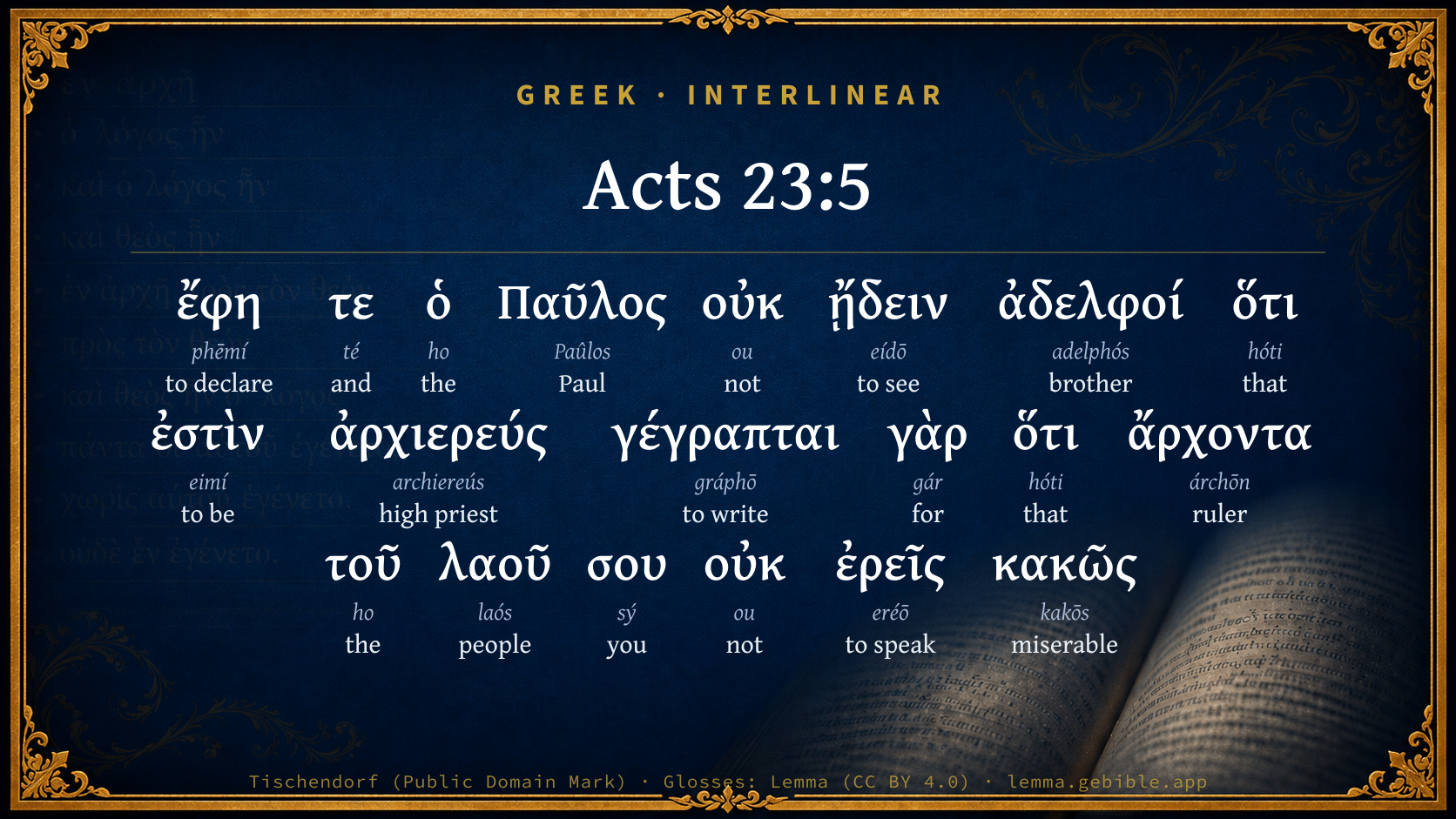
Greek (Tischendorf 8th ed.) Acts 23:5 appears in the Greek New Testament. The text above is from the Tischendorf 8th edition. Each word links to its Strong’s number and a concise gloss. Click any word for its full Thayer’s Greek Lexicon entry.
Download image
Cite this verse

Acts 23:5 (World English Bible). Public Domain. Lemma interlinear Bible study tool, https://lemma.gebible.app/v/acts/23/5.

Show BibTeX & RIS
BibTeX
RIS
English Translation
Paul said, "I didn't know, brothers, that he was high priest. For it is written, 'You shall not speak evil of a ruler of your people.'"
World English Bible · Public Domain
Download a study sheet

One document with this verse’s original text, its word-by-word gloss line, the meaning frame, cross-references with their text, attributed commentary, and full source and license credits — printable, and it pastes into notes with its structure intact.

This verse Autodidact and up

Study sheet (.html) Plain text (.txt)

A passage Seminary Student

Up to 50 verses in one chapter. A passage sheet keeps up to 6 commentary sources and 12 cross-references per verse, in the order this page ranks them, and says so on the sheet whenever that leaves anything out. Ask for a single verse and you get the Autodidact verse sheet above.

Everything on this page stays free to read, with no account — the sheet is a download of what is already on screen, not access to it.

Want to remove ads? Support Godless Engineer
Compare translations 3

The same verse in 3 English versions, stacked beneath the original-language interlinear above. Click any original word for its lexicon entry.

Each is an independent rendering of the whole verse — the interlinear is not word-aligned to these translations.

Highlighted words mark where these versions differ — a whole-verse word diff, not a word-by-word alignment.

  • World English Bible Public Domain
    Paul said, "I didn't know, brothers, that he was high priest. For it is written, 'You shall not speak evil of a ruler of your people.'"
  • King James Version Public Domain
    Then said Paul, I wist not, brethren, that he was the high priest: for it is written, Thou shalt not speak evil of the ruler of thy people.
  • unfoldingWord Literal Text CC BY-SA 4.0
    And Paul said, “I did not know, brothers, that he was the high priest. For it is written, ‘You shall not speak evil of a ruler of your people.’”

unfoldingWord Literal Text — © unfoldingWord, licensed CC BY-SA 4.0. Word-aligned USFM3 via Door43 (git.door43.org/unfoldingWord/en_ult).

Versions to compare (up to 4)

3 of 4 selected

Show all 19 translations

Every available English version of this verse, each an independent rendering of the whole verse.

  • World English Bible Public Domain
    Paul said, "I didn't know, brothers, that he was high priest. For it is written, 'You shall not speak evil of a ruler of your people.'"
  • Berean Standard Bible Public Domain
    “Brothers,” Paul replied, “I was not aware that he was the high priest, for it is written: ‘Do not speak evil about the ruler of your people.’”
  • Majority Standard Bible Public Domain
    “Brothers,” Paul replied, “I was not aware that he was the high priest, for it is written: ‘Do not speak evil about the ruler of your people.’”
  • King James Version Public Domain
    Then said Paul, I wist not, brethren, that he was the high priest: for it is written, Thou shalt not speak evil of the ruler of thy people.
  • American Standard Version (1901) Public Domain
    And Paul said, I knew not, brethren, that he was high priest: for it is written, Thou shalt not speak evil of a ruler of thy people.
  • Revised Version (1885) Public Domain
    And Paul said, I wist not, brethren, that he was high priest: for it is written, Thou shalt not speak evil of a ruler of thy people.
  • Geneva Bible (1599) Public Domain
    Then sayd Paul, I knewe not, brethren, that he was the hie Priest: for it is written, Thou shalt not speake euill of the ruler of thy people.
  • Douay-Rheims (1899) Public Domain
    And Paul said: I knew not, brethren, that he is the high priest. For it is written: Thou shalt not speak evil of the prince of thy people.
  • Young's Literal Translation Public Domain
    and Paul said, `I did not know, brethren, that he is chief priest: for it hath been written, Of the ruler of thy people thou shalt not speak evil;'
  • Literal Standard Version CC BY-SA 4.0
    And Paul said, “I did not know, brothers, that he is chief priest, for it has been written: You will not speak evil of the ruler of your people”;
  • Unlocked Literal Bible CC BY-SA 4.0
    Paul said, “I did not know, brothers, that he was high priest. For it is written, You shall not speak evil of a ruler of your people.”
  • unfoldingWord Literal Text CC BY-SA 4.0
    And Paul said, “I did not know, brothers, that he was the high priest. For it is written, ‘You shall not speak evil of a ruler of your people.’”
  • Darby Bible Public Domain
    And Paul said, I was not conscious, brethren, that he was high priest; for it is written, Thou shalt not speak evilly of the ruler of thy people.
  • World Messianic Bible Public Domain
    Paul said, “I didn’t know, brothers, that he was high priest. For it is written, ‘You shall not speak evil of a ruler of your people.’”
  • Webster's Bible Public Domain
    Then said Paul, I knew not, brethren, that he is the high priest: for it is written, Thou shalt not speak evil of the ruler of thy people.
  • Free Bible Version CC BY-SA 4.0
    “Brothers, I didn't know that he was the high priest,” Paul replied. “As Scriptures say, ‘You must not speak evil of any ruler of your people.’”
  • Bible in Basic English Public Domain
    And Paul said, Brother, I had no idea that he was the high priest: for it has been said, You may not say evil about the ruler of your people.
  • Text-Critical English NT CC BY 4.0
    Paul said, “I did not know, brothers, that he was the high priest. For it is written, ‘Yoʋ shall not speak evil of a ruler of yoʋr people.’ ”
  • Tyndale New Testament (1534) Public Domain
    Then sayd Paul: I wist not brethren that he was the hye preste. For it is written thou shalt not curse the rular of thy people.

Literal Standard Version (2020), Covenant Press — licensed CC BY-SA 4.0. Text via the HelloAO Bible API (eBible.org). Unlocked Literal Bible (unfoldingWord) — licensed CC BY-SA 4.0. Text via the HelloAO Bible API (eBible.org). unfoldingWord Literal Text — © unfoldingWord, licensed CC BY-SA 4.0. Word-aligned USFM3 via Door43 (git.door43.org/unfoldingWord/en_ult). Free Bible Version, Dr. Jonathan Gallagher — licensed CC BY-SA 4.0. Text via the HelloAO Bible API (eBible.org).

Word by word

More ways to search: Search by grammar → Find every occurrence → Compare this word →

Practice this passage: Drill this verse → Learn its vocabulary →

κακῶς
kakōs
G2560
“miserable”
Adverb
Part of Speech
Adverb
Full Thayer's Definition

Origin: from G2556

TDNT: 4:1091,*

1. miserable, to be ill 2. improperly, wrongly 3. to speak ill of, revile, one
  1. ἔφη phēmí G5346 “to declare” Verb, Imperfect, Active, Indicative, 3rd person, Singular
  2. τε té G5037 “and” Particle
  3. ὁ ho G3588 “the” Article, Nominative, Singular, Masculine
  4. Παῦλος Paûlos G3972 “Paul” Noun, Nominative, Singular, Masculine
  5. οὐκ ou G3756 “not” Particle, Negative
  6. ᾔδειν eídō G1492 “to see” Verb, Pluperfect, Active, Indicative, 1st person, Singular
  7. ἀδελφοί adelphós G80 “brother” Noun, Vocative, Plural, Masculine
  8. ὅτι hóti G3754 “that” Conjunction
  9. ἐστὶν eimí G1510 “to be” Verb, Present, Active, Indicative, 3rd person, Singular
  10. ἀρχιερεύς archiereús G749 “high priest” Noun, Nominative, Singular, Masculine
  11. γέγραπται gráphō G1125 “to write” Verb, Perfect, Passive, Indicative, 3rd person, Singular
  12. γὰρ gár G1063 “for” Conjunction
  13. ὅτι hóti G3754 “that” Conjunction
  14. ἄρχοντα árchōn G758 “ruler” Noun, Accusative, Singular, Masculine
  15. τοῦ ho G3588 “the” Article, Genitive, Singular, Masculine
  16. λαοῦ laós G2992 “people” Noun, Genitive, Singular, Masculine
  17. σου sý G4771 “you” Personal pronoun, 2nd person, Genitive, Singular
  18. οὐκ ou G3756 “not” Particle, Negative
  19. ἐρεῖς eréō G2046 “to speak” Verb, Future, Active, Indicative, 2nd person, Singular

About this verse

These counts appear in no published source. They are computed here, from the morphology-tagged text and Lemma’s own curated glosses. What Lemma adds →

20
words
17
distinct lemmas
Acts
section

Notable vocabulary

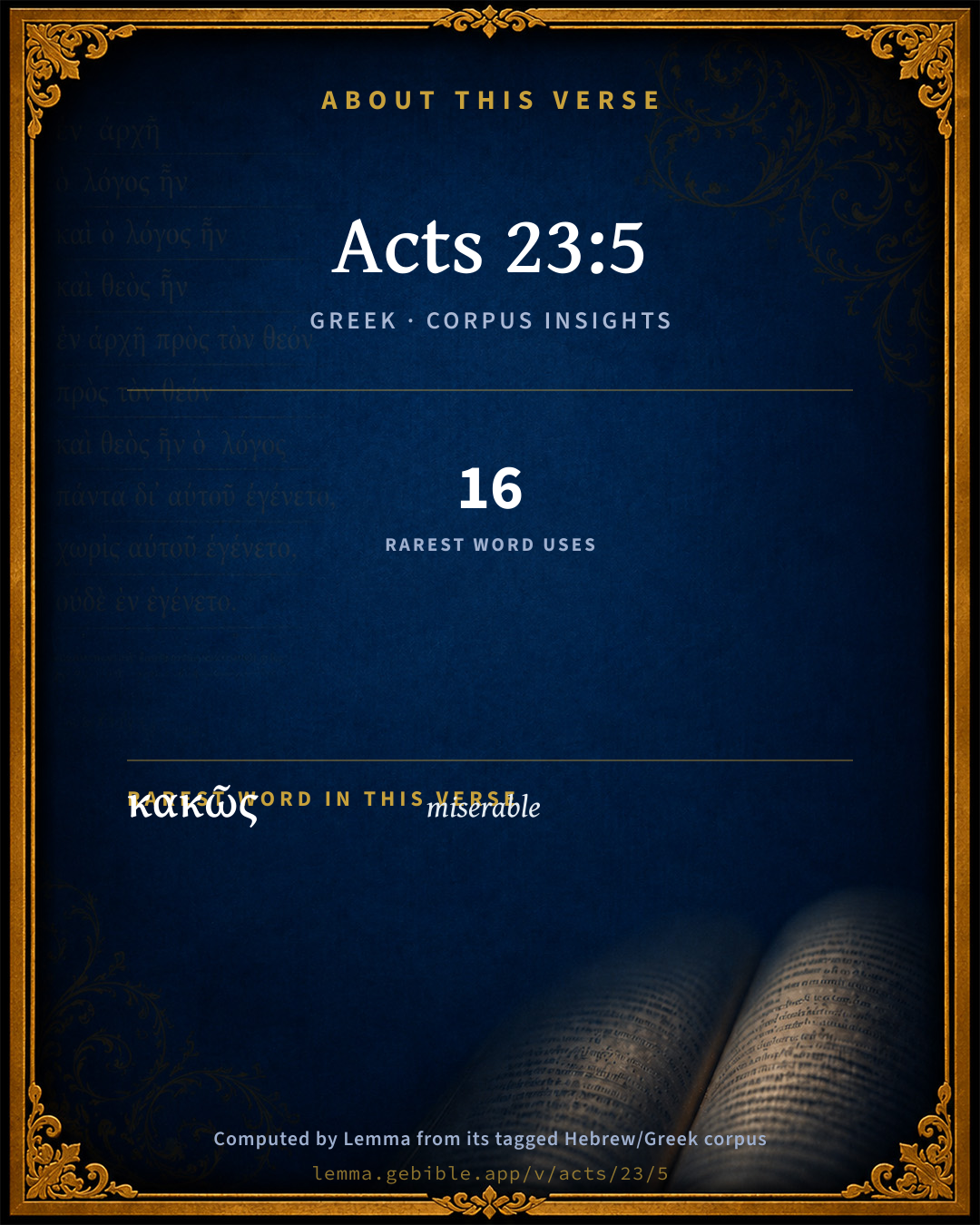
The rarest word here is κακῶς miserable G2560 — appearing just 16 times in the whole Greek New Testament.

Shared distinctive vocabulary

κακῶς miserable G2560 occurs in 16 verses of the Greek New Testament. Also found in:

Repetition

Words recur within this verse:

Cross-references

4

Topical passages linked to Acts 23:5 in the Treasury of Scripture Knowledge — connected by theme and wording, ordered by reader-vote popularity; previews shown in the World English Bible.

  • Exodus 22:28 "You shall not blaspheme God, nor curse a ruler of your people.
  • Ecclesiastes 10:20 Don't curse the king, no, not in your thoughts; And don't curse the rich in your bedchamber: For a bird of the sky may carry your voice, And that which has wings may tell the matter.
  • Jude 1:8–9 Yet in like manner these also in their dreaming defile the flesh, despise authority, and slander celestial beings.
  • 2 Peter 2:10 but chiefly those who walk after the flesh in the lust of defilement, and despise authority. Daring, self-willed, they are not afraid to speak evil of dignitaries;

Cross-references courtesy of OpenBible.info (CC BY 4.0).

Commentary

Notes on Acts 23:5 from classic Christian and Jewish commentators (each source and its license shown beneath its notes). The classic Christian expositions comment on the surrounding passage and are grouped to its opening verse, so a note may address several verses; the Jewish commentaries on the Tanakh (Rashi and others) are per-verse, so they appear only where the commentator wrote on this verse.

Lemma curates 59 commentaries, every one of them public domain or Creative Commons licensed, each selected and text-cleaned for this edition rather than reprinted as found. About our sources →

Tyndale Open Study Notes

Tyndale Open Resources

23:5 Why Paul did not recognize the high priest is not known. • Paul replied by quoting Exod 22:28, acknowledging the respect to which the high priest was entitled by virtue of his office.

Tyndale Open Study Notes — © Tyndale Open Resources, licensed CC BY-SA 4.0. Text via the HelloAO Bible API.

Bengel's Gnomon

Johann Albrecht Bengel

Act 23:5. Οὐκ ᾔδειν, I did not know, or reflect) Paul, although he had been absent for several years, ch. Act 24:17, yet knew the Chief Priest, ch. Act 22:5, inasmuch as he also knew the others, Act 23:6; and if he had not known him, he might still have now known him from the very place in which, without doubt, he was sitting, and from the number of the bystanders: nor was the council (Act 23:1, συνέδριον) of such a tumultuous (hastily-convened) character, that the High Priest did not occupy a distinguished post. Therefore I did not know may be interpreted as a modest form of expression for, it did not come into my mind. So, I know not [= I do not remember], 1Co 1:16. Comp. in the same Epistle, ch. Act 12:2, note (Eph 2:11), and ch. Act 15:34, note; Php 4:15; Luk 9:55; 2Sa 19:22; Lev 5:4. This phrase most appropriately expresses the various ἦθος of the apostle, partly in relation to the bystanders, whom he thus appeased (softened), especially with the addition of the appellation of Brethren, and by quoting the commandment of Moses as to not speaking evil of rulers; partly in relation to Ananias, whose mode of acting and commandment were such as to indicate any one else rather than the High Priest; partly in relation to Paul himself, whom an extraordinary influence (commotio) had elevated in Spirit internally, and after having fulfilled the prompting of that influence, he presently after withdrew himself back again to that ordinary principle which commands not to speak evil of rulers. In a similar way Paul often, under the influence of modesty, judged and spake of those things which he did by Divine direction in such a manner as if they had been done under a mere human impulse. See Rom 15:15; 1Co 9:17-18; 2Co 11:8-9, notes. We glance at the cause of this liberty which the apostle takes in the notes upon 1Co 7:25 (The apostles wrote nothing that was not inspired; but in some cases they had a special command or revelation, in others they drew from their general habit of faith: in all these cases they might vary most freely their modes, according to the particular circumstances, and waive their own rights, and give the preference to others above themselves, or vice versa). Furthermore, from what we have said, it is also clear how Paul could have addressed, in such a way, him whom he knew merely to be sitting as a judge, without violation of the law, which treats universally of rulers.—[γέγραπται, it is written) Exo 22:28. V. g.]

Bengel's Gnomon of the New Testament — English translation (T&T Clark, Edinburgh, 1860) — public domain. Text from a community e-Sword module.

Expositor's Greek Testament

ed. W. Robertson Nicoll

Act 23:5 . οὐκ ᾔδειν : the subject of ἐστιν is not expressed as in A. and R.V., in the Greek it is simply “I wist not that it was the high priest (who spoke)”. If it be said that St. Paul could scarcely have been ignorant that Ananias was high priest, we must bear in mind that not even the high priest wore a distinctive dress when not engaged in actual service (Edersheim, Temple and its Services , p. 67, with reference to this same passage), if we are not prepared to accept the view of Chrysostom and Oecumenius amongst others, that the Apostle, owing to his long absence from Jerusalem, did not know the high priest by sight, or to suppose that his weakness of eyesight might have prevented him from seeing clearly (so Lewin, Plumptre). The interpretation that St. Paul spoke ironically, or by way of protest, as if such behaviour as that of Ananias on his nomination to office by Herod of Chalcis was in itself sufficient to prevent his recognition as high priest, is somewhat out of harmony with the Apostle’s quotation of Scripture in his reply, nor are the attempts to translate οὐκ ᾔδειν as = non agnosco or non reputabam successful. See further Zöckler’s summary of the different views, Apostelgeschichte , 2nd edition, in loco. ἀδελφοί : the word indicates St. Paul’s quick recovery from his moment of just anger to a conciliatory tone. γέγ . γὰρ : in this appeal to the law, St. Paul showed not only his acquaintance with it, but his reverence for it another proof of his wisdom and tact. ἄρχοντα τοῦ λαοῦ σου κ . τ . λ .: LXX, Exo 22:28 , the Apostle apparently only quotes the latter part of the verse; in the Hebrew we have “thou shalt not revile God ( margin , the judges), nor curse a ruler of thy people”. Cf. the ruling principle of the Apostle’s conduct Rom 13:1-7 (1Pe 2:13-17 ).

The Expositor's Greek Testament, edited by W. Robertson Nicoll (1897–1910) — public domain. Text from a community e-Sword module.

Geneva Bible (1599)

Geneva Bible translators

We must willingly and from the heart give honor to Magistrates, although they be tyrants.

Geneva Bible (1599) marginal notes — public domain. Text via Bolls.life.

Jamieson, Fausset & Brown

Robert Jamieson, A. R. Fausset & David Brown

I wist not . . . that he was the high priest--All sorts of explanations of this have been given. The high priesthood was in a state of great confusion and constant change at this time (as appears from JOSEPHUS), and the apostle's long absence from Jerusalem, and perhaps the manner in which he was habited or the seat he occupied, with other circumstances to us unknown, may account for such a speech. But if he was thrown off his guard by an insult which touched him to the quick, "what can surpass the grace with which he recovered his self-possession, and the frankness with which he acknowledged his error? If his conduct in yielding to the momentary impulse was not that of Christ Himself under a similar provocation (Joh 18:22-23), certainly the manner in which he atoned for his fault was Christ-like" [HACKET].

Jamieson, Fausset & Brown — Commentary Critical and Explanatory on the Whole Bible (1871) — public domain (CC PDM 1.0). Text via the HelloAO Bible API.

Adam Clarke's Commentary

Verse 5. I wist not, brethren, that he was the high priest] After all the learned labour that has been spent on this subject, the simple meaning appears plainly to be this:-

St. Paul did not know that Ananias was high priest; he had been long absent from Jerusalem; political changes were frequent; the high priesthood was no longer in succession, and was frequently bought and sold; the Romans put down one high priest, and raised up another, as political reasons dictated. As the person of Ananias might have been wholly unknown to him, as the hearing was very sudden, and there was scarcely any time to consult the formalities of justice, it seems very probable that St. Paul, if he ever had known the person of Ananias, had forgotten him; and as, in a council or meeting of this kind, the presence of the high priest was not indispensably necessary, he did not know that the person who presided was not the sagan, or high priest's deputy, or some other person put in the seat for the time being. I therefore understand the words above in their most obvious and literal sense. He knew not who the person was, and God's Spirit suddenly led him to denounce the Divine displeasure against him.

Thou shalt not speak evil of the ruler of thy people.] If I had known he was the high priest, I should not have publicly pronounced this execration; for respect is due to his person for the sake of his office. I do not see that Paul intimates that he had done any thing through inadvertence; nor does he here confess any fault; he states two facts:-

1. That he did not know him to be the high priest.

2. That such a one, or any ruler of the people, should be reverenced. But he neither recalled or made an apology for his words: he had not committed a trespass, and he did not acknowledge one. We must beware how we attribute either to him in the case before us.

Adam Clarke's Commentary on the Bible (1810–1826) — public domain. Text from a community e-Sword/MySword module.

John Calvin's Commentaries

5. I knew not, brethren. Those who think that this excuse of Paul hath in it no figure, do not well mark the contrary objections wherewith their error is refuted. They say that Paul knew not the high priest, because he had been absent long time; as if he were ignorant that he was chief priest, who is the chief in the council, and hath the uppermost room. Neither was Ananias so base and obscure that Paul was ignorant of his degree. But his words cut off all occasion of disputation, when as he chideth him, because, occupying the place of a judge, under color of the law, he doth, in his rage, that which is contrary to law. Therefore Paul knew what place he had, when he said that he abused his power. Other some invent a more subtle answer, that he spake not here of the mail, but of the office and public person. But, first, the exposition is far fet, [fetched] because, if Paul did reverence the priesthood, he must needs have given some honor to the man which had the same. And now it is not to be thought (forasmuch as the majesty of the priesthood was abolished by the coming of Christ, and that there followed such filthy profanation) that Paul did honor those as he was wont, (as if their perfect and lawful authority did continue) who, under the title of the high priests, did reign as lords without any law or right.

Therefore, subscribing to Augustine, I do not doubt but that this is a taunting excuse. Neither doth that any whit hinder, because plain speech becometh the ministers of the word. For seeing there be two sorts of ironies, one which is covered with subtilty and means to deceive, another which doth so figuratively note out the thing which is in hand, that it doth prick sorer; in this second, there is nothing which doth not well beseem the servants of Christ. Therefore, this is the meaning of the words, Brethren, I acknowledge nothing in this man which belongeth to the priest. Also, he added a testimony of the 22nd chapter of Exodus, (Exodus 22:28) in which place, though Moses speak of judges, yet the sentence is extended properly unto any lawful order. Therefore all dignity, which is appointed for maintenance of civil government, ought to be reverenced and had in honor. For whosoever he be that rebelleth against or resisteth the magistrate, or those who are appointed to rule, and are promoted unto honor, he would have no government. And such desire tendeth to the disturbing of order. Yea, it shaketh and overthroweth all humanity. Therefore Paul purgeth himself of this crime; yet so, that he denieth that Ananias is to be counted a priest of God, who hath corrupted and perverted all the order of the Church.

But here riseth a question, whether we ought not to obey a ruler, though he exercise tyranny? For if that man be not to be deprived of honor which executeth his office amiss, Paul offended in robbing the high priest of his honor. Therefore I answer, that there is some difference between civil magistrates and the prelates of the Church. For though the exploiting [administration] of earthly or civil rule be confused or perverse, yet the Lord will have men to continue still in subjection. But when the spiritual government doth degenerate, the consciences of the godly are at liberty, and set free from obeying unjust authority; especially if the wicked and profane enemies of holiness do falsely pretend the title of priesthood to overthrow the doctrine of salvation, and challenge to themselves such authority, as that they will be thereby equal with God. So it is not only lawful for the faithful at this day to shake off from their shoulders the Pope’s yoke, but they must do it of necessity, seeing they cannot obey his laws unless they forsake God.

John Calvin's Commentaries (1540-1563) — public domain. Text from the Calvin Translation Society English edition (1840s-50s) via the Christian Classics Ethereal Library (ccel.org). Calvin's coverage is partial (roughly two-thirds of the Bible); uncommented books and verses are honest gaps, never fabricated. The 19th-century editor's footnotes and remarks are omitted so the notes are faithfully Calvin's own voice.

Ellicott's Commentary for English Readers

(5) I wist not, brethren, that he was the high priest.—These words admit of three different explanations:—(1) We may take them as stating that St. Paul, either from defective sight (see Notes on Act_9:18; Act_14:9), or because the high priest was not sitting as president of the Sanhedrin, literally did not know who it was that had given the order, and thought it came from one of the subordinate members of the council. (2) That the words were a somewhat ironical protest against the authority of Ananias as having been improperly appointed. (3) That the “I wist not” stands for “I did not consider,” and is an apologetic recantation of what had been uttered with a full knowledge that the words had been spoken by the high priest. Of these the first seems by far the most probable. The solemn sneer pointed by words from Scripture suggested by (2) is at variance with St. Paul’s character; and (3) puts upon the words a greater strain than they will bear. It is obvious that St. Paul might well think that greater reverence was due to the high priest than to one filling an inferior position in the councils.

Thou shalt not speak evil of the ruler of thy people.—The passage (Exo_22:28) is interesting as one of those in which the Hebrew word Elohim, commonly translated “God,” is used of earthly rulers. St. Paul probably quoted it in Hebrew (see Act_22:2), while St. Luke reproduces it from the LXX. version. It need hardly be said that to act on that law towards the rulers, not, of “the people” only, but of the heathen; to see below all the corruptions of human society and the vices of princes, the scheme of a divine order; to recognise that “the powers that be are ordained of God,” was throughout the ruling principle of the Apostle’s conduct, and, for the most part, of that of the early Christians (Rom_13:1-6; 1Pe_2:13-17). Christianity was a great revolution, but they were not, politically or socially, revolutionists.

A Bible Commentary for English Readers, edited by Charles John Ellicott (1878–1897) — public domain. Text from a community e-Sword module.

The Cambridge Bible for Schools and Colleges

gen. ed. J. J. S. Perowne

5. I wist not, brethren, that he was the high priest] Several explanations have been given of this statement of St Paul. Some think that it may have been true that St Paul from defect of sight, with which he is supposed to have been afflicted, could not distinguish that the speaker was the high priest; others that the high priest was not in his official position as president of the court; or that owing to the troublous times, and St Paul’s recent arrival in Jerusalem, he was not aware who was high priest; or that he was speaking in irony, and meant to imply that the action of the judge was of such a character that none would have supposed him to be high priest; or that he meant by “I wist not” that for the moment he was not thinking of what he was saying. It is most consonant with St Paul’s character to believe that either his own physical deficiency, or some lack of the usual formalities or insignia, made him unable to distinguish that he who had given the order was really the high priest.

for it is written] The quotation is from Exo_22:28 and is another illustration of what was said above on Act_23:4. The whole sentence of the O.T. is “Thou shalt not revile the gods, nor curse the ruler of thy people” and the marginal note on “gods” is “Or, judges” which margin should be in the text. The Rev. Ver. in this verse omits “the” before “high priest” and renders “a ruler” instead of “the ruler.”

The Cambridge Bible for Schools and Colleges (gen. ed. J. J. S. Perowne; Cambridge University Press, 1878–1918) — public domain. Text from a community e-Sword module.

John Gill's Exposition

Then said Paul, I wist not, brethren, that he was the high priest,.... Or I did not know that he was the high priest; and the sense is, that he did not really know him, either because he had been long absent from Jerusalem; and besides there were new high priests made, sometimes every year, and sometimes oftener, that it is no wonder he should not know him; or because he might not sit in his usual place; or chiefly because he was not, in his habit, an high priest; for the priests, both the high priest, and the common priests, only wore their priestly robes, when they ministered in their office, and at other times they wore other clothes, as laymen did, according to Eze 44:19 which the Targum paraphrases thus;

"when they (the priests) shall go out of the holy court into the outer court, to be mixed with the people, they shall put off their garments in which they ministered, and lay them up in the holy chamber, and shall clothe themselves with other garments, that they may not be mingled with the people, "in their garments".''

For as soon as they had performed their office, there were servants that attended them, who stripped them of their robes, and laid them up in chests which were in the temple (r) till they came to service again, and put them on common garments; for they might not appear among the common people in their priestly garments; which when they were off of them, they were, as Maimonides says (s), "as strangers", or as laymen, like the rest of the people; for which reason Paul might not know Ananias to be the high priest: and this points to another sense of these words; for it was a rule with the Jews (t), that

"at the time the priests' garments were upon them, their priesthood was upon them, but when their garments were not on them, , "there was no priesthood upon them"; for lo, they were as strangers.''

And then the sense is, Ananias not being in the discharge of his office, nor in his habit, the apostle did not know, or own him as an high priest, or consider him as in such a station; or rather, since the priesthood was changed, and there was no other high priest of God but Jesus Christ, he did not own him as one; had he, he should not have spoke to him in the manner he did. Moreover, if this was Ananias, the son of Nebedaeus, as is the opinion of many, he had no right to the office of the priesthood when he was first made an high priest; after which he was sent a prisoner to Rome; during which time several succeeded in the priesthood; and at this time not he, though he had got the management of affairs in his hands, was high priest, but Jesus the son of Gamaliel; so that the apostle's sense might be, he did not own or acknowledge him high priest. Some take the apostle's words in an ironical sense; he an high priest, I should not have known him to be an high priest, he looks and acts more like a furioso, a madman, an unjust judge, and a tyrant, than an high priest, who ought to behave in another guise manner. But what follows shows rather that the apostle spoke seriously, unless the words can be thought to be a citation made by Luke,

for it is written, in Exo 22:28 "thou shalt not speak evil of the ruler of thy people"; which the Jewish writers generally understand of the head of the great sanhedrim, as Ananias might be, or of a king (u).

(r) Misna Tamid c. 5. sect. 3. & Bartenora in ib. (s) Hilchot Cele Hamikdash, c. 10. sect. 4. (t) Maimon. Hilchot Cele Hamikdash, c. 10. sect. 4. (u) Maimon. Hilchot Sanhedrin, c. 26. sect. 1. & Moses Kotsensis Mitzvot Torn, pr. neg. 209.

John Gill's Exposition of the Whole Bible (1746–1763) — public domain (CC PDM 1.0). Text via the HelloAO Bible API.

Trapp's Complete Commentary

John Trapp

5 Then said Paul, I wist not, brethren, that he was the high priest: for it is written, Thou shalt not speak evil of the ruler of thy people.

Ver. 5. I wist not, brethren] Whether he spake seriously or ironically it is doubtful. He might not know him, as having been long absent from Jerusalem. Or his present heat might so darken his judgment, that he might not for present acknowledge the high priest’s authority. It was certainly some disadvantage to Paul, that (although provoked and unjustly smitten) he called the high priest whited wall; he was glad to excuse it by his ignorance. We may not be too bold or too forward to speak in a good matter, lest we overshoot. Luther confessed before the emperor at Worms, that in his books against private and singular persons he had been more vehement than his religion and profession required. And he cried to our Henry VIII for mercy for his uncivil handling of him.

John Trapp, A Commentary or Exposition upon All the Books of the Old and New Testament (1647–1656) — public domain. Text from a community e-Sword module.

Albert Barnes' Notes on the Bible

Then said Paul, I wist not - I know not; I was ignorant of the fact that he was high priest. Interpreters have been greatly divided on the meaning of this expression. Some have supposed that Paul said it in irony, as if he had said, “Pardon me, brethren, I did not consider that this was the high priest. It did not occur to me that a man who could conduct thus could be God’s highest. Others have thought (as Grotius) that Paul used these words for the purpose of mitigating their wrath, and as an acknowledgment that he had spoken hastily, and that it was contrary to his usual habit, which was not to speak evil of the ruler of the people. As if he had said, “I acknowledge my error and my haste. I did not consider that I was addressing him whom God had commanded me to respect.” But this interpretation is not probable, for Paul evidently did not intend to retract what he had said.

Dr. Doddridge renders it, “I was not aware, brethren, that it was the high priest,” and regards it as an apology for having spoken in haste. But the obvious reply to this interpretation is, that if Ananias was the high priest, Paul could not but be aware of it. Of so material a point it is hardly possible that he could be ignorant. Others suppose that, as Paul had been long absent from Jerusalem, and had not known the changes which had occurred there, he was a stranger to the person of the high priest. Others suppose that Ananias did not occupy the usual seat which was appropriated to the high priest, and that he was not clothed in the usual robes of office, and that Paul did not recognize him as the high priest. But it is wholly improbable that on such an occasion the high priest, who was the presiding officer in the Sanhedrin, should not be known to the accused. The true interpretation, therefore, I suppose, is what is derived from the fact that Ananias was not then properly the high priest; that there was a vacancy in the office, and that he presided by courtesy, or in virtue of his having been formerly invested with that office.

The meaning then will be: “I do not regard or acknowledge him as the high priest, or address him as such, since that is not his true character. Had he been truly the high priest, even if he had thus been guilty of manifest injustice, I would not have used the language which I did. The office, if not the man, would have claimed respect. But as he is not truly and properly clothed with that office, and as he was guilty of manifest injustice, I did not believe that he was to be shielded in his injustice by the Law which commands me to show respect to the proper ruler of the people.” If this be the true interpretation, it shows that Luke, in this account, accords entirely with the truth of history. The character of Ananias as given by Josephus, the facts which he has stated in regard to him, all accord with the account here given, and show that the writer of the “Acts of the Apostles” was acquainted with the history of that time, and has correctly stated it.

For it is written - Exo 22:28. Paul adduces this to show that it was his purpose to observe the Law; that he would not intentionally violate it; and that, if he had known Ananias to be high priest, he would have been restrained by his regard for the Law from using the language which he did.

Of the ruler of thy people - This passage had not any special reference to the high priest, but it inculcated the general spirit of respect for those in office, whatever that office was. As the office of high priest was one of importance and authority, Paul declares here that he would not be guilty of showing disrespect for it, or of using reproachful language in regard to it.

Albert Barnes' Notes on the Bible (1834–1885) — public domain. Text from a community e-Sword/MySword module.

Haydock's Catholic Bible Commentary

I knew not, &c. Some think St. Paul here speaks ironically, or to signify that now he could be no longer high priest since the Mosaic law, with its rites and ceremonies, was abolished. But St. John Chrysostom rather judges that St. Paul having been long absent from Jerusalem, might not know the person of the high priest, who was not in the sanhedrim but in the place whither the tribune had called the council, and who did not appear with that habit, and those marks which distinguished him from others. (Witham) --- It seems rather surprising that St. Paul did not know that we was the high priest. The place which he held in the council, one would suppose, would have been sufficient to have pointed him out. The apostle’s absence from Jerusalem is perhaps a sufficient reason to account for his not knowing this circumstance; especially, as the order of succession to the priesthood was at that time much confused and irregular, determined by favour of the Roman emperor, or by purchase. (Calmet) --- At all events, any difficulties we may now find in assigning a probable or true reason, are merely negative arguments; and therefore too futile to be an impeachment of the apostle’s veracity. (Haydock) --- St. Cyprian supposes that St. Paul, considering the mere shadow of the name of priest, which Ananias then held, said: I knew not, brethren, that he is high priest. (Ep. lxv. 69. nu. 2.) St. John Chrysostom says, that the apostle here shews the wisdom of the serpent; but that in his preaching, teaching, and patience, he used the simplicity of the dove.

George Leo Haydock (1774–1849), Haydock's Catholic Family Bible and Commentary, 1859 edition — public domain. Excludes Psalms (Douay-Rheims chapter numbering differs from Protestant) and Deuterocanonical books (Catholic canon only).

Matthew Poole's English Annotations

I wist not, brethren, that he was the high priest; Paul does not here ironically say this, because the high priest had, contrary to his place and office, caused him to be smitten; but either:

1. Because he knew now no high priest on earth, but only Christ in heaven to be our High Priest, Heb 8:1. Or rather:

2. Because the high priests being so often changed, (insomuch as in one year sometimes they have had three), and they being in a confusion at this time, and not meeting or sitting in their due place and order, Paul might very well be ignorant who that was, who in such a multitude had commanded that they should smite him.

Thou shalt not speak evil of the ruler of thy people; the scripture here cited by St. Paul, is Exo 22:28.

Matthew Poole's English Annotations on the Holy Bible (1683–1685) — public domain. Text from a community e-Sword/MySword module.

Whedon's Commentary on the Bible

Daniel D. Whedon

5. I wist not—Paul virtually concedes that had he known his assailant he would not have uttered the remark. But he does not concede that the warning did not fit the man; nor is he able to say that the arrow is not divinely directed to hit its mark.

Some commentators upon Paul’s words have made him confess his wrong spirit by saying, “I did not in my haste consider that he was high priest;” others make him say, I do not recognise such a tyrant as a true high priest; others suppose that he was looking in another direction, and was not aware that it was Ananias who ordered the smiting. Alford absurdly supposes that St. Paul’s thorn in the flesh was a weakness of the eyes, so that he recognised not the high priest; and Lewin maintains that Ananias was in fact not a lawful high priest. Our interpretation, if correct, takes the words in their most natural sense, furnishes obvious reasons for Paul’s personal mistake, yet subjects him to no moral charge, and preserves the prophetic import of his utterance.

Written—(See Exo_22:28.)

Paul Divides the Assembly, and is Rescued by the Chiliarch.

Act_23:9 indicates that Paul’s yesterday’s speech on the stairs, with its strong avowal of his original Phariseeism, had made its impression on some of the Pharisees who heard it, and that they were seeking for some construction of Paul’s vision of Christ as would make it allowable that “a spirit or an angel hath spoken unto him.”

Daniel D. Whedon (gen. ed.), Commentary on the Old and New Testaments (1874–1909) — public domain. Text from a community e-Sword module.

The Pulpit Commentary

And Paul said for then said Paul, A.V.; high for the high, A.V.; a ruler for the ruler, A.V. I wist not, etc. These words express, as distinctly as words can express anything, that St. Paul was not aware, when he called Ananias a "whited wall," that he was addressing the high priest. Different reasons for this ignorance have been given. Some think that it arose from the uncertainty that existed whether Ananias really was high priest or not at this time, or whether the office was not in abeyance. Others attribute to Paul"s weakness of sight the fact that he did not see that Ananias was sitting in the presidential chair, neither was able to recognize his features. Others, giving to oujk hdein a sense which it never bus, render, "I did not reflect," or "bear in mind, that he was high priest." What is certain is that for some reason or other Paul did not know that he was speaking to the high priest. Had he known it, he would not have said what he did say, because the Law is express which says, Arconta tou laou sou ouj kakwv ejreiv. (Exo_22:28)

The Pulpit Commentary (1880–1919), ed. H.D.M. Spence-Jones & Joseph S. Exell — public domain. Text from a community e-Sword module.

John Wesley's Explanatory Notes

I was not aware, brethren, that it was the high priest - He seems to mean, I did not advert to it, in the prophetic transport of my mind: but he does not add, that his not adverting to it proceeded from the power of the Spirit coming upon him; as knowing they were not able to bear it. This answer admirably shows the situation of mind he was then in, partly with regard to the bystanders, whom he thus softens, adding also the title of brethren, and justifying their reproof by the prohibition of Moses; partly with regard to himself, who, after that singular transport subsided, was again under the direction of the general command. Exod. xxii, 28.

John Wesley, Explanatory Notes Upon the Whole Bible (1754–1765) — public domain. Text via the GEBible commentary corpus.

Burkitt's Expository Notes on the New Testament

William Burkitt

Several interpretations are given by expositors of these words, I wist not, brethern, that he was the high-priest.

1. Some think that St. Paul did not really know the high-priest, having been gone so long from Jerusalem; and the high-priest being made yearly.

Others say, 2. That there being a great throng about him, the apostle could not distinctly hear who it was that spake to him.

3. Some understand it of absolute denial, that any such office as that of high-priest ought then be in being. As if the apostle had said, "I do not own any man to be a lawful high-priest now, that function being abolished and disannulled at the coming of the Messias."

Again, 4. Others understand the words, as if the apostle denied him to be the lawful high-priest, and one of God’s appointing, he being one of man’s making, having purchased the place with money; for the power and coveteousness of the Romans put a new high-priest every year to officiate: accordingly, St. Paul, knowing this man to be none of the posterity of Aaron, but brought in by sordid gain, might justly disown him to be the high-priest.

Lastly, there are who affirm, That the apostle did not certainly see and know the high-priest; and that his meaning is, "That having received such unjust usage in the court as to be openly smitten in the time of hearing, he did not know, that is, he did not consider who it was that spake to him, and therefore spake hastily and unadvisedly."

The scripture will not bear us out to use ill words to magistrates, should we be, as St. Paul here was, ill used by them; yet are magistrates no more to be flattered than they are to be reproached. The greatest may be reproved, and with a gracious severity told of their faults; and St. Paul did no more. It is no sin to tell the judgments of God, which will certainly come upon injurious and unjust oppressors.

William Burkitt's Expository Notes on the New Testament (1700–1703) — public domain. Text from a community e-Sword module.

McGarvey & Pendleton's Commentaries

J. W. McGarvey

See notes on verse 3

J. W. McGarvey (with Philip Y. Pendleton), Commentaries on the New Testament (The Fourfold Gospel, 1914; Acts; and the epistles) — public domain. Text from a community e-Sword/MySword module.

Cambridge Greek Testament for Schools and Colleges

5. οὐκ ᾔδειν, ἀδελφοί, ὅτι ἐστὶν ἀρχιερεύς, I knew not, brethren, that he was the high priest. Several explanations have been given of this statement of St Paul. Some think that it may have been true that St Paul from defect of sight, with which he is supposed to have been afflicted, could not distinguish that the speaker was the high priest; others that the high priest was not in his official position as president of the court; or that owing to the troublous times, and St Paul’s recent arrival in Jerusalem, he was not aware who was high priest; or that he was speaking in irony, and meant to imply that the action of the judge was of such a character that none would have supposed him to be high priest; or that he meant by οὐκ ᾔδειν that for the moment he was not thinking of what he was saying. It is most consonant with St Paul’s character to believe that either his own physical deficiency, or some lack of the usual formalities or insignia, made him unable to distinguish that he who had given the order was really the high priest.

Chrysostom’s opinion on the subject is given thus: καὶ σφόδρα πείθομαι μὴ εἰδὲναι αὐτὸν ὅτι ἀρχιερεύς ἐστι· διὰ μακροῦ μὲν ἐπανελθόντα χρόνου, μὴ συγγινόμενον δὲ συνεχῶς Ἰουδαίοις· ὁρῶντα δὲ καὶ ἐκῖνον ἐν τῷ μέσῳ μετὰ πολλῶν καὶ ἐτέρων. οὐκέτι γὰρ δῆλος ἦν ὁ ἀρχιερεὺς πολλῶν ὄντων καὶ διαφόρων.

γέραπται γάρ, for it is written. The quotation is from Exo 22:28 and is another illustration of what was said above on Act 23:4. The whole sentence of the O.T. is ‘Thou shalt not revile the gods, nor curse the ruler of thy people,’ and the marginal note on ‘gods’ is ‘Or, judges,’ which margin should be in the text.

Cambridge Greek Testament for Schools and Colleges (Cambridge University Press, 1896; 21 vols, various authors incl. Carr, Maclear, Plummer, Farrar, Lumby, Moule, M. R. James, Simcox) — public domain. Text from a community e-Sword module.

Alford’s Greek Testament

Henry Alford

5.] (1) The ordinary interpretation of these words since Lightfoot, adopted by Michaelis, Eichhorn, Kuinoel, and others, is, that Ananias had usurped the office during a vacancy, and therefore was not recognized by Paul. They regard his being sent to Rome as a virtual setting aside from being high priest, and suppose that Jonathan, who was murdered by order of Felix (Antt. xx. 8. 5), was appointed high priest in his absence. But (α) there is no ground whatever for believing that his office was vacated. He won the cause for which he went to Rome, and returned to Jerusalem: it was only when a high priest was detained as hostage in Rome, that we read of another being appointed in his room (Antt. xx. 8. 11): and (β) which is fatal to the hypothesis, Jonathan himself (ὁ ἀρχιερεύς) was sent to Rome with Ananias (B. J. ii. 12. 6, τοὺς ἀρχιερεῖς Ἰωνάθην καὶ Ἀνανίαν … ἀνέπεμψεν ἐπὶ Καίσαρα). Jonathan was called by the title merely as having been previously high priest. He succeeded Caiaphas, Antt. xviii. 4. 3: and he was not high priest again afterwards, having expressly declined to resume the office, Antt. xix. 6. 4. Nor can any other Jonathan have been elevated to it,—for Josephus gives, in every case, the elevation of a new high priest, and his whole number of twenty-eight from Herod the Great to the destruction of Jerusalem (Antt. xx. 10.5.) agrees with the notices thus given. (See Wieseler, Chron. Synops. Deu_4 Evv. p. 187, note: and Biscoe, pp. 48 ff.) So that this interpretation is untenable. (2) Chrys. and most of the ancient Commentators supposed that Paul, having been long absent, was really unacquainted with the person of the high priest. But this can hardly have been: and even if it were, the position and official seat would have pointed out to one, who had been himself a member of the Sanhedrim, the president of the council. (3) Calvin, Camerar., al., take the words ironically: ‘I could not be supposed to know that one who conducted himself so cruelly and illegally, could be the high priest.’ This surely needs no refutation, as being altogether out of place and character. (4) Bengel, Wetst., Kuinoel, Olsh., Neander, al., understand the words as an acknowledgment of rash and insubordinate language, and render οὐκ ᾔδειν, ‘I did not give it a thought,’ ‘I forgot:’ and so Wordsworth. But as Meyer remarks, ‘reputare’ is never the meaning of εἰδέναι; and were any pregnant or unusual sense intended, the context (as at 1Th 5:12) would suggest it. (5) On the whole then, I believe that the only rendering open to us, consistently with the simple meaning of the words, and the facts of history is, I did not know that it (or he) was the high priest: and that it is probable that the solution of his ignorance lies in the fact of his imperfect sight—he heard the insolent order given, but knew not from whom it proceeded. I own that I am not entirely satisfied with this, as being founded perhaps on too slight premises: but as far as I can see there is no positive objection to it, which there is to every other. The objection stated by Wordsworth, “If St. Paul could not discern that Ananias was high priest, how could he see that he sat there as his judge?” would of course be easily answered by supposing that Paul who had himself been a member of the Sanhedrim may have known Ananias by his voice: or indeed may not (as above) have known him at all personally. It is hardly worth while to notice the rendering given by some, ‘I knew not that there was a high priest.’ Had any such meaning been intended, it would have been further specified by the construction. Besides which, it renders Paul’s apology irrelevant, by eliminating from it the person who is necessarily its subject.

γέγραπται γάρ] Implying in this, ‘and the law is the rule of my life.’ Even in this we see the consummate skill of Paul.

Henry Alford, The Greek Testament (1849–1861) — public domain. Text from a community e-Sword module.

Lesson kit

Teaching starters — assembled from the data on this page, not authored interpretation. Every prompt links to the verse data it draws on. Edit before teaching.

Acts, in the Acts, opens this verse with 20 words (17 distinct Greek lemmas). Its most distinctive word is kakōs (“miserable”). A historical commentator’s framing appears above. Read the whole chapter for the surrounding context.

Discussion questions

  1. How does “miserable” (kakōs) shape what this verse is saying?
  2. How does Matthew 4:24, which shares the word «miserable», read alongside this verse?
  3. What does the repetition of “the” (2× in this one verse) do in this verse?
  4. These translations render this verse differently; the difference is in the English rendering, not the original. What questions does that raise?
  5. Compare how Tyndale Open Study Notes and Bengel's Gnomon read this verse. Where do they agree or differ?

Things to notice

Reading settings

Reading text

Shown beneath each verse's original-language words.

Old Testament
Old Testament edition

Read the OT as the Masoretic Hebrew (MT) or the Greek Septuagint (LXX).

English shown for the Greek Septuagint (in the Hebrew ↔ Greek comparison).

Comparing translations? Open the Compare panel on any verse page to stack up to four side by side.