Acts 23:2

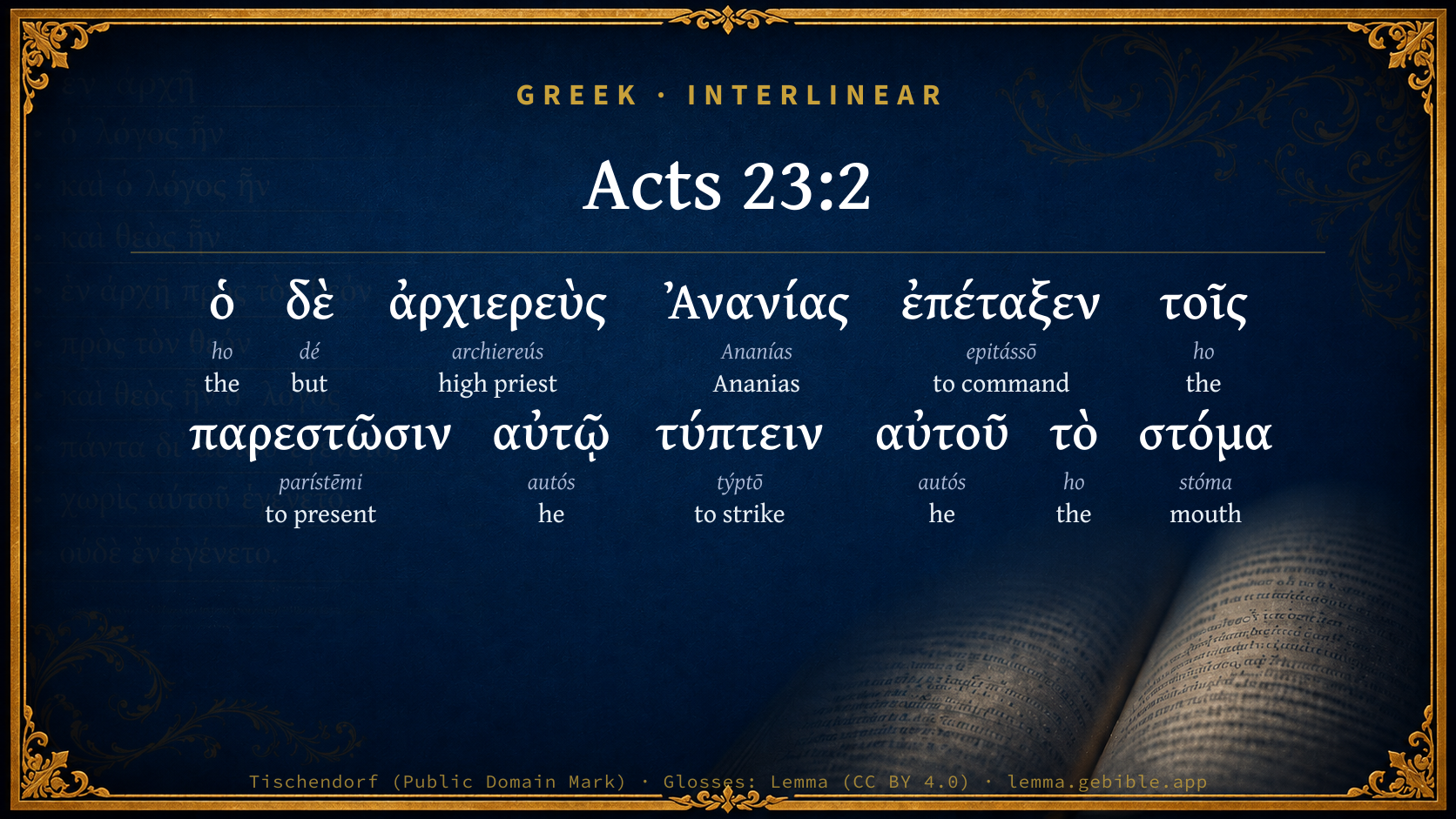
Greek (Tischendorf 8th ed.) Acts 23:2 appears in the Greek New Testament. The text above is from the Tischendorf 8th edition. Each word links to its Strong’s number and a concise gloss. Click any word for its full Thayer’s Greek Lexicon entry.
Download image
Cite this verse

Acts 23:2 (World English Bible). Public Domain. Lemma interlinear Bible study tool, https://lemma.gebible.app/v/acts/23/2.

Show BibTeX & RIS
BibTeX
RIS
English Translation
The high priest, Ananias, commanded those who stood by him to strike him on the mouth.
World English Bible · Public Domain
Download a study sheet

One document with this verse’s original text, its word-by-word gloss line, the meaning frame, cross-references with their text, attributed commentary, and full source and license credits — printable, and it pastes into notes with its structure intact.

This verse Autodidact and up

Study sheet (.html) Plain text (.txt)

A passage Seminary Student

Up to 50 verses in one chapter. A passage sheet keeps up to 6 commentary sources and 12 cross-references per verse, in the order this page ranks them, and says so on the sheet whenever that leaves anything out. Ask for a single verse and you get the Autodidact verse sheet above.

Everything on this page stays free to read, with no account — the sheet is a download of what is already on screen, not access to it.

Want to remove ads? Support Godless Engineer
Compare translations 3

The same verse in 3 English versions, stacked beneath the original-language interlinear above. Click any original word for its lexicon entry.

Each is an independent rendering of the whole verse — the interlinear is not word-aligned to these translations.

Highlighted words mark where these versions differ — a whole-verse word diff, not a word-by-word alignment.

  • World English Bible Public Domain
    The high priest, Ananias, commanded those who stood by him to strike him on the mouth.
  • King James Version Public Domain
    And the high priest Ananias commanded them that stood by him to smite him on the mouth.
  • unfoldingWord Literal Text CC BY-SA 4.0
    But Ananias the high priest commanded the ones standing by him to strike his mouth.

unfoldingWord Literal Text — © unfoldingWord, licensed CC BY-SA 4.0. Word-aligned USFM3 via Door43 (git.door43.org/unfoldingWord/en_ult).

Versions to compare (up to 4)

3 of 4 selected

Show all 19 translations

Every available English version of this verse, each an independent rendering of the whole verse.

  • World English Bible Public Domain
    The high priest, Ananias, commanded those who stood by him to strike him on the mouth.
  • Berean Standard Bible Public Domain
    At this, the high priest Ananias ordered those standing near Paul to strike him on the mouth.
  • Majority Standard Bible Public Domain
    At this, the high priest Ananias ordered those standing near Paul to strike him on the mouth.
  • King James Version Public Domain
    And the high priest Ananias commanded them that stood by him to smite him on the mouth.
  • American Standard Version (1901) Public Domain
    And the high priest Ananias commanded them that stood by him to smite him on the mouth.
  • Revised Version (1885) Public Domain
    And the high priest Ananias commanded them that stood by him to smite him on the mouth.
  • Geneva Bible (1599) Public Domain
    Then the hie Priest Ananias commanded them that stood by, to smite him on the mouth.
  • Douay-Rheims (1899) Public Domain
    And the high priest Ananias commanded them that stood by him to strike him on the mouth.
  • Young's Literal Translation Public Domain
    and the chief priest Ananias commanded those standing by him to smite him on the mouth,
  • Literal Standard Version CC BY-SA 4.0
    and the chief priest Ananias commanded those standing by him to strike him on the mouth,
  • Unlocked Literal Bible CC BY-SA 4.0
    The high priest Ananias commanded those who stood by him to strike him on the mouth.
  • unfoldingWord Literal Text CC BY-SA 4.0
    But Ananias the high priest commanded the ones standing by him to strike his mouth.
  • Darby Bible Public Domain
    But the high priest Ananias ordered those standing by him to smite his mouth.
  • World Messianic Bible Public Domain
    The high priest, Ananias, commanded those who stood by him to strike him on the mouth.
  • Webster's Bible Public Domain
    And the high priest Ananias commanded them that stood by him, to strike him on the mouth.
  • Free Bible Version CC BY-SA 4.0
    Ananias the high priest ordered the officers standing beside Paul to hit him on the mouth.
  • Bible in Basic English Public Domain
    And the high priest, Ananias, gave orders to those who were near him to give him a blow on the mouth.
  • Text-Critical English NT CC BY 4.0
    At this the high priest Ananias commanded those who were standing beside Paul to strike him on the mouth.
  • Tyndale New Testament (1534) Public Domain
    The hye prest Ananias commaunded the that stode by to smyte him on the mouth.

Literal Standard Version (2020), Covenant Press — licensed CC BY-SA 4.0. Text via the HelloAO Bible API (eBible.org). Unlocked Literal Bible (unfoldingWord) — licensed CC BY-SA 4.0. Text via the HelloAO Bible API (eBible.org). unfoldingWord Literal Text — © unfoldingWord, licensed CC BY-SA 4.0. Word-aligned USFM3 via Door43 (git.door43.org/unfoldingWord/en_ult). Free Bible Version, Dr. Jonathan Gallagher — licensed CC BY-SA 4.0. Text via the HelloAO Bible API (eBible.org).

Word by word

More ways to search: Search by grammar → Find every occurrence → Compare this word →

Practice this passage: Drill this verse → Learn its vocabulary →

About this verse

These counts appear in no published source. They are computed here, from the morphology-tagged text and Lemma’s own curated glosses. What Lemma adds →

12
words
9
distinct lemmas
Acts
section

Notable vocabulary

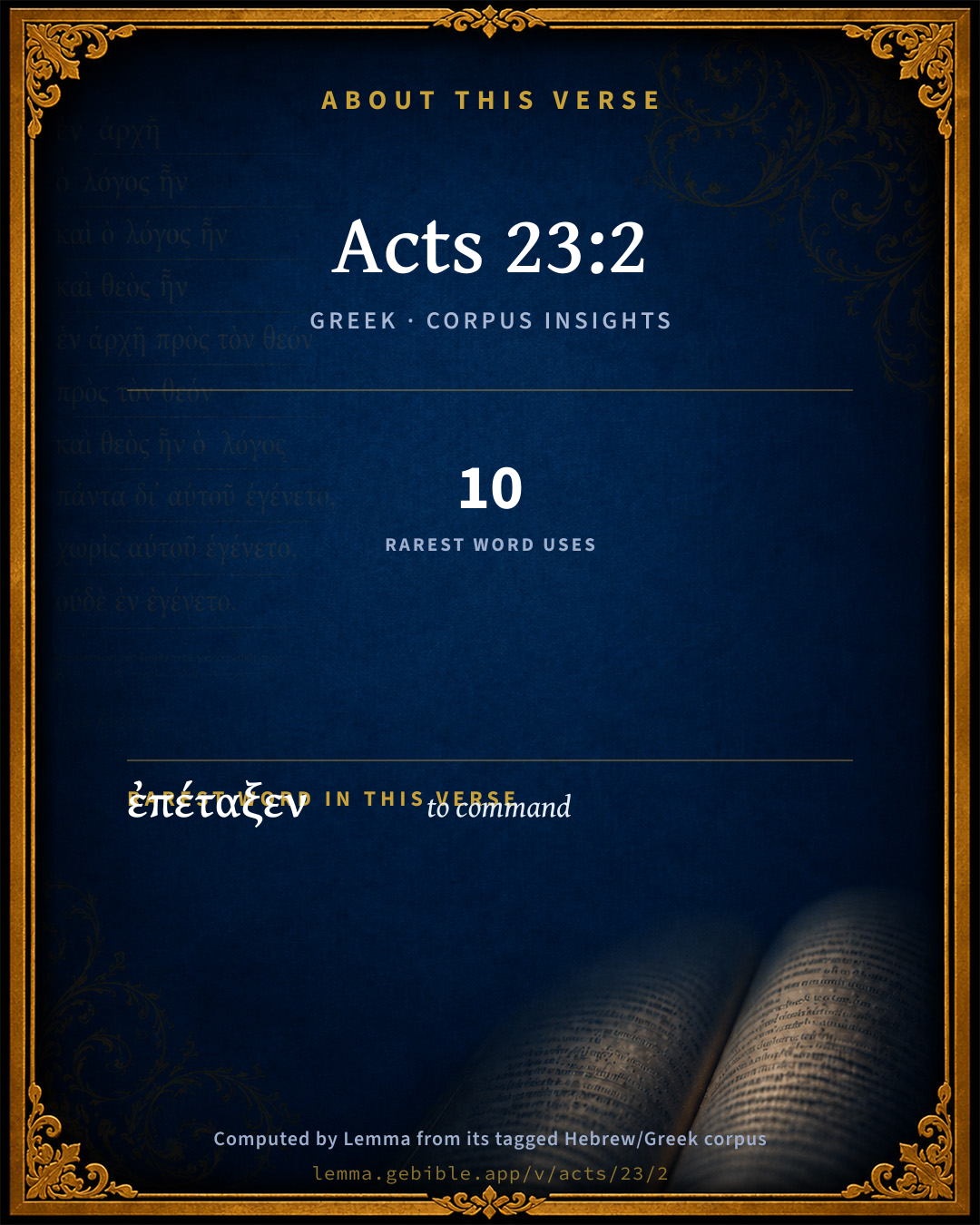
The rarest word here is ἐπέταξεν to command G2004 — appearing just 10 times in the whole Greek New Testament.

Shared distinctive vocabulary

ἐπέταξεν to command G2004 occurs in 10 verses of the Greek New Testament. Also found in:

Repetition

Words recur within this verse:

Cross-references

6

Topical passages linked to Acts 23:2 in the Treasury of Scripture Knowledge — connected by theme and wording, ordered by reader-vote popularity; previews shown in the World English Bible.

  • John 18:22 When he had said this, one of the officers standing by slapped Jesus with his hand, saying, "Do you answer the high priest like that?"
  • Acts 24:1 After five days, the high priest, Ananias, came down with certain elders and an orator, one Tertullus. They informed the governor against Paul.
  • 1 Kings 22:24 Then Zedekiah the son of Chenaanah came near, and struck Micaiah on the cheek, and said, Which way went the Spirit of Yahweh from me to speak to you?
  • Micah 5:1 Now you shall gather yourself in troops, Daughter of troops. He has laid siege against us; They will strike the judge of Israel with a rod on the cheek.
  • Jeremiah 20:2 Then Pashhur struck Jeremiah the prophet, and put him in the stocks that were in the upper gate of Benjamin, which was in the house of Yahweh.
  • Matthew 26:67 Then they spit in his face and beat him with their fists, and some slapped him,

Cross-references courtesy of OpenBible.info (CC BY 4.0).

Commentary

Notes on Acts 23:2 from classic Christian and Jewish commentators (each source and its license shown beneath its notes). The classic Christian expositions comment on the surrounding passage and are grouped to its opening verse, so a note may address several verses; the Jewish commentaries on the Tanakh (Rashi and others) are per-verse, so they appear only where the commentator wrote on this verse.

Lemma curates 59 commentaries, every one of them public domain or Creative Commons licensed, each selected and text-cleaned for this edition rather than reprinted as found. About our sources →

Tyndale Open Study Notes

Tyndale Open Resources

23:2 Ananias was the Jewish high priest from AD 47 to 58. • slap him: He apparently assumed that Paul was lying and tried to intimidate him.

Tyndale Open Study Notes — © Tyndale Open Resources, licensed CC BY-SA 4.0. Text via the HelloAO Bible API.

Bengel's Gnomon

Johann Albrecht Bengel

Act 23:2. Δὲ, but) No one, however unfavourable (prejudiced against the speaker), ought to have been displeased at Paul’s speech. He interrupts him when about to speak more fully, [or even attempts to accuse him of a lie (in laying claim to a “good conscience”).—V. g.]—ὁ ἀρχιερεὺς), the High Priest: not one of the many “chief priests,” of whom ch. Act 22:30 treats.—ἐπεταξε, commanded) without any cause.—αὐτῷ, himself) Ananias [not Paul].—στόμα, the mouth) as speaking unworthy things.

Bengel's Gnomon of the New Testament — English translation (T&T Clark, Edinburgh, 1860) — public domain. Text from a community e-Sword module.

Expositor's Greek Testament

ed. W. Robertson Nicoll

Act 23:2 . Ἀναν .: not the Ananias of Act 4:7 , Luk 3:2 , Joh 18:13 , but the son of Nebedæus, appointed to his office by Herod of Chalcis, high priest from c. 47 59. He was sent to Rome on account of the complaints of the Samaritans against the Jews, but the Jewish cause prevailed, and there is no reason to suppose that Ananias lost his office. The probabilities are that he retained it until he was deposed shortly before the departure of Felix. Josephus gives us a terrible picture of his violent and unscrupulous conduct, Ant. , xx., 9, 2. But his Roman sympathisers made him an object of hatred to the nationalists, and in A.D. 66, in the days of the last great revolt against the Romans, he was dragged from a sewer in which he had hidden, and was murdered by the weapons of the assassins whom in his own period of power he had not scrupled to employ, Jos., B.J. , ii., 17, 9, “Ananias,” B.D. 2 , and Hastings’ B.D., O. Holtzmann, Neutest. Zeitgeschichte , pp. 130, 146. τύπτειν : because Paul had forgotten that he was before his judges, and ought not to have spoken before being asked, cf. Luk 6:29 , Joh 18:22 , 2Co 11:20 , 1Ti 3:3 , Tit 1:7 . The act was illegal and peculiarly offensive to a Jew at the hands of a Jew, Farrar, St. Paul , ii., p. 323.

The Expositor's Greek Testament, edited by W. Robertson Nicoll (1897–1910) — public domain. Text from a community e-Sword module.

Geneva Bible (1599)

Geneva Bible translators

Hypocrites are constrained at length to betray themselves by their intemperance.

Geneva Bible (1599) marginal notes — public domain. Text via Bolls.life.

Jamieson, Fausset & Brown

Robert Jamieson, A. R. Fausset & David Brown

the high priest . . . commanded . . . to smite him on the mouth--a method of silencing a speaker common in the East to this day [HACKET]. But for a judge thus to treat a prisoner on his "trial," for merely prefacing his defense by a protestation of his integrity, was infamous.

Jamieson, Fausset & Brown — Commentary Critical and Explanatory on the Whole Bible (1871) — public domain (CC PDM 1.0). Text via the HelloAO Bible API.

Adam Clarke's Commentary

Verse 2. The high priest, Ananias] There was a high priest of this name, who was sent a prisoner to Rome by Quadratus, governor of Syria, to give an account of the part he took in the quarrel between the Jews and the Samaritans; see Joseph. Antiq. lib. xx. cap. 6, s. 8; but whether he ever returned again to Jerusalem, says Dr. Lightfoot, is uncertain; still more uncertain whether he was ever restored to the office of high priest; and most uncertain of all whether he filled the chair when Paul pleaded his cause, which was some years after Felix was settled in the government. But Krebs has proved that this very Ananias, on being examined at Rome, was found innocent, returned to Jerusalem, and was restored to the high priesthood; see Joseph. Antiq. lib. xx. cap. 9, s. 2; but of his death I find nothing certain. See Krebs on this place, (Observat. in Nov. Testament. e Flavio Josepho,) who successfully controverts the opinion of Dr. Lightfoot, mentioned at the beginning of this note. There was one Ananias, who is said to have perished in a tumult raised by his own son about five years after this time; see Jos. Antiq. lib. x. cap. 9. War, lib. ii. cap. 17.

To smite him on the mouth.] Because he professed to have a good conscience, while believing on Jesus Christ, and propagating his doctrine.

Adam Clarke's Commentary on the Bible (1810–1826) — public domain. Text from a community e-Sword/MySword module.

John Calvin's Commentaries

2. And the chief priest. Luke’s narration seemeth not to agree with the usual history; for Josephus writeth thus concerning the high priests of that time, that Quadratus, deputy [proconsul] of Syria, deposing Cumanus from the government of Judea, commanded him to answer for himself before Caesar, and sent Ananias, the highest priest, bound with him, into whose place who was chosen he maketh no mention, saving that it is likely that Jonathas had the honor given him, who, as he reporteth, was afterward slain by the subtilty and treachery of Felix, deputy [prefect] of Judea, who succeeded Cumanus; for when he had oftentimes told Felix part of his mind, and he could not away with the constancy of the man, he made a compact with one Doras, that he should privily convey in murderers to slay him. Then, as the same Josephus doth witness, king Agrippa made Ismael, the son of Phebeus, priest. But when he was sent by the people to Rome about a certain suit, and was kept there by Popea, wife to Nero, Agrippa putteth in his place one Josephus, whose name was Chabus, the son of Simon. But immediately being also weary of him, he appointeth Ananus, the son of Ananus, to be high priest.

Furthermore, he saith that this last thing happened at such time as, after the death of Festus, Albinus did succeed him. And I see not why some call this Ananus Ananias. That hath indeed some color, in that he is called a Pharisee; also in that it is said that he was bold and stout, who, without any lawful authority, caused James, the Lord’s brother, to be stoned. But if we give credence to Josephus, he could not be that Ananias of whom mention is made in this place by Luke, who was then made priest, when many years were past and gone, after that Felix departed out of the province.

I have another conjecture in my head. For there flourished during all that time one Ananias, an high priest, who, excepting the title of honor, was almost chief in the order. And because Josephus leaveth some void time between Ananias and Ismael, it may be that this man had the room of the highest priest in the meantime. But though this were not so, it appeareth out of Josephus, that Ananias, who died when the city was besieged, was, in the reign of Claudius Caesar and Nero, equal in dignity with the chief priests which were then.

Yea, his authority is so highly extolled, as if he had the chief government, howsoever other men did bear the ensigns of honor. Again, he is called αρχιερευς confusedly, as those who were the highest priests. Now, let the readers ponder and consider, whether the word αρχιερευς doth not rather signify in this place chief than highest, as it doth in many other places. For the Evangelists do everywhere call the priests who were of the course of Aaron αρχιερεις, that they may distinguish them from the Levites, who had a more inferior degree of priesthood. Moreover, it may be that that Ananias, who was counted stout and courageous, did supply the high priest’s room in his absence. Those things which we have recited out of Josephus are recorded partly in the Twentieth Book of Antiquities, from the third chapter until the eight; partly in the Second Book of the Wars of the Jews.

He commanded him to be smitten. We see that there was in this assembly great distemperature. For whereas the high priest was in such rage, that he commanded Paul to be smitten for nothing, he did it undoubtedly with the consent of all the rest; yea, to the end he might win the favor of mad men. The Lord doth suffer the wicked to be so carried away by Satan, that they fall from all show of equity and temperance. For hypocrites would fain bear some show of moderation; and undoubtedly this high priest went about to pretend such gravity as did beseem his person. But the Lord did pluck this visure [mask] from his face, so that there was not found in him so much as the modesty of a mean man, but he poured out his furious force like a beast.

In the mean season, we see what horrible and filthy disorder there was at that day in the Church. Ananias, who was the chief of the council, whereas he ought to have stayed others by his gravity, forgetting all modesty, he enforceth them unto violence and savageness. Therefore they had at that day no regard of discipline, but there remained among them confused barbarism. And no marvel, for they had estranged themselves from God; they had most reproachfully rejected Christ; all their religion was set to sale. Therefore it was meet that they should run headlong into furious madness, which might be loathsome even among profane men, that they might be punished in their own shame for their ungodliness.

John Calvin's Commentaries (1540-1563) — public domain. Text from the Calvin Translation Society English edition (1840s-50s) via the Christian Classics Ethereal Library (ccel.org). Calvin's coverage is partial (roughly two-thirds of the Bible); uncommented books and verses are honest gaps, never fabricated. The 19th-century editor's footnotes and remarks are omitted so the notes are faithfully Calvin's own voice.

Ellicott's Commentary for English Readers

(2) The high priest Ananias.—See Note on Act_22:5. The son of Nebedæus was conspicuous for his cruelty and injustice, and had been sent to Rome as a prisoner to take his trial before Claudius (A.D. 52). He had been acquitted, or at least released, and had returned to Judæa. To him this assertion of a life so utterly unlike his own seemed almost like a personal insult. He fitted the cap, and raged with a brutal cruelty which reminds us of Jeffreys’ treatment of Baxter.

A Bible Commentary for English Readers, edited by Charles John Ellicott (1878–1897) — public domain. Text from a community e-Sword module.

The Cambridge Bible for Schools and Colleges

gen. ed. J. J. S. Perowne

2. And the high priest Ananias] This was Ananias the son of Nebedæus. (Joseph. Ant. xx. 5, 2.) In the time of the Emperor Claudius he had been suspended from his office for some offence and sent to Rome (Ant. xx. 6, 2) but afterwards seems to have been held in great reputation in Jerusalem (Ant. xx. 9, 2).

to smite him on the mouth] No doubt St Paul’s address, before the high priest gave this order, had extended much beyond the single sentence which St Luke records, and he only preserves for us that which appears to have moved the anger of the authorities, by his claim to have led a life of which in God’s sight he was not ashamed. The action was intended to put a stop to what would be counted the presumptuous language of St Paul.

The Cambridge Bible for Schools and Colleges (gen. ed. J. J. S. Perowne; Cambridge University Press, 1878–1918) — public domain. Text from a community e-Sword module.

John Gill's Exposition

And the high priest Ananias,.... This could not be the same with Annas, the father-in-law of Caiaphas, but rather Ananus his son; though this is more generally thought to be Ananias the son of Nebedaeus, whom Josephus (m) speaks of. There is one R. Ananias, the sagan of the priests, often spoken of in the Jewish writings (n), who lived about these times, and was killed at the destruction of Jerusalem; and in the times of King Agrippa, there was one Chanina, or Ananias the priest, who was a Sadducee (o); and from the number of Sadducees in this sanhedrim, who very likely were the creatures of the high priest, one would be tempted to think he might be the same with this: who

commanded them that stood by him: that is, by Paul, who were nearest to him, some of the members of the sanhedrim; unless they should be thought to be some of the high priest's officers, or servants, as in Joh 18:22 though if they were, one would think they would be so called: these he ordered

to smite him on the mouth: or give him a slap on the face, by way of contempt, and as if he had spoken what ought not to be said, and in order to silence him; the reason of which might be, either because Paul did not directly address him, and give him such flattering titles as he expected, or because he set out with such declarations of his innocence, and spotless behaviour, and with so much courage and boldness.

(m) Antiqu. l. 18. c. 2. sect. 1. & l. 20. c. 8. sect. 1. (n) Misna Shekalim, c. 4. sect. 4. & 6. 1. & Pesachim, c. 1. sect. 6. T. Bab. Yoma, fol. 8. 1. & 21. 2. & Juchasin, fol. 24. 2. (o) Juchasin, fol. 142. 2.

John Gill's Exposition of the Whole Bible (1746–1763) — public domain (CC PDM 1.0). Text via the HelloAO Bible API.

Trapp's Complete Commentary

John Trapp

2 And the high priest Ananias commanded them that stood by him to smite him on the mouth.

Ver. 2. To smite him on the mouth] So when Henry Zutphen, martyr, was bound hard to a ladder and cast into the fire, he no sooner began to pray and to repeat his creed, but one struck him upon the face with his fist, saying, Thou shalt first be burned, and afterwards pray and prate as much as thou wilt: (Acts and Mon.)

John Trapp, A Commentary or Exposition upon All the Books of the Old and New Testament (1647–1656) — public domain. Text from a community e-Sword module.

Albert Barnes' Notes on the Bible

And the high priest Ananias - This Ananias was doubtless the son of Nebedinus (Josephus, Antiq., book 20, chapter 5, section 3), who was high priest when Quadratus, who preceded Felix, was president of Syria. He was sent bound to Rome by Quadratus, at the same time with Ananias, the prefect of the temple, that they might give an account of their conduct to Claudius Caesar (Josephus, Antiq., book 20, chapter 6, section 2). But in consequence of the intercession of Agrippa the younger, they were dismissed and returned to Jerusalem. Ananias, however, was not restored to the office of high priest. For, when Felix was governor of Judea, this office was filled by Jonathan, who succeeded Ananias I (Josephus, Antiq., book 20, chapter 10). Jonathan was slain in the temple itself, by the instigation of Felix, by assassins who had been hired for the purpose. This murder is thus described by Josephus (Antiq., book 20, chapter 8, section 5): “Felix bore an ill-will to Jonathan, the high priest, because he frequently gave him admonitions about governing the Jewish affairs better than he did, lest complaints should be made against him, since he had procured of Caesar the appointment of Felix as procurator of Judea. Accordingly, Felix contrived a method by which he might get rid of Jonathan, whose admonitions had become troublesome to him. Felix persuaded one of Jonathan’s most faithful friends, of the name Doras, to bring the robbers upon him, and to put him to death.”

This was done in Jerusalem. The robbers came into the city as if to worship God, and with daggers, which they had concealed under their garments, they put him to death. After the death of Jonathan, the office of high priest remained vacant until King Agrippa appointed Ismael, the son of Fabi, to the office (Josephus, Antiq., book 20, chapter 8, section 8). It was during this interval, while the office of high priest was vacant, that the events which are here recorded took place. Ananias was then at Jerusalem; and as the office of high priest was vacant, and as he was the last person who had borne the office, it was natural that he should discharge, probably by common consent, its duties, so far, at least, as to preside in the Sanhedrin. Of these facts Paul would be doubtless apprised; and hence, what he said Act 23:5 was strictly true, and is one of the evidences that Luke’s history accords precisely with the special circumstances which then existed. When Luke here calls Ananias “the high priest,” he evidently intends not to affirm that he was actually such, but to use the word, as the Jews did, as applicable to one who had been in that office, and who, on that occasion, when the office was vacant, performed its duties.

To smite him on the mouth - To stop him from speaking; to express their indignation at what he had said. The anger of Ananias was aroused because Paul affirmed that all he had done had been with a good conscience. Their feelings had been excited to the utmost; they regarded him as certainly guilty; they regarded him as an apostate; and they could not bear it that he, with such coolness and firmness, declared that all his conduct had been under the direction of a good conscience. The injustice of the command of Ananias is apparent to all. A similar instance of violence occurred on the trial of the Saviour, Joh 18:22.

Albert Barnes' Notes on the Bible (1834–1885) — public domain. Text from a community e-Sword/MySword module.

Matthew Poole's English Annotations

Them that stood by him; the officers, probably.

To smite him on the mouth; thus Micaiah was smote by Zedekiah the false prophet, 1Ki 22:24, and Jeremiah by Pashur, Jer 20:2; and our blessed Lord escaped not this suffering and indignity, Joh 18:22. Now this was the rather inflicted on Paul, because of his protesting of his innocency, which did reflect upon the council, as being injurious; but it was indeed no more than what was necessary in his own just defence, and for the glory of the gospel.

Matthew Poole's English Annotations on the Holy Bible (1683–1685) — public domain. Text from a community e-Sword/MySword module.

Whedon's Commentary on the Bible

Daniel D. Whedon

2. Commanded… to smite him—The high priest is left in his passion to inflict the usual Eastern penalty of criminal or impertinent speech upon this servant of Christ, an outrage which will draw forth a monitory prediction of his own violent end.

This Ananias was the son of Nebedaeus, and was appointed to the high priesthood by Herod, king of Chalcis. (See our Hist. Revelation at Act_21:17, §§ 1, 2, and 3.) He was assassinated by the Sicarii, about five years afterward.

Daniel D. Whedon (gen. ed.), Commentary on the Old and New Testaments (1874–1909) — public domain. Text from a community e-Sword module.

The Pulpit Commentary

Ananias, the son of Nebedaeus, successor of Joseph the son of Camel, or Camydus, ("Ant. Jud:," 20:1:3 5:2) appears to have been actually high priest at this time. tie was a violent, haughty, gluttonous, and rapacious man, and vet looked up to by the Jews ("tres considere," Renan). tie had probably lately returned from Rome, having been confirmed, as it seems, in his office by Claudius, to whom Quadratus, the predecessor of Felix, has sent him as a prisoner, to answer certain charges of sedition against him. He seems to have been high priest for the unusually long period of over ten years from A.D. 48 to A.D. 59 (see Josephus, "Ant. Jud:," 20:5:2 6:2, 3 8:8). But, on the other hand, Josephus ("Ant. Jud.," 20. 8:5) speaks of a certain Jonathan being high priest during the government of Felix, and being murdered by the Sicarii at his instigation; which looks as if Ananias"s high priesthood had been interrupted. It would appear, too, from 20. 8:8, that Ismael the son of Fabi succeeded to Jonathan, net to Ananias, as is usually supposed. But the question is involved in great obscurity.

The Pulpit Commentary (1880–1919), ed. H.D.M. Spence-Jones & Joseph S. Exell — public domain. Text from a community e-Sword module.

McGarvey & Pendleton's Commentaries

J. W. McGarvey

See notes on verse 1

J. W. McGarvey (with Philip Y. Pendleton), Commentaries on the New Testament (The Fourfold Gospel, 1914; Acts; and the epistles) — public domain. Text from a community e-Sword/MySword module.

The People's New Testament

B. W. Johnson

2–5. To smite him on the mouth. The high priest flamed up in an instant at the statement of Paul that he had acted in good conscience. “How could such a renegade from Judaism be conscientious?” It is common in the despotic East to order the mouths that are supposed to have spoken falsely to be smitten. Ananias was high priest at this time, but was removed on a charge brought by King Agrippa (25:13) in a.d. 59. He was at last assassinated.

God shall smite thee, thou whited wall. These words, spoken by the prisoner, indignant at the mockery of justice, were rather a prediction than an imprecation. I have just stated that this violent man came to an untimely death. The insult to Paul reminds us of a similar one to his Master before the same body (John 18:22). By whited wall Paul means a hypocrite. See note on Matt. 23:27.

I wist not, brethren, that he was the high priest. It was contrary to the law of Moses (Exod. 22:28) to revile one in high authority. Paul's reply to the charge that he had violated the law has been variously explained. Howson gives what appears to me the most probable view: “I did not take thought, at the moment, in my indignation over the command to smite a defenceless prisoner on trial, that he was the high priest. I am well aware that it is said, 'Thou shalt not speak evil of the ruler of thy people.'” His words were an apology for his hasty speech. I wist not is used in the sense of “I did not bear in mind.”

B. W. Johnson's The People's New Testament with Notes (1889–1891) — public domain. Electronic text from the Christian Classics Ethereal Library (CCEL) ThML edition.

Cambridge Greek Testament for Schools and Colleges

2. ὁ δὲ ἀρχιερεὺχ Ἀνανίας, and the high priest Ananias. This was Ananias the son of Nebedæus (Joseph. Ant. xx. 5. 2). In the time of the Emperor Claudius he had been suspended from his office for some offence and sent to Rome (Ant. xx. 6. 2) but afterwards seems to have been held in great reputation in Jerusalem (Ant. xx. 9. 2).

τύπτειν αὐτοῦ τὸ στόμα, to smite him on the mouth. No doubt St Paul’s address, before the high priest gave this order, had extended much beyond the single sentence which St Luke records. He only preserves for us that which appears to have moved the anger of the authorities, his claim to have led a life of which in God’s sight he was not ashamed. The action was intended to put a stop to what would be counted the presumptuous language of St Paul.

For ρύπτειν τὸ στόμα τινος, which is not a common form, cf. Luk 22:64.

Cambridge Greek Testament for Schools and Colleges (Cambridge University Press, 1896; 21 vols, various authors incl. Carr, Maclear, Plummer, Farrar, Lumby, Moule, M. R. James, Simcox) — public domain. Text from a community e-Sword module.

Alford’s Greek Testament

Henry Alford

2. Ἀνανίας] He was at this time the actual high priest (ver. 4). He was the son of Nebedæus (Jos. Antt. xx. 5. 2),—succeeded Joseph son of Camydus, Antt. xx. 1. 3; 5. 2,—and preceded Ismael, son of Phabi (Antt. xx. 8. 8, 11). He was nominated to the office by Herod, king of Chalcis, in a.d. 48 (Antt. xx. 5. 2); and sent to Rome by Quadratus, the prefect of Syria, to give an account to the emperor Claudius (Antt. xx. 6. 2): he appears, however, not to have lost his office, but to have resumed it on his return. This has been regarded as not certain,—and the uncertainty has produced much confusion in the Pauline chronology. But as Wieseler has shewn (Chronol. d. Apostelgeschichte, p. 76, note), there can be no reasonable doubt that it was so, especially as Ananias came off victorious in the cause for which he went to Rome, viz. a quarrel with the Jewish procurator Cumanus,—who went with him, and was condemned to banishment (Antt. xx. 6. 3). He was deposed from his office not long before the departure of Felix (Antt. xx. 8. 8), but still had great power, which he used violently and lawlessly (ib. 9. 2): he was assassinated by the sicarii [see ch. 21:38, note] at last (B. J. ii. 17, 9).

Henry Alford, The Greek Testament (1849–1861) — public domain. Text from a community e-Sword module.

Vincent's Word Studies in the New Testament

Marvin R. Vincent

Ananias. He is described as a revengeful and rapacious tyrant. We are told that he reduced the inferior priests almost to starvation by defrauding them of their tithes, and sent his creatures to the threshing - floors with bludgeons to seize the tithes by force.

Marvin R. Vincent, Word Studies in the New Testament (1887–1900) — public domain. Text from a community e-Sword/MySword module.

Lesson kit

Teaching starters — assembled from the data on this page, not authored interpretation. Every prompt links to the verse data it draws on. Edit before teaching.

Acts, in the Acts, opens this verse with 12 words (9 distinct Greek lemmas). Its most distinctive word is epitássō (“to command”). A historical commentator’s framing appears above. Read the whole chapter for the surrounding context.

Discussion questions

  1. What does “to command” (epitássō) contribute to the verse as a whole?
  2. Mark 1:27 shares the word «to command» with this verse. How do the two illuminate each other?
  3. “the” occurs 3× in this one verse. What is the effect of the repetition?
  4. These translations render this verse differently; the difference is in the English rendering, not the original. What questions does that raise?
  5. Reading how Tyndale Open Study Notes and Bengel's Gnomon read this verse, where do the two commentators agree and where do they part?

Things to notice

  • These translations choose different wording for 6 words in this verse.
  • “the” occurs 3× in this single verse.
  • 9 distinct Greek lemmas span 12 words in this verse.

Reading settings

Reading text

Shown beneath each verse's original-language words.

Old Testament
Old Testament edition

Read the OT as the Masoretic Hebrew (MT) or the Greek Septuagint (LXX).

English shown for the Greek Septuagint (in the Hebrew ↔ Greek comparison).

Comparing translations? Open the Compare panel on any verse page to stack up to four side by side.