

Acts 20:7
Greek (Tischendorf 8th ed.) Acts 20:7 appears in the Greek New Testament. The text above is from the Tischendorf 8th edition. Each word links to its Strong’s number and a concise gloss. Click any word for its full Thayer’s Greek Lexicon entry.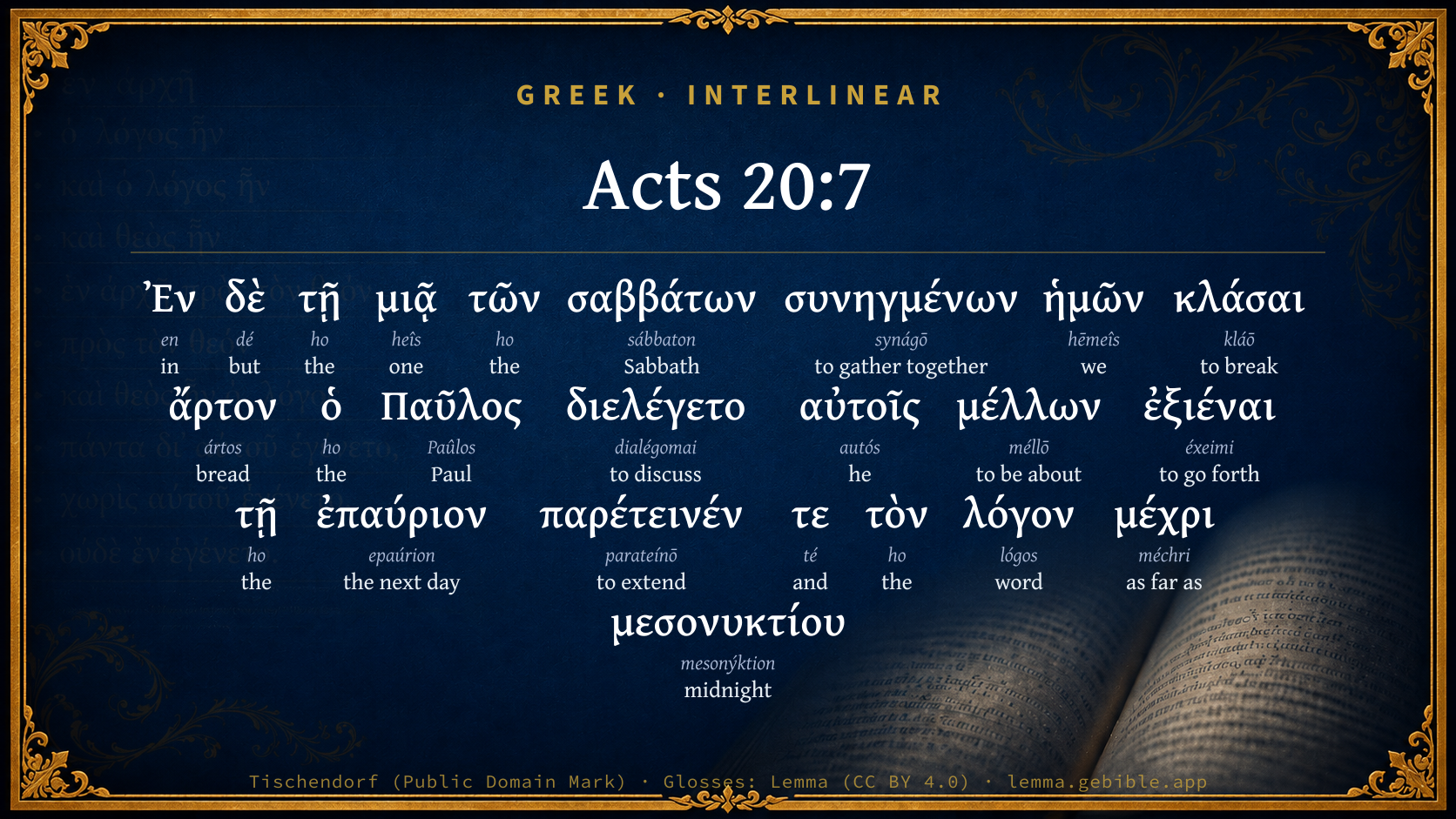
On the first day of the week, when the disciples were gathered together to break bread, Paul talked with them, intending to depart on the next day, and continued his speech until midnight.
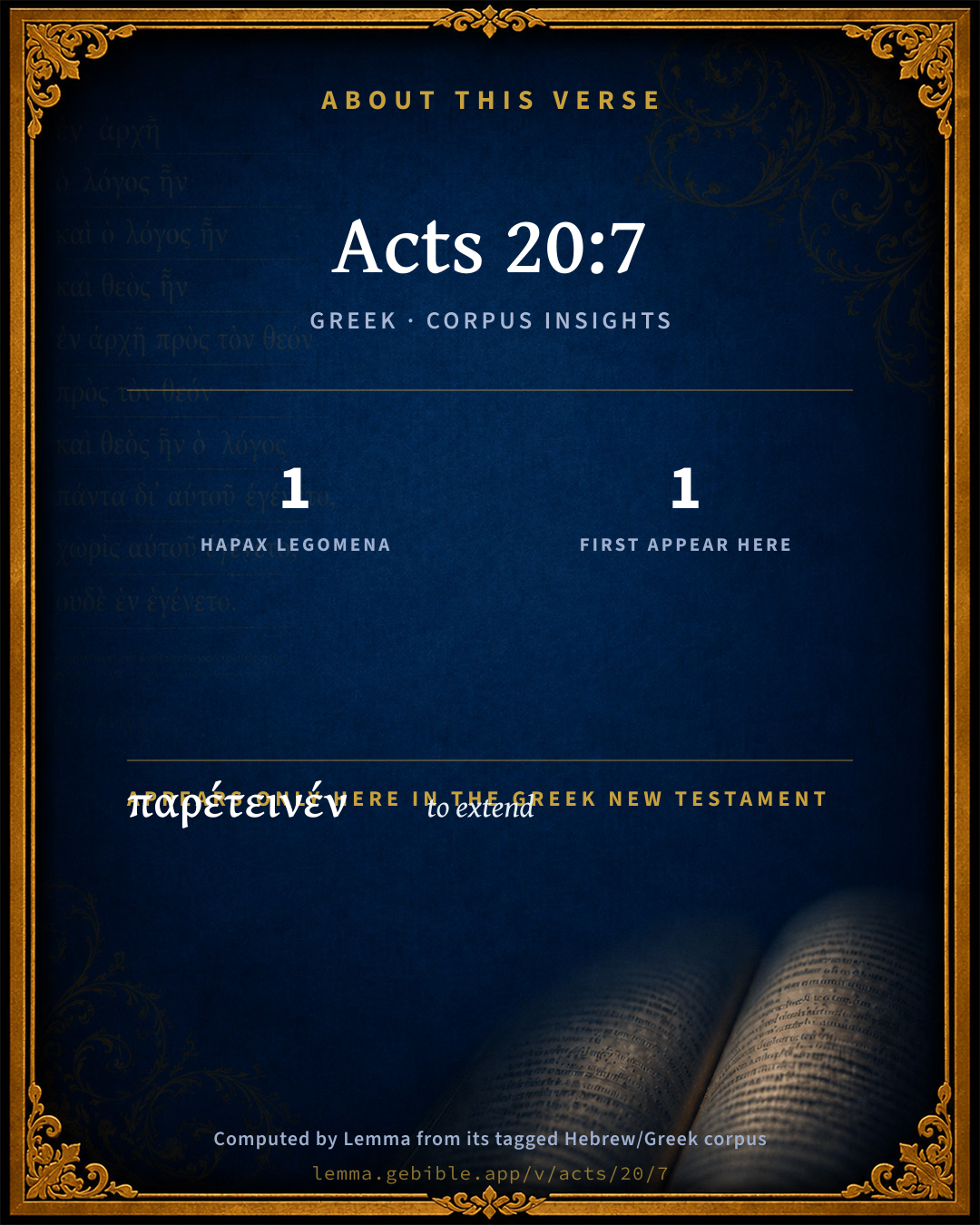
- 1 hapax legomenon — only here in the Greek New Testament
- 1 first appearance in the Greek New Testament
Download a study sheet
One document with this verse’s original text, its word-by-word gloss line, the meaning frame, cross-references with their text, attributed commentary, and full source and license credits — printable, and it pastes into notes with its structure intact.
This verse Autodidact and up
A passage Seminary Student
Up to 50 verses in one chapter. A passage sheet keeps up to 6 commentary sources and 12 cross-references per verse, in the order this page ranks them, and says so on the sheet whenever that leaves anything out. Ask for a single verse and you get the Autodidact verse sheet above.
Everything on this page stays free to read, with no account — the sheet is a download of what is already on screen, not access to it.
Compare translations 3
The same verse in 3 English versions, stacked beneath the original-language interlinear above. Click any original word for its lexicon entry.
Each is an independent rendering of the whole verse — the interlinear is not word-aligned to these translations.
Highlighted words mark where these versions differ — a whole-verse word diff, not a word-by-word alignment.
-
World English Bible Public Domain
On the first day of the week, when the disciples were gathered together to break bread, Paul talked with them, intending to depart on the next day, and continued his speech until midnight.
-
King James Version Public Domain
And upon the first day of the week, when the disciples came together to break bread, Paul preached unto them, ready to depart on the morrow; and continued his speech until midnight.
-
unfoldingWord Literal Text CC BY-SA 4.0
And on the first of the week, we having been gathered together to break bread, Paul was speaking with them. Being about to depart the next day, he was thus continuing the word until midnight.
unfoldingWord Literal Text — © unfoldingWord, licensed CC BY-SA 4.0. Word-aligned USFM3 via Door43 (git.door43.org/unfoldingWord/en_ult).
Show all 19 translations
Every available English version of this verse, each an independent rendering of the whole verse.
-
World English Bible Public Domain
On the first day of the week, when the disciples were gathered together to break bread, Paul talked with them, intending to depart on the next day, and continued his speech until midnight.
-
Berean Standard Bible Public Domain
On the first day of the week we came together to break bread. Since Paul was ready to leave the next day, he talked to them and kept on speaking until midnight.
-
Majority Standard Bible Public Domain
On the first day of the week, the disciples came together to break bread. Since Paul was ready to leave the next day, he talked to them and kept on speaking until midnight.
-
King James Version Public Domain
And upon the first day of the week, when the disciples came together to break bread, Paul preached unto them, ready to depart on the morrow; and continued his speech until midnight.
-
American Standard Version (1901) Public Domain
And upon the first day of the week, when we were gathered together to break bread, Paul discoursed with them, intending to depart on the morrow; and prolonged his speech until midnight.
-
Revised Version (1885) Public Domain
And upon the first day of the week, when we were gathered together to break bread, Paul discoursed with them, intending to depart on the morrow; and prolonged his speech until midnight.
-
Geneva Bible (1599) Public Domain
And the first day of the weeke, the disciples being come together to breake bread, Paul preached vnto them, ready to depart on the morrow, and continued the preaching vnto midnight.
-
Douay-Rheims (1899) Public Domain
And on the first day of the week, when we were assembled to break bread, Paul discoursed with them, being to depart on the morrow: and he continued his speech until midnight.
-
Young's Literal Translation Public Domain
And on the first of the week, the disciples having been gathered together to break bread, Paul was discoursing to them, about to depart on the morrow, he was also continuing the discourse till midnight,
-
Literal Standard Version CC BY-SA 4.0
And on the first [day] of the weeks, the disciples having been gathered together to break bread, Paul was discoursing to them, about to depart on the next day, he was also continuing the discourse until midnight,
-
Unlocked Literal Bible CC BY-SA 4.0
On the first day of the week, when we were gathered together to break bread, Paul spoke to the believers. He was planning to leave the next day, so he kept speaking until midnight.
-
unfoldingWord Literal Text CC BY-SA 4.0
And on the first of the week, we having been gathered together to break bread, Paul was speaking with them. Being about to depart the next day, he was thus continuing the word until midnight.
-
Darby Bible Public Domain
And the first day of the week, we being assembled to break bread, Paul discoursed to them, about to depart on the morrow. And he prolonged the discourse till midnight.
-
World Messianic Bible Public Domain
On the first day of the week, when the disciples were gathered together to break bread, Paul talked with them, intending to depart on the next day; and continued his speech until midnight.
-
Webster's Bible Public Domain
And upon the first day of the week, when the disciples came together to break bread, Paul preached to them (ready to depart on the morrow) and continued his speech until midnight.
-
Free Bible Version CC BY-SA 4.0
Paul was speaking on the first day of the week as we gathered together to break bread. He was planning to leave in the morning, and went on speaking until midnight.
-
Bible in Basic English Public Domain
And on the first day of the week, when we had come together for the holy meal, Paul gave them a talk, for it was his purpose to go away on the day after; and he went on talking till after the middle of the night.
-
Text-Critical English NT CC BY 4.0
On the first day of the week, as the disciples were gathered together to break bread, Paul addressed them, intending to depart the next day, and he prolonged his message until midnight.
-
Tyndale New Testament (1534) Public Domain
And on the morowe after the saboth daye the disciples came to geder for to breake breed and Paul preached vnto them (redy to departe on the morowe) and continued the preachynge vnto mydnyght.
Literal Standard Version (2020), Covenant Press — licensed CC BY-SA 4.0. Text via the HelloAO Bible API (eBible.org). Unlocked Literal Bible (unfoldingWord) — licensed CC BY-SA 4.0. Text via the HelloAO Bible API (eBible.org). unfoldingWord Literal Text — © unfoldingWord, licensed CC BY-SA 4.0. Word-aligned USFM3 via Door43 (git.door43.org/unfoldingWord/en_ult). Free Bible Version, Dr. Jonathan Gallagher — licensed CC BY-SA 4.0. Text via the HelloAO Bible API (eBible.org).
Word by word
More ways to search: Search by grammar → Find every occurrence → Compare this word →
Practice this passage: Drill this verse → Learn its vocabulary →
- Appears 1× in the Greek New Testament
- First appears here
- Part of Speech
- Verb
- Tense
- Imperfect
- Voice
- Active
- Mood
- Indicative
- Person
- 3rd person
- Number
- Singular
Full Thayer's Definition
- Ἐν en G1722 “in” Preposition
- δὲ dé G1161 “but” Conjunction
- τῇ ho G3588 “the” Article, Dative, Singular, Feminine
- μιᾷ heîs G1520 “one” Adjective, Dative, Singular, Feminine
- τῶν ho G3588 “the” Article, Genitive, Plural, Neuter
- σαββάτων sábbaton G4521 “Sabbath” Noun, Genitive, Plural, Neuter
- συνηγμένων synágō G4863 “to gather together” Verb, Perfect, Passive, Participle, Genitive, Plural, Masculine
- ἡμῶν hēmeîs G2249 “we” Personal pronoun, 1st person, Genitive, Plural
- κλάσαι kláō G2806 “to break” Verb, Aorist, Active, Infinitive
- ἄρτον ártos G740 “bread” Noun, Accusative, Singular, Masculine
- ὁ ho G3588 “the” Article, Nominative, Singular, Masculine
- Παῦλος Paûlos G3972 “Paul” Noun, Nominative, Singular, Masculine
- διελέγετο dialégomai G1256 “to discuss” Verb, Imperfect, Middle or Passive deponent, Indicative, 3rd person, Singular
- αὐτοῖς autós G846 “he” Personal pronoun, Dative, Plural, Masculine
- μέλλων méllō G3195 “to be about” Verb, Present, Active, Participle, Nominative, Singular, Masculine
- ἐξιέναι éxeimi G1826 “to go forth” Verb, Present, Active, Infinitive
- τῇ ho G3588 “the” Article, Dative, Singular, Feminine
- ἐπαύριον epaúrion G1887 “the next day” Adverb
- παρέτεινέν parateínō G3905 “to extend” Verb, Imperfect, Active, Indicative, 3rd person, Singular
- τε té G5037 “and” Particle
- τὸν ho G3588 “the” Article, Accusative, Singular, Masculine
- λόγον lógos G3056 “word” Noun, Accusative, Singular, Masculine
- μέχρι méchri G3360 “as far as” Adverb
- μεσονυκτίου mesonýktion G3317 “midnight” Noun, Genitive, Singular, Neuter
About this verse
These counts appear in no published source. They are computed here, from the morphology-tagged text and Lemma’s own curated glosses. What Lemma adds →
- 24
- words
- 20
- distinct lemmas
- Acts
- section
Notable vocabulary
1 hapax legomenon — a word that appears only here in the entire Greek New Testament:
- παρέτεινέν to extend G3905
First appearance in Scripture
This word makes its first canonical appearance in the Greek New Testament here:
- παρέτεινέν to extend G3905
Shared distinctive vocabulary
ἐξιέναι to go forth G1826 occurs in 4 verses of the Greek New Testament. Also found in:
Repetition
A word recurs within this verse:
- τῇ the G3588 ×5
Cross-references
20Topical passages linked to Acts 20:7 in the Treasury of Scripture Knowledge — connected by theme and wording, ordered by reader-vote popularity; previews shown in the World English Bible.
- 1 Corinthians 16:2 On the first day of the week, let each one of you save, as he may prosper, that no collections be made when I come.
- Acts 2:42 They continued steadfastly in the apostles' teaching and fellowship, in the breaking of bread, and prayer.
- John 20:19 When therefore it was evening, on that day, the first day of the week, and when the doors were locked where the disciples were assembled, for fear of the Jews, Jesus came and stood in the midst, and said to them, "Peace be to you."
- John 20:1 Now on the first day of the week, Mary Magdalene went early, while it was still dark, to the tomb, and saw the stone taken away from the tomb.
- Acts 20:11 When he had gone up, and had broken bread, and eaten, and had talked with them a long while, even until break of day, he departed.
- Revelation 1:10 I was in the Spirit on the Lord's day, and I heard behind me a loud voice, like a trumpet
- Luke 24:35 They related the things that happened along the way, and how he was recognized by them in the breaking of the bread.
- John 20:26 After eight days again his disciples were inside, and Thomas was with them. Jesus came, the doors being locked, and stood in the midst, and said, "Peace be to you."
- Acts 20:9 A certain young man named Eutychus sat in the window, weighed down with deep sleep. As Paul spoke still longer, being weighed down by his sleep, he fell down from the third story, and was taken up dead.
- Acts 28:23 When they had appointed him a day, many people came to him at his lodging. He explained to them, testifying about the Kingdom of God, and persuading them concerning Jesus, both from the law of Moses and from the prophets, from morning until evening.
- Nehemiah 8:3 He read therein before the broad place that was before the water gate from early morning until midday, in the presence of the men and the women, and of those who could understand; and the ears of all the people were [attentive] to the book of the law.
- Nehemiah 9:3 They stood up in their place, and read in the book of the law of Yahweh their God a fourth part of the day; and [another] fourth part they confessed, and worshiped Yahweh their God.
- Luke 22:19 He took bread, and when he had given thanks, he broke it, and gave to them, saying, "This is my body which is given for you. Do this in memory of me."
- Acts 2:46 Day by day, continuing steadfastly with one accord in the temple, and breaking bread at home, they took their food with gladness and singleness of heart,
- Acts 20:31 Therefore watch, remembering that for a period of three years I didn't cease to admonish everyone night and day with tears.
- 1 Corinthians 10:16 The cup of blessing which we bless, isn't it a communion of the blood of Christ? The bread which we break, isn't it a communion of the body of Christ?
- 1 Corinthians 11:17–34 But in giving you this command, I don't praise you, that you come together not for the better but for the worse.
- 1 Corinthians 15:10 But by the grace of God I am what I am. His grace which was bestowed on me was not futile, but I worked more than all of them; yet not I, but the grace of God which was with me.
- Mark 16:9 Now when he had risen early on the first day of the week, he appeared first to Mary Magdalene, from whom he had cast out seven demons.
- 2 Timothy 4:2 preach the word; be urgent in season and out of season; reprove, rebuke, and exhort, with all patience and teaching.
Cross-references courtesy of OpenBible.info (CC BY 4.0).
Where the printed editions differ
3 variantsPlaces in this verse where the major printed Greek editions disagree on the wording in a way that affects the translation — a comparison of editions, not a manuscript-by-manuscript collation. The editions are the modern critical texts (Nestlé-Aland 28/27, SBL, Westcott-Hort, Tregelles, Tyndale House) and the traditional texts behind the KJV (the Textus Receptus and the Byzantine/Majority text). It is not a claim about which reading is original.
-
Different wording
ἡμῶν
“we”
In NA28NA27TynSBLWHTreg Not in TRByzτῶν (tōn) 'the' occurs in traditional manuscripts (TR+Byz) instead of ἡμῶν (hēmōn) 'we' in older manuscripts (NA28+NA27+Tyn+SBL+WH+Treg)
-
Extra text
μαθητῶν
“disciples”
In TRByz Not in NA28NA27TynSBLWHTregμαθητῶν (mathētōn) 'disciples' is only in traditional manuscripts (TR+Byz)
-
Extra text
τοῦ
“for the”
In TR Not in NA28NA27TynSBLWHTregByzτοῦ (tou) 'for the' is only in traditional manuscripts (TR)
Textual data: Translators Amalgamated Greek New Testament (STEPBible TAGNT) · CC BY 4.0.
Lesson kit
Teaching starters — assembled from the data on this page, not authored interpretation. Every prompt links to the verse data it draws on. Edit before teaching.
Acts, in the Acts, opens this verse with 24 words (20 distinct Greek lemmas). Its most distinctive word is parateínō (“to extend”). A historical commentator’s framing appears above. Read the whole chapter for the surrounding context.
Discussion questions
- How does “to extend” (parateínō) shape what this verse is saying?
- This verse holds 1 word here found nowhere else in the Greek New Testament. What might the rare word draw attention to?
- The word “to extend” first appears here in Scripture. What is being introduced at this debut?
- Acts 13:42 shares the word «to go forth» with this verse. How do the two illuminate each other?
- “the” occurs 5× in this one verse. What is the effect of the repetition?
- The translations on this page render this verse differently — a whole-verse word diff, not a word-by-word alignment. What might account for the different wordings?
- Reading how Matthew Henry's Commentary and Joseph Benson's Commentary read this verse, where do the two commentators agree and where do they part?
Things to notice
- 1 word in this verse appears nowhere else in the Greek New Testament.
- 1 word makes its first canonical appearance in Scripture here.
- These translations choose different wording for 22 words in this verse.
- “the” occurs 5× in this single verse.
- 20 distinct Greek lemmas span 24 words in this verse.
Commentary
Notes on Acts 20:7 from classic Christian and Jewish commentators (each source and its license shown beneath its notes). The classic Christian expositions comment on the surrounding passage and are grouped to its opening verse, so a note may address several verses; the Jewish commentaries on the Tanakh (Rashi and others) are per-verse, so they appear only where the commentator wrote on this verse.
Lemma curates 59 commentaries, every one of them public domain or Creative Commons licensed, each selected and text-cleaned for this edition rather than reprinted as found. About our sources →
Matthew Henry's Commentary
Matthew Henry's Commentary on the Whole Bible (1708–1710) — public domain (CC PDM 1.0). Text via the HelloAO Bible API.
Joseph Benson's Commentary
Joseph Benson's Commentary on the Old and New Testaments (1811–1818) — public domain. Text from a community e-Sword module.
The Preacher's Complete Homiletical Commentary
Joseph S. Exell (gen. ed.)
The Preacher's Complete Homiletical Commentary (gen. ed. Joseph S. Exell; Funk & Wagnalls, c. 1892) — public domain (pre-1929). A full-Bible homiletical/sermon-outline anthology covering 65 of 66 books (2 John is absent from the source module). Text from a community e-Sword module.
Tyndale Open Study Notes
Tyndale Open Resources
Tyndale Open Study Notes — © Tyndale Open Resources, licensed CC BY-SA 4.0. Text via the HelloAO Bible API.
Bengel's Gnomon
Johann Albrecht Bengel
Bengel's Gnomon of the New Testament — English translation (T&T Clark, Edinburgh, 1860) — public domain. Text from a community e-Sword module.
Meyer's Critical & Exegetical Commentary
Heinrich August Wilhelm Meyer
Meyer — Critical and Exegetical Commentary on the New Testament — English translation by Peter Christie, edited by Frederick Crombie (T&T Clark, 1880) — public domain. Text from a community e-Sword module.
Expositor's Greek Testament
ed. W. Robertson Nicoll
The Expositor's Greek Testament, edited by W. Robertson Nicoll (1897–1910) — public domain. Text from a community e-Sword module.
Geneva Bible (1599)
Geneva Bible translators
Geneva Bible (1599) marginal notes — public domain. Text via Bolls.life.
Jamieson, Fausset & Brown
Robert Jamieson, A. R. Fausset & David Brown
Jamieson, Fausset & Brown — Commentary Critical and Explanatory on the Whole Bible (1871) — public domain (CC PDM 1.0). Text via the HelloAO Bible API.
Adam Clarke's Commentary
Adam Clarke's Commentary on the Bible (1810–1826) — public domain. Text from a community e-Sword/MySword module.
John Calvin's Commentaries
John Calvin's Commentaries (1540-1563) — public domain. Text from the Calvin Translation Society English edition (1840s-50s) via the Christian Classics Ethereal Library (ccel.org). Calvin's coverage is partial (roughly two-thirds of the Bible); uncommented books and verses are honest gaps, never fabricated. The 19th-century editor's footnotes and remarks are omitted so the notes are faithfully Calvin's own voice.
Ellicott's Commentary for English Readers
A Bible Commentary for English Readers, edited by Charles John Ellicott (1878–1897) — public domain. Text from a community e-Sword module.
The Cambridge Bible for Schools and Colleges
gen. ed. J. J. S. Perowne
The Cambridge Bible for Schools and Colleges (gen. ed. J. J. S. Perowne; Cambridge University Press, 1878–1918) — public domain. Text from a community e-Sword module.
John Gill's Exposition
John Gill's Exposition of the Whole Bible (1746–1763) — public domain (CC PDM 1.0). Text via the HelloAO Bible API.
Trapp's Complete Commentary
John Trapp
John Trapp, A Commentary or Exposition upon All the Books of the Old and New Testament (1647–1656) — public domain. Text from a community e-Sword module.
Albert Barnes' Notes on the Bible
Albert Barnes' Notes on the Bible (1834–1885) — public domain. Text from a community e-Sword/MySword module.
Haydock's Catholic Bible Commentary
George Leo Haydock (1774–1849), Haydock's Catholic Family Bible and Commentary, 1859 edition — public domain. Excludes Psalms (Douay-Rheims chapter numbering differs from Protestant) and Deuterocanonical books (Catholic canon only).
Matthew Poole's English Annotations
Matthew Poole's English Annotations on the Holy Bible (1683–1685) — public domain. Text from a community e-Sword/MySword module.
Whedon's Commentary on the Bible
Daniel D. Whedon
Daniel D. Whedon (gen. ed.), Commentary on the Old and New Testaments (1874–1909) — public domain. Text from a community e-Sword module.
The Pulpit Commentary
The Pulpit Commentary (1880–1919), ed. H.D.M. Spence-Jones & Joseph S. Exell — public domain. Text from a community e-Sword module.
John Wesley's Explanatory Notes
John Wesley, Explanatory Notes Upon the Whole Bible (1754–1765) — public domain. Text via the GEBible commentary corpus.
Scofield Reference Notes
C. I. Scofield
The Scofield Reference Bible (1917 edition), notes by C. I. Scofield — public domain. Text from a community e-Sword module.
Godbey's Commentary on the New Testament
William B. Godbey
William B. Godbey, Commentary on the New Testament (1896–1900) — public domain. Text from a community e-Sword module.
McGarvey & Pendleton's Commentaries
J. W. McGarvey
J. W. McGarvey (with Philip Y. Pendleton), Commentaries on the New Testament (The Fourfold Gospel, 1914; Acts; and the epistles) — public domain. Text from a community e-Sword/MySword module.
The People's New Testament
B. W. Johnson
B. W. Johnson's The People's New Testament with Notes (1889–1891) — public domain. Electronic text from the Christian Classics Ethereal Library (CCEL) ThML edition.
unfoldingWord translationNotes
Door43 World Missions Community
unfoldingWord translationNotes — © Distant Shores Media and the Door43 World Missions Community, licensed CC BY-SA 4.0. Source: git.door43.org/Door43/en_tn.
Cambridge Greek Testament for Schools and Colleges
Cambridge Greek Testament for Schools and Colleges (Cambridge University Press, 1896; 21 vols, various authors incl. Carr, Maclear, Plummer, Farrar, Lumby, Moule, M. R. James, Simcox) — public domain. Text from a community e-Sword module.
Alford’s Greek Testament
Henry Alford
Henry Alford, The Greek Testament (1849–1861) — public domain. Text from a community e-Sword module.
Vincent's Word Studies in the New Testament
Marvin R. Vincent
Marvin R. Vincent, Word Studies in the New Testament (1887–1900) — public domain. Text from a community e-Sword/MySword module.