Romans 3:6

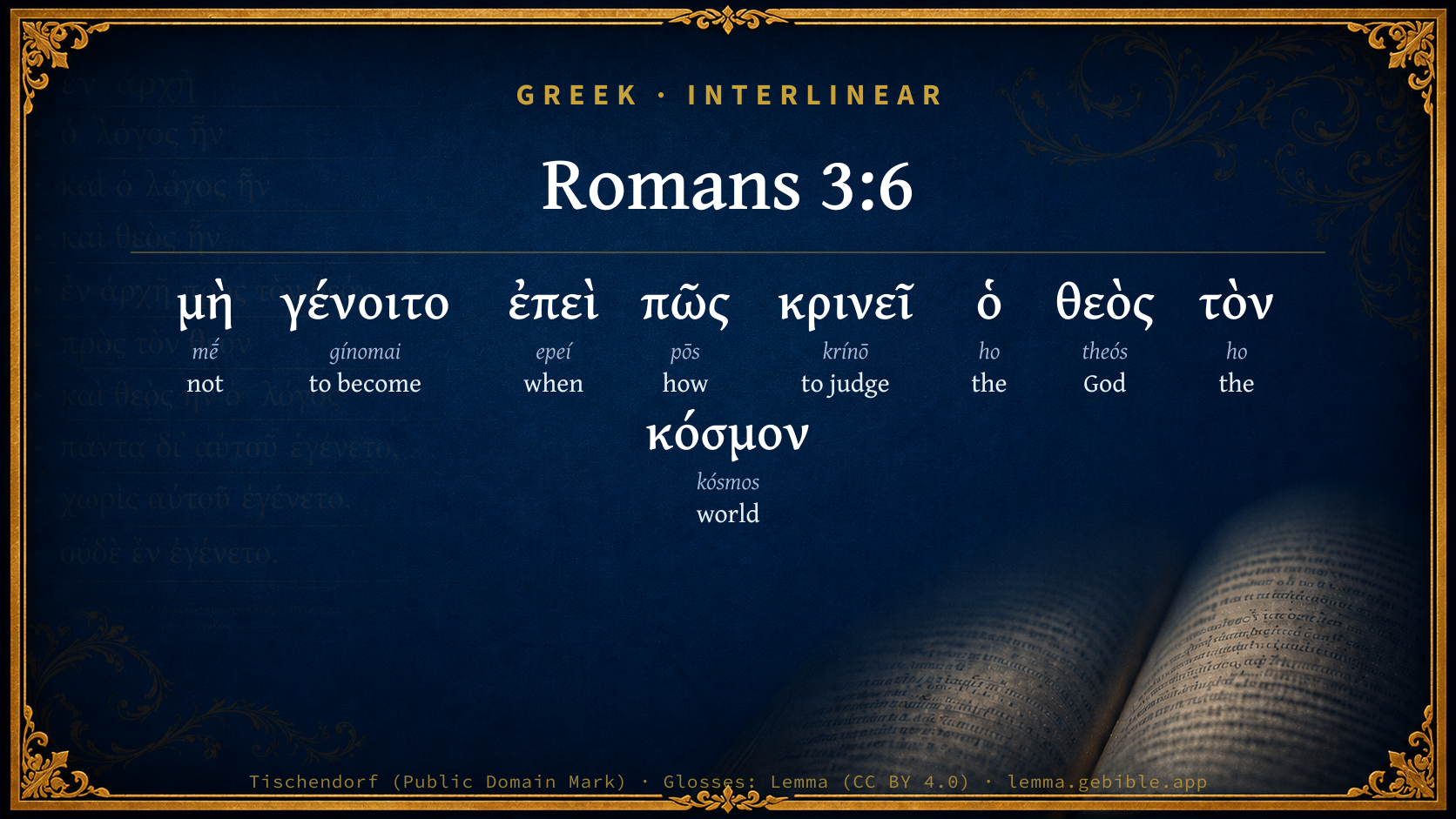
Greek (Tischendorf 8th ed.) Romans 3:6 appears in the Greek New Testament. The text above is from the Tischendorf 8th edition. Each word links to its Strong’s number and a concise gloss. Click any word for its full Thayer’s Greek Lexicon entry.
Download image
Cite this verse

Romans 3:6 (World English Bible). Public Domain. Lemma interlinear Bible study tool, https://lemma.gebible.app/v/romans/3/6.

Show BibTeX & RIS
BibTeX
RIS
English Translation
May it never be! For then how will God judge the world?
World English Bible · Public Domain
Download a study sheet

One document with this verse’s original text, its word-by-word gloss line, the meaning frame, cross-references with their text, attributed commentary, and full source and license credits — printable, and it pastes into notes with its structure intact.

This verse Autodidact and up

Study sheet (.html) Plain text (.txt)

A passage Seminary Student

Up to 50 verses in one chapter. A passage sheet keeps up to 6 commentary sources and 12 cross-references per verse, in the order this page ranks them, and says so on the sheet whenever that leaves anything out. Ask for a single verse and you get the Autodidact verse sheet above.

Everything on this page stays free to read, with no account — the sheet is a download of what is already on screen, not access to it.

Want to remove ads? Support Godless Engineer
Compare translations 3

The same verse in 3 English versions, stacked beneath the original-language interlinear above. Click any original word for its lexicon entry.

Each is an independent rendering of the whole verse — the interlinear is not word-aligned to these translations.

Highlighted words mark where these versions differ — a whole-verse word diff, not a word-by-word alignment.

  • World English Bible Public Domain
    May it never be! For then how will God judge the world?
  • King James Version Public Domain
    God forbid: for then how shall God judge the world?
  • unfoldingWord Literal Text CC BY-SA 4.0
    May it never be! Otherwise, how will God judge the world?

unfoldingWord Literal Text — © unfoldingWord, licensed CC BY-SA 4.0. Word-aligned USFM3 via Door43 (git.door43.org/unfoldingWord/en_ult).

Versions to compare (up to 4)

3 of 4 selected

Show all 19 translations

Every available English version of this verse, each an independent rendering of the whole verse.

  • World English Bible Public Domain
    May it never be! For then how will God judge the world?
  • Berean Standard Bible Public Domain
    Certainly not! In that case, how could God judge the world?
  • Majority Standard Bible Public Domain
    Certainly not! In that case, how could God judge the world?
  • King James Version Public Domain
    God forbid: for then how shall God judge the world?
  • American Standard Version (1901) Public Domain
    God forbid: for then how shall God judge the world?
  • Revised Version (1885) Public Domain
    God forbid: for then how shall God judge the world?
  • Geneva Bible (1599) Public Domain
    God forbid: els how shall God iudge ye world?
  • Douay-Rheims (1899) Public Domain
    (I speak according to man.) God forbid: otherwise how shall God judge this world?
  • Young's Literal Translation Public Domain
    let it not be! since how shall God judge the world?
  • Literal Standard Version CC BY-SA 4.0
    Let it not be! Since how will God judge the world?
  • Unlocked Literal Bible CC BY-SA 4.0
    May it never be! For then how would God judge the world?
  • unfoldingWord Literal Text CC BY-SA 4.0
    May it never be! Otherwise, how will God judge the world?
  • Darby Bible Public Domain
    Far be the thought: since how shall God judge the world?
  • World Messianic Bible Public Domain
    May it never be! For then how will God judge the world?
  • Webster's Bible Public Domain
    By no means: for then how shall God judge the world?
  • Free Bible Version CC BY-SA 4.0
    Of course not! How else could God judge the world?
  • Bible in Basic English Public Domain
    In no way: because if it is so, how is God able to be the judge of all the world?
  • Text-Critical English NT CC BY 4.0
    Certainly not! Otherwise, how could God judge the world?
  • Tyndale New Testament (1534) Public Domain
    God forbid. For how then shall God iudge the worlde?

Literal Standard Version (2020), Covenant Press — licensed CC BY-SA 4.0. Text via the HelloAO Bible API (eBible.org). Unlocked Literal Bible (unfoldingWord) — licensed CC BY-SA 4.0. Text via the HelloAO Bible API (eBible.org). unfoldingWord Literal Text — © unfoldingWord, licensed CC BY-SA 4.0. Word-aligned USFM3 via Door43 (git.door43.org/unfoldingWord/en_ult). Free Bible Version, Dr. Jonathan Gallagher — licensed CC BY-SA 4.0. Text via the HelloAO Bible API (eBible.org).

Word by word

More ways to search: Search by grammar → Find every occurrence → Compare this word →

Practice this passage: Drill this verse → Learn its vocabulary →

About this verse

These counts appear in no published source. They are computed here, from the morphology-tagged text and Lemma’s own curated glosses. What Lemma adds →

9
words
8
distinct lemmas
Pauline Epistles
section

Shared distinctive vocabulary

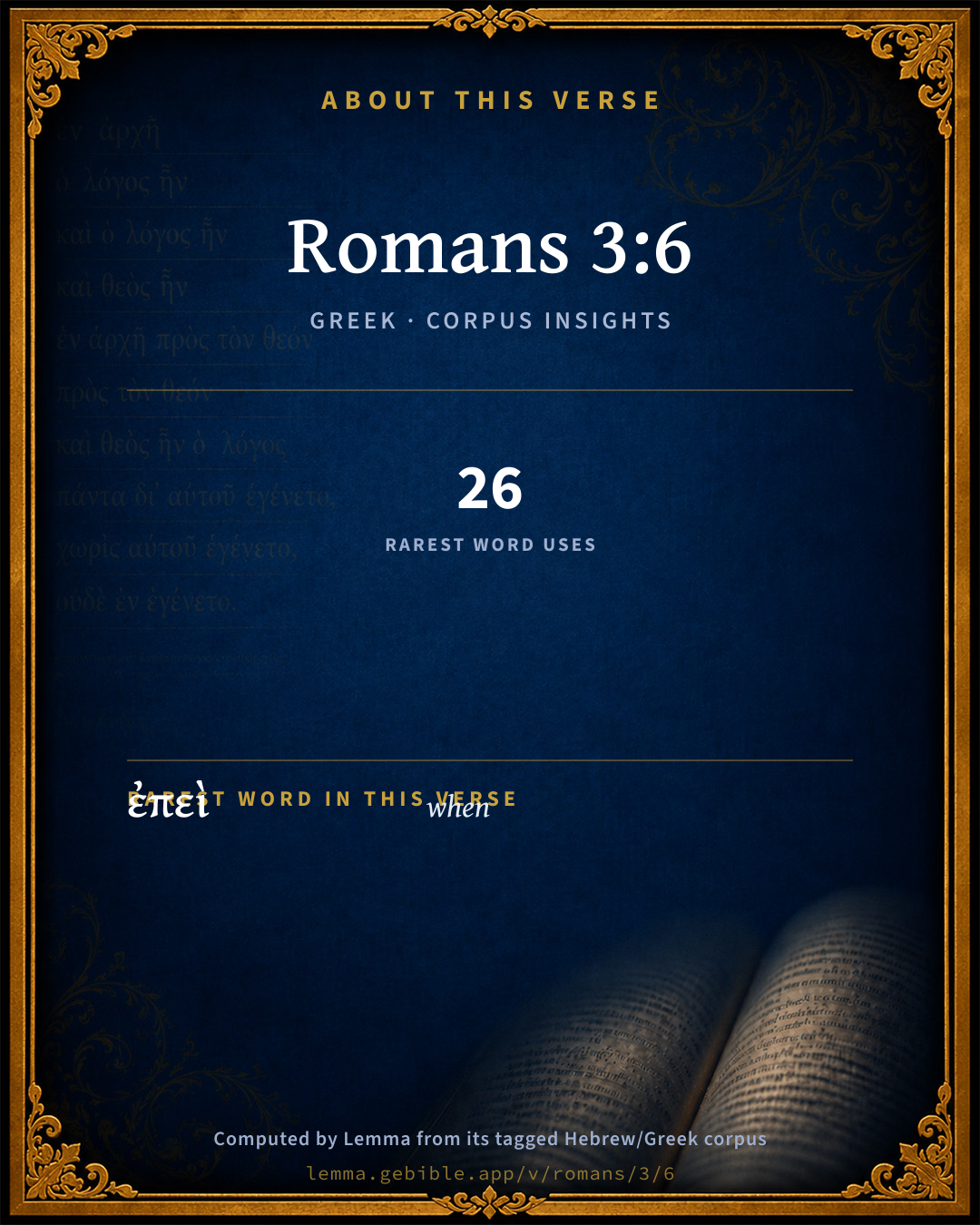
ἐπεὶ when G1893 occurs in 26 verses of the Greek New Testament. Also found in:

Repetition

A word recurs within this verse:

Cross-references

10

Topical passages linked to Romans 3:6 in the Treasury of Scripture Knowledge — connected by theme and wording, ordered by reader-vote popularity; previews shown in the World English Bible.

  • Genesis 18:25 Be it far from you to do things like that, to kill the righteous with the wicked, that so the righteous should be as the wicked. May that be far from you. Shouldn't the Judge of all the earth do right?"
  • Acts 17:31 because he has appointed a day in which he will judge the world in righteousness by the man whom he has ordained; of which he has given assurance to all men, in that he has raised him from the dead."
  • Job 8:3 Does God pervert justice? Or does the Almighty pervert righteousness?
  • Job 34:17–19 Shall even one who hates justice govern? Will you condemn him who is righteous and mighty?--
  • Psalms 9:8 He will judge the world in righteousness. He will administer judgment to the peoples in uprightness.
  • Psalms 50:6 The heavens shall declare his righteousness, For God himself is judge. Selah.
  • Psalms 96:13 Before Yahweh; for he comes, For he comes to judge the earth. He will judge the world with righteousness, The peoples with his truth.
  • Psalms 98:9 Let them sing before Yahweh, For he comes to judge the earth. He will judge the world with righteousness, And the peoples with equity.
  • Romans 2:16 in the day when God will judge the secrets of men, according to my Gospel, by Jesus Christ.
  • Psalms 11:5–7 Yahweh examines the righteous, But the wicked and him who loves violence his soul hates.

Cross-references courtesy of OpenBible.info (CC BY 4.0).

Commentary

Notes on Romans 3:6 from classic Christian and Jewish commentators (each source and its license shown beneath its notes). The classic Christian expositions comment on the surrounding passage and are grouped to its opening verse, so a note may address several verses; the Jewish commentaries on the Tanakh (Rashi and others) are per-verse, so they appear only where the commentator wrote on this verse.

Lemma curates 59 commentaries, every one of them public domain or Creative Commons licensed, each selected and text-cleaned for this edition rather than reprinted as found. About our sources →

Bengel's Gnomon

Johann Albrecht Bengel

Rom 3:6. Ἐπεὶ, otherwise) The consequence is drawn [bound, connected] from the less to the greater, as it ought to be in the case of negatives. If God were to act unrighteously, in taking vengeance on the Jew who acts unrighteously, a thing too absurd to be mentioned, He certainly could not judge the whole world. Affirmatively, the process of reasoning would take this form: He who (justly) Judges the whole world, will doubtless also judge justly in this one particular case. [Vice versa] The conclusion is, in its turn, drawn from the greater to the less at 1Co 6:2.—τὸν κόσμον, the world) For even the unrightousness of the whole world (which is put in opposition to the Jews, at ch. Rom 11:12), commends the righteousness of God; and yet God pronounces, and with justice, the whole world to be unrighteous, Gen 18:25. Nay, in the very judgment, the unrighteousness of man will greatly illustrate the righteousness of God. The Jew acknowledges the righteousness of the Divine judgment regarding the world; but Paul shows that there is the same ground for judgment regarding the unbelieving Jews.

Bengel's Gnomon of the New Testament — English translation (T&T Clark, Edinburgh, 1860) — public domain. Text from a community e-Sword module.

Hodge's Commentary on Romans, Ephesians & First Corinthians

Charles Hodge

Rom_3:6

In answer to the question whether God is unjust in punishing those whose unrighteousness renders his own righteousness the more conspicuous, he says, By no means, since in that case how can God judge the world? There is here an answer to the question, and a proof of the correctness of that answer, There are three views which may be taken of the nature of this proof. The first supposes κόσμος; to mean the Gentiles as distinguished from the Jews. The sense then is: If God cannot punish sin under the circumstances supposed, he cannot even punish the heathen, for their unrighteousness serves to commend his righteousness. This view is clear and satisfactory as far as the argument is concerned, and is adopted by Koppe, Reiche, Olshausen, etc. Besides the pertinency of the argument as thus explained, this interpretation is supported by the frequent use of κόσμος to designate the world in distinction from the Theocracy, or the Church. 1Co_6:9; 1Co_11:32; Rom_11:12; Joh_12:31; 1Jo_4:17 etc. The principal objection to it arises from the difficulties in which it involves the explanation of the following verse. The second view of the passage supposes the argument to rest on the admitted fact that God is the judge of all the earth; if so, he must be just. It is impossible that God should be unjust, if he is to judge the world; but he is to judge the world, therefore he is not unjust. Sumit argumentum ab ipsius Dei officio, says Calvin, quo probet id esse impossibile; judicabit Deus hunc mundum, ergo injustus esse non potest. To the same purpose Grotius says: Nullo modo possumns Deum injustum imaginari quem cum Abrahamo judicem mundi agnoscimus. This view is given also by Tholuck, De Wette, Rückert, Köllner and Meyer. The obvious objection to it is, that it makes the apostle assume the thing to be proved. He says, God cannot be unjust, because he is the judge of the world, and the judge of the world must be just. But it is no more certain that the judge of the world must be just, than that God is just, which is the point to be established. Rückert, in his characteristic assumption of superiority to the apostle, admits that the argument is weak, very weak; but he not the less confidently ascribes it to the apostle. The misapprehension of the argument in this verse arises out of a misapprehension of the previous reasoning, and of the precise point of the objection which is here answered. Paul is not guarding against any false inference from his own reasoning; he is not teaching that though God is seen to be just when he speaks, and clear when he judges, we must not hence infer that he is unjust in punishing the sin which commends his own righteousness, which would be indeed eine erbärmliche Einwendung, (a pitiable subterfuge), as Reiche calls it; but he is answering the objections of the Jews to his doctrine, not their false inferences. To the declaration that they were exposed to condemnation, the Jews pleaded the promise of God, which their unfaithfulness could not render of no effect, and the less so because their unrighteousness would serve to render the righteousness of God the more conspicuous. Paul says on this principle God cannot judge the world. The ground assumed by the Jews might be assumed by all mankind, and if valid in the one case it must be in all. In this view the answer is complete and satisfactory; it is a reductio ad absurdum. The correctness of this explanation is confirmed by what follows.

Charles Hodge — Commentary on Romans (1835), First Corinthians (1857), and Ephesians (1856) — public domain. Text from a community e-Sword module.

Jamieson, Fausset & Brown

Robert Jamieson, A. R. Fausset & David Brown

God forbid; for then how shall God judge the world?--that is, "Far from us be such a thought; for that would strike down all future judgment.

Jamieson, Fausset & Brown — Commentary Critical and Explanatory on the Whole Bible (1871) — public domain (CC PDM 1.0). Text via the HelloAO Bible API.

Adam Clarke's Commentary

Verse 6. APOSTLE. God forbid] μη γενοιτο, by no means. God cannot be unjust; were he unjust, he could not be qualified to judge the world, nor inflict that punishment on the unfaithful Jews, to which I refer.

Adam Clarke's Commentary on the Bible (1810–1826) — public domain. Text from a community e-Sword/MySword module.

John Calvin's Commentaries

6. By no means, etc. In checking this blasphemy he gives not a direct reply to the objection, but begins with expressing his abhorrence of it, lest the Christian religion should even appear to include absurdities so great. And this is more weighty than if he adopted a simple denial; for he implies, that this impious expression deserved to be regarded with horror, and not to be heard. He presently subjoins what may be called an indirect refutation; for he does not distinctly refute the calumny, but gives only this reply, — that the objection was absurd. Moreover, he takes an argument from an office which belongs to God, by which he proves it to be impossible, — God shall judge the world; he cannot then be unjust.

This argument is not derived, so to speak, from the mere power of God, but from his exercised power, which shines forth in the whole arrangement and order of his works; as though he said, — “It is God’s work to judge the world, that is, to rectify it by his own righteousness, and to reduce to the best order whatever there is in it out of order: he cannot then determine any thing unjustly.” And he seems to allude to a passage recorded by Moses, in Genesis 18:25, where it is said, that when Abraham prayed God not to deliver Sodom wholly to destruction, he spoke to this purpose, —

“It is not meet, that thou who art to judge the earth, shouldest destroy the just with the ungodly: for this is not thy work nor can it be done by thee.”

A similar declaration is found in Job 34:17, —

“Should he who hates judgment exercise power?”

For though there are found among men unjust judges, yet this happens, because they usurp authority contrary to law and right, or because they are inconsiderately raised to that eminence, or because they degenerate from themselves. But there is nothing of this kind with regard to God. Since, then, he is by nature judge, it must be that he is just, for he cannot deny himself. Paul then proves from what is impossible, that God is absurdly accused of unrighteousness; for to him peculiarly and naturally belongs the work of justly governing the world. And though what Paul teaches extends to the constant government of God, yet I allow that it has a special reference to the last judgment; for then only a real restoration of just order will take place. But if you wish for a direct refutation, by which profane things of this kind may be checked, take this, and say, “That it comes not through what unrighteousness is, that God’s righteousness becomes more illustrious, but that our wickedness is so surpassed by God’s goodness, that it is turned to serve an end different from that to which it tends.”

John Calvin's Commentaries (1540-1563) — public domain. Text from the Calvin Translation Society English edition (1840s-50s) via the Christian Classics Ethereal Library (ccel.org). Calvin's coverage is partial (roughly two-thirds of the Bible); uncommented books and verses are honest gaps, never fabricated. The 19th-century editor's footnotes and remarks are omitted so the notes are faithfully Calvin's own voice.

Ellicott's Commentary for English Readers

(6) For then how shall God judge the world?—St. Paul considers it a sufficient answer merely to propound this question. He and those to whom he was writing all assumed that there must be a future judgment.

The way in which Bishop Butler deals with the argument from necessity is very similar to this, substituting only present for future judgment. “It is fact that God does govern even brute creatures by the method of rewards and punishments in the natural course of things. And men are rewarded and punished for their actions—punished for actions mischievous to society as being so, punished for vicious actions as such—by the natural instrumentality of each other under the present conduct of Providence,” &c. Hence the necessitarian is in this dilemma: either his opinion is not true, or else it must be capable of being harmonised with these facts. The facts themselves are postulated.

A Bible Commentary for English Readers, edited by Charles John Ellicott (1878–1897) — public domain. Text from a community e-Sword module.

The Cambridge Bible for Schools and Colleges

gen. ed. J. J. S. Perowne

6. how shall God judge the world?] The emphasis is on “judge,” not on “world.” It is needless to suppose the word “world” here to stand in opposition to the Jewish people. The point of the question is, that if God could not righteously punish sin when sin illustrated His glory, not only would He not punish those particular sins, but He would (as to principle) entirely abdicate His office as “Judge of all the earth.” All sin, in one respect or another, illustrates His glory, if only as a black contrast: therefore, in no case would punishment be just!—On the truth that the Lord is the “Judge of all” the Apostle falls back as on a “first ground.”

The Cambridge Bible for Schools and Colleges (gen. ed. J. J. S. Perowne; Cambridge University Press, 1878–1918) — public domain. Text from a community e-Sword module.

John Gill's Exposition

God forbid, for then how shall God judge the world? "far be it"; such a notion is detestable and abominable, nor can it be fairly deduced from what is asserted; for it is the unrighteousness of his own people, on whom he takes no vengeance personally, and not the unrighteousness of others, on whom he does take vengeance, which commends his righteousness; and supposing it was that of others, God cannot be unrighteous in performing his threatenings, in a way of righteousness: moreover, unrighteousness is sin, and does not of itself but by accident, illustrate the righteousness of God; wherefore God is not unjust in punishing it; for how should God "judge the world?" whereas nothing is more certain than that he will do it, and that this will be done in righteousness; which could not be, was he unrighteous in taking vengeance; which will be one considerable part of that righteous judgment.

God forbid, for then how shall God judge the world? "far be it"; such a notion is detestable and abominable, nor can it be fairly deduced from what is asserted; for it is the unrighteousness of his own people, on whom he takes no vengeance personally, and not the unrighteousness of others, on whom he does take vengeance, which commends his righteousness; and supposing it was that of others, God cannot be unrighteous in performing his threatenings, in a way of righteousness: moreover, unrighteousness is sin, and does not of itself but by accident, illustrate the righteousness of God; wherefore God is not unjust in punishing it; for how should God "judge the world?" whereas nothing is more certain than that he will do it, and that this will be done in righteousness; which could not be, was he unrighteous in taking vengeance; which will be one considerable part of that righteous judgment.

Romans 3:7

rom 3:7

rom 3:7

rom 3:7For if the truth of God,.... The "truth of God" is the same with "the righteousness of God", Rom 3:5, and means his faithfulness; of which it is hypothetically said, it

hath more abounded; or has been more illustrated,

through my lie to his glory: nothing is more opposite to truth than a lie; a lie of itself can never be of any advantage to truth, or to the God of truth; nothing is more contrary to the nature of God, and more abominable to him; a lie is of the devil, and punishable with eternal death; wherefore it may seem strange, that the truth of God should abound through it to his glory: now let it be observed, that the apostle is not speaking of himself, nor of his lie of unbelief, in his state of unregeneracy; but in the person of a sinful man, "for every man is a liar", Rom 3:4, as he says, "I speak as a man", Rom 3:5; representing a wicked man, who from what was before said, might collect this as the sense of it, that the truth of God is illustrated by the lies of men: and so much may be owned as the apostle's sense, that the truth of God is commended, illustrated, and made to abound, when it is asserted, that he is true and faithful, and every man is a liar, fallacious, and deceitful; "let God be true, and every man a liar", Rom 3:4, moreover, the truth of God may be allowed to abound through the lies of men, in a comparative sense, the one being set against the other; and so as contraries do, illustrate each other: this may be assented to, as that sometimes a lie has been overruled by God, for the accomplishing of his purposes and promises, in which his truth and faithfulness have been displayed, as in the cases of Jacob and the Egyptian midwives; but then this does not arise from its nature and tendency, but from the overruling wisdom and providence of God, and therefore not to be excused hereby from sin; and consequently the inference from it is not just, that therefore "no man can, or ought to be, judged as a sinner"; since his sin turns to such account, as to make for the glory of God, which is intimated in the question:

why yet am I also judged as a sinner? if this be the case, I ought not to be reckoned a sinner, or to be treated as such here, or judged and condemned as one hereafter, which is a most wicked, as well as weak consequence; for though God is true and faithful to his promises, notwithstanding the sins of his people, which are as a foil, to set off the lustre of his truth the more, yet their sins are nevertheless sins, and are taken notice of by him as such, and they are corrected for them; and however God may overrule, in a providential way, the sins of others for his glory, this is no excuse for their sins, nor will it be an exemption of them from punishment. This is the sense of the passage; unless by "the truth of God" should be meant, the Gospel, the word of truth, which is of God; and which through the apostle's "lie", as the Jews might call his ministration of it, "abounded to" the "glory" of God; being spread far and near, and made useful for the conversion of sinners, for turning men from darkness to light, and from the power of Satan unto God; and for the planting of churches in the Gentile world, as well as in Judea; which much conduced to the honour of God, and the interest of true religion: and then the meaning of the last clause is, "why yet am I also judged as a sinner?" why am I accounted and condemned as an heretic? as an apostate from the faith? as he was by the Jews, and who are used to call heretics sinners: so "the sinner" in Ecc 7:26 is thus interpreted (p), "these are the heretics": and elsewhere it (q) is observed, that concerning the heretics it is said, Pro 10:7, "the name of the wicked shall rot": and I very much suspect this to be the sense of the word in Joh 9:24, "we know that this man is a sinner"; an heretic, a man of bad principles; and in Joh 9:31; "now we know that God heareth not sinners"; men of corrupt minds; since this character stands opposed to a worshipper of the God of Israel.

(p) Midrash Kohelet, fol. 77. 1. (q) Juchasin, fol. 130. 2.

John Gill's Exposition of the Whole Bible (1746–1763) — public domain (CC PDM 1.0). Text via the HelloAO Bible API.

Trapp's Complete Commentary

John Trapp

6 God forbid: for then how shall God judge the world?

Ver. 6. I speak as a man] q.d. Is there not such language heard in some men’s hearts?

For then how shall God judge the world] How shall every transgression and disobedience receive a just recompence of reward? Heb 2:2. God’s will is the absolute rule of right, nec tantum recta, sed regula. (Bonav.)

John Trapp, A Commentary or Exposition upon All the Books of the Old and New Testament (1647–1656) — public domain. Text from a community e-Sword module.

Albert Barnes' Notes on the Bible

God forbid - Note, Rom 3:4.

For then - If it be admitted that it would be unjust for God to inflict punishment.

How shall God ... - How will it be right or consistent for him to judge the world.

Judge - To “judge” implies the possibility and the correctness of “condemning” the guilty; for if it were not right to condemn them, judgment would be a farce. This does not mean that God would condemn all the world; but that the fact of judging people implied the possibility and propriety of condemning those who were guilty. It is remarkable that the apostle does not attempt to explain how it could be that God could take occasion from the sins of people to promote his glory; nor does he even admit the fact; but he meets directly the objection. To understand the force of his answer, it must be remembered that it was an admitted fact, a fact which no one among the Jews would call in question, that God would judge the world. This fact was fully taught in their own writings, Gen 18:25; Ecc 12:14; Ecc 11:9. It was besides an admitted point with them that God would condemn the pagan I world; and perhaps the term “world” here refers particularly to them.

But how could this be if it were not right for God to inflict punishment at all? The inference of the objector, therefore, could not be true; though the apostle does not tell us how it was consistent to inflict punishment for offences from which God took occasion to promote his glory. It may be remarked, however, that God will judge offences, not from what he may do in overruling them, but from the nature of the crime itself. The question is not, what good God may bring out of it, but what does the crime itself deserve? what is the character of the offender? what was his intention? It is not what God may do to overrule the offence when it is committed. The just punishment of the murderer is to be determined by the Law, and by his own desert; and not from any reputation for integrity and uprightness which the judge may manifest on his trial; or from any honor which may accrue to the police for detecting him; or any security which may result to the commonwealth from his execution; or from any honor which the Law may gain as a just law by his condemnation. Nor should any of these facts and advantages which may result from his execution, be pleaded in bar of his condemnation. So it is with the sinner under the divine administration. It is indeed a truth Psa 76:10 that the wrath of man shall praise God, and that he will take occasion from people’s wickedness to glorify himself as a just judge and moral governor; but this will be no ground of acquittal for the sinner.

Albert Barnes' Notes on the Bible (1834–1885) — public domain. Text from a community e-Sword/MySword module.

Haydock's Catholic Bible Commentary

===============================

[BIBLIOGRAPHY]

St. John Chrysostom on the words: how shall God judge the world? Greek: atopon atopo luei.

George Leo Haydock (1774–1849), Haydock's Catholic Family Bible and Commentary, 1859 edition — public domain. Excludes Psalms (Douay-Rheims chapter numbering differs from Protestant) and Deuterocanonical books (Catholic canon only).

Matthew Poole's English Annotations

God forbid; he rejects the cavil with his usual note of detestation, as not thinking it worthy of answer.

For then how shall God judge the world? q.d. If God were in the least unrighteous, how could he govern the world at present, and judge it at last in righteousness? Which is affirmed, Psa 96:13; 98:9. Or, how could he be God and supreme, if he were not just by his nature and essence, and his will the very rule of righteousness: see Gen 18:25; Job 34:12.

Matthew Poole's English Annotations on the Holy Bible (1683–1685) — public domain. Text from a community e-Sword/MySword module.

Whedon's Commentary on the Bible

Daniel D. Whedon

6. How… judge the world?—For this plea, by which the Jew makes himself so righteous a sinner, cannot be monopolized by the Jew alone. If his sin is made righteousness by the fact that it brings the righteousness of God into powerful relief by the contrast, then all sin performs the same office, and all sin is then righteous, and God can condemn no sinner in the world.

There are those who argue that sin is for the best good of the universe. They thus make sin a sort of good, a dark-bright thing. They might better say that the permission of free agency and the allowance of the free agent, by whom sin is able to be committed, is for the best good of the system of the world.

The apostle, however, does not entertain the metaphysical question. It is sufficient for him to remind the Jew that as to the excellence and uncondemnability of his sin he stands just on the same footing with the rest of the world. If God judge the world for sin he will judge the Jew.

Daniel D. Whedon (gen. ed.), Commentary on the Old and New Testaments (1874–1909) — public domain. Text from a community e-Sword module.

John Wesley's Explanatory Notes

God forbid - By no means. If it were unjust in God to punish that unrighteousness which is subservient to his own glory, how should God judge the world - Since all the unrighteousness in the world will then commend the righteousness of God.

John Wesley, Explanatory Notes Upon the Whole Bible (1754–1765) — public domain. Text via the GEBible commentary corpus.

Scofield Reference Notes

C. I. Scofield

world

kosmos = mankind. (See Scofield "Mat 4:8").

The Scofield Reference Bible (1917 edition), notes by C. I. Scofield — public domain. Text from a community e-Sword module.

Godbey's Commentary on the New Testament

William B. Godbey

6. “It could not be so; then how will God judge the world?” The apostle is answering the allegation of his opponent, who would excuse himself on the hypothesis that his failure has in no way affected the perfect purity and glory of the divine administration, since God, absolutely immutable, verifies and perfects the unimpeachable integrity, honor and majesty of His administration, despite all the irregularities and failures on the part of the world, whether religious or irreligious.

William B. Godbey, Commentary on the New Testament (1896–1900) — public domain. Text from a community e-Sword module.

McGarvey & Pendleton's Commentaries

J. W. McGarvey

God forbid: for then how shall God judge the world?

J. W. McGarvey (with Philip Y. Pendleton), Commentaries on the New Testament (The Fourfold Gospel, 1914; Acts; and the epistles) — public domain. Text from a community e-Sword/MySword module.

The People's New Testament

B. W. Johnson

6. God forbid. Rather, “By no means.” How shall God judge the world? How, if no sin is punished which God turns to some good purpose, shall he judge all men according to their deeds?

B. W. Johnson's The People's New Testament with Notes (1889–1891) — public domain. Electronic text from the Christian Classics Ethereal Library (CCEL) ThML edition.

Cambridge Greek Testament for Schools and Colleges

6. ἐπεὶ, ‘or else,’ ‘otherwise’; cf. Field on Rom 11:22; cf. Rom 11:6; 1Co 14:16; 1Co 15:29; Heb 9:17. A good classical use; cf. Wetstein. Only in S. Paul and Heb.

πῶς κρινεῖ κ.τ.λ. It is a fundamental postulate that GOD is the Judge.

Cambridge Greek Testament for Schools and Colleges (Cambridge University Press, 1896; 21 vols, various authors incl. Carr, Maclear, Plummer, Farrar, Lumby, Moule, M. R. James, Simcox) — public domain. Text from a community e-Sword module.

Alford’s Greek Testament

Henry Alford

6.] He does not enter into the objection and answer it in detail, but rejects at once the idea of God being unjust, alluding probably to Gen 18:25, by recalling to mind, that the Judge of all the earth must do right.

ἐπεί, for (i.e. ‘if it were so,’ ‘alioquin’).

τὸν κόσμον is not the Gentiles (Bengel, Reiche, Olsh., al.), nor is the respondent in ver. 7a Gentile (Olsh., at., not Bengel), but one of the ἡμῶν in ver. 5, only individualized to bring out one such case of pretended injustice more strikingly.

Henry Alford, The Greek Testament (1849–1861) — public domain. Text from a community e-Sword module.

International Critical Commentary

6. ἐπεὶ πῶς κρινεῖ: St. Paul and his readers alike held as axiomatic the belief that God would judge the world. But the objection just urged was inconsistent with that belief, and therefore must fall to the ground.

ἑπεί: ‘since, if that were so, if the inflicting of punishment necessarily implied injustice.’ Ἐπεί gets the meaning ‘if so,’ ‘if not’ (‘or else’), from the context, the clause to which it points being supposed to be repeated: here ἐπεί sc. εἰ ἄδικος ἔσται ὁ ἐπιφέρων τὴν ὀργήν (cf. Buttmann, Gr. of N. T. Gk. p. 359).

τὸν κόσμον: all mankind.

International Critical Commentary — older volumes (1896–1929), various authors — public domain. Text from a community e-Sword module.

Lesson kit

Teaching starters — assembled from the data on this page, not authored interpretation. Every prompt links to the verse data it draws on. Edit before teaching.

Romans, in the Pauline Epistles, opens this verse with 9 words (8 distinct Greek lemmas). Its most distinctive word is epeí (“when”). A historical commentator’s framing appears above. Read the whole chapter for the surrounding context.

Discussion questions

  1. What does “when” (epeí) contribute to the verse as a whole?
  2. How does Matthew 18:32, which shares the word «when», read alongside this verse?
  3. What does the repetition of “the” (2× in this one verse) do in this verse?
  4. These translations render this verse differently. What is at stake in choosing one wording over another?
  5. Compare how Bengel's Gnomon and Hodge's Commentary on Romans, Ephesians & First Corinthians read this verse. Where do they agree or differ?

Things to notice

  • These translations choose different wording for 6 words in this verse.
  • “the” occurs 2× in this single verse.
  • 8 distinct Greek lemmas span 9 words in this verse.

Reading settings

Reading text

Shown beneath each verse's original-language words.

Old Testament
Old Testament edition

Read the OT as the Masoretic Hebrew (MT) or the Greek Septuagint (LXX).

English shown for the Greek Septuagint (in the Hebrew ↔ Greek comparison).

Comparing translations? Open the Compare panel on any verse page to stack up to four side by side.