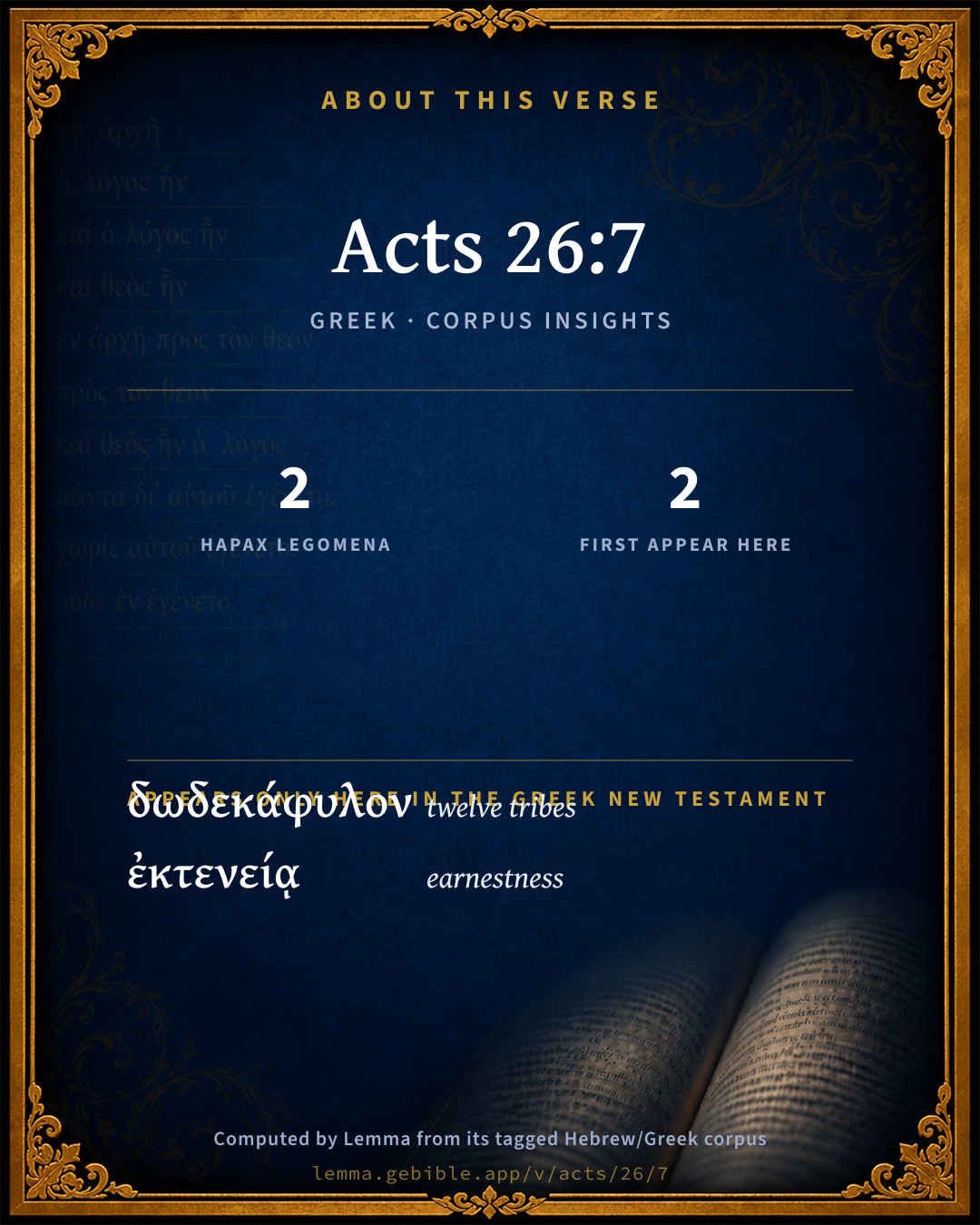
Acts 26:7

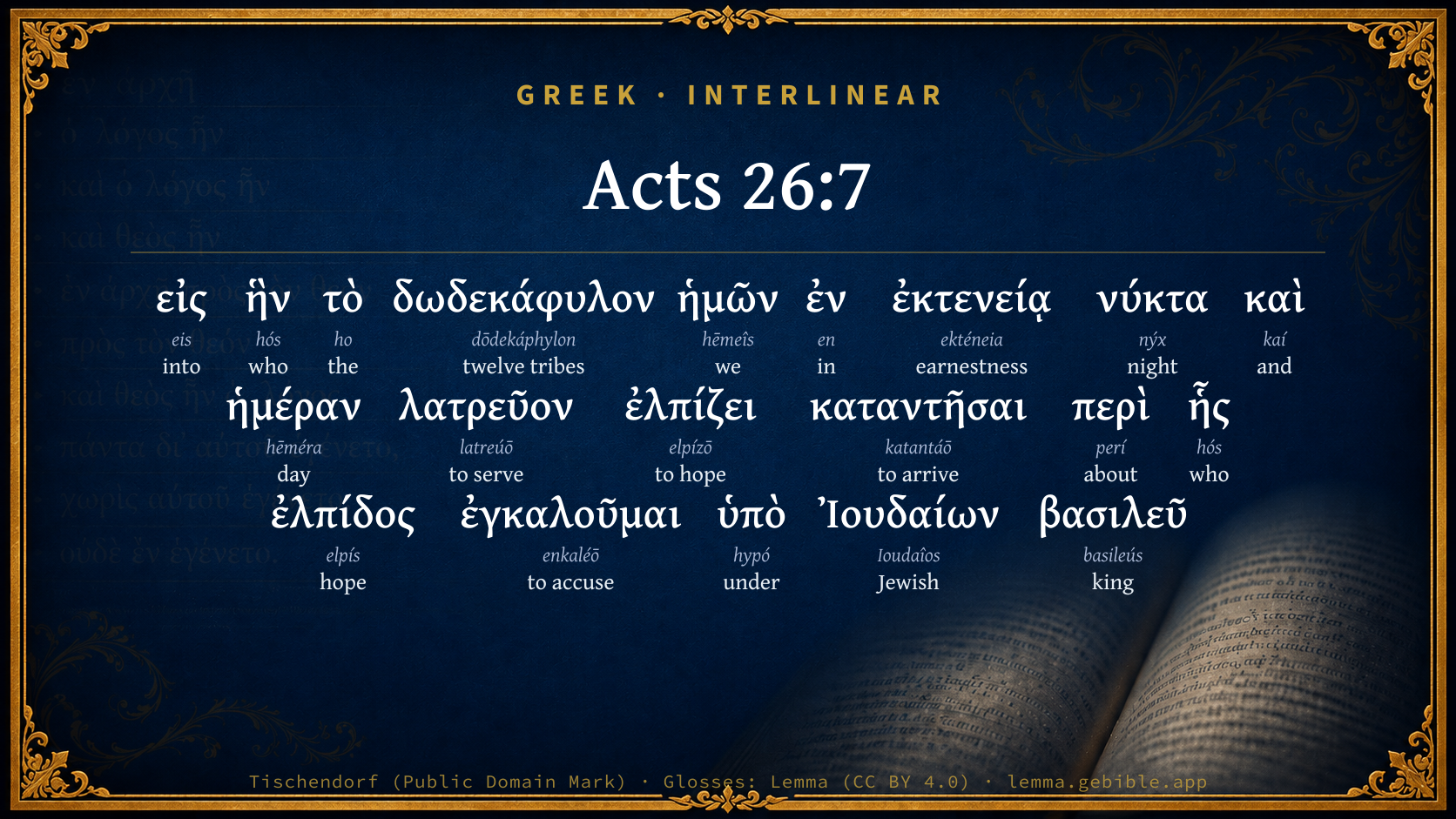
Greek (Tischendorf 8th ed.) Acts 26:7 appears in the Greek New Testament. The text above is from the Tischendorf 8th edition. Each word links to its Strong’s number and a concise gloss. Click any word for its full Thayer’s Greek Lexicon entry.
Download image
Cite this verse

Acts 26:7 (World English Bible). Public Domain. Lemma interlinear Bible study tool, https://lemma.gebible.app/v/acts/26/7.

Show BibTeX & RIS
BibTeX
RIS
English Translation
which our twelve tribes, earnestly serving night and day, hope to attain. Concerning this hope I am accused by the Jews, King Agrippa!
World English Bible · Public Domain
Highlights
  • 2 hapax legomena — only here in the Greek New Testament
  • 2 first appearances in the Greek New Testament
Full analysis ↓
Download a study sheet

One document with this verse’s original text, its word-by-word gloss line, the meaning frame, cross-references with their text, attributed commentary, and full source and license credits — printable, and it pastes into notes with its structure intact.

This verse Autodidact and up

Study sheet (.html) Plain text (.txt)

A passage Seminary Student

Up to 50 verses in one chapter. A passage sheet keeps up to 6 commentary sources and 12 cross-references per verse, in the order this page ranks them, and says so on the sheet whenever that leaves anything out. Ask for a single verse and you get the Autodidact verse sheet above.

Everything on this page stays free to read, with no account — the sheet is a download of what is already on screen, not access to it.

Want to remove ads? Support Godless Engineer
Compare translations 3

The same verse in 3 English versions, stacked beneath the original-language interlinear above. Click any original word for its lexicon entry.

Each is an independent rendering of the whole verse — the interlinear is not word-aligned to these translations.

Highlighted words mark where these versions differ — a whole-verse word diff, not a word-by-word alignment.

  • World English Bible Public Domain
    which our twelve tribes, earnestly serving night and day, hope to attain. Concerning this hope I am accused by the Jews, King Agrippa!
  • King James Version Public Domain
    Unto which promise our twelve tribes, instantly serving God day and night, hope to come. For which hope's sake, king Agrippa, I am accused of the Jews.
  • unfoldingWord Literal Text CC BY-SA 4.0
    to which our 12 tribes hope to attain, serving in earnestness night and day, concerning which hope I am being accused by the Jews, O King.

unfoldingWord Literal Text — © unfoldingWord, licensed CC BY-SA 4.0. Word-aligned USFM3 via Door43 (git.door43.org/unfoldingWord/en_ult).

Versions to compare (up to 4)

3 of 4 selected

Show all 19 translations

Every available English version of this verse, each an independent rendering of the whole verse.

  • World English Bible Public Domain
    which our twelve tribes, earnestly serving night and day, hope to attain. Concerning this hope I am accused by the Jews, King Agrippa!
  • Berean Standard Bible Public Domain
    the promise our twelve tribes are hoping to realize as they earnestly serve God day and night. It is because of this hope, O king, that I am accused by the Jews.
  • Majority Standard Bible Public Domain
    the promise our twelve tribes are hoping to see fulfilled as they earnestly serve God day and night. It is because of this hope, O King Agrippa, that I am accused by the Jews.
  • King James Version Public Domain
    Unto which promise our twelve tribes, instantly serving God day and night, hope to come. For which hope's sake, king Agrippa, I am accused of the Jews.
  • American Standard Version (1901) Public Domain
    unto which `promise' our twelve tribes, earnestly serving `God' night and day, hope to attain. And concerning this hope I am accused by the Jews, O king!
  • Revised Version (1885) Public Domain
    unto which promise our twelve tribes, earnestly serving God night and day, hope to attain. And concerning this hope I am accused by the Jews, O king!
  • Geneva Bible (1599) Public Domain
    Whereunto our twelue tribes instantly seruing God day and night, hope to come: for the which hopes sake, O King Agrippa, I am accused of the Iewes.
  • Douay-Rheims (1899) Public Domain
    Unto which, our twelve tribes, serving night and day, hope to come. For which hope, O king, I am accused by the Jews.
  • Young's Literal Translation Public Domain
    to which our twelve tribes, intently night and day serving, do hope to come, concerning which hope I am accused, king Agrippa, by the Jews;
  • Literal Standard Version CC BY-SA 4.0
    to which our twelve tribes, intently serving night and day, hope to come, concerning which hope I am accused, King Agrippa, by the Jews;
  • Unlocked Literal Bible CC BY-SA 4.0
    For this is the promise that our twelve tribes sought to receive as they earnestly worshiped God night and day. It is for this certain hope, King Agrippa, that the Jews accuse me.
  • unfoldingWord Literal Text CC BY-SA 4.0
    to which our 12 tribes hope to attain, serving in earnestness night and day, concerning which hope I am being accused by the Jews, O King.
  • Darby Bible Public Domain
    to which our whole twelve tribes serving incessantly day and night hope to arrive; about which hope, O king, I am accused of [the] Jews.
  • World Messianic Bible Public Domain
    which our twelve tribes, earnestly serving night and day, hope to attain. Concerning this hope I am accused by the Judeans, King Agrippa!
  • Webster's Bible Public Domain
    To which promise our twelve tribes, assiduously serving God day and night, hope to come. For which hope's sake, king Agrippa, I am accused by the Jews.
  • Free Bible Version CC BY-SA 4.0
    that our twelve tribes hoped to receive as they continually dedicated themselves in God's service. Yes, it's because of this hope that I'm accused by the Jews, Your Majesty!
  • Bible in Basic English Public Domain
    For the effecting of which our twelve tribes have been working and waiting night and day with all their hearts. And in connection with this hope I am attacked by the Jews, O king!
  • Text-Critical English NT CC BY 4.0
    a promise that our twelve tribes hope to attain as they earnestly serve him night and day. Regarding this hope, King Agrippa, I am being accused by the Jews.
  • Tyndale New Testament (1534) Public Domain
    vnto which promes oure.xii. tribes instantly servynge God daye and nyght hope to come. For which hopes sake kynge Agrippa am I accused of the Iewes.

Literal Standard Version (2020), Covenant Press — licensed CC BY-SA 4.0. Text via the HelloAO Bible API (eBible.org). Unlocked Literal Bible (unfoldingWord) — licensed CC BY-SA 4.0. Text via the HelloAO Bible API (eBible.org). unfoldingWord Literal Text — © unfoldingWord, licensed CC BY-SA 4.0. Word-aligned USFM3 via Door43 (git.door43.org/unfoldingWord/en_ult). Free Bible Version, Dr. Jonathan Gallagher — licensed CC BY-SA 4.0. Text via the HelloAO Bible API (eBible.org).

Word by word

More ways to search: Search by grammar → Find every occurrence → Compare this word →

Practice this passage: Drill this verse → Learn its vocabulary →

δωδεκάφυλον
dōdekáphylon
G1429
“twelve tribes”
Noun, Nominative, Singular, Neuter
Part of Speech
Noun
Case
Nominative
Number
Singular
Gender
Neuter
Full Thayer's Definition

Origin: from G1427 and G5443

TDNT: 07:21,2

1. the twelve tribes, used collectively of the Israelitish people, as consisting of the twelve tribes
  1. εἰς eis G1519 “into” Preposition
  2. ἣν hós G3739 “who” Relative pronoun, Accusative, Singular, Feminine
  3. τὸ ho G3588 “the” Article, Nominative, Singular, Neuter
  4. ἡμῶν hēmeîs G2249 “we” Personal pronoun, 1st person, Genitive, Plural
  5. ἐν en G1722 “in” Preposition
  6. ἐκτενείᾳ ekténeia G1616 “earnestness” Noun, Dative, Singular, Feminine
  7. νύκτα nýx G3571 “night” Noun, Accusative, Singular, Feminine
  8. καὶ kaí G2532 “and” Conjunction
  9. ἡμέραν hēméra G2250 “day” Noun, Accusative, Singular, Feminine
  10. λατρεῦον latreúō G3000 “to serve” Verb, Present, Active, Participle, Nominative, Singular, Neuter
  11. ἐλπίζει elpízō G1679 “to hope” Verb, Present, Active, Indicative, 3rd person, Singular
  12. καταντῆσαι katantáō G2658 “to arrive” Verb, Aorist, Active, Infinitive
  13. περὶ perí G4012 “about” Preposition
  14. ἧς hós G3739 “who” Relative pronoun, Genitive, Singular, Feminine
  15. ἐλπίδος elpís G1680 “hope” Noun, Genitive, Singular, Feminine
  16. ἐγκαλοῦμαι enkaléō G1458 “to accuse” Verb, Present, Passive, Indicative, 1st person, Singular
  17. ὑπὸ hypó G5259 “under” Preposition
  18. Ἰουδαίων Ioudaîos G2453 “Jewish” Adjective, Genitive, Plural, Masculine
  19. βασιλεῦ basileús G935 “king” Noun, Vocative, Singular, Masculine

About this verse

These counts appear in no published source. They are computed here, from the morphology-tagged text and Lemma’s own curated glosses. What Lemma adds →

20
words
19
distinct lemmas
Acts
section

Notable vocabulary

2 hapax legomena — words that appear only here in the entire Greek New Testament:

  • δωδεκάφυλον twelve tribes G1429
  • ἐκτενείᾳ earnestness G1616

First appearance in Scripture

These words make their first canonical appearance in the Greek New Testament here:

  • δωδεκάφυλον twelve tribes G1429
  • ἐκτενείᾳ earnestness G1616

Shared distinctive vocabulary

ἐγκαλοῦμαι to accuse G1458 occurs in 7 verses of the Greek New Testament. Also found in:

Repetition

A word recurs within this verse:

Cross-references

16

Topical passages linked to Acts 26:7 in the Treasury of Scripture Knowledge — connected by theme and wording, ordered by reader-vote popularity; previews shown in the World English Bible.

  • James 1:1 James, a servant of God and of the Lord Jesus Christ, to the twelve tribes which are in the Dispersion: Greetings.
  • Philippians 3:11 if by any means I may attain to the resurrection from the dead.
  • 1 Timothy 5:5 Now she who is a widow indeed, and desolate, has her hope set on God, and continues in petitions and prayers night and day.
  • Ezra 6:17 They offered at the dedication of this house of God one hundred bulls, two hundred rams, four hundred lambs; and for a sin-offering for all Israel, twelve male goats, according to the number of the tribes of Israel.
  • Matthew 19:28 Jesus said to them, "Most assuredly I tell you that you who have followed me, in the regeneration when the Son of Man will sit on the throne of his glory, you also will sit on twelve thrones, judging the twelve tribes of Israel.
  • Luke 22:30 that you may eat and drink at my table in my Kingdom. You will sit on thrones, judging the twelve tribes of Israel."
  • 1 Thessalonians 3:10 night and day praying exceedingly that we may see your face, and may perfect that which is lacking in your faith?
  • Ezra 8:35 The children of the captivity, who had come out of exile, offered burnt offerings to the God of Israel, twelve bulls for all Israel, ninety-six rams, seventy-seven lambs, and twelve male goats for a sin-offering: all this was a burnt offering to Yahweh.
  • Psalms 134:1–2 Look! Praise Yahweh, all you servants of Yahweh, Who stand by night in Yahweh's house!
  • Psalms 135:2 You who stand in the house of Yahweh, In the courts of our God's house.
  • Luke 2:25 Behold, there was a man in Jerusalem whose name was Simeon. This man was righteous and devout, looking for the consolation of Israel, and the Holy Spirit was on him.
  • Luke 2:36–38 There was one Anna, a prophetess, the daughter of Phanuel, of the tribe of Asher (she was of a great age, having lived with a husband seven years from her virginity,
  • Luke 7:19–20 John, calling to himself two of his disciples, sent them to Jesus, saying, "Are you the one who is coming, or should we look for another?"
  • Acts 20:31 Therefore watch, remembering that for a period of three years I didn't cease to admonish everyone night and day with tears.
  • Acts 26:2 "I think myself happy, King Agrippa, that I am to make my defense before you this day concerning all the things that I am accused by the Jews,
  • Revelation 7:4–8 I heard the number of those who were sealed, one hundred forty-four thousand, sealed out of every tribe of the children of Israel:

Cross-references courtesy of OpenBible.info (CC BY 4.0).

Where the printed editions differ

1 variant

Places in this verse where the major printed Greek editions disagree on the wording in a way that affects the translation — a comparison of editions, not a manuscript-by-manuscript collation. The editions are the modern critical texts (Nestlé-Aland 28/27, SBL, Westcott-Hort, Tregelles, Tyndale House) and the traditional texts behind the KJV (the Textus Receptus and the Byzantine/Majority text). It is not a claim about which reading is original.

  1. Extra text
    Ἀγρίππα

    “Agrippa”

    In TRByz Not in NA28NA27TynSBLWHTreg

    Ἀγρίππα (Agrippa) 'Agrippa' is only in traditional manuscripts (TR+Byz)

Textual data: Translators Amalgamated Greek New Testament (STEPBible TAGNT) · CC BY 4.0.

Commentary

Notes on Acts 26:7 from classic Christian and Jewish commentators (each source and its license shown beneath its notes). The classic Christian expositions comment on the surrounding passage and are grouped to its opening verse, so a note may address several verses; the Jewish commentaries on the Tanakh (Rashi and others) are per-verse, so they appear only where the commentator wrote on this verse.

Lemma curates 59 commentaries, every one of them public domain or Creative Commons licensed, each selected and text-cleaned for this edition rather than reprinted as found. About our sources →

Bengel's Gnomon

Johann Albrecht Bengel

Act 26:7. Εἰς ἣν, unto which) hope.—τὸ δωδεκάφυλον the twelve tribes) Even the Ten tribes had in considerable numbers (a good part of them) returned from the East, but they had passed from that διασπορὰ into the διασπορὰ, of which Jas 1:1 and 1Pe 1:1 speak. For the Ten tribes had not been in the first instance carried away into those localities which James and Peter, in the passages quoted, refer to (“Pontus, Galatia, Cappadocia, Asia, Bithynia”). All had the hope of the resurrection.—καταντῆσαι, to attain) A verb frequently used by Paul: Eph 4:13, “Till we all come (καταντήσωμεν) to the unity of the faith;” Php 3:11. The whole of our religion tends towards the future.

Bengel's Gnomon of the New Testament — English translation (T&T Clark, Edinburgh, 1860) — public domain. Text from a community e-Sword module.

Expositor's Greek Testament

ed. W. Robertson Nicoll

Act 26:7 . εἰς ἣν : unto which promise, not spem (Grotius, Bengel), καταντῆσαι εἰς , cf. the same construction with the same verb, Phi 3:11 , Eph 4:13 , only in Luke and Paul, but never by the former elsewhere in metaphorical sense; in classical Greek after verbs of hoping we should have had a future, but in N.T. generally aorist infinitive, Viteau, Le Grec du N.T. , p. 154 (1893). τὸ δωδεκάφυλον : here only in biblical Greek; perhaps used after the mention of the fathers, as the heads of the tribes; for the word cf. Prot. Jac. , i., 3, Clem. Rom., Cor [399] , Leviticus , 6 ( cf. xxxi. 4), and Orac. Syb. , λαὸς ὁ δωδεκάφυλος ; the expression was full of hope, and pointed to a national reunion under the Messiah; for the intensity of this hope, and of the restoration of the tribes of Israel, see on Act 3:21 (p. 115), and references in Act 26:6 , Edersheim, Jewish Social Life , p. 67, and especially Psalms of Solomon , 17:28, 30, 50. ἐν ἐκτενείᾳ , cf. Act 12:5 , 2Ma 14:38 , 3Ma 6:41 , Jdg 4:9 (twice?); Cic., Ad Att. , x., 17, 1. See Hatch, u. s. , p. 12. νύκτα καὶ ἡμέραν , cf. Act 20:31 , also used by Paul; elsewhere in his Epistles five times, and once in Mar 5 in genitive, 1Th 2:9 ; 1Th 3:10 ; 2Th 3:8 ; 1Ti 5:5 ; 2Ti 1:3 ; Mar 5:5 . The precise phrase in the accusative also occurs in Luk 2:37 , Mar 4:25 . λατρεῦον , cf. Luk 2:37 , joined with νύκτα καὶ ἡμ . as here, and in both places of the earnest prayer for the Messiah’s coming; same phrase elsewhere in N.T. only in Rev 7:15 . For the force of the expression here and its relation to the Temple worship see Blass, in loco , and Schürer, Jewish People , div. ii., vol. ii., p. 174, E.T. ὑπὸ Ἰουδ .: by Jews, O King! Agrippa knew that this hope, nowever misdirected, was the hope of every Israelite, and the Apostle lays stress upon the strange fact that Jews should thus persecute one who identified himself with their deepest and most enduring hopes.

[399] Corinth, Corinthian or Corinthians.

The Expositor's Greek Testament, edited by W. Robertson Nicoll (1897–1910) — public domain. Text from a community e-Sword module.

Jamieson, Fausset & Brown

Robert Jamieson, A. R. Fausset & David Brown

Unto which promise--the fulfilment of it.

our twelve tribes-- (Jam 1:1; and see on Luk 2:36).

instantly--"intently"; see on Act 12:5.

serving God--in the sense of religious worship; on "ministered," see on Act 13:2.

day and night, hope to come--The apostle rises into language as catholic as the thought--representing his despised nation, all scattered thought it now was, as twelve great branches of one ancient stem, in all places of their dispersion offering to the God of their fathers one unbroken worship, reposing on one great "promise" made of old unto their fathers, and sustained by one "hope" of "coming" to its fulfilment; the single point of difference between him and his countrymen, and the one cause of all their virulence against him, being, that his hope had found rest in One already come, while theirs still pointed to the future.

For which hope's sake, King Agrippa, I am accused of the Jews--"I am accused of Jews, O king" (so the true reading appears to be); of all quarters the most surprising for such a charge to come from. The charge of sedition is not so much as alluded to throughout this speech. It was indeed a mere pretext.

Jamieson, Fausset & Brown — Commentary Critical and Explanatory on the Whole Bible (1871) — public domain (CC PDM 1.0). Text via the HelloAO Bible API.

John Calvin's Commentaries

7. Whereunto our twelve tribes. Paul complaineth before Agrippa, that the state of the Church is come to that pass, that the priests set themselves against the common hope of all the faithful; as if he should say, To what end do those of our nation, who worship God carefully, and spend both days and nights in the duties of godliness, sigh in their prayers, save only that they may at length come unto eternal life? But the same is the mark whereat I aim in all my doctrine; because, when the grace of redemption is set before men, the gate of the kingdom of heaven is set open therewithal. And when I preach the author of salvation raised up from the dead, I offer the first-fruits of immortality in his person; so that the former confirmation of his doctrine was taken out of the Word of God, when he cited the promise made to the fathers. Now, in the second place, he addeth the consent of the Church. And this is the best way to maintain and avouch the opinions of faith, that the authority of God go foremost; and that then the consent of the Church come next. Though we ought therewithal wisely to make choice of the true Church, as Paul doth teach us in this place by his own example; for though he knew that the priests did pretend the visor [mask] of the Church against him, yet he doth boldly affirm, that the sincere worshippers of God are on his side, and he is content with their defense. For when he meaneth [nameth] the twelve tribes, he doth not speak generally of all those which came of Jacob according to the flesh; but he meaneth those only which did retain the true study of godliness. For it had been an unmeet thing to commend the nation generally for the fear of God, which was only in a few.

The Papists deal very disorderly in both; who, by the voices and consents of men, oppress the Word of God, and give also the name and title of the Catholic Church to a filthy rabblement of unlearned and impure men, without any color or shame. But if we will prove that we think as the true Church thinketh, we must begin with the prophets and apostles; then those must be gathered unto them whose godliness is known and manifest. If the Pope and his clergy be not on our side, we need not greatly to care. And the true affection of true religion is proved by continuance and vehemency, which was of singular force at that time, principally when the Jews were in greatest misery.

John Calvin's Commentaries (1540-1563) — public domain. Text from the Calvin Translation Society English edition (1840s-50s) via the Christian Classics Ethereal Library (ccel.org). Calvin's coverage is partial (roughly two-thirds of the Bible); uncommented books and verses are honest gaps, never fabricated. The 19th-century editor's footnotes and remarks are omitted so the notes are faithfully Calvin's own voice.

Ellicott's Commentary for English Readers

(7) Our twelve tribes.—The noun is strictly a neuter adjective: our twelve-tribed nation. It will be noted that St. Paul, like St. James (Jas_1:1), assumes the twelve tribes to be all alike sharers in the same hope of Israel, and ignores the legend, so often repeated and revived, that the ten tribes of the northern kingdom of Israel, after they had been carried away by Salmaneser, had wandered far away, and were to be found, under some strange disguise, in far-off regions of the world. The earliest appearance of the fable is in the apocryphal. 2Es_13:40-46, where they are said to have gone to “a country where never man kind dwelt, that they might there keep the statutes which they never kept in their own land.” The Apostle, on the contrary, represents the whole body of the twelve tribes as alike serving God (with the special service of worship) day and night, and speaks as accused because he had announced that the promise of God to their fathers had been fulfilled to them.

A Bible Commentary for English Readers, edited by Charles John Ellicott (1878–1897) — public domain. Text from a community e-Sword module.

The Cambridge Bible for Schools and Colleges

gen. ed. J. J. S. Perowne

7. unto which promise] This makes it clear that the promise was the sending of Him in whom all the families of the earth should be blessed.

our twelve tribes] For the Jews regarded themselves as representing the whole race, and not merely the two tribes of the kingdom of Judah. And this no doubt was true. For tribal names continued to be preserved and with the people of Judah there came back many of the members of the previous captivity of Israel. Thus in the N. T. we find (Luk_2:36) that Anna was of the tribe of Aser, and St James addresses his Epistle (Act_1:1.) “to the twelve tribes that are scattered abroad” and Paul himself knew that he was of the tribe of Benjamin. Cp. also 2Ch_31:1. for evidence of the existence of some of the ten tribes after the Captivity. In T. B. Berachoth 20a Rabbi Jochanan says “I am from the root of Joseph.”

instantly serving God] i.e. earnestly serving God (as R. V.). The old use of the word “instantly” has disappeared, and is not very common in any writings but such as are marked by the use of Scripture phraseology, e. g. Latimer’s Sermons, Bishop Pilkington’s Works, &c.

For which hope’s sake, king Agrippa] The two last words are omitted in many MSS., in some only the last one.

I am accused of the Jews] Emphatically placed to mark the inconsistency of the position. The Jews accuse Paul because he looks for the promise which was made to the forefathers of the Jewish race.

The Cambridge Bible for Schools and Colleges (gen. ed. J. J. S. Perowne; Cambridge University Press, 1878–1918) — public domain. Text from a community e-Sword module.

John Gill's Exposition

Unto which promise,.... Of the Messiah, and salvation by him; and of the resurrection of the dead and eternal glory, as following upon it:

our twelve tribes, instantly serving God day and night hope to come; and enjoy the Messiah, and all blessings along with him; and the happy state of the resurrection and eternal life: the people of Israel were distinguished into twelve tribes, according to the names of the twelve patriarchs, the sons of Jacob; and though ten of the tribes had been carried captive, and had not returned as tribes, yet there were many of the several tribes, who either were left in the land, or returned along with the two tribes, and were mixed with them: and this way of speaking here used by Paul, and also by James, Jam 1:1 is justified by Jewish writers: the Misnic doctors say (c),

"the twelve tribes bring twelve heifers, and for idolatry they bring twelve heifers and twelve goats:''

compare with this Ezr 6:17, yea, they say (d).

""twelve tribes" are called, "a congregation", eleven tribes are not called a congregation.''

This suggests a reason of the apostle's use of this phrase, for he here represents the Israelites as a worshipping assembly, serving God continually, night and day, as they were by their representatives, the priests and stationary men in the temple; and that with intenseness, ardour, and fervency, as the word rendered "instantly" signifies being in a longing and earnest expectation of the coming of the Messiah, and of his world to come, and of the resurrection of the dead, and a future state of happiness.

For which hope's sake, King Agrippa, I am accused of the Jews: for preaching that the Messiah, the twelve tribes hope for, is already come and that there is salvation in him, and in no other, and that there will be a resurrection of the dead, both just and unjust; and that there is another world and state after this, in which men will be happy and miserable; and these were the charges and accusations, or the sum of what were exhibited against him.

(c) Misn. Horayot, c. 1. sect. 5. (d) T. Bab. Horayot, fol. 5. 2.

John Gill's Exposition of the Whole Bible (1746–1763) — public domain (CC PDM 1.0). Text via the HelloAO Bible API.

Trapp's Complete Commentary

John Trapp

7 Unto which promise our twelve tribes, instantly serving God day and night, hope to come. For which hope’s sake, king Agrippa, I am accused of the Jews.

Ver. 7. Instantly serving God] And yet finding enough to do, when they have done their utmost, to get to heaven. The time is short, the task long; Castigemus ergo mores st moras,

Praecipita tempus, mors atra impendet agenti.

Silius.

John Trapp, A Commentary or Exposition upon All the Books of the Old and New Testament (1647–1656) — public domain. Text from a community e-Sword module.

Albert Barnes' Notes on the Bible

Unto which promise - To the fulfillment of which promise they hope to come; that is, they hope and believe that the promise will be fulfilled, and that they will partake of its benefits.

Our twelve tribes - This was the name by which the Jews were designated. The ancient Jewish nation had hoped to come to that promise; it had been the hope and expectation of the nation. Long before the coming of the Messiah, ten of the twelve tribes had been carried captive to Assyria, and had not returned, leaving but the two tribes of Benjamin and Judah. But the name, “the twelve tribes,” as used to designate the Jewish people, would be still retained. Compare Jam 1:1. Paul here says that the hope referred to had been that of the Jewish nation. Except the comparatively small portion of the nation, the Sadducees, the great mass of the nation had held to the doctrine of a future state. This Agrippa would know well.

Instantly - Constantly; with intensity ἐν en ἐκτένεια ekteneia; with zeal. This was true, for, amidst all the sins of the nation, they observed with punctuality and zeal the outward forms of the worship of God.

Serving God - In the ordinances and observances of the temple. As a nation they did not serve him in their hearts, but they kept up the outward forms of religious worship.

Day and night - With unwearied zeal; with constancy and ardor, Luk 2:37. The ordinary Jewish services and sacrifices were in the morning and evening, and might be said to be performed day and night. Some of their services, as the Paschal supper, were prolonged usually until late at night. The main idea is, that they kept up the worship of God with constant and untiring zeal and devotion.

For which hope’s sake - On account of my cherishing this hope in common with the great mass of my countrymen. See Act 23:6. If Paul could convince Agrippa that the main point of his offence was what had been the common belief of his countrymen, it would show to his satisfaction that he was innocent. And on this ground he put his defense - that he held only what the mass of the nation had believed, and that he maintained this in the only consistent and defensible manner that God had, in fact, raised up the Messiah, and had thus given assurance that the dead would rise.

Albert Barnes' Notes on the Bible (1834–1885) — public domain. Text from a community e-Sword/MySword module.

Matthew Poole's English Annotations

Twelve tribes; so St. Paul still reckons them, notwithstanding that ten tribes had been led captive, without returning again to this day. Yet,

1. There were many left by the king of Assyria in their own land; and though for a while they joined themselves unto the Samaritans rather than to the Jews, yet a century or two before our Saviour’s time they returned to the Jewish religion and worship, at least very many of them.

2. Though the ten tribes never returned (as tribes) entirely back again, yet many of them doubtless had that love for their religion and country, as they took all opportunities of coming back.

3. At their first defection in Jeroboam’s time, God touched the hearts of a great many, who rather changed their habitation than their religion.

So that St. James might well dedicate his Epistle to the twelve tribes, for there were some who at the dispersion were scattered out of every tribe.

Instantly serving God day and night; now these, with great intention and earnestness of desire, (as when any stretcheth himself to his utmost length to take hold of aught), endeavoured to obtain that very salvation which God had promised, and the gospel revealed.

Matthew Poole's English Annotations on the Holy Bible (1683–1685) — public domain. Text from a community e-Sword/MySword module.

Whedon's Commentary on the Bible

Daniel D. Whedon

7. Unto which promise—That is, unto the fulfilment of which promise.

Twelve tribes—A single word, δωδεκαφυλον, the twelve-tribedom. From the time of the rending of the robe of Jeroboam into twelve parts by the prophet Ahijah, and the fulfilment of its symbol in the separation of the ten tribes (1Ki_11:29-39) from the two, there never was a united yet distinct twelve-tribedom restored. The truth seems to be, first, that a remnant was left of the ten in Northern Palestine; and second, that no distinct traces of a distinct ten tribes are to be found anywhere else. In the time of Paul tribe divisions existed in much confusion, and after the destruction of Jerusalem pedigrees were lost, and the authentic distinctions of hereditary tribeship were obliterated. Yet Israelites still loved to view themselves, ideally at least, as the twelve tribes. James, who of all the apostles may be supposed to have retained the strongest Jewish feeling, addressed his epistle to the twelve tribes scattered abroad, (Act_1:1.)

Instantly—Intensely.

Serving God—With prayers, and sacrifices and good works.

Day and night—Like the prophetess Anna, (Luk_2:37.) Reversing the order of clauses, we may paraphrase the sentence thus: Our twelve tribes, worshipping intensely day and night, hope to come to the fulfilled promise of the Messiah.

Hope’s sake… accused—It was touching this Messianic hope (supposed by him to be fulfilled in Jesus) that Paul was accused by the Jews.

Daniel D. Whedon (gen. ed.), Commentary on the Old and New Testaments (1874–1909) — public domain. Text from a community e-Sword module.

The Pulpit Commentary

Earnestly for instantly, A.V.; might and day for day and night, A.V.; attain for come, A.V.; and concerning this hope I am accused by the Jews, O King! for for which hope s sake, King Agrippa, I am accused of the Jews, A.V. and T.R. Our twelve tribes. Dwdekafulon only occurs here, in the Sibylline oracles, and in the prot-evangel. Jacob., 3, and in Clement"s 1Co 55, but is formed, after the analogy of such words as dwdekaethv dwdekamoirov dwdekamhnov tetrafulov dekafulov (Herod., 5:66), and the like. The idea of the twelve tribes of Israel is part of the essential conception of the Israel of God. So our Lord (Mat_19:28; Jam_1:1 Rev_7:4, etc.) St. Paul felt and spoke like a thorough Israelite. Earnestly; ejn ejkteneia, only here and in RAPC 2Ma 14:38 (where Razis is said to have risked his body and his life for the religion of the Jews, meta pashv ejkteniav, "with all vehemence," A.V.), and Jud_1:4:9, where the phrase, ejn ejktenia megalh, "with great vehemency," "with great fervency," A.V., occurs twice, applied to prayer and to self-humiliation. The adjective ejktenhv occurs in Act_12:5; Luk_22:44; 1Pe_4:8; and ejktenwv in 1Pe_1:22. Serving (latreuon) i.e. serving with worship, prayers, sacrifices and the like. The allusion is to the temple service, with its worship by night and by day (Psa_134:1; 1Ch_9:33)

The Pulpit Commentary (1880–1919), ed. H.D.M. Spence-Jones & Joseph S. Exell — public domain. Text from a community e-Sword module.

John Wesley's Explanatory Notes

Our twelve tribes - For a great part of the ten tribes also had at various times returned from the east to their own country, James i, 1; 1 Pet. i, 1. Worshipping continually night and day - That is, this is what they aim at in all their public and private worship.

John Wesley, Explanatory Notes Upon the Whole Bible (1754–1765) — public domain. Text via the GEBible commentary corpus.

McGarvey & Pendleton's Commentaries

J. W. McGarvey

See notes on verse 4

J. W. McGarvey (with Philip Y. Pendleton), Commentaries on the New Testament (The Fourfold Gospel, 1914; Acts; and the epistles) — public domain. Text from a community e-Sword/MySword module.

Cambridge Greek Testament for Schools and Colleges

7. τῶν before Ἰουδαίων omitted with אABCEHILP.

βασιλεῦ at the end of the verse, omitting βασιλεῦ Ἀγρίππα with אBCEI. Vulg. puts ‘rex’ at the end.

7. εἰς ἥν, unto which (promise). This makes it clear that the promise was the sending of the Messiah, that in Him all the families of the earth should be blessed.

τὸ δωδεκαφυλον ἡμῶν, our twelve tribes. For the word see Protev. Jacobi chap. i. ἀπίει εἰς τὴν δωδεκάφυλον τοῦ λαοῦ.

The Jews regarded themselves as representing the whole race, and not merely the two tribes of the kingdom of Judah, and this no doubt was true, for tribal names continued to be preserved, and with the people of Judah there came back many of the members of the previous captivity of Israel. Thus in the N.T. we find (Luk 2:36) that Anna was of the tribe of Asher, and St James addresses his Epistle (Act 1:1) ‘to the twelve tribes that are scattered abroad’; and Paul himself knew that he was of the tribe of Benjamin. Cf. also 2Ch 31:1 for evidence of the existence of some of the ten tribes after the Captivity. In T. B. Berachoth 20 a Rabbi Jochanan says ‘I am from the root of Joseph.’

ἐν ἐκτενεία, earnestly. The expression ἐν ἐκτενείᾳ μεγάλῃ is found twice in Jdt 4:9, rendered in A.V. (1) ‘with great fervency’ and (2) ‘with great vehemency.’

περὶ ἧς ἐλπίδος, for which hope’s sake, i.e. because I entertain it and press it upon others.

ἑγκαλοῦμαι ὑπὸ Ἰουδαίων, I am accused by Jews, members of the twelve tribes to whom the promise was made. Thus Paul brings out the inconsistency of the situation.

Cambridge Greek Testament for Schools and Colleges (Cambridge University Press, 1896; 21 vols, various authors incl. Carr, Maclear, Plummer, Farrar, Lumby, Moule, M. R. James, Simcox) — public domain. Text from a community e-Sword module.

Alford’s Greek Testament

Henry Alford

7. τὸ δωδεκάφυλ.] The Jews in Judæa and those of the dispersion also. See Jas 1:1. There was a difference between Paul and the Jews, which lies beneath the surface of this verse, but is yet not brought out: he had already arrived at the accomplishment of this hope, to which they, with all their sacrifices and zeal, were as yet only earnestly tending, having it yet in the future only (so Rom 10:2: ζῆλον θεοῦ ἔχουσιν, ἀλλʼ οὐ κατʼ ἐπίγνωσιν). It was concerning this hope (in what sense appears not yet) that he was accused by the Jews.

The adverb ἐκτενῶς and subst. ἐκτένεια are disapproved by the philologists, as belonging to later Greek. See Lobeck on Phrynichus, p. 311. We have the adj., Æsch. Suppl. 990: ἐκτενὴς φίλος.

Henry Alford, The Greek Testament (1849–1861) — public domain. Text from a community e-Sword module.

Vincent's Word Studies in the New Testament

Marvin R. Vincent

Twelve tribes [δωδεκαφυλον] . Only here in New Testament. A collective term, embracing the tribes as a whole. Meyer renders our twelve - tribe - stock.

Instantly [εν εκτενεια] . Only here in New Testament. Lit., in intensity. See on fervently, 1Pe 1:22. Compare more earnestly, Luk 22:44; without ceasing, Act 12:5; fervent, 1Pe 4:8. See, also, on instantly and instant, Luk 7:4; Luk 23:23.

Serving. Compare ch. 24 14; and see on Luk 1:74.

Come [καταντησαι] . Lit., to arrive at, as if at a goal. Compare ch. Act 16:1; Act 18:19; Act 25:13, etc. Rev. attain.

Marvin R. Vincent, Word Studies in the New Testament (1887–1900) — public domain. Text from a community e-Sword/MySword module.

Lesson kit

Teaching starters — assembled from the data on this page, not authored interpretation. Every prompt links to the verse data it draws on. Edit before teaching.

Acts, in the Acts, opens this verse with 20 words (19 distinct Greek lemmas). Its most distinctive word is dōdekáphylon (“twelve tribes”). A historical commentator’s framing appears above. Read the whole chapter for the surrounding context.

Discussion questions

  1. How does “twelve tribes” (dōdekáphylon) shape what this verse is saying?
  2. This verse holds 2 words here found nowhere else in the Greek New Testament. What might the rare words draw attention to?
  3. 2 words here appear for the first time in Scripture. What is being introduced at this debut?
  4. Acts 19:38 shares the word «to accuse» with this verse. How do the two illuminate each other?
  5. “who” occurs 2× in this one verse. What is the effect of the repetition?
  6. The translations on this page render this verse differently — a whole-verse word diff, not a word-by-word alignment. What might account for the different wordings?
  7. Reading how Bengel's Gnomon and Expositor's Greek Testament read this verse, where do the two commentators agree and where do they part?

Things to notice

  • 2 words in this verse appear nowhere else in the Greek New Testament.
  • 2 words make their first canonical appearance in Scripture here.
  • These translations choose different wording for 15 words in this verse.
  • “who” occurs 2× in this single verse.
  • 19 distinct Greek lemmas span 20 words in this verse.

Reading settings

Reading text

Shown beneath each verse's original-language words.

Old Testament
Old Testament edition

Read the OT as the Masoretic Hebrew (MT) or the Greek Septuagint (LXX).

English shown for the Greek Septuagint (in the Hebrew ↔ Greek comparison).

Comparing translations? Open the Compare panel on any verse page to stack up to four side by side.