

Romans 2:4
Greek (Tischendorf 8th ed.) Romans 2:4 appears in the Greek New Testament. The text above is from the Tischendorf 8th edition. Each word links to its Strong’s number and a concise gloss. Click any word for its full Thayer’s Greek Lexicon entry.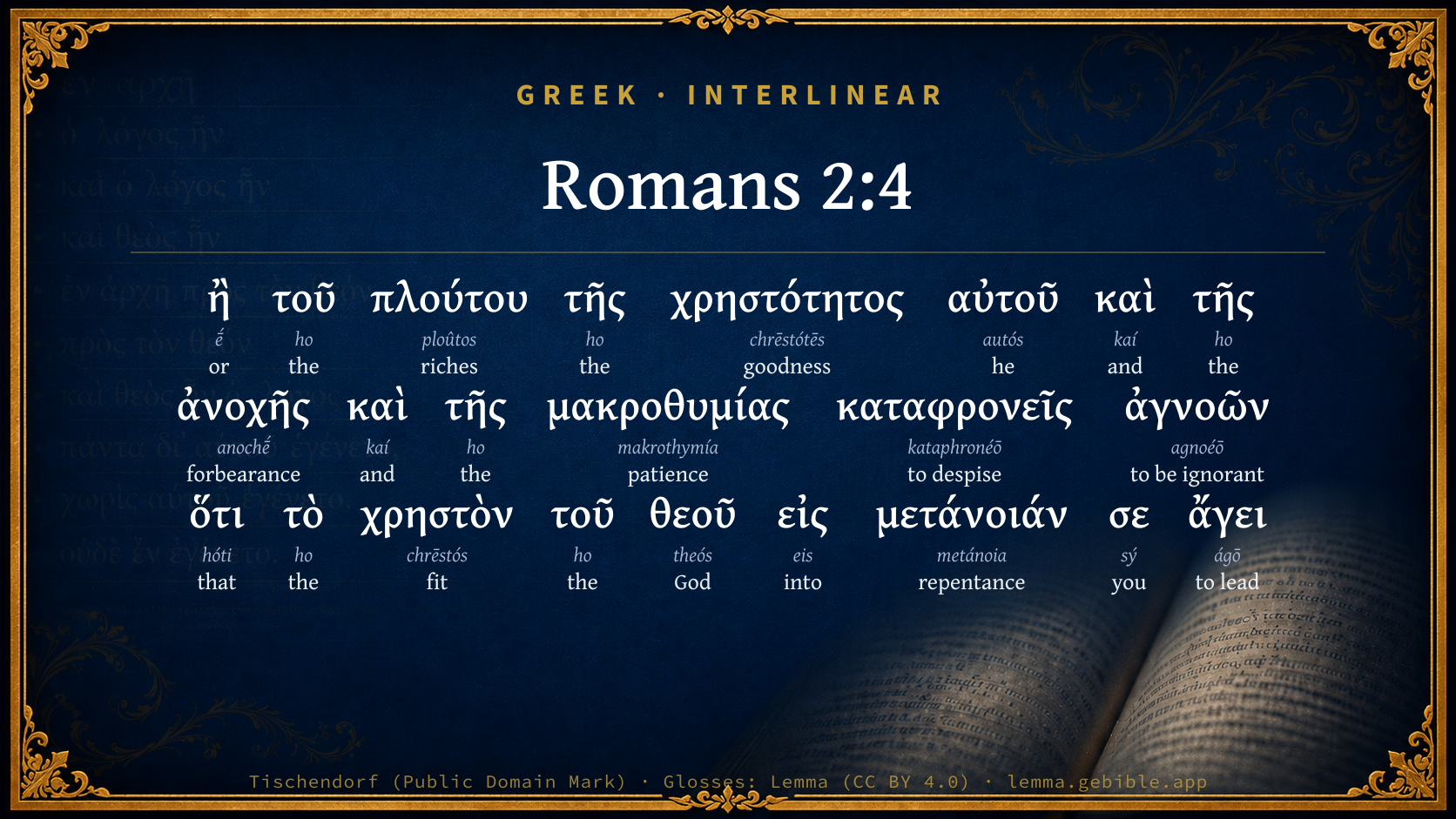
Or do you despise the riches of his goodness, forbearance, and patience, not knowing that the goodness of God leads you to repentance?
Download a study sheet
One document with this verse’s original text, its word-by-word gloss line, the meaning frame, cross-references with their text, attributed commentary, and full source and license credits — printable, and it pastes into notes with its structure intact.
This verse Autodidact and up
A passage Seminary Student
Up to 50 verses in one chapter. A passage sheet keeps up to 6 commentary sources and 12 cross-references per verse, in the order this page ranks them, and says so on the sheet whenever that leaves anything out. Ask for a single verse and you get the Autodidact verse sheet above.
Everything on this page stays free to read, with no account — the sheet is a download of what is already on screen, not access to it.
Compare translations 3
The same verse in 3 English versions, stacked beneath the original-language interlinear above. Click any original word for its lexicon entry.
Each is an independent rendering of the whole verse — the interlinear is not word-aligned to these translations.
Highlighted words mark where these versions differ — a whole-verse word diff, not a word-by-word alignment.
-
World English Bible Public Domain
Or do you despise the riches of his goodness, forbearance, and patience, not knowing that the goodness of God leads you to repentance?
-
King James Version Public Domain
Or despisest thou the riches of his goodness and forbearance and longsuffering; not knowing that the goodness of God leadeth thee to repentance?
-
unfoldingWord Literal Text CC BY-SA 4.0
Or do you scorn the wealth of his kindness and forbearance and patience, not knowing that the kindness of God leads you to repentance?
unfoldingWord Literal Text — © unfoldingWord, licensed CC BY-SA 4.0. Word-aligned USFM3 via Door43 (git.door43.org/unfoldingWord/en_ult).
Show all 19 translations
Every available English version of this verse, each an independent rendering of the whole verse.
-
World English Bible Public Domain
Or do you despise the riches of his goodness, forbearance, and patience, not knowing that the goodness of God leads you to repentance?
-
Berean Standard Bible Public Domain
Or do you disregard the riches of His kindness, tolerance, and patience, not realizing that God’s kindness leads you to repentance?
-
Majority Standard Bible Public Domain
Or do you disregard the riches of His kindness, tolerance, and patience, not realizing that God’s kindness leads you to repentance?
-
King James Version Public Domain
Or despisest thou the riches of his goodness and forbearance and longsuffering; not knowing that the goodness of God leadeth thee to repentance?
-
American Standard Version (1901) Public Domain
Or despisest thou the riches of his goodness and forbearance and longsuffering, not knowing that the goodness of God leadeth thee to repentance?
-
Revised Version (1885) Public Domain
Or despisest thou the riches of his goodness and forbearance and longsuffering, not knowing that the goodness of God leadeth thee to repentance?
-
Geneva Bible (1599) Public Domain
Or despisest thou the riches of his bountifulnesse, and patience, and long sufferance, not knowing that the bountifulnesse of God leadeth thee to repentance?
-
Douay-Rheims (1899) Public Domain
Or despisest thou the riches of his goodness, and patience, and longsuffering? Knowest thou not, that the benignity of God leadeth thee to penance?
-
Young's Literal Translation Public Domain
or the riches of His goodness, and forbearance, and long-suffering, dost thou despise? -- not knowing that the goodness of God doth lead thee to reformation!
-
Literal Standard Version CC BY-SA 4.0
Or the riches of His goodness, and forbearance, and long-suffering, do you despise, not knowing that the goodness of God leads you to conversion?
-
Unlocked Literal Bible CC BY-SA 4.0
Or do you think so little of the riches of his goodness, his delayed punishment, and his patience? Do you not know that his goodness is meant to lead you to repentance?
-
unfoldingWord Literal Text CC BY-SA 4.0
Or do you scorn the wealth of his kindness and forbearance and patience, not knowing that the kindness of God leads you to repentance?
-
Darby Bible Public Domain
or despisest thou the riches of his goodness, and forbearance, and long-suffering, not knowing that the goodness of God leads thee to repentance?
-
World Messianic Bible Public Domain
Or do you despise the riches of his goodness, forbearance, and patience, not knowing that the goodness of God leads you to repentance?
-
Webster's Bible Public Domain
Or despisest thou the riches of his goodness, and forbearance, and long-suffering; not knowing that the goodness of God leadeth thee to repentance?
-
Free Bible Version CC BY-SA 4.0
Or is it that you're treating his wonderful kindness, tolerance, and patience with contempt, not realizing that God in his kindness is trying to lead you to repent?
-
Bible in Basic English Public Domain
Or is it nothing to you that God had pity on you, waiting and putting up with you for so long, not seeing that in his pity God's desire is to give you a change of heart?
-
Text-Critical English NT CC BY 4.0
Or do yoʋ despise the riches of his kindness, forbearance, and patience, not knowing that the kindness of God leads yoʋ to repentance?
-
Tyndale New Testament (1534) Public Domain
Ether despisest thou the riches of his goodnes paciece and longe sufferaunce? and remembrest not how that the kyndnes of God ledith the to repentaunce?
Literal Standard Version (2020), Covenant Press — licensed CC BY-SA 4.0. Text via the HelloAO Bible API (eBible.org). Unlocked Literal Bible (unfoldingWord) — licensed CC BY-SA 4.0. Text via the HelloAO Bible API (eBible.org). unfoldingWord Literal Text — © unfoldingWord, licensed CC BY-SA 4.0. Word-aligned USFM3 via Door43 (git.door43.org/unfoldingWord/en_ult). Free Bible Version, Dr. Jonathan Gallagher — licensed CC BY-SA 4.0. Text via the HelloAO Bible API (eBible.org).
Word by word
More ways to search: Search by grammar → Find every occurrence → Compare this word →
Practice this passage: Drill this verse → Learn its vocabulary →
- Appears 2× in the Greek New Testament
- First appears here
- Part of Speech
- Noun
- Case
- Genitive
- Number
- Singular
- Gender
- Feminine
Full Thayer's Definition
- ἢ ḗ G2228 “or” Particle
- τοῦ ho G3588 “the” Article, Genitive, Singular, Masculine
- πλούτου ploûtos G4149 “riches” Noun, Genitive, Singular, Masculine
- τῆς ho G3588 “the” Article, Genitive, Singular, Feminine
- χρηστότητος chrēstótēs G5544 “goodness” Noun, Genitive, Singular, Feminine
- αὐτοῦ autós G846 “he” Personal pronoun, Genitive, Singular, Masculine
- καὶ kaí G2532 “and” Conjunction
- τῆς ho G3588 “the” Article, Genitive, Singular, Feminine
- ἀνοχῆς anochḗ G463 “forbearance” Noun, Genitive, Singular, Feminine
- καὶ kaí G2532 “and” Conjunction
- τῆς ho G3588 “the” Article, Genitive, Singular, Feminine
- μακροθυμίας makrothymía G3115 “patience” Noun, Genitive, Singular, Feminine
- καταφρονεῖς kataphronéō G2706 “to despise” Verb, Present, Active, Indicative, 2nd person, Singular
- ἀγνοῶν agnoéō G50 “to be ignorant” Verb, Present, Active, Participle, Nominative, Singular, Masculine
- ὅτι hóti G3754 “that” Conjunction
- τὸ ho G3588 “the” Article, Nominative, Singular, Neuter
- χρηστὸν chrēstós G5543 “fit” Adjective, Nominative, Singular, Neuter
- τοῦ ho G3588 “the” Article, Genitive, Singular, Masculine
- θεοῦ theós G2316 “God” Noun, Genitive, Singular, Masculine
- εἰς eis G1519 “into” Preposition
- μετάνοιάν metánoia G3341 “repentance” Noun, Accusative, Singular, Feminine
- σε sý G4771 “you” Personal pronoun, 2nd person, Accusative, Singular
- ἄγει ágō G71 “to lead” Verb, Present, Active, Indicative, 3rd person, Singular
About this verse
These counts appear in no published source. They are computed here, from the morphology-tagged text and Lemma’s own curated glosses. What Lemma adds →
- 23
- words
- 17
- distinct lemmas
- Pauline Epistles
- section
Notable vocabulary
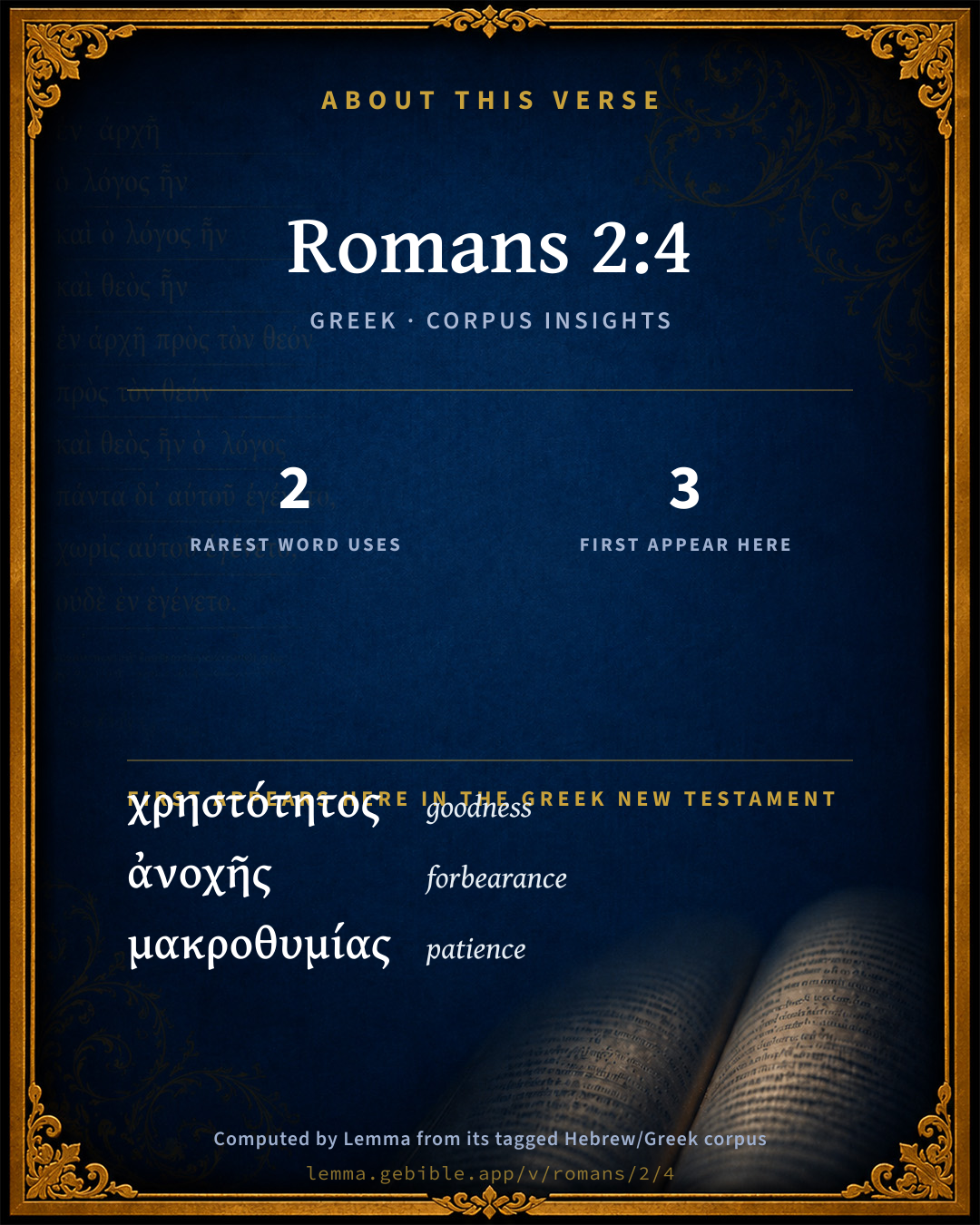
The rarest word here is ἀνοχῆς forbearance G463 — appearing just 2 times in the whole Greek New Testament.
First appearance in Scripture
These words make their first canonical appearance in the Greek New Testament here:
Shared distinctive vocabulary
ἀνοχῆς forbearance G463 occurs in 2 verses of the Greek New Testament. Also found in:
Cross-references
44Topical passages linked to Romans 2:4 in the Treasury of Scripture Knowledge — connected by theme and wording, ordered by reader-vote popularity; previews shown in the World English Bible.
- 2 Peter 3:9 The Lord is not slow concerning his promise, as some count slowness; but is patient with us, not wishing that any should perish, but that all should come to repentance.
- Isaiah 30:18 Therefore will Yahweh wait, that he may be gracious to you; and therefore will he be exalted, that he may have mercy on you: for Yahweh is a God of justice; blessed are all those who wait for him.
- Exodus 34:6 Yahweh passed by before him, and proclaimed, "Yahweh! Yahweh, a merciful and gracious God, slow to anger, and abundant in loving kindness and truth,
- Romans 9:22–23 What if God, willing to show his wrath, and to make his power known, endured with much patience vessels of wrath made for destruction,
- Titus 3:4–6 But when the kindness of God our Savior and his love toward mankind appeared,
- Ephesians 1:18 having the eyes of your hearts enlightened, that you may know what is the hope of his calling, and what are the riches of the glory of his inheritance in the saints,
- Psalms 86:15 But you, Lord, are a merciful and gracious God, Slow to anger, and abundant in loving kindness and truth.
- Ephesians 1:7 in whom we have our redemption through his blood, the forgiveness of our trespasses, according to the riches of his grace,
- Ephesians 2:7 that in the ages to come he might show the exceeding riches of his grace in kindness toward us in Christ Jesus;
- Romans 3:25 whom God set forth to be an atoning sacrifice, through faith in his blood, for a demonstration of his righteousness through the passing over of prior sins, in God's forbearance;
- Psalms 86:5 For you, Lord, are good, and ready to forgive; Abundant in loving kindness to all those who call on you.
- Matthew 24:48–49 But if that evil servant should say in his heart, 'My lord is delaying his coming,'
- Romans 11:22 See then the goodness and severity of God. Toward those who fell, severity; but toward you, goodness, if you continue in his goodness; otherwise you also will be cut off.
- Romans 11:33 Oh the depth of the riches both of the wisdom and the knowledge of God! How unsearchable are his judgments, and his ways past tracing out!
- 2 Peter 3:15 Regard the patience of our Lord as salvation; even as our beloved brother Paul also, according to the wisdom given to him, wrote to you;
- Psalms 78:38 But he, being merciful, forgave iniquity, and didn't destroy them. Yes, many times he turned his anger away, And didn't stir up all his wrath.
- Psalms 130:3–4 If you, Yah, kept a record of sins, Lord, who could stand?
- Ecclesiastes 8:11 Because sentence against an evil work is not executed speedily, therefore the heart of the sons of men is fully set in them to do evil.
- Ephesians 2:4 But God, being rich in mercy, for his great love with which he loved us,
- Psalms 10:11 He says in his heart, "God has forgotten. He hides his face. He will never see it."
- Jeremiah 3:22–23 Return, you backsliding children, I will heal your backsliding. Behold, we are come to you; for you are Yahweh our God.
- Luke 15:17–19 But when he came to himself he said, 'How many hired servants of my father's have bread enough to spare, and I'm dying with hunger!
- Luke 19:5–8 When Jesus came to the place, he looked up and saw him, and said to him, "Zacchaeus, hurry and come down, for today I must stay at your house."
- Philippians 4:19 My God will supply every need of yours according to his riches in glory in Christ Jesus.
- 1 Timothy 6:17 Charge those who are rich in this present world that they not be haughty, nor have their hope set on the uncertainty of riches, but on the living God, who richly provides us with everything to enjoy;
- 1 Peter 3:20 who before were disobedient, when God waited patiently in the days of Noah, while the ark was being built. In it, few, that is, eight souls, were saved through water.
- 2 Peter 3:3 knowing this first, that in the last days mockers will come, walking after their own lusts,
- Psalms 104:24 Yahweh, how many are your works! In wisdom have you made them all. The earth is full of your riches.
- Isaiah 63:7–10 I will make mention of the loving kindnesses of Yahweh, [and] the praises of Yahweh, according to all that Yahweh has bestowed on us, and the great goodness toward the house of Israel, which he has bestowed on them according to his mercies, and according to the multitude of his loving kindnesses.
- Romans 6:1 What shall we say then? Shall we continue in sin, that grace may abound?
- Romans 6:15 What then? Shall we sin, because we are not under law, but under grace? May it never be!
- Colossians 1:27 to whom God was pleased to make known what are the riches of the glory of this mystery among the Gentiles, which is Christ in you, the hope of glory;
- 1 Timothy 1:16 However, for this cause I obtained mercy, that in me first, Jesus Christ might display all his patience, for an example of those who were going to believe in him for eternal life.
- Revelation 3:20 Behold, I stand at the door and knock. If anyone hears my voice and opens the door, then I will come in to him, and will dine with him, and he with me.
- Numbers 14:18 Yahweh is slow to anger, and abundant in loving kindness, forgiving iniquity and disobedience; and that will by no means clear [the guilty], visiting the iniquity of the fathers on the children, on the third and on the fourth generation.
- Job 33:27–30 He sings before men, and says, 'I have sinned, and perverted that which was right, And it didn't profit me.
- Jeremiah 3:12–13 Go, and proclaim these words toward the north, and say, Return, you backsliding Israel, says Yahweh; I will not look in anger on you; for I am merciful, says Yahweh, I will not keep [anger] forever.
- Jeremiah 7:10 and come and stand before me in this house, which is called by my name, and say, We are delivered; that you may do all these abominations?
- Ezekiel 12:22–23 Son of man, what is this proverb that you have in the land of Israel, saying, The days are prolonged, and every vision fails?
- Ezekiel 16:63 that you may remember, and be confounded, and never open your mouth any more, because of your shame, when I have forgiven you all that you have done, says the Lord Yahweh.
- Romans 10:12 For there is no distinction between Jew and Greek; for the same Lord is Lord of all, and is rich to all who call on him.
- Ephesians 3:8 To me, the very least of all saints, was this grace given, to preach to the Gentiles the unsearchable riches of Christ,
- Ephesians 3:16 that he would grant you, according to the riches of his glory, that you may be strengthened with power through his Spirit in the inward man;
- Colossians 2:2 that their hearts may be comforted, they being knit together in love, and gaining all riches of the full assurance of understanding, that they may know the mystery of God, both of the Father and of Christ,
Cross-references courtesy of OpenBible.info (CC BY 4.0).
Lesson kit
Teaching starters — assembled from the data on this page, not authored interpretation. Every prompt links to the verse data it draws on. Edit before teaching.
Romans, in the Pauline Epistles, opens this verse with 23 words (17 distinct Greek lemmas). Its most distinctive word is anochḗ (“forbearance”). A historical commentator’s framing appears above. Read the whole chapter for the surrounding context.
Discussion questions
- What does “forbearance” (anochḗ) contribute to the verse as a whole?
- 3 words here appear for the first time in Scripture. What is being introduced at this debut?
- Romans 3:26 shares the word «forbearance» with this verse. How do the two illuminate each other?
- “the” occurs 6× in this one verse. What is the effect of the repetition?
- These translations render this verse differently; the difference is in the English rendering, not the original. What questions does that raise?
- Reading how Albert Barnes' Notes on the Bible and Matthew Poole's English Annotations read this verse, where do the two commentators agree and where do they part?
Things to notice
- 3 words make their first canonical appearance in Scripture here.
- These translations choose different wording for 13 words in this verse.
- “the” occurs 6× in this single verse.
- 17 distinct Greek lemmas span 23 words in this verse.
Commentary
Notes on Romans 2:4 from classic Christian and Jewish commentators (each source and its license shown beneath its notes). The classic Christian expositions comment on the surrounding passage and are grouped to its opening verse, so a note may address several verses; the Jewish commentaries on the Tanakh (Rashi and others) are per-verse, so they appear only where the commentator wrote on this verse.
Lemma curates 59 commentaries, every one of them public domain or Creative Commons licensed, each selected and text-cleaned for this edition rather than reprinted as found. About our sources →
Albert Barnes' Notes on the Bible
Albert Barnes' Notes on the Bible (1834–1885) — public domain. Text from a community e-Sword/MySword module.
Matthew Poole's English Annotations
Matthew Poole's English Annotations on the Holy Bible (1683–1685) — public domain. Text from a community e-Sword/MySword module.
The Biblical Illustrator
Joseph S. Exell
The Biblical Illustrator, edited by Joseph S. Exell (c. 1880s–1900s) — public domain. Text from a community e-Sword module.
Tyndale Open Study Notes
Tyndale Open Resources
Tyndale Open Study Notes — © Tyndale Open Resources, licensed CC BY-SA 4.0. Text via the HelloAO Bible API.
Bengel's Gnomon
Johann Albrecht Bengel
Bengel's Gnomon of the New Testament — English translation (T&T Clark, Edinburgh, 1860) — public domain. Text from a community e-Sword module.
Meyer's Critical & Exegetical Commentary
Heinrich August Wilhelm Meyer
Meyer — Critical and Exegetical Commentary on the New Testament — English translation by Peter Christie, edited by Frederick Crombie (T&T Clark, 1880) — public domain. Text from a community e-Sword module.
Expositor's Greek Testament
ed. W. Robertson Nicoll
The Expositor's Greek Testament, edited by W. Robertson Nicoll (1897–1910) — public domain. Text from a community e-Sword module.
Vincent's Word Studies in the New Testament
Marvin R. Vincent
Marvin R. Vincent, Word Studies in the New Testament (1887–1900) — public domain. Text from a community e-Sword/MySword module.
Hodge's Commentary on Romans, Ephesians & First Corinthians
Charles Hodge
Charles Hodge — Commentary on Romans (1835), First Corinthians (1857), and Ephesians (1856) — public domain. Text from a community e-Sword module.
Geneva Bible (1599)
Geneva Bible translators
Geneva Bible (1599) marginal notes — public domain. Text via Bolls.life.
Adam Clarke's Commentary
Adam Clarke's Commentary on the Bible (1810–1826) — public domain. Text from a community e-Sword/MySword module.
John Calvin's Commentaries
John Calvin's Commentaries (1540-1563) — public domain. Text from the Calvin Translation Society English edition (1840s-50s) via the Christian Classics Ethereal Library (ccel.org). Calvin's coverage is partial (roughly two-thirds of the Bible); uncommented books and verses are honest gaps, never fabricated. The 19th-century editor's footnotes and remarks are omitted so the notes are faithfully Calvin's own voice.
Ellicott's Commentary for English Readers
A Bible Commentary for English Readers, edited by Charles John Ellicott (1878–1897) — public domain. Text from a community e-Sword module.
The Cambridge Bible for Schools and Colleges
gen. ed. J. J. S. Perowne
The Cambridge Bible for Schools and Colleges (gen. ed. J. J. S. Perowne; Cambridge University Press, 1878–1918) — public domain. Text from a community e-Sword module.
John Gill's Exposition
John Gill's Exposition of the Whole Bible (1746–1763) — public domain (CC PDM 1.0). Text via the HelloAO Bible API.
Trapp's Complete Commentary
John Trapp
John Trapp, A Commentary or Exposition upon All the Books of the Old and New Testament (1647–1656) — public domain. Text from a community e-Sword module.
Whedon's Commentary on the Bible
Daniel D. Whedon
Daniel D. Whedon (gen. ed.), Commentary on the Old and New Testaments (1874–1909) — public domain. Text from a community e-Sword module.
The Pulpit Commentary
The Pulpit Commentary (1880–1919), ed. H.D.M. Spence-Jones & Joseph S. Exell — public domain. Text from a community e-Sword module.
John Wesley's Explanatory Notes
John Wesley, Explanatory Notes Upon the Whole Bible (1754–1765) — public domain. Text via the GEBible commentary corpus.
Burkitt's Expository Notes on the New Testament
William Burkitt
William Burkitt's Expository Notes on the New Testament (1700–1703) — public domain. Text from a community e-Sword module.
McGarvey & Pendleton's Commentaries
J. W. McGarvey
J. W. McGarvey (with Philip Y. Pendleton), Commentaries on the New Testament (The Fourfold Gospel, 1914; Acts; and the epistles) — public domain. Text from a community e-Sword/MySword module.
The People's New Testament
B. W. Johnson
B. W. Johnson's The People's New Testament with Notes (1889–1891) — public domain. Electronic text from the Christian Classics Ethereal Library (CCEL) ThML edition.
Cambridge Greek Testament for Schools and Colleges
Cambridge Greek Testament for Schools and Colleges (Cambridge University Press, 1896; 21 vols, various authors incl. Carr, Maclear, Plummer, Farrar, Lumby, Moule, M. R. James, Simcox) — public domain. Text from a community e-Sword module.
Alford’s Greek Testament
Henry Alford
Henry Alford, The Greek Testament (1849–1861) — public domain. Text from a community e-Sword module.
International Critical Commentary
International Critical Commentary — older volumes (1896–1929), various authors — public domain. Text from a community e-Sword module.
Godet's Commentaries
Frédéric Louis Godet
Frédéric Louis Godet — Commentaries on Luke, John, Romans, and 1 Corinthians — English translation (T&T Clark, Edinburgh, 1870s–1890s) — public domain. Text from a community e-Sword module.