Acts 26:30

Greek (Tischendorf 8th ed.) Acts 26:30 appears in the Greek New Testament. The text above is from the Tischendorf 8th edition. Each word links to its Strong’s number and a concise gloss. Click any word for its full Thayer’s Greek Lexicon entry.
Download image
Cite this verse

Acts 26:30 (World English Bible). Public Domain. Lemma interlinear Bible study tool, https://lemma.gebible.app/v/acts/26/30.

Show BibTeX & RIS
BibTeX
RIS
English Translation
The king rose up with the governor, and Bernice, and those who sat with them.
World English Bible · Public Domain
Download a study sheet

One document with this verse’s original text, its word-by-word gloss line, the meaning frame, cross-references with their text, attributed commentary, and full source and license credits — printable, and it pastes into notes with its structure intact.

This verse Autodidact and up

Study sheet (.html) Plain text (.txt)

A passage Seminary Student

Up to 50 verses in one chapter. A passage sheet keeps up to 6 commentary sources and 12 cross-references per verse, in the order this page ranks them, and says so on the sheet whenever that leaves anything out. Ask for a single verse and you get the Autodidact verse sheet above.

Everything on this page stays free to read, with no account — the sheet is a download of what is already on screen, not access to it.

Want to remove ads? Support Godless Engineer
Compare translations 3

The same verse in 3 English versions, stacked beneath the original-language interlinear above. Click any original word for its lexicon entry.

Each is an independent rendering of the whole verse — the interlinear is not word-aligned to these translations.

Highlighted words mark where these versions differ — a whole-verse word diff, not a word-by-word alignment.

  • World English Bible Public Domain
    The king rose up with the governor, and Bernice, and those who sat with them.
  • King James Version Public Domain
    And when he had thus spoken, the king rose up, and the governor, and Bernice, and they that sat with them:
  • unfoldingWord Literal Text CC BY-SA 4.0
    Then the king got up, and the governor and Bernice and the ones sitting with them,

unfoldingWord Literal Text — © unfoldingWord, licensed CC BY-SA 4.0. Word-aligned USFM3 via Door43 (git.door43.org/unfoldingWord/en_ult).

Versions to compare (up to 4)

3 of 4 selected

Show all 19 translations

Every available English version of this verse, each an independent rendering of the whole verse.

  • World English Bible Public Domain
    The king rose up with the governor, and Bernice, and those who sat with them.
  • Berean Standard Bible Public Domain
    Then the king and the governor rose, along with Bernice and those seated with them.
  • Majority Standard Bible Public Domain
    When he had spoken these things, the king and the governor rose, along with Bernice and those seated with them.
  • King James Version Public Domain
    And when he had thus spoken, the king rose up, and the governor, and Bernice, and they that sat with them:
  • American Standard Version (1901) Public Domain
    And the king rose up, and the governor, and Bernice, and they that sat with them:
  • Revised Version (1885) Public Domain
    And the king rose up, and the governor, and Bernice, and they that sat with them:
  • Geneva Bible (1599) Public Domain
    And when he had thus spoken, the King rose vp, and the gouernour, and Bernice, and they that sate with them.
  • Douay-Rheims (1899) Public Domain
    And the king rose up, and the governor, and Bernice, and they that sat with them.
  • Young's Literal Translation Public Domain
    And, he having spoken these things, the king rose up, and the governor, Bernice also, and those sitting with them,
  • Literal Standard Version CC BY-SA 4.0
    And he having spoken these things, the king rose up, and the governor, Bernice also, and those sitting with them,
  • Unlocked Literal Bible CC BY-SA 4.0
    Then the king stood up, and the governor, and Bernice also, and those who were sitting with them;
  • unfoldingWord Literal Text CC BY-SA 4.0
    Then the king got up, and the governor and Bernice and the ones sitting with them,
  • Darby Bible Public Domain
    And the king stood up, and the governor and Bernice, and those who sat with them,
  • World Messianic Bible Public Domain
    The king rose up with the governor and Bernice, and those who sat with them.
  • Webster's Bible Public Domain
    And when he had thus spoken, the king rose, and the governor, and Bernice, and they that sat with them:
  • Free Bible Version CC BY-SA 4.0
    The king stood up, along with the governor and Bernice, and everyone who had been sitting with them.
  • Bible in Basic English Public Domain
    And the king and the ruler and Bernice and those who were seated with them got up;
  • Text-Critical English NT CC BY 4.0
    After Paul said these things, the king stood up, along with the governor, Bernice, and those who were sitting with them.
  • Tyndale New Testament (1534) Public Domain
    And when he had thus spoken the kynge rose vp and the debite and Bernice and they that sate with them.

Literal Standard Version (2020), Covenant Press — licensed CC BY-SA 4.0. Text via the HelloAO Bible API (eBible.org). Unlocked Literal Bible (unfoldingWord) — licensed CC BY-SA 4.0. Text via the HelloAO Bible API (eBible.org). unfoldingWord Literal Text — © unfoldingWord, licensed CC BY-SA 4.0. Word-aligned USFM3 via Door43 (git.door43.org/unfoldingWord/en_ult). Free Bible Version, Dr. Jonathan Gallagher — licensed CC BY-SA 4.0. Text via the HelloAO Bible API (eBible.org).

Word by word

More ways to search: Search by grammar → Find every occurrence → Compare this word →

Practice this passage: Drill this verse → Learn its vocabulary →

συνκαθήμενοι
synkáthēmai
G4775
“to sit together”
Verb, Present, Middle or Passive deponent, Participle, Nominative, Plural, Masculine
Part of Speech
Verb
Tense
Present
Voice
Middle or Passive deponent
Mood
Participle
Case
Nominative
Number
Plural
Gender
Masculine
Full Thayer's Definition

Origin: from G4862 and G2521

TDNT: None

1. to sit together, to sit with one another
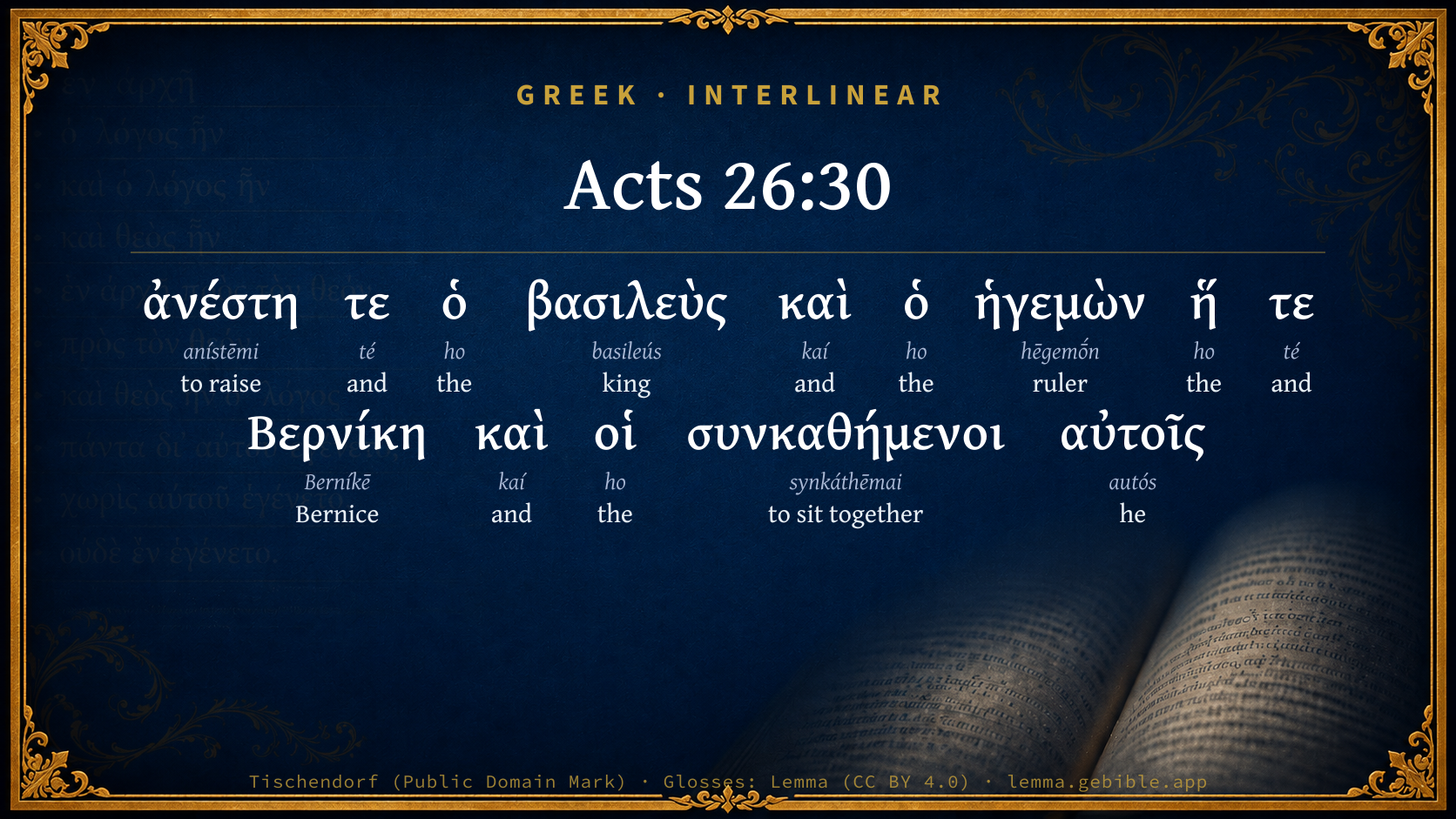
  1. ἀνέστη anístēmi G450 “to raise” Verb, Aorist, Active, Indicative, 3rd person, Singular
  2. τε té G5037 “and” Particle
  3. ὁ ho G3588 “the” Article, Nominative, Singular, Masculine
  4. βασιλεὺς basileús G935 “king” Noun, Nominative, Singular, Masculine
  5. καὶ kaí G2532 “and” Conjunction
  6. ὁ ho G3588 “the” Article, Nominative, Singular, Masculine
  7. ἡγεμὼν hēgemṓn G2232 “ruler” Noun, Nominative, Singular, Masculine
  8. ἥ ho G3588 “the” Article, Nominative, Singular, Feminine
  9. τε té G5037 “and” Particle
  10. Βερνίκη Berníkē G959 “Bernice” Noun, Nominative, Singular, Feminine
  11. καὶ kaí G2532 “and” Conjunction
  12. οἱ ho G3588 “the” Article, Nominative, Plural, Masculine
  13. αὐτοῖς autós G846 “he” Personal pronoun, Dative, Plural, Masculine

About this verse

These counts appear in no published source. They are computed here, from the morphology-tagged text and Lemma’s own curated glosses. What Lemma adds →

14
words
9
distinct lemmas
Acts
section

Notable vocabulary

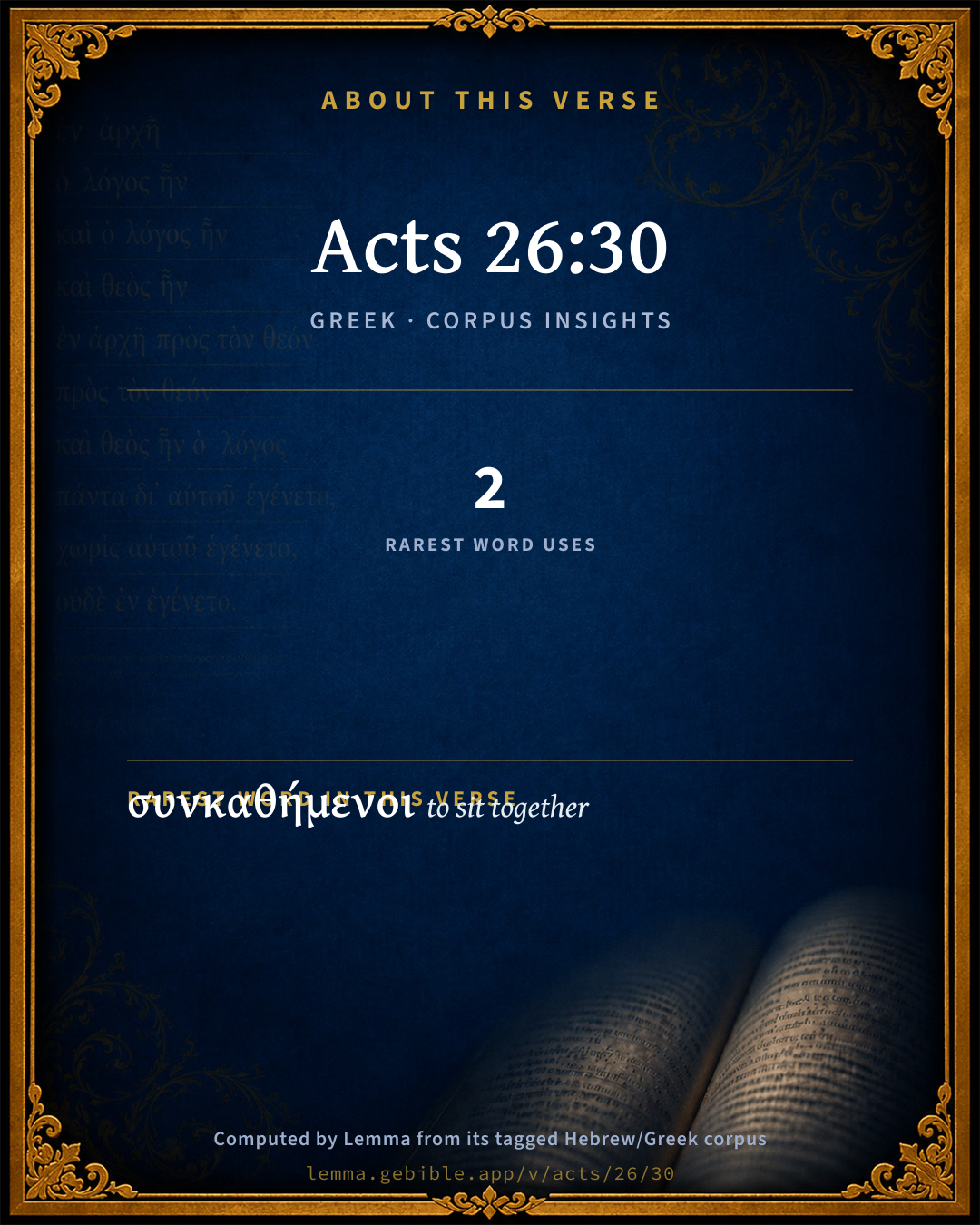
The rarest word here is συνκαθήμενοι to sit together G4775 — appearing just 2 times in the whole Greek New Testament.

Shared distinctive vocabulary

συνκαθήμενοι to sit together G4775 occurs in 2 verses of the Greek New Testament. Also found in:

Repetition

Words recur within this verse:

Cross-references

3

Topical passages linked to Acts 26:30 in the Treasury of Scripture Knowledge — connected by theme and wording, ordered by reader-vote popularity; previews shown in the World English Bible.

  • Acts 18:15 but if they are questions about words and names and your own law, look to it yourselves. For I don't want to be a judge of these matters."
  • Acts 25:23 So on the next day, when Agrippa and Bernice had come with great pomp, and they had entered into the place of hearing with the commanding officers and principal men of the city, at the command of Festus, Paul was brought in.
  • Acts 28:22 But we desire to hear from you what you think. For, as concerning this sect, it is known to us that everywhere it is spoken against."

Cross-references courtesy of OpenBible.info (CC BY 4.0).

Where the printed editions differ

1 variant

Places in this verse where the major printed Greek editions disagree on the wording in a way that affects the translation — a comparison of editions, not a manuscript-by-manuscript collation. The editions are the modern critical texts (Nestlé-Aland 28/27, SBL, Westcott-Hort, Tregelles, Tyndale House) and the traditional texts behind the KJV (the Textus Receptus and the Byzantine/Majority text). It is not a claim about which reading is original.

  1. Extra text
    Καὶ ταῦτα εἰπόντος αὐτοῦ

    “and these things when was speaking he”

    In TRByz Not in NA28NA27TynSBLWHTreg

    Καὶ ταῦτα εἰπόντος αὐτοῦ (Kai tauta eipontos autou) 'and these things when was speaking he' is only in traditional manuscripts (TR+Byz)

Textual data: Translators Amalgamated Greek New Testament (STEPBible TAGNT) · CC BY 4.0.

Commentary

Notes on Acts 26:30 from classic Christian and Jewish commentators (each source and its license shown beneath its notes). The classic Christian expositions comment on the surrounding passage and are grouped to its opening verse, so a note may address several verses; the Jewish commentaries on the Tanakh (Rashi and others) are per-verse, so they appear only where the commentator wrote on this verse.

Lemma curates 59 commentaries, every one of them public domain or Creative Commons licensed, each selected and text-cleaned for this edition rather than reprinted as found. About our sources →

Joseph Benson's Commentary

Act 26:30-32. And when he had thus spoken — That the impression Paul began to make upon the court might reach no further; the king rose up — Thus neglecting to yield to conviction, and losing, perhaps for ever, an unspeakably precious moment. Whether the good impressions made were ever afterward laid to heart and improved, we shall see in the day of final accounts. And the governor, and Bernice, &c. — On none of whom, it seems, Paul’s discourse had much, if any, effect. They ought, in justice, to have asked the prisoner whether he had any more to say for himself; but, it seems, they thought he had said enough to make his case clear, and with that they contented themselves. And when they were gone aside — Had withdrawn, to consult and know one another’s minds on the matter, they spoke one with another, all to the same purpose; saying, This man — As is evident by his discourse, which has all imaginable marks of candour and sincerity; doeth nothing worthy of death or of bonds — They appear to speak of his whole life, and not of what happened at Jerusalem only. And could ye learn nothing more than this from his discourse? A favourable judgment of such a preacher is not all that God requires. Then Agrippa — Not in the least offended with Paul for having spoken to him so freely; said to Festus — In the hearing of the whole assembly; This man might have been set at liberty, if he had not appealed unto Cesar — Paul’s appeal, however, was perfectly proper at the time he made it, seeing Festus had shown an inclination to gratify the Jews by proposing to judge him in Jerusalem. And now, although Agrippa, with the consent of Festus, had declared that Paul might have been set at liberty if he had not appealed to Cesar, Paul very prudently did not withdraw his appeal, because he fore- saw that, by the solicitations and threatenings of the chief priests and elders, Festus might be constrained, contrary to his inclination, to put him to death, even as Pilate formerly had been constrained, contrary to his conscience, to put Jesus to death. He might probably foresee, too, that his visiting Rome under the character of a prisoner, would be overruled by Providence to answer some important purposes, as is evident from Php 1:12-20, it was. We may add further here, though this declaration of Agrippa could not obtain Paul’s deliverance, yet it might do him some service, that a testimony to his innocence was pronounced by so learned and honourable a person of the Jewish nation and religion. Festus would probably entertain a better opinion of him on this account, and would give directions to the officer who attended him to treat him with so much the greater regard. “Thus it appears that, besides the defence which Paul made from the top of the stairs to the multitude in Jerusalem, he at four different times, before the highest courts of judicature in Judea, defended the gospel, and his own conduct in preaching it, in the most public manner; namely, 1st, Before the Jewish council, consisting of the high-priests, the chief priests, the whole estate of the elders, and the scribes; who all sat as his accusers. 2d, Before Felix the Roman governor, at whose tribunal the high-priest Ananias, and the elders from Jerusalem, were likewise his accusers, and employed a Roman orator to plead against him. 3d, Before Festus, the governor, on which occasion the Jews from Jerusalem stood forth, a third time, as his accusers. 4th, Before King Agrippa, Bernice, the tribunes, and the principal persons of Cesarea, with many others, in whose presence Paul boldly asserted his own innocence, with such strength of evidence that both Agrippa and Festus declared he might have been set at liberty if he had not appealed to the emperor.” — Macknight.

Joseph Benson's Commentary on the Old and New Testaments (1811–1818) — public domain. Text from a community e-Sword module.

Bengel's Gnomon

Johann Albrecht Bengel

Act 26:30. Ἀνέστη, rose up) They therefore had sat. A most precious moment (season) for Agrippa; which whether he used or not, we shall hereafter see.

Bengel's Gnomon of the New Testament — English translation (T&T Clark, Edinburgh, 1860) — public domain. Text from a community e-Sword module.

Meyer's Critical & Exegetical Commentary

Heinrich August Wilhelm Meyer

Act_26:30-32. Perhaps this bold, grand utterance of the singular man had made an impression on the kings heart, the concealment of which might have occasioned embarrassment to him, had he listened any longer: Agrippa arose and thereby brought the discussion at once to a close. With him arose, in the order of rank, first the procurator, then Bernice, then all who sat there with them (οἱ συγκαθήμενοι αὐτοῖς). After they had retired from the audience chamber (ἀναχωρήσαντες), they communicated to each other their unanimous opinion, which certainly amounted only to the superficial political negative: this man (certainly by the most regarded as a harmless enthusiast) practises nothing which merits death or bonds. But Agrippa delivered specially to Festus his opinion to this effect: this man might (already) have been set at liberty,[165] if he had not appealed unto Caesar (by which the sending him to Rome was rendered irreversible, see Grotius).

πράσσει] practises. Grotius rightly remarks: agit de vitae institute: hence in the present. Comp. Joh_3:20; Rom_1:32, al.; Joh_7:51.

The recognition of the innocence of the apostle in all judicatures (Zeller, comp. Baur) is intelligible enough from the truth of his character, and from the power of his appearance and address; and, in particular, the closing utterance of Agrippa finds its ground so vividly and with such internal truth in the course of the proceedings, that the imputation of a set purpose on the authors part (in order that, with the Gentile testimonies, Act_25:18; Act_25:25, a Jewish one might not be wanting, Zeller) can only appear as a frivolously dogmatic opinion, proceeding from personal prepossessions tending in a particular direction. The apostle might at any rate be credited, even in his situation at that time, with an ἀπόδειξις πνείματος κ. δυνάμεως (1Co_2:4).

[165] Not: dimitti poterat, Vulg. Luther, and others. See in opposition to this, and on the expression without ἄν, Buttmann, neut. Gr. pp. 187, 195 [E. T. 216, 226]. Comp. also Nägelsb. on the Iliad, p. 430, ed. 3.

Meyer — Critical and Exegetical Commentary on the New Testament — English translation by Peter Christie, edited by Frederick Crombie (T&T Clark, 1880) — public domain. Text from a community e-Sword module.

Expositor's Greek Testament

ed. W. Robertson Nicoll

Act 26:30 . καὶ ταῦτα εἰπόντος αὐτοῦ : of these words are not retained, see critical note, their omission seems to make the rising up more abrupt ( subito consurgit , Blass), and probably this is the meaning of the passage, although the order of rank is maintained in leaving the chamber. For the vividness of the whole narrative see Zöckler and Wendt, and cf. McGiffert, Apostolic Age , p. 355. ἀνέστη , Lucan, see on ἀναχωρ . Suet., Nero , 15; cf. Act 23:19 , and note on Act 25:12 .

The Expositor's Greek Testament, edited by W. Robertson Nicoll (1897–1910) — public domain. Text from a community e-Sword module.

Geneva Bible (1599)

Geneva Bible translators

Paul is solemnly quit, and yet not dismissed.

Geneva Bible (1599) marginal notes — public domain. Text via Bolls.life.

Jamieson, Fausset & Brown

Robert Jamieson, A. R. Fausset & David Brown

when he had thus spoken, the king rose--not over-easy, we may be sure.

Jamieson, Fausset & Brown — Commentary Critical and Explanatory on the Whole Bible (1871) — public domain (CC PDM 1.0). Text via the HelloAO Bible API.

Ellicott's Commentary for English Readers

(30) And when he had thus spoken, the king rose up . . .—The act indicated, as far as it went, that the Apostle’s words had made a favourable impression. This, they felt, was no common criminal, no fomenter of sedition. The question how he was to be dealt with was one that called for serious consideration; but the result showed that he was treated from this time forward with more respect and courtesy than before.

A Bible Commentary for English Readers, edited by Charles John Ellicott (1878–1897) — public domain. Text from a community e-Sword module.

The Cambridge Bible for Schools and Colleges

gen. ed. J. J. S. Perowne

30. And when he had thus spoken] The oldest MSS. omit these words.

they that sat with them] i.e. the chief captains and the principal men of Cæsarea. (See Act_25:23.) The authorities withdrew to consult upon what they had heard.

The Cambridge Bible for Schools and Colleges (gen. ed. J. J. S. Perowne; Cambridge University Press, 1878–1918) — public domain. Text from a community e-Sword module.

John Gill's Exposition

And when they were gone aside,.... Into some apartment adjoining to the judgment hall:

they talked between themselves; that the common people might not hear their debates, and the result of them, and what were their sentiments concerning Paul and his case:

saying, this man doth nothing worthy of death, or of bonds; according to the Roman laws; for as yet there were no laws among the Romans against the Christians as such, or against their professing and preaching Christ.

John Gill's Exposition of the Whole Bible (1746–1763) — public domain (CC PDM 1.0). Text via the HelloAO Bible API.

Trapp's Complete Commentary

John Trapp

30 And when he had thus spoken, the king rose up, and the governor, and Bernice, and they that sat with them:

Ver. 30. The king rose up and the governor] A little of such sad discourse served their turn: they were soon sated, and ready to say as Antipater king of Macedonia did, when one presented him a book treating of happiness, he answered, ου σχολαζω, I have somewhat else to do than to learn or listen to such businesses; when perhaps they might never have the like opportunity of hearing such a persuasive preacher while they breathed again, as Paul was.

John Trapp, A Commentary or Exposition upon All the Books of the Old and New Testament (1647–1656) — public domain. Text from a community e-Sword module.

Matthew Poole's English Annotations

Agrippa, Festus, and the queen, together with the governor’s council, although they had heard this excellent discourse from, the most learned apostle, like the blackamoor or leopard, they cannot change their spots, or skin, Jer 13:23; having sinned against former manifestations of God’s will, this, for aught we read, became ineffectual unto them.

Matthew Poole's English Annotations on the Holy Bible (1683–1685) — public domain. Text from a community e-Sword/MySword module.

Whedon's Commentary on the Bible

Daniel D. Whedon

30. Rose up—There is some appearance of abruptness in this breaking up, but more probably it was a regular adjournment because the plea was closed. Judged as an intellectual performance, this speech must ever rank among the master-pieces of oratory.

King… governor… Bernice, and they—In the order of honour.

Daniel D. Whedon (gen. ed.), Commentary on the Old and New Testaments (1874–1909) — public domain. Text from a community e-Sword module.

The Pulpit Commentary

And the king rose up for and when he had thus spoken, the king, etc., A.V. and T.R.. They that sat with them. The chief captains and principal men and the royal attendants of Act_25:23.

Vers. 30-32. Secret acquittals.

These closing verses of a chapter thrilling with interest suggest the subject of the various acquittals that men both good and bad obtain. The range of value belonging to acquittals received by men from men is vast indeed. They stand in strange contrast to the one acquittal or one condemnation which awaits each and every man in his turn, on the threshold of the hereafter. The present passage, however, will confine attention to one class of acquittals rather than invite thought to range at large. And we may think

I OF THE SECRET ACQUITTAL OF MAN BY MEN.

1. The man is innocent: his judges know it; their inner judgment acquits him; their very lips acquit him, but only "between themselves." They say it not to the innocent accused, not to the accusers, not to the world. Their real verdict transpires God takes care of that but it is no thanks to them, and it is not the good it should be to him, the victim of their injustice, who was given to them that they might do justice. This is one sort of secret acquittal.

2. The man is guilty: his judges know it; their deepest judgment finds him guilty; their lips pronounce it "between themselves." And circumstances are such that they pronounce their verdict of guilty before man also. Yet for all that, the secret thought of their heart is that they will acquit, and their covered deed is acquittal. They mete not out equal justice. Their weights and balances are not fair and just. They condone and countenance the criminal. And this is another sort of secret acquittal, as mischievous and disastrous as any can be. For such as these nothing can be said except the words of rebuke, of unsparing condemnation, of well-visited scorn.

II OF THE SECRET ACQUITTAL OF A TRUE MAN"S OWN CONSCIENCE. The brightest pages of history are written with instances of this kind of secret acquittal. From Joseph and, were all the truth known, from a much earlier than Joseph to the perfect, the sublime, the spotless innocence of Jesus, and again with fresh impulse onward by Stephen, and Paul, and Peter, and John, and the martyrs, and an unnumbered host, of whom the world was not worthy! the record Of such acquittal is safely written. What a wonderful resource an innocent conscience! What a store of peace it means! What a defense against misery, anguish, remorse, and hell on earth! It is already the bud of Heaven"s unspeakable bliss.

III OF THE SECRET ACQUITTAL OF GOD"S OWN VERDICT, At present, God"s verdict is often veiled from view, silent for the ear as the star that shines the most distant and the coldest and all the scene seems filled up with sight and sound of human judgment. Yet two things are to be said.

1. That the man who thinks knows that this is only the surface appearance; that a time far otherwise conditioned hastens to meet this present scene, and prepares a strange reversal.

2. That to the heart of the humble, God-fearing man, there is given the individual and most precious earnest of Divine approval and complacency and love many a time. That peace which the world cannot give God"s secret acquittal does give, and it is the sort of peace that both "sheds itself abroad" with all the swiftness and persuasiveness of fragrance itself, and preserves the sacred secret of its sweetness. Whatever else Paul had or had not, he had three acquittals, and they were all for the present secret the acquittal of the unjust judges, and this was no usual honor; of his own conscience; and of the holy Master and God. B.

The Pulpit Commentary (1880–1919), ed. H.D.M. Spence-Jones & Joseph S. Exell — public domain. Text from a community e-Sword module.

John Wesley's Explanatory Notes

And as he said this, the king rose up - An unspeakably precious moment to Agrippa. Whether he duly improved it or no, we shall see in that day.

John Wesley, Explanatory Notes Upon the Whole Bible (1754–1765) — public domain. Text via the GEBible commentary corpus.

Kretzmann's Popular Commentary

Paul E. Kretzmann

The end of the hearing:

v. 30. and when he had thus spoken, the king rose up, and the governor, and Bernice, and they that sat with them

v. 31. and when they were gone aside, they talked between themselves, saying, This man doeth nothing worthy of death or of bonds.

v. 32. Then said Agrippa unto Festus, This man might have been set at liberty if he had not appealed unto Caesar.

When Paul had made his last appeal, the king arose, this being the signal that he wished the hearing closed, and the governor, Bernice, and the rest of the invited. company that had sat beside them. Having left the hall, they retired to another chamber to exchange their ideas. And they all agreed in saying that this man, Paul, was doing nothing that merited either death or imprisonment. This much the open and fearless speech of Paul at least had shown them. And while Agrippa would not permit himself to be persuaded in favor of Christianity, he at least felt himself obliged to state to Festus that this man might well be released if he had not appealed to Caesar. But the appeal had now been made and accepted, and Paul must be sent to Rome. Very likely this opinion as rendered by Agrippa influenced the letter which Festus addressed to the imperial court in this matter and may thus account for the treatment of Paul upon his arrival at the capital. Note: In all these facts, as here presented, the guiding hand of the exalted Christ, the Head of His Church, is plainly seen: He wanted Paul to get to Rome, but He also protected him against all harm.

Summary.Paul makes his speech of defense at the hearing before King Agrippa, which moves the latter to declare that he is innocent of any crime, and that only his appeal caused his being sent to Rome.

Paul E. Kretzmann, Popular Commentary of the Bible (1921–1924) — public domain. Text from a community e-Sword module.

Burkitt's Expository Notes on the New Testament

William Burkitt

Observe here, How Agrippa, Festus, and the whole company, acquit the innocent apostle in their judgments and consciences, yea, with their tongues declare, that he deserves neither death nor bonds; yet at the same time that they acquit him, they discharged him not, but he is left in his enemies’ hands, and at last put to death by the Gentiles.

But how, may it be said, was God’s promises fulfilled then, I have appeared unto thee, to make thee a minister and a witness, and will deliver thee from the people, and from the Gentiles, unto whom I now send thee? Act 26:16-17

How did God deliver him from the Gentiles, when he was at last delivered into their hands, and put to death by the Gentiles?

Answer, As long as the wisdom of God saw it fit and convenient for the purposes of his glory, and as a real mercy conducing to the apostle’s good; as long as it was a true and beneficial deliverance, so long God wrought deliverance for him; nay, rather than fail, in a miraculous manner, no chains could bind him, no iron gates nor prison walls confine him. But when he had finished his course, run his race, fought the good fight of faith, and done the work which God set him about, it would not then have been a deliverance, but a real detriment, to have been kept longer from his reward.

Now might the apostle say, Give me my robes and my crown. God now made his word good to the apostle, to deliver him from the people and the Gentiles by making death his deliverer and deliverance.

Thus faithful is God in his promises to his people. He will deliver them in six troubles and in seven, in every danger, in every difficulty; but when death is the best deliverance, they shall have it as a covenant-mercy and blessing; for all things are ours, if we be Christ’s, whether life or death, 1Co 3:22.

William Burkitt's Expository Notes on the New Testament (1700–1703) — public domain. Text from a community e-Sword module.

McGarvey & Pendleton's Commentaries

J. W. McGarvey

30-32. The course of remark and the feeling of the audience had now reached that painful crisis in which it was necessary either to yield at once to the power of persuasion, or to break up the interview. Unfortunately for the audience, and especially for Agrippa, the latter alternative was chosen. The heart that beats beneath a royal robe is too deeply encased in worldly cares to often or seriously entertain the claims of such a religion as that of Jesus. A spurious religion, which shifts its demands to suit the rank of its devotees, has been acceptable to the great men of the nations, because it helps to soothe an aching conscience, and is often useful in controlling the ignorant masses; but men of rank and power are seldom willing to become altogether such as the Apostle Paul. They turn away from too close a pressure of the truth, as did Paul's royal auditory. (30) " When he had said these things, the king rose up, and the governor, and Bernice, and those seated with them; (31) and when they had gone aside, they conversed with one another, saying, This man had done nothing worthy of death or of bonds. (32) And Agrippa said to Festus, This man might have been set at liberty, if he had not appealed to Cæsar. " The decision that he had done nothing worthy of death or of bonds was the judgment of the whole company, while Agrippa went further, and said that he ought, by right, to be set at liberty. If Festus had decided thus honestly before Paul had made his appeal, he would have been released; but as the appeal had now been made, to Cæsar he must go. Whether Festus now knew any better than before what to write to Cæsar, Luke leaves to the imagination of the reader.

J. W. McGarvey (with Philip Y. Pendleton), Commentaries on the New Testament (The Fourfold Gospel, 1914; Acts; and the epistles) — public domain. Text from a community e-Sword/MySword module.

unfoldingWord translationNotes

Door43 World Missions Community

Connecting Statement:

This ends Paul's time before King Agrippa.

General Information:

Bernice was the sister of King Agrippa. (See: Acts 25:13)

Then the king stood up, and the governor

"Then King Agrippa stood up, and Governor Festus"

the hall

This is a large room for ceremonies, trials, and other events.

This man does nothing worthy of death or of bonds

The abstract noun "death" can be stated as the verb "die." Here "bonds" stands for being in prison. AT: "This man does not deserve to die or to be in prison" (See: Abstract Nouns and Metonymy)

This man could have been freed

This can be stated in active form. AT: "This man could have gone free" or "I could have freed this man" (See: Active or Passive)

translationWords

govern

worthy

die

bind

Caesar

unfoldingWord translationNotes — © Distant Shores Media and the Door43 World Missions Community, licensed CC BY-SA 4.0. Source: git.door43.org/Door43/en_tn.

Cambridge Greek Testament for Schools and Colleges

30. καὶ ταῦτα εἰπόντος αὐτοῦ omitted with אAB. Not represented in Vulg.

30. οἱ συγκαθήμενοι αὐτοῖς, they that sat with them, i.e. the chief captains and the principal men of Cæsarea. (See Act 25:23.) The authorities withdrew to consult upon what they had heard.

Cambridge Greek Testament for Schools and Colleges (Cambridge University Press, 1896; 21 vols, various authors incl. Carr, Maclear, Plummer, Farrar, Lumby, Moule, M. R. James, Simcox) — public domain. Text from a community e-Sword module.

Vincent's Word Studies in the New Testament

Marvin R. Vincent

The king, the governor, Bernice. Mentioned in the order of their rank.

Marvin R. Vincent, Word Studies in the New Testament (1887–1900) — public domain. Text from a community e-Sword/MySword module.

Lesson kit

Teaching starters — assembled from the data on this page, not authored interpretation. Every prompt links to the verse data it draws on. Edit before teaching.

Acts, in the Acts, opens this verse with 14 words (9 distinct Greek lemmas). Its most distinctive word is synkáthēmai (“to sit together”). A historical commentator’s framing appears above. Read the whole chapter for the surrounding context.

Discussion questions

  1. The word synkáthēmai carries the sense “to sit together.” How does it shape the verse?
  2. Mark 14:54 shares the word «to sit together» with this verse. How do the two illuminate each other?
  3. “the” occurs 4× in this one verse. What is the effect of the repetition?
  4. These translations render this verse differently. What is at stake in choosing one wording over another?
  5. Reading how Joseph Benson's Commentary and Bengel's Gnomon read this verse, where do the two commentators agree and where do they part?

Things to notice

Reading settings

Reading text

Shown beneath each verse's original-language words.

Old Testament
Old Testament edition

Read the OT as the Masoretic Hebrew (MT) or the Greek Septuagint (LXX).

English shown for the Greek Septuagint (in the Hebrew ↔ Greek comparison).

Comparing translations? Open the Compare panel on any verse page to stack up to four side by side.