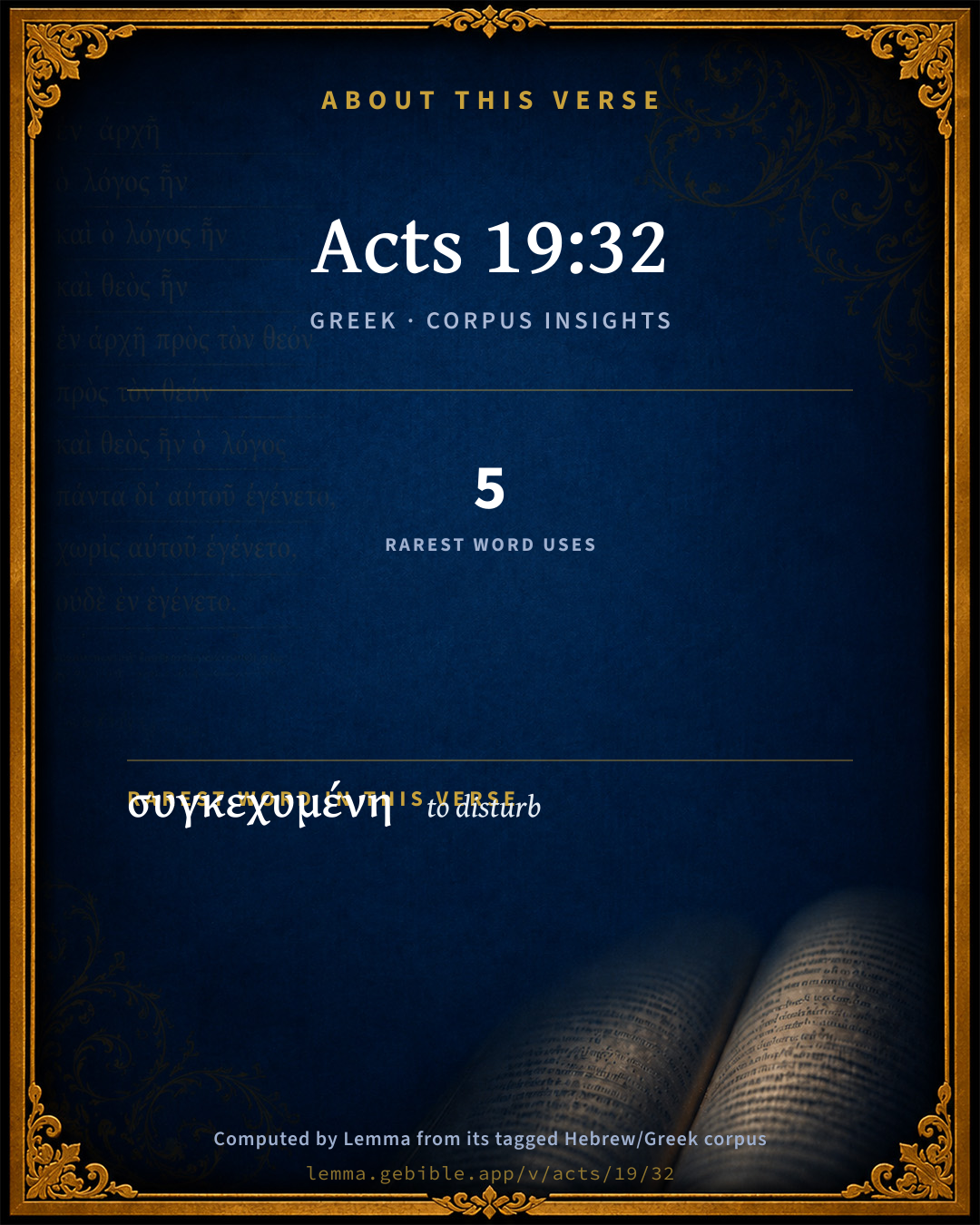
Acts 19:32

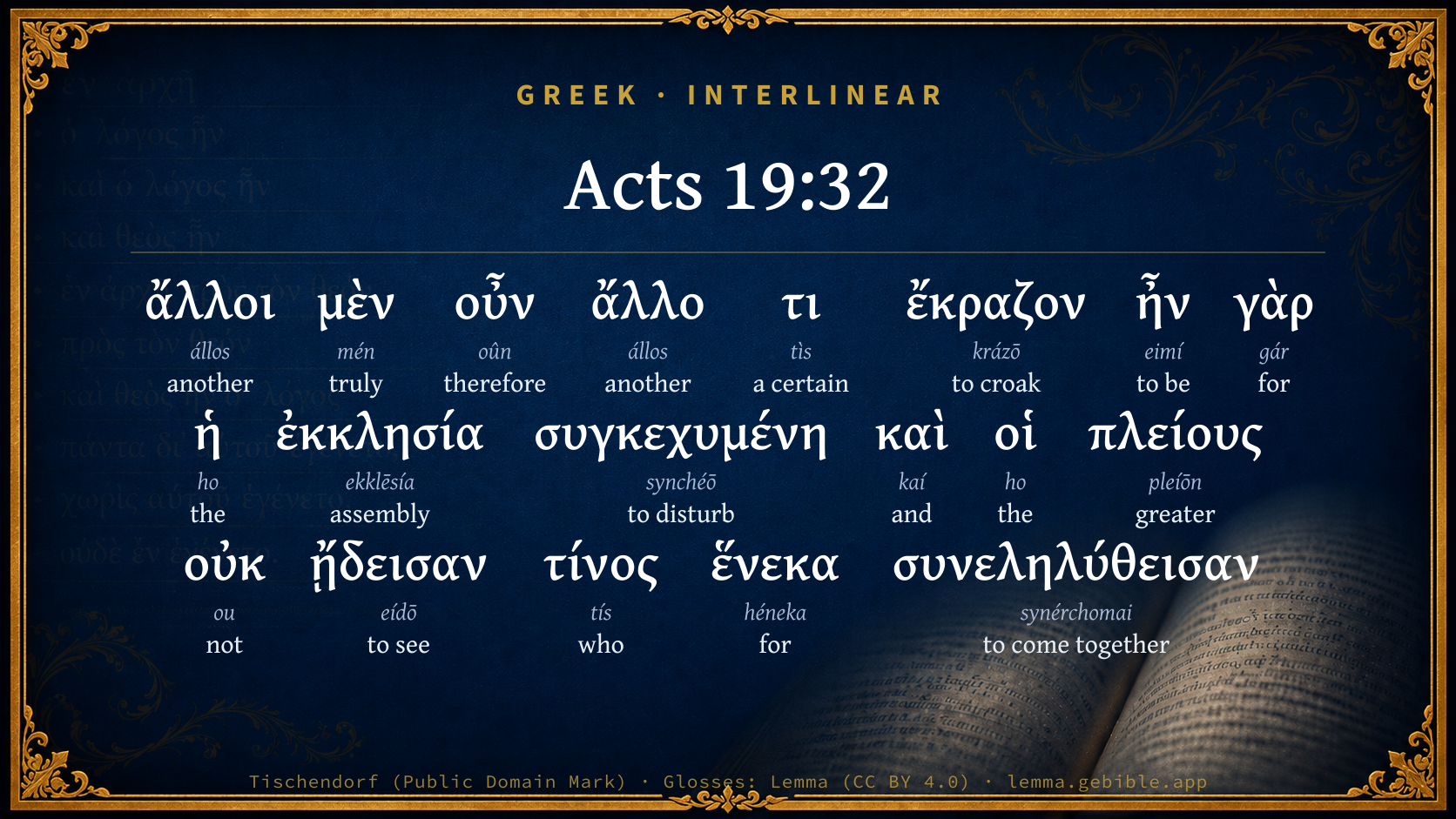
Greek (Tischendorf 8th ed.) Acts 19:32 appears in the Greek New Testament. The text above is from the Tischendorf 8th edition. Each word links to its Strong’s number and a concise gloss. Click any word for its full Thayer’s Greek Lexicon entry.
Download image
Cite this verse

Acts 19:32 (World English Bible). Public Domain. Lemma interlinear Bible study tool, https://lemma.gebible.app/v/acts/19/32.

Show BibTeX & RIS
BibTeX
RIS
English Translation
Some therefore cried one thing, and some another, for the assembly was in confusion. Most of them didn't know why they had come together.
World English Bible · Public Domain
Download a study sheet

One document with this verse’s original text, its word-by-word gloss line, the meaning frame, cross-references with their text, attributed commentary, and full source and license credits — printable, and it pastes into notes with its structure intact.

This verse Autodidact and up

Study sheet (.html) Plain text (.txt)

A passage Seminary Student

Up to 50 verses in one chapter. A passage sheet keeps up to 6 commentary sources and 12 cross-references per verse, in the order this page ranks them, and says so on the sheet whenever that leaves anything out. Ask for a single verse and you get the Autodidact verse sheet above.

Everything on this page stays free to read, with no account — the sheet is a download of what is already on screen, not access to it.

Want to remove ads? Support Godless Engineer
Compare translations 3

The same verse in 3 English versions, stacked beneath the original-language interlinear above. Click any original word for its lexicon entry.

Each is an independent rendering of the whole verse — the interlinear is not word-aligned to these translations.

Highlighted words mark where these versions differ — a whole-verse word diff, not a word-by-word alignment.

  • World English Bible Public Domain
    Some therefore cried one thing, and some another, for the assembly was in confusion. Most of them didn't know why they had come together.
  • King James Version Public Domain
    Some therefore cried one thing, and some another: for the assembly was confused: and the more part knew not wherefore they were come together.
  • unfoldingWord Literal Text CC BY-SA 4.0
    Then indeed different ones were shouting something different, for the assembly was confused, and the majority did not know for what reason they had come together.

unfoldingWord Literal Text — © unfoldingWord, licensed CC BY-SA 4.0. Word-aligned USFM3 via Door43 (git.door43.org/unfoldingWord/en_ult).

Versions to compare (up to 4)

3 of 4 selected

Show all 19 translations

Every available English version of this verse, each an independent rendering of the whole verse.

  • World English Bible Public Domain
    Some therefore cried one thing, and some another, for the assembly was in confusion. Most of them didn't know why they had come together.
  • Berean Standard Bible Public Domain
    Meanwhile the assembly was in turmoil. Some were shouting one thing and some another, and most of them did not even know why they were there.
  • Majority Standard Bible Public Domain
    Meanwhile the assembly was in turmoil. Some were shouting one thing and some another, and most of them did not even know why they were there.
  • King James Version Public Domain
    Some therefore cried one thing, and some another: for the assembly was confused: and the more part knew not wherefore they were come together.
  • American Standard Version (1901) Public Domain
    Some therefore cried one thing, and some another: for the assembly was in confusion; and the more part knew not wherefore they were come together.
  • Revised Version (1885) Public Domain
    Some therefore cried one thing, and some another: for the assembly was in confusion; and the more part knew not wherefore they were come together.
  • Geneva Bible (1599) Public Domain
    Some therefore cried one thing, and some another: for the assemblie was out of order, and the more part knewe not wherefore they were come together.
  • Douay-Rheims (1899) Public Domain
    Now some cried one thing, some another. For the assembly was confused, and the greater part knew not for what cause they were come together.
  • Young's Literal Translation Public Domain
    Some indeed, therefore, were calling out one thing, and some another, for the assembly was confused, and the greater part did not know for what they were come together;
  • Literal Standard Version CC BY-SA 4.0
    Some indeed, therefore, were calling out one thing, and some another, for the assembly was confused, and the greater part did not know for what they had come together;
  • Unlocked Literal Bible CC BY-SA 4.0
    Some people were shouting one thing, and some another, for the crowd was in confusion. Most of them did not even know why they had come together.
  • unfoldingWord Literal Text CC BY-SA 4.0
    Then indeed different ones were shouting something different, for the assembly was confused, and the majority did not know for what reason they had come together.
  • Darby Bible Public Domain
    Different persons therefore cried out some different thing; for the assembly was tumultuous, and the most did not know for what cause they had come together.
  • World Messianic Bible Public Domain
    Some therefore cried one thing, and some another, for the assembly was in confusion. Most of them didn’t know why they had come together.
  • Webster's Bible Public Domain
    Some therefore cried one thing, and some another: for the assembly was confused, and the greater part knew not why they had come together.
  • Free Bible Version CC BY-SA 4.0
    Some were shouting one thing, and some something else, for the crowd that had gathered was in total confusion—most of them had no idea why they were there.
  • Bible in Basic English Public Domain
    And some said one thing, and some another: for there was no order in the meeting; and most of them had no idea why they had come together.
  • Text-Critical English NT CC BY 4.0
    Now some were shouting one thing, and some were shouting another, for the assembly was confused, and the majority did not know for what reason they had come together.
  • Tyndale New Testament (1534) Public Domain
    Some cryed one thinge and some another and the congregacion was all out of quiet and the moare parte knewe not wherfore they were come togeder.

Literal Standard Version (2020), Covenant Press — licensed CC BY-SA 4.0. Text via the HelloAO Bible API (eBible.org). Unlocked Literal Bible (unfoldingWord) — licensed CC BY-SA 4.0. Text via the HelloAO Bible API (eBible.org). unfoldingWord Literal Text — © unfoldingWord, licensed CC BY-SA 4.0. Word-aligned USFM3 via Door43 (git.door43.org/unfoldingWord/en_ult). Free Bible Version, Dr. Jonathan Gallagher — licensed CC BY-SA 4.0. Text via the HelloAO Bible API (eBible.org).

Word by word

More ways to search: Search by grammar → Find every occurrence → Compare this word →

Practice this passage: Drill this verse → Learn its vocabulary →

συγκεχυμένη
synchéō
G4797
“to disturb”
Verb, Perfect, Passive, Participle, Nominative, Singular, Feminine
Part of Speech
Verb
Tense
Perfect
Voice
Passive
Mood
Participle
Case
Nominative
Number
Singular
Gender
Feminine
Full Thayer's Definition

Origin: from G4862 and cheo (to pour) or its alternate

TDNT: None

1. to pour together, commingle 2. to disturb the mind of one, to stir up to tumult or outbreak 3. to confound or bewilder
  1. ἄλλοι állos G243 “another” Adjective, Nominative, Plural, Masculine
  2. μὲν mén G3303 “truly” Particle
  3. οὖν oûn G3767 “therefore” Conjunction
  4. ἄλλο állos G243 “another” Adjective, Accusative, Singular, Neuter
  5. τι tìs G5100 “a certain” Indefinite pronoun, Accusative, Singular, Neuter
  6. ἔκραζον krázō G2896 “to croak” Verb, Imperfect, Active, Indicative, 3rd person, Plural
  7. ἦν eimí G1510 “to be” Verb, Imperfect, Active, Indicative, 3rd person, Singular
  8. γὰρ gár G1063 “for” Conjunction
  9. ἡ ho G3588 “the” Article, Nominative, Singular, Feminine
  10. ἐκκλησία ekklēsía G1577 “assembly” Noun, Nominative, Singular, Feminine
  11. καὶ kaí G2532 “and” Conjunction
  12. οἱ ho G3588 “the” Article, Nominative, Plural, Masculine
  13. πλείους pleíōn G4119 “greater” Adjective, Nominative, Plural, Masculine, Comparative
  14. οὐκ ou G3756 “not” Particle, Negative
  15. ᾔδεισαν eídō G1492 “to see” Verb, Pluperfect, Active, Indicative, 3rd person, Plural
  16. τίνος tís G5101 “who” Interrogative pronoun, Genitive, Singular, Neuter
  17. ἕνεκα héneka G1752 “for” Preposition
  18. συνεληλύθεισαν synérchomai G4905 “to come together” Verb, Pluperfect, Active, Indicative, 3rd person, Plural

About this verse

These counts appear in no published source. They are computed here, from the morphology-tagged text and Lemma’s own curated glosses. What Lemma adds →

19
words
17
distinct lemmas
Acts
section

Notable vocabulary

The rarest word here is συγκεχυμένη to disturb G4797 — appearing just 5 times in the whole Greek New Testament.

Shared distinctive vocabulary

συγκεχυμένη to disturb G4797 occurs in 5 verses of the Greek New Testament. Also found in:

Repetition

Words recur within this verse:

  • ἄλλοι another G243 ×2
  • ἡ the G3588 ×2

Cross-references

5

Topical passages linked to Acts 19:32 in the Treasury of Scripture Knowledge — connected by theme and wording, ordered by reader-vote popularity; previews shown in the World English Bible.

  • Acts 21:34 Some shouted one thing, and some another, among the crowd. When he couldn't find out the truth because of the noise, he commanded him to be brought into the barracks.
  • Matthew 11:7–9 As these went their way, Jesus began to say to the multitudes concerning John, "What did you go out into the wilderness to see? A reed shaken by the wind?
  • Luke 7:24–26 When John's messengers had departed, he began to tell the multitudes about John, "What did you go out into the wilderness to see? A reed shaken by the wind?
  • Acts 19:29 The whole city was filled with confusion, and they rushed with one accord into the theater, having seized Gaius and Aristarchus, men of Macedonia, Paul's companions in travel.
  • Acts 19:40 For indeed we are in danger of being accused concerning this day's riot, there being no cause. Concerning it, we wouldn't be able to give an account of this commotion."

Cross-references courtesy of OpenBible.info (CC BY 4.0).

Commentary

Notes on Acts 19:32 from classic Christian and Jewish commentators (each source and its license shown beneath its notes). The classic Christian expositions comment on the surrounding passage and are grouped to its opening verse, so a note may address several verses; the Jewish commentaries on the Tanakh (Rashi and others) are per-verse, so they appear only where the commentator wrote on this verse.

Lemma curates 59 commentaries, every one of them public domain or Creative Commons licensed, each selected and text-cleaned for this edition rather than reprinted as found. About our sources →

The Biblical Illustrator

Joseph S. Exell

Act_19:32-41

Some therefore cried one thing, and some another.

The excitement at Ephesus

I. What produced it.

1. Self-interest endangered.

2. Superstitious feelings aroused.

3. The unpopularity of the gospel.

4. The persuasive eloquence of one man.

II. What it produced. A display of the spirit of--

1. Enemies of truth.

2. True friends.

3. Eminent Christians. (Stems and Twigs for Sermon Framework.)

The tumult at Ephesus

I. Its causes.

1. The preaching of Paul.

2. The speech of Demetrius.

II. The tumult itself.

1. Pauls courageous demeanour.

2. The conduct of the populace.

III. The tumult stilled. The speech of the town clerk.

1. A model of worldly prudence.

2. An example of great moral courage.

Application:

1. Be not dismayed in times of danger.

2. Unite prudence with courage and justice. (J. H. Tasson.)

Popular disorders--their cause and cure

A depraved commonalty is the teeming source of all moral and political disorder, and the fearful presage, if not speedily averted by an efficient system of Christian instruction, of a sweeping anarchy and great national overthrow. (T. Chalmers, D. D.)

And when the town clerk had appeased the people.--

The conduct of the town clerk

When the tumult had gone on for about two hours down comes the town clerk. At the appearance of a well-known Roman official order is quickly restored, just as we have seen a crowd in the streets of London, assembled to witness a fight, quietly disperse on the appearance of one policeman, whilst the two excited combatants saunter off calmly in the opposite direction with their hands in their pockets. This sudden quieting of the city was a great tribute to the genius of Rome for good government. The Roman officials, indeed, usually appear to advantage in the New Testament, especially in the Acts. Gallio knew his business at Corinth, and the town clerk knew his business at Ephesus. His speech was brief and admirable--quite as good as Gallios, in its way, and to the point. He said in effect--Good people, what is this noise about? Great is Diana! We all know Diana is great. If a wretched, wandering Jew, half off his head, comes here and says otherwise, what can it matter? Every one in this assembly is aware that the famous image we adore came straight down from Jupiter. Nobody doubts that, so theres an end of the matter. You are not so simple as to suppose that our temple, celebrated throughout the world, can be in any danger from the windy chatter of this half-blind Paulus and his crew? Then, after all, poor deluded troublesome creatures as we know all the Jews are, yet these particular ones have committed no robbery. (Cries of Demetrius and all of us are being robbed. Heres the month of May, the place is full of visitors, the temple festival at its height, and we cant sell our shrines; theres a lot of dead stock on hand.) Well, well, if Demetrius and his friends have any grievance, the law is open; let him get his solicitor to prepare his case; both sides will then be heard, and you know that in a Roman law court justice will be done. Ill see to that. But this is not the way to get your rights. Go home quietly, and your business shall be attended to in a lawful manner. Remember, an uproar like this is a serious matter. You have special privileges, and you are in danger of forfeiting them by your unseemly behaviour. You are not under martial law with a propraetor and a legion to rule you, but you are a senatorial province, with a proconsul, and your humble servant in office, who is likely to be called to account for this disturbance, and in what a ridiculous, if not criminal light will Demetrius and his followers have to appear then! I fear they, and not Paulus and Alexander, will have to stand as prisoners in the dock. And beneath this mixture of flattery, irony, and menace, the excited crowd melted away. (H. R. Haweis, M. A.)

The conduct of the town clerk as an example

Cotton Mather used to say that there was a gentleman mentioned in Act_19:1-41, to whom he was often and greatly indebted--viz., the town clerk of Ephesus, whose counsel was, Do nothing rashly. And on any proposal of consequence he would say, Let us consult a little with the town clerk of Ephesus.

The address of the town clerk

Observe here:--

I. Conciliation. As if he had said, These poor Jews cannot in any way weaken the authority, limit the influence, or dim the glory of Diana. You may as well be anxious about the radiance of the quenchless stars as about Diana (Act_19:36). As there is not the slightest occasion for all this tumult, be quiet; act as men, not as children.

II. Conscience. He speaks out the just as well as the politic (Act_19:37). There is a high testimony from a learned and dignified pagan to the conduct of the apostles as the promoters of a new faith. It shows--

1. That they exhibited a respectful deference to the feelings of the errorists.

2. That they set forth Gods truth rather than battled with mens opinions.

3. That their language was kind and not reproachful. Would that all promoters of truth had imitated the example of the apostles in this respect.

III. Counsel. He administers wise advice (Act_19:38). This assembly is an unlawful one. Let there be an assembly of men lawfully called together to settle the matter in dispute.

IV. Caution. In conclusion, he gives them a word of warning (Act_19:40). (D. Thomas, D. D.)

The speech of the town clerk

is the model of a popular harangue. Such excitement was--

I. Undignified, as they stood above all suspicion in religious matters (Act_19:35-36).

II. Unjustifiable, as they could establish nothing against the men (Act_19:37).

III. Unnecessary, as other means of redress were open to them (Act_19:38-39).

IV. Dangerous; if neither pride nor justice availed anything, fear of the Roman power should restrain them (Act_19:40). (W. Hackett.)

The image which fell down from Jupiter.--

The image of Diana

A many-breasted idol of wood, rude as an African fetich, was worshipped in its shrine, in some portion of which a meteoric stone may have been inserted, the token of its being the image that fell down from Jupiter. Similar superstitions belong to various countries, such as the Palladium of Troy, the Ceres of Sicily, the Minerva Polias of Athens, and the Diana of Tauris. Somewhat of the same nature were the shield of Mars at Rome, the black stone in the Caabah at Mecca, that in the temple of the Sun at Baalbec, and the Lia Fail, or stone of destiny, on which the Scottish kings were for many centuries crowned at Scone. Popularly supposed in those ancient times to be a portion of Jacobs pillar, it was thought to be so connected with the destiny of the kingdom, that wherever it happened to be, there should reign the Scottish race, and though it was removed by Edward to Westminster Abbey, where it now forms the support of the coronation chair of the British sovereign, the old prophecy was fondly believed to be verified when James VI ascended the English throne on the death of Elizabeth. (Prof. Eadie.)

.

The Biblical Illustrator, edited by Joseph S. Exell (c. 1880s–1900s) — public domain. Text from a community e-Sword module.

Bengel's Gnomon

Johann Albrecht Bengel

Act 19:32. Οὐκ ᾔδεισαν, knew not) An apt and characteristic description of a people in a tumult. [This is a matter of usual occurrence to senseless zealots.—V. g.]

Bengel's Gnomon of the New Testament — English translation (T&T Clark, Edinburgh, 1860) — public domain. Text from a community e-Sword module.

Meyer's Critical & Exegetical Commentary

Heinrich August Wilhelm Meyer

Act_19:32-33. Οὖν] joins on, by way of inference, the description of the concourse (Act_19:29), interrupted by Act_19:30-31.

ἄλλο … ἄλλο] Comp. Charit. i. 5 : ὁ δῆμος ἅπας εἰς τὴν ἀγορὰν συνέτρεχεν ἄλλων ἄλλα κεκραγότων, Plat. Charm. p. 153 D: ἠρώτων δὲ ἄλλος ἄλλο. The following τί might have been left out (Kühner, § 836, note 5), but it is only wanting in D (Bornemann).

ἡ ἐκκλησία] It was no ἔννομος ἐκκλ., Act_19:39, and accordingly no legal popular assembly, neither an ordinary one (νόμιμος), nor an extraordinary (σύγκλητος), but simply an assemblage of the people, who had flocked together of their own accord,a concio plebis exlex et abusiva.

συγκεχυμ.] confused, in an uproar. Comp. Act_19:29. It lacked all order, guidance, self-restraint, discipline, etc.

προεβ. Ἀλεξ. προβαλλ. αὐτ. τ. Ἰουδ.] a vivid description of its tumultuary character. The Jews shoved (pushed) him forward from behind (προβαλλ.), and others, standing in front, brought or drew him out of the crowd (ἐκ τ. ὄχλου προεβ.). Grotius, Wetstein, Heinrichs, Kuinoel, and others take προβάλλειν as to propose (see Xen. Anab. vi. 1. 25, vi. 2. 6; Dem. 519. 16; Kypke, II. p. 101 f.), but this does not at all suffice for the lively picture of the tumult. Alexander, otherwise entirely unknown, was certainly a Christian, since only to such a one is the subsequent ἀπολογεῖσθαι suitable, not a Jew (Beza, Grotius, Ewald, and others). He is commonly, but arbitrarily, especially considering the frequency of the name, considered as identical with the Alexander mentioned in 1Ti_1:20, 2Ti_4:14, in which case it is in its turn presupposed that the name occurring at those two passages denotes one person. Such completely indemonstrable assumptions cannot serve to prove the genuineness and time of the composition of the Epistles to Timothy (in opposition to Otto). The Alexander in our passage had, in the Christian interest, mixed among the crowd, and was pushed forward by the malicious Jews that he might make a public address and, if possible, become a sacrifice to the fury of the multitude. If we hold him to be a non-Christian Jew (which does not result from Act_19:34), it is to be supposed that the Jews would be afraid that, on this occasion, they also might be attacked, and therefore pushed forward Alexander, an eloquent man and hostile to Paul, that he might maintain the innocence of the Jews to the destruction of the Christians. But Luke must have called attention to such a connection,[102] and that the more as the simple ἀπολογεῖσθαι, to make a defence, points quite naturally to the accusation of the Christians referred to.

κατασ. τ. χ.] moving his hand up and down[103] (for a sign that he wished to speak).

τῷ δημῷ] before the people, Herod. vii. 161; Plat. Prot. p. 359 A; Lucian. Gall. 3. See Bernhardy, p. 79.

δῆμος is as in Act_19:30, and the ἀπολογεῖσθαι, cannot therefore be meant to be a defence of the Jews (Bengel, Ewald) and of the ὄχλος (Otto).

[102] Otto, p. 108, makes up the scene more artificially, and that so as to make Alexander even the soul and secret spring of the whole uproar. According to Hausrath, the author gives designedly only a fragmentary account of the Jewish-Christian Alexander, because the conduct of the Jewish-Christians at that time did not suit the conciliatory object of his book.

[103] Comp. Act_12:17, Act_13:16, Act_21:40, where, however, the verb is joined with the dative, which, therefore, also D, al. (Bornemann) have here.

Meyer — Critical and Exegetical Commentary on the New Testament — English translation by Peter Christie, edited by Frederick Crombie (T&T Clark, 1880) — public domain. Text from a community e-Sword module.

Expositor's Greek Testament

ed. W. Robertson Nicoll

Act 19:32 . ἄλλοι μὲν οὖν : μὲν οὖν probably as often in Acts without any opposition expressed, but see Rendall, App. , p. 162; the antithesis may be in δέ of Act 19:33 . ἔκραζον : “kept on crying,” imperfect. ἐκκλησία , see below on Act 19:39 ; here of an unlawful tumultuous assembly. συγκεχ ., see above Act 19:29 . οἱ πλείους : “sensu vere comparativo” Blass = major pars .

The Expositor's Greek Testament, edited by W. Robertson Nicoll (1897–1910) — public domain. Text from a community e-Sword module.

Adam Clarke's Commentary

Verse 32. Some - cried one thing, and some another] This is an admirable description of a tumultuous mob, gathered together without law or reason; getting their passions inflamed, and looking for an opportunity to commit outrages, without why or wherefore-principle or object.

For the assembly was confused] Ἡ εκκλησια; The same word which we translate church; and thus we find that it signifies any assembly, good or bad, lawful, or unlawful; and that only the circumstances of the case can determine the precise nature of the assembly to which this word is applied.

Adam Clarke's Commentary on the Bible (1810–1826) — public domain. Text from a community e-Sword/MySword module.

Ellicott's Commentary for English Readers

(32) Some therefore cried one thing, and some another.—Better, kept on crying. The graphic character of the whole narrative makes it almost certain that it must have come from an eye-witness, or possibly from more than one. Aristarchus or Gaius, who travelled to Jerusalem with St. Luke (Luk_20:4), and were with him also at Rome, may have told him the whole tale of the scene in which they had borne so prominent a part. Possibly, also, following up the hint thrown out in the Note on Act_19:12, we may think of Tyrannus as having written a report of the tumult to St. Luke. The two conjunctions translated “therefore” (better, then) seem to carry the narrative back to what was passing in the theatre, after the parenthetical account of what had been going on between the Apostle, the disciples, and the Asiarchs outside it.

For the assembly was confused.—It is not without interest to note that the Greek word for assembly is the ecclesia, with which we are so familiar as applied to the Church of Christ. Strictly speaking, as the town-clerk is careful to point out (Act_19:39), this mob gathering was not an ecclesia, but the word had come to be used vaguely.

A Bible Commentary for English Readers, edited by Charles John Ellicott (1878–1897) — public domain. Text from a community e-Sword module.

The Cambridge Bible for Schools and Colleges

gen. ed. J. J. S. Perowne

32. Some therefore, &c.] As the craftsmen had not secured St Paul there was no central object to which attention could at once be called, and one general cry raised.

for the assembly was confused] The confusion in the city (Act_19:29) had become intensified by the rush to the theatre.

and the more part, &c.] All that would be heard by many would be the shouts of the mob, from which nothing could be gathered about St Paul as the offender. Amid cries of “Artemis for ever” or “Hurrah for Demetrius,” little would be learnt of how the tumult had begun.

The Cambridge Bible for Schools and Colleges (gen. ed. J. J. S. Perowne; Cambridge University Press, 1878–1918) — public domain. Text from a community e-Sword module.

John Gill's Exposition

Seeing then that these things cannot be spoken against,.... This officer intimates, in order to quiet the mob, and make them easy, that these things were so certain, and well known, that nobody would pretend to contradict them, and therefore they must be mistaken in the men, whom they had hurried into the theatre; it was impossible that they, or any men, should be capable of saying any thing against the truth of these things: therefore

ye ought to be quiet and do nothing rashly; to these men, to their hurt, but sit down, and compose yourselves, and think again, and consider of this matter, and not go into any hasty measures, which may, in the issue, be prejudicial to yourselves.

John Gill's Exposition of the Whole Bible (1746–1763) — public domain (CC PDM 1.0). Text via the HelloAO Bible API.

Trapp's Complete Commentary

John Trapp

32 Some therefore cried one thing, and some another: for the assembly was confused; and the more part knew not wherefore they were come together.

Ver. 32. Knew not wherefore, &c.] No more do the most of our common hearers. They follow the drove, and believe as the Church believeth. They will say, they come to Church to serve God; but who that God is, how to be served, wherein, and in whom to be served, they know not. Si ventri bene sit, si lateri, as Epicurus in Horace, if the belly may be filled, the back fitted, it sufficeth them.

John Trapp, A Commentary or Exposition upon All the Books of the Old and New Testament (1647–1656) — public domain. Text from a community e-Sword module.

Albert Barnes' Notes on the Bible

Some therefore cried one thing ... - This is an admirable description of a mob, assembled for what purpose they knew not; but agitated by passions, and strifes, and tumults.

And the more part knew not ... - The greater part did not know. They had been drawn together by the noise and excitement, and but a small part would know the real cause of the commotion. This is usually the case in tumultuous meetings.

Albert Barnes' Notes on the Bible (1834–1885) — public domain. Text from a community e-Sword/MySword module.

Matthew Poole's English Annotations

An excellent description of a popular tumult. Whether this

assembly was afterwards made legal by the magistrates resorting thither, (though it was not called by their authority), and is therefore called here, εκκλησια, is not so useful to inquire.

Matthew Poole's English Annotations on the Holy Bible (1683–1685) — public domain. Text from a community e-Sword/MySword module.

Whedon's Commentary on the Bible

Daniel D. Whedon

32. Cried one thing… confused—The embarrassment of the leaders against Paul was now complete. Could their mob have caught him in the street they could have easily murdered him. Had he entered the theatre, he might have been summarily dispatched. But as the crowd unconsciously moving into the theatre has assumed something of a deliberative form, then coolly to propose and debate any measure to make way with him would have brought the Roman government to say something about it. Nothing takes place now but incoherent and contradictory exclamations. At last a movement is made to put forth a single speaker, namely, Alexander.

Daniel D. Whedon (gen. ed.), Commentary on the Old and New Testaments (1874–1909) — public domain. Text from a community e-Sword module.

The Pulpit Commentary

In confusion for confused, A.V. (sugkecumenh: comp. sugcusewv, ver. 29). The more part, etc. A graphic picture of an excited mob led by interested and designing agitators.

The Pulpit Commentary (1880–1919), ed. H.D.M. Spence-Jones & Joseph S. Exell — public domain. Text from a community e-Sword module.

John Wesley's Explanatory Notes

The greater part did not know for what they were come together - Which is commonly the case in such an assembly.

John Wesley, Explanatory Notes Upon the Whole Bible (1754–1765) — public domain. Text via the GEBible commentary corpus.

McGarvey & Pendleton's Commentaries

J. W. McGarvey

32-34. Leaving the apostle, for a time, in the cloud of sorrow which we will find still enveloping him when we meet him again, we turn to witness the proceedings within the theater. (32) " Now some were crying one thing and some another; for the assembly was confused, and the greater part knew not on what account they had come together. (33) And they put forward Alexander out of the crowd, the Jews urging him forward. And Alexander, waving his hand, wished to make a defense to the people. (34) But knowing that he was a Jew, all with one voice, for about two hours, cried out, Great is Diana of the Ephesians. " There were two reasons why the Jews should feel some anxiety to defend themselves before this mob. First, It was well known in Ephesus that they were as much opposed to idols and idol worship as were the disciples. Second, The fact that the apostle and many of his brethren were Jews, naturally attracted toward all the Jews the hatred which had been aroused against them. A courageous and manly adherence to their own principles would have prompted them to share with the disciples the obloquy of their common position; but they were endeavoring to persuade the multitude that Paul and his party should not be identified with themselves. The cowardly trick was perceived by the multitude, as soon as they perceived that it was a Jew who was trying to address them, and they gave it the rebuke it deserved by refusing to hear him.

J. W. McGarvey (with Philip Y. Pendleton), Commentaries on the New Testament (The Fourfold Gospel, 1914; Acts; and the epistles) — public domain. Text from a community e-Sword/MySword module.

Cambridge Greek Testament for Schools and Colleges

32. ἄλλοι μὲν οὖν ἄλλο τι ἔκραζον, some therefore cried one thing and some another. As the craftsmen had not secured Paul, against whom Demetrius had directed their rage, there was no central object to arrest the general attention. Hence no settled cry was raised.

ἦν γὰρ ἡ ἐκκλησία συγκεχυμένη, for the assembly was confused. The σύγχυσις in the city (see Act 19:29) had become intensified by the rush into the theatre.

καὶ οἱ πλείους οὐκ ᾔδεισαν κ.τ.λ., and the greater part did not know, &c. All that would be heard by many would be the shouts of the mob, from which nothing could be gathered about St Paul as the offender. Amid cries of ‘Artemis for ever’ or ‘Hurrah for Demetrius,’ little would be learnt of how the tumult had begun.

Cambridge Greek Testament for Schools and Colleges (Cambridge University Press, 1896; 21 vols, various authors incl. Carr, Maclear, Plummer, Farrar, Lumby, Moule, M. R. James, Simcox) — public domain. Text from a community e-Sword module.

Lesson kit

Teaching starters — assembled from the data on this page, not authored interpretation. Every prompt links to the verse data it draws on. Edit before teaching.

Acts, in the Acts, opens this verse with 19 words (17 distinct Greek lemmas). Its most distinctive word is synchéō (“to disturb”). A historical commentator’s framing appears above. Read the whole chapter for the surrounding context.

Discussion questions

  1. What does “to disturb” (synchéō) contribute to the verse as a whole?
  2. Acts 2:6 shares the word «to disturb» with this verse. How do the two illuminate each other?
  3. “another” occurs 2× in this one verse. What is the effect of the repetition?
  4. The translations on this page render this verse differently — a whole-verse word diff, not a word-by-word alignment. What might account for the different wordings?
  5. Reading how The Biblical Illustrator and Bengel's Gnomon read this verse, where do the two commentators agree and where do they part?

Things to notice

Reading settings

Reading text

Shown beneath each verse's original-language words.

Old Testament
Old Testament edition

Read the OT as the Masoretic Hebrew (MT) or the Greek Septuagint (LXX).

English shown for the Greek Septuagint (in the Hebrew ↔ Greek comparison).

Comparing translations? Open the Compare panel on any verse page to stack up to four side by side.