

Acts 23:20
Greek (Tischendorf 8th ed.) Acts 23:20 appears in the Greek New Testament. The text above is from the Tischendorf 8th edition. Each word links to its Strong’s number and a concise gloss. Click any word for its full Thayer’s Greek Lexicon entry.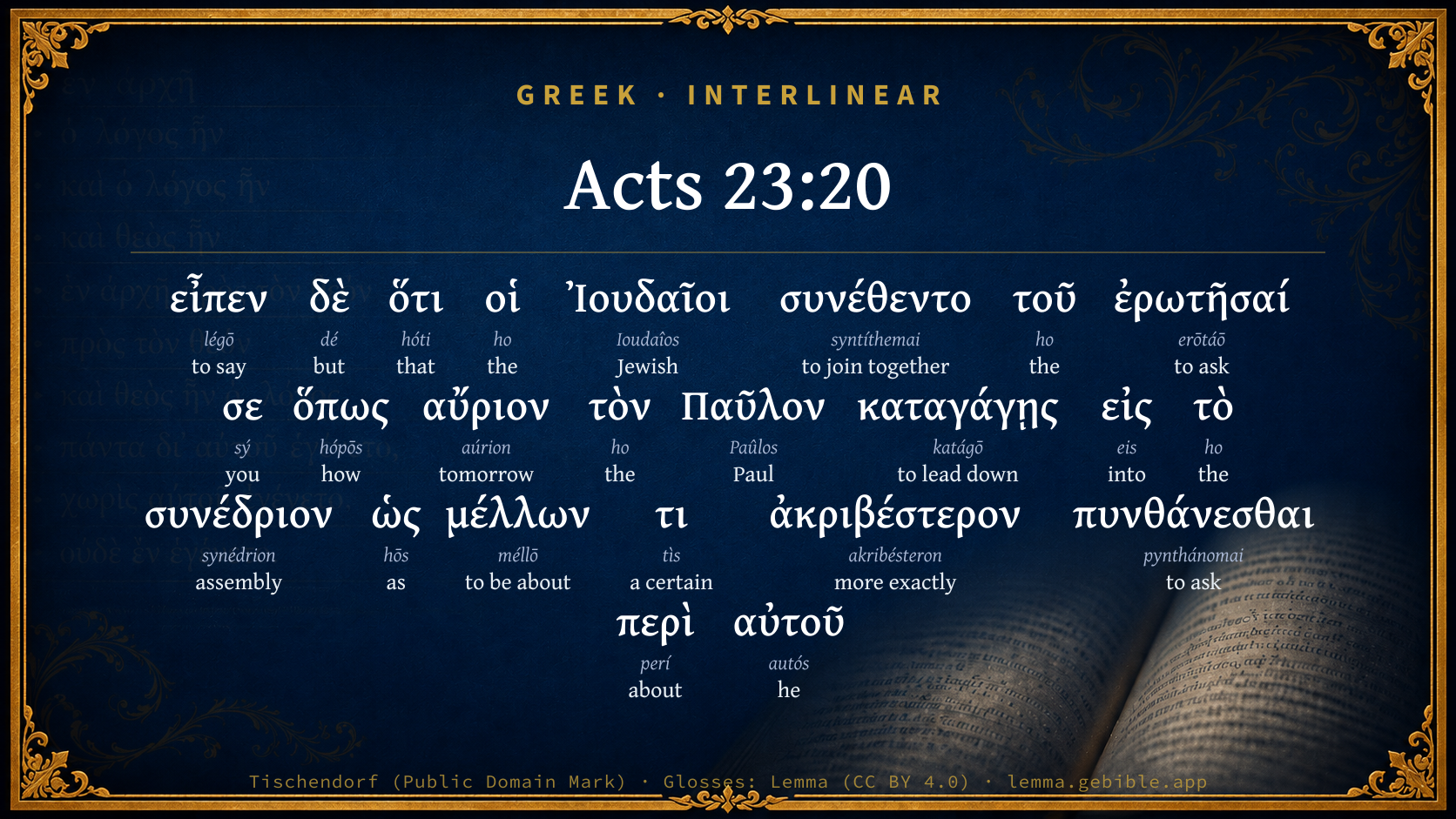
He said, "The Jews have agreed to ask you to bring Paul down to the council tomorrow, as though intending to inquire somewhat more accurately concerning him.
Download a study sheet
One document with this verse’s original text, its word-by-word gloss line, the meaning frame, cross-references with their text, attributed commentary, and full source and license credits — printable, and it pastes into notes with its structure intact.
This verse Autodidact and up
A passage Seminary Student
Up to 50 verses in one chapter. A passage sheet keeps up to 6 commentary sources and 12 cross-references per verse, in the order this page ranks them, and says so on the sheet whenever that leaves anything out. Ask for a single verse and you get the Autodidact verse sheet above.
Everything on this page stays free to read, with no account — the sheet is a download of what is already on screen, not access to it.
Compare translations 3
The same verse in 3 English versions, stacked beneath the original-language interlinear above. Click any original word for its lexicon entry.
Each is an independent rendering of the whole verse — the interlinear is not word-aligned to these translations.
Highlighted words mark where these versions differ — a whole-verse word diff, not a word-by-word alignment.
-
World English Bible Public Domain
He said, "The Jews have agreed to ask you to bring Paul down to the council tomorrow, as though intending to inquire somewhat more accurately concerning him.
-
King James Version Public Domain
And he said, The Jews have agreed to desire thee that thou wouldest bring down Paul to morrow into the council, as though they would enquire somewhat of him more perfectly.
-
unfoldingWord Literal Text CC BY-SA 4.0
So he said, “The Jews have agreed to ask you that tomorrow you might bring Paul down to the Sanhedrin, as if they were going to investigate something about him more thoroughly.
unfoldingWord Literal Text — © unfoldingWord, licensed CC BY-SA 4.0. Word-aligned USFM3 via Door43 (git.door43.org/unfoldingWord/en_ult).
Show all 19 translations
Every available English version of this verse, each an independent rendering of the whole verse.
-
World English Bible Public Domain
He said, "The Jews have agreed to ask you to bring Paul down to the council tomorrow, as though intending to inquire somewhat more accurately concerning him.
-
Berean Standard Bible Public Domain
He answered, “The Jews have agreed to ask you to bring Paul to the Sanhedrin tomorrow on the pretext of acquiring more information about him.
-
Majority Standard Bible Public Domain
He answered, “The Jews have agreed to ask you to bring Paul to the Sanhedrin tomorrow on the pretext of acquiring more information about him.
-
King James Version Public Domain
And he said, The Jews have agreed to desire thee that thou wouldest bring down Paul to morrow into the council, as though they would enquire somewhat of him more perfectly.
-
American Standard Version (1901) Public Domain
And he said, The Jews have agreed to ask thee to bring down Paul tomorrow unto the council, as though thou wouldest inquire somewhat more exactly concerning him.
-
Revised Version (1885) Public Domain
And he said, The Jews have agreed to ask thee to bring down Paul tomorrow unto the council, as though thou wouldest inquire somewhat more exactly concerning him.
-
Geneva Bible (1599) Public Domain
And he saide, The Iewes haue conspired to desire thee, that thou wouldest bring foorth Paul to morow into the Council, as though they would inquire somewhat of him more perfectly:
-
Douay-Rheims (1899) Public Domain
And he said: The Jews have agreed to desire thee, that thou wouldst bring forth Paul to morrow into the council, as if they meant to inquire some thing more certain touching him.
-
Young's Literal Translation Public Domain
and he said -- `The Jews agreed to request thee, that to-morrow to the sanhedrim thou mayest bring down Paul, as being about to enquire something more exactly concerning him;
-
Literal Standard Version CC BY-SA 4.0
And he said, “The Jews agreed to request you, that tomorrow you may bring down Paul to the Sanhedrin, as being about to inquire something more exactly concerning him;
-
Unlocked Literal Bible CC BY-SA 4.0
The young man said, “The Jews have agreed to ask you to bring down Paul tomorrow to the council, as if they were going to ask more precisely about his case.
-
unfoldingWord Literal Text CC BY-SA 4.0
So he said, “The Jews have agreed to ask you that tomorrow you might bring Paul down to the Sanhedrin, as if they were going to investigate something about him more thoroughly.
-
Darby Bible Public Domain
And he said, The Jews have agreed together to make a request to thee, that thou mayest bring Paul down to-morrow into the council, as about to inquire something more precise concerning him.
-
World Messianic Bible Public Domain
He said, “The Judeans have agreed to ask you to bring Paul down to the council tomorrow, as though intending to inquire somewhat more accurately concerning him.
-
Webster's Bible Public Domain
And he said, The Jews have agreed to desire thee, that thou wouldst bring down Paul to-morrow into the council, as though they would inquire somewhat concerning him more perfectly.
-
Free Bible Version CC BY-SA 4.0
“The Jews have arranged to ask you to bring Paul to the council tomorrow, as if they wanted to ask more detailed questions about his case,” he explained.
-
Bible in Basic English Public Domain
And he said, The Jews are in agreement together to make a request to you for Paul to be taken, on the day after this, into the Sanhedrin, to be questioned in greater detail.
-
Text-Critical English NT CC BY 4.0
The young man said, “The Jews have agreed to ask yoʋ to bring Paul down to the Sanhedrin tomorrow, as though the members of the Sanhedrin would be inquiring about his case in greater detail.
-
Tyndale New Testament (1534) Public Domain
And he sayd: the Iewes are determined to desyre the that thou woldest brynge forth Paul to morowe into the counsell as though they wolde enquyre somwhat of him more parfectly.
Literal Standard Version (2020), Covenant Press — licensed CC BY-SA 4.0. Text via the HelloAO Bible API (eBible.org). Unlocked Literal Bible (unfoldingWord) — licensed CC BY-SA 4.0. Text via the HelloAO Bible API (eBible.org). unfoldingWord Literal Text — © unfoldingWord, licensed CC BY-SA 4.0. Word-aligned USFM3 via Door43 (git.door43.org/unfoldingWord/en_ult). Free Bible Version, Dr. Jonathan Gallagher — licensed CC BY-SA 4.0. Text via the HelloAO Bible API (eBible.org).
Word by word
More ways to search: Search by grammar → Find every occurrence → Compare this word →
Practice this passage: Drill this verse → Learn its vocabulary →
- Appears 4× in the Greek New Testament
- First appears at Luke 22:5
- Part of Speech
- Verb
- Tense
- Aorist
- Voice
- Middle
- Mood
- Indicative
- Person
- 3rd person
- Number
- Plural
Full Thayer's Definition
- εἶπεν légō G3004 “to say” Verb, Aorist, Active, Indicative, 3rd person, Singular
- δὲ dé G1161 “but” Conjunction
- ὅτι hóti G3754 “that” Conjunction
- οἱ ho G3588 “the” Article, Nominative, Plural, Masculine
- Ἰουδαῖοι Ioudaîos G2453 “Jewish” Adjective, Nominative, Plural, Masculine
- συνέθεντο syntíthemai G4934 “to join together” Verb, Aorist, Middle, Indicative, 3rd person, Plural
- τοῦ ho G3588 “the” Article, Genitive, Singular, Neuter
- ἐρωτῆσαί erōtáō G2065 “to ask” Verb, Aorist, Active, Infinitive
- σε sý G4771 “you” Personal pronoun, 2nd person, Accusative, Singular
- ὅπως hópōs G3704 “how” Adverb
- αὔριον aúrion G839 “tomorrow” Adverb
- τὸν ho G3588 “the” Article, Accusative, Singular, Masculine
- Παῦλον Paûlos G3972 “Paul” Noun, Accusative, Singular, Masculine
- καταγάγῃς katágō G2609 “to lead down” Verb, Aorist, Active, Subjunctive, 2nd person, Singular
- εἰς eis G1519 “into” Preposition
- τὸ ho G3588 “the” Article, Accusative, Singular, Neuter
- συνέδριον synédrion G4892 “assembly” Noun, Accusative, Singular, Neuter
- ὡς hōs G5613 “as” Adverb
- μέλλων méllō G3195 “to be about” Verb, Present, Active, Participle, Nominative, Singular, Masculine
- τι tìs G5100 “a certain” Indefinite pronoun, Accusative, Singular, Neuter
- ἀκριβέστερον akribésteron G197 “more exactly” Adverb, Comparative
- πυνθάνεσθαι pynthánomai G4441 “to ask” Verb, Present, Middle or Passive deponent, Infinitive
- περὶ perí G4012 “about” Preposition
- αὐτοῦ autós G846 “he” Personal pronoun, Genitive, Singular, Masculine
About this verse
These counts appear in no published source. They are computed here, from the morphology-tagged text and Lemma’s own curated glosses. What Lemma adds →
- 24
- words
- 21
- distinct lemmas
- Acts
- section
Notable vocabulary
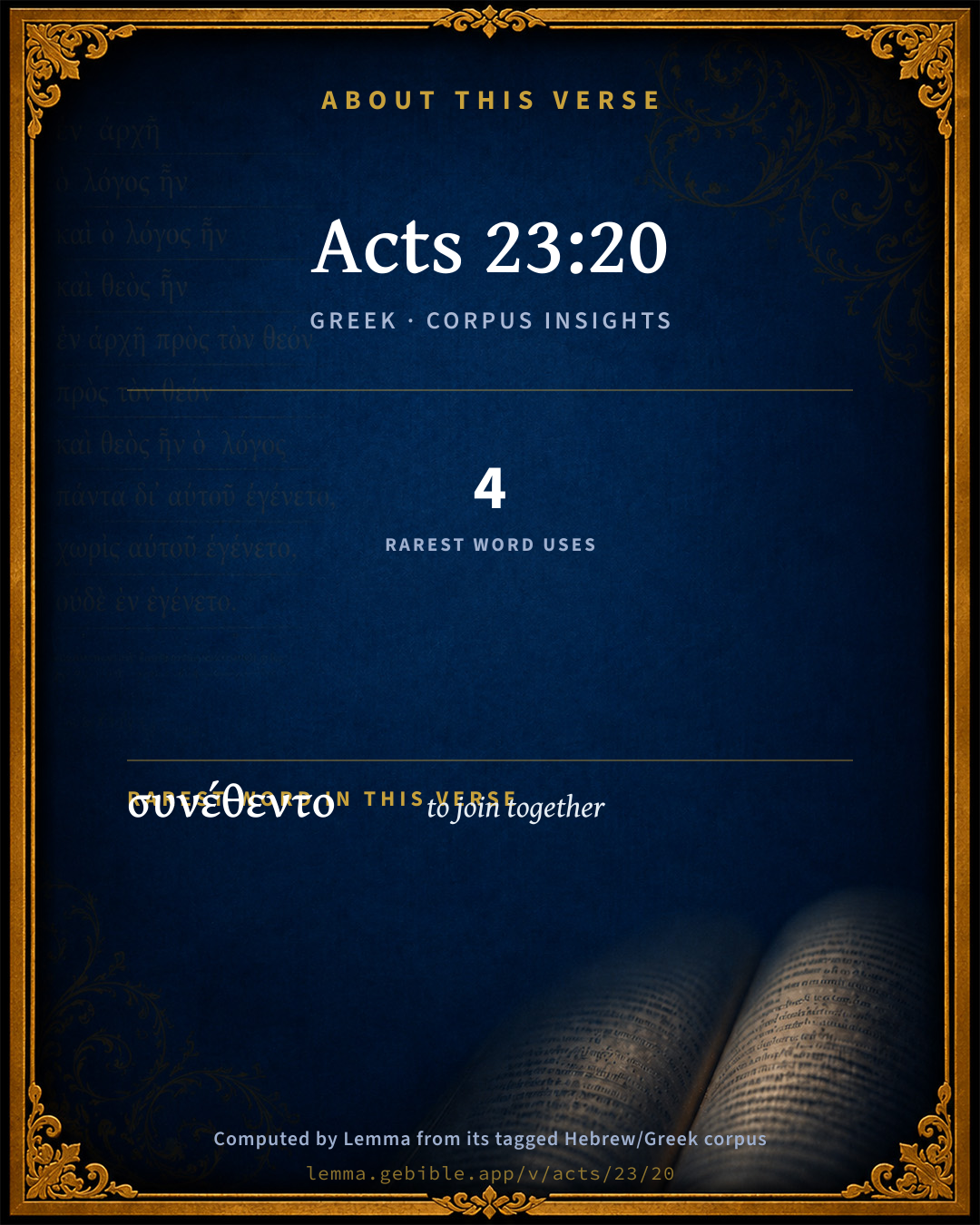
The rarest word here is συνέθεντο to join together G4934 — appearing just 4 times in the whole Greek New Testament.
Shared distinctive vocabulary
συνέθεντο to join together G4934 occurs in 4 verses of the Greek New Testament. Also found in:
Repetition
A word recurs within this verse:
- οἱ the G3588 ×4
Cross-references
4Topical passages linked to Acts 23:20 in the Treasury of Scripture Knowledge — connected by theme and wording, ordered by reader-vote popularity; previews shown in the World English Bible.
- Acts 23:14–15 They came to the chief priests and the elders, and said, "We have bound ourselves under a great curse, to taste nothing until we have killed Paul.
- Psalms 12:2 Everyone lies to his neighbor. They speak with flattering lips, and with a double heart.
- Daniel 6:5–12 Then said these men, We shall not find any occasion against this Daniel, except we find it against him concerning the law of his God.
- Acts 23:1 Paul, looking steadfastly at the council, said, "Brothers, I have lived before God in all good conscience until this day."
Cross-references courtesy of OpenBible.info (CC BY 4.0).
Where the printed editions differ
1 variantPlaces in this verse where the major printed Greek editions disagree on the wording in a way that affects the translation — a comparison of editions, not a manuscript-by-manuscript collation. The editions are the modern critical texts (Nestlé-Aland 28/27, SBL, Westcott-Hort, Tregelles, Tyndale House) and the traditional texts behind the KJV (the Textus Receptus and the Byzantine/Majority text). It is not a claim about which reading is original.
-
Editions differ
μέλλον
“it being about”
In NA28NA27SBL Not in TynWHTregTRByz
Textual data: Translators Amalgamated Greek New Testament (STEPBible TAGNT) · CC BY 4.0.
Lesson kit
Teaching starters — assembled from the data on this page, not authored interpretation. Every prompt links to the verse data it draws on. Edit before teaching.
Acts, in the Acts, opens this verse with 24 words (21 distinct Greek lemmas). Its most distinctive word is syntíthemai (“to join together”). A historical commentator’s framing appears above. Read the whole chapter for the surrounding context.
Discussion questions
- What does “to join together” (syntíthemai) contribute to the verse as a whole?
- Luke 22:5 shares the word «to join together» with this verse. How do the two illuminate each other?
- “the” occurs 4× in this one verse. What is the effect of the repetition?
- These translations render this verse differently; the difference is in the English rendering, not the original. What questions does that raise?
- Reading how Expositor's Greek Testament and The Cambridge Bible for Schools and Colleges read this verse, where do the two commentators agree and where do they part?
Things to notice
- These translations choose different wording for 24 words in this verse.
- “the” occurs 4× in this single verse.
- 21 distinct Greek lemmas span 24 words in this verse.
Commentary
Notes on Acts 23:20 from classic Christian and Jewish commentators (each source and its license shown beneath its notes). The classic Christian expositions comment on the surrounding passage and are grouped to its opening verse, so a note may address several verses; the Jewish commentaries on the Tanakh (Rashi and others) are per-verse, so they appear only where the commentator wrote on this verse.
Lemma curates 59 commentaries, every one of them public domain or Creative Commons licensed, each selected and text-cleaned for this edition rather than reprinted as found. About our sources →
Expositor's Greek Testament
ed. W. Robertson Nicoll
The Expositor's Greek Testament, edited by W. Robertson Nicoll (1897–1910) — public domain. Text from a community e-Sword module.
The Cambridge Bible for Schools and Colleges
gen. ed. J. J. S. Perowne
The Cambridge Bible for Schools and Colleges (gen. ed. J. J. S. Perowne; Cambridge University Press, 1878–1918) — public domain. Text from a community e-Sword module.
John Gill's Exposition
John Gill's Exposition of the Whole Bible (1746–1763) — public domain (CC PDM 1.0). Text via the HelloAO Bible API.
Trapp's Complete Commentary
John Trapp
John Trapp, A Commentary or Exposition upon All the Books of the Old and New Testament (1647–1656) — public domain. Text from a community e-Sword module.
Albert Barnes' Notes on the Bible
Albert Barnes' Notes on the Bible (1834–1885) — public domain. Text from a community e-Sword/MySword module.
Matthew Poole's English Annotations
Matthew Poole's English Annotations on the Holy Bible (1683–1685) — public domain. Text from a community e-Sword/MySword module.
The Pulpit Commentary
The Pulpit Commentary (1880–1919), ed. H.D.M. Spence-Jones & Joseph S. Exell — public domain. Text from a community e-Sword module.
McGarvey & Pendleton's Commentaries
J. W. McGarvey
J. W. McGarvey (with Philip Y. Pendleton), Commentaries on the New Testament (The Fourfold Gospel, 1914; Acts; and the epistles) — public domain. Text from a community e-Sword/MySword module.
unfoldingWord translationNotes
Door43 World Missions Community
unfoldingWord translationNotes — © Distant Shores Media and the Door43 World Missions Community, licensed CC BY-SA 4.0. Source: git.door43.org/Door43/en_tn.
Cambridge Greek Testament for Schools and Colleges
Cambridge Greek Testament for Schools and Colleges (Cambridge University Press, 1896; 21 vols, various authors incl. Carr, Maclear, Plummer, Farrar, Lumby, Moule, M. R. James, Simcox) — public domain. Text from a community e-Sword module.