
Romans 2:25

Greek (Tischendorf 8th ed.) Romans 2:25 appears in the Greek New Testament. The text above is from the Tischendorf 8th edition. Each word links to its Strong’s number and a concise gloss. Click any word for its full Thayer’s Greek Lexicon entry.
Download image
Cite this verse

Romans 2:25 (World English Bible). Public Domain. Lemma interlinear Bible study tool, https://lemma.gebible.app/v/romans/2/25.

Show BibTeX & RIS
BibTeX
RIS
English Translation
For circumcision indeed profits, if you are a doer of the law, but if you are a transgressor of the law, your circumcision has become uncircumcision.
World English Bible · Public Domain
Highlights
  • 1 first appearance in the Greek New Testament
Full analysis ↓
Download a study sheet

One document with this verse’s original text, its word-by-word gloss line, the meaning frame, cross-references with their text, attributed commentary, and full source and license credits — printable, and it pastes into notes with its structure intact.

This verse Autodidact and up

Study sheet (.html) Plain text (.txt)

A passage Seminary Student

Up to 50 verses in one chapter. A passage sheet keeps up to 6 commentary sources and 12 cross-references per verse, in the order this page ranks them, and says so on the sheet whenever that leaves anything out. Ask for a single verse and you get the Autodidact verse sheet above.

Everything on this page stays free to read, with no account — the sheet is a download of what is already on screen, not access to it.

Want to remove ads? Support Godless Engineer
Compare translations 3

The same verse in 3 English versions, stacked beneath the original-language interlinear above. Click any original word for its lexicon entry.

Each is an independent rendering of the whole verse — the interlinear is not word-aligned to these translations.

Highlighted words mark where these versions differ — a whole-verse word diff, not a word-by-word alignment.

  • World English Bible Public Domain
    For circumcision indeed profits, if you are a doer of the law, but if you are a transgressor of the law, your circumcision has become uncircumcision.
  • King James Version Public Domain
    For circumcision verily profiteth, if thou keep the law: but if thou be a breaker of the law, thy circumcision is made uncircumcision.
  • unfoldingWord Literal Text CC BY-SA 4.0
    For circumcision indeed benefits if you practice the law, but if you are a transgressor of the law, your circumcision has become uncircumcision.

unfoldingWord Literal Text — © unfoldingWord, licensed CC BY-SA 4.0. Word-aligned USFM3 via Door43 (git.door43.org/unfoldingWord/en_ult).

Versions to compare (up to 4)

3 of 4 selected

Show all 19 translations

Every available English version of this verse, each an independent rendering of the whole verse.

  • World English Bible Public Domain
    For circumcision indeed profits, if you are a doer of the law, but if you are a transgressor of the law, your circumcision has become uncircumcision.
  • Berean Standard Bible Public Domain
    Circumcision has value if you observe the law, but if you break the law, your circumcision has become uncircumcision.
  • Majority Standard Bible Public Domain
    Circumcision has value if you observe the law, but if you break the law, your circumcision has become uncircumcision.
  • King James Version Public Domain
    For circumcision verily profiteth, if thou keep the law: but if thou be a breaker of the law, thy circumcision is made uncircumcision.
  • American Standard Version (1901) Public Domain
    For circumcision indeed profiteth, if thou be a doer of the law: but if thou be a transgressor of the law, thy circumcision is become uncircumcision.
  • Revised Version (1885) Public Domain
    For circumcision indeed profiteth, if thou be a doer of the law: but if thou be a transgressor of the law, thy circumcision is become uncircumcision.
  • Geneva Bible (1599) Public Domain
    For circucision verely is profitable, if thou do the Lawe: but if thou be a transgressour of the Lawe, thy circumcision is made vncircumcision.
  • Douay-Rheims (1899) Public Domain
    Circumcision profiteth indeed, if thou keep the law; but if thou be a transgressor of the law, thy circumcision is made uncircumcision.
  • Young's Literal Translation Public Domain
    For circumcision, indeed, doth profit, if law thou mayest practise, but if a transgressor of law thou mayest be, thy circumcision hath become uncircumcision.
  • Literal Standard Version CC BY-SA 4.0
    For circumcision, indeed, profits, if you may practice law, but if you may be a transgressor of law, your circumcision has become uncircumcision.
  • Unlocked Literal Bible CC BY-SA 4.0
    For circumcision indeed benefits you if you obey the law, but if you break the law, your circumcision becomes uncircumcision.
  • unfoldingWord Literal Text CC BY-SA 4.0
    For circumcision indeed benefits if you practice the law, but if you are a transgressor of the law, your circumcision has become uncircumcision.
  • Darby Bible Public Domain
    For circumcision indeed profits if thou keep [the] law; but if thou be a law-transgressor, thy circumcision is become uncircumcision.
  • World Messianic Bible Public Domain
    For circumcision indeed profits, if you are a doer of the law, but if you are a transgressor of the law, your circumcision has become uncircumcision.
  • Webster's Bible Public Domain
    For circumcision verily profiteth, if thou keepest the law; but if thou art a breaker of the law, thy circumcision is made uncircumcision.
  • Free Bible Version CC BY-SA 4.0
    Being circumcised has value only if you do what the law says. But if you break the law, your circumcision is as worthless as those who are not circumcised at all.
  • Bible in Basic English Public Domain
    It is true that circumcision is of use if you keep the law, but if you go against the law it is as if you had it not.
  • Text-Critical English NT CC BY 4.0
    Circumcision does indeed benefit yoʋ if yoʋ observe the law, but if yoʋ transgress the law, yoʋr circumcision has become uncircumcision.
  • Tyndale New Testament (1534) Public Domain
    Circumcision verely avayleth if thou kepe the lawe. But if thou breake the lawe thy circumcision is made vncircumcision.

Literal Standard Version (2020), Covenant Press — licensed CC BY-SA 4.0. Text via the HelloAO Bible API (eBible.org). Unlocked Literal Bible (unfoldingWord) — licensed CC BY-SA 4.0. Text via the HelloAO Bible API (eBible.org). unfoldingWord Literal Text — © unfoldingWord, licensed CC BY-SA 4.0. Word-aligned USFM3 via Door43 (git.door43.org/unfoldingWord/en_ult). Free Bible Version, Dr. Jonathan Gallagher — licensed CC BY-SA 4.0. Text via the HelloAO Bible API (eBible.org).

Word by word

More ways to search: Search by grammar → Find every occurrence → Compare this word →

Practice this passage: Drill this verse → Learn its vocabulary →

παραβάτης
parabátēs
G3848
“lawbreaker”
Noun, Nominative, Singular, Masculine
Part of Speech
Noun
Case
Nominative
Number
Singular
Gender
Masculine
Full Thayer's Definition

Origin: from G3845

TDNT: 17:20,8

1. a transgressor 2. a lawbreaker
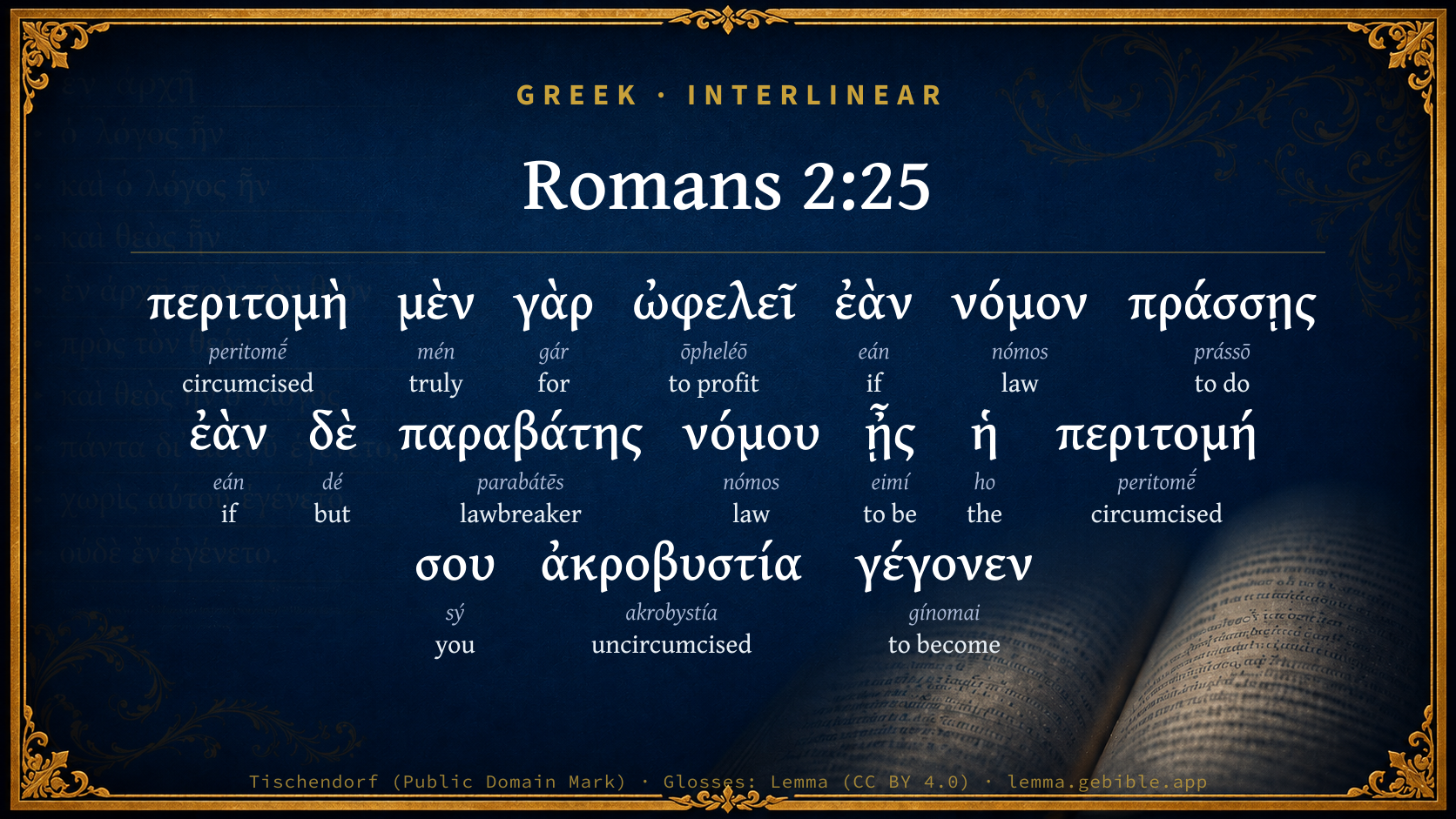
  1. περιτομὴ peritomḗ G4061 “circumcised” Noun, Nominative, Singular, Feminine
  2. μὲν mén G3303 “truly” Particle
  3. γὰρ gár G1063 “for” Conjunction
  4. ὠφελεῖ ōpheléō G5623 “to profit” Verb, Present, Active, Indicative, 3rd person, Singular
  5. ἐὰν eán G1437 “if” Conditional
  6. νόμον nómos G3551 “law” Noun, Accusative, Singular, Masculine
  7. πράσσῃς prássō G4238 “to do” Verb, Present, Active, Subjunctive, 2nd person, Singular
  8. ἐὰν eán G1437 “if” Conditional
  9. δὲ dé G1161 “but” Conjunction
  10. νόμου nómos G3551 “law” Noun, Genitive, Singular, Masculine
  11. ᾖς eimí G1510 “to be” Verb, Present, Active, Subjunctive, 2nd person, Singular
  12. ἡ ho G3588 “the” Article, Nominative, Singular, Feminine
  13. περιτομή peritomḗ G4061 “circumcised” Noun, Nominative, Singular, Feminine
  14. σου sý G4771 “you” Personal pronoun, 2nd person, Genitive, Singular
  15. ἀκροβυστία akrobystía G203 “uncircumcised” Noun, Nominative, Singular, Feminine
  16. γέγονεν gínomai G1096 “to become” Verb, Perfect, Active, Indicative, 3rd person, Singular

About this verse

These counts appear in no published source. They are computed here, from the morphology-tagged text and Lemma’s own curated glosses. What Lemma adds →

17
words
14
distinct lemmas
Pauline Epistles
section

Notable vocabulary

The rarest word here is παραβάτης lawbreaker G3848 — appearing just 5 times in the whole Greek New Testament.

First appearance in Scripture

This word makes its first canonical appearance in the Greek New Testament here:

  • παραβάτης lawbreaker G3848

Shared distinctive vocabulary

παραβάτης lawbreaker G3848 occurs in 5 verses of the Greek New Testament. Also found in:
Repetition

Words recur within this verse:

  • περιτομὴ circumcised G4061 ×2
  • νόμον law G3551 ×2
  • ἐὰν if G1437 ×2

Cross-references

10

Topical passages linked to Romans 2:25 in the Treasury of Scripture Knowledge — connected by theme and wording, ordered by reader-vote popularity; previews shown in the World English Bible.

  • Jeremiah 4:4 Circumcise yourselves to Yahweh, and take away the foreskins of your heart, you men of Judah and inhabitants of Jerusalem; lest my wrath go forth like fire, and burn so that none can quench it, because of the evil of your doings.
  • Galatians 5:3–6 Yes, I testify again to every man who receives circumcision, that he is a debtor to do the whole law.
  • Acts 7:51 "You stiff-necked and uncircumcised in heart and ears, you always resist the Holy Spirit! As your fathers did, so you do.
  • Galatians 6:15 For in Christ Jesus neither is circumcision anything, nor uncircumcision, but a new creation.
  • Deuteronomy 30:6 Yahweh your God will circumcise your heart, and the heart of your seed, to love Yahweh your God with all your heart, and with all your soul, that you may live.
  • Jeremiah 9:25–26 Behold, the days come, says Yahweh, that I will punish all those who are circumcised in [their] uncircumcision:
  • Romans 2:23 You who glory in the law, through your disobedience of the law do you dishonor God?
  • Romans 2:28–3:2 For he is not a Jew who is one outwardly, neither is that circumcision which is outward in the flesh;
  • Ephesians 2:11–12 Therefore remember that once you, the Gentiles in the flesh, who are called "uncircumcision" by that which is called "circumcision," (in the flesh, made by hands);
  • Romans 4:11–12 He received the sign of circumcision, a seal of the righteousness of the faith which he had while he was in uncircumcision, that he might be the father of all those who believe, though they be in uncircumcision, that righteousness might also be accounted to them.

Cross-references courtesy of OpenBible.info (CC BY 4.0).

Commentary

Notes on Romans 2:25 from classic Christian and Jewish commentators (each source and its license shown beneath its notes). The classic Christian expositions comment on the surrounding passage and are grouped to its opening verse, so a note may address several verses; the Jewish commentaries on the Tanakh (Rashi and others) are per-verse, so they appear only where the commentator wrote on this verse.

Lemma curates 59 commentaries, every one of them public domain or Creative Commons licensed, each selected and text-cleaned for this edition rather than reprinted as found. About our sources →

The Biblical Illustrator

Joseph S. Exell

Rom_2:25-29

For circumcision verily profiteth if thou keep the law.

Circumcision in relation to baptism

I. Its institution (Gen_17:9). It is called the covenant, and the token of the covenant, which God established with Abraham and his seed. So circumcision was not of mans invention, but of Gods appointment. And baptism is not a ceremony introduced into the Church by the invention of man. Christ said, Go and baptize all nations, etc.

II. The history of the ordinance.

1. It commenced with adults (Gen_17:23). We do not read about the state of mind of all these adults. It is certain that Ishmael differed exceedingly from Isaac and from his father. So baptism was first amongst adults. You remember the instance of Lydia. She having her heart opened, was afterwards baptized, and her house, without any specific mention of the character of the parties composing her household.

2. It continued not amongst adults, but on children (Gen_21:4). And this became a custom in Israel. Korah, Dathan, and Abiram were as truly circumcised as Moses and Aaron; Jeroboam and Ahab as David or Hezekiah. And thus it came to pass, by the continuance of the outward ordinance, not waiting upon the individual character, but taking its rise on the eighth day of the childs age, there came to be an Israel in two senses--spiritual, inclusive of that chosen people that God reserved to Himself; and national, inclusive of the others, together with the mixed multitude which knew not God. And so the apostle tells us, All are not Israel that are of Israel. Now the analogy here again is perfect. Baptism, which commenced with adults, soon proceeded among the children; the children of the baptized converts, were themselves baptized. There is no especial commandment for the purpose. None was needed, because the earliest Christians, who were Jews, regarded their children as entitled to the same privileges as themselves. It would have been strange if Christianity, placing before them greater privileges in every other respect, had restricted them in this. They were in the habit of bringing their children as Jews; to do so as Christians, at the same age, was natural. But if instead of presenting them at eight days old, they were to keep them back till they had formed some judgment of their character, then, indeed, a special commandment would have been required, because they would have been called to change their already established practice. The same consequences would naturally follow which followed in the case of Israel. There would grow up a baptized community, a variety of characters. All would not be Christians which were of Christendom; as all were not Israelites, indeed, who were of Israel in the flesh.

III. The nature of the ordinance and the abuse of it (Rom_4:11).

1. Here faith is distinguished from circumcision. It was enjoyed by Abraham previous to the circumcision; and he received the circumcision--a sign, and declared also to be a seal, to him of the righteousness of the faith which he had before. Nothing less than this could ever have been supposed to belong to circumcision by any believing Israelite. Remembering it was a seal to his father Abraham of the righteousness of faith, he would look upon it as a seal to himself in like manner, and would ask for it as a seal upon his child also, and would give thanks unto God that his infant might be sealed in like manner. He would presently find, indeed, that many have the seal Who grow up without the faith. But would their falling off alter his view of the ordinance of God? No. He would be called to distinguish between the ordinance itself and the abuse of it, into which the nation had fallen; and he would endeavour, amidst all the degeneracy of the people around him, to rise into holy confidence that God would bless His own ordinance, and as he found that faith working within him, he would appeal to that ordinance as a proof of Gods loving kindness to him. Now here the analogy is the same. Baptism was, indeed, a seal of the righteousness of the faith which the first adult Christian had, being yet unbaptized. It does not follow that no persons were baptized except true believers. We know of one who was baptized, and the apostle told him that he had neither part nor lot in the matter. But all who made a profession of faith were baptized. If the answer were the answer of a good conscience, then baptism was all that it was intended to be--a seal to them of the righteousness of the faith which God had given them. But afterwards, when the infants of those believing parents were baptized, it would presently appear that many were baptized in the flesh who lived without God in the world: and the faith of the believer would then be put to a trial. Baptism has been abused, as circumcision was.

2. See, then, how circumcision was abused. It is the nature of the human heart to desire to escape punishment without desiring to avoid sin; and therefore the tendency of man always has been to substitute some form for real religion. The Jews boasted of being the children of Abraham, and placed their confidence in that for escape from punishment. There is nothing that the Scripture is more express against than this resting in outward privileges, as if they could give them safety with God (Mat_3:8-9; Joh_8:33, etc.; Act_7:51; Rom_2:28-29). How awful is the analogy here. With regard to the outward forms of religion, there remains a large class of persons amongst ourselves who place the same sort of bold reliance upon the outward ordinance of baptism that the Jews placed upon their being the children of Abraham. Read from Rom_2:17 in its application to yourselves: most remarkable it is, by the transposition of a few words--changing Jew for Christian and changing circumcision for baptism. Oh, be assured that while circumcision was a seal of the righteousness of Abrahams faith, the baptism which is of the heart is the purifying power of God. (H. McNeill, D. D.)

Religious forms

1. Are intended to promote holy living.

2. If this end be accomplished they are invaluable.

3. If not our very religion becomes irreligion. (J. Lyth, D. D.)

For he is not a Jew that is one outwardly.--

Outward and inward religion

I. Merely outward religion is no true religion at all.

1. The apostle is proving that both Jews and Gentiles are all under sin. He has shown this respecting the Gentiles. He next comes to the Jew, and there is a harder task, for the Jew was so blinded, prejudiced, and self-righteous. There was nothing which the Jew more gloried in than in that of circumcision. God having, as they said, promised Abraham that, if his children transgressed, He would remember their compliance with this ordinance, and deliver them on account of the merit of circumcision. They accounted this one rite equal to the keeping of all the commandments of God. But in this they showed a lamentable ignorance of their own Scriptures (Deu_10:16; Jer_9:25; Jer_4:4). Surely these are sufficiently plain as to the utter outward worthlessness of circumcision. So, with regard to the other rites, when the Jews would substitute them for true religion, then they became an object of aversion to God (Isa_1:13, etc.). What is there in outward rites and practice which, of itself, can be acceptable to God, who is a Spirit. Worship offered to the Divine being must have some correspondence to His nature, and accordance with His will and Word. If God had a body, and were not a Spirit, then a religion of bodily exercise might serve without any regard to the inward state of the worshippers mind and heart. But God has no corporeal form, and therefore bodily service, without spiritual worship, is no worship at all. If, again, God were a stock or a stone, then a religion which exercises neither the mind nor the spirit might satisfy His claim. But when God is a pure Mind, a great Spirit--when God is love, and claims all souls as His, then to attempt to put Him off with outward forms is an insult to His spiritual character and His holy majesty.

2. Are there none of you who have thought that, if you came to church once or twice a week, this alone proved that you were good Christians? And yet it might be that there was only a bodily attendance: your minds might have been at home, or with your business, or with the last pleasure. And so with baptism, which has taken the place of circumcision. The Scripture itself guards us against not resting in the mere outward form or outward rite (1Pe_3:21). And yet many, if baptized with water, never examine themselves as to whether they have also been baptized with the Holy Spirit. And so the spirit of formality can turn even the Lords Supper, which is meant to deepen penitence, and to call forth simple glory in the Cross of Christ, into self-righteous formality and a judaizing ceremony.

II. The absolute necessity of an inward work of Divine grace. For he is a Jew which is one inwardly, etc.

1. This may be learned from the Old Testament. Moses taught (Deu_30:6) that true circumcision is that of the heart, in the spirit, and not in the letter, a Divine work, inwardly wrought.

2. What was the design of this peculiar rite?

(1) St. Paul says, Abraham received the sign of circumcision, a seal of the righteousness of the faith which he had, being yet uncircumcised. So, in Gen_17:1-27, God calls it a token of the covenant betwixt Him and Abraham. In that covenant God had engaged to make Abraham a father of many nations; to be a God to him and his seed after him, and in this all blessings are comprehended; and if Abraham had not believed God, he would not have complied with a rite so painful to flesh and blood. Thus, in its very origin, this rite was connected with faith, and if used without faith, it did not answer its original design.

(2) But, again, this rite also denoted that man is by nature, from his very birth, a sinner; that the covenant of grace requires blood to be shed in order to atone for him; that there must be the inward mortification of the body of sin; and that there must be a marked distinction in spirit between the people of God and the children of the world. It especially set forth Christ the Mediator of the covenant who should arise of the seed of Abraham, who should shed His blood in atonement for sin, through whom also should be given the Holy Spirit, who should impart a new nature, a new heart, and should enable men to mortify their sinful lusts, and thus to become a peculiar people, separate from the world indeed, zealous of good works. But all this spiritual meaning was lost where men used only the outward form. Hence the declaration of verses 25-29.

3. To this rite of circumcision our Lord personally submitted. He had not the personal need which others had. It was because He had consented to be made under the law, to be obedient unto the law for men, yea, to shed His blood for the atonement of the sins of men. As He ended, so He began His life, with shedding His sacred blood. Here was part of the vicarious obedience paid by Christ to the law, whence our safety, our peace, our happiness, our salvation.

4. But now, under the gospel, the outward rite is gone with the types of the ceremonial law, but the inward blessing is as important as ever. We are by nature born in sin; we have to look with faith to the blood of the everlasting covenant; we have, through the help of the Holy Spirit, to mortify our members which are on earth; we have to come out of the world. Especially we have to receive Jesus as the Messiah in all His offices, and we are to depend on Christ, in the fulness of His grace, for the help of the Holy Spirit, to regenerate, to mortify, and to sanctify. These things are not less essential to our religion than they were to the Jew; without them our Christianity is nothing worth. Whatever outward things the Christian may do, he will never allow himself to forget the necessity of inward piety. But in his zeal for spiritual religion he need not neglect the few or simple ordinances of religion; but while using all means must trust to Christ only. (J. Hambleton, M. A.)

Church privileges no sign of grace

This point deserveth a lively discovery, because it is the only evidence of most Christians for heaven. And whereas in other things they would judge a title without reality to be a miserable comfort, yet in religion they are strongly contented to have the repute of Christians, baptized persons, professors of Christs doctrine, and yet know not the power of these things, being like a dead corpse with sweet flowers strewed upon it.

1. Therefore to explicate this necessary point, consider some things by way of foundation.

(1) We find it such a sin that generally the people of Israel were guilty of, insomuch that the great contestation between the prophets in the Old Testament and the Israelites living then, between Christ and His apostles and the Jews living then, to have been upon this very particular. No minister, no sermon, could take them off from this, that because they had the external privileges, therefore they did belong to God, and were the children of Abraham.

(2) If you look over all Christianity you shall find this the universal sin, whereby Christ and regeneration with powerful godliness is wholly neglected, and a fleshly carnal confidence in the titles and ordinances of Christianity established.

(3) To demonstrate the connaturality of this sin, observe how ingenious the fleshly minds of men have been by arguments and opinions to encourage a carnal confidence in these externals.

2. While we give this explication, you must by way of caution take heed of two other extremes.

(1) To cry down the very being and use of these external ordinances as being but forms, and the spiritual frame of the heart is made all in all.

(2) We are also deficient when, although we do not cry down forms wholly, yet we give too little to these institutions of Christ.

3. Consider why people are so apt to rest upon these as comfortable testimonies, and there are several reasons.

(1) Because they being duties commanded, when performed, that gives some ease and comfort to a natural conscience.

(2) We are apt to rest in these things because they are easy to be done; whereas the way of mortification is tedious to flesh and blood. Hence it is called crucifying the flesh, and cutting off the right hand, and pulling out the right eye.

(3) Men rest upon these because they are ignorant of the work and necessity of regeneration. The apostle calls circumcision of the heart, circumcision made without hands; and so baptism and the sacraments in the heart, which are not visible in the eyes of the world, make us esteemed before God. Be not, then, idol Christians that have eyes and see not, hearts and understand not the inward virtue and spiritual efficacy of Christ in His ordinances.

(4) They put confidence in them because they are ignorant of the righteousness by faith in Christ.

(5) Men rest on them because they look on these duties as satisfactory and compensatory to God.

(6) Carnal people rely on these because they mistake the nature of them. They look upon them as those things which will of themselves make them acceptable to God, notwithstanding any preparation or spiritual managing of them. Whereas setting aside the Word of God that works the first grace in us, all other duties they are but as garments to the body, which cannot warm a dead body, but if there be life in the body to heat them first, then they will increase the heat. And thus it is here: if there be spiritual life in thee, and thou put it forth in these duties, then these duties will corroborate and strengthen it more. (A. Burgess.)

The having and enjoying such seals is not sign sure enough for our being in the state of grace

1. That they are not may appear in that the Scripture makes it not only possible for such to be damned, but doth foretell even actual damnation, and that to the greater part of such persons.

2. The Scripture reckons the condition of a man with these privileges and one without them in the same condition if there be not holiness. Thus Jeremiah makes the uncircumcised in heart, though circumcised in flesh, all one with the worst of heathens, the Moabites and the Ammonites. And to this purpose, also, the apostle in the verses before, Shall not thy circumcision be accounted uncircumcision if thou keep not the law? So that as long as wickedness is in thy life, thy baptism doth no more advantage thee than the heathens no-baptism.

3. The Scripture goeth higher, and doth not only make them equal with pagans, but God professeth His abomination of all their religious service, and thy wickedness is more noisome than all thy religion is well-pleasing. See Isa_1:1-31, how God expresseth Himself concerning the sacrifices and new moons of the sinful Israelites. He hated them; they were an abomination to Him. It was like cutting off a dogs head. Oh, how contrary are Gods thoughts and thy thoughts about the same religious duties! The prophet Haggai also (Hag_2:1-23) doth by an excellent instance show, that if a man be unclean and sinful, his holy services do not take off from his uncleanness, but his uncleanness defiles them.

4. These are so far from being signs without grace, that they will be aggravations of thy condemnation. As in some countries when their malefactors were to be burnt at the fire, they poured oil and pitch to increase their torment the more, so will every sacrament, every prayer, every church privilege, make hell the hotter for thee. (A. Burgess.)

Outward and inward religion

I. There are some who are only Christians outwardly and others who are also Christians inwardly. This difference appears--

1. In the different characters given those who profess the same faith and true religion (Mat_13:47-48). The tares and the wheat and the goats and the sheep, the wise and the foolish (Mat_25:1-46), are in the Church.

2. In the different effects religion has on the lives of those who are called Christians. There are some whose religion makes them holy, others who have nothing but an idle form (2Ti_3:5). The knowledge of some is confined to their heads, it never gets down to their hearts (Tit_1:16). Others, by reason of their light, dare not venture on an ill thing, more than on a precipice. The pretended religion of others leaves them loose.

3. In the different acceptance which persons prayers get. Some are very pleasing, others God abhors (Pro_28:9; Isa_66:2-3; Isa_1:11).

4. From the different feeling which those have of the advantage of religion, the ordinances and duties thereof. Some are acquainted with the gain of religion, and, from their own experience, can give a solid reason why they follow it (1Ti_6:6). But unto others all these things are but as empty husks (Pro_14:10). They abide in the outer court of religion all their days.

5. In the different effects of the religion which those profess. Grace is of a growing nature (Pro_4:18). And the longer that saints have a standing in religion they will be the more firmly rooted (Psa_92:13-14; Pro_26:14). But others think they are right, and they seek no farther, and some, instead of growing better, grow worse and worse (Rev_3:16).

6. In the different passage which those have out of time into eternity. Death is the point at which we all meet; but it is the point where outside and inside Christians part forever (Psa_37:37-38).

II. The causes of this difference.

1. The different way that persons come by their religion. There is a difference--

(1) In the weight which their entering on their religion had on their spirits. Some come very lightly by their religion; hence it sits lightly upon them, and often goes as lightly from them. They venture upon building a tower without counting the cost. To others it is not so easy, but they are brought to the utmost seriousness in the matter (Luk_14:28-29); hence they go to the bottom of the matter, while others satisfy themselves with superficial work.

(2) In the depth of their conviction and humiliation (Luk_6:48-49). The plough of conviction lightly going over the fallow ground of the heart is sufficient to make an outside Christian (Mat_13:5; Mat_13:20). But it must be carried deeper to make an inside Christian, even to the root of the most inward beloved lust, and to the discovery of Christ for sanctification, as well as justification.

(3) In the issue of their exercises about their souls case. In the one they have issued in the change of their nature (Eze_36:26); but in the other, whatever stir has been made in the affections, the stony heart has remained untaken away (Mat_13:5).

2. The different ways in which professors follow religion.

(1) Some make religion their main business (Gen_5:24). And this makes an inside Christian (Psa_119:6). Others make religion but a bye-work; their main business is of another kind. In regard to the one, all things else about him bow to his religion; whereas, as to the other, he makes his religion bow to his other designs.

(2) They follow religion from different principles, motives, and ends.

(a) Some follow it from a natural conscience. Fear of punishment, or hope of reward, are powerful enough to make an outward Christian. But an inside Christian has a gracious principle of love to God and holiness implanted in him which incline him unto holiness.

(b) Some aim at approving themselves to men in their religion (Mat_6:2), and others study to approve themselves to God (2Co_5:9).

III. What is the outside and letter of religion which only makes an outside Christian and what is the inside and spirit of it which makes a Christian?

1. The outside of religion is that part of it which lies open to the view of the world by which men form their estimate, not God (1Sa_16:7). It comprehends all Church privileges, duties, and attainments lying open to the view of men.

2. The letter of religion is that part of it which is agreeable to the letter of the law, whether in externals or internals. And it comprehends not only the outside, but internal dispositions and attainments as to the matter of them; for example, Judass sorrow for sin, the stony grounds joy at receiving the seed of the Word, and the hypocrites delight in approaching God (Isa_58:1-14).

3. The inside of religion is that part of it which is open to the all-seeing eye of God (Mat_6:4).

4. The spirit or spirituality of religion is the eternal grace joined to the external performance (Joh_4:24; 1Ti_1:5).

IV. Not the former, but the latter, sort of religion marks a true Christian. This is evident if we consider--

1. That there is nothing in the outside or letter of religion but what man may reach in an unregenerate state, in which no man can ever please God (Rom_3:8).

2. That the outside and letter of religion may be without any true love to God in the heart, which yet is the substance of practical holiness and the comprehensive duty of the whole law (Eze_33:31).

3. That the outside and letter of religion may consist with the reign of sin in the heart (2Ti_3:5).

4. That men are in religion only what they are before God, not what they are before men (Gen_17:1). (T. Boston, D. D.)

Outward and inward religion

Though the apostle here addresses Jews, yet his words concern us. Change Jew into Christian, and circumcision into baptism, and those outward duties and privileges which we set so high a value upon, and the text will fit us. As they believed themselves secure of Gods favour, merely because they had all the external characters of Judaism upon them, so do we, too, often presume upon an outward Christianity. Note--

I. The parallel between outward Judaism and outward Christianity.

1. The Jews place their confidence in being the seed of Abraham, being circumcised, and having the true religion and worship of God among them, and consequently despised all the world besides, and thought that therefore they should certainly be saved, let them lead what lives they would. It is this notion that the Baptist tacitly reproves in Mat_3:8-9. But many among us build upon no better a foundation. What great difference is there between being natural-born Jews and being born of Christian parents? between an outward circumcision and an outward baptism? between an external profession of the law of God given by Moses and an external profession of the gospel of Christ? And yet are there not too many of us that hope to be saved merely on account of these things? Far am I from undervaluing these privileges, but to rest upon them alone is just the folly of a man, that, being born to a good estate, riotously spends it all, and yet thinks to die rich. Baptism and the profession of a holy religion are unspeakable blessings; but they were granted us that we might be obliged to forsake the devil and all his works, and follow the example of our Lord. If we do not make use of our baptism and profession, they will signify nothing to us.

2. The Jews boasted in being skilful in the knowledge of their law (verses 19, 20), and the more they excelled in this the better Jews they took themselves to be, and the more acceptable to God, and the more they despised their inferiors in this knowledge (Joh_7:49). Hence, instead of practising the law their study was taken up in speculations about it. And are there not some now that make Christianity little more than a mere speculation, or a set of orthodox opinions? And too many, who read the Word of God, but with no intent to better their lives, but merely for the confirmation of some notion they have taken up? Others study Scripture merely for the sake of its language, which they so wretchedly misapply that it is little better than jargon and cant. With some of these, to be a good Christian is to be able to dispute about articles of faith. With others of them, Christianity is but talking warmly in Scripture phrase about matters they never troubled to understand--such regard with contempt those plain simple Christians that heartily believe their creed, and endeavour to serve God, but yet trouble not about points of speculation. This is the worst representation of Christianity that can be (Rom_2:13; Joh_13:17; Joh_2:3-4).

3. The Jews had an extraordinary zeal for things indifferent, and not commanded of God (Mar_7:7-9). What a stir did they make about their phylacteries, which they were abundantly more careful to have tied on their heads than to have the law of God written upon their hearts. What conscience did they make of cleansing cups and platters, etc. (Mat_15:1; Mar_7:2). We who know better are apt to deride these superstitions; but are not many of us as foolish? Is it not as great piece of superstition to make it a matter of conscience to forbear the use of an indifferent thing when God hath not forbid the use of it, as it is to make it a matter of conscience to use an indifferent thing when God hath not commanded it? And those who think to recommend themselves to God merely by a conformity to the forms prescribed in the worship of God, without any inward devotion, are as much devoid of the life of God as any I have now represented.

4. The Jews showed a greater zeal for rituals than for the moral duties of the law (Mat_23:23; Mat_6:5; Luk_18:12; Mat_15:8). Now, consider whether we also do not frequently thus play the Jews with God. Hath not the world experience of some who would not, for any consideration, swear an oath, that yet will make no scruple of using very indirect arts for the promoting their own interests? These are those who are very strict in keeping the Lords day; but yet they are not so strict in keeping faith and trust, and preserving their minds from worldliness and sensuality.

II. The characteristics of inward religion.

1. The inward Jew is one who is an Israelite indeed (Joh_1:47). A true disciple of Christ is one who is so far from vaunting himself in the outward privileges he enjoys, that he draws from hence an argument of working out his salvation with greater fear and trembling, knowing that the greater advantages he enjoys above others involve him in greater obligations to outstrip them in holiness.

2. He is one that hath quitted his mind of all its sinful prejudices, so that he is always prepared to receive any truth of God, though conveyed to him by mean instruments, and though never so disagreeable.

3. He is one that gives every duty its due and just place in his esteem, preferring inward acts of piety, and so ordering his devotions towards God that they promote the duties he owes to his neighbour.

4. He is one who endeavours to yield a universal obedience to the laws of God, not picking and choosing those that are easiest and least repugnant.

5. He seeks not the praise of men, but hath a mighty care to approve himself to God.

6. He is one that, when he hath done all, is yet humble, not pretending to merit anything at the hand of God (Luk_17:10; Psa_115:1). (Abp. Sharp.)

Outward and inward religion

Would the washing of the windows of a house make the inhabitants thereof clean? Yea, does the painting and ornamenting of the exterior of a mansion make the dwellers in it healthier or holier men? We read of devils entering into a clean-swept and garnished house, and the last end of that man was worse than the first. All the outward cleansing is but the gilding of the bars of the cage full of unclean birds; the whitewashing of sepulchres full of rottenness and dead mens bones. Washing the outside of a box will leave all the clothes inside as foul as ever. Remember, therefore, that all that you can do in the way of outward religion is nothing but the sacrifice of the fat of rams, and to obey is better than sacrifice, and to hearken than the fat of rams. (C. H. Spurgeon.)

Outward and inward religion

The Egyptian temples were very beautiful on the outside, but within you shall find nothing but some serpent or crocodile. (M. Mede.)

Artificial religion

When Archdeacon Hare first visited Rome, some of his Protestant friends, it is said, who knew his love of art, and the personal sympathy which he had with the Eternal City, trembled for the effect it might produce upon his mind. These fears were groundless. Rome was all, and more than all, he had imagined. But the splendid vision left him a stronger Protestant than it found him. I saw the Pope, he used to say, apparently kneeling in prayer for mankind; but the legs that kneeled were artificial--he was in his chair. That sight was enough to counteract all the aesthetical impressions of the worship, if they had been a hundred times stronger than they were. Thus it is with all mere ritualism and other formalism--the legs which kneel are artificial.

The mere routine of religion

Richard Knill notes in his journal the following amusing incident of the force of habit, as exemplified in his horse. Mr. and Mrs. Loveless would have me live with them, but they charged me very little for my board, whereby I was enabled, with my salary, to support seven native schools. These were so situated that I could visit them all in one day. My horse and gig were seen constantly on the rounds, and my horse at last knew where to stop as well as I did, This nearly cost a Bengal officer his life. Captain Page, a godly man, who was staying with us until a ship was ready to take him to the Cape, one morning requested me to lend him my horse and gig to take him to the city. The captain was driving officer-like, when the horse stopped suddenly, and nearly threw him out. He inquired, What place is this? The answer was, Its the Sailors Hospital. They started again, and soon the horse stopped suddenly, and the captain was nearly out as before. Whats this? A school, sir, was the reply. At last he finished his business, and resolved to return another way. By doing this he came near my schools, and again and again the horse stopped. When he got home, he said, I am glad that I have returned without broken bones, but never will I drive a religious horse again. Persons who go to places of worship from mere habit, and without entering into the devotions of the service, may here see that their religion is only such as a horse may possess, and a horses religion will never save a man. (C. H. Spurgeon.)

The true Christian described; the hypocrite detected

I. He is not a true Christian who only bears the visible badges of Christianity, but he who, with the visible badges, also partakes of the invisible grace (Mar_16:16).

1. One may be baptized in the name of Christ, and yet be even at the last only an outside Christian (as in our text, and Act_8:13; Act_8:21). But he is a true Christian who has the invisible grace signified by baptism. See the difference in this (Mat_3:11, and 1Pe_3:21).

2. Persons may be admitted to the Lords table, and yet not be true Christians. They may be admitted to an external partaking of the childrens bread, and yet be but dogs in the sight of the heart-searching God (Luk_12:26; Mat_22:13). But he is a true Christian who is admitted to communion with God in that ordinance (Son_5:1; Joh_6:57). The one is held in the outer court, the other is admitted into the inner, and is there feasted.

II. He is not a true Christian whose outward man only is cleansed from the pollutions of the world, but he whose inward man is also cleansed. Saving grace penetrates to the inside (Psa_24:3-4; Luk_23:11; 1Co_6:9-10). A blameless life in the world, though good in itself, yet comes not the length of true Christianity.

1. There are several things that may in some measure cleanse the conversation from gross pollutions.

(1) Good education and company, as in the case of Joash under the tutorage of Jehoiada. This may chain mens lusts, though it cannot change their nature.

(2) A good natural temper and disposition. But no man is born a true Christian, as he is with his natural temper; religion is a supernatural temper (2Pe_1:4).

(3) Their being kept out of the way of temptation. The outward cleanness of many is owing more to circumstances than to any gracious disposition. Many have kept right as long as they were not tried, but so soon as the trial comes they give way.

(4) The workings of a natural conscience under a rousing ministry (Mar_6:20).

(5) Self-love, fear of punishment, and hope of reward, are powerful incentives, where Gods authority is but little valued (Mat_6:2; Eze_8:12).

2. But the true Christian has this cleanness of the outward conversation, and goes farther.

(1) He joins internal purity to external (Psa_24:4; Mat_5:8; Gal_5:24).

(2) Even his external purity is from religious motives, springs, and principles (Gen_39:9).

III. He is not the true Christian who only performs the duties of external obedience, but he who also with them joins the duties of internal obedience.

(1) A man may perform the external duties of morality towards his neighbour, and yet be no more than an outward Christian. He may be just in his dealings with men (Luk_18:11), and be liberal towards the needy (1Co_13:3). True Christianity makes a good neighbour; but when a man is nothing else he is but half, and hardly half, a true Christian.

(2) A man may perform the outward duties of piety towards God, yet after all be but an outside Christian.

(a) Persons may be very punctual in their attendance at public ordinances, and behave themselves gravely and attentively (Isa_58:2; Eze_33:1-33; Eze_31:1-18), and be at much pains in following ordinances from place to place (Joh_6:24; Joh_6:26), and talk well of what they hear (1Co_13:1), and after all be but outside Christians.

(b) They may be praying persons, and so carry religion into their families, and into their closets (Jer_12:2; Heb_12:17).

(c) They may also be sufferers for religion (1Co_13:3). Hypocrisy is such a salamander as can live in the fire of persecution; and many whom the violent wind of persecution has not been able to drive off the Lords way, the warm sun of prosperity has done their business.

(3) They may join both the outward of the first and second tables, and yet be but outside Christians (Luk_18:12; Php_3:6). All this may be, and yet not beyond the boundaries of Pharisaical righteousness (Mat_5:20).

2. The inside exceeds the outside Christian.

(1) He performs the duties of evangelical obedience, in subjecting his whole heart and soul to the Lord, as well as the outward man (Joh_4:23; Php_3:3; Gal_5:24).

(2) He is unreserved and universal in his obedience, which the outside Christian never is.

(3) His obedience is son-like, the other is servile and slavish. The highest principle with the hypocrite is fear of punishment, and hope of reward (Hos_10:11), their highest end is themselves (Hos_10:1). Jehu professed zeal for the Lord, but in effect it was but zeal for a kingdom. The inside Christian serves God as a son does his father. Prompted by love to Him, and aiming at His honour (1Co_10:31).

IV. He is not a true Christian who has inside religion only in the letter of it, but he who also has it in its spirituality.

1. A man may carry his religion into internals, and yet be but a Christian in the letter. He may do and have that in religion which no eye but God sees or can see, and yet be no true Christian (Jer_17:9-10; Jer_3:10).

(1) A natural conscience may cheek for sins that no eye sees but Gods (Rom_2:15).

(2) An unsanctified desire of salvation, in the way of the covenant of works, may carry a man to the internals in religion (Rom_10:3). Observe the case of the young man in Mat_19:16-20.

(3) Light may be strong, and kept strong by the common operations of the Holy Spirit, in an unholy heart. Thus, Balaam durst not entertain a thought of cursing Israel; though he would fain have gained the wages of unrighteousness.

2. The true Christian has inside religion, not in the letter only, but in the spirituality thereof (Php_3:3), which consists--

(1) In the graciousness of the principle (1Ti_1:5). Their inward religion is the fruit of their new nature; it is natural, and not forced by terrors or necessity.

(2) In the holiness of their aim (Col_1:10). (T. Boston, D. D.)

But he is a Jew which is one inwardly.

A Jew in the true sense

A man may be born an Englishman or become naturalised, and yet be un-English in his thoughts and habits and character, and disloyal in his conduct; while a foreigner may be English in his sympathies and behaviour, and deeply attached to the crown. Which of the twain is the true Englishman? Which of the twain would be the most acceptable to the Sovereign? The former represents the case of the unfaithful Jew, while the latter that of the believing Gentile. (C. Neil, M. A.)

Profession and reality

If the idea we have of a philosopher and his profession were merely to wear a cloak and a long chain, those who do so may be entitled to the name; but if it be rather to keep himself free from faults, why are not those who do not fulfil the profession deprived of the title? When we see one handle an axe awkwardly we say, This man is no carpenter; and when we hear one sing badly we say, This fellow is no musician; so shall it be with philosophers who act contrary to their profession. (Epictetus.)

Literal and spiritual obedience

There are two kinds of obedience to law--the literal and the spiritual. The former depends upon specific directions; it is doing just as much as is in the letter, and because it is in the letter. This obedience is merely outward and mechanical; it is in the knee, tongue, or head, but not in the heart. It is always a burden. This was the observance of the Jews. The other is spiritual. Supreme love to the Lawgiver is the motive and inspiration. This is happiness. There are two sons, children of the same father, living under the same roof, subject to the same domestic laws; one has lost all filial love, his father has no longer any hold upon his affections. The other is full of the sentiment; the filial instinct in him is almost passion. How different is the obedience of these two sons! The one does nothing but what is found in the command, and does that merely as a matter of form; he would not do it if he could help it. The other does it not because it is in the command, but because it is the wish of him he loves. He goes beyond the written law; he anticipates his fathers will. Obedience is burden in the one case, but delight in the other. (H. Allon, D. D.)

Spiritual Judaism

To be a Jew in the proper sense was a high privilege indeed. It was to bear the highest style of man. St. Paul could give no sadder state of the unevangelised Gentiles than that they were aliens from the commonwealth of Israel. On the road to Damascus he had beheld the True Jew. This was the Messiah Himself, the only type and model henceforth of a Jew. Sauls zeal for Judaism was not diminished but rather increased by the heavenly vision. Yet it took a wholly new direction from the fundamental change in his conception of what Judaism was. True Judaism has three characteristics:--

1. It is not a thing of mere observances, but a hidden life, a sanctification of the affections, right direction of the will, a regal power which holds all inferior faculties in subjection, which mortifies all worldly and carnal lusts, and is in all things obedient to Gods blessed will.

2. It is spiritual, not a literal Judaism, not in bondage to statutes and rules, but taking the principle of the law, which being written on the heart, the Lawgivers intention is carried out in life. It is an energy which goes beyond the rules of justice to the unconstrained works of reverence, love, and pity.

3. And then, just because it is thus hidden and spiritual, the being and the beauty of it are manifest to God rather than man. Let us come to our Great High Priest for this circumcision of the heart. (Homilist.)

Inward religion is found in

I. The state of the understanding. The eyes of your understanding being enlightened. It is in this faculty that the work of grace commences, in order to bring into a right state this leading power by which all the rest are governed. If we are Christians inwardly, then our understandings will be so enlightened as that all the truths of God essential for us to know shall be so clearly discerned as to exercise an influence as powerful as their importance demands. Hero is the great cause of error in those who fancy they have already acquired a right knowledge of the truth because they have been instructed in the Christian theory. They rest in the knowledge of some general propositions; and this is perfectly consistent with complete spiritual blindness. Christ prayed for His disciples, Sanctify them through Thy truth: Thy word is truth. The truth of God, when apprehended by the understanding in the light of the Holy Spirit, exerts its own sanctifying influence on the soul.

II. In the state of the judgment. And this I pray, said the apostle (Php_1:9-10), i.e., that we may come to such conclusions in our judgment respecting the truth which our understanding has admitted as shall render our knowledge of the truth practical. What is faith, in fact, intellectually considered, but an expression of our judgments on Divine truth? What is the faith of credit but the expression of our judgment on the credibility of that which we believe? And what is the faith of trust and reliance which justifies but the expression of our judgment that the great truths of Christianity are worthy of being admitted into our spirit, and rested and acted upon? It is here that we find a great difference between outward and inward Christians. The judgment of the former respecting Divine things seldom, if ever, amounts to more than a general belief of their truth. But he who possesses inward religion has been brought to this serious judgment, that he must be born again, or he cannot enter the kingdom of God; that Christ must be received, and His atonement embraced personally; that he must yield obedience to His laws. And thus it is that the state of our religion is, to a great extent, regulated by the state of our judgment in Divine things. If this judgment is weak and feeble there is little effect produced. If it is strong, and the truth of God form the continual basis of our judgment, there will be a decision of mind which operates as a principle, and rapidly becomes a habit.

III. In the state of the will. When this is right, it will be clearly manifested in--

1. Submission to the Divine authority--i.e., a full acknowledgment that we belong to Christ, and have no right to ourselves. When we are brought to this state, everything that God has fixed as the object of our choice will be accepted by us readily, constantly, and fully.

2. Acquiescence in all the dispensations of Providence, even in the infliction of pain and trouble. Inward religion always brings us to imitate Him who said, Nevertheless not as I will, but as Thou wilt.

IV. In the state of our principles. All are men of principle, some way or other. Sometimes the principles may be right, sometimes wrong. It is only he who is a Christian inwardly that has a principle capable of universal reference, and thus of uniform operation. The grand principle on which the men of the world act is to live to themselves. The blindness of their understanding conceals from them those true and holy principles which ought to govern their feelings and life. If we are Christians inwardly, new principles are fixed in our heart and are operating there; and they all resolve themselves into this: We are not our own; we are bought with a price, etc. And how easy of application this is! What a universal rule it affords for the government of all our actions! If this great principle entirely governs us, it is impossible for us to be practically wrong.

V. In the state of the feelings. There are some who deny that feeling forms any essential part of religion. They might as well say, either that man has no feelings, or that there is one faculty of the mind which religion does not control. We do not say that these deep emotions are always visibly expressed, but wherever there is true piety there will be strong feelings. Look at man as God has made him, and then say if it would not be strange if the great things of eternity could be set before him, and cordially believed by him, without producing lively and constant emotion. Whatever danger may be ascribed to religious emotions, the real danger will be found to be, not so much in the emotion itself, as in the opinions and principles by which it is directed. The feelings that arise from right principles and opinions will seldom be wrong. Conclusion: As an inference from this passage, I would say--

1. That those external things which do not promote this state of mind are, as to us, whatever they may be to others, of no value at all (verse 25). No person derives benefit merely from having heard the name of Christ, by being acquainted with the doctrines of Christianity. This doctrine of the difference between a merely outward religion, and one which is enthroned in the heart and reigns over the whole man, separates the chaff from the wheat, and ought to lead to the inquiry, in what manner we are affected by our external privileges.

2. Let not those be discouraged who find that their understandings, judgments, will, principles, and feeling are not yet exactly in the state that has been described, if they are penitently and earnestly seeking inward religion. God will not break the bruised reed, nor quench the smoking flax.

3. When we thus bring our character and experience to the test of Gods holy Word, there is an impression which may almost naturally be made on our mind. We may think these requisitions of Almighty God to be somewhat severe and rigorous. But let us correct ourselves. He requires all this of us, not only as He is our Judge, but as He is our Saviour. (R. Watson.)

Inward religion its own evidence

A Roman Catholic priest, a Protestant minister, a farmer, and an atheist were in a railway carriage together. The atheist commenced the conversation by asking the priest this question, What, in your opinion, is sufficient proof of the truth of the Christianity which you profess to believe and teach? The priest began to talk of councils, of the traditions of the Church, and so on; but the atheist had been all over that ground before, and soon replied to the arguments advanced. He then turned to the Protestant minister and asked the same question. The minister talked of external evidences, of internal evidences, of collateral evidences, and so forth; but the infidel had also considered all these arguments, and had his answer ready. The minister then referred the atheist to the old farmer, whom he happened to know. The farmers indignation had been welling up for a considerable time at hearing his Lord and Master reviled, and when the atheist said, with a contemptuous air, Well, my man, what in your opinion is sufficient proof of the truth of the Christianity you profess to believe? the farmer answered earnestly, Sir, I feel it! The atheist was surprised at the reply, and said, Gentlemen, I cant answer that! (Gervase Smith, D. D.)

And circumcision is that of the heart.--

The circumcision of the heart

In general it is that habitual disposition of the soul which is termed holiness, and which consists in being cleansed from sin and being endued with those virtues which were in Christ. To be more particular, it implies--

I. Humility. Humility, a right judgment of ourselves, cleanses our minds from those high conceits of our abilities and attainments which are the fruit of a corrupted nature. It convinces us that in our best estate we are of ourselves sin and vanity; that we are insufficient to help ourselves; that without the help of the Spirit of God we can do nothing but add sin to sin; that it is He alone who works in us to will or do that which is good. A sure effect of having formed this right judgment will be a disregard of the honour that cometh of men.

II. This knowledge of our disease disposes us to embrace with a willing mind that faith which alone is able to make us whole. The best guide of the blind, the surest light of those who sit in darkness, the most perfect instructor of the foolish, is faith. But it is such a faith as is mighty to the overturning of all the prejudices of corrupt reason, all false maxims and evil customs and habits. All things are possible to him who thus believeth. The eyes of his understanding being enlightened he sees what is his calling, viz., to glorify God who hath bought him with a price. He feels what is the exceeding greatness of His power who is able to quicken the dead in sin. This faith is not only an assent to all, even the most important, truths of Scripture, but the conviction of Christs personal love who gave Himself for me. Such a faith cannot fail to show evidently the power of Him who inspires it, by delivering His children from the yoke of sin, and purging their consciences from dead works.

III. Those who are thus by faith born of God have also strong consolation through hope--even the testimony of their own spirit with the Spirit which witnesses in their hearts that they are the children of God. It is that Spirit who works in them that clear and cheerful confidence that their heart is upright toward God; who gives them the expectation of receiving all good things at Christs hand; who assures them that their labour is not in vain.

IV. Yet lackest thou one thing. If thou writ be perfect add to all these love, and thou hast the circumcision of the heart. Love is the fulfilling of the law, the end of the commandment.

1. To God.

2. To our neighbour.

3. To our brethren in Christ. (J. Wesley, M. A.)

Circumcision of the heart essential

It is not merely true that your sabbaths and sacraments may be as useless to you as the rite of circumcision ever was to the Jews; that the whole ceremonial of Christianity may be duly and regularly described on your part, without praise or without acceptance on the part of God; that worship may be held every day in your own houses, and your families be mustered at every recurring opportunity to close and unfailing attendance on the house of God. But it is also true that all the moral honesties of life may be rendered, and yet one thing may be lacking. The circumcision of the heart may be that which you have no part in. All its longings may be towards the affairs and the enjoyments and the interests of mortality. Your taste is not to what is sordid, but to what is splendid in character; but still it is but an earthly and a perishable splendour. Your very virtues are but the virtues of the world. They have not upon them the impress of that saintliness which will bear to be transplanted into heaven. The present and the peopled region of sense on which you expatiate, you deck, it is true, with the lustre of many fine accomplishments; but they have neither the stamp nor the endurance of eternity. And, difficult as it was to convict the Hebrew of sin, robed in the sanctities of a revered and imposing ceremonial, it is at least a task of as great strenuousness to lay the humiliation of the gospel spirit upon him, who lives surrounded by the smiles and the applauses of society--or so to awaken the blindness, and circumcise the vanity of his heart, as to bring him down a humble supplicant at the footstool of mercy. What turns the virtues of earth into splendid sins is that nothing of God is there. It is the want of this animating breath which impresses upon them all the worthlessness of materialism. It is this which makes all the native loveliness of our moral world of as little account, in the pure and spiritual reckoning of the upper sanctuary, as is a mere efflorescence of beauty on the face of the vegetable creation. It serves to adorn and even to sustain the interests of a fleeting generation. Verily it hath its reward. But not till, under a sense of nothingness and of guilt, man hies him to the Cross of expiation; not till, in the attitude of one whose breast is humbled out of all its proud complacencies, he receives the atonement of the gospel, and along with it receives a clean heart and a right spirit from the hand of his accepted Mediator; it is not till the period of such a transformation, when he is made the workmanship of God in Christ Jesus, that the true image of moral excellence which was obliterated from our species at the fall, comes to be restored to him, or that he is put in the way of attaining a resemblance to his Maker in righteousness and in true holiness. (T. Chalmers, D. D.)

Whose praise is not of men, but of God.--

The praise of true religion

The love of praise is a natural passion. We see it in children, young people, and adults. Its highest earthly form is ambition, or the love of fame. Among other things men praise religion; but that which the world commends is only an outward religion, one that can be seen, is profuse and sanctimonious in pious exercises, or which is charitable to the poor. True religion is abhorrent to the world.

I. Men do not praise it.

1. They have a difficulty in understanding it. It consists so much of feelings and experiences with which they have no sympathy.

2. They fail to appreciate what they cannot understand. Surely it is enough to do good, and harm nobody, and there can be no need for so much praying, crying, and love.

3. They make its possession no standard of worth. Their heroes are of quite another order. If they should admire a philanthropist, it will be because they view his public usefulness quite apart from his spiritual principles.

4. They often bitterly hate and persecute it.

II. Its praise is of God.

1. Why does He commend it? Because--

(1) Of its intrinsic excellence. There is an inherent worth about humility, goodness, devotedness to God, self surrender to Him, the entire circumcision of the heart.

(2) It is the produce of His own grace and power. Wherever spiritual religion exists it has been imparted supernaturally by the power of the Holy Ghost.

(3) It reflects His own image and character. God must approve Himself, and therefore He must admire all that resembles Himself.

2. How does He show it?

(1) By the inward witness of His Spirit; giving to the humble and happy soul a sweet and secret sense of His approval.

(2) By outward tokens of success and prosperity, as in the history of Abraham, Moses, David, and Daniel.

(3) Hereafter by open acknowledgment of His own elect in the day of judgment. Conclusion: The love of praise will influence you, among other motives, in matters of religion. Will you, then, seek to please men or God? If you please men, you must displease God; and what will their commendation and applause do for you in the article of death, or in the hour of judgment? Therefore--

1. Seek only to please God.

2. Be satisfied with His approval.

3. Thus overcome the worldly lust of fame.

4. And enjoy perfect peace.

5. And show yourself a pattern of high and genuine heroism. (T. G. Horton.)

.

The Biblical Illustrator, edited by Joseph S. Exell (c. 1880s–1900s) — public domain. Text from a community e-Sword module.

Joseph Benson's Commentary

Rom 2:25-27. For circumcision verily profiteth — He does not say justifieth. How far it profited is shown in the third and fourth chapters: if thou keep the law — Here, as in many other passages, the apostle speaks to the thoughts of the Jewish readers. They fancied that circumcision, by showing that they were descended from Abraham, and were members of God’s covenant, would ensure their salvation, though they were ever so wicked. But the apostle tells them their circumcision would avail them only if they practised the law; that is, performed the things required in the covenant with Abraham; (see Rom 2:12;) in which case, as the seal of that covenant, it would give them assurance of salvation. But, if they did not perform the precepts of that covenant, their circumcision would be of no use to them. If thou be a breaker of the law — Living in known sin, thy circumcision is made uncircumcision — Is so already in effect. Thou wilt have no more benefit by it than if thou hadst never received it. The very same observation holds with regard to baptism. Therefore, &c. — As if he had said, Since the stress of all lies upon keeping the law, therefore, if the uncircumcision — That is, a person uncircumcised; keep the righteousness of the law — Walk agreeably to it; shall not his uncircumcision be counted for circumcision — In the sight of God? He shall be accounted a Jew spiritually, (Rom 2:29,) and accepted of God, rather than you carnal Jews, who continue to live in sin, and boast of your circumcision. The expression, τα δικαιωματα του νομου, rendered, the righteousness of the law, is in the plural number, and rendered by Locke, the rectitude of the law; considering Paul as using it “for all those precepts of the law which contain in them any part of the natural and eternal rule of rectitude, which is made known to men by the light of reason: a rule of their actions, which all mankind, uncircumcised as well as circumcised, had, and is that which (Rom 1:32) Paul calls δικαιωμα του θεου, [rendered there, the judgment of God,] because it came from God, and was made by him the moral rule to all mankind, being laid within the discovery of their reason. And this rule of morality Paul says the Gentile world did acknowledge.” Doddridge renders the expression, the righteous determinations of the law; and Macknight, the precepts of the law; referring to the above-quoted expression, Rom 1:32, which he considers as signifying the law of God written on men’s hearts; or, as he here terms it: the law of faith, “the precepts of which,” he says, “the Gentiles may both know and keep. For the light of natural reason dictates its two great precepts, namely, that men should believe in God, and obey him from love. Further, the precepts of this law are very properly expressed by words which literally signify righteousness of the law, because they who keep them are accounted righteous in the sight of God; that is, are treated by God as righteous persons for the sake of Christ.” And shall not uncircumcision which is by nature — Those who are, literally speaking, uncircumcised. “The words, by nature, are added by the apostle to show that he is speaking of persons without revelation, and not of the converted Gentiles, nor of those who should hereafter be converted:” if it fulfil the law, That is, as to the substance of it, namely, the law of faith above mentioned. “For though the Gentiles were ignorant of the covenant that was made at the fall, and of its promises, they might both know and perform its requisitions, Rom 2:6-7. Accordingly, many of the Gentiles believed in the true God, and obeyed him from a principle of faith and love.” Judge thee — Condemn thee by his example, and make thy condemnation appear to be just, in that thou hast more helps and advantages, and yet performest less duty: who by the letter and circumcision — By trusting so much to thy having the law in writing, and to thy being circumcised, as if these things were sufficient to save thee: or by trusting to the outward privilege of circumcision, which thou partakest of according to the letter of the law, but wantest the internal and spiritual part thereof. Dost transgress the law — Takest liberty thereupon to indulge thyself securely in sin, as if these things would preserve thee from punishment. The judgment which the Gentiles, who fulfil the law, are here said to pass on the wicked Jews, is the same with that which the Jews are said, Rom 2:1, to pass on the wicked Gentiles; namely, that they are worthy of death. But they passed this judgment on the Jews with much more reason than the Jews passed it on them; because, while they condemned the Gentiles, they expected to be saved themselves, though guilty of the very same crimes, abusing far greater privileges, and breaking through much stronger obligations.

Joseph Benson's Commentary on the Old and New Testaments (1811–1818) — public domain. Text from a community e-Sword module.

The Preacher's Complete Homiletical Commentary

Joseph S. Exell (gen. ed.)

CRITICAL NOTES

Rom_2:27.—φύσεως plainly means here what we call a state of nature, in distinction from a state in which a revelation is enjoyed.

Rom_2:29.—Olshausen says that Ruchert is right in understanding πνεῦμα of the New γράμμα of the Old Testament, for the spirit in the Old Testament is just the New Testament in its πλήρωσις: consisting in spirit, not in letter; spiritual, not literal; a new dispensation, not of letter, but of spirit—not consisting of a written code of enactments, but conveying a new spirit—a spirit made new by the Holy Ghost.

MAIN HOMILETICS OF THE PARAGRAPH.—Rom_2:25-29

False religion.—Reference is not here intended to the false religions which have cursed the earth, but to the false religion which is inside the true, which may be founded upon and be a perversion of the true. It may be noted that false religions are perversions or distortions of the true. The Jewish religion was true for the time then present. It originated in the divine mind, and was promulgated by divine agents; and yet from it sprang, or perhaps we may say in connection with it rose up, those who were further from the light and the truth than the unenlightened but virtuous heathen. Circumcision was a profitable ordinance; but it became a curse under the handling of degenerate natures. The sacraments are profitable; but sacramental efficacy and sacerdotalism, its progenitor and concomitant, have been fraught with great moral damage. The extremes of truth become falsehoods. One-sided aspects of truth lead to moral ruin. Let us look at the whole truth; let us keep before the eyes of our minds the whole of its comely form, and thus become enamoured of its beautiful and harmonious proportions.

I. False religion is a mere system.—This both to the community and the individual. An arranged scheme, with more or less of order, sometimes very disorderly, so that the word “system” becomes a misnomer. It is a mere vain scaffolding, which does not serve to build up any moral structure. The scaffolding will fall with hideous ruin; the religious house built on the sand by system-mongers will be swept away by the tempest of divine wrath. The false religionist is a system-worshipper; he believes in schemes. How many system-makers to-day in our Christian England! They are building but only castles in the air.

II. False religion is thus in outward seeming.—The further we get away from the truth, the more anxious we become to make a fair and beautiful outside. We dress and adorn the dead that it may wear the semblance of life; but memories can never show the brightness and beauty of life. The sparkling eye dancing and beaming above a poor peasant’s dress is more beautiful than all the pearls and jewels with which the dead or the sickly may be adorned. There are power and beauty in a soul possessed and moved by spiritual life which cannot be imitated by the greatest zealot of outward forms and ceremonies.

III. False religion parades itself.—It glories in circumcision; it multiplies the number of its sacraments: its genuflections are numerous. All, however, is done to be seen of men. The false religionist does not care for moral drill except on review days. We have observed, we think, that the showy religious system, which has often in it more of the false than the true, is only possible where wealth accumulates and men and women gather. Have we ever seen an elaborate ritual in the remote hamlet; and yet is there no religion there? Can the Pharisees be religious if placed individually, like Robinson Crusoe, on desert islands? If they can, will their religion sing to their souls sweet songs to charm away the sense of loneliness? If they can, will their religion put joy and strength and solace into their hearts, making them sing for very gladness, as it did for Paul and Silas when in prison? We want a religion for battle days as well as review days; and such a religion is possessed by him whose circumcision is of the heart, in the spirit and not in the letter, whose praise is not of men, but of God.

IV. False religion thus is impressive.—Of course it is impressive—glare and tinsel are impressive. A glittering image would be seized by a child—a nugget of gold would be neglected. Most men and women are children in moral things. Nebuchadnezzar’s golden image has become dim, yea, has altogether disappeared; but the God of the Hebrews has still a place in some hearts. The tinsel of false religion shall be destroyed; the fine gold of true religion shall not find any consuming fire—this gold will enrich for eternity.

V. The false religion judged by the no-religion.—Will there be the class of no-religionists in heaven? Rabbis taught that no circumcised person goes into hell, and that all Israel, except heretics and apostates, have their portion in the world to come. Circumcision opens the gates of heaven; the uncircumcised go there too, if they fulfil the law. Startling if!—if they fulfil the law. Let us not say religion is no use; let us not declare sacraments are empty forms. Let us look to our hearts, so that the man of no religion may not rise in judgment; let us fulfil the high laws of love to God, to Jesus Christ, and our neighbour. Let us obey the gospel commandment, that we should believe on the name of His Son Jesus Christ, and love one another, as He gave us commandment.

True religion.—Outward ordinances and actions are necessary in our religious life, but they are not in themselves true religion. True religion is essentially an inward state—a vital principle or power in a man’s heart and spirit, without which all outward acts are worthless. This truth, so important, but so easily forgotten, is strikingly enforced in these verses—showing us, as they do, that even in the Jewish dispensation the divinely appointed ordinance which sets an indispensable mark upon every Israelite is declared to be vain and worthless if unaccompanied by a true circumcision of the heart. Still more forcibly then will such remarks apply to the Christian’s life and profession, for ours is especially a dispensation of the Spirit. And as all baptised persons are called Christians, we may take up these words of St. Paul, and say, “He is not a Christian who is one outwardly, neither is that baptism which is outward in the flesh,” etc. This Scripture thus personally applied to ourselves may suggest to us two great truths:—

I. The value and importance of Christian ordinances.

II. Our religion must be something more than such outward observances, however sacred, and must be a divine life and power in the heart, without which all religious acts are only a delusion and a sham.

I. The value of Christian ordinances seen:

1. From their necessity, owing to the very nature of man—a creature with a body and a spirit.

(1) Necessary even for individual Christians—e.g., in hearing, reading, praying.

(2) Still more necessary for Christian congregations. They could not act together without some outward forms and Acts 2. From the honour put upon them by our Lord Jesus Christ.

(1) Christ Himself appointed them. Specially those which we call sacraments. Prayer, even a form of prayer, called by us after His name. Preaching.

(2) The blessings attached to them in the New Testament baptism: made disciples by it (Mat_28:19); sins washed away by it (Act_22:16); saved by it (1Pe_3:21). The Lord’s Supper: with its visible symbols of His body and blood (Luk_22:19-20); the communion of or participation in the Lord’s death thereby obtained (1Co_10:16). Prayer: all-powerful (Mat_7:7); Christ Himself present where two or three worshippers meet. Preaching: believers saved by it (1Co_1:21); preaching saves men (1Ti_4:16).

II. Outward acts and ordinances worth nothing if they are all our religion.—Jesus Christ is the only Saviour; the Holy Spirit is the only power which brings Christ and His salvation to each individual soul.

1. Hence all outward ordinances are valuable, only as they draw us near to Christ; only in their spiritual use; only as they produce or strengthen in us repentance, faith, hope, and love; only as they are blessed by the Spirit in our hearts.

2. Hence also, if not thus used, they may be even more than useless. They may be even a form of godliness without any of its power; they may shut out Christ, and hide Him from our eyes; they may delude the worshipper with an appearance of religion, while he has in reality none.

III. Let us be on our guard against the temptation to be satisfied with an outward religion.—Let us watch well the nature of our profession (2Co_13:5). Let us ever look to Jesus as the centre and very soul of our religion; a true Christian life is a life from God, with God, to God, in the power of the Spirit.—Dr. Jacob.

Rom_2:29. Inward religion.—Man’s obligations to worship God and obey His laws are generally acknowledged. Did we not know human nature the inference would be that man is a very religious being, and that his heart must be powerfully influenced by the truths he acknowledges and the prayers he offers up. The contrary, however, is the fact. How are we to account for it? Whilst the obligations of religion are acknowledged, and its services, under some form or other, observed, yet is man the slave of sin, and his principles and practices have therefore been thus at variance with the conviction of his understanding. We cannot doubt from these facts but that man has the dreadful power of deceiving himself; that there is scarcely any error into which he falls more easily than into religious delusion—into the habit of thinking that he does God service, even while he disobeys the plainest commands; and that by outward religious performances he atones for the disregard of moral obligations. Inward religion is found in the state of the understanding. If we are Christians inwardly, then our understanding will be so enlightened as that all the truths of God essential for us to know shall be so clearly discerned as to exercise their proper influence upon us—an influence as powerful as their importance demands. We must look for inward religion in the state of the judgment—that is, to those conclusions to which we come as to the truths proposed in this book and apprehended by the understanding. What is faith in fact, intellectually considered, but an expression of our judgment on divine truth? What is the faith of credit but the expression of our judgment on the credibility of that which we believe? And what is the faith of truth and reliance, entering into the very essence of that particular faith in Christ which justifies, but the expression of our judgment that the great truths of Christianity are not merely worthy of being believed but of being admitted into the spirit and acted upon? We must look for inward religion in the state of the will. When this is right, it will be clearly manifested in submission and acquiescence. There is submission to the divine authority. There is a full acknowledgment of this great and humbling principle to which no man comes but by the grace of God: that we are under the government of God—that we belong to Jesus Christ, and have no right to ourselves. When this is fully recognised, then our will submits. And hence arises that right direction of our choice which may be said both to constitute and mark the rectitude of our will. The man may be conscious of an inward struggle—he may feel that he comes short of that state of rectitude to which his will shall be brought when, by the blessing of God, Christianity has effected all its purposes in him. But still grace gives him the victory. He is persuaded that the will of God is right, however dark and painful its appointments may at present appear; and therefore he says, “The will of God be done.” We are to look for inward religion in the state of our principles. If our principles be right, they are produced by the reception of some of those original but universal truths revealed in the word of God. These, when properly received, become principles of action and conduct laid up in the heart. All men are men of principle some way or other. It is only he who is a Christian inwardly that has a principle capable of universal reference, and thus of uniform operation. Right actions show that we are under the influence of right principles. We must look for inward religion in the state of the feelings. We are to contend for the important truth that Christianity takes hold of the whole mind and is intended thoroughly to sanctify the whole man. There are some who deny that feeling forms any essential part of religion. I have no hesitation in saying that wherever Christianity is it must produce deep and strong and constant emotion.—R. Watson.

SUGGESTIVE COMMENTS ON Rom_2:25-29

Necessity of repentance.—Shemoth Rabba, f. 138, 13, declares: “Let no heretics and apostates and impious ones of Israel say, Because we are circumcised we do not descend into hell. What does the holy and blessed God? He sends an angel and makes them uncircumcised, that they may descend into hell.” We have further and melancholy confirmation of the same in the applicability of the reasoning of this chapter to many Christians, not only in the dark ages, but in our own day and in the most enlightened Churches. Many who do what they know to be wrong rely for salvation, perhaps unconsciously, upon their knowledge by means of the gospel of the way of salvation, of which knowledge the only result in their case is that they are ready to teach or to condemn others less instructed or less orthodox than themselves; or upon their outward connection with the people of God or their attention to religious ordinances. By teaching that God looks at the heart and judges all men according to their works, Paul pronounces sentence upon all such. This may be seen by reading “Christian” instead of “Jew” in this chapter. The substitution only increases the force of the argument. The difference between the words and works of some who bear the name of Christ brings practical dishonour to that name—the name of Him who died for them—and hinders the work He died to accomplish. God, who of old required the circumcision of the heart, requires to-day that men worship Him in spirit and in truth. The existence among ourselves of the deadly errors here referred to gives to this chapter an abiding and incalculable worth. From this chapter we learn the absolute necessity of repentance. Since God is angry with all sin, none but those who turn from sin can enjoy His favour. And therefore none can intelligently seek His favour but those who sincerely purpose to avoid all sin, and none but those who actually conquer sin can intelligently believe that they possess the favour of God. Not only does Paul thus prove man’s absolute need of repentance, but by proclaiming God’s anger against all sinners he does as much as words can do to lead men to it.

A safeguard against the perversion of justification.—This chapter is a safeguard against a common perversion of the great doctrine of chap. 3—justification through faith. Through the failure of some teachers to give prominence to the truths of this chapter the doctrine of justification through faith has been frequently and seriously perverted. The teaching of chap. 2 occupies a place in relation to the rest of the epistle similar to that of the epistle of James in relation to the epistles of Paul, of the first gospel in relation to the remainder of the New Testament, and especially similar to that of the teaching of John the Baptist in relation to the teaching of Christ. The resemblance is seen in the modes of thought and even in the words of this chapter. It is therefore of great value as a means of harmonising these very different, and at first sight apparently contradictory, portions of the New Testament. The chapter from the study of which we now rise receives its entire value from the chapters which follow. It can do good only by preparing us for the more glorious truths of chap. 3. It is a “voice crying in the wilderness, Prepare ye the way of the Lord.” Like the greatness of the prophets, it points to that which is greater than itself. We may sum up the whole and its bearing on chap. 1 in the words of the Master, “Except ye repent, ye shall all likewise perish.”—Beet.

Decline of religion shown by outward observances.—When true religion declines, the disposition to lay undue stress on external rites is increased. The Jews when they lost their spirituality supposed that circumcision had power to save. St. Paul does not deny but asserts the value of circumcision. So likewise the Christian sacraments, baptism and the Lord’s supper, are of the utmost importance, and to neglect or reject them is a great sin. It is a mark of genuine piety to be disposed always to justify God and to condemn ourselves. On the other hand, a disposition to self-justification and the examination of our sins, however secret, is an indication of the want of a proper sense of our own unworthiness and of the divine excellence. There is no better evidence against the truth of any doctrine than that its tendency is immoral. Speculative and moral truths which are self-evident to the mind should be regarded as authoritative and as fixed points in all reasonings.—Hodge.

The way to end boastings.—If all men were willing to sacrifice their opinions when they appeared to impinge on the veracity of God, if they started back with instinctive shuddering at the very supposition of such a want of fidelity in Him, how soon would an end be put to the boastings of error, to the pride of philosophy, to lofty dictation in religion! No man with this feeling could be a universalist for a moment, and none could be an infidel.—Barnes.

Outward observance must be heart-prompted.—External ecclesiasticism and confession has value only when it leads to religion of the heart and life, otherwise it is only the same as heathenism. The great difference between outward and inward Christianity is internal. The true worshipper of God is inward, is concealed from the world, and is known only to God. The worth and merit of the pious person are exalted above all opinion of the world:

1. Because true piety by no means passes in the world for the highest good, but only that which is profitable and shines.

2. Because men cannot discern this inner, pure condition of heart, neither can they credit it to others.

3. Because the world cannot reward this piety. God’s word is committed to us. Use it aright, support it, propagate it. In many cases it has disappeared through the fault of men—in Asia, in Africa. God’s honour cannot be touched. Nothing can be charged against God; it would be blasphemy to charge Him with blame of any kind.—Heubner.

Outside and inside.—Many have clean hands, but unclean hearts. They wash the outside of the cup and platter when all is filthy within. Now the former without the latter profits a man no more than it profited Pilate, who condemned Christ, to wash his hands in the presence of the people. He washed his hands of the blood of Christ, and yet had a hand in the death of Christ. The Egyptian temples were beautiful on the outside, but within you shall find nothing but some serpent or crocodile. “He is not a Jew which is one outwardly.” Judas was a saint without, but a sinner within; openly a disciple, but secretly a devil.

A questionable silence.—For a time I feared he (Judge Hale) was wanting in experimental religion, as he seldom spake of his own spiritual views and feelings; but upon better acquaintance I found that I was mistaken. He had heard from many in his time so much of hypocrisy and fanaticism that he was urged towards the extreme silence.

ILLUSTRATIONS TO CHAPTER 2

Rom_2:25-27. Moral maxims not enough.—Some men tie themselves with all manner of moral maxims, and so full oft influenced by worldly wisdom and worldly motives, pass sin by. There is such a thing as honesty being the best policy, and nothing more than policy. This is shown in the words of a well-known modern writer, where one of his characters says, “You don’t think he could do anything mean or dishonourable?” “I think,” was the reply, “his own good opinion of himself would guard against that; self-esteem, and not any very high notion of morality, keeps many a man from picking a pocket.” What all this means is simply this, that men may seem to lead great and good lives, and yet be all wrong within; they are quite willing to follow the invitations of sin, but the cords of fear and what is called decency restrain them. The heart is all aglow with hidden lusts, and the only reason why there is no open flinging of life into the arms of beautiful sins is that the dread of social ostracism binds them and holds them in check. This is not enough, and Christianity, coming with her sweet song, so fills the soul that sin’s most sorcerous chants are powerless. Sin loses its power of enticing when Jesus sings the “sweet story of old.” There is no need for chains and fetters—the soul of its own free-will goes past temptation; and this is liberty in Christ Jesus.

Rom_2:25-27.—The girl in the workroom.—A girl had been mixed with others in a workroom in the city; weeks passed on, nothing was ever said about religion, until one of the girls said to her: “I want to ask you something. I have been thinking you are a Christian. Do you mind telling me if it is so?” The one asked said, “I am sorry, Leslie, I did not show it so plainly that there could be no doubt in your mind.” “Oh,” said the other, “I knew from the first that you were different to the others, and now I know why.” Again, a friend had passed through a trial, and one was speaking who had never owned herself religious: “I know why you got through. You had Jesu’s Spirit to help.”

Rom_2:27-29. John Wesley’s dream.—John Wesley once, in the visions of the night, found himself, as he thought, at the gates of hell. He knocked and asked who were within. “Are there any Roman Catholics here?” he asked. “Yes,” was the answer, “a great many.” “Any Church of England men?” “Yes, a great many.” “Any Presbyterians?” “Yes, a great many.” “Any Independents?” “Yes, a great many.” “Any Baptists?” “Yes, a great many.” “Any Wesleyans here?” “Yes, a great many.” Disappointed and dismayed, especially at the last reply, he turned his steps upward, and found himself at the gates of Paradise, and here he repeated the same questions. “Any Wesleyans here?” “No.” “Any Presbyterians?” “No.” “Any Church of England men?” “No.” “Any Roman Catholics?” “No.” “Any Baptists?” “No.” “Any Independents?” “No.” “Whom have you here, then?” he asked, in astonishment. “We know nothing here,” was the reply, “of any of those names you have mentioned. The only name of which we know anything here is ‘Christian.’ We all are Christians here; and of these we have a great multitude which no man can number, of all nations, and kindreds, and peoples, and tongues.” How many there are whose only Christianity is their name, who look for their salvation from the fact that they are good members of this communion or that—often from the fact that they are red-hot and unchristian partisans! One is of Paul, and one of Apollos, and another of Cephas; and comparatively few really of Christ. Oh that we may go deep down below all names and sects and Church memberships to the foundation rock—Jesus Christ; and, viewing all differences, which are not fundamental ones, in the light of eternity and heaven, find in the fact that we are “Christians” a bond of fellowship and brotherhood while we are here!—Quiver, “Short Arrows.”

Rom_2:29. The king’s son in the harp.—An old Norse legend tells how a certain harper played as never man played—his music instinct with such power and pathos that all must listen. The secret of his power was, that concealed in the harp foot was a little child, the son of the exiled king, whose plaintive cries, mingling with the bard’s story, gave it a new power. May we not say, at this time, the passionate, loving cries of our King’s Son are the strength and power of all our melodies and songs?

The Preacher's Complete Homiletical Commentary (gen. ed. Joseph S. Exell; Funk & Wagnalls, c. 1892) — public domain (pre-1929). A full-Bible homiletical/sermon-outline anthology covering 65 of 66 books (2 John is absent from the source module). Text from a community e-Sword module.

Lange's Commentary on the Holy Scriptures

Rom_2:25 to Rom_3:20

Fifth Section.—The external Judaism of the letter, and the internal Judaism of the spirit. The objective advantage of historical Judaism. The subjective equality of Jews and Gentiles before the law of God, according to the purpose of the law itself—to bring about the knowledge of sin. (The utility of circumcision;—an accommodation to the need of salvation by the knowledge of sin. The circumcision which becomes uncircumcision, and the uncircumcision which becomes circumcision; or, the external Jew possibly an internal Gentile, while the external Gentile may be an internal Jew. Not the mere possession of the law, but fidelity to the law, is of avail. The latter does not create pride of the law, but knowledge of sin—that is, the need of salvation. The advantage of circumcision therefore consists in this, that to the Jew were committed the oracles of God—that law by which all men are represented in the guilt of sin. Sin, as acknowledged guilt, represented in contrast with the law.)

Rom_2:25-29

25For circumcision verily [indeed] profiteth, if thou keep [keepest] the law: but if thou be [art] a breaker [transgressor] of the law, thy circumcision is made [has 26become, or, is turned into] uncircumcision. Therefore, if the uncircumcision [so-called, i. e., the uncircumcised] keep the righteousness [decrees, commandments, moral requirements, διχαιώματα] of the law, shall [will] not his uncircumcision be counted for circumcision? 27And shall not uncircumcision which is by nature, if it fulfil the law, judge thee, who by37 the letter and circumcision dost transgress the law? [He who is uncircumcised by nature, if he fulfils the law, will even judge thee, who, with the letter and circumcision, dost transgress the law.]38 28For he is not a Jew, which [who] is one outwardly; neither is that 29circumcision, which is outward in the flesh: But he is a Jew, which [who] is one inwardly; and circumcision is that of the heart, in the spirit, and [omit and] not in the letter; whose praise is not of men, but of God.

Footnotes:

[37]Rom_2:27.—[The E. V. here, as often, follows Beza, who translates διά, per, which is its fundamental meaning when it rules the genitive. But here it expresses the state or the circumstances under which the transgression takes place—i.e., with or in spite of, notwithstanding, the written law and circumcision; comp. δι ̓ ὑπομονῆς, with patience; δι ̓ ἀκροβυστίας, while is circumcision, Rom_4:11; διὰ προσκόμματος, with offence, Rom_14:20; and Winer, Gramm., 7th ed., p. 355 f.—P. S.]

[38]Rom_2:27.—[Lange, with Erasmus, Luther, Bengel, De Wette, Meyer, Tholuck (ed. 5), Alford, and others, takes Rom_2:27 to be categorical, and makes a period after “law.” Hence κρινεῖ is emphatically put first, and καί has the sense of even: Yea, verily, he will even condemn you. The E. V. regards Rom_2:27 as a continuation of the question in Rom_2:26, and supplies οὐχί before κρινεῖ. So also Fritzsche, Olshausen, Luther, Philippi, Ewald, Wordsworth.—P. S.]

Lange's Commentary on the Holy Scriptures (Critical, Doctrinal, and Homiletical), ed. John Peter Lange, English translation edited by Philip Schaff (1864–1880) — public domain. Text from a community e-Sword module.

Tyndale Open Study Notes

Tyndale Open Resources

2:25 God instituted the Jewish ceremony of circumcision as a sign of his covenant with Abraham; it was to be performed on every male Israelite child (Gen 17:9-13; see Rom 4:11). Circumcision therefore represents God’s covenant with his people Israel. The rite took on greater significance during the intertestamental period when the pagan king Antiochus IV Epiphanes tried to stamp out the Jewish faith by forbidding circumcision and other Jewish practices. The Jews resisted in the famous Maccabean Revolt (166–160 BC). After they restored the worship of the Lord in Israel, the Jews regarded circumcision as a highly prized mark of Jewish loyalty in the midst of a pagan culture.

Tyndale Open Study Notes — © Tyndale Open Resources, licensed CC BY-SA 4.0. Text via the HelloAO Bible API.

Bengel's Gnomon

Johann Albrecht Bengel

Rom 2:25. Ὠφελεῖ, profiteth) He does not say justifieth; the profit is described chap. 3 and 4 Circumcision was still practised among the (believing) Jews.—ἐὰν, if) Paul not only speaks, using the ad hominem argument [argument on his adversary’s own principles to confute him], but also speaks according to his own sentiments, and shows, that they are deceiving themselves, who are trusting to circumcision, though they have violated the law.—παραβάτης, a transgressor) A word abhorred by a Jew, Rom 2:27.

Bengel's Gnomon of the New Testament — English translation (T&T Clark, Edinburgh, 1860) — public domain. Text from a community e-Sword module.

Meyer's Critical & Exegetical Commentary

Heinrich August Wilhelm Meyer

Rom_2:25. Having in Rom_2:17-24 (not merely taken for granted, but) thrown a bright light of illumination on the culpability of the Jews in presence of the law, Paul now briefly and decisively dissipates the fancy of a special advantage, of which they were assured through circumcision. For circumcision indeed, the advantage of which thou mightest perchance urge against this condemnation, is useful, if thou doest the law; but if thou art a transgressor of the law, thou hast as circumcised no advantage over the uncircumcised.

γάρ therefore annexes a corroboration of the closing result of Rom_2:23-24, and does so by excluding every advantage, which the Jew transgressing the law might fancy himself possessed of, as compared with the Gentile, in virtue of circumcision. Stat sententia! in spite of thy circumcision! Hofmann is the less justified, however, in taking the μέν elliptically, with the suppression of its antithesis (Hartung, Partikell. II. p. 414, and generally Baeumlein, Part. p. 163), since against its correspondence with the immediately following δέ no well-founded logical objection exists.

περιτομή] circumcision, without the article. It is not however, with Köllner and many others, to be taken as a description of Judaism generally; but definitely and specially of circumcision, to which sacrifice of the bodyconsecrating men to membership of the people of God (Ewald, Alterth. p. 127), and meant to be accompanied by the inner consecration of moral holiness (see on Rom_2:28)the theocratic Jewish conceit attributed the absolute value of a service rendering them holy and appropriating the Abrahamic promises.

ὠφελεῖ] seeing that it transfers into the communion of all blessings and promises conferred by God on His covenant people; which blessings and promises, however, are attached to the observance of His law as their condition (Gen_17:1 ff.; Lev_18:5; Deu_27:26; Gal_5:3), so that circumcision points at the same time to the new covenant, and becomes a sign and seal of the righteousness that is by faith (see on Rom_4:11). This however the Apostle has not yet in view here.

ἐὰν νόμ. κ.τ.λ[707]] Not on the presupposition that, but rather, as also the two following ἐάν: in the case that, Winer, p. 275 [E. T. 366].

ἀκροβυστία γέγονεν] Has become עָרְלָה, has lost, for thee, every advantage which it was designed to secure to thee over the uncircumcised, so that thou hast now no advantage over the latter, and art, just as he is, no member of Gods people. Paul conceives of the latter as a holy people, like the invisible church of God, in which the mortua membra of the people have no part. The same idea is illustrated concretely by R. Berechias in Schemoth Rabb. f. 138, 13 : Ne haeretici et apostatae et impii ex Israelitis dicant: Quandoquidem circumcisi sumus, in infernum non descendimus. Quid agit Deus S. B.? Mittit angelum et praeputia eorum attrahit, ita ut ipsi in infernum descendant. See other similar passages in Eisenmengers entdeckt. Judenth, II. p. 339 f.

γέγονεν] Present of the completed action; Rom_7:2; Rom_14:23; Joh_20:23. It is the emergent ethical result, which takes place.

[707] .τ.λ. καὶ τὰ λοιπά.

Meyer — Critical and Exegetical Commentary on the New Testament — English translation by Peter Christie, edited by Frederick Crombie (T&T Clark, 1880) — public domain. Text from a community e-Sword module.

Expositor's Greek Testament

ed. W. Robertson Nicoll

Rom 2:25 . περιτομή : the absence of the article suggests that the argument may be extended to everything of the same character as circumcision. ὠφελεῖ : Circumcision was the seal of the covenant, and as such an assurance given to the circumcised man that he belonged to the race which was the heir of God’s promises. That was undeniably a great advantage, just as it is an advantage now to be born a Christian; but if the actual inheriting of the promises has any moral conditions attached to it (as Paul proceeds to show that it has), then the advantage of circumcision lapses unless these are fulfilled. Now the persons contemplated here have not fulfilled them. ἐὰν νόμον πράσσῃς : the habitual practice of the law is involved in this expression: as Vaughan says, it is almost like a compound word, “ if thou be a law doer ”. Similarly παραβάτης νόμου a law transgressor. The law, of course, is the Mosaic one, but it is regarded simply in its character as law, not as being definitely this law: hence the absence of the article. γέγονε : by the very fact becomes and remains.

The Expositor's Greek Testament, edited by W. Robertson Nicoll (1897–1910) — public domain. Text from a community e-Sword module.

Hodge's Commentary on Romans, Ephesians & First Corinthians

Charles Hodge

Rom_2:25

The apostle, in vv. 1-16 of this chapter, had proved that God would judge both Jew and Gentile according to their works; in Rom_2:17-24, that the Jews, notwithstanding their peculiar privileges, were no less sinful than the Gentiles; the obvious conclusion therefore was, that they were no less liable to condemnation. It is with this conclusion implied, but not expressed, that this verse is connected by the particle γάρ: You are exposed to condemnation, for circumcision, in which you trust, profits only on condition that you keep the law. Comp. Rom_4:2, and Rom_4:9, and other places in which γάρ refers to a thought omitted. Circumcision is not here to be taken for Judaism in general, of which that rite was the sign, but for the rite itself. It is obvious that the Jews regarded circumcision as in some way securing their salvation. That they did so regard it, may be proved not only from such passages of the New Testament where the sentiment is implied, but also by the direct assertion of their own writers. Such assertions have been gathered in abundance from their works by Eisenmenger, Schoettgen, and others. For example, the Rabbi Menachem, in his Commentary on the Books of Moses, fol. 43, col. 3, says, Our Rabbins have said, that no circumcised man will see hell. In the Jalkut Rubeni, num. 1, it is taught, circumcision saves from hell. In the Medrasch Tillim, fol. 7, col. 2, it is said, God swore to Abraham, that no one who was circumcised should he sent to hell. In the book Akedath Jizehak, fol. 54, col. 2, it is taught that Abraham sits before the gate of hell, and does not allow that any circumcised Israelite should enter there.‹8› The apostle considers circumcision under two different aspects. First, as a rite supposed to possess some inherent virtue or merit of its own; and secondly, as a sign and seal of Gods covenant. In the former view, Paul here as well as elsewhere, says, Circumcision is nothing, and uncircumcision is nothing, Gal_6:15; in the latter, it had its value. As a seal it was attached in the first place to the national covenant between God and the Jews. It was a sign of the existence of that covenant, and that the person to whom it was affixed was included within its pale. It was a pledge on the part of God that he would fulfill the promises of that covenant. If any Jew fulfilled his part of the national covenant, and in that sense kept the law, his circumcision profited him. It secured to him all the advantages of Judaism. But this rite was, in the second place, attached to the spiritual covenant formed with Abraham; that is, it was a seal of the righteousness of faith; it was designed as an assurance that Abraham was, in virtue of his faith, regarded as righteous in the sight of God. To all those Jews who had the faith of Abraham, and thus kept the covenant established with him, circumcision was in like manner profitable. It was the visible sign and pledge that all who believed should be justified. On the other hand, if either the national or spiritual covenant was broken, circumcision was of no avail. The fact that an Israelite was circumcised, did not save him from excision from the people, if he broke any of the fundamental laws of Moses; neither could circumcision save those who, being destitute of the faith of Abraham, appeared as sinners before the bar of God. Paul therefore teaches that circumcision had no inherent, magical efficacy; that it had no value beyond that of a sign and seal; that it secured the blessings of the covenant to those who kept the covenant; but to the transgressors of the law it was of no avail. This latter idea he expresses by saying, ης περιτομή σου ἀκροβυστία γέγονεν, thy circumcision has become uncircumcision. That is, it is of no use. It cannot prevent your being dealt with as a transgressor, or treated as though you had never been circumcised.

Charles Hodge — Commentary on Romans (1835), First Corinthians (1857), and Ephesians (1856) — public domain. Text from a community e-Sword module.

Geneva Bible (1599)

Geneva Bible translators

He precisely preventeth their objection, which set an holiness in circumcision, and the outward observation of the Law: So that he showeth that the outward circumcision, if it be separated from the inward, doth not only not justify, but also condemns them that are indeed circumcised, of whom requireth that, which is signifieth, that is to say, cleanness of the heart and the whole life, according to the commandment of the Law, so that if there be a man uncircumcised according to the flesh, who is circumcised in heart, he is far better and more to be more accounted of, than any Jew that is circumcised according to the flesh only.

Geneva Bible (1599) marginal notes — public domain. Text via Bolls.life.

Jamieson, Fausset & Brown

Robert Jamieson, A. R. Fausset & David Brown

For circumcision--that is, One's being within the covenant of which circumcision was the outward sign and seal.

verily profiteth, if thou keep the law--if the inward reality correspond to the outward sign.

but if, &c.--that is, "Otherwise, thou art no better than the uncircumcised heathen."

Jamieson, Fausset & Brown — Commentary Critical and Explanatory on the Whole Bible (1871) — public domain (CC PDM 1.0). Text via the HelloAO Bible API.

Adam Clarke's Commentary

Verse 25. For circumcision verily profiteth] It is a blessing to belong to the Church of God and wear the sign of the covenant, provided the terms of the covenant are complied with.

But if thou be a breaker of the law] If thou do not observe the conditions of the covenant, the outward sign is both without meaning and without effect. This was a maxim of the rabbins themselves; for they allowed that an apostate or ungodly Israelite must go to hell, notwithstanding his circumcision.

Adam Clarke's Commentary on the Bible (1810–1826) — public domain. Text from a community e-Sword/MySword module.

John Calvin's Commentaries

25. For circumcision indeed profits, etc. He dissipates by anticipation what the Jews might have objected in opposition to him in the defense of their own cause: for since circumcision was a symbol of the Lord’s covenant, by which he had chosen Abraham and his seed as his peculiar people, they seemed not to have gloried in vain; but as they neglected what the sign signified, and regarded only the outward form, he gives this answer — That they had no reason to lay claim to any thing on account of the bare sign. The true character of circumcision was a spiritual promise, which required faith: the Jews neglected both, the promise as well as faith. Then foolish was their confidence. Hence it is, that he omits to state here the main use of circumcision, and proceeds to expose their gross error, as he does in his Epistle to the Galatians. And this ought to be carefully noticed; for if he were explaining the whole character and design of circumcision, it would have been inconsistent in him not to have made mention of grace and free promise: but in both instances he spoke according to what the subject he had in hand required, and therefore he only discussed that part which was controverted.

They thought that circumcision was of itself sufficient for the purpose of obtaining righteousness. Hence, speaking according to such an opinion, he gives this reply — That if this benefit be expected from circumcision, it is on this condition, that he who is circumcised, must serve God wholly and perfectly. Circumcision then requires perfection. The same may be also said of our baptism: when any one confidently relies on the water of baptism alone, and thinks that he is justified, as though he had obtained holiness by that ordinance itself, the end of baptism must be adduced as an objection; which is, that the Lord thereby calls us to holiness of life: the grace and promise, which baptism testifies (testificatur) and seals, (obsignat,) need not in this case to be mentioned; for our business is with those who, being satisfied with the empty shadow of baptism, care not for nor consider what is material (solidum — substantial) in it. And this very thing you may observe in Paul — that when he speaks to the faithful of signs, apart from controversy, he connects them with the efficacy and fulfillment of the promises which belong to them; but when he contends with the absurd and unskillful interpreters of signs, he omits all mention of the proper and true character of signs, and directs his whole discourse against their perverted interpretation.

Now many, seeing that Paul brings forward circumcision rather than any other part of the law, suppose that he takes away justification only from ceremonies: but the matter is far otherwise; for it always happens, that those who dare to set up their own merits against the righteousness of God, glory more in outward observances than in real goodness; for no one, who is seriously touched and moved by the fear of God, will ever dare to raise up his eyes to heaven, since the more he strives after true righteousness, the clearer he sees how far he is from it. But as to the Pharisees, who were satisfied with imitating holiness by an outward disguise, it is no wonder that they so easily deluded themselves. Hence Paul, after having left the Jews nothing, but this poor subterfuge of being justified by circumcision, does now also take from them even this empty pretense.

John Calvin's Commentaries (1540-1563) — public domain. Text from the Calvin Translation Society English edition (1840s-50s) via the Christian Classics Ethereal Library (ccel.org). Calvin's coverage is partial (roughly two-thirds of the Bible); uncommented books and verses are honest gaps, never fabricated. The 19th-century editor's footnotes and remarks are omitted so the notes are faithfully Calvin's own voice.

Ellicott's Commentary for English Readers

(25) Is made.—Is become,—ipso facto, “is reduced to the case of.”

(25-29) This section forms a connecting-link with the opening of the next chapter. “The characteristic mark and badge of the Jew has two sides, the one outward and formal, the other inward and real. Its essence consists in the latter, and without this inward circumcision the outward profits nothing. It is not necessary to be born a Jew to possess it.” Precisely the same language might be applied to the Christian sacraments, or to the privileges of any particular communion. Privileges they may be, but they depend for their efficacy entirely upon the disposition of the heart which underlies them.

A Bible Commentary for English Readers, edited by Charles John Ellicott (1878–1897) — public domain. Text from a community e-Sword module.

The Cambridge Bible for Schools and Colleges

gen. ed. J. J. S. Perowne

25. For circumcision verily profiteth] With this verse a minor section or paragraph begins. The thought is not in. strict sequence with what has just been said, though in full connexion with the same general subject.—“Profiteth:”—for comment on this word, see Rom_3:1. Circumcision was the gate to ample privileges; above all to the familiar knowledge of the written oracles. But these privileges would finally benefit only the personally pious Jew.

if thou keep the law] Lit. if thou do the law. The reference, probably, is not to absolute righteousness (q. d., “if thou act with sinless obedience”), but to practical sincere piety, as contrasted with neglectful or wilful disobedience. The emphasis here is on the destructive effect of this latter. In Gal_5:2-3, where a widely different error is combated (not native Jewish pride, but Judaical ritualism creeping back amongst Christians), the Apostle emphasizes as he does not here the vast demands of the covenant of circumcision viewed as terms of justification.

is made uncircumcision] The benefits of thy circumcision are as if they had not been.

The Cambridge Bible for Schools and Colleges (gen. ed. J. J. S. Perowne; Cambridge University Press, 1878–1918) — public domain. Text from a community e-Sword module.

John Gill's Exposition

And shall not uncircumcision which is by nature,.... That is, the Gentiles, who are by nature uncircumcised; for as circumcision was by the command of God, and performed by the art of men, uncircumcision is by nature, and what men naturally have. Now

if it, such persons,

fulfil the law in Christ, they will

judge thee, the circumcision: and condemn, as Noah condemned the old world, Heb 11:7, and the men of Nineveh and the queen of the south will condemn the men of that generation, in which Christ lived, Mat 12:41.

Who by the letter and circumcision transgress the law; that is, either by the law, which is "the letter", and "by circumcision", or "by circumcision which is in the letter", Rom 2:29, sin being increased by the prohibitions of the moral law, and the rituals of the ceremonial law, and the more so by a dependence upon an obedience to either of them, or both, for justification.

John Gill's Exposition of the Whole Bible (1746–1763) — public domain (CC PDM 1.0). Text via the HelloAO Bible API.

Trapp's Complete Commentary

John Trapp

25 For circumcision verily profiteth, if thou keep the law: but if thou be a breaker of the law, thy circumcision is made uncircumcision.

Ver. 25. If thou keep the law] Which thou art thereby bound to do, either by thyself, or by thy surety Christ Jesus.

Thy circumcision is made uncircumcision] Thou art no whit privileged by it. Unregenerate Israel is to God as Ethiopia, Amo 9:7.

John Trapp, A Commentary or Exposition upon All the Books of the Old and New Testament (1647–1656) — public domain. Text from a community e-Sword module.

Albert Barnes' Notes on the Bible

For circumcision - Joh 7:22 note; Act 7:8 note. This was the special rite by which the relation to the covenant of Abraham was recognised; or by which the right to all the privileges of a member of the Jewish commonwealth was acknowledged. The Jews of course affixed a high importance to the rite.

Verily profiteth - Is truly a benefit; or is an advantage. The meaning is, that their being recognised as members of the Jewish commonwealth, and introduced to the privileges of the Jew, was an advantage; see Rom 3:1-2. The apostle was not disposed to deny that they possessed this advantage, but he tells them why it was a benefit, and how it might fail of conferring any favor.

If thou keep the law - The mere sign can be of no value, The mere fact of being a Jew is not what God requires. It may be a favor to have his Law, but the mere possession of the Law cannot entitle to the favor of God. So it is a privilege to be born in a Christian land; to have had pious parents; to be amidst the ordinances of religion; to be trained in Sundayschools; and to be devoted to God in baptism: for all these are favorable circumstances for salvation. But none of them entitle to the favor of God; and unless they are improved as they should be, they may be only the means of increasing our condemnation; 2Co 2:16.

Thy circumcision is made uncircumcision - Thy circumcision, or thy being called a Jew, is of no value. It will not distinguish you from those who are not circumcised. You will be treated as a pagan. No external advantages, no name, or rite, or ceremony will save you. God requires the obedience of the heart and of the life. Where there is a disposition to render that, there is an advantage in possessing the external means of grace. Where that is missing, no rite or profession can save. This applies with as much force to those who have been baptized in infancy, and to those who have made a profession of religion in a Christian church, as to the Jew.

Albert Barnes' Notes on the Bible (1834–1885) — public domain. Text from a community e-Sword/MySword module.

Haydock's Catholic Bible Commentary

Circumcision profiteth indeed, inasmuch as it was ordained by Almighty God, as were also the precepts of the law, which were to be observed before the publishing of the new law of Christ. See Galatians v. 6. But it was never profitable to the transgressors of the law. Nay, the uncircumcised Gentiles, who have complied with those natural precepts, which are also commanded by the law of Moses, shall judge and condemn those, who received the written law, and at the same time were transgressors of it. (Witham)

George Leo Haydock (1774–1849), Haydock's Catholic Family Bible and Commentary, 1859 edition — public domain. Excludes Psalms (Douay-Rheims chapter numbering differs from Protestant) and Deuterocanonical books (Catholic canon only).

Matthew Poole's English Annotations

The Jews might object: If the former privileges availed not to righteousness and salvation, yet circumcision at least might stand them in some stead. In answer whereunto you have,

1. A concession; circumcision indeed is profitable.

2. A limitation; if thou keep the law; which is illustrated by a large antithesis, Rom 2:26,27.

3. A distinction; circumcision is of two sorts, outward and literal; inward and spiritual; the latter stands in force, and hath acceptation with God, Rom 2:28,29.

If thou keep the law; if thou keep it perfectly, to which circumcision obligeth, Gal 5:3; or if thou use thy utmost care and endeavour so to do.

But if thou be a breaker of the law, thy circumcision is made uncircumcision; i.e. if otherwise thou transgress the law, thy circumcision avails thee nothing, it gives thee no privilege above the uncircumcised. A wicked Jew is to God as an Ethiopian, Amo 9:7. The apostle corrects the carnal confidence and hypocrisy of the Jews, who valued themselves upon the account of this outward ceremony, and thought it sufficient to be circumcised in the flesh. Some think the apostle hath respect in these words to the time of the law, whilst circumcision was an ordinary sacrament of the covenant; then indeed it was profitable and available; but now, in the times of the gospel, it is abrogated: see Gal 5:2,6.

Matthew Poole's English Annotations on the Holy Bible (1683–1685) — public domain. Text from a community e-Sword/MySword module.

Whedon's Commentary on the Bible

Daniel D. Whedon

25. For—What the connexion indicated by the for is not immediately clear; but it doubtless refers to an intermediate thought which the apostle knows from experience to be in the mind of the Jew. In bar to the charges of 21-24, you Jews cannot plead your circumcision, for—

Made uncircumcision—The popular creed was, None circumcised are damned. Yet the more spiritual doctors, indignant at the thought that the outrages of many of their race should be supposable cancelled by the mere rite, taught a better doctrine. Thus one writer makes the Almighty say to the Jews, “It is the proselytes who are the circumcised, you are uncircumcised.” Again, R. Beuchias said, “Let not heretics, apostates, and the impious of Israel say, ‘Since we are circumcised we shall not go down to hell.’ For God will send his angel and restore their foreskins, so that they may go down to hell uncircumcised.”

Daniel D. Whedon (gen. ed.), Commentary on the Old and New Testaments (1874–1909) — public domain. Text from a community e-Sword module.

The Pulpit Commentary

Vers. 25, 26. For circumcision verily profiteth (not justifieth, but only profiteth: it is of advantage, and no unmeaning rite, if thou understandest and carriest out its meaning; it introduces thee into a state of knowledge and opportunity, and certainty of Divine favour), if thou keep the Law: but if thou be a transgressor of the Law, thy circumcision is made uncircumcision. If therefore the uncircumcision keep the ordinances of the Law, shall not his uncircumcision he counted for circumcision? Here, again, as in vers. 10, 11, 14, 15, the impartiality of God"s dealings with all men alike is distinctly declared.

Vers. 25-29. Symbolic religion.

Closely involved in the Jew"s boast of his name and Law and God was his glorying in circumcision, the outward sign of the covenant of the Law. This leads the apostle to enunciate the law of symbolic religion, and to assert the supreme value of a true spiritualism.

I SYMBOLIC RELIGION. The law of all symbolism in religion is wrapped up in the words, "Circumcision indeed profiteth, if thou be a doer of the Law." That is, the sign is of worth just in so far as it leads to, and attests, the thing signified.

1. Personal value. Man"s nature is complex, and the spiritual and the sensuous react on each other. Hence a definite, tangible sign may help the spirit. So circumcision: God"s people. So baptism and the Lord"s Supper now.

2. Relative value. An attestation of spiritual truths can be emphasized by an outward sign. So circumcision spoke forcefully to the heathen around, and so perhaps baptism and the Lord"s Supper have such use now.

II A TRUE SPIRITUALISM. That, however, which is educative and attesting has no intrinsic worth. Hence:

1. The unvalue of mere symbolism: a childish trifling. Nay, worse a perpetual condemnation, mocking the reality with the shadow.

2. The supreme value of true spiritualism. If the lesson is learnt, and the witness borne, the work is done; for "God is a Spirit, and they that worship him," etc. So the man of circumcised heart was the true Jew; the man of baptized spirit, and who feeds upon Christ by faith, is the true Christian.

Let us learn, in the best sense, "Thou God seest me. T.F.L.

The Pulpit Commentary (1880–1919), ed. H.D.M. Spence-Jones & Joseph S. Exell — public domain. Text from a community e-Sword module.

John Wesley's Explanatory Notes

Circumcision indeed profiteth - He does not say, justifies. How far it profited is shown in the third and fourth chapters. Thy circumcision is become uncircumcision - is so already in effect. Thou wilt have no more benefit by it than if thou hadst never received it. The very same observation holds with regard to baptism.

John Wesley, Explanatory Notes Upon the Whole Bible (1754–1765) — public domain. Text via the GEBible commentary corpus.

Scofield Reference Notes

C. I. Scofield

breaker of the law

Sin. (See Scofield "Rom 3:23").

The Scofield Reference Bible (1917 edition), notes by C. I. Scofield — public domain. Text from a community e-Sword module.

Kretzmann's Popular Commentary

Paul E. Kretzmann

False and true circumcision:

v. 25. For circumcision verily profiteth, if thou keep the Law; but if thou be a breaker of the Law, thy circumcision is made uncircumcision.

v. 26. Therefore, if the uncircumcision keep the righteousness of the Law, shall not his uncircumcision be counted for circumcision?

v. 27. And shall not uncircumcision which is by nature, if it fulfill the Law, judge thee, who by the letter and circumcision dost transgress the Law?

v. 28. For he is not a Jew which is one outwardly, neither is that circumcision which is outward in the flesh;

v. 29. but he is a Jew which is one inwardly, and circumcision is that of the heart, in the spirit, and not in the letter; whose praise is not of men, but of God.

To the arraignment of Paul the Jews might have raised the objection that he was forgetting the sacrament of circumcision and the special significance which attached to this rite, by which the Jews were separated, set apart, from the heathen round about them. But circumcision does not change the argument of Paul in one single particular. It is true indeed that it has its value, if one practices the Law, follows its injunctions at all times and in all cases. If a circumcised Jew is a transgressor of the Law, the chief purpose of the sacrament is lost, for it bound the Jews under the obedience of the Law. Unless the keeping of the Law followed circumcision, the Jew was exactly in the same position as the Gentile. If, now, the uncircumcision observe the demands of the Law, will not the uncircumcision of such a person be regarded as circumcision? The argument is: If a Jew, though circumcised, break the Law, he will be condemned; if, therefore, a Gentile, though uncircumcised, keep the Law, he shall be justified. What follows? And the uncircumcision by nature (the Gentile, by nature uncircumcised and therefore unclean) that fulfills the Law will judge and condemn thee, who in spite of the letter and of circumcision art a transgressor of the Law. A heathen who with his imperfect natural law succeeds in keeping some of its demands may well condemn a Jew that boasts of the written Law and of the rite of circumcision, and yet does not honor the Law by keeping it.

And so Paul brings on his conclusion. Not he who seems so according to appearances is really a Jew; neither is that a true circumcision which is obvious as having been performed in the flesh. The mere fact that a person is a descendant of Abraham and has received in his body the rite of circumcision does not make him a member of the real Israel of the Lord, of the chosen people in the real sense of the word. The situation rather is this: He is a Jew indeed, a true Israelite, that is one in heart, in the inner man; and the true circumcision is that of the heart, that which is performed in the spirit, not in the letter. When the Holy Ghost, through the Word, changes the unrepentant, unbelieving heart into a believing heart, that is the true circumcision. And the person in whom this miracle has been performed has his praise not from men, but of God, Deu 10:16. He does not rely upon mere outward descent and ceremonies, to which he might boastfully point, but he realizes that his conversion is the work of God alone, Deu 30:6. He gives all praise and honor to God alone. Note: in a similar manner it is true of Baptism, that it must not be regarded as a rite of admission, regardless of faith and change of heart. It is a washing of regeneration and renewing of the Holy Ghost, and both obliges and enables the baptized person to lead a godly life.

Summary

God, the impartial Judge, will render to every person his reward, from the evidence of his works, according to the Gospel; the Jews that make their boast of the Law and yet transgress the Law become guilty before the Lord and will have to bear His wrath; herein circumcision will avail them nothing, for the mere external rite has no value before God unless it is accompanied also by a circumcision of the heart, which is shown in the fulfilling of the Law

Paul E. Kretzmann, Popular Commentary of the Bible (1921–1924) — public domain. Text from a community e-Sword module.

Burkitt's Expository Notes on the New Testament

William Burkitt

It is sufficiently known what great stress the Jews laid upon circumcision; they taught, that this alone was enough to procure the favour of God, and to free them from hell: "God having, as they said, promised Abraham, that if his children transgressed, he would remember the odour of the foreskins, and deliver them for the merit of circumcision." But all this was a false and vain-glorious bustle.

Our apostle, therefore, in the words before us, assures the Jews, that circumcision without holiness of conversation, would never free them from condemnation: That a circumcised Jew, who walks not in obedience to the law of God, is in as bad, or worse condition, than any uncircumcised Heathen; yea, the uncircumcision, that is, the uncircumcised person that keeps the law, shall be accepted of God, as well as if he had been circumcised; and be preferred by God before the circumcised Jew that transgresses the law.

The sum is, that the obedient Gentile shall condemn the disobedient Jew, and be sooner accepted by God, with whom there is no respect of persons, but with respect to their qualifications: That no church-privileges, no external prerogatives, nor the highest profession of piety and holiness, without an humble, uniform, and sincere obedience, will be anything available to salvation.

And as, then, an uncircumcised Gentile found better acceptance with God than many circumcised Jews; even so, an unbaptized Heathen, at the great day, will not change place with many baptized Christians. It is a sad, but a certain truth, that the case of the Pagan world will be much easier in the day of judgment, than other that live and die disobedient under the gospel of Jesus Christ. The Heathens have abused but one talent, the light of nature; but we thousands, even as many thousands as we have slighted the tenders of offered grace.

Lord, what a fearful aggravation doth it put upon our sin and misery, when we fall from the height of mercy into the depth of misery? We must certainly be accountable to thee at the great day, not only for all the light we had, but for all that we might have had in the gospel-day; and especially for that light we have sinned under, and rebelled against.

William Burkitt's Expository Notes on the New Testament (1700–1703) — public domain. Text from a community e-Sword module.

Godbey's Commentary on the New Testament

William B. Godbey

25. “For truly circumcision profiteth if you keep the law; but if you are a transgressor of the law your circumcision has become uncircumcision.” We see from this verse the condemnatory verdict of the ordinances when uncorroborated by a true and irreproachable Christian character. In that case they become witnesses against us in the Judgment Day.

William B. Godbey, Commentary on the New Testament (1896–1900) — public domain. Text from a community e-Sword module.

McGarvey & Pendleton's Commentaries

J. W. McGarvey

For circumcision indeed profiteth, if thou be a doer of the law: but if thou be a transgressor of the law, thy circumcision is become uncircumcision .

J. W. McGarvey (with Philip Y. Pendleton), Commentaries on the New Testament (The Fourfold Gospel, 1914; Acts; and the epistles) — public domain. Text from a community e-Sword/MySword module.

The People's New Testament

B. W. Johnson

25–29. For circumcision verily profiteth. The Jew was wont to fall back on his circumcision, as some still do on some outward ordinance. His answer to Paul is, Are we not the circumcised? Are not the circumcised the people of the covenant? He replied, “I admit that circumcision availeth, if one keeps law. The outward observance profits if one be a law-doer; that is, complies with its moral commandments. But if he fails to do this, his circumcision is as worthless as though he was uncircumcised.” The effect of habitual transgression is to annul the covenant.

B. W. Johnson's The People's New Testament with Notes (1889–1891) — public domain. Electronic text from the Christian Classics Ethereal Library (CCEL) ThML edition.

unfoldingWord translationNotes

Door43 World Missions Community

Connecting Statement:

Paul continues to show that God, by his law, condemns even the Jews who have God's law.

For circumcision indeed benefits you

"I say all of this because being circumcised does benefit you"

if you break the law

"if you do not obey the commandments found in the law"

your circumcision becomes uncircumcision

"it is as though you were no longer circumcised"

the uncircumcised person

"the person who is not circumcised"

keeps the requirements of the law

"obeys what God commands in the law"

will not his uncircumcision be considered as circumcision? And will not the one who is naturally uncircumcised condemn you ... the law?

Paul asks two questions here to emphasize that circumcision is not what makes one right before God. You can translate these questions as statements in an active form. AT: "God will consider him as circumcised. The one who is not physically circumcised will condemn you ... the law." (See: Rhetorical Question and Active or Passive)

translationWords

circumcise

obey

law

circumcise

written

unfoldingWord translationNotes — © Distant Shores Media and the Door43 World Missions Community, licensed CC BY-SA 4.0. Source: git.door43.org/Door43/en_tn.

Cambridge Greek Testament for Schools and Colleges

25. περιτομὴ μὲν γὰρ κ.τ.λ. The explanation of the awful contrast between the formal condition of the Jew and his actual condition. περιτομῂ is the symbol of the whole covenant relation of the Jew with GOD. The symbol has no effect unless the condition imposed by the covenant is kept. It did not either excuse from or enable to obedience. Disobedience evacuates the formal position of all meaning. The ‘weakness’ of the covenant as a spiritual force is not however developed till ch. 7.

νόμον πράσσῃς, ‘if you practise law,’ in the tenour of your life: the absence of the article and the v[93] πράσσειν throw stress on the general character of the life, as distinct from particular Acts cf.vv1-3.

[93] vb verb

παραβάτης νόμου. So ‘a law breaker’—in general.

Cambridge Greek Testament for Schools and Colleges (Cambridge University Press, 1896; 21 vols, various authors incl. Carr, Maclear, Plummer, Farrar, Lumby, Moule, M. R. James, Simcox) — public domain. Text from a community e-Sword module.

Alford’s Greek Testament

Henry Alford

25-29.] Inasmuch as circumcision was the especial sign of the covenant, and as such, a distinction on which the Jewish mind dwelt with peculiar satisfaction: the Apostle sets forth, that circumcision without the keeping of the law is of no avail, and that true circumcision and true Judaism are matters of the heart, not of the flesh only. ἀλλʼ ἡ περιτομὴ μέγα, φησίν. ὁμολογῶ κἀγώ, ἀλλὰ πότε; ὅταν ἔχῃ τὴν ἔνδον περιτομήν. καὶ σκόπει σύνεσιν, πῶς εὐκαίρως τὸν περὶ αὐτῆς εἰσήγαγε λόγον. οὐ γὰρ εὐθέως ἀπʼ αὐτῆς ἤρξατο, ἐπειδὴ πολλὴ ἦν αὐτῆς ἡ ὑπόληψις· ἀλλʼ ἡνίκα ἔνδειξεν αὐτοὺς ἀπὸ τοῦ μείζονος προσκεκρουκότας καὶ τῆς εἰς θεὸν βλασφημίας αἰτίους, τότε λοιπὸν λαβὼν τὸν ἀκροατὴν κατεγνωκότα αὐτῶν, καὶ γυμνώσας τῆς προεδρίας, εἰσάγει τὸν περὶ περιτομῆς λόγον, θαῤῥῶν ὅτι οὐδεὶς αὐτῇ ψηφιεῖται λοιπόν. Chrys. Hom. vii. 474.

25.] περιτομή, chosen as an example in point, and as the most comprehensive and decisive example; and μὲν γάρ binds it on to the foregoing reasoning: q. d. ‘in the same way circumcision, &c.’

νόμον, not τὸν νόμον, πράσσῃς,—because the latter would import the perfect fulfilment of the whole law: whereas the supposition is of acting according to the law, doing the law. παραβάτης νόμου here, not τοῦ νόμου, the παραβάτης νόμου, like ἀκροατὴς-νόμου and ποιητὴς-νόμου, ver. 13, being a designation generally of a law-breaker, as those of a law-hearer and law-fulfiller.

ἀκροβ. γέγ.] counts for nothing: the Jewish transgressor is no better off than the Gentile transgressor.

Henry Alford, The Greek Testament (1849–1861) — public domain. Text from a community e-Sword module.

International Critical Commentary

25. νόμον πράσσῃς. On the absence of the art. see especially the scholarly note in Va.: ‘It is almost as if νόμον πράσσειν and νόμου παραβάτης were severally like νομοθετεῖν, νομοφυλακεῖν, &c., νομοθέτης, νομοδιδάσκαλος, &c., one compound word: if thou be a law-doer … if thou be a law-transgressor, &c., indicating the character of the person, rather than calling attention to the particular form or designation of the law, which claims obedience.’

γέγονεν: ‘is by that very fact become.’ Del. quotes the realistic expression given to this idea in the Jewish fancy that God would send his angel to remove the marks of circumcision on the wicked

International Critical Commentary — older volumes (1896–1929), various authors — public domain. Text from a community e-Sword module.

Vincent's Word Studies in the New Testament

Marvin R. Vincent

Breaker of the law [παραβατης] . Rev., transgressor. See on Jas 2:11.

Thy circumcision is made uncircumcision. "But if any citizen be found guilty of any great or unmentionable wrong, either in relation to the gods, or his parents, or the state, let the judge deem him to be incurable, remembering what an education and training he has had from youth upward, and yet has not abstained from the greatest of crimes" (Plato, "Laws," 854).

Marvin R. Vincent, Word Studies in the New Testament (1887–1900) — public domain. Text from a community e-Sword/MySword module.

Godet's Commentaries

Frédéric Louis Godet

Vv. 25-27. “For circumcision verily profiteth, if thou keep the law: but if thou be a breaker of the law, thy circumcision is made uncircumcision. If then the uncircumcised keep the ordinances of the law, shall not his uncircumcision be counted for circumcision? And shall not he who, though uncircumcised by nature, fulfils the law, judge thee, who in full possession of the letter and circumcision, dost transgress the law?”

Paul knocks from under the Jew the support which he thought he had in his theocratic position, with its sign circumcision. We have seen it; the adage of the rabbins was: “All the circumcised have part in the world to come,” as if it were really enough to be a Jew to be assured of salvation. Now, circumcision had been given to Israel as a consecration to circumcision of heart, an engagement to holiness, and not as a shelter from judgment in favor of disobedience and pollution. Taken then in this sense, and according to the mind of God, it had its use; but employed in the Rabbinical sense, it formed only an external wall of separation requiring to be overturned. The prophets never ceased to work in this direction; comp. Isa 1:10-15; Isa 66:1 et seq.—Γέγονε, strictly: “has become, and remains henceforth uncircumcision,” in the eyes of God the righteous judge.

Frédéric Louis Godet — Commentaries on Luke, John, Romans, and 1 Corinthians — English translation (T&T Clark, Edinburgh, 1870s–1890s) — public domain. Text from a community e-Sword module.

Lesson kit

Teaching starters — assembled from the data on this page, not authored interpretation. Every prompt links to the verse data it draws on. Edit before teaching.

Romans, in the Pauline Epistles, opens this verse with 17 words (14 distinct Greek lemmas). Its most distinctive word is parabátēs (“lawbreaker”). A historical commentator’s framing appears above. Read the whole chapter for the surrounding context.

Discussion questions

  1. The word parabátēs carries the sense “lawbreaker.” How does it shape the verse?
  2. This is the first place “lawbreaker” appears in Scripture (first appears here). What does its debut here establish?
  3. How does Romans 2:27, which shares the word «lawbreaker», read alongside this verse?
  4. What does the repetition of “circumcised” (2× in this one verse) do in this verse?
  5. These translations render this verse differently; the difference is in the English rendering, not the original. What questions does that raise?
  6. Compare how The Biblical Illustrator and Joseph Benson's Commentary read this verse. Where do they agree or differ?

Things to notice

  • 1 word makes its first canonical appearance in Scripture here.
  • These translations choose different wording for 14 words in this verse.
  • “circumcised” occurs 2× in this single verse.
  • 14 distinct Greek lemmas span 17 words in this verse.

Reading settings

Reading text

Shown beneath each verse's original-language words.

Old Testament
Old Testament edition

Read the OT as the Masoretic Hebrew (MT) or the Greek Septuagint (LXX).

English shown for the Greek Septuagint (in the Hebrew ↔ Greek comparison).

Comparing translations? Open the Compare panel on any verse page to stack up to four side by side.