
Acts 17:34

Greek (Tischendorf 8th ed.) Acts 17:34 appears in the Greek New Testament. The text above is from the Tischendorf 8th edition. Each word links to its Strong’s number and a concise gloss. Click any word for its full Thayer’s Greek Lexicon entry.
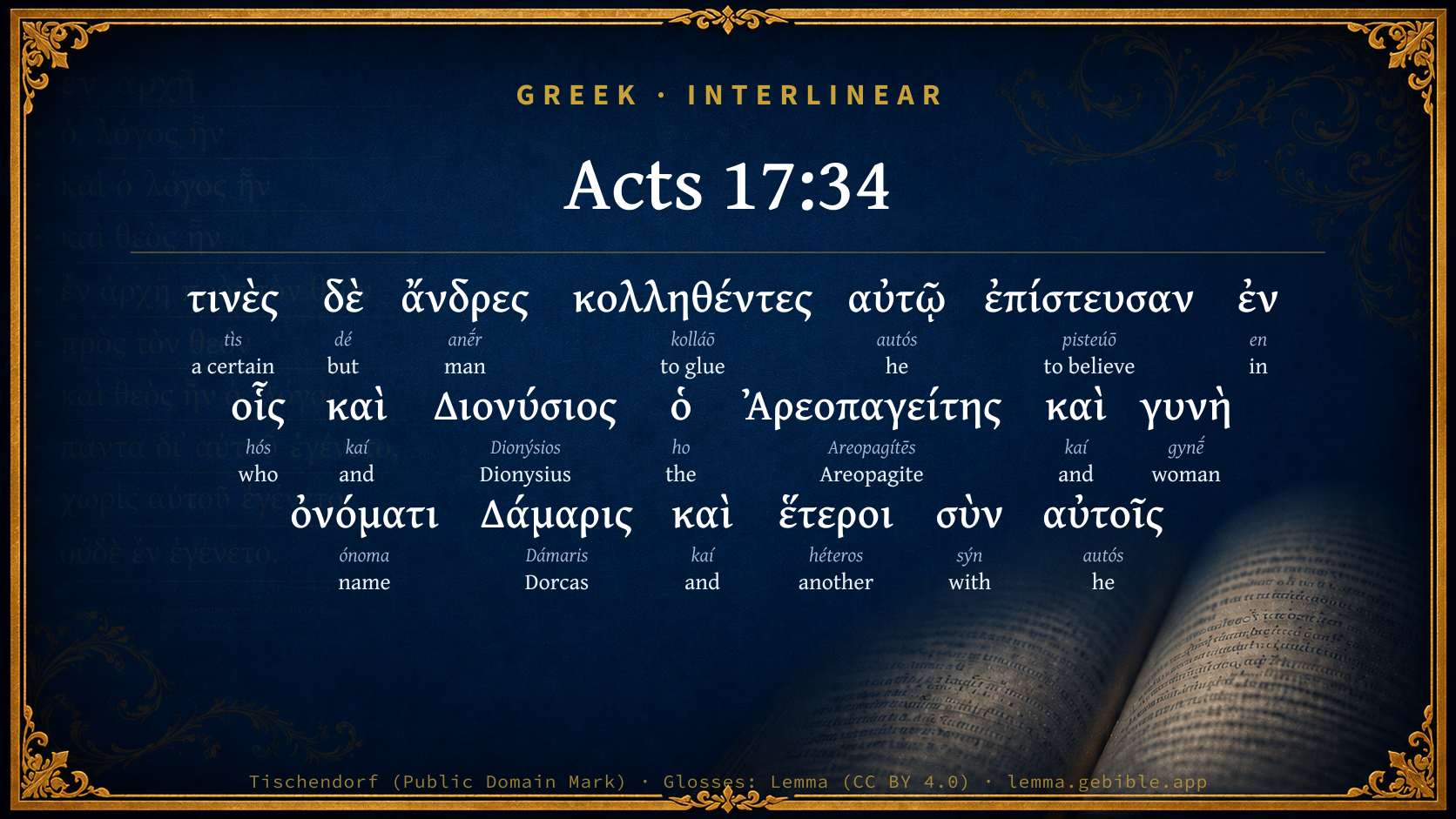
Download image
Cite this verse

Acts 17:34 (World English Bible). Public Domain. Lemma interlinear Bible study tool, https://lemma.gebible.app/v/acts/17/34.

Show BibTeX & RIS
BibTeX
RIS
English Translation
But certain men joined with him, and believed, among whom also was Dionysius the Areopagite, and a woman named Damaris, and others with them.
World English Bible · Public Domain
Highlights
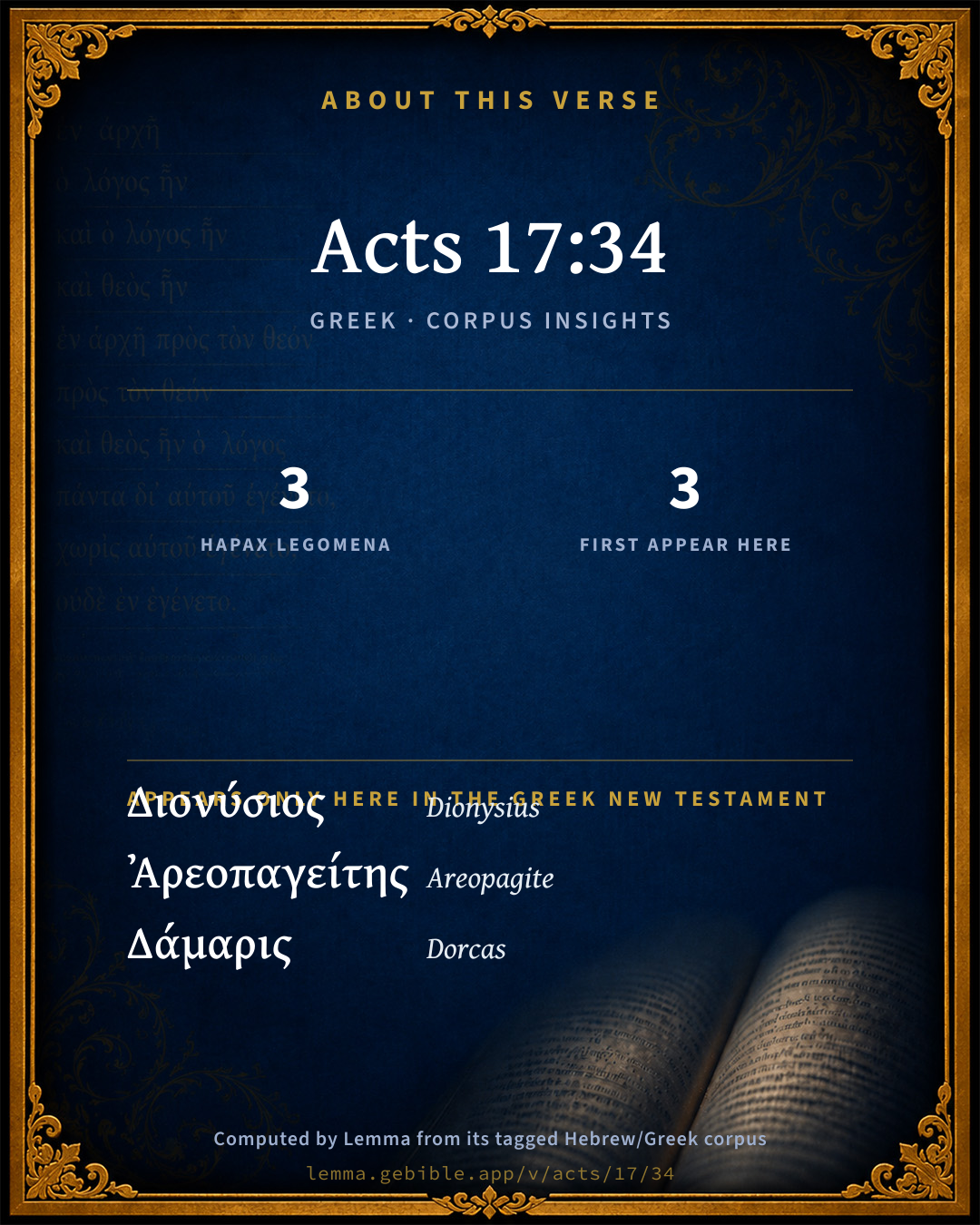
  • 3 hapax legomena — only here in the Greek New Testament
  • 3 first appearances in the Greek New Testament
Full analysis ↓
Download a study sheet

One document with this verse’s original text, its word-by-word gloss line, the meaning frame, cross-references with their text, attributed commentary, and full source and license credits — printable, and it pastes into notes with its structure intact.

This verse Autodidact and up

Study sheet (.html) Plain text (.txt)

A passage Seminary Student

Up to 50 verses in one chapter. A passage sheet keeps up to 6 commentary sources and 12 cross-references per verse, in the order this page ranks them, and says so on the sheet whenever that leaves anything out. Ask for a single verse and you get the Autodidact verse sheet above.

Everything on this page stays free to read, with no account — the sheet is a download of what is already on screen, not access to it.

Want to remove ads? Support Godless Engineer
Compare translations 3

The same verse in 3 English versions, stacked beneath the original-language interlinear above. Click any original word for its lexicon entry.

Each is an independent rendering of the whole verse — the interlinear is not word-aligned to these translations.

Highlighted words mark where these versions differ — a whole-verse word diff, not a word-by-word alignment.

  • World English Bible Public Domain
    But certain men joined with him, and believed, among whom also was Dionysius the Areopagite, and a woman named Damaris, and others with them.
  • King James Version Public Domain
    Howbeit certain men clave unto him, and believed: among the which was Dionysius the Areopagite, and a woman named Damaris, and others with them.
  • unfoldingWord Literal Text CC BY-SA 4.0
    But certain men, being joined to him, believed, among whom even Dionysius the Areopagite and a woman, Damaris by name, and others with them.

unfoldingWord Literal Text — © unfoldingWord, licensed CC BY-SA 4.0. Word-aligned USFM3 via Door43 (git.door43.org/unfoldingWord/en_ult).

Versions to compare (up to 4)

3 of 4 selected

Show all 19 translations

Every available English version of this verse, each an independent rendering of the whole verse.

  • World English Bible Public Domain
    But certain men joined with him, and believed, among whom also was Dionysius the Areopagite, and a woman named Damaris, and others with them.
  • Berean Standard Bible Public Domain
    But some joined him and believed, including Dionysius the Areopagite, a woman named Damaris, and others who were with them.
  • Majority Standard Bible Public Domain
    But some joined him and believed, including Dionysius the Areopagite, a woman named Damaris, and others who were with them.
  • King James Version Public Domain
    Howbeit certain men clave unto him, and believed: among the which was Dionysius the Areopagite, and a woman named Damaris, and others with them.
  • American Standard Version (1901) Public Domain
    But certain men clave unto him, and believed: among whom also was Dionysius the Areopagite, and a woman named Damaris, and others with them.
  • Revised Version (1885) Public Domain
    But certain men clave unto him, and believed: among whom also was Dionysius the Areopagite, and a woman named Damaris, and others with them.
  • Geneva Bible (1599) Public Domain
    Howbeit certaine men claue vnto Paul, and beleeued: among whome was also Denys Areopagita, and a woman named Damaris, and other with them.
  • Douay-Rheims (1899) Public Domain
    But certain men adhering to him, did believe; among whom was also Dionysius, the Areopagite, and a woman named Damaris, and others with them.
  • Young's Literal Translation Public Domain
    and certain men having cleaved to him, did believe, among whom `is' also Dionysius the Areopagite, and a woman, by name Damaris, and others with them.
  • Literal Standard Version CC BY-SA 4.0
    and certain men having cleaved to him, believed, among whom [is] also Dionysius the Areopagite, and a woman, by name Damaris, and others with them.
  • Unlocked Literal Bible CC BY-SA 4.0
    But certain men joined him and believed, including Dionysius the Areopagite, a woman named Damaris, and others with them.
  • unfoldingWord Literal Text CC BY-SA 4.0
    But certain men, being joined to him, believed, among whom even Dionysius the Areopagite and a woman, Damaris by name, and others with them.
  • Darby Bible Public Domain
    But some men joining themselves to him believed; among whom also was Dionysius the Areopagite, and a woman by name Damaris, and others with them.
  • World Messianic Bible Public Domain
    But certain men joined with him and believed, including Dionysius the Areopagite, and a woman named Damaris, and others with them.
  • Webster's Bible Public Domain
    But certain men adhered to him, and believed: among whom was Dionysius the Areopagite, and a woman named Damaris, and others with them.
  • Free Bible Version CC BY-SA 4.0
    A few men joined him and trusted in God, including Dionysius, a member of the Areopagus, as well as a woman called Damaris, and some others.
  • Bible in Basic English Public Domain
    But some men gave him their support: among whom was Dionysius the Areopagite, and a woman named Damaris, and others with them.
  • Text-Critical English NT CC BY 4.0
    but some of the people joined him and believed, among whom were Dionysius the Areopagite, a woman named Damaris, and others with them.
  • Tyndale New Testament (1534) Public Domain
    Howbeit certayne men clave vnto Paul and beleved amonge the which was Dionysius a senatour and a woman named Damaris and other with them.

Literal Standard Version (2020), Covenant Press — licensed CC BY-SA 4.0. Text via the HelloAO Bible API (eBible.org). Unlocked Literal Bible (unfoldingWord) — licensed CC BY-SA 4.0. Text via the HelloAO Bible API (eBible.org). unfoldingWord Literal Text — © unfoldingWord, licensed CC BY-SA 4.0. Word-aligned USFM3 via Door43 (git.door43.org/unfoldingWord/en_ult). Free Bible Version, Dr. Jonathan Gallagher — licensed CC BY-SA 4.0. Text via the HelloAO Bible API (eBible.org).

Word by word

More ways to search: Search by grammar → Find every occurrence → Compare this word →

Practice this passage: Drill this verse → Learn its vocabulary →

Διονύσιος
Dionýsios
G1354
“Dionysius”
Noun, Nominative, Singular, Masculine
Part of Speech
Noun
Case
Nominative
Number
Singular
Gender
Masculine
Full Thayer's Definition

Origin: from Dionusos (Bacchus)

TDNT: None

Dionysius = "devoted to Bacchus"
  1. τινὲς tìs G5100 “a certain” Indefinite pronoun, Nominative, Plural, Masculine
  2. δὲ dé G1161 “but” Conjunction
  3. ἄνδρες anḗr G435 “man” Noun, Nominative, Plural, Masculine
  4. κολληθέντες kolláō G2853 “to glue” Verb, Aorist, Passive, Participle, Nominative, Plural, Masculine
  5. αὐτῷ autós G846 “he” Personal pronoun, Dative, Singular, Masculine
  6. ἐπίστευσαν pisteúō G4100 “to believe” Verb, Aorist, Active, Indicative, 3rd person, Plural
  7. ἐν en G1722 “in” Preposition
  8. οἷς hós G3739 “who” Relative pronoun, Dative, Plural, Masculine
  9. καὶ kaí G2532 “and” Conjunction
  10. ὁ ho G3588 “the” Article, Nominative, Singular, Masculine
  11. Ἀρεοπαγείτης Areopagítēs G698 “Areopagite” Noun, Nominative, Singular, Masculine
  12. καὶ kaí G2532 “and” Conjunction
  13. γυνὴ gynḗ G1135 “woman” Noun, Nominative, Singular, Feminine
  14. ὀνόματι ónoma G3686 “name” Noun, Dative, Singular, Neuter
  15. Δάμαρις Dámaris G1152 “Dorcas” Noun, Nominative, Singular, Feminine
  16. καὶ kaí G2532 “and” Conjunction
  17. ἕτεροι héteros G2087 “another” Adjective, Nominative, Plural, Masculine
  18. σὺν sýn G4862 “with” Preposition
  19. αὐτοῖς autós G846 “he” Personal pronoun, Dative, Plural, Masculine

About this verse

These counts appear in no published source. They are computed here, from the morphology-tagged text and Lemma’s own curated glosses. What Lemma adds →

20
words
17
distinct lemmas
Acts
section

Notable vocabulary

3 hapax legomena — words that appear only here in the entire Greek New Testament:

  • Διονύσιος Dionysius G1354
  • Ἀρεοπαγείτης Areopagite G698
  • Δάμαρις Dorcas G1152

First appearance in Scripture

These words make their first canonical appearance in the Greek New Testament here:

  • Διονύσιος Dionysius G1354
  • Ἀρεοπαγείτης Areopagite G698
  • Δάμαρις Dorcas G1152

Shared distinctive vocabulary

κολληθέντες to glue G2853 occurs in 12 verses of the Greek New Testament. Also found in:
Repetition

Words recur within this verse:

  • καὶ and G2532 ×3
  • αὐτῷ he G846 ×2

Cross-references

10

Topical passages linked to Acts 17:34 in the Treasury of Scripture Knowledge — connected by theme and wording, ordered by reader-vote popularity; previews shown in the World English Bible.

  • Acts 17:19 They took hold of him, and brought him to the Areopagus, saying, "May we know what this new teaching is, which is spoken by you?
  • Romans 11:5–6 Even so then at this present time also there is a remnant according to the election of grace.
  • Acts 13:48 As the Gentiles heard this, they were glad, and glorified the word of God. As many as were appointed to eternal life believed.
  • Acts 17:4 Some of them were persuaded, and joined Paul and Silas, of the devout Greeks a great multitude, and not a few of the chief women.
  • Isaiah 55:10–11 For as the rain comes down and the snow from the sky, and doesn't return there, but waters the earth, and makes it bring forth and bud, and gives seed to the sower and bread to the eater;
  • Matthew 20:16 So the last will be first, and the first last. For many are called, but few are chosen."
  • John 7:48–52 Have any of the rulers believed in him, or of the Pharisees?
  • John 19:38–42 After these things, Joseph of Arimathaea, being a disciple of Jesus, but secretly for fear of the Jews, asked of Pilate that he might take away Jesus' body. Pilate gave him permission. He came therefore and took away his body.
  • Acts 17:22 Paul stood in the middle of the Areopagus, and said, "You men of Athens, I perceive that you are very religious in all things.
  • Philippians 4:22 All the saints greet you, especially those who are of Caesar's household.

Cross-references courtesy of OpenBible.info (CC BY 4.0).

Commentary

Notes on Acts 17:34 from classic Christian and Jewish commentators (each source and its license shown beneath its notes). The classic Christian expositions comment on the surrounding passage and are grouped to its opening verse, so a note may address several verses; the Jewish commentaries on the Tanakh (Rashi and others) are per-verse, so they appear only where the commentator wrote on this verse.

Lemma curates 59 commentaries, every one of them public domain or Creative Commons licensed, each selected and text-cleaned for this edition rather than reprinted as found. About our sources →

Adam Clarke's Commentary

Verse 34. Certain men clave unto him] Became affectionately united to him, and believed the doctrines he had preached.

Dionysius the Areopagite] There can be no doubt that this man was one of the judges of this great court, but whether the president or otherwise we cannot tell. Humanly speaking, his conversion must have been an acquisition of considerable importance to the Christian religion; for no person was a judge in the Areopagus who had not borne the office of archon, or chief governor of the city; and none bore the office of judge in this court who was not of the highest reputation among the people for his intelligence and exemplary conduct. In some of the popish writers we find a vast deal of groundless conjecture concerning Dionysius, who, they say, was first bishop of Athens, and raised to that dignity by Paul himself; that he was a martyr for the truth; that Damaris was his wife, c., c., concerning which the judicious Calmet says, Tout cela est de peu d' autorite. "All this has little foundation."

1. IN addition to what has been said in the notes on this subject, I may add, the original word δεισιδαιμονεστερος, from δειδω, I fear, and δαιμων, a demon, signifies, "greatly addicted to the worship of the invisible powers" for, as the word δαιμων signifies either a good or evil spirit, and δειδω, I fear, signifies not only to fear in general, but also to pay religious reverence, the word must be here taken in its best sense and so undoubtedly St. Paul intended it should; and so, doubtless, his audience understood him; for it would have been very imprudent to have charged them with superstition, which must have been extremely irritating, in the very commencement of a discourse in which he was to defend himself, and prove the truth of the Christian religion. He stated a fact, acknowledged by the best Greek writers; and he reasoned from that fact. The fact was that the Athenians were the most religious people in Greece, or, in other words, the most idolatrous: that there were in that city more altars, temples, sacrifices, and religious services, than in any other place. And independently of the authorities which may be quoted in support of this assertion, we may at once perceive the probability of it from the consideration that Athens was the grand university of Greece: that here philosophy and every thing relating to the worship of the gods was taught; and that religious services to the deities must be abundant. Look at our own universities of Oxford and Cambridge; here are more prayers, more religious acts and services, than in any other places in the nation, and very properly so. These were founded to be seminaries of learning and religion; and their very statutes suppose religion to be essential to learning; and their founders were in general religious characters, and endowed them for religious purposes. These, therefore, are not superstitious services; for, as superstition signifies "unnecessary fears or scruples in religion; observance of unnecessary and uncommanded rites or practices," - JOHNSON, it cannot be said of those services which are founded on the positive command of God, for the more effectual help to religious feelings, or as a preventive of immoral practices. I consider the Athenians, therefore, acting in conformity to their own laws and religious institutions; and Paul grants that they were much addicted to religious performances: this he pays as a compliment, and then takes occasion to show that their religion was defective: they had not a right object of devotion; they did not know the true God; the true God was to them the unknown God; and this an altar in their own city acknowledged. He therefore began to declare that glorious Being to them whom they ignorantly worshipped. As they were greatly addicted to religious services, and acknowledged that there was a Being to them unknown, and to whom they thought it necessary to erect an altar, they must, consistently with their character as a religious people, and with their own concession in the erection of this altar, hear quietly, patiently, and candidly, a discourse on that God whose being they acknowledged, but whose nature they did not know. Thus St. Paul, by acknowledging their religious disposition, and seizing the fact of the altar being inscribed to the unknown God, assumed a right which not a philosopher, orator, or judge in the Areopagus could dispute, of bringing the whole subject of Christianity before them, as he was now brought to his trial, and put on his defense. The whole of this fine advantage, this grand stroke of rhetorical prudence, is lost from the whole account, by our translation, ye are in all things too superstitious, thus causing the defendant to commence his discourse with a charge which would have roused the indignation of the Greeks, and precluded the possibility of their hearing any thing he had to say in defense of his conduct.

2. That the original word, on the right interpretation of which I have laid so much stress, is taken in a good sense, and signifies religious worship and reverence, I shall show by several proofs; some of which may be seen in Mr. Parkhurst, under the word δεισιδαιμονια, which Suidas explains by ευλαβεια περι το Θειον, reverence towards the Deity. And Hesychius, by φοβοθεια, the fear of God. "In this good sense it is often used by Diodorus Siculus. Herodotus says of Orpheus, he led men, εις δεισιδαιμονιαν, to be religious; and exhorted them, επι το ευσεβειν, to piety; where it is manifest that δεισιδαιμονια must mean religion, and not superstition. But, what is more to the present purpose, the word is used by Josephus, not only where a heathen calls the pagan religion δεισιδαιμονιας, (Antiq. lib. xix. cap. 5. s. 3,) or where the Jewish religion is spoken of by this name, in several edicts that were made in its favour by the Romans, (as in Antiq. lib. xiv. cap. 10, s. 13, 14, 16, 18, 19,) but also where the historian is expressing his own thoughts in his own words: thus, of King Manasseh, after his repentance and restoration, he says, εσπουδαζεν πασῃ περι αυτον (Θεον) τῃ δεισιδαιδαιμονιᾳ χρησθαι, he endeavoured to behave in the MOST RELIGIOUS manner towards God. Antiq. lib. x. cap. 3, s. 2. And, speaking of a riot that happened among the Jews on occasion of a Roman soldier's burning the book of the law, he observes that the Jews were drawn together on this occasion, τῃ δεισιδαιμονιᾳ, by their religion, as if it had been by an engine; οργανῳ τινι.-De Bell. lib. ii. cap. 12, s. 2." It would be easy to multiply examples of this use of the word; but the reader may refer, if necessary, to Wetstein, Pearce, and others.

3. That the Athenians were reputed, in this respect, a devout people, the following quotations may prove. Pausanias, in Attic. cap. xvii. p. 39, edit. Kuhn., says that the Athenians were not only more humane, αλλα και ες θεους ευσεβειν, but more devout towards the gods; and again he says, δηλα τε εναργως, ὁσοις πλεον τι ἑτερων ευσεβειας μετεϚιν, it appears plainly how much they exceed others in the worship of the gods; and, in cap. xxiv. p. 56, he says, Αθηναιοις περισσοτερον τι, η τοις αλλοις, ες τα θεια εϚι σπουδης, that the Athenians are abundantly more solicitous about Divine matters than others. And Josephus seals this testimony by the assertion, contr. Apion, ii. 10: Αθηναιους ευσεβεϚατους των Ἑλληνων παντες λεγουσι; Every body says that the Athenians are the most religious people of all the Greeks.-See Bp. Pearce. From all these authorities it is palpable that St. Paul must have used the term in the sense for which I have contended.

4. In the preceding notes, I have taken for granted that Paul was brought to the Areopagus to be tried on the charge of setting forth strange gods. Bp. Warburton denies that he was brought before the Areopagus on any charge whatever; and that he was taken there that the judges might hear him explain his doctrine, and not to defend himself against a charge which he does not once notice in the whole of his discourse. But there is one circumstance that the bishop has not noticed, viz. that St. Paul was not permitted to finish his discourse, and therefore could not come to those particular parts of the charge brought against him which the bishop thinks he must have taken up most pointedly, had he been accused, and brought there to make his defense. The truth is, we have little more than the apostle's exordium, as he was evidently interrupted in the prosecution of his defense. As to the supposition that he was brought by philosophers to the Areopagus, that they might the better hear him explain his doctrine, it appears to have little ground; for they might have heard him to as great advantage in any other place: nor does it appear that this court was ever used, except for the solemn purposes of justice. But the question, whether Paul was brought to the Areopagus that he might be tried by the judges of that court, Bishop Pearce answers with his usual judgment and discrimination. He observes:

1. "We are told that one effect of his preaching was, that he converted Dionysius the Areopagite, Ac 17:34; and this seems to show that he, who was a judge of that court, was present, and, if so, probably other judges were present also.

2. If they who brought Paul to Areopagus wanted only to satisfy their curiosity, they had an opportunity of doing that in the market, mentioned Ac 17:17. Why then did they remove him to another place?

3. When it is said that they brought Paul to Areopagus, it is said that they took him, επιλαβομενοιαυτοι, or rather, they laid hold on him, as the Greek word is translated, Lu 23:26; Lu 20:20; Lu 20:26, and as it ought to have been here, in Ac 21:30; Ac 21:33, and especially in this latter verse.

4. It is observable that Paul, in his whole discourse at the Areopagus, did not make the least attempt to move the passions of his audience, as he did when speaking to Felix, Ac 24:25, and to Agrippa, Ac 26:29; but he used plain and grave reasonings to convince his hearers of the soundness of his doctrine.

"Now, we are told by Quinctilian, in Inst. Orat. ii. 16, that Athenis actor movere affectus vetabatur: the actor was forbidden to endeavour to excite the passions. And again, in vi. 1, that Athenis affectus movere etiam per praeconem prohibebatur orator: among the Athenians, the orator was prohibited by the public crier to move the passions of his auditory. And this is confirmed by Philostratus in procem. lib. i. de Vit. Sophist.; and by Athenaeus, in Deipnosoph. xiii. 6. If, therefore, it was strictly forbidden at Athens to move the affections of the courts of justice, especially in that of the Areopagus, we see a good reason why Paul made no attempt in that way; and, at the same time, we learn how improperly the painters have done all they could, when they represent Paul speaking at Athens, endeavouring both by his looks and gestures to raise those several passions in his hearers which their faces are meant to express."

I have only to add here, that, though St. Paul did not endeavour to excite any passions in his address at the Areopagus, yet each sect of the philosophers would feel themselves powerfully affected by every thing in his discourse which tended to show the emptiness or falsity of their doctrines; and, though he attempted to move no passions, yet, from these considerations, their passions would be strongly moved. And this is the idea which the inimitable Raphael took up in his celebrated cartoon on this subject, and which his best copier, Mr. Thomas Holloway, has not only engraved to the life, but has also described in language only inferior to the cartoon itself; and, as it affords no mean comment on the preceding discourse, my readers will be pleased to find it here.

By the cartoons of Raphael, we are to understand certain Scripture pieces painted by Raphael d'Urbino, and now preserved in the palace at Hampton court. They are allowed to be the chefs d'oeuvre in their kind. They have been often engraved, but never so as to give an adequate representation of the matchless originals, till Mr. Thomas Holloway, who has completely seized the spirit of the artist, undertook this most laborious work, in which he has been wholly engaged for several years; and in which he has, for some time past, associated with himself Messrs. Slann and Webb, two excellent artists, who had formerly been his own pupils. The cartoon to which I have referred has been some time finished, and delivered to the subscribers; and with it that elegant description, from which the following is a copious extract:-

"The eye no sooner glances on this celebrated cartoon than it is immediately struck with the commanding attitude of the speaker, and the various emotions excited in his hearers.

"The interest which the first appearance of St. Paul at Athens had occasioned, was not calculated to subside on a sudden; his doctrines were too new, and his zeal too ardent. From the multitude it ascended to the philosophers. The Epicureans and Stoics particularly assailed him. Antecedently to the scene described in the picture, among the various characters already encountered by the apostle, many undoubtedly, in their speculations upon Divine subjects, had often imagined a sublimer religion than that commonly acknowledged: such, therefore, would make it their business to hear him again. Others, to whom truth was of less value than the idle amusement of vain disquisition, felt no other motive than curiosity. By far the greater part, however, obstinately bigoted to their particular tenets, and abhorring innovation, regarded him as impious, or a mere babbler: these also wished to hear him again, but with no other than the insidious view, that, by a more regular and explicit profession of his doctrines, he might expose his own absurdities, or render himself obnoxious to the state. The drapery accords with the majesty of the figure; and the light is so managed, especially on the arms and hands, as greatly to assist the energy of the action.

"The painter has proceeded, from the warmth of full conviction, through various gradations, to the extremes of malignant prejudice, and invincible bigotry.

"In the foreground, on the right, is Dionysius, who is recorded to have embraced the new religion. With the utmost fervour in his countenance, and with a kind of sympathetic action and unconscious eagerness, he advances a step nearer. His eye is fixed on the apostle: he longs to tell him his conversion, already perhaps preceded by conviction wrought in his mind by the reasonings of the sacred teacher on previous occasions, in the synagogue, and in the forum or marketplace. He appears not only touched with the doctrine he receives, but expresses an evident attachment to his instructer: he would become his host and protector.

"This figure is altogether admirable. The gracefulness of the drapery and of the hair; the masculine beauty of the features; the perspective drawing of the arms; the life and sentiment of the hands, the right one especially, are inimitable.

"Behind is Damaris, mentioned with him as a fellow believer. This is the only female in the composition; but the painter has fully availed himself of the character, in assisting his principle of contrast; an excellence found in all the works of Raphael. Her discreet distance, her modest deportment, her pious and diffident eye, discovering a degree of awe, the decorum and arrangement of her train, all interest the mind in her favour.

"Next to these, but at come distance, is a Stoic. The first survey of this figure conveys the nature of his peculiar philosophy-dignity and austerity. Raphael has well understood what he meant in this instance to illustrate. His head is sunk in his breast; his arms are mechanically folded; his eyes, almost shut, glance towards the ground: he is absorbed in reflection. In spite of his stoicism, discomposure and perplexity invade his soul, mixed with a degree of haughty mortification.

"Sir Joshua Reynolds has observed that 'the same idea is continued through the whole figure, even to the drapery, which is so closely muffled about him that even his hands are not seen;' and that, 'by this happy correspondence between the expression of the countenance and the disposition of the parts, the figure appears to think from head to foot.'

"Behind the Stoic are two young men, well contrasted in expression: anger in the elder, and in the other, youthful pride, half abashed, are finely discriminated.

"Beyond, in the same continued half circle with the Stoic, is perhaps exhibited the most astonishing contrast ever imagined; that of inexorable sternness, and complete placidity.

"Of the two figures, the first is denominated a Cynic, who, disappointed in his expectation of the ridiculous appearance which he conceived the apostle, when confronted, would make among them, abandons his mind to rage. His formidable forehead concentrates its whole expression: with a fixed frown and threatening eye, he surveys the object of his indignation. He alone would engage to confute him, or punish his temerity. His eager impatience and irritation are not discovered in his features only; he raises his heel from the ground, and leans with a firmer pressure on his crutch, which seems to bend beneath him.

"Pass from him to the more polished Epicurean. This figure exhibits perfect repose of body and mind: no passions agitate the one; no action discomposes the other. His hands, judiciously concealed beneath beautiful drapery, shows there can be no possible motion or employment for them. His feet seem to sleep upon the ground. His countenance, which is highly pleasing, and full of natural gentleness, expresses only a smile of pity at the fancied errors of the apostle, mingled with delight derived from his eloquence. He waits, with an inclined head, in passive and serene expectation. If a shrewd intelligence is discovered in his eyes, it is too gentle to disturb the general expression of tranquillity.

"Behind are two other young men: the first discovers a degree of superciliousness with his vexation; his companion is more disgusted, and more morose.

"These, and the two young figures previously described, are not introduced merely to fill up the group; they may be intended as pupils to the philosophers before them, though by some considered as young Romans, who have introduced themselves from ennui or curiosity.

"Beyond is a character in whose mind the force of truth and eloquence appears to have produced conviction; but pride, vanity, or self-interest, impel him to dissemble. His finger, placed upon the upper lip, shows that he has imposed silence upon himself.

"In the centre is seated a group from the academy. The skill of Raphael in this instance is eminent. These figures are not only thrown into shade, to prevent their interference with the principal figure; but, from their posture, they contribute to its elevation, and at the same time vary the line of the standing group.

"It seems as if the old philosopher in profile, on the left, had offered some observations on the apostle's address; and that he was eagerly listening to the reply of his sage friend, in whose features we behold more of the spirit of mild philosophy. The action of his fingers denotes his habit of reasoning, and regularity of argument. The middle figure behind appears to be watching the effect which his remarks would produce.

"The action of the young man, pointing to the apostle, characterizes the keen susceptibility and impetuosity of his age. His countenance expresses disgust, approaching to horror. The other young man turns his head round, as though complaining of unreasonable interruption. The drapery of both the front figures in this group is finely drawn: the opening action of the knees in the one is beautifully followed and described by the folds; in the other, the compression, in consequence of the bent attitude, is equally executed; the turn of the head gives grace and variety to the figure.

"The head introduced beyond, and rather apart, is intended to break the two answering lines of the dark contour of the apostle's drapery, and the building in the background.

"In the group placed behind the apostle, the mind is astonished at the new character of composition. The finest light imaginable is thrown upon the sitting figure; and, as necessary, a mass of shade is cast upon the two others.

"It is difficult to ascertain what or whom Raphael meant by that corpulent and haughty personage wearing the cap. His expression, however, is evident: malice and vexation are depicted in his countenance; his stride, and the action of his hand, are characteristic of his temperament.

"The figure standing behind is supposed to be a magician. His dark hair and beard, which seem to have been neglected, and the keen mysterious gaze of his eye, certainly exhibit a mind addicted to unusual studies. Under him, the only remaining figure is one who listens with malignant attention, as though intending to report every thing. He has the aspect of a spy. His eye is full of danger to the apostle; and he crouches below that he may not be disturbed by communication.

"If this figure be considered with reference to Dionysius, it may be remarked that Raphael has not only contrasted his characters, but even the two ends of his picture. By this means the greatest possible force is given to the subject. At the first survey, the subordinate contrasts may escape the eye, but these greater oppositions must have their effect.

"When, from this detailed display of the cartoon, the eye again glances over the whole subject, including the dignity of the architecture; the propriety of the statue of Mars, which faces his temple; the happy management of the landscape, with the two conversation figures; the result must be an acknowledgment that in this one effort of art is combined all that is great in drawing, in expression, and in composition." Holloway's description of Raphael's Cartoon of Paul preaching at Athens.

Adam Clarke's Commentary on the Bible (1810–1826) — public domain. Text from a community e-Sword/MySword module.

Tyndale Open Study Notes

Tyndale Open Resources

17:34 some joined him and became believers: Paul’s sermon was not without positive response. Two prominent converts are mentioned: Dionysius and Damaris. Luke often placed a man and a woman in juxtaposition (e.g., 5:1-11; 17:4, 12; Luke 14:1-6; 15:3-10). • Dionysius was a member of the council of the Areopagus, the highest governing body of Athens.

Tyndale Open Study Notes — © Tyndale Open Resources, licensed CC BY-SA 4.0. Text via the HelloAO Bible API.

Expositor's Greek Testament

ed. W. Robertson Nicoll

Act 17:34 . τινὲς δὲ : may contrast the favourable with the unfavourable, or perhaps merely continuous. κολληθέντες , see above on Act 5:13 , implies close companionship upon which their conversion followed, see additional note. Διονύσιος ὁ Ἀ .: “quam doctrinam scurræ rejecerunt, Areopagita vir gravis accipit”. Dionysius was a member of the Council, the words can mean nothing less it is evident, therefore, that this convert must have been a man of some distinction, as an Areopagite would previously have filled the office of Archon. On the honour attached to the term cf. Cicero, Pro Balbo , xii., and instances cited by Renan, Saint Paul , p. 209, note. It is not improbable that St. Luke may have received from him the draft of St. Paul’s address. On the other hand the conversion of a man occupying such a position has excited suspicion, and Baur, Paulus , i., 195, considers that the whole scene on the Areopagus is unhistorical, and owes its origin to the tradition that an Areopagite named Dionysius was converted. So Holtzmann holds that the whole scene was placed on the Areopagus, because, according to report, a member of the Areopagus was converted, Apostelgeschichte , p. 393, similarly Weizsäcker. See further, “Dionysius,” B.D. 2 , Hastings’ B.D., Smith and Wace, Dictionary of Christian Biography , i., p. 846; Felten, Apostelgeschichte , p. 337 and notes below. Δάμαρις : perhaps Δάμαλις , a heifer, a name popular amongst the Greeks, so Grotius, Wetstein, and Renan, Saint Paul , p. 209, note; see critical note above. We know nothing certain about her, but Ramsay makes the interesting conjecture that as the woman is not described as εὐσχήμων ( cf. the description of the women at Thessalonica, Berœa, and Pisidian Antioch, Act 13:50 , Act 17:4 ; Act 17:12 ), she may have been a foreign woman (perhaps one of the educated Hetairai ), as at Athens no woman of respectable position would have been present amongst St. Paul’s audience. St. Chrysostom (so St. Ambrose and Asterius) thought that she was the wife of Dionysius, but St. Luke calls her γυνή , not ἡ γυνή αὐτοῦ . No mention is made of her in (but see above critical note), and Ramsay accounts for this by the view that the reviser of Codex Bezæ was a Catholic, who objected to the prominence given to women in Acts, and that under the influence of this feeling the changes occurred in Act 17:12 (see above) and 34: this prominence assigned to women was, in Ramsay’s view, firstly, pagan rather than Christian, and, secondly, heretical rather than Catholic; Church in the Roman Empire , pp. 160, 161; see “Damaris,” Hastings’ B.D., and Felten, Apostelgeschichte , p. 337. καὶ ἕτεροι : a significant contrast to the precise results of the Apostle’s preaching elsewhere, and yet a contrast which carries with it an evidence of truth. Spitta, p. 242, justly remarks that he knows not how the author of the “We” sections, who was not present at Athens, could have represented the activity of St. Paul in that city better than he has done; the idle curiosity of the Athenians, Act 17:21 , and after a speech received with ridicule and indifference, a scanty result, graphically represented by two names, of which it is a mere assertion to say that they refer to the sub-apostolic age. Spitta thus refuses to allow any justification for Weizsäcker’s rejection of the historical worth of the narrative. Thus in the simple notice of the results of St. Paul’s preaching we gain an indication of the historical truthfulness of the narrative. If anywhere, surely at Athens a forger would have been tempted to magnify the influence of St. Paul’s intellectual power, and to attribute an overwhelming victory to the message of the Gospel in its first encounter with the philosophic wisdom of the world in a city which possessed a university, the greatest of any of that time, which was known as “the eye of Greece, mother of arts,” whose inhabitants a Jewish philosopher (Philo) had described as the keenest mentally of all the Greeks. In answer to the earlier criticism of Zeller and Overbeck, we may place the conclusion of Weiss that the result of St. Paul’s labours is plainly not described after a set pattern, but rests upon definite information, whilst Wendt, who refers the composition of the speech, as we have it, to St. Luke, and regards it as derived from information of a speech actually delivered at Athens, insists equally strongly upon the difficulty of supposing that such slender results would be represented as following, if the speech had been composed with a view of exalting Jewish and Christian monotheism against polytheism. Moreover the narrative bears the stamp of truthfulness in its picture of the local condition of Athens, and also in its representation of St. Paul’s attitude to the philosophical surroundings of the place and its schools. “One must be at home in Athens,” writes Curtius, “to understand the narrative rightly,” and no one has enabled us to realise more fully the historical character and vividness of the scene than Curtius himself in the essay to which reference is made above, of which the concluding words are these, that “he who refuses to accept the historical value of the narrative of Paul in Athens, tears one of the weightiest pages out of the history of humanity” ( Gesammelte Abhandlungen , ii., p. 543, “Paulus in Athens”: see further, Knabenbauer, pp. 308, 309). The character of the people, the moving life of the Agora, the breadth of view which could comprehend in one short speech the crude errors of the populace and the fallacious theology of the schools, “the heart of the world” too generous to ignore all that was best in men’s thoughts of God’s providence and of human brotherhood, and yet too loving to forget that all men had sinned, and that after death was the judgment we recognise them all. If we turn to the speech itself we find abundant evidence of characteristic Pauline thoughts and teaching ( cf. e.g. , Act 17:27 and Rom 1:19 ; Rom 2:14 ; Act 17:26 and Rom 5:12 , 1Co 15:45 ; Act 17:30 and Rom 3:25 , etc., Zöckler, p. 268, and instances in notes above, McGiffert, Apostolic Age , p. 259), and it is worthy of note that Weizsäcker, while rejecting with Baur, Zeller, Schwegler, and Overbeck the account of St. Paul’s visit to Athens as unhistorical, fully recognises, after an examination of the Apostle’s method of dealing with idolatry and polytheism in Rom 1:20 , that if we compare with the Apostle’s own indications the fine survey of the world, and especially of history from a monotheistic standpoint, ascribed to him by the Acts at Lystra, Act 14:15 , and afterwards at Athens, Act 17:24 , the latter, whatever its source, also gives us a true idea of Paul’s method and teaching, Apostolic Age , i., p. 117, E.T. On the whole tone of the speech as incredible as a later composition, see Ramsay, St. Paul , p. 147 ff., whilst no one perhaps has drawn up more clearly than Wetstein, see on Act 17:25 , the consummate skill of the speech addressed to an audience comprising so many varieties of culture and belief. (To the strange attempt of Holtzmann to reproduce at some length the argument of Zeller, who maintains that the scene at Athens was a mere counterpart of the scene of Stephen’s encounter with his foes at Jerusalem, a sufficient answer may be found in Spitta, Apostelgeschichte , p. 240.)

If we ask from whom the report of the speech was received, since Luke, Silas, Timothy all were absent, it is possible that a Christian convert like Dionysius the Areopagite may have preserved it (Zöckler); but a speech so full of Pauline thoughts, and so expressive of Athenian life and culture, may well have been received at least in substance from St. Paul himself, although it is quite conceivable that the precise form of it in Acts is due to St. Luke’s own editing and arrangement (see for an analysis of the language of the speech Bethge, Die Paulinischen Reden der Apostelgeschichte , p. 82). The results of St. Paul’s work at Athens were small if measured by the number of converts, although even amongst them it must not be forgotten that it was something to gain the allegiance to the faith of a man holding the position of Dionysius the Areopagite (see further an interesting account of the matter in Expository Times , April, 1898). But in addition to this, it is also important to remember that St. Paul has given us “an invaluable method of missionary preaching” (Lechler, Das Apost. Zeitalter , p. 275), that to the Church at Athens Origen could appeal against Celsus as a proof of the fruits of Christianity (Bethge, p. 116), that its failing faith was revived in time of persecution by its bishop Quadratus, the successor of the martyr-bishop Publius; that in the Christian schools of Athens St. Basil and St. Gregory were trained; and that to an Athenian philosopher, Aristides, a convert to Christ, we owe the earliest Apology which we possess (Athenagoras too was an Athenian philosopher), see Farrar, St. Paul , i., p. 551; Humphry, Commentary on the Acts . It is significant that St. Paul never visited Athens again, and never addressed a letter to the Saints at Athens, although he may well have included them in his salutation to “the Saints which are in the whole of Achaia,” 2Co 1:1 .

The Expositor's Greek Testament, edited by W. Robertson Nicoll (1897–1910) — public domain. Text from a community e-Sword module.

Jamieson, Fausset & Brown

Robert Jamieson, A. R. Fausset & David Brown

Howbeit certain men clave unto him--Instead of mocking or politely waiving the subject, having listened eagerly, they joined themselves to the apostle for further instruction; and so they "believed."

Dionysius the Areopagite--a member of that august tribunal. Ancient tradition says he was placed by the apostle over the little flock at Athens. "Certainly the number of converts there and of men fit for office in the Church was not so great that there could be much choice" [OLSHAUSEN].

a woman named Damaris--not certainly one of the apostle's audience on the Areopagus, but won to the faith either before or after. Nothing else is known of her. Of any further labors of the apostle at Athens, and how long he stayed, we are not informed. Certainly he was not driven away. But "it is a serious and instructive fact that the mercantile populations of Thessalonica and Corinth received the message of God with greater readiness than the highly educated and polished Athenians. Two letters to the Thessalonians, and two to the Corinthians, remain to attest the flourishing state of those churches. But we possess no letter written by Paul to the Athenians; and we do not read that he was ever in Athens again" [HOWSON].

Next: Acts Chapter 18

Jamieson, Fausset & Brown — Commentary Critical and Explanatory on the Whole Bible (1871) — public domain (CC PDM 1.0). Text via the HelloAO Bible API.

John Calvin's Commentaries

34. Among whom was also Dionysius. Seeing that Luke doth name one man and one woman only, it appeareth that there was but a small number of those which believed at the first. For those other of whom he maketh mention remained indifferent; because they did neither wholly despise Paul’s doctrine, neither were they so thoroughly touched, that they joined themselves unto him that they might be his scholars. Luke maketh mention of Dionysius above the rest, because he was in no small authority among his citizens. Therefore, it is likely that Damaris was also a woman of some renown, [rank.]

Furthermore, it is ridiculous in that the Papists [have] made of a judge an astrologer. But this is to be imputed partly to their ignorance, partly to their boldness, who, seeing they knew not what Areopagus or Mars’ Street meant, took to themselves liberty to feign whatsoever they would. And their rudeness is too gross, who ascribe the books of the heavenly and ecclesiastical hierarchy, and of the names of God, to this Dionysius. For the heavenly hierarchy is stuffed not only with many doltish and monkish trifles, but also with many absurd inventions, and wicked speculations. And the books of the Ecclesiastical Hierarchy do themselves declare that they were made many years after, when as the purity of Christianity was corrupt with an huge heap of ceremonies. As for the book of the names of God, though it have in it some things which are not altogether to be despised, yet it doth rather breathe out subtilties than sound godliness.

John Calvin's Commentaries (1540-1563) — public domain. Text from the Calvin Translation Society English edition (1840s-50s) via the Christian Classics Ethereal Library (ccel.org). Calvin's coverage is partial (roughly two-thirds of the Bible); uncommented books and verses are honest gaps, never fabricated. The 19th-century editor's footnotes and remarks are omitted so the notes are faithfully Calvin's own voice.

Ellicott's Commentary for English Readers

(34) Certain men clave unto him.—The word implies practically both companionship and conversion. There was an attractive power in the Apostle’s character that drew men unto him.

Dionysius the Areopagite.—As the constitution of the Court of the Areopagus required its members to have filled a high magisterial function, such as that of Archon, and to be above sixty, the convert must have been a man of some note. According to a tradition, ascribed by Eusebius (Hist. iii. 4, iv. 23) to Dionysius, Bishop of Corinth, he became Bishop of Athens. An elaborate treatise on the Hierarchy of Heaven, Cherubim, Seraphim, Thrones, Dominations, and the like, is extant under his name, but is obviously of much later date, probably of the fourth or fifth century. The legend of the Seven Champions of Christendom has transformed him into the St. Denys of France. A church dedicated to him stands on the Areopagus of modern Athens.

Damaris.—Chrysostom says that she was the wife of Dionysius, but this is obviously only a conjecture.

And others with them.—The contrast between this and the “great multitude,” the “many” at Thessalonica and Berœa, is very significant. Not less striking is the absence of any reference to Athens in St. Paul’s Epistles. Of all the cities which he visited, it was that with which he had least sympathy. All that can be said is that he may have included them among “the saints which are in all Achaia” (2Co_1:1) in his prayers and hopes. It would almost seem as if he felt that little was gained by entering into a discussion on the great questions of natural theology; and therefore he came to Corinth, determined to know nothing “but Jesus Christ, and Him crucified” (1Co_2:2).

A Bible Commentary for English Readers, edited by Charles John Ellicott (1878–1897) — public domain. Text from a community e-Sword module.

The Cambridge Bible for Schools and Colleges

gen. ed. J. J. S. Perowne

34. Dionysius the Areopagite] i.e. one of the members of the upper council of Athens. He must have been a man of position and influence, for no one could be a member of this council unless he had filled some high office of state, and was above 60 years of age. Tradition (Euseb. H. E. iii. 4; iv. 23) says that this Dionysius was the first bishop of Athens, and that he was martyred. The works which long circulated among Christians as his compositions, and which even at the time of the Reformation occupied much of the thoughts and labours of such men as Dean Colet, are no doubt forgeries of a much later date than the days of this Dionysius.

The Cambridge Bible for Schools and Colleges (gen. ed. J. J. S. Perowne; Cambridge University Press, 1878–1918) — public domain. Text from a community e-Sword module.

Trapp's Complete Commentary

John Trapp

34 Howbeit certain men clave unto him, and believed: among the which was Dionysius the Areopagite, and a woman named Damaris, and others with them.

Ver. 34. Dionysius the Areopagite] Not the astrologer, as some have made him, nor the author of the Heavenly Hierachy made by some superstitious monk; but a senator or judge in that court of Mars’ Hill in Athens, crowned with martyrdom for the Christian religion, in the year of grace 96, as Trithemius writeth.

And a woman named Damaris] Damaris as well as Dennis. Souls have no sexes. In Christ "there is neither male nor female, bond nor free," Gal 3:28. It is easy to observe, saith a grave divine, that the New Testament affords more store of good women than the Old. In the preceding chapter, when Paul came first to Philippi, he had none that would hear him, but a company of good women, Act 16:13.

John Trapp, A Commentary or Exposition upon All the Books of the Old and New Testament (1647–1656) — public domain. Text from a community e-Sword module.

Albert Barnes' Notes on the Bible

Clave unto him - Adhered to him firmly; embraced the Christian religion.

Dionysius - Nothing more is certainly known of this man than is here stated.

The Areopagite - Connected with the court of Areopagus, but in what way is not known. It is probable that he was one of the judges. The conversion of one man was worth the labor of Paul, and that conversion might have had an extensive influence on others.

In regard to this account of the visit of Paul to Athens probably the only one which he made to that splendid capital - we may remark:

(1) That he was indefatigable and constant in his great work.

(2) Christians, amidst the splendor and gaieties of such cities, should have their hearts deeply affected in view of the moral desolations of the people.

(3) They should be willing to do their duty, and to bear witness to the pure and simple gospel in the presence of the great and the noble.

(4) They should not consider it their main business to admire splendid temples, statues, and paintings - the works of art; but their main business should be to do good as they may have opportunity.

(5) A discourse, even in the midst of such wickedness and idolatry, may be calm and dignified; not an appeal merely to the passions, but to the understanding. Paul reasoned with the philosophers of Athens; he did not denounce them; he endeavored calmly to convince them, not harshly to censure them.

(6) The example of Paul is a good one for all Christians. In all places cities, towns, or country; amidst all people - philosophers, the rich, the poor; among friends and countrymen, or among strangers and foreigners, the great object should be to do good, to instruct mankind, to seek to elevate the human character, and to promote human happiness by diffusing the pare precepts of the gospel of Christ.

Albert Barnes' Notes on the Bible (1834–1885) — public domain. Text from a community e-Sword/MySword module.

Haydock's Catholic Bible Commentary

Dionysius the Areopagite. This illustrious convert was made the first bishop of Athens. They martyrologies say, St. Paul raised him to that dignity. It is the same person, who, observing the convulsions of nature, which paid homage, as it were, to its God, expiring upon the cross, and not knowing the cause, is said to have exclaimed: Either the universe is falling to ruin, or the God of nature must be suffering. It appears from his writings, that he was, previous to his conversion, of the Platonic school. Ven. Bede was mistaken in supposing that he was afterwards the bishop of Corinth, of that name, who so successfully employed his pen for the good of the Church. This Dionysius lived a whole century after the Areopagite. (Estius)

George Leo Haydock (1774–1849), Haydock's Catholic Family Bible and Commentary, 1859 edition — public domain. Excludes Psalms (Douay-Rheims chapter numbering differs from Protestant) and Deuterocanonical books (Catholic canon only).

Matthew Poole's English Annotations

Clave unto him, in more than ordinary friendship; they were as glued to him; great was their love to the apostle, by whom their eyes were opened, nay, by whose ministry they were raised from the dead.

Dionysius the Areopagite; one of that great council mentioned Act 17:19, whose conversion might have a great influence on many.

Damaris; who is thought to have been an honourable woman; such are mentioned Act 17:12; or she might have been specially eminent for some grace or goodness she excelled in, and therefore hath a name upon record in the word of God.

Matthew Poole's English Annotations on the Holy Bible (1683–1685) — public domain. Text from a community e-Sword/MySword module.

Whedon's Commentary on the Bible

Daniel D. Whedon

34. Dionysius—One eminent man, and one woman sufficiently notable to be named, with a few others nameless, who appear not to have been organized into a Church, were the converts of that day. Unreliable tradition, however, makes Dionysius a future bishop of Athens, and a volume of mythical theology, by some unknown writer, is falsely ascribed to his authorship.

Opposite as were the tempers and causes which produced the rejection of Jesus by the Jews and the Athenians, they were at bottom the same— traditional prepossession. What the Temple, and Moses, and the Old Testament were to the Jew, that the Acropolis, the tutelar Athene, and philosophy, were to the Athenian—a binder of his whole soul to the proud past, filling him with contempt for the innovator. Alike against the Temple and the Acropolis the apostle pronounced the divine protest, and left his irrevocable words of destruction upon both, to be fulfilled by time and Providence.

It was Athens, not Paul, that suffered that day the real defeat. She lost an honourable record in Christian history. She lost the honour of being the Fourth Great European Church. Though repeatedly passed, she was, probably, never revisited by the apostle. She was addressed by no apostolic epistle, received no honourable New Testament mention. When we speak of the Greek Church, we think not so readily of Athens as of Antioch, of Corinth, of Constantinople, or even of St. Petersburg.

Daniel D. Whedon (gen. ed.), Commentary on the Old and New Testaments (1874–1909) — public domain. Text from a community e-Sword module.

The Pulpit Commentary

But for howbeit, A.V.; whom also for the which, A.V. Dionysius the Areopagite. The earliest notice we have of him in ecclesiastical writers is the well-known one of Eusebius, "Eccl. Hist.," 3. 4., in which he says, "We are told by an ancient writer, Dionysius the pastor of the diocese of Corinth (ob. 178 A.D.), that his namesake Dionysius the Areopagite, of whom St. Luke says in the Acts that he was the first who embraced the faith after St. Paul"s discourse in the Areopagus, became the first bishop of the Church in Athens." Eusebius repeats the statement in his long notice of Dionysius of Corinth, in 4. 23. Other uncertain traditions speak of him (Suidas) as one who rose to the height of Greek erudition, and as having suffered a cruel martyrdom (Niceph., 3:11). "The works which go by his name are undoubtedly spurious" (Alford). Damaris; "wholly unknown" (Meyer), but certainly not the wife of Dionysius, as Chrysostom ("De Sacerd.," 4:7) and others have thought ("Dictionary of the Bible"). And others with them. These would seem to be but few from St. Luke"s way of mentioning them, and from our hearing nothing more in the Acts about the Church at Athens. It is remarkable that this small number of converts coincides with the weakness of the synagogue at Athens too weak to persecute, and too weak to make proselytes among the Greeks of Athens. It scorns clear that nowhere else had St. Paul won so few souls to Christ. And yet God"s Word did not return to him wholly void. The seed fell on some good ground, to bring forth fruit unto eternal life.

The Pulpit Commentary (1880–1919), ed. H.D.M. Spence-Jones & Joseph S. Exell — public domain. Text from a community e-Sword module.

John Wesley's Explanatory Notes

Among whom was even Dionysius the Areopagite - One of the Judges of that court: on whom some spurious writings have been fathered in later ages, by those who are fond of high sounding nonsense.

John Wesley, Explanatory Notes Upon the Whole Bible (1754–1765) — public domain. Text via the GEBible commentary corpus.

McGarvey & Pendleton's Commentaries

J. W. McGarvey

34. Although his discourse terminated amid the mockery of a portion of his audience, the apostle's effort was not altogether fruitless. (34) " But certain men followed him and believed; among whom were Dionysius the Areopagite, and a woman named Damaris, and others with them. " We find, however, no subsequent trace of a Church in Athens within the period of apostolic history, and these names are not elsewhere mentioned. We are constrained, therefore, to the conclusion, that the cold philosophy and polished heathenism of this city had too far corrupted its inhabitants to admit of their turning to Christ, until some providential changes should prepare the way.

J. W. McGarvey (with Philip Y. Pendleton), Commentaries on the New Testament (The Fourfold Gospel, 1914; Acts; and the epistles) — public domain. Text from a community e-Sword/MySword module.

Cambridge Greek Testament for Schools and Colleges

34. Διονύσιος ὁ Ἀρεοπαγίτης, Dionysius the Areopagite, i.e. one of the members of the upper council of Athens. He must have been a man of position and influence, for no one could be a member of this council unless he had filled some high office of state, and was above 60 years of age. Tradition (Euseb. H. E. III. 4, IV. 23) says that this Dionysius was the first bishop of Athens, and that he was martyred. The works which long circulated among Christians as his compositions, and which even at the time of the Reformation occupied much of the thoughts and labours of such men as Dean Colet, are no doubt forgeries of a much later date than the days of this Dionysius.

Cambridge Greek Testament for Schools and Colleges (Cambridge University Press, 1896; 21 vols, various authors incl. Carr, Maclear, Plummer, Farrar, Lumby, Moule, M. R. James, Simcox) — public domain. Text from a community e-Sword module.

Alford’s Greek Testament

Henry Alford

34. Διονύσιος ὁ Ἀρ.] Nothing more is known of him. Euseb. H. E. iii. 4; iv. 23, relates that he was bishop of Athens, and Niceph. iii. 11, that he died a martyr. The writings which go by his name are undoubtedly spurious.

γυνή] Not, as Chrys., de Sacerd. iv. 7, vol. i. p. 412, seems to infer from the form of the expression,—ἠκολούθησεν αὐτῷ μετὰ τῆς γυναικός, the wife of Dionysius: this would have been ἡ γυνὴ αὐτοῦ.

Henry Alford, The Greek Testament (1849–1861) — public domain. Text from a community e-Sword module.

Vincent's Word Studies in the New Testament

Marvin R. Vincent

Clave. See on Luk 10:11; Luk 14:15; Act 5:13.

The Areopagite. One of the judges of the court of Areopagus. Of this court Curtius remarks : "Here, instead of a single judge, a college of twelve men of proved integrity conducted the trial. If the accused had an equal number of votes for and against him, he was acquitted. The Court on the hill of Ares is one of the most ancient institutions of Athens, and none achieved for the city an earlier or more widely spread recognition. The Areopagitic penal code was adopted as a norm by all subsequent legislators" (" History of Greece, " 1, 307).

Marvin R. Vincent, Word Studies in the New Testament (1887–1900) — public domain. Text from a community e-Sword/MySword module.

Lesson kit

Teaching starters — assembled from the data on this page, not authored interpretation. Every prompt links to the verse data it draws on. Edit before teaching.

Acts, in the Acts, opens this verse with 20 words (17 distinct Greek lemmas). Its most distinctive word is Dionýsios (“Dionysius”). A historical commentator’s framing appears above. Read the whole chapter for the surrounding context.

Discussion questions

  1. What does “Dionysius” (Dionýsios) contribute to the verse as a whole?
  2. This verse holds 3 words here found nowhere else in the Greek New Testament. What might the rare words draw attention to?
  3. 3 words here appear for the first time in Scripture. What is being introduced at this debut?
  4. Matthew 19:5 shares the word «to glue» with this verse. How do the two illuminate each other?
  5. “and” occurs 3× in this one verse. What is the effect of the repetition?
  6. The translations on this page render this verse differently — a whole-verse word diff, not a word-by-word alignment. What might account for the different wordings?
  7. Reading how Adam Clarke's Commentary and Tyndale Open Study Notes read this verse, where do the two commentators agree and where do they part?

Things to notice

  • 3 words in this verse appear nowhere else in the Greek New Testament.
  • 3 words make their first canonical appearance in Scripture here.
  • These translations choose different wording for 10 words in this verse.
  • “and” occurs 3× in this single verse.
  • 17 distinct Greek lemmas span 20 words in this verse.

Reading settings

Reading text

Shown beneath each verse's original-language words.

Old Testament
Old Testament edition

Read the OT as the Masoretic Hebrew (MT) or the Greek Septuagint (LXX).

English shown for the Greek Septuagint (in the Hebrew ↔ Greek comparison).

Comparing translations? Open the Compare panel on any verse page to stack up to four side by side.