
Romans 3:13

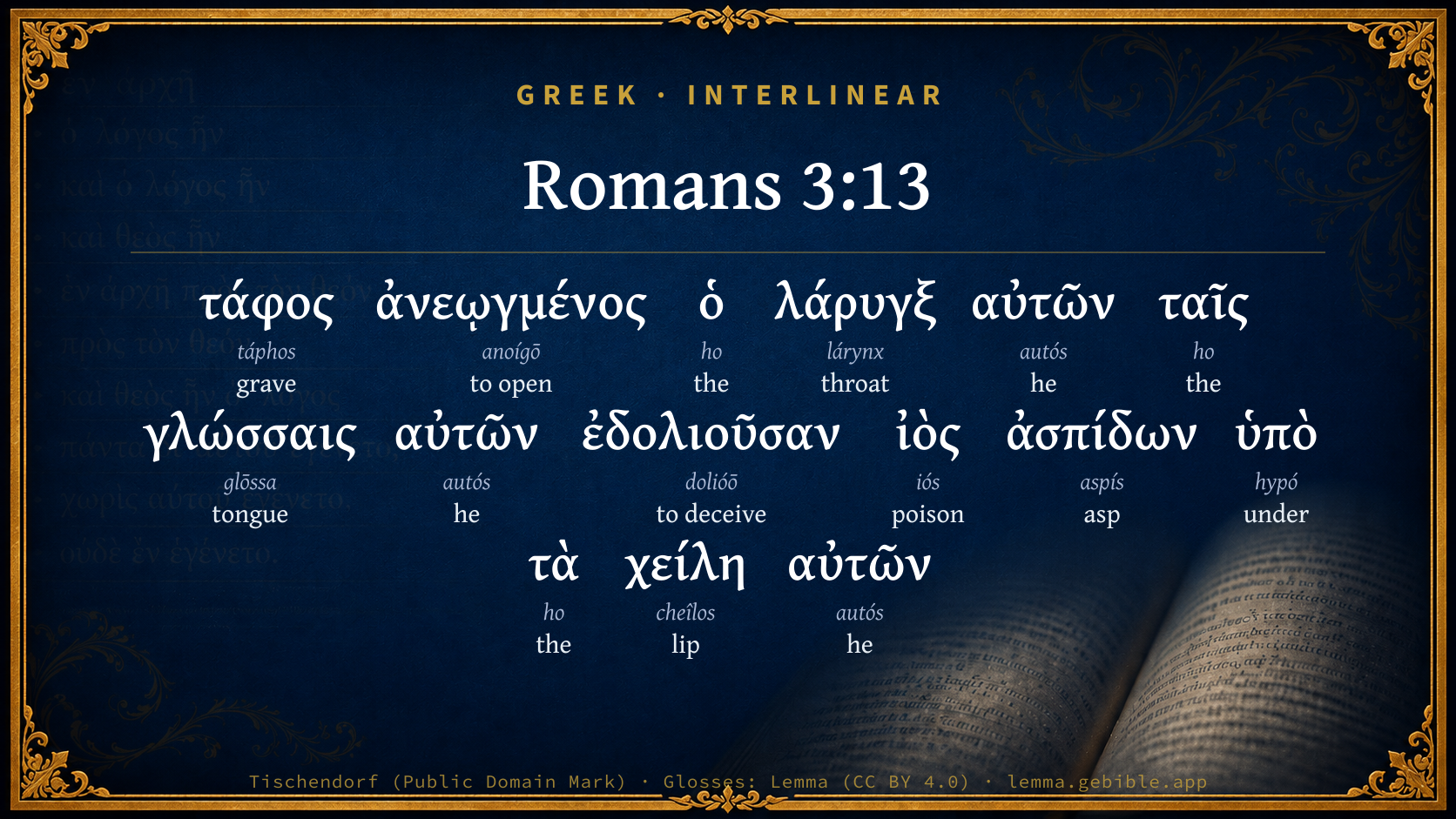
Greek (Tischendorf 8th ed.) Romans 3:13 appears in the Greek New Testament. The text above is from the Tischendorf 8th edition. Each word links to its Strong’s number and a concise gloss. Click any word for its full Thayer’s Greek Lexicon entry.
Download image
Cite this verse

Romans 3:13 (World English Bible). Public Domain. Lemma interlinear Bible study tool, https://lemma.gebible.app/v/romans/3/13.

Show BibTeX & RIS
BibTeX
RIS
English Translation
"Their throat is an open tomb. With their tongues they have used deceit." "The poison of vipers is under their lips;"
World English Bible · Public Domain
Highlights
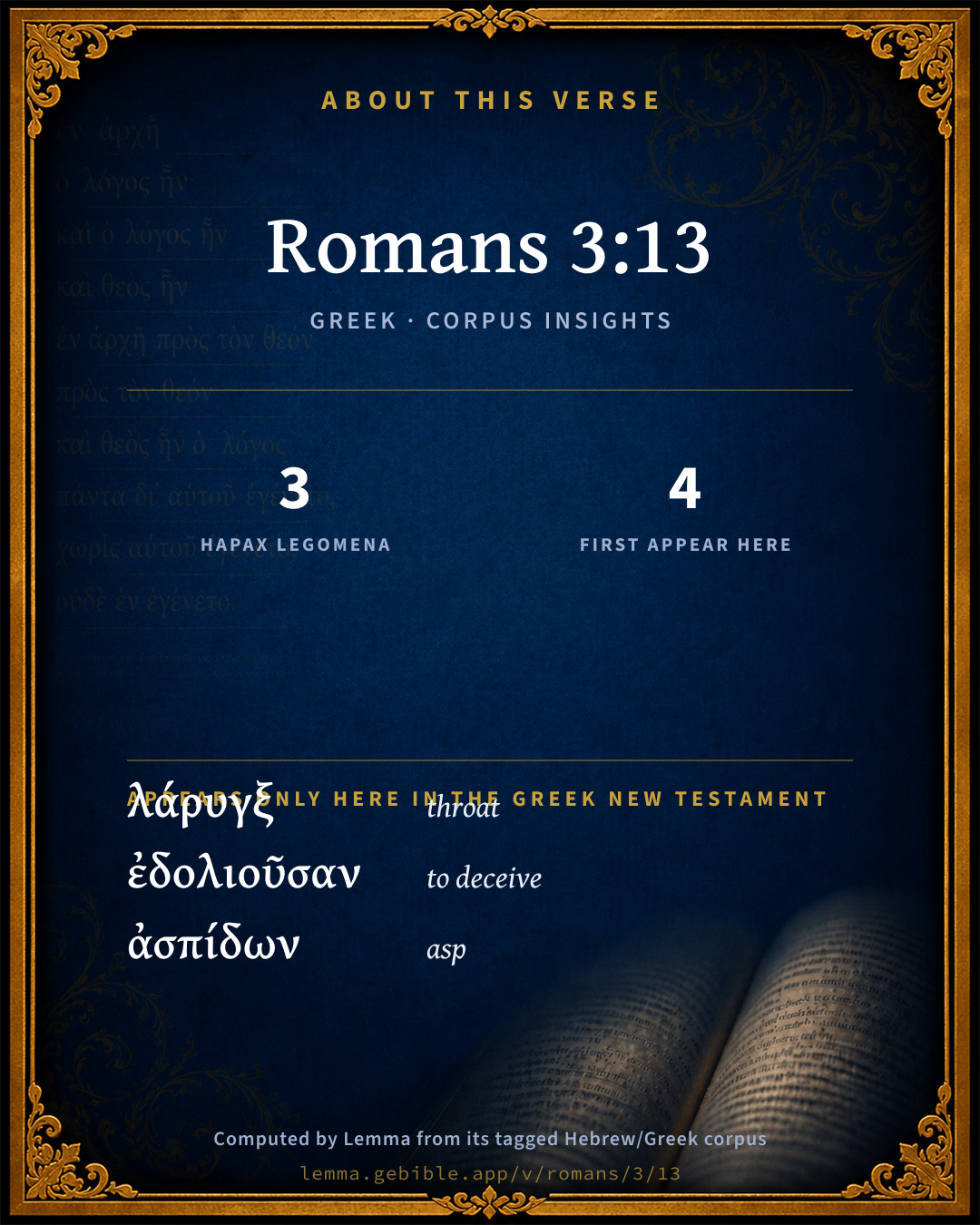
  • 3 hapax legomena — only here in the Greek New Testament
  • 4 first appearances in the Greek New Testament
Full analysis ↓
Download a study sheet

One document with this verse’s original text, its word-by-word gloss line, the meaning frame, cross-references with their text, attributed commentary, and full source and license credits — printable, and it pastes into notes with its structure intact.

This verse Autodidact and up

Study sheet (.html) Plain text (.txt)

A passage Seminary Student

Up to 50 verses in one chapter. A passage sheet keeps up to 6 commentary sources and 12 cross-references per verse, in the order this page ranks them, and says so on the sheet whenever that leaves anything out. Ask for a single verse and you get the Autodidact verse sheet above.

Everything on this page stays free to read, with no account — the sheet is a download of what is already on screen, not access to it.

Want to remove ads? Support Godless Engineer
Compare translations 3

The same verse in 3 English versions, stacked beneath the original-language interlinear above. Click any original word for its lexicon entry.

Each is an independent rendering of the whole verse — the interlinear is not word-aligned to these translations.

Highlighted words mark where these versions differ — a whole-verse word diff, not a word-by-word alignment.

  • World English Bible Public Domain
    "Their throat is an open tomb. With their tongues they have used deceit." "The poison of vipers is under their lips;"
  • King James Version Public Domain
    Their throat is an open sepulchre; with their tongues they have used deceit; the poison of asps is under their lips:
  • unfoldingWord Literal Text CC BY-SA 4.0
    “Their throat an opened grave. They keep deceiving with their tongues. The poison of asps under their lips,” q1

unfoldingWord Literal Text — © unfoldingWord, licensed CC BY-SA 4.0. Word-aligned USFM3 via Door43 (git.door43.org/unfoldingWord/en_ult).

Versions to compare (up to 4)

3 of 4 selected

Show all 19 translations

Every available English version of this verse, each an independent rendering of the whole verse.

  • World English Bible Public Domain
    "Their throat is an open tomb. With their tongues they have used deceit." "The poison of vipers is under their lips;"
  • Berean Standard Bible Public Domain
    “Their throats are open graves; their tongues practice deceit.” “The venom of vipers is on their lips.”
  • Majority Standard Bible Public Domain
    “Their throats are open graves; their tongues practice deceit.” “The venom of vipers is on their lips.”
  • King James Version Public Domain
    Their throat is an open sepulchre; with their tongues they have used deceit; the poison of asps is under their lips:
  • American Standard Version (1901) Public Domain
    Their throat is an open sepulchre; With their tongues they have used deceit: The poison of asps is under their lips:
  • Revised Version (1885) Public Domain
    Their throat is an open sepulchre; With their tongues they have used deceit: The poison of asps is under their lips:
  • Geneva Bible (1599) Public Domain
    Their throte is an open sepulchre: they haue vsed their tongues to deceit: the poyson of aspes is vnder their lippes.
  • Douay-Rheims (1899) Public Domain
    Their throat is an open sepulchre; with their tongues they have dealt deceitfully. The venom of asps is under their lips.
  • Young's Literal Translation Public Domain
    A sepulchre opened `is' their throat; with their tongues they used deceit; poison of asps `is' under their lips.
  • Literal Standard Version CC BY-SA 4.0
    Their throat [is] an opened grave; with their tongues they used deceit; poison of cobras [is] under their lips—
  • Unlocked Literal Bible CC BY-SA 4.0
    “Their throat is an open grave. Their tongues have deceived. The poison of snakes is under their lips.”
  • unfoldingWord Literal Text CC BY-SA 4.0
    “Their throat an opened grave. They keep deceiving with their tongues. The poison of asps under their lips,” q1
  • Darby Bible Public Domain
    their throat is an open sepulchre; with their tongues they have used deceit; asps' poison [is] under their lips:
  • World Messianic Bible Public Domain
    “Their throat is an open tomb. With their tongues they have used deceit.” “The poison of vipers is under their lips.”
  • Webster's Bible Public Domain
    Their throat is an open sepulcher; with their tongues they have used deceit; the poison of asps is under their lips:
  • Free Bible Version CC BY-SA 4.0
    Their throats are like an open grave; their tongues spread deceit; their lips ooze with the venom of snakes.
  • Bible in Basic English Public Domain
    Their throat is like an open place of death; with their tongues they have said what is not true: the poison of snakes is under their lips:
  • Text-Critical English NT CC BY 4.0
    “Their throat is an open grave; with their tongues they deceive.” “The venom of asps is under their lips.”
  • Tyndale New Testament (1534) Public Domain
    Their throte is an open sepulchre with their tounges they have disceaved: the poyson of Aspes is vnder their lippes.

Literal Standard Version (2020), Covenant Press — licensed CC BY-SA 4.0. Text via the HelloAO Bible API (eBible.org). Unlocked Literal Bible (unfoldingWord) — licensed CC BY-SA 4.0. Text via the HelloAO Bible API (eBible.org). unfoldingWord Literal Text — © unfoldingWord, licensed CC BY-SA 4.0. Word-aligned USFM3 via Door43 (git.door43.org/unfoldingWord/en_ult). Free Bible Version, Dr. Jonathan Gallagher — licensed CC BY-SA 4.0. Text via the HelloAO Bible API (eBible.org).

Word by word

More ways to search: Search by grammar → Find every occurrence → Compare this word →

Practice this passage: Drill this verse → Learn its vocabulary →

λάρυγξ
lárynx
G2995
“throat”
Noun, Nominative, Singular, Masculine
Part of Speech
Noun
Case
Nominative
Number
Singular
Gender
Masculine
Full Thayer's Definition

Origin: of uncertain derivation

TDNT: 04:57,5

1. the throat a. of the instrument or organ of speech
  1. τάφος táphos G5028 “grave” Noun, Nominative, Singular, Masculine
  2. ἀνεῳγμένος anoígō G455 “to open” Verb, Perfect, Passive, Participle, Nominative, Singular, Masculine
  3. ὁ ho G3588 “the” Article, Nominative, Singular, Masculine
  4. αὐτῶν autós G846 “he” Personal pronoun, Genitive, Plural, Masculine
  5. ταῖς ho G3588 “the” Article, Dative, Plural, Feminine
  6. γλώσσαις glōssa G1100 “tongue” Noun, Dative, Plural, Feminine
  7. αὐτῶν autós G846 “he” Personal pronoun, Genitive, Plural, Masculine
  8. ἐδολιοῦσαν dolióō G1387 “to deceive” Verb, Imperfect, Active, Indicative, 3rd person, Plural
  9. ἰὸς iós G2447 “poison” Noun, Nominative, Singular, Masculine
  10. ἀσπίδων aspís G785 “asp” Noun, Genitive, Plural, Feminine
  11. ὑπὸ hypó G5259 “under” Preposition
  12. τὰ ho G3588 “the” Article, Accusative, Plural, Neuter
  13. χείλη cheîlos G5491 “lip” Noun, Accusative, Plural, Neuter
  14. αὐτῶν autós G846 “he” Personal pronoun, Genitive, Plural, Masculine

About this verse

These counts appear in no published source. They are computed here, from the morphology-tagged text and Lemma’s own curated glosses. What Lemma adds →

15
words
11
distinct lemmas
Pauline Epistles
section

Notable vocabulary

3 hapax legomena — words that appear only here in the entire Greek New Testament:

  • λάρυγξ throat G2995
  • ἐδολιοῦσαν to deceive G1387
  • ἀσπίδων asp G785

First appearance in Scripture

These words make their first canonical appearance in the Greek New Testament here:

  • λάρυγξ throat G2995
  • ἐδολιοῦσαν to deceive G1387
  • ἰὸς poison G2447
  • ἀσπίδων asp G785

Shared distinctive vocabulary

ἰὸς poison G2447 occurs in 3 verses of the Greek New Testament. Also found in:
Repetition

Words recur within this verse:

Cross-references

16

Topical passages linked to Romans 3:13 in the Treasury of Scripture Knowledge — connected by theme and wording, ordered by reader-vote popularity; previews shown in the World English Bible.

  • Psalms 5:9 For there is no faithfulness in their mouth. Their heart is destruction. Their throat is an open tomb. They flatter with their tongue.
  • Psalms 140:3 They have sharpened their tongues like a serpent. Viper's poison is under their lips. Selah.
  • Matthew 23:27–28 "Woe to you, scribes and Pharisees, hypocrites! For you are like whitened tombs, which outwardly appear beautiful, but inwardly are full of dead men's bones, and of all uncleanness.
  • Psalms 57:4 My soul is among lions. I lie among those who are set on fire, Even the sons of men, whose teeth are spears and arrows, And their tongue a sharp sword.
  • Jeremiah 9:3–5 They bend their tongue, [as it were] their bow, for falsehood; and they are grown strong in the land, but not for truth: for they proceed from evil to evil, and they don't know me, says Yahweh.
  • Psalms 52:2 Your tongue plots destruction, Like a sharp razor, working deceitfully.
  • Isaiah 59:3 For your hands are defiled with blood, and your fingers with iniquity; your lips have spoken lies, your tongue mutters wickedness.
  • Ezekiel 13:7 Haven't you seen a false vision, and haven't you spoken a lying divination, in that you say, Yahweh says; but I have not spoken?
  • Matthew 12:34–35 You offspring of vipers, how can you, being evil, speak good things? For out of the abundance of the heart, the mouth speaks.
  • James 3:5–8 So the tongue is also a little member, and boasts great things. See how a small fire can spread to a large forest!
  • Psalms 36:3 The words of his mouth are iniquity and deceit. He has ceased to be wise and to do good.
  • Jeremiah 5:16 Their quiver is an open tomb, they are all mighty men.
  • Romans 3:4 May it never be! Yes, let God be found true, but every man a liar. As it is written, "That you might be justified in your words, And might prevail when you come into judgment."
  • Deuteronomy 32:33 Their wine is the poison of serpents, The cruel venom of asps.
  • Psalms 12:3–4 May Yahweh cut off all flattering lips, And the tongue that boasts,
  • Job 20:14–16 Yet his food in his bowels is turned. It is cobra venom within him.

Cross-references courtesy of OpenBible.info (CC BY 4.0).

Commentary

Notes on Romans 3:13 from classic Christian and Jewish commentators (each source and its license shown beneath its notes). The classic Christian expositions comment on the surrounding passage and are grouped to its opening verse, so a note may address several verses; the Jewish commentaries on the Tanakh (Rashi and others) are per-verse, so they appear only where the commentator wrote on this verse.

Lemma curates 59 commentaries, every one of them public domain or Creative Commons licensed, each selected and text-cleaned for this edition rather than reprinted as found. About our sources →

Adam Clarke's Commentary

Verse 13. Their throat is an open sepulchre] This and all the following verses to the end of the 18th Ro 3:13-18 are found in the Septuagint, but not in the Hebrew text; and it is most evident that it was from this version that the apostle quoted, as the verses cannot be found in any other place with so near an approximation to the apostle's meaning and words. The verses in question, however, are not found in the Alexandrian MS. But they exist in the Vulgate, the AEthiopic, and the Arabic. As the most ancient copies of the Septuagint do not contain these verses, some contend that the apostle has quoted them from different parts of Scripture; and later transcribers of the Septuagint, finding that the 10th, 11th, and 12th, verses were quoted from the xivth Psalm, Ps 14:3 imagined that the rest were found originally there too, and so incorporated them in their copies, from the apostle's text.

Their throat is an open sepulchre-By their malicious and wicked words they bury, as it were, the reputation of all men. The whole of this verse appears to belong to their habit of lying, defamation, slandering, &c., by which they wounded, blasted, and poisoned the reputation of others.

Adam Clarke's Commentary on the Bible (1810–1826) — public domain. Text from a community e-Sword/MySword module.

Tyndale Open Study Notes

Tyndale Open Resources

3:13-14 Paul here refers to sins of speech, mentioning a different organ of speech in each of the four lines (talk in 3:13 is literally throat).

Tyndale Open Study Notes — © Tyndale Open Resources, licensed CC BY-SA 4.0. Text via the HelloAO Bible API.

Bengel's Gnomon

Johann Albrecht Bengel

Rom 3:13. Τάφος—ιὂς—ἀυτῶν) so the LXX., Psa 5:10; Psa 140:4.—ἀνεῳγμένος) a sepulchre lately opened, and therefore very fetid.—ὁ λάρυγξ, their throat) Observe the course of the conversation, as it flows from the heart, by the avenue of their throat, their tongues, and their lips—the whole is comprised in the mouth; a great part of sin consists in words.—ὑπὸ τὰ χείλη) under theirlips; for on their lips is the sweetness of honey.

Bengel's Gnomon of the New Testament — English translation (T&T Clark, Edinburgh, 1860) — public domain. Text from a community e-Sword module.

Expositor's Greek Testament

ed. W. Robertson Nicoll

Rom 3:13 . τάφος … ἐδολιοῦσαν is an exact quotation of Psa 5:10 (LXX). The original seems to describe foreign enemies whose false and treacherous language threatened ruin to Israel. For the form ἐδολιοῦσαν , see Winer, p. 91 (f.). The termination is common in the LXX: Wetstein quotes one grammarian who calls it Boeotian and another Chalcidic; it was apparently widely diffused. The last clause, ἰὸς ἀσπίδων κ . τ . λ ., is Psa 139:4 , LXX.

The Expositor's Greek Testament, edited by W. Robertson Nicoll (1897–1910) — public domain. Text from a community e-Sword module.

Hodge's Commentary on Romans, Ephesians & First Corinthians

Charles Hodge

Rom_3:13, Rom_3:14

These verses relate to the sins of the tongue. The passages quoted are from Psa_5:9; Psa_140:3; and Psa_10:7. Their throat is an open sepulchre. The point of comparison may be the offensive and pestiferous character of the exhalations of an open grave. This is forcible, and suited to the context. Or the idea is, that as the grave is rapacious and insatiable, so the wicked are disposed to do all the injury with their tongues which they can accomplish. In Jer_5:16, it is said of the Chaldeans, Their quiver is as an open sepulchre, i.e., destructive. But as in the following verses sins of violence are brought distinctly into view, the former explanation is to be preferred. What issues from the mouths of the wicked is offensive and pestiferous. With their tongues they have used deceit. The word ἐδολιοῦσαν is in the imperfect, for ἐδολιοῦν, implying continuous action. In the Hebrew it is, They make smooth their tongue, i.e. they flatter. The lxx, and Vulgate give the version which the apostle adopts. The poison of asps is under their lips. This is the highest expression of malignity. The bite of the adder causes the severest pain, as well as produces death. To inflict suffering is a delight to the malignant. This is a revelation of a nature truly diabolical. Their mouth is full of cursing and bitterness. The Hebrew in Psa_10:7 is, His mouth is full of deceit and violence; the Septuagint, His mouth is full of cursing, bitterness, and deceit. The Vulgate follows the lxx; Paul condenses the idea.

Charles Hodge — Commentary on Romans (1835), First Corinthians (1857), and Ephesians (1856) — public domain. Text from a community e-Sword module.

Jamieson, Fausset & Brown

Robert Jamieson, A. R. Fausset & David Brown

Their, &c.--From generals, the apostle here comes to particulars, culling from different parts of Scripture passages which speak of depravity as it affects the different members of the body; as if to show more affectingly how "from the sole of the foot even to the head there is no soundness" in us.

throat is an open sepulchre-- (Psa 5:9); that is, "What proceeds out of their heart, and finds vent in speech and action through the throat, is like the pestilential breath of an open grave."

with their tongues they have used deceit-- (Psa 5:9); that is, "That tongue which is man's glory (Psa 16:9; Psa 57:8) is prostituted to the purposes of deception."

the poison of asps is under their lips-- (Psa 140:3): that is, "Those lips which should 'drop as an honeycomb,' and 'feed many,' and 'give thanks unto His name' (Sol 4:11; Pro 10:21; Heb 13:15), are employed to secrete and to dart deadly poison."

Jamieson, Fausset & Brown — Commentary Critical and Explanatory on the Whole Bible (1871) — public domain (CC PDM 1.0). Text via the HelloAO Bible API.

John Calvin's Commentaries

13. It is further added, Their throat is an open grave; that is, a gulf to swallow up men. It is more than if he had said, that they were devourers (ἀνθρωποφάγους — men-eaters;) for it is an intimation of extreme barbarity, when the throat is said to be so great a gulf, that it is sufficient to swallow down and devour men whole and entire. Their tongues are deceitful, and, the poison of asps is under their lips, import the same thing,

John Calvin's Commentaries (1540-1563) — public domain. Text from the Calvin Translation Society English edition (1840s-50s) via the Christian Classics Ethereal Library (ccel.org). Calvin's coverage is partial (roughly two-thirds of the Bible); uncommented books and verses are honest gaps, never fabricated. The 19th-century editor's footnotes and remarks are omitted so the notes are faithfully Calvin's own voice.

Ellicott's Commentary for English Readers

(13) Their throat is an open sepulchre—i.e., their speech is at once corrupt and corrupting. It is compared to a “yawning grave”—not merely to a pit into which a man may fall, but to a sort of pestiferous chasm yawning and ravening, as it were, after its prey.

They have used deceit.—Strictly, they were deceiving; a continued action brought up to the present time.

Under their lips.—As the poison-bag of the serpent is directly under the kind of tooth by which its venom is discharged.

A Bible Commentary for English Readers, edited by Charles John Ellicott (1878–1897) — public domain. Text from a community e-Sword module.

The Cambridge Bible for Schools and Colleges

gen. ed. J. J. S. Perowne

13. an open sepulchre] Perhaps as “uttering abomination.” “Emitting the noisome exhalations of a putrid heart (Bp Home on Psa_5:9).

The Cambridge Bible for Schools and Colleges (gen. ed. J. J. S. Perowne; Cambridge University Press, 1878–1918) — public domain. Text from a community e-Sword module.

John Gill's Exposition

Whose mouth is full of cursing and bitterness. These words are taken from Psa 10:7, by cursing is meant, cursing of God, which is sometimes internal with the heart, and sometimes external with the mouth, as here; and of all good men, though without cause, and to no purpose with respect to the persons they curse, since God has blessed them, and they are blessed, and greatly to their own detriment, for, in the issue, their curses will be turned against themselves. There is also a cursing of superiors, as parents, masters, magistrates, kings, and governors; which is a sore evil, and attended with bad consequences; likewise of themselves, and their fellow creatures: and "the mouth being full of it", denotes the frequency of the sin; scarce anything else comes out of it but cursing; which discovers the sad corruption of the heart; "for out of the abundance of the heart the mouth speaketh", Mat 12:34. By "bitterness" is meant, either sin in general, which is "an evil and bitter thing", Jer 2:19, in its nature and effects; or sinful words, such as oaths, curses, imprecations, all wrathful and deceitful words.

, in its nature and effects; or sinful words, such as oaths, curses, imprecations, all wrathful and deceitful words.

Romans 3:15

rom 3:15

rom 3:15

rom 3:15Their feet are swift to shed blood. The sins of the heart and mouth are before described, and now the sins of action are taken notice of; for "the feet" are the instruments of motion and action: and when these are said to be "swift to shed blood", it denotes the readiness and eagerness of men, to murder innocent creatures; which shows the dreadful malice and hatred that is in them. The words are cited from Isa 59:7, and seem to point at the times of Manasseh, who shed so much innocent blood, as to fill Jerusalem with it from one end to the other.

John Gill's Exposition of the Whole Bible (1746–1763) — public domain (CC PDM 1.0). Text via the HelloAO Bible API.

Trapp's Complete Commentary

John Trapp

13 Their throat is an open sepulchre; with their tongues they have used deceit; the poison of asps is under their lips:

Ver. 13. The poison of the asps] Of that sort of asps that spit their venom far from them upon the bystanders. (πρυαδες.) There is a great deal of such vermin and venom in that newly found world of wickedness, the tongue, Jas 3:6. It is easy to observe that St Paul here, making the anatomy of a natural man, stands more on the organs of speaking than all other members, and showeth how his tongue is tipped with fraud, his lips tainted with venom, his mouth full of gall, his throat a gaping grave, his tongue as a rapier to run men through with, and his throat as a sepulchre to bury them in. As for the asp, they write of her, That whereas her poison is so deadly, that the part infected cannot be cured but by cutting off, succurrit periclitantibus benignior natura, et noxiosissimo animali caliginosos obtutus dedit. (Jo. Wover.) Aspidi (saith Pliny, viii. 23) hebetes oculi dati, eosque non in fronte, sed in temporibus habet.

John Trapp, A Commentary or Exposition upon All the Books of the Old and New Testament (1647–1656) — public domain. Text from a community e-Sword module.

Albert Barnes' Notes on the Bible

Their throat ... - This expression is taken from Psa 5:9, literally from the Septuagint. The design of the psalm is to reprove those who were false, traitorous, slanderous, etc. Psa 5:6. The psalmist has the sin of deceit, and falsehood, and slander particularly in his eye. The expressions here are to be interpreted in accordance with that. The sentiment here may be, as the grave is ever open to receive all into it, that is, into destruction, so the mouth or the throat of the slanderer is ever open to swallow up the peace and happiness of all. Or it may mean, as from an open sepulchre there proceeds an offensive and pestilential vapor, so from the mouths of slanderous persons there proceed noisome and ruinous words. “(Stuart.)” I think the connection demands the former interpretation.

With their tongues ... - In their conversation, their promises, etc., they have been false, treacherous, and unfaithful.

The poison of asps - This is taken literally from the Septuagint of Psa 140:3. The asp, or adder, is a species of serpent whose poison is of such active operation that it kills almost the instant that it penetrates, and that without remedy. It is small, and commonly lies concealed, often in the “sand” in a road, and strikes the traveler before he sees it. It is found chiefly in Egypt and Lybia. It is said by ancient writers that the celebrated Cleopatra, rather than be carried a captive to Rome by Augustus, suffered an asp to bite her in the arm, by which she soon died. The precise species of serpent which is here meant by the psalmist, however, cannot be ascertained. All that is necessary to understand the passage is, that it refers to a serpent whose bite was deadly, and rapid in its execution.

Is under their lips - The poison of the serpent is contained in a small bag which is concealed at the root of the tooth. When the tooth is struck into the flesh, the poison is pressed out, through a small hole in the tooth, into the wound. Whether the psalmist was acquainted with that fact, or referred to it, cannot be known: his words do not of necessity imply it. The sentiment is, that as the poison of the asp is rapid, certain, spreading quickly through the system, and producing death; so the words of the slanderer are deadly, pestiferous, quickly destroying the reputation and happiness of man. They are as subtle, as insinuating, and as deadly to the reputation, as the poison of the adder is to the body. Wicked people in the Bible are often compared to serpents; Mat 23:33; Gen 49:17.

Albert Barnes' Notes on the Bible (1834–1885) — public domain. Text from a community e-Sword/MySword module.

Matthew Poole's English Annotations

Their throat is an open sepulchre; he proceeds to instance in the corruption of man with respect to the members of his body; and he mentions the organs of speech in four several expressions, much to the same purpose: the first is allegorical, taken out of Psa 5:9, upon which see the annotations.

With their tongues they have used deceit; this text doth plainly express the corruption of the tongue, because of lies, calumnies, perjuries, flatteries; and it is taken out of Jer 9:3-5.

The poison of asps is under their lips: the third expression is allegorical, as the first, taken out of Psa 140:3, upon which see the annotations.

Matthew Poole's English Annotations on the Holy Bible (1683–1685) — public domain. Text from a community e-Sword/MySword module.

Whedon's Commentary on the Bible

Daniel D. Whedon

13. An open sepulchre—As swallowing the once living; and, like the whited sepulchres of the Saviour’s words, full of dead men’s bones.

Daniel D. Whedon (gen. ed.), Commentary on the Old and New Testaments (1874–1909) — public domain. Text from a community e-Sword module.

John Wesley's Explanatory Notes

Their throat - Is noisome and dangerous as an open sepulchre. Observe the progress of evil discourse, proceeding out of the heart, through the throat, tongue, lips, till the whole mouth is filled therewith. The poison of asps - Infectious, deadly backbiting, tale-bearing, evil-speaking, is under (for honey is on) their lips. An asp is a venomous kind of serpent. Psalm v, 9; Psalm cxl, 3.

John Wesley, Explanatory Notes Upon the Whole Bible (1754–1765) — public domain. Text via the GEBible commentary corpus.

Godbey's Commentary on the New Testament

William B. Godbey

13. “Their throat is an open sepulcher; with their tongues they have used deceit; the poison of asps is under their lips.” This is an awful description of the above who depart from God. This picture is progressive, this verse describing an advanced state of alienation from God.

William B. Godbey, Commentary on the New Testament (1896–1900) — public domain. Text from a community e-Sword module.

McGarvey & Pendleton's Commentaries

J. W. McGarvey

Their throat is an open sepulchre; With their tongues they have used deceit [ Psa_5:9 ]: The poison of asps is under their lips [ Psa_140:3 ]:

J. W. McGarvey (with Philip Y. Pendleton), Commentaries on the New Testament (The Fourfold Gospel, 1914; Acts; and the epistles) — public domain. Text from a community e-Sword/MySword module.

The People's New Testament

B. W. Johnson

13. Their throat is an open sepulchre. Thus far the statements have been general. Now we come to particulars. If the grave is opened, corruption is manifest. So corruption comes from the throats of men when they speak. The poison of asps. The venom of falsehood, as deadly as the deadly serpent.

B. W. Johnson's The People's New Testament with Notes (1889–1891) — public domain. Electronic text from the Christian Classics Ethereal Library (CCEL) ThML edition.

unfoldingWord translationNotes

Door43 World Missions Community

Their ... Their

The word "their" refers to the "Jews and Greeks" of Romans 3:9.

Their throat is an open grave

The word "throat" is a metonym for everything that people say that is unrighteous and disgusting. Here "open grave" is a metaphor that refers to the stench of the evil words of the people. (See: Metonymy and Metaphor)

Their tongues have deceived

The word "tongues" is a metonym for the false words that people speak. AT: "People speak lies" (See: Metonymy)

The poison of snakes is under their lips

Here "poison of snakes" is a metaphor that is used to represent the great harm of the evil words that the people speak. The word "lips" refers to the words of the people. AT: "Their evil words injure people just like the poison of a venomous snake" (See: Metaphor and Metonymy)

Their mouths are full of cursing and bitterness

Here "mouths" is a metonym that represents the evil words of the people. The word "full" exaggerates how often people speak bitterly and curse. AT: "They often speak curses and cruel words" (See: Metonymy and Hyperbole and Generalization)

translationWords

grave

tongue

deceive

curse

unfoldingWord translationNotes — © Distant Shores Media and the Door43 World Missions Community, licensed CC BY-SA 4.0. Source: git.door43.org/Door43/en_tn.

Cambridge Greek Testament for Schools and Colleges

13. ἐδολιοῦσαν. Hebr. ‘make smooth their tongue,’ R.V. margin, Psa 5:9 only, in Gk Bible. Prop. = deceived; form = imperf. with aor. term. cf. Thackeray, op. cit[107] p. 214.

[107] op. cit. opus citatum

Cambridge Greek Testament for Schools and Colleges (Cambridge University Press, 1896; 21 vols, various authors incl. Carr, Maclear, Plummer, Farrar, Lumby, Moule, M. R. James, Simcox) — public domain. Text from a community e-Sword module.

Alford’s Greek Testament

Henry Alford

13.] ἐδολιοῦσαν, an Alexandrine form for ἐδολίουν; see Lobeck, Phrynichus, p. 349. The open sepulchre is an emblem of perdition, to which their throat, as the instrument of their speech, is compared.

Henry Alford, The Greek Testament (1849–1861) — public domain. Text from a community e-Sword module.

International Critical Commentary

13. τάφος … ἐδολιοῦσαν. The LXX of Psa 5:9 [10] corresponds pretty nearly to Heb. The last clause = rather linguam suam blandam reddunt (poliunt), or perhaps lingua sua blandiuntur (Kautzsch, p. 34): ‘their tongue do they make smooth’ Cheyne; ‘smooth speech glideth from their tongue’ De Witt.

ἐδολιοῦσαν: Win. Gr. § xiii, 14 (Exo_8; xiii, 2 f. E. T.). The termination -σαν, extended from imperf. and 2nd aor. of verbs in -μι to verbs in -ω, is widely found; it is common in LXX and in Alexandrian Greek, but by no means confined to it; it is frequent in Boeotian inscriptions, and is called by one grammarian a ‘Boeotian’ form, as by others ‘Alexandrian.’

ἰὸς ἀσπίδων: Psa 140:3 [139:4]. The position of the poison-bag of the serpent is rightly described. The venom is more correctly referred to the bite (as in Num 21:9; Pro 23:32), than to the forked tongue (Job 20:16): see art. ‘Serpent’ in D. B.

International Critical Commentary — older volumes (1896–1929), various authors — public domain. Text from a community e-Sword module.

Vincent's Word Studies in the New Testament

Marvin R. Vincent

Open sepulchre [ταφος ανεωγμενος] . Lit., a sepulchre opened or standing open. Some explain the figure by the noisome exhalations from a tomb. Others refer it to a pit standing open and ready to devour, comparing Jer 5:16, where the quiver of the Chaldaeans is called an open sepulchre. So Meyer and Morison. Godet compares the phrase used of a brutal man : "it seems as if he would like to eat you." Compare Dante's vision of the lion :

"With head uplifted and with ravenous hunger, So that it seemed the air was afraid of him." " Inferno, " 1, 47.

Have used deceit [εδολιουσαν] . Hebrew, they smoothed their tongues.

Guile is contrasted with violence in the previous clause. Wyc., with their tongues they did guilingly. The imperfect tense denotes perseverance in their hypocritical professions.

Marvin R. Vincent, Word Studies in the New Testament (1887–1900) — public domain. Text from a community e-Sword/MySword module.

Godet's Commentaries

Frédéric Louis Godet

Vv. 13, 14. “Their throat is an open sepulchre; with their tongues they have used deceit; the poison of asps is under their lips: whose mouth is full of cursing and bitterness.”

These four propositions refer to the different organs of speech, and show them all exercising their power to hurt, under the dominion of sin. The throat (larynx) is compared to a sepulchre; this refers to the language of the gross and brutal man, of whom it is said in common parlance: it seems as if he would like to eat you. The characteristic which follows contrasts with the former; it is the sugared tongue, which charms you like a melodious instrument. The imperfect ἐδολιοῦσαν (Alex. form) denotes the action as continually repeated. These two features are borrowed from Psa 5:9, where they describe the behavior of David’s enemies. The third proposition is taken from Psa 140:3, which treats of the same subject; what is meant is that calumny and falsehood which malignant lips give forth, as the serpent infuses its poison. The fourth (Rom 3:14) describes the wickedness which is cast in your face by a mouth full of hatred or bitterness; it is borrowed from Psa 10:7, where the contrast is between the weak godly man and the powerful wicked man within the theocracy itself.

This picture of human depravity manifesting itself in word is completed by the description of the same wickedness shown in deeds.

Frédéric Louis Godet — Commentaries on Luke, John, Romans, and 1 Corinthians — English translation (T&T Clark, Edinburgh, 1870s–1890s) — public domain. Text from a community e-Sword module.

Lesson kit

Teaching starters — assembled from the data on this page, not authored interpretation. Every prompt links to the verse data it draws on. Edit before teaching.

Romans, in the Pauline Epistles, opens this verse with 15 words (11 distinct Greek lemmas). Its most distinctive word is lárynx (“throat”). A historical commentator’s framing appears above. Read the whole chapter for the surrounding context.

Discussion questions

  1. What does “throat” (lárynx) contribute to the verse as a whole?
  2. 3 words here appear nowhere else in the Greek New Testament. Why might the author reach for such rare wording?
  3. 4 words make their first appearance in Scripture here. What does this debut establish?
  4. How does James 3:8, which shares the word «poison», read alongside this verse?
  5. What does the repetition of “the” (3× in this one verse) do in this verse?
  6. These translations render this verse differently; the difference is in the English rendering, not the original. What questions does that raise?
  7. Compare how Adam Clarke's Commentary and Tyndale Open Study Notes read this verse. Where do they agree or differ?

Things to notice

  • 3 words in this verse appear nowhere else in the Greek New Testament.
  • 4 words make their first canonical appearance in Scripture here.
  • These translations choose different wording for 13 words in this verse.
  • “the” occurs 3× in this single verse.
  • 11 distinct Greek lemmas span 15 words in this verse.

Reading settings

Reading text

Shown beneath each verse's original-language words.

Old Testament
Old Testament edition

Read the OT as the Masoretic Hebrew (MT) or the Greek Septuagint (LXX).

English shown for the Greek Septuagint (in the Hebrew ↔ Greek comparison).

Comparing translations? Open the Compare panel on any verse page to stack up to four side by side.