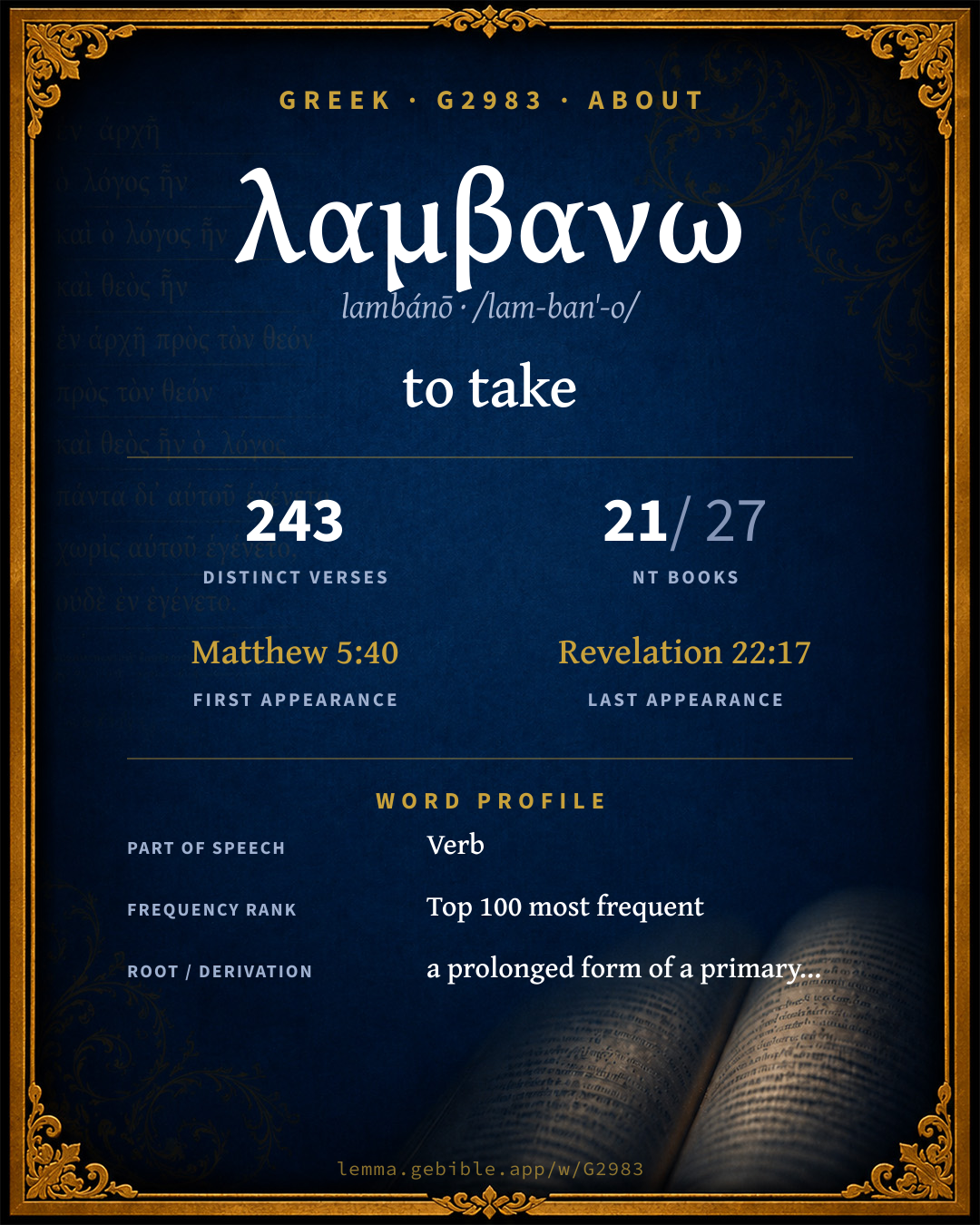
λαμβάνω
to take
‘to take’ is one of 7 main senses fuller range ↓
Full lexicon entry — Thayer's Greek Lexicon
From Thayer's Greek Lexicon
Where this word appears
See every Aorist-tense verb in the Greek New Testament →
Grammar key — what these labels mean
Part of speech
- Verb
- An action or state-of-being word.
Tense
- Aorist
- Action viewed as a simple whole, without regard to duration — often past (perfective aspect).
- Present
- Ongoing or general action in present time (imperfective aspect).
- Future
- Action expected in future time.
- Perfect
- A completed past action with continuing present results.
- Imperfect
- Continuous or repeated action in past time (“was writing”).
Voice
- Active
- The subject performs the action.
- Middle deponent
- Middle in form but active in meaning.
- Passive
- The subject receives the action.
Mood
- Participle
- A verbal adjective (“writing,” “having written”).
- Indicative
- States a fact or asks a factual question (the mood of reality).
- Infinitive
- A verbal noun (“to write”), unmarked for person or number.
- Subjunctive
- Expresses probability, purpose, or possibility (the mood of contingency).
- Imperative
- Expresses a command or request.
- Optative
- Expresses a wish or a remote possibility.
Case
- Nominative
- The case of the subject (and the predicate nominative).
- Accusative
- The case of the direct object and of extent.
Person
- 3rd person
- The one spoken about (“he / she / it / they”).
- 2nd person
- The one addressed (“you”).
- 1st person
- The speaker (“I / we”).
Gender
- Masculine
- Grammatically masculine.
- Feminine
- Grammatically feminine.
- Neuter
- Grammatically neuter.
Number
- Singular
- One.
- Plural
- More than one.
Grammatical forms 44 distinct
- Verb, Aorist, Active, Participle, Nominative, Singular, Masculine 39 times (15%)
- Verb, Aorist, Active, Indicative, 3rd person, Singular 22 times (9%)
- Verb, Aorist, Active, Infinitive 22 times (9%)
- Verb, Aorist, Active, Indicative, 3rd person, Plural 20 times (8%)
- Verb, Present, Active, Indicative, 3rd person, Singular 18 times (7%)
- Verb, Aorist, Active, Participle, Nominative, Plural, Masculine 14 times (5%)
- Verb, Aorist, Active, Indicative, 2nd person, Plural 13 times (5%)
- Verb, Aorist, Active, Subjunctive, 3rd person, Singular 8 times (3%)
+36 more forms (102 occurrences)
Parsed forms decoded from the imported morphology (Robinson–Tischendorf, public domain), counted across 258 parsed occurrences — not distinct verses.
Page 1 of 2 — showing verses 1–200 of 243 distinct verses where G2983 appears, across 21 books. Click any verse to open its interlinear word-by-word view. Verse text shown in the World English Bible for context — . Each verse’s Greek form is shown with its reference; the English is not keyword-highlighted, since the data carries no word-level English alignment. Use “Compare translations” on any verse to read it across multiple English versions. This concordance covers the Greek New Testament; Septuagint (Greek Old Testament) occurrences of this word are not indexed here.
Matthew 50 verses
- Matthew 5:40 λαβεῖν aor act inf If anyone sues you to take away your coat, let him have your cloak also.
- Matthew 7:8 λαμβάνει pres act ind 3sg For everyone who asks receives. He who seeks finds. To him who knocks it will be opened.
- Matthew 8:17 ἔλαβεν aor act ind 3sg that it might be fulfilled which was spoken through Isaiah the prophet, saying: "He took our infirmities, and bore our diseases."
- Matthew 10:8 ἐλάβετε aor act ind 2pl Heal the sick, cleanse the lepers, and cast out demons. Freely you received, so freely give.
- Matthew 10:38 λαμβάνει pres act ind 3sg He who doesn't take his cross and follow after me, isn't worthy of me.
- Matthew 10:41 λήμψεται λήμψεται fut mid.dep ind 3sg fut mid.dep ind 3sg He who receives a prophet in the name of a prophet will receive a prophet's reward: and he who receives a righteous man in the name of a righteous man will receive a righteous man's reward.
- Matthew 12:14 ἔλαβον aor act ind 3pl But the Pharisees went out, and conspired against him, how they might destroy him.
- Matthew 13:20 λαμβάνων pres act ptcp nom sg masc What was sown on the rocky places, this is he who hears the word, and immediately with joy receives it;
- Matthew 13:31 λαβὼν aor act ptcp nom sg masc He set another parable before them, saying, "The Kingdom of Heaven is like a grain of mustard seed, which a man took, and sowed in his field;
- Matthew 13:33 λαβοῦσα aor act ptcp nom sg fem He spoke another parable to them. "The Kingdom of Heaven is like yeast, which a woman took, and hid in three measures of meal, until it was all leavened."
- Matthew 14:19 λαβὼν aor act ptcp nom sg masc He commanded the multitudes to sit down on the grass; and he took the five loaves and the two fish, and looking up to heaven, he blessed, broke and gave the loaves to the disciples, and the disciples gave to the multitudes.
- Matthew 15:26 λαβεῖν aor act inf But he answered, "It is not appropriate to take the children's bread and throw it to the dogs."
- Matthew 15:36 ἔλαβεν aor act ind 3sg and he took the seven loaves and the fish. He gave thanks and broke them, and gave to the disciples, and the disciples to the multitudes.
- Matthew 16:5 λαβεῖν aor act inf The disciples came to the other side and had forgotten to take bread.
- Matthew 16:7 ἐλάβομεν aor act ind 1pl They reasoned among themselves, saying, "We brought no bread."
- Matthew 16:8 ἐλάβετε aor act ind 2pl Jesus, perceiving it, said, "Why do you reason among yourselves, you of little faith, 'because you have brought no bread?'
- Matthew 16:9 ἐλάβετε aor act ind 2pl Don't you yet perceive, neither remember the five loaves for the five thousand, and how many baskets you took up?
- Matthew 16:10 ἐλάβετε aor act ind 2pl Nor the seven loaves for the four thousand, and how many baskets you took up?
- Matthew 17:24 λαμβάνοντες pres act ptcp nom pl masc When they had come to Capernaum, those who collected the didrachma coins came to Peter, and said, "Doesn't your teacher pay the didrachma?"
- Matthew 17:25 λαμβάνουσιν pres act ind 3pl He said, "Yes." When he came into the house, Jesus anticipated him, saying, "What do you think, Simon? From whom do the kings of the earth receive toll or tribute? From their children, or from strangers?"
- Matthew 17:27 λαβὼν aor act ptcp nom sg masc But, lest we cause them to stumble, go to the sea, and cast a hook, and take up the first fish that comes up. When you have opened its mouth, you will find a stater coin. Take that, and give it to them for me and you."
- Matthew 19:29 λήμψεται fut mid.dep ind 3sg Everyone who has left houses, or brothers, or sisters, or father, or mother, or wife, or children, or lands, for my name's sake, will receive one hundred times, and will inherit eternal life.
- Matthew 20:9 ἔλαβον aor act ind 3pl "When those who were hired at about the eleventh hour came, they each received a denarius.
- Matthew 20:10 λήμψονται ἔλαβον fut mid.dep ind 3pl aor act ind 3pl When the first came, they supposed that they would receive more; and they likewise each received a denarius.
- Matthew 20:11 λαβόντες aor act ptcp nom pl masc When they received it, they murmured against the master of the household,
- Matthew 21:22 λήμψεσθε fut mid.dep ind 2pl All things, whatever you ask in prayer, believing, you will receive."
- Matthew 21:34 λαβεῖν aor act inf When the season for the fruit drew near, he sent his servants to the farmers, to receive his fruit.
- Matthew 21:35 λαβόντες aor act ptcp nom pl masc The farmers took his servants, beat one, killed another, and stoned another.
- Matthew 21:39 λαβόντες aor act ptcp nom pl masc So they took him, and threw him out of the vineyard, and killed him.
- Matthew 22:15 ἔλαβον aor act ind 3pl Then the Pharisees went and took counsel how they might entrap him in his talk.
- Matthew 25:1 λαβοῦσαι aor act ptcp nom pl fem "Then the Kingdom of Heaven will be like ten virgins, who took their lamps, and went out to meet the bridegroom.
- Matthew 25:3 λαβοῦσαι ἔλαβον aor act ptcp nom pl fem aor act ind 3pl Those who were foolish, when they took their lamps, took no oil with them,
- Matthew 25:4 ἔλαβον aor act ind 3pl but the wise took oil in their vessels with their lamps.
- Matthew 25:16 λαβὼν aor act ptcp nom sg masc Immediately he who received the five talents went and traded with them, and made another five talents.
- Matthew 25:18 λαβὼν aor act ptcp nom sg masc But he who received the one went away and dug in the earth, and hid his lord's money.
- Matthew 25:20 λαβὼν aor act ptcp nom sg masc He who received the five talents came and brought another five talents, saying, 'Lord, you delivered to me five talents. Behold, I have gained another five talents besides them.'
- Matthew 25:24 εἰληφὼς perf act ptcp nom sg masc "He also who had received the one talent came and said, 'Lord, I knew you that you are a hard man, reaping where you did not sow, and gathering where you did not scatter.
- Matthew 26:26 λαβὼν λάβετε aor act ptcp nom sg masc aor act impv 2pl As they were eating, Jesus took bread, gave thanks for it, and broke it. He gave to the disciples, and said, "Take, eat; this is my body."
- Matthew 26:27 λαβὼν aor act ptcp nom sg masc He took the cup, gave thanks, and gave to them, saying, "All of you drink it,
- Matthew 26:52 λαβόντες aor act ptcp nom pl masc Then Jesus said to him, "Put your sword back into its place, for all those who take the sword will die by the sword.
- Matthew 27:1 ἔλαβον aor act ind 3pl Now when morning had come, all the chief priests and the elders of the people took counsel against Jesus to put him to death:
- Matthew 27:6 λαβόντες aor act ptcp nom pl masc The chief priests took the pieces of silver, and said, "It's not lawful to put them into the treasury, since it is the price of blood."
- Matthew 27:7 λαβόντες aor act ptcp nom pl masc They took counsel, and bought the potter's field with them, to bury strangers in.
- Matthew 27:9 ἔλαβον aor act ind 3pl Then that which was spoken through Jeremiah the prophet was fulfilled, saying, "They took the thirty pieces of silver, The price of him upon whom a price had been set, Whom some of the children of Israel priced,
- Matthew 27:24 λαβὼν aor act ptcp nom sg masc So when Pilate saw that nothing was being gained, but rather that a disturbance was starting, he took water, and washed his hands before the multitude, saying, "I am innocent of the blood of this righteous person. You see to it."
- Matthew 27:30 ἔλαβον aor act ind 3pl They spat on him, and took the reed and struck him on the head.
- Matthew 27:48 λαβὼν aor act ptcp nom sg masc Immediately one of them ran, and took a sponge, and filled it with vinegar, and put it on a reed, and gave him a drink.
- Matthew 27:59 λαβὼν aor act ptcp nom sg masc Joseph took the body, and wrapped it in a clean linen cloth,
- Matthew 28:12 λαβόντες aor act ptcp nom pl masc When they were assembled with the elders, and had taken counsel, they gave a large amount of silver to the soldiers,
- Matthew 28:15 λαβόντες aor act ptcp nom pl masc So they took the money and did as they were told. This saying was spread abroad among the Jews, and continues until this day.
Mark 19 verses
- Mark 4:16 λαμβάνουσιν pres act ind 3pl These in like manner are those who are sown on the rocky places, who, when they have heard the word, immediately receive it with joy.
- Mark 6:41 λαβὼν aor act ptcp nom sg masc He took the five loaves and the two fish, and looking up to heaven, he blessed and broke the loaves, and he gave to his disciples to set before them, and he divided the two fish among them all.
- Mark 7:27 λαβεῖν aor act inf But Jesus said to her, "Let the children be filled first, for it is not appropriate to take the children's bread and throw it to the dogs."
- Mark 8:6 λαβὼν aor act ptcp nom sg masc He commanded the multitude to sit down on the ground, and he took the seven loaves. Having given thanks, he broke them, and gave them to his disciples to serve, and they served the multitude.
- Mark 8:14 λαβεῖν aor act inf They forgot to take bread; and they didn't have more than one loaf in the boat with them.
- Mark 9:36 λαβὼν aor act ptcp nom sg masc He took a little child, and set him in the midst of them. Taking him in his arms, he said to them,
- Mark 10:30 λάβῃ aor act subj 3sg but he will receive one hundred times more now in this time, houses, brothers, sisters, mothers, children, and land, with persecutions; and in the age to come eternal life.
- Mark 11:24 ἐλάβετε aor act ind 2pl Therefore I tell you, all things whatever you pray and ask for, believe that you receive them, and you shall have them.
- Mark 12:2 λάβῃ aor act subj 3sg When it was time, he sent a servant to the farmer to get from the farmer his share of the fruit of the vineyard.
- Mark 12:3 λαβόντες aor act ptcp nom pl masc They took him, beat him, and sent him away empty.
- Mark 12:8 λαβόντες aor act ptcp nom pl masc They took him, killed him, and cast him out of the vineyard.
- Mark 12:19 λάβῃ aor act subj 3sg "Teacher, Moses wrote to us, 'If a man's brother dies, and leaves a wife behind him, and leaves no children, that his brother should take his wife, and raise up offspring for his brother.'
- Mark 12:20 ἔλαβεν aor act ind 3sg There were seven brothers. The first took a wife, and dying left no offspring.
- Mark 12:21 ἔλαβεν aor act ind 3sg The second took her, and died, leaving no children behind him. The third likewise;
- Mark 12:40 λήμψονται fut mid.dep ind 3pl those who devour widows' houses, and for a pretense make long prayers. These will receive greater condemnation."
- Mark 14:22 λαβὼν λάβετε aor act ptcp nom sg masc aor act impv 2pl As they were eating, Jesus took bread, and when he had blessed, he broke it, and gave to them, and said, "Take, eat. This is my body."
- Mark 14:23 λαβὼν aor act ptcp nom sg masc He took the cup, and when he had given thanks, he gave to them. They all drank of it.
- Mark 14:65 ἔλαβον aor act ind 3pl Some began to spit on him, and to cover his face, and to beat him with fists, and to tell him, "Prophesy!" The officers struck him with the palms of their hands.
- Mark 15:23 ἔλαβεν aor act ind 3sg They offered him wine mixed with myrrh to drink, but he didn't take it.
Luke 21 verses
- Luke 5:5 ἐλάβομεν aor act ind 1pl Simon answered him, "Master, we worked all night, and took nothing; but at your word I will let down the net."
- Luke 5:26 ἔλαβεν aor act ind 3sg Amazement took hold on all, and they glorified God. They were filled with fear, saying, "We have seen strange things today."
- Luke 6:4 ἔλαβεν aor act ind 3sg how he entered into the house of God, and took and ate the show bread, and gave also to those who were with him, which is not lawful to eat except for the priests alone?"
- Luke 6:34 λαβεῖν aor act inf If you lend to those from whom you hope to receive, what credit is that to you? Even sinners lend to sinners, to receive back as much.
- Luke 7:16 ἔλαβεν aor act ind 3sg Fear took hold of all, and they glorified God, saying, "A great prophet has arisen among us!" and, "God has visited his people!"
- Luke 9:16 λαβὼν aor act ptcp nom sg masc He took the five loaves and the two fish, and looking up to the sky, he blessed them, and broke them, and gave them to the disciples to set before the multitude.
- Luke 9:39 λαμβάνει pres act ind 3sg Behold, a spirit takes him, he suddenly cries out, and it convulses him so that he foams, and it hardly departs from him, bruising him severely.
- Luke 11:10 λαμβάνει pres act ind 3sg For everyone who asks receives. He who seeks finds. To him who knocks it will be opened.
- Luke 13:19 λαβὼν aor act ptcp nom sg masc It is like a grain of mustard seed, which a man took, and put in his own garden. It grew, and became a large tree, and the birds of the sky lodged in its branches."
- Luke 13:21 λαβοῦσα aor act ptcp nom sg fem It is like yeast, which a woman took and hid in three measures of flour, until it was all leavened."
- Luke 19:12 λαβεῖν aor act inf He said therefore, "A certain nobleman went into a far country to receive for himself a kingdom, and to return.
- Luke 19:15 λαβόντα aor act ptcp acc sg masc "It happened when he had come back again, having received the kingdom, that he commanded these servants, to whom he had given the money, to be called to him, that he might know what they had gained by conducting business.
- Luke 20:21 λαμβάνεις pres act ind 2sg They asked him, "Teacher, we know that you say and teach what is right, and aren't partial to anyone, but truly teach the way of God.
- Luke 20:28 λάβῃ aor act subj 3sg They asked him, "Teacher, Moses wrote to us that if a man's brother dies having a wife, and he is childless, his brother should take the wife, and raise up children for his brother.
- Luke 20:29 λαβὼν aor act ptcp nom sg masc There were therefore seven brothers. The first took a wife, and died childless.
- Luke 20:31 ἔλαβεν aor act ind 3sg The third took her, and likewise the seven all left no children, and died.
- Luke 20:47 λήμψονται fut mid.dep ind 3pl who devour widows' houses, and for a pretense make long prayers: these will receive greater condemnation."
- Luke 22:17 λάβετε aor act impv 2pl He received a cup, and when he had given thanks, he said, "Take this, and share it among yourselves,
- Luke 22:19 λαβὼν aor act ptcp nom sg masc He took bread, and when he had given thanks, he broke it, and gave to them, saying, "This is my body which is given for you. Do this in memory of me."
- Luke 24:30 λαβὼν aor act ptcp nom sg masc It happened, that when he had sat down at the table with them, he took the bread and gave thanks. Breaking it, he gave to them.
- Luke 24:43 λαβὼν aor act ptcp nom sg masc He took them, and ate in front of them.
John 41 verses
- John 1:12 ἔλαβον aor act ind 3pl But as many as received him, to them he gave the right to become God's children, to those who believe in his name:
- John 1:16 ἐλάβομεν aor act ind 1pl From his fullness we all received grace upon grace.
- John 3:11 λαμβάνετε pres act ind 2pl Most assuredly I tell you, we speak that which we know, and testify of that which we have seen, and you don't receive our witness.
- John 3:27 λαμβάνειν pres act inf John answered, "A man can receive nothing, unless it has been given him from heaven.
- John 3:32 λαμβάνει pres act ind 3sg What he has seen and heard, of that he testifies; and no one receives his witness.
- John 3:33 λαβὼν aor act ptcp nom sg masc He who has received his witness has set his seal to this, that God is true.
- John 4:36 λαμβάνει pres act ind 3sg He who reaps receives wages, and gathers fruit to eternal life; that both he who sows and he who reaps may rejoice together.
- John 5:34 λαμβάνω pres act ind 1sg But the testimony which I receive is not from man. However, I say these things that you may be saved.
- John 5:41 λαμβάνω pres act ind 1sg I don't receive glory from men.
- John 5:43 λαμβάνετέ λήμψεσθε pres act ind 2pl fut mid.dep ind 2pl I have come in my Father's name, and you don't receive me. If another comes in his own name, you will receive him.
- John 5:44 λαμβάνοντες pres act ptcp nom pl masc How can you believe, who receive glory from one another, and you don't seek the glory that comes from the only God?
- John 6:7 λάβῃ aor act subj 3sg Philip answered him, "Two hundred denarii worth of bread is not sufficient for them, that everyone of them may receive a little."
- John 6:11 ἔλαβεν aor act ind 3sg Jesus took the loaves; and having given thanks, he distributed to the disciples, and the disciples to those who were sitting down; likewise also of the fish as much as they desired.
- John 6:21 λαβεῖν aor act inf They were willing therefore to receive him into the boat. Immediately the boat was at the land where they were going.
- John 7:23 λαμβάνει pres act ind 3sg If a boy receives circumcision on the Sabbath, that the law of Moses may not be broken, are you angry with me, because I made a man every bit whole on the Sabbath?
- John 7:39 λαμβάνειν pres act inf But he said this about the Spirit, which those believing in him were to receive. For the Holy Spirit was not yet given, because Jesus wasn't yet glorified.
- John 10:17 λάβω aor act subj 1sg Therefore the Father loves me, because I lay down my life, that I may take it again.
- John 10:18 λαβεῖν ἔλαβον aor act inf aor act ind 1sg No one takes it away from me, but I lay it down by myself. I have power to lay it down, and I have power to take it again. I received this commandment from my Father."
- John 12:3 λαβοῦσα aor act ptcp nom sg fem Mary, therefore, took a pound of ointment of pure nard, very precious, and anointed the feet of Jesus, and wiped his feet with her hair. The house was filled with the fragrance of the ointment.
- John 12:13 ἔλαβον aor act ind 3pl they took the branches of the palm trees, and went out to meet him, and cried out, "Hosanna! Blessed is he who comes in the name of the Lord, the King of Israel!"
- John 12:48 λαμβάνων pres act ptcp nom sg masc He who rejects me, and doesn't receive my sayings, has one who judges him. The word that I spoke, the same will judge him in the last day.
- John 13:4 λαβὼν aor act ptcp nom sg masc arose from supper, and laid aside his outer garments. He took a towel, and wrapped a towel around his waist.
- John 13:12 ἔλαβεν aor act ind 3sg So when he had washed their feet, put his outer garment back on, and sat down again, he said to them, "Do you know what I have done to you?
- John 13:20 λαμβάνων λαμβάνει λαμβάνων λαμβάνει pres act ptcp nom sg masc pres act ind 3sg pres act ptcp nom sg masc pres act ind 3sg Most assuredly I tell you, he who receives whomever I send, receives me; and he who receives me, receives him who sent me."
- John 13:26 λαμβάνει pres act ind 3sg Jesus therefore answered, "It is he to whom I will give this piece of bread when I have dipped it." So when he had dipped the piece of bread, he gave it to Judas, the son of Simon Iscariot.
- John 13:30 λαβὼν aor act ptcp nom sg masc Therefore, having received that morsel, he went out immediately. It was night.
- John 14:17 λαβεῖν aor act inf the Spirit of truth, whom the world can't receive; for it doesn't see him, neither knows him. You know him, for he lives with you, and will be in you.
- John 16:14 λήμψεται fut mid.dep ind 3sg He will glorify me, for he will take from what is mine, and will declare it to you.
- John 16:15 λαμβάνει pres act ind 3sg All things whatever the Father has are mine; therefore I said that he takes of mine, and will declare it to you.
- John 16:24 λήμψεσθε fut mid.dep ind 2pl Until now, you have asked nothing in my name. Ask, and you will receive, that your joy may be made full.
- John 17:8 ἔλαβον aor act ind 3pl for the words which you have given me I have given to them, and they received them, and knew for sure that I came forth from you, and they have believed that you sent me.
- John 18:3 λαβὼν aor act ptcp nom sg masc Judas then, having taken a detachment of soldiers and officers from the chief priests and the Pharisees, came there with lanterns, torches, and weapons.
- John 18:31 λάβετε aor act impv 2pl Pilate therefore said to them, "Take him yourselves, and judge him according to your law." Therefore the Jews said to him, "It is not lawful for us to put anyone to death,"
- John 19:1 ἔλαβεν aor act ind 3sg So Pilate then took Jesus, and flogged him.
- John 19:6 λάβετε aor act impv 2pl When therefore the chief priests and the officers saw him, they shouted, saying, "Crucify! Crucify!" Pilate said to them, "Take him yourselves, and crucify him, for I find no basis for a charge against him."
- John 19:23 ἔλαβον aor act ind 3pl Then the soldiers, when they had crucified Jesus, took his garments and made four parts, to every soldier a part; and also the coat. Now the coat was without seam, woven from the top throughout.
- John 19:27 ἔλαβεν aor act ind 3sg Then he said to the disciple, "Behold, your mother!" From that hour, the disciple took her to his own home.
- John 19:30 ἔλαβεν aor act ind 3sg When Jesus therefore had received the vinegar, he said, "It is finished." He bowed his head, and gave up his spirit.
- John 19:40 ἔλαβον aor act ind 3pl So they took Jesus' body, and bound it in linen cloths with the spices, as the custom of the Jews is to bury.
- John 20:22 λάβετε aor act impv 2pl When he had said this, he breathed on them, and said to them, "Receive the Holy Spirit!
- John 21:13 λαμβάνει pres act ind 3sg Then Jesus came and took the bread, gave it to them, and the fish likewise.
Acts 29 verses
- Acts 1:8 λήμψεσθε fut mid.dep ind 2pl But you will receive power when the Holy Spirit has come upon you. You will be witnesses to me in Jerusalem, in all Judea and Samaria, and to the uttermost parts of the earth."
- Acts 1:20 λαβέτω aor act impv 3sg For it is written in the book of Psalms, 'Let his habitation be made desolate, Let no one dwell therein,' and, 'Let another take his office.'
- Acts 1:25 λαβεῖν aor act inf to take part in this ministry and apostleship from which Judas fell away, that he might go to his own place."
- Acts 2:33 λαβὼν aor act ptcp nom sg masc Being therefore exalted by the right hand of God, and having received from the Father the promise of the Holy Spirit, he has poured out this, which you now see and hear.
- Acts 2:38 λήμψεσθε fut mid.dep ind 2pl Peter said to them, "Repent, and be baptized, everyone of you, in the name of Jesus Christ for the forgiveness of sins, and you will receive the gift of the Holy Spirit.
- Acts 3:3 λαβεῖν aor act inf Seeing Peter and John about to go into the temple, he asked to receive gifts for the needy.
- Acts 3:5 λαβεῖν aor act inf He listened to them, expecting to receive something from them.
- Acts 7:53 ἐλάβετε aor act ind 2pl You received the law as it was ordained by angels, and didn't keep it!"
- Acts 8:15 λάβωσιν aor act subj 3pl who, when they had come down, prayed for them, that they might receive the Holy Spirit;
- Acts 8:17 ἐλάμβανον impf act ind 3pl Then they laid their hands on them, and they received the Holy Spirit.
- Acts 8:19 λαμβάνῃ pres act subj 3sg saying, "Give me also this power, that whoever I lay my hands on may receive the Holy Spirit."
- Acts 9:19 λαβὼν aor act ptcp nom sg masc He took food and was strengthened. Saul stayed several days with the disciples who were at Damascus.
- Acts 9:25 λαβόντες aor act ptcp nom pl masc but his disciples took him by night, and let him down through the wall, lowering him in a basket.
- Acts 10:43 λαβεῖν aor act inf All the prophets testify about him, that through his name everyone who believes in him will receive remission of sins."
- Acts 10:47 ἔλαβον aor act ind 3pl "Can any man forbid the water, that these who have received the Holy Spirit as well as we should not be baptized?"
- Acts 15:14 λαβεῖν aor act inf Simeon has reported how God first visited the Gentiles, to take out of them a people for his name.
- Acts 16:3 λαβὼν aor act ptcp nom sg masc Paul wanted to have him go out with him, and he took and circumcised him because of the Jews who were in those parts; for they all knew that his father was a Greek.
- Acts 16:24 λαβὼν aor act ptcp nom sg masc who, having received such a charge, threw them into the inner prison, and secured their feet in the stocks.
- Acts 17:9 λαβόντες aor act ptcp nom pl masc When they had taken security from Jason and the rest, they let them go.
- Acts 17:15 λαβόντες aor act ptcp nom pl masc But those who escorted Paul brought him as far as Athens. Receiving a commandment to Silas and Timothy that they should come to him very quickly, they departed.
- Acts 19:2 ἐλάβετε aor act ind 2pl He said to them, "Did you receive the Holy Spirit when you believed?" They said to him, "No, we haven't even heard that there is a Holy Spirit."
- Acts 20:24 ἔλαβον aor act ind 1sg But these things don't count; nor do I hold my life dear to myself, so that I may finish my race with joy, and the ministry which I received from the Lord Jesus, to fully testify to the Gospel of the grace of God.
- Acts 20:35 λαμβάνειν pres act inf In all things I gave you an example, that so laboring you ought to help the weak, and to remember the words of the Lord Jesus, that he himself said, 'It is more blessed to give than to receive.'"
- Acts 24:27 ἔλαβεν aor act ind 3sg But when two years were fulfilled, Felix was succeeded by Porcius Festus, and desiring to gain favor with the Jews, Felix left Paul in bonds.
- Acts 25:16 λάβοι aor act opt 3sg To whom I answered that it is not the custom of the Romans to give up any man to destruction, before the accused has met the accusers face to face, and has had opportunity to make his defense concerning the matter laid against him.
- Acts 26:10 λαβών aor act ptcp nom sg masc This I also did in Jerusalem. I both shut up many of the saints in prisons, having received authority from the chief priests, and when they were put to death I gave my vote against them.
- Acts 26:18 λαβεῖν aor act inf to open their eyes, that they may turn from darkness to light and from the power of Satan to God, that they may receive remission of sins and an inheritance among those who are sanctified by faith in me.'
- Acts 27:35 λαβὼν aor act ptcp nom sg masc When he had said this, and had taken bread, he gave thanks to God in the presence of all, and he broke it, and began to eat.
- Acts 28:15 ἔλαβε aor act ind 3sg From there the brothers, when they heard of us, came to meet us as far as The Market of Appius and The Three Taverns. When Paul saw them, he thanked God, and took courage.
Romans 8 verses
- Romans 1:5 ἐλάβομεν aor act ind 1pl through whom we received grace and apostleship, for obedience of faith among all the nations, for his name's sake;
- Romans 4:11 ἔλαβεν aor act ind 3sg He received the sign of circumcision, a seal of the righteousness of the faith which he had while he was in uncircumcision, that he might be the father of all those who believe, though they be in uncircumcision, that righteousness might also be accounted to them.
- Romans 5:11 ἐλάβομεν aor act ind 1pl Not only so, but we also rejoice in God through our Lord Jesus Christ, through whom we have now received the reconciliation.
- Romans 5:17 λαμβάνοντες pres act ptcp nom pl masc For if by the trespass of the one, death reigned through the one; so much more will those who receive the abundance of grace and of the gift of righteousness reign in life through the one, Jesus Christ.
- Romans 7:8 λαβοῦσα aor act ptcp nom sg fem But sin, finding occasion through the commandment, produced in me all kinds of coveting. For apart from the law, sin is dead.
- Romans 7:11 λαβοῦσα aor act ptcp nom sg fem for sin, finding occasion through the commandment, deceived me, and through it killed me.
- Romans 8:15 ἐλάβετε ἐλάβετε aor act ind 2pl aor act ind 2pl For you didn't receive the spirit of bondage again to fear, but you received the Spirit of adoption, by whom we cry, "Abba! Father!"
- Romans 13:2 λήμψονται fut mid.dep ind 3pl Therefore he who resists the authority, withstands the ordinance of God; and those who withstand will receive to themselves judgment.
1 Corinthians 9 verses
- 1 Corinthians 2:12 ἐλάβομεν aor act ind 1pl But we received, not the spirit of the world, but the Spirit which is from God, that we might know the things that were freely given to us by God.
- 1 Corinthians 3:8 λήμψεται fut mid.dep ind 3sg Now he who plants and he who waters are the same, but each will receive his own reward according to his own labor.
- 1 Corinthians 3:14 λήμψεται fut mid.dep ind 3sg If any man's work remains which he built on it, he will receive a reward.
- 1 Corinthians 4:7 ἔλαβες ἔλαβες λαβών aor act ind 2sg aor act ind 2sg aor act ptcp nom sg masc For who makes you different? And what do you have that you didn't receive? But if you did receive it, why do you boast as if you had not received it?
- 1 Corinthians 9:24 λαμβάνει pres act ind 3sg Don't you know that those who run in a race all run, but one receives the prize? Run like that, that you may win.
- 1 Corinthians 9:25 λάβωσιν aor act subj 3pl Every man who strives in the games exercises self-control in all things. Now they do it to receive a corruptible crown, but we an incorruptible.
- 1 Corinthians 10:13 εἴληφεν perf act ind 3sg No temptation has taken you except what is common to man. God is faithful, who will not allow you to be tempted above what you are able, but will with the temptation also make the way of escape, that you may be able to endure it.
- 1 Corinthians 11:23 ἔλαβεν aor act ind 3sg For I received from the Lord that which also I delivered to you, that the Lord Jesus on the night in which he was betrayed took bread.
- 1 Corinthians 14:5 λάβῃ aor act subj 3sg Now I desire to have you all speak with other languages, but rather that you would prophesy. For he is greater who prophesies than he who speaks with other languages, unless he interprets, that the assembly may be built up.
2 Corinthians 5 verses
- 2 Corinthians 11:4 λαμβάνετε ἐλάβετε pres act ind 2pl aor act ind 2pl For if he who comes preaches another Jesus, whom we did not preach, or if you receive a different spirit, which you did not receive, or a different gospel, which you did not accept, you put up with that well enough.
- 2 Corinthians 11:8 λαβὼν aor act ptcp nom sg masc I robbed other assemblies, taking wages from them that I might serve you.
- 2 Corinthians 11:20 λαμβάνει pres act ind 3sg For you bear with a man, if he brings you into bondage, if he devours you, if he takes you captive, if he exalts himself, if he strikes you on the face.
- 2 Corinthians 11:24 ἔλαβον aor act ind 1sg Five times from the Jews I received forty stripes minus one.
- 2 Corinthians 12:16 ἔλαβον aor act ind 1sg But be it so, I did not myself burden you. But, being crafty, I caught you with deception.
Galatians 3 verses
- Galatians 2:6 λαμβάνει pres act ind 3sg But from those who were reputed to be important (whatever they were, it makes no difference to me; God doesn't show partiality to man)--they, I say, who were respected imparted nothing to me,
- Galatians 3:2 ἐλάβετε aor act ind 2pl I just want to learn this from you. Did you receive the Spirit by the works of the law, or by hearing of faith?
- Galatians 3:14 λάβωμεν aor act subj 1pl that the blessing of Abraham might come on the Gentiles through Christ Jesus; that we might receive the promise of the Spirit through faith.
Philippians 2 verses
- Philippians 2:7 λαβών aor act ptcp nom sg masc but emptied himself, taking the form of a servant, being made in the likeness of men.
- Philippians 3:12 ἔλαβον aor act ind 1sg Not that I have already obtained, or am already made perfect; but I press on, if it is so that I may take hold of that for which also I was taken hold of by Christ Jesus.
Colossians 1 verse
1 Timothy 1 verse
2 Timothy 1 verse
Hebrews 16 verses
- Hebrews 2:2 ἔλαβεν aor act ind 3sg For if the word spoken through angels proved steadfast, and every transgression and disobedience received a just recompense;
- Hebrews 2:3 λαβοῦσα aor act ptcp nom sg fem how will we escape if we neglect so great a salvation-- which at the first having been spoken through the Lord, was confirmed to us by those who heard;
- Hebrews 4:16 λάβωμεν aor act subj 1pl Let us therefore draw near with boldness to the throne of grace, that we may receive mercy, and may find grace for help in time of need.
- Hebrews 5:1 λαμβανόμενος pres pass ptcp nom sg masc For every high priest, being taken from among men, is appointed for men in things pertaining to God, that he may offer both gifts and sacrifices for sins.
- Hebrews 5:4 λαμβάνει pres act ind 3sg Nobody takes this honor on himself, but he is called by God, just like Aaron was.
- Hebrews 7:5 λαμβάνοντες pres act ptcp nom pl masc They indeed of the sons of Levi who receive the priest's office have a commandment to take tithes of the people according to the law, that is, of their brothers, though these have come out of the loins of Abraham,
- Hebrews 7:8 λαμβάνουσιν pres act ind 3pl Here people who die receive tithes, but there one receives tithes of whom it is testified that he lives.
- Hebrews 7:9 λαμβάνων pres act ptcp nom sg masc So to say, through Abraham even Levi, who receives tithes, has paid tithes,
- Hebrews 9:15 λάβωσιν aor act subj 3pl For this reason he is the mediator of a new covenant, since a death has occurred for the redemption of the transgressions that were under the first covenant, that those who have been called may receive the promise of the eternal inheritance.
- Hebrews 9:19 λαβὼν aor act ptcp nom sg masc For when every commandment had been spoken by Moses to all the people according to the law, he took the blood of the calves and the goats, with water and scarlet wool and hyssop, and sprinkled both the book itself and all the people,
About this entry
At a glance — auto-summarized from this page’s data, not written by a person. Every figure links to its source below. This summary describes the numbers; it doesn’t interpret them.
At its core, λαμβανω (lambánō) means “to take.” Translators differ — “took” in the King James Version, then “having taken” (unfoldingWord Literal Text), as the renderings breakdown shows. With 243 verses in 21 books, it is a common word in the Greek New Testament. First canonically at Matthew 5:40, it enters the text early. Catalogued under 7 senses, its meaning is not single-sense. Each statement above links to its evidence; the full detail follows below.
Gloss history
Strong's 1890 vs modern scholarship

About this word
Strong's G2983 catalogs a Greek word from the Greek New Testament.
These counts are not copied from any lexicon or concordance. They are computed here, from the morphology-tagged Greek New Testament. What Lemma adds →
- 243
- distinct verses
- The word appears in 243 distinct verses.
- 21 / 27
- NT books
- The word appears in 21 of 27 New Testament books.
- #62
- by frequency
- Top 100 most frequent Greek words (rank 62 of 5,347 Greek words by occurrence).
View all 243 occurrences in the concordance →
By section of the New Testament
By traditional corpus
Conventional, traditional groupings — biblical authorship is debated, so this is a traditional corpus grouping, not an authorship claim. Some books belong to more than one corpus (Luke is in both the Gospels and the Lukan corpus, and so on), so these shares overlap and need not total 100%. Each figure is a share of the word’s 243 distinct verses.
- Gospels 131 verses · 54%
- Johannine 69 verses · 28%
- Lukan (Luke–Acts) 50 verses · 21%
- Pauline corpus 30 verses · 12%
- Revelation 22 verses · 9%
- Hebrews 16 verses · 7%
- General (Catholic) Epistles 15 verses · 6%
How translations render this word
Counts come from each version’s own published word-to-Strong’s tagging or interlinear alignment — an approximate guide to how each version renders this word, not a word-level alignment the data otherwise carries. Because each total is that version’s own tagged count, the per-version totals vary from one another and need not match the appearance or distinct-verse counts above. These counts may also differ from a printed concordance because Lemma counts each distinctly tagged rendering and does not collapse phrase taggings into a single head-word total. This is a fixed set of word-tagged versions (KJV, ASV, BSB, ULT) and does not change with the reading translation you choose elsewhere. Each version’s license is shown beside its name below (and on Sources).
- King James Version: Took 36×, Take 23×, Receive 20×
- American Standard Version: Took 35×, Take 20×, Receive 18×
- Berean Standard Bible: Took 22×, Take 16×, Receive 15×
- unfoldingWord Literal Text: Having taken 34×, Receive 33×, Take 19×
King James Version Public Domain
Renders G2983 across 270 tagged occurrences — most commonly:
Plus other, less common renderings. Plus 60 renderings that appear only once — usually multi-word phrases or single function words the recovered tagging swept in, not distinct renderings. Not rendered by a distinct English word in 2 further occurrences.
American Standard Version Public Domain
Renders G2983 across 264 tagged occurrences — most commonly:
Plus other, less common renderings. Plus 60 renderings that appear only once — usually multi-word phrases or single function words the recovered tagging swept in, not distinct renderings.
Berean Standard Bible Public Domain
Renders G2983 across 241 tagged occurrences — most commonly:
Plus other, less common renderings. Plus 77 renderings that appear only once — usually multi-word phrases or single function words the recovered tagging swept in, not distinct renderings. Not rendered by a distinct English word in 7 further occurrences.
unfoldingWord Literal Text CC BY-SA 4.0
Renders G2983 across 299 tagged occurrences — most commonly:
Plus other, less common renderings. Plus 52 renderings that appear only once — usually multi-word phrases or single function words the recovered tagging swept in, not distinct renderings.
7 senses in Thayer's, in lexicon order
The 7 senses Thayer's distinguishes for this word, in lexicon order (not ranked by frequency or importance). The full entry — with sub-senses — is in the Lexicon Entry tab.
- to take with the hand, lay hold of, any person or thing in order to use it
- to take in order to carry away
- to take what is one's own, to take to one's self, to make one's own
- to associate with one's self as companion, attendant
- to take
- to regard any one's power, rank, external circumstances, and on that account to do some injustice or neglect something
- to receive (what is given), to gain, get, obtain, to get back
Word origin
Origin: a prolonged form of a primary verb, which is use only as an alternate in certain tenses
A prolonged form of a primary verb which is used only as an alternate in certain tenses; to take (in very many applications literally and figuratively [probably objective or active to get hold of; whereas G1209 is rather subjective or passive to have offered to one; while G138 is more violent to seize or remove ]): - accept + be amazed assay attain bring X when I call catch come on (X unto) + forget have hold obtain receive (X after) take (away up).
— Strong’s Exhaustive Concordance (1890), public domain.
Forms in the corpus
The 46 distinct written forms G2983 takes in the Greek New Testament, most frequent first — each parse links to that tense’s occurrences in the concordance.
Same root — word family
Other Thayer's entries built from the same root as G2983, grouped by Strong’s listed origin. These share a root / origin per the lexicon — not necessarily a shared meaning. Each links to that word’s own entry.
Derived from this word
Compare all same-root words → They share a root, not necessarily a meaning.
Septuagint usage
The same Greek word λαμβανω appears 1,084 times in the Greek Old Testament (Septuagint), across 1,009 verses in 35 books.
- 1,084
- LXX occurrences
- Tagged occurrences of this Greek word in the Septuagint.
- 1,009
- verses
- Distinct Septuagint verses containing this word.
- 35 / 39
- OT books
- The word appears in 35 of the 39 Old Testament books.
Sample Septuagint occurrences
- Genesis 2:15 λαμβάνω
- Exodus 2:1 λαμβάνω
- Leviticus 4:5 λαμβάνω
- Numbers 1:2 λαμβάνω
- Deuteronomy 1:15 λαμβάνω
- Joshua 2:4 λαμβάνω
- Judges 1:24 λαμβάνω
- Ruth 1:4 λαμβάνω
- 1 Samuel 2:14 λαμβάνω
- 2 Samuel 1:10 λαμβάνω
- 1 Kings 1:33 λαμβάνω
- 2 Kings 2:3 λαμβάνω
Septuagint occurrences (same lexeme)
Every verse where the same Strong’s number (G2983) appears in the Greek Septuagint — showing the first 50 of 1,009. Verse text shown in the World English Bible for context; the Greek form is the matched word — the English is not keyword-highlighted.
- Genesis 2:15 λαμβάνω Yahweh God took the man, and put him into the garden of Eden to dress it and to keep it.
- Genesis 2:21 λαμβάνω Yahweh God caused a deep sleep to fall on the man, and he slept; and he took one of his ribs, and closed up the flesh in its place.
- Genesis 2:22 λαμβάνω He made the rib, which Yahweh God had taken from the man, into a woman, and brought her to the man.
- Genesis 2:23 λαμβάνω The man said, "This is now bone of my bones, and flesh of my flesh. She will be called Woman, because she was taken out of Man."
- Genesis 3:6 λαμβάνω When the woman saw that the tree was good for food, and that it was a delight to the eyes, and that the tree was to be desired to make one wise, she took of the fruit of it, and ate; and she gave some to her husband with her, and he ate.
- Genesis 3:19 λαμβάνω By the sweat of your face will you eat bread until you return to the ground, for out of it you were taken. For you are dust, and to dust you shall return."
- Genesis 3:22 λαμβάνω Yahweh God said, "Behold, the man has become like one of us, knowing good and evil. Now, lest he put forth his hand, and also take of the tree of life, and eat, and live forever..."
- Genesis 3:23 λαμβάνω Therefore Yahweh God sent him forth from the garden of Eden, to till the ground from whence he was taken.
- Genesis 4:19 λαμβάνω Lamech took two wives: the name of the one was Adah, and the name of the other Zillah.
- Genesis 6:2 λαμβάνω that God's sons saw that men's daughters were beautiful, and they took for themselves wives of all that they chose.
- Genesis 6:21 λαμβάνω Take with you of all food that is eaten, and gather it to you; and it will be for food for you, and for them."
- Genesis 8:9 λαμβάνω but the dove found no place to rest her foot, and she returned to him into the ark; for the waters were on the surface of the whole earth. He put forth his hand, and took her, and brought her to him into the ark.
- Genesis 8:20 λαμβάνω Noah built an altar to Yahweh, and took of every clean animal, and of every clean bird, and offered burnt offerings on the altar.
- Genesis 9:23 λαμβάνω Shem and Japheth took a garment, and laid it on both their shoulders, went in backwards, and covered the nakedness of their father. Their faces were backwards, and they didn't see their father's nakedness.
- Genesis 11:29 λαμβάνω Abram and Nahor took wives. The name of Abram's wife was Sarai, and the name of Nahor's wife, Milcah, the daughter of Haran who was also the father of Iscah.
- Genesis 11:31 λαμβάνω Terah took Abram his son, Lot the son of Haran, his son's son, and Sarai his daughter-in-law, his son Abram's wife. They went forth from Ur of the Chaldees, to go into the land of Canaan. They came to Haran, and lived there.
- Genesis 12:5 λαμβάνω Abram took Sarai his wife, Lot his brother's son, all their substance that they had gathered, and the souls who they had gotten in Haran; and they went forth to go into the land of Canaan. Into the land of Canaan they came.
- Genesis 12:19 λαμβάνω Why did you say, 'She is my sister,' so that I took her to be my wife? Now therefore, see your wife, take her, and go your way."
- Genesis 14:11 λαμβάνω They took all the goods of Sodom and Gomorrah, and all their food, and went their way.
- Genesis 14:12 λαμβάνω They took Lot, Abram's brother's son, who lived in Sodom, and his goods, and departed.
- Genesis 14:21 λαμβάνω The king of Sodom said to Abram, "Give me the people, and take the goods to yourself."
- Genesis 14:23 λαμβάνω that I will not take a thread nor a shoe-latchet nor anything that is yours, lest you should say, 'I have made Abram rich.'
- Genesis 14:24 λαμβάνω Except only that which the young men have eaten, and the portion of the men who went with me, Aner, Eshcol, and Mamre: let them take their portion."
- Genesis 15:9 λαμβάνω He said to him, "Take me a heifer three years old, a female goat three years old, a ram three years old, a turtle-dove, and a young pigeon."
- Genesis 15:10 λαμβάνω He took him all these, and divided them in the middle, and laid each half opposite the other; but he didn't divide the birds.
- Genesis 16:3 λαμβάνω Sarai, Abram's wife, took Hagar the Egyptian, her handmaid, after Abram had lived ten years in the land of Canaan, and gave her to Abram her husband to be his wife.
- Genesis 17:23 λαμβάνω Abraham took Ishmael his son, all who were born in his house, and all who were bought with his money; every male among the men of Abraham's house, and circumcised the flesh of their foreskin in the same day, as God had said to him.
- Genesis 18:4 λαμβάνω Now let a little water be fetched, wash your feet, and rest yourselves under the tree.
- Genesis 18:5 λαμβάνω I will get a morsel of bread so you can refresh your heart. After that you may go your way, now that you have come to your servant." They said, "Very well, do as you have said."
- Genesis 18:7 λαμβάνω Abraham ran to the herd, and fetched a tender and good calf, and gave it to the servant. He hurried to dress it.
- Genesis 18:8 λαμβάνω He took butter, milk, and the calf which he had dressed, and set it before them. He stood by them under the tree, and they ate.
- Genesis 19:14 λαμβάνω Lot went out, and spoke to his sons-in-law, who were pledged to marry his daughters, and said, "Get up! Get out of this place, for Yahweh will destroy the city." But he seemed to his sons-in-law to be joking.
- Genesis 19:15 λαμβάνω When the morning arose, then the angels hurried Lot, saying, "Arise, take your wife, and your two daughters who are here, lest you be consumed in the iniquity of the city."
- Genesis 20:2 λαμβάνω Abraham said about Sarah his wife, "She is my sister." Abimelech king of Gerar sent, and took Sarah.
- Genesis 20:3 λαμβάνω But God came to Abimelech in a dream of the night, and said to him, "Behold, you are a dead man, because of the woman whom you have taken. For she is a man's wife."
- Genesis 20:14 λαμβάνω Abimelech took sheep and oxen, men-servants and women-servants, and gave them to Abraham, and restored Sarah, his wife to him.
- Genesis 21:14 λαμβάνω Abraham rose up early in the morning, and took bread and a bottle of water, and gave it to Hagar, putting it on her shoulder, and gave her the child, and sent her away. She departed, and wandered in the wilderness of Beersheba.
- Genesis 21:18 λαμβάνω Get up, lift up the boy, and hold him in your hand. For I will make him a great nation."
- Genesis 21:21 λαμβάνω He lived in the wilderness of Paran. His mother took a wife for him out of the land of Egypt.
- Genesis 21:27 λαμβάνω Abraham took sheep and oxen, and gave them to Abimelech. Those two made a covenant.
- Genesis 21:30 λαμβάνω He said, "You shall take these seven ewe lambs from my hand, that it may be a witness to me, that I have dug this well."
- Genesis 22:2 λαμβάνω He said, "Now take your son, your only son, whom you love, even Isaac, and go into the land of Moriah. Offer him there for a burnt offering on one of the mountains which I will tell you of."
- Genesis 22:6 λαμβάνω Abraham took the wood of the burnt offering and laid it on Isaac his son. He took in his hand the fire and the knife. They both went together.
- Genesis 22:10 λαμβάνω Abraham stretched forth his hand, and took the knife to kill his son.
- Genesis 22:13 λαμβάνω Abraham lifted up his eyes, and looked, and saw that behind him was a ram caught in the thicket by his horns. Abraham went and took the ram, and offered him up for a burnt offering instead of his son.
- Genesis 23:13 λαμβάνω He spoke to Ephron in the audience of the people of the land, saying, "But if you will, please hear me. I will give the price of the field. Take it from me, and I will bury my dead there."
- Genesis 24:3 λαμβάνω I will make you swear by Yahweh, the God of heaven and the God of the earth, that you shall not take a wife for my son of the daughters of the Canaanites, among whom I live.
- Genesis 24:4 λαμβάνω But you shall go to my country, and to my relatives, and take a wife for my son Isaac."
- Genesis 24:7 λαμβάνω Yahweh, the God of heaven, who took me from my father's house, and from the land of my birth, who spoke to me, and who swore to me, saying, 'I will give this land to your seed.' He will send his angel before you, and you shall take a wife for my son from there.
- Genesis 24:10 λαμβάνω The servant took ten camels, of his master's camels, and departed, having all goodly things of his master's in his hand. He arose, and went to Mesopotamia, to the city of Nahor.
These are occurrences of the same Greek lexeme (G2983) in the Septuagint — not a translation of any one Hebrew word. The store carries no word-level Hebrew↔Greek alignment, so no Hebrew original is asserted here. Counts come from the recovered LXX Strong's tagging — high-frequency vocabulary is well covered, while rare or late forms may be untagged — so they reflect tagged occurrences and may slightly undercount.