Luke 24:30

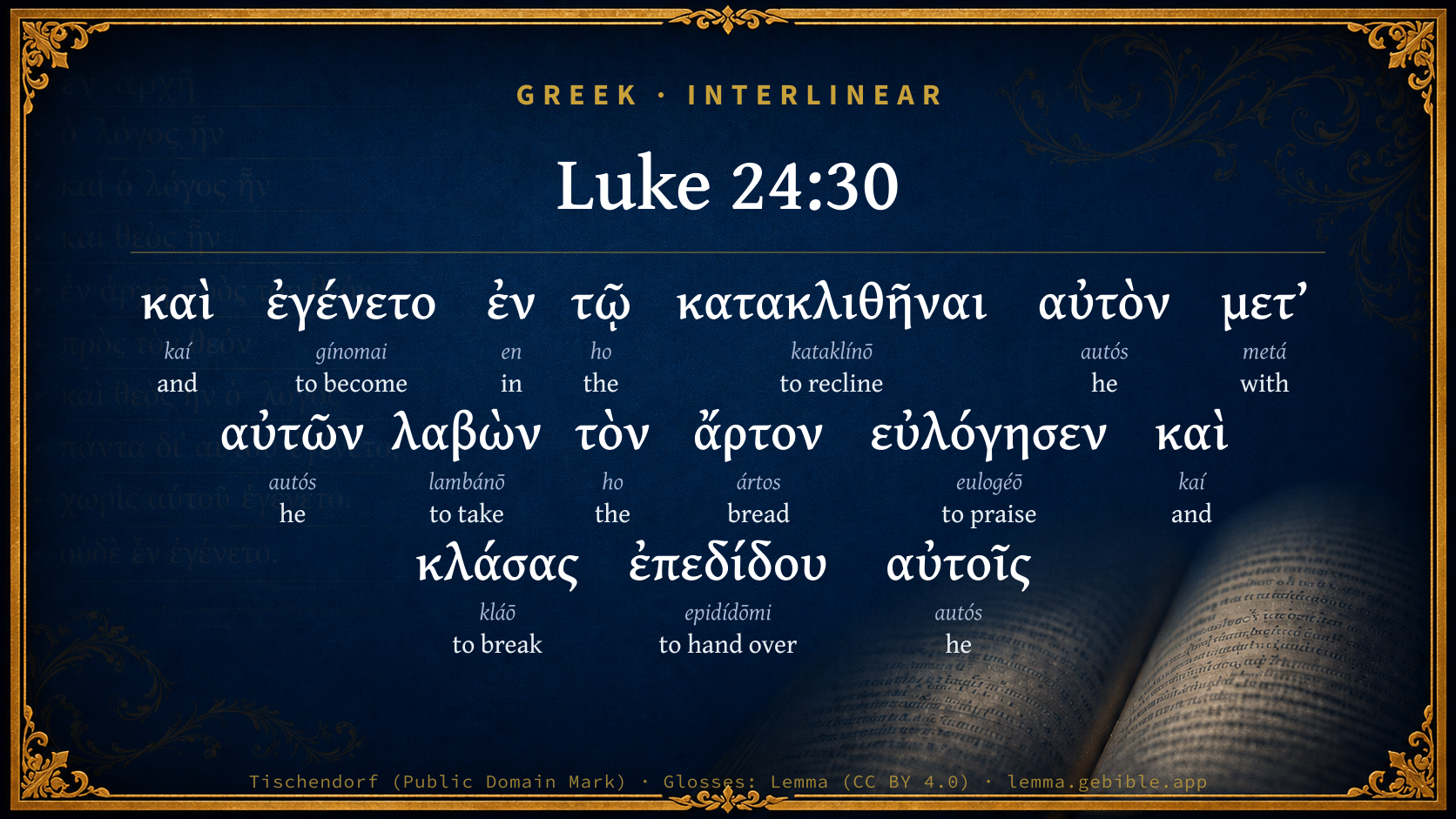
Greek (Tischendorf 8th ed.) Luke 24:30 appears in the Greek New Testament. The text above is from the Tischendorf 8th edition. Each word links to its Strong’s number and a concise gloss. Click any word for its full Thayer’s Greek Lexicon entry.
Download image
Cite this verse

Luke 24:30 (World English Bible). Public Domain. Lemma interlinear Bible study tool, https://lemma.gebible.app/v/luke/24/30.

Show BibTeX & RIS
BibTeX
RIS
English Translation
It happened, that when he had sat down at the table with them, he took the bread and gave thanks. Breaking it, he gave to them.
World English Bible · Public Domain
Download a study sheet

One document with this verse’s original text, its word-by-word gloss line, the meaning frame, cross-references with their text, attributed commentary, and full source and license credits — printable, and it pastes into notes with its structure intact.

This verse Autodidact and up

Study sheet (.html) Plain text (.txt)

A passage Seminary Student

Up to 50 verses in one chapter. A passage sheet keeps up to 6 commentary sources and 12 cross-references per verse, in the order this page ranks them, and says so on the sheet whenever that leaves anything out. Ask for a single verse and you get the Autodidact verse sheet above.

Everything on this page stays free to read, with no account — the sheet is a download of what is already on screen, not access to it.

Want to remove ads? Support Godless Engineer
Compare translations 3

The same verse in 3 English versions, stacked beneath the original-language interlinear above. Click any original word for its lexicon entry.

Each is an independent rendering of the whole verse — the interlinear is not word-aligned to these translations.

Highlighted words mark where these versions differ — a whole-verse word diff, not a word-by-word alignment.

  • World English Bible Public Domain
    It happened, that when he had sat down at the table with them, he took the bread and gave thanks. Breaking it, he gave to them.
  • King James Version Public Domain
    And it came to pass, as he sat at meat with them, he took bread, and blessed it, and brake, and gave to them.
  • unfoldingWord Literal Text CC BY-SA 4.0
    And it happened that, when he had reclined to eat with them, taking the bread, he blessed, and having broken, he was giving to them.

unfoldingWord Literal Text — © unfoldingWord, licensed CC BY-SA 4.0. Word-aligned USFM3 via Door43 (git.door43.org/unfoldingWord/en_ult).

Versions to compare (up to 4)

3 of 4 selected

Show all 19 translations

Every available English version of this verse, each an independent rendering of the whole verse.

  • World English Bible Public Domain
    It happened, that when he had sat down at the table with them, he took the bread and gave thanks. Breaking it, he gave to them.
  • Berean Standard Bible Public Domain
    While He was reclining at the table with them, He took bread, spoke a blessing and broke it, and gave it to them.
  • Majority Standard Bible Public Domain
    While He was reclining at the table with them, He took bread, spoke a blessing and broke it, and gave it to them.
  • King James Version Public Domain
    And it came to pass, as he sat at meat with them, he took bread, and blessed it, and brake, and gave to them.
  • American Standard Version (1901) Public Domain
    And it came to pass, when he had sat down with them to meat, he took the bread and blessed; and breaking `it' he gave to them.
  • Revised Version (1885) Public Domain
    And it came to pass, when he had sat down with them to meat, he took the bread, and blessed it, and brake, and gave to them.
  • Geneva Bible (1599) Public Domain
    And it came to passe, as hee sate at table with them, he tooke the bread, and blessed, and brake it, and gaue it to them.
  • Douay-Rheims (1899) Public Domain
    And it came to pass, whilst he was at table with them, he took bread, and blessed, and brake, and gave to them.
  • Young's Literal Translation Public Domain
    And it came to pass, in his reclining (at meat) with them, having taken the bread, he blessed, and having broken, he was giving to them,
  • Literal Standard Version CC BY-SA 4.0
    And it came to pass, in His reclining with them, having taken the bread, He blessed, and having broken, He was giving to them,
  • Unlocked Literal Bible CC BY-SA 4.0
    It happened that, when he had sat down with them to eat, he took the bread, blessed it, and breaking it, he gave it to them.
  • unfoldingWord Literal Text CC BY-SA 4.0
    And it happened that, when he had reclined to eat with them, taking the bread, he blessed, and having broken, he was giving to them.
  • Darby Bible Public Domain
    And it came to pass as he was at table with them, having taken the bread, he blessed, and having broken it, gave it to them.
  • World Messianic Bible Public Domain
    When he had sat down at the table with them, he took the bread and gave thanks. Breaking it, he gave it to them.
  • Webster's Bible Public Domain
    And it came to pass, as he sat at table with them, he took bread, and blessed it, and broke, and gave to them.
  • Free Bible Version CC BY-SA 4.0
    When he sat down to eat with them, he took the bread and gave thanks, broke it, and gave it to them.
  • Bible in Basic English Public Domain
    And when he was seated with them at table, he took the bread, and said words of blessing and, making division of it, he gave it to them.
  • Text-Critical English NT CC BY 4.0
    As he was reclining at the table with them, he took the bread, blessed and broke it, and gave it to them.
  • Tyndale New Testament (1534) Public Domain
    And it came to passe as he sate at meate with them he toke breed blessed it brake and gave to them.

Literal Standard Version (2020), Covenant Press — licensed CC BY-SA 4.0. Text via the HelloAO Bible API (eBible.org). Unlocked Literal Bible (unfoldingWord) — licensed CC BY-SA 4.0. Text via the HelloAO Bible API (eBible.org). unfoldingWord Literal Text — © unfoldingWord, licensed CC BY-SA 4.0. Word-aligned USFM3 via Door43 (git.door43.org/unfoldingWord/en_ult). Free Bible Version, Dr. Jonathan Gallagher — licensed CC BY-SA 4.0. Text via the HelloAO Bible API (eBible.org).

Word by word

More ways to search: Search by grammar → Find every occurrence → Compare this word →

Practice this passage: Drill this verse → Learn its vocabulary →

κατακλιθῆναι
kataklínō
G2625
“to recline”
Verb, Aorist, Passive, Infinitive
Part of Speech
Verb
Tense
Aorist
Voice
Passive
Mood
Infinitive
Full Thayer's Definition

Origin: from G2596 and G2827

TDNT: None

1. in the NT in reference to eating, to make to recline 2. to recline (at a table)
  1. καὶ kaí G2532 “and” Conjunction
  2. ἐγένετο gínomai G1096 “to become” Verb, Aorist, Middle deponent, Indicative, 3rd person, Singular
  3. ἐν en G1722 “in” Preposition
  4. τῷ ho G3588 “the” Article, Dative, Singular, Neuter
  5. αὐτὸν autós G846 “he” Personal pronoun, Accusative, Singular, Masculine
  6. μετ’ metá G3326 “with” Preposition
  7. αὐτῶν autós G846 “he” Personal pronoun, Genitive, Plural, Masculine
  8. λαβὼν lambánō G2983 “to take” Verb, Aorist, Active, Participle, Nominative, Singular, Masculine
  9. τὸν ho G3588 “the” Article, Accusative, Singular, Masculine
  10. ἄρτον ártos G740 “bread” Noun, Accusative, Singular, Masculine
  11. εὐλόγησεν eulogéō G2127 “to praise” Verb, Aorist, Active, Indicative, 3rd person, Singular
  12. καὶ kaí G2532 “and” Conjunction
  13. κλάσας kláō G2806 “to break” Verb, Aorist, Active, Participle, Nominative, Singular, Masculine
  14. ἐπεδίδου epidídōmi G1929 “to hand over” Verb, Imperfect, Active, Indicative, 3rd person, Singular
  15. αὐτοῖς autós G846 “he” Personal pronoun, Dative, Plural, Masculine

About this verse

These counts appear in no published source. They are computed here, from the morphology-tagged text and Lemma’s own curated glosses. What Lemma adds →

16
words
12
distinct lemmas
Gospels
section

Notable vocabulary

The rarest word here is κατακλιθῆναι to recline G2625 — appearing just 5 times in the whole Greek New Testament.

Shared distinctive vocabulary

κατακλιθῆναι to recline G2625 occurs in 5 verses of the Greek New Testament. Also found in:

Repetition

Words recur within this verse:

Cross-references

11

Topical passages linked to Luke 24:30 in the Treasury of Scripture Knowledge — connected by theme and wording, ordered by reader-vote popularity; previews shown in the World English Bible.

  • Matthew 14:19 He commanded the multitudes to sit down on the grass; and he took the five loaves and the two fish, and looking up to heaven, he blessed, broke and gave the loaves to the disciples, and the disciples gave to the multitudes.
  • Luke 24:35 They related the things that happened along the way, and how he was recognized by them in the breaking of the bread.
  • Matthew 15:36 and he took the seven loaves and the fish. He gave thanks and broke them, and gave to the disciples, and the disciples to the multitudes.
  • Luke 9:16 He took the five loaves and the two fish, and looking up to the sky, he blessed them, and broke them, and gave them to the disciples to set before the multitude.
  • Mark 8:6 He commanded the multitude to sit down on the ground, and he took the seven loaves. Having given thanks, he broke them, and gave them to his disciples to serve, and they served the multitude.
  • Mark 14:22 As they were eating, Jesus took bread, and when he had blessed, he broke it, and gave to them, and said, "Take, eat. This is my body."
  • Luke 22:19 He took bread, and when he had given thanks, he broke it, and gave to them, saying, "This is my body which is given for you. Do this in memory of me."
  • John 6:11 Jesus took the loaves; and having given thanks, he distributed to the disciples, and the disciples to those who were sitting down; likewise also of the fish as much as they desired.
  • Acts 27:35 When he had said this, and had taken bread, he gave thanks to God in the presence of all, and he broke it, and began to eat.
  • Matthew 26:26 As they were eating, Jesus took bread, gave thanks for it, and broke it. He gave to the disciples, and said, "Take, eat; this is my body."
  • Mark 6:41 He took the five loaves and the two fish, and looking up to heaven, he blessed and broke the loaves, and he gave to his disciples to set before them, and he divided the two fish among them all.

Cross-references courtesy of OpenBible.info (CC BY 4.0).

Commentary

Notes on Luke 24:30 from classic Christian and Jewish commentators (each source and its license shown beneath its notes). The classic Christian expositions comment on the surrounding passage and are grouped to its opening verse, so a note may address several verses; the Jewish commentaries on the Tanakh (Rashi and others) are per-verse, so they appear only where the commentator wrote on this verse.

Lemma curates 59 commentaries, every one of them public domain or Creative Commons licensed, each selected and text-cleaned for this edition rather than reprinted as found. About our sources →

The Pulpit Commentary

And it came to pass, as he sat at meat with them, he took bread, and blessed it, and brake, and gave to them. There was a deep significance in the concluding act of this memorable appearance of the risen Lord. This taking the bread, and blessing it, and breaking it, and then giving it to them, was no ordinary act of courtesy, or welcome, or friendship, which, from a master or teacher might be shown to his disciples. It resembles too closely the great sacramental act in the upper room, when Jesus was alone with his apostles, for us to mistake its solemn sacramental character. The great teachers of the Church in different ages have generally so understood it. So Chrysostom in the Eastern, and Augustine in the Western Church; so Theophylact, and later Beza the Reformer all affirm that this meal was the sacrament. It taught men generally, even more plainly than did the first sacred institution teach the twelve, that in this solemn breaking of bread the Church would recognize their Master"s presence. So generally, in fact, has this Emmaus "breaking of bread" been recognized by the Catholic Church as the sacrament, that later Romanist divines have even pressed it as a scriptural demonstration for the abuse which administered the elements under one form (compare, for instance, the "Refutation of the Confession of Angsberg," quoted by Stier, in his comment on this passage of Luke, "Words of the Lord Jesus"). How unnecessary and forced such a construction is, Bishop Wordsworth points out in his note on Luk_24:30, "It may be remembered that bread (artov) was to the Jews a general name for food, including drink as well as meat Thus bread became spiritually an expressive term for all the blessings received from communion in Christ"s body and blood, and the klasiv artou , or "breaking of bread," was suggestive of the source from which these blessings flow, (viz.) Christ"s body (klwmenon) broken; (1Co_11:24) hence klasiv artou in Act_2:42 is a general term for the Holy Eucharist."

The Pulpit Commentary (1880–1919), ed. H.D.M. Spence-Jones & Joseph S. Exell — public domain. Text from a community e-Sword module.

MacLaren's Expositions of Holy Scripture

Alexander MacLaren

Luke

THE RISEN LORD’S SELF-REVELATION TO WAVERING DISCIPLES

THE MEAL AT EMMAUS

Luk 24:30 - Luk 24:31.

Perhaps the most striking characteristic of the Gospel accounts of our Lord’s intercourse with His disciples, in the interval between the Resurrection and His Ascension, is the singular union of mystery and simplicity which they present. There is a certain air of remoteness and depth over all the intercourse, as if it meant more, and was intended to teach more, than appears on the surface, as I believe it was intended. And yet, at the same time, there is, along with that, in most singular combination, the very utmost simplicity, amounting almost sometimes to baseness and rudeness, as for instance, here. Some poor house of entertainment, possibly, at any rate, some poor man’s house, in a little country village; the company these two talkative, and yet despondent disciples; the fare and the means of manifestation a bit of barley-bread; and out of these materials are woven lessons that will live in the Church in all ages. ‘He took bread and blessed it, and brake.’ These are the words, almost verbatim, of the institution of the Lord’s Supper. They are the words, almost verbatim, with which more than one of the Evangelists describes the miraculous feeding of the four and the five thousand; and it was the old familiar act, expressed by the Evangelist by the old familiar words, that opened the disciples’ eyes, and they knew Him. How simply the process of discovery is told! It was quite natural that a casual stranger upon the road should not say who He was; it was quite as natural that when He entered into the closer relationship of sitting with the disciples at the table, and sharing their hospitality, they should expect, as indeed they did expect, that as they had been frank with Him, He would be frank with them, and they would find out now who this unknown teacher and apparent Rabbi was. And so, as it would seem, in silence, or at least with nothing of any moment, the meal went on, but all at once, at some point in the meal, the guest assumes the position of the master of the house, takes upon Himself the function and office of host, interrupts the progress of the meal by the solemn prayer of blessing; and whilst the singularity of the action drew their attention, perhaps some little peculiarity in His way of doing it, or something else, opened the door for a whole stream of associations and half-dormant remembrances to rush in, and they remembered what they had heard of the last supper,-for these two were not at it,-and they remembered what they had seen,-miraculous feedings; and they remembered no doubt how He had always done with them in the happy old days when He communed with them. At all events, by the natural action of breaking the bread and sharing it amongst them, the subjective hindrances which had stood in the way of their recognising Him dropped away like scales from their eyes, and they beheld Him, and then, without a word, He vanished out of their sight, and the wearied, hungry men girded up their loins and rushed back to Jerusalem to tell the brethren the story.

Now, I think that, taking the event as it stands before us, and especially marking the obviously intended parallelism in expression, and I hare no doubt in action, between former miracles, the institution of the Lord’s Supper, and this neither sacramental nor religious meal in the little village-I think we may get some lessons worth pondering.

I confine myself quite simply to the three points of the narrative:-

The distribution of the bread;

The discovery;

And the disappearance.

‘He took bread and blessed it, and brake and gave to them, and their eyes were opened, and they knew Him; and He vanished out of their sight.’

I. Look, then, for a moment or two at the thoughts which I think are intended to be conveyed to us by that first point-the action of breaking and distributing the bread.

I have said, incidentally, in my previous remarks, that there is a singular air of remoteness, removedness, mystery, reticence, about our Lord’s relations to His disciples in the interval of these forty days; and I suppose that that change from the frankness of His former relations and the close contact in which the Apostles and disciples had been brought during all the previous three years-I suppose that that was intended to be the beginning of the preparation of weaning and preparing them to do without Him altogether. And along with that removedness, there is also, as I take it, and as I have already said, a great depth of significance about the whole of these events which lead people to deal with them as being symbols, types, exhibitions on a material platform of great spiritual truths; and although the habit of finding symbolical meaning in historical events, especially as applied to the Gospels, has been full of all manner of mischief, yet that there is that element is not to be denied; and whilst we have to keep it down and be very careful in our application of it, lest in finding ingenious fanciful meanings, we lose the plain prose, which is always the best and the most important, yet that element is there, and we have to take heed that we do not push the denial of it to excess, as the recognition of it has often been pushed. And so, from these two points of view. I think the thing should be looked at. The plain prose, then, of the matter is this-that at a given point in this humble road-side meal, our Lord having been guest, having been constrained to enter in by the loving importunity of these people, becomes the host, takes upon Himself the position of the head of the household, and in that position so acts as to bring to the disciples’ remembrance former deeds of miracles, and the institution of the ordinance of the Lord’s Supper, and that was the means of their recognition.

Well, then, if so, I think that we may say fairly that in this breaking and distribution of the bread, there is first of all this lesson-the old familiar blessed intercourse between Him and them had not been put an end to then by all that had passed during these three mysterious days; but they were as they used to be in regard to the closeness of their relationship and the reality of their intercourse. No doubt, in the former years, Christ had been in the habit of always acting as the Head of the little family. When they gathered for their frugal meals, He was the master, they the disciples; He the elder brother, and they gathered about Him. And He assumes the old position; and if we will try for a moment to throw ourselves into their position and to see with their eyes, we shall understand the pathetic beauty-I was going to say the poetic beauty, but perhaps you would not like that word to be applied to the history of our Redeemer-the pathetic beauty of the deed. They had been thinking of themselves as forsaken of Him; the grave had broken off all their sweet and blessed intercourse; they were alone now. ‘We trusted that it had been He which should have redeemed Israel.’ He is gone! Even the poor consolation of looking upon the place where He lies is denied us; for whatever may be doubtful this is certain, that the grave is open and the body is not there. And so they felt lost and scattered; and there comes to them this gleam of consolation-I take my place amongst you just as I used to do; ‘I am He that liveth and was dead, and behold, I am alive for evermore.’ We used to sit together at the table; let that be repeated here once more that you may learn, and all the world through you may learn, that the accident of death, which affects only the externals of society, has no power over the reality of the bond that knits even two human hearts with love together, still less a power over the reality of the bond that binds us to our Master. Death vanishes as a nothing in their intercourse; they stand where they were; the fellowship is unbroken; the society is the same; all that there used to be of love and friendship, of peaceful concord, of true association; it abides for ever!

Thus, heavy with meaning and full of immortal hope may be the simplest act wrought with the simplest materials, when the dead Christ who lives takes His old place in the midst of His disciples, and once again as He used to do, parts the bread between them. And, dear brethren, though it has nothing to do with my present purpose, may this thought not add a wider application to our text; may it not be a comfort and hope to many of us to remember that the grim shadow that stretches athwart our path, and gathers into its blackness so many of our sunny sparkling joys, and takes the light and the movement and the colour out of them, is only a shadow, and that the substance lives in the shadow as it used to live in the sunshine, and passes through the shadow and comes out on the other side, blazing in more than its former lustre, and rich with more than its former preciousness? For all whom we have loved and lost, the death which was a nothing in regard to Christ’s intercourse with His disciples, is a nothing, too, in regard to our real intercourse and sense of society and unity with them. They live in Him, and they are more worthy to be loved than ever they were before. He who has conquered Death for Himself has conquered it for us all; and every true and pure human affection rooted in Him is as immortal as the love that binds souls to Himself. Therefore, let us remember that they sit at His table, and that we shall sit there some day too.

II. Well, then, still further, another idea that I think belongs to this first part of our thoughts as to the profound significance of our Lord’s here assuming the office and function of host, is this-we are thereby taught the same lesson that we are taught by His institution of the Communion, and taught by the whole details of His relation to His disciples upon earth-that the true idea of the relation which results from Him and His Presence is that of the Family.

He takes His place at the head of the table; He is the Lord of the household, though it be but a household of two men, and they belong to the family and the society which He founds. Now it seems to me that next to the great lesson which the Lord’s Supper teaches us in reference to our individual dependence upon Him, His death as being all our hope and all our life, this is the most important lesson that it teaches-the simplicity of the rite, the fact that it was based upon the Jewish rite, which was a purely domestic one; the fact that our Lord steps into the place of the head of the household by His very presiding at the Passover service amongst His disciples; the fact that He parts the common materials of the common meal and uses them and it as the symbols of His death, and of our life thereby-all that teaches us the same thing which the whole strain of His teaching and the whole strain of the New Testament sets forth-that the Church of Christ is then understood when we think of it as being one family in Him, bound together by the bands of a close brotherhood, relying upon Him as the fountain of its life; having fellowship with one Father through that elder Brother; pledged, therefore, to all fraternal kindness and frankness of communion and of mutual help, and gladdened by the hope of journeying onwards to Him. We cannot, of course, apply the analogy round and round; but of all the forms of human association which Christ has honoured and glorified by laying His hand upon them, and showing that they are symbols of the society that He founds, and of which He is the centre, it is not the kingdom, but the family that is the nearest approach to the Church of the living God.

And you and I, Christian men and women, if we come and sit at that table of our Lord, let us remember that we thereby declare, not only for ourselves that we enter into individual relations of reliance upon Him, and draw our life from Him, but that we pledge ourselves to the family bond, to be true to the brotherhood, that we declare ourselves the sons of God and the brethren of all that are partakers of the like precious faith. The thing has become a word, a name amongst us. I wonder if any of you remember the bitter saying of one of our modern teachers; he says that he found out somehow or other how much less ‘brethren’ in the Church meant than ‘brothers’ out of it. Let us learn the lesson and take the rebuke, and remember that if the Lord’s Supper means anything, it means that we belong to the household of faith, and are members of the great family in heaven and in earth.

III. Well, then, still further connected with this first idea of the lesson and significance of the distribution of the bread, I think we may take another consideration, which is, in fact, only another application of the one I have already been suggesting-Where Christ is invited as a guest, He becomes the host.

They constrained Him to abide with them; they made Him welcome to their rude hospitality. It was little-a hut where poor men lay, a bit of barley-bread. But it was theirs, and they gave it Him; and He entered in and supped with them, and then, in the middle of it, the relations were inverted, and they that had been showing the hospitality became the guests, and the table that had been theirs became His. ‘And He took the bread and gave it to them.’ You have the same inversion of relation in that first miracle that He wrought at Cana of Galilee, where invited as a guest, at a point in the entertainment He provides the supplies for the further conduct of it. You remember the words which contain the spiritual application of the same thought-’Behold, I stand at the door and knock. If any man open the door, I will enter in and sup with him and he with Me.’ To put away the metaphor, it amounts to this-our Master never comes empty-handed. Where He is invited, He comes to bestow; where He is welcomed, He comes with His gifts; where we say, ‘Do Thou take what I offer,’ He says, ‘Do thou take Myself.’ All His requirements are veiled promises; all His commandments are assurances of His gifts. He bestows that He may receive; He seems to take that He may enrich. They that give to Christ receive back again more than all that they gave, according to the profound words, ‘There is no man that hath left father or mother, or wife or children, or houses or lands, for My sake and the Gospel’s, but shall receive a hundredfold more in this life, and in the world to come life everlasting.’ The Christ that is asked to come in order to receive, abides in order to bestow.

And then there is a second point, going on with the flow of this little narrative before us, about which a word or two may be said. The consequence of this assumption of the position of master, host, bestower is-’Their eyes were opened, and they knew Him.’ The discovery of His person follows on the distribution of His gifts.

Now, there is one point to be remarked before I deal with the lessons which I think are capable of being gathered from this part of our subject, and that is, that this narrative gives no sort of support, as it seems to me, to the ordinary notion that, subsequent to the Resurrection, there had passed upon our Lord’s corporeal frame any change whatsoever as the commencement of the glorification of His earthly body. If you observe, the course of the narrative takes pains to point out to us distinctly, that whatever may have been the reason why they did not recognise Him at first, that reason was entirely in them, and not at all in Him. It is not that He was changed; it is that ‘their eyes were holden’; and when they did recognise Him, it is not that any change whatsoever is recorded as having passed upon Him, but ‘their eyes were opened, and they knew Him.’ And the same thing may be said, as I believe, about the whole of the appearances, mysterious as they were, of our Lord, in the interval between the Resurrection and the Ascension. I do not think, for my part, {although I would by no means speak with confidence about a matter that is so fragmentarily dealt with in Scripture}, but I do not think, for my part, that the narrative gives any support whatsoever to the idea of any change analogous to that which takes place upon us at our resurrection, having begun to take place upon our Lord so long as He remained upon earth. The Ascension and the Resurrection of Jesus Christ, in His case, are parts of one process. He was raised with the body with which He was crucified; He ascended up on high, and there the glorification, as far as Scripture teaches, is, I conceive, commenced. At all events, there is nothing in our narrative to support the idea of an incipient transformation having begun with the Resurrection.

But, passing by that, which has nothing to do with my main present purpose, I may notice just one or two considerations in reference to this discovery of our Lord. And the first and main one that I would suggest is this-Where Christ is loved and desired, the veriest trifles of common life may be the means of His discovery. We know not what was the special point which brought dormant remembrance to life again, and quickened the associations of the two, so that they knew Jesus; even as we do not know what was the hindrance, whether supernatural or whether by reason of their own fault, which prevented the earlier recognition; but this at least we see, that in all probability something in the manner of taking the bread and breaking it, the well-remembered action of the Master, brought back to mind the whole of the former relation, and a rush of associations and memories pulled away the veil and scaled off the mists from their eyes. And so, dear brethren, if we have loving, and waiting, and Christ-desiring spirits, everything in this world-the common meal, the events of every day, the most veritable trifles of our earthly relationships-they will all have hooks and barbs, as it were, which will draw after them thoughts of Him. There is nothing so small but that to it there may be attached some filament which will bring after it the whole majesty and grace of Christ and His love. Whether ye eat or drink, or whatsoever ye do, do all in remembrance of Him, and do all to His glory. Oh, if we had in our inmost spirits a closer fellowship with Him, and a truer relation to Him, we should be more quick of apprehension. And, as in regard to those that we love, when they are away from us, the fold of a garment, some bit of cloth lying about the room, something upon the table, some common incident of the day that used to be done in company with them, may bring a flood of memories that sometimes is too strong for a weak heart, so with the Lord, if we loved Him-everything would be {as it is to those whose ears are purged} vocal with His name, and everything would be flushed with the light that falls from His face, and everything would suffice to remind us of our love, our hope, our joy. Especially let us remember that He has entrusted-with strange humility and with wonderful knowledge of us, and with the truest sympathy and tenderness for our weakness-He has entrusted a large portion of our most spiritual remembrance and recognition of Him to material things. Did it ever strike you what a depth of what I may call Christ’s condescension there lay in this? ‘Take this bread and this wine, and if you will not remember Me because I loved you so well, if you will not remember Me because I died for you, if earthly things and material realities will drive Me out of your thoughts, at least remember Me because and when earthly things and material realities become My agents and My memorials. If you forget the Cross, perhaps a bit of bread will remind you of Me; and I am not too proud to spurn the remembrance that roots itself even in the material things of earth and by such means as that.’ ‘He took the bread and brake it.’ They had listened to all His words upon the road, and it never occurred to them who He was; they had walked beside Him all day long, and even their burning hearts did not make them suspect that it was the Master. It must needs be so-they whom wisdom and truth and His spiritual Presence cannot teach to recognise, may be led to recognise Him by the movement of His hands with the barley loaf, and some intonation of His voice in blessing it. ‘This do in remembrance of Me’ is the word of that deep pity that knows our frame and remembers that we are dust, and is a word of the most marvellous condescension that ever was uttered in human ears.

IV. And then there is the final consideration here upon which I touch but for a moment.

The distribution and the discovery are followed by the disappearance of the Lord, ‘They knew Him, and’-and what? And He let their hearts run over in thankful words? No. ‘They knew Him,’ and so they all went back to Jerusalem happy together? No. ‘They knew Him, and-He vanished out of their sight.’ Yes, for two reasons. First, because when Christ’s Presence is recognised sense may be put aside. ‘It is expedient for you that I go away.’ You and I, dear brethren, need no visible manifestation; we have lost nothing though we have lost the bodily Presence of our Master. It is more than made up to us, as He Himself assures us, and as we shall see ourselves if we think for a moment, by the clearer knowledge of His spiritual verity and stature, by the deeper experience of the profounder aspects of His mission and message, by the indwelling Spirit, and by the knowledge of Him working evermore for us all. His going is a step in advance. ‘If I go not away the Comforter will not come to you; but if I depart, I will send Him unto you.’ The earthly manifestation was only the basis and the platform for that which is purer and deeper in kind, and more precious and powerful; and when the platform has been laid, then there is no need for the continuance thereof. And so, when He was manifested to the heart He disappeared from the eyes; and we, who have not beheld Him, stand upon no lower level than they who did, for the voice of our experience is, ‘Whom having not seen we love; in whom, though now we see Him not, yet believing, we rejoice with joy that is unspeakable and full of glory.’

And for another reason.-When Christ is discerned there is work to be done. ‘Their eyes were opened, and they knew Him, and He vanished out of their sight; and . . . they rose up that same hour; and returned to Jerusalem’ and said, He was known to us in breaking of bread, and He talked with us by the way. Yes, the vision of Christ binds us to work, and while the more close and intimate and silent communion has its rights and its place in life, it is never to be made a substitute for the active exercise of our Christian vocation to bear witness of Him, and to tell His name to those who need the consolation of His Resurrection, and the joyful news that He lives to bless. So then that meal by the wayside may stand as type and symbol of the way in which we, like the two pedestrians on the road and at the table, may have heart intercourse with Jesus, and may be impelled thereby to labour for Him.

There was another time, after the Resurrection, when in like manner we read that our Lord took bread, and blessed and brake and gave it to them; and that was in that mysterious meal upon the shores of the Galilean Lake, which has always been recognised as having a symbolical meaning-though the exposition and detail have often been exaggerated and made absurd. In the one case it was two travellers who met their Lord; it was in an inn that the recognition took place; it was a brief moment of vision, followed by disappearance, and the disappearance led on to work; but in the other story it was when the morning broke that the Lord was manifest; it was after the night of toil that His form appeared; His words to them were, ‘Bring of the fruits of your labours and lay them upon the beach at My feet.’ And in the light of the eternal morning, after the weary night of toil, they who on earth in their journey and pilgrimage have had Him walking with them as third in their sweet society, and sitting with them in the tents and changeful residences of earth, may expect to find Him waiting for them upon the shore; and, as one says, ‘It is the Lord!’ and another dashes through the water to reach Christ, the invitation to all of them will be, ‘Come and sit with Me at My table in My kingdom; I provide the meal, and you add to it by that which you have caught.’ ‘They rest from their labours and their works do follow them.’ And so ‘they go no more out, but are ever with the Lord.’

Alexander MacLaren, Expositions of Holy Scripture (1904–1910) — public domain. Text from a community e-Sword module.

Tyndale Open Study Notes

Tyndale Open Resources

24:30 As they sat down to eat: The meal is a symbol of the messianic banquet and of the salvation that God is accomplishing (Isa 25:6-8; Luke 14:1-24). • Then he broke it and gave it to them: This action recalls the feeding of the 5,000 (9:16) and the institution of the Lord’s Supper (22:19).

Tyndale Open Study Notes — © Tyndale Open Resources, licensed CC BY-SA 4.0. Text via the HelloAO Bible API.

Bengel's Gnomon

Johann Albrecht Bengel

Luk 24:30. Λαβὼν, having taken) according to His wonted mode.

Bengel's Gnomon of the New Testament — English translation (T&T Clark, Edinburgh, 1860) — public domain. Text from a community e-Sword module.

Meyer's Critical & Exegetical Commentary

Heinrich August Wilhelm Meyer

Luk_24:30. Jesus proceeds not as a guest, but as the master of the house, according to His accustomed manner in the circle of His disciples; thus, it is true, that does not appear by which they recognise Him, but probably it is the external situation, corresponding to the opening of their eyes that now follows, which enhances the certainty and the impression of the recognition. Comp. Luk_24:35.

εὐλόγησε] Tres, qui simul comedunt, tenentur ad gratias indicendum, Berac. f. 45, 1. It is the master of the house giving thanks before the meal. It is quite arbitrary for most of the church Fathers (Augustine, Chrysostom, Theophylact, and many others) and Catholics (so also Sepp, not Schegg, but Bisping) to decide that Jesus celebrated the Lords Supper,[275] from which even the ἐν τῷ κατακλιθ. ought to have guarded them, since this in fact points to the time before the proper beginning of the meal (as they reclined). Comp. on Luk_3:21.

[275] The Catholics make use of vv. 30 and 35 as a defence of their Eucharistia, sub una specie. See the Confut. Confess. Aug. II. 1. Even Melanchthon does not refuse to explain the passage before us of the Lords Supper, disapproving, nevertheless, of the conclusion drawn from it: unam partem tantum datam esse; quia partis appellatione reliquum significatur communi consuetudine sermonis, Apol. x. 7, p. 234.

Meyer — Critical and Exegetical Commentary on the New Testament — English translation by Peter Christie, edited by Frederick Crombie (T&T Clark, 1880) — public domain. Text from a community e-Sword module.

Expositor's Greek Testament

ed. W. Robertson Nicoll

Luk 24:30 . λαβὼν τ . α ., etc.: Jesus possibly by request assumes the position of host, prepared for by the previous exercise of the function of Master. By this time a suspicion of who He was had dawned upon the two disciples. While He spoke old impressions of His teaching were revived (Pricaeus).

The Expositor's Greek Testament, edited by W. Robertson Nicoll (1897–1910) — public domain. Text from a community e-Sword module.

Jamieson, Fausset & Brown

Robert Jamieson, A. R. Fausset & David Brown

he took . . . and blessed . . . and their eyes were opened--The stranger first startles them by taking the place of master at their own table, but on proceeding to that act which reproduced the whole scene of the last Supper, a rush of associations and recollections disclosed their guest, and He stood confessed before their astonished gaze--THEIR RISEN LORD! They were going to gaze on Him, perhaps embrace Him, but that moment He is gone! It was enough.

Jamieson, Fausset & Brown — Commentary Critical and Explanatory on the Whole Bible (1871) — public domain (CC PDM 1.0). Text via the HelloAO Bible API.

Adam Clarke's Commentary

Verse 30. He took bread] This was the office of the master and father of a family, and this was our Lord's usual custom among his disciples. Those whom Christ lodges with he feeds, and feeds too with bread that himself hath blessed, and this feeding not only strengthens, but also enlightens the soul.

Adam Clarke's Commentary on the Bible (1810–1826) — public domain. Text from a community e-Sword/MySword module.

Ellicott's Commentary for English Readers

(30) He took bread, and blessed it.—Had the two travellers been of the number of the Twelve, we might have thought of the words and acts as reminding them of their last Supper with their Lord. As it was, we must think of those words and acts as meant to teach them, and, through them, others, the same lesson that had then been taught to the Twelve, that it would be in the “breaking of bread” that they would hereafter come to recognise their Master’s presence. And they, too, we must remember, whether they were of the Seventy, or among the wider company of disciples, must have had memories, it may be of multitudes fed with the scanty provision of a few barley loaves, it may be of quiet evenings without a multitude, when they had looked on the same act, and heard the same words of blessing. This meal, too, became so full of spiritual significance that we may well anticipate the technical language of theology and say that it was to them “sacramental.”

A Bible Commentary for English Readers, edited by Charles John Ellicott (1878–1897) — public domain. Text from a community e-Sword module.

The Cambridge Bible for Schools and Colleges

gen. ed. J. J. S. Perowne

30. he took bread, and blessed it, and brake, and gave to them] Rather, the bread. Comp. Luk_22:19. Our Lord seems, by a kind of natural authority, to have assumed the position of host; which shews that they were at an inn.

The Cambridge Bible for Schools and Colleges (gen. ed. J. J. S. Perowne; Cambridge University Press, 1878–1918) — public domain. Text from a community e-Sword module.

John Gill's Exposition

And they said one to another,.... After Christ was gone, being surprised at what happened, that they should not know him all that while; and that as soon as they did, he should disappear, or withdraw himself in this manner:

did not our hearts burn within us while he talked with us by the way, and while he opened to us the Scriptures? concerning himself, his sufferings, death, and resurrection, which are in Moses, the Prophets, and the Psalms. The Scriptures are as a sealed book to men, learned and unlearned; and none so fit to open them as the lion of the tribe of Judah: he did open and explain them to these his disciples, as well as conversed with them about other things, as they travelled together; and his words came with such evidence, power, and sweetness, that they were ravished with them; their minds were irradiated with beams and rays of divine light; their hearts were warmed and glowed within them; they became fervent in spirit, and their affections were raised and fired; they found the word to be as burning fire within them; and they now knew somewhat what it was to be baptized with fire, which is Christ's peculiar office to administer; see Psa 39:3 they seem as it were not only to reflect on these things with wonder and pleasure, but also to charge themselves with want of thought, with inattention and stupidity; since they might have concluded from the uncommon evidence, force, and energy with which his words came to them, who he was, seeing no man could speak as he did, and with such effect as his words had.

John Gill's Exposition of the Whole Bible (1746–1763) — public domain (CC PDM 1.0). Text via the HelloAO Bible API.

Trapp's Complete Commentary

John Trapp

30 And it came to pass, as he sat at meat with them, he took bread, and blessed it, and brake, and gave to them.

Ver. 30. And blessed it] It is thought they knew him by his ordinary form of giving thanks before meat.

John Trapp, A Commentary or Exposition upon All the Books of the Old and New Testament (1647–1656) — public domain. Text from a community e-Sword module.

Albert Barnes' Notes on the Bible

Sat at meat - Reclined at the table, or while he was at supper.

He took bread and blessed it ... - This was the office of the master of a feast, and perhaps this first attracted particularly their attention. Though he was in “their” house, yet he acted as “master” of the feast, as he used to do with them before his death. Perhaps, also, as he “gave” them the bread, they observed the “prints” in his hands, and they knew that it was Jesus. This was not a “sacramental,” but a common supper; yet our Saviour sought a blessing on the food, and thus set an example to all his followers to acknowledge God in their daily gifts, and to seek his benediction in all their enjoyments.

Albert Barnes' Notes on the Bible (1834–1885) — public domain. Text from a community e-Sword/MySword module.

Haydock's Catholic Bible Commentary

The ancient Fathers think our Saviour consecrated, on this occasion, and administered the Eucharist to the two disciples. In the Acts of the Apostles, this same term, breaking of bread, is explained without difficulty of the Eucharist. St. Luke seems fond of this manner of expression, to signify that sacrament. (Calmet)

George Leo Haydock (1774–1849), Haydock's Catholic Family Bible and Commentary, 1859 edition — public domain. Excludes Psalms (Douay-Rheims chapter numbering differs from Protestant) and Deuterocanonical books (Catholic canon only).

Matthew Poole's English Annotations

Some would have this bread to be sacramental bread, as if our Lord at this time celebrated his supper; and some of the papists are mightily zealous for that interpretation, thinking that they have in it a mighty argument to justify their lame administration of it in one kind (for here is no mention of the cup at all); but they do not consider, that this text will prove (if it be taken with relation to the supper) more than they would have it; as,

1. That priests may consecrate without wine, which themselves will not grant, though they say that, both elements being consecrated, the people sufficiently partake if they share but in one.

2. It will also prove that a priest may consecrate without using those substantial words, This is my body. But it is a most improbable thing, that our Saviour coming just out of his journey should fall upon his administration of this ordinance.

The text is certainly to be meant of bodily bread, which our Saviour never took without a previous blessing of it, Mat 14:19. How their eyes were opened the evangelist tells us. Some think they knew him by his form of blessing. It is a wonder then they did not know him before by his style in three or four hours discourse by the way. Others think they knew him by taking upon him the office of the master of the feast, to bless the table, and to carve to the guests. But all this is vain. He withdrew the veil from their eyes, which alone hindered their discerning him before, for the object was visible, only the medium of their sight was indisposed.

And he vanished out of their sight. Our Saviour had now obtained his end, viz. to satisfy them that he was indeed risen; now he disappears, for that he had a power to make his body imperceptible to the disciples’ senses is out of doubt.

Matthew Poole's English Annotations on the Holy Bible (1683–1685) — public domain. Text from a community e-Sword/MySword module.

Whedon's Commentary on the Bible

Daniel D. Whedon

30. He took bread—They readily resigned to him the dignity of host and president of the table.

Gave to them—But ate not himself. It is plain that this was not a sacramental but an ordinary meal.

Daniel D. Whedon (gen. ed.), Commentary on the Old and New Testaments (1874–1909) — public domain. Text from a community e-Sword module.

John Wesley's Explanatory Notes

He took the bread, and blessed, and brake - Just in the same manner as when he instituted his last supper.

John Wesley, Explanatory Notes Upon the Whole Bible (1754–1765) — public domain. Text via the GEBible commentary corpus.

unfoldingWord translationNotes

Door43 World Missions Community

It happened

This phrase is used here to mark an important event in the story. If your language has a way for doing this, you could consider using it here.

the bread

This refers to bread made without yeast. It does not refer to food in general.

blessed it

"gave thanks for it" or "thanked God for it"

Then their eyes were opened

Their "eyes" represent their understanding. This can be stated in active form. AT: "Then they understood" or "Then they realized" (See: Metonymy and Active or Passive)

they knew him

"they recognized him." These disciples had known him before his death.

he vanished out of their sight

This means that suddenly he was no longer there. It does not mean that he became invisible.

Was not our heart burning ... scriptures?

They use a question to emphasize how amazed they were about their encounter with Jesus. The intense feelings they had while talking to Jesus are spoken of as if they were a fire burning inside them. AT: "Our hearts were burning ... scriptures." (See: Metaphor and Rhetorical Question)

within us

The two men were speaking to each other. The word "us" is dual inclusive for languages that make these distinctions. (See: Pronouns and Inclusive "We")

while he opened to us the scriptures

Jesus did not open a book or scroll. "opened" refers to their understanding. AT: "while he explained the scriptures to us" or "while he enabled us to understand the scriptures"

translationWords

bread

bless

heart

word of God

unfoldingWord translationNotes — © Distant Shores Media and the Door43 World Missions Community, licensed CC BY-SA 4.0. Source: git.door43.org/Door43/en_tn.

Cambridge Greek Testament for Schools and Colleges

30. τὸν ἄρτον. ‘The loaf.’ Comp. Luk 22:19. Our Lord seems, by a kind of natural authority, to have assumed the position of host; which shews that they were at an inn. By one of the melancholy perversions of Scripture in the interests of mistaken dogma and practice, this passage is applied to defend the Romish custom of “communion in one kind.”

Cambridge Greek Testament for Schools and Colleges (Cambridge University Press, 1896; 21 vols, various authors incl. Carr, Maclear, Plummer, Farrar, Lumby, Moule, M. R. James, Simcox) — public domain. Text from a community e-Sword module.

Alford’s Greek Testament

Henry Alford

30.] I believe that there was something in the manner of His breaking the bread, and helping and giving it to them, which was his own appointed means of opening their eyes to the recognition of Him. But we must not suppose any reference to, much less any celebration of, the Sacrament of the Lord’s Supper. Neither of these disciples was present at its institution (but see Wieseler’s conjecture, which is at all events worth consideration, in note on ver. 13); and certainly it had never been celebrated since. With this simple consideration will fall to the ground all that Romanists have built on this incident, even to making it a defence of administration in one kind only. See Wordsw., who gives, in reply, a solution as artificial and unwarranted as the argument of the R. Catholics: shewing the danger of departing from the plain sense of Holy Scripture in search of fanciful allusions. The analogy of such a breaking and giving with His institution of that holy ordinance becomes lost, when we force the incident into an example of the ordinance itself. The Lord at their meal takes on Him the office of the master of the house (which alone would shew that it was not their house, but an inn), perhaps on account of the superior place which His discourse had won for Him in their estimation:—and as the Jewish rule was, that “three eating together were bound to give thanks” (Berac. 45. 1, cited by Meyer), He fulfils this duty. In doing so, perhaps the well-known manner of His taking bread, &c., perhaps the marks of the nails in His hands, then first noticed, or these together, as secondary means,—but certainly His own will and permission to be seen by them, opened their eyes to know Him.

Henry Alford, The Greek Testament (1849–1861) — public domain. Text from a community e-Sword module.

International Critical Commentary

30. ἐν τῷ κατακλιθῆναι. “After He had sat down”; not “as sat, He sat” etc. (AV.), nor dum recumberet (Vulg.): see on 3:21. In N.T. in the verb is peculiar to Lk. (7:36, 9:14, 15, 14:8): see on 9:14.

λαβὼν τὸν ἄρτον. “He took the bread” that was usual, or “the loaf” that was there. That this was a celebration of the eucharist (Theophylact), and a eucharist sub unâspecie, is an improbable hypothesis, To support it Maldouatus makes ἐν τῷκατακλ mean `“after He had supped, ” as a parallel to μετὰ τὸ δειπῆσαι (22:20). But the imperf. ἐπεδίδου is against the theory of a eucharist. In the Last Supper there is no change from aor. to imperf such as we have here and in the Miracles of the Five Thousand (κατέκλασεν καὶ ἐδίδου, 9:16) and of the Four Thousand (ἔκλασεν καὶ ἐδιδου Mar 8:6). In none of the Gospels is the imperf used of the eucharist (22:19; Mar 14:22;Mat 26:26) nor in 1 Cor in 11:23. Wordsworth, although he regards this as a eucharist, points out that “bread” was to the Jews a general name for food, including drink as well as meat; and that to “eat bread” and “break bread” are general terms for taking refreshment. That the bread was blessed in order that it might open the eyes of the disciples is also improbable: the εὐλόγησεν is the usual grace before meat. It was the breaking of the bread on the part of Jesus, rather than their own partaking of the bread, which d them to see who He was: see ver. 35.

International Critical Commentary — older volumes (1896–1929), various authors — public domain. Text from a community e-Sword module.

Vincent's Word Studies in the New Testament

Marvin R. Vincent

And gave [επεδιδου] . A very beautiful use of the imperfect, indicating that while he was in the act of distributing they recognized him. He blessed, and having broken, was giving it to them, when, in an instant, their eyes were opened (aorist tense).

Marvin R. Vincent, Word Studies in the New Testament (1887–1900) — public domain. Text from a community e-Sword/MySword module.

Lesson kit

Teaching starters — assembled from the data on this page, not authored interpretation. Every prompt links to the verse data it draws on. Edit before teaching.

Luke, in the Gospels, opens this verse with 16 words (12 distinct Greek lemmas). Its most distinctive word is kataklínō (“to recline”). A historical commentator’s framing appears above. Read the whole chapter for the surrounding context.

Discussion questions

  1. What does “to recline” (kataklínō) contribute to the verse as a whole?
  2. Luke 7:36 shares the word «to recline» with this verse. How do the two illuminate each other?
  3. “he” occurs 3× in this one verse. What is the effect of the repetition?
  4. These translations render this verse differently. What is at stake in choosing one wording over another?
  5. Reading how The Pulpit Commentary and MacLaren's Expositions of Holy Scripture read this verse, where do the two commentators agree and where do they part?

Things to notice

Reading settings

Reading text

Shown beneath each verse's original-language words.

Old Testament
Old Testament edition

Read the OT as the Masoretic Hebrew (MT) or the Greek Septuagint (LXX).

English shown for the Greek Septuagint (in the Hebrew ↔ Greek comparison).

Comparing translations? Open the Compare panel on any verse page to stack up to four side by side.