Genesis 20:2

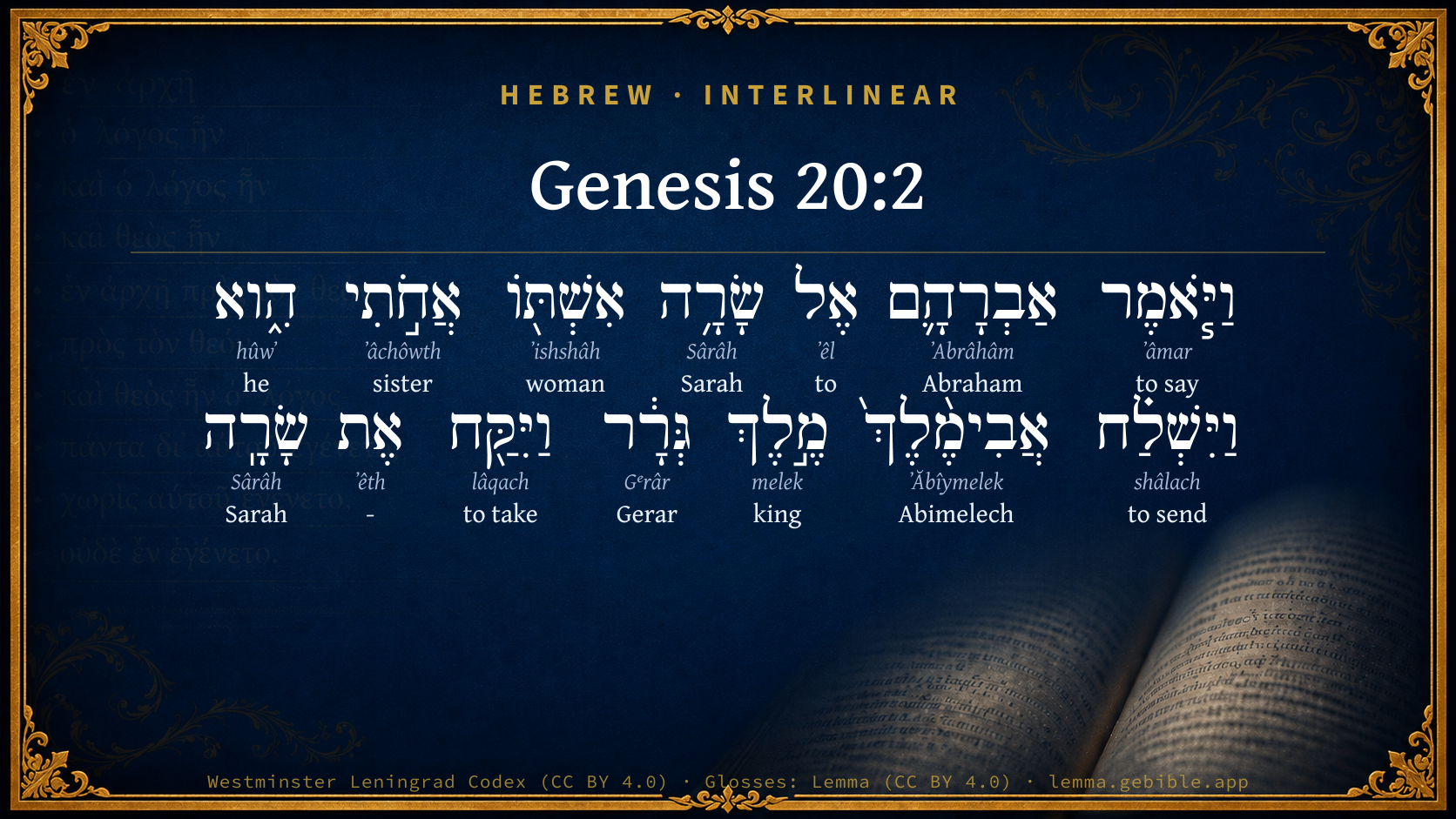
Hebrew (Westminster Leningrad Codex) Genesis 20:2 appears in the Hebrew Old Testament. The text above is from the Westminster Leningrad Codex. Each word links to its Strong’s number, a concise gloss, and parsing drawn from the Open Scriptures Hebrew Bible morphology. Click any word for its full Brown-Driver-Briggs (BDB) entry.
Download image
Cite this verse

Genesis 20:2 (World English Bible). Public Domain. Lemma interlinear Bible study tool, https://lemma.gebible.app/v/genesis/20/2.

Show BibTeX & RIS
BibTeX
RIS
English Translation
Abraham said about Sarah his wife, "She is my sister." Abimelech king of Gerar sent, and took Sarah.
World English Bible · Public Domain
Highlights Full analysis ↓
Download a study sheet

One document with this verse’s original text, its word-by-word gloss line, the meaning frame, cross-references with their text, attributed commentary, and full source and license credits — printable, and it pastes into notes with its structure intact.

This verse Autodidact and up

Study sheet (.html) Plain text (.txt)

A passage Seminary Student

Up to 50 verses in one chapter. A passage sheet keeps up to 6 commentary sources and 12 cross-references per verse, in the order this page ranks them, and says so on the sheet whenever that leaves anything out. Ask for a single verse and you get the Autodidact verse sheet above.

Everything on this page stays free to read, with no account — the sheet is a download of what is already on screen, not access to it.

Want to remove ads? Support Godless Engineer
Compare translations 3

The same verse in 3 English versions, stacked beneath the original-language interlinear above. Click any original word for its lexicon entry.

Each is an independent rendering of the whole verse — the interlinear is not word-aligned to these translations.

Highlighted words mark where these versions differ — a whole-verse word diff, not a word-by-word alignment.

  • World English Bible Public Domain
    Abraham said about Sarah his wife, "She is my sister." Abimelech king of Gerar sent, and took Sarah.
  • King James Version Public Domain
    And Abraham said of Sarah his wife, She is my sister: and Abimelech king of Gerar sent, and took Sarah.
  • unfoldingWord Literal Text CC BY-SA 4.0
    And Abraham said about Sarah his wife, “She my sister.” So Abimelech the king of Gerar sent for Sarah and took her.

unfoldingWord Literal Text — © unfoldingWord, licensed CC BY-SA 4.0. Word-aligned USFM3 via Door43 (git.door43.org/unfoldingWord/en_ult).

Versions to compare (up to 4)

3 of 4 selected

Show all 18 translations

Every available English version of this verse, each an independent rendering of the whole verse.

  • World English Bible Public Domain
    Abraham said about Sarah his wife, "She is my sister." Abimelech king of Gerar sent, and took Sarah.
  • Berean Standard Bible Public Domain
    Abraham said of his wife Sarah, “She is my sister.” So Abimelech king of Gerar had Sarah brought to him.
  • Majority Standard Bible Public Domain
    Abraham said of his wife Sarah, “She is my sister.” So Abimelech king of Gerar had Sarah brought to him.
  • King James Version Public Domain
    And Abraham said of Sarah his wife, She is my sister: and Abimelech king of Gerar sent, and took Sarah.
  • American Standard Version (1901) Public Domain
    And Abraham said of Sarah his wife, She is my sister. And Abimelech king of Gerar sent, and took Sarah.
  • Revised Version (1885) Public Domain
    And Abraham said of Sarah his wife, She is my sister: and Abimelech king of Gerar sent, and took Sarah.
  • Geneva Bible (1599) Public Domain
    And Abraham said of Sarah his wife, She is my sister. Then Abimelech King of Gerar sent and tooke Sarah.
  • Douay-Rheims (1899) Public Domain
    And he said of Sara his wife: She is my sister. So Abimelech the king of Oerara sent, and took her.
  • Young's Literal Translation Public Domain
    and Abraham saith concerning Sarah his wife, `She is my sister;' and Abimelech king of Gerar sendeth and taketh Sarah.
  • Literal Standard Version CC BY-SA 4.0
    and Abraham says concerning his wife Sarah, “She is my sister”; and Abimelech king of Gerar sends and takes Sarah.
  • Unlocked Literal Bible CC BY-SA 4.0
    Abraham said concerning Sarah his wife, “She is my sister.” So Abimelech king of Gerar sent for Sarah and took her.
  • unfoldingWord Literal Text CC BY-SA 4.0
    And Abraham said about Sarah his wife, “She my sister.” So Abimelech the king of Gerar sent for Sarah and took her.
  • Darby Bible Public Domain
    And Abraham said of Sarah his wife, She is my sister. And Abimelech the king of Gerar sent and took Sarah.
  • World Messianic Bible Public Domain
    Abraham said about Sarah his wife, “She is my sister.” Abimelech king of Gerar sent, and took Sarah.
  • Webster's Bible Public Domain
    And Abraham said of Sarah his wife, she is my sister: And Abimelech king of Gerar sent and took Sarah.
  • Free Bible Version CC BY-SA 4.0
    During his time there, when Abraham told people about his wife Sarah, he said, “She's my sister.” So Abimelech, king of Gerar, sent for Sarah and took her to become one of his wives.
  • Bible in Basic English Public Domain
    And Abraham said of Sarah, his wife, She is my sister: and Abimelech, king of Gerar, sent and took Sarah.
  • JPS Tanakh (1917) Public Domain
    And Abraham said of Sarah his wife: 'She is my sister.' And Abimelech king of Gerar sent, and took Sarah.

Literal Standard Version (2020), Covenant Press — licensed CC BY-SA 4.0. Text via the HelloAO Bible API (eBible.org). Unlocked Literal Bible (unfoldingWord) — licensed CC BY-SA 4.0. Text via the HelloAO Bible API (eBible.org). unfoldingWord Literal Text — © unfoldingWord, licensed CC BY-SA 4.0. Word-aligned USFM3 via Door43 (git.door43.org/unfoldingWord/en_ult). Free Bible Version, Dr. Jonathan Gallagher — licensed CC BY-SA 4.0. Text via the HelloAO Bible API (eBible.org).

Word by word

More ways to search: Search by grammar → Find every occurrence → Compare this word →

Practice this passage: Drill this verse → Learn its vocabulary →

גְּרָ֔ר
Gᵉrâr
H1642
“Gerar”
Noun, Proper
Part of Speech
Noun
Type
Proper
Full BDB Definition

Origin: probably from H1641

TWOT: None

Gerar = "a lodging place" - a Philistine town south of Gaza, modern 'Umm'
  1. וַיֹּ֧אמֶר ʼâmar H559 “and · to say” Conjunction + Verb, Qal, Sequential Imperfect, 3rd Person, Masculine, Singular
  2. אַבְרָהָ֛ם ʼAbrâhâm H85 “Abraham” Noun, Proper
  3. אֶל ʼêl H413 “to” Preposition
  4. שָׂרָ֥ה Sârâh H8283 “Sarah” Noun, Proper
  5. אִשְׁתּ֖וֹ ʼishshâh H802 “woman · his” Noun, Common, Feminine, Singular, Construct + Suffix, Personal, 3rd Person, Masculine, Singular
  6. אֲחֹ֣תִי ʼâchôwth H269 “sister · my” Noun, Common, Feminine, Singular, Construct + Suffix, Personal, 1st Person, Common, Singular
  7. הִ֑וא hûwʼ H1931 “he” Pronoun, Personal, 3rd Person, Feminine, Singular
  8. וַיִּשְׁלַ֗ח shâlach H7971 “and · to send” Conjunction + Verb, Qal, Sequential Imperfect, 3rd Person, Masculine, Singular
  9. אֲבִימֶ֨לֶךְ֙ ʼĂbîymelek H40 “Abimelech” Noun, Proper
  10. מֶ֣לֶךְ melek H4428 “king of” Noun, Common, Masculine, Singular, Construct
  11. וַיִּקַּ֖ח lâqach H3947 “and · to take” Conjunction + Verb, Qal, Sequential Imperfect, 3rd Person, Masculine, Singular
  12. אֶת ʼêth H853 “-” Particle, Direct Object
  13. שָׂרָֽה Sârâh H8283 “Sarah” Noun, Proper

About this verse

These counts appear in no published source. They are computed here, from the morphology-tagged text and Lemma’s own curated glosses. What Lemma adds →

14
words
13
distinct lemmas
Pentateuch
section

Notable vocabulary

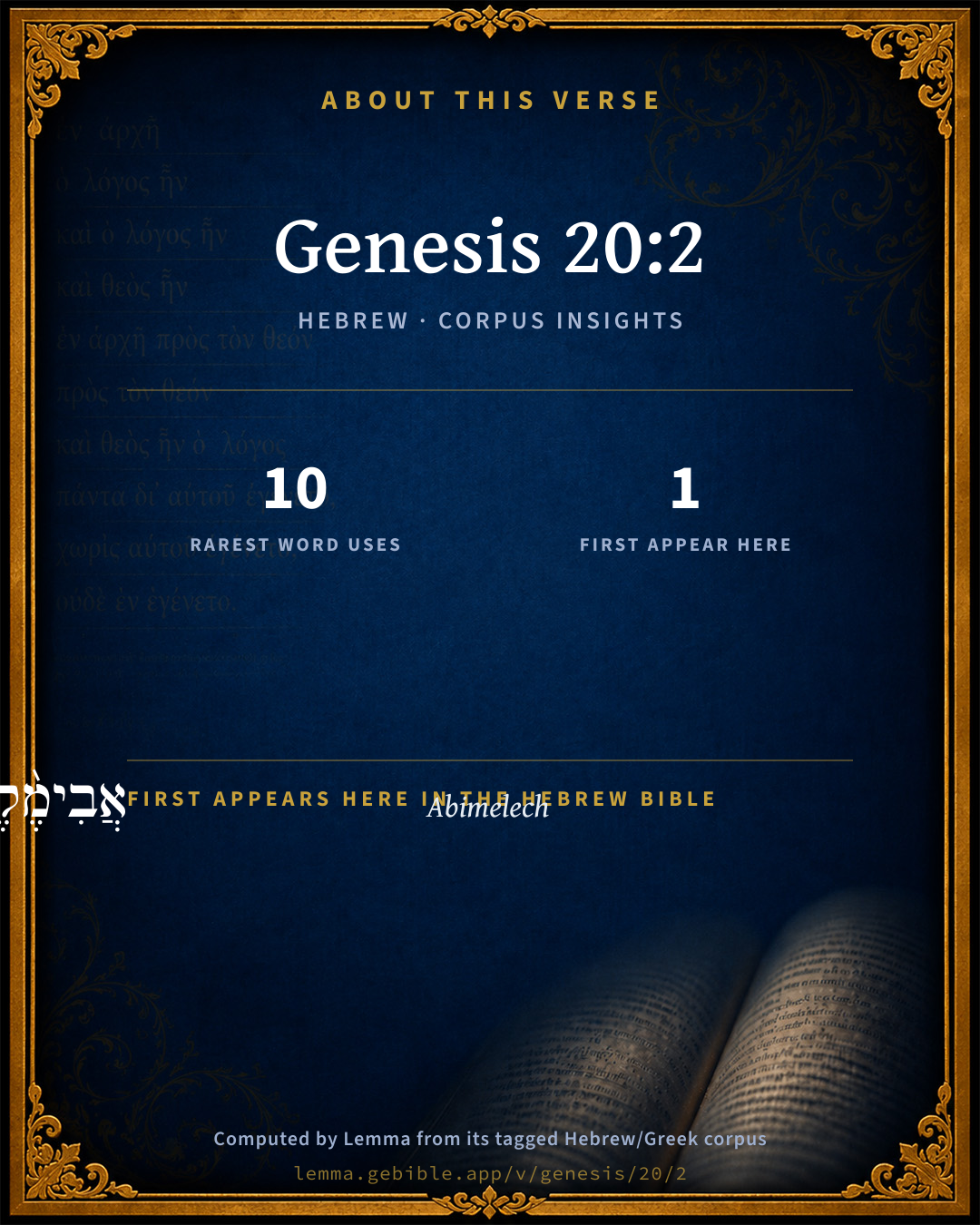
The rarest word here is גְּרָ֔ר Gerar H1642 — appearing just 10 times in the whole Hebrew Bible.

First appearance in Scripture

This word makes its first canonical appearance in the Hebrew Bible here:

  • אֲבִימֶ֨לֶךְ֙ Abimelech H40

Shared distinctive vocabulary

גְּרָ֔ר Gerar H1642 occurs in 10 verses of the Hebrew Bible. Also found in:

Grammatical profile

  • 3 verbs
  • 8 nouns
  • 1 pronoun
  • 1 preposition
  • 1 particle

Verb forms

  • וַיֹּ֧אמֶר Qal · Sequential Imperfect
  • וַיִּשְׁלַ֗ח Qal · Sequential Imperfect
  • וַיִּקַּ֖ח Qal · Sequential Imperfect

Repetition

A word recurs within this verse — often emphatic in Hebrew:

  • שָׂרָ֥ה Sarah H8283 ×2

Hebrew & Septuagint length

In English translation the verse runs 18 words from the Hebrew and 44 from the Septuagint (LXX English) — the Septuagint runs noticeably longer here. See the side-by-side →

A rough comparison of the two English renderings, which tokenize alike — not a word-level alignment.

Word counts can differ between the Hebrew and the Greek without any difference in meaning — e.g. the Hebrew direct-object marker אֵת has no separate Greek word, and Greek often adds the article ὁ.

Cross-references

14

Topical passages linked to Genesis 20:2 in the Treasury of Scripture Knowledge — connected by theme and wording, ordered by reader-vote popularity; previews shown in the World English Bible.

  • Genesis 12:15 The princes of Pharaoh saw her, and praised her to Pharaoh; and the woman was taken into Pharaoh's house.
  • Genesis 26:7 The men of the place asked him about his wife. He said, "She is my sister," for he was afraid to say, "My wife," lest, he thought, the men of the place might kill me for Rebekah, because she was beautiful to look on.
  • Genesis 12:11–13 It happened, when he was come near to enter into Egypt, that he said to Sarai his wife, "See now, I know that you are a beautiful woman to look on.
  • Genesis 20:12 Moreover she is indeed my sister, the daughter of my father, but not the daughter of my mother; and she became my wife.
  • Genesis 26:1 There was a famine in the land, besides the first famine that was in the days of Abraham. Isaac went to Abimelech king of the Philistines, to Gerar.
  • Genesis 26:16 Abimelech said to Isaac, "Go from us, for you are much mightier than we."
  • 2 Chronicles 19:2 Jehu the son of Hanani the seer went out to meet him, and said to king Jehoshaphat, Should you help the wicked, and love those who hate Yahweh? for this thing wrath is on you from before Yahweh.
  • 2 Chronicles 32:31 However in [the business of] the ambassadors of the princes of Babylon, who sent to him to inquire of the wonder that was done in the land, God left him, to try him, that he might know all that was in his heart.
  • Proverbs 24:16 For a righteous man falls seven times, and rises up again; But the wicked are overthrown by calamity.
  • Ecclesiastes 7:20 Surely there is not a righteous man on earth, who does good and doesn't sin.
  • Galatians 2:11–12 But when Peter came to Antioch, I resisted him to the face, because he stood condemned.
  • Ephesians 4:25 Therefore, putting away falsehood, speak truth each one with his neighbor. For we are members one of another.
  • Colossians 3:9 Don't lie to one another, seeing that you have put off the old man with his doings,
  • 2 Chronicles 20:37 Then Eliezer the son of Dodavahu of Mareshah prophesied against Jehoshaphat, saying, Because you have joined yourself with Ahaziah, Yahweh has destroyed your works. The ships were broken, so that they were not able to go to Tarshish.

Cross-references courtesy of OpenBible.info (CC BY 4.0).

Hebrew and Greek witnesses Masoretic Hebrew ↔ Greek Septuagint

The same verse in the two great witnesses to the Old Testament, shown verse-for-verse.

Here the Septuagint runs noticeably longer than the Hebrew — LXX2012 (modern English Septuagint) 44 words vs World English Bible 18. A rough length comparison of the two English translations, not a word-level alignment — read both below.

These are two independent witnesses, not word-aligned to each other, and the Septuagint is shown in lemma (dictionary) form.

Hebrew Genesis 20:2 Masoretic · Westminster Leningrad Codex

וַיֹּ֧אמֶר אַבְרָהָ֛ם אֶל שָׂרָ֥ה אִשְׁתּ֖וֹ אֲחֹ֣תִי הִ֑וא וַיִּשְׁלַ֗ח אֲבִימֶ֨לֶךְ֙ מֶ֣לֶךְ גְּרָ֔ר וַיִּקַּ֖ח אֶת שָׂרָֽה

Abraham said about Sarah his wife, "She is my sister." Abimelech king of Gerar sent, and took Sarah.

World English Bible · Public Domain

Greek LXX Genesis 20:2 Septuagint · lemma form

εἶπον δέ αβρααμ περί σαρρα ὁ γυνή αὐτός ὅτι ἀδελφή ἐγώ εἰμί φοβέω γάρ εἶπον ὅτι γυνή ἐγώ εἰμί μήποτε ἀποκτείνω αὐτός ὁ ἀνήρ ὁ πόλις διά αὐτός ἀποστέλλω δέ αβιμελεχ βασιλεύς γεραρα καί λαμβάνω ὁ σαρρα

And Abraam said concerning Sarrha his wife, She is my sister, for he feared to say, She is my wife, lest at any time the men of the city should kill him for her sake. So Abimelech king of Gerara sent and took Sarrha.

LXX2012 (modern English Septuagint) · Public Domain

Hebrew: Westminster Leningrad Codex (CC BY 4.0). Greek: Septuagint (public domain); English from LXX2012 (modern English Septuagint) (Public Domain). How the Septuagint differs from the Hebrew →

Targum (Aramaic paraphrase)

2

The Targum is the ancient Jewish Aramaic paraphrase of the Hebrew Scriptures — an interpretive translation, not the Hebrew text itself. Onkelos (literal) and Pseudo-Jonathan (expansive) render the Torah, and Jonathan the Prophets. Coverage is partial: where no permissively-licensed English translation exists for a verse, only the Aramaic is shown. This is verse-level text, not a word-by-word alignment to the Hebrew.

  1. Targum Onkelos Torah (Genesis–Deuteronomy)
    וַאֲמַר אַבְרָהָם עַל שָׂרָה אִתְּתֵהּ אֲחָתִי הִיא וּשְׁלַח אֲבִימֶלֶךְ מַלְכָּא דִּגְרָר וּדְבַר יָת שָׂרָה

    (no public-domain English translation for this verse)

    Targum Onkelos — Aramaic: “Onkelos Genesis” (public domain); “Onkelos Exodus” (public domain); “Onkelos Leviticus” (public domain); “Onkelos Numbers” (public domain); “Onkelos Deuteronomy” (public domain). English: “Sefaria Community Translation” (CC0 1.0 (public-domain dedication)); “J.W. Etheridge. The Targums of Onkelos and Jonathan Ben Uzziel on the Pentateuch. London: Longmans, Green, 1862” (public domain). Text via Sefaria.

  2. Targum Pseudo-Jonathan Torah (Genesis–Deuteronomy)
    וַאֲמַר אַבְרָהָם עַל שָרָה אִנְתְּתֵיהּ אֲחוֹתִי הִיא וְשַׁדַר אֲבִימֶלֶךְ מַלְכָּא דִגְרָר וּדְבַר יַת שָרָה

    And Abraham said concerning Sarah his wife, She is my sister. And Abimelek, king of Gerar, sent and took Sarah.

    Targum Pseudo-Jonathan — Aramaic: “Targum Jonathan on Genesis” (public domain); “Targum Jonathan on Exodus” (public domain); “Targum Jonathan on Leviticus” (public domain); “Targum Jonathan on Numbers” (public domain); “Targum Jonathan on Deuteronomy” (public domain). English: “The Targum of Jonathan ben Uzziel, trans. J. W. Etheridge, London, 1862” (public domain). Text via Sefaria.

Commentary

Notes on Genesis 20:2 from classic Christian and Jewish commentators (each source and its license shown beneath its notes). The classic Christian expositions comment on the surrounding passage and are grouped to its opening verse, so a note may address several verses; the Jewish commentaries on the Tanakh (Rashi and others) are per-verse, so they appear only where the commentator wrote on this verse.

Lemma curates 59 commentaries, every one of them public domain or Creative Commons licensed, each selected and text-cleaned for this edition rather than reprinted as found. About our sources →

Trapp's Complete Commentary

John Trapp

Gen 20:2 And Abraham said of Sarah his wife, She [is] my sister: and Abimelech king of Gerar sent, and took Sarah.

Ver. 2. She is my sister.] This is the second time he thus sinned, both against piety by distrust; and charity, in exposing his wife to other men’s pleasure, and his neighbour thereby to God’s displeasure. So Jehoshaphat was twice taken tardy in Ahab’s amity; {2Ch 19:2; 2Ch 20:37} Jonah twice reproved for rebellion; and John for angel worship; Samson, twenty years after he had loved the Philistine woman, goes down to Gaza, and went into Delilah. {Jdg 15:20; Jdg 16:1} Lot committed incest two nights together. Indeed, the orifice of his lust was not yet stopped by repentance. But Jonah had surely repented of his former frowardness; and so had Samson, Jehoshaphat, and Abraham too, {a} of his former hypocrascy; which made the Lord to move Pharaoh to deal kindly with him, so that "he had sheep and oxen," &c. {Gen 12:16} But what shall we say to that example of the apostles, {Luk 22:24} among whom "there was a strife who should be accounted the greatest?" And this was not the first, but the third time they had thus offended by ambition; and even after our Saviour had discoursed unto them of his cross. But this last time, most absurdly, and unseasonably, after that he had foretold his passion to follow within two days; had taught them that he was anointed by the woman for the day of his burial; had administered to them the sacrament, that seal of mutual love; had washed their feet, to teach them humility and charity, &c. Oh, the incredible perverseness of corrupt nature! How strongly do the best still smell of the old cask, taste of the old stock, though ingrafted into Christ, and though poured from vessel to vessel. {Joh 5:14} "And this have ye done again," saith the Lord. {Mal 2:13} A great aggravation, as numbers added to numbers, are first ten times more, and then a hundred, and then a thousand. "How oft did they provoke him in the wilderness, and grieve him in the desert". {Psa 78:40} A regenerate man may fall into the same sin again that he hath truly repented of nor can we define how oft, and into how heinous but surely, not oft into the same, that is heinous and scandalous. That is a graceless person that hath "eyes full of adultery, and that cannot cease to sin". {2Pe 2:14} An enemy to God, that "goeth on still in his trespasses". {Psa 68:21} It is expressly noted of Judah, {Gen 38:26} that "he knew Tamar again no more."

And Abimelech king of Gerar.] A fit name for a king; and a common name to the kings of this country: it signifies father king. "I was a father to the poor," saith Job. {Job 29:16} And "kings shall be nursing fathers" to the Church, saith Isaiah. {Isa 49:23} Augustus was styled Pater Patriae. And Trajan gloried most in his title Optimus. He desired more to be loved, than honoured, and counted it a greater dignity, Prodesse quam praeesse .{ b} He tare his own garment to bind up therewith the wounds of his soldiers; and professed that he would so carry himself to private persons, now that he was emperor, as he wished, when he was a private man, that the emperors should carry themselves toward him. {c} Titus, for his sweet nature and carriage, was called the world’s darling. {d} Scipio the city’s sweetheart. {e} Julian the apostate, as he came not short of the greatest philosophers for learning, so neither of Titus for lenity, of Antoninus for clemency, of Marcus Aurelius for moderation, setting aside his satanical hatred of the Christian religion. {f} Queen Elizabeth ever accounted devotion and mercy the brightest stars in the sphere of majesty. She always thought it more fit to offend a man, than to hate him, saith Master Camden. In the year 1579, a young man discharged a piece out of a boat, and shot one of the bargemen in the Queen’s barge (where she was then) through both his arms; who was soon apprehended, and led to the gallows for a terror to him. But whereas he religiously affirmed, that he did it unwittingly, and thought no harm, he was discharged: the Queen many times saying, that she could believe nothing of her people that parents would not believe of their children. {g} This made her so beloved at home and admired abroad. Queen Elizabeth was the most glorious and happy woman that ever wore a crown, said that thrice noble Princess Anna Atestina, the mother of the Dukes of Guise and Nemours, as Thuanus hath recorded it {h} Her subjects were ready to say to her, as the senate said to Severus, All is well with us, so long as thou rulest well over us. {i}

{a} Non dubium, quin Abram poenitudine ductus , &c. - Pareus in Gen 12:16.

{b} φιλουμενος μαλλον η τιμωμενος εχαιρε. - Dio.

{c} Ibid. in Vita Bucholc. in Indice Chronol.

{d} Orbis amor et deliciae .

{e} Corculum appellatus est. - Tusc. Quaest., lib. i.

{f} Parei Medul. Hist. Profan., p. 482

{g} Camd. Elis., fol. 494, 205.

{h} Thuan. Hist., lib. cxxix.

{i} παντες παντα καλως ποιουσιν επειδαν συ καλως απχεις - Dio.

John Trapp, A Commentary or Exposition upon All the Books of the Old and New Testament (1647–1656) — public domain. Text from a community e-Sword module.

Tyndale Open Study Notes

Tyndale Open Resources

20:2 Abraham told the same lie to Abimelech that he had told to Pharaoh (12:13); Isaac would later do the same (26:1-11), probably having learned this tactic from his father. • Abimelech (literally my father the king) was probably a title like “Pharaoh” (37:36; Exod 1:15), not a proper name (see study note on Gen 26:1).

Tyndale Open Study Notes — © Tyndale Open Resources, licensed CC BY-SA 4.0. Text via the HelloAO Bible API.

Geneva Bible (1599)

Geneva Bible translators

Abraham had now twice fallen into this fault: such is man’s frailty.

Geneva Bible (1599) marginal notes — public domain. Text via Bolls.life.

Jamieson, Fausset & Brown

Robert Jamieson, A. R. Fausset & David Brown

Abraham said of Sarah his wife, She is my sister--Fear of the people among whom he was, tempted him to equivocate. His conduct was highly culpable. It was deceit, deliberate and premeditated--there was no sudden pressure upon him--it was the second offense of the kind [see on Gen 12:13] --it was a distrust of God every way surprising, and it was calculated to produce injurious effects on the heathen around. Its mischievous tendency was not long in being developed.

Abimelech (father-king) . . . sent and took Sarah--to be one of his wives, in the exercise of a privilege claimed by Eastern sovereigns, already explained (see on Gen 12:15).

Jamieson, Fausset & Brown — Commentary Critical and Explanatory on the Whole Bible (1871) — public domain (CC PDM 1.0). Text via the HelloAO Bible API.

Adam Clarke's Commentary

Verse 2. She is my sister] See the parallel account, Ge 12:11-20, and the notes there. Sarah was now about ninety years of age, and probably pregnant with Isaac. Her beauty, therefore, must have been considerably impaired since the time she was taken in a similar manner by Pharaoh, king of Egypt; but she was probably now chosen by Abimelech more on the account of forming an alliance with Abraham, who was very rich, than on account of any personal accomplishments. A petty king, such as Abimelech, would naturally be glad to form an alliance with such a powerful chief as Abraham was: we cannot but recollect his late defeat of the four confederate Canannitish kings. See Clarke on Ge 14:14, c. This circumstance was sufficient to establish his credit, and cause his friendship to be courted and what more effectual means could Abimelech use in reference to this than the taking of Sarah, who he understood was Abraham's sister, to be his concubine or second wife, which in those times had no kind of disgrace attached to it?

Adam Clarke's Commentary on the Bible (1810–1826) — public domain. Text from a community e-Sword/MySword module.

John Calvin's Commentaries

2. And Abraham said of Sarah his wife. In this history, the Holy Spirit presents to us a remarkable instance, both of the infirmity of man, and of the grace of God. It is a common proverb, that even fools become wise by suffering evil. But Abraham, forgetful of the great danger which had befallen him in Egypt, once more strikes his foot against the same stone; although the Lord had purposely chastised him, in order that the warning might be useful to him, throughout his whole life. Therefore we perceive, in the example of the holy patriarch, how easily the oblivion, both of the chastisements and the favors of God, steals over us. For it is impossible to excuse his gross negligence, in not calling to mind, that he had once tempted God; and that he would have had himself alone to blame, if his wife had become the property of another man. But if we thoroughly examine ourselves scarcely any one will be found who will not acknowledge, that he has often offended in the same way. It may be added, that Abraham was not free from the charge of ingratitude; because, if he had rejected that his wife had been wonderfully preserved to him by the Lord, he would never again, knowingly and willingly, have cast himself into similar danger. For he makes the former favor divinely offered unto him, so far as he is able, of none effect. We must, however, notice the nature of the sin, on which we have touched before. For Abraham did not, for the sake of providing for his own safety prostitute his wife, (as impious men cavil.) But, as he had before been anxious to preserve his life, till he should receive the seed divinely promised to him; so now, seeing his wife with child, in the hope of enjoying so great a blessing, he thought nothing of his wife’s danger. Therefore if we thoroughly weigh all things, he sinned through unbelief, by attributing less than he ought to the providence of God. Whence also, we are admonished, how dangerous a thing it is, to trust our own counsels. For Abraham’s disposition is right, while fixing his attention on the promise of God; but inasmuch as he does not patiently wait for God’s helps but turns aside to the use of unlawful means, he is, in this respect, worthy of censure.

And Abimelech sent. There is no doubt that the Lord purposed to punish his servant, for the counsel he had so rashly taken. And such fruits of distrust do all receive, who rely not, as they ought, on the providence of God. Some perverse men quarrel with this passage; because nothing seems to them more improbable than that a decrepit old woman should be desired by the king, and taken from the bosom of her husband. But we answer, first, that it is not known what her appearance was, except that Moses before declared her to be a person of singular beauty. And it is possible that she was not much worn with age. For we often see some women in their fortieth year more wrinkled than others in their seventieth. But here another thing is to be considered, that, by the unwonted favor of God, her comeliness was preeminent among her other endowments. It might also be, that king Abimelech was less attracted by the elegance of her form, than by the rare virtues with which he saw her, as a matron, to be endued. Lastly, we must remember, that this whole affair was directed by the hand of God, in order that Abraham might receive the due reward of his folly. And as we find that they who are exceedingly acute in discerning the natural causes of things, are yet most blind in reference to the divine judgments; let this single fact suffice us, that Abimelech, being a minister to execute the divine chastisement, acted under a secret impulse.

John Calvin's Commentaries (1540-1563) — public domain. Text from the Calvin Translation Society English edition (1840s-50s) via the Christian Classics Ethereal Library (ccel.org). Calvin's coverage is partial (roughly two-thirds of the Bible); uncommented books and verses are honest gaps, never fabricated. The 19th-century editor's footnotes and remarks are omitted so the notes are faithfully Calvin's own voice.

Ellicott's Commentary for English Readers

(2) She is my sister.—Twenty years before, Abraham had acted in the same way in Egypt, and Pharaoh had rebuked him, but sent him away with large presents. We learn from this chapter, Gen_20:13, that the false representation which twice brought them into trouble was habitual with the two; nor does Abraham ever seem conscious that he was acting in it wrongfully. To us it seems cowardly, in one who had so many men trained to battle, thus to expose his wife to danger; and to have recourse to deceit, at the very time when such abundant revelations were being made to him, also shows an apparent want of faith in God. But Holy Scripture neither represents its heroes as perfect, nor does it raise them disproportionately above the level of their own times. Its distinguishing feature rather is that it ever insists upon a perpetual progress upwards, and urges men onward to be better and holier than those that went before. Abraham was not on the same high spiritual level as a Christian ought to be who has the perfect example of Christ as his pattern, and the gift of the Holy Ghost for his aid; and the fact that God rescued him and Sarah from all danger in Egypt may have seemed to him a warrant that in future difficulties he would have the same Divine protection. Human conduct is ever strangely chequered, but we have a wholesome lesson in the fact, that it was Abraham’s politic device which twice entangled him in actual danger.

Abimelech (called in Gen_26:1, king of the Philistines, where see Note) . . . took Sarah.—She was now ninety years of age, and naturally her beauty must have faded. Some, however, think that with the promise of a son her youth had been renewed, while others suppose that the purpose uppermost in the mind of Abimelech was political, and that what he really desired was an alliance with the powerful sheik who had entered his territories.

A Bible Commentary for English Readers, edited by Charles John Ellicott (1878–1897) — public domain. Text from a community e-Sword module.

The Cambridge Bible for Schools and Colleges

gen. ed. J. J. S. Perowne

2. She is my sister] See notes on Gen_12:13. It seems almost incredible that, after the event recorded in Gen_12:13-20, Abraham should once again have displayed the same faults of cowardice and dissimulation. Sarah also is advanced in years; and, in Gen_18:10-14, had received the promise of a son. The narrative most probably is a duplicate of the tradition of Gen_12:13-20. Its present position, between the promise of a son in Gen_18:10-14, and its fulfilment in chap. 21, becomes intelligible on the supposition of its derivation from an independent source, not connected with chap. 18.

Abimelech] i.e. “my father is Melech.” This is probably a name compounded with that of a Canaanite deity, Milk (= Molech in the English Bible).

The Cambridge Bible for Schools and Colleges (gen. ed. J. J. S. Perowne; Cambridge University Press, 1878–1918) — public domain. Text from a community e-Sword module.

John Gill's Exposition

And Abraham said of Sarah his wife, she is my sister,.... This he gave out in all conversation he came into, and said it to every one that asked who she was, which was little better than a lie; it at least was an equivocation and deception, and not at all justifiable, and tended to expose his wife's chastity, and discovered a distrust of divine Providence; the same infirmity be had given way to, and the same evil he had fallen into in Egypt, Gen 12:11, and therefore was the more inexcusable now; good men not only fall into sin, but have their relapses:

and Abimelech king of Gerar sent and took Sarah; having heard or seen what a beautiful woman. Sarah was, though ninety years of age, having never bore children; and understanding she was a single person, sent his servants to take her, and bring her to his house, in order to be his wife, which seems to be done with some kind of force; and it can hardly be thought that Abraham and Sarah would freely agree to it, at least it must be done with reluctance on their parts. Whether Abimelech was the first king of Palestine of this name, is not certain; if he was, which is not improbable, it became usual afterwards for the kings thereof to be so called, as Pharaoh was a common name to the kings of Egypt; it signifies "father" and "king", as kings should be the fathers of their people.

John Gill's Exposition of the Whole Bible (1746–1763) — public domain (CC PDM 1.0). Text via the HelloAO Bible API.

Haydock's Catholic Bible Commentary

He said to the king, and to all others who made inquiry, as it was his custom, whenever he came into a strange land, ver. 13. He was encouraged to do this, by the protection which God had shewn him in Egypt. --- Took her, against her will, as Pharao had done. (Haydock) --- Though she was ninety years old, and with child, her beauty was still extraordinary, the Rabbin think miraculous. At that time people lived above 120 years; so that at the age of ninety, she would only be about as near the end of her life as our women are at forty; and we often see people sufficiently attracting at that age. (Calmet)

George Leo Haydock (1774–1849), Haydock's Catholic Family Bible and Commentary, 1859 edition — public domain. Excludes Psalms (Douay-Rheims chapter numbering differs from Protestant) and Deuterocanonical books (Catholic canon only).

Matthew Poole's English Annotations

Abraham said this lest they should slay him for his beautiful wife’s sake, as himself tells us, Gen 20:11. For though Sarah was ninety years old, yet she retained her beauty in good measure, partly, because she had not been broken by bearing and nursing of children; partly, because in that age of the world men and women, as they lived longer, so they did not so soon begin to decay, as now they do; and partly, because of God’s especial blessing upon her.

Abimelech took Sarah, not without violence, for it is not to be thought that either Abraham or Sarah would consent to it.

Matthew Poole's English Annotations on the Holy Bible (1683–1685) — public domain. Text from a community e-Sword/MySword module.

Whedon's Commentary on the Bible

Daniel D. Whedon

2. She is my sister — Here Abraham repeats the folly he had shown in Egypt. Comp. Gen_12:11-17. Abimelech means, my father king, or fathers of the king, and seems to have been the common title of the Philistine kings, as Pharaoh was of Egyptian kings.

Daniel D. Whedon (gen. ed.), Commentary on the Old and New Testaments (1874–1909) — public domain. Text from a community e-Sword module.

The Pulpit Commentary

And Abraham said of Sarah his wife, She is my sister. As formerly he had done on descending into Egypt. (Gen_12:13) That Abraham should a second time have resorted to this ignoble expedient after the hazardous experience of Egypt and the richly-merited rebuke of Pharaoh, but more especially after the assurance he had lately received of his own acceptance before God, (Gen_15:6) and of Sarah"s destiny to be the mother of the promised seed, (Gen_17:16) is well nigh unaccountable, and almost irreconcilable with any degree of faith and piety. Yet the lapse of upwards of twenty years since that former mistake may have deadened the impression of sinfulness which Pharaoh"s rebuke must have left upon his conscience; while altogether the result of that experiment may, through a common misinterpretation of Divine providence, have encouraged him to think that God would watch over the purity of his house as he had done before. Thus, though in reality a tempting of God, the patriarch"s repetition of his early venture may have had a secret connection with his deeply-grounded faith in the Divine promise (cf. Kalisch in loco). And Abimelechi.e. Father-king, a title of the Philistine kings (Gen_21:22 Gen_26:1; Psa_34:1) as Pharaoh was of the Egyptian, (Gen_12:15) and Hamor of the Shechemite (Gen_34:4) monarchs; cf. Padishah (father-king), a title of the Persian kings, and Atalik (father, properly paternity), of the Khans of Bokhara (Gesenius, p. 6)king of Gerar sent, and took Sarah. Ie. into his harem, as Pharaoh previously had done, (Gen_12:15) either having been fascinated by her beauty, which, although she was twenty years older than when she entered Egypt, need not have been much faded, (Gen_12:11; Calvin) or may have been miraculously rejuvenated when she received strength to conceive seed (Kurtz); or, what is as probable, having sought through her an alliance with the rich and powerful nomad prince who had entered his dominions (Delitzsch).

HOMILIES BY J.F. MONTGOMERY Ver. 2.

Falsehood the fruit of unbelief.

said of Sarah his wife, She is my sister." Notice how imperfectly the obligation of truth recognized in Old Testament times. Not only among heathen, or those who knew little of God (Jos_2:5; 2Ki_10:18) but godly men among God"s own people (Gen_26:7; 1Sa_27:10) Yet the excellence of truth was known, and its connection with the fear of God (Exo_18:21; Psa_15:2) Not until manifested in Christ does truth seem to be fully understood. (cf. 1Jn_3:8) This gives force to "I am the truth." Some see in text an act of faith; trust that God would make the plan (Ver. 13) successful. But faith must rest on God"s word. Trust in what God gives no warrant for believing is not faith but fancy, e.g. to attempt what we have no reason to believe we can accomplish, or to incur liabilities without reasonable prospect of meeting them. More natural and better to look on it as a breach of truth under temptation; the failure Of a godly man under trial. His words were true in letter (Ver. 12), but were spoken to deceive, and did deceive.

I ROOT OF HIS FAULT UNBELIEF; want of all-embracing trust. His faith was real and vigorous, (cf. 1Co_10:12) but partial (Gen_27:19; Mat_14:28) Shrank from trusting God fully. Turned to human devices, and thus turned out of the way. (Pro_3:5) Partial distrust may be found even where real faith. A very common instance is trusting in God for spiritual blessings only. A large part of our actions, especially in little things, springs not from conscious decision, but from habitual modes of thought and feeling. We act instinctively, according to what is the natural drift of thought. Abraham had so dwelt on the danger that he forgot the help at hand (Psa_34:7; Rom_8:28) Bold in action, his faith failed when danger threatened.

To endure is a greater trial of faith than to do. To stand firm amid secularizing influences, ridicule, misconstruction is harder than to do some great thing. St. Peter was ready to fight for his Master, but failed to endure (Mar_14:50-71; Gal_2:12) So to St. Paul"s What wilt thou have me to do?" the Lord"s word was, I will show him how great things he must suffer.

II FORM OF HIS FAULT UNTRUTH. Contrary to the mind of Christ. May be without direct statement of untruth. May be by true words so used as to convey a wrong idea; by pretences, e. g. taking credit unduly for any possession or power; by being ashamed to admit our motives; or by untruth in the spiritual life, making unreal professions in prayer, or self-deceiving. Every day brings numberless trials. These can be resisted only by the habit of truthfulness, gained by cultivating "truth in the inward parts," aiming at entire truthfulness. Nothing unpractical in this. May be said, Mast I tell all my thoughts to every one? Not so. Many things we have no right to speak; e.g. things told in confidence, or what would give unnecessary pain. Concealment when it is right is not untruth. No doubt questions of difficulty may arise. Hence rules of casuistry. But a Christian should be guided by principles rather than by rules; (Gal_5:1) and wisdom to apply these rightly is to be gained by studying the character of Christ, and prayer for the Holy Spirit"s guidance M. (Luk_11:13; Joh_16:14)

The Pulpit Commentary (1880–1919), ed. H.D.M. Spence-Jones & Joseph S. Exell — public domain. Text from a community e-Sword module.

Rashi

Rabbi Shlomo Yitzchaki (Rashi)

ויאמר אברהם AND ABRAHAM SAID — This time he did not ask her consent but forcibly and against her inclination he stated that she was his sister, because she had already been taken once to Pharaoh’s house on account of this (Genesis Rabbah 52:4).

אל שרה אשתו OF SARAH HIS WIFE — means in reference to (אֶל in sense of עַל) just as (1 Samuel 4:21) “in reference to (אל) the ark of God being taken, and in reference to (אל) her father-in-law”, where the word אל, in both cases, has the same meaning as על.

Rashi on the Tanakh — English translations: “The Judaica Press complete Tanach with Rashi, translated by A. J. Rosenberg” (CC BY 4.0); “Pentateuch with Rashi's commentary by M. Rosenbaum and A.M. Silbermann, 1929-1934” (public domain); “The Metsudah Tanach series, Lakewood, N.J” (CC BY 4.0); and “The Book of Joshua, Metsudah Publications, 1997” (CC BY 4.0). Text via Sefaria.

Ramban (Nachmanides)

Rabbi Moshe ben Nachman (Ramban / Nachmanides)

AND ABRAHAM SAID OF SARAH HIS WIFE, SHE IS MY SISTER. This was not like what happened in Egypt. There, when they entered the land, it is said that the Egyptians saw that the woman was beautiful, and they praised her to the lords and to Pharaoh, as they were an immoral people but this king was perfect and upright, and his people were likewise good. However Abraham suspected them, and he told everyone that she was his sister.

AND ABIMELECH, KING OF GERAR, SENT AND TOOK SARAH. It is wondrous that Sarah, after being worn with age, was extremely beautiful, fit to be taken by kings. When she was taken to Pharaoh, though she was sixty-five years old, it is possible that she still had her beautiful appearance, but after being worn with age and the manner of women had ceased with her, that is a wonder! Perhaps her youthfulness returned to her when the angel brought her the tidings, as our Rabbis have said.

Ramban (Nachmanides) on the Tanakh — English translation: “Commentary on the Torah by Ramban (Nachmanides). Translated and annotated by Charles B. Chavel. New York, Shilo Pub. House, 1971-1976” (CC BY 4.0). Text via Sefaria.

Radak

Rabbi David Kimhi (Radak)

ויאמר...אל שרה אשתו, concerning his wife Sarah he told anyone inquiring about her אחותי היא, he told the same to Avimelech who inquired, as we know from verse 5 when the latter referred to Avraham having told him that Sarah was his sister. We find a similar meaning of the word אל in Samuel I 17,49 when the lineויך את הפלשתי אל מצחו, means: “it struck the Philistine on his forehead,” or the line אל ההרים לא אכל in Ezekiel 18,6 where the word אל does not mean “to” but the line means: “if he has not eaten on the mountains.” Avraham said this as soon as he arrived in Gerar, as he had heard that the people of that town were wicked people, as he mentioned to Avimelech in verse 11 where he told him that there was no fear of G’d in that town. A generation later Yitzchok had a similar experience in Gerar. Neither Avraham nor Yitzchok are on record as having made similar comments about the local populations of other towns they visited. As to why Avraham risked going to a town full of wicked people and endangered both himself and his wife, this is something we discussed in 12,12. What is more surprising is the fact that Sarah, so many years after her experience in Egypt, was still so physically attractive that she inspired physical passions among the people who saw her. Clearly, her good looks must have been the result of her regaining her youthful vigour when she became pregnant at the time the angels visited Avraham, and she herself remarked on that phenomenon. The time frame in which the events reported in this chapter occurred must have been immediately after the beginning of her pregnancy, mentioned in 21,1 in the past tense, i.e. וה' פקד את שרה, “and the Lord had benevolently remembered Sarah (allowing her to become pregnant).

וישלח, after Avimelech heard about Sarah’s beauty, he sent to have her brought to his palace.

Radak on the Tanakh — English translations: “Sefaria Community Translation” (CC0 1.0 (public-domain dedication)); “Eliyahu Munk, HaChut Hameshulash” (CC BY 4.0); “Rabbi Mike Feuer, Jerusalem Anthology” (CC BY 4.0); and “R. David Kimhi on the first book of Psalms, Translated by R.G. Finch, London, 1919” (public domain). Text via Sefaria.

Lesson kit

Teaching starters — assembled from the data on this page, not authored interpretation. Every prompt links to the verse data it draws on. Edit before teaching.

Genesis, in the Pentateuch, opens this verse with 14 words (13 distinct Hebrew lemmas). Its most distinctive word is Gᵉrâr (“Gerar”). The Greek Septuagint runs longer here. A historical commentator’s framing appears above. Read the whole chapter for the surrounding context.

Discussion questions

  1. What does “Gerar” (Gᵉrâr) contribute to the verse as a whole?
  2. The word “Abimelech” first appears here in Scripture. What is being introduced at this debut?
  3. Genesis 10:19 shares the word «Gerar» with this verse. How do the two illuminate each other?
  4. “Sarah” occurs 2× in this one verse. What is the effect of the repetition?
  5. Compared with the Hebrew, the Septuagint runs longer here. What questions does that raise?
  6. These translations render this verse differently. What is at stake in choosing one wording over another?
  7. The verb «וַיֹּ֧אמֶר» is Qal Sequential Imperfect. How does its form color the action?
  8. Reading how Trapp's Complete Commentary and Tyndale Open Study Notes read this verse, where do the two commentators agree and where do they part?

Things to notice

  • 1 word makes its first canonical appearance in Scripture here.
  • These translations choose different wording for 1 word in this verse.
  • “Sarah” occurs 2× in this single verse.
  • 13 distinct Hebrew lemmas span 14 words in this verse.

Reading settings

Reading text

Shown beneath each verse's original-language words.

Old Testament
Old Testament edition

Read the OT as the Masoretic Hebrew (MT) or the Greek Septuagint (LXX).

English shown for the Greek Septuagint (in the Hebrew ↔ Greek comparison).

Comparing translations? Open the Compare panel on any verse page to stack up to four side by side.