
Acts 9:25

Greek (Tischendorf 8th ed.) Acts 9:25 appears in the Greek New Testament. The text above is from the Tischendorf 8th edition. Each word links to its Strong’s number and a concise gloss. Click any word for its full Thayer’s Greek Lexicon entry.

Download image
Cite this verse

Acts 9:25 (World English Bible). Public Domain. Lemma interlinear Bible study tool, https://lemma.gebible.app/v/acts/9/25.

Show BibTeX & RIS
BibTeX
RIS
English Translation
but his disciples took him by night, and let him down through the wall, lowering him in a basket.
World English Bible · Public Domain
Highlights
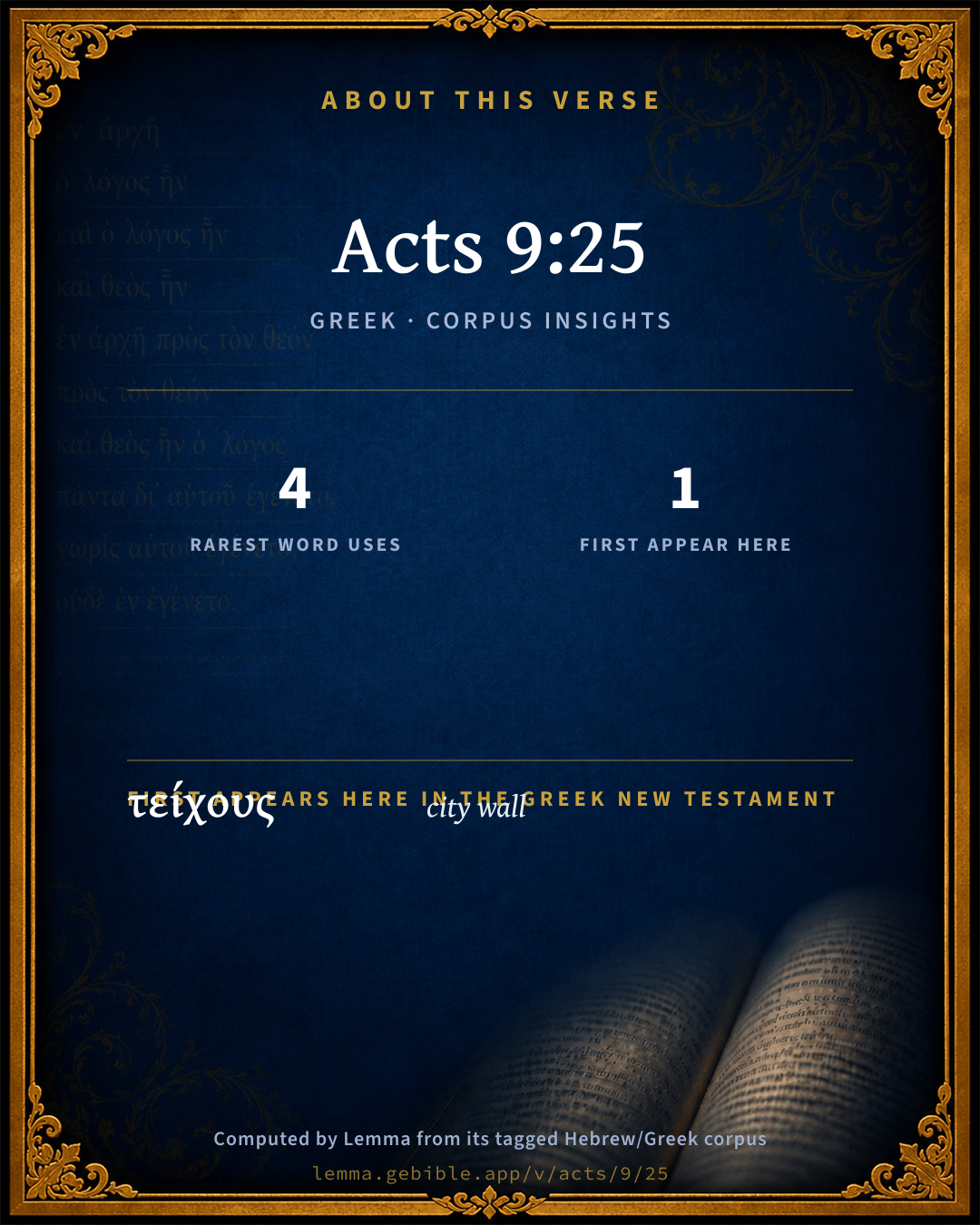
  • 1 first appearance in the Greek New Testament
Full analysis ↓
Download a study sheet

One document with this verse’s original text, its word-by-word gloss line, the meaning frame, cross-references with their text, attributed commentary, and full source and license credits — printable, and it pastes into notes with its structure intact.

This verse Autodidact and up

Study sheet (.html) Plain text (.txt)

A passage Seminary Student

Up to 50 verses in one chapter. A passage sheet keeps up to 6 commentary sources and 12 cross-references per verse, in the order this page ranks them, and says so on the sheet whenever that leaves anything out. Ask for a single verse and you get the Autodidact verse sheet above.

Everything on this page stays free to read, with no account — the sheet is a download of what is already on screen, not access to it.

Want to remove ads? Support Godless Engineer
Compare translations 3

The same verse in 3 English versions, stacked beneath the original-language interlinear above. Click any original word for its lexicon entry.

Each is an independent rendering of the whole verse — the interlinear is not word-aligned to these translations.

Highlighted words mark where these versions differ — a whole-verse word diff, not a word-by-word alignment.

  • World English Bible Public Domain
    but his disciples took him by night, and let him down through the wall, lowering him in a basket.
  • King James Version Public Domain
    Then the disciples took him by night, and let him down by the wall in a basket.
  • unfoldingWord Literal Text CC BY-SA 4.0
    But his disciples, taking him by night, let him down through the wall, lowering him in a basket.

unfoldingWord Literal Text — © unfoldingWord, licensed CC BY-SA 4.0. Word-aligned USFM3 via Door43 (git.door43.org/unfoldingWord/en_ult).

Versions to compare (up to 4)

3 of 4 selected

Show all 19 translations

Every available English version of this verse, each an independent rendering of the whole verse.

  • World English Bible Public Domain
    but his disciples took him by night, and let him down through the wall, lowering him in a basket.
  • Berean Standard Bible Public Domain
    One night, however, his disciples took him and lowered him in a basket through a window in the wall.
  • Majority Standard Bible Public Domain
    One night, however, the disciples took him and lowered him in a basket through a window in the wall.
  • King James Version Public Domain
    Then the disciples took him by night, and let him down by the wall in a basket.
  • American Standard Version (1901) Public Domain
    but his disciples took him by night, and let him down through the wall, lowering him in a basket.
  • Revised Version (1885) Public Domain
    but his disciples took him by night, and let him down through the wall, lowering him in a basket.
  • Geneva Bible (1599) Public Domain
    Then the disciples tooke him by night, and put him through the wall, and let him downe by a rope in a basket.
  • Douay-Rheims (1899) Public Domain
    But the disciples taking him in the night, conveyed him away by the wall, letting him down in a basket.
  • Young's Literal Translation Public Domain
    and the disciples having taken him, by night did let him down by the wall, letting down in a basket.
  • Literal Standard Version CC BY-SA 4.0
    and the disciples having taken him, by night let him down by the wall, letting down in a basket.
  • Unlocked Literal Bible CC BY-SA 4.0
    But his disciples took him by night and let him down through the wall, lowering him in a basket.
  • unfoldingWord Literal Text CC BY-SA 4.0
    But his disciples, taking him by night, let him down through the wall, lowering him in a basket.
  • Darby Bible Public Domain
    but the disciples took him by night and let him down through the wall, lowering him in a basket.
  • World Messianic Bible Public Domain
    but his disciples took him by night and let him down through the wall, lowering him in a basket.
  • Webster's Bible Public Domain
    Then the disciples took him by night, and let him down by the wall in a basket.
  • Free Bible Version CC BY-SA 4.0
    So during the night his followers took him and lowered him down in a basket from an opening in the city wall.
  • Bible in Basic English Public Domain
    But his disciples took him by night and let him down from the wall in a basket.
  • Text-Critical English NT CC BY 4.0
    But the disciples took him by night and let him down through a window in the city wall, lowering him in a basket.
  • Tyndale New Testament (1534) Public Domain
    Then the disciples toke him by night and put him thorow the wall and let him doune in a basket.

Literal Standard Version (2020), Covenant Press — licensed CC BY-SA 4.0. Text via the HelloAO Bible API (eBible.org). Unlocked Literal Bible (unfoldingWord) — licensed CC BY-SA 4.0. Text via the HelloAO Bible API (eBible.org). unfoldingWord Literal Text — © unfoldingWord, licensed CC BY-SA 4.0. Word-aligned USFM3 via Door43 (git.door43.org/unfoldingWord/en_ult). Free Bible Version, Dr. Jonathan Gallagher — licensed CC BY-SA 4.0. Text via the HelloAO Bible API (eBible.org).

Word by word

More ways to search: Search by grammar → Find every occurrence → Compare this word →

Practice this passage: Drill this verse → Learn its vocabulary →

καθῆκαν
kathíēmi
G2524
“to send down”
Verb, Aorist, Active, Indicative, 3rd person, Plural
Part of Speech
Verb
Tense
Aorist
Voice
Active
Mood
Indicative
Person
3rd person
Number
Plural
Full Thayer's Definition

Origin: from G2596 , and hiemi (to send)

TDNT: None

1. to send down, to let down
  1. λαβόντες lambánō G2983 “to take” Verb, Aorist, Active, Participle, Nominative, Plural, Masculine
  2. δὲ dé G1161 “but” Conjunction
  3. οἱ ho G3588 “the” Article, Nominative, Plural, Masculine
  4. μαθηταὶ mathētḗs G3101 “disciple” Noun, Nominative, Plural, Masculine
  5. αὐτοῦ autós G846 “he” Personal pronoun, Genitive, Singular, Masculine
  6. νυκτὸς nýx G3571 “night” Noun, Genitive, Singular, Feminine
  7. διὰ diá G1223 “through” Preposition
  8. τοῦ ho G3588 “the” Article, Genitive, Singular, Neuter
  9. τείχους teîchos G5038 “city wall” Noun, Genitive, Singular, Neuter
  10. αὐτὸν autós G846 “he” Personal pronoun, Accusative, Singular, Masculine
  11. χαλάσαντες chaláō G5465 “to relax” Verb, Aorist, Active, Participle, Nominative, Plural, Masculine
  12. ἐν en G1722 “in” Preposition
  13. σπυρίδι spyrís G4711 “basket” Noun, Dative, Singular, Feminine

About this verse

These counts appear in no published source. They are computed here, from the morphology-tagged text and Lemma’s own curated glosses. What Lemma adds →

14
words
12
distinct lemmas
Acts
section

Notable vocabulary

The rarest word here is καθῆκαν to send down G2524 — appearing just 4 times in the whole Greek New Testament.

First appearance in Scripture

This word makes its first canonical appearance in the Greek New Testament here:

  • τείχους city wall G5038

Shared distinctive vocabulary

καθῆκαν to send down G2524 occurs in 4 verses of the Greek New Testament. Also found in:
Repetition

Words recur within this verse:

  • οἱ the G3588 ×2
  • αὐτοῦ he G846 ×2

Cross-references

3

Topical passages linked to Acts 9:25 in the Treasury of Scripture Knowledge — connected by theme and wording, ordered by reader-vote popularity; previews shown in the World English Bible.

  • Joshua 2:15 Then she let them down by a cord through the window: for her house was on the side of the wall, and she lived on the wall.
  • 2 Corinthians 11:33 Through a window I was let down in a basket by the wall, and escaped his hands.
  • 1 Samuel 19:11–12 Saul sent messengers to David's house, to watch him, and to kill him in the morning: and Michal, David's wife, told him, saying, If you don't save your life tonight, tomorrow you will be slain.

Cross-references courtesy of OpenBible.info (CC BY 4.0).

Where the printed editions differ

1 variant

Places in this verse where the major printed Greek editions disagree on the wording in a way that affects the translation — a comparison of editions, not a manuscript-by-manuscript collation. The editions are the modern critical texts (Nestlé-Aland 28/27, SBL, Westcott-Hort, Tregelles, Tyndale House) and the traditional texts behind the KJV (the Textus Receptus and the Byzantine/Majority text). It is not a claim about which reading is original.

  1. Extra text
    αὐτοῦ

    “of him”

    In NA28NA27TynSBLWHTreg Not in TRByz

    αὐτοῦ (autou) 'of him' is only in older manuscripts (NA28+NA27+Tyn+SBL+WH+Treg)

Textual data: Translators Amalgamated Greek New Testament (STEPBible TAGNT) · CC BY 4.0.

Commentary

Notes on Acts 9:25 from classic Christian and Jewish commentators (each source and its license shown beneath its notes). The classic Christian expositions comment on the surrounding passage and are grouped to its opening verse, so a note may address several verses; the Jewish commentaries on the Tanakh (Rashi and others) are per-verse, so they appear only where the commentator wrote on this verse.

Lemma curates 59 commentaries, every one of them public domain or Creative Commons licensed, each selected and text-cleaned for this edition rather than reprinted as found. About our sources →

Bengel's Gnomon

Johann Albrecht Bengel

Act 9:25. Καθῆκαν, let him down) This fact had been known to but few, before that Paul mentioned it, 2Co 11:31, etc., “The God and Father of our Lord Jesus Christ—knoweth that I lie not.” Luke knew most intimately all the affairs of Paul.

Bengel's Gnomon of the New Testament — English translation (T&T Clark, Edinburgh, 1860) — public domain. Text from a community e-Sword module.

Expositor's Greek Testament

ed. W. Robertson Nicoll

Act 9:25 . οἱ μαθηταὶ if we add αὐτοῦ , see critical notes, the words would apparently refer to Jews converted by Saul, so Chrysostom: “but his disciples” R.V. Alford, who reads αὐτοῦ , supposes that we have here an unusual government of the genitive by λαβόντες , and compares Luk 8:54 and classical instances, see in loco. διὰ τοῦ τείχους : “through the wall,” R.V., cf. 2Co 11:33 , where we read διὰ θυρίδος … διὰ τοῦ τεὶχους , perhaps a window in the external face of the wall opening into the house on the inside, rather than simply a window of a house overhanging the wall; cf. Jos 2:16 , 1Sa 19:12 . Blass takes it of a window made “in ipso muro scil. ad tormenta mittenda,” but there is no need for this explantion; see Hackett’s note on his own observations at Damascus of two or three windows built in the wall as above. χαλάσαντες ἐν σπυρίδι .: “lowering him,” R.V., not expressed in A.V.; on spelling of σπυρ . see critical note. In 2Co 11:33 Paul uses the word σαργάνη , a basket of wickerwork, σπυρ . a basket larger than the κόφινος , the small hand-basket of the Jew, Juv. , iii., 14; vi., 541, probably a provision basket of considerable size, used as by the Paeonians for fishing, Herod. , v., 16. σαργάνη too is used of a fish basket by Timokles, Ληθ ., i., see further, “Basket,” Hastings’ B.D., and Plummer on Luk 9:17 . Neither word is met with in the LXX or Apocrypha. For the naturalness of the incident according to the present customs of the country see Hackett, in loco. The traditional spot of its occurrence is still shown, but we can only say of it as of the “house of Judas,” see above on Act 9:2 . Wendt, p. 35 (1899), thinks that here we have a coincidence with the account in 2 Cor., which cannot be accounted for except by the acquaintance of the author of Acts with the Epistle.

The Expositor's Greek Testament, edited by W. Robertson Nicoll (1897–1910) — public domain. Text from a community e-Sword module.

Geneva Bible (1599)

Geneva Bible translators

We are not forbidden to avoid and eschew the dangers and conspiracies that the enemies of God lay for us, so that we swerve not from our vocation.

Geneva Bible (1599) marginal notes — public domain. Text via Bolls.life.

Jamieson, Fausset & Brown

Robert Jamieson, A. R. Fausset & David Brown

Then the disciples . . . by night let him down--"through a window" (Co2 11:33).

by the wall--Such overhanging windows in the walls of Eastern cities were common, and are to be seen in Damascus to this day.

Jamieson, Fausset & Brown — Commentary Critical and Explanatory on the Whole Bible (1871) — public domain (CC PDM 1.0). Text via the HelloAO Bible API.

Adam Clarke's Commentary

Verse 25. Let him down, by the wall] Favoured, probably, by a house built against or upon the wall, through the window of which they could lower him in a basket; and by this means he made his escape. His escape was something similar to that of the spies at Jericho, Jos 2:15.

Adam Clarke's Commentary on the Bible (1810–1826) — public domain. Text from a community e-Sword/MySword module.

John Calvin's Commentaries

25. The disciples having taken him by night. There is a question moved here, whether it were lawful for the disciples to save Paul thus or no? and also, whether it were lawful for Paul to escape danger by this means or no? For the laws say that the walls of cities are holy, [sacred,] and that the gates are holy. Therefore, he ought rather to have suffered death, than to have suffered a public order to be broken for his sake. I answer, that we must consider why it is decreed by the laws that the walls should not be violated; to wit, that the cities may not be laid open to murders and robberies, and that the cities may be free from treason. That reason ceaseth when the question is concerning the delivery of an innocent man. Therefore, it was no less lawful for the faithful to be let down in a basket, than it shall be lawful for any private person to leap over a wall, that he may avoid the sudden invasion of the enemy. Cicero doth handle this latter member, and he setteth down very well, that although the law forbid a stranger to come near the wall, yet doth not he offend who shall go up upon the wall to save the city, because the laws must always be inclined to equity. Therefore Paul is not to be blamed, because he escaped by stealth, seeing that he doth that without raising any tumult amongst the people. Nevertheless, we see how the Lord useth to humble those that be his, seeing that Paul is enforced to steal his life from the watchmen of the city if he will save himself. Therefore, he reckoneth this example amongst his infirmities. He was acquainted betime with the cross with this first exercise.

John Calvin's Commentaries (1540-1563) — public domain. Text from the Calvin Translation Society English edition (1840s-50s) via the Christian Classics Ethereal Library (ccel.org). Calvin's coverage is partial (roughly two-thirds of the Bible); uncommented books and verses are honest gaps, never fabricated. The 19th-century editor's footnotes and remarks are omitted so the notes are faithfully Calvin's own voice.

Ellicott's Commentary for English Readers

(25) Let him down by the wall in a basket.—The basket is the spuris of Mat_15:37, where see Note. In 2Co_11:33 St. Paul describes it by another word (sarganè), which gives the idea of a wicker or rope-work hamper. It seems to follow, from the tone in which the Apostle there speaks of this adventure, that it had been made matter of ridicule. It is connected in his thoughts with the “infirmities” (probably with his smallness of stature) of which he was content to boast. The escape was effected, like that of the spies from the house of Rahab (Jos_2:15) and of David from his own house (1Sa_19:11), through an opening or “window” in the town wall. Such a window is still shown in the wall of Damascus as the traditional scene of the escape.

A Bible Commentary for English Readers, edited by Charles John Ellicott (1878–1897) — public domain. Text from a community e-Sword module.

The Cambridge Bible for Schools and Colleges

gen. ed. J. J. S. Perowne

25. Then the disciples took him by night] The oldest MSS. read “But his disciples, &c.,” and this well-supported reading favours the explanation of the “many days” given in Act_9:24. On his second visit Saul had remained long enough to nave gathered round him a party of followers who accepted him as their teacher.

and let him down by [through] the wall in a basket] In 2Co_11:33 St Paul says, “And through a window in a basket was I let down by the wall and escaped.” Such apertures can be found in the walls of houses in all defenced cities, and it was by such a way that Rahab let the spies escape from Jericho (Jos_2:15), and Michal aided David’s escape (1Sa_19:12). The basket here mentioned (spuris) is the same that is spoken of (Mat_15:37) at the feeding of the four thousand in the mountain district west of the Sea of Galilee. It appears to have been large and soft, fit for carrying a large quantity of miscellaneous articles from the plain into the hills, while the baskets (cophinoi) spoken of at the feeding of the five thousand (Mat_14:20) were such as the multitude, which in that case had followed Jesus on foot out of the cities, would be likely to carry in their hands. In a basket of the former kind Saul might easily be wrapped and then lowered over the city wall.

The Cambridge Bible for Schools and Colleges (gen. ed. J. J. S. Perowne; Cambridge University Press, 1878–1918) — public domain. Text from a community e-Sword module.

John Gill's Exposition

And when Saul was come to Jerusalem,.... After he had escaped out of Damascus, in the manner before related, and which was three years after his conversion:

he assayed to join himself to the disciples; not to the private members of the church, or ordinary disciples, as distinct from the apostles, but to the whole society, as consisting of apostles and private Christians; for his chief view in going to Jerusalem was to see Peter; and the Ethiopic version reads, "to the apostles": the sense is, that he tried either to get into a free and familiar conversation with them, or to become one of their body, and a member of the church. He did not return to the high priest from whom he had received letters to Damascus, to give him an account of the execution of his commission, or what use he had made of the letters he gave him, but to the disciples, against whom he had breathed out threatenings and slaughter. Grace had made a strange alteration in him; those whom he hated, and was exceeding mad against, he now loves; they are the excellent ones in the earth in whom is all his delight; and whom he persecuted to strange cities, he now courts their company, and attempts to get among them; accounting it his greatest honour and happiness to be one of their society. It is the duty and interest of every gracious soul to join himself to a church of Christ, which consists of the disciples of Christ, as the church at Jerusalem did; of such who have learned Christ, and the way of life and salvation by him; who have believed in him, and have been taught to deny themselves for his sake, and to take up the cross and follow him, in the way of his ordinances and appointments; and to be "joined" to a church, is to become an open subject of Christ's kingdom, a citizen of the heavenly Jerusalem, one of the family of God, and a member of the body of Christ visibly. The phrase is expressive of that strict union there is between the saints in church relation, and of that close and intimate communion they have with each other, and shows that their incorporation together is by mutual consent and agreement. And a great privilege it is to be in such a relation, having the grace of God; for such have the best of company, and the most refreshing ordinances; are in the greatest safety, being under the watch and care of ministers and members, of angels, and of God himself; and shall never be disfranchised, or become foreigners and strangers; they may expect the presence of God, fresh supplies of his grace, and even life for evermore, and need fear no enemy. That which qualifies for church membership, is not natural descent from religious parents, nor a religious education, nor mere morality and civility, nor even a constant attendance on the word of God, but faith in Christ Jesus, and a profession of it; and according to the order of the Gospel it is necessary that baptism in water should go before it; and these qualifications the apostle had.

But they were all afraid of him; knowing him to have been such an enemy to Christ, and so violent a persecutor of his church in times past:

and believed not that he was a disciple; or a true follower of Christ, but only pretended to be one, having some wicked design upon them in attempting to get among them: the reason of their not knowing anything of his conversion might be, because not only of the distance between Damascus and Jerusalem, and the continuance of the persecution in the latter place, which might occasion few comers to and fro of the Christians; but because the apostle, soon after his conversion, went to Arabia, where he had been all this while. Hence it appears, that the primitive churches were very careful in the admission of persons into fellowship with them; as they could not bear them in their communion who were evil, so they would not admit any among them but such as they looked upon to be the true disciples of Christ: and this is a method worthy of imitation; and such persons who, before a profession of religion, have been either very scandalous in their lives and conversations, or notorious enemies to Christ and his Gospel, ought to be thoroughly examined into, and full satisfaction obtained concerning them, ere they be received into the bosom of the church.

John Gill's Exposition of the Whole Bible (1746–1763) — public domain (CC PDM 1.0). Text via the HelloAO Bible API.

Trapp's Complete Commentary

John Trapp

25 Then the disciples took him by night, and let him down by the wall in a basket.

Ver. 25. Let him down, &c.] It is not unlawful then to fly in some cases. Tertullian was too rigid in condemning all kinds of flight, in time of persecution; God hath not set us as standing marks, or butts, to be shot at.

John Trapp, A Commentary or Exposition upon All the Books of the Old and New Testament (1647–1656) — public domain. Text from a community e-Sword module.

Albert Barnes' Notes on the Bible

Took him by night ... - This was done through a window in the wall, 2Co 11:33.

In a basket - This word is used to denote commonly “the basket in which food was carried,” Mat 15:37; Mar 8:8, Mar 8:20. It was in this way that Rahab let down the spies Jos 2:15, and so David escaped from Saul, 1Sa 19:12. Probably this occurred in an unguarded part of the wall, where some overhanging houses, as is usual in Eastern cities, opened into the outer country. This conduct of Saul was in accordance with the direction of the Lord Jesus Mat 10:23, “When they persecute you in one city, flee ye into another,” etc. Saul was certain of death if he remained; and as he could secure his life by flight without abandoning any principle of religion, or denying his Lord, it was his duty to do so. Christianity requires us to sacrifice our lives only when we cannot avoid it without denying the Saviour, or abandoning the principles of our religion.

Albert Barnes' Notes on the Bible (1834–1885) — public domain. Text from a community e-Sword/MySword module.

Matthew Poole's English Annotations

As Rahab did the spies, Jos 2:15, and Michal did David, 1Sa 19:12.

Matthew Poole's English Annotations on the Holy Bible (1683–1685) — public domain. Text from a community e-Sword/MySword module.

Whedon's Commentary on the Bible

Daniel D. Whedon

25. By the wall—The base or window of a house projecting beyond the wall allowed Saul to be let down without, and so escape.

Daniel D. Whedon (gen. ed.), Commentary on the Old and New Testaments (1874–1909) — public domain. Text from a community e-Sword module.

The Pulpit Commentary

The beginning of perils for Paul.

To this beginning of "perils" Paul will often in later days of life have looked back. He did not live to any prolonged period, but if he had, there is not a length of life so long nor charged with changes so violent as to be able to cut off from us the effects of the touching comparisons and the telling contrasts of beginning and ending. Many a broken portion of life offers us such effects; but how much more moving those of life itself! Long was the list of perils and sufferings, varied and sharp the discipline of them; but when the rehearsal of them comes, (2Co_11:16-33) it speaks a perseverance unbroken, a courage unquenched, a heart, fidelity, love, stronger and more determined than ever. That rehearsal somewhat remarkably closes with the mention of the first peril of Paul, as here given us, as though his memory, deliberately traveling backward, reached last that which life brought to him first. The opportunity may be seized for considering at least one side of the great service of suffering. It must be a ministry full of expression, full of meaning, full of deep feeling, and, if not made full of use also, it must be of all loss "most miserable." In the present connection let us observe that

I IT TESTS A CAUSE, OF WHAT SORT IT IS. With rare exceptions, it may be said that the cause which bears the test of suffering, and of much suffering, will be a cause alike great and good. Human hearts, strong though they be, are not strong enough to bear gratuitously a vast amount of suffering. The vast amount of the worst sort of suffering that sin entails, that comes inevitably in its wake, is of course not in the place for a test, and cannot operate as such. The abundant presence of it, therefore, where it is, does not invalidate the position. The cause that asks suffering to espouse it, to sustain it, to carry it to completion, is self-hedged around as with some sovereign safeguard. The frivolous will not come near it, and the great multitude will pay no court to it. But:

1. If it arrest the attention, kindle the enthusiasm, win the practical confidence of a few, and those, perhaps, the thoughtful, the useful, the unselfish, it is a considerable augury of something substantial and substantial good in it.

2. Enthusiasm can do very great things for an hour. It will encounter and even court any amount of suffering. We cannot, therefore, consider taking service in a cause that imposes suffering any decisive test. The test, however, becomes much more decisive when that service is persevered in, still entailing suffering, year after year, and on to the maturity of life.

3. The highest kind of human test is reached when the cause is one persevered in to the very end of life, through suffering all the way and almost every step. The enterprise that can secure this allegiance says as much for itself as any enterprise on earth can, and the best. And this is abundantly the case with Christianity. When Saul embraced it, it meant peril, and labor, and privation, and much direct suffering. But, "being persuaded of it, he embraced it," and was faithful to it through the succeeding periods and phases of his own earthly career, and up to the very last. Then in old age, beaten and weather-beaten, in prison and in chains and bonds, he does not dream of repenting or of recanting, but says, "I am not ashamed," and bids others follow in his steps. (2Ti_1:12) If it had been a flowery path and an easy career, Paul"s perseverance would have been no argument for it. But because it was a suffering career, his perseverance spoke, not his praise alone, but that of his Master"s cause yet more. How many a cause will waken enthusiasm! how few will sustain it! How many will beg it! how few reward it! There is the difference of a world, ay, of two worlds, between the two.

II SUFFERING TESTS A MAN, OF WHAT SORT HE IS. If any one persevere in fighting a suffering battle, it is certainly so far forth an argument for the object of the battle. But if he do not fight the battle, or beginning do not carry out to the end the struggle, it by no means condemns the cause. The question will have to be settled whether blame lie with the cause or whether it do not rather lie with the person.

1. Suffering for the individual tries high moral quality and improves it.

2. Suffering tries many individual virtues and graces those of faith, of hope, of perseverance, of love that fires cannot burn away nor death destroy. And it unfailingly improves them.

3. Suffering certainly tends to fix and give clear "evidence" to an unearthly type of character.

4. Suffering lends distinctness to conviction, to purpose, to achievement. It is a disinfectant, an alterative, and a tonic all in one. Pleasure and indulgence enfeeble, that is, they tend to enfeeble and to enervate, once past a very moderate amount. Suffering, short of an excessive amount of it, makes keen the faculty, the sight, the soul itself! Wonderful is its bracing effect on body and mind, on heart and life.

III SUFFERING BECOMES SOMETIMES THE OCCASION OF A GREAT MORAL DISPLAY IN THE WORLD. Beside the uses of suffering in the good fruits it produces on individual character; and beside its use as a test, whether of worth in an enterprise or of strength in a person, it cannot be denied that it lends itself to special moral service, often on a large scale and in a wide theatre. Against it all nature rebels. For that very reason, when it is voluntarily encountered, patiently borne, and embraced even to the cross, to stoning, to torture, and the stake, the world has no help for it but to notice what is transpiring. An unwilling world is put into the dilemma that it is either convinced or convicted. The confession is wrested from all beholders that there is something present which begs and deserves close scrutiny and respectful attention, or that they are in any given instance deserting precedents that in all others they have observed. When the testimony of suffering is shown forth in one, the force of it will partly depend on the notoriety that his conduct may win, and it may undoubtedly be weakened by the suspicion of individual eccentricity until this again be rebutted. But when the testimony is borne by many and for a length of time, it is equivalent to the presence of a new and very real moral force among mankind, many of the grandest and most impressive triumphs of Christianity have been owing to this, and many of its most significant impulses have been due to it. Men and suffering have calmly faced one another, have measured the force of one another; neither have shrunk from the wager men have not fled and suffering has not yielded up its sting. And yet they have made common cause, and have made also most wonderfully effective fight. Something in man, given him from without and from above, has made him fearless of what all nature made him to fear. It is an exhibition in the arena of the world; it never fails of having witnesses; it always leaves its traces. And the Paul of perils and sufferings ever stands one of the clearest and noblest illustrations of a great and effectual moral display. B.

The Pulpit Commentary (1880–1919), ed. H.D.M. Spence-Jones & Joseph S. Exell — public domain. Text from a community e-Sword module.

McGarvey & Pendleton's Commentaries

J. W. McGarvey

See notes on verse 23

J. W. McGarvey (with Philip Y. Pendleton), Commentaries on the New Testament (The Fourfold Gospel, 1914; Acts; and the epistles) — public domain. Text from a community e-Sword/MySword module.

The People's New Testament

B. W. Johnson

25. Let him down by the wall. As the gates were guarded, there was no escape that way. Houses built against or on the wall, would afford an opportunity of letting him down on the outside. “And through a window, in a basket, was I let down by the wall and escaped his hands” (2 Cor. 11:33).

B. W. Johnson's The People's New Testament with Notes (1889–1891) — public domain. Electronic text from the Christian Classics Ethereal Library (CCEL) ThML edition.

Cambridge Greek Testament for Schools and Colleges

25. λαβόντες δὲ οἱ μαθηταὶ αὐτοῦ κ.τ.λ., but his disciples took him by night and, &c. This well-supported reading favours the explanation of ἡμέραι ἱκαναί given in Act 9:23. On his second visit to Damascus, more than ever filled with the Spirit, he stayed long enough to gather about him a band of followers who accepted him as their leader in spiritual things.

διὰ τοῦ τείχους, through the wall, i.e. by some opening in the wall, on which probably stood, as is often the case in Eastern cities, some of the dwelling-houses. In 2Co 11:33 St Paul says, ‘and through a window in a basket was I let down by the wall and escaped.’ Such apertures can be found in the walls of houses in all defenced cities, and it was by such a way that Rahab let the spies escape from Jericho (Jos 2:15), and Michal aided David’s escape (1Sa 19:12). The basket here mentioned (σπυρίς) is of the same kind as that spoken of (Mat 15:37) at the feeding of the Four Thousand in the mountain district west of the Sea of Galilee. It appears to have been large and soft, fit for carrying a great quantity of miscellaneous articles from the plain into the hills, while the baskets (κόφινοι) spoken of at the feeding of the Five Thousand (Mat 14:20) were such as the multitude, which in that case had followed Jesus on foot out of the cities, would be likely to carry in their hands. In a basket of the former kind Saul might easily be wrapped and then lowered over the city wall.

Cambridge Greek Testament for Schools and Colleges (Cambridge University Press, 1896; 21 vols, various authors incl. Carr, Maclear, Plummer, Farrar, Lumby, Moule, M. R. James, Simcox) — public domain. Text from a community e-Sword module.

Alford’s Greek Testament

Henry Alford

25.] The reading in the text, λαβ. οἱ μαθηταὶ αὐτοῦ, is ambiguous, Chrys. (see in var. readd.), al. take it as if Saul had disciples of his own who did this. The only escape from this inference is by supposing an unusual government of a gen. by λαβόντες, such as we sometimes find in Homer, e.g. ἀγκὰς λαβέτην ἀλλήλων, Il. ψ. 711; Ὀδυσῆος λάβε γούνων, Od. χ. 310: see also Il. γ. 369, θ. 371; Od. ε. 428, τ. 480. So we have κρατήσας τῆς χειρὸς αὐτῆς, Luk 8:54. But whether this is justified in a case where the whole person is concerned, as here, may be a question. If it is, it must be because not the taking and bringing him to the spot, but the act of laying hold of him to put him into the basket, is intended.

διὰ τ. τείχους] Further particularized by the addition of διὰ θυρίδος, 2Co 11:33. Such windows in the walls of cities are common in the East: see Jos 2:15, 1Sa 19:12: and an engraving of part of the present wall of Damascus in C. and H. i. p. 124.

σπυρίδι] σαργάνη, 2Co 11:33. See note there, and on Mat 15:37.

Henry Alford, The Greek Testament (1849–1861) — public domain. Text from a community e-Sword module.

Vincent's Word Studies in the New Testament

Marvin R. Vincent

By the wall [δια του τειχους] . Rev., more accurately, through the wall, as is explained by 2Co 11:33. Either through the window of a house overhanging the wall, or through a window in the wall itself opening to houses on its inner side. Hackett says that he observed such windows in the wall at Damascus. On the mode of escape, compare Jos 2:15; 1Sa 19:12.

Basket [σπυριδι] . See on Mt 14:20. In Paul 's account of this adventure he uses sarganh, a plaited or braided basket of wicker - work; or, as some think, of ropes.

Marvin R. Vincent, Word Studies in the New Testament (1887–1900) — public domain. Text from a community e-Sword/MySword module.

Lesson kit

Teaching starters — assembled from the data on this page, not authored interpretation. Every prompt links to the verse data it draws on. Edit before teaching.

Acts, in the Acts, opens this verse with 14 words (12 distinct Greek lemmas). Its most distinctive word is kathíēmi (“to send down”). A historical commentator’s framing appears above. Read the whole chapter for the surrounding context.

Discussion questions

  1. What does “to send down” (kathíēmi) contribute to the verse as a whole?
  2. This is the first place “city wall” appears in Scripture (first appears here). What does its debut here establish?
  3. How does Luke 5:19, which shares the word «to send down», read alongside this verse?
  4. What does the repetition of “the” (2× in this one verse) do in this verse?
  5. The translations on this page render this verse differently — a whole-verse word diff, not a word-by-word alignment. What might account for the different wordings?
  6. Compare how Bengel's Gnomon and Expositor's Greek Testament read this verse. Where do they agree or differ?

Things to notice

  • 1 word makes its first canonical appearance in Scripture here.
  • These translations choose different wording for 4 words in this verse.
  • “the” occurs 2× in this single verse.
  • 12 distinct Greek lemmas span 14 words in this verse.

Reading settings

Reading text

Shown beneath each verse's original-language words.

Old Testament
Old Testament edition

Read the OT as the Masoretic Hebrew (MT) or the Greek Septuagint (LXX).

English shown for the Greek Septuagint (in the Hebrew ↔ Greek comparison).

Comparing translations? Open the Compare panel on any verse page to stack up to four side by side.