
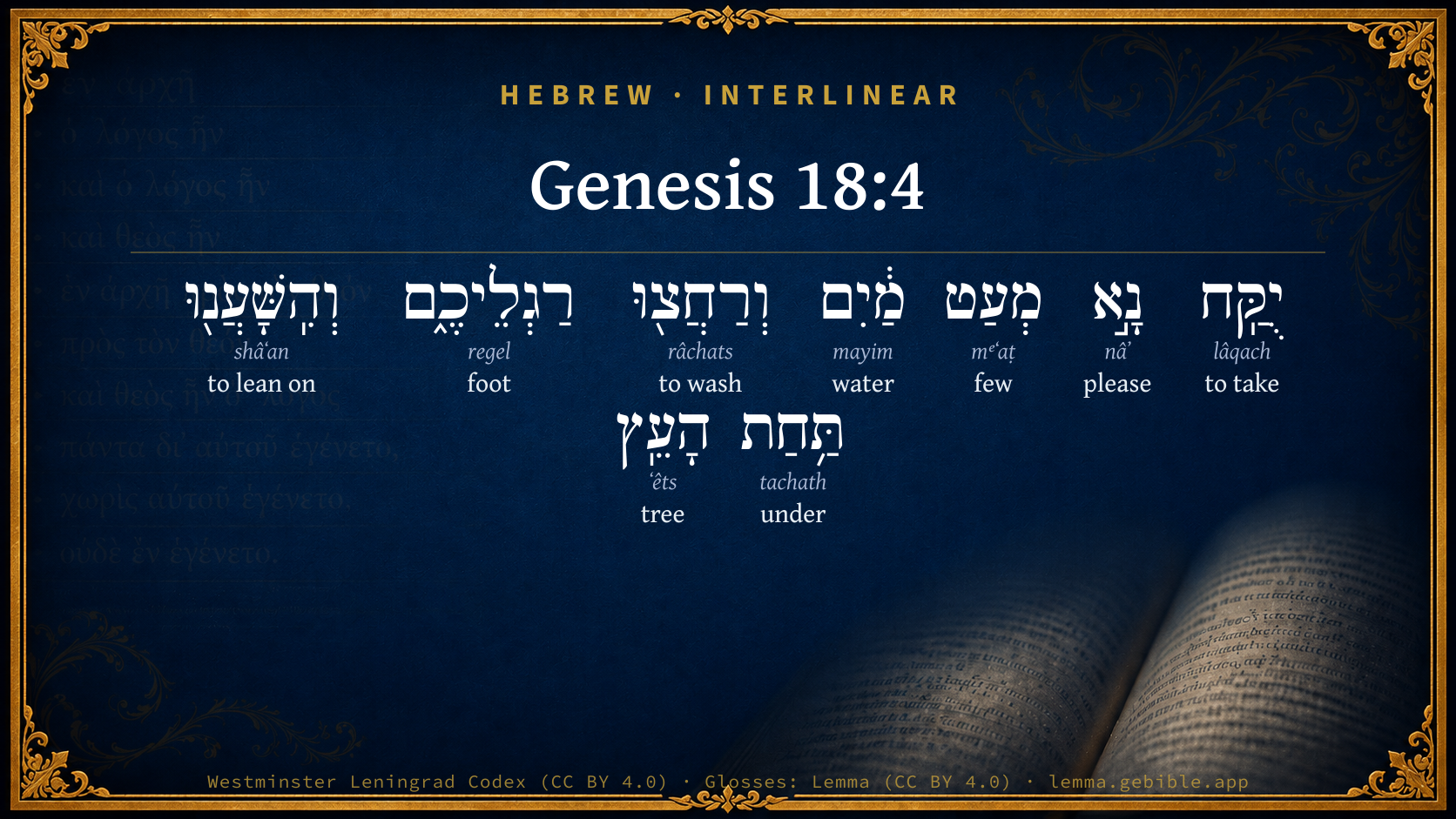
Genesis 18:4

Hebrew (Westminster Leningrad Codex) Genesis 18:4 appears in the Hebrew Old Testament. The text above is from the Westminster Leningrad Codex. Each word links to its Strong’s number, a concise gloss, and parsing drawn from the Open Scriptures Hebrew Bible morphology. Click any word for its full Brown-Driver-Briggs (BDB) entry.
Download image
Cite this verse

Genesis 18:4 (World English Bible). Public Domain. Lemma interlinear Bible study tool, https://lemma.gebible.app/v/genesis/18/4.

Show BibTeX & RIS
BibTeX
RIS
English Translation
Now let a little water be fetched, wash your feet, and rest yourselves under the tree.
World English Bible · Public Domain
Highlights
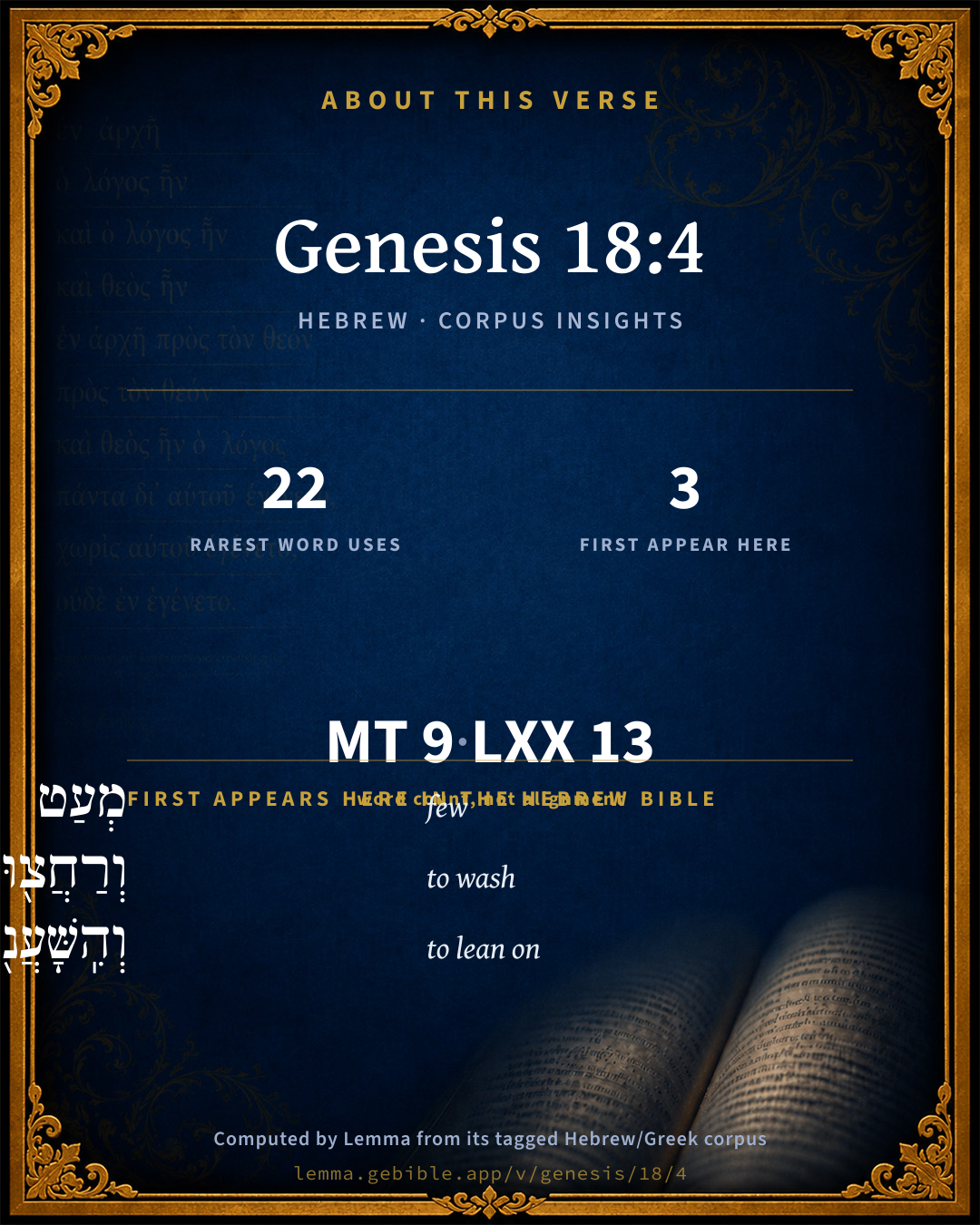
  • 3 first appearances in the Hebrew Bible
Full analysis ↓
Download a study sheet

One document with this verse’s original text, its word-by-word gloss line, the meaning frame, cross-references with their text, attributed commentary, and full source and license credits — printable, and it pastes into notes with its structure intact.

This verse Autodidact and up

Study sheet (.html) Plain text (.txt)

A passage Seminary Student

Up to 50 verses in one chapter. A passage sheet keeps up to 6 commentary sources and 12 cross-references per verse, in the order this page ranks them, and says so on the sheet whenever that leaves anything out. Ask for a single verse and you get the Autodidact verse sheet above.

Everything on this page stays free to read, with no account — the sheet is a download of what is already on screen, not access to it.

Want to remove ads? Support Godless Engineer
Compare translations 3

The same verse in 3 English versions, stacked beneath the original-language interlinear above. Click any original word for its lexicon entry.

Each is an independent rendering of the whole verse — the interlinear is not word-aligned to these translations.

Highlighted words mark where these versions differ — a whole-verse word diff, not a word-by-word alignment.

  • World English Bible Public Domain
    Now let a little water be fetched, wash your feet, and rest yourselves under the tree.
  • King James Version Public Domain
    Let a little water, I pray you, be fetched, and wash your feet, and rest yourselves under the tree:
  • unfoldingWord Literal Text CC BY-SA 4.0
    Please let a little water be brought. Then you can wash your feet, and rest yourselves under the tree.

unfoldingWord Literal Text — © unfoldingWord, licensed CC BY-SA 4.0. Word-aligned USFM3 via Door43 (git.door43.org/unfoldingWord/en_ult).

Versions to compare (up to 4)

3 of 4 selected

Show all 18 translations

Every available English version of this verse, each an independent rendering of the whole verse.

  • World English Bible Public Domain
    Now let a little water be fetched, wash your feet, and rest yourselves under the tree.
  • Berean Standard Bible Public Domain
    Let a little water be brought, that you may wash your feet and rest yourselves under the tree.
  • Majority Standard Bible Public Domain
    Let a little water be brought, that you may wash your feet and rest yourselves under the tree.
  • King James Version Public Domain
    Let a little water, I pray you, be fetched, and wash your feet, and rest yourselves under the tree:
  • American Standard Version (1901) Public Domain
    let now a little water be fetched, and wash your feet, and rest yourselves under the tree:
  • Revised Version (1885) Public Domain
    let now a little water be fetched, and wash your feet, and rest yourselves under the tree:
  • Geneva Bible (1599) Public Domain
    Let a litle water, I pray you, be brought, and wash your feete, and rest your selues vnder the tree.
  • Douay-Rheims (1899) Public Domain
    And he said: Lord, if I have found favour in thy sight, pass not away from thy servant:
  • Young's Literal Translation Public Domain
    let, I pray thee, a little water be accepted, and wash your feet, and recline under the tree;
  • Literal Standard Version CC BY-SA 4.0
    please let a little water be accepted, and wash Your feet, and recline under the tree;
  • Unlocked Literal Bible CC BY-SA 4.0
    Let a little water be brought, wash your feet, and rest yourselves under the tree.
  • unfoldingWord Literal Text CC BY-SA 4.0
    Please let a little water be brought. Then you can wash your feet, and rest yourselves under the tree.
  • Darby Bible Public Domain
    Let now a little water be fetched, that ye may wash your feet, and rest yourselves under the tree.
  • World Messianic Bible Public Domain
    Now let a little water be fetched, wash your feet, and rest yourselves under the tree.
  • Webster's Bible Public Domain
    Let a little water, I pray you, be brought, and wash your feet, and rest yourselves under the tree:
  • Free Bible Version CC BY-SA 4.0
    Let me have some water brought so you can wash your feet and rest under the tree.
  • Bible in Basic English Public Domain
    Let me get water for washing your feet, and take your rest under the tree:
  • JPS Tanakh (1917) Public Domain
    Let now a little water be fetched, and wash your feet, and recline yourselves under the tree.

Literal Standard Version (2020), Covenant Press — licensed CC BY-SA 4.0. Text via the HelloAO Bible API (eBible.org). Unlocked Literal Bible (unfoldingWord) — licensed CC BY-SA 4.0. Text via the HelloAO Bible API (eBible.org). unfoldingWord Literal Text — © unfoldingWord, licensed CC BY-SA 4.0. Word-aligned USFM3 via Door43 (git.door43.org/unfoldingWord/en_ult). Free Bible Version, Dr. Jonathan Gallagher — licensed CC BY-SA 4.0. Text via the HelloAO Bible API (eBible.org).

Word by word

More ways to search: Search by grammar → Find every occurrence → Compare this word →

Practice this passage: Drill this verse → Learn its vocabulary →

וְהִֽשָּׁעֲנ֖וּ
shâʻan
H8172
“and · lean on”
Conjunction + Verb, Niphal, Imperative, 2nd Person, Masculine, Plural
Part of Speech
Conjunction + Verb
Stem
Niphal
Form
Imperative
Person
2nd Person
Gender
Masculine
Number
Plural
Full BDB Definition

Origin: a primitive root

TWOT: 2434

to lean on, trust in, support - (Niphal) to lean, lean upon, support oneself - of trust in God (figuratively)
  1. יֻקַּֽח lâqach H3947 “to take” Verb, Qal Passive, Jussive, 3rd Person, Masculine, Singular
  2. נָ֣א nâʼ H4994 “please” Particle, Exhortation
  3. מְעַט mᵉʻaṭ H4592 “few of” Noun, Common, Masculine, Singular, Construct
  4. מַ֔יִם mayim H4325 “water(s)” Noun, Common, Masculine, Plural, Absolute
  5. וְרַחֲצ֖וּ râchats H7364 “and · wash” Conjunction + Verb, Qal, Imperative, 2nd Person, Masculine, Plural
  6. רַגְלֵיכֶ֑ם regel H7272 “feet · your” Noun, Common, Feminine, Dual, Construct + Suffix, Personal, 2nd Person, Masculine, Plural
  7. תַּ֥חַת tachath H8478 “under” Preposition
  8. הָעֵֽץ ʻêts H6086 “the · tree” Particle, Definite Article + Noun, Common, Masculine, Singular, Absolute

About this verse

These counts appear in no published source. They are computed here, from the morphology-tagged text and Lemma’s own curated glosses. What Lemma adds →

9
words
9
distinct lemmas
Pentateuch
section

Notable vocabulary

The rarest word here is וְהִֽשָּׁעֲנ֖וּ to lean on H8172 — appearing just 22 times in the whole Hebrew Bible.

First appearance in Scripture

These words make their first canonical appearance in the Hebrew Bible here:

  • מְעַט few H4592
  • וְרַחֲצ֖וּ to wash H7364
  • וְהִֽשָּׁעֲנ֖וּ to lean on H8172

Shared distinctive vocabulary

וְהִֽשָּׁעֲנ֖וּ to lean on H8172 occurs in 20 verses of the Hebrew Bible. Also found in:

Grammatical profile

  • 3 verbs
  • 4 nouns
  • 1 preposition
  • 1 particle

Verb forms

  • יֻקַּֽח Qal Passive · Jussive
  • וְרַחֲצ֖וּ Qal · Imperative
  • וְהִֽשָּׁעֲנ֖וּ Niphal · Imperative

Hebrew & Septuagint length

In English translation the verse runs 16 words from the Hebrew and 19 from the Septuagint (LXX English) — closely comparable.

A rough comparison of the two English renderings, which tokenize alike — not a word-level alignment.

Word counts can differ between the Hebrew and the Greek without any difference in meaning — e.g. the Hebrew direct-object marker אֵת has no separate Greek word, and Greek often adds the article ὁ.

In the original languages it is 9 Hebrew tokens and 13 Greek tokens — but the two are counted differently (Hebrew bundles its prefixes and suffixes into one token; the Greek is in lemma form), so that isn’t a like-for-like length.

Cross-references

7

Topical passages linked to Genesis 18:4 in the Treasury of Scripture Knowledge — connected by theme and wording, ordered by reader-vote popularity; previews shown in the World English Bible.

  • Genesis 19:2 and he said, "See now, my lords, please turn aside into your servant's house, stay all night, wash your feet, and you will rise up early, and go on your way." They said, "No, but we will stay in the street all night."
  • Genesis 24:32 The man came into the house, and he unloaded the camels. He gave straw and provender for the camels, and water to wash his feet and the feet of the men who were with him.
  • Genesis 43:24 The man brought the men into Joseph's house, and gave them water, and they washed their feet. He gave their donkeys fodder.
  • Luke 7:44 Turning to the woman, he said to Simon, "Do you see this woman? I entered into your house, and you gave me no water for my feet, but she has wet my feet with her tears, and wiped them with the hair of her head.
  • 1 Samuel 25:41 She arose, and bowed herself with her face to the earth, and said, Behold, your handmaid is a servant to wash the feet of the servants of my lord.
  • John 13:5–15 Then he poured water into the basin, and began to wash the disciples' feet, and to wipe them with the towel that was wrapped around him.
  • 1 Timothy 5:10 being approved by good works, if she has brought up children, if she has been hospitable to strangers, if she has washed the saints' feet, if she has relieved the afflicted, and if she has diligently followed every good work.

Cross-references courtesy of OpenBible.info (CC BY 4.0).

Hebrew and Greek witnesses Masoretic Hebrew ↔ Greek Septuagint

The same verse in the two great witnesses to the Old Testament, shown verse-for-verse.

These are two independent witnesses, not word-aligned to each other, and the Septuagint is shown in lemma (dictionary) form.

Hebrew Genesis 18:4 Masoretic · Westminster Leningrad Codex

יֻקַּֽח נָ֣א מְעַט מַ֔יִם וְרַחֲצ֖וּ רַגְלֵיכֶ֑ם וְהִֽשָּׁעֲנ֖וּ תַּ֥חַת הָעֵֽץ

Now let a little water be fetched, wash your feet, and rest yourselves under the tree.

World English Bible · Public Domain

Greek LXX Genesis 18:4 Septuagint · lemma form

λαμβάνω δή ὕδωρ καί νίπτω ὁ πούς σύ καί καταψύχω ὑπό ὁ δένδρον

Let water now be brought, and let them wash your feet, and do you⌃ refresh yourselves under the tree.

LXX2012 (modern English Septuagint) · Public Domain

Hebrew: Westminster Leningrad Codex (CC BY 4.0). Greek: Septuagint (public domain); English from LXX2012 (modern English Septuagint) (Public Domain). How the Septuagint differs from the Hebrew →

Targum (Aramaic paraphrase)

2

The Targum is the ancient Jewish Aramaic paraphrase of the Hebrew Scriptures — an interpretive translation, not the Hebrew text itself. Onkelos (literal) and Pseudo-Jonathan (expansive) render the Torah, and Jonathan the Prophets. Coverage is partial: where no permissively-licensed English translation exists for a verse, only the Aramaic is shown. This is verse-level text, not a word-by-word alignment to the Hebrew.

  1. Targum Onkelos Torah (Genesis–Deuteronomy)
    יִסְּבוּן כְּעַן זְעֵיר מַיָּא וְאַסְחוּ רַגְלֵיכוֹן וְאִסְתְּמִיכוּ תְּחוֹת אִילָנָא

    (no public-domain English translation for this verse)

    Targum Onkelos — Aramaic: “Onkelos Genesis” (public domain); “Onkelos Exodus” (public domain); “Onkelos Leviticus” (public domain); “Onkelos Numbers” (public domain); “Onkelos Deuteronomy” (public domain). English: “Sefaria Community Translation” (CC0 1.0 (public-domain dedication)); “J.W. Etheridge. The Targums of Onkelos and Jonathan Ben Uzziel on the Pentateuch. London: Longmans, Green, 1862” (public domain). Text via Sefaria.

  2. Targum Pseudo-Jonathan Torah (Genesis–Deuteronomy)
    תְּחוֹת אִילָנָא

    {Abraham again said to these men, Let a little water be brought, and wash your feet, and recline} under the tree.

    Targum Pseudo-Jonathan — Aramaic: “Targum Jonathan on Genesis” (public domain); “Targum Jonathan on Exodus” (public domain); “Targum Jonathan on Leviticus” (public domain); “Targum Jonathan on Numbers” (public domain); “Targum Jonathan on Deuteronomy” (public domain). English: “The Targum of Jonathan ben Uzziel, trans. J. W. Etheridge, London, 1862” (public domain). Text via Sefaria.

Commentary

Notes on Genesis 18:4 from classic Christian and Jewish commentators (each source and its license shown beneath its notes). The classic Christian expositions comment on the surrounding passage and are grouped to its opening verse, so a note may address several verses; the Jewish commentaries on the Tanakh (Rashi and others) are per-verse, so they appear only where the commentator wrote on this verse.

Lemma curates 59 commentaries, every one of them public domain or Creative Commons licensed, each selected and text-cleaned for this edition rather than reprinted as found. About our sources →

Trapp's Complete Commentary

John Trapp

Gen 18:4 Let a little water, I pray you, be fetched, and wash your feet, and rest yourselves under the tree:

Ver. 4. And wash your feet.] Fouled with going barefoot; as in these parts men used to do, because of the great heat.

John Trapp, A Commentary or Exposition upon All the Books of the Old and New Testament (1647–1656) — public domain. Text from a community e-Sword module.

Geneva Bible (1599)

Geneva Bible translators

For men used because of the great heat to go bare footed in those parts.

Geneva Bible (1599) marginal notes — public domain. Text via Bolls.life.

Adam Clarke's Commentary

Verse 4. Let a little water - be fetched, and wash your feet, c.] In these verses we find a delightful picture of primitive hospitality. In those ancient times shoes such as ours were not in use and the foot was protected only by sandals or soles, which fastened round the foot with straps. It was therefore a great refreshment in so hot a country to get the feet washed at the end of a day's journey; and this is the first thing that Abraham proposes.

Rest yourselves under the tree] We have already heard of the oak grove of Mamre, Ge 12:6, and this was the second requisite for the refreshment of a weary traveller, viz., rest in the shade.

Adam Clarke's Commentary on the Bible (1810–1826) — public domain. Text from a community e-Sword/MySword module.

Ellicott's Commentary for English Readers

(4) Wash your feet.—This is the first necessity of Oriental hospitality (Jdg_19:21), not merely because the feet, protected only by sandals, are soiled by the dirt of the roads, but because it cools the whole body, and allays the feverishness caused by the heat of travelling. Thus refreshed they are “to rest,” Heb., to lay themselves down, in the shade.

A Bible Commentary for English Readers, edited by Charles John Ellicott (1878–1897) — public domain. Text from a community e-Sword module.

The Cambridge Bible for Schools and Colleges

gen. ed. J. J. S. Perowne

4. wash your feet] Abraham’s offer of hospitable welcome is said to be a faithful representation of the reception of a traveller by an Eastern sheikh. Here we have its various aspects of (1) the courteous greeting; (2) the feet washing; (3) the repast and personal attendance by the host; (4) the escort on the road at departure.

The washing of the feet is necessary for comfort as well as cleanliness in the East where sandals are worn. Cf. Gen_19:2, Gen_24:32, Gen_43:24; Luk_7:44; Joh_13:14.

rest yourselves under the tree] Abraham invites them to recline in the shade, while the meal is made ready. It does not necessarily indicate the posture at the meal. Judging from 1Sa_9:22; 1Sa_20:5, 1Ki_13:20, a sitting posture was usual among the Israelites. Probably we should understand that, in this scene, as in Gen_27:19, Jdg_19:6, those who ate were seated on the ground, the food being placed in front of them.

The Cambridge Bible for Schools and Colleges (gen. ed. J. J. S. Perowne; Cambridge University Press, 1878–1918) — public domain. Text from a community e-Sword module.

John Gill's Exposition

Let a little water, I pray you, be fetched, and wash your feet,.... Which was very refreshing to travellers in hot countries, who walked barefoot or in sandals; and this he proposes to be done by one of his servants, whose business it was, only desires they would give him leave to order it, Sa1 25:41; and so it was usual in other countries, and in later times, for servants to fetch water to wash the hands and feet of guests (l):

and rest yourselves under the tree; before the tent door, under which doubtless were seats to sit down upon, where they might rest their weary limbs; it is very probable this was an oak tree, and which, and a turpentine tree the ancient writers speak of, continued unto the times of Constantine; see Gill on Gen 13:18; and the Jewish writers say (m), that now near the city (Hebron), between the vineyards, are the oaks of Mamre, where is the house of Abraham our father, on whom be peace, and the tree under which the angels ate, and the stone on which he (Abraham) sat when he was circumcised.

(l) "----- dant manibus famuli lymphas." --Virgil. Aeneid. l. 1. (m) Cippi Hebr. p. 9. Ed. Hottinger.

John Gill's Exposition of the Whole Bible (1746–1763) — public domain (CC PDM 1.0). Text via the HelloAO Bible API.

Haydock's Catholic Bible Commentary

Wash ye, or let your feet be washed by me, or by my servants, laventur. (Menochius)

George Leo Haydock (1774–1849), Haydock's Catholic Family Bible and Commentary, 1859 edition — public domain. Excludes Psalms (Douay-Rheims chapter numbering differs from Protestant) and Deuterocanonical books (Catholic canon only).

Matthew Poole's English Annotations

A practice usual in those parts, Gen 19:2; 24:32; 43:24; Joh 13:4-5; 1Ti 5:10, because they used to travel either bare-footed, or only with sandals to cover and secure the bottom of their feet.

Matthew Poole's English Annotations on the Holy Bible (1683–1685) — public domain. Text from a community e-Sword/MySword module.

Whedon's Commentary on the Bible

Daniel D. Whedon

4. Wash your feet — Ablutions of all kinds are very common in the East, and considered essential as safeguards against the leprosy. But feet washing was among the most common rites of hospitality. Comp. Gen_19:2; Gen_24:32; Jdg_19:21. The foot was usually protected only by a sandal, and after a journey over the heated roads or fields, the washing of the feet was peculiarly gratifying to the traveller.

Daniel D. Whedon (gen. ed.), Commentary on the Old and New Testaments (1874–1909) — public domain. Text from a community e-Sword module.

The Pulpit Commentary

Let a little water, I pray yon, be fetched, and wash your feet. Feet washing was a necessary part of Oriental hospitality (cf. Gen_19:2 Gen_24:32 Gen_43:24) "Among the ancient Egyptians the basins kept in the houses of the rich for this purpose were sometimes of gold" (Freeman, Bible Manners, "Homiletic Quarterly," vol. 1. p. 78). In India it is considered a necessary part of hospitality to wash the feet and ankles of the weary traveler, and even in Palestine this interesting custom is not extinct. Dr. Robinson and party on arriving at Ramleh repaired to the abode of a wealthy Arab, where the ceremony was performed in the genuine style of ancient Oriental hospitality (vide Kitto"s "Bible Illustrations," vol. 1. p. 230). And rest yourselves (literally, recline by resting on the elbow) under the tree.

The Pulpit Commentary (1880–1919), ed. H.D.M. Spence-Jones & Joseph S. Exell — public domain. Text from a community e-Sword module.

Rashi

Rabbi Shlomo Yitzchaki (Rashi)

יקח נא LET BE FETCHED, I PRAY THEE — This implies bringing by a messenger: therefore did the Holy One, blessed be He, recompense his (Abraham’s) children by a messenger when they required water, as it is said, (Numbers 20:11) “And Moses lifted up his hand and smote the rock etc.” (Bava Metzia 86b)

ורחצו רגליכם AND WASH YOUR FEET — He thought they were Arabians who worship the dust of their feet, and he was particular not to have the object of idolatrous worship brought into his house (Bava Metzia 86b). Lot, however, who was not particular about this, mentioned “lodging” (i.e. entering the house) before “washing” the feet, as it is said (Genesis 19:2) “[And he said to the angels] tarry here all night and wash your feet.”

תחת העץ UNDER THE TREE — beneath the terebinth (Genesis Rabbah 48:11).

Rashi on the Tanakh — English translations: “The Judaica Press complete Tanach with Rashi, translated by A. J. Rosenberg” (CC BY 4.0); “Pentateuch with Rashi's commentary by M. Rosenbaum and A.M. Silbermann, 1929-1934” (public domain); “The Metsudah Tanach series, Lakewood, N.J” (CC BY 4.0); and “The Book of Joshua, Metsudah Publications, 1997” (CC BY 4.0). Text via Sefaria.

Radak

Rabbi David Kimhi (Radak)

יקח נא מעט מים, the reason why he mentioned “a little,” is in order to understate his generosity, something that is expected of any person who claims to possess a certain minimum of good character traits. When referring to the water,” Avraham used the passive form of yukach, meaning the water would be supplied by someone other than himself, whereas when he spoke about the bread he would supply, he said: “I will take a piece of bread, etc.”

ורחצו, an imperative, seeing that the letter ר has the vowel patach. If this had been a form of the future constructed with the introductory letter ו, the letter ר should have the vowel kametz under it. Examples are: Exodus 40,31 ורחצו ממנו. Avraham meant to tell his guests to allow themselves to have their feet washed by one of his servants.

Radak on the Tanakh — English translations: “Sefaria Community Translation” (CC0 1.0 (public-domain dedication)); “Eliyahu Munk, HaChut Hameshulash” (CC BY 4.0); “Rabbi Mike Feuer, Jerusalem Anthology” (CC BY 4.0); and “R. David Kimhi on the first book of Psalms, Translated by R.G. Finch, London, 1919” (public domain). Text via Sefaria.

Lesson kit

Teaching starters — assembled from the data on this page, not authored interpretation. Every prompt links to the verse data it draws on. Edit before teaching.

Genesis, in the Pentateuch, opens this verse with 9 words (9 distinct Hebrew lemmas). Its most distinctive word is shâʻan (“to lean on”). A historical commentator’s framing appears above. Read the whole chapter for the surrounding context.

Discussion questions

  1. What does “to lean on” (shâʻan) contribute to the verse as a whole?
  2. 3 words make their first appearance in Scripture here. What does this debut establish?
  3. How does Numbers 21:15, which shares the word «to lean on», read alongside this verse?
  4. The translations on this page render this verse differently — a whole-verse word diff, not a word-by-word alignment. What might account for the different wordings?
  5. «יֻקַּֽח» is a Qal Passive Jussive verb. How does that grammatical form shape the action described?
  6. Compare how Trapp's Complete Commentary and Geneva Bible (1599) read this verse. Where do they agree or differ?

Things to notice

Reading settings

Reading text

Shown beneath each verse's original-language words.

Old Testament
Old Testament edition

Read the OT as the Masoretic Hebrew (MT) or the Greek Septuagint (LXX).

English shown for the Greek Septuagint (in the Hebrew ↔ Greek comparison).

Comparing translations? Open the Compare panel on any verse page to stack up to four side by side.