Mark 12:40

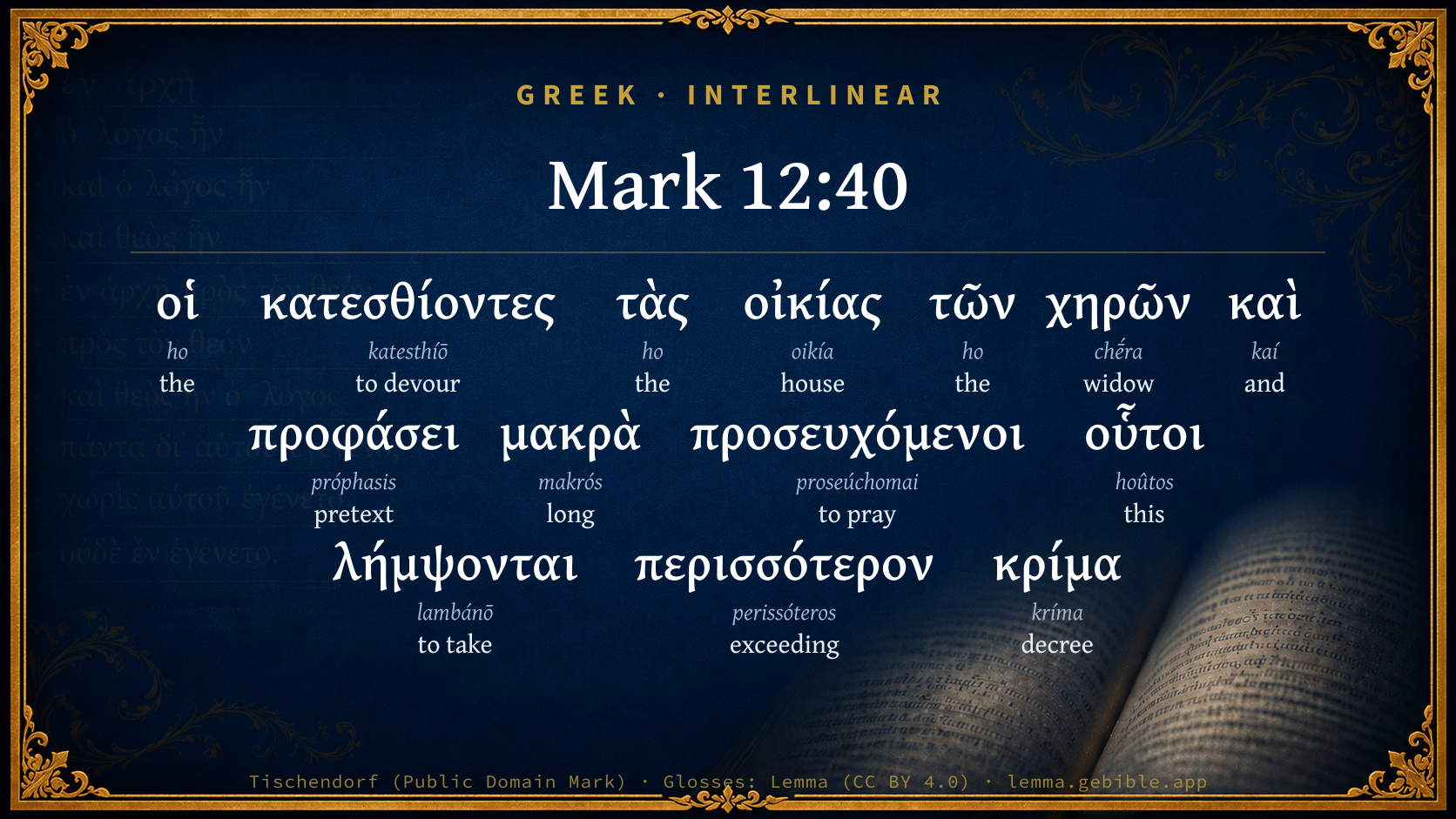
Greek (Tischendorf 8th ed.) Mark 12:40 appears in the Greek New Testament. The text above is from the Tischendorf 8th edition. Each word links to its Strong’s number and a concise gloss. Click any word for its full Thayer’s Greek Lexicon entry.
Download image
Cite this verse

Mark 12:40 (World English Bible). Public Domain. Lemma interlinear Bible study tool, https://lemma.gebible.app/v/mark/12/40.

Show BibTeX & RIS
BibTeX
RIS
English Translation
those who devour widows' houses, and for a pretense make long prayers. These will receive greater condemnation."
World English Bible · Public Domain
Highlights
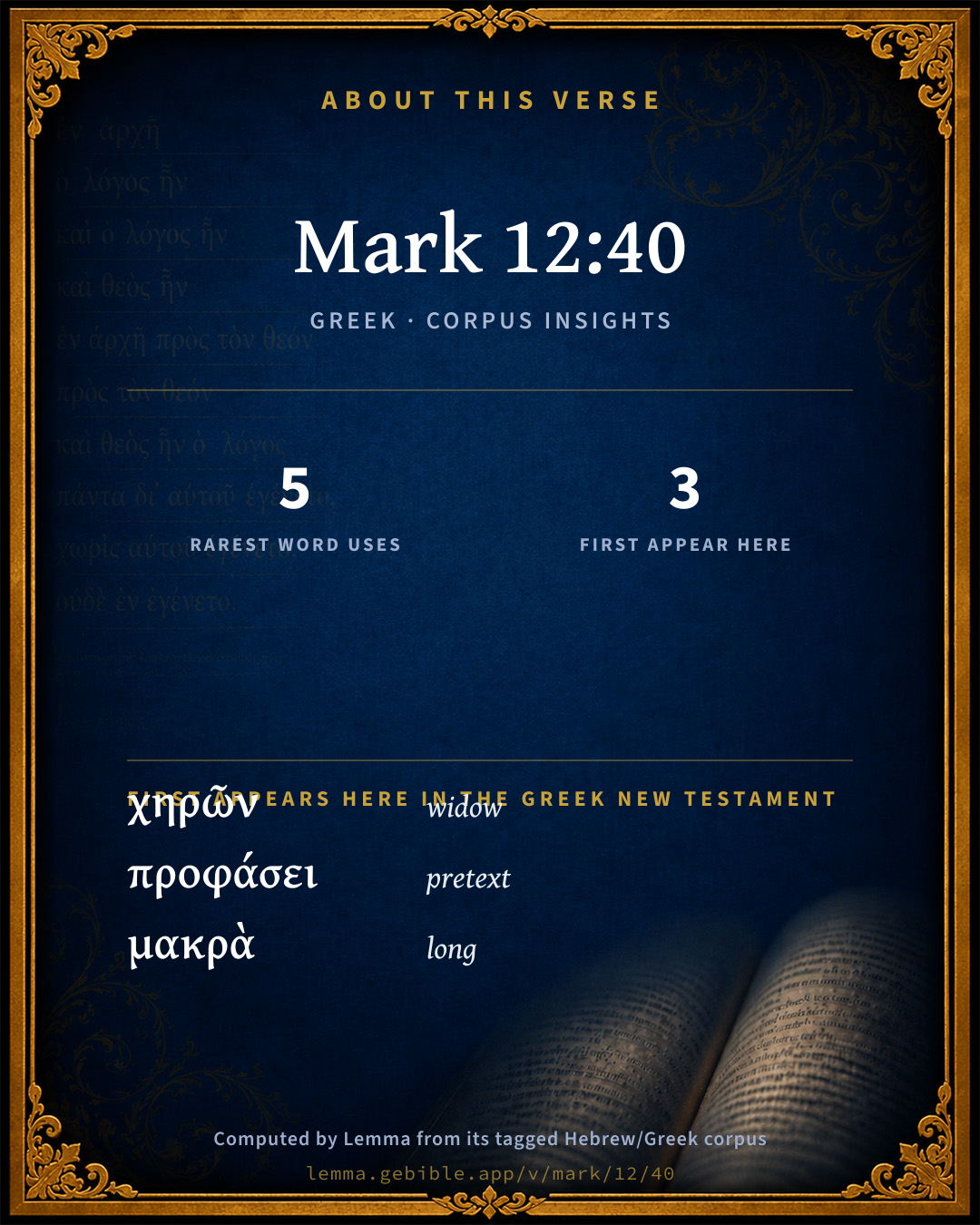
  • 3 first appearances in the Greek New Testament
Full analysis ↓
Download a study sheet

One document with this verse’s original text, its word-by-word gloss line, the meaning frame, cross-references with their text, attributed commentary, and full source and license credits — printable, and it pastes into notes with its structure intact.

This verse Autodidact and up

Study sheet (.html) Plain text (.txt)

A passage Seminary Student

Up to 50 verses in one chapter. A passage sheet keeps up to 6 commentary sources and 12 cross-references per verse, in the order this page ranks them, and says so on the sheet whenever that leaves anything out. Ask for a single verse and you get the Autodidact verse sheet above.

Everything on this page stays free to read, with no account — the sheet is a download of what is already on screen, not access to it.

Want to remove ads? Support Godless Engineer
Compare translations 3

The same verse in 3 English versions, stacked beneath the original-language interlinear above. Click any original word for its lexicon entry.

Each is an independent rendering of the whole verse — the interlinear is not word-aligned to these translations.

Highlighted words mark where these versions differ — a whole-verse word diff, not a word-by-word alignment.

  • World English Bible Public Domain
    those who devour widows' houses, and for a pretense make long prayers. These will receive greater condemnation."
  • King James Version Public Domain
    Which devour widows' houses, and for a pretence make long prayers: these shall receive greater damnation.
  • unfoldingWord Literal Text CC BY-SA 4.0
    the ones devouring the houses of the widows, and as a pretext, offering long prayers. These will receive greater condemnation.”

unfoldingWord Literal Text — © unfoldingWord, licensed CC BY-SA 4.0. Word-aligned USFM3 via Door43 (git.door43.org/unfoldingWord/en_ult).

Versions to compare (up to 4)

3 of 4 selected

Show all 19 translations

Every available English version of this verse, each an independent rendering of the whole verse.

  • World English Bible Public Domain
    those who devour widows' houses, and for a pretense make long prayers. These will receive greater condemnation."
  • Berean Standard Bible Public Domain
    They defraud widows of their houses, and for a show make lengthy prayers. These men will receive greater condemnation.”
  • Majority Standard Bible Public Domain
    They defraud widows of their houses, and for a show make lengthy prayers. These men will receive greater condemnation.”
  • King James Version Public Domain
    Which devour widows' houses, and for a pretence make long prayers: these shall receive greater damnation.
  • American Standard Version (1901) Public Domain
    they that devour widows' houses, and for a pretence make long prayers; these shall receive greater condemnation.
  • Revised Version (1885) Public Domain
    they which devour widows’ houses, and for a pretence make long prayers; these shall receive greater condemnation.
  • Geneva Bible (1599) Public Domain
    Which deuoure widowes houses, euen vnder a colour of long prayers. These shall receiue the greater damnation.
  • Douay-Rheims (1899) Public Domain
    Who devour the houses of widows under the pretence of long prayer: these shall receive greater judgment.
  • Young's Literal Translation Public Domain
    who are devouring the widows' houses, and for a pretense are making long prayers; these shall receive more abundant judgment.'
  • Literal Standard Version CC BY-SA 4.0
    who are devouring the widows’ houses, and for a pretense are making long prayers; these will receive more abundant judgment.”
  • Unlocked Literal Bible CC BY-SA 4.0
    They also devour widows' houses, and they pray long prayers for people to see. These men will receive greater condemnation.”
  • unfoldingWord Literal Text CC BY-SA 4.0
    the ones devouring the houses of the widows, and as a pretext, offering long prayers. These will receive greater condemnation.”
  • Darby Bible Public Domain
    who devour the houses of widows, and as a pretext make long prayers. These shall receive a severer judgment.
  • World Messianic Bible Public Domain
    those who devour widows’ houses, and for a pretense make long prayers. These will receive greater condemnation.”
  • Webster's Bible Public Domain
    Who devour widows' houses, and for a pretense make long prayers: these shall receive greater damnation.
  • Free Bible Version CC BY-SA 4.0
    They cheat widows out of what they own, and cover up the kind of people they really are with long-winded prayers. They will receive severe condemnation in the judgment.”
  • Bible in Basic English Public Domain
    Who take away the property of widows, and before the eyes of men make long prayers; these will be judged more hardly.
  • Text-Critical English NT CC BY 4.0
    who devour widows' houses and for a pretense make long prayers. They will receive a more severe judgment.”
  • Tyndale New Testament (1534) Public Domain
    and devoure widowes houses and that vnder coloure of longe prayinge. These shall receave greater dampnacion.

Literal Standard Version (2020), Covenant Press — licensed CC BY-SA 4.0. Text via the HelloAO Bible API (eBible.org). Unlocked Literal Bible (unfoldingWord) — licensed CC BY-SA 4.0. Text via the HelloAO Bible API (eBible.org). unfoldingWord Literal Text — © unfoldingWord, licensed CC BY-SA 4.0. Word-aligned USFM3 via Door43 (git.door43.org/unfoldingWord/en_ult). Free Bible Version, Dr. Jonathan Gallagher — licensed CC BY-SA 4.0. Text via the HelloAO Bible API (eBible.org).

Word by word

More ways to search: Search by grammar → Find every occurrence → Compare this word →

Practice this passage: Drill this verse → Learn its vocabulary →

μακρὰ
makrós
G3117
“long”
Adjective, Accusative, Plural, Neuter
Part of Speech
Adjective
Case
Accusative
Number
Plural
Gender
Neuter
Full Thayer's Definition

Origin: from G3372

TDNT: None

1. long a. of place: remote, distant, far off b. of time: long, long lasting
  1. οἱ ho G3588 “the” Article, Nominative, Plural, Masculine
  2. κατεσθίοντες katesthíō G2719 “to devour” Verb, Present, Active, Participle, Nominative, Plural, Masculine
  3. τὰς ho G3588 “the” Article, Accusative, Plural, Feminine
  4. οἰκίας oikía G3614 “house” Noun, Accusative, Plural, Feminine
  5. τῶν ho G3588 “the” Article, Genitive, Plural, Feminine
  6. χηρῶν chḗra G5503 “widow” Noun, Genitive, Plural, Feminine
  7. καὶ kaí G2532 “and” Conjunction
  8. προφάσει próphasis G4392 “pretext” Noun, Dative, Singular, Feminine
  9. προσευχόμενοι proseúchomai G4336 “to pray” Verb, Present, Middle or Passive deponent, Participle, Nominative, Plural, Masculine
  10. οὗτοι hoûtos G3778 “this” Demonstrative pronoun, Nominative, Plural, Masculine
  11. λήμψονται lambánō G2983 “to take” Verb, Future, Middle deponent, Indicative, 3rd person, Plural
  12. περισσότερον perissóteros G4055 “exceeding” Adjective, Accusative, Singular, Neuter, Comparative
  13. κρίμα kríma G2917 “decree” Noun, Accusative, Singular, Neuter

About this verse

These counts appear in no published source. They are computed here, from the morphology-tagged text and Lemma’s own curated glosses. What Lemma adds →

14
words
12
distinct lemmas
Gospels
section

Notable vocabulary

The rarest word here is μακρὰ long G3117 — appearing just 5 times in the whole Greek New Testament.

First appearance in Scripture

These words make their first canonical appearance in the Greek New Testament here:

  • χηρῶν widow G5503
  • προφάσει pretext G4392
  • μακρὰ long G3117

Shared distinctive vocabulary

μακρὰ long G3117 occurs in 5 verses of the Greek New Testament. Also found in:

Repetition

A word recurs within this verse:

Cross-references

8

Topical passages linked to Mark 12:40 in the Treasury of Scripture Knowledge — connected by theme and wording, ordered by reader-vote popularity; previews shown in the World English Bible.

  • Luke 20:47 who devour widows' houses, and for a pretense make long prayers: these will receive greater condemnation."
  • Matthew 23:13 "Woe to you, scribes and Pharisees, hypocrites! For you devour widows' houses, and as a pretense you make long prayers. Therefore you will receive greater condemnation.
  • Matthew 23:33 You serpents, you offspring of vipers, how will you escape the judgment of Gehenna?
  • Ezekiel 22:25 There is a conspiracy of her prophets in the midst of it, like a roaring lion ravening the prey: they have devoured souls; they take treasure and precious things; they have made her widows many in the midst of it.
  • Matthew 6:7 In praying, don't use vain repetitions, as the Gentiles do; for they think that they will be heard for their much speaking.
  • Micah 3:1–4 I said, "Please listen, you heads of Jacob, And rulers of the house of Israel: Isn't it for you to know justice?
  • Luke 12:47–48 That servant, who knew his lord's will, and didn't prepare, nor do what he wanted, will be beaten with many stripes,
  • 2 Timothy 3:6 For of these are those who creep into houses, and take captive gullible women loaded down with sins, led away by various lusts,

Cross-references courtesy of OpenBible.info (CC BY 4.0).

Commentary

Notes on Mark 12:40 from classic Christian and Jewish commentators (each source and its license shown beneath its notes). The classic Christian expositions comment on the surrounding passage and are grouped to its opening verse, so a note may address several verses; the Jewish commentaries on the Tanakh (Rashi and others) are per-verse, so they appear only where the commentator wrote on this verse.

Lemma curates 59 commentaries, every one of them public domain or Creative Commons licensed, each selected and text-cleaned for this edition rather than reprinted as found. About our sources →

Godbey's Commentary on the New Testament

William B. Godbey

WOES AGAINST THE SCRIBES AND PHARISEES

Luk 20:47, Mar 12:40; Mat 23:13-39. “Woe unto you, scribes and Pharisees, hypocrites! because you devour the houses of widows, and through pretense make long prayers; therefore ye shall receive the greater damnation.” You see He withers them awfully for oppressing the widows. You must not here understand a condemnation of long prayers. Jesus Himself sometimes prayed all night. The condemnation is on the hypocrisy, because through pretense they made long prayers. However, we should all take warning and condense our prayers, throwing away all forms and routines, introductories and conclusions, except the simple “Amen,” and by the help of the Spirit focalize and concentrate our prayers, making them multum in parvo; i.e., “much in little.”

“Woe unto you, scribes and Pharisees, hypocrites! because you shut up the kingdom of the heavens against the people: for you do not come in, neither do you permit those coming in to enter.” What awful preaching to the pastors of the Churches, ruling elders, and leading members, while looking them in the face! How terrible was the grip of Satan on them, that they did not heed the warning, but got violently mad, and killed Him for telling them the truth! Lord help us to walk in Thy footprints! There is a world of truth in this accusation. Those were the very men who would not enter the kingdom nor permit others. If they had repented under the preaching of John the Baptist, instead of getting mad at him for telling them the truth (Mat 3:7), and received their own Christ with open arms, thus passing exultantly from the Mosaic dispensation into the kingdom of heaven, the people would have followed them in solid columns, the whole Jewish nation receiving their own Christ, turning evangelist, preaching Him to all the Gentiles, and actually bringing on she millennium, far back in the early centuries of the Christian era, the Lord returning on the throne of His glory, as He said He would when the gospel was preached to all nations. The same sad phenomenon you may observe this day. If the leading preachers and Church officers throughout Christendom would receive the Holy Ghost and get sanctified wholly, as Jesus is now calling them, the Churches would follow in swelling multitudes, the revival tide of holiness to the Lord inundate the globe like a mighty swelling sea, and bring on the millennium in the present generation. The rank and file of people will follow their leaders. The climacteric trick of Satan in all ages has been to lead the leaders, and thus populate hell with the downward rush of millions lost.

“Woe unto you, scribes and Pharisees, hypocrites! because you compass sea and land to make one proselyte; and when he may become, you make him twofold more the son of hell than yourselves.” This poor, deluded, heathen proselyte, not only retains his own sins, but takes on those of hypocrisy and formality peculiar to his Jewish leaders. The deader a Church is, the more proselytic, ready to do almost anything to get a member, especially if he has money. Misery loves company. When people have God with them, they are satisfied to walk alone. When they are without God, they seek comfort in all the company they can get, going for the popular Church.

“Woe unto you. blind guides, saying, Whosoever may swear by the temple, it is nothing; but whosoever may swear by the gold of the temple, he is debtor. Ye foolish and blind: for which is the greater, the gold, or the temple that sanctifies the gold? Whosoever may swear by the altar, it is nothing; but whosoever may swear by the gift which is upon it, he is debtor. Ye blind, for which is the greater, the gift, or the altar that sanctifies the gift? Therefore he that sweareth by the altar, sweareth by it, and by all things which are on it; and he that sweareth by the temple, sweareth by it, and by Him that dwelleth in it; and he that sweareth by heaven, sweareth by the throne of God, and by Him that sitteth upon it.” That our Savior is not here condemning judicial oaths,: we have abundant proof, as He Himself responded to Caiaphas when he administered to Him a solemn oath (Mat 26:63), and Paul administered a solemn oath to the Thessalonians that the epistle should be read to all the brethren. But Jesus is here speaking of profane swearing, condemning the use of bywords, which is incitive to profanity at least, and all superfluous language, as indicative of evil and conducive to sin, cutting down our phraseology to simple statements of fact. We have in this paragraph a very important specification, certifying that the altar sanctifies the gift, which has in all ages been a prominent battle-cry in God’s holiness movements. Consecration is man’s work, just as the Jew brought the sheep, with his own hands, and placed it on God’s altar, neither daring to take it off nor thinking of a doubt as to God’s acceptance of it, believing unhesitatingly and unwaveringly that everything on God’s altar was thereby sanctified and holy. Therefore consecration is man’s work, assisted by the Holy Ghost. When we make the clear, unequivocal, and eternal consecration, we should never doubt the sanctification, as we know God is infallible. He never fails to do His work, while doubt is grievous and dishonoring to Him. All we have to do is to keep all on the altar, consecrated for this world arid all other worlds, to live or to die. Then believe without a doubt that God accepts and sanctifies, going on undeviatingly in the line of joyful obedience, never again listening to the devil, who would destroy your experience by the injection of doubts. Once you move out on this line, and abide, your life will quickly become a constant sunshine, a sweet heaven in which to go to heaven, victory night and day brightening the escutcheon of your joyful experience, and proclaiming Satan’s signal and perpetual defeat.

“Woe unto you, scribes and Pharisees, hypocrites l because you tithe mint, anise, and cumin, and you pass by the weightier matters of the law, judgment, mercy, and faith: it behooveth to do these, and not to leave those undone.” When preachers and Church members have no salvation, they are apt to be very particular about little things, and ready to criticize harshly all who do not conform to their little, silly notions punctiliously. Jesus does not object to their tithing everything, even these garden vegetables, giving one-tenth of all their produce to the Lord; but lie commends it. Meanwhile lie denounces them awfully for neglecting the great issues of the law; e.g., judgment — i. e., doing right by everybody, vindicating truth and righteousness, at home and abroad, with all classes indiscriminately, exhibiting to the world a life irreproachable from the standpoint of all rectitude. Mercy also must characterize all our deportment, reaching out to man and beast to friends and enemies, Jews and Gentiles, indiscriminately; full of kindness, pity, sympathy, and love for everything that hath feeling; and always holding up the banner of truth. in harmony with the blessed Word of God, enforcing it, not only by precept, but by example, in small matters as well as great, alway and everywhere on the side of truth and righteousness. While those preachers and Church officers were particular about little non-essentials, they were awfully delinquent in the grand and indispensable, item of true and genuine Holy Ghost religion. Our Savior: even charges these scribes and Pharisees with neglecting faith, which is the basis of all salvation, and without which it is impossible to please God. Now, these were the bon tons of the Jewish Church, both clerical and laical, claiming to be paragons of faith, the boasted children of faithful Abraham. But you see they really had no faith. They had plenty of intellectual and doctrinal faith, but were destitute of spirituality. “With the heart man believeth unto righteousness.” (Rom 10:10) None but spiritual faith has any availability, or even possesses the essence of faith, in the Divine estimation.

“Ye blind guides, who are straining out the gnat, but swallowing down the camel.” As the gnat was unclean, and condemned by the Levitical law, they were very careful to strain their wine and milk lest a gnat might happen to be in it; thus straining it out, and not straining at it as in E. V., The camel is an unclean animal, and the largest in that country. Now, what is meant by straining out the gnat and swallowing down the camel? Be sure you understand it. This is a logical conclusion from the preceding verse, in which, calling them hypocrites, He denounces them for tithing mint, anise, and cumin, garden herbs, and at the same time neglecting judgment, mercy, and faith, these grand, cardinal, spiritual graces. If I had the wings: of an angel and the trump of an archangel, I would fly from ocean to ocean, and warn the blind guides in pulpits and Amen-corners who are this clay straining out gnats — i. e., very punctilious about all sorts of Church finances and duties harmonical with the popular shibboleth of Church loyalty — and at the same time deplorably delinquent with reference to the momentous relations to the Divine government, and the immeasurable obligations arising out of the same; and the poor widows, orphans, and. slumites in the neighborhood, are ready witnesses to their deplorable deficiency of that sweet grace denominated mercy; and as to the faith inspired by the Holy Ghost, the only medium through which we can possibly receive anything from God, and without which all are doomed and lost, it has actually become a dead-letter in their Creed. Those Church bon tons, to whom Jesus did this awful preaching, rejected it as an insult, and killed Him for what they regarded as insolence, and even blasphemy. O how the clergy and ruling elders are this day straining out gnats and swallowing down camels I If you are all right on the gnat question — i. e., little Church duties — you can be an acceptable member or preacher though you have a devil in you as big as a camel. You see. here the gnat represents the little items of practical obedience to the moral and ritual law, like tithing everything, Small as well as great; while the camel represents your delinquency in the great and momentous graces of the Spirit; i. e., like justice, mercy, and faith. While our Savior says we should do all the former, so as not to swallow gnats, as they are unclean, you see how your deficiency in, the graces of the Spirit is illustrated by swallowing do the great camel, which is unclean as well as the gnat, and a thousand million times larger. Good Lord, help us to see this truth, and preach it fearlessly, like Jesus!

“Woe unto you, scribes and Pharisees, hypocrites because you cleanse the exterior of the cup and the plate, but within they are full of extortion and impurity. Ye blind Pharisee, first purify that which is within the cup, in order that its exterior may also be pure.” The holiness movement is everywhere shouting the battle-cry of a clean heart. You see that is precisely what Jesus is here preaching; i.e., inward purity. O this is the crying need of the Churches — heart holiness. They all want their members to be externally obedient, prompt, faithful, and dutiful in every ramification of Church work, interest, and enterprise. This is all right; the outside of a cup ought to be clean. But Jesus charged the Church leaders in His day with neglecting heart purity. When the people want inward purity, you can not preach entire sanctification too forcefully to suit them. Here the Savior commands them to purify the interior, assuring them that in that case the outside would also be clean. The interior is your immortal spirit, the eternal self, that must live with God in heaven forever or with demons in the regions of woe. Hence, when the immortal spirit is clean, the exterior always falls in line, and everything is right.

“Woe unto you. scribes and Pharisees, hypocrites because you are like whited sepulchers, which indeed appear fair without, but within they are full of dead men’s bones and all impurity.” It is still customary in that country of whitewash the sepulchers. You can see them a fire at way off, because they are white as snow. What a vivid illustration of a fair external profession and inward rottenness! If the leading preachers of the Jewish Church were in that awful condition, and so blind that they were utterly unconscious of it, should we not all fall on our knees before God, and ask Him for the light needed to see our heads as God sees them? I am witness that the sepulchers in that country, externally, appear most beautiful and fair, while within they are full of putrefying bodies.

“Thus you also indeed appear righteous unto the people; but within, you are full of hypocrisy and iniquity.” What awful preaching to the pastors and leading members of the popular Churches while looking them in the face. “Yes; but the Churches at the present day are more spiritual than those to whom Jesus preached.” I hope that is so; yet there is no doubt but multitudes of preachers, Church officers, and leading members, this day, stand precisely where those did. The only remedy for this awful state of things is experimental holiness; i.e., entire sanctification. The very fact that preachers and members kick against the plain truth when preached in its purity, is demonstrative proof that they. are not right.

“Woe unto you, scribes and Pharisees, hypocrites! because you build the tombs of the prophets, and ornament the sepulchers of the righteous; and you say, If we were in the days of our fathers, we were not their comrades in the blood of the prophets. So you witness to yourselves, that you are the sons of those who murdered the prophets.” Here Jesus turns on them the homogeneity argument; i.e., the very fact that they build the tombs, shows them up as carrying forward the work which their predecessors began, though they aim it to signify the very opposite. Multitudes of preachers and members who now honor John Wesley, close the doors against the men who preach precisely what Wesley did. The same is true of all the great Protestant Churches. John Bunyan among the Baptists, and John Knox among the Presbyterians, would this day meet a very cold reception.

“You fill up the measure of your fathers. Ye serpents, generations of vipers, how can you escape from the damnation of hell?” If the loving Jesus could look people in the face and thus preach, we need not be afraid of using language too strong, if we are sure we are telling the truth. Of course, we can not read their hearts as He did; but the Holy Ghost can, and He will apply the truth Where it belongs.

“Therefore, behold, I send unto you prophets, wise men, and scribes; some of them you will slay and crucify, and some of them you will scourge in your synagogues, and persecute from city to city.” This awful prophecy was literally verified. Soon afterward those same people murdered Stephen and many others in the bloody persecution which followed, doing their utmost to exterminate the Nazarenes in blood. “In order that all the righteous blood shed upon the earth, from the blood of righteous Abel unto the blood of Zacharias, the son of the blessed, may come upon you.” The very fact that those people, who, in less than forty-eight hours after that awful sermon, actually killed Him, and subsequently put Stephen and many others to death, showed them up in the same line with their bloody predecessors, and consequently particeps criminis.

“But Jehoiada waxed old, and was full of days when he died; a hundred and thirty years old was he when he died. And they buried him in the city of David among the kings, because he had done good in Israel, both toward God and toward his house. Now, after the death of Jehoiada came the princes of Judah, and made obeisance to the king. Then the king hearkened unto them. And they left the house of the Lord God of their fathers, and served groves and idols: and wrath came upon Judah and Jerusalem for this their trespass. Yet he sent prophets to them, to bring them again unto the Lord; and they testified against them but they would not give ear. And the Spirit of God came upon Zechariah, the son of Jehoiada the priest, who stood before the people, and said unto them, Thus saith God, Why transgress ye the commandments of the Lord, that ye can not prosper? Because ye have forsaken the Lord, He hath also forsaken you. And they conspired against him, and stoned him with stones at the commandment of the king in the court of the house of the Lord. Thus Joash the king remembered not the kindness which Jehoiada his father had done to him, but slew his son. And when he died, he said, The Lord look upon it,. and require it.” (2Ch 24:15-21)

King Joash was only seven years old when he began to reign, his life having been preserved from the cruel Athaliah, who had murdered all of his brothers; and through the kindness of Jehoiada the priest, he reigned and did well during the lifetime of Jehoiada, his foster-father. But, as you see, after the death of Jehoiada, he was led into idolatry by the princes of Judah, and when God put the spirit of prophecy on Zechariah, the son of Jehoiada, so that he boldly told them the truth, the king encouraged an evil conspiracy against him, and they stoned him to death, as Jesus here says, “between the temple and the altar;” i. e., the brazen altar for burnt offerings, which stood outside of the temple. While this prophet of God was dying, he said, “The Lord look upon it, and require it;” i.e., he turned over the case to the Lord. “Barachias,” in E. V., a proper name, is evidently a mistake, as Zacharias was not the son of a man by that name, but the son of Jehoiada the priest. The plain solution of the matter is, Barachias is a Hebrew word, and simply means “the blessed.” Therefore I translate it, “Zacharias, the son of the blessed,” — an epithet of Jehoiada. That bloody scene took place right there on the spot where they were standing when Jesus referred to it.

“Truly I say unto you, All these things shall come upon this generation;” i.e., the awful Divine retribution for the martyrdoms of God’s prophets and saints, from Abel down, was coming on that generation, because God had sent them all to prepare the people for His Son; and now that He has come, they are rejecting Him, and going to kill Him, thus climaxing all the murders of their predecessors.

William B. Godbey, Commentary on the New Testament (1896–1900) — public domain. Text from a community e-Sword module.

Tyndale Open Study Notes

Tyndale Open Resources

12:40 The teachers of religious law broke the second command by failing to love their neighbors, as was seen in their cheating widows of their property. They clearly were cheating the most vulnerable and needy people despite God’s concern for widows (Deut 14:29; Pss 68:5; 146:9; Isa 1:17; Jer 7:6; 49:11) and his condemnation of those who mistreat them (Isa 1:23; Ezek 22:7; Zech 7:10; Mal 3:5). The scribes wore a hypocritical cloak of false piety (see Matt 6:5-6; Luke 18:11-12). • they will be more severely punished: In the final judgment (Mark 9:42-48; see Luke 14:11).

Tyndale Open Study Notes — © Tyndale Open Resources, licensed CC BY-SA 4.0. Text via the HelloAO Bible API.

Bengel's Gnomon

Johann Albrecht Bengel

Mar 12:40. Οἱ κατεσθίοντες, who devour) Construe with the following words.

Bengel's Gnomon of the New Testament — English translation (T&T Clark, Edinburgh, 1860) — public domain. Text from a community e-Sword module.

Expositor's Greek Testament

ed. W. Robertson Nicoll

Mar 12:40 . οἱ κατεσθίοντες : this verse is probably still to be regarded as a continuation of the description of the scribes commencing with τῶν θελόντων , only the writer has lost the sense of the original construction, and instead of the genitive puts the nominative, so giving to what follows the force of an independent sentence (so Weiss). Grotius, Meyer, and Schanz take Mar 12:40 as a really independent sentence. Lk. set the precedent for this; for, apparently having Mk.’s text before him, he turns f1οἱ κατεσθίοντες into οἱ κατεσθίουσι . Holtzmann, H. C., is undecided between the two views. As to the sense, two facts are stated about the scribes: they devoured the houses, the property of widows, and they made long ( μακρὰ , vide on Luk 20:47 ) prayers in the homes of, and presumably for, these widows. προφάσει : the real aim to get money, the long seemingly fervent prayers a blind to hide this aim. It is not necessary to suppose that the money-getting and the praying were connected by regular contract (so apparently Fritzsche, and Weiss in Meyer). For πρόφασις cf. Phi 1:18 and especially 1Th 2:5 . οὗτοι λήψονται , etc.: this remark applies specially to the conduct just described: catching widows’ substance with the bait of prayer, which Jesus characteristically pronounces exceptionally damnable in view of its sleek hypocrisy and low greed. The appending of this reflection favours the view that Mar 12:40 is after all an independent sentence. In it and the two preceding we have a very slight yet vivid picture of Pharisaic piety in its vanity, avarice, and hypocrisy.

The Expositor's Greek Testament, edited by W. Robertson Nicoll (1897–1910) — public domain. Text from a community e-Sword module.

Ellicott's Commentary for English Readers

(40) Which devour widow’s houses.—Here the word has a special force as coming after the mention of the feasts. They seek the highest places at such banquets, our Lord seems to say, and when there, this is what they feast on. The special charge is not reported by St. Matthew in this connection, but occurs in Mat_23:14, where see Note. The better MSS., indeed, omit it even there. The relative pronoun gives a wrong idea of the construction. We have really a new sentence. “They that devour . . . these shall receive . . .”

A Bible Commentary for English Readers, edited by Charles John Ellicott (1878–1897) — public domain. Text from a community e-Sword module.

The Cambridge Bible for Schools and Colleges

gen. ed. J. J. S. Perowne

40. devour widows’ houses] as guardians and administrators of their property

greater damnation] “pei taken longe dom,” Wyclif. The word denotes “judgment,” “punishment.” The verb from which it comes denotes “to judge,” pass sentence, condemn. In 1Co_11:29, the words rendered damnation, discerning, judged, and condemnation, are all, in the original, parts or derivations of one and the same word; and so Wyclif admirably rendered them into the language of his day by words connected with one and the same English verb; “He that etith and drinkith vnworthili, etith and drinkith doom to him, not wisely demyng the bodi of the Lord … and if we demyden wiseli us silf we schulden not be demyd, but while we be demyd of the lord we ben chastised, that we be not dampnyd with this world.” Compare also Chaucer, Monk’s Tale, 15091,

“Dampnyd was he to deye in that prison.”

Bible Word-Book, pp. 142, 143.

The Cambridge Bible for Schools and Colleges (gen. ed. J. J. S. Perowne; Cambridge University Press, 1878–1918) — public domain. Text from a community e-Sword module.

John Gill's Exposition

And he called unto him, his disciples,.... Who were at some little distance from him, he having finished his discourses:

and saith unto them, verily I say unto you: a way of speaking he often used, when he was about to deliver something of importance, and not so easy of belief, and which required attention, and what he solemnly affirmed:

that this poor widow, pointing to her,

hath cast more in, than all they which have cast into the treasury: not that she had cast in more, or so much as any one of them as to value and substance, much less more than them all put together; but that she had cast in more in proportion to what she had, than they had in proportion to their substance; and that hers, though very small in itself, and might be contemptible to others, yet it was more in the account of God and Christ, and more highly valued and esteemed of by them, than all that the rich men put in: since what she gave, she gave in faith, and from a principle of love, and with a view to the glory of God; when theirs was given only in hypocrisy, to make an outward show, and to be seen of men.

John Gill's Exposition of the Whole Bible (1746–1763) — public domain (CC PDM 1.0). Text via the HelloAO Bible API.

Trapp's Complete Commentary

John Trapp

40 Which devour widows’ houses, and for a pretence make long prayers: these shall receive greater damnation.

Ver. 40. {See Trapp on "Mat 23:14"}

John Trapp, A Commentary or Exposition upon All the Books of the Old and New Testament (1647–1656) — public domain. Text from a community e-Sword module.

Albert Barnes' Notes on the Bible

Which devour widows’ houses - Which devour the families of widows, or the means of supporting their families. This they did under pretence of counseling them in the knowledge of the law and in the management of their estates. They took advantage of their ignorance and their unprotected state, and either extorted large sums for their counsel, or perverted the property to their own use.

No wonder that our Saviour denounced them! If there is any sin of special enormity, it is that of taking advantage of the circumstances of the poor, the needy, and the helpless, to wrong them out of the pittance on which they depend for the support of their families; and as God is the friend of the widow and the fatherless, it may be expected that such will be visited with heavy condemnation.

For a pretence - For show, or “pretending” great devotion.

Albert Barnes' Notes on the Bible (1834–1885) — public domain. Text from a community e-Sword/MySword module.

The Pulpit Commentary

There is a change in the construction here, which is not marked in the Authorized Version. The sentence in this fortieth verse should stand alone, and be read thus: They which devour (oi katesyiontev) widows" houses, and for a pretense make long prayers; these shall receive greater condemnation. The sentence thus read is far more graphic. The statement thus becomes indeed more general, but the reference is still to the scribes who through their avarice swallowed up the property of helpless widows, and through their hypocrisy, in the hope of thus more effectually imposing upon their victims, lengthened out their prayers. Greater condemnation. The word in the Greek is krima , that is, "judgment." A severer sentence would fall upon them in the day of judgment and a heavier condemnation, because, under the semblance of piety, they practiced iniquity, and indulged their avarice under the mask of religion.

The Pulpit Commentary (1880–1919), ed. H.D.M. Spence-Jones & Joseph S. Exell — public domain. Text from a community e-Sword module.

Cambridge Greek Testament for Schools and Colleges

40. κατεσθίοντες τὰς οἰκίας. Here again we have an easy conversational style; τῶν θελόντων is forgotten. These Scribes abused the hospitality and benevolence of devout women. Widows are mentioned as being those who ought least of all to have been thus treated (Exo 22:22-24; Deu 10:18, etc.). Josephus (Ant. XVII. ii. 4) says of the Pharisees, οἷς ὑπῆκτο ἡ γυναικωνῖτις. The primitive Church seems to have suffered much from the greed of officials (1Th 2:5; 1Ti 3:3; 1Ti 3:8; 1Pe 5:2). see on 2Co 2:17; 2Co 8:20; 2Co 11:20.

προφάσει. Sub obtentu prolixae orationis (Vulg.), but in Lk. simulantes longam orationem. They pretended to pray for a long time in order to gain influence over religious people. There was a Rabbinical saying that long prayers make a long life.

οὗτοι. “Such people as these,” isti, who turn prayer into an instrument of wickedness, “shall receive a sentence of much greater severity.” Cf. Jas 3:1. They act a part in order to rob the poor and the bereaved, and they employ the most sacred actions in religion in order to do this with success. Others may rob the fatherless and the widow, but they do not make a show of piety in doing so.

Cambridge Greek Testament for Schools and Colleges (Cambridge University Press, 1896; 21 vols, various authors incl. Carr, Maclear, Plummer, Farrar, Lumby, Moule, M. R. James, Simcox) — public domain. Text from a community e-Sword module.

International Critical Commentary

40. οἱ κατεσθίοντες—If this is a continuation of the preceding sentence, the nom. is an irregularity, as its noun is in the Gen_2 It is better, therefore, to begin a new sentence here, making οἱ κατεσθίοντες the subj. of λήμψονται—those who devour, etc., shall receive.3 This devouring of widows’ houses would be under the forms of civil law, but in contravention of the Divine law of love. προφάσει—for a covering. That is, they tried to hide their covetousness behind a show of piety. See 1Th 2:5, where the meaning is, that the apostle did not use his preaching of the Gospel as a mere cloak of covetousness. περισσότερον κρίμα—more abundant, or overflowing condemnation. The adjective is strong. The comparison is with what they would receive if they made no pretence of piety. Notice that the show, as it is commonly with men, is of religion, while the offence is against humanity. The warning is addressed to the people, and bids them beware of religious leaders who affect the outward titles and trappings of their office, and offset their lack of humanity by a show of piety.

The exact verbal correspondence of Mk. and Lk. in this warning is proof positive of their interdependence.

JESUS’ COMMENDATION OF THE WIDOW’S OFFERING

International Critical Commentary — older volumes (1896–1929), various authors — public domain. Text from a community e-Sword module.

Vincent's Word Studies in the New Testament

Marvin R. Vincent

Widows ' houses. People often left their whole fortune to the temple, and a good deal of the temple - money went, in the end, to the Scribes and Pharisees. The Scribes were universally employed in making wills and conveyances of property. They may have abused their influence with widows.

Marvin R. Vincent, Word Studies in the New Testament (1887–1900) — public domain. Text from a community e-Sword/MySword module.

Lesson kit

Teaching starters — assembled from the data on this page, not authored interpretation. Every prompt links to the verse data it draws on. Edit before teaching.

Mark, in the Gospels, opens this verse with 14 words (12 distinct Greek lemmas). Its most distinctive word is makrós (“long”). A historical commentator’s framing appears above. Read the whole chapter for the surrounding context.

Discussion questions

  1. How does “long” (makrós) shape what this verse is saying?
  2. 3 words here appear for the first time in Scripture. What is being introduced at this debut?
  3. Luke 15:13 shares the word «long» with this verse. How do the two illuminate each other?
  4. “the” occurs 3× in this one verse. What is the effect of the repetition?
  5. These translations render this verse differently. What is at stake in choosing one wording over another?
  6. Reading how Godbey's Commentary on the New Testament and Tyndale Open Study Notes read this verse, where do the two commentators agree and where do they part?

Things to notice

  • 3 words make their first canonical appearance in Scripture here.
  • These translations choose different wording for 14 words in this verse.
  • “the” occurs 3× in this single verse.
  • 12 distinct Greek lemmas span 14 words in this verse.

Reading settings

Reading text

Shown beneath each verse's original-language words.

Old Testament
Old Testament edition

Read the OT as the Masoretic Hebrew (MT) or the Greek Septuagint (LXX).

English shown for the Greek Septuagint (in the Hebrew ↔ Greek comparison).

Comparing translations? Open the Compare panel on any verse page to stack up to four side by side.