Revelation 19:20

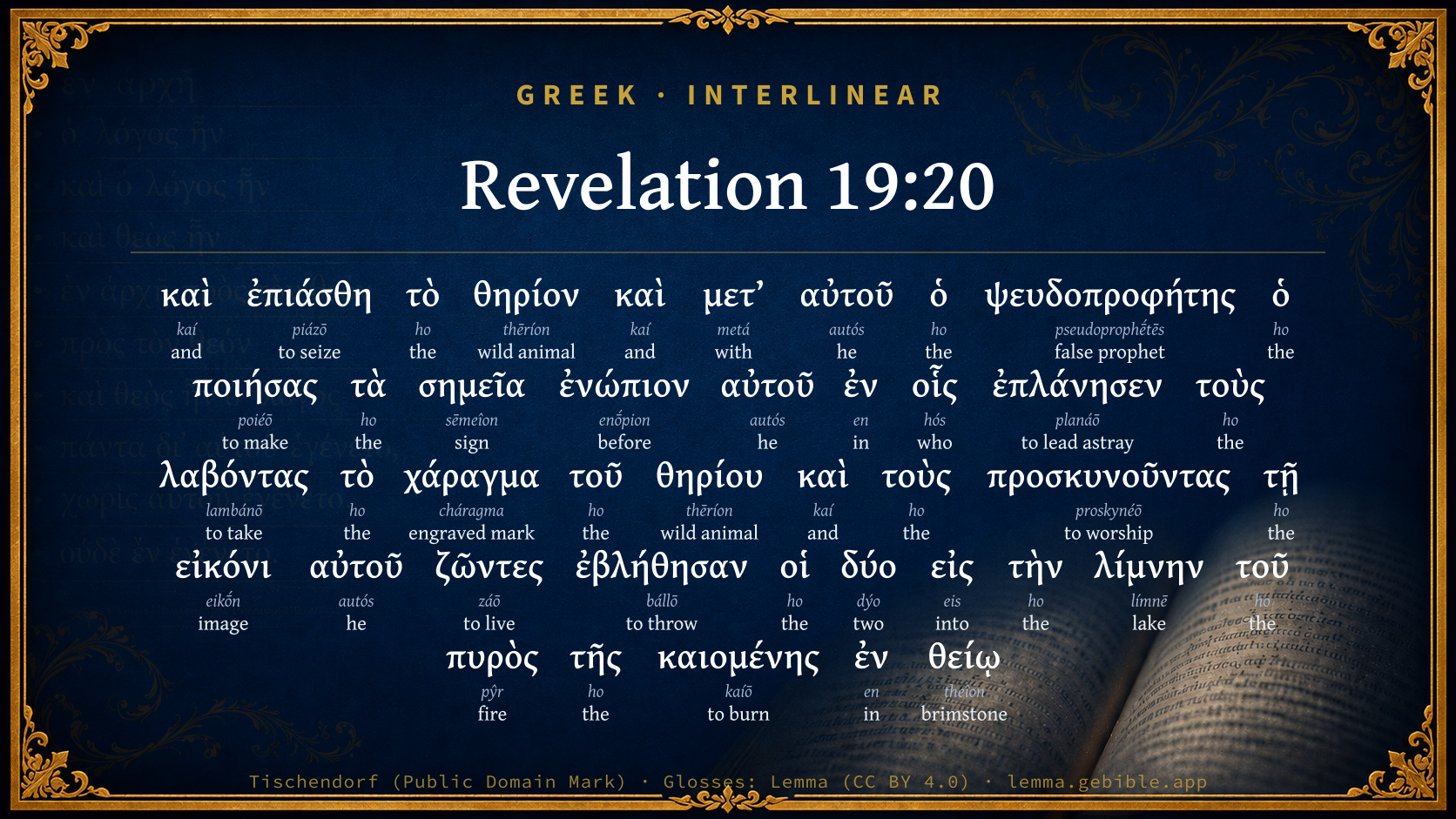
Greek (Tischendorf 8th ed.) Revelation 19:20 appears in the Greek New Testament. The text above is from the Tischendorf 8th edition. Each word links to its Strong’s number and a concise gloss. Click any word for its full Thayer’s Greek Lexicon entry.
Download image
Cite this verse

Revelation 19:20 (World English Bible). Public Domain. Lemma interlinear Bible study tool, https://lemma.gebible.app/v/revelation/19/20.

Show BibTeX & RIS
BibTeX
RIS
English Translation
The beast was taken, and with him the false prophet who worked the signs in his sight, with which he deceived those who had received the mark of the beast and those who worshiped his image. These two were thrown alive into the lake of fire that burns with sulfur.
World English Bible · Public Domain
Download a study sheet

One document with this verse’s original text, its word-by-word gloss line, the meaning frame, cross-references with their text, attributed commentary, and full source and license credits — printable, and it pastes into notes with its structure intact.

This verse Autodidact and up

Study sheet (.html) Plain text (.txt)

A passage Seminary Student

Up to 50 verses in one chapter. A passage sheet keeps up to 6 commentary sources and 12 cross-references per verse, in the order this page ranks them, and says so on the sheet whenever that leaves anything out. Ask for a single verse and you get the Autodidact verse sheet above.

Everything on this page stays free to read, with no account — the sheet is a download of what is already on screen, not access to it.

Want to remove ads? Support Godless Engineer
Compare translations 3

The same verse in 3 English versions, stacked beneath the original-language interlinear above. Click any original word for its lexicon entry.

Each is an independent rendering of the whole verse — the interlinear is not word-aligned to these translations.

Highlighted words mark where these versions differ — a whole-verse word diff, not a word-by-word alignment.

  • World English Bible Public Domain
    The beast was taken, and with him the false prophet who worked the signs in his sight, with which he deceived those who had received the mark of the beast and those who worshiped his image. These two were thrown alive into the lake of fire that burns with sulfur.
  • King James Version Public Domain
    And the beast was taken, and with him the false prophet that wrought miracles before him, with which he deceived them that had received the mark of the beast, and them that worshipped his image. These both were cast alive into a lake of fire burning with brimstone.
  • unfoldingWord Literal Text CC BY-SA 4.0
    And the beast was captured and with him the false prophet having performed signs before him, by which he deceived the ones having received the mark of the beast and the ones worshiping his image. The two were thrown living into the lake of fire burning with sulfur.

unfoldingWord Literal Text — © unfoldingWord, licensed CC BY-SA 4.0. Word-aligned USFM3 via Door43 (git.door43.org/unfoldingWord/en_ult).

Versions to compare (up to 4)

3 of 4 selected

Show all 19 translations

Every available English version of this verse, each an independent rendering of the whole verse.

  • World English Bible Public Domain
    The beast was taken, and with him the false prophet who worked the signs in his sight, with which he deceived those who had received the mark of the beast and those who worshiped his image. These two were thrown alive into the lake of fire that burns with sulfur.
  • Berean Standard Bible Public Domain
    But the beast was captured along with the false prophet, who on its behalf had performed signs deceiving those who had the mark of the beast and worshiped its image. Both the beast and the false prophet were thrown alive into the fiery lake of burning sulfur.
  • Majority Standard Bible Public Domain
    But the beast was captured along with the false prophet, who on its behalf had performed signs deceiving those who had the mark of the beast and worshiped its image. Both the beast and the false prophet were thrown alive into the fiery lake of burning sulfur.
  • King James Version Public Domain
    And the beast was taken, and with him the false prophet that wrought miracles before him, with which he deceived them that had received the mark of the beast, and them that worshipped his image. These both were cast alive into a lake of fire burning with brimstone.
  • American Standard Version (1901) Public Domain
    And the beast was taken, and with him the false prophet that wrought the signs in his sight, wherewith he deceived them that had received the mark of the beast and them that worshipped his image: they two were cast alive into the lake of fire that burneth with brimstone:
  • Revised Version (1885) Public Domain
    And the beast was taken, and with him the false prophet that wrought the signs in his sight, wherewith he deceived them that had received the mark of the beast, and them that worshipped his image: they twain were cast alive into the lake of fire that burneth with brimstone:
  • Geneva Bible (1599) Public Domain
    But ye beast was taken, and with him that false prophet that wrought miracles before him, whereby he deceiued them that receiued ye beastes marke, and them that worshipped his image. These both were aliue cast into a lake of fire, burning with brimstone.
  • Douay-Rheims (1899) Public Domain
    And the beast was taken, and with him the false prophet, who wrought signs before him, wherewith he seduced them who received the character of the beast, and who adored his image. These two were cast alive into the pool of fire, burning with brimstone.
  • Young's Literal Translation Public Domain
    and the beast was taken, and with him the false prophet who did the signs before him, in which he led astray those who did receive the mark of the beast, and those who did bow before his image; living they were cast -- the two -- to the lake of the fire, that is burning with brimstone;
  • Literal Standard Version CC BY-SA 4.0
    and the beast was taken, and with him the false prophet who did the signs before him, in which he led astray those who received the mark of the beast, and those who worshiped his image; the two were cast living into the lake of the fire that is burning with brimstone;
  • Unlocked Literal Bible CC BY-SA 4.0
    The beast was captured and with him the false prophet who performed the signs in his presence. With these signs he deceived those who had received the mark of the beast and who worshiped his image. The two of them were thrown alive into the fiery lake of burning sulfur.
  • unfoldingWord Literal Text CC BY-SA 4.0
    And the beast was captured and with him the false prophet having performed signs before him, by which he deceived the ones having received the mark of the beast and the ones worshiping his image. The two were thrown living into the lake of fire burning with sulfur.
  • Darby Bible Public Domain
    And the beast was taken, and the false prophet that [was] with him, who wrought the signs before him by which he deceived them that received the mark of the beast, and those that worship his image. Alive were both cast into the lake of fire which burns with brimstone;
  • World Messianic Bible Public Domain
    The beast was taken, and with him the false prophet who worked the signs in his sight, with which he deceived those who had received the mark of the beast and those who worshiped his image. These two were thrown alive into the lake of fire that burns with sulfur.
  • Webster's Bible Public Domain
    And the beast was taken, and with him the false prophet that wrought miracles before him, with which he deceived them that had received the mark of the beast, and them that worshiped his image. These both were cast alive into a lake of fire burning with brimstone.
  • Free Bible Version CC BY-SA 4.0
    The beast was captured, along with the false prophet who performed miracles in his presence (by which he deceived those who had received the mark of the beast and those who worshiped the beast's image). Both of them were thrown alive into the like of fire that burns with sulfur.
  • Bible in Basic English Public Domain
    And the beast was taken, and with him the false prophet who did the signs before him, by which they were turned from the true way who had the mark of the beast, and who gave worship to his image: these two were put living into the sea of ever-burning fire.
  • Text-Critical English NT CC BY 4.0
    But the beast was captured, and so was the false prophet who was with him, who in his sight had performed the signs by which he had deceived those who had received the mark of the beast and who worshiped his image. The two of them were thrown alive into the lake of fire that burns with sulfur.
  • Tyndale New Testament (1534) Public Domain
    And the beste was take and with him that falce prophett that wrought myracles before him with which he desceaved the that receaved the beestes marke and them that worshipped his ymage. These both were cast into a pode of fyre burnyge with brymstone:

Literal Standard Version (2020), Covenant Press — licensed CC BY-SA 4.0. Text via the HelloAO Bible API (eBible.org). Unlocked Literal Bible (unfoldingWord) — licensed CC BY-SA 4.0. Text via the HelloAO Bible API (eBible.org). unfoldingWord Literal Text — © unfoldingWord, licensed CC BY-SA 4.0. Word-aligned USFM3 via Door43 (git.door43.org/unfoldingWord/en_ult). Free Bible Version, Dr. Jonathan Gallagher — licensed CC BY-SA 4.0. Text via the HelloAO Bible API (eBible.org).

Word by word

More ways to search: Search by grammar → Find every occurrence → Compare this word →

Practice this passage: Drill this verse → Learn its vocabulary →

θείῳ
theîon
G2303
“brimstone”
Noun, Dative, Singular, Neuter
Part of Speech
Noun
Case
Dative
Number
Singular
Gender
Neuter
Full Thayer's Definition

Origin: probably of G2304 (in its original sense of flashing)

TDNT: 3:122,*

1. brimstone a. divine incense, because burning brimstone was regarded as having power to purify, and to ward off disease
  1. καὶ kaí G2532 “and” Conjunction
  2. ἐπιάσθη piázō G4084 “to seize” Verb, Aorist, Passive, Indicative, 3rd person, Singular
  3. τὸ ho G3588 “the” Article, Nominative, Singular, Neuter
  4. θηρίον thēríon G2342 “wild animal” Noun, Nominative, Singular, Neuter
  5. καὶ kaí G2532 “and” Conjunction
  6. μετ’ metá G3326 “with” Preposition
  7. αὐτοῦ autós G846 “he” Personal pronoun, Genitive, Singular, Neuter
  8. ὁ ho G3588 “the” Article, Nominative, Singular, Masculine
  9. ψευδοπροφήτης pseudoprophḗtēs G5578 “false prophet” Noun, Nominative, Singular, Masculine
  10. ὁ ho G3588 “the” Article, Nominative, Singular, Masculine
  11. ποιήσας poiéō G4160 “to make” Verb, Aorist, Active, Participle, Nominative, Singular, Masculine
  12. τὰ ho G3588 “the” Article, Accusative, Plural, Neuter
  13. σημεῖα sēmeîon G4592 “sign” Noun, Accusative, Plural, Neuter
  14. ἐνώπιον enṓpion G1799 “before” Adverb
  15. αὐτοῦ autós G846 “he” Personal pronoun, Genitive, Singular, Neuter
  16. ἐν en G1722 “in” Preposition
  17. οἷς hós G3739 “who” Relative pronoun, Dative, Plural, Neuter
  18. ἐπλάνησεν planáō G4105 “to lead astray” Verb, Aorist, Active, Indicative, 3rd person, Singular
  19. τοὺς ho G3588 “the” Article, Accusative, Plural, Masculine
  20. λαβόντας lambánō G2983 “to take” Verb, Aorist, Active, Participle, Accusative, Plural, Masculine
  21. τὸ ho G3588 “the” Article, Accusative, Singular, Neuter
  22. χάραγμα cháragma G5480 “engraved mark” Noun, Accusative, Singular, Neuter
  23. τοῦ ho G3588 “the” Article, Genitive, Singular, Neuter
  24. θηρίου thēríon G2342 “wild animal” Noun, Genitive, Singular, Neuter
  25. καὶ kaí G2532 “and” Conjunction
  26. τοὺς ho G3588 “the” Article, Accusative, Plural, Masculine
  27. προσκυνοῦντας proskynéō G4352 “to worship” Verb, Present, Active, Participle, Accusative, Plural, Masculine
  28. τῇ ho G3588 “the” Article, Dative, Singular, Feminine
  29. εἰκόνι eikṓn G1504 “image” Noun, Dative, Singular, Feminine
  30. αὐτοῦ autós G846 “he” Personal pronoun, Genitive, Singular, Neuter
  31. ζῶντες záō G2198 “to live” Verb, Present, Active, Participle, Nominative, Plural, Masculine
  32. ἐβλήθησαν bállō G906 “to throw” Verb, Aorist, Passive, Indicative, 3rd person, Plural
  33. οἱ ho G3588 “the” Article, Nominative, Plural, Masculine
  34. δύο dýo G1417 “two” Adjective, Numeral (indeclinable)
  35. εἰς eis G1519 “into” Preposition
  36. τὴν ho G3588 “the” Article, Accusative, Singular, Feminine
  37. λίμνην límnē G3041 “lake” Noun, Accusative, Singular, Feminine
  38. τοῦ ho G3588 “the” Article, Genitive, Singular, Neuter
  39. πυρὸς pŷr G4442 “fire” Noun, Genitive, Singular, Neuter
  40. τῆς ho G3588 “the” Article, Genitive, Singular, Feminine
  41. καιομένης kaíō G2545 “to burn” Verb, Present, Passive, Participle, Genitive, Singular, Feminine
  42. ἐν en G1722 “in” Preposition

About this verse

These counts appear in no published source. They are computed here, from the morphology-tagged text and Lemma’s own curated glosses. What Lemma adds →

43
words
25
distinct lemmas
Revelation
section

Notable vocabulary

The rarest word here is θείῳ brimstone G2303 — appearing just 7 times in the whole Greek New Testament.

Shared distinctive vocabulary

θείῳ brimstone G2303 occurs in 7 verses of the Greek New Testament. Also found in:

Repetition

Words recur within this verse:

  • θηρίον wild animal G2342 ×2
  • τὸ the G3588 ×13
  • καὶ and G2532 ×3
  • αὐτοῦ he G846 ×3
  • ἐν in G1722 ×2

Cross-references

26

Topical passages linked to Revelation 19:20 in the Treasury of Scripture Knowledge — connected by theme and wording, ordered by reader-vote popularity; previews shown in the World English Bible.

  • Revelation 20:10 The devil who deceived them was thrown into the lake of fire and sulfur, where the beast and the false prophet are also. They will be tormented day and night forever and ever.
  • Revelation 21:8 But for the cowardly, unbelieving, sinners, abominable, murderers, sexually immoral, sorcerers, idolaters, and all liars, their part is in the lake that burns with fire and sulfur, which is the second death."
  • Daniel 7:7–14 After this I saw in the night-visions, and, behold, a fourth animal, awesome and powerful, and strong exceedingly; and it had great iron teeth; it devoured and broke in pieces, and stamped the residue with its feet: and it was diverse from all the animals that were before it; and it had ten horns.
  • 2 Thessalonians 2:8–11 Then the lawless one will be revealed, whom the Lord will kill with the breath of his mouth, and bring to nothing by the brightness of his coming;
  • Revelation 20:14–15 Death and Hades were thrown into the lake of fire. This is the second death, the lake of fire.
  • Isaiah 30:33 For a Topheth is prepared of old; yes, for the king it is made ready; he has made it deep and large; the pile of it is fire and much wood; the breath of Yahweh, like a stream of sulfur, does kindle it.
  • Revelation 14:10 he also will drink of the wine of the wrath of God, which is prepared unmixed in the cup of his anger. He will be tormented with fire and sulfur in the presence of the holy angels, and in the presence of the Lamb.
  • Deuteronomy 29:23 [and that] the whole land of it is sulfur, and salt, [and] a burning, [that] it is not sown, nor bears, nor any grass grows therein, like the overthrow of Sodom and Gomorrah, Admah and Zeboiim, which Yahweh overthrew in his anger, and in his wrath:
  • Revelation 13:11–18 I saw another beast coming up out of the earth. He had two horns like a lamb, and he spoke like a dragon.
  • Revelation 16:13–14 I saw coming out of the mouth of the dragon, and out of the mouth of the beast, and out of the mouth of the false prophet, three unclean spirits, something like frogs;
  • Revelation 17:12 The ten horns that you saw are ten kings who have received no kingdom as yet, but they receive authority as kings, with the beast, for one hour.
  • Genesis 19:24 Then Yahweh rained on Sodom and on Gomorrah sulfur and fire from Yahweh out of the sky.
  • Daniel 2:40–45 The fourth kingdom shall be strong as iron, because iron breaks in pieces and subdues all things; and as iron that crushes all these, shall it break in pieces and crush.
  • Daniel 7:19–21 Then I desired to know the truth concerning the fourth animal, which was diverse from all of them, exceedingly terrible, whose teeth were of iron, and its nails of brass; which devoured, broke in pieces, and stamped the residue with its feet;
  • Daniel 7:23–26 Thus he said, The fourth animal shall be a fourth kingdom on earth, which shall be diverse from all the kingdoms, and shall devour the whole earth, and shall tread it down, and break it in pieces.
  • Daniel 8:24 His power shall be mighty, but not by his own power; and he shall destroy wonderfully, and shall prosper and do [his pleasure]; and he shall destroy the mighty ones and the holy people.
  • Revelation 13:1–8 Then I stood on the sand of the sea. I saw a beast coming up out of the sea, having ten horns and seven heads. On his horns were ten crowns, and on his heads, blasphemous names.
  • Revelation 22:15 Outside are the dogs, the sorcerers, the sexually immoral, the murderers, the idolaters, and everyone who loves and practices falsehood.
  • Psalms 11:6 On the wicked he will rain blazing coals; Fire, sulfur, and scorching wind shall be the portion of their cup.
  • Isaiah 34:9 The streams of [Edom] shall be turned into pitch, and the dust of it into sulfur, and the land of it shall become burning pitch.
  • Ezekiel 38:22 With pestilence and with blood will I enter into judgment with him; and I will rain on him, and on his hordes, and on the many peoples who are with him, an overflowing shower, and great hailstones, fire, and sulfur.
  • Job 18:15 There shall dwell in his tent that which is none of his. Sulfur shall be scattered on his habitation.
  • Daniel 11:45 He shall plant the tents of his palace between the sea and the glorious holy mountain; yet he shall come to his end, and none shall help him.
  • Revelation 17:3–8 He carried me away in the Spirit into a wilderness. I saw a woman sitting on a scarlet-colored animal, full of blasphemous names, having seven heads and ten horns.
  • Revelation 19:19 I saw the beast, and the kings of the earth, and their armies, gathered together to make war against him who sat on the horse, and against his army.
  • Daniel 8:26 The vision of the evenings and mornings which has been told is true: but seal up the vision; for it belongs to many days [to come].

Cross-references courtesy of OpenBible.info (CC BY 4.0).

Commentary

Notes on Revelation 19:20 from classic Christian and Jewish commentators (each source and its license shown beneath its notes). The classic Christian expositions comment on the surrounding passage and are grouped to its opening verse, so a note may address several verses; the Jewish commentaries on the Tanakh (Rashi and others) are per-verse, so they appear only where the commentator wrote on this verse.

Lemma curates 59 commentaries, every one of them public domain or Creative Commons licensed, each selected and text-cleaned for this edition rather than reprinted as found. About our sources →

Joseph Benson's Commentary

Rev 19:20-21. And — The issue was such as might be expected: Christ and his saints obtained a full and entire victory; a victory as complete as when the generals and all the chief officers of an enemy’s army are made prisoners of war, and the rest are cut to pieces in the field of battle. For the beast — The idolatrous persecuting power represented thereby; and the false prophet, that wrought miracles before him — That, by pretended miracles and false doctrine, had supported the apostacy; that is, the antichristian tyranny, and the corrupt clergy, were taken, were made prisoners, and condemned to suffer the most exemplary punishment by the hands of justice. These both were cast alive — Without undergoing bodily death; into the lake of fire, burning with brimstone — And that, it seems, before the devil himself, chap. Rev 20:10. Here is the last of the beast and of the false prophet. After several repeated strokes of divine vengeance, they are represented as delivered to suffer the vengeance of eternal fire. They are plunged at once into the extremest degree of torment, without being reserved in chains of darkness to the judgment of the great day. Surely none but the beast and false prophet of Rome, the persecutors and deceivers of that antichristian kingdom, could have hardened themselves thus against the God they pretended to adore; or refused to have repented under such dreadful and repeated visitations. And the remnant — Those of inferior rank and power, who had aided and abetted the apostacy, and concurred in opposing the truth and religion of Christ; were slain with the sword of him that sat upon the horse, which proceeded out of his mouth — That is, with the word of Christ, like the common soldiers of a conquered army, who fall in the field of battle, and are left there unburied, a prey to the fowls of the air, which feed on them, and are filled with their flesh — Their substance being seized for other persons, and other uses. A most magnificent description this of the final overthrow of the beast and false prophet, and all their adherents. It has, in particular, one exquisite beauty, that, after exhibiting the two opposite armies, and all the apparatus for a battle, (Rev 19:11-19,) then follows immediately (Rev 19:20) the account of the victory, without one word of an engagement or fighting. Here is the most exact propriety; for what struggle can there be between Omnipotence and the power of all the creation united against it? Every description must have fallen short of this admirable silence. The intelligent reader will easily observe, that the description is not only incomparably sublime, but strongly figurative; and that, speaking in plain language, its design is to show, in the most expressive manner, the complete downfall of Popery, with all its delusive and destructive abominations, and the triumphs of the pure and genuine religion of Jesus; the true word of God will in the end prevail over every species of superstition and idolatry: all the powers of antichrist shall be completely subdued: and the religion of Rome, as well as Rome itself, be totally destroyed.

Joseph Benson's Commentary on the Old and New Testaments (1811–1818) — public domain. Text from a community e-Sword module.

Tyndale Open Study Notes

Tyndale Open Resources

19:20 beast . . . false prophet See 13:1-10. • The fiery lake of burning sulfur provides a picture of eternal punishment (see 20:10, 14-15; 21:8; see also Isa 66:24; Matt 13:41, 49-50; Mark 9:43, 48). • God’s enemies are thrown into the fiery lake. The two beasts (Rev 19:20) are followed by the dragon (20:10) and then by death (20:14) and unsaved humans (20:15).

Tyndale Open Study Notes — © Tyndale Open Resources, licensed CC BY-SA 4.0. Text via the HelloAO Bible API.

Bengel's Gnomon

Johann Albrecht Bengel

Rev 19:20. [213] Ἐπιάσθη) The beast was taken: but the angel ἐκράτησε, laid hold of the dragon, ch. Rev 20:2. The beast and the false prophet even then shall be reduced to extremities; the dragon shall have strength, but shall be restrained.—ζῶντες, alive) This destruction is much more dreadful than the death itself of the body. Comp. respecting the Son of Perdition, 2Th 2:8; also Dan 7:11; Dan 7:26, and Isa 11:4, where רשע, LXX., ἀσεβὴς, the Chaldee paraphrast has ארמילום רשיעא, the impious Roman.—ΤῊΝ ΛΊΜΝΗΝ ΤΟῦ ΠΥΡῸς, the lake of fire) The word gehennah [hell] does not occur in the Apocalypse.

[213] 17. δεῦτε, Come hither) The victory cannot but follow. Beforehand the flesh of the enemy is already given to be torn in pieces by birds.—V. g.

19. μετὰ, with) The enemies will undoubtedly attempt to attack the saints on the earth. But Christ the Lord, with His heavenly band, will engage with them.—V. g.

Bengel's Gnomon of the New Testament — English translation (T&T Clark, Edinburgh, 1860) — public domain. Text from a community e-Sword module.

Expositor's Greek Testament

ed. W. Robertson Nicoll

Rev 19:20 . This marks the culmination of many previous oracles: the messiah meets and defeats (Rev 16:13 f.) the beast ( i.e. , Nero-antichrist, Rev 11:7 , Rev 13:1 f.) and the false prophet ( i.e. , the Imperial priesthood = second beast of Rev 13:11 f.) and their allies ( the kings of the earth, cf. Rev 11:9 ; Rev 11:18 , Rev 14:8 , Rev 16:14 , Rev 17:12 f.), according to a more specific form of the tradition reflected in Rev 14:14-20 . Possibly the ghastly repast of Rev 19:21 is a dramatic foil to that of Rev 19:9 . At any rate there is a slight confusion in the sketch, due to the presence of heterogeneous conceptions; whilst one tradition made messiah at his coming vanquish all the surviving inhabitants of the earth, who were ex hypothesi opponents of God’s people ( cf. Rev 2:26-27 , Rev 11:9 f., Rev 12:9 , Rev 14:14 f., Rev 16:13-16 , Rev 19:17 f.), the prophet at the same time used the special conception of a Nero-antichrist whose allies were mainly Eastern chiefs (Rev 9:14 f., Rev 16:12 , Rev 17:12 f.), and also shared the O.T. belief in a weird independent outburst from the skirts of the earth (Rev 20:8 ). Hence the rout of nations here is only apparently final. See on Rev 20:3 . The lake of fire, a place of torment which burns throughout most of the apocalypses (Sibyll. ii. 196 200, 252 253, 286, etc.; Apoc. Pet. 8), was lit first in Enoch, (sec. cent.) where it is the punishment reserved for Azazel on the day of judgment (Rev 9:6 ) and for the fallen angels (Rev 21:7-10 ) with their paramours. The prophet prefers this to the alternative conception of a river of fire [Slav. En. 10.]. The whole passage reflects traditions such as those preserved ( cf. Gfrörer ii., 232 f.), e.g. , in Targ. Jerus. on Gen 49:11 and Sohar on Lev. Exodus (miracula, uariaque et horrenda bella fient mari terraque circa Jerusalem, cum messias reuelabitur), where the beasts of the field feed for one year, and the birds for seven, upon the carcases of Israel’s foes. The supreme penalty inflicted on the opponents of Zoroastrianism is that their corpses are given over to the corpse-eating bird s, i.e. , ravens (Vend. 3:20, 9:49). cf. I ntrod. § 4 b .

The messiah who forms “the central figure of this bloodthirsty scene,” written like the preceding out of the presbyter’s “savage hatred of Rome” (Selwyn, 83) has a semi-political rather than a transcendental role to play. The normal Christian consciousness ( cf. Rev 22:12 ) viewed the return of Jesus as ushering in the final requital of mankind; but in these special oracles ( cf. Rev 17:14 ) where a semi-historical figure is pitted against Christ on earth, the latter is brought down to meet the adversary on his own ground a development of eschatology which is a resumption of primitive messianic categories in Judaism. The messiah here is consequently a grim, silent, implacable conqueror. There is no tenderness in the Apocalypse save for the pious core of the elect people, nothing of that disquiet of heart with which the sensitiveness of later ages viewed the innumerable dead. Here mankind are naïvely disposed of in huge masses; their antagonism to the messiah and his people is assumed to have exposed them to ruthless and inexorable doom. Nor do the scenic categories of the tradition leave any room for such a feeling as dictated Plutarch’s noble description ( De Sera Uind. 555 E. F.) of the eternal pangs of conscience. Upon the other hand, there is no gloating over the torments of the wicked.

Now that the destructive work of messiah is over, the ground seems clear for his constructive work ( cf. Ps. Sol. 17:26 f.). But the idiosyncracies of John’s outlook involve a departure from the normal tradition of Judaism and early Christianity at this point. Satan, who survives, as he had preceded, the Roman empire, still remains to be dealt with. The third vision of doom, therefore (Rev 20:1-10 ) outlines his final defeat, in two panels: ( a ) one exhibiting a period of enforced restraint, during which (for 2, 3 and 4 7 are synchronous) messiah and the martyrs enjoy a halcyon time of temporal and temporary bliss, ( b ) the other sketching (Rev 19:7-10 ) a desperate but unavailing recrudescence of the devil’s power. The oracle is brief and uncoloured. It rounds off the preceding predictions and at the same time paves the way for the magnificent finalê of 21 22, on which the writer puts forth all his powers. But it is more than usually enigmatic and allusive. “Dans ces derniers chapitres les tableaux qui passent sous nos yeux n’ont plus la fraícheur vivante de ceux qui ont précédé. L’imagination ayant affaire à des conceptions absolument idéales et sans aucune analogie avec les réalités concrètes de la nature, est naturellement moins sûre d’elle-même, et ne parvient plus aussi facilement à satisfaire celle du lecteur” (Reuss). Ingenious attempts have been made ( e.g. , by Vischer, Spitta, and Wellhausen) to disentangle a Jewish source from the passage, but real problem is raised and solved on the soil of the variant traditions which John moulded at this point for his own Christian purposes. In the creation-myth the binding of the chaos-dragon or his allies took place at the beginning of the world’s history (cf. Prayer of Manass. 2 4). As the dragon came to be moralised into the power of spiritual evil, this temporary restraint ( cf. on Rev 19:2 ) was transferred to the beginning of the end, by a modification of the primitive view which probably goes back to Iranian theology ( cf. Stave, 175 f., Baljon, Völter, 120 f., Briggs, etc.). The conception of messiah’s reign as preliminary and limited on earth was not unknown to Judaism ( Encycl. Relig. and Ethics , i. 203 f.) or even to primitive Christianity ( cf. 1Co 15:21-28 , where Paul develops it differently). But the identification of it with the sabbath of the celestial week (which was originally non-messianic, cf. Slav. En. xxxii. 33.) and the association of it with the martyrs are peculiar to John’s outlook. A further idiosyncracy is the connection between the Gog and Magog attack and the final manœuvre of Satan. The psychological clue to these conceptions probably lies in the prophet’s desire to provide a special compensation for the martyrs, prior to the general bliss of the saints. This may have determined his adoption or adaptation of the chiliastic tradition, which also conserved the archaic hope of an earthly reign for the saints without interfering with the more spiritual and transcendent outlook of Rev 20:11 f. His procedure further enabled him to preserve the primitive idea of messiah’s reign [4] as distinct from that of God, by dividing the final act of the drama into two scenes (4 f., 11 f.). With the realistic episode of 1 3, angels pass off the stage (except the angel of Rev 21:9 f. and the angelus interpres of xxii. 6 10), in accordance with the Jewish feeling that they were inferior to the glorified saints to whom alone ( cf. Heb 2:4 ) the next world belonged. There is no evidence to support the conjecture (Cheyne, Bible Problems , 233) that ἄγγελον in Rev 19:1 represents “an already corrupt text of an older Hebrew Apocalypse, in which mal’âk was written instead of mikâ’çl ” ( cf. above on Rev 12:7 ).

The Expositor's Greek Testament, edited by W. Robertson Nicoll (1897–1910) — public domain. Text from a community e-Sword module.

Geneva Bible (1599)

Geneva Bible translators

That is, that beast with two heads, of which Rev. 13:11. See also Rev. 16:14.

Namely, that beast with seven heads, of which before, Rev. 13:1 and 17:3.

Geneva Bible (1599) marginal notes — public domain. Text via Bolls.life.

Jamieson, Fausset & Brown

Robert Jamieson, A. R. Fausset & David Brown

and with him the false prophet--A reads, "and those with him." B reads, "and he who was with him, the false prophet."

miracles--Greek, "the miracles" (literally, "signs") recorded already (Rev 13:14) as wrought by the second beast before (literally, 'in sight of') the first beast. Hence it follows the second beast is identical with the false prophet. Many expositors represent the first beast to be the secular, the second beast to be the ecclesiastical power of Rome; and account for the change of title for the latter from the "other beast" to the "false prophet," is because by the judgment on the harlot, the ecclesiastical power will then retain nothing of its former character save the power to deceive. I think it not unlikely that the false prophet will be the successor of the spiritual pretensions of the papacy; while the beast in its last form as the fully revealed Antichrist will be the secular representative and embodiment of the fourth world kingdom, Rome, in its last form of intensified opposition to God. Compare with this prophecy, Eze. 38:1-39:29; Dan 2:34-35, Dan 2:44; Dan 11:44-45; Dan 12:1; Joe 3:9-17; Zec. 12:1-14:21. Daniel (Dan 7:8) makes no mention of the second beast, or false prophet, but mentions that "the little horn" has "the eyes of a man," that is, cunning and intellectual culture; this is not a feature of the first beast in the thirteenth chapter, but is expressed by the Apocalyptic "false prophet," the embodiment of man's unsanctified knowledge, and the subtlety of the old serpent. The first beast is a political power; the second is a spiritual power--the power of ideas. But both are beasts, the worldly Antichristian wisdom serving the worldly Antichristian power. The dragon is both lion and serpent. As the first law in God's moral government is that "judgment should begin at the house of God," and be executed on the harlot, the faithless Church, by the world power with which she had committed spiritual adultery, so it is a second law that the world power, after having served as God's instrument of punishment, is itself punished. As the harlot is judged by the beast and the ten kings, so these are destroyed by the Lord Himself coming in person. So Zep. 1:1-18 compared with Zep 2:1-15. And Jeremiah, after denouncing Jerusalem's judgment by Babylon, ends with denouncing Babylon's own doom. Between the judgment on the harlot and the Lord's destruction of the beast, will intervene that season in which earthly-mindedness will reach its culmination, and Antichristianity triumph for its short three and a half days during which the two witnesses lie dead. Then shall the Church be ripe for her glorification, the Antichristian world for destruction. The world at the highest development of its material and spiritual power is but a decorated carcass round which the eagles gather. It is characteristic that Antichrist and his kings, in their blindness, imagine that they can wage war against the King of heaven with earthly hosts; herein is shown the extreme folly of Babylonian confusion. The Lord's mere appearance, without any actual encounter, shows Antichrist his nothingness; compare the effect of Jesus' appearance even in His humiliation, Joh 18:6 [AUBERLEN].

had received--rather as Greek, "received," once for all.

them; that worshipped--literally, "them worshipping" not an act once for all done, as the "received" implies, but those in the habit of "worshipping."

These both were cast . . . into a lake--Greek, ". . . the lake of fire," Gehenna. Satan is subsequently cast into it, at the close of the outbreak which succeeds the millennium (Rev 20:10). Then Death and Hell, as well those not found at the general judgment "written in the book of life"; this constitutes "the second death."

alive--a living death; not mere annihilation. "Their worm dieth not, their fire is not quenched."

Jamieson, Fausset & Brown — Commentary Critical and Explanatory on the Whole Bible (1871) — public domain (CC PDM 1.0). Text via the HelloAO Bible API.

Adam Clarke's Commentary

Verse 20. And the beast was taken, and-the false prophet] See Clarke on Re 17:8, c.

That worshipped his image.] The beast has been represented as the Latin empire the image of the beast, the popes of Rome; and the false prophet, the papal clergy.

Were cast alive into a lake of fire] Were discomfited when alive-in the zenith of their power, and destroyed with an utter destruction.

Adam Clarke's Commentary on the Bible (1810–1826) — public domain. Text from a community e-Sword/MySword module.

The Cambridge Bible for Schools and Colleges

gen. ed. J. J. S. Perowne

20. was taken] Scarcely a strong enough word—“was seized” or “overpowered.”

the false prophet] So called in Rev_16:13 : see Rev_13:11 sqq.

miracles] Should be “the signs”—those described in Rev_13:13 sqq.

were cast alive &c.] In Dan_7:11 the Beast is slain and his body burnt. Perhaps the one indicates the fate of the empire, the other of its personal ruler.

The Cambridge Bible for Schools and Colleges (gen. ed. J. J. S. Perowne; Cambridge University Press, 1878–1918) — public domain. Text from a community e-Sword module.

John Gill's Exposition

And the beast was taken,.... At the first onset, as soon as ever the battle begun, and carried away captive, as it was threatened he should, Rev 13:10 and this by Christ, who will destroy him with the breath of his mouth, and the brightness of his coming, Th2 2:8.

And with him the false prophet; that is, the second beast in Rev 13:11 as appears by the characters by which he is here described, or antichrist in his ecclesiastic capacity; that is, the pope with his clergy: and indeed, when the antichristian princes and states are taken and destroyed, which are the support of the Papacy, that must in consequence sink, be crushed and ruined; the Alexandrian copy reads, "and they that are with him, the false prophet Jezebel"; the false prophetess and her children, who will now be killed with death, Rev 2:20

that wrought miracles before him: the beast, or the civil antichristian powers, even signs and lying wonders, which were approved of, and applauded by him, by which, believing them, he was confirmed in antichristian principles:

with which he deceived them that had the mark of the beast, and them that worshipped his image; the several subjects of the antichristian states; see Rev 13:14 but none of God's elect, who cannot be seduced by such means, Mat 24:24.

These both were cast alive into a lake of fire burning with brimstone; which is the second death, Rev 21:8. The severe punishment of antichrist, considered in both his capacities, civil and ecclesiastic, is expressed by being "cast into a lake of fire", not material fire, but the wrath of God, which will be poured out like fire, and will be intolerable; and by this lake "burning with brimstone", which, giving a nauseous stench, aggravates the punishment. Says R. Joden (t), when a man smells the smell of brimstone, why does his breath draw back at it (or catch)? because he knows he shall be judged with it in the world to come. The allusion seems to be to the place where Sodom and Gomorrah stood, which is become a sulphurous lake, and is an emblem of the vengeance of eternal fire, Jde 1:7 and these two are said to be "cast alive" into it, which shows that they will not only suffer a corporeal death at this battle, and in the issue of it, but will be destroyed, body and soul, in hell: the phrase denotes the awfulness, inevitableness, and severity of their punishment; there seems to be some reference to the earth's swallowing up Korah and his company alive, Num 16:33 see Dan 7:11.

(t) Bereshit Rabba, sect. 51. fol. 45. 4.

John Gill's Exposition of the Whole Bible (1746–1763) — public domain (CC PDM 1.0). Text via the HelloAO Bible API.

Trapp's Complete Commentary

John Trapp

20 And the beast was taken, and with him the false prophet that wrought miracles before him, with which he deceived them that had received the mark of the beast, and them that worshipped his image. These both were cast alive into a lake of fire burning with brimstone.

Ver. 20. And the beast was taken] Taken suddenly, or as he was fleeing, and so thinking to escape. {a} Dio maketh mention of a notable thief that did much mischief in Italy (afterwards the pope’s seat) in the days of Severus. This emperor used all the means he could to catch him, but could not do it, Quippe qui visus non videbutur, non inveniebatur inventus, deprehensus non capiebatur, saith the historian. But this subtle beast meeteth with his match and more; for he is caught and cast into the lake, &c. Christ is a conqueror so soon as ever he comes into the field, Venit, vidit, vicit. He came, he saw, he couquered. When the enemies are tumultuating, he comes upon them as out of an engine, and hurls them headlong into hell.

And with him the false prophet] This is the same with the beast; only the pope is called the beast in respect of his civil power, and the false prophet in respect of his spiritual. {See Trapp on "Rev 13:12"} I remember, saith Aretius here, that many learned men in the year 1546 interpreted these words of the war that then was, and were confident that the emperor was the beast here mentioned, that should be overcome, and taken in battle by the Protestants; and together with him some false prophet of his (perhaps the pope), but it proved much otherwise, and the event showed that this application of the text was false.

" Fallitur augurio spes bona saepe suo."

These both were cast alive] Death shall not end their misery, but they shall suffer most exquisite torments. Potentes potenter torquebuntur.

{a} επιασθη, proprie dicitur de iis quos fugientes arripimus. Beza.

John Trapp, A Commentary or Exposition upon All the Books of the Old and New Testament (1647–1656) — public domain. Text from a community e-Sword module.

Albert Barnes' Notes on the Bible

And the beast was taken - That is, was taken alive, to be thrown into the lake of fire. The hosts were slain Rev 19:21, but the leaders were made prisoners of war. The general idea is, that these armies were overcome, and that the Messiah was victorious; but there is a propriety in the representation here that the leaders - the authors of the war should be taken captive, and reserved for severer punishment than death on the battlefield would be - for they had stirred up their hosts, and summoned these armies to make rebellion against the Messiah. The beast here, as all along, refers to the papal power; and the idea is that of its complete and utter overthrow, as if the leader of an army were taken captive and tormented in burning flames, and all his followers were cut down on the field of battle.

And with him the false prophet - As they had been practically associated together, there was a propriety that they should share the same fate. In regard to the false prophet, and the nature of this alliance, see the notes on Rev 16:13.

That wrought miracles before him - That is, the false prophet had been united with the beast in deceiving the nations of the earth. See the notes on Rev 16:14.

With which he deceived them that had received the mark of the beast - notes on Rev 13:16-18. By these arts they had been deceived - that is, they had been led into the alliance, and had been sustained in their opposition to the truth. The whole representation is that of an alliance to prevent the spread of the true religion, as if the papacy and Mohammedanism were combined, and the one was sustained by the pretended miracles of the other. There would be a practical array against the reign of the Son of God, as if these great powers should act in concert, and as if the special claims which each set up in behalf of its own divine origin became a claim which went to support the whole combined organization.

These both were cast alive into a lake of fire - The beast and the false prophet. That is, the overthrow will be as signal, and the destruction as complete, as if the leaders of the combined hosts should be taken alive, and thrown into a pit or lake that burns with an intense heat. There is no necessity for supposing that this is to be literally inflicted - for the whole scene is symbolical - meaning that the destruction of these powers would be as complete as if they were thrown into such a burning lake. Compare the notes on Rev 14:10-11.

Burning with brimstone - Sulphur - the usual expression to denote intense heat, and especially as referring to the punishment of the wicked. See the notes on Rev 14:10.

Albert Barnes' Notes on the Bible (1834–1885) — public domain. Text from a community e-Sword/MySword module.

Haydock's Catholic Bible Commentary

The beast, &c. Antichrist is taken alive. (Menochius)

George Leo Haydock (1774–1849), Haydock's Catholic Family Bible and Commentary, 1859 edition — public domain. Excludes Psalms (Douay-Rheims chapter numbering differs from Protestant) and Deuterocanonical books (Catholic canon only).

Matthew Poole's English Annotations

The issue of this great battle will be the total ruin of all enemies of the church, their bodies being made meat for the fowls of the heaven, their souls cast into the bottomless pit of hell. The secular part of antichrist is here meant by

the beast; the ecclesiastical antichrist, by

the false prophet, that had cheated credulous princes and credulous people, with his pretended miracles, into an idolatry, that was but the image of the old idolatry of the heathens, in worshipping demons, and the images of such as were in great estimation amongst them while they were alive.

These both were cast alive into a lake of fire burning with brimstone; both these, the laic and secular popish party, and all their church party, that should be left to this day, shall all now be destroyed. In a matter of fact, not likely to appear in the world yet of two hundred years or more, and thus darkly foretold, who can be positive and particular? But this seemeth the sense of it, upon the former hypotheses: That the beast with the seven heads and ten horns, mentioned Rev 13:1, and the beast with two horns, also there mentioned, Rev 13:11, are antichrist, beginning with those Roman emperors that favoured the idolatry introduced by the bishops of Rome, and ending in ending in the universal bishop, or popes of Rome, and their clergy, who quickly wormed out the emperor’s power, and for one thousand two hundred and sixty years reigned, setting up idolatry and superstition, and corrupting the doctrine of faith, and for the six hundred years of time, persecuting the true church of Christ more notoriously. After which God will begin to reckon with him, gradually pouring out five vials upon him. I am very inclinable to think, that we in this age are yet under the pouring out of the second of these vials, seeing little yet effected towards the ruin of the papacy, more than the exposing of their idolatries and cheats to several princes and states, and to the generality of thinking people; nor hath the providence of God proceeded far in that as yet. The three other vials are yet to be poured out upon the papacy, besides that upon Euphrates, and then this last upon all the enemies of the church together: and who shall live when God shall do these things?

Matthew Poole's English Annotations on the Holy Bible (1683–1685) — public domain. Text from a community e-Sword/MySword module.

Whedon's Commentary on the Bible

Daniel D. Whedon

20. Capture of the adverse leaders. The beast and the false prophet—The latter the two-horned lamb, and so clearly an ecclesiastical deceiver. In the false prophet the entire pseudo-spiritual body (the image of xiii included) as the corrupt spokesmen of a corrupt Church are individualized as a single person.

Lake… brimstone—Note on Rev_20:14-15.

Alive— Not slain, like the remnant of next verse. As both these personages are allegorical, we may be at a loss, at first, what can be meant by their being cast into Gehenna. But the thought appears to be, that hell is the final receptacle of all that is essentially evil, whether persons, systems, or principles, whether personal or abstract; just as the bottomless pit, (Rev_20:9,) is its source. It is not said (Rev_20:10)

that these two were tormented as the dragon is.

Daniel D. Whedon (gen. ed.), Commentary on the Old and New Testaments (1874–1909) — public domain. Text from a community e-Sword module.

The Pulpit Commentary

And the beast was taken, and with him the false prophet that wrought miracles before him, with which he deceived them that had received the mark of the beast, and them that worshipped his image; that wrought the signs in his sight (Revised Version). Here we have described the destruction of the earthly manifestations of Satan"s power; the means by which he seeks to achieve his purposes, and which we have interpreted as the hostile world power and self deception (see on Revelation 13). The whole account contained in vers. 11-21 is a brief recapitulation of the whole period of warfare between Christ and Satan, with special attention given to the final overthrow of the powers of evil. It, therefore, covers the same ground as the vision of seals, and then that of the trumpets, then that of the vials, and afterwards that of the beasts, each occupies. The chief difference is that in all those visions the everyday conflict is more particularly described; whereas in this passage the termination of the conflict is specially brought before us. The same ground is covered in the next chapter, advancing, however, one step further, and showing us the final punishment of Satan himself, as well as of his instruments. (Rev_20:10) These both were cast alive into a lake of fire burning with brimstone; they twain were cast alive into the lake, etc. (On "brimstone," etc., see on Rev_9:17, Rev_9:18. Cf. Rev_20:10, Rev_20:14, 15 21:8) This "lake of fire" is the place of punishment for Satan and his hosts; not the place in which he at present works and reigns which is described as the abyss. (Rev_9:1 Rev_11:7 Rev_17:8 Rev_20:1, Rev_20:3)

The Pulpit Commentary (1880–1919), ed. H.D.M. Spence-Jones & Joseph S. Exell — public domain. Text from a community e-Sword module.

John Wesley's Explanatory Notes

The false prophet, who had wrought the miracles before him - And therefore shared in his punishment; these two ungodly men were cast alive - Without undergoing bodily death. Into the lake of fire - And that before the devil himself, chap. xx, 10. Here is the last of the beast. After several repeated strokes of omnipotence, he is gone alive into hell. There were two that went alive into heaven; perhaps there are two that go alive into hell. It may be, Enoch and Elijah entered at once into glory, without first waiting in paradise; the beast and the false prophet plunge at once into the extremest degree of torment, without being reserved in chains of darkness till the judgment of the great day. Surely, none but the beast of Rome would have hardened himself thus against the God he pretended to adore, or refused to have repented under such dreadful, repeated visitations! Well is he styled a beast, from his carnal and vile affections; a wild beast, from his savage and cruel spirit! The rest were slain - A like difference is afterwards made between the devil, and Gog and Magog, chap. xx, 9, 10.

John Wesley, Explanatory Notes Upon the Whole Bible (1754–1765) — public domain. Text via the GEBible commentary corpus.

Scofield Reference Notes

C. I. Scofield

Beast

The Beast, Summary: This "Beast" is the "little horn" of Dan 7:24-26 and "desolator" of Dan 9:27 the "abomination of desolation" of Mat 24:15 the "man of sin" of 2Th 2:4-8 earth’s last and most awful tyrant, Satan’s fell instrument of wrath and hatred against God and the Jewish saints. He is, perhaps, identical with the rider on the white horse of Rev 6:2 who begins by the peaceful conquest of three of the ten kingdoms into which the former Roman empire will then be divided, but who soon establishes the ecclesiastical and governmental tyranny described in Daniel 7, 9, 11; Revelation 13. To him Satan gives the power which he offered to Christ.; Mat 4:8; Mat 4:9; Rev 13:4. See "The great tribulation," Psa 2:5.

(See Scofield "Rev 7:14").

The Scofield Reference Bible (1917 edition), notes by C. I. Scofield — public domain. Text from a community e-Sword module.

The People's New Testament

B. W. Johnson

20. And the beast was taken. It is the beast's last appearance. He is now finally overthrown. And with him the false prophet. The false prophet, the beast, and the dragon have been named in chap. 16:13 as calling the kings of the earth to the battle of Armageddon. See notes there. This is the same conflict. Here the result of the conflict is given. That wrought the signs. This description identifies the false prophet. He is the lamb-like dragon of 13:11, the false spiritual despotism, the apostate church. This false prophet is now taken. They twain were cast alive into a lake of fire. In 18:8 it is said that Babylon shall be burned with fire. Here the false prophet, both symbols of the same power, is cast into the lake of fire. The symbol indicates utter destruction. What is cast into this lake is seen no more.

B. W. Johnson's The People's New Testament with Notes (1889–1891) — public domain. Electronic text from the Christian Classics Ethereal Library (CCEL) ThML edition.

Cambridge Greek Testament for Schools and Colleges

20. καὶ μετ ̓ αὐτοῦ ὁ ψ. A cop[739] read καὶ οἱ μετ ̓ αὐτοῦ ὁ ψ.; B2 καὶ ὁ μετ ̓ αὐτοῦ ψ. Tyc[740] (ap. Beatum) reads pseudoprophetae.

[739] Coptic.

[740] Tyconius.

ζῶντες. Primas[741] omits.

[741] Primasius, edited by Haussleiter.

οἱ δύο. Arm[742] æth[743] omit.

[742] Armenian.

[743] Aethiopic Version.

τῆς καιομένης. With אAP And[744]bav[745] vg[746]; Text. Rec[747] τὴν καιομένην with B2 cett.

[744] Andreas’ Munich MS.

[745] Andreas’ Munich MS.

[746] Vulgate.

[747] Rec. Textus Receptus as printed by Scrivener.

20. ἐπιάσθη. Like a thief or a rebel. The word is found oftener in the Fourth Gospel than in all the rest of the New Testament. It is found six times of schemes to ‘take’ Christ; twice in the narrative of the miraculous draught of fishes; twice in the Acts, once of the arrest of St Peter; once in St Paul of the attempt to arrest him at Damascus.

ὁ ψευδοπροφήτης. So called in Rev 16:13; see Rev 13:11 sqq.

τὰ σημεῖα. Those described in Rev 13:13 sqq.

ζῶντες ἐβλήθησαν. In Dan 7:11 the Beast is slain, and his body burnt. Perhaps the one indicates the fate of the empire, the other of its personal ruler.

τῆς καιομένης. As if after τὸ πῦρ τῆς λίμνης, cf. Rev 21:8 ἐν τῇ λίμνῃ τῇ καιομένῃ πυρὶ καὶ θείῳ.

Cambridge Greek Testament for Schools and Colleges (Cambridge University Press, 1896; 21 vols, various authors incl. Carr, Maclear, Plummer, Farrar, Lumby, Moule, M. R. James, Simcox) — public domain. Text from a community e-Sword module.

Vincent's Word Studies in the New Testament

Marvin R. Vincent

Was taken [επιασθη] . See on Act 3:7.

Mark. See on ch. Rev 13:16.

Lake [λιμνην] . See on Luk 5:1.

Brimstone. See on ch. Rev 14:10.

Marvin R. Vincent, Word Studies in the New Testament (1887–1900) — public domain. Text from a community e-Sword/MySword module.

Lesson kit

Teaching starters — assembled from the data on this page, not authored interpretation. Every prompt links to the verse data it draws on. Edit before teaching.

Revelation, in the Revelation, opens this verse with 43 words (25 distinct Greek lemmas). Its most distinctive word is theîon (“brimstone”). A historical commentator’s framing appears above. Read the whole chapter for the surrounding context.

Discussion questions

  1. The word theîon carries the sense “brimstone.” How does it shape the verse?
  2. How does Luke 17:29, which shares the word «brimstone», read alongside this verse?
  3. What does the repetition of “wild animal” (2× in this one verse) do in this verse?
  4. The translations on this page render this verse differently — a whole-verse word diff, not a word-by-word alignment. What might account for the different wordings?
  5. Compare how Joseph Benson's Commentary and Tyndale Open Study Notes read this verse. Where do they agree or differ?

Things to notice

  • These translations choose different wording for 26 words in this verse.
  • “wild animal” occurs 2× in this single verse.
  • 25 distinct Greek lemmas span 43 words in this verse.

Reading settings

Reading text

Shown beneath each verse's original-language words.

Old Testament
Old Testament edition

Read the OT as the Masoretic Hebrew (MT) or the Greek Septuagint (LXX).

English shown for the Greek Septuagint (in the Hebrew ↔ Greek comparison).

Comparing translations? Open the Compare panel on any verse page to stack up to four side by side.