

1 Corinthians 10:13
Greek (Tischendorf 8th ed.) 1 Corinthians 10:13 appears in the Greek New Testament. The text above is from the Tischendorf 8th edition. Each word links to its Strong’s number and a concise gloss. Click any word for its full Thayer’s Greek Lexicon entry.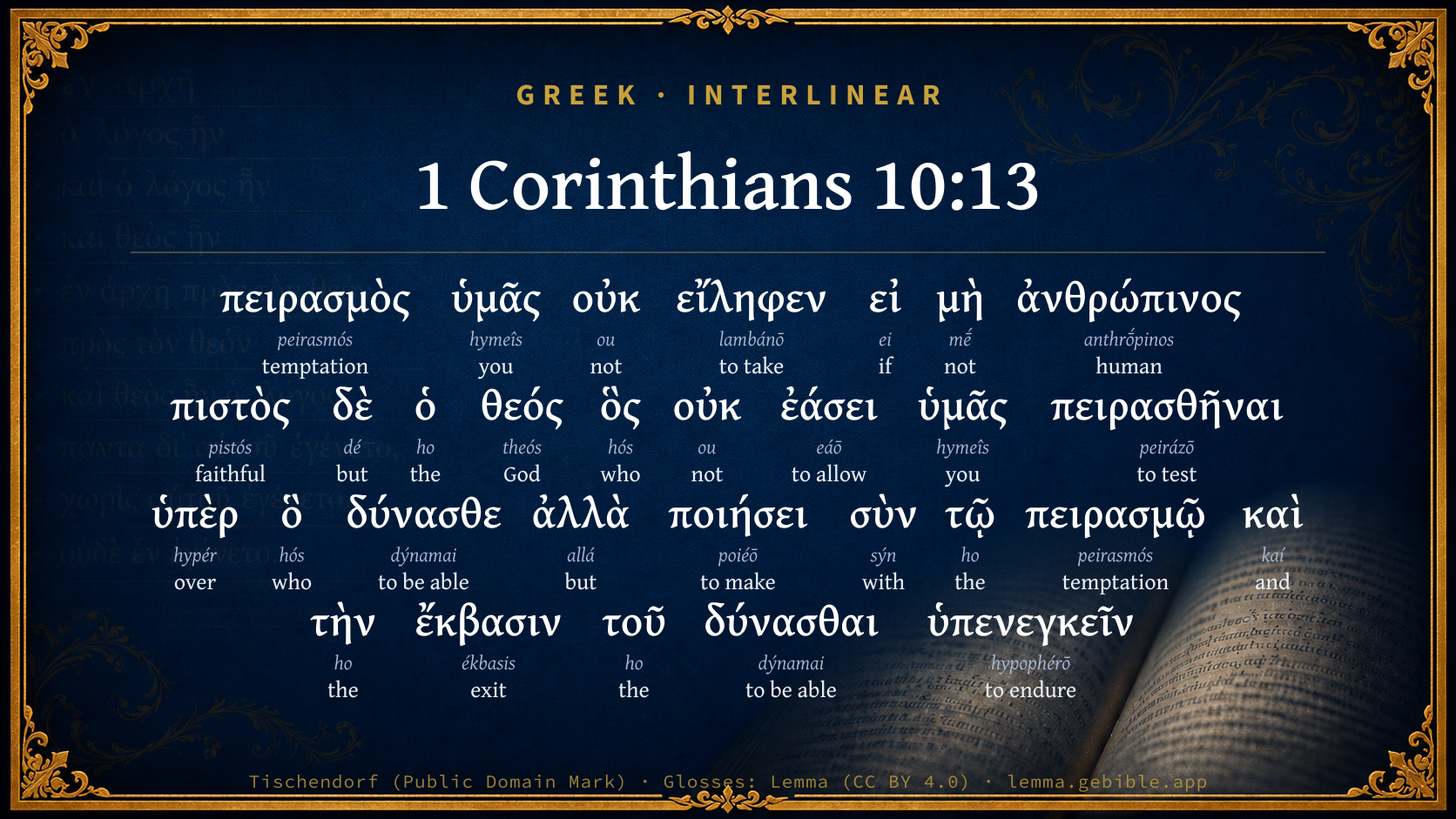
No temptation has taken you except what is common to man. God is faithful, who will not allow you to be tempted above what you are able, but will with the temptation also make the way of escape, that you may be able to endure it.
Download a study sheet
One document with this verse’s original text, its word-by-word gloss line, the meaning frame, cross-references with their text, attributed commentary, and full source and license credits — printable, and it pastes into notes with its structure intact.
This verse Autodidact and up
A passage Seminary Student
Up to 50 verses in one chapter. A passage sheet keeps up to 6 commentary sources and 12 cross-references per verse, in the order this page ranks them, and says so on the sheet whenever that leaves anything out. Ask for a single verse and you get the Autodidact verse sheet above.
Everything on this page stays free to read, with no account — the sheet is a download of what is already on screen, not access to it.
Compare translations 3
The same verse in 3 English versions, stacked beneath the original-language interlinear above. Click any original word for its lexicon entry.
Each is an independent rendering of the whole verse — the interlinear is not word-aligned to these translations.
Highlighted words mark where these versions differ — a whole-verse word diff, not a word-by-word alignment.
-
World English Bible Public Domain
No temptation has taken you except what is common to man. God is faithful, who will not allow you to be tempted above what you are able, but will with the temptation also make the way of escape, that you may be able to endure it.
-
King James Version Public Domain
There hath no temptation taken you but such as is common to man: but God is faithful, who will not suffer you to be tempted above that ye are able; but will with the temptation also make a way to escape, that ye may be able to bear it.
-
unfoldingWord Literal Text CC BY-SA 4.0
No temptation has seized you except common to humanity; but God faithful, who will not allow you to be tempted beyond what you are able, but with the temptation, he will also provide the way of escape, you will be able to endure it.
unfoldingWord Literal Text — © unfoldingWord, licensed CC BY-SA 4.0. Word-aligned USFM3 via Door43 (git.door43.org/unfoldingWord/en_ult).
Show all 19 translations
Every available English version of this verse, each an independent rendering of the whole verse.
-
World English Bible Public Domain
No temptation has taken you except what is common to man. God is faithful, who will not allow you to be tempted above what you are able, but will with the temptation also make the way of escape, that you may be able to endure it.
-
Berean Standard Bible Public Domain
No temptation has seized you except what is common to man. And God is faithful; He will not let you be tempted beyond what you can bear. But when you are tempted, He will also provide an escape, so that you can stand up under it.
-
Majority Standard Bible Public Domain
No temptation has seized you except what is common to man. And God is faithful; He will not let you be tempted beyond what you can bear. But when you are tempted, He will also provide an escape, so that you can stand up under it.
-
King James Version Public Domain
There hath no temptation taken you but such as is common to man: but God is faithful, who will not suffer you to be tempted above that ye are able; but will with the temptation also make a way to escape, that ye may be able to bear it.
-
American Standard Version (1901) Public Domain
There hath no temptation taken you but such as man can bear: but God is faithful, who will not suffer you to be tempted above that ye are able; but will with the temptation make also the way of escape, that ye may be able to endure it.
-
Revised Version (1885) Public Domain
There hath no temptation taken you but such as man can bear: but God is faithful, who will not suffer you to be tempted above that ye are able; but will with the temptation make also the way of escape, that ye may be able to endure it.
-
Geneva Bible (1599) Public Domain
There hath no tentation taken you, but such as appertaine to man: and God is faithfull, which will not suffer you to be tempted aboue that you be able, but wil euen giue the issue with the tentation, that ye may be able to beare it.
-
Douay-Rheims (1899) Public Domain
Let no temptation take hold on you, but such as is human. And God is faithful, who will not suffer you to be tempted above that which you are able: but will make also with temptation issue, that you may be able to bear it.
-
Young's Literal Translation Public Domain
No temptation hath taken you -- except human; and God is faithful, who will not suffer you to be tempted above what ye are able, but He will make, with the temptation, also the outlet, for your being able to bear `it'.
-
Literal Standard Version CC BY-SA 4.0
No temptation has taken you—except that of man; and God is faithful, who will not permit you to be tempted above what you are able, but He will make, with the temptation, also the outlet, for your being able to bear [it].
-
Unlocked Literal Bible CC BY-SA 4.0
No temptation has overtaken you that is not common to all humanity. Instead, God is faithful. He will not let you be tempted beyond your ability. With the temptation he will also provide the way of escape, so that you may be able to endure it.
-
unfoldingWord Literal Text CC BY-SA 4.0
No temptation has seized you except common to humanity; but God faithful, who will not allow you to be tempted beyond what you are able, but with the temptation, he will also provide the way of escape, you will be able to endure it.
-
Darby Bible Public Domain
No temptation has taken you but such as is according to man's nature; and God is faithful, who will not suffer you to be tempted above what ye are able [to bear], but will with the temptation make the issue also, so that [ye] should be able to bear [it].
-
World Messianic Bible Public Domain
No temptation has taken you except what is common to man. God is faithful, who will not allow you to be tempted above what you are able, but will with the temptation also make the way of escape, that you may be able to endure it.
-
Webster's Bible Public Domain
There hath no temptation taken you but such as is common to man: but God is faithful, who will not suffer you to be tempted above what ye are able; but will with the temptation also make a way to escape, that ye may be able to bear it.
-
Free Bible Version CC BY-SA 4.0
You won't experience any greater temptation than anyone else, and God is trustworthy. He won't allow you to be tempted more than you can bear, and when you are tempted, he will provide for you a way out so you can stay strong.
-
Bible in Basic English Public Domain
You have been put to no test but such as is common to man: and God is true, who will not let any test come on you which you are not able to undergo; but he will make with the test a way out of it, so that you may be able to go through it.
-
Text-Critical English NT CC BY 4.0
No temptation has overtaken you except what is common to man. God is faithful; he will not allow you to be tempted beyond what you can bear, but with the temptation he will also provide the way out so that you can endure it.
-
Tyndale New Testament (1534) Public Domain
There hath none other temptacion taken you but soche as foloweth the nature of man. But God is faythfull which shall not suffer you to be tempted above youre strenght: but shall in the myddes of the temptacion make awaye to escape out.
Literal Standard Version (2020), Covenant Press — licensed CC BY-SA 4.0. Text via the HelloAO Bible API (eBible.org). Unlocked Literal Bible (unfoldingWord) — licensed CC BY-SA 4.0. Text via the HelloAO Bible API (eBible.org). unfoldingWord Literal Text — © unfoldingWord, licensed CC BY-SA 4.0. Word-aligned USFM3 via Door43 (git.door43.org/unfoldingWord/en_ult). Free Bible Version, Dr. Jonathan Gallagher — licensed CC BY-SA 4.0. Text via the HelloAO Bible API (eBible.org).
Word by word
More ways to search: Search by grammar → Find every occurrence → Compare this word →
Practice this passage: Drill this verse → Learn its vocabulary →
- Appears 3× in the Greek New Testament
- First appears here
- Part of Speech
- Noun
- Case
- Accusative
- Number
- Singular
- Gender
- Feminine
Full Thayer's Definition
- πειρασμὸς peirasmós G3986 “temptation” Noun, Nominative, Singular, Masculine
- ὑμᾶς hymeîs G5210 “you” Personal pronoun, 2nd person, Accusative, Plural
- οὐκ ou G3756 “not” Particle, Negative
- εἴληφεν lambánō G2983 “to take” Verb, Perfect, Active, Indicative, 3rd person, Singular
- εἰ ei G1487 “if” Conditional
- μὴ mḗ G3361 “not” Particle, Negative
- ἀνθρώπινος anthrṓpinos G442 “human” Adjective, Nominative, Singular, Masculine
- πιστὸς pistós G4103 “faithful” Adjective, Nominative, Singular, Masculine
- δὲ dé G1161 “but” Conjunction
- ὁ ho G3588 “the” Article, Nominative, Singular, Masculine
- θεός theós G2316 “God” Noun, Nominative, Singular, Masculine
- ὃς hós G3739 “who” Relative pronoun, Nominative, Singular, Masculine
- οὐκ ou G3756 “not” Particle, Negative
- ἐάσει eáō G1439 “to allow” Verb, Future, Active, Indicative, 3rd person, Singular
- ὑμᾶς hymeîs G5210 “you” Personal pronoun, 2nd person, Accusative, Plural
- πειρασθῆναι peirázō G3985 “to test” Verb, Aorist, Passive, Infinitive
- ὑπὲρ hypér G5228 “over” Preposition
- ὃ hós G3739 “who” Relative pronoun, Accusative, Singular, Neuter
- δύνασθε dýnamai G1410 “to be able” Verb, Present, Middle or Passive deponent, Indicative, 2nd person, Plural
- ἀλλὰ allá G235 “but” Conjunction
- ποιήσει poiéō G4160 “to make” Verb, Future, Active, Indicative, 3rd person, Singular
- σὺν sýn G4862 “with” Preposition
- τῷ ho G3588 “the” Article, Dative, Singular, Masculine
- πειρασμῷ peirasmós G3986 “temptation” Noun, Dative, Singular, Masculine
- καὶ kaí G2532 “and” Conjunction
- τὴν ho G3588 “the” Article, Accusative, Singular, Feminine
- ἔκβασιν ékbasis G1545 “exit” Noun, Accusative, Singular, Feminine
- τοῦ ho G3588 “the” Article, Genitive, Singular, Neuter
- δύνασθαι dýnamai G1410 “to be able” Verb, Present, Middle or Passive deponent, Infinitive
- ὑπενεγκεῖν hypophérō G5297 “to endure” Verb, Aorist, Active, Infinitive
About this verse
These counts appear in no published source. They are computed here, from the morphology-tagged text and Lemma’s own curated glosses. What Lemma adds →
- 30
- words
- 22
- distinct lemmas
- Pauline Epistles
- section
Notable vocabulary
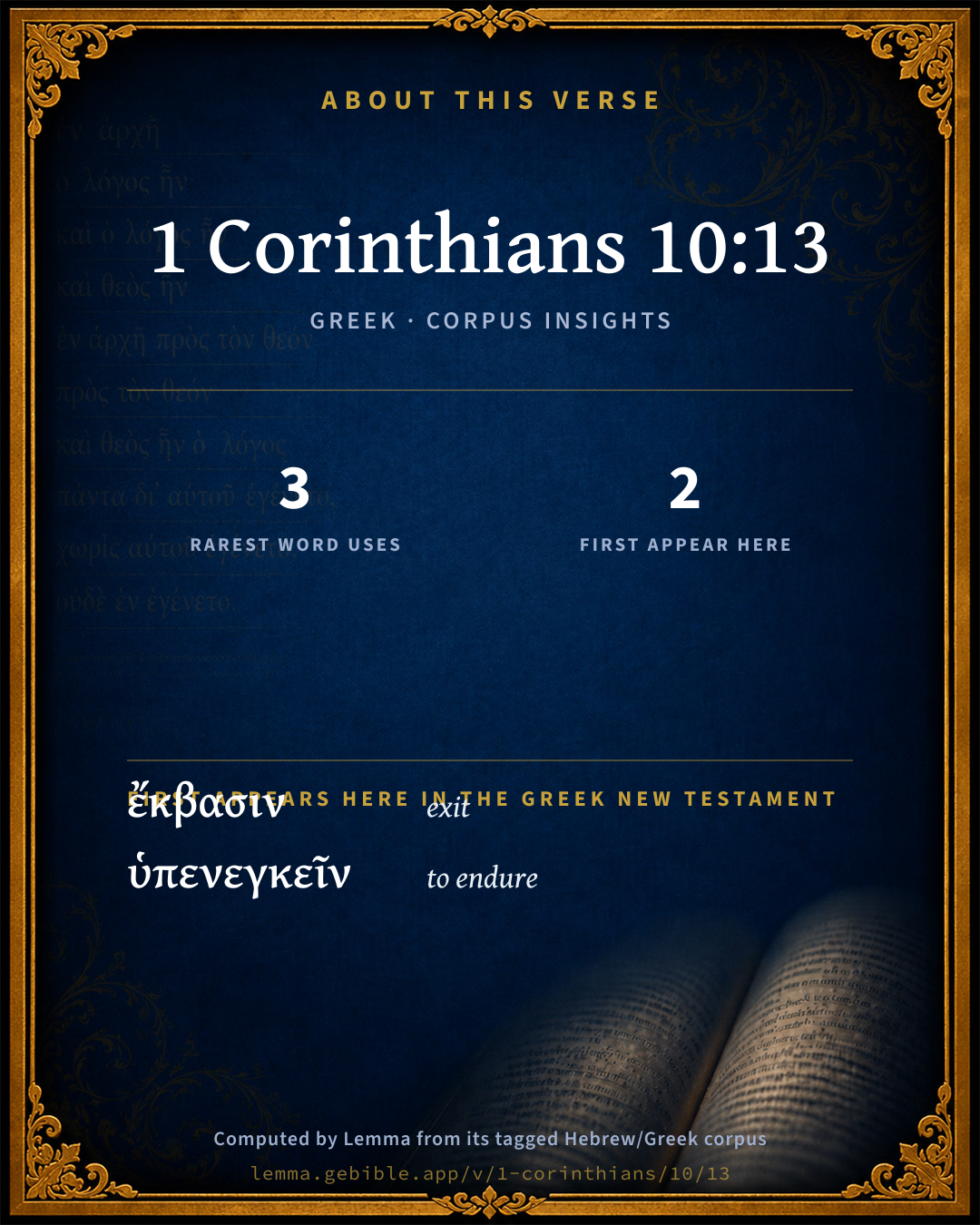
The rarest word here is ἔκβασιν exit G1545 — appearing just 3 times in the whole Greek New Testament.
First appearance in Scripture
These words make their first canonical appearance in the Greek New Testament here:
Shared distinctive vocabulary
ἔκβασιν exit G1545 occurs in 3 verses of the Greek New Testament. Also found in:
Cross-references
46Topical passages linked to 1 Corinthians 10:13 in the Treasury of Scripture Knowledge — connected by theme and wording, ordered by reader-vote popularity; previews shown in the World English Bible.
- 2 Peter 2:9 the Lord knows how to deliver the godly out of temptation and to keep the unrighteous under punishment for the day of judgment;
- 2 Timothy 4:18 And the Lord will deliver me from every evil work, and will preserve me for his heavenly Kingdom; to whom be the glory forever and ever. Amen.
- 2 Thessalonians 3:3 But the Lord is faithful, who will establish you, and guard you from the evil one.
- 1 Peter 5:8–9 Be sober and self-controlled. Be watchful. Your adversary the devil, walks around like a roaring lion, seeking whom he may devour.
- Hebrews 12:4 You have not yet resisted to blood, striving against sin;
- 1 Thessalonians 5:24 Faithful is he who calls you, who will also do it.
- Romans 8:28–39 We know that all things work together for good for those who love God, to those who are called according to his purpose.
- 2 Corinthians 12:8–10 Concerning this thing, I begged the Lord three times that it might depart from me.
- Ephesians 6:12–13 For our wrestling is not against flesh and blood, but against the principalities, against the powers, against the world's rulers of the darkness of this age, and against the spiritual hosts of wickedness in the heavenly places.
- Luke 22:46 and said to them, "Why do you sleep? Rise and pray that you may not enter into temptation."
- Jeremiah 29:11 For I know the thoughts that I think toward you, says Yahweh, thoughts of peace, and not of evil, to give you hope in your latter end.
- Daniel 3:17 If it be [so], our God whom we serve is able to deliver us from the burning fiery furnace; and he will deliver us out of your hand, O king.
- Deuteronomy 7:9 Know therefore that Yahweh your God, he is God, the faithful God, who keeps covenant and loving kindness with them who love him and keep his commandments to a thousand generations,
- Lamentations 3:23 They are new every morning; great is your faithfulness.
- Revelation 3:10 Because you kept my command to endure, I also will keep you from the hour of testing, which is to come on the whole world, to test those who dwell on the earth.
- James 5:10–11 Take, brothers, for an example of suffering and of patience, the prophets who spoke in the name of the Lord.
- John 10:28–30 I give eternal life to them. They will never perish, and no one will snatch them out of my hand.
- 2 Corinthians 1:10 who delivered us out of so great a death, and does deliver; on whom we have set our hope that he will also still deliver us;
- Revelation 2:10 Don't be afraid of the things which you are about to suffer. Behold, the devil is about to throw some of you into prison, that you may be tested; and you will have oppression for ten days. Be faithful to death, and I will give you the crown of life.
- 1 Peter 4:19 Therefore let them also who suffer according to the will of God in doing good entrust their souls to him, as to a faithful Creator.
- 1 John 1:9 If we confess our sins, he is faithful and righteous to forgive us the sins, and to cleanse us from all unrighteousness.
- 2 Timothy 2:11–13 This saying is faithful: For if we died with him, We will also live with him.
- Hebrews 11:11 By faith, even Sarah herself received power to conceive, and she bore a child when she was past age, since she counted him faithful who had promised.
- 1 Corinthians 1:9 God is faithful, through whom you were called into the fellowship of his Son, Jesus Christ, our Lord.
- Hebrews 10:23 let us hold fast the confession of our hope unyieldingly. For he who promised is faithful.
- Luke 22:31–32 The Lord said, "Simon, Simon, behold, Satan asked to have you, that he might sift you as wheat,
- Psalms 89:33 But I will not completely take my loving kindness from him, Nor allow my faithfulness to fail.
- Psalms 124:7 Our soul has escaped like a bird out of the fowler's snare. The snare is broken, and we have escaped.
- Psalms 125:3 For the scepter of wickedness won't remain over the allotment of the righteous; So that the righteous won't use their hands to do evil.
- Luke 11:4 Forgive us our sins, For we ourselves also forgive everyone who is indebted to us. Bring us not into temptation, But deliver us from the evil one.'"
- 1 Peter 1:5–7 who by the power of God are guarded through faith for a salvation ready to be revealed in the last time.
- Exodus 3:17 and I have said, I will bring you up out of the affliction of Egypt to the land of the Canaanite, the Hittite, the Amorite, the Perizzite, the Hivite, and the Jebusite, to a land flowing with milk and honey."'
- Matthew 24:21–24 for then there will be great oppression, such as has not been from the beginning of the world until now, no, nor ever will be.
- Hebrews 6:18 that by two immutable things, in which it is impossible for God to lie, we may have a strong encouragement, who have fled for refuge to take hold of the hope set before us.
- Hebrews 11:35–38 Women received their dead by resurrection. Others were tortured, not accepting their deliverance, that they might obtain a better resurrection.
- Isaiah 25:1 Yahweh, you are my God; I will exalt you, I will praise your name; for you have done wonderful things, [even] counsels of old, in faithfulness [and] truth.
- 2 Corinthians 11:23–28 Are they servants of Christ? (I speak as one beside himself) I am more so; in labors more abundantly, in prisons more abundantly, in stripes above measure, in deaths often.
- Revelation 19:11 I saw the heaven opened, and behold, a white horse, and he who sat on it is called Faithful and True. In righteousness he judges and makes war.
- Isaiah 11:5 Righteousness shall be the belt of his waist, and faithfulness the belt of his loins.
- Hosea 2:20 I will even betroth you to me in faithfulness; And you shall know Yahweh.
- Isaiah 49:7 Thus says Yahweh, the Redeemer of Israel, [and] his Holy One, to him whom man despises, to him whom the nation abhors, to a servant of rulers: Kings shall see and arise; princes, and they shall worship; because of Yahweh who is faithful, [even] the Holy One of Israel, who has chosen you.
- Jeremiah 12:5 If you have run with the footmen, and they have wearied you, then how can you contend with horses? and though in a land of peace you are secure, yet how will you do in the pride of the Jordan?
- Luke 16:26 Besides all this, between us and you there is a great gulf fixed, that those who want to pass from here to you are not able, and that none may cross over from there to us.'
- Acts 27:44 and the rest should follow, some on planks, and some on other things from the ship. So it happened that they all escaped safely to the land.
- Genesis 19:20–21 See now, this city is near to flee to, and it is a little one. Oh let me escape there (isn't it a little one?), and my soul will live."
- Psalms 36:5 Your loving kindness, Yahweh, is in the heavens. Your faithfulness reaches to the skies.
Cross-references courtesy of OpenBible.info (CC BY 4.0).
Lesson kit
Teaching starters — assembled from the data on this page, not authored interpretation. Every prompt links to the verse data it draws on. Edit before teaching.
1 Corinthians, in the Pauline Epistles, opens this verse with 30 words (22 distinct Greek lemmas). Its most distinctive word is ékbasis (“exit”). A historical commentator’s framing appears above. Read the whole chapter for the surrounding context.
Discussion questions
- The word ékbasis carries the sense “exit.” How does it shape the verse?
- 2 words here appear for the first time in Scripture. What is being introduced at this debut?
- Hebrews 11:15 shares the word «exit» with this verse. How do the two illuminate each other?
- “temptation” occurs 2× in this one verse. What is the effect of the repetition?
- These translations render this verse differently; the difference is in the English rendering, not the original. What questions does that raise?
- Reading how Bengel's Gnomon and Meyer's Critical & Exegetical Commentary read this verse, where do the two commentators agree and where do they part?
Things to notice
- 2 words make their first canonical appearance in Scripture here.
- These translations choose different wording for 18 words in this verse.
- “temptation” occurs 2× in this single verse.
- 22 distinct Greek lemmas span 30 words in this verse.
Commentary
Notes on 1 Corinthians 10:13 from classic Christian and Jewish commentators (each source and its license shown beneath its notes). The classic Christian expositions comment on the surrounding passage and are grouped to its opening verse, so a note may address several verses; the Jewish commentaries on the Tanakh (Rashi and others) are per-verse, so they appear only where the commentator wrote on this verse.
Lemma curates 59 commentaries, every one of them public domain or Creative Commons licensed, each selected and text-cleaned for this edition rather than reprinted as found. About our sources →
Bengel's Gnomon
Johann Albrecht Bengel
Bengel's Gnomon of the New Testament — English translation (T&T Clark, Edinburgh, 1860) — public domain. Text from a community e-Sword module.
Meyer's Critical & Exegetical Commentary
Heinrich August Wilhelm Meyer
Meyer — Critical and Exegetical Commentary on the New Testament — English translation by Peter Christie, edited by Frederick Crombie (T&T Clark, 1880) — public domain. Text from a community e-Sword module.
Hodge's Commentary on Romans, Ephesians & First Corinthians
Charles Hodge
Charles Hodge — Commentary on Romans (1835), First Corinthians (1857), and Ephesians (1856) — public domain. Text from a community e-Sword module.
Geneva Bible (1599)
Geneva Bible translators
Geneva Bible (1599) marginal notes — public domain. Text via Bolls.life.
Jamieson, Fausset & Brown
Robert Jamieson, A. R. Fausset & David Brown
Jamieson, Fausset & Brown — Commentary Critical and Explanatory on the Whole Bible (1871) — public domain (CC PDM 1.0). Text via the HelloAO Bible API.
Adam Clarke's Commentary
Adam Clarke's Commentary on the Bible (1810–1826) — public domain. Text from a community e-Sword/MySword module.
John Calvin's Commentaries
John Calvin's Commentaries (1540-1563) — public domain. Text from the Calvin Translation Society English edition (1840s-50s) via the Christian Classics Ethereal Library (ccel.org). Calvin's coverage is partial (roughly two-thirds of the Bible); uncommented books and verses are honest gaps, never fabricated. The 19th-century editor's footnotes and remarks are omitted so the notes are faithfully Calvin's own voice.
Ellicott's Commentary for English Readers
A Bible Commentary for English Readers, edited by Charles John Ellicott (1878–1897) — public domain. Text from a community e-Sword module.
The Cambridge Bible for Schools and Colleges
gen. ed. J. J. S. Perowne
The Cambridge Bible for Schools and Colleges (gen. ed. J. J. S. Perowne; Cambridge University Press, 1878–1918) — public domain. Text from a community e-Sword module.
John Gill's Exposition
John Gill's Exposition of the Whole Bible (1746–1763) — public domain (CC PDM 1.0). Text via the HelloAO Bible API.
Trapp's Complete Commentary
John Trapp
John Trapp, A Commentary or Exposition upon All the Books of the Old and New Testament (1647–1656) — public domain. Text from a community e-Sword module.
Albert Barnes' Notes on the Bible
Albert Barnes' Notes on the Bible (1834–1885) — public domain. Text from a community e-Sword/MySword module.
Haydock's Catholic Bible Commentary
George Leo Haydock (1774–1849), Haydock's Catholic Family Bible and Commentary, 1859 edition — public domain. Excludes Psalms (Douay-Rheims chapter numbering differs from Protestant) and Deuterocanonical books (Catholic canon only).
Matthew Poole's English Annotations
Matthew Poole's English Annotations on the Holy Bible (1683–1685) — public domain. Text from a community e-Sword/MySword module.
Whedon's Commentary on the Bible
Daniel D. Whedon
Daniel D. Whedon (gen. ed.), Commentary on the Old and New Testaments (1874–1909) — public domain. Text from a community e-Sword module.
The Pulpit Commentary
The Pulpit Commentary (1880–1919), ed. H.D.M. Spence-Jones & Joseph S. Exell — public domain. Text from a community e-Sword module.
John Wesley's Explanatory Notes
John Wesley, Explanatory Notes Upon the Whole Bible (1754–1765) — public domain. Text via the GEBible commentary corpus.
Burkitt's Expository Notes on the New Testament
William Burkitt
William Burkitt's Expository Notes on the New Testament (1700–1703) — public domain. Text from a community e-Sword module.
Godbey's Commentary on the New Testament
William B. Godbey
William B. Godbey, Commentary on the New Testament (1896–1900) — public domain. Text from a community e-Sword module.
McGarvey & Pendleton's Commentaries
J. W. McGarvey
J. W. McGarvey (with Philip Y. Pendleton), Commentaries on the New Testament (The Fourfold Gospel, 1914; Acts; and the epistles) — public domain. Text from a community e-Sword/MySword module.
The People's New Testament
B. W. Johnson
B. W. Johnson's The People's New Testament with Notes (1889–1891) — public domain. Electronic text from the Christian Classics Ethereal Library (CCEL) ThML edition.
Cambridge Greek Testament for Schools and Colleges
Cambridge Greek Testament for Schools and Colleges (Cambridge University Press, 1896; 21 vols, various authors incl. Carr, Maclear, Plummer, Farrar, Lumby, Moule, M. R. James, Simcox) — public domain. Text from a community e-Sword module.
Alford’s Greek Testament
Henry Alford
Henry Alford, The Greek Testament (1849–1861) — public domain. Text from a community e-Sword module.
International Critical Commentary
International Critical Commentary — older volumes (1896–1929), various authors — public domain. Text from a community e-Sword module.
Vincent's Word Studies in the New Testament
Marvin R. Vincent
Marvin R. Vincent, Word Studies in the New Testament (1887–1900) — public domain. Text from a community e-Sword/MySword module.