Luke 7:16

Greek (Tischendorf 8th ed.) Luke 7:16 appears in the Greek New Testament. The text above is from the Tischendorf 8th edition. Each word links to its Strong’s number and a concise gloss. Click any word for its full Thayer’s Greek Lexicon entry.
Download image
Cite this verse

Luke 7:16 (World English Bible). Public Domain. Lemma interlinear Bible study tool, https://lemma.gebible.app/v/luke/7/16.

Show BibTeX & RIS
BibTeX
RIS
English Translation
Fear took hold of all, and they glorified God, saying, "A great prophet has arisen among us!" and, "God has visited his people!"
World English Bible · Public Domain
Download a study sheet

One document with this verse’s original text, its word-by-word gloss line, the meaning frame, cross-references with their text, attributed commentary, and full source and license credits — printable, and it pastes into notes with its structure intact.

This verse Autodidact and up

Study sheet (.html) Plain text (.txt)

A passage Seminary Student

Up to 50 verses in one chapter. A passage sheet keeps up to 6 commentary sources and 12 cross-references per verse, in the order this page ranks them, and says so on the sheet whenever that leaves anything out. Ask for a single verse and you get the Autodidact verse sheet above.

Everything on this page stays free to read, with no account — the sheet is a download of what is already on screen, not access to it.

Want to remove ads? Support Godless Engineer
Compare translations 3

The same verse in 3 English versions, stacked beneath the original-language interlinear above. Click any original word for its lexicon entry.

Each is an independent rendering of the whole verse — the interlinear is not word-aligned to these translations.

Highlighted words mark where these versions differ — a whole-verse word diff, not a word-by-word alignment.

  • World English Bible Public Domain
    Fear took hold of all, and they glorified God, saying, "A great prophet has arisen among us!" and, "God has visited his people!"
  • King James Version Public Domain
    And there came a fear on all: and they glorified God, saying, That a great prophet is risen up among us; and, That God hath visited his people.
  • unfoldingWord Literal Text CC BY-SA 4.0
    Then fear seized all, and they were glorifying God, saying, “A great prophet has been raised among us” and “God has visited his people.”

unfoldingWord Literal Text — © unfoldingWord, licensed CC BY-SA 4.0. Word-aligned USFM3 via Door43 (git.door43.org/unfoldingWord/en_ult).

Versions to compare (up to 4)

3 of 4 selected

Show all 19 translations

Every available English version of this verse, each an independent rendering of the whole verse.

  • World English Bible Public Domain
    Fear took hold of all, and they glorified God, saying, "A great prophet has arisen among us!" and, "God has visited his people!"
  • Berean Standard Bible Public Domain
    A sense of awe swept over all of them, and they glorified God. “A great prophet has appeared among us!” they said. “God has visited His people!”
  • Majority Standard Bible Public Domain
    A sense of awe swept over all of them, and they glorified God. “A great prophet has appeared among us!” they said. “God has visited His people!”
  • King James Version Public Domain
    And there came a fear on all: and they glorified God, saying, That a great prophet is risen up among us; and, That God hath visited his people.
  • American Standard Version (1901) Public Domain
    And fear took hold on all: and they glorified God, saying, A great prophet is arisen among us: and, God hath visited his people.
  • Revised Version (1885) Public Domain
    And fear took hold on all: and they glorified God, saying, A great prophet is arisen among us: and, God hath visited his people.
  • Geneva Bible (1599) Public Domain
    Then there came a feare on them all, and they glorified God, saying, A great Prophet is risen among vs, and God hath visited his people.
  • Douay-Rheims (1899) Public Domain
    And there came a fear on them all: and they glorified God, saying: A great prophet is risen up among us: and, God hath visited his people.
  • Young's Literal Translation Public Domain
    and fear took hold of all, and they were glorifying God, saying -- `A great prophet hath risen among us,' and -- `God did look upon His people.'
  • Literal Standard Version CC BY-SA 4.0
    and fear took hold of all, and they were glorifying God, saying, “A great prophet has risen among us,” and, “God looked on His people.”
  • Unlocked Literal Bible CC BY-SA 4.0
    Then fear overcame all of them, and they kept praising God, saying, “A great prophet has been raised among us” and “God has looked upon his people.”
  • unfoldingWord Literal Text CC BY-SA 4.0
    Then fear seized all, and they were glorifying God, saying, “A great prophet has been raised among us” and “God has visited his people.”
  • Darby Bible Public Domain
    And fear seized on all, and they glorified God, saying, A great prophet has been raised up amongst us; and God has visited his people.
  • World Messianic Bible Public Domain
    Fear took hold of all, and they glorified God, saying, “A great prophet has arisen among us!” and, “God has visited his people!”
  • Webster's Bible Public Domain
    And there came a fear on all: and they glorified God, saying, That a great prophet hath risen among us; and, That God hath visited his people.
  • Free Bible Version CC BY-SA 4.0
    A sense of awe filled everyone there and they praised God, saying, “A great prophet has arisen among us,” and “God has visited his people.”
  • Bible in Basic English Public Domain
    And fear came on all, and they gave praise to God, saying, A great prophet is among us: and, God has given thought to his people.
  • Text-Critical English NT CC BY 4.0
    Then all the people were filled with awe and began glorifying God, saying, “A great prophet has arisen among us,” and, “God has visited his people.”
  • Tyndale New Testament (1534) Public Domain
    And ther came a feare on the all. And they glorified god sayinge: a greate prophet is rysen amonge vs and god hath visited his people

Literal Standard Version (2020), Covenant Press — licensed CC BY-SA 4.0. Text via the HelloAO Bible API (eBible.org). Unlocked Literal Bible (unfoldingWord) — licensed CC BY-SA 4.0. Text via the HelloAO Bible API (eBible.org). unfoldingWord Literal Text — © unfoldingWord, licensed CC BY-SA 4.0. Word-aligned USFM3 via Door43 (git.door43.org/unfoldingWord/en_ult). Free Bible Version, Dr. Jonathan Gallagher — licensed CC BY-SA 4.0. Text via the HelloAO Bible API (eBible.org).

Word by word

More ways to search: Search by grammar → Find every occurrence → Compare this word →

Practice this passage: Drill this verse → Learn its vocabulary →

ἐπεσκέψατο
episképtomai
G1980
“to look after”
Verb, Aorist, Middle deponent, Indicative, 3rd person, Singular
Part of Speech
Verb
Tense
Aorist
Voice
Middle deponent
Mood
Indicative
Person
3rd person
Number
Singular
Full Thayer's Definition

Origin: middle voice from G1909 and the base of G4649

TDNT: 11:59,2

1. to look upon or after, to inspect, examine with the eyes a. in order to see how he is, i.e. to visit, go to see one 1. the poor and afflicted, the sick b. to look upon in order to help or to benefit 1. to look after, have care for, provide for: of God c. to look (about) for, look out (one to choose, employ, etc.)
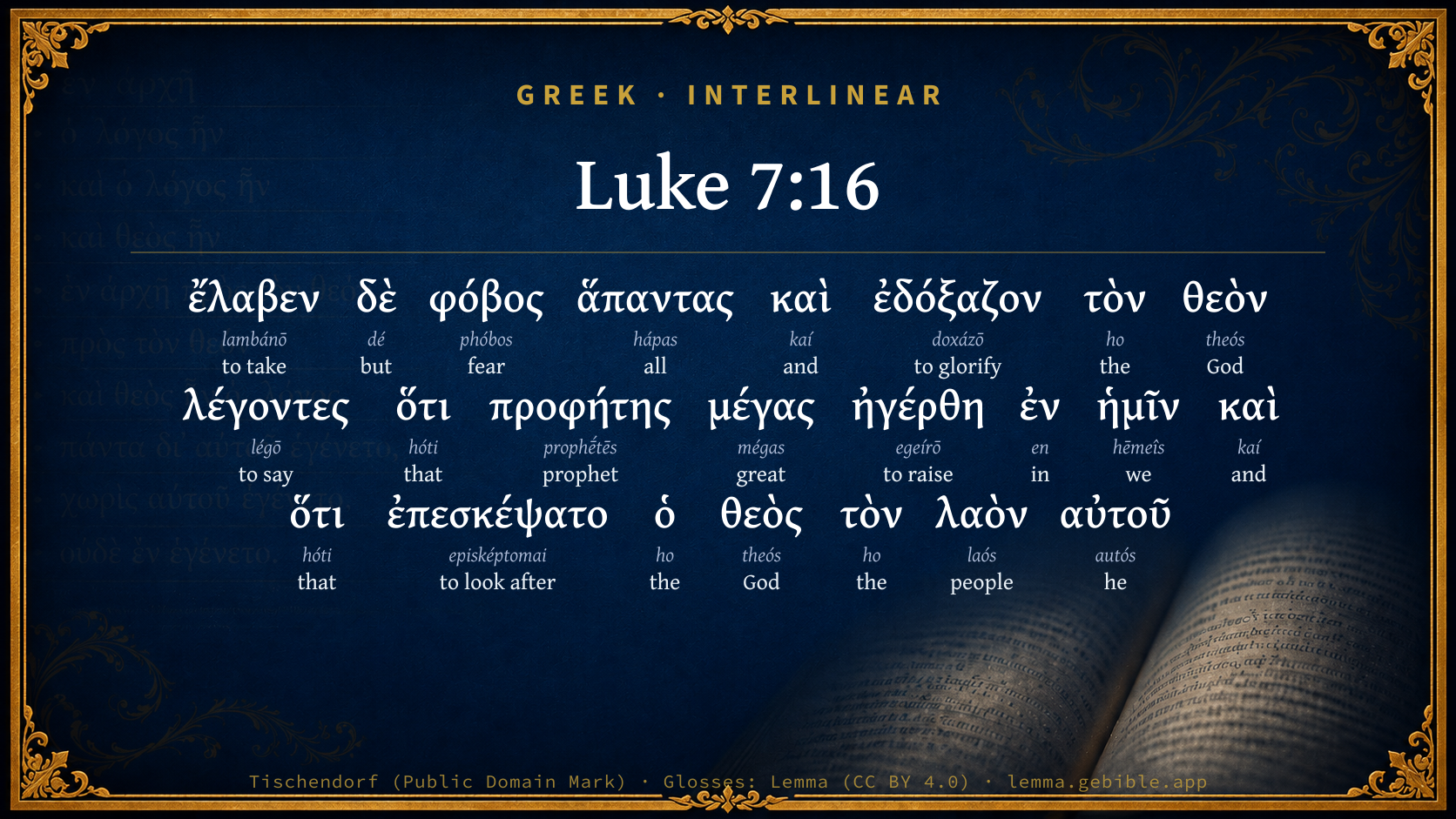
  1. ἔλαβεν lambánō G2983 “to take” Verb, Aorist, Active, Indicative, 3rd person, Singular
  2. δὲ dé G1161 “but” Conjunction
  3. φόβος phóbos G5401 “fear” Noun, Nominative, Singular, Masculine
  4. ἅπαντας hápas G537 “all” Adjective, Accusative, Plural, Masculine
  5. καὶ kaí G2532 “and” Conjunction
  6. ἐδόξαζον doxázō G1392 “to glorify” Verb, Imperfect, Active, Indicative, 3rd person, Plural
  7. τὸν ho G3588 “the” Article, Accusative, Singular, Masculine
  8. θεὸν theós G2316 “God” Noun, Accusative, Singular, Masculine
  9. λέγοντες légō G3004 “to say” Verb, Present, Active, Participle, Nominative, Plural, Masculine
  10. ὅτι hóti G3754 “that” Conjunction
  11. προφήτης prophḗtēs G4396 “prophet” Noun, Nominative, Singular, Masculine
  12. μέγας mégas G3173 “great” Adjective, Nominative, Singular, Masculine
  13. ἠγέρθη egeírō G1453 “to raise” Verb, Aorist, Passive, Indicative, 3rd person, Singular
  14. ἐν en G1722 “in” Preposition
  15. ἡμῖν hēmeîs G2249 “we” Personal pronoun, 1st person, Dative, Plural
  16. καὶ kaí G2532 “and” Conjunction
  17. ὅτι hóti G3754 “that” Conjunction
  18. ὁ ho G3588 “the” Article, Nominative, Singular, Masculine
  19. θεὸς theós G2316 “God” Noun, Nominative, Singular, Masculine
  20. τὸν ho G3588 “the” Article, Accusative, Singular, Masculine
  21. λαὸν laós G2992 “people” Noun, Accusative, Singular, Masculine
  22. αὐτοῦ autós G846 “he” Personal pronoun, Genitive, Singular, Masculine

About this verse

These counts appear in no published source. They are computed here, from the morphology-tagged text and Lemma’s own curated glosses. What Lemma adds →

23
words
18
distinct lemmas
Gospels
section

Notable vocabulary

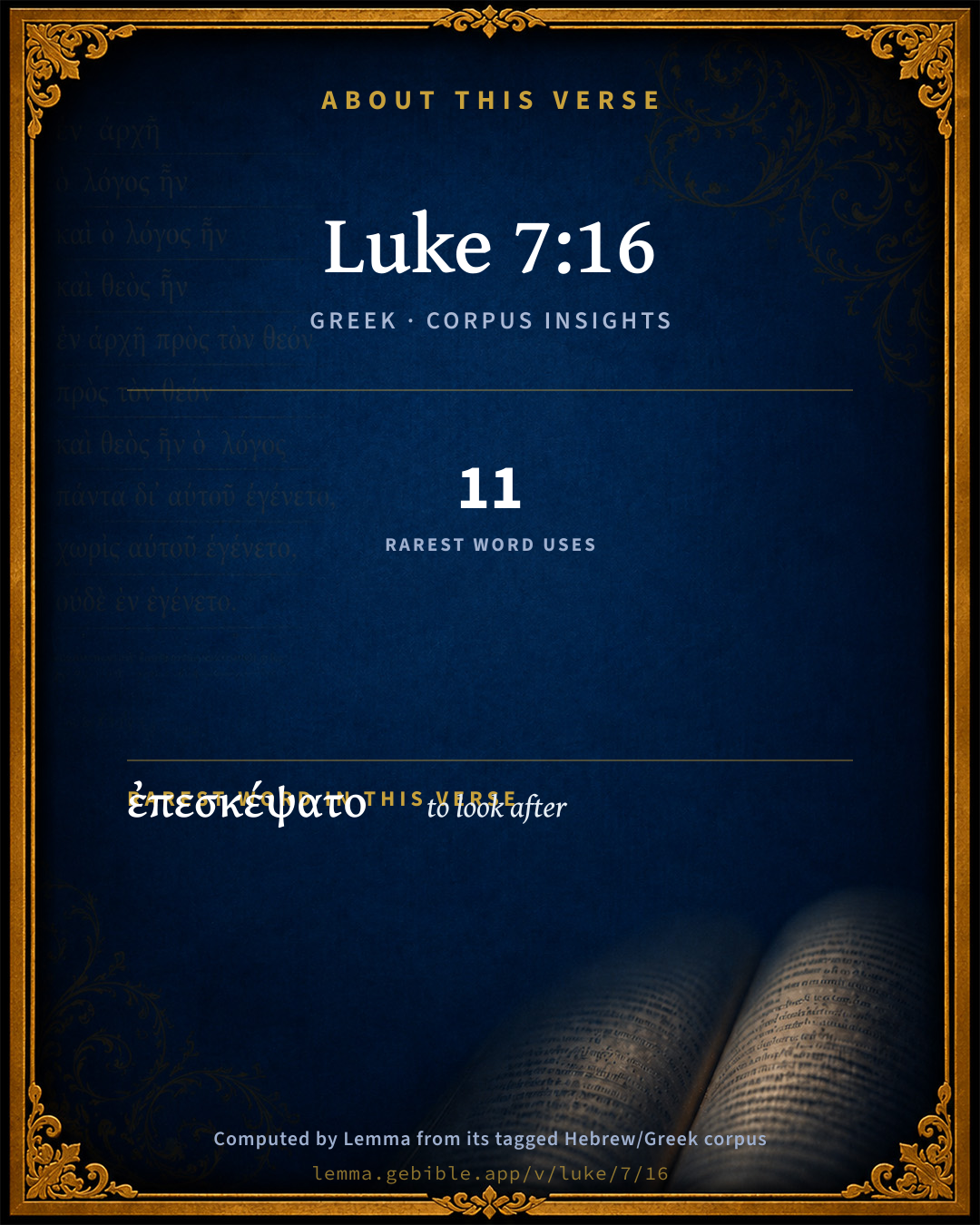
The rarest word here is ἐπεσκέψατο to look after G1980 — appearing just 11 times in the whole Greek New Testament.

Shared distinctive vocabulary

ἐπεσκέψατο to look after G1980 occurs in 11 verses of the Greek New Testament. Also found in:

Repetition

Words recur within this verse:

Cross-references

29

Topical passages linked to Luke 7:16 in the Treasury of Scripture Knowledge — connected by theme and wording, ordered by reader-vote popularity; previews shown in the World English Bible.

  • Matthew 9:8 But when the multitudes saw it, they marveled and glorified God, who had given such authority to men.
  • Jeremiah 33:9 [This city] shall be to me for a name of joy, for a praise and for a glory, before all the nations of the earth, which shall hear all the good that I do to them, and shall fear and tremble for all the good and for all the peace that I procure to it.
  • Luke 1:68 "Blessed be the Lord, the God of Israel, For he has visited and worked redemption for his people;
  • Luke 7:39 Now when the Pharisee who had invited him saw it, he said to himself, "This man, if he were a prophet, would have perceived who and what kind of woman this is who touches him, that she is a sinner."
  • Exodus 4:31 The people believed, and when they heard that Yahweh had visited the children of Israel, and that he had seen their affliction, then they bowed their heads and worshiped.
  • Psalms 65:9 You visit the earth, and water it. You greatly enrich it. The river of God is full of water. You provide them grain, for so you have ordained it.
  • Psalms 106:4–5 Remember me, Yahweh, with the favor that you show to your people. Visit me with your salvation,
  • Matthew 15:31 so that the multitude wondered when they saw the mute speaking, injured whole, lame walking, and blind seeing--and they glorified the God of Israel.
  • Matthew 21:11 The multitudes said, "This is the prophet, Jesus, from Nazareth of Galilee."
  • Luke 1:65 Fear came on all who lived around them, and all these sayings were talked about throughout all the hill country of Judea.
  • Luke 2:20 The shepherds returned, glorifying and praising God for all the things that they had heard and seen, just as it was told them.
  • Luke 5:26 Amazement took hold on all, and they glorified God. They were filled with fear, saying, "We have seen strange things today."
  • Matthew 28:8 They departed quickly from the tomb with fear and great joy, and ran to bring his disciples word.
  • Luke 5:8 But Simon Peter, when he saw it, fell down at Jesus' knees, saying, "Depart from me, for I am a sinful man, Lord."
  • Luke 8:37 All the people of the surrounding country of the Gadarenes asked him to depart from them, for they were very much afraid. He entered into the boat, and returned.
  • Luke 9:19 They answered, "'John the Baptizer,' but others say, 'Elijah,' and others, that one of the old prophets is risen again."
  • Luke 24:19 He said to them, "What things?" They said to him, "The things concerning Jesus, the Nazarene, who was a prophet mighty in deed and word before God and all the people;
  • John 1:21 They asked him, "What then? Are you Elijah?" He said, "I am not." "Are you the Prophet?" He answered, "No."
  • John 1:25 They asked him, "Why then do you baptize, if you are not the Christ, nor Elijah, nor the Prophet?"
  • John 4:19 The woman said to him, "Sir, I perceive that you are a prophet.
  • John 6:14 When therefore the people saw the sign which Jesus did, they said, "This is truly the prophet who comes into the world."
  • John 7:40–41 Many of the multitude therefore, when they heard these words, said, "This is truly the prophet."
  • John 9:17 Therefore they asked the blind man again, "What do you say about him, because he opened your eyes?" He said, "He is a prophet."
  • Acts 3:22–23 For Moses indeed said to the fathers, 'The Lord God will raise up a prophet for you from among your brothers, like me. You shall listen to him in all things whatever he says to you.
  • Acts 5:5 Ananias, hearing these words, fell down and died. Great fear came on all who heard these things.
  • Acts 5:11–13 Great fear came on the whole assembly, and on all who heard these things.
  • Galatians 1:24 And they glorified God in me.
  • Luke 19:44 and will dash you and your children within you to the ground. They will not leave in you one stone on another, because you didn't know the time of your visitation."
  • Acts 7:37 This is that Moses, who said to the children of Israel, 'The Lord our God will raise up a prophet for you from among your brothers, like me.'

Cross-references courtesy of OpenBible.info (CC BY 4.0).

Commentary

Notes on Luke 7:16 from classic Christian and Jewish commentators (each source and its license shown beneath its notes). The classic Christian expositions comment on the surrounding passage and are grouped to its opening verse, so a note may address several verses; the Jewish commentaries on the Tanakh (Rashi and others) are per-verse, so they appear only where the commentator wrote on this verse.

Lemma curates 59 commentaries, every one of them public domain or Creative Commons licensed, each selected and text-cleaned for this edition rather than reprinted as found. About our sources →

Joseph Benson's Commentary

Luk 7:16. And there came a fear on all — All the people present, being sensible that Jesus showed, in this instance, not only the greatness of his power, but the truth of his mission from God, were seized with a religious awe and reverence, which had him for its object. And they glorified God — For the Lord and his goodness, as well as the Lord and his greatness, are to be feared and glorified; saying, That a great prophet is risen up among us. This was the inference which they drew from the miracle, that God had again graciously regarded his ancient people, by raising up among them an extraordinary prophet, as he had often done in former ages. It was indeed reasonable to conclude that the person must be divinely inspired, who could thus restore the dead to life; nay, and that he was the great prophet they had been long looking for, and that in and by him God had visited his people to redeem them, as was expected, Luk 1:68. This would be life from the dead indeed, to all them that waited for the consolation of Israel. And when dead souls are thus raised to spiritual life, by a divine power going along with the gospel, we must glorify God, and look upon it as his graciously visiting his people. And this rumour of him went forth — Wherever this miracle was reported, which was not only in Judea, but in all the neighbouring regions, it produced the same opinion in those who heard of it, namely, that God had visited his people in an extraordinary way, and had raised up among them a very eminent prophet, which greatly heightened and increased the mighty expectations from him, which long before they had begun to entertain. “The ancients,” says Grotius, “observe, that in three of the miracles, performed by Jesus after his sermon on the mount, the three kinds of God’s benefits are represented to us: 1st, Of those which are conferred upon our suing to God for them ourselves, as in the case of the leper. 2d, Of those which are obtained for us by the prayers of others, as in the case of the centurion’s servant. And, 3d, Of those which God bestows out of his own free mercy, as in the present case. To which kind of mercy the apostles very justly refer the calling of the Gentiles.”

Joseph Benson's Commentary on the Old and New Testaments (1811–1818) — public domain. Text from a community e-Sword module.

Tyndale Open Study Notes

Tyndale Open Resources

7:16 A mighty prophet: Jesus was like Elijah and Elisha.

Tyndale Open Study Notes — © Tyndale Open Resources, licensed CC BY-SA 4.0. Text via the HelloAO Bible API.

Bengel's Gnomon

Johann Albrecht Bengel

Luk 7:16. Προφήτης, a prophet) Hebr. נביא is not only one who predicts the future, but one who imparts to men divine gifts, lessons.—καὶ ὅτι) By this formula the two epiphonemata [exclamations subjoined to the narrative which gave rise to them] are divided from one another.—[ἐπεσκέψατο, hath visited) For that visitation we have even still reason to celebrate the divine love to man, φιλανθρωπία.—V. g.]

Bengel's Gnomon of the New Testament — English translation (T&T Clark, Edinburgh, 1860) — public domain. Text from a community e-Sword module.

Meyer's Critical & Exegetical Commentary

Heinrich August Wilhelm Meyer

Luk_7:16-17. Φόβος] Fear, the first natural impression, Luk_5:26.

ὅτι … καὶ ὅτι] not recitative (so usually), but argumentative (Bornemann), as Luk_1:25 : (we praise God) because … and because. The recitative ὅτι occurs nowhere (not even in Luk_4:10) twice in the same discourse; moreover, it is quite arbitrary to assume that in the second half, which is by no means specifically different from the first, we have the words of others (Paulus, Kuinoel, Bleek).

They saw in this miracle a σημεῖον of a great prophet, and in His appearance they saw the beginning of the Messianic deliverance (comp. Luk_1:68; Luk_1:78).

ὁ λόγος οὗτος] This saying, namely, that a great prophet with his claim made good by a raising from the dead, etc.

ἐν ὅλῃ τ. Ἰουδ.] a pregnant expression: in the whole of Judaea, whither the saying had penetrated. Comp. Thucyd. iv. 42: ἐν Λευκαδίᾳ ἀπῄεσαν. Judaea is not here to be understood in the narrower sense of the province, as though this were specified as the theatre of the incident (Weizsäcker), but in the wider sense of Palestine in general (Luk_1:5); and by ἐν πάσῃ τῇ περιχώρῳ, which is not to be referred to the neighbourhood of Nain (Köstlin, p. 231), it is asserted that the rumour had spread abroad even beyond the limits of Palestine.

περὶ αὐτοῦ] so that He was mentioned as the subject of the rumour. Comp. Luk_5:15.

REMARK.

The natural explanation of this miracle as of the awakening of a person only apparently dead (Paulus, Ammon; comp. Schleiermacher, L. J. p. 233) so directly conflicts with the Gospel narrative, and, moreover, places Jesus in so injurious a light of dissimulation and pretence, that it is decisively to be rejected, even apart from the fact that in itself it would be improbable, nay monstrous, to suppose that as often as dead people required His help, He should have chanced every time upon people only apparently dead (to which class in the end even He Himself also must have belonged after His crucifixion!). Further, the allegorical explanation (Weisse), as well as also the identification of this miracle with the narrative of the daughter of Jairus (Gfrörer, Heil. Sage, I. p. 194), and finally, the mythical solution (Strauss), depend upon subjective assumptions, which are not sufficient to set aside the objective historical testimony, all the more that this testimony is conjoined, in respect of the nature of the miracle, with that of Matthew (Jairus daughter) and that of John (Lazarus); and to suspect the three narratives of raisings from the dead taken together because of the gradual climax of their attendant circumstances (Woolston, Strauss: death-bed, coffin, grave) is inadmissible, because Luke has not the history of the raising on the death-bed until later (Luk_8:50 ff.), and therefore was not consciously aware of that progression to a climax. The raisings of the dead, attested beyond all doubt by all the four evangelists, referred to by Jesus Himself among the proofs of His divine vocation (Mat_11:5; Luk_7:22), kept in lively remembrance in the most ancient church (Justin, Ap. i. 48. 22; Origen, c. Cels. ii. 48), and hence not to be left on one side as problematical (Schleiermacher, Weizsäker), are analogous σημεῖα of the specific Messianic work of the future ἀνάστασις νεκρῶν.

Meyer — Critical and Exegetical Commentary on the New Testament — English translation by Peter Christie, edited by Frederick Crombie (T&T Clark, 1880) — public domain. Text from a community e-Sword module.

Expositor's Greek Testament

ed. W. Robertson Nicoll

Luk 7:16 . φόβος : the awe natural to all, and especially simple people, in presence of the preternatural. προφήτης μέγας , a great prophet, like Elisha, who had wrought a similar miracle at Shunem, near by (2Ki 4 ). ἐπεσκέψατο , visited graciously, as in Luk 1:68 ; Luk 1:78 .

The Expositor's Greek Testament, edited by W. Robertson Nicoll (1897–1910) — public domain. Text from a community e-Sword module.

Godet's Commentaries

Frédéric Louis Godet

Vers. 16, 17. The Effect produced.

On the feeling of fear, see chap. Luk 5:8.

A great prophet: a greater than John the Baptist himself, a prophet of the first rank, such as Elijah or Moses. The second expression: God hath visited..., is more forcible still; it suggests more than it expresses. The expression: this saying [this rumour, A. V.], might be referred to the fame of the miracle which was immediately spread abroad. But the words περὶ αὐτοῦ, concerning Him, which depend, as in Luk 7:15, on λόγος οὗτος, rather incline us to refer this expression to the two preceding exclamations (Luk 7:16): “This manner of thinking and speaking about Jesus spread abroad.” It is an indication of progress in the development of the work of Jesus. In order to explain into Judaea, Keim (i. p. 72) unceremoniously says: Luke just makes Nain a city of Judaea. But the term ἐξήλθεν, literally: went out, signifies the very contrary; it intimates that these sayings, after having filled Galilee (their first sphere, understood without express mention), this time passed beyond this natural limit, and resounded as far as the country of Judaea, where they filled every mouth. There is no necessity, therefore, to give the word Judaea here the unusual meaning of the entire Holy Land, as Meyer and Bleek do. The reason why this detail is added, is not in any way what Köstlin’s acute discernment surmised in order to build upon it the critical hypothesis that the narrative is of Judaean origin. These words are intended to form the transition to the following passage. John was in prison in the south of the Holy Land, in the neighbourhood of Judaea (in Peraea, in the castle of Machaerus, according to Josephus). The fame of the works of Jesus, therefore, only reached him in his prison by passing through Judaea. The words: and through out all the region round about, which refer especially to the Peraea, leave no doubt as to the intention of this remark of Luke. It forms the introduction to the following narrative.

There is a difficulty peculiar to this miracle, owing to the absence of all moral receptivity in the subject of it. Lazarus was a believer; in the case of the daughter of Jairus, the faith of the parents to a certain extent supplied the place of her personal faith. But here there is nothing of the kind. The only receptive element that can be imagined is the ardent desire of life with which this young man, the only son of a widowed mother, had doubtless yielded his last breath. And this, indeed, is sufficient. For it follows from this, that Jesus did not dispose of him arbitrarily. And as to faith, many facts prove that not in any miracle is it to be regarded as a dynamical factor, but only as a simple moral condition related to the spiritual aim which Jesus sets before Himself in performing the wonderful work.

Keim, fully sensible of the incompetency of any psychological explanation to account for such a miracle, has recourse to the mythical interpretation of Strauss in his first Life of Jesus. We are supposed to have here an imitation of the resurrection of dead persons in the Old Testament, particularly of that wrought by Elisha at Shunem, which is only a short league from Nain. These continual changes of expedients, with a view to get rid of the miracles, are not calculated to recommend rationalistic criticism. And we cannot forbear reminding ourselves here of what Baur urged with so much force against Strauss on the subject of the resurrection of Lazarus: that a myth that was a creation of the Christian consciousness must have been generally diffused, and not have been found in only one of our Gospels. Invention by the author (and consequently imposture) or history, is the only alternative.

From the omission of this miracle in Matthew and Mark, the advocates of the opinion that a proto-Mark was the common source of the Syn., conclude that this narrative was wanting in the primitive document, and that Luke added it from special sources. But if this were only a simple intercalation of Luke’s, his narrative would coincide immediately afterwards with those of Mark and Matthew. Unfortunately there is no such coincidence. Matthew, after the cure of the centurion’s servant, relates the cure of Peter’s mother-in-law, and a number of incidents which have nothing in common with those which follow in Luke. And Mark, who has already omitted the preceding fact, although it should have been found, according to this hypothesis, in the proto-Mark,—for that is where Matthew must have taken it from,—does not fall, after this omission, into the series of facts related by Luke. After the day of the Sermon on the Mount, he places a series of incidents which have no connection with those that follow in Luke. And yet the boast is made, that the dependence of the three Syn. on a primitive Mark has been shown to demonstration! As to Bleek, who makes Mark depend on the other two, he does not even attempt to explain how Mark, having Luke before his eyes, omitted incidents of such importance.

Frédéric Louis Godet — Commentaries on Luke, John, Romans, and 1 Corinthians — English translation (T&T Clark, Edinburgh, 1870s–1890s) — public domain. Text from a community e-Sword module.

Jamieson, Fausset & Brown

Robert Jamieson, A. R. Fausset & David Brown

visited his people--more than bringing back the days of Elijah and Elisha (Kg1 17:17-24; Kg2 4:32-37; and see Mat 15:31).

Jamieson, Fausset & Brown — Commentary Critical and Explanatory on the Whole Bible (1871) — public domain (CC PDM 1.0). Text via the HelloAO Bible API.

Adam Clarke's Commentary

Verse 16. God hath visited his people.] Several MSS. and versions add, εις αγαθον, for good. Sometimes God visited his people in the way of judgment, to consume them in their transgressions; but it was now plain that he had visited them in the most tender compassion and mercy. This seems to have been added by some ancient copyist, by way of explanation.

Adam Clarke's Commentary on the Bible (1810–1826) — public domain. Text from a community e-Sword/MySword module.

Ellicott's Commentary for English Readers

(16) A great prophet.—This, we must remember, was the first instance of our Lord’s power as put forth to raise the dead, that of Jairus’s daughter following in Luk_8:40-56. In the history of the Old Testament there were examples of such wonders having been wrought by Elijah (1Ki_17:22) and Elisha (2Ki_4:34), and the people drew the natural inference that here there was at least a prophet of the same order.

That God hath visited his people.—The same word as in Luk_1:68; Luk_1:78, where see Notes.

A Bible Commentary for English Readers, edited by Charles John Ellicott (1878–1897) — public domain. Text from a community e-Sword module.

The Cambridge Bible for Schools and Colleges

gen. ed. J. J. S. Perowne

16. a great prophet] The expectation of the return of Elijah, Jeremiah, or “one of the Prophets” was at that time widely spread. See on Luk_9:8; Luk_9:19.

God hath visited his people] Compare Luk_1:68; Joh_3:2.

The Cambridge Bible for Schools and Colleges (gen. ed. J. J. S. Perowne; Cambridge University Press, 1878–1918) — public domain. Text from a community e-Sword module.

John Gill's Exposition

And there came a fear on all,.... That were there present, and heard, and saw what was done. Not a fear of dread, and terror, and of punishment, as in devils and wicked men; but a fear and reverence of the divine majesty, whose power and presence they were sensible must be there at that time:

and they glorified God; they praised him, and gave thanks to him, ascribing this amazing action to divine power, and gave God the glory of it; and blessed him for the Messiah, who was sent unto them, as they concluded Jesus to be, from this wonderful instance:

saying, that a great prophet is risen up among us; even that great prophet Moses wrote of, and said should be raised up from among the children of Israel, Deu 18:15 and that God hath visited his people. The Arabic version adds, "for good". For God sometimes visits for evil, in a wave of wrath and sore displeasure; but this was a visitation for good: they concluded that God had looked upon them with a look of love, and had a gracious regard to them, and had sent them the Messiah, who, they hoped, would deliver them from the Roman yoke; as he had formerly looked upon, and visited their fathers, and sent a redeemer to them, to deliver them from Egyptian bondage. The Ethiopic version renders it, "and God hath mercy on his people"; and the Persic version, "God hath looked upon his people, and hath taken care of them."

John Gill's Exposition of the Whole Bible (1746–1763) — public domain (CC PDM 1.0). Text via the HelloAO Bible API.

Trapp's Complete Commentary

John Trapp

16 And there came a fear on all: and they glorified God, saying, That a great prophet is risen up among us; and, That God hath visited his people.

Ver. 16. And there came a fear upon all] This was timor amicalis, a fear of reverence, for it produced thankfulness.

John Trapp, A Commentary or Exposition upon All the Books of the Old and New Testament (1647–1656) — public domain. Text from a community e-Sword module.

Albert Barnes' Notes on the Bible

Came a fear on all - An “awe” or solemnity at the presence of one who had power to raise the dead, and at the miracle which had been performed.

Glorified God - Praised or honored God that he had sent such a prophet.

And, That God hath visited his people - Some said one thing and some another, but all expressing their belief that God had showed special favor to the people.

Hath visited - See Luk 1:68.

The raising of this young man was one of the most decisive and instructive of our Lord’s miracles. There was no doubt that he was dead. There could be no delusion, and no agreement to impose on the people. He came near to the city with no reference to this young man; he met the funeral procession, as it were, by accident, and by a word he restored him to life. All those who had the best opportunity of judging - the mother, the friends - believed him to be dead, and were about to bury him. The evidence that he came to life was decisive. He sat up, he spoke, and “all” were impressed with the full assurance that God had raised him to life. Many witnesses were present, and none doubted that Jesus “by a word” had restored him to his weeping mother.

The whole scene was affecting. Here was a widowed mother who was following her only son, her stay and hope, to the grave. He was carried along - one in the prime of life and the only comfort of his parent - impressive proof that the young, the useful, the vigorous, and the lovely may die. Jesus met them, apparently a stranger. He approached the procession as if he had something important to say; he touched the bier and the procession stood still. He was full of compassion for the weeping parent, and by a word restored the youth, stretched upon the bier, to life. He sat up, and spoke. Jesus therefore had power over the dead. He also has power to raise sinners, dead in trespasses and sins, to life. He can speak the word, and, though in their death of sin they are borne along toward ruin, he can open their eyes, and raise them up, and restore them revived to real life or to their friends. Often he raises up children in this manner, and gives them, converted to God, to their friends, imparting as real joy as he gave to the widow of Nain by raising her son from the dead, And every child should remember, if he has pious parents, that there is “no way” in which he can give so much joy to them as by embracing Him who is the resurrection and the life, and resolving to live to his glory.

Albert Barnes' Notes on the Bible (1834–1885) — public domain. Text from a community e-Sword/MySword module.

Haydock's Catholic Bible Commentary

And there came a fear on them all; i.e. a certain reverential awe and trepidation seized them, and an uncommon degree of astonishment at the divinity which appeared to them. (Menochius) --- And they glorified God: (Greek: edoxazan) they gave praise and glory to God for thus visiting his people, by sending them the Saviour he had promised them. (Polus, synop. crit.)

George Leo Haydock (1774–1849), Haydock's Catholic Family Bible and Commentary, 1859 edition — public domain. Excludes Psalms (Douay-Rheims chapter numbering differs from Protestant) and Deuterocanonical books (Catholic canon only).

Matthew Poole's English Annotations

The people here saw the Divine power manifestly exerted; for the keys of the clouds, the womb, and the grave, are three keys, which their teachers had taught them were kept in God’s hand alone. All sense of the Divine presence naturally fills us with fear. Some, even the worst of men, are filled with a stupid fear of astonishment and amazement. Pious persons, or those that are inclined to piety, are filled with a fear of reverence; such a fear we read of, Luk 1:65. Such was this; for it issued in a predication of the name of God, and a giving to him praise and glory; for that a great Prophet was risen amongst them. Thus far God blessed this miracle, to make them look upon Christ as a Prophet, a great Prophet; and to look upon God’s act in his sending him as an act of great kindness to the Jews, for that is here plainly understood by them, saying,

God hath visited his people, as before, Luk 1:68; and this rumour was spread abroad throughout all that country.

Matthew Poole's English Annotations on the Holy Bible (1683–1685) — public domain. Text from a community e-Sword/MySword module.

Whedon's Commentary on the Bible

Daniel D. Whedon

16. They glorified God—Truly the miracle has not been in vain, if it has awakened dead souls to life. Who knows how many true Christian converts remained faithful in this sweet Nain, (the name in Hebrew signifies pleasant,) and who knows what numbers now sleep in the many tombs that, at the present day, stand thick upon the eastern side of the slope, who in eternity shall rejoice over the mighty work of that day?

A great prophet—Greater than Elijah, who indeed raised the dead, but with what pains and multiplied efforts! Jesus speaks the resurrection word, and it is done. And yet the evangelist narrates it in the simplest style, without any purpose of displaying the superiority of Jesus by the comparison.

Fear—glorified—This is a remarkable blending of awe at the display of divine power, and joy at the divine mercy. So God is truly said to be “fearful in praises.” Exo_15:11.

Daniel D. Whedon (gen. ed.), Commentary on the Old and New Testaments (1874–1909) — public domain. Text from a community e-Sword module.

The Pulpit Commentary

And there came a fear on all: and they glorified God, saying, That a great prophet is risen up among us; and, That God hath visited his people. With the exception of two or three like the centurion, whose sick servant was healed, this was the general conception which the people had of Jesus a fear is mentioned in this place the natural result of the marvellous works, especially those worked in the case of the already dead, but nothing more. The sublime humility of the great Wonder-worker failed to persuade the bulk of men and women with whom he came in contact. They could not look on this quiet Rabbi-Physician, who gently put all state and pomp and glory aside, as the Divine Messiah; but that in Jesus Israel possessed a great Prophet the people were persuaded they recognized that at last, after four long centuries of absence, God again had visited his people. There had arisen in the coasts of Israel no prophet of the Highest since the far-back days of Malachi, some four hundred years before the days of the Lord and his forerunner John.

The Pulpit Commentary (1880–1919), ed. H.D.M. Spence-Jones & Joseph S. Exell — public domain. Text from a community e-Sword module.

The People's New Testament

B. W. Johnson

16, 17. Came a fear. A sense of awe. That a great prophet. Not even the apostles had yet confessed him as the Christ.

Throughout all Judaea. The story seems even to have reached John in prison, east of the Dead Sea.

B. W. Johnson's The People's New Testament with Notes (1889–1891) — public domain. Electronic text from the Christian Classics Ethereal Library (CCEL) ThML edition.

unfoldingWord translationNotes

Door43 World Missions Community

Connecting Statement:

This tells what happens as a result of Jesus' healing the man who had died.

fear overcame all of them

"fear filled all of them." This can be stated in active form. AT: "they all became very afraid" (See: Active or Passive)

A great prophet has been raised among us

They were referring to Jesus, not to some unidentified prophet. "Raised" here is an idiom for "caused to become." This can be stated in active form. AT: "God has caused one of us to become a great prophet" (See: Active or Passive) (See: Idiom)

looked upon

This idiom means "cared for" (See: Idiom)

This news about Jesus spread

"This news" refers to the things people were saying in verse 16. This can be stated in active form. AT: "People spread this report about Jesus" or "People told others this report about Jesus"

This news

"This report" or "This message"

translationWords

fear

praise

God

prophet

people of God

Judea

unfoldingWord translationNotes — © Distant Shores Media and the Door43 World Missions Community, licensed CC BY-SA 4.0. Source: git.door43.org/Door43/en_tn.

Cambridge Greek Testament for Schools and Colleges

16. ἠγέρθη. אABCL. ἐξηγέρθη, D. Rec[153] ἐγήγερται.

[153] Rec. The Textus Receptus.

16. προφήτης μέγας. The expectation of the return of Elijah, Jeremiah, or “one of the Prophets” was at that time widely spread. See on Luk 9:8; Luk 9:19.

ἐπεσκέψατο. Compare Luk 1:68; Luk 1:78; Joh 3:2.

Cambridge Greek Testament for Schools and Colleges (Cambridge University Press, 1896; 21 vols, various authors incl. Carr, Maclear, Plummer, Farrar, Lumby, Moule, M. R. James, Simcox) — public domain. Text from a community e-Sword module.

Alford’s Greek Testament

Henry Alford

16.] φόβος, the natural result of witnessing a direct exhibition of divine power: compare ch. 5:8.

προφ. μέγ.] For they had only been the greatest of prophets who had before raised the dead,—Elijah and Elisha; and the Prophet who was to come was doubtless in their minds. Bornemann supposes ὅτι in both cases to be not merely ὅτι loquentis, but ‘for that,’ and to be connected with ἐδόξαζον (but qu.?).

Henry Alford, The Greek Testament (1849–1861) — public domain. Text from a community e-Sword module.

International Critical Commentary

16. Ἔλαβεν δὲ φόβος πάντας. It is natural that this should be the first feeling on seeing a corpse reanimated. But a writer of fiction would rather have given us the frantic joy of the mother and of those who sympathized with her. Comp. 1:65, 5:8, 26, 8:37; Act 2:43, Act 19:17. See on 1:12, and also Schanz, ad loc.

λέγοντες ὅτι … καὶ ὅτι. It is very forced to make ὅτι in both cases argumentative: “Saying, (We praise God) because … and because.” It is possible to take the second ὅτι in this way; but the common method of making both to be recitative is preferable. Both, therefore, are to be omitted in translation, the words quoted being in the oratio recta (Tyn. Cran. Cov. RV.). Cases in which ὅτι may be taken either way are freq. in N.T. (1:45, 2:11, 4:36, 7:39, 9:22, 10:21, 11:38, 22:70; 1Jn 2:12-14, etc.).

Ἐπεσκέψατο ὁ θεὸς τὸν λαὸν αὐτοῦ. Comp. 1:68, 78; Act 15:14; Heb 2:6. The verb was specially used of the “visits” of a physician. Comp. Mat 25:36, Mat 25:43; Jas 1:27; Act 6:3, Act 7:23, Act 15:36, the only other passages in N.T. in which the word occurs. In the sense of visiting with judgment or punishment it is never used in N.T. and but seldom in LXX (Ps. 88:33; Jer 9:9, Jer 9:25, Jer 9:11:22, 51:29). After the weary centuries during which no Prophet had appeared, it was indeed a proof of Jehovah’s visiting His people that one who excelled the greatest Prophets was among them. No one in O. T. raised the dead with a word.

International Critical Commentary — older volumes (1896–1929), various authors — public domain. Text from a community e-Sword module.

Vincent's Word Studies in the New Testament

Marvin R. Vincent

There came a fear on all [ελαβεν δε φοβος απαντας] . Lit., as Rev., fear took hold on all.

Marvin R. Vincent, Word Studies in the New Testament (1887–1900) — public domain. Text from a community e-Sword/MySword module.

Lesson kit

Teaching starters — assembled from the data on this page, not authored interpretation. Every prompt links to the verse data it draws on. Edit before teaching.

Luke, in the Gospels, opens this verse with 23 words (18 distinct Greek lemmas). Its most distinctive word is episképtomai (“to look after”). A historical commentator’s framing appears above. Read the whole chapter for the surrounding context.

Discussion questions

  1. The word episképtomai carries the sense “to look after.” How does it shape the verse?
  2. How does Matthew 25:36, which shares the word «to look after», read alongside this verse?
  3. What does the repetition of “God” (2× in this one verse) do in this verse?
  4. These translations render this verse differently; the difference is in the English rendering, not the original. What questions does that raise?
  5. Compare how Joseph Benson's Commentary and Tyndale Open Study Notes read this verse. Where do they agree or differ?

Things to notice

Reading settings

Reading text

Shown beneath each verse's original-language words.

Old Testament
Old Testament edition

Read the OT as the Masoretic Hebrew (MT) or the Greek Septuagint (LXX).

English shown for the Greek Septuagint (in the Hebrew ↔ Greek comparison).

Comparing translations? Open the Compare panel on any verse page to stack up to four side by side.