
2 Corinthians 11:24

Greek (Tischendorf 8th ed.) 2 Corinthians 11:24 appears in the Greek New Testament. The text above is from the Tischendorf 8th edition. Each word links to its Strong’s number and a concise gloss. Click any word for its full Thayer’s Greek Lexicon entry.
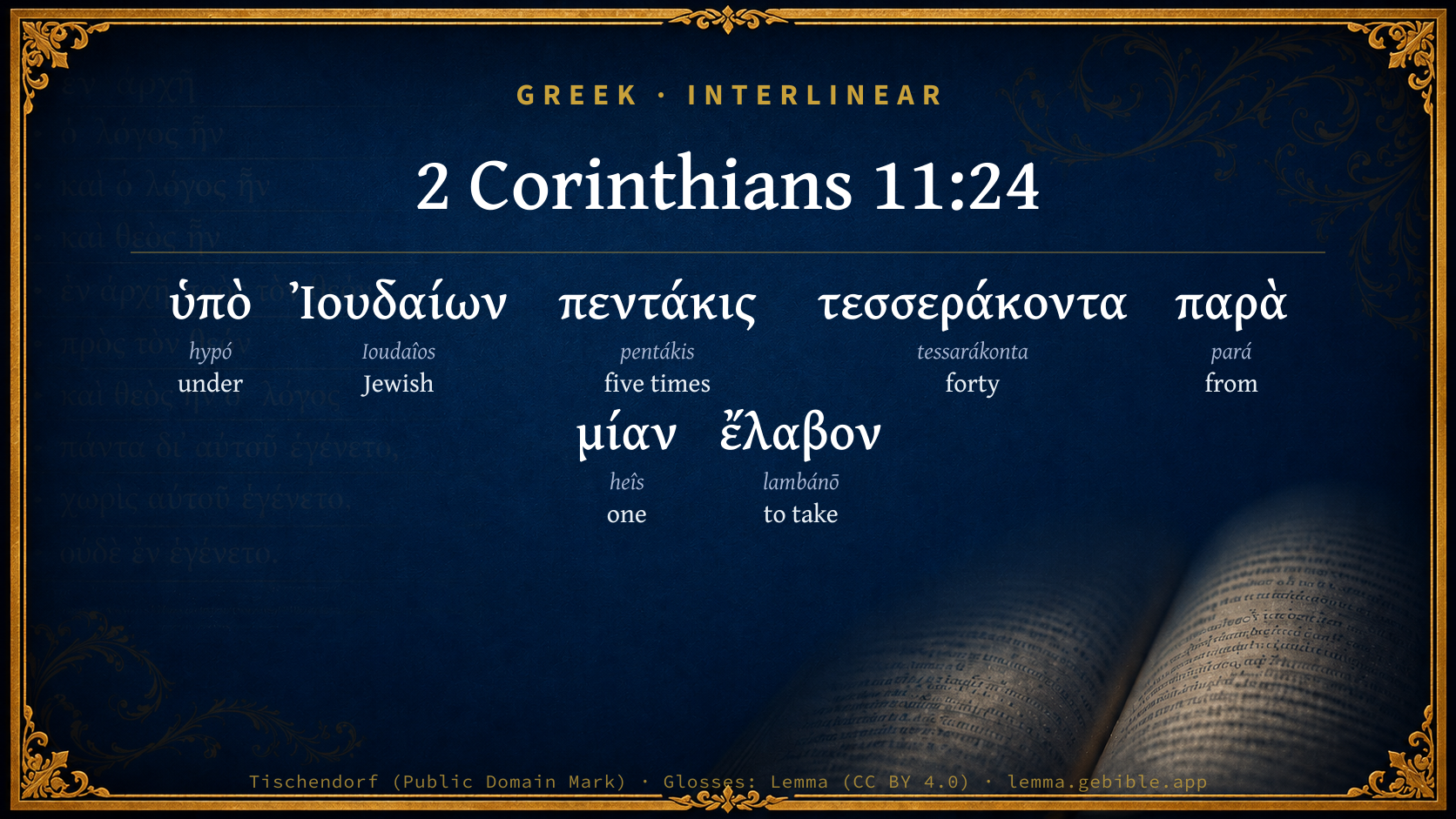
Download image
Cite this verse

2 Corinthians 11:24 (World English Bible). Public Domain. Lemma interlinear Bible study tool, https://lemma.gebible.app/v/2-corinthians/11/24.

Show BibTeX & RIS
BibTeX
RIS
English Translation
Five times from the Jews I received forty stripes minus one.
World English Bible · Public Domain
Highlights
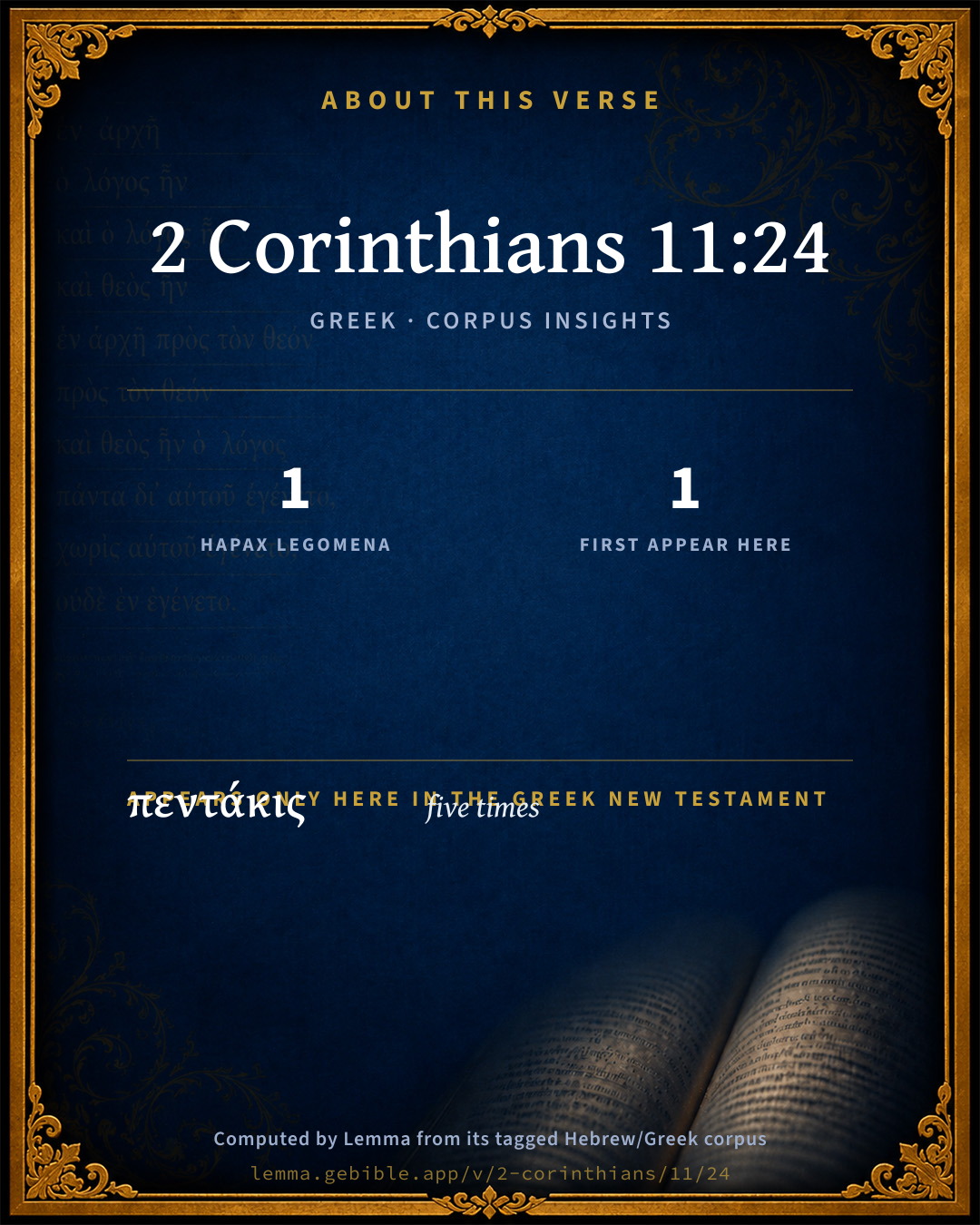
  • 1 hapax legomenon — only here in the Greek New Testament
  • 1 first appearance in the Greek New Testament
Full analysis ↓
Download a study sheet

One document with this verse’s original text, its word-by-word gloss line, the meaning frame, cross-references with their text, attributed commentary, and full source and license credits — printable, and it pastes into notes with its structure intact.

This verse Autodidact and up

Study sheet (.html) Plain text (.txt)

A passage Seminary Student

Up to 50 verses in one chapter. A passage sheet keeps up to 6 commentary sources and 12 cross-references per verse, in the order this page ranks them, and says so on the sheet whenever that leaves anything out. Ask for a single verse and you get the Autodidact verse sheet above.

Everything on this page stays free to read, with no account — the sheet is a download of what is already on screen, not access to it.

Want to remove ads? Support Godless Engineer
Compare translations 3

The same verse in 3 English versions, stacked beneath the original-language interlinear above. Click any original word for its lexicon entry.

Each is an independent rendering of the whole verse — the interlinear is not word-aligned to these translations.

Highlighted words mark where these versions differ — a whole-verse word diff, not a word-by-word alignment.

  • World English Bible Public Domain
    Five times from the Jews I received forty stripes minus one.
  • King James Version Public Domain
    Of the Jews five times received I forty stripes save one.
  • unfoldingWord Literal Text CC BY-SA 4.0
    Five times I received from Jews 40 minus one.

unfoldingWord Literal Text — © unfoldingWord, licensed CC BY-SA 4.0. Word-aligned USFM3 via Door43 (git.door43.org/unfoldingWord/en_ult).

Versions to compare (up to 4)

3 of 4 selected

Show all 19 translations

Every available English version of this verse, each an independent rendering of the whole verse.

  • World English Bible Public Domain
    Five times from the Jews I received forty stripes minus one.
  • Berean Standard Bible Public Domain
    Five times I received from the Jews the forty lashes minus one.
  • Majority Standard Bible Public Domain
    Five times I received from the Jews the forty lashes minus one.
  • King James Version Public Domain
    Of the Jews five times received I forty stripes save one.
  • American Standard Version (1901) Public Domain
    Of the Jews five times received I forty `stripes' save one.
  • Revised Version (1885) Public Domain
    Of the Jews five times received I forty stripes save one.
  • Geneva Bible (1599) Public Domain
    Of the Iewes fiue times receiued I fourtie stripes saue one.
  • Douay-Rheims (1899) Public Domain
    Of the Jews five times did I receive forty stripes, save one.
  • Young's Literal Translation Public Domain
    from Jews five times forty `stripes' save one I did receive;
  • Literal Standard Version CC BY-SA 4.0
    Five times I received from Jews forty [stripes] except one;
  • Unlocked Literal Bible CC BY-SA 4.0
    From Jews I received five times the “forty lashes minus one.”
  • unfoldingWord Literal Text CC BY-SA 4.0
    Five times I received from Jews 40 minus one.
  • Darby Bible Public Domain
    From the Jews five times have I received forty [stripes], save one.
  • World Messianic Bible Public Domain
    Five times I received forty stripes minus one from the Jews.
  • Webster's Bible Public Domain
    From the Jews five times I received forty stripes save one.
  • Free Bible Version CC BY-SA 4.0
    Five times I received from the Jews the forty lashes less one.
  • Bible in Basic English Public Domain
    Five times the Jews gave me forty blows but one.
  • Text-Critical English NT CC BY 4.0
    Five times I received from the Jews the forty lashes minus one.
  • Tyndale New Testament (1534) Public Domain
    Of the Iewes five tymes receaved I every tyme.xl. strypes saue one.

Literal Standard Version (2020), Covenant Press — licensed CC BY-SA 4.0. Text via the HelloAO Bible API (eBible.org). Unlocked Literal Bible (unfoldingWord) — licensed CC BY-SA 4.0. Text via the HelloAO Bible API (eBible.org). unfoldingWord Literal Text — © unfoldingWord, licensed CC BY-SA 4.0. Word-aligned USFM3 via Door43 (git.door43.org/unfoldingWord/en_ult). Free Bible Version, Dr. Jonathan Gallagher — licensed CC BY-SA 4.0. Text via the HelloAO Bible API (eBible.org).

Word by word

More ways to search: Search by grammar → Find every occurrence → Compare this word →

Practice this passage: Drill this verse → Learn its vocabulary →

About this verse

These counts appear in no published source. They are computed here, from the morphology-tagged text and Lemma’s own curated glosses. What Lemma adds →

7
words
7
distinct lemmas
Pauline Epistles
section

Notable vocabulary

1 hapax legomenon — a word that appears only here in the entire Greek New Testament:

  • πεντάκις five times G3999

First appearance in Scripture

This word makes its first canonical appearance in the Greek New Testament here:

  • πεντάκις five times G3999

Shared distinctive vocabulary

τεσσεράκοντα forty G5062 occurs in 21 verses of the Greek New Testament. Also found in:
Cross-references

3

Topical passages linked to 2 Corinthians 11:24 in the Treasury of Scripture Knowledge — connected by theme and wording, ordered by reader-vote popularity; previews shown in the World English Bible.

  • Mark 13:9 But watch yourselves, for they will deliver you up to councils. You will be beaten in synagogues. You will stand before rulers and kings for my sake, for a testimony to them.
  • Deuteronomy 25:2–3 and it shall be, if the wicked man be worthy to be beaten, that the judge shall cause him to lie down, and to be beaten before his face, according to his wickedness, by number.
  • Matthew 10:17 But beware of men: for they will deliver you up to councils, and in their synagogues they will scourge you.

Cross-references courtesy of OpenBible.info (CC BY 4.0).

Commentary

Notes on 2 Corinthians 11:24 from classic Christian and Jewish commentators (each source and its license shown beneath its notes). The classic Christian expositions comment on the surrounding passage and are grouped to its opening verse, so a note may address several verses; the Jewish commentaries on the Tanakh (Rashi and others) are per-verse, so they appear only where the commentator wrote on this verse.

Lemma curates 59 commentaries, every one of them public domain or Creative Commons licensed, each selected and text-cleaned for this edition rather than reprinted as found. About our sources →

Jamieson, Fausset & Brown

Robert Jamieson, A. R. Fausset & David Brown

co2 11:24Deu 25:3 ordained that not more than forty stripes should be inflicted To avoid exceeding this number, they gave one short of it: thirteen strokes with a treble lash [BENGEL]. This is one of those minute agreements with Jewish usage, which a forger would have not been likely to observe.

Jamieson, Fausset & Brown — Commentary Critical and Explanatory on the Whole Bible (1871) — public domain (CC PDM 1.0). Text via the HelloAO Bible API.

Bengel's Gnomon

Johann Albrecht Bengel

2Co 11:24. Πεντάκις, five times) It is of advantage to the servants of God accurately to remember all that they have done and suffered with a view to relate them, according as it may be afterwards necessary. Comp. Galatians 1.—τεσσαράκοντα παρὰ μίαν, forty save one) Thirteen strokes with a triple lash made thirty-nine. See Buxt. dedic. Abbrev.

Bengel's Gnomon of the New Testament — English translation (T&T Clark, Edinburgh, 1860) — public domain. Text from a community e-Sword module.

Meyer's Critical & Exegetical Commentary

Heinrich August Wilhelm Meyer

2Co_11:24-25. Parenthesis, in which definite proofs are brought forward for the ἐν θανάτοις πολλάκις.

ὑπὸ Ἰουδαίων] refers merely to πεντάκις … ἔλαβον; for it is obvious of itself that the subsequent τρὶς ἐῤῥαβδίσθην was a Gentile maltreatment. Paul seems to have had in his mind the order: from Jews … from Gentiles, which, however, he then abandone.

τεσσαράκοντα παρὰ μίαν] sc. πληγάς. Comp. on Luk_12:47, and Ast, ad Legg. p. 433. παρά in the sense of subtraction; see Herod. i. 120; Plut. Caes 30; Wyttenb. ad Plat. VI. pp. 461, 1059; Winer, p. 377 [E. T. 503]. Deu_25:3 ordains that no one shall be beaten more than forty times. In order, therefore, not to exceed the law by possible miscounting, only nine and thirty strokes were commonly given under the later administration of Jewish law.[337] See Joseph. Antt. iv. 8. 21, 23, and the Rabbinical passages (especially from the treatise Maccoth in Surenhusius, IV. p. 269 ff.); in Wetstein, Schoettgen, Hor. p. 714 ff.; and generally, Saalschütz, M. R. p. 469. Paul rightly adduces his five scourgings (not mentioned in Acts) as proof of his ἐν θανάτοις πολλάκις, for this punishment was so cruel that not unfrequently the recipients died under it; hence there is no occasion for taking into account bodily weakness in the case of Paul. See Lund, Jüd. Heiligth. ed. Wolf, p. 539 f.

τρὶς ἐῤῥαβδίσθην] One such scourging with rods by the Romans is reported in Act_16:22; the two others are unknown to u.

ἅπαξ ἐλιθάσθ.] See Act_14:19; Clem. 5.

τρὶς ἐναυάγ.] There is nothing of this in Acts, for the last shipwreck, Acts 27, was much later. How many voyages of the apostle may have remained quite unknown to us! and how strongly does all this list of sufferings show the incompleteness of the Book of Acts!

νυχθήμερον ἐν τῷ βυθῷ πεποίηκα] Lyra, Estius, Calovius, and others explain this of a miracle, as if Paul, actually sunk in the deep, had spent twenty-four hours without injury; but this view is at variance with the context. It is most naturally regarded as the sequel of one of these shipwrecks, namely, that he had, with the help of some floating wreck, tossed about on the sea for a day and a night, often overwhelmed by the waves, before he was rescued. On βυθός, the depth of the sea, comp. LXX. Exo_15:5; Ps. 67:14; Psa_106:24, al.; Bergl. ad Alciphr. i. 5, p. 10; and Wetstein in loc.

ποιεῖν of time: to spend, as in Act_15:33; Jam_4:13; Jacobs, ad Anthol. IX. p. 449. The perfect is used because Paul, after he has simply related the previous points, looks back on this last from the present time (comp. Kühner, § 439, 1a); there lies in this change of tenses a climactic vividness of representation.

[337] This reason for omitting the last stroke is given by Maimonides (see Coccej. ad Maccoth iii. 10). Another Rabbinical view is that thirteen strokes were given with the three-thonged leathern scourge, so that the strokes amounted in all to thirty-nine. See in general, Lund, p. 540 f. According to Maccoth iii. 12, the breast, the right and the left shoulder, received each thirteen of the thirty-nine strokes. But it cannot be proved from the Rabbins that it was on this account that the fortieth was not added, as Bengel, Wetstein, and others assume.

Meyer — Critical and Exegetical Commentary on the New Testament — English translation by Peter Christie, edited by Frederick Crombie (T&T Clark, 1880) — public domain. Text from a community e-Sword module.

Expositor's Greek Testament

ed. W. Robertson Nicoll

2Co 11:24 . ὑπὸ Ἰουδ . κ . τ . λ .: of the Jews five times received I forty stripes (there is an ellipse of πληγάς as at Luk 12:47 ) save one . The Law forbad more than forty stripes (Deu 25:3 ); and, to be on the safe side, it was the custom in the judicial scourgings of the synagogues (Mat 23:34 , Act 22:19 ) to stop short at thirty-nine. This punishment was so severe that death often ensued (cf. Josephus, Antt. , iv., 8, 21); we know nothing of the circumstances under which it was inflicted on St. Paul.

The Expositor's Greek Testament, edited by W. Robertson Nicoll (1897–1910) — public domain. Text from a community e-Sword module.

Cambridge Greek Testament for Schools and Colleges

24–28. We have, in rough order, three groups; 1. the details of being ἐν θανάτοις πολλάκις (2Co 11:24-25); 2. the details of being ὁδοιπορίαις πολλάκις (2Co 11:26); 3. a variety of sufferings (2Co 11:27-28). In the first group he begins with what was inflicted on him in the name of law, Jewish or Roman, and passes on to man’s lawlessness and operations of nature.

24. ὑπὸ Ἰουδαίων. These words belong to the first clause only: perhaps he meant to go on to ὑπὸ τῶν ἐθνῶν, but forgot to make the formal antithesis. For this use of ὑπό comp. 1Co 10:9; 1Th 2:14; Mat 17:12. None of these Jewish floggings are recorded elsewhere. Such punishments, like Roman scourging or beating with rods, could be so severe as sometimes to cause death; but such a result under Jewish law would be rare. Deu 25:1-3, the earliest passage in which this form of punishment is expressly mentioned, forbids the infliction of more than 40 stripes; and it was usual to inflict only 39, for fear of a miscount. Others explain that 13 stripes were given with a whip that had three lashes; or that 13 were given on three different parts of the body, viz. right and left shoulders and the breast. But ‘cause to lie down’ (Deu 25:2) points to the bastinado, which was common in Egypt. Josephus (Ant. IV. viii. 21) calls it τιμωρίαν ταύτην αἰσχίστην. Fatal blows inflicted by a master on his slaves (Exo 21:20) are not here in point. With παρὰ μιαν comp. τῶν τεσσαράκοντα ἐτῶν παρὰ τριάκονθʼ ἡμέρας συμπεπληρωμένων (Joseph. Ant. IV. viii. 1) and παρὰ ἔν πάλαισμα ἔδραμε νικᾶν Ὀλυμπιάδα, ‘he was within one bout of winning, won an Olympic victory all but one wrestling-bout’ (Hdt. IX. xxxiii. 4). For the omission of πληγάς comp. Luk 12:47 and παιειν ὀλίγας (Xen. Anab. v. viii. 12).

Cambridge Greek Testament for Schools and Colleges (Cambridge University Press, 1896; 21 vols, various authors incl. Carr, Maclear, Plummer, Farrar, Lumby, Moule, M. R. James, Simcox) — public domain. Text from a community e-Sword module.

Geneva Bible (1599)

Geneva Bible translators

He alludeth to that that is written, Deut. 25:3, and moreover this place showeth us, that Paul suffered many things which Luke passed over.

Geneva Bible (1599) marginal notes — public domain. Text via Bolls.life.

Adam Clarke's Commentary

Verse 24. Of the Jews five times received I forty stripes save one.] That is, he was five times scourged by the Jews, whose law (De 25:3) allowed forty stripes; but they, pretending to be lenient, and to act within the letter of the law, inflicted but thirty-nine.

To except one stripe from the forty was a very ancient canon among the Jews, as we learn from Josephus, Antiq. lib. iv. ch. viii. sec. 21, who mentions the same thing: πληγας μιας λειπουσης τεσσαπακοντα· forty stripes, excepting one.

The Mishna gives this as a rule, MISH., Maccoth, fol. 22, 10: "How often shall he, the culprit, be smitten? Ans. ארבעים תמר אתר forty stripes, wanting one; i.e. with the number which is highest to forty."

Frequently a man was scourged according to his ability to bear the punishment; and it is a canon in the Mishna, "That he who cannot bear forty stripes should receive only eighteen, and yet be considered as having suffered the whole punishment."

They also thought it right to stop under forty, lest the person who counted should make a mistake, and the criminal get more than forty stripes, which would be injustice, as the law required only forty.

The manner in which this punishment was inflicted is described in the Mishna, fol. 22, 2: "The two hands of the criminal are bound to a post, and then the servant of the synagogue either pulls or tears off his clothes till he leaves his breast and shoulders bare. A stone or block is placed behind him on which the servant stands; he holds in his hands a scourge made of leather, divided into four tails. He who scourges lays one third on the criminal's breast, another third on his right shoulder, and another on his left. The man who receives the punishment is neither sitting nor standing, but all the while stooping; and the man smites with all his strength, with one hand." The severity of this punishment depends on the nature of the scourge, and the strength of the executioner.

It is also observed that the Jews did not repeat scourgings except for enormous offences. But they had scourged the apostle five times; for with those murderers no quarter would be given to the disciples, as none was given to the Master. See Schoettgen.

Adam Clarke's Commentary on the Bible (1810–1826) — public domain. Text from a community e-Sword/MySword module.

John Calvin's Commentaries

24. From the Jews. It is certain that the Jews had at that time been deprived of jurisdiction, but as this was a kind of moderate punishment (as they termed it) it is probable that it was allowed them. Now the law of God was to this effect, that those who did not deserve capital punishment should be beaten in the presence of a judge, (Deuteronomy 25:2, 3,) provided not more than forty stripes were inflicted, lest the body should be disfigured or mutilated by cruelty. Now it is probable, that in process of time it became customary to stop at the thirty-ninth lash, lest perhaps they should on any occasion, from undue warmth, exceed the number prescribed by God. Many such precautions, prescribed by the Rabbins, are to be found among the Jews, which make some restriction upon the permission that the Lord had given. Hence, perhaps, in process of time, (as things generally deteriorate,) they came to think, that all criminals should be beaten with stripes to that number, though the Lord did not prescribe, how far severity should go, but where it was to stop; unless perhaps you prefer to receive what is stated by others, that they exercised greater cruelty upon Paul. This is not at all improbable, for if they had been accustomed ordinarily to practice this severity upon all, he might have said that he was beaten according to custom. Hence the statement of the number is expressive of extreme severity.

John Calvin's Commentaries (1540-1563) — public domain. Text from the Calvin Translation Society English edition (1840s-50s) via the Christian Classics Ethereal Library (ccel.org). Calvin's coverage is partial (roughly two-thirds of the Bible); uncommented books and verses are honest gaps, never fabricated. The 19th-century editor's footnotes and remarks are omitted so the notes are faithfully Calvin's own voice.

Ellicott's Commentary for English Readers

(24) Of the Jews five times received I forty stripes save one.—None of these are recorded in the Acts. It is probable that the words refer to the early period of his work in Cilicia, which is implied though not recorded in that book. (See Note on Act_15:41). The number of the stripes in Jewish punishments of this kind rested on the rule of Deu_25:3, which fixed forty as the maximum. In practice it was thought desirable to stop short of the full number in order to avoid exceeding it. The punishment was inflicted with a leather scourge of three knotted thongs, and with a curiously elaborate distribution: thirteen strokes were given on the breast, thirteen on the right shoulder, and thirteen on the left.

Thrice was I beaten with rods.—This, as we see in Act_16:22-23, was distinctively, though, perhaps, not exclusively, a Roman punishment. The instance at Philippi, as above, is the only one recorded in the Acts. As a Roman citizen he could claim exemption from a punishment which was essentially servile (Act_16:37), and at Jerusalem (Act_22:25) he asserted this claim; but it may well have happened elsewhere, as at Philippi, either that the reckless haste of Roman officials led them to order the punishment without inquiry; or that they disregarded the appeal, and took their chance of impunity; or that there were reasons which led him to prefer enduring the ignominious punishment in silence, without protest.

A Bible Commentary for English Readers, edited by Charles John Ellicott (1878–1897) — public domain. Text from a community e-Sword module.

The Cambridge Bible for Schools and Colleges

gen. ed. J. J. S. Perowne

24. Of the Jews] Literally, Under Jews, as though it were a disgrace to them to have treated one of their brethren thus. Cf. St Mat_10:17.

forty stripes save one] Cf. Deu_25:3. The Mishna (Makkoth, iii. 10 [9]) prescribes that one below the number there mentioned were to be given, clearly, as Maimonides (Commentary in loco and Mishneh Torah, Hilekhoth Synhedrin, xvii. 1) explains, lest by a mistake the prescribed number should be exceeded. Others refer it to the three cords of the scourges, which could only inflict stripes to the extent of some multiple of three. Josephus, Antiq. iv. 8. 21, mentions the custom.

The Cambridge Bible for Schools and Colleges (gen. ed. J. J. S. Perowne; Cambridge University Press, 1878–1918) — public domain. Text from a community e-Sword module.

John Gill's Exposition

Thrice was I beaten with rods,.... Or "wands", by the Romans; for this was a Roman punishment, distinct from scourging with cords used by the Jews. There is mention made but of one time only that he was so beaten, elsewhere, and that is in Act 16:22 which was at Philippi; but that he was so many times beaten in this way, there is no room to doubt:

once was I stoned. This was at Lystra, at the instigation of the Jews that came from Antioch and Iconium, Act 14:19 by whom he was left for dead:

thrice I suffered shipwreck; neither of which are mentioned by Luke in the Acts of the Apostles; for the shipwreck he suffered as when he went to Rome was some time after the writing of this epistle, and therefore cannot be one of these here referred to

a night and a day I have been in the deep; some understand this of a well, called "Bythos", or "the deep", which was near Lystra, where the apostle was hid for such a space of time after his deliverance there; but this, were it so, he would scarcely reckon among his very great hardships and sufferings: others of a prison at Cyzicum in Asia, which, because of its very great height, was called "the depth of the sea", in which the apostle was imprisoned for such a time; but, we nowhere read that he ever was at that place, or preached there, and much less was imprisoned there; and had he, it is not likely that he should particularly point out such a short imprisonment, but would have let it pass in the general account of being in prisons before mentioned: but rather this is to be understood of the sea, often called the "deep" in Scripture, where by some accident he was cast, and was in it, as the Syriac version has it, , "where was no ship", or without one, being shipwrecked; or being cast, or having fallen into the sea, he was swimming in it, or was preserved by a broken piece of the ship, or by some other means, or by the wonderful providence of God for so long a time; though as sailing in those times was chiefly by coasting, this phrase may only signify that the ship in which he was was drove from the coast into the sea, and lost sight of the land for the space of a day and night, and lay floating about in the deep, which was reckoned very dangerous. The word "a night day", signifies a whole natural day, consisting of a night and a day; and is an Hebraism, and answers to , "the evening and the morning", which make a full day; see Gen 1:5 Dan 8:14.

John Gill's Exposition of the Whole Bible (1746–1763) — public domain (CC PDM 1.0). Text via the HelloAO Bible API.

Trapp's Complete Commentary

John Trapp

24 Of the Jews five times received I forty stripes save one.

Ver. 24. Forty stripes save one] That they might be sure not to exceed the set number of stripes, limited by the law, Deu 25:3.

John Trapp, A Commentary or Exposition upon All the Books of the Old and New Testament (1647–1656) — public domain. Text from a community e-Sword module.

Albert Barnes' Notes on the Bible

Of the Jews ... - On this verse and the following verse it is of importance to make a few remarks preliminary to the explanation of the phrases:

(1) It is admitted that the particulars here referred to cannot be extracted out of the Acts of the Apostles. A few can be identified, but there are many more trials referred to here than are specified there.

(2) This proves that this Epistle was not framed from the history, but that they are written independently of one another - Paley.

(3) Yet they are not inconsistent one with the other. For there is no article in the enumeration here which is contradicted by the history, and the history, though silent with respect to many of these transactions, has left space enough to suppose that they may have occurred.

(a) There is no contradiction between the accounts. Where it is said by Paul that he was thrice beaten with rods, though in the Acts but one beating is mentioned, yet there is no contradiction. It is only the omission to record all that occurred to Paul. But had the history, says Paley, contained an account of four beatings with rods, while Paul mentions here but three, there would have been a contradiction. And so of the other particulars.

(b) Though the Acts of the Apostles be silent concerning many of the instances referred to, yet that silence may be accounted for on the plan and design of the history. The date of the Epistle synchronizes with the beginning of Acts 20. The part, therefore, which precedes the twentieth chapter is the only place in which can be found any notice of the transactions to which Paul here refers. And it is evident from the Acts that the author of that history was not with Paul until his departure from Troas, as related in 1Co 16:10; see the note on that place. From that time Luke attended Paul in his travels. From that period to the time when this Epistle was written occupies but four chapters of the history, and it is here if anywhere that we are to look for the minute account of the life of Paul. But here much may have occurred to Paul before Luke joined him. And as it was the design of Luke to give an account of Paul mainly after he had joined him, it is not to be wondered at that many things may have been omitted of his previous life.

(c) The period of time after the conversion of Paul to the time when Luke joined him at Troas is very succinctly given. That period embraced 16 years, and is comprised in a few chapters. Yet in that time Paul was constantly traveling. He went to Arabia, returned to Damascus, went to Jerusalem, and then to Tarsus, and from Tarsus to Antioch, and thence to Cyprus, and then through Asia Minor, etc. In this time he must have made many voyages, and been exposed to many perils. Yet all this is comprised in a few chapters, and a considerable portion of them is occupied with an account of public discourses. In that period of sixteen years, therefore, there was ample opportunity for all the occurrences which are here referred to by Paul; see Paley’s Horse Paulinae on 2 Corinthians, No. 9:

(d) I may add, that from the account which follows the time when Luke joined him at Troas (from Act 16:10), it is altogether probable that he had endured much before. After that time there is mention of just such transactions of scourging, stoning, etc., as are here specified, and it is altogether probable that he had been called to suffer them before. When Paul says “of the Jews,” etc., he refers to this because this was a Jewish mode of punishment. It was usual with them to inflict but 39 blows. The Gentiles were not limited by law in the number which they inflicted.

Five times - This was doubtless in their synagogues and before their courts of justice. They had not the power of capital punishment, but they had the power of inflicting minor punishments. And though the instances are not specified by Luke in the Acts , yet the statement here by Paul has every degree of probability. We know that he often preached in their synagogues Act 9:20; Act 13:5, Act 13:14-15; Act 14:1; Act 17:17; Act 18:4; and nothing is more probable than that they would be enraged against him, and would vent their malice in every way possible. They regarded him as an apostate, and a ringleader of the Nazarenes, and they would not fail to inflict on him the severest punishment which they were permitted to inflict.

Forty stripes save one - The word “stripes” does not occur in the original, but is necessarily understood. The Law of Moses Deu 25:3 expressly limited the number of stripes that might be inflicted to 40. In no case might this number be exceeded. This was a humane provision, and one that was not found among the pagan, who inflicted any number of blows at discretion. Unhappily it is not observed among professedly Christian nations where the practice of whipping prevails, and particularly in slave countries, where the master inflicts any number of blows at his pleasure. In practice among the Hebrews, the number of blows inflicted was in fact limited to 39, lest by any accident in counting, the criminal should receive more than the number prescribed in the Law. There was another reason still for limiting it to 39. They usually made use of a scourge with three thongs, and this was struck 13 times. That it was usual to inflict but 39 lashes is apparent from Josephus, Ant. 4. viii, section 21.

Albert Barnes' Notes on the Bible (1834–1885) — public domain. Text from a community e-Sword/MySword module.

Haydock's Catholic Bible Commentary

The Jews had power under the Romans to inflict punishments, not indeed capital, but corporal, such as flogging, &c. See Mark xiii. 9. The law, in Deuteronomy xxv. 3. permitted, but did not command, forty stripes to be inflicted; it strictly forbad that number to be exceeded.

George Leo Haydock (1774–1849), Haydock's Catholic Family Bible and Commentary, 1859 edition — public domain. Excludes Psalms (Douay-Rheims chapter numbering differs from Protestant) and Deuterocanonical books (Catholic canon only).

Matthew Poole's English Annotations

God, to restrain the passions of his people, which might carry them out to cruelty in the punishments of malefactors, forbade the Jewish magistrates to give any malefactor above forty stripes; (so many they might give them by the Divine law, Deu 25:3); but they had made an order, that none should receive above thirty-nine. This was amongst their constitions which they called sepimenta legis, hedges to the Divine law; which indeed was a violation of the law: for that did not oblige them to give every malefactor, that had not deserved death, so many stripes; it gave them only a liberty to go so far, but they were not to exceed. Some think, that they punished every such malefactor with thirty-nine stripes: others, more rationally, think, that they did not so, but thirty-nine was the highest number they laid upon any. And it is most probable, that, out of their hatred to the apostle, they laid as many stripes upon him as their constitution would suffer them to do.

Matthew Poole's English Annotations on the Holy Bible (1683–1685) — public domain. Text from a community e-Sword/MySword module.

Whedon's Commentary on the Bible

Daniel D. Whedon

24. The Jews—A less honourable epithet than either of the three in 2Co_11:22, used here to intimate to the Judaizers whence his severest persecutors came. John, in his gospel, uses the word Jews in the same adverse sense. Note, Joh_1:19.

Five times—A most bitter recollection; for the stripes of antiquity were deaths in the amount of agony they inflicted and the probability of death as the result. Note, Joh_19:1.

Stripes—In italics as not being in the Greek; it being unnecessary to Paul’s readers, who knew what the terrible number forty save one indicated. Forty stripes was the limit by law, (Deu_25:1;) but Jewish custom, in its caution against accidentally breaking the law, limited it in Paul’s time to thirty-nine. Says Stanley: “The culprit was bound by both hands to a pillar; the officer of the synagogue stripped off his clothes until his back was bared. The officer then ascended a stone behind. The scourge consisted of four thongs of calf skin, and two of asses’ skin. The culprit bent to receive the lashes. The officer struck with one hand with all his force. A reader meanwhile read, first, Deu_28:58-59; next, Deu_29:8; lastly, Psa_78:38. It was so severe a punishment that death often ensued.” The thrice thirteen strokes were impartially distributed; thirteen on the back, thirteen on the right shoulder, and thirteen on the left shoulder.

Daniel D. Whedon (gen. ed.), Commentary on the Old and New Testaments (1874–1909) — public domain. Text from a community e-Sword module.

The Pulpit Commentary

Five times. Not one of these Jewish scourgings which yet were so severe that the sufferer often died under them is mentioned in the Acts. This paragraph is the most striking proof of the complete fragmentariness of that narrative, marvellous as it is. On the circumstances which probably led to these Jewish scourgings, see "Life of St. Paul," exc. 11.; and comp. Act_22:19 Act_26:11; Mat_23:34. The question arises Was St. Luke entirely unaware of all these scenes of anguish and daily martyrdom? Had St. Paul, in his humble reticence, never cared to speak of them? or were the Acts only intended for a sketch which made no pretension to completeness, and only related certain scenes and events by way of specimen and example? Forty stripes save one. (Deu_25:3) On this instance of Jewish scrupulosity, and for all that is known of the rationale of Jewish scourgings, see "Life of St. Paul," ubi supra.

The Pulpit Commentary (1880–1919), ed. H.D.M. Spence-Jones & Joseph S. Exell — public domain. Text from a community e-Sword module.

John Wesley's Explanatory Notes

Five times I received from the Jews forty stripes save one - Which was the utmost that the law allowed. With the Roman he sometimes pleaded his privilege as a Roman; but from the Jews he suffered all things.

John Wesley, Explanatory Notes Upon the Whole Bible (1754–1765) — public domain. Text via the GEBible commentary corpus.

Burkitt's Expository Notes on the New Testament

William Burkitt

The law in Deu 25:3 allowed forty stripes to be given to them that were worthy to be beaten, but forbade them to exceed that number: But it being their custom to beat them with a whip that had three cords, they must either stop at thirty-nine, or exceed and go to forty-two.

Here observe, That the apostle contending with these false teachers, proves the truth of his ministry and apostleship; not, as elsewhere, from the miracles and gifts of the Holy Ghost, which did accompany his preaching, but from his sufferings, as being the things which these false apostles could not pretend unto, and so could not glory that they were like unto him in them.

William Burkitt's Expository Notes on the New Testament (1700–1703) — public domain. Text from a community e-Sword module.

McGarvey & Pendleton's Commentaries

J. W. McGarvey

Of the Jews five times received I forty stripes save one . [ Deu_25:2 . The law limited all beatings to forty stripes; but one stripe was omitted lest the law should be accidentally broken through careless counting. Such a scourging inflicted the agony of death, and generally resulted in it. Not one of these scourgings is mentioned in Acts.]

J. W. McGarvey (with Philip Y. Pendleton), Commentaries on the New Testament (The Fourfold Gospel, 1914; Acts; and the epistles) — public domain. Text from a community e-Sword/MySword module.

The People's New Testament

B. W. Johnson

24. Of the Jews fives times received I forty stripes save one. See Deut. 25:3. The Jews were not allowed to exceed this number.

B. W. Johnson's The People's New Testament with Notes (1889–1891) — public domain. Electronic text from the Christian Classics Ethereal Library (CCEL) ThML edition.

unfoldingWord translationNotes

Door43 World Missions Community

forty lashes minus one

This was a common expression for being whipped 39 times. In Jewish law the most they were allowed to whip a person at one time was forty lashes. So they commonly whipped a person thirty-nine times so that they would be guilty of whipping someone too many times if the accidentally counted wrong.

I was beaten with rods

This can be stated in active form. AT: "people beat me with wooden rods" (See: Active or Passive)

I was stoned

This can be stated in active form. AT: "people threw stones at me until they thought I was dead" (See: Active or Passive)

I have spent a night and a day on the open sea

Paul was referring to floating in the water after the ship he was on sank.

in danger from false brothers

The full meaning of this statement can be made explicit. AT: "and in danger from people who claimed to be brothers in Christ, but who betrayed us" (See: Assumed Knowledge and Implicit Information)

translationWords

Jew

Gentile

desert

unfoldingWord translationNotes — © Distant Shores Media and the Door43 World Missions Community, licensed CC BY-SA 4.0. Source: git.door43.org/Door43/en_tn.

International Critical Commentary

24. ὑπὸ Ἰουδαίων. He begins with sufferings which were inflicted on him by officials, Jewish and Roman, in the name of law; then, after one outrage inflicted by a lawless mob, he mentions a number which were due to the operations of nature. This use of ὑπό, ‘at the hands of,’ is classical and is found in papyri, but it is rare in N.T. In 1Th 2:14 and Mat 17:12 we have πάσχειν ὑπό. Winer, p. 462. We expect ὑπὸ τῶν ἐθνῶν with the next statement, but in the rapid enumeration it is omitted. He naturally begins with what his own nation, which had become bitterly hostile, had done to him.

πεντάκις τεσσεράκοντα παρὰ μίαν ἔλαβον. ‘Five times I received forty save one.’* The omission of πληγάς is idiomatic; see on Luk 12:47. These Jewish floggings are not mentioned in Acts or in any other Epistle. The earliest passage in which this kind of punishment is mentioned is Deu 25:1-3, where see Driver’s notes. More than 40 stripes could not lawfully be inflicted, and it is said that the executioner who exceeded 40 was liable to be flogged himself; hence only 39 were inflicted for fear of a miscount. Some say that only 13 were given with a whip that had three lashes, and that they counted as 39, or that 13 were given on the breast and 13 on each shoulder. ‘Cause to lie down’ (Deu 25:2) does not necessarily imply the bastinado, and there seems to be no tradition that the punishment ever took this form. It was administered in the synagogue (Mat 10:17), and during the infliction passages from Deut. and the Psalms were read. Josephus (Ant. IV. viii. 21) calls it τιμωρόαν ταύτην αἰσχίτην, but he does not intimate that death often ensued, and it is improbable that Jewish magistrates would allow death to be risked.† But the frail and sensitive Apostle might feel that he had nearly died under the infliction. This use of παρά is found in Josephus, not in iv. viii 21, where he has πληγὰς μιᾷ λειπούας τεσσεράκοντα, but in iv. viii. 1, τεσσεράκοντα ἐτῶν παρὰ τριάκονθʼ ἡμέρας, and in Herodotus (ix. 23), παρὰ ἓν παλαίσμα ἔδραμε νικᾶν Ὀλυμπιάδα, ‘he won an Olympic victory all but one wrestling-bout.’ Cf. Psa 8:6, quoted Heb 2:7, ἠλάττωσας αὐτὸν βραχύ τι παρʼ ἀγγέλους, which, however, is not quite parallel. See λαμβάνω, Index IV.

International Critical Commentary — older volumes (1896–1929), various authors — public domain. Text from a community e-Sword module.

Lesson kit

Teaching starters — assembled from the data on this page, not authored interpretation. Every prompt links to the verse data it draws on. Edit before teaching.

2 Corinthians, in the Pauline Epistles, opens this verse with 7 words (7 distinct Greek lemmas). Its most distinctive word is pentákis (“five times”). A historical commentator’s framing appears above. Read the whole chapter for the surrounding context.

Discussion questions

  1. The word pentákis carries the sense “five times.” How does it shape the verse?
  2. This verse holds 1 word here found nowhere else in the Greek New Testament. What might the rare word draw attention to?
  3. The word “five times” first appears here in Scripture. What is being introduced at this debut?
  4. Matthew 4:2 shares the word «forty» with this verse. How do the two illuminate each other?
  5. These translations render this verse differently; the difference is in the English rendering, not the original. What questions does that raise?
  6. Reading how Jamieson, Fausset & Brown and Bengel's Gnomon read this verse, where do the two commentators agree and where do they part?

Things to notice

  • 1 word in this verse appears nowhere else in the Greek New Testament.
  • 1 word makes its first canonical appearance in Scripture here.
  • These translations choose different wording for 5 words in this verse.
  • 7 distinct Greek lemmas span 7 words in this verse.

Reading settings

Reading text

Shown beneath each verse's original-language words.

Old Testament
Old Testament edition

Read the OT as the Masoretic Hebrew (MT) or the Greek Septuagint (LXX).

English shown for the Greek Septuagint (in the Hebrew ↔ Greek comparison).

Comparing translations? Open the Compare panel on any verse page to stack up to four side by side.