Romans 13:2

Greek (Tischendorf 8th ed.) Romans 13:2 appears in the Greek New Testament. The text above is from the Tischendorf 8th edition. Each word links to its Strong’s number and a concise gloss. Click any word for its full Thayer’s Greek Lexicon entry.
Download image
Cite this verse

Romans 13:2 (World English Bible). Public Domain. Lemma interlinear Bible study tool, https://lemma.gebible.app/v/romans/13/2.

Show BibTeX & RIS
BibTeX
RIS
English Translation
Therefore he who resists the authority, withstands the ordinance of God; and those who withstand will receive to themselves judgment.
World English Bible · Public Domain
Download a study sheet

One document with this verse’s original text, its word-by-word gloss line, the meaning frame, cross-references with their text, attributed commentary, and full source and license credits — printable, and it pastes into notes with its structure intact.

This verse Autodidact and up

Study sheet (.html) Plain text (.txt)

A passage Seminary Student

Up to 50 verses in one chapter. A passage sheet keeps up to 6 commentary sources and 12 cross-references per verse, in the order this page ranks them, and says so on the sheet whenever that leaves anything out. Ask for a single verse and you get the Autodidact verse sheet above.

Everything on this page stays free to read, with no account — the sheet is a download of what is already on screen, not access to it.

Want to remove ads? Support Godless Engineer
Compare translations 3

The same verse in 3 English versions, stacked beneath the original-language interlinear above. Click any original word for its lexicon entry.

Each is an independent rendering of the whole verse — the interlinear is not word-aligned to these translations.

Highlighted words mark where these versions differ — a whole-verse word diff, not a word-by-word alignment.

  • World English Bible Public Domain
    Therefore he who resists the authority, withstands the ordinance of God; and those who withstand will receive to themselves judgment.
  • King James Version Public Domain
    Whosoever therefore resisteth the power, resisteth the ordinance of God: and they that resist shall receive to themselves damnation.
  • unfoldingWord Literal Text CC BY-SA 4.0
    So then, the one resisting that authority has opposed the command of God, and the ones who have opposed it will bring judgment on themselves.

unfoldingWord Literal Text — © unfoldingWord, licensed CC BY-SA 4.0. Word-aligned USFM3 via Door43 (git.door43.org/unfoldingWord/en_ult).

Versions to compare (up to 4)

3 of 4 selected

Show all 19 translations

Every available English version of this verse, each an independent rendering of the whole verse.

  • World English Bible Public Domain
    Therefore he who resists the authority, withstands the ordinance of God; and those who withstand will receive to themselves judgment.
  • Berean Standard Bible Public Domain
    Consequently, whoever resists authority is opposing what God has set in place, and those who do so will bring judgment on themselves.
  • Majority Standard Bible Public Domain
    Consequently, whoever resists authority is opposing what God has set in place, and those who do so will bring judgment on themselves.
  • King James Version Public Domain
    Whosoever therefore resisteth the power, resisteth the ordinance of God: and they that resist shall receive to themselves damnation.
  • American Standard Version (1901) Public Domain
    Therefore he that resisteth the power, withstandeth the ordinance of God: and they that withstand shall receive to themselves judgment.
  • Revised Version (1885) Public Domain
    Therefore he that resisteth the power, withstandeth the ordinance of God: and they that withstand shall receive to themselves judgment.
  • Geneva Bible (1599) Public Domain
    Whosoeuer therefore resisteth the power, resisteth the ordinance of God: and they that resist, shall receiue to themselues condemnation.
  • Douay-Rheims (1899) Public Domain
    Therefore he that resisteth the power, resisteth the ordinance of God. And they that resist, purchase to themselves damnation.
  • Young's Literal Translation Public Domain
    so that he who is setting himself against the authority, against God's ordinance hath resisted; and those resisting, to themselves shall receive judgment.
  • Literal Standard Version CC BY-SA 4.0
    so that he who is setting himself against the authority, has resisted against God’s ordinance; and those resisting will receive judgment to themselves.
  • Unlocked Literal Bible CC BY-SA 4.0
    Therefore he who resists that authority opposes the command of God; and those who oppose it will receive judgment on themselves.
  • unfoldingWord Literal Text CC BY-SA 4.0
    So then, the one resisting that authority has opposed the command of God, and the ones who have opposed it will bring judgment on themselves.
  • Darby Bible Public Domain
    So that he that sets himself in opposition to the authority resists the ordinance of God; and they who [thus] resist shall bring sentence of guilt on themselves.
  • World Messianic Bible Public Domain
    Therefore he who resists the authority withstands the ordinance of God; and those who withstand will receive to themselves judgment.
  • Webster's Bible Public Domain
    Whoever therefore resisteth the power, resisteth the ordinance of God: and they that resist shall receive to themselves damnation.
  • Free Bible Version CC BY-SA 4.0
    Whoever resists the authorities opposes what God has put in place, and those who do so shall find themselves judged accordingly.
  • Bible in Basic English Public Domain
    For which reason everyone who puts himself against the authority puts himself against the order of God: and those who are against it will get punishment for themselves.
  • Text-Critical English NT CC BY 4.0
    So then, whoever resists authority opposes what God has instituted, and those who do so will bring judgment on themselves.
  • Tyndale New Testament (1534) Public Domain
    Whosoever therfore resysteth power resisteth the ordinaunce of God. And they that resist shall receave to the selfe damnacion.

Literal Standard Version (2020), Covenant Press — licensed CC BY-SA 4.0. Text via the HelloAO Bible API (eBible.org). Unlocked Literal Bible (unfoldingWord) — licensed CC BY-SA 4.0. Text via the HelloAO Bible API (eBible.org). unfoldingWord Literal Text — © unfoldingWord, licensed CC BY-SA 4.0. Word-aligned USFM3 via Door43 (git.door43.org/unfoldingWord/en_ult). Free Bible Version, Dr. Jonathan Gallagher — licensed CC BY-SA 4.0. Text via the HelloAO Bible API (eBible.org).

Word by word

More ways to search: Search by grammar → Find every occurrence → Compare this word →

Practice this passage: Drill this verse → Learn its vocabulary →

διαταγῇ
diatagḗ
G1296
“arrangement”
Noun, Dative, Singular, Feminine
Part of Speech
Noun
Case
Dative
Number
Singular
Gender
Feminine
Full Thayer's Definition

Origin: from G1299

TDNT: 08:36,1

1. a disposition, arrangement, ordinance
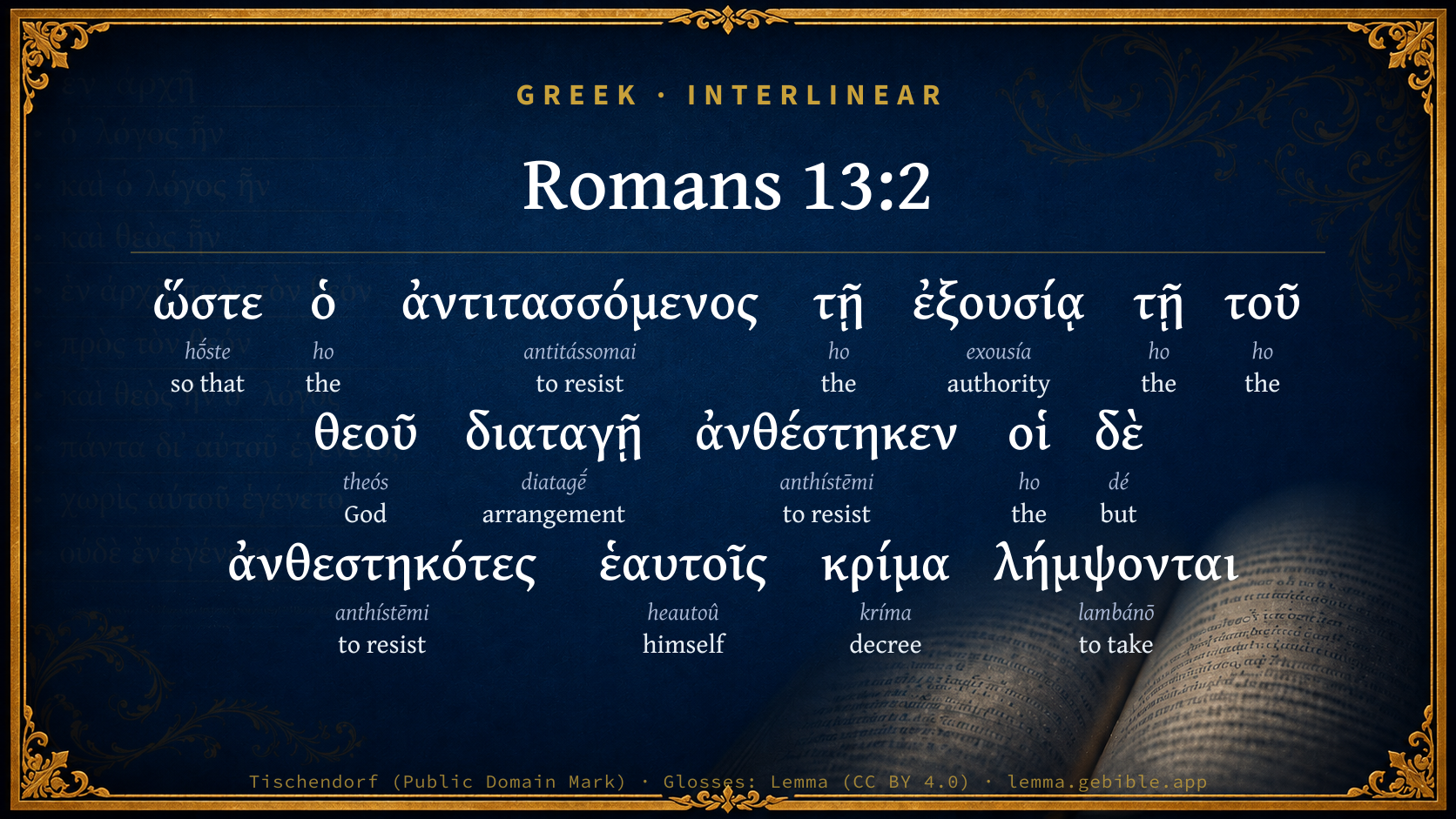
  1. ὥστε hṓste G5620 “so that” Conjunction
  2. ὁ ho G3588 “the” Article, Nominative, Singular, Masculine
  3. ἀντιτασσόμενος antitássomai G498 “to resist” Verb, Present, Middle, Participle, Nominative, Singular, Masculine
  4. τῇ ho G3588 “the” Article, Dative, Singular, Feminine
  5. ἐξουσίᾳ exousía G1849 “authority” Noun, Dative, Singular, Feminine
  6. τῇ ho G3588 “the” Article, Dative, Singular, Feminine
  7. τοῦ ho G3588 “the” Article, Genitive, Singular, Masculine
  8. θεοῦ theós G2316 “God” Noun, Genitive, Singular, Masculine
  9. ἀνθέστηκεν anthístēmi G436 “to resist” Verb, Perfect, Active, Indicative, 3rd person, Singular
  10. οἱ ho G3588 “the” Article, Nominative, Plural, Masculine
  11. δὲ dé G1161 “but” Conjunction
  12. ἀνθεστηκότες anthístēmi G436 “to resist” Verb, Perfect, Active, Participle, Nominative, Plural, Masculine
  13. ἑαυτοῖς heautoû G1438 “himself” Reflexive pronoun, 3rd person, Dative, Plural, Masculine
  14. κρίμα kríma G2917 “decree” Noun, Accusative, Singular, Neuter
  15. λήμψονται lambánō G2983 “to take” Verb, Future, Middle deponent, Indicative, 3rd person, Plural

About this verse

These counts appear in no published source. They are computed here, from the morphology-tagged text and Lemma’s own curated glosses. What Lemma adds →

16
words
11
distinct lemmas
Pauline Epistles
section

Notable vocabulary

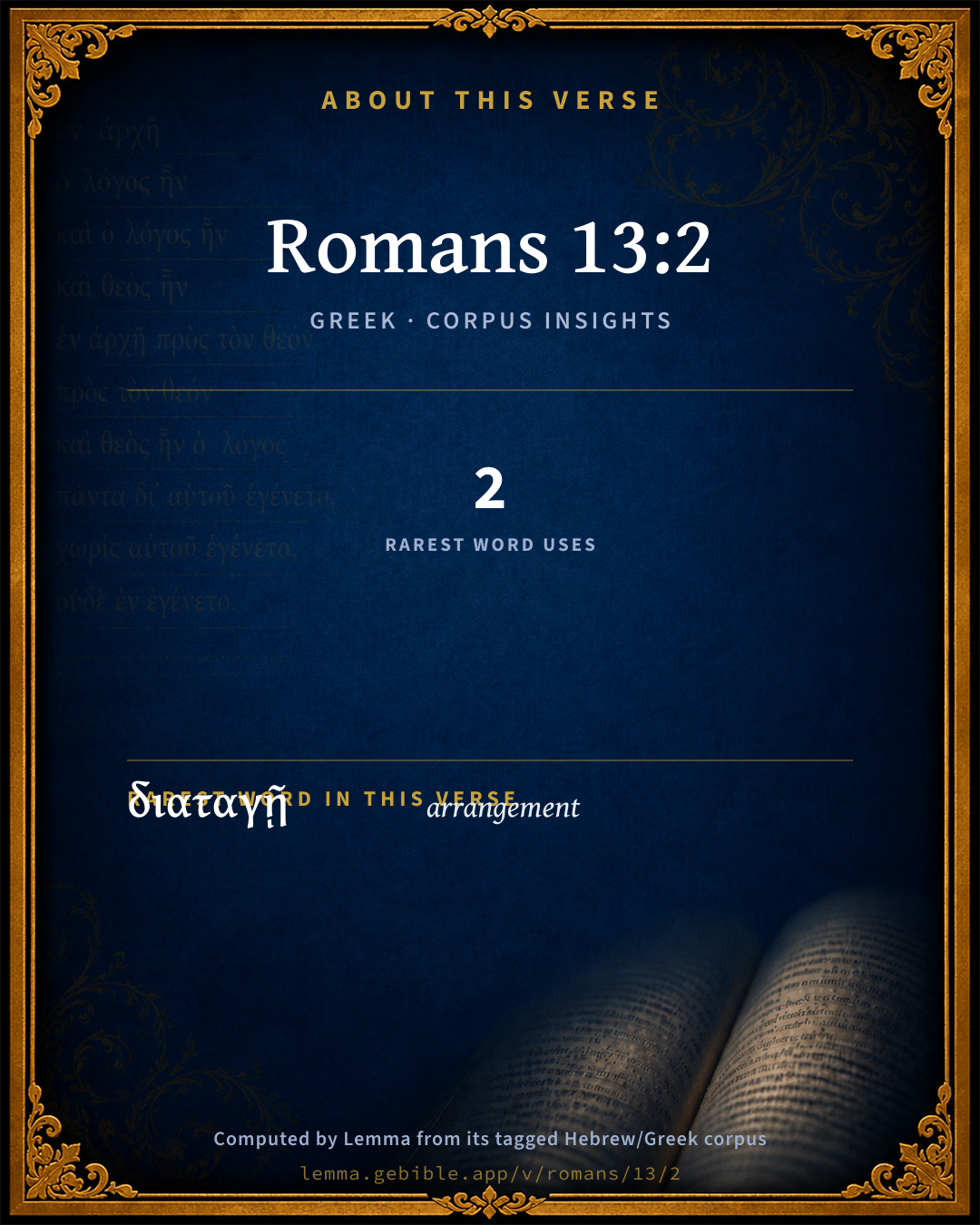
The rarest word here is διαταγῇ arrangement G1296 — appearing just 2 times in the whole Greek New Testament.

Shared distinctive vocabulary

διαταγῇ arrangement G1296 occurs in 2 verses of the Greek New Testament. Also found in:

Repetition

Words recur within this verse:

  • ἀνθέστηκεν to resist G436 ×2
  • ὁ the G3588 ×5

Cross-references

10

Topical passages linked to Romans 13:2 in the Treasury of Scripture Knowledge — connected by theme and wording, ordered by reader-vote popularity; previews shown in the World English Bible.

  • 1 Peter 2:13 Therefore subject yourselves to every ordinance of man for the Lord's sake: whether to the king, as supreme;
  • Titus 3:1 Remind them to be in subjection to rulers and to authorities, to be obedient, to be ready for every good work,
  • Romans 13:5 Therefore you need to be in subjection, not only because of the wrath, but also for conscience' sake.
  • James 3:1 Let not many of you be teachers, my brothers, knowing that we will receive heavier judgment.
  • Mark 12:40 those who devour widows' houses, and for a pretense make long prayers. These will receive greater condemnation."
  • Luke 20:47 who devour widows' houses, and for a pretense make long prayers: these will receive greater condemnation."
  • Matthew 23:13 "Woe to you, scribes and Pharisees, hypocrites! For you devour widows' houses, and as a pretense you make long prayers. Therefore you will receive greater condemnation.
  • Jeremiah 23:8–17 but, As Yahweh lives, who brought up and who led the seed of the house of Israel out of the north country, and from all the countries where I had driven them. They shall dwell in their own land.
  • Jeremiah 44:14–17 so that none of the remnant of Judah, who have gone into the land of Egypt to sojourn there, shall escape or be left, to return into the land of Judah, to which they have a desire to return to dwell there: for none shall return save such as shall escape.
  • Isaiah 58:2 Yet they seek me daily, and delight to know my ways: as a nation that did righteousness, and didn't forsake the ordinance of their God, they ask of me righteous judgments; they delight to draw near to God.

Cross-references courtesy of OpenBible.info (CC BY 4.0).

Commentary

Notes on Romans 13:2 from classic Christian and Jewish commentators (each source and its license shown beneath its notes). The classic Christian expositions comment on the surrounding passage and are grouped to its opening verse, so a note may address several verses; the Jewish commentaries on the Tanakh (Rashi and others) are per-verse, so they appear only where the commentator wrote on this verse.

Lemma curates 59 commentaries, every one of them public domain or Creative Commons licensed, each selected and text-cleaned for this edition rather than reprinted as found. About our sources →

Joseph Benson's Commentary

Rom 13:2. Whosoever therefore resisteth the power — Or the authority, of which the magistrate is possessed; resisteth the ordinance of God — God’s appointment for the preservation of order and of the public peace. And they that resist — Who withstand so wise and beneficial an institution; shall receive to themselves damnation — Or condemnation and punishment, not only from the civil powers they injure, but from the supreme sovereign, whose laws they break, and whose order they endeavour to reverse. “As the precept in the foregoing verse, and the declarations in this, are general, they must be interpreted according to the nature of the subjects to which they are applied. Wherefore, since the power of which the apostle speaks in both verses is the form of government, and not the rulers of the country, the subjection enjoined in the first verse is not an unlimited passive obedience to rulers in things sinful, but an obedience to the wholesome laws, enacted for the good of the community by common consent, or by those who, according to the constitution of the state, have the power of enacting laws. To these good laws the people are to give obedience, without examining by what title the magistrates, who execute these laws, hold their power; and even without considering whether the religion professed by the magistrates be true or false. For the same reason the opposition to, and resistance of the power, forbidden in Rom 13:2, is an opposition to, and resistance of the established government, by disobeying the wholesome laws of the state; or by attempting to overturn the government from a factious disposition, or from ill-will to the persons in power, or from an ambitious desire to possess the government ourselves. These precepts, therefore, do not enjoin obedience to the magistrates in things sinful, but in things not sinful; and more especially in things morally good, and which tend to the welfare of the state; besides, as in the following verses, the apostle hath shown, from the nature and end of their office, that the duty of rulers is to promote the happiness of the people, it is plain from the apostle himself, that they who refuse to do things sinful, or even things inconsistent with the fundamental laws of the state, do not resist the ordinance of God, although these things should be commanded by a lawful magistrate, because in commanding them he exceeds his power. And opposition to a ruler who endeavours utterly to subvert the constitution, or to enslave a free people, is warranted not only by right reason, but by the gospel, which teaches that rulers are the servants of God for good to the people, and are supported by God only in the just execution of their office.”

Joseph Benson's Commentary on the Old and New Testaments (1811–1818) — public domain. Text from a community e-Sword module.

Bengel's Gnomon

Johann Albrecht Bengel

Rom 13:2. Διαταγῇ, the ordinance) the abstract, in which the concrete is implied. So 1Pe 2:13, κτίσις, creature, in the abstract [but Engl. Vers. the ordinance]; it at the same time includes, for example, the king, in the concrete.—ἀνθέστηκεν) The Preterite, i.e. by that very act resists.—κρίμα) Divine judgment, through the magistrate.—λήψονται, they shall bring on themselves) While they take to themselves another’s power, they shall by their own spontaneous act take [bring] on themselves, receive judgment. We have here the figure [134]Mimesis [an allusion to the words of another with a view to refute him].

[134] See Appendix.

Bengel's Gnomon of the New Testament — English translation (T&T Clark, Edinburgh, 1860) — public domain. Text from a community e-Sword module.

Meyer's Critical & Exegetical Commentary

Heinrich August Wilhelm Meyer

Rom_13:2. Ὥστε] Since it is instituted by God.

ὁ ἀντιτασς.] Note the correlation of ἀντιτασς., ὑποτασς., and τεταγμ. The latter stands in the middle.

ἑαυτοῖς] Dativus incommodi: their resistance to the divinely-ordained magistracy will issue in their own self-destruction; comp. Rom_2:5; 1Co_11:29. According to Hofmann (who in his Schriftbew. II. 2, p. 443, even imported a contrast to τῷ κυρίῳ, as in Rom_14:6-7), ἑαυτοῖς is to be viewed as in contrast to the Christian body as such; the punishment to be suffered is a judgment which lights on the doers personally, and is not put to the account of their Christian standing. This explanation (they have to ascribe the punishment to themselves solely) is incorrect, because it obtrudes on the text a purely fictitious antithesis, and because the apostle lays down the relation to the magistracy quite generally, not from the specific point of view of Christian standing, according to which his readers might perhaps have supposed that they had become foreign to the political commonwealth. Had this comprehensive error in principle been here in Pauls view, in how entirely different a way must he have expressed what he intended than by the single expression ἑαυτοῖς, into which, moreover, that alleged thought would have first to be imported!

κρῖμα] a judgment, is understood of itself, according to the connection, as a penal judgment. Comp. Rom_2:2-3, Rom_3:8; 1Co_11:29; Gal_5:10; Mar_12:40. From whom they will receive it, is decided by the fact that with οἱ δὲ ἀνθεστηκότες, according to the context, τῇ τοῦ Θεοῦ διαταγῇ is again to be supplied. It is therefore a penal judgment of God, as the executors of which, however, the ἄρχοντες are conceived, as Rom_13:3 proves. Consequently the passage does not relate to eternal punishment (Reiche and others), but to the temporal punishment which God causes to be inflicted by means of the magistrates. Philippi prefers to leave κρῖμα without more special definition (comp. also Rückert); but against this is the consideration, that Rom_13:3 can only arbitrarily be taken otherwise than as assigning the ground of what immediately precedes.

Meyer — Critical and Exegetical Commentary on the New Testament — English translation by Peter Christie, edited by Frederick Crombie (T&T Clark, 1880) — public domain. Text from a community e-Sword module.

Expositor's Greek Testament

ed. W. Robertson Nicoll

Rom 13:2 . ὥστε cf. Rom 7:4 ; Rom 7:12 . The conclusion is that he who sets himself against the authorities withstands what has been instituted by God: διαταγῇ (Act 7:53 ) recalls τεταγμέναι , Rom 13:1 . The κρίμα , i.e. , the judgment or condemnation which those who offer such resistance shall receive, is of course a Divine one that is the nerve of the whole passage; but most commentators seem to regard it as coming through the human authority resisted. This is by no means clear; even a successful defiance of authority, which involved no human κρίμα , would according to Paul ensure punishment from God. For λήψονται κρίμα cf. Mar 12:40 , Jas 3:1 : where also God’s judgment alone is in view. But to say that it is God’s judgment only is not to say that it is eternal damnation. There are many ways in which God’s condemnation of sin is expressed and executed.

The Expositor's Greek Testament, edited by W. Robertson Nicoll (1897–1910) — public domain. Text from a community e-Sword module.

Hodge's Commentary on Romans, Ephesians & First Corinthians

Charles Hodge

Rom_13:2

Whoso, therefore, resisteth the power, resisteth the ordinance of God. This is an obvious inference from the doctrine of the preceding verse. If it is the will of God that there should be civil government, and persons appointed to exercise authority over others, it is plain that to resist such persons in the exercise of their lawful authority is an act of disobedience to God.

And they that resist shall receive to themselves damnation. This also is an obvious conclusion from the preceding. If disobedience is a sin it will be punished. The word (κρίμα) rendered damnation, means simply sentence, judicial decision; whether favorable or adverse, depends on the context. Here it is plain it means a sentence of condemnation. He shall be condemned, and, by implication, punished. As the word damnation is by modern usage restricted to the final and eternal condemnation of the wicked, it is unsuited to this passage and some others in which it occurs in our version; see 1Co_11:29. Paul does not refer to the punishment which the civil magistrate may inflict; for he is speaking of disobedience to those in authority as a sin against God, which he will punish.

It is clear that this passage (Rom_13:1, Rom_13:2) is applicable to men living under every form of government, monarchical, aristocratical, or democratical, in all their various modifications. Those who are in authority are to be obeyed within their sphere, no matter how or by whom appointed. It is the οὖσαι ἐξουσίαι, the powers that be, the de facto government, that is to be regarded as, for the time being, ordained of God. It was to Paul a matter of little importance whether the Roman emperor was appointed by the senate, the army, or the people; whether the assumption of the imperial authority by Caesar was just or unjust, or whether his successors had a legitimate claim to the throne or not. It was his object to lay down the simple principle, that magistrates are to be obeyed. The extent of this obedience is to be determined from the nature of the case. They are to be obeyed as magistrates, in the exercise of their lawful authority. When Paul commands wives to obey their husbands, they are required to obey them as husbands, not as masters, nor as kings; children are to obey their parents as parents, not as sovereigns; and so in every other case. This passage, therefore, affords a very slight foundation for the doctrine of passive obedience.

Charles Hodge — Commentary on Romans (1835), First Corinthians (1857), and Ephesians (1856) — public domain. Text from a community e-Sword module.

Jamieson, Fausset & Brown

Robert Jamieson, A. R. Fausset & David Brown

Whosoever therefore resisteth the power--"So that he that setteth himself against the authority."

resisteth the ordinance of God; and they that resist shall receive to themselves damnation--or, "condemnation," according to the old sense of that word; that is, not from the magistrate, but from God, whose authority in the magistrate's is resisted.

Jamieson, Fausset & Brown — Commentary Critical and Explanatory on the Whole Bible (1871) — public domain (CC PDM 1.0). Text via the HelloAO Bible API.

Adam Clarke's Commentary

Verse 2. Whosoever resisteth the power] ο αντιτασσομενος, He who sets himself in order against this order of God; τη του θεου διαταγη, and they who resist, οι ανθεστηκοτες, they who obstinately, and for no right reason, oppose the ruler, and strive to unsettle the constitution, and to bring about illegal changes,

Shall receive to themselves damnation.] κριμα, condemnation; shall be condemned both by the spirit and letter of that constitution, which, under pretence of defending or improving, they are indirectly labouring to subvert.

Adam Clarke's Commentary on the Bible (1810–1826) — public domain. Text from a community e-Sword/MySword module.

John Calvin's Commentaries

2. And they who resist, etc. As no one can resist God but to his own ruin, he threatens, that they shall not be unpunished who in this respect oppose the providence of God. Let us then beware, lest we incur this denunciation. And by judgment, I understand not only the punishment which is inflicted by the magistrate, as though he had only said, that they would be justly punished who resisted authority; but also the vengeance of God, however it may at length be executed: for he teaches us in general what end awaits those who contend with God.

John Calvin's Commentaries (1540-1563) — public domain. Text from the Calvin Translation Society English edition (1840s-50s) via the Christian Classics Ethereal Library (ccel.org). Calvin's coverage is partial (roughly two-thirds of the Bible); uncommented books and verses are honest gaps, never fabricated. The 19th-century editor's footnotes and remarks are omitted so the notes are faithfully Calvin's own voice.

Ellicott's Commentary for English Readers

(2) Damnation.—Condemnation—i.e., the sentence passed upon him by the judge or magistrate as God’s representative.

A Bible Commentary for English Readers, edited by Charles John Ellicott (1878–1897) — public domain. Text from a community e-Sword module.

The Cambridge Bible for Schools and Colleges

gen. ed. J. J. S. Perowne

2. The passage does not touch on the question of forms of government. “The powers that be” is a phrase which, on the whole, accepts authority de facto, irrespective of its theory, or of its circumstances of origin. Just so both human and Divine law, after no long lapse of time, recognize property de facto, irrespective of circumstances of acquisition.

The Cambridge Bible for Schools and Colleges (gen. ed. J. J. S. Perowne; Cambridge University Press, 1878–1918) — public domain. Text from a community e-Sword module.

John Gill's Exposition

Whosoever therefore resisteth the power,.... The office of magistracy, and such as are lawfully placed in it, and rightly exercise it; who denies that there is, or ought to be any such order among men, despises it, and opposes it, and withdraws himself from it, and will not be subject to it in any form:

resisteth the ordinance of God, the will and appointment of God, whose pleasure it is that there should be such an office, and that men should be subject to it. This is not to be understood, as if magistrates were above the laws, and had a lawless power to do as they will without opposition; for they are under the law, and liable to the penalty of it, in case of disobedience, as others; and when they make their own will a law, or exercise a lawless tyrannical power, in defiance of the laws of God, and of the land, to the endangering of the lives, liberties, and properties of subjects, they may be resisted, as Saul was by the people of Israel, when he would have took away the life of Jonathan for the breach of an arbitrary law of his own, and that too without the knowledge of it, Sa1 14:45; but the apostle is speaking of resisting magistrates in the right discharge of their office, and in the exercise of legal power and authority:

and they that resist them, in this sense,

shall receive to themselves damnation; that is, punishment; either temporal, and that either by the hand of the magistrate himself, who has it in his power to punish mutiny, sedition, and insurrection, and any opposition to him in the just discharge of his duty; or at the hand of God, in righteous judgment, for their disobedience to an ordinance of his; as in the case of Korah, Dathan, and Abiram, who opposed themselves both to the civil and sacred government of the people of Israel, Num 26:9; and were swallowed up alive in the earth, Num 26:10, or eternal punishment, unless the grace of God prevents; for "the blackness of darkness is reserved for ever", Jde 1:13, for such persons, who, among other of their characters, are said to "despise dominion, and speak evil of dignities", Jde 1:8. This is another argument persuading to subjection to magistrates.

John Gill's Exposition of the Whole Bible (1746–1763) — public domain (CC PDM 1.0). Text via the HelloAO Bible API.

Trapp's Complete Commentary

John Trapp

2 Whosoever therefore resisteth the power, resisteth the ordinance of God: and they that resist shall receive to themselves damnation.

Ver. 2. Resisteth the power] His authoritative commands, not his personal.

Receive to themselves damnation] κριμα, 1Co 11:31-32. Poenam sibi auferent, saith Piscator, they shall receive punishment, to wit, from the magistrate; as Aretine deserved to do, who by longer custom of libellous and contumelious speaking against princes, had got such a habit, that at last he came to diminish and disesteem God himself.

John Trapp, A Commentary or Exposition upon All the Books of the Old and New Testament (1647–1656) — public domain. Text from a community e-Sword module.

Albert Barnes' Notes on the Bible

Whosoever therefore resisteth ... - That is, they who rise up against “government itself;” who seek anarchy and confusion; and who oppose the regular execution of the laws. It is implied, however, that those laws shall not be such as to violate the rights of conscience, or oppose the laws of God.

Resisteth the ordinance of God - What God has ordained, or appointed. This means clearly that we are to regard “government” as instituted by God, and as agreeable to his will. “When” established, we are not to be agitated about the “titles” of the rulers; not to enter into angry contentions, or to refuse to submit to them, because we are apprehensive of a defect in their “title,” or because they may have obtained it by oppression. If the government is established, and if its decisions are not a manifest violation of the laws of God, we are to submit to them.

Shall receive to themselves damnation - The word “damnation” we apply now exclusively to the punishment of hell; to future torments. But this is not necessarily the meaning of the word which is used here κρίμα krima. It often simply denotes “punishment;” Rom 3:8; 1Co 11:29; Gal 5:10. In this place the word implies “guilt” or “criminality” in resisting the ordinance of God, and affirms that the man that does it shall be punished. Whether the apostle means that he shall be punished by “God,” or by the “magistrate,” is not quite clear. Probably the “latter,” however, is intended; compare Rom 13:4. It is also true that such resistance shall be attended with the displeasure of God, and be punished by him.

Albert Barnes' Notes on the Bible (1834–1885) — public domain. Text from a community e-Sword/MySword module.

Matthew Poole's English Annotations

Whosoever therefore resisteth the power, resisteth the ordinance of God: these words are, either an argument to enforce the subjection enjoined in the former part of the foregoing verse; q. d. You may not resist; therefore, you must be subject: or else, they are an inference from the latter part of it; q.d. Seeing the civil power is of God, and of his ordination; therefore, it must not be resisted or opposed. To resist authority, is to wage war against God himself.

Damnation; the word properly signifieth judgment, and it is applied in Scripture, either to human and temporal punishment, as Luk 23:40; 1Co 6:7; 1Pe 4:17; or else to Divine and eternal punishment, as Luk 20:47; Heb 6:2; 2Pe 2:3. Accordingly, it may be understood of eternal punishment, that the resister of authority shall receive from God; or of temporal punishment, that he shall receive from the magistrate.

Matthew Poole's English Annotations on the Holy Bible (1683–1685) — public domain. Text from a community e-Sword/MySword module.

Whedon's Commentary on the Bible

Daniel D. Whedon

2. Resisteth the power—That is, resisteth a power which is confessedly the government.

The Romans to whom Paul wrote were under the rule, and lived not many yards from the palace of the Emperor Nero, whose is one of the names in history most conspicuous for tyranny and blood. Yet, bad as he was, and bad as was his government, it was the best thing of which the age was capable. When he was assassinated a series of civil wars and of brief tyrannies succeeded, under which the empire declined to its final fall under the incoming flood of the northern barbarians, under which the ancient society perished.

Damnation—Divine condemnation. For he is guilty of treason not only against the existing government, but against the public welfare.

The apostle now argues against resistance, first, from the social necessity of a terror over the evil, and, second, from the rightfulness of terror as a governmental principle.

Daniel D. Whedon (gen. ed.), Commentary on the Old and New Testaments (1874–1909) — public domain. Text from a community e-Sword module.

The Pulpit Commentary

Vers. 2-5. Whosoever therefore resisteth the power, withstandeth the ordinance of God: and they which withstand shall receive to themselves condemnation (i.e. really God"s, operating through the human "power;" not meaning damnation in the common sense of the word). For rulers are not a terror to good works, but to the evil. Wilt thou then not be afraid of the power? do that which is good, and thou shalt have praise of the same. It is the theory of the laws of all civilized governments to uphold justice, and only to punish what is wrong; and in the main they do so. The principles of the Roman law were just, and Paul himself found protection from its officers and tribunals, whose fairness he had, and had reason to have, more confidence in than in the tender mercy of either Gentile or Jewish zealots. (cf. Act_19:35, seq.; Act_21:31, seq.; Act_22:30 Act_24:10 Act_25:10, 11 26:30, seq. ) As has been observed already, the Neronian persecutions had not yet begun. For he is the minister of God to thee for good. But if thou do that which is evil, be afraid; for he beareth not the sword in vain: (though "the sword" might possibly be understood as only the familiar symbol of power, yet the mention of it may be taken to imply the apostle"s recognition of the legitimacy of capital punishment, such as he also expressed distinctly, Act_25:11) for he is the minister of God, an avenger to execute wrath upon him that doeth evil. Wrath here expresses the familiar idea of the Divine wrath against evil-doing, for the execution of which, in the sphere of human law, the magistrate is the appointed instrument. (see note on Rom_12:19) Wherefore ye must needs be subject, not only for wrath, but also for conscience" sake. Not only for fear of penal consequences, but because it is your duty, whatever might ensue, to submit to the ordinance of God. Similarly, in 1Pe_2:13, submission to every ordinance of man is enjoined "for the Lord"s sake (dia torion)."

The Pulpit Commentary (1880–1919), ed. H.D.M. Spence-Jones & Joseph S. Exell — public domain. Text from a community e-Sword module.

John Wesley's Explanatory Notes

Whosoever resisteth the power - In any other manner than the laws of the community direct. Shall receive condemnation - Not only from the magistrate, but from God also.

John Wesley, Explanatory Notes Upon the Whole Bible (1754–1765) — public domain. Text via the GEBible commentary corpus.

Scofield Reference Notes

C. I. Scofield

damnation

Condemnation, i.e. in the sense of judgment by the magistrate.

The Scofield Reference Bible (1917 edition), notes by C. I. Scofield — public domain. Text from a community e-Sword module.

Burkitt's Expository Notes on the New Testament

William Burkitt

The forementioned duty of subjection unto magistracy, insisted upon in the foregoing verse, the apostle urges and enforces upon all Christians, by sundry arguments in this and the foregoing verses; as, namely, 1. From the sinfulness of resistance: They resist the ordinance of God; they make war upon God himself; he that rebelleth against his prince, is a rebel also to his God. From the danger of resistance: They shall receive to themselves damnation.

That is, 1. Temporal judgement from the hand of the magistrate, to whom the sword is committed, as Korah, Absalom, and others, did experience.

2. Eternal punishment from the hand of God, who will plead the cause, and vindicate the honour of his vicegerents and representatives here on earth, and cast those into hell who pour contempt upon them, if sincere repentance by a timely interposure prevent it not.

William Burkitt's Expository Notes on the New Testament (1700–1703) — public domain. Text from a community e-Sword module.

McGarvey & Pendleton's Commentaries

J. W. McGarvey

Therefore he that resisteth the power, withstandeth the ordinance of God [This is the enunciation of the general principle without any accompanying exceptions. Pressed to its limits, this precept would prevent any revolution from succeeding, for the leader of the revolution could never be permitted of God to rule, as his rulership would then be countenanced by God as of his ordaining, and thus, in countenancing and ordaining both opposing governments, God would be divided against himself. The principle and its exceptions would best be understood by comparing the life of a government with that of a man. Each life is an emanation from God, and therefore each is protected by the general, fundamental law, "Thou shalt not kill." But this law in each case presumes that each life, whether governmental or individual, will so comply with the precepts and purposes of God, and so fulfill the ends for which it was created, as to deserve to live. If it does things worthy of death, it shall be put to death ( Gen_9:6 ). Paul, therefore, in laying down the rule, has in mind the age-long principle which, in our common law, finds expression in the maxim, "The king [government] can do no wrong." Only the most obvious, evident breach of this maxim can justify revolution. Each life must, as it were, be rigidly protected from lynch law, and must be given the calm deliberation of a judicial trial. When this is not the case, the one who assails the individual life becomes a murderer, and the one who attempts the life of the state "resists the ordinance of God." Every revolt, for a time, shakes public confidence in a divine institution, so there must be no resistance until the demand for it becomes practically unavoidable; otherwise we incur the resentment of God, for our conduct has tended toward anarchy and confusion. We should therefore exhaust legitimate expedients, such as protests, political reactions etc., before we resort to revolutionary extremes]: and they that withstand shall receive to themselves judgment . [Commentators, unable to define the preceding precept, and regarding it as ostensibly a prohibition of all revolution, or practically to that effect, have consoled themselves by limiting "judgment" to the punishments which the state inflicts, thus arriving at the conclusion that rebels have a right to rebel if they are willing to suffer the temporal punishment attendant on failure. But the context forbids this mollifying modification. If we resist the ordinance of God, we shall undoubtedly taste the judgment of God, and rightly, too, for what terrific misery, poverty, suffering and loss of life attend on revolution! Shall not God award justice to those who lightly and for personal ambitions fill the world with such horrors?]

J. W. McGarvey (with Philip Y. Pendleton), Commentaries on the New Testament (The Fourfold Gospel, 1914; Acts; and the epistles) — public domain. Text from a community e-Sword/MySword module.

The People's New Testament

B. W. Johnson

2. Whosoever therefore resisteth the power. It follows that he who seeks to break down his government is fighting the ordinance of God, and shall be liable to punishment. This implies a loyal submission to the forms of government over us. It does not imply that we shall obey wicked magistrates when they command us to disobey God. See Acts 4:19.

B. W. Johnson's The People's New Testament with Notes (1889–1891) — public domain. Electronic text from the Christian Classics Ethereal Library (CCEL) ThML edition.

Cambridge Greek Testament for Schools and Colleges

2. ἐαυτοῖς. Emphatic: will bring judgment upon themselves.

κρίμα λήμψονται. Of the civil judgment involved by their acts; cf. Luk 23:40; Luk 24:20.

Cambridge Greek Testament for Schools and Colleges (Cambridge University Press, 1896; 21 vols, various authors incl. Carr, Maclear, Plummer, Farrar, Lumby, Moule, M. R. James, Simcox) — public domain. Text from a community e-Sword module.

Alford’s Greek Testament

Henry Alford

2.] ἀντιτασσ., see above on ὑποτασς.

ἑαυτοῖς κρῖμαλ.] shall receive for themselves (the dat. incommodi) condemnation, viz. punishment from God, through His minister, the civil power.

Henry Alford, The Greek Testament (1849–1861) — public domain. Text from a community e-Sword module.

International Critical Commentary

2. ὥστε ὁ ἀντιτασσόμενος κ.τ.λ. The logical result of this theory as to the origin of human power is that resistance to it is resistance to the ordering of God; and hence those who resist will receive κρῖμα—a judgement or condemnation which is human, for it comes through human instruments, but Divine as having its origin and source in God. There is no reference here to eternal punishment.

International Critical Commentary — older volumes (1896–1929), various authors — public domain. Text from a community e-Sword module.

Vincent's Word Studies in the New Testament

Marvin R. Vincent

He that resisteth [ο αντιτασσομενος] . Lit., setteth himself in array against. See on 1Pe 5:5; Act 18:6.

Resisteth [ανθεστηκεν] . Rev., better, withstandeth. See on ch. Rom 9:19. Ordinance [διαταγη] . From tassw to put in place, which appears in the first resisteth. He setteth himself against that which is divinely set. Damnation [κριμα] . Judicial sentence. Rev., better, judgment.

Marvin R. Vincent, Word Studies in the New Testament (1887–1900) — public domain. Text from a community e-Sword/MySword module.

Godet's Commentaries

Frédéric Louis Godet

Vv. 2. “Whosoever, therefore, rebelleth against the power, resisteth the ordinance of God; now, they that resist shall receive to themselves a judgment.”

This verse exhibits the guilt, and, as a consequence, the inevitable punishment of revolt. The term ἀντιτασσόμενος is the counterpart of ὑποτάσσεσθαι, Rom 13:1. The perfect ἀνθέστηκεν, as well as the participle which follows, has the meaning of the present.

The term διαταγή, ordinance, includes the two ideas expressed in 1b: an institution, and a fact of which God Himself is the ordainer. This term etymologically and logically recalls the three preceding: ὑποτασσέσθω, ἀντιτασσόμενος, and τεταγμέναι.

The application of the principle laid down here remains always the same, whatever may be the form of government, Monarchical or Republican. Every revolt has for its effect to shake for a longer or shorter time the feeling of respect due to a divine institution; and hence the judgment of God cannot fail to overtake him who becomes guilty.

Undoubtedly the term κρῖμα, judgment, without article, does not refer to eternal perdition; but neither should we apply it, with many critics, solely to the punishment which will be inflicted by the authority attacked. Most certainly, in the mind of the apostle, it is God who will put forth His hand to avenge His institution which has been compromised, whether he do so directly or by some human instrumentality. Paul here reproduces in a certain sense, but in another form, the saying of Jesus, Mat 26:52: “All they that take the sword shall perish by the sword.” Volkmar has thought good, in connection with this precept, to advance a supposition which resembles a wicked piece of pleasantry. He alleges that when the author of the Apocalypse represents the false prophet seeking to induce men to submit to the beast (the Antichrist), he meant to designate Paul himself, who, in our passage, teaches the Christians of Rome to submit to the emperor. But the author of this ingenious hypothesis will yet acknowledge that to submit is not the equivalent of to worship (Rev 13:12). And to give this application any probability whatever, the Apocalypse must have avoided reproducing exactly the saying of Jesus which we have just quoted, and the precept of Paul himself, by cautioning Christians against revolt, and saying to them, Rom 13:10 : “He that killeth with the sword must be killed with the sword; here is the patience and the faith of the saints.” It is obvious that Jesus, Paul, and John have only one and the same watchword to give to the believer in regard to his relations to the state: submission, and, when necessary, patience.

Frédéric Louis Godet — Commentaries on Luke, John, Romans, and 1 Corinthians — English translation (T&T Clark, Edinburgh, 1870s–1890s) — public domain. Text from a community e-Sword module.

Lesson kit

Teaching starters — assembled from the data on this page, not authored interpretation. Every prompt links to the verse data it draws on. Edit before teaching.

Romans, in the Pauline Epistles, opens this verse with 16 words (11 distinct Greek lemmas). Its most distinctive word is diatagḗ (“arrangement”). A historical commentator’s framing appears above. Read the whole chapter for the surrounding context.

Discussion questions

  1. What does “arrangement” (diatagḗ) contribute to the verse as a whole?
  2. Acts 7:53 shares the word «arrangement» with this verse. How do the two illuminate each other?
  3. “to resist” occurs 2× in this one verse. What is the effect of the repetition?
  4. These translations render this verse differently. What is at stake in choosing one wording over another?
  5. Reading how Joseph Benson's Commentary and Bengel's Gnomon read this verse, where do the two commentators agree and where do they part?

Things to notice

  • These translations choose different wording for 24 words in this verse.
  • “to resist” occurs 2× in this single verse.
  • 11 distinct Greek lemmas span 16 words in this verse.

Reading settings

Reading text

Shown beneath each verse's original-language words.

Old Testament
Old Testament edition

Read the OT as the Masoretic Hebrew (MT) or the Greek Septuagint (LXX).

English shown for the Greek Septuagint (in the Hebrew ↔ Greek comparison).

Comparing translations? Open the Compare panel on any verse page to stack up to four side by side.