
1 Kings 1:33

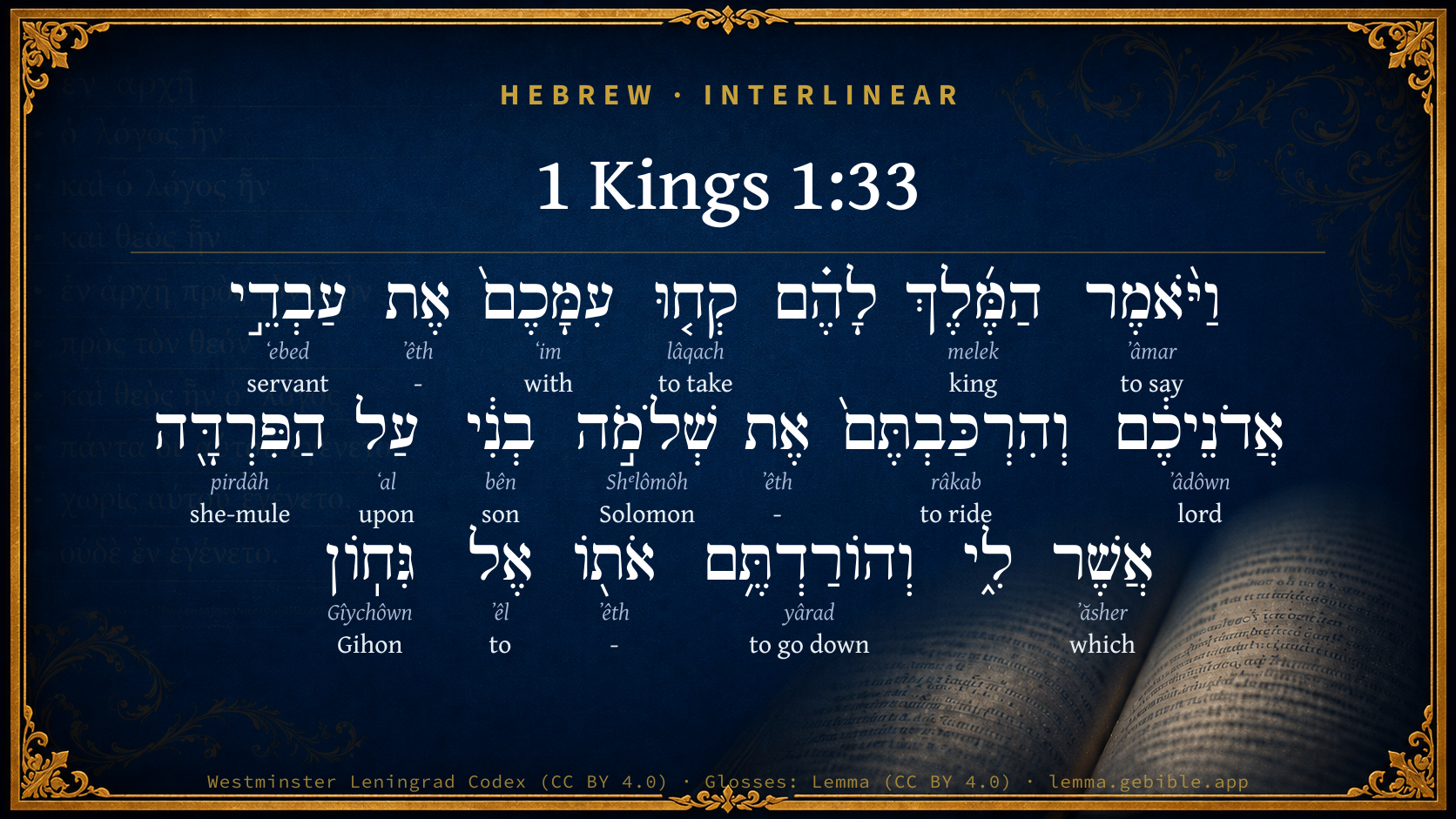
Hebrew (Westminster Leningrad Codex) 1 Kings 1:33 appears in the Hebrew Old Testament. The text above is from the Westminster Leningrad Codex. Each word links to its Strong’s number, a concise gloss, and parsing drawn from the Open Scriptures Hebrew Bible morphology. Click any word for its full Brown-Driver-Briggs (BDB) entry.
Download image
Cite this verse

1 Kings 1:33 (World English Bible). Public Domain. Lemma interlinear Bible study tool, https://lemma.gebible.app/v/1-kings/1/33.

Show BibTeX & RIS
BibTeX
RIS
English Translation
The king said to them, Take with you the servants of your lord, and cause Solomon my son to ride on my own mule, and bring him down to Gihon:
World English Bible · Public Domain
Highlights
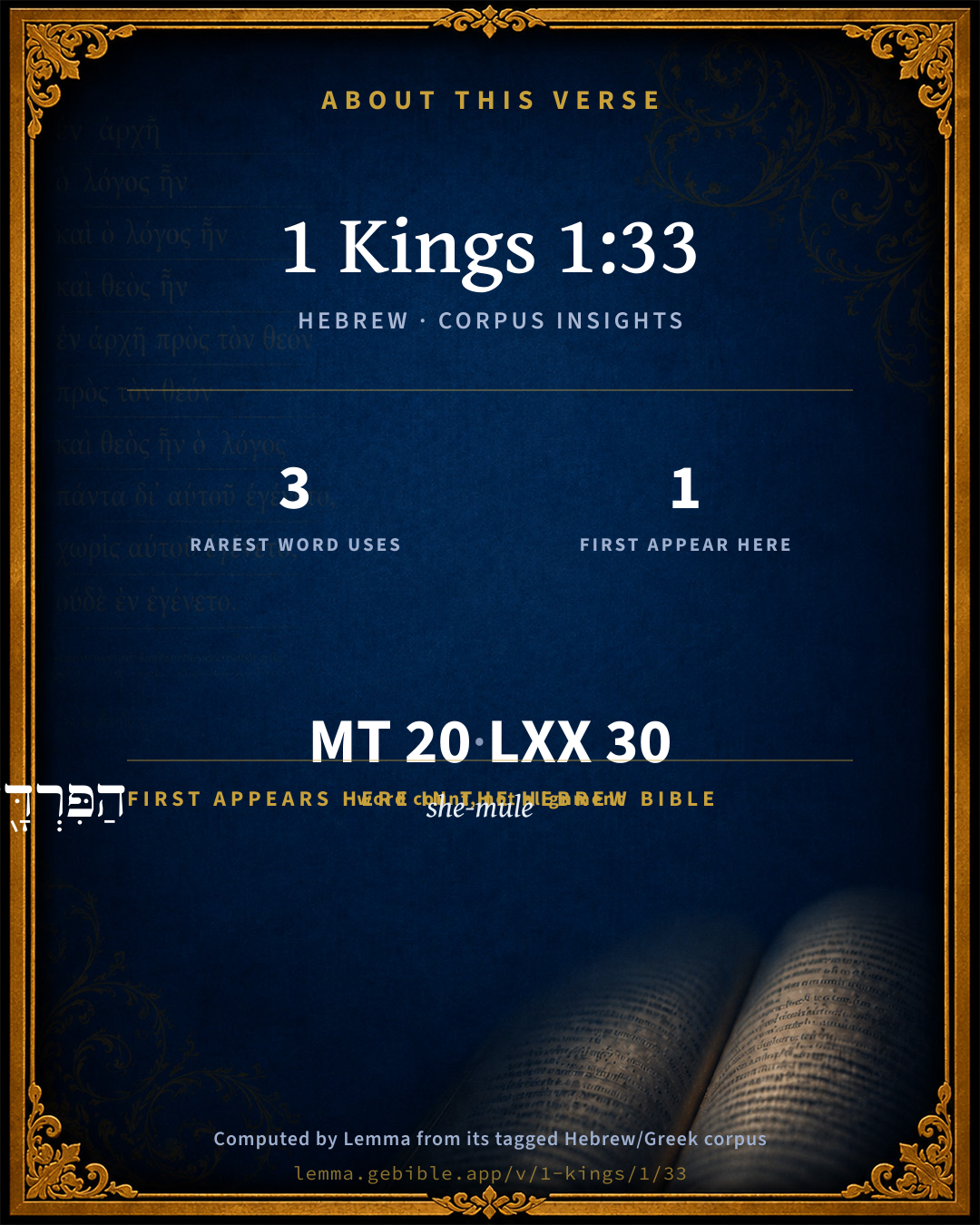
  • 1 first appearance in the Hebrew Bible
Full analysis ↓
Download a study sheet

One document with this verse’s original text, its word-by-word gloss line, the meaning frame, cross-references with their text, attributed commentary, and full source and license credits — printable, and it pastes into notes with its structure intact.

This verse Autodidact and up

Study sheet (.html) Plain text (.txt)

A passage Seminary Student

Up to 50 verses in one chapter. A passage sheet keeps up to 6 commentary sources and 12 cross-references per verse, in the order this page ranks them, and says so on the sheet whenever that leaves anything out. Ask for a single verse and you get the Autodidact verse sheet above.

Everything on this page stays free to read, with no account — the sheet is a download of what is already on screen, not access to it.

Want to remove ads? Support Godless Engineer
Compare translations 3

The same verse in 3 English versions, stacked beneath the original-language interlinear above. Click any original word for its lexicon entry.

Each is an independent rendering of the whole verse — the interlinear is not word-aligned to these translations.

Highlighted words mark where these versions differ — a whole-verse word diff, not a word-by-word alignment.

  • World English Bible Public Domain
    The king said to them, Take with you the servants of your lord, and cause Solomon my son to ride on my own mule, and bring him down to Gihon:
  • King James Version Public Domain
    The king also said unto them, Take with you the servants of your lord, and cause Solomon my son to ride upon mine own mule, and bring him down to Gihon:
  • unfoldingWord Literal Text CC BY-SA 4.0
    And the king said to them, “Take the servants of your master with you, and you shall make Solomon my son ride on the female mule that is to me, and you shall bring him down to Gihon.

unfoldingWord Literal Text — © unfoldingWord, licensed CC BY-SA 4.0. Word-aligned USFM3 via Door43 (git.door43.org/unfoldingWord/en_ult).

Versions to compare (up to 4)

3 of 4 selected

Show all 18 translations

Every available English version of this verse, each an independent rendering of the whole verse.

  • World English Bible Public Domain
    The king said to them, Take with you the servants of your lord, and cause Solomon my son to ride on my own mule, and bring him down to Gihon:
  • Berean Standard Bible Public Domain
    “Take my servants with you,” said the king. “Set my son Solomon on my own mule and take him down to Gihon.
  • Majority Standard Bible Public Domain
    “Take my servants with you,” said the king. “Set my son Solomon on my own mule and take him down to Gihon.
  • King James Version Public Domain
    The king also said unto them, Take with you the servants of your lord, and cause Solomon my son to ride upon mine own mule, and bring him down to Gihon:
  • American Standard Version (1901) Public Domain
    And the king said unto them, Take with you the servants of your lord, and cause Solomon my son to ride upon mine own mule, and bring him down to Gihon:
  • Revised Version (1885) Public Domain
    And the king, said unto them, Take with you the servants of your lord, and cause Solomon my son to ride upon mine own mule, and bring him down to Gihon:
  • Geneva Bible (1599) Public Domain
    Then the King said vnto them, Take with you the seruants of your lorde, and cause Salomon my sonne to ride vpon mine owne mule, and carie him downe to Gihon.
  • Douay-Rheims (1899) Public Domain
    He said to them: Take with you the servants of your lord, and set my son Solomon upon my mule: and bring him to Gihon.
  • Young's Literal Translation Public Domain
    And the king saith to them, `Take with you the servants of your lord, and ye have caused Solomon my son to ride on mine own mule, and caused him to go down unto Gihon,
  • Literal Standard Version CC BY-SA 4.0
    And the king says to them, “Take the servants of your lord with you, and you have caused my son Solomon to ride on my own mule, and caused him to go down to Gihon,
  • Unlocked Literal Bible CC BY-SA 4.0
    The king said to them, “Take with you the servants of your master, and have Solomon my son ride on my own mule and take him down to Gihon.
  • unfoldingWord Literal Text CC BY-SA 4.0
    And the king said to them, “Take the servants of your master with you, and you shall make Solomon my son ride on the female mule that is to me, and you shall bring him down to Gihon.
  • Darby Bible Public Domain
    And the king said to them, Take with you the servants of your lord, and cause Solomon my son to ride upon mine own mule, and bring him down to Gihon;
  • World Messianic Bible Public Domain
    The king said to them, “Take with you the servants of your lord, and cause Solomon my son to ride on my own mule, and bring him down to Gihon.
  • Webster's Bible Public Domain
    The king also said to them, Take with you the servants of your lord, and cause Solomon my son to ride upon my own mule, and bring him down to Gihon:
  • Free Bible Version CC BY-SA 4.0
    the king told them, “Take the king's officials with you, and have them put Solomon on my own mule and lead him down to the Gihon Spring.
  • Bible in Basic English Public Domain
    And the king said to them, Take with you the servants of your lord, and put Solomon my son on my beast, yes, mine, and take him down to Gihon;
  • JPS Tanakh (1917) Public Domain
    And the king said unto them: 'Take with you the servants of your lord, and cause Solomon my son to ride upon mine own mule, and bring him down to Gihon.

Literal Standard Version (2020), Covenant Press — licensed CC BY-SA 4.0. Text via the HelloAO Bible API (eBible.org). Unlocked Literal Bible (unfoldingWord) — licensed CC BY-SA 4.0. Text via the HelloAO Bible API (eBible.org). unfoldingWord Literal Text — © unfoldingWord, licensed CC BY-SA 4.0. Word-aligned USFM3 via Door43 (git.door43.org/unfoldingWord/en_ult). Free Bible Version, Dr. Jonathan Gallagher — licensed CC BY-SA 4.0. Text via the HelloAO Bible API (eBible.org).

Word by word

More ways to search: Search by grammar → Find every occurrence → Compare this word →

Practice this passage: Drill this verse → Learn its vocabulary →

הַפִּרְדָּ֖ה
pirdâh
H6506
“the · she-mule”
Particle, Definite Article + Noun, Common, Feminine, Singular, Absolute
Part of Speech
Particle + Noun
Type
Common
Gender
Feminine
Number
Singular
State
Absolute
Full BDB Definition

Origin: from H6505

TWOT: 1807b

she-mule, mule
  1. וַיֹּ֨אמֶר ʼâmar H559 “and · to say” Conjunction + Verb, Qal, Sequential Imperfect, 3rd Person, Masculine, Singular
  2. הַמֶּ֜לֶךְ melek H4428 “the · king” Particle, Definite Article + Noun, Common, Masculine, Singular, Absolute
  3. קְח֤וּ lâqach H3947 “take” Verb, Qal, Imperative, 2nd Person, Masculine, Plural
  4. עִמָּכֶם֙ ʻim H5973 “with · you” Preposition + Suffix, Personal, 2nd Person, Masculine, Plural
  5. אֶת ʼêth H853 “-” Particle, Direct Object
  6. עַבְדֵ֣י ʻebed H5650 “servants of” Noun, Common, Masculine, Plural, Construct
  7. אֲדֹנֵיכֶ֔ם ʼâdôwn H113 “lords · your” Noun, Common, Masculine, Plural, Construct + Suffix, Personal, 2nd Person, Masculine, Plural
  8. וְהִרְכַּבְתֶּם֙ râkab H7392 “and · to ride” Conjunction + Verb, Hiphil, Sequential Perfect, 2nd Person, Masculine, Plural
  9. אֶת ʼêth H853 “-” Particle, Direct Object
  10. שְׁלֹמֹ֣ה Shᵉlômôh H8010 “Solomon” Noun, Proper
  11. בְנִ֔י bên H1121 “son · my” Noun, Common, Masculine, Singular, Construct + Suffix, Personal, 1st Person, Common, Singular
  12. עַל ʻal H5921 “upon” Preposition
  13. אֲשֶׁר ʼăsher H834 “which” Particle, Relative
  14. וְהוֹרַדְתֶּ֥ם yârad H3381 “and · to go down” Conjunction + Verb, Hiphil, Sequential Perfect, 2nd Person, Masculine, Plural
  15. אֹת֖וֹ ʼêth H853 “- · him” Particle, Direct Object + Suffix, Personal, 3rd Person, Masculine, Singular
  16. אֶל ʼêl H413 “to” Preposition
  17. גִּחֽוֹן Gîychôwn H1521 “Gihon” Noun, Proper

About this verse

These counts appear in no published source. They are computed here, from the morphology-tagged text and Lemma’s own curated glosses. What Lemma adds →

20
words
16
distinct lemmas
Historical
section

Notable vocabulary

The rarest word here is הַפִּרְדָּ֖ה she-mule H6506 — appearing just 3 times in the whole Hebrew Bible.

First appearance in Scripture

This word makes its first canonical appearance in the Hebrew Bible here:

  • הַפִּרְדָּ֖ה she-mule H6506

Shared distinctive vocabulary

הַפִּרְדָּ֖ה she-mule H6506 occurs in 3 verses of the Hebrew Bible. Also found in:

Grammatical profile

  • 4 verbs
  • 7 nouns
  • 5 prepositions
  • 4 particles

Verb forms

  • וַיֹּ֨אמֶר Qal · Sequential Imperfect
  • קְח֤וּ Qal · Imperative
  • וְהִרְכַּבְתֶּם֙ Hiphil · Sequential Perfect
  • וְהוֹרַדְתֶּ֥ם Hiphil · Sequential Perfect

Hebrew & Septuagint length

In English translation the verse runs 30 words from the Hebrew and 29 from the Septuagint (LXX English) — closely comparable.

A rough comparison of the two English renderings, which tokenize alike — not a word-level alignment.

Word counts can differ between the Hebrew and the Greek without any difference in meaning — e.g. the Hebrew direct-object marker אֵת has no separate Greek word, and Greek often adds the article ὁ.

In the original languages it is 20 Hebrew tokens and 30 Greek tokens — but the two are counted differently (Hebrew bundles its prefixes and suffixes into one token; the Greek is in lemma form), so that isn’t a like-for-like length.

Cross-references

9

Topical passages linked to 1 Kings 1:33 in the Treasury of Scripture Knowledge — connected by theme and wording, ordered by reader-vote popularity; previews shown in the World English Bible.

  • 2 Chronicles 32:30 This same Hezekiah also stopped the upper spring of the waters of Gihon, and brought them straight down on the west side of the city of David. Hezekiah prospered in all his works.
  • 1 Kings 1:38 So Zadok the priest, and Nathan the prophet, and Benaiah the son of Jehoiada, and the Cherethites and the Pelethites, went down, and caused Solomon to ride on king David's mule, and brought him to Gihon.
  • 2 Chronicles 33:14 Now after this he built an outer wall to the city of David, on the west side of Gihon, in the valley, even to the entrance at the fish gate; and he compassed Ophel about [with it], and raised it up to a very great height: and he put valiant captains in all the fortified cities of Judah.
  • Genesis 41:43 and he made him to ride in the second chariot which he had. They cried before him, "Bow the knee!" He set him over all the land of Egypt.
  • Leviticus 19:19 "'You shall keep my statutes. "'You shall not crossbreed different kinds of animals. "'you shall not sow your field with two kinds of seed; "'neither shall there come upon on you a garment made of two kinds of material.
  • 2 Samuel 20:6–7 David said to Abishai, Now will Sheba the son of Bichri do us more harm than did Absalom: take your lord's servants, and pursue after him, lest he get him fortified cities, and escape out of our sight.
  • 1 Kings 1:5 Then Adonijah the son of Haggith exalted himself, saying, I will be king: and he prepared him chariots and horsemen, and fifty men to run before him.
  • 1 Kings 1:44–45 and the king has sent with him Zadok the priest, and Nathan the prophet, and Benaiah the son of Jehoiada, and the Cherethites and the Pelethites; and they have caused him to ride on the king's mule;
  • Esther 6:6–11 So Haman came in. The king said to him, What shall be done to the man whom the king delights to honor? Now Haman said in his heart, To whom would the king delight to do honor more than to myself?

Cross-references courtesy of OpenBible.info (CC BY 4.0).

Hebrew and Greek witnesses Masoretic Hebrew ↔ Greek Septuagint

The same verse in the two great witnesses to the Old Testament, shown verse-for-verse.

These are two independent witnesses, not word-aligned to each other, and the Septuagint is shown in lemma (dictionary) form.

Hebrew 1 Kings 1:33 Masoretic · Westminster Leningrad Codex

וַיֹּ֨אמֶר הַמֶּ֜לֶךְ לָהֶ֗ם קְח֤וּ עִמָּכֶם֙ אֶת עַבְדֵ֣י אֲדֹנֵיכֶ֔ם וְהִרְכַּבְתֶּם֙ אֶת שְׁלֹמֹ֣ה בְנִ֔י עַל הַפִּרְדָּ֖ה אֲשֶׁר לִ֑י וְהוֹרַדְתֶּ֥ם אֹת֖וֹ אֶל גִּחֽוֹן

The king said to them, Take with you the servants of your lord, and cause Solomon my son to ride on my own mule, and bring him down to Gihon:

World English Bible · Public Domain

Greek LXX 1 Kings 1:33 Septuagint · lemma form

καί εἶπον ὁ βασιλεύς αὐτός λαμβάνω ὁ δοῦλος ὁ κύριος σύ μετά σύ καί ἐπιβιβάζω ὁ υἱός ἐγώ σαλωμών ἐπί ὁ ἡμίονος ὁ ἐμός καί καταἄγω αὐτός εἰς ὁ γιων

And the king said to them, Take the servants of your lord with you, and mount my son Solomon upon my own mule, and bring him down to Gion.

LXX2012 (modern English Septuagint) · Public Domain

Hebrew: Westminster Leningrad Codex (CC BY 4.0). Greek: Septuagint (public domain); English from LXX2012 (modern English Septuagint) (Public Domain). How the Septuagint differs from the Hebrew →

Targum (Aramaic paraphrase)

1

The Targum is the ancient Jewish Aramaic paraphrase of the Hebrew Scriptures — an interpretive translation, not the Hebrew text itself. Onkelos (literal) and Pseudo-Jonathan (expansive) render the Torah, and Jonathan the Prophets. Coverage is partial: where no permissively-licensed English translation exists for a verse, only the Aramaic is shown. This is verse-level text, not a word-by-word alignment to the Hebrew.

  1. Targum Jonathan Prophets (Joshua–Malachi)
    וַאֲמַר מַלְכָּא לְהוֹן דַבָּרוּ עִמְכוֹן יַת עַבְדֵי רִבּוֹנֵיכוֹן וְתִרְכְּבוּן יַת שְׁלֹמֹה בְרִי עַל כּוּדַנְתָּא דִי לִי וְתַחֲתוּן יָתֵיהּ לְשִׁילוּחָא:

    (no public-domain English translation for this verse)

    Targum Jonathan — Aramaic: “Mikraot Gedolot” (public domain). English: “Sefaria Community Translation” (CC0 1.0 (public-domain dedication)); “London "Chaldee Paraphrase," 1871” (public domain). Text via Sefaria.

Commentary

Notes on 1 Kings 1:33 from classic Christian and Jewish commentators (each source and its license shown beneath its notes). The classic Christian expositions comment on the surrounding passage and are grouped to its opening verse, so a note may address several verses; the Jewish commentaries on the Tanakh (Rashi and others) are per-verse, so they appear only where the commentator wrote on this verse.

Lemma curates 59 commentaries, every one of them public domain or Creative Commons licensed, each selected and text-cleaned for this edition rather than reprinted as found. About our sources →

Trapp's Complete Commentary

John Trapp

1Ki 1:33 The king also said unto them, Take with you the servants of your lord, and cause Solomon my son to ride upon mine own mule, and bring him down to Gihon:

Ver. 33. Take with you the servants of your lord.] My guard, and the garrison soldiers that are at hand.

To ride upon mine own mule.] In token that I have transferred upon him the royal dignity. {Est 6:8}

And bring him down to Gihon.] The Chaldee hath it, To Siloe, where the waters ran softly and constantly. Hereby, saith Martyr, David would set forth his desire that Solomon’s reign might be mild and moderate, as also perpetuum et perenne, durable and longlasting.

John Trapp, A Commentary or Exposition upon All the Books of the Old and New Testament (1647–1656) — public domain. Text from a community e-Sword module.

Joseph Benson's Commentary

1Ki 1:33. Take with you the servants of your lord — His constant guards, the Cherethites and Pelethites, 1Ki 1:38. Cause Solomon to ride upon mine own mule — As a token that the royal dignity is transferred upon him, and that by my consent. The rest of David’s sons were wont to ride upon mules when they went abroad, 2Sa 13:29. And Absalom rode on a mule when he was hanged in the oak. But David had a mule peculiarly reserved for himself alone; on which Solomon’s being set, was considered as the beginning of his kingly power, no private person whatsoever being permitted to ride upon the king’s mule. “It was capital,” says Maimonides, “to ride on the king’s ass or mule, to sit upon his throne, or to handle his sceptre without his order.” On the contrary, it appears from the story of Mordecai, (Esther 6.,) that to have the honour to ride on the king’s beast by his appointment, was accounted the highest dignity among the Persians. Bring him down to Gihon — A little river or brook near Jerusalem, on the west side, which discharged itself into the brook Kidron, and in the Chaldee is called by its modern name, Siloa. If we may credit Maimonides, and other rabbis, the kings of the house of David were all obliged, to be anointed by the side of a fountain or river; which, they say, was the reason why David commanded his servants to bring his son down to Gihon, and anoint him there. Such a situation for anointing their kings, the Jews say, was chosen to show the perpetuity of their kingdom, because rivers run always, though the cities which they wash are continually decaying, and liable to destruction. But it is much more probable that this place was fixed on, because it was near Jerusalem, and a place of great resort, and capable of containing and displaying that numerous company, which David knew would follow Solomon thither. And being on the west side of the city, it was remote from Adonijah, who was inaugurated on the east side, and from his company, and therefore the people could assemble here without fear of tumults or bloodshed.

Joseph Benson's Commentary on the Old and New Testaments (1811–1818) — public domain. Text from a community e-Sword module.

Tyndale Open Study Notes

Tyndale Open Resources

1:33 Riding the king’s own mule was a sign of prestige. In an ancient text from Mari, King Zimri-Lim was advised that royal protocol would be served by his riding in a donkey cart. David’s sons rode mules (2 Sam 13:29; 18:9). Similarly Zechariah predicts that Israel’s king will come “riding on a donkey’s colt” (Zech 9:9), a prophecy fulfilled by Jesus (Matt 21:4-7; John 12:14-15). With Solomon mounted on David’s royal mule, the people would know that Solomon’s anointing as king had David’s blessing. • The Gihon Spring, just outside Jerusalem’s eastern slopes, was the city’s major water source. In this common gathering place, Solomon’s anointing would be well known, yet not visible to Adonijah’s supporters at En-rogel.

Tyndale Open Study Notes — © Tyndale Open Resources, licensed CC BY-SA 4.0. Text via the HelloAO Bible API.

Geneva Bible (1599)

Geneva Bible translators

Meaning, the king’s servants and such as were of his guard.

Geneva Bible (1599) marginal notes — public domain. Text via Bolls.life.

Jamieson, Fausset & Brown

Robert Jamieson, A. R. Fausset & David Brown

SOLOMON, BY DAVID'S APPOINTMENT, IS ANOINTED KING. (1Ki. 1:32-49)

cause Solomon my son to ride upon mine own mule--Directions were forthwith given for the immediate coronation of Solomon. A procession was to be formed by the "servants of their lord"--that is, the king's bodyguard. Mules were then used by all the princes (Sa2 13:29); but there was a state mule of which all subjects were forbidden, under pain of death, to make use, without special permission; so that its being granted to Solomon was a public declaration in his favor as the future king (see on Est 6:8-9).

bring him down to Gihon--a pool or fountain on the west of Jerusalem (see on Ch2 32:30), chosen as equally public for the counter proclamation.

Jamieson, Fausset & Brown — Commentary Critical and Explanatory on the Whole Bible (1871) — public domain (CC PDM 1.0). Text via the HelloAO Bible API.

Adam Clarke's Commentary

Verse 33. Take with you the servants of your lord] By these we may understand the kings guards, the guards of the city, the Cherethites and Pelethites, who were under the command of Benaiah; and in short, all the disposable force that was at hand.

Solomon - to ride upon mine own mule] No subject could use any thing that belonged to the prince, without forfeiting his life. As David offered Solomon to ride on his own mule, this was full evidence that he had appointed him his successor.

Adam Clarke's Commentary on the Bible (1810–1826) — public domain. Text from a community e-Sword/MySword module.

Ellicott's Commentary for English Readers

(33) Gihon (“breaking forth”) is clearly a place in the valley, under the walls of Jerusalem, mentioned as having a watercourse, or torrent, diverted by Heekiah in his preparation of the city for siege (2Ch_32:30), and as forming one end of a new wall “up to the fish gate,” built by Manasseh; but whether it is on the west of the city, near the present Jaffa gate, or (as seems more probable) on the south, at the end of the valley called the Tyropœon, running through the city, has been doubted. The Targums here read Siloam; and this agrees with the latter supposition, which is also supported by the proximity to Adonijah’s feast at En-rogel, implied in the narrative.

A Bible Commentary for English Readers, edited by Charles John Ellicott (1878–1897) — public domain. Text from a community e-Sword module.

The Cambridge Bible for Schools and Colleges

gen. ed. J. J. S. Perowne

33. Take with you the servants of your lord] Judging from a similar order given by David (2Sa_20:6-7) these words imply a considerable body of armed men. For there it is said that the servants comprised Joab’s men, and the Cherethites and the Pelethites and all the mighty men. Where Joab was of the other side it was needful to be prepared for fighting.

upon mine own mule] To ride in the chariot or on the beast which carried the king was a mark of special distinction. So Pharaoh (Gen_41:43) made Joseph ‘ride in the second chariot which he had.’ In like manner Jehonadab was taken (2Ki_10:16) into Jehu’s chariot, and Haman named as a special mark of honour that a man should be set on ‘the horse that the king rideth upon’ (Est_6:8).

bring him down to Gihon] From the direction here given this place must have been in the lower ground near Jerusalem. This agrees with the mention made of it in 2Ch_33:14, where it is said to be in the valley, by which word is probably meant the torrent bed of the brook Kedron, so that Gihon would be in the Valley of Jehoshaphat on the east of Jerusalem. Both parties chose a place where there was water (see 1Ki_5:9) for the anointing. Does this indicate that there was some purification connected with the act? At a later period there was an ‘upper’ and ‘lower’ pool at Gihon (2Ch_32:30).

The Cambridge Bible for Schools and Colleges (gen. ed. J. J. S. Perowne; Cambridge University Press, 1878–1918) — public domain. Text from a community e-Sword module.

John Gill's Exposition

And the king said unto them, take ye the servants of your lord,.... Meaning his own servants, his bodyguards, the Cherethites and Pelethites, as appears from Kg1 1:38; the Jews (a) from hence gather, that a king is superior to an high priest, since David calls himself the lord of Zadok the priest and Nathan the prophet:

and cause Solomon my son to ride upon mine own mule; for it seems on such a creature David used to ride, as did his sons; horses not being so common in Judea as they were afterwards. Some of the Jews (b) say it was not lawful to ride upon a mule, and that this case of David is to be excepted; for they pretend that this was a peculiar mule; and if the instance of his son urged, they reply, an argument from what kings and their sons used to do is of no force. Now this was one way of testifying that it was his will that Solomon should reign in his stead; for no private person might ride upon the beast the king was wont to ride on; this is now one of the Jewish canons (c),

"no one may ride on the king's horse, nor sit on his throne, nor use his sceptre:''

and bring him down to Gihon; a fountain near Jerusalem, on the west side of it, which flowed from Mount Gihon, Ch2 32:30; the same with Siloah according to the Targum, of which mention is made, Joh 9:7. The reason for this order is not easily given; whether it was to denote the peaceableness and gentleness of Solomon's government, the waters of Shiloah moving softly, Isa 8:6, or the spread, constancy, firmness, and perpetuity of it, as the Jews say (d), since the water of a fountain is ever running; or because there might be a concourse of people there, and so he would be anointed and proclaimed king in a public manner, and be attended to the city with great pomp and solemnity.

(a) Bemidbar Rabba, sect. 6. fol. 186. 3. (b) Vid. Bartenoram in Misn. Celaim, c. 8. sect. 1. (c) Misn. Sanhedrin, c. 2. sect. 5. (d) T. Bab. Horayot, fol. 12. 1.

John Gill's Exposition of the Whole Bible (1746–1763) — public domain (CC PDM 1.0). Text via the HelloAO Bible API.

Albert Barnes' Notes on the Bible

Mules and horses seem to have been first employed by the Israelites in the reign of David, and the use of the former was at first confined to great personages 2Sa 13:29; 2Sa 18:9. The rabbis tell us that it was death to ride on the king’s mule without his permission; and thus it would be the more evident to all that the proceedings with respect to Solomon had David’s sanction.

Gihon - Probably the ancient name of the valley called afterward the Tyropoeum, which ran from the present Damascus Gate, by Siloam, into the Kedron vale, having the temple hill, or true Zion, on the left, and on the right the modern Zion or ancient city of the Jebusites. The upper “source” of the “waters of Gihon,” which Hezekiah stopped (see the margin reference), was probably in the neighborhood of the Damascus Gate.

Albert Barnes' Notes on the Bible (1834–1885) — public domain. Text from a community e-Sword/MySword module.

Haydock's Catholic Bible Commentary

Lord, David. (Menochius) --- The Cerethi, and other life-guards, went under the command of their captain, Banaias, (Calmet) to repel any force that might disturb this solemn inauguration. (Haydock) --- Mule. None but the king was allowed to mount it. --- Gihon, a fountain, or place of public resort, on the west of Jerusalem. Ezechias brought its waters into the city, 2 Paralipomenon xxxii. 30. (Calmet) --- Adonias was at Rogel, on the east. (Menochius)

George Leo Haydock (1774–1849), Haydock's Catholic Family Bible and Commentary, 1859 edition — public domain. Excludes Psalms (Douay-Rheims chapter numbering differs from Protestant) and Deuterocanonical books (Catholic canon only).

Matthew Poole's English Annotations

The servants of your Lord, i.e. my public officers, and my guards.

To ride upon mine own mule; as a token that the royal dignity is transferred upon Solomon, and that by my consent. Compare Gen 41:43; Est 6:8.

To Gihon; a river near Jerusalem, on the west side, as may be gathered from 2Ch 32:30, as En-rogel, where Adonijah was inaugurated, was on the east side. This place David chose, either as remote from Adonijah and his company, that so the people might go thither, and be there without fear of tumults or bloodshed; or to show that Solomon was chosen king in opposition to Adonijah; or because this was a place of great resort, and fit to receive and display that numerous company which he knew would follow Solomon thither; or that he might from thence return and make the more magnificent entrance into the city.

Matthew Poole's English Annotations on the Holy Bible (1683–1685) — public domain. Text from a community e-Sword/MySword module.

Whedon's Commentary on the Bible

Daniel D. Whedon

33. Mine own mule — To ride upon the king’s mule was almost equivalent to being crowned. In the Eastern mind it was an honour ever associated with that of wearing the royal apparel and the crown. Thus Mordecai received the highest marks of honour the king of Persia could bestow. Est_6:8-9. See cut of mules and note. 2Sa_13:29.

Gihon — A reservoir at the head of the valley of Hinnom, about seven hundred yards northwest of the Yaffa gate of Jerusalem. Its length from east to west is about three hundred feet; its breadth about two hundred. This reservoir is, doubtless, identical with “the upper watercourse of Gihon,” or, more literally, “the outflow of the waters of the upper Gihon,” which, according to 2Ch_32:30, Hezekiah “brought straight down to the west side of the city of David.” At the present time, when in the rainy season this reservoir becomes full, its waters are conducted by an aqueduct to the vicinity of the Yaffa gate, and so to the pool of Hezekiah within the city. It is no valid objection to this view of the Gihon here named that it is on such high ground, as regards the city of David, that it would be incorrect to speak of bringing Solomon down to it, or coming up from it after him, (1Ki_1:35,) for any locality outside the holy city might be spoken of as down from that place, and from whatsoever quarter an Israelite came to Jerusalem he was accustomed to speak of it as a going up. Besides, being situated in the basin at the head of the Hinnom valley, it was naturally called “Gihon in the valley.” 2Ch_33:14. The “lower pool,” mentioned by Isaiah, (Isa_22:9,) is probably the large broken reservoir still seen lower down in the same valley, and on the west side of the city, called by the Arabs Birket es-Sultan.

Daniel D. Whedon (gen. ed.), Commentary on the Old and New Testaments (1874–1909) — public domain. Text from a community e-Sword module.

The Pulpit Commentary

The king also said Heb. "And the king said," which is everyway preferable. The "also" is somewhat confusing, Take with you the servants i.e. , the Cherethites and Pelethites, ver. 38 of your lord, Hebrews lords ; probably a pluralis majestatis (of Gen_39:2; 2Ki_2:3, 2Ki_2:5, 2Ki_2:16) suggested to David by the usus loquendi of the court. This expression seems at first a strange periphrasis for "my servants." But David naturally adopts the language those around him were always using. See ver. 43; also 2Sa_11:11, and 20:6. Note: The latter passage, which refers to the king, has the plur.; the former, referring to Joab, the sing. and cause Solomon my son to ride upon mine own mule, lit., "the she mule" (the most prized in the East. Cf. Jud_1:5:10, Hebrews) "which is mine." This was not merely a mark of honour (Gen_41:43; Est_6:8, Est_6:9) but a public and very significant indication of David"s will respecting his successor. The populace would perceive at once who was destined to sit in David"s seat. "The Rabbins tell us that it was death to ride on the king"s mule without his permission" (Rawlinson). hDrpi, the fem. form is only found here and in vers. 38, 44. The mule would seem to have been a recent importation into Palestine we never read of them before the time of David and the Israelites were forbidden to breed them. (Lev_19:19) Their use, consequently, was naturally restricted to royal or distinguished personages. (2Sa_13:29) Wordsworth sees in the word a proof that David had not disobeyed God by multiplying horses to himself, and bring him down to Gihon. Not Gibeon, which Thenius most arbitrarily would substitute for the received text. Where was Gihon? The popular belief (accepted by Bahr and Keil, as well as by some geographers) is that it was in the valley of the Son of Hinnom, a part of which still bears the name of Gihon, i.e. , to the west of Jerusalem, and not far from the Jaffa gate. By many indeed the present Birket-es-Sultan is identified with the Lower Pool of Gihon. But others (Ferguson, Rawlinson, etc.) see in it the ancient name of the Tyropaeon. Scripture does not speak of it as a spring, though the "source of the waters of Gihon" is mentioned 2Ch_32:30, Hebrews The text shows that it was below the city ("bring him down upon Gihon," ver. 33. Cf. also ver. 40). 2Ch_33:14, speaks of "Gihon in the valley," where it is very noticeable that the word used is Nachal (i.e. Wady, watercourse) But this "is the word always employed for the valley of the Kedron, east of Jerusalem, the so called valley of Jehoshaphat; ge (ravine or glen) being as constantly employed for the valley of Hinnom, south and west of the town" (Grove," Dict. Bible," art. Gihon). It is also to be noticed that the text last cited mentions Gihon in connection with Ophel, which lies southeast of Jerusalem.. The Chald., Arab., and Syr. are probably right, therefore, in identifying Gihon here with Siloam (which lies at the foot of Ophel), in favour of which it may further be said that it would be admirably suited for David"s purpose of a counter demonstration and that whether En-Rogel is to be found at the Well of the Virgin or the Well of Job. Siloam is at no great distance from either, and quite within earshot, whereas the traditional Gihon is altogether out of the way. It must be borne in mind that this procession to and from Gihon was ordained, not because there was any special reason for anointing Solomon there for it was not a holy place but purely as a demonstration to the populace, and to checkmate the conspirators. It was probably a public place, and would accommodate a large concourse (Poole).

The Pulpit Commentary (1880–1919), ed. H.D.M. Spence-Jones & Joseph S. Exell — public domain. Text from a community e-Sword module.

Rashi

Rabbi Shlomo Yitzchaki (Rashi)

On my personal mule. This will be a sign that he will reign and the beginning of [his] greatness, because a commoner is forbidden to ride on the king’s horse.

To Gichon. [Gichon] is the well of Shilo’ach. From this [episode is derived the custom] not to anoint the kings except at the well, to symbolize thereby that his kingship shall continue on and on.

Rashi on the Tanakh — English translations: “The Judaica Press complete Tanach with Rashi, translated by A. J. Rosenberg” (CC BY 4.0); “Pentateuch with Rashi's commentary by M. Rosenbaum and A.M. Silbermann, 1929-1934” (public domain); “The Metsudah Tanach series, Lakewood, N.J” (CC BY 4.0); and “The Book of Joshua, Metsudah Publications, 1997” (CC BY 4.0). Text via Sefaria.

Lesson kit

Teaching starters — assembled from the data on this page, not authored interpretation. Every prompt links to the verse data it draws on. Edit before teaching.

1 Kings, in the Historical, opens this verse with 20 words (16 distinct Hebrew lemmas). Its most distinctive word is pirdâh (“she-mule”). A historical commentator’s framing appears above. Read the whole chapter for the surrounding context.

Discussion questions

  1. The word pirdâh carries the sense “she-mule.” How does it shape the verse?
  2. The word “she-mule” first appears here in Scripture. What is being introduced at this debut?
  3. 1 Kings 1:38 shares the word «she-mule» with this verse. How do the two illuminate each other?
  4. These translations render this verse differently; the difference is in the English rendering, not the original. What questions does that raise?
  5. The verb «וַיֹּ֨אמֶר» is Qal Sequential Imperfect. How does its form color the action?
  6. Reading how Trapp's Complete Commentary and Joseph Benson's Commentary read this verse, where do the two commentators agree and where do they part?

Things to notice

Reading settings

Reading text

Shown beneath each verse's original-language words.

Old Testament
Old Testament edition

Read the OT as the Masoretic Hebrew (MT) or the Greek Septuagint (LXX).

English shown for the Greek Septuagint (in the Hebrew ↔ Greek comparison).

Comparing translations? Open the Compare panel on any verse page to stack up to four side by side.