
2 Timothy 1:5

Greek (Tischendorf 8th ed.) 2 Timothy 1:5 appears in the Greek New Testament. The text above is from the Tischendorf 8th edition. Each word links to its Strong’s number and a concise gloss. Click any word for its full Thayer’s Greek Lexicon entry.
Download image
Cite this verse

2 Timothy 1:5 (World English Bible). Public Domain. Lemma interlinear Bible study tool, https://lemma.gebible.app/v/2-timothy/1/5.

Show BibTeX & RIS
BibTeX
RIS
English Translation
having been reminded of the unfeigned faith that is in you; which lived first in your grandmother Lois, and your mother Eunice, and, I am persuaded, in you also.
World English Bible · Public Domain
Highlights
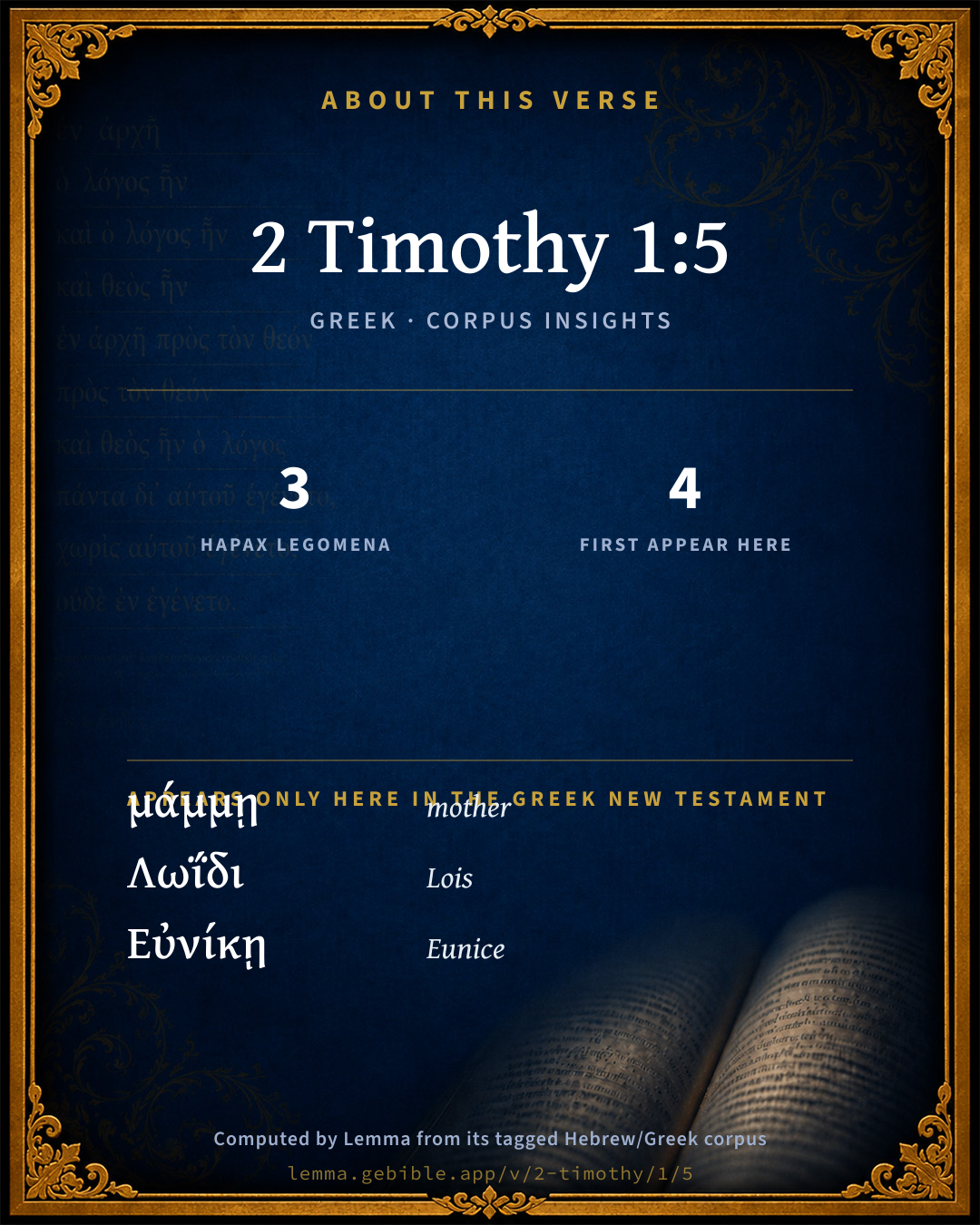
  • 3 hapax legomena — only here in the Greek New Testament
  • 4 first appearances in the Greek New Testament
Full analysis ↓
Download a study sheet

One document with this verse’s original text, its word-by-word gloss line, the meaning frame, cross-references with their text, attributed commentary, and full source and license credits — printable, and it pastes into notes with its structure intact.

This verse Autodidact and up

Study sheet (.html) Plain text (.txt)

A passage Seminary Student

Up to 50 verses in one chapter. A passage sheet keeps up to 6 commentary sources and 12 cross-references per verse, in the order this page ranks them, and says so on the sheet whenever that leaves anything out. Ask for a single verse and you get the Autodidact verse sheet above.

Everything on this page stays free to read, with no account — the sheet is a download of what is already on screen, not access to it.

Want to remove ads? Support Godless Engineer
Compare translations 3

The same verse in 3 English versions, stacked beneath the original-language interlinear above. Click any original word for its lexicon entry.

Each is an independent rendering of the whole verse — the interlinear is not word-aligned to these translations.

Highlighted words mark where these versions differ — a whole-verse word diff, not a word-by-word alignment.

  • World English Bible Public Domain
    having been reminded of the unfeigned faith that is in you; which lived first in your grandmother Lois, and your mother Eunice, and, I am persuaded, in you also.
  • King James Version Public Domain
    When I call to remembrance the unfeigned faith that is in thee, which dwelt first in thy grandmother Lois, and thy mother Eunice; and I am persuaded that in thee also.
  • unfoldingWord Literal Text CC BY-SA 4.0
    having received remembrance of the sincere faith in you, which dwelled first in your grandmother Lois and your mother Eunice, and I am persuaded that also in you.

unfoldingWord Literal Text — © unfoldingWord, licensed CC BY-SA 4.0. Word-aligned USFM3 via Door43 (git.door43.org/unfoldingWord/en_ult).

Versions to compare (up to 4)

3 of 4 selected

Show all 19 translations

Every available English version of this verse, each an independent rendering of the whole verse.

  • World English Bible Public Domain
    having been reminded of the unfeigned faith that is in you; which lived first in your grandmother Lois, and your mother Eunice, and, I am persuaded, in you also.
  • Berean Standard Bible Public Domain
    I am reminded of your sincere faith, which first dwelt in your grandmother Lois and your mother Eunice, and I am convinced is in you as well.
  • Majority Standard Bible Public Domain
    I am reminded of your sincere faith, which first dwelt in your grandmother Lois and your mother Eunice, and I am convinced is in you as well.
  • King James Version Public Domain
    When I call to remembrance the unfeigned faith that is in thee, which dwelt first in thy grandmother Lois, and thy mother Eunice; and I am persuaded that in thee also.
  • American Standard Version (1901) Public Domain
    having been reminded of the unfeigned faith that is in thee; which dwelt first in thy grandmother Lois, and thy mother Eunice; and, I am persuaded, in thee also.
  • Revised Version (1885) Public Domain
    having been reminded of the unfeigned faith that is in thee; which dwelt first in thy grandmother Lois, and thy mother Eunice; and, I am persuaded, in thee also.
  • Geneva Bible (1599) Public Domain
    When I call to remembrance the vnfained faith that is in thee, which dwelt first in thy grandmother Lois, and in thy mother Eunice, and am assured that it dwelleth in thee also.
  • Douay-Rheims (1899) Public Domain
    Calling to mind that faith which is in thee unfeigned, which also dwelt first in thy grandmother Lois, and in thy mother Eunice, and I am certain that in thee also.
  • Young's Literal Translation Public Domain
    taking remembrance of the unfeigned faith that is in thee, that dwelt first in thy grandmother Lois, and thy mother Eunice, and I am persuaded that also in thee.
  • Literal Standard Version CC BY-SA 4.0
    taking remembrance of the unhypocritical faith that is in you, that first dwelt in your grandmother Lois, and your mother Eunice, and I am persuaded that also in you.
  • Unlocked Literal Bible CC BY-SA 4.0
    I have been reminded of your genuine faith, which lived first in your grandmother Lois and your mother Eunice, and I am convinced that it lives in you also.
  • unfoldingWord Literal Text CC BY-SA 4.0
    having received remembrance of the sincere faith in you, which dwelled first in your grandmother Lois and your mother Eunice, and I am persuaded that also in you.
  • Darby Bible Public Domain
    calling to mind the unfeigned faith which [has been] in thee, which dwelt first in thy grandmother Lois, and in thy mother Eunice, and I am persuaded that in thee also.
  • World Messianic Bible Public Domain
    having been reminded of the sincere faith that is in you, which lived first in your grandmother Lois and your mother Eunice and, I am persuaded, in you also.
  • Webster's Bible Public Domain
    When I call to remembrance the unfeigned faith that is in thee, which dwelt first in thy grandmother Lois, and thy mother Eunice; and I am persuaded that in thee also.
  • Free Bible Version CC BY-SA 4.0
    I keep in mind your sincere trust in God, the same trust that your grandmother Lois and mother Eunice also had—and I know that same trust continues in you.
  • Bible in Basic English Public Domain
    Having in mind your true faith, which first was in your mother's mother Lois, and in your mother Eunice, and, I am certain, is now in you.
  • Text-Critical English NT CC BY 4.0
    I am reminded of the sincere faith that is in yoʋ, which dwelt first in yoʋr grandmother Lois and in yoʋr mother Eunice, and now, I am sure, dwells in yoʋ also.
  • Tyndale New Testament (1534) Public Domain
    when I call to remembraunce the vnfayned fayth that is in the which dwelt fyrst in thy graumoder Lois and in thy mother Eunica: and am assured that it dwelleth in the also.

Literal Standard Version (2020), Covenant Press — licensed CC BY-SA 4.0. Text via the HelloAO Bible API (eBible.org). Unlocked Literal Bible (unfoldingWord) — licensed CC BY-SA 4.0. Text via the HelloAO Bible API (eBible.org). unfoldingWord Literal Text — © unfoldingWord, licensed CC BY-SA 4.0. Word-aligned USFM3 via Door43 (git.door43.org/unfoldingWord/en_ult). Free Bible Version, Dr. Jonathan Gallagher — licensed CC BY-SA 4.0. Text via the HelloAO Bible API (eBible.org).

Word by word

More ways to search: Search by grammar → Find every occurrence → Compare this word →

Practice this passage: Drill this verse → Learn its vocabulary →

μάμμῃ
mámmē
G3125
“mother”
Noun, Dative, Singular, Feminine
Part of Speech
Noun
Case
Dative
Number
Singular
Gender
Feminine
Full Thayer's Definition

Origin: "of natural origin ["mammy"]"

TDNT: None

1. mother (the name infants use in addressing their mother) 2. grandmother
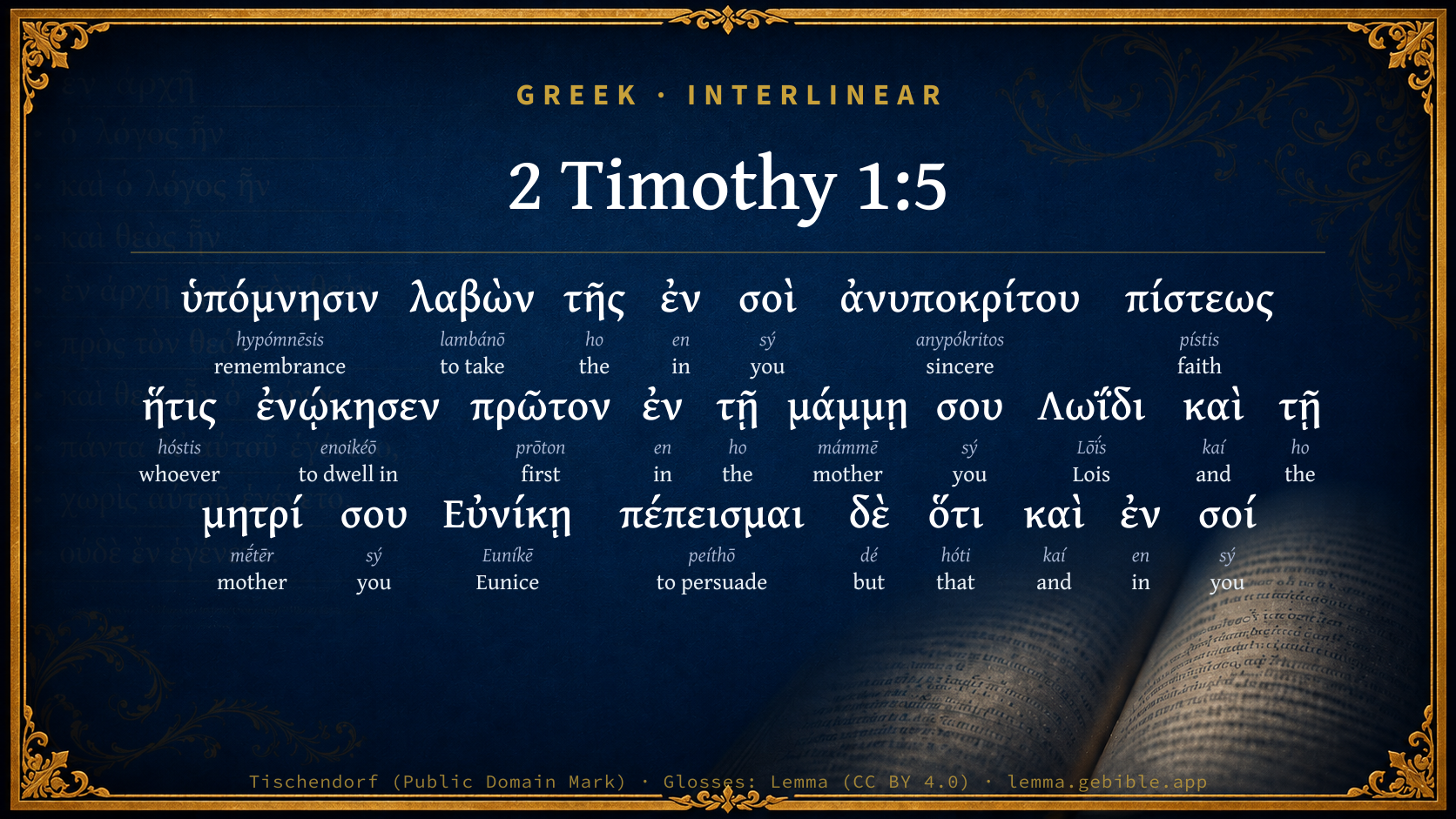
  1. ὑπόμνησιν hypómnēsis G5280 “remembrance” Noun, Accusative, Singular, Feminine
  2. λαβὼν lambánō G2983 “to take” Verb, Aorist, Active, Participle, Nominative, Singular, Masculine
  3. τῆς ho G3588 “the” Article, Genitive, Singular, Feminine
  4. ἐν en G1722 “in” Preposition
  5. σοὶ sý G4771 “you” Personal pronoun, 2nd person, Dative, Singular
  6. ἀνυποκρίτου anypókritos G505 “sincere” Adjective, Genitive, Singular, Feminine
  7. πίστεως pístis G4102 “faith” Noun, Genitive, Singular, Feminine
  8. ἥτις hóstis G3748 “whoever” Relative pronoun, Nominative, Singular, Feminine
  9. ἐνῴκησεν enoikéō G1774 “to dwell in” Verb, Aorist, Active, Indicative, 3rd person, Singular
  10. πρῶτον prōton G4412 “first” Adverb, Superlative
  11. ἐν en G1722 “in” Preposition
  12. τῇ ho G3588 “the” Article, Dative, Singular, Feminine
  13. σου sý G4771 “you” Personal pronoun, 2nd person, Genitive, Singular
  14. Λωΐδι Lōḯs G3090 “Lois” Noun, Dative, Singular, Feminine
  15. καὶ kaí G2532 “and” Conjunction
  16. τῇ ho G3588 “the” Article, Dative, Singular, Feminine
  17. μητρί mḗtēr G3384 “mother” Noun, Dative, Singular, Feminine
  18. σου sý G4771 “you” Personal pronoun, 2nd person, Genitive, Singular
  19. Εὐνίκῃ Euníkē G2131 “Eunice” Noun, Dative, Singular, Feminine
  20. πέπεισμαι peíthō G3982 “to persuade” Verb, Perfect, Passive, Indicative, 1st person, Singular
  21. δὲ dé G1161 “but” Conjunction
  22. ὅτι hóti G3754 “that” Conjunction
  23. καὶ kaí G2532 “and” Conjunction
  24. ἐν en G1722 “in” Preposition
  25. σοί sý G4771 “you” Personal pronoun, 2nd person, Dative, Singular

About this verse

These counts appear in no published source. They are computed here, from the morphology-tagged text and Lemma’s own curated glosses. What Lemma adds →

26
words
18
distinct lemmas
Pauline Epistles
section

Notable vocabulary

3 hapax legomena — words that appear only here in the entire Greek New Testament:

First appearance in Scripture

These words make their first canonical appearance in the Greek New Testament here:

  • ὑπόμνησιν remembrance G5280
  • μάμμῃ mother G3125
  • Λωΐδι Lois G3090
  • Εὐνίκῃ Eunice G2131

Shared distinctive vocabulary

ὑπόμνησιν remembrance G5280 occurs in 3 verses of the Greek New Testament. Also found in:
Repetition

Words recur within this verse:

Cross-references

25

Topical passages linked to 2 Timothy 1:5 in the Treasury of Scripture Knowledge — connected by theme and wording, ordered by reader-vote popularity; previews shown in the World English Bible.

  • 1 Timothy 1:5 but the end of the charge is love, out of a pure heart and a good conscience and unfeigned faith;
  • Acts 16:1 He came to Derbe and Lystra: and behold, a certain disciple was there, named Timothy, the son of a Jewess who believed; but his father was a Greek.
  • 2 Timothy 3:15 From infancy, you have known the sacred writings which are able to make you wise for salvation through faith, which is in Christ Jesus.
  • 1 Timothy 4:6 If you instruct the brothers of these things, you will be a good servant of Christ Jesus, nourished in the words of the faith, and of the good doctrine which you have followed.
  • Romans 15:14 I myself am also persuaded about you, my brothers, that you yourselves are full of goodness, filled with all knowledge, able also to admonish others.
  • 2 Corinthians 6:6 in pureness, in knowledge, in patience, in kindness, in the Holy Spirit, in sincere love,
  • 2 Timothy 1:12 For this cause I suffer also these things. Yet I am not ashamed, for I know him whom I have believed, and I am persuaded that he is able to guard that which I have committed to him against that day.
  • Psalms 86:16 Turn to me, and have mercy on me! Give your strength to your servant. Save the son of your handmaid.
  • Psalms 116:16 Yahweh, truly I am your servant. I am your servant, the son of your handmaid. You have freed me from my chains.
  • Romans 4:21 and being fully assured that what he had promised, he was able also to perform.
  • Romans 8:38 For I am persuaded, that neither death, nor life, nor angels, nor principalities, nor things present, nor things to come, nor powers,
  • Hebrews 6:9 But, beloved, we are persuaded of better things for you, and things that accompany salvation, even though we speak like this.
  • Psalms 17:1 Hear, Yahweh, my righteous plea; Give ear to my prayer, that doesn't go out of deceitful lips.
  • Psalms 18:44 As soon as they hear of me they shall obey me. The foreigners shall submit themselves to me.
  • Psalms 22:10 I was thrown on you from my mother's womb. You are my God since my mother bore me.
  • Psalms 66:3 Tell God, "How awesome are your deeds! Through the greatness of your power, your enemies submit themselves to you.
  • Psalms 77:6 I remember my song in the night. I consider in my own heart; My spirit diligently inquires:
  • Psalms 81:15 The haters of Yahweh would cringe before him, And their punishment would last forever.
  • Jeremiah 3:10 Yet for all this her treacherous sister Judah has not returned to me with her whole heart, but only in pretense, says Yahweh.
  • John 1:47 Jesus saw Nathanael coming to him, and said about him, "Behold, an Israelite indeed, in whom is no deceit!"
  • Acts 26:26 For the king knows of these things, to whom also I speak freely. For I am persuaded that none of these things is hidden from him, for this has not been done in a corner.
  • Romans 14:5 One man esteems one day as more important. Another esteems every day alike. Let each man be fully assured in his own mind.
  • Romans 14:14 I know, and am persuaded in the Lord Jesus, that nothing is unclean of itself; except that to him who considers anything to be unclean, to him it is unclean.
  • Hebrews 11:13 These all died in faith, not having received the promises, but having seen them and embraced them from afar, and having confessed that they were strangers and pilgrims on the earth.
  • 1 Peter 1:22 Seeing you have purified your souls in your obedience to the truth through the Spirit in sincere brotherly affection, love one another from the heart fervently:

Cross-references courtesy of OpenBible.info (CC BY 4.0).

Commentary

Notes on 2 Timothy 1:5 from classic Christian and Jewish commentators (each source and its license shown beneath its notes). The classic Christian expositions comment on the surrounding passage and are grouped to its opening verse, so a note may address several verses; the Jewish commentaries on the Tanakh (Rashi and others) are per-verse, so they appear only where the commentator wrote on this verse.

Lemma curates 59 commentaries, every one of them public domain or Creative Commons licensed, each selected and text-cleaned for this edition rather than reprinted as found. About our sources →

The Cambridge Bible for Schools and Colleges

gen. ed. J. J. S. Perowne

5. remembrance] The noun occurs only 2Pe_1:13; 2Pe_3:1, besides in N. T.; the verb Tit_3:1, where see note, 2Pe_1:12, &c.

the unfeigned faith that is in thee] ‘Unfeigned,’ ‘true and trusty.’ Contrasted with that of Phygelus and Hermogenes and Demas, 2Ti_1:15, 2Ti_4:9. The word is applied to ‘love,’ Rom_12:9, and to ‘wisdom,’ Jas_3:17. It has been used with ‘faith,’ 1Ti_1:5.

which dwelt first] The pronoun may be rendered a faith such as, ‘the which faith,’ as it is rendered 1Ti_1:4. Cf. also 1Ti_3:15. ‘Dwell in,’ the verb, is used (in quotation) in 2Co_6:16 of the indwelling of the Almighty, in Rom_8:11, 2Ti_1:14 of the indwelling of the Holy Spirit, in Col_3:16 of the indwelling of ‘the word of Christ,’ the nearest passage to this; where however Bp Lightfoot explains it of ‘the presence of Christ in the heart as an inward monitor’; as Dr Westcott explains 1Jn_2:14 ‘ye are strong and the word (of God) abideth in you,’ ‘the natural endowment of energetic vigour is consecrated to a divine end by a divine voice.’ Here too, then, ‘faith’ is personified. Like ‘Heavenly Wisdom’ she ‘dwelt in’ these pious Jewesses from the first, in their early hold of the promises made to Israel, before ‘the glad news’ of Jesus Christ the ‘glory of his people Israel.’ Then, in a larger room, a clearer light within them, the Faith of their fathers in a pure conscience was ‘transfigured’ into the Unclouded Faith of Christ Jesus their Saviour and dwelt within them, and the light and love from that pure presence there passed over into the breast of son and grandson.

thy grandmother Lois] The non-Attic word is used. Eunice is referred to Act_16:1 as ‘a Jewess which believed.’

and I am persuaded that in thee also] A.V. following the Greek idiom of ellipse; R.V. ‘and, I am persuaded, in thee also,’ following the English idiom of ellipse.

Prof. Reynolds quotes here ‘the celebrated mothers of Augustine, of Chrysostom, of Basil, whose life sincerity and constancy became vicariously a glorious heritage of the universal Church.’ We may add the mother of the Wesleys.

The Cambridge Bible for Schools and Colleges (gen. ed. J. J. S. Perowne; Cambridge University Press, 1878–1918) — public domain. Text from a community e-Sword module.

Albert Barnes' Notes on the Bible

When I call to remembrance the unfeigned faith that is in thee; - notes, 1Ti 1:5. On the faith of Timothy, see the notes at 1Ti 4:6.

Which dwelt first in thy grandmother Lois - That is, the same faith dwelt in her; or, she was a sincere believer in Christ. It would seem probable, from this, that she was the first of the family who had been converted. In the Acts of the Apostles Act 16:1, we have an account of the family of Timothy: - “Then came he to Derbe and Lystra; and behold a certain disciple was there, named Timotheus, the son of a certain woman which was a Jewess, and believed; but his father was a Greek.” In this account no mention is made of the grandmother Lois, but there is no improbability in supposing that Paul was better acquainted with the family than Luke. There is, at any rate, no contradiction between the two accounts; but the one confirms the other, and the “undesigned coincidence” furnishes an argument for the authenticity of both. See Paley’s Horae Paulinae, in loc. As the mother of Timothy was a Hebrew, it is clear that his grandmother was also. Nothing more is known of her than is mentioned here.

And in thy mother Eunice - In Act 16:1, it is said that the mother of Timothy was “a Jewess, and believed;” but her name is not mentioned. This shows that Paul was acquainted with the family, and that the statement in the Epistle to Timothy was not forged from the account in the Acts . Here is another “undesigned coincidence.” In the history in the Acts , nothing is said of the father, except that he was “a Greek,” but it is implied that he was not a believer. In the Epistle before us, nothing whatever is said of him. But the piety of his mother alone is commended, and it is fairly implied that his father was not a believer. This is one of those coincidences on which Paley has constructed his beautiful argument in the Horae Paulinae in favor of the genuineness of the New Testament.

Albert Barnes' Notes on the Bible (1834–1885) — public domain. Text from a community e-Sword/MySword module.

The Biblical Illustrator

Joseph S. Exell

2Ti_1:5

When I call to remembrance [R.., having been reminded of] the unfeigned faith that is in thee.

Unfeigned faith

Some recorded circumstance, some spoken words, some searching test, had convinced St. Paul that Timothy at the present time was shedding no womanish tears, that his faith had revealed its strength and reality. If put to a severe strain there was now no mistake about it. His faith was not a mask of unbelief, not a mere species of personal affection for the apostle, nor was it an unpractical faith, or one dependent on circumstances. St. Paul may once have entertained some transient doubt about Timothy. His fears may have exaggerated to himself the significance of Timothys excessive grief. The words of despair wrung from his lips at their parting may have distressed the apostle; but now the ugly suspicion is suppressed and no longer haunts his nightly intercession. (H. R. Reynolds, D. D.)

Unfeigned faith practical

A lady and gentleman were being shown over the Mint by the Master of the Mint, who took them from the gate where the rough gold came in until they saw it going out in the form of coins to the bank for distribution all over the country. When they were in the melting-room, the Master said, Do you see that pail of liquid? Yes. If you dip your hand into it I will pour a ladleful of molten gold into your hand, and it will roll off it without hurting you. Oh! was the remark somewhat sceptically made. Do you not believe me? inquired the Master. Well; yes, I do, replied the gentleman. Hold out your hand, then. When he saw the boiling gold above his hand, ready to be poured out, the gentleman took a step back, and, in terror, put his hand behind his back. The lady, however, stooped down, dipped her hand into the liquid, and holding it out, said, Pour it into my hand. She really believed, and could trust, but her friend had not the practical faith to enable him to trust. (J. Campbell White.)

Timothys faith

I. The peculiar excellence for which Timothy 1s here commended--Unfeigned faith. St. Paul goes to the root of all that was excellent in Timothy--namely, his faith. Not but that he could at other times dwell with pleasure on the fruits of that faith; especially when speaking of him to others. A beautiful specimen we have in Php_2:19-22. But in writing to Timothy himself, he thinks it most profitable to insist upon the source of that excellent character--his faith.

II. The instrumental cause to which the faith of Timothy is here ascribed--namely, the previous faith of his pious mother, Eunice, and of his grandmother, Lois. The only effectual cause to which unfeigned faith can be ascribed, is the grace of Christ and His Spirit. Nevertheless, in conferring this precious gift, the Lord frequently works by instruments or means. The case of these excellent women, then, may lead us to observe the special honour conferred on the weaker sex, in their being often made--

1. Foremost in faith and piety. Man fell by the womans transgression; but it is by the seed of the woman that he is redeemed. The first convert in Europe was a woman--Lydia. In every period of the history of the Church women have been more open to conviction, more simple believers in Christ, more devoted in their zeal for His cause, than others.

2. Foremost in spiritual usefulness. Such they were in the case before us. Now this remarkable succession of piety, 1.n three generations of the same family, was a blessing from God, in honour of female faith--unfeigned faith. Them that honour Me, saith God, I will honour. (J. Jowett, M. A.)

The worth of faith

All other graces do still accompany it. Where it is they all be. Faith may be compared to a prince which, wheresoever he pitcheth his tents, hath many rich attendants (1Co_13:1-13. ult.), as love, hope, zeal, patience, etc. Faith expelleth infidelity out of the heart, as heat doth cold, wind, smoke, for they he contraries. It cannot, nor will not, admit of so bad a neighbour; it shoulders out all unprofitable guests (Act_15:9; Heb_4:2). And besides this, faith makes our actions acceptable to God; for without it it is impossible to please God: this is that true fire which cometh down from heaven and seasons all our sacrifices (Heb_2:6; Rom_14:1-23. ult.). What, then, are they worthy of, that neither respect it in themselves nor others; many have no care to plant this flower in the garden of their hearts; or, if they have it, to preserve it from perishing. Jonah mourned that his gourd withered, yet we grieve not if faith be destroyed. (J. Barlow, D. D.)

Faith the chief thing

The world cries, Whats a man without money? but I say, Whats a man without faith? For no faith, no soul quickened; heart purified, sin pardoned; bond cancelled, quittance received; or any person justified, saved. (J. Barlow, D. D.)

Get faith

I say that to all, which I do to one, get faith, keep faith, and increase your faith. A mite of this grain is worth a million of gold; a stalk of this faith, a standing tree of earthly fruits; a soul freighted and filled with this treasure, all the coffers of silver in the whole world. What can I more say? The least true faith is of more value than large domains, stately buildings, and ten thousand rivers of oil. If the mountains were pearl, the huge rocks precious stones, and the whole globe a shining chrysolite; yet faith, as much as the least drop of water, grain of sand, or smallest mustard-seed, is more worth than all. This will swim with his master; hold up his drooping head, and land him safe at the shore, against all winds and weather, storms and tempests; strive then for this freight; for the time and tide thereof serveth but once, and not for ever. (J. Barlow, D. D.)

Faith works like effects in divers subjects

The grandmother, the mother, and the mothers son, had the same faith; and the like fruits proceeded from them, else Paul would never have called it unfeigned, or said that it dwelt in them, or given them all three one and the same testimony. All three had faith, and unfeigned faith. For the likeness of actions were in them, and proceed from them, by the which it was called unfeigned, and equally appropriated to each particular person. And it is an undoubted position that faith produceth the like effects in all Gods children; in truth, it must be understood, not in degree. For as faith increaseth, the effects are bettered. Many lanterns, with several candles, will all give light; but in proportion to their adverse degrees and quantities. Every piece hath his report, but according to the bigness, and, each instrument will sound, but variously as they be in proportion, and that for these reasons. Because faith differs not in kind, but in degree, and like causes produce like effects. Every bell hath its sound, each tone its weight, and several plants, their diverse influences; yet not in the same measure, though they may vary in kind. Again, faith is diffused into subjects, though several, yet they are the same in nature and consist of like principles. Fire, put into straw, will either smoke or burn, let the bundles be a thousand; life in the body will have motion, though not in the same degree and measure; and reason in every man acteth, but not so exquisitely. The constitution may not be alike, therefore a difference may be in operation natural, and also from the same ground, in acts spiritual. A dark horn in the lantern dims the light somewhat, (J. Barlow, D. D.)

Unfeigned faith manifested

From this point we may learn how to judge of the faith in our times which so many boast of; they cry, Have not we faith? do riot we believe as well as the best? But where be the fruits of faith unfeigned? hast thou an humble and purging heart? dost thou call upon God at all times, tarry His leisure, and rely upon His promise? art thou bold and resolute for good causes? canst thou resist Satan? cleave to God, and shun the appearances of evil? will neither poverty oppress thee by despair, or prosperity by presumption? Why, it is well, and we believe, that faith is to be found in thee, but if not, thou hast it not rooted in thee. For the tree is known by the fruit. Will not the flower smell? the candle give light? and the fire heat? and shall true faith be without her effects? Boast not too much, lest thou deceive thyself, taking the shadow for the body; and that which is not for that which should be. (J. Barlow, D. D.)

Which dwelt first in thy grandmother Lois, and thy mother Eunice.

Lois and Eunice

Origen conjectured that Lois and Eunice were relatives of St. Paul. This is only conjecture. There is far more reason for believing that they were converts made by him on his first visit to Lystra. In the Jewish communities of these Asiatic towns there were elect souls who had begun to cherish larger hopes for humanity. If Lois had permitted her daughter to marry a Greek, and yet had retained her faith in the promises made to Israel, and if Eunice had so far yielded to her husbands views or habits as to have foregone for her only son the sacramental rite of admission to the Jewish nation, and yet, notwithstanding this, had diligently instructed him in the history and contents of Holy Scriptures (2Ti_3:15). We have a glimpse of light thrown upon the synagogues and homes of devout Israelites in Asia Minor. (H. R. Reynolds, D. D.)

Lois

is the same with the more familiar Lois; Eunice is an equivalent of the Latin Victoria. (H. D. M. Spence, M. A.)

The day of Christian faith

Christian faith in its morning (Timothy), at noon (Eunice), and at the evening of life (Lois). (Dr. Van Oosterzee.)

Celebrated mothers

Like the celebrated mothers of Augustine, of Chrysostom, of Basil, and of other illustrious saints of God, the life, sincerity and constancy of Lois and Eunice became vicariously a glorious heritage of the universal Church. (H. R. Reynolds, D. D.)

Lessons

1. The infidelity of the father prevents not faith in the children. For if it had, Eunice and Timothy and many more should never have been found faithful (1Ki_14:13; 1Co_7:14).

2. Succession of faith is the best succession.

3. Where we see signs of goodness, we are to judge the best.

4. When we give others instruction, we are first to possess them with the per suasion of our affection. For then they will take it in good part, and our words will have the deeper impression. (J. Barlow, D. D.)

Memories of a mother

Among the reminiscences of a great statesman, Daniel Webster, it is related that on one occasion a public reception was given him in Boston. Thousands of his countrys citizens crowded together and paid him homage. Bursts of applause had been sounding all day in his ears. Elegantly dressed ladies had thrown bouquets of the rarest flowers at his feet. But as he ascended the stops leading to his mansion, crowned with the honours of the gala day, a little, timid girl stepped up and placed a bunch of old-fashioned garden pinks in his hand. At sight of these old, familiar flowers, and their well-remembered fragrance filled the air, the old memories were stirred. Just such pinks used to grow in his mothers garden when he was a child. Instantly that sweet face of the loved mother came to his vision; her tender, gentle voice sounded once more in his ears. So overcome was he with the tide of old memories that crowded into his heart that he excused himself, and went to his apartments alone. Nothing, said he, in all my life affected me like that little incident. John Newton in his worst days could never forget his mother, at whose knees he had learned to pray, but who was taken to heaven when he was but eight years old. My mothers God, the God of mercy, have mercy upon me! was often his agonising prayer in danger, and we all know how it was answered. (Great Thoughts.)

Mothers influence

If we call him great who planned the Cathedral of St. Peter, with all its massiveness and beauty; if they call the old masters great whose paintings hang on monastery and chapel walls, is not she (the mother) great who is building up characters for the service of God, who is painting on the soul canvas the beauty and strength of Jesus the Christ? (A. E. Kittredge.)

Christian mothers

Give me a generation of Christian mothers and I will under take to change the whole face of society in twelve months. (Lord Shaftesbury.)

Womans influence

A missionary in Ceylon writes as a noticeable fact that where Christian women are married to heathen husbands, generally the influence in the household is Christian; whereas, when a Christian man takes a heathen woman he usually loses his Christian character, and the influences of the household are on the side of heathenism.

Parental example

We may read in the fable what the mother crab said to the daughter: Go forward, my daughter, go forward. The daughter replied, Good mother, do you show me the way? Whereupon the mother, crawling backward and sidling, as she was wont, the daughter cried out, So, mother! I go just as you do. (Family Churchman.)

Mother and child

Sir Walter Scotts mother was a superior woman, and a great lover of poetry and painting. Byrons mother was proud, ill-tempered, and violent. The mother of Napoleon Buonaparte was noted for her beauty and energy. Lord Bacons mother was a woman of superior mind and deep piety. The mother of Nero was a murderess. The mother of Washington was pious, pure, and true. The mother of Matthew Henry was marked by her superior conversational powers. The mother of John Wesley was remarkable for her intelligence, piety, and executive ability, so that she has been called the Mother of Methodism. It will be observed that in each of these examples the child inherited the prominent traits of the mother. (J. L. Nye.)

Mothers influence

It was at my mothers knees, he says, that I first learned to pray; that I learned to form a reverence for the Bible as the inspired word of God; that I learned the peculiarities of the Scottish religion; that I learned my regard to the principles of civil and religious liberty, which have made me hate oppression and--whether it be a pope, or a prelate, or an ecclesiastical demagogue--resist the oppressor. (T. Guthrie, D. D.)

Children to be taught young

First, for then they will remember it when they are old (Pro_23:13). Dye cloth in the wool, not in the web, and the colour will be the better, the more durable. Secondly, to defer this duty is dangerous, for thou mayst be took from them. Who then shall teach them after thy departure? (2Ki_2:24). Thirdly, besides, what if they come to faith? Will it not be with the more difficulty? Fallow ground must have the stronger team, great trees will not easily bend, and a bad habit is not easily left and better come by. If their memories be stuffed with vanity as a table-book, the old must be washed out before new can be written in. Fourthly, what shall I more say? God works strangely in children, and rare things have been found in them; and what a comfort will it be for parents in their life, to hear their children speak of good things, and at the last day, when they can say to Christ, Here am I, and the children Thou hast given me! (J. Barlow, D. D.)

The secret of a good mothers influence

Some one asked a mother whose children had turned out very well, what was the secret by which she prepared them for usefulness and for the Christian life, and she said, This was the secret. When in the morning I washed my children, I prayed that they might be washed in the fountain of a Saviours mercy. When I put on their garments, I prayed that they might be arrayed in the robe of a Saviours righteousness. When I gave them food, I prayed that they might be fed with manna from heaven. When I started them on the road to school I prayed that their faith might be as the shining light, brighter and brighter to the perfect day. When I put them to sleep, I prayed that they might be enfolded in the Saviours arms. (T. De Witt Talmage.)

Training the young

Rightly to train a single youth is a greater exploit than the taking of Troy. (Melancthon.)

A good grandmother

I owe a great deal to nay grandmother, said a young man who was courageous and true above many in his Christian life. Why, what did she do for you? Oh, she just sat by the fire. Did she knit? A little. Did she talk to you? A little; but grannie was not much of a talker; she did not go in for all that, you know; but she just sat and looked comfortable, and when we were good she smiled, and when we were wild in our talk she smiled too, but if ever we were mean she sighed. We all loved her, and nobody did as much for us, really, as grannie. (Marianne Farningham.)

A godly household

A household that fears God is another joy of my life. I would rather see it than the finest landscape. I can understand why Sir Walter Scott got his seat put down in his garden, within earshot of his bailiffs cottage, that he might always hear the sound of the psalms at morning and evening worship. There never was incense sweeter from morning or evening sacrifice! A home, where the father and mother walk in the narrow way, is pretty sure to find their children accompany ing them. Not that Gods gifts are hereditary, but example goes a great way, and if the parent, who is the highest on earth to the child, live a Christian life, it is very seldom the child Will not follow him. It depends on the parent. If the mother, or father, or both, be real Christians, gentle, kind, reverent, pure, the little ones grow accustomed to these graces and catch them almost unconsciously.

Suppressed lives

A few years ago a gentleman died in Germany whose name was almost unknown both in Great Britain and on the Continent. A physician by profession, and an inheritor of a title, he lived a life of comparative seclusion. He was never in the front at any pageant or ceremonial of any court. He was never known when treaties and alliances were made between reigning sovereigns. In diplomatic circles his name was never prominently mentioned. And yet no man of his time in all Europe had more influence in determining the destiny of nations than he. He was the power behind thrones. He was the intimate confidant of princes. He rendered the most important services to England and to Germany. His was one of those suppressed lives which are so often lives of commanding power. It was a suppressed life, expressed in kings, parliaments, and statesmen. Such lives are to be found in literary circles. It is often a matter of infinite surprise that such marvels of erudition and widest compass of reading in the domain of metaphysics, philosophy, theology, and ecclesiastical history, can be produced by a single man in the compass of so short a life as is given the world by many a German writer. But the secret is, that behind the life of the author, who may receive all the praise of the public, are scores of suppressed lives. These are the men of culture and training who are doing the toiling drudgery, wading through volumes, finding and verifying quotations. It is well known that in the business world these suppressed lives play a most important part. Many an employer is dependent upon the labours of faithful men, unknown to the world, who have mastered all the intricacies of a complex business, and upon whom they implicitly depend for advice in its management. St. Paul, after his somewhat depressing visit to Athens, found a home in the humble abode of Aquila and Priscilla, in the busy, sensual city of Corinth. In the house of this lowly artisan he found rest, refreshment, and strength. Working with him side by side, in the plebeian craft of tent-making, the great apostle to the Gentiles derived new zeal and energy for his great work from the life and conversation of this faithful disciple of Jesus Christ. In the same home the eloquent Alexandrian, Apollos, found shelter and instruction. In his life, full of eloquent thought and speech, and still more eloquent deeds, their suppressed lives found a brilliant and glorious expression. These two lives may justly stand for the lives of the great multitude of teachers in the Sunday Schools and other schools of our land. Suppressed lives mostly they are. Comparatively unrecognised is the influence these teachers are exerting upon the destinies of the millions of children intrusted to their care. In St. Pauls words to Timothy, as quoted in the text, we have the recognition of the power of suppressed lives in the charmed circle of the home. An ampler life has been opened to woman than heretofore in our day. The most thoroughgoing infidel cannot deny that Christianity above all other systems guards and glorifies the home; that it has given to the wife and the mother the unique and the peerless position they hold in the countries where the highest civilisation is enjoyed. This Bible before me loves to honour the home. Who can estimate the influence of the suppressed lives in these homes? In that obscure country rectory at Epworth lived the mother of the Wesleys. The husband was a dreamy, poetical, unpractical man. The household quiver was full and running over with children. She was the teacher of them all. John Wesley was taught by her the alphabet for the twentieth time, that in her own language, the nineteenth might not be in vain. She kept up with the classical studies of her boys until they went away from home to school and college. She managed her large family with the economy extolled by Poor Richard, with the discipline of West Point, and yet in the loving spirit of the home at Bethany. She was the constant counsellor of her once seemingly stupid but now most gifted son John, and the earnest defender if not initiator of the greatest ecclesiastical movement of our day--the coming to the front in every Christian enterprise of the laymen of the Church. She stood in her old age by the side of that son when, as the foremost religions leader of the centuries, he preached on Kensington common the memorable sermon to twenty thousand persons, and the slain of the Lord lay in windrows before him. The grey-haired, bent, and silent mother was speaking in the burning words and ringing tones of the great reformer. The mother of Washington lived and triumphed in the matchless deeds of the father of his country. (S. Fallows.)

The Biblical Illustrator, edited by Joseph S. Exell (c. 1880s–1900s) — public domain. Text from a community e-Sword module.

The Pulpit Commentary

Having been reminded of for when I call to remembrance, A.V; in thee for that in thee, A.V Unfeigned (ajnupokritou); as Timothy 1:5 (see also Rom_12:9; 2Co_6:6; 1 Peter. Jam_3:17) Having been reminded, etc. (see preceding note). Thy grandmother Lois. Mammh properly corresponds exactly to our word "mamma." In RAPC 4Ma 16:9, Ouj mammh klhqeisa makarisqhsomai, "I shall never be called a happy grandmother," and here (the only place where it is found in the New Testament) it has the sense of "grandmother." It is hardly a real word, and has no place in Stephens" "Thes.," except incidentally by comparison with pappa. It has, however, a classical usage. The proper word for a "grandmother" is thqh. Lois; a name not found elsewhere, possibly meaning "good," or "excellent," from the same root as lwiterov and lwistov. This and the following Eunice are examples of the frequent use of Greek or Latin names by Jews. Eunice, we know from Act_16:1, was a Jewess and a Christian, as it would seem her mother Lois was before her.

A holy ancestry.

grandmother Lois, and thy mother Eunice." We were constituted to be influenced through the family relationship, and it is sad indeed when the young break away from a religious ancestry, and forsake their fathers" God.

I HERE IS ALREADY A HISTORIC PEDIGREE OF CHRISTIAN PEOPLE. The gospel had been long enough in the world to have a history in families. We find three generations here. The grandmother Lois, the mother Eunice, and "thee also.

II HERE IS THE TRUE SPIRIT OF THE GOSPEL MANIFESTED. Unfeigned faith, or undissembled faith. No mere creed. No mere appearance of piety, in that age men of education despised the pagan faiths which they yet professed to believe. They kept up their actual adherence to heathen worship because of custom or family tradition, or because they believed religion in some sort to be the protective police of society, without which there would be revolution. This unfeigned faith was the faith of conviction the faith that so believed in the risen Christ that it could endure persecution and suffer loss, and live or die for the sake of Christ, with the sure hope of eternal life. W.M.S.

The Pulpit Commentary (1880–1919), ed. H.D.M. Spence-Jones & Joseph S. Exell — public domain. Text from a community e-Sword module.

Tyndale Open Study Notes

Tyndale Open Resources

1:5-14 Paul gently but firmly summons Timothy to Rome (see also 4:9, 21; cp. 1 Tim 1:3-11, 12-17). Suffering seemed certain if Timothy remained faithful, and Paul wanted to strengthen Timothy’s resolve. • The allusions to the Spirit in 2 Tim 1:6-7 and 1:14 form an inclusio (literary bookends) around this section.

1:5 On Timothy’s parentage, see Acts 16:1-3; 1 Tim 1:2. • Faith means Christian faith, but Timothy’s Jewish heritage through his grandmother and mother explains how he was rooted in Old Testament instruction (2 Tim 3:14-15). Their Christian faith was an example for him to follow.

Tyndale Open Study Notes — © Tyndale Open Resources, licensed CC BY-SA 4.0. Text via the HelloAO Bible API.

Bengel's Gnomon

Johann Albrecht Bengel

2Ti 1:5. Ὑπόμνησιν λαμβάνων, receiving a remembrance) [a reminiscence reminding me] Some external occasion, or a message from Timothy, had brought his faith to Paul’s remembrance [not as Engl. Vers. “When I call to remembrance”]. Ammonius says, “ἀνάμνησις is, when a man comes to the remembrance of things past—ὑπόμνησις, when they are suggested to him by another [whether person, or thing].—πίστεως, of faith) Among all the virtues of Timothy, faith is most to the purpose which Paul has in view.—ἐνῴκησε, dwelt in) This word conveys the idea of continuance [had its fixed dwelling in].—πρῶτον) first, perhaps before the birth of Timothy. So far the remembrance of Paul reaches. What the condition of the parents of Lois was, is not mentioned.—μάμμῃ, grandmother) The remembrance of the dead is pleasant to intimate friends, especially to those whose death is at hand, and to the posterity of the dead.—μητρὶ, mother) She had married a Greek.—Εὐνείκῃ, Eunice) That name is found in Hesiod’s Theogony. Lois seems to have been the mother of Eunice, and both were dead.

Bengel's Gnomon of the New Testament — English translation (T&T Clark, Edinburgh, 1860) — public domain. Text from a community e-Sword module.

Meyer's Critical & Exegetical Commentary

Heinrich August Wilhelm Meyer

2Ti_1:5. Ὑπόμνησιν λαβὼν τῆς κ.τ.λ.] This participial clause is to be taken neither with μωμνημένος nor with ἐπιποθῶν (de Wette, Leo); the sense forbids us to subordinate it to one of these ideas, and the want of the copula καί to co-ordinate it with them. Otto joins it with ἵνα χαρᾶς πληρωθῶ: that I may be filled with joy, as I (sc. by thy personal presence in Rome) receive a renewal of my remembrance of thy unfeigned faith. Against this construction, however, there are the following reasons:(1) That to supply by thy presence is not only arbitrary, but does not suit with the idea ὑπόμνησιν λαμβάνειν, since the impression made on us by anything before the eyes cannot be described as reminding us of that thing. (2) That, if the remembrance of Timothys constancy in the faith is so unceasing with the apostle that he thanks God for it, it is quite inconceivable how he could still wish to receive a ὑπόμνησις of it. (3) That we see ourselves forced by it to prefer the reading λαμβάνων (which Tisch. adopted) to λαβών.

The only remaining course is to connect ὑπομν. λαβ. with χάριν ἔχω τῷ Θεῷ (so Wiesinger, Plitt, and others). It does stand at some distance from it, but that cannot be considered a good reason against the construction. The construction in Php_1:3-5 is similar. Nor can we make objection that Paul according to this view would not thank God because Timothy stands in such faith, but because he has been brought to his recollection (Hofmann), for the participial clause does not give the reason of the thanksgiving directly, but only hints at it. It is the same here as at Eph_1:15 and Col_1:3, where, too, the subject of thanksgiving is not the ἀκούειν, but that which the apostle had heard.

ὑπόμνησιν λαβών is not equivalent to recordans, as I remember (de Wette: retaining the remembrance), for ὑπόμνησις in the N. T. (comp. 2Pe_1:13; 2Pe_3:1; also Sir_16:11; 2Ma_6:17) has an active signification; it is equivalent, therefore, to since I have received remembrance, i.e. since I have been reminded (Wiesinger, van Oosterzee, Hofmann). It is not said what had reminded the apostle of Timothys faith. Bengel supposes that it was externa quaedam occasio, or a nuntius a Timotheo; Wiesinger, that it was Onesimus. But it suits better with the context to regard the tears just mentioned as causing the recollection, inasmuch as they were to the apostle a proof of his unfeigned faith. It is unnecessary to derive the ὑπόμνησις from some inner working of the apostles soul (so formerly in this commentary); there is no hint of any such thing. The present λαμβάνων is not against this interpretation, since these tears came so vividly before the apostles soul that he was thereby reminded more and more of Timothys faith.

τῆς ἐν σοὶ ἀνυποκρίτου πίστεως] see 1Ti_1:5; this, now, is the subject of the thanksgiving.

As Paul is conscious that the God whom he serves was the God also of his ancestors, he can remind Timothy of the fact that the faith which dwells in him was before the possession of his grandmother and mother.[5]

ἥτις ἐνῴκησε πρῶτον] ἐνοικεῖν as in 2Ti_1:14; Rom_8:11; 2Co_6:16. The word is chosen here to denote faith on its objective side as a possession coming from God (Wiesinger), and it declares that it has not become a merely transient feeling, but an abiding principle of life dwelling in them (van Oosterzee).

ΠΡῶΤΟΝ is not, with Luther, to be translated by before, but to be taken in its proper meaning, in reference to the ΠΡΌΓΟΝΟΙ of Timothy. The point brought out is, that Timothy was not the first of his family to be a believer, but we cannot press the point so far as to suppose that a distinction is drawn between the apostle whose ancestors served God as Jews, while Timothys ancestors were heathen (so Hofmann).

ἘΝ Τῇ ΜΆΜΜῌ ΣΟΝ Κ.Τ.Λ.] Regarding ΜΆΜΜΗ, see Wahl on the passage.

This grandmother of Timothy is not mentioned elsewhere. Of the mother, it is said in Act_16:1 ff. that she was a ΓΥΝΉ ἸΟΥΔΑΊΑ ΠΙΣΤΉ; her name is given only here. The mention of the two is not to be regarded as a superfluousor even surprisingafterthought. Paul might repose in Timothy all the greater confidence, that he, brought up by a pious mother, had before him her example and that of his grandmother.

This confidence the apostle expresses still more definitely in the next words: ΠΈΠΕΙΣΜΑΙ ΔῈ, ὍΤΙ ΚΑῚ ἘΝ ΣΟΊ, with which Heydenreich wrongly supplies ἘΝΟΙΚΉΣΕΙ instead of ἘΝΟΙΚΕῖ.

[5] Since Timothys ἀνυπόκριτος πίστις is Christian faith, faith in Jesus Christ, it is manifestly wrong to regard the πίστις of the grandmother and mother as only faith in the O. T. promise (Otto); the relative ἥτις shows that the two are identical. From Pauls ascription to himself of a λατρεύειν ἀπὸ προγόνων, we cannot infer, with Otto, that the matter of faith on the part of Timothys πρόγονοι cannot be taken further than on the part of the apostles πρόγονοι. The apostle does not at all boast of the πίστις of his ancestors, but says merely that he serves the same God as they had served. Timothys faith could only mean something to him, if it was not only faith in the promise, but also faith in Him who had appeared according to the promise.

Meyer — Critical and Exegetical Commentary on the New Testament — English translation by Peter Christie, edited by Frederick Crombie (T&T Clark, 1880) — public domain. Text from a community e-Sword module.

Expositor's Greek Testament

ed. W. Robertson Nicoll

2Ti 1:5 . ὑπόμνησιν λαβών : Having been reminded . Not to be connected with the clause immediately preceding, as R.V.m. ὑπόμνησις , a reminder, i.e. , an act of recollection specially excited by a particular person or thing, thus differs from ἀνάμνησις , which is self-originated (so Ammonius Grammaticus, quoted by Bengel). Ell. compares for the thought Eph 1:15 . For this use of λαμβάνω , cf. Rom 7:8 ; Rom 7:11 ( ἀφορμὴν λ .), Heb 2:3 ( ἀρχὴν λ .), Heb 11:29 ; Heb 11:36 ( πεῖραν λ .), 2Pe 1:9 ( λήθην λ .). The fact that St. Paul received this reminder of Timothy’s faith suggests that there were other aspects of his conduct possibly as an administrator which were not wholly satisfactory. His unfeigned faith made up for much.

ἥτις ἐνῴκησεν κ . τ . λ .: ἐνοικέω is used in Rom 8:11 and 2Ti 1:14 of the indwelling of the Holy Spirit; and in Col 3:16 of the Word of Christ. In 2Co 6:16 , ἐνοικήσω is added in the quotation from Lev 26:12 to ἐνπεριπατήσω . Tisch. and W.H. read ἐνοικοῦσα for οἰκοῦσα in Rom 7:17 . Timothy’s faith was hereditary as St. Paul’s was. πρῶτον does not mean that Lois was the first of her family to have faith, but that it dwelt in her, to St. Paul’s knowledge, before it dwelt in Timothy. It is to be observed that it is implied that the faith of God’s people before Christ came is not different in kind from faith after Christ has come.

μάμμῃ : an infantile equivalent in early Greek for μήτηρ , is used in later Greek for τήθη , grandmother . It occurs, e.g. , in 4Ma 16:9 , οὐκ ὄψομαι ὑμῶν τέκνα , οὐδὲ μάμμη κληθεῖσα μακαρισθήσομαι . See also Moulton and Milligan, Expositor , vii., vii. 561.

Λωίδι : Since Timothy’s father was a Greek, and his mother a Jewess (Act 16:1 ), we may conclude that Lois was the mother of Eunice (see art. in Hastings’ D. B .).

Εὐνίκῃ : See art. in Hastings’ D. B. , where Lock notes that the curious reading of cursive 25 in Act 16:1 , υἱὸς γυναικός τινος Ἰουδαίας χήρας , and the substitution of χήρας for Ἰουδαίας in Gig., fuld [306] “may embody a tradition of her widowhood”.

[306]uld. Cod. Fuldensis

πέπεισμαι : The other examples of St. Paul’s use of this word (see reff.) give no support to the notion of Thdrt. (followed by Alf.) that πέπεισμαι here has the force of our I am sure, I am certain , when we wish to hint gently that we desire reassurance on the point about which we express our certainty. In all the places in which St. Paul uses πέπεισμαι he is anxious to leave no doubt as to his own certitude. Nevertheless, in this case, it was quite possible for him to be perfectly certain that unfeigned faith animated Timothy, and at the same time to have misgivings (2Ti 1:7 ) as to Timothy’s moral courage in dealing with men. We supply ἐνοικεῖ after σοί .

The Expositor's Greek Testament, edited by W. Robertson Nicoll (1897–1910) — public domain. Text from a community e-Sword module.

Cambridge Greek Testament for Schools and Colleges

5. λαβών. So א*ACG; the rec. text is λαμβάνων with אcD2EKL and the Latin versions.

5. ὑπόμνησιν λαβών, having been put in remembrance, lit., having received a ‘reminder.’ ὑπόμνησις (only again in 2Ma 6:17; 2Pe 1:13; 2Pe 3:1; but cp. ὑπομιμνήσκειν 2Ti 2:14; Tit 3:1) is an act of the memory prompted from without; and thus Bengel’s suggestion, that there is here an allusion to some news of Timothy which had recently reached St Paul whether by messenger or by letter, is not improbable.

τῆς ἐν σοὶ ἀνυποκρίτου πίστεως, of the unfeigned faith that is in thee. For ἐν σοί instead of σου cp. Rom 1:12, διὰ τῆς ἐν ἀλλήλοις πίστεως; for ἀνυπόκριτος see on 1Ti 1:5.

ἥτις. see on 1Ti 1:4.

πρῶτον ἐν τῇ μάμμῃ κ.τ.λ. πρῶτον simply means ‘before it dwelt in you.’ It is likely (though not explicitly stated) that Lois was Eunice’s mother. The latter is described in Act 16:1 as a believing Jewish woman, and as this was on St Paul’s second visit to Lystra it has been supposed that she accepted the gospel on the Apostle’s first visit to that place. After the word Ἰουδαίας (Act 16:1) one cursive MS. (25) adds χήρας, and this is confirmed by two or three Latin authorities; the tradition that Eunice was a widow at the time of Timothy’s circumcision (although thus slenderly attested) is interesting and falls in with the omission of any mention of Timothy’s father in St Paul’s letters. It also gives a new significance to the injunctions in 1Ti 5:4. But, however this may have been, the faith of both Lois and Eunice is here commended, and it was evidently to their pious care that Timothy owed his instruction in the Scriptures (2Ti 3:15). Whether Lois was a Christian or only a faithful Jewess we cannot tell. The word ͅμάμμη, ‘grandmother,’ only occurs again in the Greek Bible at 4Ma 16:9; the more correct Attic form being τήθη.

πέπεισμαι δὲ ὅτι καὶ ἐν σοί, and [not only so, but] I am persuaded [that it dwells] in thee also. We are not to press the adversative force of δέ, as if it meant ‘but, notwithstanding all appearances’; it simply connects the clause with what has gone before.

Cambridge Greek Testament for Schools and Colleges (Cambridge University Press, 1896; 21 vols, various authors incl. Carr, Maclear, Plummer, Farrar, Lumby, Moule, M. R. James, Simcox) — public domain. Text from a community e-Sword module.

International Critical Commentary

5. ὑπόμνησιν] properly of an external reminder, cf. 2 P 1:13, 3:1 and ὑπομίμνησκε, 2:14; but a comparison of Mar 14:72 ἀνεμνήσθη ὁ Πέτρος τὸ ῥῆμα with Luk 22:61 ὑπεμνήσθη ὁ Πέτρος τοὺ ῥήματος makes it doubtful whether the difference can be pressed in Hellenistic Greek; cf. Clem. Hom. i. 1, συνῆν γάρ μοι λογισμὸς . . . περὶ θανάτου πυκνὰς ποιούμενος ὑπομνήσεις: Marc. Aurel. vii. 27, x. 34.

ἥτις (not ἥ) gives partly the reason for ἀνυποκρίτου π., sincere, for it was inherited as well as personal. Timothy, like the writer (3), has a family religion behind him; cf. the appeal of Virtue to the young Heracles, ἐγὼ ἥκω πρός σε εἰδυῖα τοὺς γεννήσαντάς σε καὶ τὴν φύσιν τὴν σὴν ἐν τῇ παιδείᾳ καταμαθοῦσα, Xen. Mem. ii. 1; cf: I 2:8-15 note, p. 31. This does not necessarily imply that Lois and Eunice had become Christians, though it is probable. The language might have been used by St. Paul of religious Jewesses who had trained the young Timothy in the Jewish expectations of a Messiah, cf. 3:15.

πέπεισμαι] cf. 12, Rom 8:38, Rom 14:14, Rom 15:14. ἐνῴκησε “implies steady and persistent faith,” Hillard. It was always at home in their hearts; cf. 14.

6-2:13. Appeal to Timothy for greater effort, for courage to face danger and difficulty, and for loyalty to the Apostle’s doctrine. The appeal is based upon the reality of God’s power to strengthen him (7-10), the example of the Apostle (11, 12, 2:9, 10), and of Onesiphorus (15-18), the memory of the Risen Christ (2:8), and the sense that the doctrine is a sacred trust (13, 14, 2:1, 2). The key-notes of the section are δύναμις(7, 8. δυνατός 12, ἐνδυναμοῦ 2:1), ἐπαισχύνεσθαι (8, 12, 16), παραθήκη (12, 14, 2:2), συγκακοπαθεῖν (8, 2:3, 9), πίστις (loyalty to a loyal Master, 1:5, 12, 13, 2:2, 11, 13). There are many points of kinship in phrase and thought with the earlier letters, cf. Rom 1:16, Rom 1:8:15, 1Co 15:55, Eph 2:5-9, but none suggest conscious adaptation. The writer is perhaps feeling his way towards the request that Timothy will come to him at once to Rome. For that he will need courage, and he must leave faithful men in charge of his work at Ephesus.

International Critical Commentary — older volumes (1896–1929), various authors — public domain. Text from a community e-Sword module.

Vincent's Word Studies in the New Testament

Marvin R. Vincent

When I call to remembrance [υπομνησιν λαβων] . The object of carin ecw ver. 3. Lit. having received a reminding. The phrases N. T.. o. Upomnhsiv reminding (but sometimes intransitive, remembrance), only here, 2Pe 1:13; 2Pe 3:1. In LXX three times. As distinguished from ajnamnhsiv remembrance (1Co 11:24, 25) it signifies a reminding or being reminded by another; while ajnamnhsiv is a recalling by one's self.

Unfeigned faith that is in thee [της εν σοι ανυποκριτου πιστεως] . See on 1Ti 1:5. For the peculiar collocation of the Greek words, comp. Act 17:28; Rom 1:12; Eph 1:15. The writer's thought is probably not confined to Christian faith, but has in view the continuity of Judaism and Christianity. In verse 3 he speaks of serving God from his forefathers. In Act 24:14 Paul is represented as saying that even as a Christian he serves the God of his fathers, believing all things contained in the law and the prophets.

Dwelt [ενωκησεν] . Paul uses the verb with sin, the divine Spirit, God, the word of Christ, but nowhere with faith. The phrase faith dwells in, N. T. o. According to Paul, Christians are or stand in faith; but faith is not represented as dwelling in them. Christ dwells in the heart through faith (Eph 3:17).

First [πρωτον] . With reference to Timothy, and with a comparative sense, as Mt 5:24; Mt 7:5; Mr 3:27; 1Th 4:16, etc. This is shown by the last clause of the verse. The writer merely means that faith had already dwelt in Timothy's grandmother and mother before it did in him. How much farther back his believing ancestry went he does not say. Comp. Act 16:1.

Grandmother [μαμμη] . N. T. Once in LXX, 4 Macc. 16 9. Later Greek. The correct classical word is thqh. See Aristoph. Ach. 49; Plato, Repub. 461 D. From the emphasis upon Timothy's receiving his training from his Jewish mother, it has been inferred that his father died early. That he was the child of a mixed marriage appears from Act 16:1 I am persuaded [πεπεισμαι] . The verb in Pastorals only here and verse

2Ti 1:12Often in Paul.

Marvin R. Vincent, Word Studies in the New Testament (1887–1900) — public domain. Text from a community e-Sword/MySword module.

Jamieson, Fausset & Brown

Robert Jamieson, A. R. Fausset & David Brown

When I call to remembrance--This increased his "desire to see" Timothy. The oldest manuscripts read, "When I called to remembrance"; implying that some recent incident (perhaps the contrasted cowardice of the hypocrite Demas, who forsook him) had reminded him of the sincerity of Timothy's faith.

faith that is in thee--ALFORD translates, "that was in thee." He remembers Timothy's faith in the past as a fact; its present existence in him is only matter of his confident persuasion or hope.

which--Greek, "such as."

dwelt--"made its dwelling" or abode (Joh 14:23). The past tense implies they were now dead.

first--before it dwelt in thee. She was the furthest back of the progenitors of Timothy whom Paul knew.

mother Eunice--a believing Jewess; but his father was a Greek, that is, a heathen (Act 16:1). The faith of the one parent sanctified the child (Ti2 3:15; Co1 7:14). She was probably converted at Paul's first visit to Lystra (Act 14:6). It is an undesigned coincidence, and so a mark of truth, that in Act 16:1 the belief of the mother alone is mentioned, just as here praise is bestowed on the faith of the mother, while no notice is taken of the father [PALEY, Horæ Paulinæ].

and--Greek, "but," that is, notwithstanding appearances [ALFORD].

persuaded that--it dwells, or it shall dwell "in thee also." The mention of the faith of his mother and grandmother is designed as an incentive to stir up his faith.

Jamieson, Fausset & Brown — Commentary Critical and Explanatory on the Whole Bible (1871) — public domain (CC PDM 1.0). Text via the HelloAO Bible API.

Adam Clarke's Commentary

Verse 5. The unfeigned faith that is in thee] Timothy had given the fullest proof of the sincerity of his conversion, and of the purity of his faith.

Which dwelt first in thy grandmother Lois] In Ac 16:1, we are informed that Paul came to Derbe and Lystra; and behold, a certain disciple was there, named Timotheus, the son of a certain woman, who was a Jewess, and believed; but his father was a Greek. Luke, the historian, it appears, was not particularly acquainted with the family; Paul evidently was. Luke mentions the same circumstance which the apostle mentions here; but in the apostle's account there are particulars which argue an intimate acquaintance with the family and its history. Luke says Timothy's father was a Greek, consequently we may believe him to have been then in his heathen state; Paul, in mentioning the grandmother, mother, and son, passes by the father in silence; which intimates that either the father remained in his unconverted state, or was now dead. Lois and Eunice are both Grecian, and indeed heathen names; hence we are led to conclude that, although Timothy's mother was a Jewess according to St. Luke, yet she was a Grecian or Hellenist by birth. Lois, the grandmother, appears to have been the first convert to Christianity: she instructed her daughter Eunice, and both brought up Timothy in the Christian faith; so that he had a general knowledge of it before he met with St. Paul at Lystra. There, it appears the apostle was the instrument of the conversion of his heart to God; for a man may be well instructed in Divine things, have a very orthodox creed, and yet his heart not be changed. Instruction precedes conversion; conversion should follow it. To be brought up in the fear of God is a great blessing; and a truly religious education is an advantage of infinite worth.

Adam Clarke's Commentary on the Bible (1810–1826) — public domain. Text from a community e-Sword/MySword module.

John Calvin's Commentaries

5 Calling to remembrance that unfeigned faith Not so much for the purpose of applauding as of exhorting Timothy, the Apostle commends both his own faith and that of his grandmother and mother; for, when one has begun well and valiantly, the progress he has made should encourage him to advance, and domestic examples are powerful excitements to urge him forward. Accordingly, he sets before him his grandmother Lois and his mother Eunice, by whom he had been educated from his infancy in such a manner that he might have sucked godliness along with his milk. By this godly education, therefore, Timothy is admonished not to degenerate from himself and from his ancestors.

It is uncertain whether, on the one hand, these women were converted to Christ, and what Paul here applauds was the commencement of faith, or whether, on the other hand, faith is attributed to them apart from Christianity. The latter appears to me more probable; for, although at that time everything abounded with many superstitions and corruptions, yet God had always his own people, whom he did not suffer to be corrupted with the multitude, but whom he sanctified and separated to himself, that there might always exist among the Jews a pledge of this grace, which he had promised to the seed of Abraham. There is, therefore, no absurdity in saying that they lived and died in the faith of the Mediator, although Christ had not yet been revealed to them. But I do not assert anything, and could not assert without rashness.

And I am persuaded that in thee also This clause confirms me in the conjecture which I have just now stated; for, in my opinion, he does not here speak of the present faith of Timothy. It would lessen that sure confidence of the former eulogium, if he only said that he reckoned the faith of Timothy to resemble the faith of his grandmother and mother. But I understand the meaning to be, that Timothy, from his childhood, while he had not yet obtained a knowledge of the gospel, was imbued with the fear of God, and with such faith as proved to be a living seed, which afterwards manifested itself.

John Calvin's Commentaries (1540-1563) — public domain. Text from the Calvin Translation Society English edition (1840s-50s) via the Christian Classics Ethereal Library (ccel.org). Calvin's coverage is partial (roughly two-thirds of the Bible); uncommented books and verses are honest gaps, never fabricated. The 19th-century editor's footnotes and remarks are omitted so the notes are faithfully Calvin's own voice.

Ellicott's Commentary for English Readers

(5) When I call to remembrance the unfeigned faith that is in thee.—It is for the “unfeigned faith” which he was confident dwelt still in his dearest and best loved companion, whom he had intrusted with the care of the Ephesian church, that he thanked God. (See 2Ti_1:3.)

It is more than probable that some special instance of this unfeigned faith on the part of the chief pastor of Ephesus had come to the Apostle’s knowledge, and cheered that great loving heart of his while he languished in prison.

Which dwelt first in thy grandmother Lois, and thy mother Eunice . . .—We know, in the course of his second missionary journey (Act_16:1-3) St. Paul was brought into contact with this pious family at Lystra. It has been suggested that Lois, Eunice, and Timothy were kinsfolk of St. Paul, hence his intimacy with the family, and his knowledge of their faith; hence, too, perhaps, his devoted and unbroken friendship for Timothy. We are told (Act_16:1) that this Eunice was a Jewess, married to a Greek. Lystra is no great distance from Tarsus—whence St. Paul came. The supposition is just possible; but it is only an ingenious thought, there being no data to support it. Of the names—Lois is the same with the more familiar Lais; Eunice is an equivalent of the Latin Victoria.

A Bible Commentary for English Readers, edited by Charles John Ellicott (1878–1897) — public domain. Text from a community e-Sword module.

John Gill's Exposition

When I call to remembrance the unfeigned faith that is in thee,.... This caused him to give thanks to God for it, whose gift it is and made him the more desirous of seeing one, who was a true believer, and an Israelite indeed. This is to be understood of the grace of faith, which was implanted in the heart of Timothy by the Spirit of God, and was genuine and sincere; he believed with the heart unto righteousness; his faith worked by love to God, and Christ, and to his people, and was attended with good works;

which dwelt first in thy grandmother Lois: who was his grandmother, not by his father's side, who was a Greek, but by his mother's side; and so the Syriac version renders it, "thy mother's mother"; who, though she might not know that the Messiah was come in the flesh, and that Jesus of Nazareth was he, yet believed in the Messiah to come, and died in the faith of it, and in a dependence upon righteousness and salvation by him; and so her faith was of the same kind with Timothy's; and which dwelt in her, and continued with her to the last:

and thy mother Eunice: who was a Jewess, and a believer in Christ, Act 16:1 though her name is a Greek one, and so is her mother's name; hers signifies "good victory", and is the name of one of the Nereides, the daughters of Oceanus (a); and her mother's signifies "better", or "more excellent". She lived, it seems, if her mother did not, to know that Christ was come, and that Jesus, the son of Mary, was he; and she believed in him for righteousness, life, and salvation; and in her this faith dwelt and abode to the end.

And I am persuaded that in thee also; not only that faith was in him, and that that was unfeigned, but that it also dwelt, remained, and would continue with him to the end of life; for true faith is an abiding grace, it is a gift of God, that is irrevocable, and without repentance; Christ is the author and finisher of it, and prays that it fail not, whose prayers are always heard; it is begun, carried on, and performed by the power of God, and has salvation inseparably connected with it. Now when the same faith is said to dwell, first in his grandmother, and in his mother, and in him, this is not to be understood as if this grace was conveyed from one to another by natural generation; for grace comes not that way, only sin; men are not born of blood, but of God; but the sense is, that the same like precious faith was obtained by one, as by another. This was a rich family mercy, and deserved special notice, as being a thing uncommon, and required a particular thanksgiving; and is designed as a motive and encouragement to stir up Timothy to the exercise of that grace, and every other gift God had bestowed upon him, as in the following verse.

(a) Hesiod. Theogonia, Apollodorus de Deor. Orig. l. 1. p. 5. Vid. Theocrit. Idyll. 13.

John Gill's Exposition of the Whole Bible (1746–1763) — public domain (CC PDM 1.0). Text via the HelloAO Bible API.

Trapp's Complete Commentary

John Trapp

5 When I call to remembrance the unfeigned faith that is in thee, which dwelt first in thy grandmother Lois, and thy mother Eunice; and I am persuaded that in thee also.

Ver. 5. In thy grandmother Lois, and mother] A sweet happiness to any child to have a good mother and grandmother. For these have great opportunity of dropping good things into their little Lemuels, as being much about them. The mothers of the kings of Judah are constantly mentioned; and as they were good or evil, so were their children. Partus sequitur ventrem, The birth follows the belly. The grandmothers also, as they often love their nephews better than their own immediate children (for love descendeth), so if they be religious ( expertus loquor) they have a strong influence upon them, and are a means of much good unto them, as was Naomi, no doubt, to Obed, Rth 4:16, though she were but his grandmother-in-law.

John Trapp, A Commentary or Exposition upon All the Books of the Old and New Testament (1647–1656) — public domain. Text from a community e-Sword module.

Haydock's Catholic Bible Commentary

Thy grandmother, Lois. The principal intention St. Paul seems to have had in writing this second epistle to Timothy, was, to comfort him under the many hardships under which he laboured for the faith of Christ. To this end he endeavours first to strengthen his faith, by calling to his mind the example given him in his grandmother, as also in his mother, Eunice. Some likewise think St. Paul is here exhorting Timothy to a desire of martyrdom in the perfect discharge of his ministry, by his own example; as the same writers think it most probable that he was confined in prison at Rome, or at Laodicea, at the time he wrote this epistle. (Denis the Carthusian) --- Certain [1] that in thee also. (Witham)

===============================

[BIBLIOGRAPHY]

Certus sum, Greek: pepeismai, persuasum habeo.

George Leo Haydock (1774–1849), Haydock's Catholic Family Bible and Commentary, 1859 edition — public domain. Excludes Psalms (Douay-Rheims chapter numbering differs from Protestant) and Deuterocanonical books (Catholic canon only).

Matthew Poole's English Annotations

The apostle expresseth another cause of his affection to Timothy, viz. his sincere owning and adhering to the profession of the gospel; as his

grandmother Lois and his mother Eunice had done before him (he saith nothing of his father, for he was a Jew proselyted, or a heathen, Act 16:1); and though he could not infallibly determine, yet he was verily persuaded of his sincerity also.

Matthew Poole's English Annotations on the Holy Bible (1683–1685) — public domain. Text from a community e-Sword/MySword module.

Whedon's Commentary on the Bible

Daniel D. Whedon

5. When—He gives now his theme of thanks in 2Ti_1:3. Timothy’s faith, like Paul’s, is hereditary; both are firm Christians, as their parents were devout Jews.

Lois—Here only mentioned. Eunice is referred to, but not named, in Act_16:1, “which was a Jewess, and believed.” When Paul says that the same unfeigned faith permanently dwelt first in… Lois, he must refer to her previous faith as a devout Jewess before Jesus was preached by Paul in Lystra. In Timothy’s ancestry, then, as well as in his own, (2Ti_1:3,) Paul recognises that devout Hebraism was one with devout Christianity. And in this tender reminder of his maternal home, the mind of Timothy is turned back to those past days when the gospel came to Lystra, and perfected the Jewish faith, that there dwelt, into Christian faith.

I am persuaded—In spite of the desertion of almost all others, in thee also. Timothy, he was persuaded, would be found “faithful among the faithless;” and thence he expected that instead of deserting him, like others, (2Ti_1:15,) Timothy would hasten to Rome at his call. Chap. 2Ti_4:9.

Daniel D. Whedon (gen. ed.), Commentary on the Old and New Testaments (1874–1909) — public domain. Text from a community e-Sword module.

John Wesley's Explanatory Notes

Which dwelt - A word not applied to a transient guest, but only to a settled inhabitant. First - Probably this was before Timothy was born, yet not beyond St. Paul's memory.

John Wesley, Explanatory Notes Upon the Whole Bible (1754–1765) — public domain. Text via the GEBible commentary corpus.

Burkitt's Expository Notes on the New Testament

William Burkitt

This is another reason why St. Paul so earnestly desired a sight of his dear son Timothy, namely, a remembrance of his faith, as well as of his tears; which faith is described by the qulaity of it, unfeigned; by the effect of it, it dwelt; by the subjects wherein, in Lois, Eunice, and Timothy; by the order in which, first, in the grandmother Lois, then in the mother Eunice, and lastly, in the child Timothy.

Learn hence, That it is a most desirable and blessed thing when there is a succession of believers in a family, and to see faith transmitted down to posterity, when grandmother, mother, and grandchild, all walk in the truth.

Thus here: And whereas Timothy received the advantage of a religious education from those two holy women, Lois and Eunice, we learn, That God often blesses the labours and examples of holy women, to raise up excellent instruments in his church.

William Burkitt's Expository Notes on the New Testament (1700–1703) — public domain. Text from a community e-Sword module.

Godbey's Commentary on the New Testament

William B. Godbey

5. “Receiving the remembrance of thy unhypocritical faith, which dwelt in thy grandmother Lois and thy mother Eunice, and I am persuaded that it is in thee also.” No wonder Timothy was a paragon preacher! How could he help it under the benedictions of a sanctified mother and grandmother? The promises of God never fail: “Train up a child in the way he should go, and when he reaches maturity, he will not depart from it.” The saddest phenomenon of the deplorable religious apostasies of the present day is the relaxation of parental discipline, the collapse of domestic government, the desolation of family altars, the dereliction of home training, and the consequent incorrigibility of the rising generation.

William B. Godbey, Commentary on the New Testament (1896–1900) — public domain. Text from a community e-Sword module.

The People's New Testament

B. W. Johnson

5. When I call to remembrance. As he looked back he saw Timothy from his youth up a believer. His grandmother and mother had been converted before him, and he had followed them into the kingdom. See Acts 16:1.

B. W. Johnson's The People's New Testament with Notes (1889–1891) — public domain. Electronic text from the Christian Classics Ethereal Library (CCEL) ThML edition.

Lesson kit

Teaching starters — assembled from the data on this page, not authored interpretation. Every prompt links to the verse data it draws on. Edit before teaching.

2 Timothy, in the Pauline Epistles, opens this verse with 26 words (18 distinct Greek lemmas). Its most distinctive word is mámmē (“mother”). A historical commentator’s framing appears above. Read the whole chapter for the surrounding context.

Discussion questions

  1. How does “mother” (mámmē) shape what this verse is saying?
  2. This verse holds 3 words here found nowhere else in the Greek New Testament. What might the rare words draw attention to?
  3. 4 words here appear for the first time in Scripture. What is being introduced at this debut?
  4. 2 Peter 1:13 shares the word «remembrance» with this verse. How do the two illuminate each other?
  5. “you” occurs 4× in this one verse. What is the effect of the repetition?
  6. These translations render this verse differently. What is at stake in choosing one wording over another?
  7. Reading how The Cambridge Bible for Schools and Colleges and Albert Barnes' Notes on the Bible read this verse, where do the two commentators agree and where do they part?

Things to notice

  • 3 words in this verse appear nowhere else in the Greek New Testament.
  • 4 words make their first canonical appearance in Scripture here.
  • These translations choose different wording for 13 words in this verse.
  • “you” occurs 4× in this single verse.
  • 18 distinct Greek lemmas span 26 words in this verse.

Reading settings

Reading text

Shown beneath each verse's original-language words.

Old Testament
Old Testament edition

Read the OT as the Masoretic Hebrew (MT) or the Greek Septuagint (LXX).

English shown for the Greek Septuagint (in the Hebrew ↔ Greek comparison).

Comparing translations? Open the Compare panel on any verse page to stack up to four side by side.