James 1:7

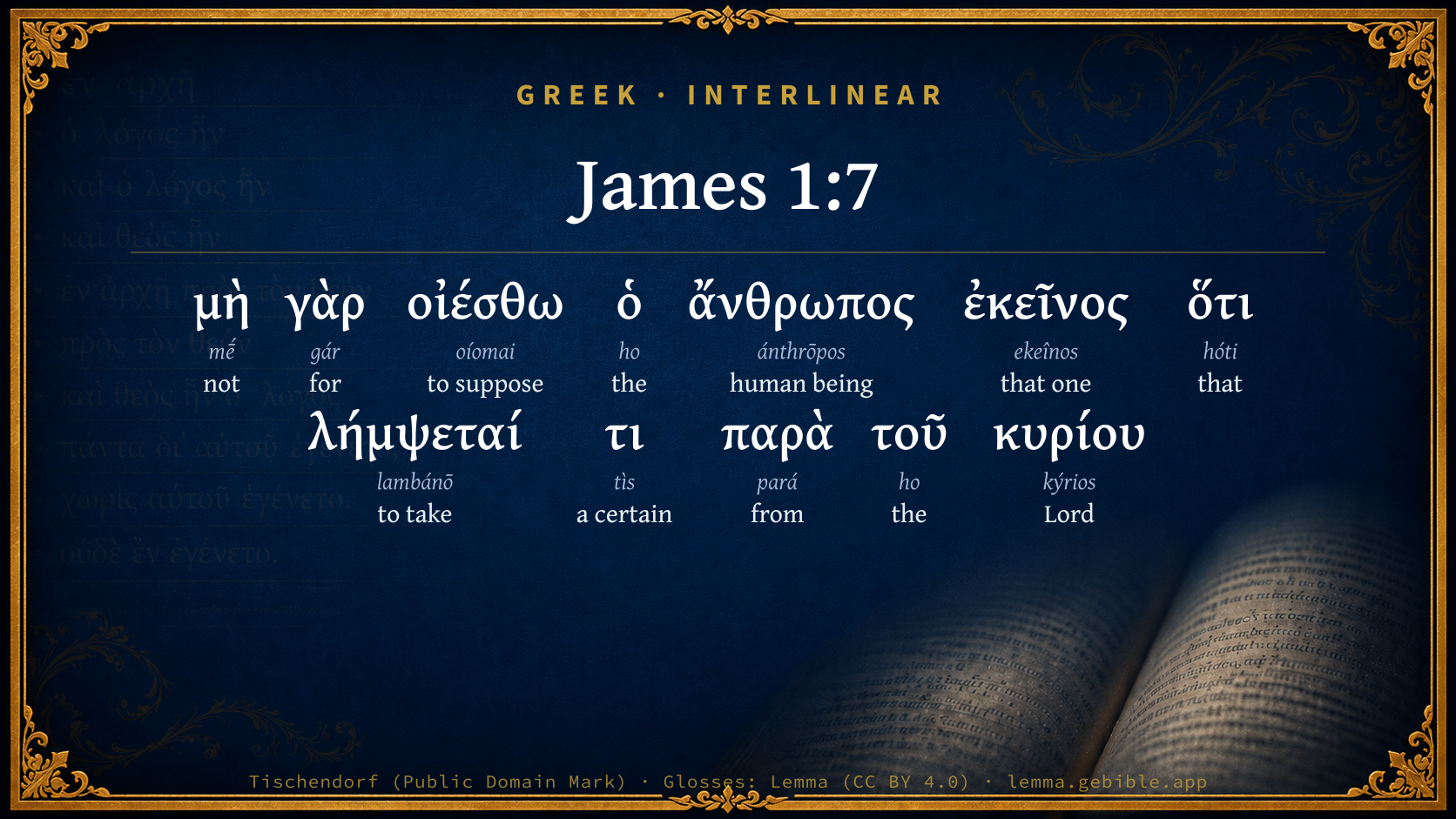
Greek (Tischendorf 8th ed.) James 1:7 appears in the Greek New Testament. The text above is from the Tischendorf 8th edition. Each word links to its Strong’s number and a concise gloss. Click any word for its full Thayer’s Greek Lexicon entry.
Download image
Cite this verse

James 1:7 (World English Bible). Public Domain. Lemma interlinear Bible study tool, https://lemma.gebible.app/v/james/1/7.

Show BibTeX & RIS
BibTeX
RIS
English Translation
For let that man not think that he will receive anything from the Lord.
World English Bible · Public Domain
Download a study sheet

One document with this verse’s original text, its word-by-word gloss line, the meaning frame, cross-references with their text, attributed commentary, and full source and license credits — printable, and it pastes into notes with its structure intact.

This verse Autodidact and up

Study sheet (.html) Plain text (.txt)

A passage Seminary Student

Up to 50 verses in one chapter. A passage sheet keeps up to 6 commentary sources and 12 cross-references per verse, in the order this page ranks them, and says so on the sheet whenever that leaves anything out. Ask for a single verse and you get the Autodidact verse sheet above.

Everything on this page stays free to read, with no account — the sheet is a download of what is already on screen, not access to it.

Want to remove ads? Support Godless Engineer
Compare translations 3

The same verse in 3 English versions, stacked beneath the original-language interlinear above. Click any original word for its lexicon entry.

Each is an independent rendering of the whole verse — the interlinear is not word-aligned to these translations.

Highlighted words mark where these versions differ — a whole-verse word diff, not a word-by-word alignment.

  • World English Bible Public Domain
    For let that man not think that he will receive anything from the Lord.
  • King James Version Public Domain
    For let not that man think that he shall receive any thing of the Lord.
  • unfoldingWord Literal Text CC BY-SA 4.0
    For let that man not think that he will receive anything from the Lord,

unfoldingWord Literal Text — © unfoldingWord, licensed CC BY-SA 4.0. Word-aligned USFM3 via Door43 (git.door43.org/unfoldingWord/en_ult).

Versions to compare (up to 4)

3 of 4 selected

Show all 19 translations

Every available English version of this verse, each an independent rendering of the whole verse.

  • World English Bible Public Domain
    For let that man not think that he will receive anything from the Lord.
  • Berean Standard Bible Public Domain
    That man should not expect to receive anything from the Lord.
  • Majority Standard Bible Public Domain
    That man should not expect to receive anything from the Lord.
  • King James Version Public Domain
    For let not that man think that he shall receive any thing of the Lord.
  • American Standard Version (1901) Public Domain
    For let not that man think that he shall receive anything of the Lord;
  • Revised Version (1885) Public Domain
    For let not that man think that he shall receive anything of the Lord;
  • Geneva Bible (1599) Public Domain
    Neither let that man thinke that hee shall receiue any thing of the Lord.
  • Douay-Rheims (1899) Public Domain
    Therefore let not that man think that he shall receive any thing of the Lord.
  • Young's Literal Translation Public Domain
    for let not that man suppose that he shall receive anything from the Lord --
  • Literal Standard Version CC BY-SA 4.0
    for do not let that man suppose that he will receive anything from the LORD—
  • Unlocked Literal Bible CC BY-SA 4.0
    For that person must not think that he will receive anything from the Lord.
  • unfoldingWord Literal Text CC BY-SA 4.0
    For let that man not think that he will receive anything from the Lord,
  • Darby Bible Public Domain
    for let not that man think that he shall receive anything from the Lord;
  • World Messianic Bible Public Domain
    For that man shouldn’t think that he will receive anything from the Lord.
  • Webster's Bible Public Domain
    For let not that man think that he shall receive any thing from the Lord.
  • Free Bible Version CC BY-SA 4.0
    Nobody like that should think they'll get anything from the Lord—
  • Bible in Basic English Public Domain
    Let it not seem to such a man that he will get anything from the Lord;
  • Text-Critical English NT CC BY 4.0
    That person should not expect to receive anything from the Lord.
  • Tyndale New Testament (1534) Public Domain
    Nether let that man thinke that he shall receave eny thinge of the Lorde.

Literal Standard Version (2020), Covenant Press — licensed CC BY-SA 4.0. Text via the HelloAO Bible API (eBible.org). Unlocked Literal Bible (unfoldingWord) — licensed CC BY-SA 4.0. Text via the HelloAO Bible API (eBible.org). unfoldingWord Literal Text — © unfoldingWord, licensed CC BY-SA 4.0. Word-aligned USFM3 via Door43 (git.door43.org/unfoldingWord/en_ult). Free Bible Version, Dr. Jonathan Gallagher — licensed CC BY-SA 4.0. Text via the HelloAO Bible API (eBible.org).

Word by word

More ways to search: Search by grammar → Find every occurrence → Compare this word →

Practice this passage: Drill this verse → Learn its vocabulary →

About this verse

These counts appear in no published source. They are computed here, from the morphology-tagged text and Lemma’s own curated glosses. What Lemma adds →

12
words
11
distinct lemmas
General Epistles
section

Notable vocabulary

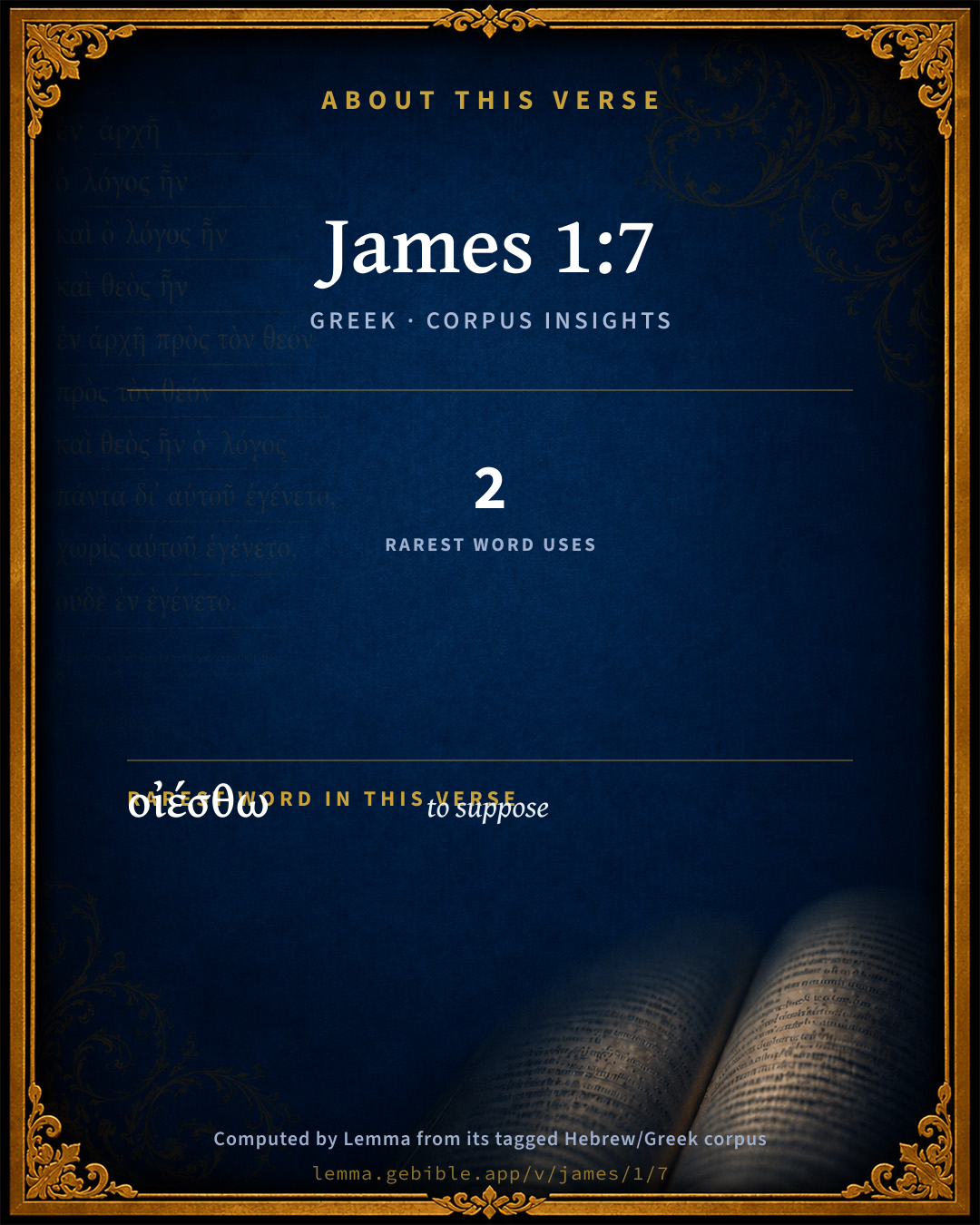
The rarest word here is οἰέσθω to suppose G3633 — appearing just 2 times in the whole Greek New Testament.

Shared distinctive vocabulary

οἰέσθω to suppose G3633 occurs in 2 verses of the Greek New Testament. Also found in:

Repetition

A word recurs within this verse:

Cross-references

5

Topical passages linked to James 1:7 in the Treasury of Scripture Knowledge — connected by theme and wording, ordered by reader-vote popularity; previews shown in the World English Bible.

  • James 4:3 You ask, and don't receive, because you ask with wrong motives, so that you may spend it for your pleasures.
  • Proverbs 15:8 The sacrifice made by the wicked is an abomination to Yahweh, But the prayer of the upright is his delight.
  • Isaiah 1:15 When you spread forth your hands, I will hide my eyes from you; Yes, when you make many prayers, I will not hear. Your hands are full of blood.
  • Isaiah 58:3–4 Why have we fasted, [say they], and you don't see? [why] have we afflicted our soul, and you take no knowledge? Behold, in the day of your fast you find [your own] pleasure, and exact all your labors.
  • Proverbs 21:27 The sacrifice of the wicked is an abomination: How much more, when he brings it with a wicked mind!

Cross-references courtesy of OpenBible.info (CC BY 4.0).

Commentary

Notes on James 1:7 from classic Christian and Jewish commentators (each source and its license shown beneath its notes). The classic Christian expositions comment on the surrounding passage and are grouped to its opening verse, so a note may address several verses; the Jewish commentaries on the Tanakh (Rashi and others) are per-verse, so they appear only where the commentator wrote on this verse.

Lemma curates 59 commentaries, every one of them public domain or Creative Commons licensed, each selected and text-cleaned for this edition rather than reprinted as found. About our sources →

The Biblical Illustrator

Joseph S. Exell

Jam_1:7

Let not that man think that he shall receive

Unbelieving prayer useless

1.

Unbelievers, though they may receive something, yet they can expect nothing from God. They are under a double misery.

(1) They can lift up no thoughts of hope and comfort, for they are not under the assurance of a promise.

(2) If they receive anything, they cannot leek upon it as coming by promise, or as a return of prayers.

2. Men usually deceive themselves with vain hopes and thoughts; they are out in their thinking (Mat_3:9).

3. The cause why we receive not upon asking is not from God, but ourselves; He giveth liberally, but we pray doubtingly. He would give, but we cannot receive. We see men are discouraged when they are distrusted, and suspicion is the ready way to make them unfaithful; and, certainly, when we distrust God, it is not reasonable we should expect aught from Him.

4. From that anything--neither wisdom nor anything else--that God thinketh the least mercy too good for unbelievers: He thinketh nothing too good for faith, nod anything too good for unbelief.

5. From that from the Lord, that the fruit of our prayers is received from the hands of Christ; He is the middle person by whom God conveyeth blessings to us, and we return duty to Him. (T. Manton.)

The Biblical Illustrator, edited by Joseph S. Exell (c. 1880s–1900s) — public domain. Text from a community e-Sword module.

Bengel's Gnomon

Johann Albrecht Bengel

Jas 1:7. Μὴ γὰρ οἰέσθω, for let not that man think) Faith does not entertain mere opinions.[6] He who thinks as the double-minded man (δίψυχος), thinks in vain.

[6] οἴεσθαι, as the Latin opinari, denotes the mere holding of an opinion or supposition, and expresses a condition of doubt as opposed to faith.—T.

Bengel's Gnomon of the New Testament — English translation (T&T Clark, Edinburgh, 1860) — public domain. Text from a community e-Sword module.

Meyer's Critical & Exegetical Commentary

Heinrich August Wilhelm Meyer

Jam_1:7. μὴ γὰρ οἰέσθω] On γάρ, see Jam_1:6; it is neither the simple particle of transition (Pott), nor equivalent to ergo (Calvin), nor is it to he explained, with Winer [E. T. 558], according to its derivation from γε and ἄρα, by thus indeed; but is the reason for the exhortation in Jam_1:6; hence for.

The warning: μὴ οἰέσθω, supposes the fancy of the doubter, that he will receive something from God in answer to prayer; similarly Mat_3:9 : μὴ δόξητε.

ὁ ἄνθρωπος ἐκεῖνος] refers back to ὁ διακρινόμενος. Although not in ἐκεῖνος (in itself), yet in the whole mode of expression, there is something disparaging.

By λήμψεται,[53] instead of δοθήσεται (Jam_1:5), is not intended to be indicated, that the fault of not being heard lies not with God but with man; rather he receives not, because God gives not.

τί naturally refers to what the doubter asks; thus scil. αἰτουμένων. The definite object (wisdom) above spoken of is not here meant; for the particular thought is founded on a general declaration. By κύριος Christ is not to be understood, but, as in chap. Jam_4:10, Jam_5:4; Jam_5:10, according to O. T. usage, God.

The designation of God as the Lord naturally suggested itself to James, because he was here speaking of the power of God manifested in giving or not giving; it is not, as Lange thinks, chosen in order to characterize God as Jehovah the living covenant-God, who has now fully manifested Himself in Christ.

[53] The form λήμψεται, for which MS. authorities decide, is not classical Greek; the lonic form is λάμψομαι.

Meyer — Critical and Exegetical Commentary on the New Testament — English translation by Peter Christie, edited by Frederick Crombie (T&T Clark, 1880) — public domain. Text from a community e-Sword module.

Expositor's Greek Testament

ed. W. Robertson Nicoll

Jas 1:7 . μὴ γὰρ οἰέσθω , etc.: γὰρ almost in the sense of διὰ τοῦτο . The verb occurs very rarely, see Joh 21:25 ; Phi 1:17 . There is a ring of contempt in the passage at the idea of a man with halting faith expecting his prayer to be answered. ἄνθρωπος is used here in reference to men in general; ἀνήρ in the next verse is more specific; in this Epistle ἀνήρ occurs usually with some qualifying word. τοῦ Κυρίου : obviously in reference to God the Father on account of the τοῦ διδ . Θεοῦ above.

The Expositor's Greek Testament, edited by W. Robertson Nicoll (1897–1910) — public domain. Text from a community e-Sword module.

Jamieson, Fausset & Brown

Robert Jamieson, A. R. Fausset & David Brown

For--resumed from "For" in Jam 1:6.

that man--such a wavering self-deceiver.

think--Real faith is something more than a mere thinking or surmise.

anything--namely, of the things that he prays for: he does receive many things from God, food, raiment, &c., but these are the general gifts of His providence: of the things specially granted in answer to prayer, the waverer shall not receive "anything," much less wisdom.

Jamieson, Fausset & Brown — Commentary Critical and Explanatory on the Whole Bible (1871) — public domain (CC PDM 1.0). Text via the HelloAO Bible API.

Adam Clarke's Commentary

Verse 7. Let not that man think] The man whose mind is divided, who is not properly persuaded either of his own wants or God's sufficiency. Such persons may pray, but having no faith, they can get no answer.

Adam Clarke's Commentary on the Bible (1810–1826) — public domain. Text from a community e-Sword/MySword module.

Ellicott's Commentary for English Readers

(7) Once more the Apostle warns the doubtful, holding out no hope of help until the wavering mind be fixed on God.

A Bible Commentary for English Readers, edited by Charles John Ellicott (1878–1897) — public domain. Text from a community e-Sword module.

The Cambridge Bible for Schools and Colleges

gen. ed. J. J. S. Perowne

7. let not that man think …] Faith, undoubting faith, is then the condition of the prayer for wisdom, as of all other prayers, being heard and answered. Without it, the No excludes the Yes, which yet the man will not quite abandon.

of the Lord] It is a question whether the Divine Title is used in the Old Testament sense, for the Father, or, as generally, though not exclusively, in the New Testament, for the Son. On the whole, looking (1) to the meaning of the word in ch. Jas_5:7; Jas_5:14-15, (2) and to the frequent use of “God” and “the Father,” where Christ is not meant, there seems a balance of evidence in favour of the latter meaning. Christ also, not less than the Father, is thought of as giving or not giving, in answer to prayer. Possibly, however, the word was used without the thought of a distinction between the Divine Persons.

The Cambridge Bible for Schools and Colleges (gen. ed. J. J. S. Perowne; Cambridge University Press, 1878–1918) — public domain. Text from a community e-Sword module.

John Gill's Exposition

For let not that man think,.... Imagine, conclude, or please himself with such thoughts,

that he shall receive anything from the Lord; wisdom, or anything else, he is seeking after; for wanting faith, he has nothing to receive with; faith is the grace, which receives the Lord Jesus Christ himself, and all grace from him; which receives a justifying righteousness, pardon of sin, adoption of children, and even the everlasting inheritance, at least, the right unto it; wherefore those who have not faith, as the wavering man, cannot receive any thing.

John Gill's Exposition of the Whole Bible (1746–1763) — public domain (CC PDM 1.0). Text via the HelloAO Bible API.

Trapp's Complete Commentary

John Trapp

7 For let not that man think that he shall receive any thing of the Lord.

Ver. 7. That he shall receive] Unless he strive against his doubting, and wade out of it, as the moon doth out of the cloud. Qui timide rogat, negare docet; He that prayeth doubtingly, shuts heaven’s gates against his own prayers.

John Trapp, A Commentary or Exposition upon All the Books of the Old and New Testament (1647–1656) — public domain. Text from a community e-Sword module.

Albert Barnes' Notes on the Bible

For let not that man think that he shall receive anything of the Lord - Compare Heb 11:6. A man can hope for favor from God only as he puts confidence in him. He sees the heart; and if he sees that there is no belief in his existence, or his perfections - no real trust in him - no reliance on his promises, his wisdom, his grace - it cannot be proper that he should grant an answer to our petitions. That will account sufficiently for the fact that there are so many prayers unanswered; that we so frequently go to the throne of grace, and are sent empty away. A man that goes to God in such a state of mind, should not expect to receive any favor.

Albert Barnes' Notes on the Bible (1834–1885) — public domain. Text from a community e-Sword/MySword module.

Haydock's Catholic Bible Commentary

Let not that man think that he shall receive. He that has not a lively faith and firm hope, wavering with a distrust of God’s power or goodness, must not imagine to receive what he so faintly asks. (Witham)

George Leo Haydock (1774–1849), Haydock's Catholic Family Bible and Commentary, 1859 edition — public domain. Excludes Psalms (Douay-Rheims chapter numbering differs from Protestant) and Deuterocanonical books (Catholic canon only).

Matthew Poole's English Annotations

For let not that man; he that wavers, in opposition to him that asks in faith: all doubting doth not hinder the hearing of prayer, but that which excludes faith, Mar 9:23,24.

Think; vainly conceit, or persuade himself.

That he shall receive any thing of the Lord; even the least mercy, much less the wisdom mentioned.

Matthew Poole's English Annotations on the Holy Bible (1683–1685) — public domain. Text from a community e-Sword/MySword module.

Whedon's Commentary on the Bible

Daniel D. Whedon

7. Not… receive any thing—Why should he? He has asked and refused in perhaps equal measure, so that he has not asked. As Stier says, “The wavering beggar has not held heart and hand steady enough and long enough for God to put any thing in.” Not receive is used instead of the above not shall be given to indicate that the failure is not in the giver but in the would-be and would-not-be recipient.

Any thing—That is, of those things he has asked. Many things unasked, as life and its enjoyments, and, perhaps, many other things for which he had faith, have been given him.

The Lord—A word inherited in the Greek from the Septuagint to designate Jehovah, the God of the covenant.

Daniel D. Whedon (gen. ed.), Commentary on the Old and New Testaments (1874–1909) — public domain. Text from a community e-Sword module.

The Pulpit Commentary

Vers. 7, 8. The A.V, which makes ver. 8 an independent sentence, is certainly wrong. Render, Let not that man think that he shall receive anything of the Lord, double-minded man that he is, unstable in all his ways. So Vulgate, Vir duplex animi, inconstans in omnibus viis. (The Clementine Vulgate, by reading est after inconstans, agrees with A.V) Another possible rendering is that of the R.V margin, "Let not that man think that a double-minded man, unstable in all his ways, shall receive," etc. But the rendering given above is better. Double-minded; diyucov occurs only here and in Jam_4:8 in the New Testament. It is not found in any earlier writer, and was perhaps coined by St. James to represent the idea of the Hebrew, "a heart and a heart (blew; bleb 1Ch_12:33). It took root at once in the vocabulary of ecclesiastical writers, being found three times in Clement of Rome, and frequently in his younger contemporary Hermas. St. James"s words are apparently alluded to in the Apost. Coust., VII 11., Mhnou diyucov ejn proseuch sou eij estai h) ouJ: and cf. Clem., "Romans," c. 23. The same thought is also found in Ecc 1:28, "Come not before him with a double heart (ejn kardia disoh)." Unstable; ajkatastatov, only here and (probably) Jam_3:8.

The Pulpit Commentary (1880–1919), ed. H.D.M. Spence-Jones & Joseph S. Exell — public domain. Text from a community e-Sword module.

Godbey's Commentary on the New Testament

William B. Godbey

ARGUMENT 1

DOUBLE MIND

7, 8. “Let not that person think that the double souled man, most unstable in all his ways, shall receive anything from the Lord.” The Bible describes the sinner, one soul (or mind), and that a bad one; the sanctified man, one soul, and that a good one, while James’ double souled man is an unsanctified Christian. We are born into the world with the carnal mind, transmitted from Satan through Adam the first. In regeneration, the Holy Ghost imparts the mind of Christ, simultaneously subjugating the carnal mind and giving grace to keep it in subjection. Then follows the civil war in the heart between the good soul and the bad one, i.e., the Spirit and the flesh. In sanctification after regeneration, the Pentecostal fire consumes the carnal mind, leaving the mind of Christ to reign in the heart without a rival. We see from this Scripture that the unsanctified Christian must totally abrogate the carnal mind, and get victory over it, in order to prevail with God in prayer. “Most unstable in all his ways.” O, how significantly the Holy Ghost describes the unsanctified man! Today he is all honey and, you think, a Christian; tomorrow he is all vinegar and you think he is a sinner. Truly his religion is always in the subjunctive mood, so you never know where to locate him. He does things unbecoming a Christian and repents at once. O, how he needs sanctification to establish him.

9. “Let the poor brother boast in his exaltation.” The penniless scavenger, sweeping the streets, intelligently saved and gloriously sanctified, hears the angels singing all the day long, ready to encircle him in their pinions of light, and waft him like lightning to the bosom of God.

10. “And the rich man in his humility.” While God blesses the pauper with the transcendent grace of entire sanctification, exalting him above kings and millionaires, He blesses the rich man with that perfect humility which enables him to consecrate all to God, who fills him with the Holy Ghost, makes him humble as a beggar, benevolent, and takes him up to heaven.

11... “So also the rich man shall pass away in his ways.” If the rich man holds on to his selfish, avaricious ways, though he may bloom as the rose and flourish in royal splendor, he is destined to fade like vernal flowers,

blighted by the withering siroccoes of endless damnation; while, if in the full and eternal abandonment he takes God’s method, consecrates all and lives for heaven, he will rejoice with Abraham and Job in the city of God.

William B. Godbey, Commentary on the New Testament (1896–1900) — public domain. Text from a community e-Sword module.

Cambridge Greek Testament for Schools and Colleges

7. γάρ. See Winer, LIII. 3. The ἄρα in γάρ draws the inference, the γε corroborates it. ‘Let not then that man,’ &c.

Cambridge Greek Testament for Schools and Colleges (Cambridge University Press, 1896; 21 vols, various authors incl. Carr, Maclear, Plummer, Farrar, Lumby, Moule, M. R. James, Simcox) — public domain. Text from a community e-Sword module.

Alford’s Greek Testament

Henry Alford

7.] for (takes up and repeats the former γάρ: not as Calvin, “non ergo existimet,” nor as Huther, = namlich) let not that man (said with a certain slight expression of contempt) think (cf. Mat 5:17, μὴ νομίσητε ὅτι κ.τ.λ.) that he shall receive any thing (sc. τῶν αἰτουμένων: some things, as life, food, raiment, &c., he does continually receive) from the Lord (i. e. as usually in this Epistle, from God. So ch. 4:10, 15; 5:4, 10, 11: see at each of those places. On the other hand, ὁ κύριος, ch. 5:7, 14, 15, is used of Christ. Hofmann remarks that where the Father is not expressly distinguished from the Son by the context, the Godhead, in its unity, is to be understood by ὁ θεός: and the same may be said of ὁ κύριος).

Henry Alford, The Greek Testament (1849–1861) — public domain. Text from a community e-Sword module.

International Critical Commentary

7. γάρ. Introduces a second time, in another and more direct form, the reason for v. 6a. Cf. Hermas, Sim. 4:6 πῶς οὖν, φησίν, ὁ τοιοῦτος δύναταί τι αἰτήσασθαι παρὰ τοῦ κυρίου καὶ λαβεῖν, μὴ δουλεύων τῷ κυρίῳ; also Jas 4:3 and note.

οἰέσθω. οἶμαι is found in N. T. only here and Joh 21:25, Php 1:17, δοκέω having taken its place (cf. Mat 3:9 μὴ δόξητε). It is often used, as here, “with collateral notion of wrong judgment or conceit” (L. and S.). So in Attic; and cf. Job 11:2, Job 11:1 Macc. 5:61, 2 Macc. 5:21.

ὁ ἄνθρωπος ἐκεῖνος, with a suggestion of disapproval, or contempt, as Mar 14:21, Mat 12:45.

τοῦ κυρίου, i. e. God, cf. v. 5. In Paul always, or nearly always, of Christ, except in quotations.

International Critical Commentary — older volumes (1896–1929), various authors — public domain. Text from a community e-Sword module.

Vincent's Word Studies in the New Testament

Marvin R. Vincent

That man [εκεινος] . Emphatic, and with a slightly contemptuous force.

Anything. i e. which he asks for.

Marvin R. Vincent, Word Studies in the New Testament (1887–1900) — public domain. Text from a community e-Sword/MySword module.

Lesson kit

Teaching starters — assembled from the data on this page, not authored interpretation. Every prompt links to the verse data it draws on. Edit before teaching.

James, in the General Epistles, opens this verse with 12 words (11 distinct Greek lemmas). Its most distinctive word is oíomai (“to suppose”). A historical commentator’s framing appears above. Read the whole chapter for the surrounding context.

Discussion questions

  1. How does “to suppose” (oíomai) shape what this verse is saying?
  2. Philippians 1:17 shares the word «to suppose» with this verse. How do the two illuminate each other?
  3. “the” occurs 2× in this one verse. What is the effect of the repetition?
  4. These translations render this verse differently. What is at stake in choosing one wording over another?
  5. Reading how The Biblical Illustrator and Bengel's Gnomon read this verse, where do the two commentators agree and where do they part?

Things to notice

Reading settings

Reading text

Shown beneath each verse's original-language words.

Old Testament
Old Testament edition

Read the OT as the Masoretic Hebrew (MT) or the Greek Septuagint (LXX).

English shown for the Greek Septuagint (in the Hebrew ↔ Greek comparison).

Comparing translations? Open the Compare panel on any verse page to stack up to four side by side.