
Genesis 14:12

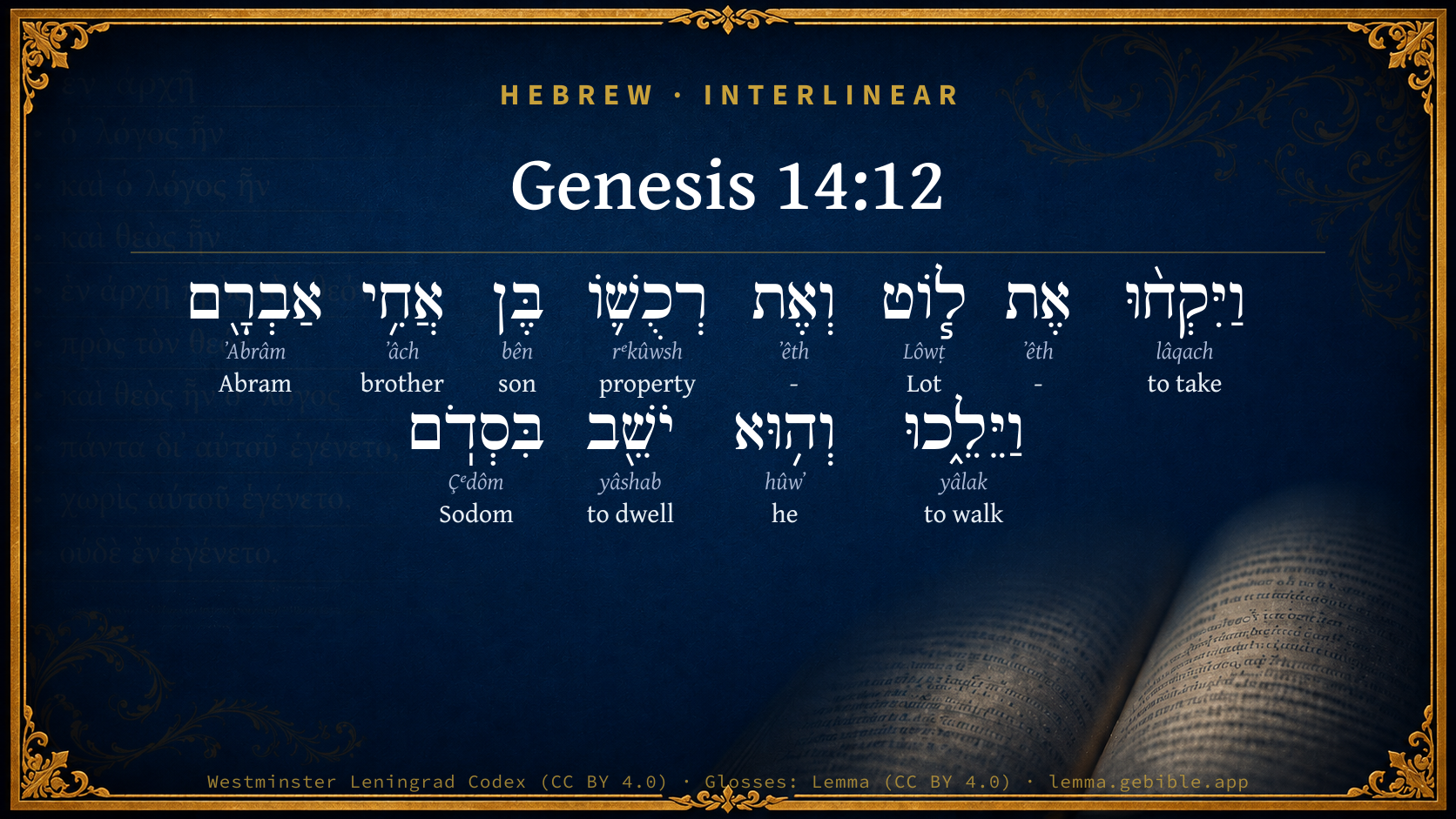
Hebrew (Westminster Leningrad Codex) Genesis 14:12 appears in the Hebrew Old Testament. The text above is from the Westminster Leningrad Codex. Each word links to its Strong’s number, a concise gloss, and parsing drawn from the Open Scriptures Hebrew Bible morphology. Click any word for its full Brown-Driver-Briggs (BDB) entry.
Download image
Cite this verse

Genesis 14:12 (World English Bible). Public Domain. Lemma interlinear Bible study tool, https://lemma.gebible.app/v/genesis/14/12.

Show BibTeX & RIS
BibTeX
RIS
English Translation
They took Lot, Abram's brother's son, who lived in Sodom, and his goods, and departed.
World English Bible · Public Domain
Download a study sheet

One document with this verse’s original text, its word-by-word gloss line, the meaning frame, cross-references with their text, attributed commentary, and full source and license credits — printable, and it pastes into notes with its structure intact.

This verse Autodidact and up

Study sheet (.html) Plain text (.txt)

A passage Seminary Student

Up to 50 verses in one chapter. A passage sheet keeps up to 6 commentary sources and 12 cross-references per verse, in the order this page ranks them, and says so on the sheet whenever that leaves anything out. Ask for a single verse and you get the Autodidact verse sheet above.

Everything on this page stays free to read, with no account — the sheet is a download of what is already on screen, not access to it.

Want to remove ads? Support Godless Engineer
Compare translations 3

The same verse in 3 English versions, stacked beneath the original-language interlinear above. Click any original word for its lexicon entry.

Each is an independent rendering of the whole verse — the interlinear is not word-aligned to these translations.

Highlighted words mark where these versions differ — a whole-verse word diff, not a word-by-word alignment.

  • World English Bible Public Domain
    They took Lot, Abram's brother's son, who lived in Sodom, and his goods, and departed.
  • King James Version Public Domain
    And they took Lot, Abram's brother's son, who dwelt in Sodom, and his goods, and departed.
  • unfoldingWord Literal Text CC BY-SA 4.0
    And they took Lot and his possessions, the son of Abram’s brother, when they left, since he was living in Sodom.

unfoldingWord Literal Text — © unfoldingWord, licensed CC BY-SA 4.0. Word-aligned USFM3 via Door43 (git.door43.org/unfoldingWord/en_ult).

Versions to compare (up to 4)

3 of 4 selected

Show all 18 translations

Every available English version of this verse, each an independent rendering of the whole verse.

  • World English Bible Public Domain
    They took Lot, Abram's brother's son, who lived in Sodom, and his goods, and departed.
  • Berean Standard Bible Public Domain
    They also carried off Abram’s nephew Lot and his possessions, since Lot was living in Sodom.
  • Majority Standard Bible Public Domain
    They also carried off Abram’s nephew Lot and his possessions, since Lot was living in Sodom.
  • King James Version Public Domain
    And they took Lot, Abram's brother's son, who dwelt in Sodom, and his goods, and departed.
  • American Standard Version (1901) Public Domain
    And they took Lot, Abram's brother's son, who dwelt in Sodom, and his goods, and departed.
  • Revised Version (1885) Public Domain
    And they took Lot, Abram’s brother’s son, who dwelt in Sodom, and his goods, and departed.
  • Geneva Bible (1599) Public Domain
    They tooke Lot also Abrams brothers sonne and his substance (for he dwelt at Sodom) and departed.
  • Douay-Rheims (1899) Public Domain
    And Lot also, the son of Abram's brother, who dwelt in Sodom, and his substance.
  • Young's Literal Translation Public Domain
    and they take Lot, Abram's brother's son (seeing he is dwelling in Sodom), and his substance, and go away.
  • Literal Standard Version CC BY-SA 4.0
    and they take Lot, Abram’s brother’s son (seeing he is dwelling in Sodom), and his substance, and go away.
  • Unlocked Literal Bible CC BY-SA 4.0
    When they went, they also took Lot, Abram's brother's son, who was living in Sodom, along with all his possessions.
  • unfoldingWord Literal Text CC BY-SA 4.0
    And they took Lot and his possessions, the son of Abram’s brother, when they left, since he was living in Sodom.
  • Darby Bible Public Domain
    And they took Lot and his property, Abram's brother's son, and departed. For he dwelt in Sodom.
  • World Messianic Bible Public Domain
    They took Lot, Abram’s brother’s son, who lived in Sodom, and his goods, and departed.
  • Webster's Bible Public Domain
    And they took Lot, Abram's brother's son, who dwelt in Sodom, and his goods, and departed.
  • Free Bible Version CC BY-SA 4.0
    They also captured Lot, Abram's nephew, and his possessions, because he was living in Sodom.
  • Bible in Basic English Public Domain
    And in addition they took Lot, Abram's brother's son, who was living in Sodom, and all his goods.
  • JPS Tanakh (1917) Public Domain
    And they took Lot, Abram's brother's son, who dwelt in Sodom, and his goods, and departed.

Literal Standard Version (2020), Covenant Press — licensed CC BY-SA 4.0. Text via the HelloAO Bible API (eBible.org). Unlocked Literal Bible (unfoldingWord) — licensed CC BY-SA 4.0. Text via the HelloAO Bible API (eBible.org). unfoldingWord Literal Text — © unfoldingWord, licensed CC BY-SA 4.0. Word-aligned USFM3 via Door43 (git.door43.org/unfoldingWord/en_ult). Free Bible Version, Dr. Jonathan Gallagher — licensed CC BY-SA 4.0. Text via the HelloAO Bible API (eBible.org).

Word by word

More ways to search: Search by grammar → Find every occurrence → Compare this word →

Practice this passage: Drill this verse → Learn its vocabulary →

רְכֻשׁ֛וֹ
rᵉkûwsh
H7399
“property · his”
Noun, Common, Masculine, Singular, Construct + Suffix, Personal, 3rd Person, Masculine, Singular
Part of Speech
Noun
Type
Common
Gender
Masculine
Number
Singular
State
Construct
Full BDB Definition

Origin: from pass part of H7408

TWOT: 2167b

property, goods, possessions - property, goods - general term for all movable goods - of livestock - of stores, utensils, etc
  1. וַיִּקְח֨וּ lâqach H3947 “and · to take” Conjunction + Verb, Qal, Sequential Imperfect, 3rd Person, Masculine, Plural
  2. אֶת ʼêth H853 “-” Particle, Direct Object
  3. ל֧וֹט Lôwṭ H3876 “Lot” Noun, Proper
  4. וְאֶת ʼêth H853 “and · -” Conjunction + Particle, Direct Object
  5. בֶּן bên H1121 “son of” Noun, Common, Masculine, Singular, Construct
  6. אֲחִ֥י ʼâch H251 “brother of” Noun, Common, Masculine, Singular, Construct
  7. אַבְרָ֖ם ʼAbrâm H87 “Abram” Noun, Proper
  8. וַיֵּלֵ֑כוּ yâlak H3212 “and · to walk” Conjunction + Verb, Qal, Sequential Imperfect, 3rd Person, Masculine, Plural
  9. וְה֥וּא hûwʼ H1931 “and · he” Conjunction + Pronoun, Personal, 3rd Person, Masculine, Singular
  10. יֹשֵׁ֖ב yâshab H3427 “dwelling” Verb, Qal, Participle Active, Masculine, Singular, Absolute
  11. בִּסְדֹֽם Çᵉdôm H5467 “in/at · Sodom” Preposition + Noun, Proper

About this verse

These counts appear in no published source. They are computed here, from the morphology-tagged text and Lemma’s own curated glosses. What Lemma adds →

12
words
11
distinct lemmas
Pentateuch
section

Shared distinctive vocabulary

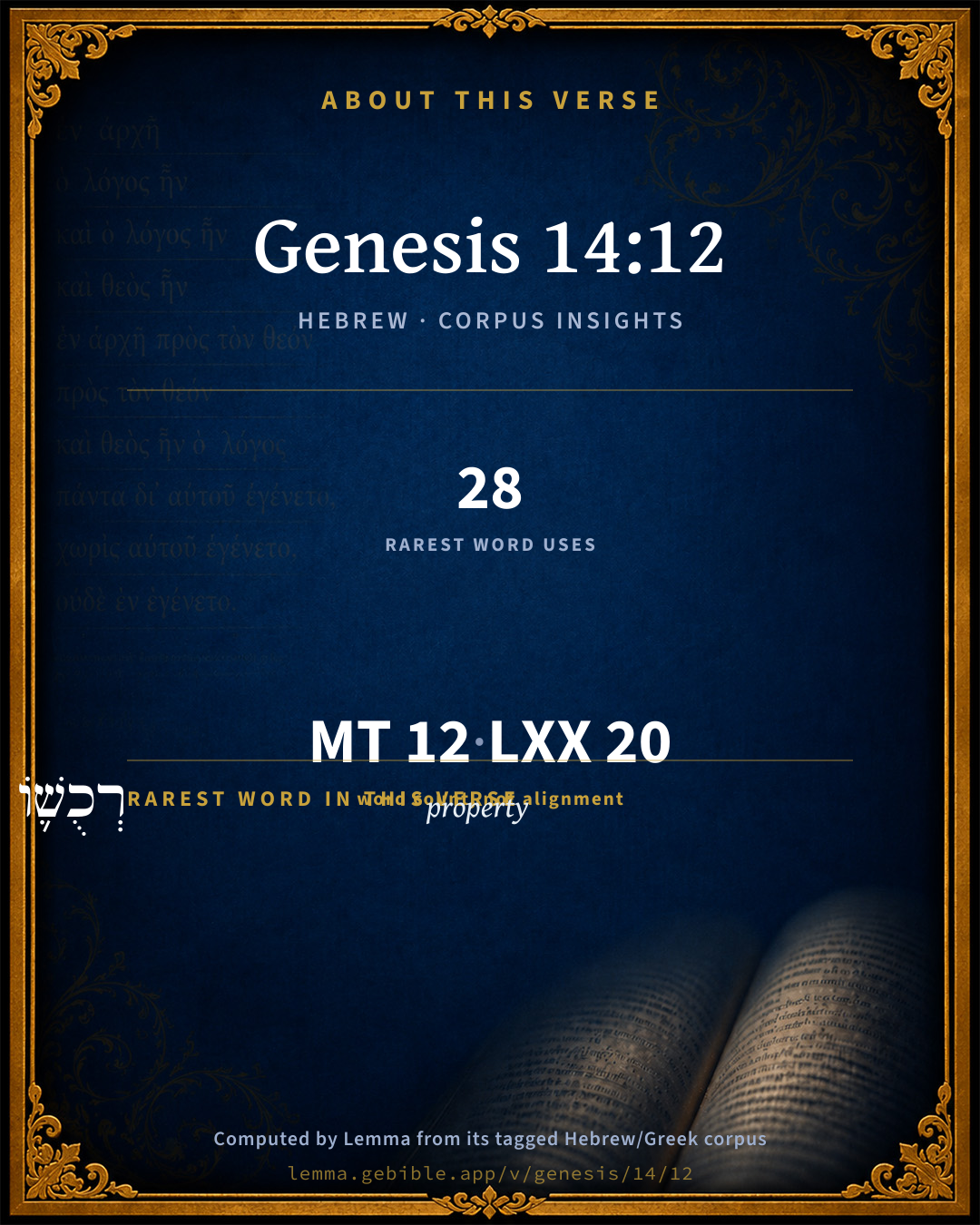
רְכֻשׁ֛וֹ property H7399 occurs in 27 verses of the Hebrew Bible. Also found in:

Grammatical profile

  • 3 verbs
  • 6 nouns
  • 1 pronoun
  • 2 particles

Verb forms

  • וַיִּקְח֨וּ Qal · Sequential Imperfect
  • וַיֵּלֵ֑כוּ Qal · Sequential Imperfect
  • יֹשֵׁ֖ב Qal · Participle Active

Hebrew & Septuagint length

In English translation the verse runs 15 words from the Hebrew and 20 from the Septuagint (LXX English) — closely comparable.

A rough comparison of the two English renderings, which tokenize alike — not a word-level alignment.

Word counts can differ between the Hebrew and the Greek without any difference in meaning — e.g. the Hebrew direct-object marker אֵת has no separate Greek word, and Greek often adds the article ὁ.

In the original languages it is 12 Hebrew tokens and 20 Greek tokens — but the two are counted differently (Hebrew bundles its prefixes and suffixes into one token; the Greek is in lemma form), so that isn’t a like-for-like length.

Cross-references

9

Topical passages linked to Genesis 14:12 in the Treasury of Scripture Knowledge — connected by theme and wording, ordered by reader-vote popularity; previews shown in the World English Bible.

  • Genesis 12:5 Abram took Sarai his wife, Lot his brother's son, all their substance that they had gathered, and the souls who they had gotten in Haran; and they went forth to go into the land of Canaan. Into the land of Canaan they came.
  • Genesis 11:27 Now this is the history of the generations of Terah. Terah became the father of Abram, Nahor, and Haran. Haran became the father of Lot.
  • Revelation 3:19 As many as I love, I reprove and chasten. Be zealous therefore, and repent.
  • Genesis 13:12–13 Abram lived in the land of Canaan, and Lot lived in the cities of the plain, and moved his tent as far as Sodom.
  • Numbers 16:26 He spoke to the congregation, saying, Depart, I pray you, from the tents of these wicked men, and touch nothing of theirs, lest you be consumed in all their sins.
  • Job 9:23 If the scourge kills suddenly, He will mock at the trial of the innocent.
  • Jeremiah 2:17–19 Haven't you procured this to yourself, in that you have forsaken Yahweh your God, when he led you by the way?
  • 1 Timothy 6:9–11 But those who are determined to be rich fall into a temptation and a snare and many foolish and harmful lusts, such as drown men in ruin and destruction.
  • Revelation 18:4 I heard another voice from heaven, saying, "Come out of her, my people, that you have no participation in her sins, and that you don't receive of her plagues,

Cross-references courtesy of OpenBible.info (CC BY 4.0).

Hebrew and Greek witnesses Masoretic Hebrew ↔ Greek Septuagint

The same verse in the two great witnesses to the Old Testament, shown verse-for-verse.

These are two independent witnesses, not word-aligned to each other, and the Septuagint is shown in lemma (dictionary) form.

Hebrew Genesis 14:12 Masoretic · Westminster Leningrad Codex

וַיִּקְח֨וּ אֶת ל֧וֹט וְאֶת רְכֻשׁ֛וֹ בֶּן אֲחִ֥י אַבְרָ֖ם וַיֵּלֵ֑כוּ וְה֥וּא יֹשֵׁ֖ב בִּסְדֹֽם

They took Lot, Abram's brother's son, who lived in Sodom, and his goods, and departed.

World English Bible · Public Domain

Greek LXX Genesis 14:12 Septuagint · lemma form

λαμβάνω δέ καί ὁ λωτ υἱός ὁ ἀδελφός αβραμ καί ὁ ἀποσκευή αὐτός καί ἀποοἴχομαι εἰμί γάρ καταοἰκέω ἐν σοδομα

And they took also Lot the son of Abram's brother, and his baggage, and departed, for he lived in Sodom.

LXX2012 (modern English Septuagint) · Public Domain

Hebrew: Westminster Leningrad Codex (CC BY 4.0). Greek: Septuagint (public domain); English from LXX2012 (modern English Septuagint) (Public Domain). How the Septuagint differs from the Hebrew →

Targum (Aramaic paraphrase)

2

The Targum is the ancient Jewish Aramaic paraphrase of the Hebrew Scriptures — an interpretive translation, not the Hebrew text itself. Onkelos (literal) and Pseudo-Jonathan (expansive) render the Torah, and Jonathan the Prophets. Coverage is partial: where no permissively-licensed English translation exists for a verse, only the Aramaic is shown. This is verse-level text, not a word-by-word alignment to the Hebrew.

  1. Targum Onkelos Torah (Genesis–Deuteronomy)
    וּשְׁבוֹ יָת לוֹט וְיָת קִנְיָנֵהּ בַּר אַחוּהִי דְאַבְרָם וַאֲזָלוּ וְהוּא יָתֵיב בִּסְדוֹם

    And they captured Lot and his substance, son of the brother of Abram, and went. And he had dwelt in Sedom.

    Targum Onkelos — Aramaic: “Onkelos Genesis” (public domain); “Onkelos Exodus” (public domain); “Onkelos Leviticus” (public domain); “Onkelos Numbers” (public domain); “Onkelos Deuteronomy” (public domain). English: “Sefaria Community Translation” (CC0 1.0 (public-domain dedication)); “J.W. Etheridge. The Targums of Onkelos and Jonathan Ben Uzziel on the Pentateuch. London: Longmans, Green, 1862” (public domain). Text via Sefaria.

  2. Targum Pseudo-Jonathan Torah (Genesis–Deuteronomy)
    וּשְׁבוֹ יַת לוֹט וְיַת קִנְיָנֵיהּ בַּר אָחוֹי דְאַבְרָם וַאֲזָלוּ וְהוּא יָתֵיב בִּסְדוֹם

    And they made captive Lot the son of Abram's brother, and his property, and went. And he had dwelt in Sedom.

    Targum Pseudo-Jonathan — Aramaic: “Targum Jonathan on Genesis” (public domain); “Targum Jonathan on Exodus” (public domain); “Targum Jonathan on Leviticus” (public domain); “Targum Jonathan on Numbers” (public domain); “Targum Jonathan on Deuteronomy” (public domain). English: “The Targum of Jonathan ben Uzziel, trans. J. W. Etheridge, London, 1862” (public domain). Text via Sefaria.

Commentary

Notes on Genesis 14:12 from classic Christian and Jewish commentators (each source and its license shown beneath its notes). The classic Christian expositions comment on the surrounding passage and are grouped to its opening verse, so a note may address several verses; the Jewish commentaries on the Tanakh (Rashi and others) are per-verse, so they appear only where the commentator wrote on this verse.

Lemma curates 59 commentaries, every one of them public domain or Creative Commons licensed, each selected and text-cleaned for this edition rather than reprinted as found. About our sources →

Trapp's Complete Commentary

John Trapp

Gen 14:12 And they took Lot, Abram’s brother’s son, who dwelt in Sodom, and his goods, and departed.

Ver. 12. And they took Lot.] God passeth not by the sins of his dearest saints, without a sensible check. Lot, for his affecting the first choice, had soon enough of it. Strong affections bring strong afflictions; as hard knots require hard wedges. Earthly things court us, that they may cut our throats: these hosts welcome us into our inn with smiling countenance, that they may despatch us in our beds. Beware of the world’s cut-throat kindnesses; consort not with Sodomites, lest ye partake of their plagues. Hamath lies nigh to Damascus in place, and fares the worse for its neighbourhood. {Zec 9:2} Lot loseth his goods and liberty; Jehoshaphat had well-nigh lost his life, for "loving those that hated the Lord." {2Ch 18:31; 2Ch 19:2}.

John Trapp, A Commentary or Exposition upon All the Books of the Old and New Testament (1647–1656) — public domain. Text from a community e-Sword module.

Geneva Bible (1599)

Geneva Bible translators

The godly are plagued many times with the wicked: therefore their company is dangerous.

Geneva Bible (1599) marginal notes — public domain. Text via Bolls.life.

Jamieson, Fausset & Brown

Robert Jamieson, A. R. Fausset & David Brown

they took Lot . . . and his goods, and departed--How would the conscience of that young man now upbraid him for his selfish folly and ingratitude in withdrawing from his kind and pious relative! Whenever we go out of the path of duty, we put ourselves away from God's protection, and cannot expect that the choice we make will be for our lasting good.

Jamieson, Fausset & Brown — Commentary Critical and Explanatory on the Whole Bible (1871) — public domain (CC PDM 1.0). Text via the HelloAO Bible API.

Adam Clarke's Commentary

Verse 12. They took Lot, c.] The people, being exceedingly wicked, had provoked God to afflict them by means of those marauding kings and Lot also suffered, being found in company with the workers of iniquity. Every child remembers the fable of the Geese and Cranes; the former, being found feeding where the latter were destroying the grain, were all taken in the same net. Let him that readeth understand.

Adam Clarke's Commentary on the Bible (1810–1826) — public domain. Text from a community e-Sword/MySword module.

John Calvin's Commentaries

12. And they took Lot. It is doubtful whether Lot remained at home while others went to the battle, and was there captured by the enemy; or whether he had been compelled to take arms with the rest of the people. As, however, Moses does not mention him till he speaks of the plundering of the city, the conjecture is probable, that at the conclusion of the battle, he was taken at home, unarmed. We here see, first, that sufferings are common to the good and the evil; then, that the more closely we are connected with the wicked and the ungodly, when God pours down his vengeance on them, the more quickly does the scourge come upon us.

John Calvin's Commentaries (1540-1563) — public domain. Text from the Calvin Translation Society English edition (1840s-50s) via the Christian Classics Ethereal Library (ccel.org). Calvin's coverage is partial (roughly two-thirds of the Bible); uncommented books and verses are honest gaps, never fabricated. The 19th-century editor's footnotes and remarks are omitted so the notes are faithfully Calvin's own voice.

The Cambridge Bible for Schools and Colleges

gen. ed. J. J. S. Perowne

12. Lot, Abram’s brother’s son] Notice this minute description of Lot and the mention of his residence in Sodom, as if chap. 13 had not immediately preceded. In Gen_14:14; Gen_14:16, Lot is spoken of as Abram’s brother.

The Cambridge Bible for Schools and Colleges (gen. ed. J. J. S. Perowne; Cambridge University Press, 1878–1918) — public domain. Text from a community e-Sword module.

John Gill's Exposition

And they took Lot, Abram's brother's son,.... The son of Haran, his elder brother, who was now, as the Jews say (x), fifty years of age:

who dwelt in Sodom, or near it, in the country adjacent to it, see Gen 13:12; and so being a neighbour of the men of Sodom, and a sojourner among them, he partakes of their punishment; and this was a just correction of him for choosing to dwell among such a people: and they took

his goods, and departed; as him and his family, so all his substance, his cattle, wealth, and riches of every sort, and went off with it: Eupolemus (y), an Heathen writer, makes mention of this circumstance in his relation of this war, and says, that the Armenians, as he calls the four kings, baring conquered the Phoenicians, carried away captive the brother's son of Abram.

(x) Shalshalet Hakabala, fol. 77. 1. (y) Apud Euseb. Evangel. Praepar. l. 9. c. 17. p. 418.

John Gill's Exposition of the Whole Bible (1746–1763) — public domain (CC PDM 1.0). Text via the HelloAO Bible API.

Matthew Poole's English Annotations

Lot now suffered for his cohabitation with bad neighbours.

Matthew Poole's English Annotations on the Holy Bible (1683–1685) — public domain. Text from a community e-Sword/MySword module.

Whedon's Commentary on the Bible

Daniel D. Whedon

12. Took Lot — This fact our writer is careful to note. Lot and all his family and possessions (comp. Gen_14:16) were taken, and it is also stated that Lot now dwelt in Sodom. He had first “pitched his tent toward Sodom,” (Gen_13:12,) but now has come to dwell in the city. “It does not seem that Lot had taken part in the revolt, or in the war; but as a prominent man his capture may have been deemed the more important.” — Jacobus.

Daniel D. Whedon (gen. ed.), Commentary on the Old and New Testaments (1874–1909) — public domain. Text from a community e-Sword module.

The Pulpit Commentary

And they took Lot, Abram"s brother"s son, who dwelt in Sodom. The last view of Lot saw him driving off his flocks and herds from Bethel. It betokens a considerable declension in spiritual life to behold him a citizen of Sodom. And his goods (all the property he had acquired through his selfish choice of the Jordan circle), and departed.

HOMILETICS.

The capture of Lot, or Nemesis pursuing, sin.

I AN EXAMPLE OF THE BITTER FRUITS OF WAR.

1. War is sometimes justifiable in its origin and objects. When undertaken to achieve or preserve national independence, to vindicate the liberties and secure the rights of men, or to repel the aggressions of ambitious despots, even war with all its bloody horrors may become an imperious and fierce necessity. It is difficult to determine whether on either side the campaign in the vale of Siddim was entitled to be so characterized. The kings of the Pentapolis were fighting for emancipation from a foreign yoke, and so far perhaps were entitled to be regarded as having right upon their side; yet

2. they had themselves been invaders of a land which had originally been assigned to the tribes of Shem. But however the question of right may be settled as between these ancient warriors, it is certain their successors on the battle-fields of earth have much more frequently had the wrong upon their sides than the right.

3. Victory does not always favor those who seem to have the best cause. The maxim of the great Napoleon, that God is always on the side of the strongest battalions, is as wide astray from the exact truth on this important subject as is the prevailing sentiment that God always defends the right. The doctrine of Scripture is that the Lord of Hosts is independent of both regiments and rifles, can save by many or by few, and giveth the victory to whomsoever he will; and that not always does he choose to render these arms triumphant which are striking for the holiest cause, but sometimes, for reasons of his own (it may be to chastise a nation for its sins, or to move them to faith and prayer, or to teach them some important lesson), permits the wrong to trample down the right. The history of Israel and the records of modern warfare supply numerous examples.

1. Disastrous and terrible are the usual concomitants of war. Not that God does not frequently overrule the hostilities of contending nations, and evolve from the murderous designs of monarchs results the most beneficial, making war the pioneer of civilization, and even of religion; but the immediate effects of international strife are ever ruinous and appalling fruitful fields devastated, fair cities sacked, valuable property destroyed, lives of men wasted, a nation"s blood and treasure poured out like water, lamentation: mourning, and woe commissioned to many homes, and a burden of care and sorrow laid on all. All this was exemplified in the present instance.

2. When war arises the innocent largely suffer with the guilty. Had the campaign against the kings of the Pentapolis not been prepared, it is probable that the Rephaims, Zuzims, Emims, Horites, Amalekites, and Amerites would not have suffered at the hands of Chedorlaomer, and it is certain that Lot would not have been made a prisoner by the victorious monarch. Now, so far as the primal reason of this invasion was concerned, all these were innocent of any offence against the Asiatic king, and yet they were amongst the victims of his wrath against the rebels of the Jordan circle.

II AN INSTANCE OF DIVINE RETRIBUTION.

1. Deserved. Although Lot was a righteous man, he had egregiously sinned,

(1) in choosing the Jordan circle as his portion,

(2) in making his abode in Sodom,

(3) in continuing amongst the inhabitants when he ascertained their ungodly character.

Consequently God avenged himself upon his erring servant by allowing him to lose his property, and to come near the losing of his life as well in the sacking of the city. So "the face of the Lord is set against them that do evil.

1. Unexpected probably as to its cause, Lot thinking he had committed nothing worthy of chastisement, for sin has a strange power of obscuring the moral vision and deadening the voice of conscience; almost certainly as to its time, God"s judgments for the most part taking men unawares, (cf. Psa_73:18, Psa_73:19) and evil-doers being commonly snared in an evil time, like the fishes of the sea, (Ecc_9:12) walking like blind men because they have sinned against the Lord; (Zep_1:17) and more than likely as to its form, those who anticipate the outpouring of Divine indignation being seldom able to discern beforehand the special character it will assume.

2. Appropriate. Lot had chosen the Jordan circle as the most advantageous locality for thriving in his flocks and herds, and Chedorlaomer"s armies swept his folds and stalls entirely clean. He had elected to live among the filthy Sodomites, and so he is compelled to fare as they. God"s recompenses to evil-doers (whether saints or sinners) are never unsuitable, though man"s often are.

3. Merciful. He might have lost his life in the general massacre of the city"s inhabitants, but he only lost his property, or rather it was not yet lost, although, doubtless, Lot imagined that it was; only pillaged and carried off along with himself, his wife, and daughters. So God ever mingles mercy with judgment when dealing with his people.

4. Premonitory. Though all retribution is not designed to admonish and reprove, this was. The vengeance taken on the wicked at the Day of Judgment will be purely punitive; that which falls upon transgressors while on earth is aimed at their amendment. Unhappily, however, as in the case of Lot, it is sometimes inefficacious. Instead of taking warning at what might have proved his ruin, Lot was no sooner rescued than he returned to Sodom. So great providential judgments and great providential mercies are often equally despised.

The Pulpit Commentary (1880–1919), ed. H.D.M. Spence-Jones & Joseph S. Exell — public domain. Text from a community e-Sword module.

Rashi

Rabbi Shlomo Yitzchaki (Rashi)

והוא ישב בסדם FOR HE DWELT IN SODOM — What made this happen to him? The fact that he was dwelling in Sodom (Genesis Rabbah 42:7).

Rashi on the Tanakh — English translations: “The Judaica Press complete Tanach with Rashi, translated by A. J. Rosenberg” (CC BY 4.0); “Pentateuch with Rashi's commentary by M. Rosenbaum and A.M. Silbermann, 1929-1934” (public domain); “The Metsudah Tanach series, Lakewood, N.J” (CC BY 4.0); and “The Book of Joshua, Metsudah Publications, 1997” (CC BY 4.0). Text via Sefaria.

Radak

Rabbi David Kimhi (Radak)

ויקחו..והוא יושב בסדום. The Torah had already told us in 13,12 where Lot had settled. This was only meant to tell us that he had not moved from these since he took up residence there in the first place. Or, whereas at the beginning he had actually not resided within the city, by now he had moved into Sodom proper.

Radak on the Tanakh — English translations: “Sefaria Community Translation” (CC0 1.0 (public-domain dedication)); “Eliyahu Munk, HaChut Hameshulash” (CC BY 4.0); “Rabbi Mike Feuer, Jerusalem Anthology” (CC BY 4.0); and “R. David Kimhi on the first book of Psalms, Translated by R.G. Finch, London, 1919” (public domain). Text via Sefaria.

Lesson kit

Teaching starters — assembled from the data on this page, not authored interpretation. Every prompt links to the verse data it draws on. Edit before teaching.

Genesis, in the Pentateuch, opens this verse with 12 words (11 distinct Hebrew lemmas). Its most distinctive word is rᵉkûwsh (“property”). A historical commentator’s framing appears above. Read the whole chapter for the surrounding context.

Discussion questions

  1. How does “property” (rᵉkûwsh) shape what this verse is saying?
  2. Genesis 12:5 shares the word «property» with this verse. How do the two illuminate each other?
  3. The translations on this page render this verse differently — a whole-verse word diff, not a word-by-word alignment. What might account for the different wordings?
  4. The verb «וַיִּקְח֨וּ» is Qal Sequential Imperfect. How does its form color the action?
  5. Reading how Trapp's Complete Commentary and Geneva Bible (1599) read this verse, where do the two commentators agree and where do they part?

Things to notice

Reading settings

Reading text

Shown beneath each verse's original-language words.

Old Testament
Old Testament edition

Read the OT as the Masoretic Hebrew (MT) or the Greek Septuagint (LXX).

English shown for the Greek Septuagint (in the Hebrew ↔ Greek comparison).

Comparing translations? Open the Compare panel on any verse page to stack up to four side by side.