Mark 7:27

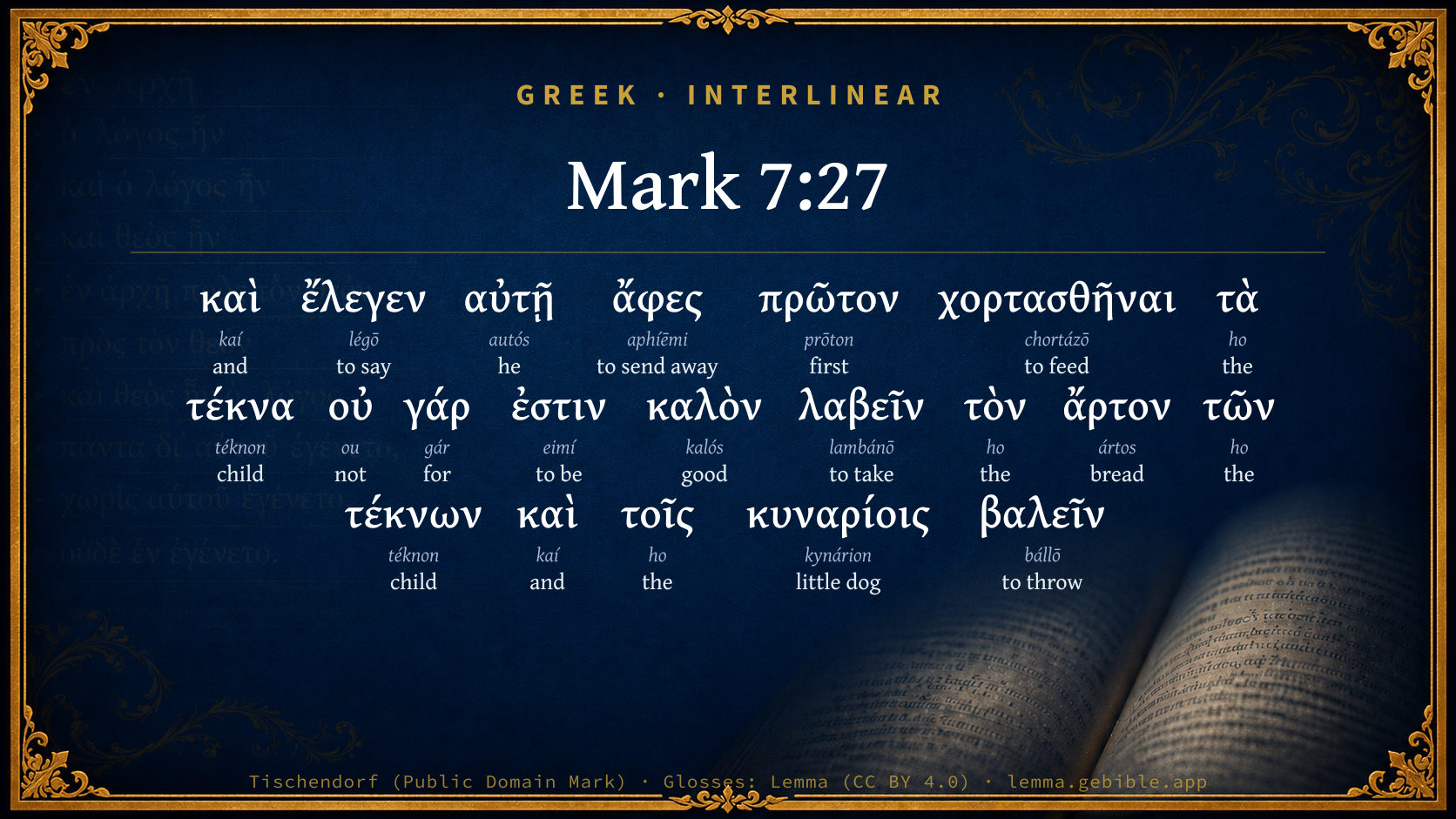
Greek (Tischendorf 8th ed.) Mark 7:27 appears in the Greek New Testament. The text above is from the Tischendorf 8th edition. Each word links to its Strong’s number and a concise gloss. Click any word for its full Thayer’s Greek Lexicon entry.
Download image
Cite this verse

Mark 7:27 (World English Bible). Public Domain. Lemma interlinear Bible study tool, https://lemma.gebible.app/v/mark/7/27.

Show BibTeX & RIS
BibTeX
RIS
English Translation
But Jesus said to her, "Let the children be filled first, for it is not appropriate to take the children's bread and throw it to the dogs."
World English Bible · Public Domain
Download a study sheet

One document with this verse’s original text, its word-by-word gloss line, the meaning frame, cross-references with their text, attributed commentary, and full source and license credits — printable, and it pastes into notes with its structure intact.

This verse Autodidact and up

Study sheet (.html) Plain text (.txt)

A passage Seminary Student

Up to 50 verses in one chapter. A passage sheet keeps up to 6 commentary sources and 12 cross-references per verse, in the order this page ranks them, and says so on the sheet whenever that leaves anything out. Ask for a single verse and you get the Autodidact verse sheet above.

Everything on this page stays free to read, with no account — the sheet is a download of what is already on screen, not access to it.

Want to remove ads? Support Godless Engineer
Compare translations 3

The same verse in 3 English versions, stacked beneath the original-language interlinear above. Click any original word for its lexicon entry.

Each is an independent rendering of the whole verse — the interlinear is not word-aligned to these translations.

Highlighted words mark where these versions differ — a whole-verse word diff, not a word-by-word alignment.

  • World English Bible Public Domain
    But Jesus said to her, "Let the children be filled first, for it is not appropriate to take the children's bread and throw it to the dogs."
  • King James Version Public Domain
    But Jesus said unto her, Let the children first be filled: for it is not meet to take the children's bread, and to cast it unto the dogs.
  • unfoldingWord Literal Text CC BY-SA 4.0
    And he was saying to her, “Permit the children first to be fed, for it is not good to take the bread of the children and to throw to the little dogs.”

unfoldingWord Literal Text — © unfoldingWord, licensed CC BY-SA 4.0. Word-aligned USFM3 via Door43 (git.door43.org/unfoldingWord/en_ult).

Versions to compare (up to 4)

3 of 4 selected

Show all 19 translations

Every available English version of this verse, each an independent rendering of the whole verse.

  • World English Bible Public Domain
    But Jesus said to her, "Let the children be filled first, for it is not appropriate to take the children's bread and throw it to the dogs."
  • Berean Standard Bible Public Domain
    “First let the children have their fill,” He said. “For it is not right to take the children’s bread and toss it to the dogs.”
  • Majority Standard Bible Public Domain
    “First let the children have their fill,” Jesus said. “For it is not right to take the children’s bread and toss it to the dogs.”
  • King James Version Public Domain
    But Jesus said unto her, Let the children first be filled: for it is not meet to take the children's bread, and to cast it unto the dogs.
  • American Standard Version (1901) Public Domain
    And he said unto her, Let the children first be filled: for it is not meet to take the children's bread and cast it to the dogs.
  • Revised Version (1885) Public Domain
    And he said unto her, Let the children first be filled: for it is not meet to take the children’s bread and cast it to the dogs.
  • Geneva Bible (1599) Public Domain
    But Iesus saide vnto her, Let the children first be fedde: for it is not good to take the childrens bread, and to cast it vnto whelpes.
  • Douay-Rheims (1899) Public Domain
    Who said to her: Suffer first the children to be filled: for it is not good to take the bread of the children, and cast it to the dogs.
  • Young's Literal Translation Public Domain
    And Jesus said to her, `Suffer first the children to be filled, for it is not good to take the children's bread, and to cast `it' to the little dogs.'
  • Literal Standard Version CC BY-SA 4.0
    And Jesus said to her, “First permit the children to be filled, for it is not good to take the children’s bread, and to cast [it] to the little dogs.”
  • Unlocked Literal Bible CC BY-SA 4.0
    He said to her, “Let the children first be fed. For it is not right to take the children's bread and throw it to the dogs.”
  • unfoldingWord Literal Text CC BY-SA 4.0
    And he was saying to her, “Permit the children first to be fed, for it is not good to take the bread of the children and to throw to the little dogs.”
  • Darby Bible Public Domain
    But [Jesus] said to her, Suffer the children to be first filled; for it is not right to take the children's bread and cast it to the dogs.
  • World Messianic Bible Public Domain
    But Yeshua said to her, “Let the children be filled first, for it is not appropriate to take the children’s bread and throw it to the dogs.”
  • Webster's Bible Public Domain
    But Jesus said to her, Let the children first be satisfied: for it is not meet to take the children's bread, and to cast it to the dogs.
  • Free Bible Version CC BY-SA 4.0
    “First let the children eat until they're full,” Jesus replied. “It's not right to take the children's food and throw it to the dogs.”
  • Bible in Basic English Public Domain
    And he said to her, Let the children first have their food: for it is not right to take the children's bread and give it to the dogs.
  • Text-Critical English NT CC BY 4.0
    But Jesus said to her, “Let the children first be filled, for it is not good to take the children's bread and throw it to the dogs.”
  • Tyndale New Testament (1534) Public Domain
    And Iesus sayde vnto her: let the chyldren fyrst be feed. For it is not mete to take the chyldres breed and to caste it vnto whelppes.

Literal Standard Version (2020), Covenant Press — licensed CC BY-SA 4.0. Text via the HelloAO Bible API (eBible.org). Unlocked Literal Bible (unfoldingWord) — licensed CC BY-SA 4.0. Text via the HelloAO Bible API (eBible.org). unfoldingWord Literal Text — © unfoldingWord, licensed CC BY-SA 4.0. Word-aligned USFM3 via Door43 (git.door43.org/unfoldingWord/en_ult). Free Bible Version, Dr. Jonathan Gallagher — licensed CC BY-SA 4.0. Text via the HelloAO Bible API (eBible.org).

Word by word

More ways to search: Search by grammar → Find every occurrence → Compare this word →

Practice this passage: Drill this verse → Learn its vocabulary →

κυναρίοις
kynárion
G2952
“little dog”
Noun, Dative, Plural, Neuter
Part of Speech
Noun
Case
Dative
Number
Plural
Gender
Neuter
Full Thayer's Definition

Origin: from a presumed derivative of G2965

TDNT: 21:24,5

1. a little dog
  1. καὶ kaí G2532 “and” Conjunction
  2. ἔλεγεν légō G3004 “to say” Verb, Imperfect, Active, Indicative, 3rd person, Singular
  3. αὐτῇ autós G846 “he” Personal pronoun, Dative, Singular, Feminine
  4. ἄφες aphíēmi G863 “to send away” Verb, Aorist, Active, Imperative, 2nd person, Singular
  5. πρῶτον prōton G4412 “first” Adverb, Superlative
  6. χορτασθῆναι chortázō G5526 “to feed” Verb, Aorist, Passive, Infinitive
  7. τὰ ho G3588 “the” Article, Accusative, Plural, Neuter
  8. τέκνα téknon G5043 “child” Noun, Accusative, Plural, Neuter
  9. οὐ ou G3756 “not” Particle, Negative
  10. γάρ gár G1063 “for” Conjunction
  11. ἐστιν eimí G1510 “to be” Verb, Present, Active, Indicative, 3rd person, Singular
  12. καλὸν kalós G2570 “good” Adjective, Nominative, Singular, Neuter
  13. λαβεῖν lambánō G2983 “to take” Verb, Aorist, Active, Infinitive
  14. τὸν ho G3588 “the” Article, Accusative, Singular, Masculine
  15. ἄρτον ártos G740 “bread” Noun, Accusative, Singular, Masculine
  16. τῶν ho G3588 “the” Article, Genitive, Plural, Neuter
  17. τέκνων téknon G5043 “child” Noun, Genitive, Plural, Neuter
  18. καὶ kaí G2532 “and” Conjunction
  19. τοῖς ho G3588 “the” Article, Dative, Plural, Neuter
  20. βαλεῖν bállō G906 “to throw” Verb, Aorist, Active, Infinitive

About this verse

These counts appear in no published source. They are computed here, from the morphology-tagged text and Lemma’s own curated glosses. What Lemma adds →

21
words
16
distinct lemmas
Gospels
section

Notable vocabulary

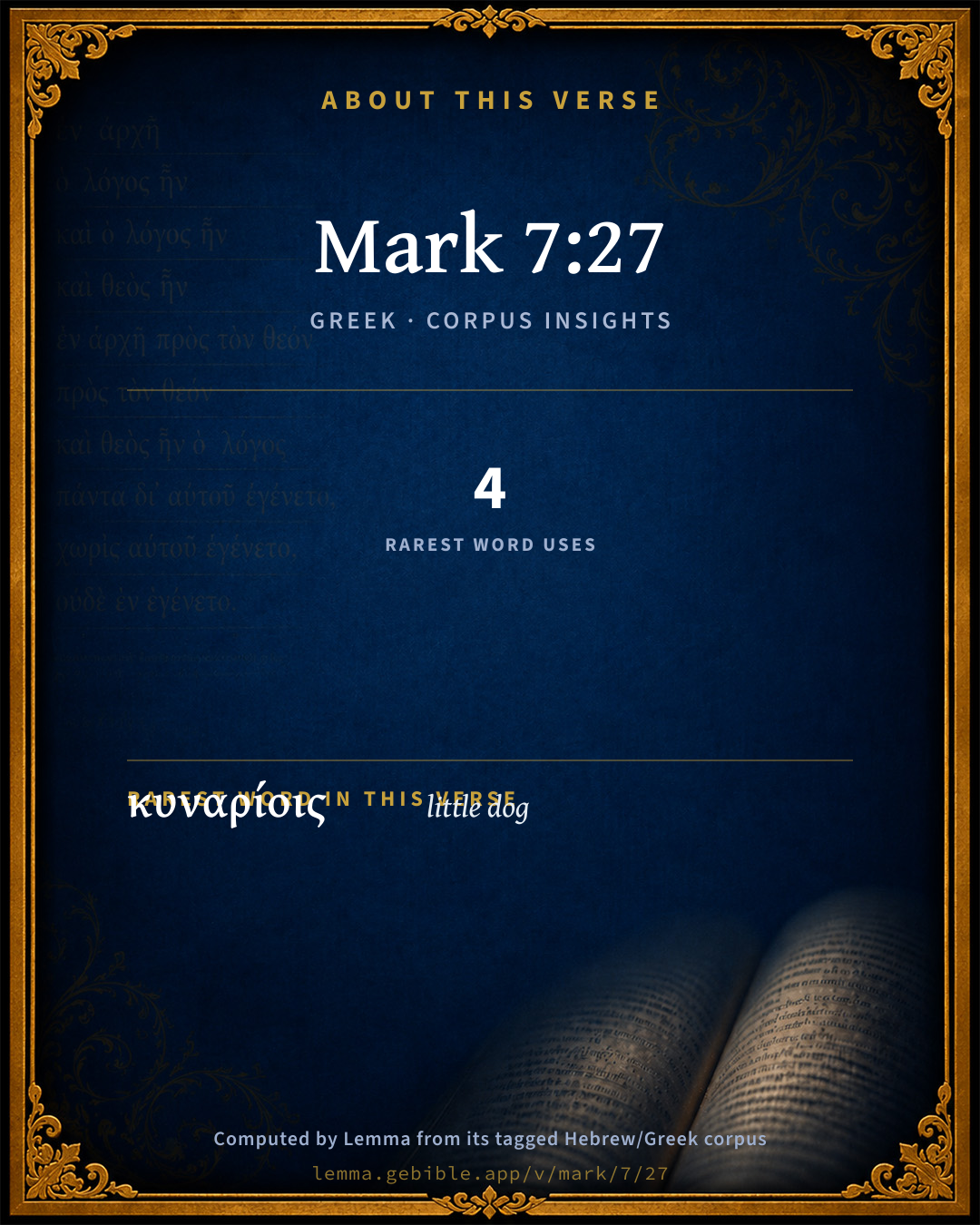
The rarest word here is κυναρίοις little dog G2952 — appearing just 4 times in the whole Greek New Testament.

Shared distinctive vocabulary

κυναρίοις little dog G2952 occurs in 4 verses of the Greek New Testament. Also found in:

Repetition

Words recur within this verse:

Cross-references

6

Topical passages linked to Mark 7:27 in the Treasury of Scripture Knowledge — connected by theme and wording, ordered by reader-vote popularity; previews shown in the World English Bible.

  • Matthew 15:23–28 But he answered her not a word. His disciples came and begged him, saying, "Send her away; for she cries after us."
  • Matthew 7:6 "Don't give that which is holy to the dogs, neither throw your pearls before the pigs, lest perhaps they trample them under their feet, and turn and tear you to pieces.
  • Matthew 10:5 Jesus sent these twelve out, and charged them, saying, "Don't go among the Gentiles, and don't enter into any city of the Samaritans.
  • Acts 22:21 "He said to me, 'Depart, for I will send you out far from here to the Gentiles.'"
  • Ephesians 2:12 that you were at that time separate from Christ, alienated from the commonwealth of Israel, and strangers from the covenants of the promise, having no hope and without God in the world.
  • Romans 15:8 Now I say that Christ has been made a minister of the circumcision for the truth of God, that he might confirm the promises given to the fathers,

Cross-references courtesy of OpenBible.info (CC BY 4.0).

Commentary

Notes on Mark 7:27 from classic Christian and Jewish commentators (each source and its license shown beneath its notes). The classic Christian expositions comment on the surrounding passage and are grouped to its opening verse, so a note may address several verses; the Jewish commentaries on the Tanakh (Rashi and others) are per-verse, so they appear only where the commentator wrote on this verse.

Lemma curates 59 commentaries, every one of them public domain or Creative Commons licensed, each selected and text-cleaned for this edition rather than reprinted as found. About our sources →

Tyndale Open Study Notes

Tyndale Open Resources

7:27-28 Jesus’ reply to the woman seems like a harsh refusal, but their interaction indicates that he wanted to see her faith (cp. Matt 15:28). • Jesus’ use of first did not exclude her as a Gentile from the grace of God but indicated that his mission was first to the Jews (Acts 13:46; Rom 1:16). The woman responded to Jesus’ words with humility and faith. She acknowledged the priority of the Jewish people but argued that there was more than enough food for the dogs as well. (In Jewish literature, Gentiles were frequently referred to as dogs, which were seen as filthy scavengers rather than as adorable pets; see also study note on Rev 22:15.) The woman’s persistence and acknowledgment of Jesus as Lord were rewarded.

Tyndale Open Study Notes — © Tyndale Open Resources, licensed CC BY-SA 4.0. Text via the HelloAO Bible API.

Bengel's Gnomon

Johann Albrecht Bengel

Mar 7:27. Ἄφες πρῶτον, let first) He does not give her a decided denial; He seems to mark to her the fact, that she is unseasonably importunate.—χορτασθῆναι, be filled) It would have been to derogate from the rights [privileges] of the Jews, had Jesus bestowed more time on the Gentiles.—[οὐ γὰρ καλόν ἐστι, for it is not becoming) That which is not in itself becoming, is altogether so in the case of those who duly pray.—V. g.]

Bengel's Gnomon of the New Testament — English translation (T&T Clark, Edinburgh, 1860) — public domain. Text from a community e-Sword module.

Expositor's Greek Testament

ed. W. Robertson Nicoll

Mar 7:27 . ἄφες πρῶτον , etc.: a milder word than that in Mt. (Mat 7:26 ); it is here a mere question of order: first Jews, then Gentiles, St. Paul’s programme, Rom 1:16 . In Mt. we read, οὐκ ἔστι καλὸν , it is not right, seemly, to take the children’s bread and to throw it to the dogs. Mk. also has this word, but in a subordinate place, and simply as a reason for the prior claim of the children. We note also that Mk., usually so full in his narratives compared with Mt., omits the intercession of the Twelve with Christ’s reply. Yet Mk.’s, “first the children,” is really equivalent to “I am not sent,” etc. The former implies: “your turn will come”; the latter: “to minister to you is not my vocation”. This word, preserved in Mt., becomes less harsh when looked at in the light of Christ’s desire for quiet, not mentioned in Mt. Jesus made the most of the fact that His commission was to Jews. It has been thought that, in comparison with Mt., Mk.’s report of Christ’s words is secondary, adapted purposely to Gentile readers. Probably that is the case, but, on the other hand, he gives us a far clearer view of the extent and aim of the excursion to the North, concerning which Mt. has, and gives, no adequate conception.

The Expositor's Greek Testament, edited by W. Robertson Nicoll (1897–1910) — public domain. Text from a community e-Sword module.

Geneva Bible (1599)

Geneva Bible translators

He useth this word Whelps rather than the word Dogs, that he may seem to speak more contumaciously.

Geneva Bible (1599) marginal notes — public domain. Text via Bolls.life.

Ellicott's Commentary for English Readers

(27) Let the children first be filled.—The precise form of the answer thus given is peculiar to St. Mark.

A Bible Commentary for English Readers, edited by Charles John Ellicott (1878–1897) — public domain. Text from a community e-Sword module.

The Cambridge Bible for Schools and Colleges

gen. ed. J. J. S. Perowne

27. But Jesus said unto her] St Mark passes more briefly over the interview than St Matthew. The latter Evangelist points out three stages of this woman’s trial; (i) Silence; “He answered her not a word” (Mat_15:23); (ii) Refusal; “I am not sent but unto the lost sheep of the house of Israel” (Mat_15:24); (iii) Reproach; “It is not meet to take the children’s bread and cast it to the dogs” (Mat_15:26). But in spite of all she persevered and finally conquered.

the dogs] In the original the diminutive is used = “little dogs.” “Little whelps” Wyclif; “the whelps” Tyndale, Cranmer. The Jews, “the children of the kingdom” (Mat_8:12), were wont to designate the heathen as “dogs,” the noble characteristics of which animal are seldom brought out in Scripture (comp. Deu_23:18; Job_30:1; 2Ki_8:13; Php_3:2; Rev_22:15). Here however the term is somewhat softened. The heathen are compared not to the great wild dogs infesting Eastern towns (1Ki_14:11; 1Ki_16:4; 2Ki_9:10), but to the small dogs attached to households. In the East now the Mahometans apply this name to the Christians.

The Cambridge Bible for Schools and Colleges (gen. ed. J. J. S. Perowne; Cambridge University Press, 1878–1918) — public domain. Text from a community e-Sword module.

John Gill's Exposition

And she answered and said unto him, yes, Lord,.... Agreeing to, and acquiescing in, what he said; which she seemed to have understood, though delivered in a proverbial way; and very appropriately replies,

yet the dogs under the table eat of the children's crumbs; which they leave, or let fall: signifying that she did not envy the blessings of the Jews, or desire any thing might be done injurious to them; only that this favour might be granted her, which she owned she was unworthy of, that her daughter might be healed. She tacitly owns, that the character of dogs belonged to the Gentiles, and to her and hers among the rest; that they were vile and base in themselves, inferior to the Jews, as to privileges, like dogs under the table; that the provisions with which the table of the Gospel ministry was furnished, was not for them; at least, that they were quite undeserving of them: but however, whereas dogs were allowed to eat crumbs, which now and then fell from the table, or out of the children's hands and laps; so such unworthy Gentiles as she, might be allowed a small benefit or favour by the bye, when it did not take from, and was no disadvantage to the Jews; See Gill on Mat 15:27.

John Gill's Exposition of the Whole Bible (1746–1763) — public domain (CC PDM 1.0). Text via the HelloAO Bible API.

Trapp's Complete Commentary

John Trapp

27 But Jesus said unto her, Let the children first be filled: for it is not meet to take the children’s bread, and to cast it unto the dogs.

Ver. 27. To cast it unto dogs] τοις κυναριοις, unto whelps, for more contempt’ sake, as Beza noteth. The pope made Dandalus, the Venetian ambassador, to come before him, tied in iron chains, and to wallow under his table with dogs, while his Holiness sat at supper. Unde ei canis cognomentum apud suos, saith Revius. He was ever after called the dog ambassador.

John Trapp, A Commentary or Exposition upon All the Books of the Old and New Testament (1647–1656) — public domain. Text from a community e-Sword module.

Kretzmann's Popular Commentary

Paul E. Kretzmann

The victory of faith:

v. 27. But Jesus said unto her, Let the children first be filled; for it is not meet to take the children’s bread, and to cast it unto the dogs.

v. 28. And she answered and said unto Him, Yes, Lord; yet the dogs under the table eat of the children’s crumbs.

v. 29. And He said unto her, For this saying go thy way; the devil is gone out of thy daughter.

v. 30. And when she was come to her house, she found the devil gone out, and her daughter laid upon the bed.

Mark gives the story in a very brief form, merely indicating the battle which the woman fought in proving herself equal to the test of faith which Jesus laid upon her. Christ was not sent but to the lost sheep of the house of Israel, Mat 15:24; His personal ministry extended no farther, and He frankly told the woman so. Neither could the impatient interference of the disciples induce Him to change His mind, Mat 15:21-28. But the woman’s method of attacking Christ and taking hold of His own words in her interest won the day for her. When He told her: Let the children have their food first; it isn’t a nice thing to take the children’s bread and throw it to the dogs, she acknowledged and admitted the truth of that saying without reservation. She stood the blow in a splendid manner, as Luther says. She was ready to concede to the Jews the right of being children of God, His chosen nation. But she marked well that Jesus used the word that was usually applied to the privileged house-dogs, that had the right to gather up the crumbs under the table. Upon this word she pounces, to that she clings: Yes, Lord. In spite of the fact that He had apparently rejected her and her petition, though there seemed no ray of hope in His manner nor in His words, she found the one place where He had left an opening: And yet the little house-dogs under the table eat of the crumbs of the children; if Thou thinkest the comparison fits, Lord, I do not question it; rather do I count myself lucky that this word includes a promise for me, the promise to receive the crumbs which the Jews, in the richness of the ministry being done among them, will never miss. Thus did this heathen woman give evidence of a conquering faith, in overcoming Christ with His own arguments. And Jesus, ever delighted over any show of true trust and faith in Him, gladly yields to her request, for the sake of that word of humble trust, of sublime assurance which she hath spoken. Let her therefore go home happy, for the demon had already gone forth out of her daughter. And so she found the situation when she came to her house: the daughter, whom the evil spirit had formerly tormented and torn in the most excruciating manner, now lying quietly on the couch, with no more indication of her former suffering. Her faith had won the victory. We, who have much more definite promises of the Lord regarding our earthly and spiritual welfare, usually do not show even a fraction of the faith exhibited by the Syrophoenician woman. It behooves us to be much more instant in prayer and, above all, much more persevering in our appeals to the grace and mercy of God, no matter what gifts we have in mind. We must learn to conquer the Lord with His own words and promises, then true happiness will be ours both here and hereafter.

Paul E. Kretzmann, Popular Commentary of the Bible (1921–1924) — public domain. Text from a community e-Sword module.

unfoldingWord translationNotes

Door43 World Missions Community

Let the children first be fed. For it is not right ... throw it to the dogs

Here Jesus speaks about the Jews as if they are children and the Gentiles as if they are dogs. AT: "Let the children of Israel first be fed. For it is not right to take the children's bread and throw it to the Gentiles, who are like dogs" (See: Metaphor)

Let the children first be fed

This can be stated in active form. AT: "We must first feed the children of Israel" (See: Active or Passive)

bread

This refers to food in general. AT: "food" (See: Synecdoche)

dogs

This refers to small dogs kept as pets.

translationWords

bread

lord

unfoldingWord translationNotes — © Distant Shores Media and the Door43 World Missions Community, licensed CC BY-SA 4.0. Source: git.door43.org/Door43/en_tn.

Cambridge Greek Testament for Schools and Colleges

27. ἔλεγεν. Mt. again substitutes εἶπεν, as in Mar 7:14.

Ἄφες πρῶτον χορτασθῆναι τὰ τέκνα. See on Mar 6:42 and cf. Mar 10:14. In Mar 15:36 we have the subj. after ἄφετε. “The children” are the Jews, but πρῶτον implies that the others will have their turn (Joh 10:16; Joh 12:32; Joh 17:20; Act 1:8; Act 13:47). This important πρῶτον is omitted in Mt. It mitigates the harsh refusal.

ἐστιν καλόν. The expression is freq. in Mk. Cf. Mar 9:5; Mar 9:42-43; Mar 9:45; Mar 9:47; Mar 14:21. Christ’s reply illustrates the principle that, where faith is strong, He seems to hold aloof, to bring the faith to perfection; whereas weak faith is encouraged (Mar 5:36, Mar 9:23).

τοῖς κυναρίοις. The diminutive is another mitigation. The Gentiles are not called “dogs” but “doggies,” not outside scavengers (Psa 59:7; Psa 59:15), but household companions (τὰ κυνίδια τῆς οἰκίας, Orig.). In late Greek, diminutives sometimes lose their force, e.g. ὠτάριον (Mar 14:47), ὠτίον (Mat 26:51); but the dimin. has point here. Contrast κύνες (Mat 7:6; Php 3:2; Rev 22:15). Vulg. spoils this by having canibus in Christ’s Saying and catelli in her reply.

Cambridge Greek Testament for Schools and Colleges (Cambridge University Press, 1896; 21 vols, various authors incl. Carr, Maclear, Plummer, Farrar, Lumby, Moule, M. R. James, Simcox) — public domain. Text from a community e-Sword module.

Alford’s Greek Testament

Henry Alford

27.] ἄφες πρῶτον.…] This important addition in Mark sets forth the whole ground on which the present refusal rested. The Jews were first to have the Gospel offered to them, for their acceptance or rejection; it was not yet time for the Gentiles.

Henry Alford, The Greek Testament (1849–1861) — public domain. Text from a community e-Sword module.

International Critical Commentary

27. καὶ ἔλεγεν—and he said.

This reading, instead of ὁ δὲ Ἰησοῦς εἶπεν, and Jesus said, Tisch. Treg. WH. RV. א BL Δ 33, Memph.

Ἄφες πρῶτον χορτασθῆναι τὰ τέκνα—let the children be fed first. In this word, first, Jesus hints that the time of the Gentiles is coming, as he frequently does in the course of his teaching, while he restricts his own work to the Jews. Mt. omits this, and makes Jesus’ refusal to be much more definite and positive. τ. τεκνων … τ. κυναρίοις—By these terms, Jesus distinguishes between the Jews, who are the children of the household, and the Gentiles. Dogs is a term expressing the contempt of your true Jew for the heathen, and sounds strange in the mouth of our Lord. Weiss denies the contemptuous use of the term dog, and makes it merely a parable, in which an arrangement of the kingdom of God is expressed in the terms of household economy, in which the contempt for dogs plays no part. But this is to ignore the fact that “dog” is always a term of contempt, especially in the East; that as such, it was applied by Jews to Gentiles; and that, if Jesus did not mean to express contempt, his language was singularly ill-chosen, as the woman would be sure to understand him so. See Bib. Dic. But I am inclined to believe that Jesus did not use the term seriously, but with a kind of ironical conformity to this common sneer, having felt in his own experience how small occasion the Jews of his time had to treat any other people with contempt. He had good reasons for confining his work to the Jews, but they did not arise from any acceptance of their estimate of themselves or of others. It is as if he had put in a “you know,” to indicate a common opinion.

International Critical Commentary — older volumes (1896–1929), various authors — public domain. Text from a community e-Sword module.

Vincent's Word Studies in the New Testament

Marvin R. Vincent

Let the children first be filled. Peculiar to Mark.

The dogs. Diminutive. See on Mt 14:26.

Marvin R. Vincent, Word Studies in the New Testament (1887–1900) — public domain. Text from a community e-Sword/MySword module.

Lesson kit

Teaching starters — assembled from the data on this page, not authored interpretation. Every prompt links to the verse data it draws on. Edit before teaching.

Mark, in the Gospels, opens this verse with 21 words (16 distinct Greek lemmas). Its most distinctive word is kynárion (“little dog”). A historical commentator’s framing appears above. Read the whole chapter for the surrounding context.

Discussion questions

  1. What does “little dog” (kynárion) contribute to the verse as a whole?
  2. How does Matthew 15:26, which shares the word «little dog», read alongside this verse?
  3. What does the repetition of “child” (2× in this one verse) do in this verse?
  4. The translations on this page render this verse differently — a whole-verse word diff, not a word-by-word alignment. What might account for the different wordings?
  5. Compare how Tyndale Open Study Notes and Bengel's Gnomon read this verse. Where do they agree or differ?

Things to notice

Reading settings

Reading text

Shown beneath each verse's original-language words.

Old Testament
Old Testament edition

Read the OT as the Masoretic Hebrew (MT) or the Greek Septuagint (LXX).

English shown for the Greek Septuagint (in the Hebrew ↔ Greek comparison).

Comparing translations? Open the Compare panel on any verse page to stack up to four side by side.