2 Corinthians 12:16

Greek (Tischendorf 8th ed.) 2 Corinthians 12:16 appears in the Greek New Testament. The text above is from the Tischendorf 8th edition. Each word links to its Strong’s number and a concise gloss. Click any word for its full Thayer’s Greek Lexicon entry.
Download image
Cite this verse

2 Corinthians 12:16 (World English Bible). Public Domain. Lemma interlinear Bible study tool, https://lemma.gebible.app/v/2-corinthians/12/16.

Show BibTeX & RIS
BibTeX
RIS
English Translation
But be it so, I did not myself burden you. But, being crafty, I caught you with deception.
World English Bible · Public Domain
Highlights
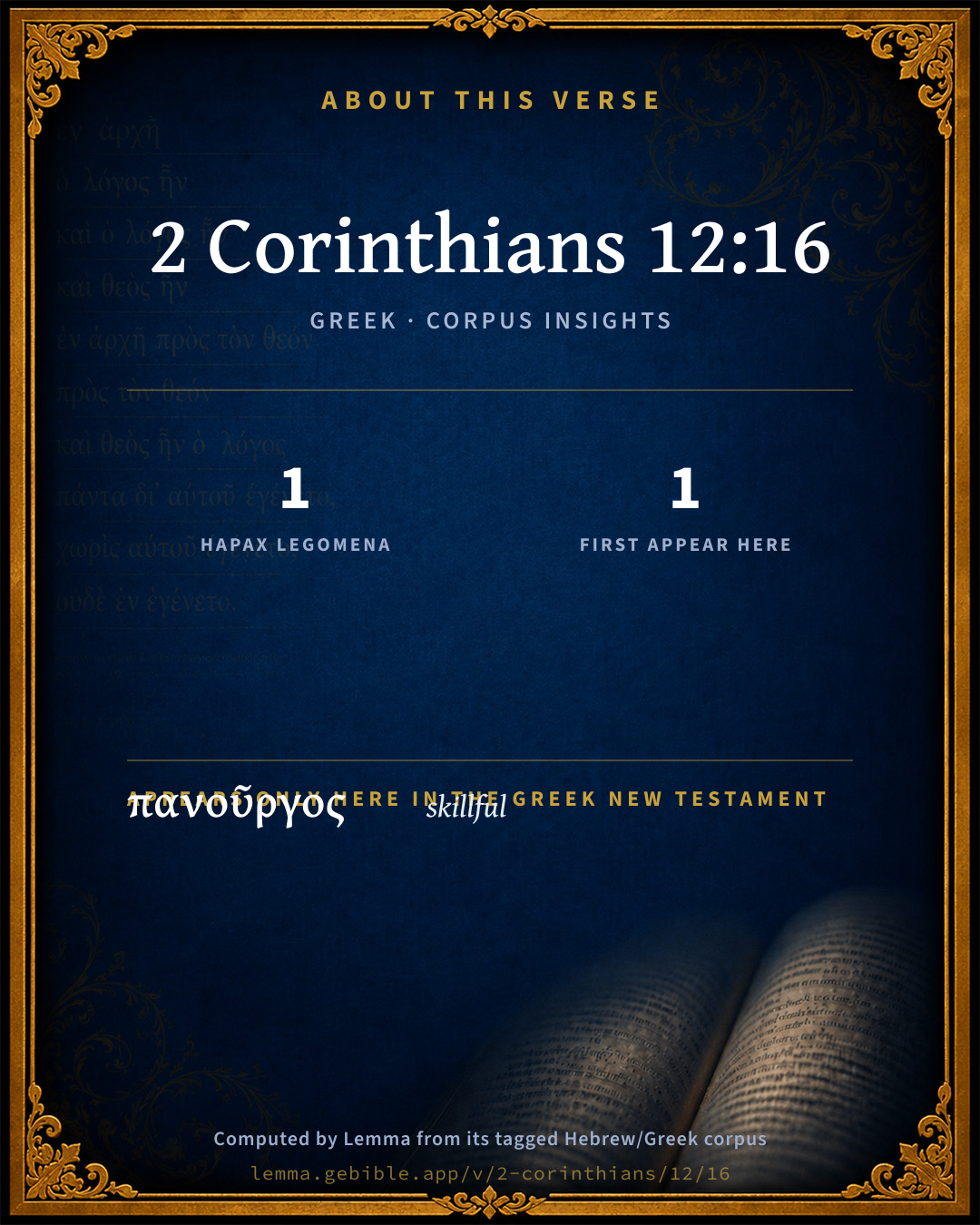
  • 1 hapax legomenon — only here in the Greek New Testament
  • 1 first appearance in the Greek New Testament
Full analysis ↓
Download a study sheet

One document with this verse’s original text, its word-by-word gloss line, the meaning frame, cross-references with their text, attributed commentary, and full source and license credits — printable, and it pastes into notes with its structure intact.

This verse Autodidact and up

Study sheet (.html) Plain text (.txt)

A passage Seminary Student

Up to 50 verses in one chapter. A passage sheet keeps up to 6 commentary sources and 12 cross-references per verse, in the order this page ranks them, and says so on the sheet whenever that leaves anything out. Ask for a single verse and you get the Autodidact verse sheet above.

Everything on this page stays free to read, with no account — the sheet is a download of what is already on screen, not access to it.

Want to remove ads? Support Godless Engineer
Compare translations 3

The same verse in 3 English versions, stacked beneath the original-language interlinear above. Click any original word for its lexicon entry.

Each is an independent rendering of the whole verse — the interlinear is not word-aligned to these translations.

Highlighted words mark where these versions differ — a whole-verse word diff, not a word-by-word alignment.

  • World English Bible Public Domain
    But be it so, I did not myself burden you. But, being crafty, I caught you with deception.
  • King James Version Public Domain
    But be it so, I did not burden you: nevertheless, being crafty, I caught you with guile.
  • unfoldingWord Literal Text CC BY-SA 4.0
    But let it be, I myself did not burden you, but being crafty, I caught you by deceit.

unfoldingWord Literal Text — © unfoldingWord, licensed CC BY-SA 4.0. Word-aligned USFM3 via Door43 (git.door43.org/unfoldingWord/en_ult).

Versions to compare (up to 4)

3 of 4 selected

Show all 19 translations

Every available English version of this verse, each an independent rendering of the whole verse.

  • World English Bible Public Domain
    But be it so, I did not myself burden you. But, being crafty, I caught you with deception.
  • Berean Standard Bible Public Domain
    Be that as it may, I was not a burden to you; but crafty as I am, I caught you by trickery.
  • Majority Standard Bible Public Domain
    Be that as it may, I was not a burden to you; but crafty as I am, I caught you by trickery.
  • King James Version Public Domain
    But be it so, I did not burden you: nevertheless, being crafty, I caught you with guile.
  • American Standard Version (1901) Public Domain
    But be it so, I did not myself burden you; but, being crafty, I caught you with guile.
  • Revised Version (1885) Public Domain
    But be it so, I did not myself burden you; but, being crafty, I caught you with guile.
  • Geneva Bible (1599) Public Domain
    But bee it that I charged you not: yet for as much as I was craftie, I tooke you with guile.
  • Douay-Rheims (1899) Public Domain
    But be it so: I did not burthen you: but being crafty, I caught you by guile.
  • Young's Literal Translation Public Domain
    And be it `so', I -- I did not burden you, but being crafty, with guile I did take you;
  • Literal Standard Version CC BY-SA 4.0
    And be it [so], I did not burden you, but being crafty, I took you with guile;
  • Unlocked Literal Bible CC BY-SA 4.0
    But as it is, I did not burden you. But, since I am so crafty, I am the one who caught you by deceit.
  • unfoldingWord Literal Text CC BY-SA 4.0
    But let it be, I myself did not burden you, but being crafty, I caught you by deceit.
  • Darby Bible Public Domain
    But be it so. *I* did not burden you, but being crafty I took you by guile.
  • World Messianic Bible Public Domain
    Even so, I myself didn’t burden you. But you might say that being crafty, I caught you with deception.
  • Webster's Bible Public Domain
    But be it so, I did not burden you: nevertheless, being crafty, I caught you with guile.
  • Free Bible Version CC BY-SA 4.0
    Well, even if that's so, I wasn't a burden to you. Maybe I was being devious, and tricked you with my cunning ways!
  • Bible in Basic English Public Domain
    But let it be so, that I was not a trouble to you myself; but (someone may say) being false, I took you with deceit.
  • Text-Critical English NT CC BY 4.0
    Be that as it may, I did not burden you. But crafty fellow that I am, I apparently took you in by deceit!
  • Tyndale New Testament (1534) Public Domain
    But be it that I greved you not: never the lesse I was crafty and toke you with gile.

Literal Standard Version (2020), Covenant Press — licensed CC BY-SA 4.0. Text via the HelloAO Bible API (eBible.org). Unlocked Literal Bible (unfoldingWord) — licensed CC BY-SA 4.0. Text via the HelloAO Bible API (eBible.org). unfoldingWord Literal Text — © unfoldingWord, licensed CC BY-SA 4.0. Word-aligned USFM3 via Door43 (git.door43.org/unfoldingWord/en_ult). Free Bible Version, Dr. Jonathan Gallagher — licensed CC BY-SA 4.0. Text via the HelloAO Bible API (eBible.org).

Word by word

More ways to search: Search by grammar → Find every occurrence → Compare this word →

Practice this passage: Drill this verse → Learn its vocabulary →

πανοῦργος
panoûrgos
G3835
“skillful”
Noun, Nominative, Singular, Masculine
Part of Speech
Noun
Case
Nominative
Number
Singular
Gender
Masculine
Full Thayer's Definition

Origin: from G3956 and G2041

TDNT: 17:02,8

1. skilful, clever a. in a good sense, fit to undertake and accomplish anything, dexterous, wise, sagacious, skilful b. in a bad sense, crafty, cunning, knavish, treacherous, deceitful
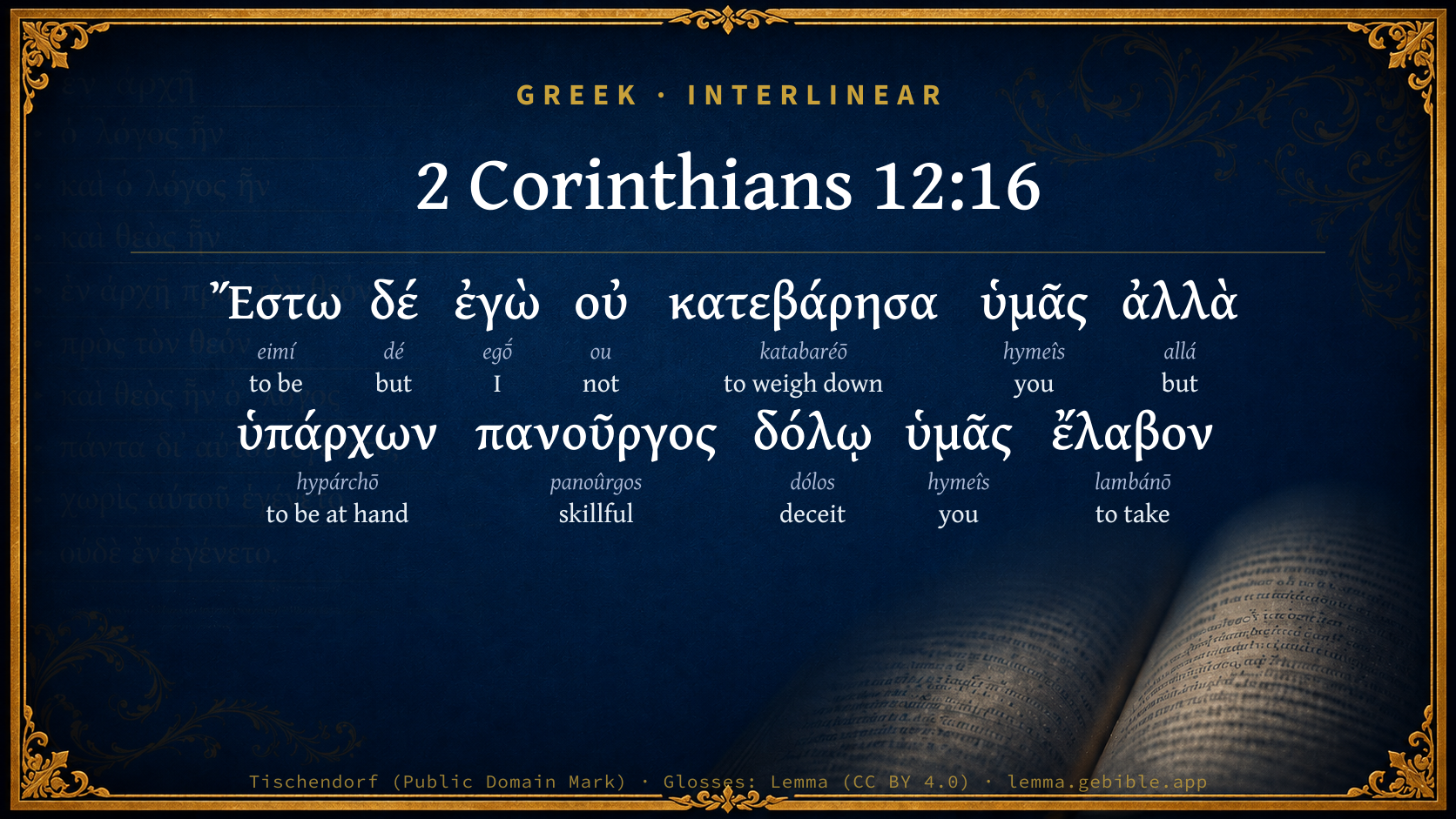
  1. Ἔστω eimí G1510 “to be” Verb, Present, Active, Imperative, 3rd person, Singular
  2. δέ dé G1161 “but” Conjunction
  3. ἐγὼ egṓ G1473 “I” Personal pronoun, 1st person, Nominative, Singular
  4. οὐ ou G3756 “not” Particle, Negative
  5. κατεβάρησα katabaréō G2599 “to weigh down” Verb, Aorist, Active, Indicative, 1st person, Singular
  6. ὑμᾶς hymeîs G5210 “you” Personal pronoun, 2nd person, Accusative, Plural
  7. ἀλλὰ allá G235 “but” Conjunction
  8. ὑπάρχων hypárchō G5225 “to be at hand” Verb, Present, Active, Participle, Nominative, Singular, Masculine
  9. δόλῳ dólos G1388 “deceit” Noun, Dative, Singular, Masculine
  10. ὑμᾶς hymeîs G5210 “you” Personal pronoun, 2nd person, Accusative, Plural
  11. ἔλαβον lambánō G2983 “to take” Verb, Aorist, Active, Indicative, 1st person, Singular

About this verse

These counts appear in no published source. They are computed here, from the morphology-tagged text and Lemma’s own curated glosses. What Lemma adds →

12
words
11
distinct lemmas
Pauline Epistles
section

Notable vocabulary

1 hapax legomenon — a word that appears only here in the entire Greek New Testament:

  • πανοῦργος skillful G3835

First appearance in Scripture

This word makes its first canonical appearance in the Greek New Testament here:

  • πανοῦργος skillful G3835

Shared distinctive vocabulary

κατεβάρησα to weigh down G2599 occurs in 2 verses of the Greek New Testament. Also found in:

Repetition

A word recurs within this verse:

  • ὑμᾶς you G5210 ×2

Cross-references

9

Topical passages linked to 2 Corinthians 12:16 in the Treasury of Scripture Knowledge — connected by theme and wording, ordered by reader-vote popularity; previews shown in the World English Bible.

  • 2 Corinthians 1:12 For our boasting is this: the testimony of our conscience, that in holiness and sincerity of God, not in fleshly wisdom but in the grace of God we behaved ourselves in the world, and more abundantly toward you.
  • 2 Corinthians 4:2 But we have renounced the hidden things of shame, not walking in craftiness, nor handling the word of God deceitfully; but by the manifestation of the truth commending ourselves to every man's conscience in the sight of God.
  • 2 Corinthians 7:2 Open your hearts to us. We wronged no one. We corrupted no one. We took advantage of no one.
  • 2 Corinthians 10:2–3 Yes, I beg you that I may not, when present, show courage with the confidence with which I intend to be bold against some, who consider us to be walking according to the flesh.
  • 2 Corinthians 11:9–10 When I was present with you and was in need, I wasn't a burden on anyone, for the brothers, when they came from Macedonia, supplied the measure of my need. In everything I kept myself from being burdensome to you, and I will continue to do so.
  • 2 Corinthians 12:13 For what is there in which you were made inferior to the rest of the assemblies, unless it is that I myself was not a burden to you? Forgive me this wrong.
  • 1 Thessalonians 2:3 For our exhortation is not of error, nor of uncleanness, nor in deception.
  • 1 Thessalonians 2:5 For neither were we at any time found using words of flattery, as you know, nor a cloak of covetousness (God is witness),
  • 1 Peter 2:3 if indeed you have tasted that the Lord is gracious:

Cross-references courtesy of OpenBible.info (CC BY 4.0).

Commentary

Notes on 2 Corinthians 12:16 from classic Christian and Jewish commentators (each source and its license shown beneath its notes). The classic Christian expositions comment on the surrounding passage and are grouped to its opening verse, so a note may address several verses; the Jewish commentaries on the Tanakh (Rashi and others) are per-verse, so they appear only where the commentator wrote on this verse.

Lemma curates 59 commentaries, every one of them public domain or Creative Commons licensed, each selected and text-cleaned for this edition rather than reprinted as found. About our sources →

Joseph Benson's Commentary

2Co 12:16-18. Be it so, &c. — But some may object; though I did not burden you — Though I did not take any thing of you myself; yet being crafty, I caught you with guile — I did secretly by my messengers what I would not do openly or in person. I answer this lying accusation by appealing to plain fact. Did I make a gain of you by any of my messengers? — You know the contrary. It should be carefully observed that St. Paul does not allow, but absolutely denies, that he had caught them with guile. So that the common plea for guile, which has been drawn from this text, is utterly without foundation. I desired Titus — To go to you; and with him I sent a brother — Who that brother was, is not known. He may have been one of the apostle’s companions in travel, who was with him in Ephesus when he wrote his first epistle to the Corinthians. Or he may have been one of the Ephesian brethren, whose zeal for the gospel moved him to accompany Titus to Corinth, when he carried the former letter. Did Titus make a gain of you? — Did he draw any money from you, either on account of his own maintenance, or on pretence that he would persuade me to receive it for mine? Walked we not in the same spirit, &c. — Did we not all agree in mind and practice?

Joseph Benson's Commentary on the Old and New Testaments (1811–1818) — public domain. Text from a community e-Sword module.

Tyndale Open Study Notes

Tyndale Open Resources

12:16-18 Some of the Corinthians still believed that Paul had deceived them by trickery. They might have insinuated that Paul was helping himself to the proceeds of the collection for the Jerusalem church (chs 8–9). The answer to this charge is a reminder of the integrity of Titus and the other brother (see 8:18-24). The integrity of Paul and his associates should debunk such false charges.

Tyndale Open Study Notes — © Tyndale Open Resources, licensed CC BY-SA 4.0. Text via the HelloAO Bible API.

Bengel's Gnomon

Johann Albrecht Bengel

2Co 12:16. Ἀλλʼ ὑπάρχων, but inasmuch as I was) an objection which the Corinthians [moved by suspicion, V. g.] might frame.[87] The answer is in the following verse.—ἜΛΑΒΟΝ, I caught) that you might not escape the net, that was set with a view to my gain.

[87] i.e., You may object and say that though I did not burden you, I yet, as being crafty, caught you by guile.—ED.

Bengel's Gnomon of the New Testament — English translation (T&T Clark, Edinburgh, 1860) — public domain. Text from a community e-Sword module.

Meyer's Critical & Exegetical Commentary

Heinrich August Wilhelm Meyer

2Co_12:16-18. Refutation of the possible slander, which assuredly was also actually ventured on the part of his adversaries, that, if he had not himself directly burdened the Corinthians, he had still done so in a cunning way indirectly by means of his emissaries.

In 2Co_12:16 Paul does not, indeed, speak in the person of his opponents, for otherwise, instead of ἐγώ, he must have expressed himself in the third person; but he clothes his speech in the words of his adversaries.[382]

ἔστω δέ] concessive: but be it so, it may, however, be the case that I have not oppressed you. Comp. Plat. Gorg. p. 516 C, al. (Krüger, § 54, 4. 2); also the εἶεν, very common in classical writers, Stallbaum, ad Plat. Euthyph. p. 13 D; Reisig, ad Oed. Col. 1303, and for the similar use of the Latin esto, sit ita sane, Cicero, Tusc. i. 43. 102; De Fin. iv. 45.

ἐγώ] my own perso.

ἈΛΛʼ ὙΠΆΡΧΩΝ Κ.Τ.Λ.] no longer depends on ἜΣΤΩ ΔΈ, but is the contrastto be read as an exclamationof ἜΣΤΩ ΔῈ, ἘΓῺ Οὐ ΚΑΤΕΒΆΡ. ὙΜᾶς: but cunningly I, et.

δόλῳ] This would have been the case, if he had made plunder of them indirectly by a third han.

ἜΛΑΒΟΝ] caught, figure taken from hunting. See on 2Co_11:20. Comp. on δόλῳ λαμβάν. Soph. Phil. 101, 107, 1266.2Co_12:17-18 now show in lively questions, appealing to the readers own experience, how untrue that ἀλλʼ ὑπάρχων … ἔλαβον was. Have I then overreached you by one of those whom I sent to you? namely, by claims for money, and the like. The construction is anacoluthic, inasmuch as Paul, for emphasis, prefixes absolutely the τινα ὧν ἀπέσταλκα πρὸς ὑμᾶς as the object of what he wishes to say, and then subjoins the further statement independently of it, so that the accusative remains the more emphatically pendenta usage found also in classical writers. See Bernhardy, p. 133.

ὧν] τούτων οὕς. Comp. Rom_15:18.

In 2Co_12:18 he now mentions, by way of example, Titus, whom he had encouraged to travel to Corinth, and his fellow-envoy, and he asks, significantly repeating ἐπλεονέκτ. and prefixing it: Has Titus overreached you? This journey of Titus to Corinth is not, as is otherwise usually supposed, the one mentioned in chap. 8, which had yet to be made, and in which Titus had two companions (2Co_8:18; 2Co_8:22), but the one made soon after our first Epistle, and mentioned in chap. 7. The fact that Titus only is here mentioned, and not also Timothy (1Co_4:17; 1Co_16:10), is made use of to support the opinion that Timothy had not come to Corinth at all (see the Introd.). Comp. Rück. pp. 380, 409. But how groundlessly! From the long and close connection of the apostle with the Corinthians it may be even à priori concluded, that he had sent various persons to Corinth beside Titus; and he himself testifies this by the plural ὧν ἀπέσταλκα. But here he names only Titus instar omnium as the one last sent. Besides, it would not have been even proper to say: I have sent Timothy to you, since Timothy, in fact, was joint-sender of the letter (2Co_1:1).

τὸν ἀδελφόν] the brother (fellow-Christian) well known to them (but unknown to us).[383] That in that mission he was quite subordinate to Titus is clear from συναπέστ., and from the fact that in what follows the conduct of Titus alone is spoken o.

τῷ αὐτῷ πνευμ.] with the same Spirit, namely, with the Holy Spirit determining our walk and excluding all πλεονεξία. The dative is that of manner to the question how? Comp. Act_9:31; Act_21:21; Rom_13:13. It may, however, also be just as fitly taken as dative of the norm (Gal_5:16; Gal_6:16). We cannot decide the point. If the inward agreement is denoted by τῷ αὐτῷ πνευμ., the likeness of outward procedure is expressed by τοῖς αὐτοῖς ἴχυεσι (comp. Plat. Phaed. p. 276 D: τῷ ταὐτὸν ἴχνος μετιόντι). But here the dative is local, as in Act_14:16; Jud_1:11 (comp. Fritzsche, ad Rom. I. p. 225 f.). So Pind. Pyth. x 20: ἐμβέβακεν ἴχνεσιν πατρός, comp. with Nem. vi 27: ἴχνεσιν ἐν Πραξιδάμαντος ἐὸν πόδα νέμων. Whose are the footsteps, in which the two walked? The footsteps of Paul, in which Titus followed his predecessor (comp. Lucian, Herm. 73), so that they thereby became the same, in which both walkedsaid with reference to the unselfishness maintained by both. The context does not yield any reference to Christ (1Pe_2:21).

[382] Let us conceive that they had asserted regarding Paul: ἔστω δέ· αὐτὶς οὐ κατεβάρησεν ὑμᾶς κ.τ.λ. This Paul makes use of, inasmuch as he, entering into their meaning, says of himself, what they have said of hima mimesis, which is almost a parody.

[383] According to Wieseler, Chronol. p. 349, it was Tychicus, as also at 2Co_8:22. This rests on a combination drawn from Tit_3:12.

Meyer — Critical and Exegetical Commentary on the New Testament — English translation by Peter Christie, edited by Frederick Crombie (T&T Clark, 1880) — public domain. Text from a community e-Sword module.

Expositor's Greek Testament

ed. W. Robertson Nicoll

2Co 12:16 . ἔστω δὲ κ . τ . λ .: but he it so! I did not myself burden you ( cf. 2Co 11:9 and 2Co 12:13 ). This the Corinthians grant as indisputable, but they allege a sinister reason, viz., being crafty (for ὑπάρχων see on 2Co 8:17 ) I caught you (see on 2Co 11:20 ) with guile ( cf. 2Co 4:2 , μὴ περιπατοῦντες ἐν πανουργίᾳ μηδὲ δολοῦντες κ . τ . λ .). That is, his adversaries hinted that, although he did not accept maintenance directly, yet the collection made for the Judæan Christians was under his hand, and that he was not above suspicion in his disposal of it. To this he returns an indignant denial, and appeals directly to their own observation of the messengers whom he had sent, of whom Titus (at least) had met him in Macedonia with a report (2Co 7:6 ) and was sent back to Corinth with two companions to complete the business, carrying this letter (2Co 8:6 ; 2Co 8:18 ff.).

The Expositor's Greek Testament, edited by W. Robertson Nicoll (1897–1910) — public domain. Text from a community e-Sword module.

Geneva Bible (1599)

Geneva Bible translators

He putteth away another most grievous slander, to wit, that he did subtly and by others, make his gain and profit of them.

Geneva Bible (1599) marginal notes — public domain. Text via Bolls.life.

Jamieson, Fausset & Brown

Robert Jamieson, A. R. Fausset & David Brown

I did not burden you--The "I" in the Greek is emphatic. A possible insinuation of the Corinthians is hereby anticipated and refuted: "But, you may say, granted that I did not burden you myself; nevertheless, being crafty, I caught you (in my net) with guile"; namely, made a gain of you by means of others (Th1 2:3).

Jamieson, Fausset & Brown — Commentary Critical and Explanatory on the Whole Bible (1871) — public domain (CC PDM 1.0). Text via the HelloAO Bible API.

Adam Clarke's Commentary

Verse 16. But be it so, I did not burden you] That is: You grant that I did not burden you, that I took nothing from you, but preached to you the Gospel freely; but you say that, BEING CRAFTY, I caught you with guile; i.e. getting from you, by means of others, what I pretended to be unwilling to receive immediately from yourselves.

Many persons suppose that the words, being crafty, I caught you with guile, are the words of the apostle and not of his slanderers; and therefore have concluded that it is lawful to use guile, deceit, c., in order to serve a good and a religious purpose. This doctrine is abominable and the words are most evidently those of the apostle's detractors, against which he defends his conduct in the two following verses.

Adam Clarke's Commentary on the Bible (1810–1826) — public domain. Text from a community e-Sword/MySword module.

John Calvin's Commentaries

16. But be it so. These words intimate, that Paul had been blamed by malevolent persons, as though he had in a clandestine way procured, through means of hired persons, what he had refused to receive with his own hands — not that he had done any such thing, but they “measure others,” as they say, “by their own ell.” For it is customary for the wicked impudently to impute to the servants of God, whatever they would themselves do, if they had it in their power. Hence, Paul is constrained, with the view of clearing himself of a charge impudently fabricated, to defend the integrity of those whom he sent, for if they had committed any error, it would have been reckoned to his account. Now, who would be surprised at his being so cautious as to alms, when he had been harassed by such unfair judgments as to his conduct, after having made use of every precaution? Let his case, however, be a warning to us, not to look upon it as a thing that is new and intolerable, if at any time we find occasion to answer similar calumnies; but, more especially, let this be an admonition to us to use strict caution, not to furnish any handle to revilers. For we see, that it is not enough to give evidence of being ourselves upright, if those, whose assistance we have made use of, are not, also, found to be so. Hence, our choice of them must not be made lightly, or as a matter of mere form, but with the utmost possible care.

John Calvin's Commentaries (1540-1563) — public domain. Text from the Calvin Translation Society English edition (1840s-50s) via the Christian Classics Ethereal Library (ccel.org). Calvin's coverage is partial (roughly two-thirds of the Bible); uncommented books and verses are honest gaps, never fabricated. The 19th-century editor's footnotes and remarks are omitted so the notes are faithfully Calvin's own voice.

Ellicott's Commentary for English Readers

(16) But be it so, I did not burden you.—The pronoun is again emphatic. The word for “burden” is not the same as in 2Co_12:13-14, but puts the fact less figuratively. The abruptness of the sentence requires us to trace between the lines the under-currents of unexpressed thoughts. The extreme, almost jealous, sensitiveness of the Apostle’s nature leads him to imagine the cynical sneer with which these assertions of disinterested work would be received. “Be it so,” he hears them saying; “we admit that he, in his own person, when he was with us, made no demands on our purses; but what are we to think of this ‘collection for the saints’? How do we know into whose pockets that money will go? We know him to be subtle enough” (the adjective is that from which we get the “subtlety” of 2Co_4:2; 2Co_11:3) “to take us in somehow: what if the collection be a trap?” There is a specially taunting force in the Greek for “being crafty,” as taking the fact for granted, and assuming that it would inevitably lead on to some new development of that character in act.

A Bible Commentary for English Readers, edited by Charles John Ellicott (1878–1897) — public domain. Text from a community e-Sword module.

The Cambridge Bible for Schools and Colleges

gen. ed. J. J. S. Perowne

16. But be it so] St Paul returns to the charge in 2Co_12:13. He supposes his antagonists to admit that, as far as he himself is concerned, he has given it a satisfactory answer. But he is prepared for any amount of unjust insinuations. He expects (see note on 2Co_12:13, on the words ‘I myself’) that they will attempt to charge him with making use of others to do what he boasted of not doing himself.

nevertheless, being crafty, I caught you with guile] These words are frequently quoted as though the practice here referred to were a defensible one. The next verse shews that St Paul repudiates such an imputation with the utmost distinctness. For crafty see ch. 2Co_4:2, 2Co_11:3.

The Cambridge Bible for Schools and Colleges (gen. ed. J. J. S. Perowne; Cambridge University Press, 1878–1918) — public domain. Text from a community e-Sword module.

John Gill's Exposition

I desired Titus, and with him I sent a brother,.... The apostle proceeds to mention one or two persons that he had sent unto them, and desires to know whether they could charge them with any such practices. He had desired, exhorted, and encouraged Titus to go unto them, and collect money from them; but not for either of themselves, but for the poor saints at Jerusalem; and he sent another brother along with him, who is by some supposed to be Luke, to be a companion of him, and an assistant to him; and who was a witness of what he did, and for what purpose he was sent, and how he behaved:

did Titus make a gain of you? did he greedily desire your substance? did he show an avaricious temper, or a covetous inclination after your money? did he by any methods extort it from you? say if Titus, or the brother with him, received anything from you, either on their own, or my account?

walked we not in the same Spirit? in the same Spirit of God, being directed and influenced by him; or in the same disposition of mind, being agreed and determined to preach the Gospel freely, and receive nothing for it:

walked we not in the same steps? took the same methods, lived the same course of life, working with their own hands to supply their wants, rather than be burdensome to others: the apostle suggests, that where are the same Spirit, temper, disposition, and principles, there will be the same works and actions; and as for covetousness, it is neither agreeable to the Spirit of God, nor to the spirit of a Christian.

John Gill's Exposition of the Whole Bible (1746–1763) — public domain (CC PDM 1.0). Text via the HelloAO Bible API.

Trapp's Complete Commentary

John Trapp

16 But be it so, I did not burden you: nevertheless, being crafty, I caught you with guile.

Ver. 16. Being crafty I caught] A blessed craft, a high point of heavenly wisdom, Dan 12:3. It is written of the fox, that when he is very hungry after prey, and can find none, he lieth down and feigneth himself to be a dead carcase, and so the fowls fall upon him, and then he catcheth them. St Paul hungering after the souls’ health of his Corinthians, denies himself to gain them.

John Trapp, A Commentary or Exposition upon All the Books of the Old and New Testament (1647–1656) — public domain. Text from a community e-Sword module.

Albert Barnes' Notes on the Bible

But be it so - This is evidently a charge of his enemies; or at least a charge which it might be supposed they would make. Whether they ever in fact made it, or whether the apostle merely anticipates an objection, it is impossible to determine. It is clearly to be regarded as the language of objectors; for:

(1) It can never be supposed that Paul would state as a serious matter that he had caught them with deceit or fraud.

(2) He answers it as an objection in the following verse. The meaning is, “We admit that you did not burden us. You did not exact a support from us. But all this was mere trick. You accomplished the same thing in another way. You professed when with us not to seek our property but our souls. But in various ways you contrived to get our money, and to secure your object. You made others the agents for doing this, and sent them among us under various pretexts to gain money from us.” It will be remembered that Paul had sent; Titus among them to take up the collection for the poor saints in Judea 2Co 8:6, and it is not at all improbable that some there had charged Paul with making use of this pretence only to obtain money for his own private use. To guard against this charge. was one of the reasons why Paul was so anxious to have some persons appointed by the church to take charge of the contribution; see 1Co 16:3; compare the notes on 2Co 8:19-21.

Being crafty - Being cunning That is, by sending persons to obtain money on different pretences.

I caught you with guile - I took you by deceit or fraud. That is, making use of fraud in pretending that the money was for poor and afflicted saints, when in reality it was for my own use. It is impossible that Paul should have ever admitted this of himself; and they greatly pervert the passage who suppose that it applies to him, and then plead that it is right to make use of guile in accomplishing their purposes. Paul never carried his measures by dishonesty, nor did he ever justify fraud; compare the notes on Act 23:6.

Albert Barnes' Notes on the Bible (1834–1885) — public domain. Text from a community e-Sword/MySword module.

Haydock's Catholic Bible Commentary

I caught you by guile. He answers an objection or suspicion of his adversaries, as if he took no presents himself, but employed others to do it for him: he appeals to them, if Titus did not serve them in all things as he had done, in the same spirit, treading the same steps. Think you, as some pretended of old, formerly, or of a long time, that we make vain and false excuses to you, and at the bottom aim to be gainers by you? He appeals with an oath to God, that he does all things for their good, for their advantage, and edification. (Witham)

George Leo Haydock (1774–1849), Haydock's Catholic Family Bible and Commentary, 1859 edition — public domain. Excludes Psalms (Douay-Rheims chapter numbering differs from Protestant) and Deuterocanonical books (Catholic canon only).

Matthew Poole's English Annotations

I hear what some say: It is true, that when I was myself with you, I laid no burden upon you, did not put upon you any collection for me; but, like a crafty man, I set others to take money of you for my use; so as, what I did not by myself, I did by those whom I employed. This appeareth to be the sense by what followeth in the next verse, where he appealeth to them for his vindication of this particular.

Matthew Poole's English Annotations on the Holy Bible (1683–1685) — public domain. Text from a community e-Sword/MySword module.

Whedon's Commentary on the Bible

Daniel D. Whedon

16. So… nevertheless—Paul passes to the next and last fling of his detractors. He did not, they plainly admit, take pay or gift from them; but he juggled, forsooth, about “contributions,” and takes of the avails. This is said, however, rather in anticipation than from the past.

Be it so—The detractor concedes thus much.

Guile—Under pretext of making a benevolent collection for the Jerusalem poor.

Daniel D. Whedon (gen. ed.), Commentary on the Old and New Testaments (1874–1909) — public domain. Text from a community e-Sword module.

The Pulpit Commentary

But be it so, I did not burden you. The "I" is emphatic. It is shocking to think that, even after Paul has so triumphantly cleared himself from the disgraceful charge of trying to make gain out of the Corinthians, he should still be obliged to meet the slanderous innuendo that, even if he had not personally tried to get anything out of them, still he had done so indirectly through the agency of Titus. Being crafty, I caught you with guile. He is here quoting the sneer of his enemies. (see what he has already said in 2Co_1:12 2Co_7:2) The word used for "being" means "being by my very nature.

Vers. 16-19.

Forestalling false criticism.

What limit is there to the carping skill of envy and hatred! Some of this Judaizing party might say that, under cover of disinterestedness, he had acted cunningly in the matter of the collection for the poor saints at Jerusalem. Was this so? Did the deputies make a gain of you? Did Titus abuse his position? One spirit, Christ"s spirit, animated us, for we all "walked in the same steps." Think you that this has been said for self-justification? Do we excuse ourselves? Fears were oppressing him, fears that he would mention presently. Can it all be in vain? Assurances of fatherly regard, assurances of a willingness, ay, of a gladness, in giving all he had and all he was, even life itself, to their service and interest; would they pass for nought? And were there both history and prophecy in the melancholy winds, "The more abundantly I love you, the less I be loved"? The fervent appeal, the protracted argument, the action and reaction, the irony and the profound sincerity, the grieved tenderness, the sad ingratitude, the memory of noble self-sacrifice, gather into the climax, "We speak before God in Christ." There, at that bar of judgment, he makes the solemn avowal, "We do all things, dearly beloved, for your edifying." Once more he would conciliate, nor should this long and impassioned outburst come to a close without calling God in Christ to witness his deep-felt affection for these ungrateful Corinthians. L.

Caught with guile.

being crafty, I caught you with guile? This expression occasions serious difficulty to the exegete. It may be that St. Paul is referring to the accusation made against him that, being a crafty man, he had caught the Corinthians with guile. He repudiates altogether such a charge, and pleads, as o, sufficient proof of his guilelessness, that no man could say he had ever used his official position to make personal gains. Archdeacon Farrar says, "Being confessedly one who strove for peace and unity, who endeavoured to meet all men half way, who was ready to be all things to all men if by any means he might save some, he has more than once to vindicate his character from those charges of insincerity, craftiness, dishonesty, guile, man pleasing, and flattery which are, perhaps, summed up in the general depreciation which he so indignantly rebuts, that "he walked according to the flesh," or in other words, that his motives were not spiritual, but low and selfish." He paraphrases the sentence taken as our text thus: "But stop! though I did not burden you, yet "being a cunning person, I caught you with guile." Under the pretext of a collection I got money out of you by my confederates! I ask you, is that a fact?" A possible insinuation of the Corinthians is hereby anticipated and refuted; and we need not treat the statement of the text as any acknowledgment by St. Paul that he had adopted any guileful schemes. No man could have been more thoroughly genuine, more honorably straightforward. The subject for our consideration may be treated under three divisions.

I THE IDEA OF "CAUGHT WITH GUILE" THAT IS INADMISSIBLE IN CHRISTIAN WORK.

1. Anything approaching to "doing evil that good may come" isinadmissible.

2. So is any altering or qualifying the fundamental truths, claims, and dutiesof the gospel.

3. So is any kind of action that is immoral, or of which the morality is evendoubtful. Illustrate by some of the guileful principles enunciated by the Jesuit fathers, and so mercilessly exposed by Pascal in the "Provincial Letters." Sincerity and simplicity are first virtues in Christian workers; both the man and his labours must be such as can be searched through and through. Guile, as the world understands the term, must not be once known among us, as becometh saints.

II THE IDEA OF "CAUGHT WITH GUILE" THAT IS ADMISSIBLE IN CHRISTIAN WORK. In the sense of adaptation to capacity it is an essential feature of Christian service. This may sometimes appear to the onlooker as guile. In teaching children or uneducated people, truth has to be simplified, to be set in figure and parable, and broken up into parts and pieces, and such guilefulness St. Paul recognizes as valuable. He fed the people with "milk" when he knew that they were unlit to receive "strong meat" of truth. Our Lord himself was guileful in this good sense, for at the close of his intercourse with his disciples he said, "I have many things to say unto you, but ye cannot bear them now." It may also be shown that there is a "quick wittedness" and skilful seizing of opportunities, which are gifts finding honourable spheres in the Christian Church.

III THE IDEA OF "CAUGHT WITH GUILE" THAT NOBLEMINDED MEN SHRINK FROM EMPLOYING. Such are the various sensational devices of modern revivalism. The masses are to be caught with the guile of trumpet, and drum, and dress, and excited meetings. We need not say that such things are inadmissible, because they are not morally wrong. But where there is a full sympathy with the Divine Lord, who "did not strive, nor cry, nor cause his voice to be heard in the streets," all such guilefulnesses cannot but be painful. Anything approaching to an advertising of the gospel or the preachers of the gospel grieves the sensitive feeling of all who know that the gospel needs no such introductions, but is itself God"s power unto salvation to every one that believes. Our "yea" had better be simple "yea;" with no blast of trumpet or roll of drum let us tell men of the life there is for all in Christ our living Saviour; and let our only guile be adaptation. R.T.

The Pulpit Commentary (1880–1919), ed. H.D.M. Spence-Jones & Joseph S. Exell — public domain. Text from a community e-Sword module.

John Wesley's Explanatory Notes

But some may object, though I did not burden you, though I did not take anything of you myself, yet being crafty I caught you with guile - I did secretly by my messengers what I would not do openly, or in person.

John Wesley, Explanatory Notes Upon the Whole Bible (1754–1765) — public domain. Text via the GEBible commentary corpus.

Burkitt's Expository Notes on the New Testament

William Burkitt

Here the apostle answers an objection, which without any just cause was made against him by some: it was suggested, "that though he was not burdensome to the Corinthians himself, nor took any thing of them for preaching the gospel, yet that he cunningly and craftily sent others to them, and set them at work to take money for him."

Now, to wipe off this aspersion, the apostle appeals to themselves, whether any person he ever sent to them received any thing of them for his use? Neither Titus nor Luke made a gain of them, but with the same generosity and freedom preached the gospel, and communicated the riches of grace to their souls.

When the ministers of the gospel at any time call in the assistance of others to help them in their work, their care is to employ such, as near as they can judge, who are of the same spirit, and walk in the same steps, with themselves.

St. Paul, Titus, and Luke, all agree together in carrying on a generous design for the preaching the gospel to the Corinthians freely, and are of the same mind and practice in every thing.

William Burkitt's Expository Notes on the New Testament (1700–1703) — public domain. Text from a community e-Sword module.

McGarvey & Pendleton's Commentaries

J. W. McGarvey

But be it so, I did not myself burden you; but, being crafty, I caught you with guile . [And as a doting parent I will gladly spend all that I have and all that I am for your soul's sake. Gladly, as it were, will I break the earthen vessel that its contents may be lavishly poured out upon you ( 2Co_4:7 ; Mar_14:3 ). And can it be possible that you will be so unnatural as to love me less in proportion as I love you the more? "But," say my detractors, "you apparently did not burden us; we concede this to be so; but you caught us with guile, for you have levied contributions, ostensibly for the poor in Jerusalem, but really to reimburse yourself for the wages which you feel to be due you, and about which you have been so noisily boasting."]

J. W. McGarvey (with Philip Y. Pendleton), Commentaries on the New Testament (The Fourfold Gospel, 1914; Acts; and the epistles) — public domain. Text from a community e-Sword/MySword module.

The People's New Testament

B. W. Johnson

16–18. But be it so, I did not burden you, etc. It was charged that even if he did not burden them, there was guile about it and in some other way he would secure their substance. Hence he asks:

B. W. Johnson's The People's New Testament with Notes (1889–1891) — public domain. Electronic text from the Christian Classics Ethereal Library (CCEL) ThML edition.

unfoldingWord translationNotes

Door43 World Missions Community

But, since I am so crafty, I am the one who caught you by deceit

Paul uses irony to shame the Corinthians who think he lied to them even if he did not ask them for money. AT: "but others think I was deceptive and used trickery" (See: Irony)

Did I take advantage of you by anyone I sent to you?

Both Paul and the Corinthians know the answer is no. This rhetorical question can be translated as a statement. AT: "No one that I sent to you has taken advantage of you!" (See: Rhetorical Question)

Did Titus take advantage of you?

Both Paul and the Corinthians know the answer is no. This rhetorical question can be translated as a statement. AT: "Titus did not take advantage of you." (See: Rhetorical Question)

Did we not walk in the same way?

Paul speaks of living as if it were walking on a road. Both Paul and the Corinthians know the answer to the question is yes. This rhetorical question can be translated as a statement. AT: "We all have the same attitude and live alike." (See: Rhetorical Question)

Did we not walk in the same steps?

Paul speaks of living as if it were walking on a road. Both Paul and the Corinthians know the answer to the question is yes. This rhetorical question can be translated as a statement. AT: "We all do things the same way."

translationWords

burden

Titus

brother

walk

unfoldingWord translationNotes — © Distant Shores Media and the Door43 World Missions Community, licensed CC BY-SA 4.0. Source: git.door43.org/Door43/en_tn.

Cambridge Greek Testament for Schools and Colleges

16. Ἔστω δέ. But be it so. ‘You will say, We grant all that: we admit that you did not yourself take money from us, but you were cunning enough to get it out of us through others.’ This use of ἔστω is not found elsewhere in the N.T. In Plato’s dialogues we sometimes have ἔστω, when one side grants what the other states (Gory. 516 c), but it is not common.

οὐ κατεβάρησα ὑμᾶς. The verb is late, and occurs nowhere else in Biblical Greek, καταβαρύνειν (Mar 14:40 and LXX.) being more common. In Mar 14:40 καταβεβαρημένοι (א) is one of many variants. The ἐγώ is emphatic; I did not myself burden you; ‘but I got others to do it.’ There was no limit to the insinuations of his opponents.

ἀλλὰ ὑπάρχων πανοῦργος. But being crafty; ‘being in character thoroughly unscrupulous.’ This is not his admission about himself, and it ought never to be quoted as stating a principle which has apostolic authority. It is what his critics have said of him. The ὑπάρχων (2Co 8:17; Gal 1:14; Gal 2:14) indicates that he had all along been regarded as a person of bad character: πανοῦργος, frequent in Psalms and Ecclus, occurs here only in the N.T.; but comp. 2Co 4:2, 2Co 11:3. His craftiness consisted in professing to preserve his independence by refusing payment, while he set other people to fleece them.

ἔλαβον. A hunting or fishing metaphor: see on λαμβάνει (2Co 11:20). For δόλῳ λαβεῖν comp. Soph. Phil. 101, 107.

Cambridge Greek Testament for Schools and Colleges (Cambridge University Press, 1896; 21 vols, various authors incl. Carr, Maclear, Plummer, Farrar, Lumby, Moule, M. R. James, Simcox) — public domain. Text from a community e-Sword module.

Alford’s Greek Testament

Henry Alford

16-18.] He refutes a possible, perhaps an actual calumny,—that though he had acted disinterestedly towards them himself, he had some side-way of profiting by them, through others.

16.] ἔστω δέ—‘but let us suppose the former matter dismissed:’ let the fact be granted, that I myself (emphatic) did not burden (= κατενάρκησα) you. Then the sense breaks off, and the force of the concession goes no farther, the following words making a new hypothesis.Nevertheless, being (by habit and standing, ὑπάρχ.) crafty (unprincipled, and versatile in devices), I caught yon with guile (with some more subtle way. Caught you, in order to practise upon you for my own ends; but ἔλαβον is not ἐπλεονέκτησα, as Chrys., Hom. xxviii. p. 633:—see ref. and note).

17,

Henry Alford, The Greek Testament (1849–1861) — public domain. Text from a community e-Sword module.

International Critical Commentary

16. Ἔστω δέ, ἐγὼ οὐ κατεβάρησα ὑμᾶς. He is quoting another charge which his detractors had made against him. It was impossible for them to deny that St Paul absolutely refused maintenance, and they are supposed to say; ‘Be it so, we are agreed about that; you did not yourself (the ἐγώ is emphatic) burden us by coming on us for support; but you were cunning enough to catch us and our money in other ways.’*) Neither this use of ἔστω nor the late verb καταβαρέω is found elsewhere in Bibl. Greek, except that καταβεβαρηυμένοι is a v.l. (N) in Mar 14:4.

ἀλλὰ ὑπάρχων πανοῦργος. ‘But being in character thoroughly unscrupulous.’ He is, of course, quoting his critics’ estimate of him; according to them, he is a born shuffler, it is his nature (ὑπάρχων) to be crafty; cf. 8:17; Gal 1:14, In such cases ὑπάρχων is almost equivalent to φύσει. Πανοῦργος is found nowhere else in N.T., but is freq. in Psalms and Ecclus.; πανουργία occurs 4:2, 11:3; 1Co 3:19; Eph 4:14; Luk 20:23.

ελαβον. Like λαμβάνει (11:20), a metaphor from hunting or fishing; he entrapped or caught them in his wiliness. Some of his friends took maintenance (see on αὐτὸς ἐγώ, v. 13), and he shared what they got; he and his friends collected money for the poor saints, and some of it stuck to his fingers. It is hardly likely that his enemies made the accusation in such plain and blunt terms as St Paul himself uses here: but they insinuated what he states plainly, and to state such charges in plain language is to answer them. In four rapid questions he asks them whether they really believe that any of the missionaries whom he sent to them cheated them.

οὐ κατεβάρησα ὑμᾶς (A B D3 E K L P) rather than οὐκ ἐβάρησα ὑμᾶς (D*) or κατενάρκησα ὑμῶς א F G).

International Critical Commentary — older volumes (1896–1929), various authors — public domain. Text from a community e-Sword module.

Vincent's Word Studies in the New Testament

Marvin R. Vincent

With guile. Alluding to a charge that he availed himself of the collection for the poor to secure money for himself. He uses his adversaries ' words.

Marvin R. Vincent, Word Studies in the New Testament (1887–1900) — public domain. Text from a community e-Sword/MySword module.

Lesson kit

Teaching starters — assembled from the data on this page, not authored interpretation. Every prompt links to the verse data it draws on. Edit before teaching.

2 Corinthians, in the Pauline Epistles, opens this verse with 12 words (11 distinct Greek lemmas). Its most distinctive word is panoûrgos (“skillful”). A historical commentator’s framing appears above. Read the whole chapter for the surrounding context.

Discussion questions

  1. The word panoûrgos carries the sense “skillful.” How does it shape the verse?
  2. This verse holds 1 word here found nowhere else in the Greek New Testament. What might the rare word draw attention to?
  3. The word “skillful” first appears here in Scripture. What is being introduced at this debut?
  4. Mark 14:40 shares the word «to weigh down» with this verse. How do the two illuminate each other?
  5. “you” occurs 2× in this one verse. What is the effect of the repetition?
  6. These translations render this verse differently; the difference is in the English rendering, not the original. What questions does that raise?
  7. Reading how Joseph Benson's Commentary and Tyndale Open Study Notes read this verse, where do the two commentators agree and where do they part?

Things to notice

  • 1 word in this verse appears nowhere else in the Greek New Testament.
  • 1 word makes its first canonical appearance in Scripture here.
  • These translations choose different wording for 6 words in this verse.
  • “you” occurs 2× in this single verse.
  • 11 distinct Greek lemmas span 12 words in this verse.

Reading settings

Reading text

Shown beneath each verse's original-language words.

Old Testament
Old Testament edition

Read the OT as the Masoretic Hebrew (MT) or the Greek Septuagint (LXX).

English shown for the Greek Septuagint (in the Hebrew ↔ Greek comparison).

Comparing translations? Open the Compare panel on any verse page to stack up to four side by side.