
Acts 1:20

Greek (Tischendorf 8th ed.) Acts 1:20 appears in the Greek New Testament. The text above is from the Tischendorf 8th edition. Each word links to its Strong’s number and a concise gloss. Click any word for its full Thayer’s Greek Lexicon entry.
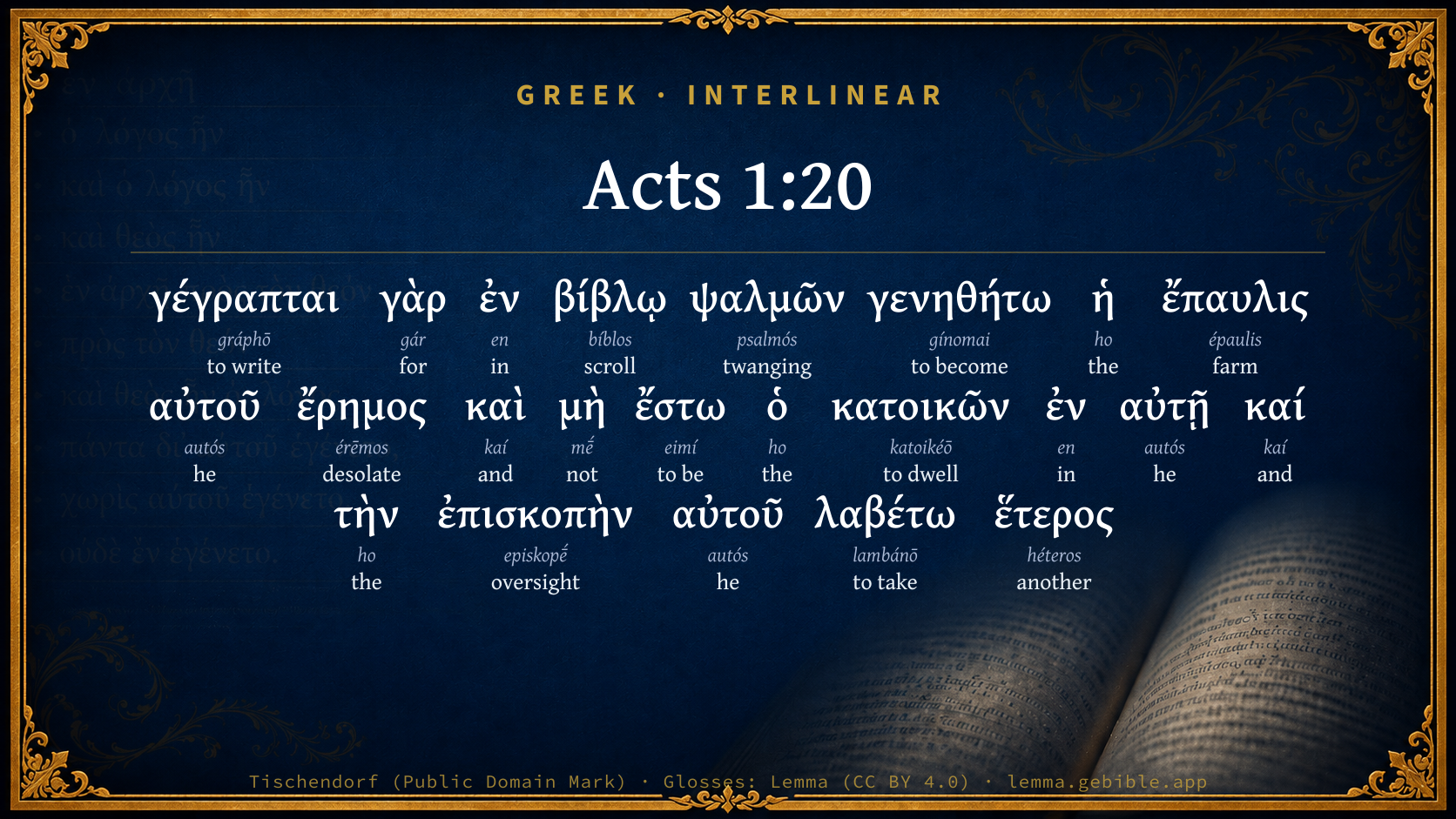
Download image
Cite this verse

Acts 1:20 (World English Bible). Public Domain. Lemma interlinear Bible study tool, https://lemma.gebible.app/v/acts/1/20.

Show BibTeX & RIS
BibTeX
RIS
English Translation
For it is written in the book of Psalms, 'Let his habitation be made desolate, Let no one dwell therein,' and, 'Let another take his office.'
World English Bible · Public Domain
Highlights
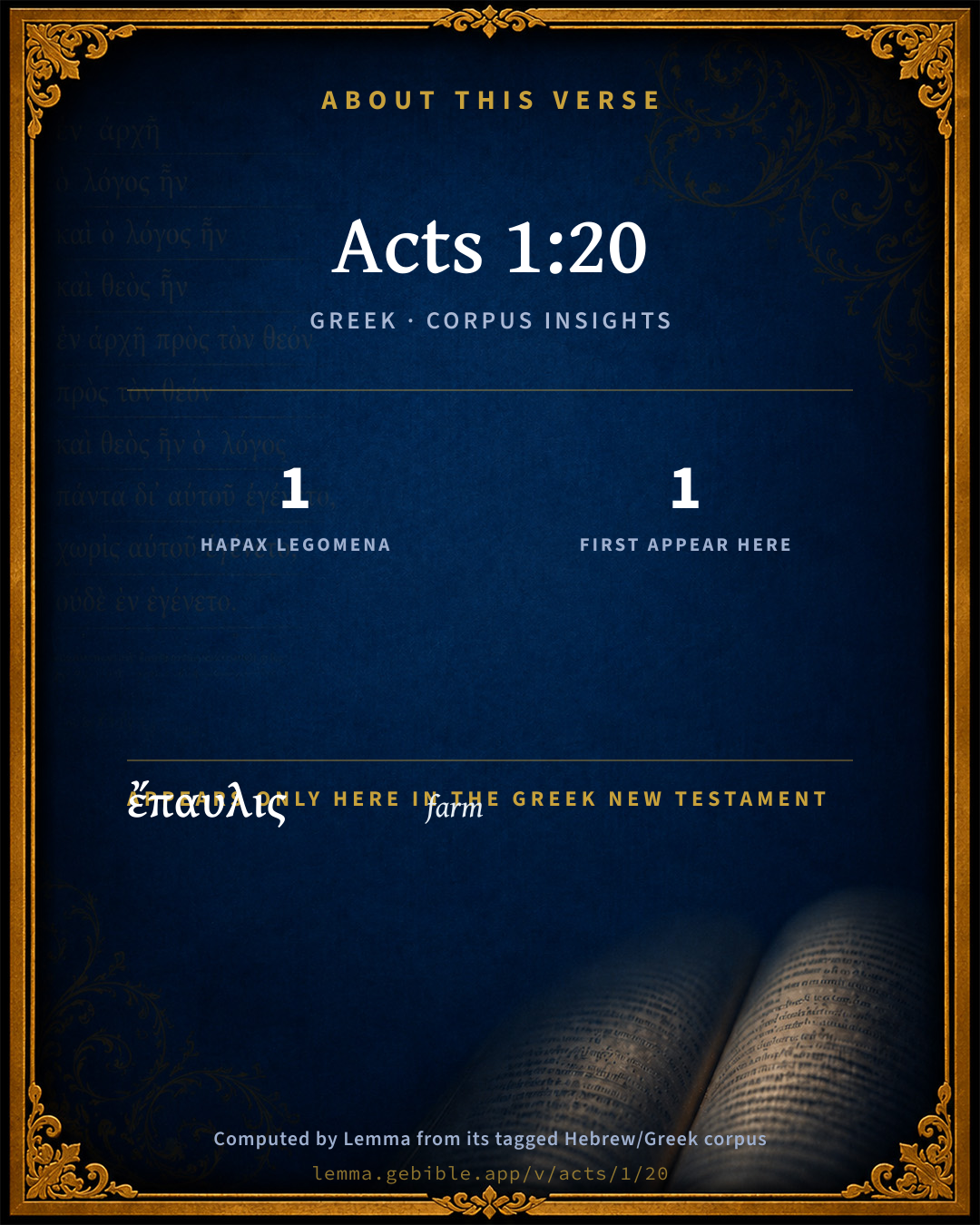
  • 1 hapax legomenon — only here in the Greek New Testament
  • 1 first appearance in the Greek New Testament
Full analysis ↓
Download a study sheet

One document with this verse’s original text, its word-by-word gloss line, the meaning frame, cross-references with their text, attributed commentary, and full source and license credits — printable, and it pastes into notes with its structure intact.

This verse Autodidact and up

Study sheet (.html) Plain text (.txt)

A passage Seminary Student

Up to 50 verses in one chapter. A passage sheet keeps up to 6 commentary sources and 12 cross-references per verse, in the order this page ranks them, and says so on the sheet whenever that leaves anything out. Ask for a single verse and you get the Autodidact verse sheet above.

Everything on this page stays free to read, with no account — the sheet is a download of what is already on screen, not access to it.

Want to remove ads? Support Godless Engineer
Compare translations 3

The same verse in 3 English versions, stacked beneath the original-language interlinear above. Click any original word for its lexicon entry.

Each is an independent rendering of the whole verse — the interlinear is not word-aligned to these translations.

Highlighted words mark where these versions differ — a whole-verse word diff, not a word-by-word alignment.

  • World English Bible Public Domain
    For it is written in the book of Psalms, 'Let his habitation be made desolate, Let no one dwell therein,' and, 'Let another take his office.'
  • King James Version Public Domain
    For it is written in the book of Psalms, Let his habitation be desolate, and let no man dwell therein: and his bishoprick let another take.
  • unfoldingWord Literal Text CC BY-SA 4.0
    “For it is written in the book of Psalms, ‘Let his habitation become desolate, and let not one dwelling be in it,’ and ‘Let another take his overseership.’

unfoldingWord Literal Text — © unfoldingWord, licensed CC BY-SA 4.0. Word-aligned USFM3 via Door43 (git.door43.org/unfoldingWord/en_ult).

Versions to compare (up to 4)

3 of 4 selected

Show all 19 translations

Every available English version of this verse, each an independent rendering of the whole verse.

  • World English Bible Public Domain
    For it is written in the book of Psalms, 'Let his habitation be made desolate, Let no one dwell therein,' and, 'Let another take his office.'
  • Berean Standard Bible Public Domain
    “For it is written in the book of Psalms: ‘May his place be deserted; let there be no one to dwell in it,’ and, ‘May another take his position.’
  • Majority Standard Bible Public Domain
    “For it is written in the book of Psalms: ‘May his place be deserted; let there be no one to dwell in it,’ and, ‘May another take his position.’
  • King James Version Public Domain
    For it is written in the book of Psalms, Let his habitation be desolate, and let no man dwell therein: and his bishoprick let another take.
  • American Standard Version (1901) Public Domain
    For it is written in the book of Psalms, Let his habitation be made desolate, And let no man dwell therein: and, His office let another take.
  • Revised Version (1885) Public Domain
    For it is written in the book of Psalms, Let his habitation be made desolate, And let no man dwell therein: and, His office let another take.
  • Geneva Bible (1599) Public Domain
    For it is written in the booke of Psalmes, Let his habitation be void, and let no man dwel therein: also, Let another take his charge.
  • Douay-Rheims (1899) Public Domain
    For it is written in the book of Psalms: Let their habitation become desolate, and let there be none to dwell therein. And his bishopric let another take.
  • Young's Literal Translation Public Domain
    for it hath been written in the book of Psalms: Let his lodging-place become desolate, and let no one be dwelling in it, and his oversight let another take.
  • Literal Standard Version CC BY-SA 4.0
    For it has been written in [the] Scroll of Psalms: Let his lodging-place become desolate, and let no one be dwelling in it, and let another take his oversight.
  • Unlocked Literal Bible CC BY-SA 4.0
    “For it is written in the Book of Psalms, 'Let his field be made desolate, and do not let even one person live there'; 'Let someone else take his position of leadership.'
  • unfoldingWord Literal Text CC BY-SA 4.0
    “For it is written in the book of Psalms, ‘Let his habitation become desolate, and let not one dwelling be in it,’ and ‘Let another take his overseership.’
  • Darby Bible Public Domain
    For it is written in [the] book of Psalms, Let his homestead become desolate, and let there be no dweller in it; and, Let another take his overseership.
  • World Messianic Bible Public Domain
    For it is written in the scroll of Psalms, ‘Let his habitation be made desolate. Let no one dwell in it;’ and, ‘Let another take his office.’
  • Webster's Bible Public Domain
    For it is written in the book of Psalms, Let his habitation be desolate, and let no man dwell in it: and, His bishopric let another take.
  • Free Bible Version CC BY-SA 4.0
    As it's written in the book of Psalms, “Let his home be abandoned, and no one live there,” and “Let someone else take over his position.”
  • Bible in Basic English Public Domain
    For in the book of Psalms it says, Let his house be waste, and let no man be living in it: and, Let his position be taken by another.
  • Text-Critical English NT CC BY 4.0
    Peter continued, “For it is written in the Book of Psalms: ‘May his homestead become desolate; let there be no one to dwell in it,’ and, ‘May another take his position as overseer.’
  • Tyndale New Testament (1534) Public Domain
    It is written in the boke of Psalmes: His habitacion be voyde and no man be dwellinge therin: and his bisshoprycke let another take.

Literal Standard Version (2020), Covenant Press — licensed CC BY-SA 4.0. Text via the HelloAO Bible API (eBible.org). Unlocked Literal Bible (unfoldingWord) — licensed CC BY-SA 4.0. Text via the HelloAO Bible API (eBible.org). unfoldingWord Literal Text — © unfoldingWord, licensed CC BY-SA 4.0. Word-aligned USFM3 via Door43 (git.door43.org/unfoldingWord/en_ult). Free Bible Version, Dr. Jonathan Gallagher — licensed CC BY-SA 4.0. Text via the HelloAO Bible API (eBible.org).

Word by word

More ways to search: Search by grammar → Find every occurrence → Compare this word →

Practice this passage: Drill this verse → Learn its vocabulary →

ἔπαυλις
épaulis
G1886
“farm”
Noun, Nominative, Singular, Feminine
Part of Speech
Noun
Case
Nominative
Number
Singular
Gender
Feminine
Full Thayer's Definition

Origin: from G1909 and an equivalent of G833

TDNT: None

1. a farm 2. a dwelling
  1. γέγραπται gráphō G1125 “to write” Verb, Perfect, Passive, Indicative, 3rd person, Singular
  2. γὰρ gár G1063 “for” Conjunction
  3. ἐν en G1722 “in” Preposition
  4. βίβλῳ bíblos G976 “scroll” Noun, Dative, Singular, Feminine
  5. ψαλμῶν psalmós G5568 “twanging” Noun, Genitive, Plural, Masculine
  6. γενηθήτω gínomai G1096 “to become” Verb, Aorist, Passive deponent, Imperative, 3rd person, Singular
  7. ἡ ho G3588 “the” Article, Nominative, Singular, Feminine
  8. αὐτοῦ autós G846 “he” Personal pronoun, Genitive, Singular, Masculine
  9. ἔρημος érēmos G2048 “desolate” Adjective, Nominative, Singular, Feminine
  10. καὶ kaí G2532 “and” Conjunction
  11. μὴ mḗ G3361 “not” Particle, Negative
  12. ἔστω eimí G1510 “to be” Verb, Present, Active, Imperative, 3rd person, Singular
  13. ὁ ho G3588 “the” Article, Nominative, Singular, Masculine
  14. κατοικῶν katoikéō G2730 “to dwell” Verb, Present, Active, Participle, Nominative, Singular, Masculine
  15. ἐν en G1722 “in” Preposition
  16. αὐτῇ autós G846 “he” Personal pronoun, Dative, Singular, Feminine
  17. καί kaí G2532 “and” Conjunction
  18. τὴν ho G3588 “the” Article, Accusative, Singular, Feminine
  19. ἐπισκοπὴν episkopḗ G1984 “oversight” Noun, Accusative, Singular, Feminine
  20. αὐτοῦ autós G846 “he” Personal pronoun, Genitive, Singular, Masculine
  21. λαβέτω lambánō G2983 “to take” Verb, Aorist, Active, Imperative, 3rd person, Singular
  22. ἕτερος héteros G2087 “another” Adjective, Nominative, Singular, Masculine

About this verse

These counts appear in no published source. They are computed here, from the morphology-tagged text and Lemma’s own curated glosses. What Lemma adds →

23
words
17
distinct lemmas
Acts
section

Notable vocabulary

1 hapax legomenon — a word that appears only here in the entire Greek New Testament:

  • ἔπαυλις farm G1886

First appearance in Scripture

This word makes its first canonical appearance in the Greek New Testament here:

  • ἔπαυλις farm G1886

Shared distinctive vocabulary

ἐπισκοπὴν oversight G1984 occurs in 4 verses of the Greek New Testament. Also found in:
Repetition

Words recur within this verse:

Cross-references

3

Topical passages linked to Acts 1:20 in the Treasury of Scripture Knowledge — connected by theme and wording, ordered by reader-vote popularity; previews shown in the World English Bible.

  • Psalms 69:25 Let their habitation be desolate. Let no one dwell in their tents.
  • Psalms 109:8–15 Let his days be few. Let another take his office.
  • Acts 1:25 to take part in this ministry and apostleship from which Judas fell away, that he might go to his own place."

Cross-references courtesy of OpenBible.info (CC BY 4.0).

Commentary

Notes on Acts 1:20 from classic Christian and Jewish commentators (each source and its license shown beneath its notes). The classic Christian expositions comment on the surrounding passage and are grouped to its opening verse, so a note may address several verses; the Jewish commentaries on the Tanakh (Rashi and others) are per-verse, so they appear only where the commentator wrote on this verse.

Lemma curates 59 commentaries, every one of them public domain or Creative Commons licensed, each selected and text-cleaned for this edition rather than reprinted as found. About our sources →

Tyndale Open Study Notes

Tyndale Open Resources

1:20-21 ‘Let someone else take his position’: It was imperative that a replacement be found for Judas so that his position as the twelfth apostle would not remain empty. The new people of God, like Israel, were to have twelve designated and appointed leaders (see Matt 19:28; Luke 22:29-30).

Tyndale Open Study Notes — © Tyndale Open Resources, licensed CC BY-SA 4.0. Text via the HelloAO Bible API.

Bengel's Gnomon

Johann Albrecht Bengel

Act 1:20. Γενήθητο, κ.τ.λ.) Psa 69:25 (26), LXX., γενηθήτω ἡ ἔπαυλις αὐτῶν αὐτῶν ἠρημωμένη, καὶ ἐν τοῖς σκηνώμασιν αὐτῶν μὴ ἔστω ὁ κατοικῶν.—ἔπαυλις) that is to say, οἴκημα εὐτελὲς, a mean dwelling, according to Eustathius.—αὐτοῦ, his) The Hebrew and LXX. have αὐτῶν, their. But it is understood of Judas as being included in the plural pronoun, to accord with the present purpose of the apostle. Justus Jonas remarks, “By the rejection of Judas, and the substituting of another, is indicated the casting away of the Jews, and of all who persecute Christ after He has been sent to them.”—[ἔρημος, desolate) This is the lot that falls to all things which the ungodly possess in the world.—V. g.]—μὴ ἔστω, let there not be) This was fulfilled when the field passed into a burying-place for strangers.—καἰ τὴν—ἓτερος) Psa 109:8. So clearly the LXX.—ἓτερος, another) Matthias, as an individual, was not more plainly designated, and so occasion arose for recourse to a holy casting of lots.

Bengel's Gnomon of the New Testament — English translation (T&T Clark, Edinburgh, 1860) — public domain. Text from a community e-Sword module.

Meyer's Critical & Exegetical Commentary

Heinrich August Wilhelm Meyer

Act_1:20. Γάρ] The tragic end of Judas was his withdrawal from the apostolic office, by which a new choice was now necessary. But both that withdrawal and this necessity are, as already indicated in Act_1:16, to be demonstrated not as something accidental, but as divinely ordained.

The first passage is Psa_69:26, freely quoted from memory, and with an intentional change of the plural (LXX. αὐτῶν), because its historical fulfilment is represented κατʼ ἐξοχήν in Judas. The second passage is Psa_109:8, verbatim, after the LXX. Both passages contain curses against enemies of the theocracy, as the antitype of whom Judas here appears.

The ἔπαυλις is not that χωρίον which had become desolate by the death of Judas (Chrysostom, Oecumenius, and others; also Strauss, Hofmann, de Wette, Schneckenburger), but it corresponds to the parallel ἐπισκοπή, and as the χωρίον is not to be considered as belonging to Judas (see on Act_1:18), the meaning is: Let his farm, i.e. in the antitypical fulfilment of the saying in the Psalm, the apostolic office of Judas, become desolate, forsaken by its possessor, and non-existent, i.e. let him be gone, who has his dwelling therein.

τὴν ἐπισκοπ.] the oversight (Lucian, D. D. xx. 8, frequently in the LXX. and Apocr.), the superintendence which he had to exercise, פְּקֻּרָּה, in the sense of the πλήρωσις: the apostolic office. Comp. 1Ti_3:1 (of the office of a bishop).

Meyer — Critical and Exegetical Commentary on the New Testament — English translation by Peter Christie, edited by Frederick Crombie (T&T Clark, 1880) — public domain. Text from a community e-Sword module.

Expositor's Greek Testament

ed. W. Robertson Nicoll

Act 1:20 . The quotation is twofold, the first part from Psa 69:26 (LXX, 68); in the LXX we have αὐτῶν , changed here into αὐτοῦ with reference to Judas, whilst ἐν τοῖς σκηνώμασιν is omitted and the words ἐν αὐτῇ , referring to ἔπαυλις , are added. The omission would make the application of the words more general than in the original, which related to the desolation of the encampment and tents of a nomadic tribe. The other part of the quotation is verbatim from Psa 108:8 (109), called by the ancients the Iscariot Psalm. With the exception of Psa 22 , no Psalm is more frequently quoted in the N.T. than 69; cf. Psa 108:9 with Joh 2:17 ; Psa 108:21 with Mat 27:34 , and with Joh 19:28 ; Psa 108:22-23 with Rom 11:9-10 ; and Psa 108:9 with Rom 15:3 . In these Psalms, as in the twenty-second Psalm, we see how the history of prophets and holy men of old, of a David or a Jeremiah, was typical of the history of the Son of man made perfect through suffering, and we know how our Lord Himself saw the fulfilment of the words of the suffering Psalmist Psa 41:9 ) in the tragic events of His own life (Joh 13:18 ). So too St. Peter in the recent miserable end of the traitor sees another evidence, not only of the general truth, which the Psalmists learnt through suffering, that God rewarded His servants and that confusion awaited the unrighteous, but also another fulfilment in the case of Judas of the doom which the Psalmists of old had invoked upon the persecutors of the faithful servants of God. But we are not called upon to regard Psa 109 as the Iscariot Psalm in all its details (see Perowne, Psalms , p. 538 (smaller edition)), or to forget, as Delitzsch reminds us, that the spirit of Elias is not that of the N.T. St. Peter, although he must have regarded the crime of Judas as a crime without a parallel, does not dwell upon his punishment, but passes at once to the duty incumbent upon the infant Church in view of the vacant Apostleship. ἔπαυλις : by many commentators, both ancient and modern (Chrys., Oecum., so too Nösgen, Overbeck, Wendt, Blass, Holtzmann, Zöckler, Jüngst), this is referred to the χωρίον , which was rendered desolate by the death of Judas in it, on the ground that γάρ thus maintains its evident relation to what precedes. But if the two preceding verses are inserted by St. Luke, and form no part of St. Peter’s words, it would seem that ἔπαυλις must be regarded as parallel to ἐπισκοπή in the second quotation. ἐπισκοπὴν : “his office,” R.V. (“overseership,” margin), so for the same word in LXX, Psa 109:8 , from which the quotation is made. In the LXX the word is used, Num 4:16 , for the charge of the tabernacle. St. Peter uses the word ἐπίσκοπος in 1Pe 2:25 , and it is significant that there the translators of 1611 maintain the use of the word “bishop,” as here “bishoprick” (so R.V., “overseer,” margin), whilst they use “overseer” and “oversight” ( ἐπισκοπή ), Act 20:28 and 1Pe 5:2 , where the reference is to the function of the elders or presbyters. The word ἐπισκοπή , of course, could not have its later ecclesiastical force, but the Apostolic office of Judas might well be described as one of oversight, and care of others; and it is significant that it is so described, and not only as a διακονία (see below on Act 1:25 , and on ἐπίσκοπος , Act 20:28 , note): “St. Peter would not have quoted the Psalm containing the expression ἐπισκοπή unless he had instinctively felt the word to be applicable to Judas’ position” (Canon Gore in Guardian , 16th March, 1898).

The Expositor's Greek Testament, edited by W. Robertson Nicoll (1897–1910) — public domain. Text from a community e-Sword module.

Geneva Bible (1599)

Geneva Bible translators

His office and ministry David wrote these words against Doeg the King’s herdsman: And these words, Shepherd, Sheep, and Flock, are put over to the Church office and ministry, so that the Church and the offices thereof are called by these names.

Geneva Bible (1599) marginal notes — public domain. Text via Bolls.life.

Jamieson, Fausset & Brown

Robert Jamieson, A. R. Fausset & David Brown

his bishopric--or "charge." The words are a combination of Psa 69:25 and Psa 109:8; in which the apostle discerns a greater than David, and a worse than Ahithophel and his fellow conspirators against David.

Jamieson, Fausset & Brown — Commentary Critical and Explanatory on the Whole Bible (1871) — public domain (CC PDM 1.0). Text via the HelloAO Bible API.

Adam Clarke's Commentary

Verse 20. For it is written in the book of Psalms] The places usually referred to are Ps 69:25: Let their habitation be desolate, and let none dwell in their tents. And Ps 109:8: Let his days be few, and let another take his office, פקדתו pekudato, his overseership, his charge of visitation or superintendence, translated by the SEPTUAGINT, την επισκοπην, VULGATE, episcopatum; and WE, following both, bishopric, but not with sufficient propriety, for surely the office or charge of Judas was widely different from what we call bishopric, the diocess, estate, and emoluments of a bishop. επισκοπος, episcopos, which was corrupted by our Saxon ancestors into [Anglo-Saxon], biscop, and by us into bishop, signifies literally an overseer or superintendent, from επι, over, and σκεπτομαι, I see, a person who had the inspection, overseeing, or superintendence of others. The ancient επισκοποι were persons who had the care of different congregations of the Church of Christ; who travelled, preached, enforced the discipline of the Church, and took care to prevent false doctrines, heresies, c. Those who still deserve this title, and it is an august and noble one, walk by the same rule, and mind the same thing. επισκοπος, episcopus, or bishop, is a scriptural and sacred title was gloriously supported in the primitive Church; and many to the present day are not less ornaments to the title, than the title is ornamental to them. The best defenses of the truth of God, and the Protestant faith, are in the works of the bishops of the British Churches.

The words quoted from the Psalms were originally spoken against the enemies of David; and as David, in certain particulars, was a type of Christ, the words are applied to him in an especial manner who had sinned against his own soul and the life of his Master.

Adam Clarke's Commentary on the Bible (1810–1826) — public domain. Text from a community e-Sword/MySword module.

Ellicott's Commentary for English Readers

(20) For it is written in the book of Psalms—St. Peter’s speech is continued after the parenthetical note. His purpose in making the quotation is to show that the disciples should not be staggered by the treachery of Judas, and the seeming failure of their hopes. The Psalms had represented the righteous sufferer as the victim of treachery. They had also spoken of the traitor as receiving a righteous punishment such as had now fallen upon Judas. No strange thing had happened. What had been of old was typical of what they had heard or known. We need not in this place discuss either the historical occasions of the Psalms cited, or the ethical difficulties presented by their imprecations of evil. Neither comes, so to speak, within the horizon of St. Peter’s thoughts. It was enough for him to note the striking parallelism which they presented to what was fresh in his memory, and to believe that it was not accidental.

His bishoprick let another take.—Better, as in Psa_109:8, let another take his office. The Greek word is episcopè, which, as meaning an office like that of the episcopos, is, of course, in one sense, rightly translated by “bishoprick.” The latter term is, however, so surrounded by associations foreign to the apostolic age that it is better to use the more general, and, therefore, neutral, term of the English version of the Psalm. The use of “bishoprick” may be noted as an instance of the tendency of the revisers of 1611 to maintain the use of “bishop” and the like where the office seemed to be placed on a high level (as here and in 1Pe_2:25), while they use “overseer” and “oversight” (as in Act_20:28, and 1Pe_5:2) where it is identified with the functions of the elders or presbyters of the Church. “Bishoprick” had, however, been used in all previous versions except the Geneva, which gives “charge.”

A Bible Commentary for English Readers, edited by Charles John Ellicott (1878–1897) — public domain. Text from a community e-Sword module.

The Cambridge Bible for Schools and Colleges

gen. ed. J. J. S. Perowne

20. The passages quoted by St Peter are from Psa_69:25, where it is written “Let their habitation be desolate, and let none dwell in their tents;” and Psa_109:8, “Let his days be few, and let another take his office.” St Peter changes the plural of the former verse into the singular in his quotation, for David was speaking of many enemies of his own, yet though Judas was the instrument through which the many enemies of Jesus wrought out their will, it is the punishment which came on the chief offender that St Peter is now desirous to illustrate and point to as a fulfilment of prophecy. The fulfilment in the case of the Jewish nation came at a later date, though their days as a nation were now few, and their destruction, when it came, as terrible as that of Judas.

Let his habitation be] Rather, become, or be made.

and his bishoprick] Now that this word has so restricted a meaning in English it is better to use the more general term office which is given in the margin. In Act_1:25 this ministry is used of the same charge, and might be rendered this diaconate. A comma placed after the second and in this verse will make it clear that there are two quotations from different places. There is no contradiction between the two passages quoted by St Peter, for though the habitation of Judas is to become desolate, and have none dwelling therein, the office which he had been chosen to fill is still to be occupied, and the purpose of God in the choice of the twelve is not to be left incomplete through the offence of the traitor. And it is on the necessity for filling his place that St Peter immediately dwells, saying, For this reason must a new member be chosen. In one passage of the Psalmist the Spirit speaks of the vacancy in the Apostolic office through Iscariot’s transgression, in the other of the necessity for filling it up.

The Cambridge Bible for Schools and Colleges (gen. ed. J. J. S. Perowne; Cambridge University Press, 1878–1918) — public domain. Text from a community e-Sword module.

John Gill's Exposition

For it is written in the book of Psalms,.... In Psa 69:25. These are the words of Peter, citing the Scripture he had said must be fulfilled, which the Holy Ghost, by David, had spoke concerning Judas:

let his habitation be desolate. The Arabic and Ethiopic versions render it, "his city"; meaning, perhaps, the city of Jerusalem; and which afterwards did become desolate, and was utterly destroyed:

and let no man dwell therein; in his habitation. The psalm, out of which these words are cited, is a psalm concerning the Messiah, and there are many passages cited out of it in the New Testament, and applied to him, or referred unto; see Joh 2:17 compared with Psa 69:4 and what the psalmist says of the enemies of the Messiah in general, is applied by the apostle to Judas in particular. In the Hebrew text, in Psa 69:25 the words are in the plural number, "let their habitation be desolate, and let none dwell in their tents"; and refer to all the enemies of Christ, the chief priests, elders of the people, Scribes and Pharisees, who covenanted with Judas to give him so much money to betray Christ into their hands; and who delivered him to the Roman governor, by whom, at their instigation, he was crucified; and particularly may well be thought to include Judas, who betrayed him to them; and therefore are very fitly interpreted of him: though not to be understood to the exclusion of the others, whose house was to be left desolate, and was left desolate, as our Lord predicted, Mat 23:38. The first word in the Hebrew text rendered "habitation", signifies a very magnificent dwelling; it is sometimes translated a "castle", Gen 25:16 and sometimes a "palace", Cant. 8:9, Eze 25:4 and it is interpreted by "a palace", here, by several Jewish writers (s); and so may intend the dwelling places of the richer sort of Christ's enemies, as the palaces of the high priest, and of the prince, or president of the sanhedrim, and the stately houses of the members of it, of the chief priests and elders of the people, and of the Scribes and Pharisees; all which became desolate at the destruction of Jerusalem: the other word, rendered "tents", may design the cottages of the meaner sort of people, who, with united voices, cried aloud for the crucifixion of Christ; and which also shared the same fate when Jerusalem was destroyed: now inasmuch as Judas was of the meaner sort, the apostle here makes use of a word which signifies but a poor and mean habitation, though it is sometimes used of grander ones, and which seems to answer to the latter; for as there are two words in the original text expressive of habitation, he might choose which he would, and did choose that which was most pertinent in the application of the passage to Judas. However, a Jew has no reason to find fault with this version, since the Targum renders both words by "habitation", thus,

let their habitation be desolate, and in their habitations let no one dwell: where Judas's habitation was is not certain; but that he might have one as well as the Apostle John, is not at all improbable, and from hence seems evident:

and his bishopric let another take; which passage stands in Psa 109:8 and is fitly applied to Judas, and was verified in him, who not only died a violent and infamous death, by which he was in consequence stripped of his office, as a bishop, or overseer; but another was to be put into it, invested with it, and exercise it; and therefore very pertinently does Peter produce it, his intention being to move the disciples to choose another in his room. These words are produced by the apostle, as if they were to be found in the same place with the preceding; whereas they stand in another psalm, as has been observed: and this is no unusual thing with the writers of the New Testament, to put several passages of Scripture together, as if they were in one place, when they are to be sought for in different places; an instance of this, among many, that might be mentioned, is in Rom 3:10 and this is a very common way of citing Scripture with the Jews. Surenhusius (t) has given a variety of instances, in proof of this, out of their writings, as in the margin (u), which the learned reader may consult and compare at leisure. The psalm, out of which this passage is cited, is not to be understood of David literally, and of what he met with from his enemies, and of his imprecations upon them, either Doeg the Edomite, as Kimchi interprets it, or Ahithophel, as others, but of the Messiah, with whom the whole agrees; against whom the mouth of the wicked Jews, and particularly of the deceitful Pharisees, were opened; and against whom the false witnesses spoke with lying tongues; and who, all of them, compassed him with words of hatred to take away his life, and acted a most ungenerous and ungrateful part; opposed him without a cause, and became his enemies for his love showed to them, both to soul and body, preaching the Gospel, and healing diseases, Psa 109:2. The poverty and distress he submitted to; the griefs and sorrows which he bore; the fatigues he underwent at his examination; and the weakness of body he was then reduced to, as well as the reproach cast upon him on the cross, when his enemies shook their heads at him, are in a very lively manner described, Psa 109:22 and whereas one of his enemies particularly is singled out from the rest, what is said concerning him, by way of imprecation, suits with Judas, and had its accomplishment in him, Psa 109:6 who had a wicked man set over him, as over the rest of the Jews, Pilate, the Roman governor, a very wicked man; and at whose right hand Satan stood, as one of his council, as Aben Ezra interprets it, and put it into his heart to betray his master, and prompted him to it, and then accused him of it, and brought him to black despair for it; and who, when this affair was brought home to his own conscience, and there arraigned for it, was convicted and self-condemned, as he also will be at the general judgment; and as he found no place of mercy then, whatever prayers or entreaties he might make, so neither will he hereafter: his days were but few, being cut off in the prime of them, as may be concluded from the many years which some of his fellow apostles lived after him; and his bishopric, or office, as an apostle, was taken by another, even by Matthias, who was chosen in his room, of which we have an account in the following part of this chapter; for this is to be understood neither of his money, nor of his wife, nor of his own soul committed to his trust, as some of the Jewish writers (w) explain it; but of his apostleship, with which he was invested by Christ. The word signifies an oversight, care, or charge; and so the Hebrew word is rendered in Num 3:32 and designs any office, as the office of the priests and Levites in the house of God; see Num 4:16. Jarchi interprets it here by "his greatness", or "dignity"; and explains it by the Spanish word "provostia", an office of honour and authority, as this of being an apostle of Christ was; than which, a greater external dignity could not be enjoyed in the church of God, in which he has set first apostles, Co1 12:28. That this psalm refers to Judas Iscariot, and to his affair, was so clear a point with the ancients, that they used to call it the Iscariotic Psalm. I lay no stress upon the observation some have made, that thirty curses are contained in it, the number of the pieces of silver for which he betrayed his master, since this may be thought to be too curious,

(s) Kimchi & Sol. ben Melech in Psal. 69. 25. R. Nathan. Concordant. (t) Biblos Katallages, p. 45, 46. (u) T. Bab Roshhoshana, fol. 4. 2. Beracot, fol. 13. 1. Sabbat, fol. 20. 1. Maccot, fol. 13. 2. & 16. 1. Tanchuma, fol. 17. 1, 4. & 25. 1, 4. (w) Aben Ezra, Kimchi, & Sol. ben Melech in loc.

John Gill's Exposition of the Whole Bible (1746–1763) — public domain (CC PDM 1.0). Text via the HelloAO Bible API.

Trapp's Complete Commentary

John Trapp

20 For it is written in the book of Psalms, Let his habitation be desolate, and let no man dwell therein: and his bishoprick let another take.

Ver. 20. In the book of Psalms] That common magazine of wholesome lessons, as Basil hath it. {a}

{a} κοινον ταμειον αγαθων διδαγματων

John Trapp, A Commentary or Exposition upon All the Books of the Old and New Testament (1647–1656) — public domain. Text from a community e-Sword module.

Albert Barnes' Notes on the Bible

For it is written ... - See Psa 69:25. This is the prediction doubtless to which Peter refers in Act 1:16. The intermediate passage in Act 1:18-19, is probably a parenthesis; the words of Luke, not of Peter. So Calvin, Kuinoel, Olshausen, DeWette, and Hackett understand it. It is not probable that Peter would introduce a narrative like this, with which they were all familiar, in an address to the disciples. The Hebrew in the Psalm is, “Let their habitation (Hebrew: fold, enclosure for cattle; tower, or palace) be desolate, and let none dwell in their tents.” This quotation is not made literally from the Hebrew, nor from the Septuagint. The plural is changed to the singular, and there are some other slight variations. The Hebrew is, “Let there be no one dwelling in their tents.” The reference to the tents is omitted in the quotation. The term “habitation,” in the Psalm, means evidently the dwelling-place of the enemies of the writer of the Psalm. It is an image expressive of their overthrow and defeat by a just God: “Let their families be scattered, and the places where they have dwelt be without an inhabitant, as a reward for their crimes.”

If the Psalm was originally composed with reference to the Messiah and his sufferings, the expression here was not intended to denote Judas in particular, but one of his foes who was to meet the just punishment of rejecting, betraying, and murdering him. The change, therefore, which Peter made from the plural to the singular, and the application to Judas especially “as one of those enemies,” accords with the design of the Psalm, and is such a change as the circumstances of the case justified and required. It is an image, therefore, expressive of judgment and desolation coming upon his betrayer - an image to be literally fulfilled in relation to his habitation, drawn from the desolation when a man is driven from his home, and when his dwelling-place becomes tenantless. It is not a little remarkable that this Psalm is repeatedly quoted as referring to the Messiah: Psa 69:9, “The zeal of thine house hath eaten me up,” expressly applied to Christ in Joh 2:17, Joh 2:21, “They gave me also gall for my meat; and in my thirst they gave me vinegar to drink” - the thing which was done to Jesus on the cross, Mat 27:34.

The whole Psalm is expressive of deep sorrow of persecution, contempt, weeping, being forsaken, and is throughout applicable to the Messiah; with what is remarkable, not a single expression necessarily limited to David. It is not easy to ascertain whether the ancient Jews referred this Psalm to the Messiah. A part of the title to the Psalm in the Syriac version is, “It is called a prophecy concerning those things which Christ suffered, and concerning the casting away of the Jews.” The prophecy in Act 1:25 is not to be understood of Judas alone, but of the enemies of the Messiah in general, of which Judas was one. On this principle the application to Judas of the passage by Peter is to be defended.

And his bishopric let another take - This is quoted from Psa 109:8, “Let his days be few, and let another take his office.” This is called “a Psalm of David,” and is of the same class as Psa 6:1-10; Ps. 22; Ps. 25; Ps. 38; Psa 42:1-11; This class of Psalms is commonly supposed to have expressed David’s feelings in the calamitous times of the persecution by Saul, the rebellion of Absalom, etc. They are all also expressive of the condition of a suffering and persecuted Messiah, and many of them are applied to him in the New Testament. The general principle on which most of them are applicable is, not that David personated or typified the Messiah which is nowhere affirmed, and which can be true in no intelligible sense - but that he was placed in circumstances similar to the Messiah; was encompassed with like enemies; was persecuted in the same manner. They are expressive of high rank, office, dignity, and piety, cast down, waylaid, and encompassed with enemies.

In this way they express “general sentiments” as really applicable to the case of the Messiah as to David. They were placed in similar circumstances. The same help was needed. The same expressions would convey their feelings. The same treatment was proper for their enemies. On this principle it was that David deemed his enemy, whoever he was, unworthy of his office, and desired that it should be given to another. In like manner, Judas had rendered himself unworthy of his office, and there was the same propriety that it should be given to another. And as the office had now become vacant by the death of Judas, and according to one declaration in the Psalms, so, according to another, it was proper that it should be conferred on some other person. The word rendered “office” in the Psalm means the care, charge, business, oversight of anything. It is a word applicable to magistrates, whose care it is to see that the laws are executed; and to military men who have charge of an army, or a part of an army.

In Job 10:12 it is rendered “thy visitation.” In Num 4:16, “and to the office of Eleazar,” etc. In the case of David it refers to those who were entrusted with military or other offices who had treacherously perverted them to persecute and oppose him, and who had thus shown themselves unworthy of the office. The Greek word which is used here, ἐπισκοπὴν episkopēn, is taken from the Septuagint, and means the same thing as the Hebrew. It is well rendered in the margin “office, or charge.” It means charge or office in general, without in itself specifying of what kind. It is the concrete of the noun ἐπισκόπους episkopous, commonly translated “bishop,” and means his office, charge, or duty. That word means simply having the oversight of anything, and as applied to the officers of the New Testament, it denotes merely “their having charge of the affairs of the church,” without specifying the nature or the extent of their jurisdiction.

Hence, it is often interchanged with presbyter or elder, and denotes the discharge of the duties of the same office: Act 20:28, “Take heed (presbyters or elders, Act 20:17) to yourselves, and to all the flock over the which the Holy Spirit hath made you overseers” - ἐπισκόπους episkopous - bishops; Heb 12:15, “Looking diligently,” etc. - ἐπισκοποῦντες episkopountes; Phi 1:1, “with the bishops and deacons”; “Paul called presbyters bishops, for they had at that time the same name” (Theodoret, as quoted by Sehleusner); 1Pe 5:2, “Feed the flock of God (that is, you who are elders, or presbyters, 1Pe 5:1), taking the oversight thereof” - ἐπισκοποῦντες episkopountes. These passages show that the term in the New Testament designates the supervision or care which was exercised over the church, by whomsoever performed, without specifying the nature or extent of the jurisdiction. It is scarcely necessary to add that Peter here did not intend to affirm that Judas sustained any office corresponding to what is now commonly understood by the term “bishop.”

Albert Barnes' Notes on the Bible (1834–1885) — public domain. Text from a community e-Sword/MySword module.

Haydock's Catholic Bible Commentary

His bishoprick. The words were prophetically spoken in the Psalms, of the traitor Judas. (Witham) --- Let their habitation. In some manuscript copies, in both Greek and Syriac, we read his. In the Psalms, the text was written against the Jews, the persecutors of Christ in general; but in this place, Peter applies it to Judas in particular. (Estius, in a different place.)

George Leo Haydock (1774–1849), Haydock's Catholic Family Bible and Commentary, 1859 edition — public domain. Excludes Psalms (Douay-Rheims chapter numbering differs from Protestant) and Deuterocanonical books (Catholic canon only).

Matthew Poole's English Annotations

For it is written in the book of Psalms; viz. Psa 69:25. What there is in general spoken by David concerning his enemies, is here applied particularly to Judas, who betrayed our Saviour; whose type David was, as Doeg was of Judas.

His bishopric; his charge or office, or prefecture, as of a shepherd over his flock.

Matthew Poole's English Annotations on the Holy Bible (1683–1685) — public domain. Text from a community e-Sword/MySword module.

Whedon's Commentary on the Bible

Daniel D. Whedon

20. For—Referring to David spake in Act_1:16. The distance of the reference shows that Act_1:18-19 are Luke’s parenthesis inserted in Peter’s speech.

Psalms—Peter here quoted Psa_69:25; Psa_109:8, both of which are considered by biblical scholars as Messianic Psalms. That is, Christ is represented in those Psalms by his great type, the royal David, the psalmist himself. The psalmist’s words are, “Let their habitation be desolate, and let none dwell therein,” where, probably, Ahithophel is really indicated under the plural them, which Peter explains by rendering it his.

So, habitation and tents meaning the same thing, Peter omits the last. In Psa_108:9, the words in our English translation are, Let another take his office. The word bishopric is here capriciously used by our translators for the Greek of the Septuagint, επισκοπην, overseer-ship. But though the application of these words to Judas is to be admitted by every believing Christian, and served to guide the apostles aright on this occasion, yet this prophecy could not be conclusively used to convince a sceptic. Prophetic passages are divisible into two classes, namely, those which are explicit and demonstrative, and may be used to convince infidels of the divinity of the Scriptures; and those which can be used only within the Church, by her own interpretation, to guide her own belief and action. The clause in the last-quoted psalm, Let another take his office, was proof to the present assembly that a successor was required in Judas’ apostolate. The promise of twelve apostolic thrones was originally made to include Judas; but another was to inherit that promise in his place, just as Gentiles inherit the Abrahamic promises.

Daniel D. Whedon (gen. ed.), Commentary on the Old and New Testaments (1874–1909) — public domain. Text from a community e-Sword module.

The Pulpit Commentary

Made desolate for desolate, A.V.; office (as in margin) for bishopric, A.V. The book of Psalms, one of the recognized divisions of the canonical Scriptures, as we find Luk_24:44, "The law of Moses, and the prophets, and the psalms," the last standing for the Hagiographa, of which it was the first and principal book. Here, however, as in Luk_20:42, it may rather mean the Book of Psalms proper. (For similar quotations from the Psalms, see Act_13:33-35 Heb 1:, Heb 2:, Heb 3:, Heb 4:, Heb 5:, Heb_5:10., etc.) His office let another take. Bishop being the English transliteration of ejpiskopov, bishopric is, of course, the literal rendering of ejpiskoph; if taken in its wider and more general sense, as in the well-known work of Archdeacon Evans? "the bishopric of souls." This same office is called a diakonia (a deaconship), and ajpostolh (an apostleship) in vers. 17 and 25. So St. Paul cells himself diakonov (a minister) in Eph_3:7; Col_1:23, Col_1:25, etc. So the presbyters of the Church are called bishops (Act_20:17, Act_20:28; 1Ti_1:1, 1Ti_1:2. etc.) The ecclesiastical names for the different offices in the Church only acquired their distinctive use later, and by the gradual growth of custom. In the Septuagint, ejpiskoph answers to the Hebrew hDqup, A.V., "oversight". (Num_3:32 Num_4:16, etc.)

The Pulpit Commentary (1880–1919), ed. H.D.M. Spence-Jones & Joseph S. Exell — public domain. Text from a community e-Sword module.

John Wesley's Explanatory Notes

His bishopric - That is, his apostleship. Psalm lxix, 25.

John Wesley, Explanatory Notes Upon the Whole Bible (1754–1765) — public domain. Text via the GEBible commentary corpus.

Scofield Reference Notes

C. I. Scofield

bishoprick

(Greek - ναός, overseership). See "elders" (See Scofield "Tit 1:5")

The Scofield Reference Bible (1917 edition), notes by C. I. Scofield — public domain. Text from a community e-Sword module.

Godbey's Commentary on the New Testament

William B. Godbey

20. “His episcopacy let another take.” Here we find that Judas was a bishop, like all the other apostles. The New Testament bishop is simply a pastor of the flock of Christ, the original word being episcopos from epi, “over,” and scopeoo, “see.” Hence it simply means an overseer, and applies legitimately and unequivocally to every class-leader, leader of a Holiness band or pastor in charge of a little bunch of Christians. The modern episcopacy is utterly unknown in the New Testament, and certainly a mistake in church economy, as out of it has developed priestcraft, prelacy, popery and the institutions of Antichrist which have girdled the globe with the abominations of spiritual Babylon. These facts do not necessarily preclude the legitimacy and the expediency of a judicious and Scriptural superintendency. They recognize but one qualification for the apostleship, and that is primitive and persevering discipleship with Jesus throughout His entire ministry. Now they present two candidates, both well qualified, and turn over the election to the Holy Ghost. The casting of lots, customary in that day, innocent, simple and recognized of God, was equivalent to drawing straws, a very simple and common method of decision at the present day. The lot having fallen on Matthias, he is at once recognized as a legal apostle, filling the vacancy created by the fall of Judas. This whole transaction has been severely criticized and condemned by theologians as destitute of divine authority, at the same time alleging that Matthias never served as an apostle, as we never hear of him afterward. This argument breaks down of its own weight, as the same may be said of the majority of the other apostles. Paul, with his vast learning, as a matter of course wrote up his ministry; while, for the very opposite reason, the other apostles wrote nothing, except four, and some of them but little; while we are dependent on secular history for our knowledge of the life, ministry and destiny of the majority. History informs us that Matthias entered courageously upon his great and responsible work. During the destruction of Jerusalem, A. D. 73, all the apostles, being Jews, with all other Jews and Christians who were nearly all Jews at that time, being driven out of Palestine went in all directions preaching the Word, doubtless like Paul each of them seeking a new field where he would build on no man’s foundation. Matthias went on preaching, taking Africa for his field of labor, wandering far away into Abyssinia, where he preached faithfully till he was honored with a martyr’s crown. Mark also went to Africa and finally suffered martyrdom in Alexandria, Egypt, being dragged by a cruel mob through the streets till he expired. Matthew also spent his life preaching in Africa, finally suffering martyrdom in a city of Ethiopia. Luke, the faithful writer of this book, was hung on an olive tree in Greece. Paul was beheaded by order of Nero, about one mile west of the Roman wall. Peter was crucified on the Campus Martins in Rome, with his head downward. Andrew became the apostle of Armenia, where he faithfully preached till they crucified him on a transverse cross. Philip was crucified in Asia Minor.

Bartholomew preached faithfully in Phrygia till ordered by the king to leave his country forever. Failing to obey the order, the enraged monarch had him skinned alive. Jude, the brother of our Lord, wandered far away into Northwestern Asia, preaching in Tartary and perhaps in China till they put him to death by tying him up to a tree and shooting his body full of arrows. James the Greater, the son of Zebedee and brother of John, was beheaded by Herod Antipas. James the Less, the son of Alphaeus, was precipitated from a pinnacle of the temple in Jerusalem, and then beaten to death with a fuller’s club. Thomas the doubter, all of his doubts and cowardice having been burned up when he received the fiery baptism, preached his way far out into India, where he faithfully preached and witnessed for Jesus till his enemies ran a cruel iron bar through his body and hung him up between two trees, thus complimenting him with a martyr’s crown.

William B. Godbey, Commentary on the New Testament (1896–1900) — public domain. Text from a community e-Sword module.

McGarvey & Pendleton's Commentaries

J. W. McGarvey

20. The historian now resumes the report of Peter's speech, which he had interrupted by the parenthesis. In the remarks already quoted, Peter bases the action which he proposes, not upon any commandment of Jesus, but upon a prophesy uttered by David. He also states, as the ground for the application of that prophesy which he is about to make, the fact that Judas had been numbered with them, and had "obtained part of this ministry." He now quotes the prophesy alluded to: (20) " For it is written in the book of Psalms, Let his habitation be desolate, and let no man dwell therein. His office let another take. "

These two passages from the Psalms, when read in their original context, seem to apply to the wicked in general, and there is not the slightest indication that David had Judas in prophetic view when he uttered them. This is an instance, therefore, of the particular application of a general prophetic sentiment. If it be proper that the habitation of a wicked man should become desolate, and that whatever office he held should be given to another, then it was pre-eminently proper that such a crime as that of Judas should be thus punished, and that so important an office as that of Judas should be filled by a worthy successor.

J. W. McGarvey (with Philip Y. Pendleton), Commentaries on the New Testament (The Fourfold Gospel, 1914; Acts; and the epistles) — public domain. Text from a community e-Sword/MySword module.

The People's New Testament

B. W. Johnson

20. His bishoprick let another take. Psa. 109:8. His office. This is, rather, an application of the spirit of the Psalm, than its exact words. It sets forth the desert of persecutors.

B. W. Johnson's The People's New Testament with Notes (1889–1891) — public domain. Electronic text from the Christian Classics Ethereal Library (CCEL) ThML edition.

unfoldingWord translationNotes

Door43 World Missions Community

Connecting Statement:

Peter continues his speech to the believers that he began in Acts 1:16.

General Information:

Based on the situation with Judas that Peter just recounted, he recalls two Psalms of David that relate to the incident. The quote ends at the end of this verse.

For it is written in the Book of Psalms

This can be stated in active form. AT: "For David wrote in the Book of Psalms" (See: Active or Passive)

Let his field be made desolate, and do not let even one person live there

These two phrases mean basically the same thing. The second emphasizes the meaning of the first by repeating the same idea with different words. (See: Parallelism)

Let his field be made desolate

Possible meanings are 1) that the word "field" refers to the field where Judas died or 2) that the word "field" refers to Judas's dwelling place and is a metaphor for his family line. (See: Metaphor)

be made desolate

"become empty"

translationWords

written

desolate

unfoldingWord translationNotes — © Distant Shores Media and the Door43 World Missions Community, licensed CC BY-SA 4.0. Source: git.door43.org/Door43/en_tn.

Cambridge Greek Testament for Schools and Colleges

20. γενηθήτω, let it become (or be made) desolate. The Vulgate gives ‘fiat commoratio eorum deserta,’ quoting exactly from Psalms 69, where the pronoun is plural. But there is no authority for reading αὐτῶν instead of αὐτοῦ, and the singular is needed in this application of the verse to Judas. The further application of the prophecies to the Jewish nation, and their fulfilment in that case too, came at a later date, but were as terrible as the fulfilment upon Judas.

ἐπισκοπήν. An office involving oversight of others. In A.V. ‘bishoprick,’ and so in all previous versions except the Geneva, which has ‘charge.’ But ‘office’ which is the word used in Psa 109:8 is better.

It is this second prophecy which makes a new election necessary. Judas has perished, but the work must have another overseer and not be hindered by the sin of the traitor.

The former of these quotations stands in the LXX. (Psalms 68, Heb. 69:26) thus γενηθήτω ἡ ἔπαυλις αὐτῶν ἠρημωμένη, καὶ ἐν τοῖς σκηνώμασιν αὐτῶν μὴ ἔστω ὁ κατοικῶν. These variations are of interest as shewing the freedom with which the text was handled in quotation.

Cambridge Greek Testament for Schools and Colleges (Cambridge University Press, 1896; 21 vols, various authors incl. Carr, Maclear, Plummer, Farrar, Lumby, Moule, M. R. James, Simcox) — public domain. Text from a community e-Sword module.

Alford’s Greek Testament

Henry Alford

20.] γάρ, the connexion being, ‘all this happened and became known,’ &c., ‘in accordance with the prophecy,’ &c. Psa_69 is eminently a Messianic psalm,—spoken in the first place of David and his kingdom and its enemies, and so, according to the universal canon of O. T. interpretation, of Him in whom that kingdom found its true fulfilment, and of His enemies. And Judas being the first and most notable of these, the Apostle applies eminently to him the words which in the Psalm are spoken in the plural of all such enemies. The same is true of Psa 109, and there one adversary is even more pointedly marked out. See also Psa_55.

ἐπισκοπήν = פְּקֻדָּה, office, or charge. The citations are freely from the LXX.

Henry Alford, The Greek Testament (1849–1861) — public domain. Text from a community e-Sword module.

Vincent's Word Studies in the New Testament

Marvin R. Vincent

Habitation [επαυλις] . Only here in New Testament. The word is used in classical Greek of a place for cattle. So Herodotus (i., 111) : "The herdsman took the child in his arms, and went back the way he had come, till he reached the fold" [επαυλιν] . Also of a farm - building, a country - house..

Bishopric [επισκοπην] . See on 1Pe 2:12. Rev., better, office, with overseership in margin. Compare Luk 19:44.

Another [ετερος] . And different person. See on ch. Act 2:4.

Marvin R. Vincent, Word Studies in the New Testament (1887–1900) — public domain. Text from a community e-Sword/MySword module.

Lesson kit

Teaching starters — assembled from the data on this page, not authored interpretation. Every prompt links to the verse data it draws on. Edit before teaching.

Acts, in the Acts, opens this verse with 23 words (17 distinct Greek lemmas). Its most distinctive word is épaulis (“farm”). A historical commentator’s framing appears above. Read the whole chapter for the surrounding context.

Discussion questions

  1. What does “farm” (épaulis) contribute to the verse as a whole?
  2. This verse holds 1 word here found nowhere else in the Greek New Testament. What might the rare word draw attention to?
  3. The word “farm” first appears here in Scripture. What is being introduced at this debut?
  4. Luke 19:44 shares the word «oversight» with this verse. How do the two illuminate each other?
  5. “the” occurs 3× in this one verse. What is the effect of the repetition?
  6. These translations render this verse differently; the difference is in the English rendering, not the original. What questions does that raise?
  7. Reading how Tyndale Open Study Notes and Bengel's Gnomon read this verse, where do the two commentators agree and where do they part?

Things to notice

  • 1 word in this verse appears nowhere else in the Greek New Testament.
  • 1 word makes its first canonical appearance in Scripture here.
  • These translations choose different wording for 10 words in this verse.
  • “the” occurs 3× in this single verse.
  • 17 distinct Greek lemmas span 23 words in this verse.

Reading settings

Reading text

Shown beneath each verse's original-language words.

Old Testament
Old Testament edition

Read the OT as the Masoretic Hebrew (MT) or the Greek Septuagint (LXX).

English shown for the Greek Septuagint (in the Hebrew ↔ Greek comparison).

Comparing translations? Open the Compare panel on any verse page to stack up to four side by side.