
Mark 9:36

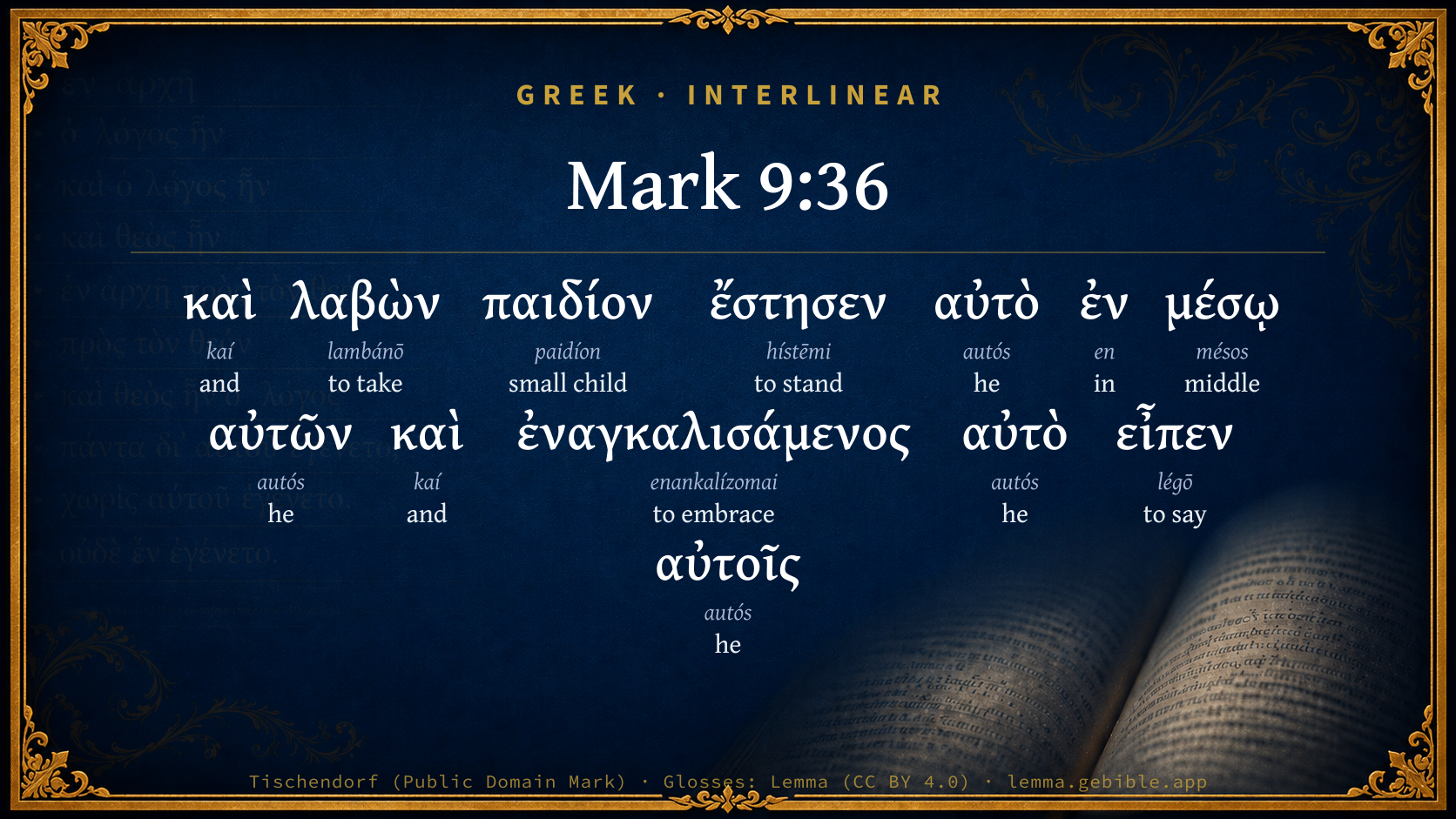
Greek (Tischendorf 8th ed.) Mark 9:36 appears in the Greek New Testament. The text above is from the Tischendorf 8th edition. Each word links to its Strong’s number and a concise gloss. Click any word for its full Thayer’s Greek Lexicon entry.
Download image
Cite this verse

Mark 9:36 (World English Bible). Public Domain. Lemma interlinear Bible study tool, https://lemma.gebible.app/v/mark/9/36.

Show BibTeX & RIS
BibTeX
RIS
English Translation
He took a little child, and set him in the midst of them. Taking him in his arms, he said to them,
World English Bible · Public Domain
Highlights
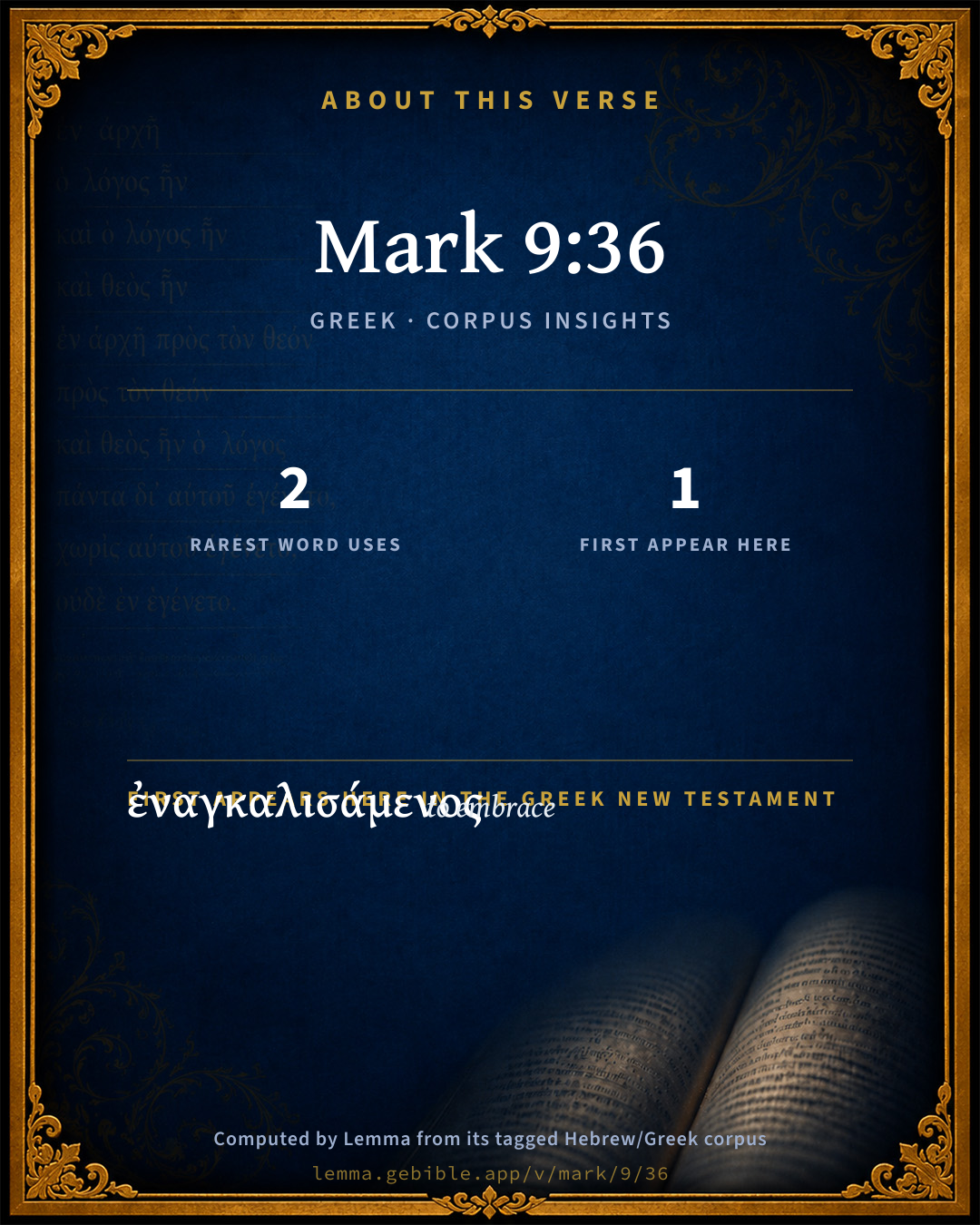
  • 1 first appearance in the Greek New Testament
Full analysis ↓
Download a study sheet

One document with this verse’s original text, its word-by-word gloss line, the meaning frame, cross-references with their text, attributed commentary, and full source and license credits — printable, and it pastes into notes with its structure intact.

This verse Autodidact and up

Study sheet (.html) Plain text (.txt)

A passage Seminary Student

Up to 50 verses in one chapter. A passage sheet keeps up to 6 commentary sources and 12 cross-references per verse, in the order this page ranks them, and says so on the sheet whenever that leaves anything out. Ask for a single verse and you get the Autodidact verse sheet above.

Everything on this page stays free to read, with no account — the sheet is a download of what is already on screen, not access to it.

Want to remove ads? Support Godless Engineer
Compare translations 3

The same verse in 3 English versions, stacked beneath the original-language interlinear above. Click any original word for its lexicon entry.

Each is an independent rendering of the whole verse — the interlinear is not word-aligned to these translations.

Highlighted words mark where these versions differ — a whole-verse word diff, not a word-by-word alignment.

  • World English Bible Public Domain
    He took a little child, and set him in the midst of them. Taking him in his arms, he said to them,
  • King James Version Public Domain
    And he took a child, and set him in the midst of them: and when he had taken him in his arms, he said unto them,
  • unfoldingWord Literal Text CC BY-SA 4.0
    And having taken a little child, he set him in the midst of them, and having taken him in his arms, he said to them,

unfoldingWord Literal Text — © unfoldingWord, licensed CC BY-SA 4.0. Word-aligned USFM3 via Door43 (git.door43.org/unfoldingWord/en_ult).

Versions to compare (up to 4)

3 of 4 selected

Show all 19 translations

Every available English version of this verse, each an independent rendering of the whole verse.

  • World English Bible Public Domain
    He took a little child, and set him in the midst of them. Taking him in his arms, he said to them,
  • Berean Standard Bible Public Domain
    Then He had a little child stand among them. Taking the child in His arms, He said to them,
  • Majority Standard Bible Public Domain
    Then He had a little child stand among them. Taking the child in His arms, He said to them,
  • King James Version Public Domain
    And he took a child, and set him in the midst of them: and when he had taken him in his arms, he said unto them,
  • American Standard Version (1901) Public Domain
    And he took a little child, and set him in the midst of them: and taking him in his arms, he said unto them,
  • Revised Version (1885) Public Domain
    And he took a little child, and set him in the midst of them: and taking him in his arms, he said unto them,
  • Geneva Bible (1599) Public Domain
    And he tooke a litle childe, and set him in the middes of them, and tooke him in his armes, and sayd vnto them,
  • Douay-Rheims (1899) Public Domain
    Whosoever shall receive one such child as this in my name, receiveth me. And whosoever shall receive me, receiveth not me, but him that sent me.
  • Young's Literal Translation Public Domain
    And having taken a child, he set him in the midst of them, and having taken him in his arms, said to them,
  • Literal Standard Version CC BY-SA 4.0
    And having taken a child, He set him in the midst of them, and having taken him in His arms, said to them,
  • Unlocked Literal Bible CC BY-SA 4.0
    He took a little child and placed him in their midst. He took him in his arms and said to them,
  • unfoldingWord Literal Text CC BY-SA 4.0
    And having taken a little child, he set him in the midst of them, and having taken him in his arms, he said to them,
  • Darby Bible Public Domain
    And taking a little child he set it in their midst, and having taken it in his arms he said to them,
  • World Messianic Bible Public Domain
    He took a little child and set him in the middle of them. Taking him in his arms, he said to them,
  • Webster's Bible Public Domain
    And he took a child, and set him in the midst of them: and when he had taken him in his arms, he said to them,
  • Free Bible Version CC BY-SA 4.0
    He took a small child and had the child stand right in the middle of them. Then he picked up and hugged the child, and told them,
  • Bible in Basic English Public Domain
    And he took a little child, and put him in the middle of them; and taking him in his arms, he said to them,
  • Text-Critical English NT CC BY 4.0
    Then he took a child and placed him before them. And taking the child in his arms, he said to them,
  • Tyndale New Testament (1534) Public Domain
    And he toke a chylde and set him in the middes of them and toke him in his armes and sayde vnto them.

Literal Standard Version (2020), Covenant Press — licensed CC BY-SA 4.0. Text via the HelloAO Bible API (eBible.org). Unlocked Literal Bible (unfoldingWord) — licensed CC BY-SA 4.0. Text via the HelloAO Bible API (eBible.org). unfoldingWord Literal Text — © unfoldingWord, licensed CC BY-SA 4.0. Word-aligned USFM3 via Door43 (git.door43.org/unfoldingWord/en_ult). Free Bible Version, Dr. Jonathan Gallagher — licensed CC BY-SA 4.0. Text via the HelloAO Bible API (eBible.org).

Word by word

More ways to search: Search by grammar → Find every occurrence → Compare this word →

Practice this passage: Drill this verse → Learn its vocabulary →

ἐναγκαλισάμενος
enankalízomai
G1723
“to embrace”
Verb, Aorist, Middle deponent, Participle, Nominative, Singular, Masculine
Part of Speech
Verb
Tense
Aorist
Voice
Middle deponent
Mood
Participle
Case
Nominative
Number
Singular
Gender
Masculine
Full Thayer's Definition

Origin: from G1722 and a derivative of G43

TDNT: None

1. to take into one's arms, embrace
  1. καὶ kaí G2532 “and” Conjunction
  2. λαβὼν lambánō G2983 “to take” Verb, Aorist, Active, Participle, Nominative, Singular, Masculine
  3. παιδίον paidíon G3813 “small child” Noun, Accusative, Singular, Neuter
  4. ἔστησεν hístēmi G2476 “to stand” Verb, Aorist, Active, Indicative, 3rd person, Singular
  5. αὐτὸ autós G846 “he” Personal pronoun, Accusative, Singular, Neuter
  6. ἐν en G1722 “in” Preposition
  7. μέσῳ mésos G3319 “middle” Adjective, Dative, Singular, Neuter
  8. αὐτῶν autós G846 “he” Personal pronoun, Genitive, Plural, Masculine
  9. καὶ kaí G2532 “and” Conjunction
  10. αὐτὸ autós G846 “he” Personal pronoun, Accusative, Singular, Neuter
  11. εἶπεν légō G3004 “to say” Verb, Aorist, Active, Indicative, 3rd person, Singular
  12. αὐτοῖς autós G846 “he” Personal pronoun, Dative, Plural, Masculine

About this verse

These counts appear in no published source. They are computed here, from the morphology-tagged text and Lemma’s own curated glosses. What Lemma adds →

13
words
9
distinct lemmas
Gospels
section

Notable vocabulary

The rarest word here is ἐναγκαλισάμενος to embrace G1723 — appearing just 2 times in the whole Greek New Testament.

First appearance in Scripture

This word makes its first canonical appearance in the Greek New Testament here:

  • ἐναγκαλισάμενος to embrace G1723

Shared distinctive vocabulary

ἐναγκαλισάμενος to embrace G1723 occurs in 2 verses of the Greek New Testament. Also found in:
Repetition

Words recur within this verse:

  • αὐτὸ he G846 ×4
  • καὶ and G2532 ×2

Cross-references

3

Topical passages linked to Mark 9:36 in the Treasury of Scripture Knowledge — connected by theme and wording, ordered by reader-vote popularity; previews shown in the World English Bible.

  • Mark 10:16 He took them in his arms, and blessed them, laying his hands on them.
  • Matthew 18:2 Jesus called a little child to himself, and set him in the midst of them,
  • Matthew 19:14–15 But Jesus said, "Allow the little children, and don't forbid them to come to me; for to such belongs the Kingdom of Heaven."

Cross-references courtesy of OpenBible.info (CC BY 4.0).

Commentary

Notes on Mark 9:36 from classic Christian and Jewish commentators (each source and its license shown beneath its notes). The classic Christian expositions comment on the surrounding passage and are grouped to its opening verse, so a note may address several verses; the Jewish commentaries on the Tanakh (Rashi and others) are per-verse, so they appear only where the commentator wrote on this verse.

Lemma curates 59 commentaries, every one of them public domain or Creative Commons licensed, each selected and text-cleaned for this edition rather than reprinted as found. About our sources →

Godbey's Commentary on the New Testament

William B. Godbey

THE INFANT THE PARAGON

Mat 18:2-5; Mar 9:36-37; Luk 9:48. Mark: “Jesus, calling to Him a little child, placed it in their midst, and said, Truly, I say unto you, Except ye may be converted, and become as little children, you may not enter into the kingdom of the heavens. Therefore whosoever may humble himself as this little child, the same is the greater in the kingdom of the heavens; and whosoever may receive one such little child in My name, receiveth Me.” Mark: “Taking a little child, He placed it in their midst, and taking it up in His arms, He said to them.” . . . There is no mistake as to the conclusion that these are literal, natural infants, small enough for Jesus to lift up in His arms, exhibiting them illustratively. This is beautifully illustrative of the glorious, universal redemption in Christ, reaching every human being, even in the prenatal state, so soon as soul and body, united, constitute personality. Now as these infants, by the redemption of Christ, had been born in the kingdom, and could only get out by sinning out, which they could not do till they reached responsibility, it was demonstrative proof that they are all members of the heavenly kingdom; whereas, in the case of adults, the matter is at least problematical, so that we can not know for any one but ourselves the status before God. So here we have an irrefutable illustration of the consolatory fact that all infants are members of God’s kingdom, and here held up as paragons, because there can be no defalcation in their case, as they can only get out by actual sin, of which they are incapable till they reach responsibility. Hence, in their case, there can be no doubt, which can not be said of any adult, because no one but God knows the heart. It is a patent fact that infancy is the very period of an humble, loving disposition; humility and love constituting the preeminent graces of the kingdom. We may pertinently here observe that these infants are not sanctified, but possessed of depravity, manifested in evil tempers cropping out from the cradle; but, as Jesus says, they are normal citizens of the kingdom, standing where a genuine conversion brings every adult, and needing sanctification, like every justified Christian, such as those apostles, who there permitted ministerial ambition to show its cloven foot to their just reprehension.

William B. Godbey, Commentary on the New Testament (1896–1900) — public domain. Text from a community e-Sword module.

Tyndale Open Study Notes

Tyndale Open Resources

9:36-37 In Jesus’ day, children were not romanticized as innocent and pure but were considered to be weak and inferior. Children were to be received on my behalf. Welcoming a child is an example of humbly taking the last place and serving everyone else (9:35; cp. 10:13-16). Other sayings about receiving or rejecting Jesus also involve receiving or rejecting his followers (Matt 10:40; 25:31-46; Luke 10:16; John 13:20).

Tyndale Open Study Notes — © Tyndale Open Resources, licensed CC BY-SA 4.0. Text via the HelloAO Bible API.

Bengel's Gnomon

Johann Albrecht Bengel

Mar 9:36. Ἐν μέσῳ αὐτῶν, in the midst between Himself) and His disciples: as appears by comparing Luk 9:47, by Himself [He set the child by Him].—ἐναγκαλισάμενος, having embraced him in His arms) Symbolical of the intimate union between Him and such children. Comp. Mar 9:37; ch. Mar 10:16. By that very act He conferred grace on the little one [and how great was the sweetness, with which the child was thereby bedewed, is not hard to understand.—V. g.]. So dear to Him, doth He teach us, that the lowly are.

Bengel's Gnomon of the New Testament — English translation (T&T Clark, Edinburgh, 1860) — public domain. Text from a community e-Sword module.

Expositor's Greek Testament

ed. W. Robertson Nicoll

Mar 9:36 . The child, produced at the outset in Mt., is now brought on the scene ( λαβών ), not, however, as a model (that in Mar 10:15 ), but as an object of kind treatment. ἐναγκαλισάμενος : in Mk. only = taking it into His arms, to symbolise how all that the child represents should be treated.

The Expositor's Greek Testament, edited by W. Robertson Nicoll (1897–1910) — public domain. Text from a community e-Sword module.

Ellicott's Commentary for English Readers

(36) When he had taken him in his arms.—The act is expressed in the Greek by a single participle which occurs only here and in Mar_10:16. It may mean either that the child was taken up in our Lord’s arms, or that the arms were folded round him. The latter is somewhat the more probable.

A Bible Commentary for English Readers, edited by Charles John Ellicott (1878–1897) — public domain. Text from a community e-Sword module.

John Gill's Exposition

And he took a child,.... Which was in the house, and which he called unto him, and set by him, as the other evangelists observe:

and set him in the midst of them; his disciples, that all might see and learn from this instance;

and when he had taken him in his arms; and embraced him, to show his great regard to humility, and humble persons:

he said unto them; the following words.

John Gill's Exposition of the Whole Bible (1746–1763) — public domain (CC PDM 1.0). Text via the HelloAO Bible API.

Trapp's Complete Commentary

John Trapp

36 And he took a child, and set him in the midst of them: and when he had taken him in his arms, he said unto them,

Ver. 36. {See Trapp on "Mat 18:2"} {See Trapp on "Mat 18:3"}

John Trapp, A Commentary or Exposition upon All the Books of the Old and New Testament (1647–1656) — public domain. Text from a community e-Sword module.

The Pulpit Commentary

And he took a little child (paidion), and set him in the midst of them. St. Mark adds, what is not recorded by the other synoptists, that he took him in his arms. And taking him in his arms ( enagkalisamenov); literally, folding him in his arms; embracing him. It is probable that the house where he was the house of Simon Peter; and it is possible that this little child might have been Simon"s. A tradition not earlier than the ninth century says that this child was Ignatius.

HOMILIES BY A. ROWLAND Ver. 36. Christ and the child: a sermon to children.

The disciples of Jesus had been disputing amongst themselves which of them should be the greatest in his kingdom. Though they were ashamed to confess this, Jesus knew all about it; for he overhears even whispered and secret conversations, He rebuked their ambition by calling a little child to him, who was glad enough to come to One so loving; and taking him up in his arms, he bade his disciples become childlike, not caring for money and high positions, but being glad in the love of the Lord. Probably the child never saw Jesus again; but he would never forget him. Legend reports that his name was Ignatius, and that he grew up to be an earnest and devout man, who at last bravely died for the faith. But the treatment of this child by Jesus is only an example of his treatment of children now. He loves them, and they should love him.

I WHY DID JESUS CALL THE CHILD TO HIM?

1. Because there was something in the child which Jesus liked. We do not call to us and take into our arms those we hate and avoid. It was not sinlessness that Jesus saw in the child, but simplicity. He was something like what Jesus himself had been in the home at Nazareth, when he was subject to his parents, and so sweet, humble, and gentle that every one loved him. Children are not perfectly innocent; they do many things that are wrong, and need to be forgiven. Jesus did not say to the child, "You can do without me," but, "Come to me." So, when he saw the young man who said he had kept the commandments, Jesus "loved him;" yet he did not leave him as he was, but bade him go and sell all that he had.

2. Because there was in the child something he wanted. He wanted the child"s love. "My son, give me thine heart." The way to be loved is to love; and Jesus loves us, not as crowds, but as individuals. Each can say with Paul, "He loved me, and gave himself for me." The child knew this from the look and tone of the Lord.

3. Because there was something he hoped to do for the child. He meant to save him. To be saved from sin involves something more than being forgiven. If bad temper asserts itself, you may be forgiven for an outburst; but it rises again and again. Jesus would conquer that temper so that it should never trouble you any more.

II WHY DID THE CHILD GO TO JESUS? He might have hesitated and said, "He does not mean it;" or, "The disciples are rough, and will push me back, or laugh at me;" or, "Perhaps I had better wait a little, till I am older." Instead of this, he went at once, and went as he was. There are reasons why you, as children, should go to him.

1. Because conscience says you need him. Conscience is more sensitive, and speaks more clearly in childhood than in age; and this is an evidence that childhood is the appointed and the best time to hear God"s voice.

2. Because affection says you need him. Some children feel much secret grief because they have an impression that no one cares much for them. Their brothers and sisters are more popular than they are, so they are always supposing that they are being slighted. Or perhaps they are at school, and are thoroughly homesick among strangers. How pleasant it is to feel that One who is always near loves you personally, intensely, fervently! and how naturally should your love flow forth responsively to him!

3. Because energy says you need him. A child is naturally active. The fingers itch to touch what is forbidden, to try what is unknown; and mischief often results from no evil intention. All that pent-up energy is from God; stored up for the doing of life"s work, and the bearing of its burdens. And the Lord wants in his kingdom these vigorous frames and powerful minds, that he may sanctify and bless them that the children may lead off the hosannas in which the world will join in the New Jerusalem.

4. Because hope says you want him. Every child has some hope of becoming better and greater. It is a sign that Paradise is lost, but that heaven is possible, else we might be satisfied. Many boys and girls have quiet times, little spoken of to others, when they say, "I wish I could be better; that I could get over this evil habit; that I was steadfast, pure, and true; that I loved God, and was glad he loved me." That is the time when Jesus is near, when he stretches out his arms and says, "Come unto me;" and in answer to the secret prayer he will take the little one in his arms, put his hands on him, and bless him. A.R.

The Pulpit Commentary (1880–1919), ed. H.D.M. Spence-Jones & Joseph S. Exell — public domain. Text from a community e-Sword module.

John Wesley's Explanatory Notes

Matt. xviii, 2; Luke ix, 47.

John Wesley, Explanatory Notes Upon the Whole Bible (1754–1765) — public domain. Text via the GEBible commentary corpus.

unfoldingWord translationNotes

Door43 World Missions Community

in their midst

"among them." The word "their" refers to the crowd.

He took him in his arms

This means that he hugged the child or picked him up and placed him on his lap.

such a child

"a child like this"

in my name

This means to do something because of love for Jesus. AT: "because he loves me" or "for my sake" (See: Idiom)

the one who sent me

This refers to God, who has sent him to earth. AT: "God, who has sent me" (See: Assumed Knowledge and Implicit Information)

translationWords

receive

send

unfoldingWord translationNotes — © Distant Shores Media and the Door43 World Missions Community, licensed CC BY-SA 4.0. Source: git.door43.org/Door43/en_tn.

Cambridge Greek Testament for Schools and Colleges

36. λαβὼν παιδίον. A representative of the humblest and simplest of His followers; τὸ γὰρ παιδίον οὔτε δόξης ἐφίεται, οὔτε φθονεῖ, οὔτε μνησικακεῖ (Theoph.). Syr-Sin. inserts that “He looked at him” before addressing the disciples. Similarly at Mar 10:16 it inserts that “He called” the children before laying His hands on them.

ἐν μέσῳ αὐτῶν. He was sitting as the centre of the group, and therefore ἐν μέσῳ for the child would be παρʼ ἑαυτῷ (Lk.), the place of honour. For other instances of Christ’s treatment of children see Mar 10:15; Luk 10:21; Luk 17:2; Mat 21:16. The tradition that this child was Ignatius of Antioch is not found earlier than the ninth cent. (Anastasius Bibliothecarius, Nicephorus Callistus). It is not mentioned by Eusebius, and Chrysostom says that Ignatius had not seen Christ. The title ὁ Θεοφόρος means that Ignatius carried God in his heart, and ὁ Θεόφορος would mean “borne along by God” rather than “carried in the Divine arms.” It is futile to guess whose child it was.

ἐναγκαλισάμενος. See on Mar 10:16. In Pro 6:10; Pro 24:33 (28) the verb is used of folding the arms with the hands in lazy inactivity. Syr-Sin. omits.

Cambridge Greek Testament for Schools and Colleges (Cambridge University Press, 1896; 21 vols, various authors incl. Carr, Maclear, Plummer, Farrar, Lumby, Moule, M. R. James, Simcox) — public domain. Text from a community e-Sword module.

Alford’s Greek Testament

Henry Alford

36. ἐναγκ. αὐτό] This particular we learn from Mark.

Henry Alford, The Greek Testament (1849–1861) — public domain. Text from a community e-Sword module.

International Critical Commentary

36. ἐναγκαλισάμενος—a Biblical word, corresponding exactly to our embrace, en bras, for which the Greeks said ἐν ἀγκάλαις λαμβάνω.

International Critical Commentary — older volumes (1896–1929), various authors — public domain. Text from a community e-Sword module.

Vincent's Word Studies in the New Testament

Marvin R. Vincent

Servant [διακονος] . Rev., minister. Probably from diwkw, to pursue; to be the follower of a person; to attach one's self to him. As distinguished from other words in the New Testament meaning servant, this represents the servant in his activity; while doulov, slave, represents him in his condition or relation as a bondman. A diakonov may be either a slave or a freeman. The word deacon is an almost literal transcription of the original. See Phi 1:1; 1Ti 3:8, 12. The word is often used in the New Testament to denote ministers of the gospel. See 1Co 3:5; Eph 3:7; 1Th 3:2, and elsewhere. Mark uses doulov in Mr 10:44.

Let [εστησεν] . Wyc. renders ordained.

When he had taken him in his arms [εναγκαλισαμενος] . The verb is found only in Mark, and only he records this detail.

Marvin R. Vincent, Word Studies in the New Testament (1887–1900) — public domain. Text from a community e-Sword/MySword module.

Lesson kit

Teaching starters — assembled from the data on this page, not authored interpretation. Every prompt links to the verse data it draws on. Edit before teaching.

Mark, in the Gospels, opens this verse with 13 words (9 distinct Greek lemmas). Its most distinctive word is enankalízomai (“to embrace”). A historical commentator’s framing appears above. Read the whole chapter for the surrounding context.

Discussion questions

  1. The word enankalízomai carries the sense “to embrace.” How does it shape the verse?
  2. This is the first place “to embrace” appears in Scripture (first appears here). What does its debut here establish?
  3. How does Mark 10:16, which shares the word «to embrace», read alongside this verse?
  4. What does the repetition of “he” (4× in this one verse) do in this verse?
  5. These translations render this verse differently. What is at stake in choosing one wording over another?
  6. Compare how Godbey's Commentary on the New Testament and Tyndale Open Study Notes read this verse. Where do they agree or differ?

Things to notice

  • 1 word makes its first canonical appearance in Scripture here.
  • These translations choose different wording for 7 words in this verse.
  • “he” occurs 4× in this single verse.
  • 9 distinct Greek lemmas span 13 words in this verse.

Reading settings

Reading text

Shown beneath each verse's original-language words.

Old Testament
Old Testament edition

Read the OT as the Masoretic Hebrew (MT) or the Greek Septuagint (LXX).

English shown for the Greek Septuagint (in the Hebrew ↔ Greek comparison).

Comparing translations? Open the Compare panel on any verse page to stack up to four side by side.