1 Corinthians 3:8

Greek (Tischendorf 8th ed.) 1 Corinthians 3:8 appears in the Greek New Testament. The text above is from the Tischendorf 8th edition. Each word links to its Strong’s number and a concise gloss. Click any word for its full Thayer’s Greek Lexicon entry.
Download image
Cite this verse

1 Corinthians 3:8 (World English Bible). Public Domain. Lemma interlinear Bible study tool, https://lemma.gebible.app/v/1-corinthians/3/8.

Show BibTeX & RIS
BibTeX
RIS
English Translation
Now he who plants and he who waters are the same, but each will receive his own reward according to his own labor.
World English Bible · Public Domain
Download a study sheet

One document with this verse’s original text, its word-by-word gloss line, the meaning frame, cross-references with their text, attributed commentary, and full source and license credits — printable, and it pastes into notes with its structure intact.

This verse Autodidact and up

Study sheet (.html) Plain text (.txt)

A passage Seminary Student

Up to 50 verses in one chapter. A passage sheet keeps up to 6 commentary sources and 12 cross-references per verse, in the order this page ranks them, and says so on the sheet whenever that leaves anything out. Ask for a single verse and you get the Autodidact verse sheet above.

Everything on this page stays free to read, with no account — the sheet is a download of what is already on screen, not access to it.

Want to remove ads? Support Godless Engineer
Compare translations 3

The same verse in 3 English versions, stacked beneath the original-language interlinear above. Click any original word for its lexicon entry.

Each is an independent rendering of the whole verse — the interlinear is not word-aligned to these translations.

Highlighted words mark where these versions differ — a whole-verse word diff, not a word-by-word alignment.

  • World English Bible Public Domain
    Now he who plants and he who waters are the same, but each will receive his own reward according to his own labor.
  • King James Version Public Domain
    Now he that planteth and he that watereth are one: and every man shall receive his own reward according to his own labour.
  • unfoldingWord Literal Text CC BY-SA 4.0
    Now the one planting and the one watering are one, and each will receive his own wages according to his own labor.

unfoldingWord Literal Text — © unfoldingWord, licensed CC BY-SA 4.0. Word-aligned USFM3 via Door43 (git.door43.org/unfoldingWord/en_ult).

Versions to compare (up to 4)

3 of 4 selected

Show all 19 translations

Every available English version of this verse, each an independent rendering of the whole verse.

  • World English Bible Public Domain
    Now he who plants and he who waters are the same, but each will receive his own reward according to his own labor.
  • Berean Standard Bible Public Domain
    He who plants and he who waters are one in purpose, and each will be rewarded according to his own labor.
  • Majority Standard Bible Public Domain
    He who plants and he who waters are one in purpose, and each will be rewarded according to his own labor.
  • King James Version Public Domain
    Now he that planteth and he that watereth are one: and every man shall receive his own reward according to his own labour.
  • American Standard Version (1901) Public Domain
    Now he that planteth and he that watereth are one: but each shall receive his own reward according to his own labor.
  • Revised Version (1885) Public Domain
    Now he that planteth and he that watereth are one: but each shall receive his own reward according to his own labour.
  • Geneva Bible (1599) Public Domain
    And he that planteth, and he that watreth, are one, and euery man shall receiue his wages, according to his labour.
  • Douay-Rheims (1899) Public Domain
    Now he that planteth, and he that watereth, ate one. And every man shall receive his own reward, according to his own labour.
  • Young's Literal Translation Public Domain
    and he who is planting and he who is watering are one, and each his own reward shall receive, according to his own labour,
  • Literal Standard Version CC BY-SA 4.0
    and he who is planting and he who is watering are one, and each will receive his own reward according to his own labor,
  • Unlocked Literal Bible CC BY-SA 4.0
    Now he who plants and he who waters are one, and each will receive his own wages according to his own labor.
  • unfoldingWord Literal Text CC BY-SA 4.0
    Now the one planting and the one watering are one, and each will receive his own wages according to his own labor.
  • Darby Bible Public Domain
    But the planter and the waterer are one; but each shall receive his own reward according to his own labour.
  • World Messianic Bible Public Domain
    Now he who plants and he who waters are the same, but each will receive his own reward according to his own labor.
  • Webster's Bible Public Domain
    Now he that planteth and he that watereth are one: and every man shall receive his own reward, according to his own labor.
  • Free Bible Version CC BY-SA 4.0
    The one planting and the one watering have the same goal, and both will be rewarded according to what they've done.
  • Bible in Basic English Public Domain
    Now the planter and the waterer are working for the same end: but they will have their separate rewards in the measure of their work.
  • Text-Critical English NT CC BY 4.0
    He who plants and he who waters are one, and each will receive his own reward according to his own labor.
  • Tyndale New Testament (1534) Public Domain
    He that planteth and he that watreth are nether better then the other. Every man yet shall receave his rewarde accordynge to his laboure.

Literal Standard Version (2020), Covenant Press — licensed CC BY-SA 4.0. Text via the HelloAO Bible API (eBible.org). Unlocked Literal Bible (unfoldingWord) — licensed CC BY-SA 4.0. Text via the HelloAO Bible API (eBible.org). unfoldingWord Literal Text — © unfoldingWord, licensed CC BY-SA 4.0. Word-aligned USFM3 via Door43 (git.door43.org/unfoldingWord/en_ult). Free Bible Version, Dr. Jonathan Gallagher — licensed CC BY-SA 4.0. Text via the HelloAO Bible API (eBible.org).

Word by word

More ways to search: Search by grammar → Find every occurrence → Compare this word →

Practice this passage: Drill this verse → Learn its vocabulary →

φυτεύων
phyteúō
G5452
“to plant”
Verb, Present, Active, Participle, Nominative, Singular, Masculine
Part of Speech
Verb
Tense
Present
Voice
Active
Mood
Participle
Case
Nominative
Number
Singular
Gender
Masculine
Full Thayer's Definition

Origin: from a derivative of G5453

TDNT: None

1. to plant
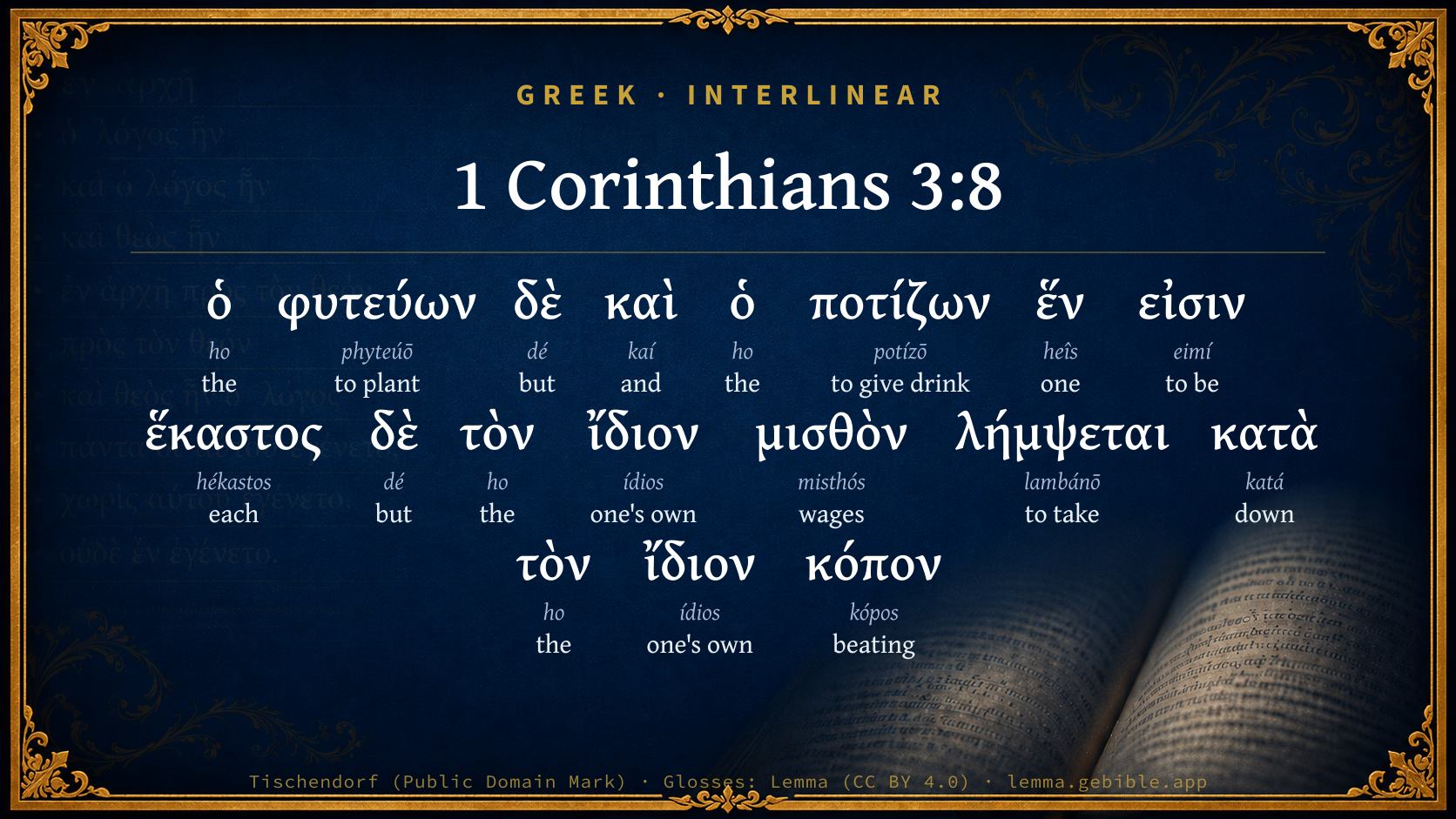
  1. ὁ ho G3588 “the” Article, Nominative, Singular, Masculine
  2. δὲ dé G1161 “but” Conjunction
  3. καὶ kaí G2532 “and” Conjunction
  4. ὁ ho G3588 “the” Article, Nominative, Singular, Masculine
  5. ποτίζων potízō G4222 “to give drink” Verb, Present, Active, Participle, Nominative, Singular, Masculine
  6. ἕν heîs G1520 “one” Adjective, Nominative, Singular, Neuter
  7. εἰσιν eimí G1510 “to be” Verb, Present, Active, Indicative, 3rd person, Plural
  8. ἕκαστος hékastos G1538 “each” Adjective, Nominative, Singular, Masculine
  9. δὲ dé G1161 “but” Conjunction
  10. τὸν ho G3588 “the” Article, Accusative, Singular, Masculine
  11. ἴδιον ídios G2398 “one's own” Adjective, Accusative, Singular, Masculine
  12. μισθὸν misthós G3408 “wages” Noun, Accusative, Singular, Masculine
  13. λήμψεται lambánō G2983 “to take” Verb, Future, Middle deponent, Indicative, 3rd person, Singular
  14. κατὰ katá G2596 “down” Preposition
  15. τὸν ho G3588 “the” Article, Accusative, Singular, Masculine
  16. ἴδιον ídios G2398 “one's own” Adjective, Accusative, Singular, Masculine
  17. κόπον kópos G2873 “beating” Noun, Accusative, Singular, Masculine

About this verse

These counts appear in no published source. They are computed here, from the morphology-tagged text and Lemma’s own curated glosses. What Lemma adds →

18
words
13
distinct lemmas
Pauline Epistles
section

Notable vocabulary

The rarest word here is φυτεύων to plant G5452 — appearing just 11 times in the whole Greek New Testament.

Shared distinctive vocabulary

φυτεύων to plant G5452 occurs in 11 verses of the Greek New Testament. Also found in:

Repetition

Words recur within this verse:

Cross-references

19

Topical passages linked to 1 Corinthians 3:8 in the Treasury of Scripture Knowledge — connected by theme and wording, ordered by reader-vote popularity; previews shown in the World English Bible.

  • Romans 2:6 who "will pay back to everyone according to their works:"
  • Psalms 62:12 Also to you, Lord, belongs loving kindness, For you reward every man according to his work.
  • Matthew 16:27 For the Son of Man will come in the glory of his Father with his angels, and then he will render to everyone according to his deeds.
  • John 4:36–38 He who reaps receives wages, and gathers fruit to eternal life; that both he who sows and he who reaps may rejoice together.
  • 2 John 1:8 Watch yourselves, that we don't lose the things which we have accomplished, but that we receive a full reward.
  • 1 Corinthians 15:58 Therefore, my beloved brothers, be steadfast, immovable, always abounding in the Lord's work, because you know that your labor is not in vain in the Lord.
  • Galatians 6:7–8 Don't be deceived. God is not mocked, for whatever a man sows, that will he also reap.
  • Revelation 22:12 "Behold, I come quickly. My reward is with me, to repay to each man according to his work.
  • Galatians 6:4 But let each man test his own work, and then he will take pride in himself and not in his neighbor.
  • 1 Peter 5:4 When the chief Shepherd is revealed, you will receive the crown of glory that doesn't fade away.
  • Daniel 12:3 Those who are wise shall shine as the brightness of the expanse; and those who turn many to righteousness as the stars forever and ever.
  • Matthew 5:11–12 "Blessed are you when people reproach you, persecute you, and say all kinds of evil against you falsely, for my sake.
  • Matthew 10:41–42 He who receives a prophet in the name of a prophet will receive a prophet's reward: and he who receives a righteous man in the name of a righteous man will receive a righteous man's reward.
  • 1 Corinthians 3:9 For we are God's fellow workers. You are God's farming, God's building.
  • 1 Corinthians 3:14 If any man's work remains which he built on it, he will receive a reward.
  • Hebrews 6:10 For God is not unrighteous, so as to forget your work and the labor of love which you showed toward his name, in that you served the saints, and still do serve them.
  • 1 Corinthians 4:5–6 Therefore judge nothing before the time, until the Lord comes, who will both bring to light the hidden things of darkness, and reveal the counsels of the hearts. Then each man will get his praise from God.
  • 1 Corinthians 9:17–18 For if I do this of my own will, I have a reward. But if not of my own will, I have a stewardship entrusted to me.
  • Revelation 2:23 I will kill her children with Death, and all the assemblies will know that I am he who searches the minds and hearts. I will give to each one of you according to your deeds.

Cross-references courtesy of OpenBible.info (CC BY 4.0).

Commentary

Notes on 1 Corinthians 3:8 from classic Christian and Jewish commentators (each source and its license shown beneath its notes). The classic Christian expositions comment on the surrounding passage and are grouped to its opening verse, so a note may address several verses; the Jewish commentaries on the Tanakh (Rashi and others) are per-verse, so they appear only where the commentator wrote on this verse.

Lemma curates 59 commentaries, every one of them public domain or Creative Commons licensed, each selected and text-cleaned for this edition rather than reprinted as found. About our sources →

Joseph Benson's Commentary

1Co 3:8-9. He that planteth and he that watereth are one — United in affection, and engaged in one general design, the design of glorifying God in the salvation of souls, though their labours may be in some respect different: and hence, instead of being pleased, we are rather displeased and grieved with those invidious comparisons in favour of one against another. Our great concern is to please our common Lord, to whom we are shortly to give up our account; and from whom every man — He primarily means every minister of Christ; shall receive his own reward — The reward in some respects peculiar to himself; according to his own peculiar labour — For as some labour with greater zeal and diligence, and others with less, so they shall be rewarded with different degrees of felicity and glory. He does not say, according to his success, because he who labours much, supposing he labours with a single eye to the glory of God, from a principle of love to him, and a conscientious regard to his will, shall have a great reward, though it may please God to give him little success. Has not all this reasoning the same force still? Ministers are still barely instruments in God’s hand, and depend as entirely as ever on his blessing, to give the increase to their labours. Without this they are nothing; with it their part is so small, that they hardly deserve to be mentioned. May their hearts and hands be more united; and, retaining a due sense of the honour God doth them in employing them, may they faithfully labour, not as for themselves, but for the great Proprietor of all, till the day come when he will reward them in full proportion to their fidelity and diligence! For we are labourers together, &c. — Greek, Θεου γαρ εσμεν συνεργοι, we are fellow- labourers of God; or, we are God’s labourers, and fellow-labourers with each other. Ye are God’s husbandry — Or God’s tillage, God’s cultivated ground: a comprehensive word, taking in a field, a garden, and a vineyard. This is the sum of what went before. Ye are God’s building — This refers to what follows.

Joseph Benson's Commentary on the Old and New Testaments (1811–1818) — public domain. Text from a community e-Sword module.

Bengel's Gnomon

Johann Albrecht Bengel

1Co 3:8. Ἓν) one; neither of them is so much as anything. As one star in the heavens shines high above another; but the unscientific man does not perceive the difference in the height; so the Apostle Paul shone far above Apollos; but the Corinthians did not understand this, and Paul in this passage does not instruct them much on that point; he merely asserts the eminent superiority of Christ.—ἴδιον—ἴδιον, his own—his own) an appropriate repetition, and an antithesis to one.—μισθὸν, reward) something beyond salvation, 1Co 3:14-15. The faithful steward will receive praise, the diligent workman a reward.—κόπον, labour) not merely according to the work [done, but according to each man’s labour].

Bengel's Gnomon of the New Testament — English translation (T&T Clark, Edinburgh, 1860) — public domain. Text from a community e-Sword module.

Meyer's Critical & Exegetical Commentary

Heinrich August Wilhelm Meyer

1Co_3:8-9. The planter, on the other hand, and the waterer are one: each of them, however (and here we pass on to the new point of the recompense of the teachers), will receive his own reward, etc.

ἕν εἰσιν] the one is not something other than the other, generically as respects a relation defined in the text (1Co_11:5; Joh_10:30; Joh_17:11; Joh_17:21), here: in so far as both are of one and the same official character, namely, as workers in the service of God. Theodoret: κατὰ τὴν ὑπουργίαν.

ἕκαστος δὲ κ.τ.λ[497]] ΠΡῸς ΓᾺΡ ΤῸ ΤΟῦ ΘΕΟῦ ἜΡΓΟΝ ΠΑΡΑΒΑΛΛΌΜΕΝΟΙ ἝΝ ΕἸΣΙΝ· ἘΠΕῚ ΠΌΝΩΝ ἝΝΕΚΕΝ (i.e. in respect of the pains and labour expended) οὐκ εἰσὶν, ἀλλὰ ἕκαστος Κ.Τ.Λ[498], Chrysostom.

ἴδιον] both times with emphasis. Bengel puts it happily: congruens iteratio; antitheton ad unum. The λήψεται, however, refers to the recompense at the last judgment, 1Co_3:13 ff.1Co_3:9 gives now the proof, not for both halves of 1Co_3:8, of which the first has been already disposed of in the preceding statement (in opposition to Hofmann), but for the new thought ἕκαστος … κόπον introduced by δέ. The emphasis of proof lies wholly on the word thrice put foremost, Θεοῦ. For since it is God whose helpers we are (eximium elogium ministerii, Calvin), God whose tillage-field, God whose building ye are: therefore it cannot be otherwise than that that ἕκαστος … κόπον must hold good, and none lack his reward according to his labour (secundum laborem, non propter laborem, Calovius).

Θεοῦ συνεργοί] for we, your teachers, labour with God, the supreme Lord and Fosterer of the church, at one work, which is simply the furtherance of the church. The explanation: workers who work with each other for Gods cause (Estius by way of suggestion, Bengel, Flatt, Heydenreich, Olshausen), is linguistically erroneous (see 1Th_3:2; Rom_16:3; Rom_16:9; Rom_16:21; Php_2:25; Php_4:3; 2Co_1:24; 2Ma_14:5; Plato, Def. p. 414 A; Dem. 68. 27, 884. 2; Plut. Per. 31; Bernhardy, p. 171; Kühner, II. p. 172), and fails to appreciate that lofty conception of a δοῦλος Θεοῦ.

Θεοῦ γεώργ. and Θεοῦ οἰκ. set before us the Corinthian church, in so far as it is the object of the ministerial service of Christian teachers, under the twofold image of a field for tillage (γεώργ., Strabo, xiv. p. 671; Theag. in Schol. on Pind. Nem. iii. 21; Pro_24:30; Pro_31:16), which belongs to God and is cultivated, and as a building belonging to God (Eph_2:21), which is being carried up to completion.

[497] .τ.λ. καὶ τὰ λοιπά.

[498] .τ.λ. καὶ τὰ λοιπά.

Meyer — Critical and Exegetical Commentary on the New Testament — English translation by Peter Christie, edited by Frederick Crombie (T&T Clark, 1880) — public domain. Text from a community e-Sword module.

Expositor's Greek Testament

ed. W. Robertson Nicoll

1Co 3:8 . In comparison with God, Ap. and P. are simply nothing (1Co 3:7 ): in relation to each other they are not rivals, as their Cor [516] favourers would make them (1Co 3:4 ): “But the planter and the waterer are one” ( ἕν , one thing ) with one interest and aim, viz. , the growth of the Church; cf. 1Co 12:12 ; 1Co 12:20 ; also Joh 10:30 . Their functions are complementary, not competitive: a further answer to the question, τί οὖν ἐστὶν Ἀπολλώς κ . τ . λ .; The servants of God are nothing before Him, “one thing” before His Church: vanity and variance are alike impossible.

[516] Corinth, Corinthian or Corinthians.

While one in aim, they are distinct in responsibility and reward: “But each will get his own (proper) wage, according to his own toil”. ἴδιος , appropriate, specific ( cf. 1Co 7:7 , 1Co 15:23 ; 1Co 15:28 ): “congruens iteratio, antitheton ad unum ” (Bg [517] ). ἔργον (1Co 3:13-15 ) denotes the work achieved , κόπος the exertion put forth (see parls., and κοπιάω , 1Co 15:10 , etc.): τί γὰρ εἰ ἔργον οὐκ ἐτέλεσεν ; ἐκοπίασεν δέ (Thp [518] ). The contrast ἕν εἰσιν … ἕκαστος δέ , between collective and individual relationships, is characteristic of Paul: cf. 1Co 12:5-11 ; 1Co 12:27 , 1Co 15:10 f., Gal 6:2-5 , Rom 14:7-10 . He forbids the man either to assert himself against the community or to merge himself in it. The fixed ratio between present labour in Christ’s service and final reward is set forth, diff [519] but consistently, in the two parables of the Talents and Pounds, Mat 25:14-30 , Luk 19:11-28 .

[517] Bengel’s Gnomon Novi Testamenti.

[518] Theophylact, Greek Commentator.

[519] difference, different, differently.

The Expositor's Greek Testament, edited by W. Robertson Nicoll (1897–1910) — public domain. Text from a community e-Sword module.

Hodge's Commentary on Romans, Ephesians & First Corinthians

Charles Hodge

1Co_3:8

Now he that planteth and he that watereth are one: and every man shall receive his own reward, according to his own labor.

Are one. Ministers have the same office; they have the same work, they stand in the same relation to God and to his Church. They are fellow-laborers. To array the one against the other, is, therefore, inconsistent with their relation to each other and to the people whom they serve.

Every man shall receive his own reward. Diversity and unity is the law of all Gods works. Ministers are one, yet they have different gifts, different services to perform. One plants and another waters, and they have different rewards.

According to his own labor. The rule of reward is not the talents or gifts, nor the success of ministers, but their labors. This brings the humblest on a level with the most exalted; the least successful with the most highly favored. The faithful, laborious minister or missionary who labors in obscurity and without apparent fruit, will meet a reward far beyond that of those who, with less self-denial and effort, are made the instruments of great results. Corinth was the field of labor of a multitude of teachers, some faithful, and some unfaithful; some laborious, and others indolent and self-indulgent. Each would have to answer for himself, and would receive a reward proportioned to his fidelity and self-denial.

Charles Hodge — Commentary on Romans (1835), First Corinthians (1857), and Ephesians (1856) — public domain. Text from a community e-Sword module.

Jamieson, Fausset & Brown

Robert Jamieson, A. R. Fausset & David Brown

one--essentially in their aim they are one, engaged in one and the same ministry; therefore they ought not to be made by you the occasion of forming separate parties.

and every man--rather "but every man." Though in their service or ministry, they are essentially "one," yet every minister is separately responsible in "his own" work, and "shall receive his own (emphatically repeated) reward, according to his own labor." The reward is something over and above personal salvation (Co1 3:14-15; Jo2 1:8). He shall be rewarded according to, not his success or the amount of work done, but "according to his own labor." It shall be said to him, "Well done, thou good and (not successful, but) faithful servant, enter thou into the joy of thy Lord" (Mat 25:23).

Jamieson, Fausset & Brown — Commentary Critical and Explanatory on the Whole Bible (1871) — public domain (CC PDM 1.0). Text via the HelloAO Bible API.

Adam Clarke's Commentary

Verse 8. He that planteth and he that watereth are one] Both Paul and Apollos have received the same doctrine, preach the same doctrine, and labour to promote the glory of God in the salvation of your souls. Why should you be divided with respect to Paul and Apollos, while these apostles are intimately ONE in spirit, design, and operation?

According to his own labour.] God does not reward his servants according to the success of their labour, because that depends on himself; but he rewards them according to the quantum of faithful labour which they bestow on his work. In this sense none can say, I have laboured in vain, and spent my strength for nought.

Adam Clarke's Commentary on the Bible (1810–1826) — public domain. Text from a community e-Sword/MySword module.

John Calvin's Commentaries

8. He that planteth, and he that watereth are one He shows farther, from another consideration, that the Corinthians are greatly to blame in abusing, with a view to maintain their own sects and parties, the names of their teachers, who in the meantime are, with united efforts, aiming at one and the same thing, and can by no means be separated, or torn asunder, without at the same time leaving off the duties of their office. They are one, says he; in other words, they are so linked together, that their connection does not allow of any separation, because all ought to have one end in view, and they serve one Lord, and are engaged in the same work. Hence, if they employ themselves faithfully in cultivating the Lord’s field, they will maintain unity; and, by mutual communication, will help each other — so far from their names serving as standards to stir up contendings. Here we have a beautiful passage for exhorting ministers to concord. Meanwhile, however, he indirectly reproves those ambitious teachers, who, by giving occasion for contentions, discovered thereby that they were not the servants of Christ, but the slaves of vain-glory — that they did not employ themselves in planting and watering, but in rooting up and burning.

Every man will receive his own reward Here he shows what is the end that all ministers should have in view — not to catch the applause of the multitude, but to please the Lord. This, too, he does with the view of calling to the judgment-seat of God those ambitious teachers, who were intoxicated with the glory of the world, and thought of nothing else; and at the same time admonishing the Corinthians, as to the worthlessness of that empty applause which is drawn forth by elegance of expression and vain ostentation. He at the same time discovers in these words the fearlessness of his conscience, inasmuch as he ventures to look forward to the judgment of God without dismay. For the reason why ambitious men recommend themselves to the esteem of the world is, that they have not learned to devote themselves to God, and that they do not set before their eyes Christ’s heavenly kingdom. Accordingly, as soon as God comes to be seen, that foolish desire of gaining man’s favor disappears.

John Calvin's Commentaries (1540-1563) — public domain. Text from the Calvin Translation Society English edition (1840s-50s) via the Christian Classics Ethereal Library (ccel.org). Calvin's coverage is partial (roughly two-thirds of the Bible); uncommented books and verses are honest gaps, never fabricated. The 19th-century editor's footnotes and remarks are omitted so the notes are faithfully Calvin's own voice.

Ellicott's Commentary for English Readers

(8) Are one.—The planter and the waterer are one in that they are both working in the same cause. “But,” says the Apostle (not “and,” as in our version), “each man shall receive his own reward from God, not from man, according to his labour.” There is an individuality as well as a unity in the work of the ministry. This is, however, not a thing to be noticed by men, but it will be recognised by the great Master.

A Bible Commentary for English Readers, edited by Charles John Ellicott (1878–1897) — public domain. Text from a community e-Sword module.

The Cambridge Bible for Schools and Colleges

gen. ed. J. J. S. Perowne

8. he that planteth and he that watereth are one] As though to make his depreciation of man as emphatic as possible, the Apostle uses the neuter gender here. The instruments are one thing, parts of a vast piece of machinery which God has put in motion for the salvation of the world. As channels of Divine grace it is our duty to forget their personality.

The Cambridge Bible for Schools and Colleges (gen. ed. J. J. S. Perowne; Cambridge University Press, 1878–1918) — public domain. Text from a community e-Sword module.

John Gill's Exposition

Now he that planteth, and he that watereth are one,.... Not in every respect so; they were different as men, they were not the same individual persons, nor in the same office; Paul was an apostle, Apollos only a preacher of the Gospel; nor had they the same measure of gifts, nor did they labour alike, or were of the same usefulness; but they had one and the same commission to preach the Gospel; and the Gospel they preached was the same; and so were their views, aims, and ends, which were the glory of God, and the good of immortal souls; and they had the same love and affection for one another; they were one in their work, judgment, and affection; and which carries in it a strong reason and argument why the members of this church should not contend and divide about them:

and every man shall receive his own reward; either from men, that double honour he is worthy of, maintenance and respect; or rather from God, not a reward of debt, for his labours are by no means meritorious of anything at the hands of God, from whom he has all the grace, strength, and abilities he labours with; but of grace, even the reward of the inheritance, because he serves the Lord Christ; which is by bequest, through the death of the testator, and common to all the children of God, and heirs of glory:

according to his own labour; and not another's; and not according to the success of it, but according to that itself; not that that is the measure of the reward, for the reward infinitely exceeds it; but is that to which God has graciously annexed the promise of the reward, as an encouragement to it.

John Gill's Exposition of the Whole Bible (1746–1763) — public domain (CC PDM 1.0). Text via the HelloAO Bible API.

Trapp's Complete Commentary

John Trapp

8 Now he that planteth and he that watereth are one: and every man shall receive his own reward according to his own labour.

Ver. 8. And he that watereth are one] Why then are not you at one? Should ye not follow your leaders, press their footsteps? Surely you would, did you not more mind party than peace. Maxima pars studiorum, est studium partium; a hateful kind of study.

Shall receive his own reward] Those ambitious doctors that draw disciples after them, hunting after popular applause (that empty blast of stinking breath), shall have that for their reward; let them make them merry with it. When faithful ministers shall shine as stars, Dan 12:3.

John Trapp, A Commentary or Exposition upon All the Books of the Old and New Testament (1647–1656) — public domain. Text from a community e-Sword module.

Albert Barnes' Notes on the Bible

Are one - ἕν εἰσιν hen eisin. They are not the same person; but they are one in the following respects:

(1) They are united in reference to the same work. Though they are engaged in different things - for planting and watering are different kinds of work, yet it is one in regard to the end to be gained. The employments do not at all clash, but tend to the same end. It is not as if one planted, and the other was engaged in pulling up.

(2) Their work is one, because one is as necessary as the other. If the grain was not planted there would be no use in pouring water there; if not watered, there would be no use in planting. The work of one is as necessary, therefore, as the other; and the one should not undervalue the labors of the other.

(3) They are one in regard to God. They are both engaged in performing one work; God is performing another. There are not three parties or portions of the work, but two. They two perform one part of the work; God alone performs the other. Theirs would be useless without him; he would not ordinarily perform his without their performing their part. They could not do his part it they would - as they cannot make a plant grow; he could perform their part - as he could plant and water without the farmer; but it is not in accordance with his arrangements to do it.

And every man - The argument of the apostle here has reference only to ministers; but it is equally true of all people, that they shall receive their proper reward.

Shall receive - On the Day of Judgment, when God decides the destiny of men. The decisions of that Day will be simply determining what every moral agent ought to receive.

His own reward - His fit, or proper (τον ἴδιον ton idion) reward; that which pertains to him, or which shall be a proper expression of the character and value of his labor - The word “reward” μισθὸν misthon denotes properly that which is given by contract for service rendered; an equivalent in value for services or for kindness; see the note at Rom 4:4. In the Scriptures it denotes pay, wages, recompense given to day-laborers, to soldiers, etc. It is applied often, as here, to the retribution which God will make to people on the Day of Judgment; and is applied to the “favors” which he will then bestow on them, or to the “punishment” which he will inflict as the reward of their deeds. Instances of the former sense occur in Mat 5:12; 6; Luk 6:23, Luk 6:35; Rev 11:18; of the latter in 2Pe 2:13, 2Pe 2:15 - In regard to the righteous, it does not imply merit, or that they deserve heaven; but it means that, God will render to them that which, according to the terms of his new covenant, he has promised, and which shall be a fit expression of his acceptance of their services. It is proper, according to these arrangements, that they should be blessed in heaven. It would not be proper that they should be cast down to hell - Their original and their sole title to eternal life is the grace of God through Jesus Christ: the “measure,” or “amount” of the favors bestowed on them there, shall be according to the services which they render on earth. A parent may resolve to divide his estate among his sons, and their title to any thing may be derived from his mere favor but he may determine that it shall be divided according to their expressions of attachment, and to their obedience to him.

Albert Barnes' Notes on the Bible (1834–1885) — public domain. Text from a community e-Sword/MySword module.

Matthew Poole's English Annotations

The ministers of Christ, though one be used in planting and another in watering, one in laying the foundation and another in building thereupon, yet are one; one in their office and work, one in their ministry, being all servants to Christ, who is one; all serving one and the same Lord, all doing the same business, proposing the same end, and with all their might labouring towards it; and therefore, as they ought not to divide into parties and factions, so you ought not for their sakes to be so divided. Yet they are not so one, but that one may labour more than another, and be honoured by God with more success than another, and every one shall receive a reward proportioned to his labour: the apostle saith not, according to the success of his labour, (that is not in his power), but,

according to his labour.

Matthew Poole's English Annotations on the Holy Bible (1683–1685) — public domain. Text from a community e-Sword/MySword module.

Whedon's Commentary on the Bible

Daniel D. Whedon

8. Are one—And so should not be divided between contending parties.

Every man—That truly either plants or waters God’s heritage.

According to his own laborer—As is fully shown in 1Co_3:12-15.

Daniel D. Whedon (gen. ed.), Commentary on the Old and New Testaments (1874–1909) — public domain. Text from a community e-Sword module.

The Pulpit Commentary

Are one; literally, one thing. God is the sole Agent; the teachers, so far from being able to pose as rival leaders, form but one instrument in God"s hand. Their relative differences shrink into insignificance when the source and objects of their ministry are considered. His own reward his own labour. In the lower individual sphere the work of teachers shall be fairly estimated and rewarded as in the parable of the pounds and talents. (comp Joh_4:36; Rev_22:12)

The Pulpit Commentary (1880–1919), ed. H.D.M. Spence-Jones & Joseph S. Exell — public domain. Text from a community e-Sword module.

John Wesley's Explanatory Notes

But he that planteth and he that watereth are one - Which is another argument against division. Though their labours are different. they are all employed in one general work, - the saving souls. Hence he takes occasion to speak of the reward of them that labour faithfully, and the awful account to be given by all. Every man shall receive his own peculiar reward according to his own peculiar labour - Not according to his success; but he who labours much, though with small success, shall have a great reward. Has not all this reasoning the same force still? The ministers are still surely instruments in God's hand, and depend as entirely as ever on his blessing, to give the increase to their labours. Without this, they are nothing: with it, their part is so small, that they hardly deserve to be mentioned. May their hearts and hands be more united; and, retaining a due sense of the honour God doeth them in employing them, may they faithfully labour, not as for themselves, but for the great Proprietor of all, till the day come when he will reward them in full proportion to their fidelity and diligence!

John Wesley, Explanatory Notes Upon the Whole Bible (1754–1765) — public domain. Text via the GEBible commentary corpus.

Scofield Reference Notes

C. I. Scofield

one

Paul refutes the notion that he and Cephas and Apollos are at variance, mere theologians and rival founders of sects: they are "one." 1Co 3:22; 1Co 16:12.

reward 1Co 9:17; Dan 12:3; 1Co 3:14

The Scofield Reference Bible (1917 edition), notes by C. I. Scofield — public domain. Text from a community e-Sword module.

Burkitt's Expository Notes on the New Testament

William Burkitt

He that planteth and he that watereth are one: that is, in their design and scope, in the aim and end of their ministry; therefore they should not be factiously divided, either among themselves or by their hearers. Although there is a variety and diversity in the gifts of Christ’s ministers, yet the intent and design of their ministry being one, they all ought to agree as one. They should be one in doctrine, and one in affection; aiming at one and the same mark, namely, the glory of God, and men’s salvation, as they are one in their office, institution, and end.

It follows, Every man shall receive his own reward, according to his own labour.

Thence learn, That every man, especially every minister, is sure to receive a proportionable reward hereafter, according to his labour and working for God here.

Learn, 2. The approbation and distinction of this reward; He shall receive his own reward: implying that there are degrees of reward and glory in heaven, according as men have laboured more or less for God here on earth: according to this gradual diversity, shall be gradual degrees of reward and glory in heaven, according as men have laboured more or less for God here on earth: according to this gradual diversity, shall be gradual degrees of glory.

Learn, 3. The measure and rule of this reward: according to the fruit of his ministry. If he labours faithfully, God will reward him proportionably, though few or none have believed his report.

William Burkitt's Expository Notes on the New Testament (1700–1703) — public domain. Text from a community e-Sword module.

Godbey's Commentary on the New Testament

William B. Godbey

8. “And he that planteth and he that watereth are one, but each one shall receive his own reward according to his own labor.” What a disposition do we find to honor the revivalist who has been instrumental in the conversion of many, and lose sight of his faithful successors who came on and irrigated the crop, without which it certainly would have died. Lord, save us from worshipping men! We must remember that God Himself is the only efficient worker, and that He uses an infinite diversity of human instrumentality.

William B. Godbey, Commentary on the New Testament (1896–1900) — public domain. Text from a community e-Sword module.

McGarvey & Pendleton's Commentaries

J. W. McGarvey

Now he that planteth and he that watereth are one [with respect to their purposes, or the ends for which they labor: hence, not rivals]: but each shall receive his own reward according to his own labor . [Since God gives the increase, the reward will be proportioned to fidelity, etc., rather than to results.]

J. W. McGarvey (with Philip Y. Pendleton), Commentaries on the New Testament (The Fourfold Gospel, 1914; Acts; and the epistles) — public domain. Text from a community e-Sword/MySword module.

The People's New Testament

B. W. Johnson

8. Now he that planteth and he that watereth are one. They have kindred work, as servants, and each will be rewarded as a servant, according to his own labor.

B. W. Johnson's The People's New Testament with Notes (1889–1891) — public domain. Electronic text from the Christian Classics Ethereal Library (CCEL) ThML edition.

unfoldingWord translationNotes

Door43 World Missions Community

he who plants and he who waters are one

Paul speaks of telling people the good news and teaching those who have accepted it as if they were planting and watering plants. (See: Metaphor)

are one

Possible meanings are "one" are 1) "united in purpose" or 2) "equal in importance."

wages

an amount of money that a worker receives for his work

we

This refers to Paul and Apollos but not the Corinthian church. (See: Exclusive and Inclusive "We")

God's fellow workers

Paul considers himself and Apollos as working together.

You are God's garden

Possible meanings are 1) being God's garden represents belonging to God. AT: "You are like a garden that belongs to God" or 2) being God's garden represents God causing us to grow. AT: "You are like a garden that God makes grow" (See: Metaphor)

God's building

Possible meanings are 1) being God's building represents belonging to God. AT: "and you are like a building that belongs to God" or 2) being God's building represents God causing us to become what he wants. AT: "and you are like a building that God is constructing" (See: Metaphor)

translationWords

labor

unfoldingWord translationNotes — © Distant Shores Media and the Door43 World Missions Community, licensed CC BY-SA 4.0. Source: git.door43.org/Door43/en_tn.

Cambridge Greek Testament for Schools and Colleges

8. ὁ φυτεύων δὲ καὶ ὁ ποτίζων ἕν εἰσιν. As though to make his depreciation of man as emphatic as possible, the Apostle uses the neuter gender here. The instruments are one thing, parts of a vast piece of machinery which God has put in motion for the salvation of the world. As channels of Divine grace it is our duty to forget their personality.

μισθὸν λήμψεται. The great truth contained in the first part of the verse is, however, capable of being misinterpreted. In reference to the work God’s ministers are but one. But in reference to their own individual action they are distinct. ‘Every man shall receive according as his work shall be.’ Else were God unjust.

Cambridge Greek Testament for Schools and Colleges (Cambridge University Press, 1896; 21 vols, various authors incl. Carr, Maclear, Plummer, Farrar, Lumby, Moule, M. R. James, Simcox) — public domain. Text from a community e-Sword module.

Alford’s Greek Testament

Henry Alford

8.] ἕν, in the nature of their ministry,—generically, κατὰ τὴν ὑπουργίαν· ἀμφότεραι γὰρ τῷ θείῳ διακονοῦσι βουλήματι. Theodoret.

ἕκαστος δὲ …] Here he introduces a new element—the separate responsibility of each minister for the results of his own labour, so that, though κατὰ τὴν ὑπουργίαν they are one,—κατὰ τὸ ἔργον (ib.) they are diverse. The stress is twice on ἴδιον.

Henry Alford, The Greek Testament (1849–1861) — public domain. Text from a community e-Sword module.

Godet's Commentaries

Frédéric Louis Godet

Vv. 8. “Now he that planteth and he that watereth are one, but every man shall receive his own reward according to his own labour.”

The δέ is here a particle of transition, but with a shade of contrast: “Now, despite this difference of functions (pointed out, 1Co 3:5-7), these ministers are one.” This unity is not that of their common nothingness (Bengel: “Neuter aeque quidquam est”), nor that of the part of simple servants (de Wette, Meyer, Heinrici, etc.); it is that of the work on which they labour together. To understand what Paul means by this unity, it is enough to consider the foregoing figures (1Co 3:6-7). Between two gardeners, one of whom plants and the other waters one and the same garden, who would think of setting up any rivalry? Would not the labour of the one become useless without that of the other? What folly, then, to disparage the one and exalt the other!

But yet there will one day be—the second δέ is adversative—a difference established between them: the difference of the reward they will receive, which will depend on the degree of their fidelity in their respective labours. This idea, expressed in the second part of the verse, is that which Paul proceeds to develop in the passage, 1Co 3:10-15. Of course it is the Master who will pass this estimate; it will take place at the day of judgment. And so what folly it is to anticipate it by comparisons made beforehand! The terms ἴδιος μισθός, his own reward, and ἴδιος κόπος, his own labour, recall the saying, Gal 6:5: “Every man will bear his own burden.” The estimate of the fidelity of each servant will not rest on the comparison of it with another’s, but on the labour of each compared with his own task and his own gift. Now who else than God could pronounce such a sentence? And not only has He alone the power, but He alone has the right. This is what is brought out in 1Co 3:9.

Frédéric Louis Godet — Commentaries on Luke, John, Romans, and 1 Corinthians — English translation (T&T Clark, Edinburgh, 1870s–1890s) — public domain. Text from a community e-Sword module.

Lesson kit

Teaching starters — assembled from the data on this page, not authored interpretation. Every prompt links to the verse data it draws on. Edit before teaching.

1 Corinthians, in the Pauline Epistles, opens this verse with 18 words (13 distinct Greek lemmas). Its most distinctive word is phyteúō (“to plant”). A historical commentator’s framing appears above. Read the whole chapter for the surrounding context.

Discussion questions

  1. How does “to plant” (phyteúō) shape what this verse is saying?
  2. Matthew 15:13 shares the word «to plant» with this verse. How do the two illuminate each other?
  3. “one's own” occurs 2× in this one verse. What is the effect of the repetition?
  4. These translations render this verse differently. What is at stake in choosing one wording over another?
  5. Reading how Joseph Benson's Commentary and Bengel's Gnomon read this verse, where do the two commentators agree and where do they part?

Things to notice

  • These translations choose different wording for 18 words in this verse.
  • “one's own” occurs 2× in this single verse.
  • 13 distinct Greek lemmas span 18 words in this verse.

Reading settings

Reading text

Shown beneath each verse's original-language words.

Old Testament
Old Testament edition

Read the OT as the Masoretic Hebrew (MT) or the Greek Septuagint (LXX).

English shown for the Greek Septuagint (in the Hebrew ↔ Greek comparison).

Comparing translations? Open the Compare panel on any verse page to stack up to four side by side.