

Hebrews 7:5
Greek (Tischendorf 8th ed.) Hebrews 7:5 appears in the Greek New Testament. The text above is from the Tischendorf 8th edition. Each word links to its Strong’s number and a concise gloss. Click any word for its full Thayer’s Greek Lexicon entry.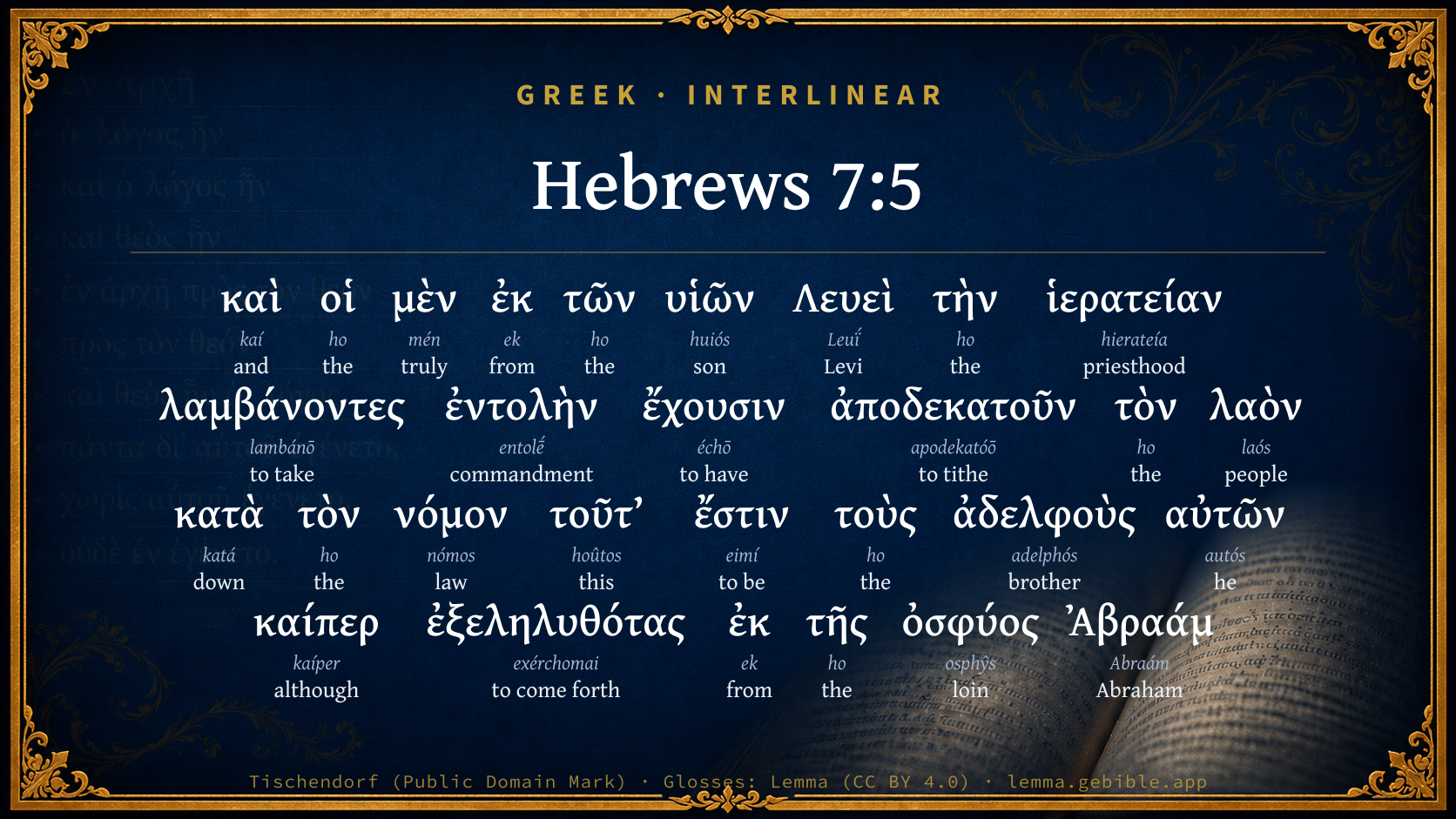
They indeed of the sons of Levi who receive the priest's office have a commandment to take tithes of the people according to the law, that is, of their brothers, though these have come out of the loins of Abraham,
Download a study sheet
One document with this verse’s original text, its word-by-word gloss line, the meaning frame, cross-references with their text, attributed commentary, and full source and license credits — printable, and it pastes into notes with its structure intact.
This verse Autodidact and up
A passage Seminary Student
Up to 50 verses in one chapter. A passage sheet keeps up to 6 commentary sources and 12 cross-references per verse, in the order this page ranks them, and says so on the sheet whenever that leaves anything out. Ask for a single verse and you get the Autodidact verse sheet above.
Everything on this page stays free to read, with no account — the sheet is a download of what is already on screen, not access to it.
Compare translations 3
The same verse in 3 English versions, stacked beneath the original-language interlinear above. Click any original word for its lexicon entry.
Each is an independent rendering of the whole verse — the interlinear is not word-aligned to these translations.
Highlighted words mark where these versions differ — a whole-verse word diff, not a word-by-word alignment.
-
World English Bible Public Domain
They indeed of the sons of Levi who receive the priest's office have a commandment to take tithes of the people according to the law, that is, of their brothers, though these have come out of the loins of Abraham,
-
King James Version Public Domain
And verily they that are of the sons of Levi, who receive the office of the priesthood, have a commandment to take tithes of the people according to the law, that is, of their brethren, though they come out of the loins of Abraham:
-
unfoldingWord Literal Text CC BY-SA 4.0
And the ones indeed from the sons of Levi having received the priesthood, have a command according to the law to collect a tithe from the people, that is, their brothers, even though they have come from the loin of Abraham.
unfoldingWord Literal Text — © unfoldingWord, licensed CC BY-SA 4.0. Word-aligned USFM3 via Door43 (git.door43.org/unfoldingWord/en_ult).
Show all 19 translations
Every available English version of this verse, each an independent rendering of the whole verse.
-
World English Bible Public Domain
They indeed of the sons of Levi who receive the priest's office have a commandment to take tithes of the people according to the law, that is, of their brothers, though these have come out of the loins of Abraham,
-
Berean Standard Bible Public Domain
Now the law commands the sons of Levi who become priests to collect a tenth from the people—that is, from their brothers—though they too are descended from Abraham.
-
Majority Standard Bible Public Domain
Now the law commands the sons of Levi who become priests to collect a tenth from the people—that is, from their brothers—though they too are descended from Abraham.
-
King James Version Public Domain
And verily they that are of the sons of Levi, who receive the office of the priesthood, have a commandment to take tithes of the people according to the law, that is, of their brethren, though they come out of the loins of Abraham:
-
American Standard Version (1901) Public Domain
And they indeed of the sons of Levi that receive the priest's office have commandment to take tithes of the people according to the law, that is, of their brethren, though these have come out of the loins of Abraham:
-
Revised Version (1885) Public Domain
And they indeed of the sons of Levi that receive the priest’s office have commandment to take tithes of the people according to the law, that is, of their brethren, though these have come out of the loins of Abraham:
-
Geneva Bible (1599) Public Domain
For verely they which are the childre of Leui, which receiue the office of the Priesthode, haue a commandement to take, according to the Law, tithes of the people (that is, of their bethren) though they came out of ye loynes of Abraham.
-
Douay-Rheims (1899) Public Domain
And indeed they that are of the sons of Levi, who receive the priesthood, have a commandment to take tithes of the people according to the law, that is to say, of their brethren: though they themselves also came out of the loins of Abraham.
-
Young's Literal Translation Public Domain
and those, indeed, out of the sons of Levi receiving the priesthood, a command have to take tithes from the people according to the law, that is, their brethren, even though they came forth out of the loins of Abraham;
-
Literal Standard Version CC BY-SA 4.0
and those, indeed, out of the sons of Levi receiving the priesthood, have a command to take tithes from the people according to the Law, that is, their brothers, even though they came forth out of the loins of Abraham;
-
Unlocked Literal Bible CC BY-SA 4.0
The sons of Levi who receive the priesthood have a command from the law to collect tithes from the people, that is, from their brothers, even though they, too, have come from Abraham's body.
-
unfoldingWord Literal Text CC BY-SA 4.0
And the ones indeed from the sons of Levi having received the priesthood, have a command according to the law to collect a tithe from the people, that is, their brothers, even though they have come from the loin of Abraham.
-
Darby Bible Public Domain
And they indeed from among the sons of Levi, who receive the priesthood, have commandment to take tithes from the people according to the law, that is from their brethren, though these are come out of the loins of Abraham:
-
World Messianic Bible Public Domain
They indeed of the sons of Levi who receive the priest’s office have a commandment to take tithes from the people according to the Torah, that is, of their brothers, though these have come out of the body of Abraham,
-
Webster's Bible Public Domain
And verily they that are of the sons of Levi, who receive the office of the priesthood, have a commandment to take tithes from the people according to the law, that is, from their brethren, though they come from the loins of Abraham:
-
Free Bible Version CC BY-SA 4.0
Yes, the sons of Levi who are priests were commanded by the law to receive a tithe from the people, their brothers and sisters, who are descended from Abraham.
-
Bible in Basic English Public Domain
And it is true that by the law, those of the sons of Levi who have the position of priests may take a tenth part of the people's goods; that is to say, they take it from their brothers though these are the sons of Abraham.
-
Text-Critical English NT CC BY 4.0
Now the law commands the sons of Levi who receive the priestly office to collect tithes from the people, that is, their brothers, even though their brothers are also descended from Abraham.
-
Tyndale New Testament (1534) Public Domain
And verely those children of levy which receave the office of the prestes have a commaundement to take a cordyng to the lawe tythes of the people that is to saye of their brethren yee though they spronge out of the loynes of Abraham.
Literal Standard Version (2020), Covenant Press — licensed CC BY-SA 4.0. Text via the HelloAO Bible API (eBible.org). Unlocked Literal Bible (unfoldingWord) — licensed CC BY-SA 4.0. Text via the HelloAO Bible API (eBible.org). unfoldingWord Literal Text — © unfoldingWord, licensed CC BY-SA 4.0. Word-aligned USFM3 via Door43 (git.door43.org/unfoldingWord/en_ult). Free Bible Version, Dr. Jonathan Gallagher — licensed CC BY-SA 4.0. Text via the HelloAO Bible API (eBible.org).
Word by word
More ways to search: Search by grammar → Find every occurrence → Compare this word →
Practice this passage: Drill this verse → Learn its vocabulary →
- Appears 2× in the Greek New Testament
- First appears at Luke 1:9
- Part of Speech
- Noun
- Case
- Accusative
- Number
- Singular
- Gender
- Feminine
Full Thayer's Definition
- καὶ kaí G2532 “and” Conjunction
- οἱ ho G3588 “the” Article, Nominative, Plural, Masculine
- μὲν mén G3303 “truly” Particle
- ἐκ ek G1537 “from” Preposition
- τῶν ho G3588 “the” Article, Genitive, Plural, Masculine
- υἱῶν huiós G5207 “son” Noun, Genitive, Plural, Masculine
- Λευεὶ Leuḯ G3017 “Levi” Noun, Proper, indeclinable
- τὴν ho G3588 “the” Article, Accusative, Singular, Feminine
- ἱερατείαν hierateía G2405 “priesthood” Noun, Accusative, Singular, Feminine
- λαμβάνοντες lambánō G2983 “to take” Verb, Present, Active, Participle, Nominative, Plural, Masculine
- ἐντολὴν entolḗ G1785 “commandment” Noun, Accusative, Singular, Feminine
- ἔχουσιν échō G2192 “to have” Verb, Present, Active, Indicative, 3rd person, Plural
- ἀποδεκατοῦν apodekatóō G586 “to tithe” Verb, Present, Active, Infinitive
- τὸν ho G3588 “the” Article, Accusative, Singular, Masculine
- λαὸν laós G2992 “people” Noun, Accusative, Singular, Masculine
- κατὰ katá G2596 “down” Preposition
- τὸν ho G3588 “the” Article, Accusative, Singular, Masculine
- νόμον nómos G3551 “law” Noun, Accusative, Singular, Masculine
- τοῦτ’ hoûtos G3778 “this” Demonstrative pronoun, Nominative, Singular, Neuter
- ἔστιν eimí G1510 “to be” Verb, Present, Active, Indicative, 3rd person, Singular
- τοὺς ho G3588 “the” Article, Accusative, Plural, Masculine
- ἀδελφοὺς adelphós G80 “brother” Noun, Accusative, Plural, Masculine
- αὐτῶν autós G846 “he” Personal pronoun, Genitive, Plural, Masculine
- καίπερ kaíper G2539 “although” Conjunction
- ἐξεληλυθότας exérchomai G1831 “to come forth” Verb, Perfect, Active, Participle, Accusative, Plural, Masculine
- ἐκ ek G1537 “from” Preposition
- τῆς ho G3588 “the” Article, Genitive, Singular, Feminine
- ὀσφύος osphŷs G3751 “loin” Noun, Genitive, Singular, Feminine
- Ἀβραάμ Abraám G11 “Abraham” Noun, Proper, indeclinable
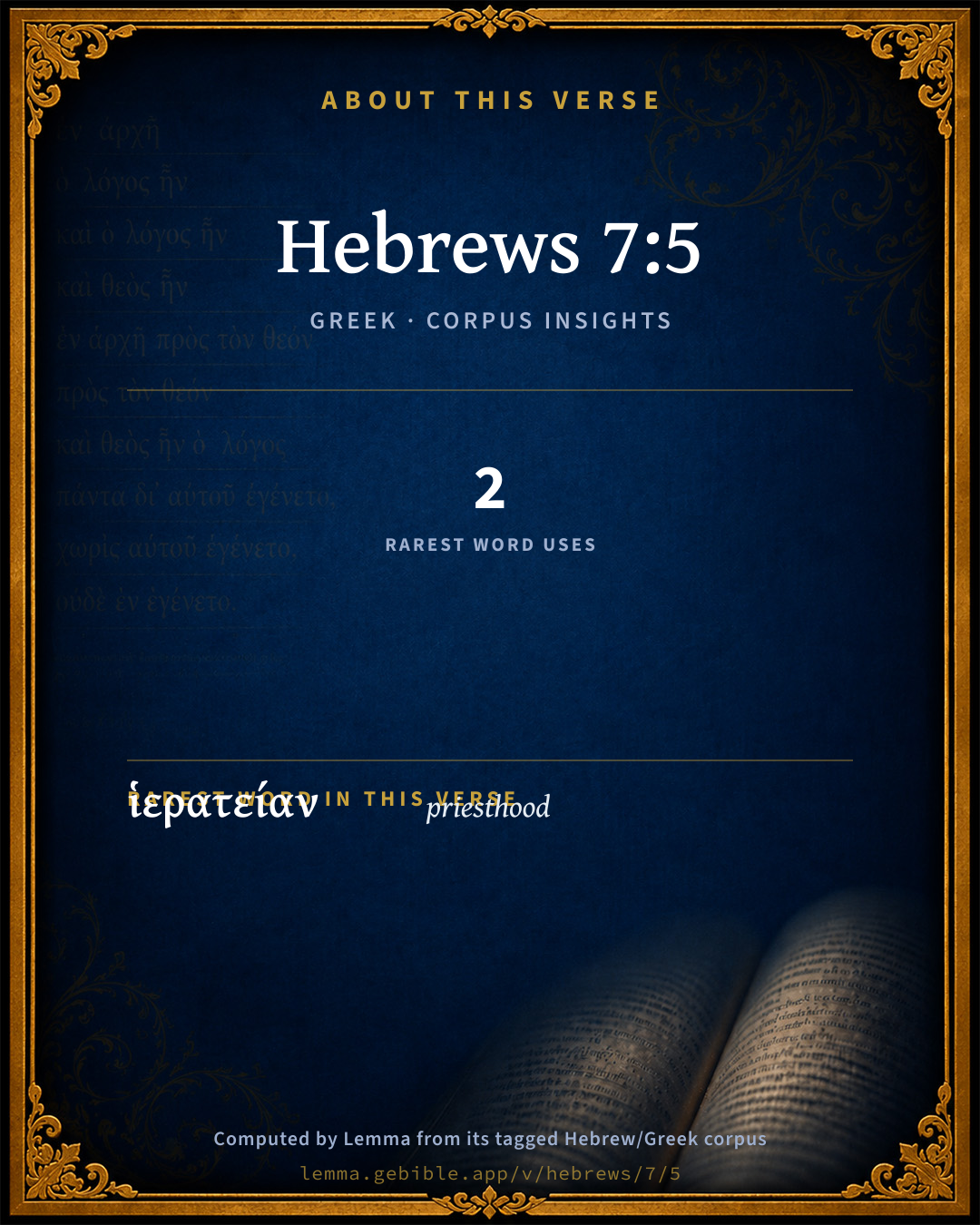
About this verse
These counts appear in no published source. They are computed here, from the morphology-tagged text and Lemma’s own curated glosses. What Lemma adds →
- 29
- words
- 22
- distinct lemmas
- General Epistles
- section
Cross-references
11Topical passages linked to Hebrews 7:5 in the Treasury of Scripture Knowledge — connected by theme and wording, ordered by reader-vote popularity; previews shown in the World English Bible.
- Leviticus 27:30–33 "'All the tithe of the land, whether of the seed of the land or of the fruit of the trees, is Yahweh's. It is holy to Yahweh.
- 2 Chronicles 31:4–6 Moreover he commanded the people who lived in Jerusalem to give the portion of the priests and the Levites, that they might give themselves to the law of Yahweh.
- Numbers 16:10–11 and that he has brought you near, and all your brothers the sons of Levi with you? and seek you the priesthood also?
- Numbers 18:21–32 To the children of Levi, behold, I have given all the tithe in Israel for an inheritance, in return for their service which they serve, even the service of the tent of meeting.
- Numbers 17:3–10 You shall write Aaron's name on the rod of Levi; for there shall be one rod for each head of their fathers' houses.
- Numbers 18:7 You and your sons with you shall keep your priesthood for everything of the altar, and for that within the veil; and you shall serve: I give you the priesthood as a service of gift: and the stranger who comes near shall be put to death.
- 1 Kings 8:19 nevertheless you shall not build the house; but your son who shall come forth out of your loins, he shall build the house for my name.
- Nehemiah 13:10 I perceived that the portions of the Levites had not been given them; so that the Levites and the singers, who did the work, were fled everyone to his field.
- Hebrews 7:10 for he was yet in the loins of his father when Melchizedek met him.
- Genesis 46:26 All the souls who came with Jacob into Egypt, who were his direct descendants, besides Jacob's sons' wives, all the souls were sixty-six.
- Exodus 28:1 "Bring Aaron your brother, and his sons with him, near to you from among the children of Israel, that he may minister to me in the priest's office, even Aaron, Nadab and Abihu, Eleazar and Ithamar, Aaron's sons.
Cross-references courtesy of OpenBible.info (CC BY 4.0).
Lesson kit
Teaching starters — assembled from the data on this page, not authored interpretation. Every prompt links to the verse data it draws on. Edit before teaching.
Hebrews, in the General Epistles, opens this verse with 29 words (22 distinct Greek lemmas). Its most distinctive word is hierateía (“priesthood”). A historical commentator’s framing appears above. Read the whole chapter for the surrounding context.
Discussion questions
- How does “priesthood” (hierateía) shape what this verse is saying?
- Luke 1:9 shares the word «priesthood» with this verse. How do the two illuminate each other?
- “the” occurs 7× in this one verse. What is the effect of the repetition?
- The translations on this page render this verse differently — a whole-verse word diff, not a word-by-word alignment. What might account for the different wordings?
- Reading how Tyndale Open Study Notes and Bengel's Gnomon read this verse, where do the two commentators agree and where do they part?
Things to notice
- These translations choose different wording for 22 words in this verse.
- “the” occurs 7× in this single verse.
- 22 distinct Greek lemmas span 29 words in this verse.
Commentary
Notes on Hebrews 7:5 from classic Christian and Jewish commentators (each source and its license shown beneath its notes). The classic Christian expositions comment on the surrounding passage and are grouped to its opening verse, so a note may address several verses; the Jewish commentaries on the Tanakh (Rashi and others) are per-verse, so they appear only where the commentator wrote on this verse.
Lemma curates 59 commentaries, every one of them public domain or Creative Commons licensed, each selected and text-cleaned for this edition rather than reprinted as found. About our sources →
Tyndale Open Study Notes
Tyndale Open Resources
Tyndale Open Study Notes — © Tyndale Open Resources, licensed CC BY-SA 4.0. Text via the HelloAO Bible API.
Bengel's Gnomon
Johann Albrecht Bengel
Bengel's Gnomon of the New Testament — English translation (T&T Clark, Edinburgh, 1860) — public domain. Text from a community e-Sword module.
Meyer's Critical & Exegetical Commentary
Heinrich August Wilhelm Meyer
Meyer — Critical and Exegetical Commentary on the New Testament — English translation by Peter Christie, edited by Frederick Crombie (T&T Clark, 1880) — public domain. Text from a community e-Sword module.
Expositor's Greek Testament
ed. W. Robertson Nicoll
The Expositor's Greek Testament, edited by W. Robertson Nicoll (1897–1910) — public domain. Text from a community e-Sword module.
Geneva Bible (1599)
Geneva Bible translators
Geneva Bible (1599) marginal notes — public domain. Text via Bolls.life.
Jamieson, Fausset & Brown
Robert Jamieson, A. R. Fausset & David Brown
Jamieson, Fausset & Brown — Commentary Critical and Explanatory on the Whole Bible (1871) — public domain (CC PDM 1.0). Text via the HelloAO Bible API.
Adam Clarke's Commentary
Adam Clarke's Commentary on the Bible (1810–1826) — public domain. Text from a community e-Sword/MySword module.
John Calvin's Commentaries
John Calvin's Commentaries (1540-1563) — public domain. Text from the Calvin Translation Society English edition (1840s-50s) via the Christian Classics Ethereal Library (ccel.org). Calvin's coverage is partial (roughly two-thirds of the Bible); uncommented books and verses are honest gaps, never fabricated. The 19th-century editor's footnotes and remarks are omitted so the notes are faithfully Calvin's own voice.
Ellicott's Commentary for English Readers
A Bible Commentary for English Readers, edited by Charles John Ellicott (1878–1897) — public domain. Text from a community e-Sword module.
The Cambridge Bible for Schools and Colleges
gen. ed. J. J. S. Perowne
The Cambridge Bible for Schools and Colleges (gen. ed. J. J. S. Perowne; Cambridge University Press, 1878–1918) — public domain. Text from a community e-Sword module.
John Gill's Exposition
John Gill's Exposition of the Whole Bible (1746–1763) — public domain (CC PDM 1.0). Text via the HelloAO Bible API.
Trapp's Complete Commentary
John Trapp
John Trapp, A Commentary or Exposition upon All the Books of the Old and New Testament (1647–1656) — public domain. Text from a community e-Sword module.
Albert Barnes' Notes on the Bible
Albert Barnes' Notes on the Bible (1834–1885) — public domain. Text from a community e-Sword/MySword module.
Matthew Poole's English Annotations
Matthew Poole's English Annotations on the Holy Bible (1683–1685) — public domain. Text from a community e-Sword/MySword module.
Whedon's Commentary on the Bible
Daniel D. Whedon
Daniel D. Whedon (gen. ed.), Commentary on the Old and New Testaments (1874–1909) — public domain. Text from a community e-Sword module.
The Pulpit Commentary
The Pulpit Commentary (1880–1919), ed. H.D.M. Spence-Jones & Joseph S. Exell — public domain. Text from a community e-Sword module.
John Wesley's Explanatory Notes
John Wesley, Explanatory Notes Upon the Whole Bible (1754–1765) — public domain. Text via the GEBible commentary corpus.
Burkitt's Expository Notes on the New Testament
William Burkitt
William Burkitt's Expository Notes on the New Testament (1700–1703) — public domain. Text from a community e-Sword module.
The People's New Testament
B. W. Johnson
B. W. Johnson's The People's New Testament with Notes (1889–1891) — public domain. Electronic text from the Christian Classics Ethereal Library (CCEL) ThML edition.
Cambridge Greek Testament for Schools and Colleges
Cambridge Greek Testament for Schools and Colleges (Cambridge University Press, 1896; 21 vols, various authors incl. Carr, Maclear, Plummer, Farrar, Lumby, Moule, M. R. James, Simcox) — public domain. Text from a community e-Sword module.
Alford’s Greek Testament
Henry Alford
Henry Alford, The Greek Testament (1849–1861) — public domain. Text from a community e-Sword module.
Vincent's Word Studies in the New Testament
Marvin R. Vincent
Marvin R. Vincent, Word Studies in the New Testament (1887–1900) — public domain. Text from a community e-Sword/MySword module.
Westcott on Hebrews & the Epistles of John
Brooke Foss Westcott
Brooke Foss Westcott (1825–1901), The Epistle to the Hebrews (1889) and The Epistles of St John (1883) — public domain (pre-1929). Text recovered from Internet Archive / Google Books OCR scans. Westcott’s Gospel of John commentary is not included (its OCR lost the chapter running-heads required for reliable verse-keying). Some Greek quoted in the Hebrews volume is imperfectly rendered by the OCR.