
Romans 4:11

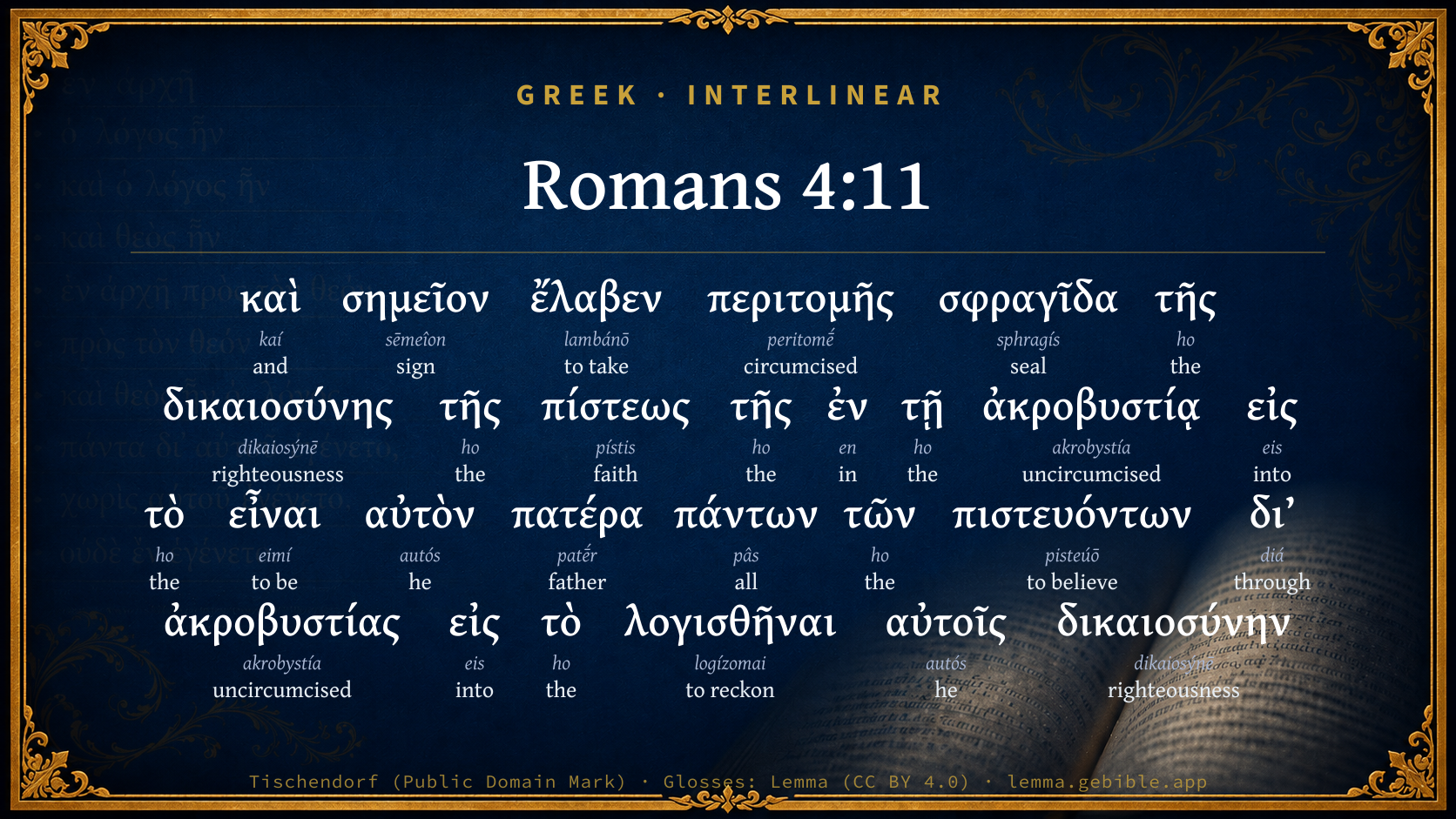
Greek (Tischendorf 8th ed.) Romans 4:11 appears in the Greek New Testament. The text above is from the Tischendorf 8th edition. Each word links to its Strong’s number and a concise gloss. Click any word for its full Thayer’s Greek Lexicon entry.
Download image
Cite this verse

Romans 4:11 (World English Bible). Public Domain. Lemma interlinear Bible study tool, https://lemma.gebible.app/v/romans/4/11.

Show BibTeX & RIS
BibTeX
RIS
English Translation
He received the sign of circumcision, a seal of the righteousness of the faith which he had while he was in uncircumcision, that he might be the father of all those who believe, though they be in uncircumcision, that righteousness might also be accounted to them.
World English Bible · Public Domain
Highlights
  • 1 first appearance in the Greek New Testament
Full analysis ↓
Download a study sheet

One document with this verse’s original text, its word-by-word gloss line, the meaning frame, cross-references with their text, attributed commentary, and full source and license credits — printable, and it pastes into notes with its structure intact.

This verse Autodidact and up

Study sheet (.html) Plain text (.txt)

A passage Seminary Student

Up to 50 verses in one chapter. A passage sheet keeps up to 6 commentary sources and 12 cross-references per verse, in the order this page ranks them, and says so on the sheet whenever that leaves anything out. Ask for a single verse and you get the Autodidact verse sheet above.

Everything on this page stays free to read, with no account — the sheet is a download of what is already on screen, not access to it.

Want to remove ads? Support Godless Engineer
Compare translations 3

The same verse in 3 English versions, stacked beneath the original-language interlinear above. Click any original word for its lexicon entry.

Each is an independent rendering of the whole verse — the interlinear is not word-aligned to these translations.

Highlighted words mark where these versions differ — a whole-verse word diff, not a word-by-word alignment.

  • World English Bible Public Domain
    He received the sign of circumcision, a seal of the righteousness of the faith which he had while he was in uncircumcision, that he might be the father of all those who believe, though they be in uncircumcision, that righteousness might also be accounted to them.
  • King James Version Public Domain
    And he received the sign of circumcision, a seal of the righteousness of the faith which he had yet being uncircumcised: that he might be the father of all them that believe, though they be not circumcised; that righteousness might be imputed unto them also:
  • unfoldingWord Literal Text CC BY-SA 4.0
    And he received the sign of circumcision, a seal of the righteousness of the faith that in his uncircumcision so that he would be the father of all the ones believing through uncircumcision, so that the righteousness would be credited to them;

unfoldingWord Literal Text — © unfoldingWord, licensed CC BY-SA 4.0. Word-aligned USFM3 via Door43 (git.door43.org/unfoldingWord/en_ult).

Versions to compare (up to 4)

3 of 4 selected

Show all 19 translations

Every available English version of this verse, each an independent rendering of the whole verse.

  • World English Bible Public Domain
    He received the sign of circumcision, a seal of the righteousness of the faith which he had while he was in uncircumcision, that he might be the father of all those who believe, though they be in uncircumcision, that righteousness might also be accounted to them.
  • Berean Standard Bible Public Domain
    And he received the sign of circumcision as a seal of the righteousness that he had by faith while he was still uncircumcised. So then, he is the father of all who believe but are not circumcised, in order that righteousness might be credited to them.
  • Majority Standard Bible Public Domain
    And he received the sign of circumcision as a seal of the righteousness that he had by faith while he was still uncircumcised. So then, he is the father of all who believe but are not circumcised, in order that righteousness might be credited to them as well.
  • King James Version Public Domain
    And he received the sign of circumcision, a seal of the righteousness of the faith which he had yet being uncircumcised: that he might be the father of all them that believe, though they be not circumcised; that righteousness might be imputed unto them also:
  • American Standard Version (1901) Public Domain
    and he received the sign of circumcision, a seal of the righteousness of the faith which he had while he was in uncircumcision; that he might be the father of all them that believe, though they be in uncircumcision, that righteousness might be reckoned unto them;
  • Revised Version (1885) Public Domain
    and he received the sign of circumcision, a seal of the righteousness of the faith which he had while he was in uncircumcision: that he might be the father of all them that believe, though they be in uncircumcision, that righteousness might be reckoned unto them;
  • Geneva Bible (1599) Public Domain
    After, he receiued the signe of circumcision, as the seale of the righteousnesse of ye faith which he had, when he was vncircumcised, that he should be the father of all them that beleeue, not being circumcised, that righteousnesse might be imputed to them also,
  • Douay-Rheims (1899) Public Domain
    And he received the sign of circumcision, a seal of the justice of the faith, which he had, being uncircumcised; that he might be the father of all them that believe, being uncircumcised, that unto them also it may be reputed to justice:
  • Young's Literal Translation Public Domain
    and a sign he did receive of circumcision, a seal of the righteousness of the faith in the uncircumcision, for his being father of all those believing through uncircumcision, for the righteousness also being reckoned to them,
  • Literal Standard Version CC BY-SA 4.0
    and he received a sign of circumcision, a seal of the righteousness of faith in the uncircumcision, for his being father of all those believing through uncircumcision, for the righteousness also being reckoned to them,
  • Unlocked Literal Bible CC BY-SA 4.0
    Abraham received the sign of circumcision. This was a seal of the righteousness of the faith that he had already possessed when he was in uncircumcision. The result of this sign was that he became the father of all those who believe, even if they are in uncircumcision. This means that righteousness will be counted for them.
  • unfoldingWord Literal Text CC BY-SA 4.0
    And he received the sign of circumcision, a seal of the righteousness of the faith that in his uncircumcision so that he would be the father of all the ones believing through uncircumcision, so that the righteousness would be credited to them;
  • Darby Bible Public Domain
    And he received [the] sign of circumcision [as] seal of the righteousness of faith which [he had] being in uncircumcision, that he might be [the] father of all them that believe being in uncircumcision, that righteousness might be reckoned to them also;
  • World Messianic Bible Public Domain
    He received the sign of circumcision, a seal of the righteousness of the faith which he had while he was in uncircumcision, that he might be the father of all those who believe, though they might be in uncircumcision, that righteousness might also be accounted to them.
  • Webster's Bible Public Domain
    And he received the sign of circumcision, a seal of the righteousness of the faith, which he had yet being uncircumcised: that he might be the father of all them that believe, though they are not circumcised, that righteousness might be imputed to them also;
  • Free Bible Version CC BY-SA 4.0
    It was actually before he became a Jew by being circumcised, which was a confirmation of his trust in God to make him right. This happened before he was circumcised, so he is the father of everyone who trusts in God and are considered as right by God, even though they may not be circumcised Jews.
  • Bible in Basic English Public Domain
    And he was given the sign of circumcision as a witness of the faith which he had before he underwent circumcision: so that he might be the father of all those who have faith, though they have not circumcision, and so that righteousness might be put to their account;
  • Text-Critical English NT CC BY 4.0
    He received the sign of circumcision as a seal of the righteousness that he had by faith while he was still uncircumcised, so that he might be the father of all who believe when they are uncircumcised, so that righteousness might be counted to them as well,
  • Tyndale New Testament (1534) Public Domain
    And he receaved the signe of circumcision as a seale of that rightewesnes which is by fayth which fayth he had yet beynge vncircumcised: that he shuld be the father of all them that beleve though they be not circumcised that rightewesnes myght be imputed to them also:

Literal Standard Version (2020), Covenant Press — licensed CC BY-SA 4.0. Text via the HelloAO Bible API (eBible.org). Unlocked Literal Bible (unfoldingWord) — licensed CC BY-SA 4.0. Text via the HelloAO Bible API (eBible.org). unfoldingWord Literal Text — © unfoldingWord, licensed CC BY-SA 4.0. Word-aligned USFM3 via Door43 (git.door43.org/unfoldingWord/en_ult). Free Bible Version, Dr. Jonathan Gallagher — licensed CC BY-SA 4.0. Text via the HelloAO Bible API (eBible.org).

Word by word

More ways to search: Search by grammar → Find every occurrence → Compare this word →

Practice this passage: Drill this verse → Learn its vocabulary →

σφραγῖδα
sphragís
G4973
“seal”
Noun, Accusative, Singular, Feminine
Part of Speech
Noun
Case
Accusative
Number
Singular
Gender
Feminine
Full Thayer's Definition

Origin: probably strengthened from G5420

TDNT: 22:39,1

1. a seal a. the seal placed upon books b. a signet ring c. the inscription or impression made by a seal 1. of the name of God and Christ stamped upon their foreheads d. that by which anything is confirmed, proved, authenticated, as by a seal (a token or proof)
  1. καὶ kaí G2532 “and” Conjunction
  2. σημεῖον sēmeîon G4592 “sign” Noun, Accusative, Singular, Neuter
  3. ἔλαβεν lambánō G2983 “to take” Verb, Aorist, Active, Indicative, 3rd person, Singular
  4. περιτομῆς peritomḗ G4061 “circumcised” Noun, Genitive, Singular, Feminine
  5. τῆς ho G3588 “the” Article, Genitive, Singular, Feminine
  6. δικαιοσύνης dikaiosýnē G1343 “righteousness” Noun, Genitive, Singular, Feminine
  7. τῆς ho G3588 “the” Article, Genitive, Singular, Feminine
  8. πίστεως pístis G4102 “faith” Noun, Genitive, Singular, Feminine
  9. τῆς ho G3588 “the” Article, Genitive, Singular, Feminine
  10. ἐν en G1722 “in” Preposition
  11. τῇ ho G3588 “the” Article, Dative, Singular, Feminine
  12. ἀκροβυστίᾳ akrobystía G203 “uncircumcised” Noun, Dative, Singular, Feminine
  13. εἰς eis G1519 “into” Preposition
  14. τὸ ho G3588 “the” Article, Accusative, Singular, Neuter
  15. εἶναι eimí G1510 “to be” Verb, Present, Active, Infinitive
  16. αὐτὸν autós G846 “he” Personal pronoun, Accusative, Singular, Masculine
  17. πατέρα patḗr G3962 “father” Noun, Accusative, Singular, Masculine
  18. πάντων pâs G3956 “all” Adjective, Genitive, Plural, Masculine
  19. τῶν ho G3588 “the” Article, Genitive, Plural, Masculine
  20. πιστευόντων pisteúō G4100 “to believe” Verb, Present, Active, Participle, Genitive, Plural, Masculine
  21. δι’ diá G1223 “through” Preposition
  22. ἀκροβυστίας akrobystía G203 “uncircumcised” Noun, Genitive, Singular, Feminine
  23. εἰς eis G1519 “into” Preposition
  24. τὸ ho G3588 “the” Article, Accusative, Singular, Neuter
  25. λογισθῆναι logízomai G3049 “to reckon” Verb, Aorist, Passive, Infinitive
  26. αὐτοῖς autós G846 “he” Personal pronoun, Dative, Plural, Masculine
  27. δικαιοσύνην dikaiosýnē G1343 “righteousness” Noun, Accusative, Singular, Feminine

About this verse

These counts appear in no published source. They are computed here, from the morphology-tagged text and Lemma’s own curated glosses. What Lemma adds →

28
words
18
distinct lemmas
Pauline Epistles
section

Notable vocabulary

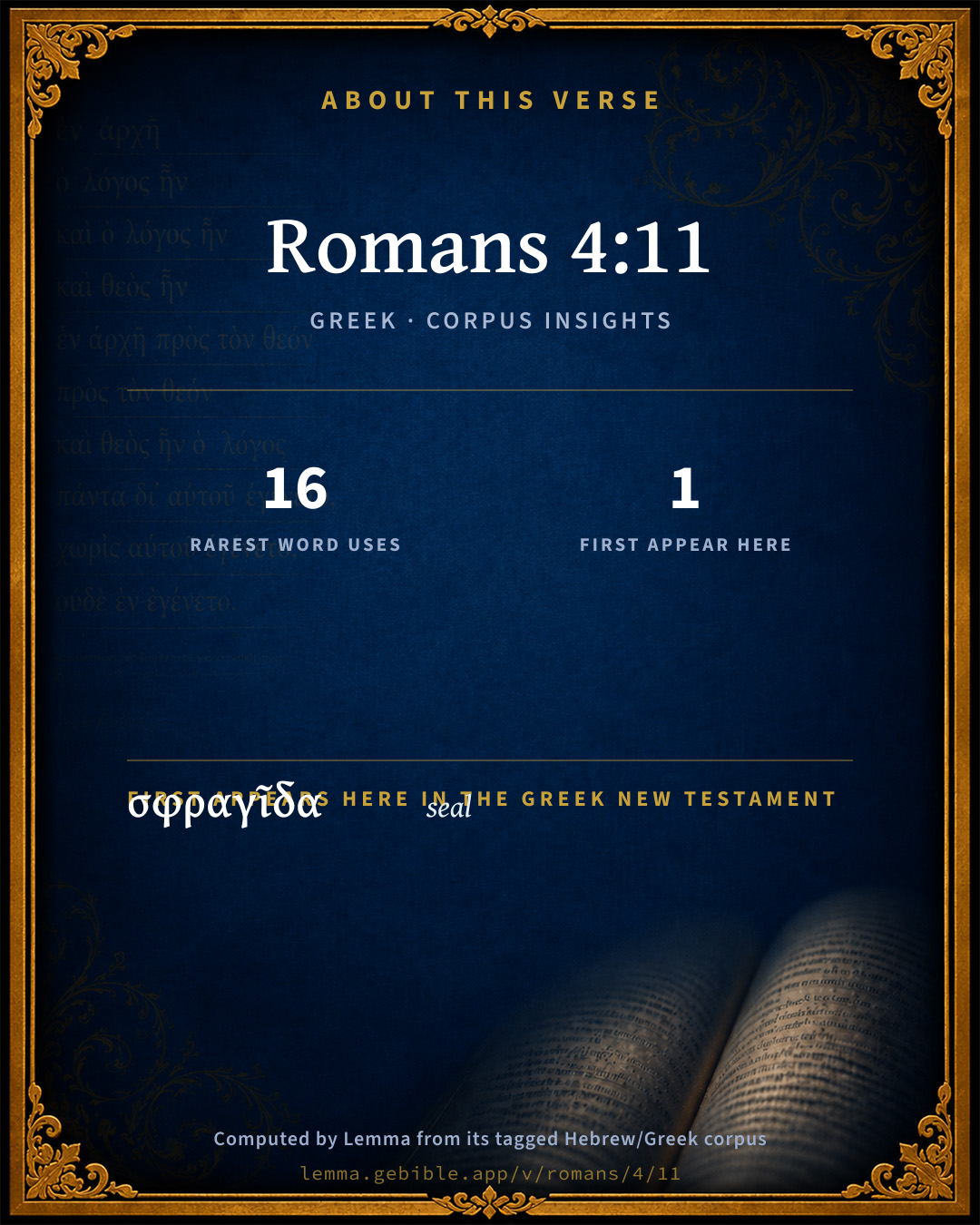
The rarest word here is σφραγῖδα seal G4973 — appearing just 16 times in the whole Greek New Testament.

First appearance in Scripture

This word makes its first canonical appearance in the Greek New Testament here:

  • σφραγῖδα seal G4973

Shared distinctive vocabulary

σφραγῖδα seal G4973 occurs in 16 verses of the Greek New Testament. Also found in:
Repetition

Words recur within this verse:

  • δικαιοσύνης righteousness G1343 ×2
  • ἀκροβυστίᾳ uncircumcised G203 ×2
  • εἰς into G1519 ×2
  • τῆς the G3588 ×7
  • αὐτὸν he G846 ×2

Cross-references

41

Topical passages linked to Romans 4:11 in the Treasury of Scripture Knowledge — connected by theme and wording, ordered by reader-vote popularity; previews shown in the World English Bible.

  • Luke 19:9 Jesus said to him, "Today, salvation has come to this house, because he also is a son of Abraham.
  • Romans 3:22 even the righteousness of God through faith in Jesus Christ to all and on all those who believe. For there is no distinction,
  • 2 Corinthians 1:22 who also sealed us, and gave us the down payment of the Spirit in our hearts.
  • Hebrews 11:7 By faith, Noah, being warned about things not yet seen, moved with godly fear, prepared an ark for the saving of his house, through which he condemned the world, and became heir of the righteousness which is according to faith.
  • John 6:35 Jesus said to them, "I am the bread of life. He who comes to me will not be hungry, and he who believes in me will never be thirsty.
  • Romans 10:4 For Christ is the fulfillment of the law for righteousness to everyone who believes.
  • Romans 10:6 But the righteousness which is of faith says this, "Don't say in your heart, 'Who will ascend into heaven?' (that is, to bring Christ down);
  • Romans 10:11 For the Scripture says, "Whoever believes in him will not be disappointed."
  • Galatians 3:7 Know therefore that those who are of faith, the same are children of Abraham.
  • Galatians 3:22 But the Scriptures shut up all things under sin, that the promise by faith in Jesus Christ might be given to those who believe.
  • Galatians 3:29 If you are Christ's, then you are Abraham's seed and heirs according to promise.
  • Galatians 5:5 For we, through the Spirit, by faith wait for the hope of righteousness.
  • Galatians 6:16 As many as walk by this rule, peace and mercy be on them, and on God's Israel.
  • Ephesians 1:13 in whom you also, having heard the word of the truth, the Gospel of your salvation,--in whom, having also believed, you were sealed with the Holy Spirit of promise,
  • Ephesians 4:30 Don't grieve the Holy Spirit of God, in whom you were sealed for the day of redemption.
  • Philippians 3:9 and be found in him, not having a righteousness of my own, that which is of the law, but that which is through faith in Christ, the righteousness which is from God by faith;
  • Genesis 17:10–11 This is my covenant, which you shall keep, between me and you and your seed after you. Every male among you shall be circumcised.
  • Exodus 12:13 The blood shall be to you for a token on the houses where you are: and when I see the blood, I will pass over you, and there shall no plague be on you to destroy you, when I strike the land of Egypt.
  • Exodus 31:13 "Speak also to the children of Israel, saying, 'Most assuredly you shall keep my Sabbaths: for it is a sign between me and you throughout your generations; that you may know that I am Yahweh who sanctifies you.
  • Exodus 31:17 It is a sign between me and the children of Israel forever; for in six days Yahweh made heaven and earth, and on the seventh day he rested, and was refreshed.'"
  • Deuteronomy 30:6 Yahweh your God will circumcise your heart, and the heart of your seed, to love Yahweh your God with all your heart, and with all your soul, that you may live.
  • Ezekiel 20:12 Moreover also I gave them my Sabbaths, to be a sign between me and them, that they might know that I am Yahweh who sanctifies them.
  • Ezekiel 20:20 and make my Sabbaths holy; and they shall be a sign between me and you, that you may know that I am Yahweh your God.
  • Matthew 8:11 I tell you that many will come from the east and the west, and will sit down with Abraham, Isaac, and Jacob in the Kingdom of Heaven,
  • Matthew 16:16 Simon Peter answered, "You are the Christ, the Son of the living God."
  • John 3:15–16 that whoever believes in him should not perish, but have eternal life.
  • John 3:36 One who believes in the Son has eternal life, but one who disobeys the Son won't see life, but the wrath of God remains on him."
  • John 6:40 This is the will of the one who sent me, that everyone who sees the Son, and believes in him, should have eternal life; and I will raise him up at the last day."
  • John 6:47 Most assuredly, I tell you, he who believes in me has eternal life.
  • John 7:38–39 He who believes in me, as the Scripture has said, from within him will flow rivers of living water."
  • John 8:33 They answered him, "We are Abraham's seed, and have never been in bondage to anyone. How do you say, 'You will be made free?'"
  • John 11:25–26 Jesus said to her, "I am the resurrection and the life. He who believes in me, though he die, yet will he live.
  • Romans 2:28–29 For he is not a Jew who is one outwardly, neither is that circumcision which is outward in the flesh;
  • Romans 3:26 to demonstrate his righteousness at this present time; that he might himself be just, and the justifier of him who has faith in Jesus.
  • Romans 9:6 But it is not as though the word of God has come to nothing. For they are not all Israel, that are of Israel.
  • Romans 9:30 What shall we say then? That the Gentiles, who didn't follow after righteousness, attained to righteousness, even the righteousness which is of faith;
  • 2 Peter 1:1 Simon Peter, a servant and apostle of Jesus Christ, to those who have obtained a like precious faith with us in the righteousness of our God and Savior, Jesus Christ:
  • Revelation 9:4 They were told that they should not hurt the grass of the earth, neither any green thing, neither any tree, but only those people who don't have God's seal on their foreheads.
  • Romans 4:12–13 The father of circumcision to those who not only are of the circumcision, but who also walk in the steps of that faith of our father Abraham, which he had in uncircumcision.
  • Romans 4:16–18 For this cause it is of faith, that it may be according to grace, to the end that the promise may be sure to all the seed, not to that only which is of the law, but to that also which is of the faith of Abraham, who is the father of us all.
  • Romans 9:33 even as it is written, "Behold, I lay in Zion a stumbling stone and a rock of offense; And no one who believes in him will be disappointed."

Cross-references courtesy of OpenBible.info (CC BY 4.0).

Commentary

Notes on Romans 4:11 from classic Christian and Jewish commentators (each source and its license shown beneath its notes). The classic Christian expositions comment on the surrounding passage and are grouped to its opening verse, so a note may address several verses; the Jewish commentaries on the Tanakh (Rashi and others) are per-verse, so they appear only where the commentator wrote on this verse.

Lemma curates 59 commentaries, every one of them public domain or Creative Commons licensed, each selected and text-cleaned for this edition rather than reprinted as found. About our sources →

Joseph Benson's Commentary

Rom 4:11-12. And — After he was justified; he received the sign of circumcision — Circumcision which was intended to be a sign, or token, of his being in covenant with God, and an emblem of that circumcision of the heart, which, even under that dispensation of divine grace, was, and still is, necessary to salvation. A seal of the righteousness of faith — An assurance on God’s part that he accounted him righteous, upon his believing, before he was circumcised. Circumcision seems to be called a seal, in allusion to the custom of affixing seals to written covenants, to render them firm. That he might be the father of all them that believe —

With a true and lively faith; the father of all the faithful; though they be not circumcised — Though they have not that sign of their being in covenant with God, nor that seal of the truth of their faith, and of their being accounted righteous. “Hence, Gal 3:14. faith counted for righteousness is called the blessing of Abraham, and is said to come on the Gentiles through Christ. For the same purpose God ordered all Abraham’s male descendants to be circumcised, on the eighth day after their birth. The Israelitish children being thus early initiated into God’s covenant, their parents were thereby assured, that if, when grown up, they followed Abraham in his faith and obedience, they were, like him, to have their faith counted to them for righteousness, and be entitled to all the blessings of the covenant: or, if they died in infancy, that God would raise them from the dead, to enjoy the heavenly country, of which the earthly was the type. But the covenant with Abraham being in reality the gospel covenant, set forth in types and figures, according to the manner of ancient times, may we not from the use and efficacy of circumcision believe, that baptism, the rite of initiation into the Christian Church, is, like it, a seal of the gospel covenant, and a declaration on the part of God, that he will count the faith of the baptized person for righteousness? And that, like circumcision, it may be administered to infants, to assure the parents that their future faith shall be counted and rewarded as righteousness; or, if they die in infancy, that they shall be raised to eternal life? In this view the baptism of infants is a reasonable rite, and must afford the greatest consolation to all pious parents.” And the father of circumcision — Abraham received this rite by divine appointment, that he might also be the father of those who are circumcised, and believe as he did: for, in the covenant which God made with him, he constituted him the father of all believers; and whatever promises were made to him and his seed, were in reality made to believers of all nations; to all who walk in the steps of that faith which he had being uncircumcised — That is, who, like Abraham, exercise a continued faith, and who from faith live a life of obedience to God to the end of their days. To those who do not thus believe and obey, Abraham is not a father, neither are they his seed.

Rom 4:13-15 For — As if he had said, And it further appears that Abraham was righteous, or justified by faith only, and not by the works of the law, because the promise that he should be the heir of the world — Should have a numerous natural offspring, (and among them Christ, by whom blessedness was to be obtained,) who should inherit that rich and pleasant part of the world, Canaan, a type of heaven; and also that he should have a spiritual seed among all nations, all over the world; was not to Abraham or to his seed — To true believers; through the law — Of Moses, or any law except that of faith; was not made to him upon consideration of works done by him, and meriting that blessing; but through the righteousness of faith — Upon account of his faith, which rendered him a righteous person in a gospel sense, and was manifested especially by his offering Isaac, which was a distinguished act of faith, Heb 11:17; and on occasion of which God made those promises to him, Gen 22:17-18. Christ is the heir of the world, and of all things, and so are all that believe in him with the faith of Abraham. All things were promised to him and them conjointly. For if they only who are of the law — Either of the law of Moses. or of the law of nature, who are righteous by their obedience to it; be heirs — The only persons that have a title to the promised inheritance and blessedness: see Eph 3:6 : faith is made void — There is no use of believing in Christ, and depending upon him alone for blessedness; and the promise, mentioned Rom 4:13, is made of none effect — Can do us no good, is to no purpose. The argument stands thus: “If Abraham and his seed were made heirs of the world, through a righteousness arising from a perfect, unsinning obedience to the law, their faith is rendered useless in this transaction; and the promise by which they became heirs through favour, had no influence in procuring that blessing, they having merited the inheritance by their works.” Because the law — Of works, considered apart from that grace which, though it was in fact mingled with it, yet is, properly speaking, no part of it, is so difficult, and we so weak and sinful, that, instead of bringing us a blessing, it only worketh wrath — It becomes to us an occasion of wrath, and exposes us to punishment as transgressors. In other words, it reveals God’s wrath against transgressors, and binds them over to punishment for the transgression of it, and so begets fear of wrath, instead of conferring happiness. For where there is no law — Either revealed or intimated, or no law in force; there is no transgression — Of it; but the multiplication of precepts increases the danger of offending; and the clearer declaration of those precepts aggravates the guilt attending the violation of them.

Joseph Benson's Commentary on the Old and New Testaments (1811–1818) — public domain. Text from a community e-Sword module.

Tyndale Open Study Notes

Tyndale Open Resources

4:11-12 When God instituted circumcision, he called it “a sign of the covenant” between himself and Abraham (Gen 17:11). The covenant was already in place (Gen 12:1-3; 15:1-21; 17:1-8) even before Abraham was circumcised (Gen 17:9-14). This shows that the covenant was based on faith, not circumcision. So Abraham is the spiritual father of all people, whether circumcised (Jews) or uncircumcised (Gentiles), who have the same kind of faith Abraham had—that is, faith in God’s promises (Rom 4:13-25).

Tyndale Open Study Notes — © Tyndale Open Resources, licensed CC BY-SA 4.0. Text via the HelloAO Bible API.

Bengel's Gnomon

Johann Albrecht Bengel

Rom 4:11. Σημε͂ιον, a sign) Circumcision itself was a sign, a mark, namely, imprinted on the body, and the expression, the sign of circumcision, is used just as taking of rest in sleep [κοίμησις τ. ὕπνου], Joh 11:13; and the virtue of piety, that is, piety a virtue.—ἔλαβε, received) obediently.—τῆς ἐν τῇ) τῆς is to be construed with πίστεως; with which compare the next verse.—τοῦ χαρίσματος) διά, with; as in ch. Rom 2:27 [not as Eng. vers. “by the letter, and circumcision;” but ‘with,’ or ‘in.’ Eng. vers. here, Rom 4:11, renders διὰ ἀκροβ, though they be not circumcised]. 11, 12. Πατέρα) the construction is, that he might be the father of all who believe with [i.e. being in] uncircumcision—and the father of the circumcision. Father and seed are correlatives.

Bengel's Gnomon of the New Testament — English translation (T&T Clark, Edinburgh, 1860) — public domain. Text from a community e-Sword module.

Meyer's Critical & Exegetical Commentary

Heinrich August Wilhelm Meyer

Rom_4:11. An amplification of the οὐκ ἐν περιτ., ἀλλʼ ἐν ἀκροβ. viewed as to its historical bearings, showing namely the relation of Abrahams circumcision to his δικαιοσύνη, and therefore only to be separated by a comma from Rom_4:10. And he received a sign of circumcision as seal (external confirmation, 1Co_9:2, and see on Joh_3:33) of the righteousness of faith (obtained through faith, Rom_4:3; Rom_4:5), which he had in uncircumcision. That τῆς ἐν τ. ἀκροβ. is not to be connected with δικαιοσ. (Rückert, Reiche) is plain from the following context (πιστευόντων διʼ ἀκροβυστίας Rom_4:11, and τῆς ἐν τῆ ἀκροβ. πίστεως Rom_4:12). The genitive περιτομῆς is usually taken as that of apposition: the sign consisting in circumcision. But in that case the article could not be omitted before σημεῖον (the absence of it drove van Hengel to the reading περιτομήν, which Hofmann also prefers)[999], since the concrete, historically definite sign would here be meant (compare 2Co_5:5; Eph_2:14 et al[1000]). It is therefore to be rendered: And a sign, which took place through circumcision, a signature which was given to him in the fact that he was circumcised, he received as seal, etc. The genitive is thus to be taken simply as completing the notion of σημεῖον, i.e. as defining it more precisely as respects its modal expression. Observe at the same time the dislocation in the order of the words, which brings into emphatic relief the idea of the σημεῖον. According to Gen_11:17 circumcision was the sign of the covenant[1001] which God made with Abraham. But with correct dogmatic consistency Paul represents it as the significant mark which had been the seal of the righteousness by faith, since in that covenant what God promised was the Messianic ΚΛΗΡΟΝΟΜΊΑ (Gen_15:5; Gen_15:18), and Abraham on his part rendered the faith (Gen_15:6) which God imputed to him for righteousness.

ΕἸς ΤῸ ΕἾΝΑΙ ΑὐΤῸΝ Κ.Τ.Λ[1002]] in order that he might be, etc., contains the divinely appointed aim of the σημεῖον ἔλαβε περιτ. κ.τ.λ[1003] This telic rendering is grammatically necessary (see on Rom_1:20), as more in keeping with the biblical view (ὁ γὰρ τῶν ὅλων θεὸς προειδὼς ὡς θεὸς, ὡς ἕνα λαὸν ἐξ ἐθνῶν καὶ ʼΙουδαίων ἀθροίσει καὶ διὰ πίστεως αὐτοῖς τὴν σωτηρίαν παρέξει, ἐν τῷ πατριάρχῃ Ἀβρ. ἀμφότερα προδιέγραψε, Theodoret), and with the importance of the matter, than the ecbatic explanation καὶ οὕτως ἐγένετο πατήρ, which has been justly abandoned of late.

ΠΑΤΈΡΑ ΠΆΝΤΩΝ ΤῶΝ ΠΊΣΤ. ΔΙʼ ἈΚΡΟΒ.] The essence of this spiritual fatherhood is the identity of the relation forming the basis of the sacred-historical connection of all believers with the patriarch without intervention of circumcisiona relation which began with Abraham justified through faith whilst still uncircumcised. Thus the Jewish conception of the national-theocratic childship of Abraham is elevated and enlarged by Paul (comp Mat_3:9; Joh_8:37; Joh_8:39), into the idea of the purely spiritual-theocratic childship, which embraces, not Jews and proselytes as such, but the believers as suchall uncircumcised who believe, and (Rom_4:12) the believing circumcised. For Abrahams righteousness through faith was attained, when as yet there was no distinction between circumcised and uncircumcised; and to this mode of becoming just before God, independent of external conditions, Christianity by its ΔΙΚΑΙΟΣΎΝΗ ἘΚ ΠΊΣΤΕΩς leads back again, and continues it.

ΔΙʼ ἈΚΡΟΒ.] with foreskin, although they are uncircumcised. Comp on Rom_2:27, Barnab. Ep. 13: τέθεικα σε πατέρα ἐθνῶν τῶν πιστευόντων διʼ ἀκροβυστίας τῷ κυρίῳ.

εἰς τὸ λογισθῆναι Κ.Τ.[1006]] is taken by many, including Tholuck and Philippi, as a parenthetical illustration of εἰς τὸ εἷναι αὐτὸν πατέρα κ.τ.λ[1007] But as we can attach ΕἸς ΤῸ ΛΟΓΙΣΘῆΝΑΙ Κ.Τ.Λ[1008] without violence or obscurity to πιστευόντων, there is no necessity for the assumption of a parenthesis (which is rejected by Lachmann, Tischendorf, van Hengel, Ewald, Mehring, and Hofmann). Nevertheless εἰς τὸ λογισθ. is not: who believe on the fact, that to them also will be imputed (Hofmann), for the object of faith is never expressed by εἰς with a substantival infinitive;[1009] but, quite in accordance with the telic sense of this form of expression (as in the εἰς τὸ εἶναι previously): who believe (on Christ) in order that (according to the divine final purpose ruling therein) to them also, etc.

καὶ αὐτοῖς] to them also, as to Abraham himself; τὴν δικαιοσύνην expresses the righteousness which is under discussion, that of faith.

[999] Hofmann explains: and as a sign he received circumcision, as seal (apposition to σημ.). In that case περιτομήν must have had the article (Joh_7:22; otherwise in ver. 23). For to take λαμβάνειν περιτομήν as equivalent to περιτέμνεσθαι is forbidden by σημεῖον, with which the περιτομή can be correlative only as a substantive conception.

[1000] t al. and others; and other passages; and other editions.

[1001] In the Talmud also it is presented as the sign and seal of the covenant. See Schoettgen and Wetstein. To the formulary of circumcision belonged the words: Benedictus sit, qui sanctificat dilectum ab utero, et signum (אות) posuit in arne, et filios suos sigillavit (חתם) signo foederis sancti. Berachoth f. 13, 1.

[1002] .τ.λ. καὶ τὰ λοιπά.

[1003] .τ.λ. καὶ τὰ λοιπά.

[1006] .τ.λ καὶ τὰ λοιπά.

[1007] .τ.λ. καὶ τὰ λοιπά.

[1008] .τ.λ. καὶ τὰ λοιπά.

[1009] Not even in ver. 18. And Act_15:11, to which Hofmann appeals as an analogous passage, tells directly against him, because there the construction of the infinitive obtains in the usual way, that the subject of the governing verb is understood, as a matter of course, with the infinitive. Comp. Hofmann himself above on ver. 1; Krüger, § 55, 4, 1. Besides the result, according to Hofmanns interpretation, would be an awkward thought, not in keeping with the faith of Abraham.

Meyer — Critical and Exegetical Commentary on the New Testament — English translation by Peter Christie, edited by Frederick Crombie (T&T Clark, 1880) — public domain. Text from a community e-Sword module.

Expositor's Greek Testament

ed. W. Robertson Nicoll

Rom 4:11 f. On the contrary, he received a sign in circumcision a seal of the righteousness of the faith which he had while uncircumcised. Both sign ( אוֹת ) and seal ( חוֹתָם ) are frequently used by Rabbinical writers to describe circumcision as a symbol or pledge that one is in covenant with God. So even of heathens: “Og was circumcised, and Moses feared מפני אות ברית שׁלו , propter signum foederis ejus ”. But usually of Jews: “Jonah shewed Leviathan sigillum ( חותמו ) Abrahami patris nostri ”. See Schoettgen, Wetstein, or Delitzsch, ad loc περιτομῆς (for which W. and H. have in margin περιτομήν ) must be a genitive of apposition. With εἰς τὸ εἶναι the Divine purpose in this relation of circumcision to justification in the case of Abraham is explained. Things were ordered as has been described that he might be father of all that believe while uncircumcised (as he himself did) that the righteousness in question might be imputed to them; and father of circumcision ( i.e. , of persons circumcised) in the case of those who are not only circumcised, but also walk in the steps of the faith which he had while not circumcised. It was God’s intention that Abraham should be the representative and typical believer, in whom all believers without distinction should recognise their spiritual father; the Divine method of justification was to be inaugurated and illustrated in him, as it should hold good for all who were to be justified: accordingly the whole process took place antecedent to his circumcision, and in no circumstances has circumcision any essential relation to this great blessing. For its true meaning and advantage see on Rom 2:25 . On οὐκ ἐκ περιτομῆς μόνον , see Simcox, Language of the N.T. , 184. The grammar in Rom 4:12 is faulty, and Westcott and Hort suspect a primitive error. Either τοῖς before στοιχοῦσιν must be omitted, or it must be changed, as Hort suggests, into αὐτοῖς , if we are to express the meaning correctly. The sense required by the context is not open to doubt. For διʼ ἀκροβυστίας cf. Rom 2:27 . For the dative τοῖς ἴχνεσιν see Philipp. Rom 3:16 , Gal 5:16 ; Gal 5:25 . But cf. also Winer, p. 274.

The Expositor's Greek Testament, edited by W. Robertson Nicoll (1897–1910) — public domain. Text from a community e-Sword module.

Godet's Commentaries

Frédéric Louis Godet

Vv. 11, 12. “And he received the sign of circumcision, as a seal of the righteousness of the faith which he had yet being uncircumcised: that he might be at once the father of all them that believe while in a state of uncircumcision, in order that righteousness may be imputed unto them also; and the father of the circumcised, of them who not only are of the circumcision, but who also walk in the steps of the faith which our father Abraham had in uncircumcision.”

Καί, and, signifies here: “and in consequence of the justification thus found.”—Περιτομῆς, of circumcision, may be made a genitive of apposition: “the sign which is circumcision,” or a genitive of quality: “a sign in the form of circumcision.” The former is the simpler sense. In any case, the reading περιτομήν in two Mjj. is a correction. Circumcision appears even in Gen 17:11 as the sign of the covenant between God and His people. The Rabbins express themselves thus: “God put the sign of love in the flesh.” The term σημεῖον, sign, relates to the material thing; the term σφραγίς, seal, to its religious import. Far, then, from circumcision having been the antecedent condition of Abraham’s justification, it was the mark, and consequently the effect of it.

The article τῆς (after the words righteousness of faith), which we have translated by: which he had, may relate to the entire phrase righteousness of faith, or to the word faith taken by itself. If we consider the following expression: “father of all believers” (not of all the justified), and especially the end of Rom 4:12, we cannot doubt that the article applies to the word faith taken alone: “the faith which he had yet being uncircumcised.” The in order that which follows should not be taken in the weakened sense of so that. No doubt Abraham in believing did not set before himself the end of becoming the spiritual father of Gentile believers. But the matter in question here is the intention of God who directed things with this view which was His from the beginning of the history. The real purpose of God extended to the Gentiles; the theocracy was only a means in His mind. Had He not said to Abraham, when calling him, that “in him should all the families of the earth be blessed”? Gen 12:3.

On the meaning of διά, in the state of, see on Rom 2:27.

The last words: that righteousness might be imputed unto them, should not be regarded as a new end of the: he received the sign, to be added to the first already mentioned (that he might be the father...). The verb is too remote; we must therefore make the that...depend on the participle πιστευόντων. them that believe (though they be not circumcised); not certainly in Hofmann’s sense: “who have faith in the fact that it will be imputed to them,” but in the only grammatically admissible sense: “them who believe in order that righteousness may be imputed to them.” There is a desire in faith. It seeks reconciliation with God, and consequently justification.

The pronoun αὐτόν, he (“that he might be, even he”), is intended to bring the person of Abraham strongly into relief, as called to fill, he, this one solitary man, the double place of father of believing Gentiles (Rom 4:11) and of believing Jews (Rom 4:12). It is very remarkable that the apostle here puts the believers of Gentile origin first among the members of Abraham’s posterity. But was it not they in fact who were in the condition most similar to that of the patriarch at the time when he obtained his justification by faith? If, then, a preference was to be given to the one over the other, it was certainly due to them rather than to circumcised Christians. What a complete reversal of Jewish notions!

Frédéric Louis Godet — Commentaries on Luke, John, Romans, and 1 Corinthians — English translation (T&T Clark, Edinburgh, 1870s–1890s) — public domain. Text from a community e-Sword module.

Hodge's Commentary on Romans, Ephesians & First Corinthians

Charles Hodge

Rom_4:11

And he received the sign of circumcision, the seal of the righteousness of the faith which he had, being yet uncircumcised, etc. As Paul had shown that circumcision was not the condition of justification, it became necessary to declare its true nature and design. The sign of circumcision, i.e. circumcision which was a sign, (genitive of apposition;) as the earnest of the spirit, for the Spirit which is an earnest, 2Co_1:20. The seal of the righteousness of faith, etc. The phrase, righteousness of faith, is a concise expression for righteousness which is attained by faith, or, as it stands more fully in Phi_3:9, the righteousness of God, which is by faith. The word righteousness, in such connections, includes, with the idea of excellence or obedience, that of consequent blessedness. It is the state of acceptableness with God. The circumcision of Abraham was designed to confirm to him the fact, that he was regarded and treated by God as righteous, through faith, which was the means of his becoming interested in the promise of redemption. From this passage it is evident that circumcision was not merely the seal of the covenant between God and the Hebrews as a nation. Besides the promises made to Abraham of a numerous posterity, and of the possession of the land of Canaan, there was the far higher promise, that through his seed (i.e. Christ, Gal_3:16) all the nations of the earth should be blessed. This was the promise of redemption, as the apostle teaches us in Gal_3:13-18, Christ, he says, has redeemed us from the curse of the law in order that the blessing of Abraham might come upon the Gentiles. The blessing promised to Abraham, in which the Gentiles participate through Jesus Christ, can he none other than redemption. As that blessing was promised to Abraham on the condition, not of works, but of faith, the apostle hence argues, that in our case also we are made partakers of that blessing by faith, and not by works. This was the covenant of which circumcision was the seal. All therefore who were circumcised, professed to embrace the covenant of grace. All the Jews were professors of the true religion, and constituted the visible Church, in which by divine appointment their children were included. This is the broad and enduring basis of infant church membership.

Abraham, says the apostle, was thus assured of his justification by faith, (εἰς τὸ εἶναι,) in order that he might be the father; or, so that he is the father, etc. The former explanation is to be preferred, not only because εἰς with the infinitive, commonly expresses design, but also because the whole context shows that the apostle intends to bring into view the purpose of God in the justification of Abraham. The father of all them that believed though they be not circumcised, πάντων τῶν πιστευόντων δι ̓ ἀκροβυστίας i.e. of all believing, with uncircumcision. That is, of all uncircumcised believes. The preposition, διά here, as in Rom_2:27, and elsewhere, simply marks the attendant circumstances. The word father expresses community of nature or character, and is often applied to the head or founder of any school or class of men, whose character or course is determined by the relation to the person so designated: as Gen_4:20, Gen_4:21 : Jabal … was the father of such as dwell in tents; and, Jubal … was the father of all such as handle the harp and organ. Hence teachers, priests, and kings are often called fathers. Believers are called the children of Abraham, because of this identity of religious nature or character, as he stands out in Scripture as the believer; and because it was with him that the covenant of grace, embracing all the children of God, whether Jews or Gentiles, was reenacted; and because they are his heirs, inheriting the blessings promised to him. As Abraham was the head and father of the theoretical people under the Old Testament, this relation was not disowned when the middle wall of partition was broken down, and the Gentiles introduced into the family of God. He still remained the father of the faithful, and we are the sons of Abraham by faith, Gal_3:7. The Jews were accustomed to speak in the same way of Abraham: Michlol Jophi on Mal_2:15, by the one there mentioned, Abraham is intended, for he was one alone, and the father of all who follow and imitate him in faith. Bechai, fol. 27, he is called The root of faith, and father of all those who believe in one God. Jalkut Chadash, fol. 54, 4, On this account Abraham was not circumcised until he was ninety-nine years old, lest he should shut the door on proselytes coming in. See Schoettgen, p. 508.

That righteousness might be imputed unto them also. The connection and design of these words are not very clear, and they are variously explained. They may be considered as explanatory of the former clause, and therefore connected with the first part of the verse. The sense would then be, Abraham was justified, being yet uncircumcised, that he might be the father of believers, although uncircumcised, that is, that righteousness might be imputed unto them also. This clause is most commonly regarded as a parenthesis, designed to indicate the point of resemblance between Abraham and those of whom he is called the father: He is the father of uncircumcised believers, since they also are justified by faith, as he was. The words εἰς τὸ λογισθῆναι are explanatory of εἰς τὸ εἶναι αὐτὸν πατέρα: He was justified in uncircumcision, in order that he might be the father, etc.; that is, in order that faith might be imputed to them also. From this it appears that to impute faith for righteousness and to impute righteousness, are synonymous. To Abraham righteousness was imputed; he had the (δικαιοσύνη τῆς πίστεως) righteousness of faith as truly and really as believers now have. Nothing can be more opposed to the whole tenor of apostolic teaching than the Romish and modern mystical doctrine, that the Old Testament believers were not fully justified; that their sins were pretermitted, but not remitted; that their regeneration was symbolical, but not real.

Charles Hodge — Commentary on Romans (1835), First Corinthians (1857), and Ephesians (1856) — public domain. Text from a community e-Sword module.

Geneva Bible (1599)

Geneva Bible translators

An applying of the example of Abraham to the uncircumcised believers, whose father also he maketh Abraham.

A preventing of an objection: why then was Abraham circumcised, if he were already justified? That the gift of righteousness (saith he) might be confirmed in him.

Circumcision, which is a sign: as we say, the Sacrament of Baptism, for Baptism which is a Sacrament.

Circumcision was called before a sign, in respect of the outward ceremony: now Paul showeth the force and substance of that sign, that is, to what end it is used, to wit, not only to signify, but also to seal up the righteousness of faith, whereby we come to possess Christ himself: for the holy Ghost worketh that inwardly indeed, which the Sacraments being joined with the word, do represent.

Geneva Bible (1599) marginal notes — public domain. Text via Bolls.life.

Adam Clarke's Commentary

Verse 11. And he received the sign of circumcision, a seal, c.] So far was obedience to the law of circumcision from being the reason of his justification, that he not only received this justification before he was circumcised, but he received the sign of circumcision, as a seal of the pardon which he had before actually received. And thus he became the father, the great head and representative, of all them that believe particularly the Gentiles, who are now in precisely the same state in which Abraham was when he received the mercy of God. Hence it appears, says Dr. Taylor, that the covenant established with Abraham, Ge 17:2-15, is the same with that, Ge 12:2, Ge 12:3; Ge 15:5, c. for circumcision was not a seal of any new grant, but of the justification and promise which Abraham had received before he was circumcised; and that justification and promise included the Gospel covenant in which we are now interested. St. Paul refers to this, Ga 3:8: The Scripture foreseeing that God would justify us, heathens, through faith, preached before the Gospel unto Abraham, saying, In thee shall all nations be blessed. The whole of the apostle's argument, in this fourth chapter to the Romans, proves that we, believing Gentiles, are the seed of Abraham, to whom, as well as to himself, the promise was made; and that the promise made to him is the same in effect as that promise which is now made to us; consequently, it is the Abrahamic covenant in which we now stand; and any argument taken from the nature of that covenant, and applied to ourselves, must be good and valid. It is also undeniably evident, from this eleventh verse, as well as from Ge 17:1-11, that circumcision was a seal or sign of the Gospel covenant in which we now stand. See Taylor.

There is nothing more common in the Jewish writers than the words אוה oth, SIGN, and חותם chotham, SEAL, as signifying the mark in the flesh, by the rite of circumcision; see on Ge 4:15. SOHAR Genes., fol. 41, col. 161, has these words: And God set a mark upon Cain; this mark was the sign of the covenant of circumcision. TARGUM, Cant. iii. 8: The seal of circumcision is in your flesh; as Abraham was sealed in the flesh. YALCUT RUBENI, fol. 64: Joseph did not defile the sign of the holy covenant; i.e. he did not commit adultery with the wife of Potiphar. Liber Cosri, part i., c. 115, p. 70: Circumcision is a Divine sign which God has placed on the member of concupiscence, to the end that we may overcome evil desire. SHEMOTH RABBA, sec. 19, fol. 118: Ye shall not eat the passover unless the SEAL of Abraham be in your flesh. Yalcut Rubeni, fol. 36: God said to Abraham, I will seal thy flesh. Sohar Levit. fol. 6: Abraham was sealed with the holy seal. See Schoettgen.

Adam Clarke's Commentary on the Bible (1810–1826) — public domain. Text from a community e-Sword/MySword module.

John Calvin's Commentaries

11. And he received the sign, etc. In order to anticipate an objection, he shows that circumcision was not unprofitable and superfluous, though it could not justify; but it had another very remarkable use, it had the office of sealing, and as it were of ratifying the righteousness of faith. And yet he intimates at the same time, by stating what its object was, that it was not the cause of righteousness, it indeed tended to confirm the righteousness of faith, and that already obtained in uncircumcision. He then derogates or takes away nothing from it.

We have indeed here a remarkable passage with regard to the general benefits of sacraments. According to the testimony of Paul, they are seals by which the promises of God are in a manner imprinted on our hearts, (Dei promissiones cordibus nostris quodammodo imprimuntur,) and the certainty of grace confirmed (sancitur gratœ certitudo ) And though by themselves they profit nothing, yet God has designed them to be the instruments (instrumenta) of his grace; and he effects by the secret grace of his Spirit, that they should not be without benefit in the elect. And though they are dead and unprofitable symbols to the reprobate, they yet ever retain their import and character (vim suam et naturam:) for though our unbelief may deprive them of their effect, yet it cannot weaken or extinguish the truth of God. Hence it remains a fixed principle, that sacred symbols are testimonies, by which God seals his grace on our hearts.

As to the symbol of circumcision, this especially is to be said, that a twofold grace was represented by it. God had promised to Abraham a blessed seed, from whom salvation was to be expected by the whole world. On this depended the promise — “I will be to thee a God.” (Genesis 17:7.) Then a gratuitous reconciliation with God was included in that symbol: and for this reason it was necessary that the faithful should look forward to the promised seed. On the other hand, God requires integrity and holiness of life; he indicated by the symbol how this could be attained, that is, by cutting off in man whatever is born of the flesh, for his whole nature had become vicious. He therefore reminded Abraham by the external sign, that he was spiritually to cut off the corruption of the flesh; and to this Moses has also alluded in Deuteronomy 10:16. And to show that it was not the work of man, but of God, he commanded tender infants to be circumcised, who, on account of their age, could not have performed such a command. Moses has indeed expressly mentioned spiritual circumcision as the work of divine power, as you will find in Deuteronomy 30:6, where he says, “The Lord will circumcise thine heart:” and the Prophets afterwards declared the same thing much more clearly.

As there are two points in baptism now, so there were formerly in circumcision; for it was a symbol of a new life, and also of the remission of sins. But the fact as to Abraham himself, that righteousness preceded circumcision, is not always the case in sacraments, as it is evident from the case of Isaac and his posterity: but God intended to give such an instance once at the beginning, that no one might ascribe salvation to external signs.

That he might be the father, etc. Mark how the circumcision of Abraham confirms our faith with regard to gratuitous righteousness; for it was the sealing of the righteousness of faith, that righteousness might also be imputed to us who believe. And thus Paul, by a remarkable dexterity makes to recoil on his opponents what they might have adduced as an objection: for since the truth and import (veritas et vis) of circumcision were found in an uncircumcised state, there was no ground for the Jews to elevate themselves so much above the Gentiles.

But as a doubt might arise, whether it behoves us, after the example of Abraham, to confirm also the same righteousness by the sign of circumcision, how came the Apostle to make this omission? Even because he thought that the question was sufficiently settled by the drift of his argument: for as this truth had been admitted, that circumcision availed only to seal the grace of God, it follows, that it is now of no benefit to us, who have a sign instituted in its place by our Lord. As then there is no necessity now for circumcision, where baptism is, he was not disposed to contend unnecessarily for that respecting which there was no doubt, that is, why the righteousness of faith was not sealed to the Gentiles in the same way as it was to Abraham. To believe in uncircumcision means, that the Gentiles, being satisfied with their own condition, did not introduce the seal of circumcision: and so the preposition δια, by is put for εν, in

John Calvin's Commentaries (1540-1563) — public domain. Text from the Calvin Translation Society English edition (1840s-50s) via the Christian Classics Ethereal Library (ccel.org). Calvin's coverage is partial (roughly two-thirds of the Bible); uncommented books and verses are honest gaps, never fabricated. The 19th-century editor's footnotes and remarks are omitted so the notes are faithfully Calvin's own voice.

Ellicott's Commentary for English Readers

(11) The sign of circumcision—i.e., circumcision as a sign. The expression is an instance of what is known in Greek as the “genitive of apposition,” but it is common in English. Thus we speak of the City of London, the County of Kent.

Abraham is the father (1) of faithful uncircumcised—he himself being so—and (2) of circumcised, but only of faithful circumcised.

A seal of the righteousness . . .—The Apostle here puts forth his view of the real import of circumcision. It was not (as so many of his contemporaries supposed) the cause or condition of Israel’s privileges so much as the sign or ratification of them. It ratified a state of things already existing when it was instituted. Hence, to those who inherited that state of things (justification by faith) the want of circumcision was no bar.

A Bible Commentary for English Readers, edited by Charles John Ellicott (1878–1897) — public domain. Text from a community e-Sword module.

The Cambridge Bible for Schools and Colleges

gen. ed. J. J. S. Perowne

11. the sign of circumcision] i.e. circumcision as a physical mark to denote the accomplished fact of justification.

a seal of the righteousness] A formal, legal attestation that He who prescribed the rite held to His grant already made.

the righteousness of the faith, &c.] Lit. the righteousness of that faith which was in his uncircumcision: i.e. “the righteousness (Rom_1:17) connected with the faith which he exercised in the days of his uncircumcision.” For a passage illustrative of the words “the righteousness of the faith” see Php_3:9; “the righteousness which is through faith of (in) Christ, the righteousness granted from God on condition of faith.”

that he might be, &c.] This refers to the whole previous immediate context. Q. d., “It was divinely ordained that Abraham’s justification should precede his circumcision, and so that his circumcision should not convey but attest his justification,—in order that his relationship to all the believing, Gentiles and Jews, might stand clear of the circumcision-covenant.”

the father] The progenitor; in a sense figurative but quite natural. It implies here not only priority in time and example, but that Abraham received a blessing which was the title-deed of inheritance to all who should “walk in the steps of his faith.” On the doctrine of this great spiritual Fatherhood cp. Gal_3:7; Gal_3:9; and see Mat_3:9; Joh_8:39; Gal_6:16.

them that believe, though, &c.] Lit. them that believe through uncircumcision. The Gr. idiom indicates merely the state in and under which the belief is exercised.

righteousness] Lit. the righteousness; i.e. perhaps “the righteousness in question, that which is by faith.”

The Cambridge Bible for Schools and Colleges (gen. ed. J. J. S. Perowne; Cambridge University Press, 1878–1918) — public domain. Text from a community e-Sword module.

John Gill's Exposition

And the father of circumcision,.... So the Jews call Abraham (l), "the head of those that are circumcised"; and (m), "the head to them that are circumcised"; but the apostle here says, he is a father

to them who are not of the circumcision only; not to the Jews only, in a spiritual sense, and not to all of them, since some were "of Israel", who were not Israel, not Israelites indeed, or true believers;

but to such also who walk in the steps of that faith of our father Abraham, which he had, being yet uncircumcised; that is, who have the same faith he had; imitate and follow him in the exercise of faith; walk by faith, as he did when he was uncircumcised, as they are; and so the Jews say (n),

"Abraham is the father of all, , "that go after him in his faith".''

(l) Tzeror Hammor, fol. 18. 3. (m) Juchasin, fol. 5. 2. Midrash Esther, fol. 85. 3. (n) R. Sol. Hammelech Michlol. Jophi in Mal. ii. 15.

John Gill's Exposition of the Whole Bible (1746–1763) — public domain (CC PDM 1.0). Text via the HelloAO Bible API.

Trapp's Complete Commentary

John Trapp

11 And he received the sign of circumcision, a seal of the righteousness of the faith which he had yet being uncircumcised: that he might be the father of all them that believe, though they be not circumcised; that righteousness might be imputed unto them also:

Ver. 11. A seal of the righteousness] Circumcision is called a sign and a seal by a doctor of the Jews more ancient than their Talmud Zohar, Gen 17:9-14

That righteousness might be imputed] How foolish is that inference of Thammerus, that because the word here used to signify imputed comes of a word that signifies reason, therefore the righteousness of faith must be such as a man may understand and comprehend by reason (λογισθηναι, λογος).

John Trapp, A Commentary or Exposition upon All the Books of the Old and New Testament (1647–1656) — public domain. Text from a community e-Sword module.

Albert Barnes' Notes on the Bible

And he received the sign ... - A sign is that by which any thing is shown, or represented. And circumcision thus showed that there was a covenant between Abraham and God; Gen 17:1-10. It became the public mark or token of the relation which he sustained to God.

A seal - See the note at Joh 3:33. A seal is that mark of wax or other substance, which is attached to an instrument of writing, as a deed, etc., to confirm, ratify it, or to make it binding. Sometimes instruments were sealed, or made authentic by stamping on them some word, letter, or device, which had been engraved on silver, or on precious stones. The seal or stamp was often worn as an ornament on the finger; Est 8:8; Gen 41:42; Gen 38:18; Exo 28:11, Exo 28:36; Exo 29:6 To affix the seal, whether of wax, or otherwise, was to confirm contract or an engagement. In allusion to this, circumcision is called a seal of the covenant which God had made with Abraham. That is, he appointed this as a public attestation to the fact that he had previously approved of Abraham, and had made important promises to him.

Which he had, yet being circumcised - He believed Gen 15:5; was accepted, or justified; was admitted to the favor of God, and favored with clear and remarkable promises Gen 15:18-21; Gen 17:1-9, before he was circumcised. Circumcision, therefore, could have contributed neither to his justification, nor to the premises made to him by God.

That he might be the father ... - All this was done that Abraham might be held up as an example, or a model, of the very doctrine which the apostle was defending. The word “father” here is used evidently in a spiritual sense, as denoting that he was the ancestor of all true believers; that he was their model, and example. They are regarded as his children because they are possessed of his spirit; are justified in the same way, and are imitators of his example; see the note at Mat 1:1. In this sense the expression occurs in Luk 19:9; Joh 8:33; Gal 3:7, Gal 3:29.

Though they be not circumcised - This was stated in opposition to the opinion of the Jews that all ought to be circumcised. As the apostle had shown that Abraham enjoyed the favor of God previous to his being circumcised, that is, without circumcision; so it followed that others might on the same principle also. This instance settles the point; and there is nothing which a Jew can reply to this.

That righteousness ... - That is, in the same way, by faith without works: that they might be accepted, and treated as righteous.

Albert Barnes' Notes on the Bible (1834–1885) — public domain. Text from a community e-Sword/MySword module.

Haydock's Catholic Bible Commentary

And he received, after he was justified, circumcision, as a seal of the justice of faith, which he had before when he believed. Circumcision, therefore, in Abraham, was as a seal and testimony of the justice which he had already by faith: though circumcision was chiefly given to Abraham and his posterity, as a sign or seal of that alliance which God made with Abraham, and his seed, to shew he had made choice of them for his elect people. (Witham)

George Leo Haydock (1774–1849), Haydock's Catholic Family Bible and Commentary, 1859 edition — public domain. Excludes Psalms (Douay-Rheims chapter numbering differs from Protestant) and Deuterocanonical books (Catholic canon only).

Matthew Poole's English Annotations

The sign of circumcision; or, circumcision, which is a sign. Two things are here affirmed of circumcision:

1. That it was a sign. Of what? Of the circumcision of the heart, of original sin and its cure.

2. That it was a seal. Of what?

Of the righteousness of faith: of the meaning of which, See Poole on "Rom 1:17".

This is a periphrasis of the covenant of grace, wherein righteousness is promised, and made over to us in a way of believing: and this is not the only place where

the righteousness of faith is put for the new covenant; see Rom 10:6, and the notes there. Circumcision is called a

seal, because it was a confirmation of the covenant of grace, and the righteousness therein promised. The common use of a seal amongst men is to confirm and ratify a matter, and make it more firm and sure: it is joined often with an earnest, which is for the same end and purpose. The Corinthians’ conversion is said to be the seal of Paul’s apostleship; i.e. it was a confirmation of it, and made it more evident that he was sent of God. What the apostle says of an oath, that we may say of a seal; it is for confirmation, and for putting things out of controversy. When God made a promise to Abraham, he confirmed it with an oath; and when he made a covenant with him, and with his seed, he confirmed it by a seal, and that was circumcision, which he calls in Genesis the convenant of God, and here, the seal thereof. And what is said of circumcision is not spoken of it barely as circumcision, but as a sacrament; and it shows the nature and use of all sacraments, both of the Old Testament and New, that they are seals of the new covenant. That which the apostle mentions here of circumcision, hath nothing proper and peculiar in it to circumcision as such; but it may, with equal reason, be applied to any other sacrament: it belongs as well to the passover, yea, to baptism, and the Lord’s supper: e.g. The apostle first calls circumcision a sign; so was the passover, so is baptism, and the Lord’s supper. Again, he calls it a seal of the righteousness of faith, or of the new covenant, as before; and so is each of the other sacriments: take, for instance, the Lord’s supper; our Saviour calls the cup therein the new testament, or covenant, that is, it is a seal and confirmation thereof. And what is here affirmed of Abraham, may be affirmed as well of the eunuch, or the jailer, or any baptized person; he received the sign of baptism, a seal of the righteousness of faith, and of remission of sins, &c.

That he might be the father of all them that believe; i.e. that he might be known or declared to be the father of such: see the like phrase, Mat 5:45. Though many of the fathers did believe before Abraham, yet none of them are said to be the fathers of the faithful, as Abraham was, because God made to none of them the like promise, concerning their posterity, as he did to Abraham. See the next verse.

Matthew Poole's English Annotations on the Holy Bible (1683–1685) — public domain. Text from a community e-Sword/MySword module.

Whedon's Commentary on the Bible

Daniel D. Whedon

11. Father of all—Great was the reverence in primitive ages for paternity, and great was the name of Father. From the purely corporeal paternity the name was applied to any great founder, inventor, or model character, whose eminence attracted a retinue of followers, who became as their children. Jabal was father of all tent-dwellers, and Jubal was father of all harpers and organists. (Gen_4:20-21.) So Abraham was held by the Jews as father of the whole Church of the faithful. One of their writers quoted by Schoettgen (Jalkut Chadash) says: “On this account Abraham was not circumcised until he was ninety-nine years old, lest he should shut the door on proselytes coming in.” Physical descent was not necessary in any age in order that a true believer should be reckoned among Abraham’s sons. While the Jewish Church stood, the Gentile world could enter into this sonship of Abraham by faith, of which circumcision was but the external sign. And now Paul preached that the Gentile world shall enter in by faith, endorsed by a simpler sign, baptism, and a lighter ritual, the supper. And of this new universal Church, in which Jew and Gentile distinctions no longer exist, the ancient father still is Abraham.

Not circumcised—As circumcised, he was spiritual as well as corporeal father of the Jews; as uncircumcised, yet justified, he was spiritual father of faithful Gentiles.

Daniel D. Whedon (gen. ed.), Commentary on the Old and New Testaments (1874–1909) — public domain. Text from a community e-Sword module.

The Pulpit Commentary

Vers. 11, 12. And he received the sign of circumcision, a seal of the righteousness of the faith which he had in uncircumcision (this was all that circumcision was a visible sign and seal to his own descendants of the righteousness that is of faith; but not confining it to them, or in itself conferring it) that he might be the father of all them that believe, though they be in uncircumcision, that righteousness might be reckoned unto them also. And the father of circumcision to them who are not of circumcision only, but who also walk in the steps of that faith of our father Abraham which he had in uncircumcision. The intention of ver. 12 is to express that, though the faithful who are not of Israel are Abraham"s children, yet his circumcised descendants have not lost their privilege. They are already his children according to the flesh, and his spiritual children too, if they walk in the steps of his faith. (cf. Joh_8:37, "I know that ye are Abraham"s seed," compared with ver. 39, "If ye were Abraham"s children, ye would do the works of Abraham

What now follows is to show (as above explained) that the Law could not be the fulfilment of the promise to Abraham, or appropriate its blessing to the Jews.

The fatherhood of Abraham.

It is remarkable that the whole of this chapter deals with Abraham a proof, not only of the greatness of Abraham"s character, the conspicuousness of his position in the history of mankind, and the hold the grand figure of the patriarch possessed of the imagination of the apostle, but also of Abraham"s real importance in the development of the leading ideas of true religion. We are reminded that Abraham was the father of many nations the father of the chosen people Israel, the ancestor of the Messiah, the promised Seed. But especially father is it brought before us here that Abraham is the of the faithful, inasmuch as he afforded an early and illustrious example of the virtue upon which St. Paul dilates at length in this Epistle to the Romans the virtue of faith.

I ABRAHAM IS THE FATHER OF THE FAITHFUL IN THAT HE IS AN EXAMPLE OF FAITH IN ITS SUPERIORITY TO SENSE AND TO HUMAN JUDGMENT. The ancestor of the Hebrew nation received repeated assurances of the purpose of the Eternal with regard to himself and his posterity. There was no human likelihood of the fulfilment of these assurances; in themselves they were opposed to all reasonable probability, and there were special circumstances which increased a hundredfold their inherent unlikelihood. But they were, in Abraham"s belief, the assurances of God himself, and that was sufficient to command his immediate and unquestioning acceptance. The Divine is the proper object of human faith. Let a declaration be from God; then it should be received with an absolute and unhesitating trust.

II ABRAHAM IS THE FATHER OF THE FAITHFUL IN THAT HIS FAITH WAS INDEPENDENT OF EXTERNAL RITES AND PRIVILEGES. St. Paul lays great stress upon the historical fact that the exercise of Abraham"s faith in God preceded the institution of the symbolic rite of circumcision. This may seem to us an immaterial consideration; but from the point of view of the apostle it has great importance. He is arguing against an external, ceremonial view of religion, such as was too customary among the Jews, and indeed is too customary among all people through all time. And he made a "point" when he brought forward the fact that Abraham exercised faith in God whilst still uncircumcised; for this is a proof that the essence of religion does not depend upon external privileges, even though they be of Divine appointment. A lesson which we need to learn today, even as did the contemporaries of St. Paul.

III ABRAHAM IS THE FATHER OF THE FAITHFUL INASMUCH AS HE EXHIBITED THE POWER OF FAITH TO POSSESS THE MORAL NATURE AND TO CONTROL THE LIFE. The patriarch was not a man to yield the assent of the lips, and to withhold the practical acknowledgment which is the best proof of sincere profession. It is enough, in support of this, to remark that his whole subsequent life was affected and governed by his belief of God"s promise. He confessed himself a pilgrim in the land, but whilst for himself he sought a heavenly inheritance, he lived as one persuaded that Canaan was the destined property of his posterity. Faith without works is dead; Abraham"s faith was living. As Christians, we are called upon, not only to believe, but to live by faith, to show our faith by our works, and, if we believe God"s promises, to give them a place so prominent in our heart that they may sway our conduct and govern our actions. The life which we live in the flesh is to be by the faith of the Son of God. Only thus can we prove ourselves to be true children of faithful Abraham.

IV ABRAHAM IS THE FATHER OF THE FAITHFUL ESPECIALLY BECAUSE IN HIM FAITH WAS SHOWN TO BE THE SPRING OF RIGHTEOUSNESS. We are told by the apostle that Abraham"s faith was reckoned to him for righteousness. This doctrine of imputation has been misunderstood, when it has been inferred from the teaching of the apostle that, faith being present, righteousness may be dispensed with. The real teaching of St. Paul aims at removing religion from outward actions to inward dispositions. The righteousness which God values is not the performance of services or the submission to rites, so much as the pure thoughts and intents of the heart. So far as what is external is valuable, it is as an indication of what is deep-seated within. Faith brings the soul into right relations with God, and these secure habits of obedience and subjection which display themselves in the words, the deeds, and the course of moral life by which a man is judged by his fellow-men.

The Pulpit Commentary (1880–1919), ed. H.D.M. Spence-Jones & Joseph S. Exell — public domain. Text from a community e-Sword module.

John Wesley's Explanatory Notes

And - After he was justified. He received the sign of circumcision - Circumcision, which was a sign or token of his being in covenant with God. A seal - An assurance on God's part, that he accounted him righteous, upon his believing, before he was circumcised. Who believe in uncircumcision - That is, though they are not circumcised.

John Wesley, Explanatory Notes Upon the Whole Bible (1754–1765) — public domain. Text via the GEBible commentary corpus.

Scofield Reference Notes

C. I. Scofield

imputed

Or, reckoned, i.e. put to the account of. See Phm 1:18; same word:

The Scofield Reference Bible (1917 edition), notes by C. I. Scofield — public domain. Text from a community e-Sword module.

Burkitt's Expository Notes on the New Testament

William Burkitt

Here the apostle declares the reason why, and the end for which Abraham was circumcised, seeing he was justified by faith in the promised Messiah, long before circumcision, as a sign and seal of the covenant made with him, and to his seed, Genesis 17. and as an obligation that the righteousness of faith was the true way for a sinner to become righteous; which righteousness Abraham had obtained whilst he was uncircumcised, that so he might be the father in a spiritual sense, of all believers, both Jews and Gentiles, who imitated him in his faith, and in the holiness and obedience of his life.

Note here, 1. The person instituting the sacrament of circumcision: God, and not Abraham: He received circumcision: that is, by the appointment of God he was circumcised. Sacraments must be of divine institution, not of human invention. The church can make no sacraments; her duty is, with care and caution to administer them.

There is a fourfold word requisite to a sacrament. A word of institution; a word of command; a word of promise; a word of blessing. The elements are cyphers: ’Tis the institution makes them figures. Divine institutionis as necessary to a sacrament, as the royal inscription is to current money.

Note, 2. The nature of sacrments in general, and of circumcision in particular. They are signs and seals; He received the sign of circumcision: a seal of the righteousness by faith.

The circumcision, 1. Was a sign and token of the covenant which God made with Abraham and the Jews. It was a commemorative sign of God’s covenant with Abraham: A representative sign of Abraham’s faith and obedience towards God: A demonstrative sign of original sin, and the depravity of human nture: A discriminating and distinguishing sign of the true church and people of God from all the rest of the world: An initiating sign, by which all stangers, that were received into the commonwealth of Israel, were admitted into the Jewish church: And lastly, It was a prefigurative sign of baptism, which, in the Christian church, was to succeed in the room of circumcision.

2. Circumcision was not a sign only, but a seal also. A seal of the righteousness by faith; it was a seal, both on God’s part, and on Abraham’s also. A seal on God’s part, to confirm all the promises made to Abraham and his seed.

3. A seal on his and their parts, to bind them to renounce the service of all other gods, and to oblige them to the observation of the whole law.

Note lastly, The character and description here given of true believers; they are such as walk in the steps of faithful Abraham. They have not only Abraham to their father, but they walk in the footsteps of their father’s faith.

As Abraham readily obeyed the call of God, so do they:

As Abraham left his idolatrous country and kindred, and though he had opportunity of returning, yet never returned more; so do the faithful sons and daughters of Abraham leave all known sins, and no temptations can prevail with them to return to the delightful practice of them.

Did Abraham break through all impediments, difficulties, and discouragements whatsoever?

So do and will all those that tread in the faith of their father Abraham, surmount all difficulties, bid defiance to all dangers, that they may yield a ready, cheerful, and persevering obedience to the commands of the God of Abraham: Few of the children of Abraham’s flesh, but all the children of his faith, do thus walk in the steps of their renowned father.

William Burkitt's Expository Notes on the New Testament (1700–1703) — public domain. Text from a community e-Sword module.

Godbey's Commentary on the New Testament

William B. Godbey

11. “And he received the sign of circumcision, the seal of the righteousness of the faith which he had in uncircumcision, that he should be the father of all those believing through uncircumcision, that righteousness may be imputed to them:

William B. Godbey, Commentary on the New Testament (1896–1900) — public domain. Text from a community e-Sword module.

McGarvey & Pendleton's Commentaries

J. W. McGarvey

and he received the sign of circumcision, a seal of the righteousness of the faith which he had while he was in uncircumcision: that he might be the father of all them that believe, though they be in uncircumcision, that righteousness might be reckoned unto them ;

J. W. McGarvey (with Philip Y. Pendleton), Commentaries on the New Testament (The Fourfold Gospel, 1914; Acts; and the epistles) — public domain. Text from a community e-Sword/MySword module.

The People's New Testament

B. W. Johnson

11. He received the sign of circumcision. The outward mark in the flesh. A seal. A seal is often appended to a legal document as a proof. The covenant is made before the seal is annexed. Circumcision was not the covenant, but an outward mark of a covenant that before existed. The righteousness, of which it was a seal, had been acknowledged many years before. That he might be the father of all them that believe. Both Jews and Gentiles, circumcised and uncircumcised. The righteous, uncircumcised Abraham belonged to the latter class.

B. W. Johnson's The People's New Testament with Notes (1889–1891) — public domain. Electronic text from the Christian Classics Ethereal Library (CCEL) ThML edition.

unfoldingWord translationNotes

Door43 World Missions Community

a seal of the righteousness of the faith that he had already possessed when he was in uncircumcision

Here "righteousness of the faith" means that God considered him to be righteous. AT: "a visible sign that God considered him righteous because he had believed in God before he was circumcised" (See: Assumed Knowledge and Implicit Information)

even if they are in uncircumcision

"even if they are not circumcised"

This means that righteousness will be counted for them

You can translate this in an active form. AT: "This means that God will consider them righteous" (See: Active or Passive)

Abraham became the father of the circumcision

Here "the circumcision" refers to those who are true believers in God, both Jews and Gentiles.

who follow in the steps of faith of our father Abraham

Here "follow in the steps of faith" is an idiom that means to follow someone's example of follow. AT: "who follow our father Abraham's example of faith" or "who have faith as our father Abraham did" (See: Idiom)

translationWords

ancestor

unfoldingWord translationNotes — © Distant Shores Media and the Door43 World Missions Community, licensed CC BY-SA 4.0. Source: git.door43.org/Door43/en_tn.

Cambridge Greek Testament for Schools and Colleges

11. περιτομῆς. The gen. of description—not practically different from περιτομήν.

σφραγῖδα. App. a common Jewish term for circumcision; cf. S. H., Wetst. ad loc[118], “signum foederis, sigillum Abrahami.” For the Jew circumcision marked the inclusion of the individual in the Covenant: here S. Paul treats it as a mark of the righteousness reckoned by GOD to Abraham as a result of his faith (a different interpretation), consequently not as excluding others, but as an outward sign and acknowledgment of Abraham’s actual position; cf. Eph 1:13.

[118] ad loc. ad locum

εἰς τὸ εἶναι αὐ. π. The essential characteristic of A. was righteousness imputed to faith. Circumcision confirmed this, and consequently itself points to the lineage of A. being a lineage dependent on sharing his faith, not on sharing his circumcision.

δι’ ἀκροβυστίας = while in a state of uncircumcision. = ἐν, Rom 4:10; cf. Rom 2:27 n.

τὴν δικαιοσύνην = the same righteousness that was imputed to Abraham.

Cambridge Greek Testament for Schools and Colleges (Cambridge University Press, 1896; 21 vols, various authors incl. Carr, Maclear, Plummer, Farrar, Lumby, Moule, M. R. James, Simcox) — public domain. Text from a community e-Sword module.

Alford’s Greek Testament

Henry Alford

11.] And he received (from God) the sign (token, or symbol) of circumcision (gen. of apposition, see reff. The reading περιτομήν appears to have been an alteration on account of σφραγῖδα following), a seal (the Targum on Son 3:8, cited by Tholuck, has the expression, ‘the seal of circumcision,’ and in Sohar, Lev 6:21, it is called ‘a holy sign.’ So also Baptism is called in the Acta Thomæ, § 26, ἡ σφραγὶς τοῦ λουτροῦ, and elsewhere in the Fathers simply ἡ σφραγίς. Grabe, Spicil. Patr. i. 333) of the righteousness (to stamp, and certify the righteousness) of the faith (gen. of apposition (but not in appos. with δικ. by construction),—‘of the righteousness which consisted in his faith,’—not, ‘of his justification by faith:’ the present argument treats of faith accounted as righteousness) which was (or, ‘which he had:’ τῆς may refer either to δικ. or to πίστ.,—but better to the former, because the object is to shew that the righteousness was imputed in uncircumcision) during his uncircumcision. In literal historical matter of fact, Abraham received circumcision as a seal of the covenant between God and him (Gen 17:1-14). But this covenant was only a renewal of that very one, on the promise of which Abraham’s faith was exercised, Gen 15:5, Gen 15:6,—and each successive renewal of which was a fresh approval of that faith. The Apostle’s point is,—that the righteousness was reckoned, and the promise made, to Abraham, not in circumcision, but in uncircumcision.

εἰς τὸ εἶναι.…] In order that he might be (not ‘so that he is;’ see Gal 3:7) the father of all in uncircumcision (διὰ, see reff.,—‘conditionis’) that believe.

Abraham is the father of the faithful. But the triumph and recognition of that faith whereby he was constituted so, was not during his circumcision, but during his uncircumcision:—therefore the faithful, his descendants, must not be confined to the circumcised, but must take in the uncircumcised also.

On πατέρα in this sense, Tholuck compares the expression Gen 4:20; Gen_1 Macc. 2:54 (Φινεὲς ὁ πατὴρ ἡμῶν ἐν τῷ ζηλῶσαι ζῆλον), and Maimonides, ‘Moses is the father of all the prophets who succeeded him.’ See also our Lord’s saying, Joh 8:37, Joh 8:39. The Rabbinical book Michlal Jophi on Mal_2. (Thol.) has a sentiment remarkably coincident with that in our text: “Abraham is the father of all those who follow his faith.”

εἰς τὸ λογ. κ.τ.λ.] (is in fact parenthetical, whether brackets are used or not; for otherwise the construction from the former to the latter πατέρα would not proceed) in order that the righteousness (which Abraham’s faith was reckoned as being,—the righteousness of God, then hidden though imputed, but now revealed in Jesus Christ) might be imputed to them also.

Henry Alford, The Greek Testament (1849–1861) — public domain. Text from a community e-Sword module.

International Critical Commentary

11. σημεῖον περιτομῆς. Circumcision at its institution is said to be ἐν σημείῳ διαθήκης (Gen 17:11), between God and the circumcised. The gen. περιτομῆς is a genitive of apposition or identity, a sign ‘consisting in circumcision,’ ‘which was circumcision.’ Some authorities (A C* al.) read περιτομήν.

σφραγῖδα. The prayer pronounced at the circumcising of a child runs thus: ‘Blessed be He who sanctified His beloved from the womb, and put His ordinance upon His flesh, and sealed His offspring with the sign of a holy covenant.’ Comp. Targum Cant. iii. 8 ‘The seal of circumcision is in your flesh as it was sealed in the flesh of Abraham’; Shemoth R. 19 ‘Ye shall not eat of the passover unless the seal of Abraham be in your flesh.’ Many other parallels will be found in Wetstein ad loc. (cf. also Delitzsch).

At a very early date the same term σφραγίς was transferred from the rite of circumcision to Christian baptism. See the passages collected by Lightfoot on 2 Clem. vii. 6 (Clem. Rom. ii. 226), also Gebhardt and Harnack ad loc., and Hatch, Hibbert Lectures, p. 295. Dr. Hatch connects the use of the term with ‘the mysteries and some forms of foreign cult’; and it may have coalesced with language borrowed from these; but in its origin it appears to be Jewish. A similar view is taken by Anrich, Das antike Mysterienwesen in seinem Einfluss auf das Christentum (Göttingen, 1894), p. 120 ff., where the Christian use of the word σφραγίς is fully discussed.

Barnabas (ix. 6) seems to refer to, and refute, the Jewish doctrine which he puts in the mouth of an objector: ἀλλʼ ἐρεῖς· Καὶ μὴν περιτέτμηται ὁ λαὸς εἰς σφραγῖδα. ἀλλὰ πᾶς Σύρος καὶ ῎ Αραψ καὶ πάντες οἱ ἱερεῖς τῶν εἰδώλων. ἆρα οὖν κἀκεῖνοι ἐκ τῆς διαθήκης αὐτῶν εἰσίν ; ἀλλὰ καὶ οἱ Αἰγύπτιοι ἐν περιτομῇ εἰσίν. The fact that so many heathen nations were circumcised proved that circumcision could not be the seal of a special covenant.

εἰς τὸ εἶναι, κ.τ.λ. Even circumcision, the strongest mark of Jewish separation, in St. Paul’s view looked beyond its immediate exclusiveness to an ultimate inclusion of Gentiles as well as Jews. It was nothing more than a ratification of Abraham’s faith. Faith was the real motive power; and as applied to the present condition of things, Abraham’s faith in the promise had its counterpart in the Christian’s faith in the fulfilment of the promise (i.e. in Christ). Thus a new division was made. The true descendants of Abraham were not so much those who imitated his circumcision (i.e. all Jews whether believing or not), but those who imitated his faith (i.e. believing Jews and believing Gentiles). εἰς τό denotes that all this was contemplated in the Divine purpose.

πατέρα πάντων τῶν πιστευόντων. Delitzsch (ad loc.) quotes one of the prayers for the Day of Atonement in which Abraham is called ‘the first of my faithful ones.’ He also adduces a passage, Jerus. Gemara on Biccurim, i. 1, in which it is proved that even the proselyte may claim the patriarchs as his אֲבוֹתֵיכוּ because Abram became Abraham, ‘father of many nations,’ lit. ‘a great multitude’; ‘he was so,’ the Glossator adds, ‘because he taught them to believe.’

διʼ ἀκροβυστίας: ‘though in a state of uncircumcision.’ διά of attendant circumstances as in διὰ γράμματος καὶ περιτομῆς ii. 27, τῷ διὰ προσκόμματος ἐσθίοντι xiv. 20.

International Critical Commentary — older volumes (1896–1929), various authors — public domain. Text from a community e-Sword module.

Vincent's Word Studies in the New Testament

Marvin R. Vincent

The sign - a seal [σημειον - σφραγιδα] . Sign refers to the material token; seal to its religious import. Compare 1Co 9:2; Gen 17:11. See on to seal, Rev 22:10.

That he might be [εις το ειναι αυτον] . Not so that he became, but expressing the divinely appointed aim of his receiving the sign.

Marvin R. Vincent, Word Studies in the New Testament (1887–1900) — public domain. Text from a community e-Sword/MySword module.

Lesson kit

Teaching starters — assembled from the data on this page, not authored interpretation. Every prompt links to the verse data it draws on. Edit before teaching.

Romans, in the Pauline Epistles, opens this verse with 28 words (18 distinct Greek lemmas). Its most distinctive word is sphragís (“seal”). A historical commentator’s framing appears above. Read the whole chapter for the surrounding context.

Discussion questions

  1. How does “seal” (sphragís) shape what this verse is saying?
  2. The word “seal” first appears here in Scripture. What is being introduced at this debut?
  3. 1 Corinthians 9:2 shares the word «seal» with this verse. How do the two illuminate each other?
  4. “righteousness” occurs 2× in this one verse. What is the effect of the repetition?
  5. The translations on this page render this verse differently — a whole-verse word diff, not a word-by-word alignment. What might account for the different wordings?
  6. Reading how Joseph Benson's Commentary and Tyndale Open Study Notes read this verse, where do the two commentators agree and where do they part?

Things to notice

  • 1 word makes its first canonical appearance in Scripture here.
  • These translations choose different wording for 19 words in this verse.
  • “righteousness” occurs 2× in this single verse.
  • 18 distinct Greek lemmas span 28 words in this verse.

Reading settings

Reading text

Shown beneath each verse's original-language words.

Old Testament
Old Testament edition

Read the OT as the Masoretic Hebrew (MT) or the Greek Septuagint (LXX).

English shown for the Greek Septuagint (in the Hebrew ↔ Greek comparison).

Comparing translations? Open the Compare panel on any verse page to stack up to four side by side.