
Romans 7:8

Greek (Tischendorf 8th ed.) Romans 7:8 appears in the Greek New Testament. The text above is from the Tischendorf 8th edition. Each word links to its Strong’s number and a concise gloss. Click any word for its full Thayer’s Greek Lexicon entry.
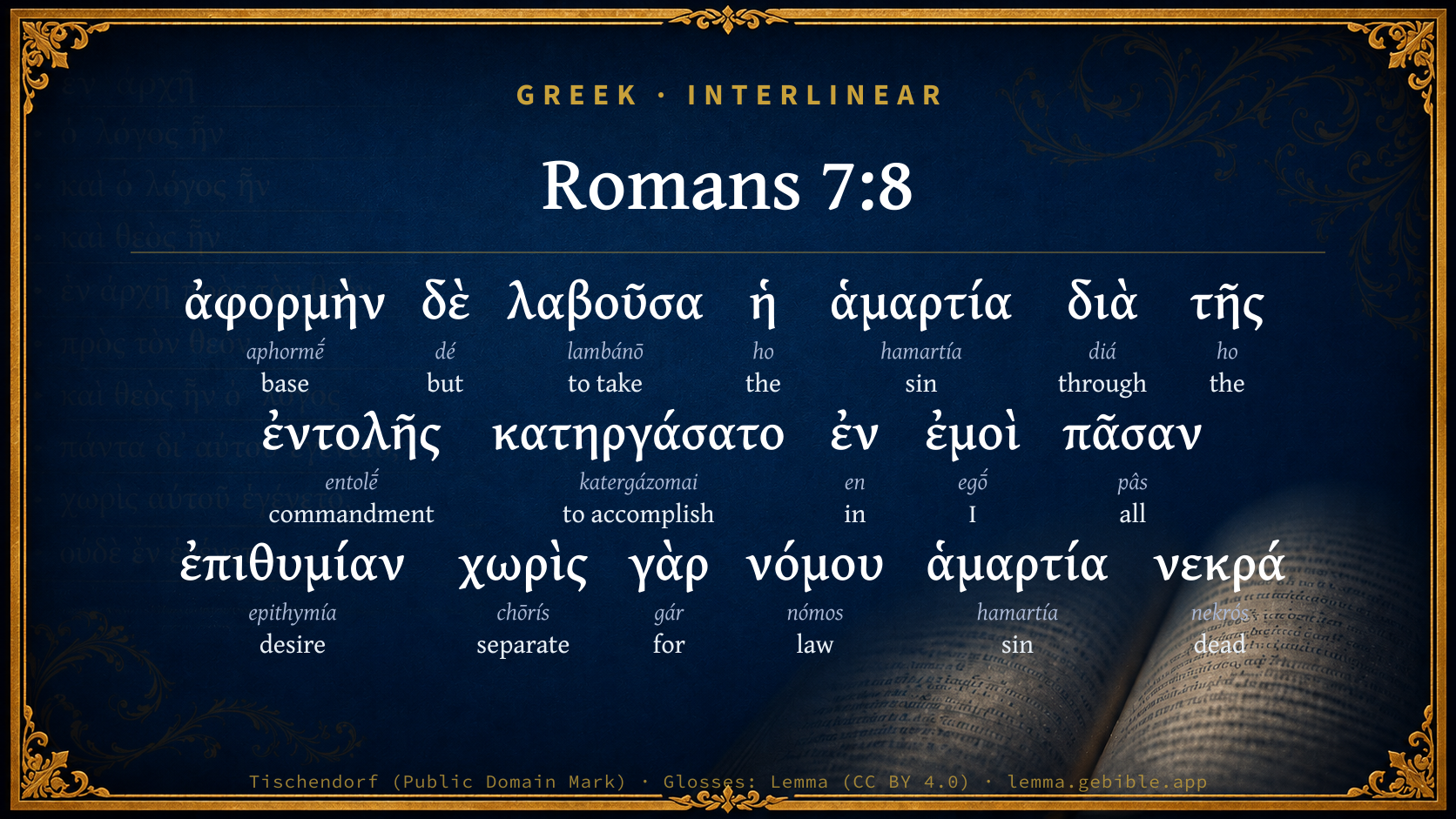
Download image
Cite this verse

Romans 7:8 (World English Bible). Public Domain. Lemma interlinear Bible study tool, https://lemma.gebible.app/v/romans/7/8.

Show BibTeX & RIS
BibTeX
RIS
English Translation
But sin, finding occasion through the commandment, produced in me all kinds of coveting. For apart from the law, sin is dead.
World English Bible · Public Domain
Highlights
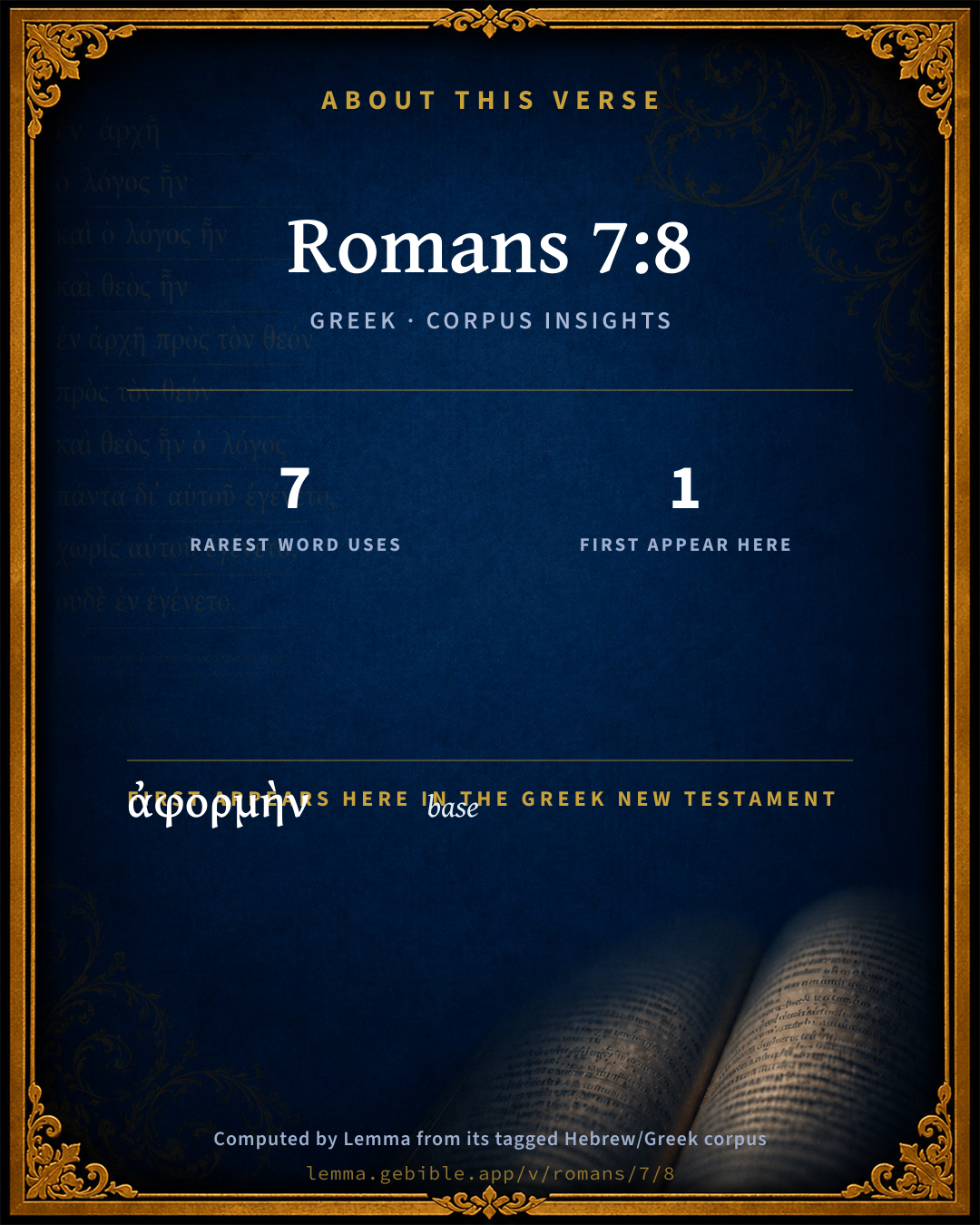
  • 1 first appearance in the Greek New Testament
Full analysis ↓
Download a study sheet

One document with this verse’s original text, its word-by-word gloss line, the meaning frame, cross-references with their text, attributed commentary, and full source and license credits — printable, and it pastes into notes with its structure intact.

This verse Autodidact and up

Study sheet (.html) Plain text (.txt)

A passage Seminary Student

Up to 50 verses in one chapter. A passage sheet keeps up to 6 commentary sources and 12 cross-references per verse, in the order this page ranks them, and says so on the sheet whenever that leaves anything out. Ask for a single verse and you get the Autodidact verse sheet above.

Everything on this page stays free to read, with no account — the sheet is a download of what is already on screen, not access to it.

Want to remove ads? Support Godless Engineer
Compare translations 3

The same verse in 3 English versions, stacked beneath the original-language interlinear above. Click any original word for its lexicon entry.

Each is an independent rendering of the whole verse — the interlinear is not word-aligned to these translations.

Highlighted words mark where these versions differ — a whole-verse word diff, not a word-by-word alignment.

  • World English Bible Public Domain
    But sin, finding occasion through the commandment, produced in me all kinds of coveting. For apart from the law, sin is dead.
  • King James Version Public Domain
    But sin, taking occasion by the commandment, wrought in me all manner of concupiscence. For without the law sin was dead.
  • unfoldingWord Literal Text CC BY-SA 4.0
    But sin, having taken opportunity through the commandment, produced all covetousness in me. For apart from law, sin dead.

unfoldingWord Literal Text — © unfoldingWord, licensed CC BY-SA 4.0. Word-aligned USFM3 via Door43 (git.door43.org/unfoldingWord/en_ult).

Versions to compare (up to 4)

3 of 4 selected

Show all 19 translations

Every available English version of this verse, each an independent rendering of the whole verse.

  • World English Bible Public Domain
    But sin, finding occasion through the commandment, produced in me all kinds of coveting. For apart from the law, sin is dead.
  • Berean Standard Bible Public Domain
    But sin, seizing its opportunity through the commandment, produced in me every kind of covetous desire. For apart from the law, sin is dead.
  • Majority Standard Bible Public Domain
    But sin, seizing its opportunity through the commandment, produced in me every kind of covetous desire. For apart from the law, sin is dead.
  • King James Version Public Domain
    But sin, taking occasion by the commandment, wrought in me all manner of concupiscence. For without the law sin was dead.
  • American Standard Version (1901) Public Domain
    but sin, finding occasion, wrought in me through the commandment all manner of coveting: for apart from the law sin `is' dead.
  • Revised Version (1885) Public Domain
    but sin, finding occasion, wrought in me through the commandment all manner of coveting: for apart from the law sin is dead.
  • Geneva Bible (1599) Public Domain
    But sinne tooke an occasion by ye commandement, and wrought in me all maner of concupiscence: for without the Lawe sinne is dead.
  • Douay-Rheims (1899) Public Domain
    But sin taking occasion by the commandment, wrought in me all manner of concupiscence. For without the law sin was dead.
  • Young's Literal Translation Public Domain
    `Thou shalt not covet;' and the sin having received an opportunity, through the command, did work in me all covetousness -- for apart from law sin is dead.
  • Literal Standard Version CC BY-SA 4.0
    “You will not covet”; and sin having received an opportunity, through the command, worked in me all covetousness—for apart from law sin is dead.
  • Unlocked Literal Bible CC BY-SA 4.0
    But sin took the opportunity through the commandment and brought about every lust in me. For without the law, sin is dead.
  • unfoldingWord Literal Text CC BY-SA 4.0
    But sin, having taken opportunity through the commandment, produced all covetousness in me. For apart from law, sin dead.
  • Darby Bible Public Domain
    but sin, getting a point of attack by the commandment, wrought in me every lust; for without law sin [was] dead.
  • World Messianic Bible Public Domain
    But sin, finding occasion through the commandment, produced in me all kinds of coveting. For apart from the law, sin is dead.
  • Webster's Bible Public Domain
    But sin, taking occasion by the commandment, wrought in me all manner of concupiscence. For without the law sin was dead.
  • Free Bible Version CC BY-SA 4.0
    But through this commandment sin found a way to stir up in me all kinds of selfish desires—for without law, sin is dead.
  • Bible in Basic English Public Domain
    But sin, taking its chance through that which was ordered by the law, was working in me every form of desire: because without the law sin is dead.
  • Text-Critical English NT CC BY 4.0
    But sin, seizing an opportunity through the commandment, produced in me every kind of covetousness. For apart from the law sin is dead.
  • Tyndale New Testament (1534) Public Domain
    But synne toke an occasion by the meanes of the commaundement and wrought in me all manner of concupiscece. For with out the lawe synne was deed.

Literal Standard Version (2020), Covenant Press — licensed CC BY-SA 4.0. Text via the HelloAO Bible API (eBible.org). Unlocked Literal Bible (unfoldingWord) — licensed CC BY-SA 4.0. Text via the HelloAO Bible API (eBible.org). unfoldingWord Literal Text — © unfoldingWord, licensed CC BY-SA 4.0. Word-aligned USFM3 via Door43 (git.door43.org/unfoldingWord/en_ult). Free Bible Version, Dr. Jonathan Gallagher — licensed CC BY-SA 4.0. Text via the HelloAO Bible API (eBible.org).

Word by word

More ways to search: Search by grammar → Find every occurrence → Compare this word →

Practice this passage: Drill this verse → Learn its vocabulary →

ἀφορμὴν
aphormḗ
G874
“base”
Noun, Accusative, Singular, Feminine
Part of Speech
Noun
Case
Accusative
Number
Singular
Gender
Feminine
Full Thayer's Definition

Origin: from a compound of G575 and G3729

TDNT: 12:52,7

1. a place from which a movement or attack is made, a base of operations 2. metaph. that by which endeavour is excited and from which it goes forth a. that which gives occasion and supplies matter for an undertaking, the incentive b. the resources we avail ourselves of in attempting or performing anything
  1. δὲ dé G1161 “but” Conjunction
  2. λαβοῦσα lambánō G2983 “to take” Verb, Aorist, Active, Participle, Nominative, Singular, Feminine
  3. ἡ ho G3588 “the” Article, Nominative, Singular, Feminine
  4. ἁμαρτία hamartía G266 “sin” Noun, Nominative, Singular, Feminine
  5. διὰ diá G1223 “through” Preposition
  6. τῆς ho G3588 “the” Article, Genitive, Singular, Feminine
  7. ἐντολῆς entolḗ G1785 “commandment” Noun, Genitive, Singular, Feminine
  8. κατηργάσατο katergázomai G2716 “to accomplish” Verb, Aorist, Middle deponent, Indicative, 3rd person, Singular
  9. ἐν en G1722 “in” Preposition
  10. ἐμοὶ egṓ G1473 “I” Personal pronoun, 1st person, Dative, Singular
  11. πᾶσαν pâs G3956 “all” Adjective, Accusative, Singular, Feminine
  12. ἐπιθυμίαν epithymía G1939 “desire” Noun, Accusative, Singular, Feminine
  13. χωρὶς chōrís G5565 “separate” Adverb
  14. γὰρ gár G1063 “for” Conjunction
  15. νόμου nómos G3551 “law” Noun, Genitive, Singular, Masculine
  16. ἁμαρτία hamartía G266 “sin” Noun, Nominative, Singular, Feminine
  17. νεκρά nekrós G3498 “dead” Adjective, Nominative, Singular, Feminine

About this verse

These counts appear in no published source. They are computed here, from the morphology-tagged text and Lemma’s own curated glosses. What Lemma adds →

18
words
16
distinct lemmas
Pauline Epistles
section

Notable vocabulary

The rarest word here is ἀφορμὴν base G874 — appearing just 7 times in the whole Greek New Testament.

First appearance in Scripture

This word makes its first canonical appearance in the Greek New Testament here:

  • ἀφορμὴν base G874

Shared distinctive vocabulary

ἀφορμὴν base G874 occurs in 6 verses of the Greek New Testament. Also found in:
Repetition

Words recur within this verse:

  • ἁμαρτία sin G266 ×2
  • ἡ the G3588 ×2

Cross-references

9

Topical passages linked to Romans 7:8 in the Treasury of Scripture Knowledge — connected by theme and wording, ordered by reader-vote popularity; previews shown in the World English Bible.

  • Romans 7:11 for sin, finding occasion through the commandment, deceived me, and through it killed me.
  • 1 Corinthians 15:56 The sting of death is sin, and the power of sin is the law.
  • Romans 4:15 For the law works wrath, for where there is no law, neither is there disobedience.
  • James 1:14–15 But each one is tempted, when he is drawn away by his own lust, and enticed.
  • Romans 7:13 Did then that which is good become death to me? May it never be! But sin, that it might be shown to be sin, by working death to me through that which is good; that through the commandment sin might become exceeding sinful.
  • John 15:22 If I had not come and spoken to them, they would not have had sin; but now they have no excuse for their sin.
  • Romans 5:20 The law came in besides, that the trespass might abound; but where sin abounded, grace did abound more exceedingly;
  • John 15:24 If I hadn't done among them the works which no one else did, they wouldn't have had sin. But now have they seen and also hated both me and my Father.
  • Romans 7:17 So now it is no more I that do it, but sin which dwells in me.

Cross-references courtesy of OpenBible.info (CC BY 4.0).

Commentary

Notes on Romans 7:8 from classic Christian and Jewish commentators (each source and its license shown beneath its notes). The classic Christian expositions comment on the surrounding passage and are grouped to its opening verse, so a note may address several verses; the Jewish commentaries on the Tanakh (Rashi and others) are per-verse, so they appear only where the commentator wrote on this verse.

Lemma curates 59 commentaries, every one of them public domain or Creative Commons licensed, each selected and text-cleaned for this edition rather than reprinted as found. About our sources →

Adam Clarke's Commentary

Verse 8. Sin, taking occasion by the commandment] I think the pointing, both in this and in the 11th verse, to be wrong: the comma should be after occasion, and not after commandment. But sin taking occasion, wrought in me by this commandment all manner of concupiscence. There are different opinions concerning the meaning of the word αφορμη, which we here translate occasion. Dr. Waterland translates the clause, Sin, taking ADVANTAGE. Dr. Taylor contends that all commentators have mistaken the meaning of it, and that it should be rendered having received FORCE. For this acceptation of the word I can find no adequate authority except in its etymology-απο, from, and ορμη, impetus. The word appears to signify, in general, whatsoever is necessary for the completion or accomplishment of any particular purpose. Xenophon uses αφορμαιειςτονβιον to signify whatever is necessary for the support of life. There is a personification in the text: sin is, represented as a murderer watching for life, and snatching at every means and embracing every opportunity to carry his fell purpose into effect. The miserable sinner has a murderer, sin, within him; this murderer can only destroy life in certain circumstances; finding that the law condemns the object of his cruelty to death, he takes occasion from this to work in the soul all manner of concupiscence, evil and irregular desires and appetites of every kind, and, by thus increasing the evil, exposes the soul to more condemnation; and thus it is represented as being slain, Ro 7:11. That is, the law, on the evidence of those sinful dispositions, and their corresponding practices, condemns the sinner to death: so that he is dead in law. Thus the very prohibition, as we have already seen in the preceding verse, becomes the instrument of exciting the evil propensity; for, although a sinner has the general propensity to do what is evil, yet he seems to feel most delight in transgressing known law: stat pro ratione voluntas; "I will do it, because I will."

For without the law, sin was dead.] Where there is no law there is no transgression; for sin is the transgression of the law; and no fault can be imputed unto death, where there is no statute by which such a fault is made a capital offence.

Dr. Taylor thinks that χωριςνομον, without the law, means the time before the giving of the law from Mount Sinai, which took in the space of 430 years, during which time the people were under the Abrahamic covenant of grace; and without the law that was given on Mount Sinai, the sting of death, which is sin, had not power to slay the sinner; for, from the time that Adam sinned, the law was not re-enacted till it was given by Moses, Ro 5:13. The Jew was then alive, because he was not under the law subjecting him to death for his transgressions; but when the commandment came, with the penalty of death annexed, sin revived, and the Jew died. Then the sting of death acquired life; and the Jew, upon the first transgression, was dead in law. Thus sin, the sting of death, received force or advantage to destroy by the commandment, Ro 7:8; Ro 7:11.

All manner of concupiscence.] It showed what was evil and forbade it; and then the principle of rebellion, which seems essential to the very nature of sins rose up against the prohibition; and he was the more strongly incited to disobey in proportion as obedience was enjoined. Thus the apostle shows that the law had authority to prohibit, condemn, and destroy; but no power to pardon sin, root out enmity, or save the soul.

The word επιθυμια, which we render concupiscence, signifies simply strong desire of any kind; but in the New Testament, it is generally taken to signify irregular and unholy desires. Sin in the mind is the desire to do, or to be, what is contrary to the holiness and authority of GOD.

For without the law, sin was dead.] This means, according to Dr. Taylor's hypothesis, the time previous to the giving of the law. See before. But it seems also consistent with the apostle's meaning, to interpret the place as implying the time in which Paul, in his unconverted Jewish state, had not the proper knowledge of the law-while he was unacquainted with its spirituality. He felt evil desire, but he did not know the evil of it; he did not consider that the law tried the heart and its workings, as well as outward actions. This is farther explained in the next verse.

Adam Clarke's Commentary on the Bible (1810–1826) — public domain. Text from a community e-Sword/MySword module.

Tyndale Open Study Notes

Tyndale Open Resources

7:8 sin used this command (literally sin took an opportunity through this command): The word opportunity is a military term for a position seized in enemy territory that becomes a base of operations (see 7:11). By expressing God’s demands, the commandments stimulate rebellion in sinful human beings. The commandments of God become an occasion for sin to accomplish its deadly purposes. • sin would not have that power: The law, by clearly expressing God’s will, makes people more accountable than they would be without it. The law of Moses did not solve Israel’s sin problem but exposed and exacerbated it. This is always the effect that God’s law, by itself, has on sinful human beings.

Tyndale Open Study Notes — © Tyndale Open Resources, licensed CC BY-SA 4.0. Text via the HelloAO Bible API.

Bengel's Gnomon

Johann Albrecht Bengel

Rom 7:8. Διὰ τῆς ἐντολῆς, by the commandment) The construction is with the following verb [κατειργάσατο, wrought concupiscence by the commandment. Not as Engl. V., Taking occasion by the commandment, here and at Rom 7:11]; as in Rom 7:11 twice.—χωρὶς—νεκρὰ, without—dead) A self-evident principle.—νεκρὰ, dead) viz. was: it did not so much rage through concupiscence: or the word to be supplied may be, is.

Bengel's Gnomon of the New Testament — English translation (T&T Clark, Edinburgh, 1860) — public domain. Text from a community e-Sword module.

Meyer's Critical & Exegetical Commentary

Heinrich August Wilhelm Meyer

Rom_7:8. Δέ] placing over against the negative declaration of Rom_7:7 the description of the positive process, by which the consciousness of desire of Rom_7:7 emerged: but indeed sin took occasion, etc. In this ἀφορμήν placed first emphatically, not in ἡ ἁμαρτία (Th. Schott), lies the point of the relation.

ἡ ἁμαρτία] as in Rom_7:7, not conceived as κακοδαίμων (Fritzsche); nor yet the sinful activity, as Reiche thinks; for that is the result of the ἐπιθυμία (Jam_1:5), and the sin that first takes occasion from the law cannot be an action.

For examples of ἀφορμὴν λαμβ., to take occasion, see Wetstein and Kypke. The principle of sin took occasion, not, as Reiche thinks, received occasion; for it is conceived as something revived (Rom_7:9), which works.

διὰ τῆς ἐντολῆς] through the command, namely, the οὐκ ἐπιθυμ. of Rom_7:7. This interpretation is plainly necessary from the following κατειργάσατο κ.τ.λ. Reiche, following De Dieu and several others, erroneously (comp. Eph_2:15) takes ἐντολή as equivalent to νόμος. We must connect διὰ τ. ἐντ. with κατειργ. (Rückert, Winzer, Benecke, de Wette, Fritzsche, Tholuck, Umbreit, van Hengel, and Hofmann), not with ἀφορμ. λαβ. (Luther and many others, including Reiche, Köllner, Olshausen, Philippi, Maier, and Ewald), because ἀφορμ. λαμβάνειν is never construed with διὰ (frequently with ἐκ, as in Polyb. iii. 32. 7, iii. 7. 5), and because Rom_7:11 (διʼ αὐτῆς ἀπέκτ.) and Rom_7:13 confirm the connection with κατειργ.

κατειργ. ἐν ἐμοὶ πᾶσαν ἐπιθ.] it brought about in me all manner of desire. Respecting κατεργάζ., see on Rom_1:27. Even without the law there is desire in man, but not yet in the ethical definite character of desire after the forbidden, as ἐπιθυμία is conceived of according to Rom_7:7; for as yet there is no prohibition, and consequently no moral antithesis existing to the desire in itself (ignoti nulla cupido, Ovid, A. A. 397), through which antithesis the inner conflict is first introduced. Every desire is, in accordance with the quite general οὐκ ἐπιθυμήσεις, to be left without limitation. No desire (as respects category) was excluded. A reference to the desires, which the state of civilisation joined with a positive legislation calls forth (de Wette), is foreign to the connection. Comp. Pro_9:17.

χωρὶς γὰρ νόμου ἁμαρτία νεκρά] sc. ἐστι, not ἦν (Beza, Reiche, Krummacher), just because the omission of the verb betokens a general proposition: for without the law, i.e. if it do not enter into relation with the law, sin, the sinful principle in man, is dead, i.e. not active, because that is wanting, by which it may take occasion to be alive. The potentiality of the nitimur in vetitum is indeed there, but, lacking the veto of the νόμος (τοῦ τὸ πρακτέον ὑποδεικνύντος καὶ τὸ οὐ πρακτέον ἀπαγορεύοντος, Theodoret), can exhibit no actual vital activity; it does not stir, because the antithesis is wanting. Hence the law becomes the δύναμις τῆς ἁμαρτίας, 1Co_15:56, though it is not itself τοῦ παρανομεῖν παραίτιος (Chrysippus in Plut. de Stoic. Rep. 33). Erroneous is the view held by Chrysostom, Calvin, Estius, Olshausen, and others, that νεκρά implies the absence of knowledge of sin (οὐχ οὕτω γνώριμος). The νόμος is here, as throughout in this connection, the Mosaic law, which contains the ἐντολή (Rom_7:7; Rom_7:9; Rom_7:12). That this may be and is misused by the principle of sin, in the way indicated, arises from the fact, that it comes forward merely with the outward command (thou shalt, thou shalt not), without giving the power of fulfilment; comp. Lipsius, Rechtfertigungsl. p. 63 ff. And the analogous application, which the general proposition admits of to the moral law of nature also, is indeed self-evident, but lies here aloof from the apostles sphere of thought.

Meyer — Critical and Exegetical Commentary on the New Testament — English translation by Peter Christie, edited by Frederick Crombie (T&T Clark, 1880) — public domain. Text from a community e-Sword module.

Expositor's Greek Testament

ed. W. Robertson Nicoll

Rom 7:8 . ἀφορμὴν λαβοῦσα means “having received,” not “having taken” occasion. ἡ ἁμαρτία is sin as a power dwelling in man, of the presence of which he is as yet unaware. How it “receives occasion” is not stated; it must be by coming face to face with something which appeals to ἐπιθυμία ; but when it has received it, it avails itself of the commandment ( viz. , the one prohibiting ἐπιθυμία ) to work in us ἐπιθυμία of every sort. It really is the commandment which it uses, for without law sin is dead. Cf. Rom 4:15 , Rom 5:13 : but especially 1Co 15:56 . Apart from the law we have no experience either of its character or of its vitality.

The Expositor's Greek Testament, edited by W. Robertson Nicoll (1897–1910) — public domain. Text from a community e-Sword module.

Godet's Commentaries

Frédéric Louis Godet

Vv. 8. “Then sin, taking occasion, wrought in me by the commandment all manner of concupiscence; for without the law sin is dead.”

After revealing to him the presence of sin, the law itself intensified in him the force of this evil principle. This idea of progress is indicated by the δέ, now, then, which makes the fact described in Rom 7:8 a sequel to that of which we are reminded in Rom 7:7. The word ἀφορμή, which we translate by occasion, strictly signifies the point of support from which the spring or flight proceeds (ἀπό, ὁρμάω). Some critics make the words διὰ τῆς ἐντολῆς, by the commandment, dependent on the participle λαβοῦσα, having taken. In this case we should not have to translate: “Taking occasion from the commandment,” which would require one of the prepositions ἀπό or ἐκ usual in such a case. The meaning would be: “Taking occasion by means of the commandment.” But it is more natural to make this clause depend on the principal verb wrought. For, in the other sense, there would have been no reason for inserting the subject between this clause and the participle which depended on it. The analogous construction of Rom 7:11 also leads us to make the clause: by the commandment, dependent on the principal verb wrought.

What is the occasion meant by the apostle? The usual answer is, the commandment itself: “In lege est occasio,” says Calvin. This meaning is not inadmissible. Sin, finding a series of prohibitions enumerated in the commandment, made use of this means to enkindle desire for the forbidden objects. But is it not more probable that Paul finds the occasion of which sin makes use, in those forbidden objects themselves, when they appear to the eye or imagination? “Sin finding an occasion, in the view of one of those objects in regard to which God says to me: Thou shalt not covet, took advantage of the circumstance to kindle in my heart, through this very prohibition, the manifold lusts which are related to those different objects.” The point in question here is the well-known experience already remarked by the ancients, that man always inclines to forbidden fruit. Comp. Pro 9:17. The prohibition has for its effect to fix the object strongly on the imagination, and thereby to lend it a new charm. The heart is as it were fascinated by it, and the latent desire changes into intense aspiration. Thus every word of the commandment has, so to speak, the property of awakening in the heart a new lust. But it must be constantly borne in mind that this is only so because sin, the egoistic instinct, already exists in the heart. The commandment of itself does not produce this result; it is sin which, so to speak, trades upon the commandment for its own profit. On a sound nature, the commandment would not have acted thus; witness the first temptation in which a foreign agent required to play the part here ascribed to sin.

Calvin, in his eagerness to exculpate the apostle completely from the charge of ascribing to the law the aggravation of sin, gives this verse a purely logical meaning. Paul means, according to him, that the law manifested the various lusts already present. Detexit in me omnem concupiscentiam. This is evidently to distort the meaning of the apostle’s words.

And in what state, then, was sin before the law had thus made it abound in all manner of particular lusts? It was dead, says Paul. This expression, far from signifying that it did not exist, proves, on the contrary, its presence, but, virtually, like the germ of a disease still slumbering, which the least circumstance may cause to break out so as to bring the malady to the acute state. And it is this malignant principle, already in existence, which bears all the responsibility of the disagreeable effects of the law. The literal translation would be: Without law sin is dead. It is not as Mosaic law, but as law, that is to say, as an external letter, that the code produces this pernicious effect on the sinful soul. And this is what warrants us in applying this description to the law of nature, and what explains how the nitimur in vetitum may also be a confession of the heathen conscience.

We must beware of understanding with Beza the verb ἦν, was: “Without law sin was dead.” The very ellipsis of the verb proves that we have here a general proposition.

The verses which follow initiate us more deeply still into the apostle’s moral experiences, when he was under the law.

Frédéric Louis Godet — Commentaries on Luke, John, Romans, and 1 Corinthians — English translation (T&T Clark, Edinburgh, 1870s–1890s) — public domain. Text from a community e-Sword module.

Hodge's Commentary on Romans, Ephesians & First Corinthians

Charles Hodge

Rom_7:8

But sin, taking occasion by the commandment, wrought in me all manner of concupiscence. This verse is not logically connected with the preceding. It is rather coordinate with it, and is a virtual, or rather, an additional answer to the question, Is the law evil? To this question Paul replies, No; on the contrary, it leads to the knowledge of sin. And hence he adds, It is not evil in itself, although incidentally the cause of sin in us. By sin, in this case, cannot be understood actual sin. It must mean indwelling sin, or corruption of nature; sin as the principle or source of action, and not as an act. Ἁμαρτία non potest esse hoc loco peccatum ipsum, says Koppe, sed ipsa potius prava et ad peccandum proclivis indoles, vitiosa hominis natura, vitiositas ipsa. To the same effect, Olshausen: Aus der allgemeinen sündhaften natur des Menschen geht die ἐπιθυμία prava concupiscentia, als erste Äusserung hervor und dann folgt erst die That. That is, from sin immanent in our nature, comes first desire, and then the act. Thus Köllner says, ἐπιθυμίαν, so von ἁμαρτία verschieden, dass diese das gleichsam im Menschen ruhende sündliche Princip bezeichnet, ἐπιθυμία aber die im einzelnen Falle wirksame böse Lust, ganz eigentlich die Begierde, die dann zunächst zur Sünde in concreto fürht. Such is plainly the meaning of the apostle. There is a principle of sin, a corruption of nature which lies back of all conscious voluntary exercises, to which they owe their origin. Ἐπιθυμία, feeling, the first form in which sin is revealed in the consciousness, springs from ἁμαρτία. This is a truth of great importance. According to the theology and religious conviction of the apostle, sin can be predicated not only of acts, but also of inward states.

Sin taking occasion, ἀφορμήν, opportunity or advantage, by the commandment, i.e., the command, Thou shalt not covet. A part is taken for the whole. This special precept (ἐντολή) stands, by way of illustration, for the whole law. The words διὰ τῆς ἐντολῆς, by the commandment, may be taken with the preceding clause, taking advantage of the commandment. In favor of this construction is the position of the words, and, as is supposed, the δι ̓ αὐτῆς in Rom_7:11, which, it is said, corresponds to these words in this verse. This is the construction which is adopted by our translators, and by many commentators. Others prefer connecting the words in question with what follows: by the commandment wrought in me. In favor of this is the fact, that the main idea of the passage is thus brought out. The apostle designs to show how the law, although good in itself, produced evil: Sin wrought by it. Besides, the phrase ἀφορμὴν λαμβάνειν ἐκ, or παρά, or ἀπό, is common, but with διά it never occurs: διά is not the appropriate preposition; whereas κατεργάζεσθαι διά is perfectly appropriate. Wrought in me all manner of concupiscence, πάσαν ἐπιθυμίαν, every (evil) desire.

For without the law sin (was) dead. This is designed as a confirmation of the preceding declaration. This confirmation is drawn either from a fact of Pauls personal experience, or from an universally admitted truth. If the former, then we must supply was: Sin is excited by the law, for without the law sin was dead; i.e., I was not aware of its existence. If the latter, then, is is to be supplied: Without the law sin is dead. This is an undisputed fact: Where there is no law there is no sin; and where is no knowledge of law there is no knowledge of sin. The latter view best suits the context. To say that a thing is dead, is to say that it is inactive, unproductive, and unobserved. All this may be said of sin prior to the operation of the law. It is comparatively inoperative and unknown, until aroused and brought to light by the law. There are two effects of the law included in this declaration the excitement of evil passions, and the discovery of them. Calvin makes the latter much the more prominent: Ad cognitionem praecipue refero, acsi dictum foret: Detexit in me omnem concupiscentiam; quae dum lateret, quodammodo nulla esse videbatur. But the context, and the analogous declarations in the succeeding verses, seem to require the former to be considered as the more important. The law then is not evil, but it produces the conviction of sin, by teaching us what sin is, Rom_7:7, and by making us conscious of the existence and power of this evil in our own hearts, Rom_7:8. Ehe dem Menschen ein νόμος entweder von aussen gegeben wird, oder in ihm selbst sich entwickelt, so ist die Sündhaftigkeit zwar in ihm, als Anlage, aber sie ist todt, d. h. sie ist ihm noch nicht zum Bewusstseyn gekommen, weil noch kein Widerstreit zwischen seiner Sündhaftigkeit und einem Gebote in ihm entstehen konnte. Usteri Lehrbegriff Pauli, p. 25. Such is certainly the experience of Christians. They live at ease. Conscience is at rest. They think themselves to be as good as can be reasonably required of them. They have no adequate conception of the power or heinousness of the evil within them. Sin lies, as it were, dead, as the torpid serpent, until the operation of the law rouses it from its slumbers, and reveals its character.

Charles Hodge — Commentary on Romans (1835), First Corinthians (1857), and Ephesians (1856) — public domain. Text from a community e-Sword module.

Geneva Bible (1599)

Geneva Bible translators

Though sin be in us, yet it is not known for sin, neither doth it so rage, as it rageth after that the law is known.

Geneva Bible (1599) marginal notes — public domain. Text via Bolls.life.

Jamieson, Fausset & Brown

Robert Jamieson, A. R. Fausset & David Brown

For without the law--that is, before its extensive demands and prohibitions come to operate upon our corrupt nature.

sin was--rather, "is"

dead--that is, the sinful principle of our nature lies so dormant, so torpid, that its virulence and power are unknown, and to our feeling it is as good as "dead."

Jamieson, Fausset & Brown — Commentary Critical and Explanatory on the Whole Bible (1871) — public domain (CC PDM 1.0). Text via the HelloAO Bible API.

John Calvin's Commentaries

8. For without the law, etc. He expresses most clearly the meaning of his former words; for it is the same as though he had said, that the knowledge of sin without the law is buried. It is a general truth, which he presently applies to his own case. I hence wonder what could have come into the minds of interpreters to render the passage in the preterimperfect tense, as though Paul was speaking of himself; for it is easy to see that his purpose was to begin with a general proposition, and then to explain the subject by his own example.

John Calvin's Commentaries (1540-1563) — public domain. Text from the Calvin Translation Society English edition (1840s-50s) via the Christian Classics Ethereal Library (ccel.org). Calvin's coverage is partial (roughly two-thirds of the Bible); uncommented books and verses are honest gaps, never fabricated. The 19th-century editor's footnotes and remarks are omitted so the notes are faithfully Calvin's own voice.

Ellicott's Commentary for English Readers

(8) Taking occasion.—The word in the Greek implies originally a military metaphor: taking as a “base of operations,” i.e., an advanced post occupied as the starting-point and rendezvous for further advances. Sin is unable to. act upon man without the co-operation of law, without being able to hold up law before him, and so show itself in its true colours.

The words “by the commandment” may either go with “taking occasion” or with “wrought in me.” The sense would, in either case, be very much the same, “taking advantage of the commandment,” or “wrought in me by the help of the commandment.” The first is the construction usually adopted, as in the Authorised version, but there seem to be reasons of some force for preferring the second. The phrase “wrought in me coveting by the commandment” would thus be parallel to “working death in me by that which is good,” below.

Concupiscence.—Rather, coveting; the same word which had been used above. Sin and the Commandment together—Sin, the evil principle in men, acting as the primary cause, and the Commandment as the secondary cause—led their unfortunate victim into all kinds of violation of the Law. This is done in two ways: (1) the perverseness of human nature is such that the mere prohibition of an act suggests the desire to do that which is prohibited; (2) the act, when done, is invested with the character of sin, which hitherto it did not possess. It becomes a distinct breach of law, where previously there had been no law to break. This is what the Apostle means by saying that “without the Law sin was dead.” Until there was a written prohibition, Sin (the evil principle) was powerless to produce sinful actions.

A Bible Commentary for English Readers, edited by Charles John Ellicott (1878–1897) — public domain. Text from a community e-Sword module.

The Cambridge Bible for Schools and Colleges

gen. ed. J. J. S. Perowne

8. But] This word refers to the statement “I had not known lust;” and this verse explains the action of the law in causing (indirectly) the knowledge of sin.

sin] As a principle, “working” evil desires as its result.

occasion] The Gr. word = the French point d’appui. The positive inexorable precept, presented to the fallen will, became the fulcrum for the energy of the evil principle.

concupiscence] The same word as that just rendered “lust.”—The verb is aorist; wrought; but the reference is not necessarily to any single crisis of the past. St Paul probably views the whole past action of the Commandment and of Sin respectively as, in idea, one thing. Not, however, that there may not have been a crisis of “fierce temptation” in his recollection.—These remarks apply to Rom_7:9-11 also.

sin was dead] The context explains this phrase. Sin, as sin, as resistance to God, (see fourth note on Rom_7:7,) was torpid till the Law called it out. It was present; for certainly he does not mean that he was once sinless; but it was present as a blind negative bias rather than otherwise.

The Cambridge Bible for Schools and Colleges (gen. ed. J. J. S. Perowne; Cambridge University Press, 1878–1918) — public domain. Text from a community e-Sword module.

John Gill's Exposition

But sin taking occasion by the commandment,.... By "the commandment" is meant, either the whole moral law, or that particular commandment, "thou shalt not covet", Exo 20:17, which, the Jews say, comprehends all;

"God, (say they (f),) caused them (the Israelites) to hear the ten words, which he concluded with this word, "thou shalt not covet"; , "for all of them depend on that": and to intimate, that whoever keeps this commandment, it is as if he kept the whole law, and whoever transgresses this, it is all one as if he transgressed the whole law;''

and no doubt but it does refer to any unlawful thought of, desire after, and inclination to anything forbidden in the other commandments. By "sin" is meant, not the devil, as some of the ancients thought; but the vitiosity and corruption of nature, indwelling sin, the law in the members that took "occasion" by the law of God; so that the law at most could only be an occasion, not the cause of sin, and besides, this was an occasion not given by the law, but taken by sin; so that it was sin, and not the law, which

wrought in him all manner of concupiscence. The law forbidding every unclean thought, and covetous desire of unlawful objects, sin took an occasion through these prohibitions to work in him, stir up and excite concupiscence, evil desire after all manner of things forbidden by the law; hence it is clear that not the law, but sin, is exceeding sinful:

for without the law sin was dead; not that, before the law of Moses was given, sin lay dead and unexerted, for during that interval between Adam and Moses sin was, and lived and reigned, and death by it, as much as at any other time; but when the apostle was without the law, that is, without the knowledge of the spirituality of it, before it came with power and light into his heart and conscience, sin lay as though it was dead; it was so in his apprehension, he fancied himself free from it, and that he was perfectly righteous.

(f) Abkath Rochel, l. 1. par. 1. p. 3. Ed. Huls.

John Gill's Exposition of the Whole Bible (1746–1763) — public domain (CC PDM 1.0). Text via the HelloAO Bible API.

Trapp's Complete Commentary

John Trapp

8 But sin, taking occasion by the commandment, wrought in me all manner of concupiscence. For without the law sin was dead.

Ver. 8. By the commandment] Not commandments. Papists abolishing, or at least destroying, the sense of the second commandment, by making it a member of the first, that they may retain the number of ten words (so loth are heretics to have their asses’ ears seen) they divide this last; which yet Paul here calls the commandment; and sure he knew better than they the analysis of the law.

Wrought in me all manner of concupiscence] The more the law would dam up the torrent of sinful lusts, the higher did they swell. ( Nitimur in vetitum.) Corruption doth increase and begin by the law. The more God forbids sin, the more we bid for it: as if we did sin on purpose to provoke God; as if God had need deal with us as he did in the story, who was wont to command the contrary when he would have anything done, because he knew they would cross him. Howbeit, although sin thus take occasion by the law, yet this is per accidens, as in the dropsy, it is not the drink that is to be blamed for increasing the disease, but the ill distemper of the body.

John Trapp, A Commentary or Exposition upon All the Books of the Old and New Testament (1647–1656) — public domain. Text from a community e-Sword module.

Albert Barnes' Notes on the Bible

But sin - To illustrate the effect of the Law on the mind, the apostle in this verse depicts its influence in exciting to evil desires and purposes. Perhaps no where has he evinced more consummate knowledge of the human heart than here. He brings an illustration that might have escaped most persons, but which goes directly to establish his position that the Law is insufficient to promote the salvation of man. Sin here is personified. It means not a real entity; not a physical subsistence; not something independent of the mind, having a separate existence, and lodged in the soul, but it means the corrupt passions, inclinations, and desires of the mind itself. Thus, we say that lust burns, and ambition rages, and envy corrodes the mind, without meaning that lust, ambition, or envy are any independent physical subsistences, but meaning that the mind that is ambitious, or envious, is thus excited.

Taking occasion - The word “occasion” ἀφορμὴν aphormēn properly denotes any material, or preparation for accomplishing anything; then any opportunity, occasion, etc. of doing it. Here it means that the Law was the exciting cause of sin; or was what called the sinful principle of the heart into exercise. But for this, the effect here described would not have existed. Thus, we say that a tempting object of desire presented is the exciting cause of covetousness. Thus, an object of ambition is the exciting cause of the principle of ambition. Thus, the presentation of wealth, or of advantages possessed by others which we have not, may excite covetousness or envy. Thus, the fruit presented to Eve was the exciting cause of sin; the wedge of gold to Achan excited his covetousness. Had not these objects been presented, the evil principles of the heart might have slumbered, and never have been called forth. And hence, no one understand the full force of their native propensities until some object is presented that calls them forth into decided action. The occasion which called these forth in the mind of Paul was the Law crossing his path, and irritating and exciting the native strong inclinations of the mind.

By the commandment - By all law appointed to restrain and control the mind.

Wrought in me - Produced or worked in me. The word used here means often to operate in a powerful and efficacious manner. (Doddridge.)

All manner of - Greek, “All desire.” Every species of unlawful desire. It was not confined to one single desire, but extended to everything which the Law declared to be wrong.

Concupiscence - Unlawful or irregular desire. Inclination for unlawful enjoyments. The word is the same which in Rom 7:7 is rendered “lust.” If it be asked in what way the Law led to this, we may reply, that the main idea here is, that opposition by law to the desires and passions of wicked men only tends to inflame and exasperate them. This is the case with regard to sin in every form. An attempt to restrain it by force; to denounce it by laws and penalties; to cross the path of wickedness; only tends to irritate, and to excite into living energy, what otherwise would be dormant in the bosom. This it does, because,

(1) It crosses the path of the sinner, and opposes his intention, and the current of his feelings and his life.

(2) The Law acts the part of a detector, and lays open to view that which was in the bosom, but was concealed.

(3) Such is the depth and obstinacy of sin in man, that the very attempt to restrain often only serves to exasperate, and to urge to greater deeds of wickedness. Restraint by law rouses the mad passions; urges to greater deeds of depravity; makes the sinner stubborn, obstinate, and more desperate. The very attempt to set up authority over him throws him into a posture of resistance, and makes him a party, and excites all the feelings of party rage. Anyone may have witnessed this effect often on the mind of a wicked and obstinate child.

(4) This is particularly true in regard to a sinner. He is calm often, and apparently tranquil. But let the Law of God be brought home to his conscience, and he becomes maddened and enraged. He spurns its authority, yet his conscience tells him it is right; he attempts to throw it off, yet trembles at its power; and to show his independence, or his purpose to sin, he plunges into iniquity, and becomes a more dreadful and obstinate sinner. It becomes a struggle for victory; in the controversy with God he re solves not to be overcome. It accordingly happens that many a man is more profane, blasphemous, and desperate when under conviction for sin than at other times. In revivals of religion it often happens that people evince violence, and rage, and cursing, which they do not in a state of spiritual death in the church; and it is often a very certain indication that a man is under conviction for sin when he becomes particularly violent, and abusive, and outrageous in his opposition to God.

(5) The effect here noticed by the apostle is one that has been observed at all times, and by all classes of writers. Thus, Cato says (Livy, xxxiv. 4,) “Do not think, Romans, that it will be hereafter as it was before the Law was enacted. It is more safe that a bad man should not be accused, than that he should be absolved; and luxury not excited would be more tolerable than it will be now by the very chains irritated and excited as a wild beast.” Thus, Seneca says (de Clementia, i. 23,) “Parricides began with the law.” Thus, Horace (Odes, i. 3,) “The human race, bold to endure all things, rushes through forbidden crime.” Thus, Ovid (Amor. iii. 4,) “We always endeavour to obtain what is forbidden, and desire what is denied.” (These passages are quoted from Tholuck.) See also Pro 9:17, “Stolen waters are sweet, and bread eaten in secret is pleasant.” If such be the effect of the Law, then the inference of the apostle is unavoidable, that it is not adapted to save and sanctify man.

For without the law - Before it was given; or where it was not applied to the mind.

Sin was dead - It was inoperative, inactive, unexcited. This is evidently in a comparative sense. The connection requires us to under stand it only so far as it was excited by the Law. People’s passions would exist; but without law they would not be known to be evil, and they would not be excited into wild and tumultuous raging.

Albert Barnes' Notes on the Bible (1834–1885) — public domain. Text from a community e-Sword/MySword module.

Haydock's Catholic Bible Commentary

Sin, taking occasion. Sin, or concupiscence, which is called sin, because it is from sin, and leads to sin, which was asleep before, was awakened by the prohibition; the law not being the cause thereof, nor properly giving occasion to it: but occasion being taken by our corrupt nature to resist the commandment laid upon us. (Challoner) --- Sin. The apostle here calls concupiscence by the name of sin; because it is the consequence and punishment of it, and drags us along to sin. This takes occasion from the precept of the law to induce us to transgress it; for we are naturally inclined to do what is forbidden. --- Nitmur in vetitum --- which is the offspring of a disorderly love of liberty and independence. Without the law sin was dead, because concupiscence had nothing to rouse and trouble it. It was like a torrent which rolled rapidly, without resistance in its channel, but as soon as the law came and put an obstacle, it began to spread itself far and wide, and commit the strangest ravages. Or it may be explained thus: without the law sin was dead; not being known to the world, and not imputed to us as a transgression. He speaks here of the transgressions of the written law, not the law of nature, of which each one has a sufficient knowledge to render him inexcusable, whenever he transgresses it. (Calmet) --- Without the law sin was dead; that is, many sins were so little known, that before the written law they seemed no sins; not but that, at all times, reason and conscience shewed many things to be sinful and ill done, so that whosoever acted against these lights could not be excused. See what St. Paul says of the heathen philosophers, chap. i. (Witham)

George Leo Haydock (1774–1849), Haydock's Catholic Family Bible and Commentary, 1859 edition — public domain. Excludes Psalms (Douay-Rheims chapter numbering differs from Protestant) and Deuterocanonical books (Catholic canon only).

Matthew Poole's English Annotations

But sin; i.e. the corruption of our nature, the depraved bent and bias of the soul, called before lust.

Taking occassion by the commandment; i.e. being stirred up or drawn forth by the prohibition of the law. The law did not properly give occasion, but sin took it. The law (as before) is not the cause of sin, though by accident it is the occasion of it. In a dropsy, it is not the drink that is to be blamed for increasing the disease, but the ill habit of body. Such is the depravedness of man’s nature, that the things which are forbidden are the more desired: the more the law would dam up the torrent of sinful lusts, the higher do they swell. The law was given to restrain sin, but through our corruption it falls out contrarily. The law inhibiting sin, and not giving power to avoid it, our impetuous lusts take occasion or advantage from thence, the more eagerly to pursue it.

Wrought in me all manner of concupiscence; i.e. inordinate affections and inclinations of all sorts.

For without the law; i.e. without the knowledge of the law.

Sin was dead; i.e. comparatively dead. Sin hath not so much power, either to terrify the conscience, or to stir up inordinate affections; it is like a sleepy lion, that stirs not.

Matthew Poole's English Annotations on the Holy Bible (1683–1685) — public domain. Text from a community e-Sword/MySword module.

Whedon's Commentary on the Bible

Daniel D. Whedon

8. Wrought… concupiscence—Commentators generally understand that the apostle here describes the reaction that sometimes takes place, with which the fractious soul sins the worse from its very spite against the restraints of law. It will not only sin when it is forbidden, but sin all the more rampantly because it is forbidden. Prohibition provokes transgression, and transgression ramps and rages out of vengeance against prohibition. Now this may be the meaning; and yet the idea seems hardly called for, or relevant to the train of thought. The demanded meaning is that sin, by means of law, brought every variety of concupiscence or unlawful heart-sin into revelation and visible existence; for the apostle more than once vividly describes a bringing into sight as a bringing into existence.

Dead—Dead to all visibility or phenomenal existence.

Daniel D. Whedon (gen. ed.), Commentary on the Old and New Testaments (1874–1909) — public domain. Text from a community e-Sword module.

The Pulpit Commentary

But sin, taking occasion, through the commandment wrought in me all manner of concupiscence (or, of lust): for without (or, apart from) law sin is dead. Here, as in Rom_5:12, seq., sin is personified as a power, antagonistic to the Law of God, that has been introduced into the world of man, causing death. In Ro 5 its first introduction was found in the scriptural account of Adam"s transgression. It has ever since been in the world, as is evidenced by the continuance of the reign of death as it comes to all men now (vers. 13, 14). But it is only when men, through law, know it to be sin, that it is imputed (ver. 13), and so slays them spiritually. Apart from law, it is as it were dead with respect to its power over the soul to kill. It is regarded here as an enemy on the watch, seizing its occasion to kill which is offered it when law comes in. It may be observed here that, though it is not easy to define exactly in all cases what St. Paul means by death, it is evident that he means in this place more than the physical death which seemed, at first sight at least, to be exclusively referred to in Ro 5. For all die in the latter sense of the word; but only those who sin with knowledge of law in the sense intended here. (see also note on Rom_5:12) It is supposed by most commentators that the expression kateirgasato in this verse means, not only that "the commandment" brought out lust as sin, but further that it provoked it, according to the alleged tendency of human nature to long all the more for what is forbidden; Nitimur in vetitum semper, cupimusque negata. Whether or not we have this tendency to the extent sometimes supposed, the context certainly neither requires nor suggests the conception, either here or in vers. 5 and 7. It is true, however, that the language of vers. 5 and 8 does in itself suggest it. Against it is the reason which follows; "for without law sin is dead," which can hardly mean (as the strong word nekra would seem in such case to require) that lust itself is altogether dormant until prohibition excites it. Calvin interprets kateirgasato thus: "Detexit in me omnem concupiscentiam; quae, dum lateret, quo-dammodo nulla esse videbatur;" and on amartia nekra remarks, "Clarissime exprimit quem sensum habeant superiora. Perinde enim est ac si diceret, sepnltam esse sine Legs peccati notitiam."

The Pulpit Commentary (1880–1919), ed. H.D.M. Spence-Jones & Joseph S. Exell — public domain. Text from a community e-Sword module.

John Wesley's Explanatory Notes

But sin - My inbred corruption. Taking occasion by the commandment - Forbidding, but not subduing it, was only fretted, and wrought in me so much the more all manner of evil desire. For while I was without the knowledge of the law, sin was dead - Neither so apparent, nor so active; nor was I under the least apprehensions of any danger from it.

John Wesley, Explanatory Notes Upon the Whole Bible (1754–1765) — public domain. Text via the GEBible commentary corpus.

Scofield Reference Notes

C. I. Scofield

sin

Sin. (See Scofield "Rom 5:21").

The Scofield Reference Bible (1917 edition), notes by C. I. Scofield — public domain. Text from a community e-Sword module.

Burkitt's Expository Notes on the New Testament

William Burkitt

Observe here, A concession or grant made by the apostle, that although the law was not the formal cause of sin, yet sin was an accidental event of the law, through the depravity and corruption of our natures; lust or concupiscence in us being stirred up more strongly, and breaking forth more violently in us, by being prohibited and restrained by the law. As things forbidden us are the more desired by us; the more the law would restrain sin through our corruption, the more it enrages sin: As the more you could dam up a torrent, the higher it swells. Thus sin takes occasion by the commandment to work all manner of concupiscence in us.

Learn hence, That such is the depravity and perverseness of our present natures, that there is found within us a propensity and inclination to all sin; and although the law of God doth not give the least countenance to sin, yet sin takes occasion, from the restraints of the law, to grow more impetuous, and is the more irritated by being prohibited; and consequently it is not from ourselves, but from God’s restraining grace, that those evil inclinations which are in our hearts do not break forth in our lives.

The apostle adds, Without the law sin was dead: that is, without the knowledge and due consideration of the law, sin is comparatively dead: that is, the corruption of nature lies hid, and is not so much known to be sin; nor had it so much power to terrify the conscience, and to stir up inordinate affections, as after the law is known and duly considered.

Learn hence, that such as either know not the word and law of God, or do not duly consider it, have very little sense of inward pollution. But their corruption lies, as it were, dead in them, and they in that without touching the conscience, or laying the soul under sensible apprehensions of its sin and danger: Without the law sin is dead. Sin in the conscience is like a lion asleep in his den; it awakes not, stirs not, terrifies and accuses not, till the law of God rouses it; and then the sinner sees himself under the curse, and liable to perdition.

William Burkitt's Expository Notes on the New Testament (1700–1703) — public domain. Text from a community e-Sword module.

Godbey's Commentary on the New Testament

William B. Godbey

8. “For sin taking occasion through the commandment wrought out in me all antagonism; for without the law sin was dead.” N. B. — Sin so constantly repeated here is in the singular number, meaning the sin- principle, i. e., original sin and not actual sin, which is in the plural. Where there is no commandment sin is dead, because it has nothing to antagonize.

William B. Godbey, Commentary on the New Testament (1896–1900) — public domain. Text from a community e-Sword module.

McGarvey & Pendleton's Commentaries

J. W. McGarvey

but sin, finding occasion, wrought in me through the commandment all manner of coveting: for apart from law sin is dead . [Those following the apostle through the last section would be apt to have confused views concerning the law, which would lead them to ask, "If it is such a blessed thing to be free from the law, is not the law evil? If God took as much pains to emancipate us from the law as he did to free us from sin, are not the law and sin equally evil, and practically synonymous, so that we can truly say, The law is sin?" Not at all, is the prompt denial of the apostle; but there is an apparent ground for such a question, for the law is an occasion of sin, for sin is not sin where it is not known to be sin, and in the law lies that revelation or knowledge of sin which makes it sinful, so that I had not experienced the sense of sin except through the law. For example, I would not have known that inordinate desire for the property of others was a sin called coveting if the law had not defined it, and made it a desire after the forbidden, and hence a sinful desire, by saying, Thou shalt not covet. But when the law thus spake, then sin, finding in the utterance of the law an opportunity or occasion to assert itself, stirred me up to desire all those things which were forbidden by the law, and filled me with the sense of my sinfulness by reason of the revelation of the law; for without this revelation the sense of sin would have been dead in me. Without the law sin was not roused to life and consciousness.]

J. W. McGarvey (with Philip Y. Pendleton), Commentaries on the New Testament (The Fourfold Gospel, 1914; Acts; and the epistles) — public domain. Text from a community e-Sword/MySword module.

The People's New Testament

B. W. Johnson

8. But sin, taking occasion by the commandment. Strange a psychological fact as it is, it is nevertheless true that to the carnal nature what is forbidden seems especially desirable. Adam and Eve would hardly have desired the forbidden fruit had it not been forbidden. When sinful men's freedom is limited, he rages against the limitation. One of the agnostic Ingersoll's pleas against the Divine government is that it is a limitation of freedom. Concupisence. Evil desire. For apart from the law sin is dead. Apart from law. There is no article before law. If there was no law to be broken, sin would be quiescent, and would be lifeless. The restraint of law makes it spring into vigorous life. Our carnal nature rebels whenever it is restrained.

B. W. Johnson's The People's New Testament with Notes (1889–1891) — public domain. Electronic text from the Christian Classics Ethereal Library (CCEL) ThML edition.

Cambridge Greek Testament for Schools and Colleges

8. ἀφορμὴν … λαβοῦσα, ‘having got a handle.’ ἀφορμὴ = a starting point, base of operations, opportunity.

ἡ ἁμαρτία throughout the passage is treated as a concrete force or power. It is remarkable that S. Paul comes as near as possible to personifying the conception of sin, but does not actually use the idea of a personal author of evil: he here limits his account strictly to the analysis of actual experience; cf. S. H. p. 145. See Additional Note, p. 218.

διὰ τῆς ἐντολῆς. Closely with ἀφ. λ.: the positive command (ἐ. = a particular law) was the opportunity; cf. Rom 3:20, Rom 5:20. The order of the phrases is due to the necessity of emphasising the manner of sin’s entry into experience; διὰ τ. ἐ. is here unemphatic.

ἐν ἐμοὶ. S. Paul analyses his own experience as typical.

κατειργάσατο … π. ἐ. The idea seems to be that the impulses of man’s nature are not recognised as being right or wrong, till the sense of right and wrong is awakened by a positive command: when this occurs, what were neutral impulses become ‘lusts,’ i.e. desires of what is forbidden; it is this perverse desire which is described as the work of ‘sin,’ impulses persisting when there is present the knowledge that they are wrong, and the will or true self is not yet strong enough to control them.

χωρὶς γὰρ κ.τ.λ. For apart from a knowledge of right and wrong sin has no power of action; there is no moral sense or moral judgment. Cf. 1Co 15:56, a passage which shows that the main idea had been represented already in S. Paul’s teaching. For νόμος as imparting the sense of right and wrong cf. Rom 2:14 f.

Cambridge Greek Testament for Schools and Colleges (Cambridge University Press, 1896; 21 vols, various authors incl. Carr, Maclear, Plummer, Farrar, Lumby, Moule, M. R. James, Simcox) — public domain. Text from a community e-Sword module.

Alford’s Greek Testament

Henry Alford

8.] But (proceeding with the development of sin by means of the law) sin (the sinful principle or propensity, but without any conscious personification on the part of the Apostle,—see some excellent remarks on personification in Tholuck) having found occasion (ἀφορμή, as its derivation shews, means more than mere opportunity,—it indicates the furnishing the material and ground of attack, the wherewith and whence to attack. The words here are not to be joined, as Luth., Olsh., Meyer, with διὰ τ. ἐντολῆς [which belongs to κατηργάσατο, see below]:—for (1) ἀφορμ. λαβεῖν διὰ would not express whence the ἀφορμή is taken, as παρά or ἐκ, but only by what means some ἀφ. is taken from some source,—which would not here suit the Apostle’s meaning, seeing that the source itself was the commandment,—and (2) ver. 13, διὰ τοῦ ἀγ. κατεργ., decides the matter here,—but absolutely, as frequently, see Wetst.) by means of the commandment (not = τοῦ νόμου, but the tenth commandment, the prohibition in question) wrought in me (not ‘wrought out,’ ‘brought into action,’ but ‘originated’ [using this commandment as its instrument]) all (manner) of coveting; for without the law sin is (not ‘was:’ the omission of the verb substantive shews the sentence to be a locus communis,—and compare ch. 4:15) dead (powerless and inactive: compare 1Co 15:56, ἡ δύναμις τ. ἁμαρτίας ὁ νόμος).

This deadness of sin without the law must not be understood as meaning that sin was committed but not recognized, the conscience being not informed nor awakened: such a statement would be true, but would not touch the matter argued here. Erasmus (Thol.) well explains the νεκρά,—‘Quum ante legem proditam (but see below) quædam peccata nescirem, quædam ita scirem, ut mihi tamen licere putarem, quod vetita non essent,—levius ac languidius sollicitabatur animus ad peccandum, ut frigidius amamus ea, quibus ubi libeat potiri fas sit. Cæterum legis indicio proditis tot peccati formis, universa cupiditatum cohors irritata prohibitione cœpit acrius ad peccandum sollicitare.’ Compare also Pro 9:17, and (Wetst.) Ovid. Amor. ii. 19. 3, ‘Quod licet ingratum est, quod non licet acrius urit:’ and ib. iii. 4. 17, ‘Nitimur in vetitum semper, cupimusque negata:’ and Seneca, de Clem. i. 23 (Thol.), ‘Parricidæ cum lege cœperunt, et illis facinus pœna monstravit:’ and a remarkable passage from Cato’s speech in Livy xxxiv. 4, ‘Nolite eodem loco existimare, Quirites, futuram rem, quo fuit, antequam lex de hoc ferretur. Et hominem improbum non accusari tutius est, quam absolvi, et luxuria non mota tolerabilior esset, quam erit nunc, ipsis vinculis, sicut fera bestia, irritata, deinde emissa.’

Henry Alford, The Greek Testament (1849–1861) — public domain. Text from a community e-Sword module.

International Critical Commentary

8. ἀφορμὴν λαβοῦσα: ‘getting a start,’ finding a point d’appui, or, as we should say, ‘something to take hold of.’ In a military sense ἀφορμή = ‘a base of operations’ (Thuc. i. 90. 2, &c.). In a literary sense ἀφορμὴν λαβεῖν = ‘to take a hint,’ ‘adopt a suggestion’; cf. Eus. Ep. ad Carpianum ἐκ τοῦ πονήματος τοῦ προειρημένου ἀνδρὸς εἰληφὼς ἀφορμάς. And so here in a moral sense: Sin exists, but apart from Law it has nothing to work upon, no means of producing guilt. Law gives it just the opportunity it wants.

ἡ ἁμαρτία: see p. 145, sup.

διὰ τῆς ἐντολῆς. The prep. διά and the position of the word show that it is better taken with κατειργάσατο than with ἀφορμ, λαβ. ἐντολή is the single commandment; νόμος the code as a whole.

χωρὶς γὰρ … νεκρά. A standing thought which we have had before, 4:15; 5:13: cf. 3:20.

International Critical Commentary — older volumes (1896–1929), various authors — public domain. Text from a community e-Sword module.

Vincent's Word Studies in the New Testament

Marvin R. Vincent

Sin. Personified.

Occasion [αφορμην] . Emphatic, expressing the relation of the law to sin. The law is not sin, but sin found occasion in the law. Used only by Paul. See 2Co 5:12; Gal 5:13; 1Ti 5:14. The verb ajformaw means to make a start from a place. Aformh is therefore primarily a starting - point, a base of operations. The Lacedaemonians agreed that Peloponnesus would be ajformhn iJkanhn a good base of operations (Thucydides, 1, 90). Thus, the origin, cause, occasion, or pretext of a thing; the means with which one begins. Generally, resources, as means of war, capital in business. Here the law is represented as furnishing sin with the material or ground of assault, "the fulcrum for the energy of the evil principle." Sin took the law as a base of operations. Wrought [κατειργασατο] . The compound verb with kata down through always signifies the bringing to pass or accomplishment. See ch. Rom 2:9; 1Co 5:3; 2Co 7:10. It is used both of evil and good. See especially vers. 15, 17, 18, 20. "To man everything forbidden appears as a desirable blessing; but yet, as it is forbidden, he feels that his freedom is limited, and now his lust rages more violently, like the waves against the dyke" (Tholuck).

Dead. Not active.

Marvin R. Vincent, Word Studies in the New Testament (1887–1900) — public domain. Text from a community e-Sword/MySword module.

Lesson kit

Teaching starters — assembled from the data on this page, not authored interpretation. Every prompt links to the verse data it draws on. Edit before teaching.

Romans, in the Pauline Epistles, opens this verse with 18 words (16 distinct Greek lemmas). Its most distinctive word is aphormḗ (“base”). A historical commentator’s framing appears above. Read the whole chapter for the surrounding context.

Discussion questions

  1. The word aphormḗ carries the sense “base.” How does it shape the verse?
  2. This is the first place “base” appears in Scripture (first appears here). What does its debut here establish?
  3. How does Romans 7:11, which shares the word «base», read alongside this verse?
  4. What does the repetition of “sin” (2× in this one verse) do in this verse?
  5. The translations on this page render this verse differently — a whole-verse word diff, not a word-by-word alignment. What might account for the different wordings?
  6. Compare how Adam Clarke's Commentary and Tyndale Open Study Notes read this verse. Where do they agree or differ?

Things to notice

  • 1 word makes its first canonical appearance in Scripture here.
  • These translations choose different wording for 16 words in this verse.
  • “sin” occurs 2× in this single verse.
  • 16 distinct Greek lemmas span 18 words in this verse.

Reading settings

Reading text

Shown beneath each verse's original-language words.

Old Testament
Old Testament edition

Read the OT as the Masoretic Hebrew (MT) or the Greek Septuagint (LXX).

English shown for the Greek Septuagint (in the Hebrew ↔ Greek comparison).

Comparing translations? Open the Compare panel on any verse page to stack up to four side by side.