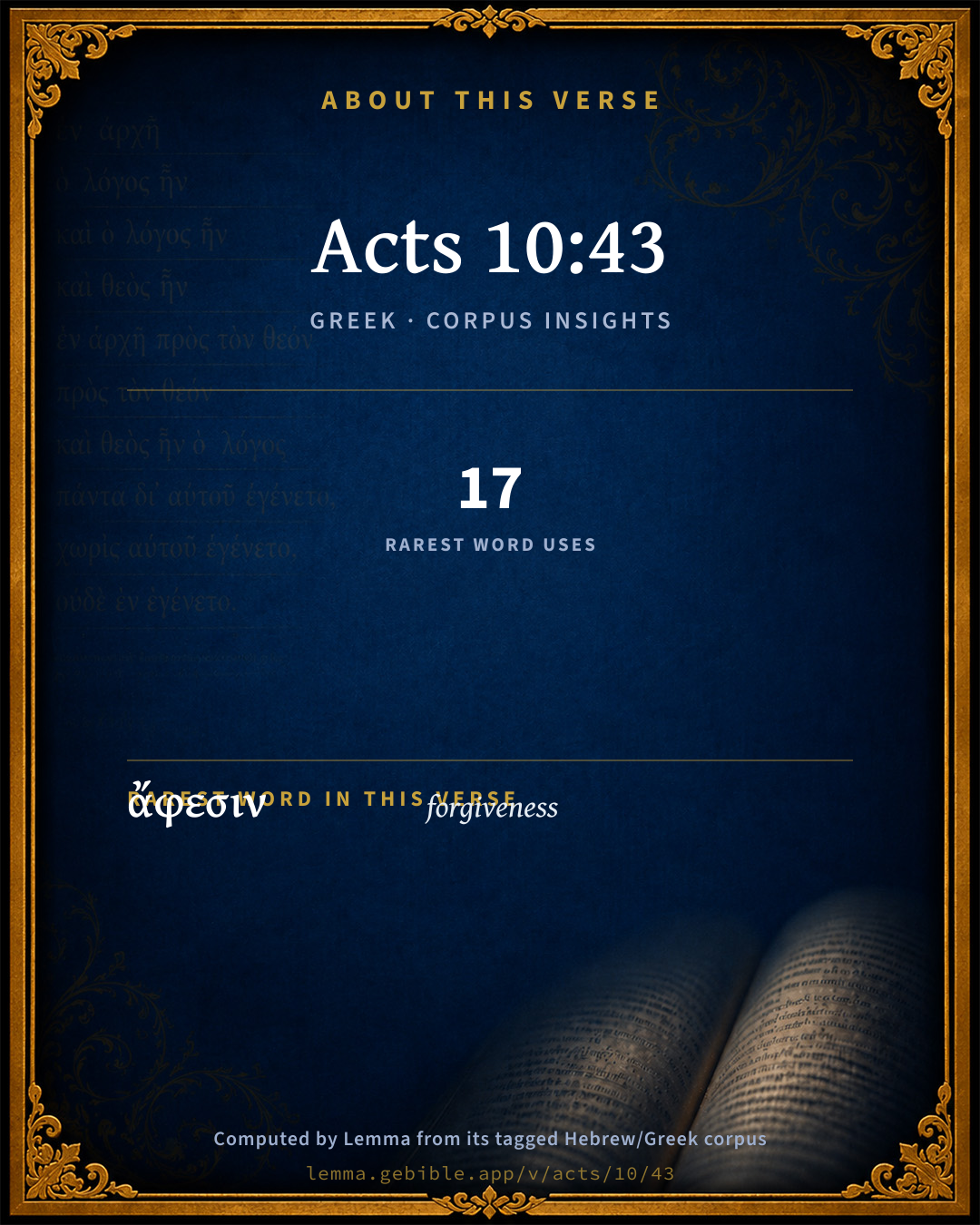
Acts 10:43

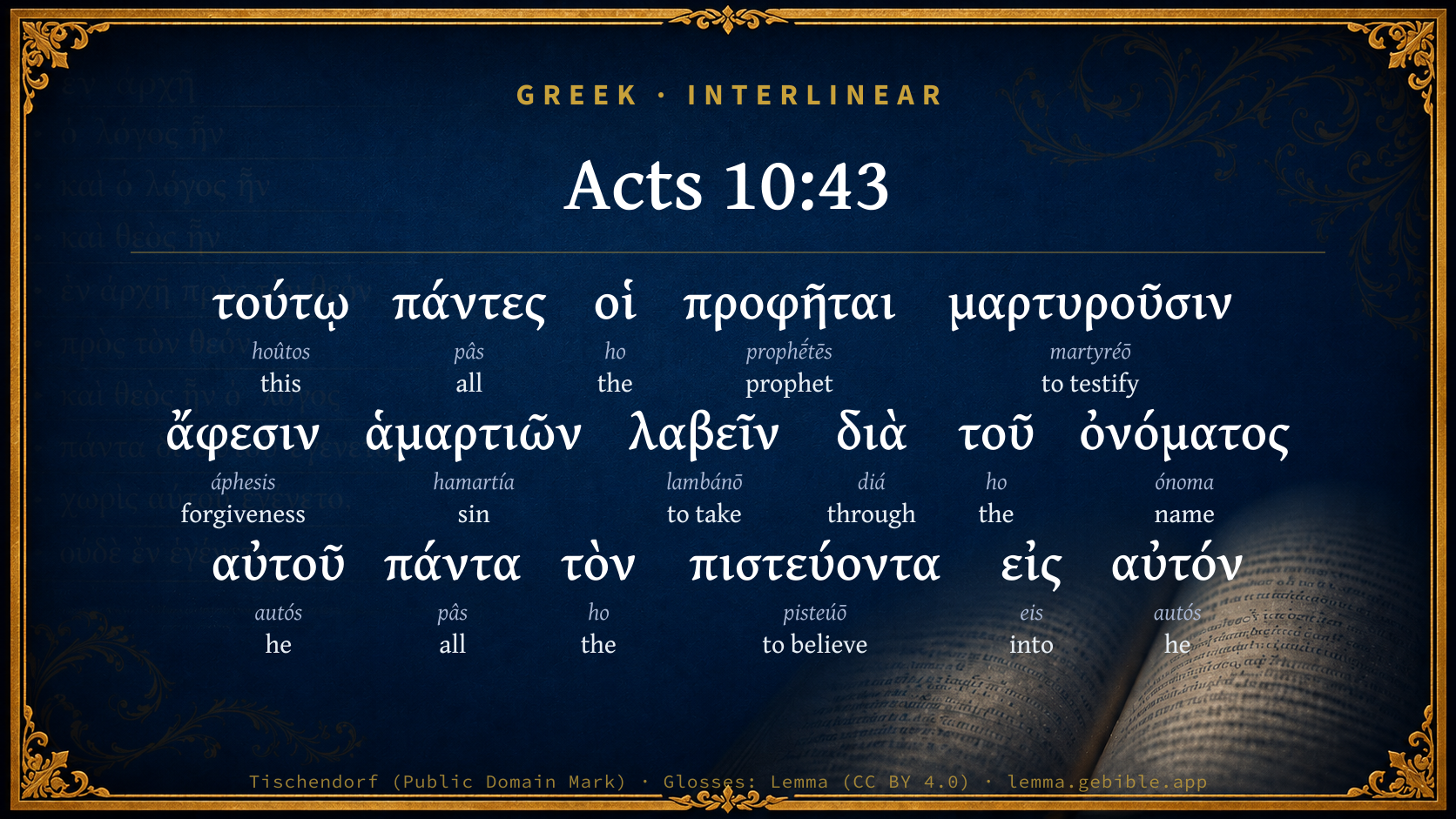
Greek (Tischendorf 8th ed.) Acts 10:43 appears in the Greek New Testament. The text above is from the Tischendorf 8th edition. Each word links to its Strong’s number and a concise gloss. Click any word for its full Thayer’s Greek Lexicon entry.
Download image
Cite this verse

Acts 10:43 (World English Bible). Public Domain. Lemma interlinear Bible study tool, https://lemma.gebible.app/v/acts/10/43.

Show BibTeX & RIS
BibTeX
RIS
English Translation
All the prophets testify about him, that through his name everyone who believes in him will receive remission of sins."
World English Bible · Public Domain
Download a study sheet

One document with this verse’s original text, its word-by-word gloss line, the meaning frame, cross-references with their text, attributed commentary, and full source and license credits — printable, and it pastes into notes with its structure intact.

This verse Autodidact and up

Study sheet (.html) Plain text (.txt)

A passage Seminary Student

Up to 50 verses in one chapter. A passage sheet keeps up to 6 commentary sources and 12 cross-references per verse, in the order this page ranks them, and says so on the sheet whenever that leaves anything out. Ask for a single verse and you get the Autodidact verse sheet above.

Everything on this page stays free to read, with no account — the sheet is a download of what is already on screen, not access to it.

Want to remove ads? Support Godless Engineer
Compare translations 3

The same verse in 3 English versions, stacked beneath the original-language interlinear above. Click any original word for its lexicon entry.

Each is an independent rendering of the whole verse — the interlinear is not word-aligned to these translations.

Highlighted words mark where these versions differ — a whole-verse word diff, not a word-by-word alignment.

  • World English Bible Public Domain
    All the prophets testify about him, that through his name everyone who believes in him will receive remission of sins."
  • King James Version Public Domain
    To him give all the prophets witness, that through his name whosoever believeth in him shall receive remission of sins.
  • unfoldingWord Literal Text CC BY-SA 4.0
    To this one all the prophets bear witness, that everyone believing in him receives forgiveness of sins through his name.”

unfoldingWord Literal Text — © unfoldingWord, licensed CC BY-SA 4.0. Word-aligned USFM3 via Door43 (git.door43.org/unfoldingWord/en_ult).

Versions to compare (up to 4)

3 of 4 selected

Show all 19 translations

Every available English version of this verse, each an independent rendering of the whole verse.

  • World English Bible Public Domain
    All the prophets testify about him, that through his name everyone who believes in him will receive remission of sins."
  • Berean Standard Bible Public Domain
    All the prophets testify about Him that everyone who believes in Him receives forgiveness of sins through His name.”
  • Majority Standard Bible Public Domain
    All the prophets testify about Him that everyone who believes in Him receives forgiveness of sins through His name.”
  • King James Version Public Domain
    To him give all the prophets witness, that through his name whosoever believeth in him shall receive remission of sins.
  • American Standard Version (1901) Public Domain
    To him bear all the prophets witness, that through his name every one that believeth on him shall receive remission of sins.
  • Revised Version (1885) Public Domain
    To him bear all the prophets witness, that through his name every one that believeth on him shall receive remission of sins.
  • Geneva Bible (1599) Public Domain
    To him also giue all the Prophets witnesse, that through his Name all that beleeue in him, shall receiue remission of sinnes.
  • Douay-Rheims (1899) Public Domain
    To him all the prophets give testimony, that by his name all receive remission of sins, who believe in him.
  • Young's Literal Translation Public Domain
    to this one do all the prophets testify, that through his name every one that is believing in him doth receive remission of sins.'
  • Literal Standard Version CC BY-SA 4.0
    to this One do all the Prophets testify, that through His Name everyone that is believing in Him receives forgiveness of sins.”
  • Unlocked Literal Bible CC BY-SA 4.0
    It is to him that all the prophets bear witness, so that everyone who believes in him shall receive forgiveness of sins through his name.”
  • unfoldingWord Literal Text CC BY-SA 4.0
    To this one all the prophets bear witness, that everyone believing in him receives forgiveness of sins through his name.”
  • Darby Bible Public Domain
    To him all the prophets bear witness that every one that believes on him will receive through his name remission of sins.
  • World Messianic Bible Public Domain
    All the prophets testify about him, that through his name everyone who believes in him will receive remission of sins.”
  • Webster's Bible Public Domain
    To him give all the prophets testimony, that through his name whoever believeth in him shall receive remission of sins.
  • Free Bible Version CC BY-SA 4.0
    He is the one all the prophets spoke about, that everyone who trusts in him will receive forgiveness through his name.”
  • Bible in Basic English Public Domain
    To him all the prophets give witness, that through his name everyone who has faith in him will have forgiveness of sins.
  • Text-Critical English NT CC BY 4.0
    All the prophets testify about him that everyone who believes in him receives remission of sins through his name.”
  • Tyndale New Testament (1534) Public Domain
    To him geve all the Prophetes witnes that thorowe his name shall receave remission of synnes all that beleve in him.

Literal Standard Version (2020), Covenant Press — licensed CC BY-SA 4.0. Text via the HelloAO Bible API (eBible.org). Unlocked Literal Bible (unfoldingWord) — licensed CC BY-SA 4.0. Text via the HelloAO Bible API (eBible.org). unfoldingWord Literal Text — © unfoldingWord, licensed CC BY-SA 4.0. Word-aligned USFM3 via Door43 (git.door43.org/unfoldingWord/en_ult). Free Bible Version, Dr. Jonathan Gallagher — licensed CC BY-SA 4.0. Text via the HelloAO Bible API (eBible.org).

Word by word

More ways to search: Search by grammar → Find every occurrence → Compare this word →

Practice this passage: Drill this verse → Learn its vocabulary →

ἄφεσιν
áphesis
G859
“forgiveness”
Noun, Accusative, Singular, Feminine
Part of Speech
Noun
Case
Accusative
Number
Singular
Gender
Feminine
Full Thayer's Definition

Origin: from G863

TDNT: 09:29,9

1. release from bondage or imprisonment 2. forgiveness or pardon, of sins (letting them go as if they had never been committed), remission of the penalty
  1. τούτῳ hoûtos G3778 “this” Demonstrative pronoun, Dative, Singular, Masculine
  2. πάντες pâs G3956 “all” Adjective, Nominative, Plural, Masculine
  3. οἱ ho G3588 “the” Article, Nominative, Plural, Masculine
  4. προφῆται prophḗtēs G4396 “prophet” Noun, Nominative, Plural, Masculine
  5. μαρτυροῦσιν martyréō G3140 “to testify” Verb, Present, Active, Indicative, 3rd person, Plural
  6. ἁμαρτιῶν hamartía G266 “sin” Noun, Genitive, Plural, Feminine
  7. λαβεῖν lambánō G2983 “to take” Verb, Aorist, Active, Infinitive
  8. διὰ diá G1223 “through” Preposition
  9. τοῦ ho G3588 “the” Article, Genitive, Singular, Neuter
  10. ὀνόματος ónoma G3686 “name” Noun, Genitive, Singular, Neuter
  11. αὐτοῦ autós G846 “he” Personal pronoun, Genitive, Singular, Masculine
  12. πάντα pâs G3956 “all” Adjective, Accusative, Singular, Masculine
  13. τὸν ho G3588 “the” Article, Accusative, Singular, Masculine
  14. πιστεύοντα pisteúō G4100 “to believe” Verb, Present, Active, Participle, Accusative, Singular, Masculine
  15. εἰς eis G1519 “into” Preposition
  16. αὐτόν autós G846 “he” Personal pronoun, Accusative, Singular, Masculine

About this verse

These counts appear in no published source. They are computed here, from the morphology-tagged text and Lemma’s own curated glosses. What Lemma adds →

17
words
13
distinct lemmas
Acts
section

Notable vocabulary

The rarest word here is ἄφεσιν forgiveness G859 — appearing just 17 times in the whole Greek New Testament.

Shared distinctive vocabulary

ἄφεσιν forgiveness G859 occurs in 16 verses of the Greek New Testament. Also found in:

Repetition

Words recur within this verse:

  • πάντες all G3956 ×2
  • οἱ the G3588 ×3
  • αὐτοῦ he G846 ×2

Cross-references

33

Topical passages linked to Acts 10:43 in the Treasury of Scripture Knowledge — connected by theme and wording, ordered by reader-vote popularity; previews shown in the World English Bible.

  • Zechariah 13:1 "In that day there will be a spring opened to the house of David and to the inhabitants of Jerusalem, for sin and for uncleanness.
  • Acts 2:38 Peter said to them, "Repent, and be baptized, everyone of you, in the name of Jesus Christ for the forgiveness of sins, and you will receive the gift of the Holy Spirit.
  • Isaiah 53:11 He shall see of the travail of his soul, [and] shall be satisfied: by the knowledge of himself shall my righteous servant justify many; and he shall bear their iniquities.
  • Jeremiah 31:34 and they shall teach no more every man his neighbor, and every man his brother, saying, Know Yahweh; for they shall all know me, from the least of them to the greatest of them, says Yahweh: for I will forgive their iniquity, and their sin will I remember no more.
  • Romans 10:11 For the Scripture says, "Whoever believes in him will not be disappointed."
  • Acts 13:38–39 Be it known to you therefore, brothers, that through this man is proclaimed to you remission of sins,
  • John 3:14–17 As Moses lifted up the serpent in the wilderness, even so must the Son of Man be lifted up,
  • 1 Peter 1:11 searching for who or what kind of time the Spirit of Christ, which was in them, pointed to, when he predicted the sufferings of Christ, and the glories that would follow them.
  • Malachi 4:2 But to you who fear my name shall the sun of righteousness arise with healing in its wings. You will go out, and leap like calves of the stall.
  • Romans 5:1 Being therefore justified by faith, we have peace with God through our Lord Jesus Christ;
  • John 5:24 "Most assuredly I tell you, he who hears my word, and believes him who sent me, has eternal life, and doesn't come into judgment, but has passed out of death into life.
  • Acts 4:10–12 be it known to you all, and to all the people of Israel, that in the name of Jesus Christ of Nazareth, whom you crucified, whom God raised from the dead, in him does this man stand here before you whole.
  • Romans 8:1 There is therefore now no condemnation to those who are in Christ Jesus, who don't walk according to the flesh, but according to the Spirit.
  • Daniel 9:24 Seventy weeks are decreed on your people and on your holy city, to finish disobedience, and to make an end of sins, and to make reconciliation for iniquity, and to bring in everlasting righteousness, and to seal up vision and prophecy, and to anoint the most holy.
  • Micah 7:18 Who is a God like you, who pardons iniquity, And passes over the disobedience of the remnant of his heritage? He doesn't retain his anger forever, Because he delights in loving kindness.
  • Mark 16:16 He who believes and is baptized will be saved; but he who disbelieves will be condemned.
  • John 20:31 but these are written, that you may believe that Jesus is the Christ, the Son of God, and that believing you may have life in his name.
  • Acts 3:16 By faith in his name has his name made this man strong, whom you see and know. Yes, the faith which is through him has given him this perfect soundness in the presence of you all.
  • Acts 15:9 He made no distinction between us and them, cleansing their hearts by faith.
  • Acts 26:18 to open their eyes, that they may turn from darkness to light and from the power of Satan to God, that they may receive remission of sins and an inheritance among those who are sanctified by faith in me.'
  • Acts 26:22 Having therefore obtained the help that is from God, I stand to this day testifying both to small and great, saying nothing but what the prophets and Moses said would happen,
  • Romans 8:34 Who is he who condemns? It is Christ who died, yes rather, who was raised from the dead, who is at the right hand of God, who also makes intercession for us.
  • Galatians 3:22 But the Scriptures shut up all things under sin, that the promise by faith in Jesus Christ might be given to those who believe.
  • Luke 24:44–46 He said to them, "This is what I told you, while I was still with you, that all things which are written in the law of Moses, the prophets, and the psalms, concerning me must be fulfilled."
  • Revelation 19:10 I fell down before his feet to worship him. He said to me, "Look! Don't do it! I am a fellow bondservant with you and with your brothers who hold the testimony of Jesus. Worship God, for the testimony of Jesus is the Spirit of Prophecy."
  • Luke 24:25–27 He said to them, "Foolish men, and slow of heart to believe in all that the prophets have spoken!
  • Romans 6:23 For the wages of sin is death, but the free gift of God is eternal life in Christ Jesus our Lord.
  • Ephesians 1:7 in whom we have our redemption through his blood, the forgiveness of our trespasses, according to the riches of his grace,
  • Colossians 1:14 in whom we have our redemption, the forgiveness of our sins;
  • Hebrews 13:20 Now may the God of peace, who brought again from the dead the great shepherd of the sheep with the blood of an eternal covenant, our Lord Jesus,
  • Acts 3:18 But the things which God announced by the mouth of all his prophets, that Christ should suffer, he thus fulfilled.
  • John 1:45 Philip found Nathanael, and said to him, "We have found him, of whom Moses in the law, and the prophets, wrote: Jesus of Nazareth, the son of Joseph."
  • John 5:39–40 "You search the Scriptures, because you think that in them you have eternal life; and these are they which testify about me.

Cross-references courtesy of OpenBible.info (CC BY 4.0).

Commentary

Notes on Acts 10:43 from classic Christian and Jewish commentators (each source and its license shown beneath its notes). The classic Christian expositions comment on the surrounding passage and are grouped to its opening verse, so a note may address several verses; the Jewish commentaries on the Tanakh (Rashi and others) are per-verse, so they appear only where the commentator wrote on this verse.

Lemma curates 59 commentaries, every one of them public domain or Creative Commons licensed, each selected and text-cleaned for this edition rather than reprinted as found. About our sources →

Joseph Benson's Commentary

Act 10:43. To him give all the prophets witness — Speaking to heathen, he does not mention the name of any one prophet in particular; but, after having spoken of Christ’s person, miracles, and resurrection, contents himself with informing them, in general terms, that there were many prophets in former ages who bore testimony to him, without entering into a particular enumeration of them, or quoting their predictions: an observation which is also applicable to that particular truth which Peter here declares the prophets, which he referred to, had attested, namely, that through his name — Through his mediation, grace, and Spirit; whosoever believeth in him — With a living faith, whether he be Jew or Gentile; shall receive remission of sins — Though he had not before either feared God or wrought righteousness. This truth it would have been easy for the apostle to have proved, from several testimonies of the prophets, (had it been proper to do so to that audience,) as will appear by comparing the passages referred to in the margin. We may further observe here, that we do not read of Peter’s working any miracle on this great occasion, in proof of the truth of his doctrine; as the preceding testimony of the angel to Cornelius, and the descent of the Holy Spirit in his miraculous gifts, while he was speaking to them, were sufficient proofs, both of the truth of the gospel, and of Peter’s being an authorized interpreter of it.

Joseph Benson's Commentary on the Old and New Testaments (1811–1818) — public domain. Text from a community e-Sword module.

Tyndale Open Study Notes

Tyndale Open Resources

10:43 Based on what they had seen and heard (10:39-42), the apostles could proclaim that Jesus of Nazareth was indeed the one all the prophets testified about. The whole plan of the Scriptures is profoundly centered in Christ (see Luke 24:25-27, 44-47; John 5:39). • The major point of their message was that everyone who believes in him will have their sins forgiven through his name (see Luke 24:47).

Tyndale Open Study Notes — © Tyndale Open Resources, licensed CC BY-SA 4.0. Text via the HelloAO Bible API.

Bengel's Gnomon

Johann Albrecht Bengel

Act 10:43. Πάντες, all) Those whose books are, as also those whose books are not extant: ch. Act 3:24.—προφῆται, the prophets) In this discourse Peter had not yet cited the testimonies of the Old Testament; and now, whilst he appeals to the prophets in general, the result is accomplished at the beginning of his discourse, ch. Act 11:15, at once, as is appropriate to the economy regarding the Gentiles, in the case of such hearers.—μαρτυροῦσιν, are witnesses) as we, Act 10:39. Peter does not use here the term, promise, as described by the prophets.—ἄφεσιν ἀμαρτιῶν, remission of sins) which is the source (head) of all benefits.—πάντα, every one) even of the Gentiles.

Bengel's Gnomon of the New Testament — English translation (T&T Clark, Edinburgh, 1860) — public domain. Text from a community e-Sword module.

Meyer's Critical & Exegetical Commentary

Heinrich August Wilhelm Meyer

Act_10:43-44. Now follows the divinely attested way of salvation unto this Judge of the living and dead.

πάντες οἱ προφ.] comp. Act_3:24.

That every one who believes on Him receives forgiveness of sins by means of His name (of the believing confession of it, by which the objectively completed redemption is subjectively appropriated, Rom_3:25; Rom_10:10, al.). The general πάντα τὸν πιστ. εἰς αὐτ., which lays down no national distinction, is very emphatically placed at the end, Rom_3:22. Thus has Peter opened the door for further announcing to his hearers the universalism of the salvation in Christ. But already the living power of his words has become the vehicle of the Holy Spirit, who falls upon all the hearers, and by His operations makes the continuation of the discourse superfluous andimpossible. Comp. on Act_11:15.

Here the unique example of the outpouring of the Spirit before baptismtreated, indeed, by Baur as unhistorical and ascribed to the set purpose influencing the authoris of itself intelligible from the frame of mind, now exalted after an extraordinary manner to the pitch of full susceptibility, in those present. The appropriate degree of receptivity was there; and so, for a special divine purpose, the πνεῦμα communicated itself according to the free will of God even before baptism.[261] Olshausen thinks that this extraordinary circumstance took place for the sake of Peter, in order to make him aware, beyond a doubt, in this first decisive instance, that the Gentiles would not be excluded from the gift of the Spirit. But Peter had this illumination already (Act_10:34 f.); and besides, this object would have been fully attained by the outpouring of the Spirit after baptism. We may add that the quite extraordinary and, in fact, unique nature of the case stands decidedly opposed to the abuse of the passage by the Baptists.[262]

[261] Liberum gratia habet ordinem, Bengel. Not the necessity, but the possibility of the bestowal of the Spirit before baptism, was implied by the susceptibility which had already emerged. The design of this extraordinary effusion of the Spirit is, according to ver. 45, to be found in this, that all scruples concerning the reception of the Gentiles were to be taken away from the Jewish-Christians who were present in addition to Peter, and thereby from the Christians generally. What Peter had just said: πάντα τὸν πιστεύοντα εἰς αὐτόν, was at once divinely affirmed and sealed by this σημεῖον in such a way that now no doubt at all could remain concerning the immediate admissibility of baptism. Chrysostom strikingly calls this event the ἀπολογίαν μεγάλην, which God had arranged beforehand for Peter. That it could not but, at the same time, form for the latter himself the divine confirmation of the revelation already imparted to him, is obvious of itself.

[262] Comp. Laufs in the Stud. u. Krit. 1858, p. 234.

Meyer — Critical and Exegetical Commentary on the New Testament — English translation by Peter Christie, edited by Frederick Crombie (T&T Clark, 1880) — public domain. Text from a community e-Sword module.

Expositor's Greek Testament

ed. W. Robertson Nicoll

Act 10:43 . πάντα τὸν πιστεύοντα , cf. Rom 10:11 , whether Jew or Gentile; the phrase emphatic at the close of the verse, cf. Rom 3:22 . There is no occasion to refer the words to a reviser in their Pauline meaning (Weiss); St. Peter in reality says nothing more than he had already said and implied, Act 2:38 , Act 3:16 ; Act 3:26 .

The Expositor's Greek Testament, edited by W. Robertson Nicoll (1897–1910) — public domain. Text from a community e-Sword module.

Jamieson, Fausset & Brown

Robert Jamieson, A. R. Fausset & David Brown

To him give all the prophets witness--that is, This is the burden, generally of the prophetic testimony. It was fitter thus to give the spirit of their testimony, than to quote them in detail on such an occasion. But let this apostolic statement of the evangelical import of the Old Testament writings be devoutly weighed by those who are disposed to rationalize away this element in the Old Testament.

whosoever believeth in him--This was evidently said with special reference to the Gentile audience then before him, and formed a noble practical conclusion to the whole discourse.

Jamieson, Fausset & Brown — Commentary Critical and Explanatory on the Whole Bible (1871) — public domain (CC PDM 1.0). Text via the HelloAO Bible API.

Adam Clarke's Commentary

Verse 43. To him give all the prophets witness] See Isa 9:6; Isa 52:7; Isa 53:5-6; Isa 59:20; Jer 31:34; Da 9:24; Mic 7:18, c. and Zec 13:1. As Jesus Christ was the sum and substance of the law and the Mosaic dispensation, so all the prophets bore testimony, either directly or indirectly, to him; and, indeed, without him and the salvation he has promised, there is scarcely any meaning in the Mosaic economy, nor in most of the allusions of the prophets.

Remission of sins.] The phrase, αφεσις αμαρτιων, means simply the taking away of sins; and this does not refer to the guilt of sin merely, but also to its power, nature, and consequences. All that is implied in pardon of sin, destruction of its tyranny, and purification from its pollution, is here intended; and it is wrong to restrict such operations of mercy to pardon alone.

Adam Clarke's Commentary on the Bible (1810–1826) — public domain. Text from a community e-Sword/MySword module.

John Calvin's Commentaries

43. To him bear all the prophets. Luke toucheth and gathereth the sum of the sermon briefly, as we have said; therefore is he so short in noting the fruit of the history. Let us know that the words uttered by Peter are not recited in this place; but that it, is only declared of what things he intreated. And we must consider three things, That it is the proper office of Christ to reconcile men to God when their sins are done away; that we have remission of sins by faith; that this doctrine is not new or of late invented, but that it had all the prophets of God since the beginning of the world to bear witness of it.

As touching the first, if God be pleased and pacified by not imputing our sins, it appeareth hereby that he hateth and is displeased with all mankind, until such time as they begin to please him by free pardon. Therefore we are all condemned of sin, which maketh us subject to the wrath of God, and bindeth us with the guiltiness of eternal death; and because we are destitute of righteousness in ourselves, we are taught to flee unto the mercy of God, as unto our only fortress. When as he saith that the faithful receive remission of sins, there is understood a hidden contrariety between them and God; for God must needs offer it of his own accord that the faithful may receive it. When as he saith that it is given by the name of Christ, his meaning is, that we return into God’s favor by the benefit of Christ alone, because he hath once reconciled him to us by his death; or, as they say commonly, that we obtain forgiveness of sins by Christ’s mediation, (and coming between,) and by none other means.

Satan could never blot out of the minds of men the feeling of their guiltiness, but that they were always careful to crave pardon at God’s hands; but forasmuch as there was but one way and means to obtain pardon, miserable men, being deluded with the jugglings [impostures] of Satan, did invent to themselves wonderful labyrinths, in whose crooks and turns they wearied themselves in vain. This first error did first lead them away from the right way, because they essayed to deserve pardon, which is offered freely, and is received by faith alone. Afterward there were innumerable kinds of satisfactions [expiations] invented whereby they appeased God. The beginning thereof flowed indeed from the Word of God; but forasmuch as when God gave unto the fathers the sacrifices and rites of oblations, he shadowed Christ, blind and profane men, setting Christ aside, and following a vain shadow, did corrupt all that which was God’s in sacrifices and satisfactions. Wherefore, what sacrifices soever the Gentiles did use since the beginning of the world, and those which the Turks and Jews use at this day, may be set against Christ as things altogether contrary. The Papists are never a whit better, save only that they sprinkle their satisfactions with the blood of Christ; but they deal too disorderly therein, because, being not content with Christ alone, they gather to themselves, on every side, a thousand manner of sacrifices or satisfactions. Therefore, whosoever desireth to have remission of sins, let him not turn aside from Christ, even the least nail’s breadth.

When as we hear, that we have remission of sins by believing, we must understand and know the force and nature of faith, as undoubtedly Peter intreated abundantly of this, [viz.] after what sort we must believe in Christ. And this is nothing else, but with the sincere affection of the mind to embrace him as he is set before us in the gospel; so that faith dependeth upon the promises. Yet Peter seemeth to deal amiss, because whereas we have two principal things by our Savior Christ, he doth only make mention of the one of them; for he speaketh nothing of repentance and newness of 1ife, which ought not to be omitted in the sum of the gospel. But we may easily answer, That the regeneration of the Spirit is comprehended under faith, as it is an effect thereof. For we believe in Christ for this cause, partly that he may restore us unto the Father’s favor by the free imputation of righteousness; partly that he may sanctify us by his Spirit, And we know that we are adopted by God to be his children upon this condition, that he may govern us by his Spirit. Therefore, it was sufficient for Peter to show how men, who were by nature estranged from God, do return into favor with him.

As touching the third member, we need not reckon up all places of the prophets, where they set before us Christ to be the mediator, who by obtaining pardon for our sins, doth reconcile God to us; but this is their common order of teaching, and, as it were, their rule, to call back all the godly unto that covenant which God made with Abraham putting the mediator between. Furthermore, this point is very needful to be known, that the grace which was offered at length by Christ is the same which the law and the prophets, in times past, delivered unto the fathers to be hoped for. And surely it was of great force with Cornelius and such like, who did greatly reverence the law and prophets, that they might know that that was performed and accomplished in very deed in Christ which was testified in the oracles of the prophets. Therefore, to the end the ministers of the Church may agree with the prophets in their form of teaching, let them study by preaching to set forth Christ; let them continually testify that we must seek righteousness at his hands alone, which consisteth upon [of] free remission of sins. This is another manner of antiquity than that which is showed with great boasting of the Papists, whilst that they thrust in the rotten inventions of their satisfactions into the place of Christ’s blood.

John Calvin's Commentaries (1540-1563) — public domain. Text from the Calvin Translation Society English edition (1840s-50s) via the Christian Classics Ethereal Library (ccel.org). Calvin's coverage is partial (roughly two-thirds of the Bible); uncommented books and verses are honest gaps, never fabricated. The 19th-century editor's footnotes and remarks are omitted so the notes are faithfully Calvin's own voice.

Ellicott's Commentary for English Readers

(43) To him give all the prophets witness.—As in St. Peter’s earlier speeches in Acts 2, 3 so here, we trace the result of our Lord’s teaching given in the interval between the Resurrection and Ascension as to the method of prophetic interpretation which discerns, below all temporary and historical references, the under-current of testimony to the kingdom of which Christ was the Head.

That through his name. . . .—We can without difficulty represent to ourselves the impression which these words must have made on the anxious listeners. This was the answer to their doubts and perplexities. Not by submitting themselves to the bondage of the Law, not by circumcision and all that it implied, but by the simple act of faith in Christ, and in the power of His Name, i.e., of all the attributes and energies of which the Name was the symbol, they, Gentiles as they were, might receive that remission of sins which conscience, now roused to its full activity, taught them was the indispensable condition of acceptance and of peace. The intensity of that emotion, the satisfaction of all their previous yearnings, placed them subjectively in a spiritual condition which prepared the way for the wonder which the next verse narrates.

A Bible Commentary for English Readers, edited by Charles John Ellicott (1878–1897) — public domain. Text from a community e-Sword module.

The Cambridge Bible for Schools and Colleges

gen. ed. J. J. S. Perowne

43. To him give all the prophets witness] Cp. Isa_49:6, “I will also give thee for a light to the Gentiles that thou mayest be my salvation unto the end of the earth.” Also Joe_2:32, “Whosoever shall call on the name of the Lord shall be delivered.” So that under the Law the redemption of the Gentiles was seen afar off. The way in which St Peter uses the Jewish Scriptures to enforce his arguments is an evidence that Cornelius and his household were familiar with those writings.

The Cambridge Bible for Schools and Colleges (gen. ed. J. J. S. Perowne; Cambridge University Press, 1878–1918) — public domain. Text from a community e-Sword module.

John Gill's Exposition

To him give all the prophets witness,.... As David, Psa 32:1 Dan 9:9

that through his name, whosoever believeth in him, shall receive the remission of sins; the meaning is, that whoever believes in Christ with a right and true faith, with the heart, he shall receive, not as what his faith procures or deserves, but as a gift of God's grace, the free and full forgiveness of his sins, through Christ; through the effusion of his blood, and the virtue of his sacrifice. Christ was set forth in the purposes of God, in the types, figures, and sacrifices of the law, and in the promises and prophecies of the Old Testament, as he that should obtain the remission of sins by his blood, without which there is no remission; he came in the fulness of time, and shed his blood for this purpose, and accordingly it is procured by it; and this is published in the everlasting Gospel, that whoever believes in Christ, not with an historical or temporary faith, or in profession only, but with the faith of God's elect, which is the gift of God, and the operation of his Spirit, which works by love, and makes Christ precious, shall receive it as a free gift; for it is not to be purchased by money, nor obtained by works of righteousness, nor procured by repentance, or by anything done by the creature, but is according to the riches of divine grace and mercy: through the name of Christ: through the blood of Christ, which was shed for it; through the power of Christ, as God, who is able to forgive it; and through the hands of Christ, as Mediator, who is exalted to bestow it; and for the sake of Christ, and his mediation, whose blood calls aloud for it; and whoever looks by faith to him for it, shall have it, of whatsoever sex, state, or condition they be, of whatsoever people or nation, and how great sinners soever they have been, and whether they are weak or strong believers. Some copies read, "through his blood".

John Gill's Exposition of the Whole Bible (1746–1763) — public domain (CC PDM 1.0). Text via the HelloAO Bible API.

Trapp's Complete Commentary

John Trapp

43 To him give all the prophets witness, that through his name whosoever believeth in him shall receive remission of sins.

Ver. 43. Shall receive remission of sins] Together with all the purchase of his passion. But this is instanced as a principal piece thereof, and worthily. David had a crown of pure gold upon his head, Psa 21:3, but he blesseth God for a better crown, Psa 103:3-4, viz. pardon of sin.

John Trapp, A Commentary or Exposition upon All the Books of the Old and New Testament (1647–1656) — public domain. Text from a community e-Sword module.

Albert Barnes' Notes on the Bible

To him give ... - See the notes on Luk 24:27, Luk 24:44.

That through his name ... - This was implied in what the prophets said. See Rom 10:11. It was not, indeed, expressly affirmed that they who believed in him should be pardoned, but this was implied in what they said. They promised a Messiah, and their religion consisted mainly in believing in a Messiah to come. See the reasoning of the apostle Paul in Rom. 4:

Albert Barnes' Notes on the Bible (1834–1885) — public domain. Text from a community e-Sword/MySword module.

Matthew Poole's English Annotations

This our Saviour had told his apostles, which St. Peter here preaches to his auditors. It was included in the very first promise recorded by Moses, Gen 3:15, The seed of the woman shall break the serpent’s head; and so continued through all ages of the church, to be manifest in such degrees as it pleased the wisdom of God to make it known: it is certain that all the ceremonial law concerning sacrifices did testify this very thing; for by it, it did appear, that without shedding of blood there was no remission of sin, as Heb 9:22; and it is manifest by the light of nature, that the blood of bulls and goats could not take away sins, as Heb 10:4.

But through Christ’s name, for his sake, and by virtue of his merit, who died for our sins, and rose again for our justification, Rom 4:25, we shall receive remission of sins, Heb 9:13,14.

Matthew Poole's English Annotations on the Holy Bible (1683–1685) — public domain. Text from a community e-Sword/MySword module.

Whedon's Commentary on the Bible

Daniel D. Whedon

43. To him—The last verse touches the preaching of Christ in his judicial character; this in his redeeming office.

All the prophets—Not each one individually, but the whole in sum.

Whosoever—Whether Jews, like these men of Joppa, or Gentiles, like these of Cesarea.

Remission of sins—The dismissal of sins in their condemning power, forgiveness.

Daniel D. Whedon (gen. ed.), Commentary on the Old and New Testaments (1874–1909) — public domain. Text from a community e-Sword module.

The Pulpit Commentary

Bear for give, A.V.; every one that for whosoever, A.V.; on him for in him, A.V. Here we have another article of the Creed, the forgiveness of sins, preached too in immediate anticipation of baptism, on the profession of faith in Jesus Christ (ver. 48). Comp. Act_8:37 (T.R.) and 38.

Faith directed to its highest object.

him give all the prophets witness," etc. Peter"s climax. He led his hearers up the ascent of faith, and bid them see Jesus on the height, above all, summing up all in himself, before all eyes, testified to by all witnesses from the beginning.

I THE TWO TESTIMONIES here set forth the witness of the written Word, the witness of the unwritten work of the Spirit in the heart.

1. The union of these the ground of a sinner"s confidence. Faith lays hold of the object.

2. The world is invited to examine these two witnesses for Christ. The Bible, as the Book of the prophets, stands not alone. God writes a Bible in his Church, in great examples of his Spirit"s work; in the consciences of men. We must appeal to both. Review the course of revelation side by side with the facts of spiritual history. Great revivals accompanied by great openings of the Word.

II THE WORLD-WIDE BLESSEDNESS.

1. Remission of sins the foundation on which all spiritual, moral, and physical change must be built up. No compromise with a lower doctrine. The promise of the Spirit is to faith. The kingdom proclaimed is not man"s kingdom, but God"s.

2. The Name of Jesus is the center of all religious reformation. Apostolic successes were due to the unflinching steadfastness of the ambassadors.

3. Connect the conclusion of Peter"s sermon with the preceding testimony. Faith is acceptance, not of any Christ, but of the Christ to whom all the prophets witnessed. Practical religion is based upon intelligent understanding of the object of faith. It is obedience to the truth. R.

The Pulpit Commentary (1880–1919), ed. H.D.M. Spence-Jones & Joseph S. Exell — public domain. Text from a community e-Sword module.

John Wesley's Explanatory Notes

To him give all the prophets witness - Speaking to heathens he does not quote any in particular; that every one who believeth in him - Whether he be Jew or Gentile; receiveth remission of sins - Though he had not before either feared God, or worked righteousness.

John Wesley, Explanatory Notes Upon the Whole Bible (1754–1765) — public domain. Text via the GEBible commentary corpus.

Scofield Reference Notes

C. I. Scofield

sins

Sin. (See Scofield "Rom 3:23").

The Scofield Reference Bible (1917 edition), notes by C. I. Scofield — public domain. Text from a community e-Sword module.

McGarvey & Pendleton's Commentaries

J. W. McGarvey

Seen notes on verse 42

J. W. McGarvey (with Philip Y. Pendleton), Commentaries on the New Testament (The Fourfold Gospel, 1914; Acts; and the epistles) — public domain. Text from a community e-Sword/MySword module.

The People's New Testament

B. W. Johnson

43. To him give all the prophets witness. By their testimony of the Christ, which is so prominent a feature of prophecy. See Isa. 53:11; 55:1–3; Joel 2:32. That through his name, etc. Three important facts are stated: (1) that remission of sins is in the name of Christ; (2) that it is only granted on condition of belief upon him; that is, trust in his name; (3) that whosoever believes thus, Jew or Gentile, shall receive remission of sins.

B. W. Johnson's The People's New Testament with Notes (1889–1891) — public domain. Electronic text from the Christian Classics Ethereal Library (CCEL) ThML edition.

Cambridge Greek Testament for Schools and Colleges

43. τούτῳ πάντες οἱ προφῆται μαρτυροῦσιν, to Him give all the prophets witness. Cornelius and his friends could be referred to the prophets, for though not Jews, they were students and followers of Jehovah’s law. The prophetic words to which allusion is specially made are such as Jer 31:34 ‘They shall all know Me, from the least of them unto the greatest of them.’ Also Joe 2:32 ‘Whosoever shall call on the name of the Lord shall be delivered.’ So that under the Law the redemption of the Gentiles was seen afar off.

πάντα τὸν πιστεύοντα, every one that believeth. So that not circumcision but faith was now the key to the Kingdom of Heaven.

Cambridge Greek Testament for Schools and Colleges (Cambridge University Press, 1896; 21 vols, various authors incl. Carr, Maclear, Plummer, Farrar, Lumby, Moule, M. R. James, Simcox) — public domain. Text from a community e-Sword module.

Alford’s Greek Testament

Henry Alford

43. πάντες οἱ προφ.] All the prophets, generically: not that every one positively asserted this, but that the whole bulk of prophetic testimony announced it. To press such expressions to literal exactness is mere trifling. See ch. 3:21, 24.

ἄφ. ἁμ. λαβ. κ.τ.λ.] The legal sacrifices, as well as the declarations of the prophets, all pointed to the remission of sins by faith in Him. And the universality of this proclamation, πάντα τὸν πιστ., is set forth by the prophets in many places, and was recognized even by the Jews themselves, in their expositions of Scripture, though not in their practice.

Henry Alford, The Greek Testament (1849–1861) — public domain. Text from a community e-Sword module.

Vincent's Word Studies in the New Testament

Marvin R. Vincent

His name. As in the Lord 's prayer : not simply the title, but all that is embraced and expressed by the name : Christ 's "entire perfection, as the object revealed to the believer for his apprehension, confession, and worship" (Meyer).

Marvin R. Vincent, Word Studies in the New Testament (1887–1900) — public domain. Text from a community e-Sword/MySword module.

Lesson kit

Teaching starters — assembled from the data on this page, not authored interpretation. Every prompt links to the verse data it draws on. Edit before teaching.

Acts, in the Acts, opens this verse with 17 words (13 distinct Greek lemmas). Its most distinctive word is áphesis (“forgiveness”). A historical commentator’s framing appears above. Read the whole chapter for the surrounding context.

Discussion questions

  1. What does “forgiveness” (áphesis) contribute to the verse as a whole?
  2. How does Matthew 26:28, which shares the word «forgiveness», read alongside this verse?
  3. What does the repetition of “all” (2× in this one verse) do in this verse?
  4. These translations render this verse differently. What is at stake in choosing one wording over another?
  5. Compare how Joseph Benson's Commentary and Tyndale Open Study Notes read this verse. Where do they agree or differ?

Things to notice

Reading settings

Reading text

Shown beneath each verse's original-language words.

Old Testament
Old Testament edition

Read the OT as the Masoretic Hebrew (MT) or the Greek Septuagint (LXX).

English shown for the Greek Septuagint (in the Hebrew ↔ Greek comparison).

Comparing translations? Open the Compare panel on any verse page to stack up to four side by side.