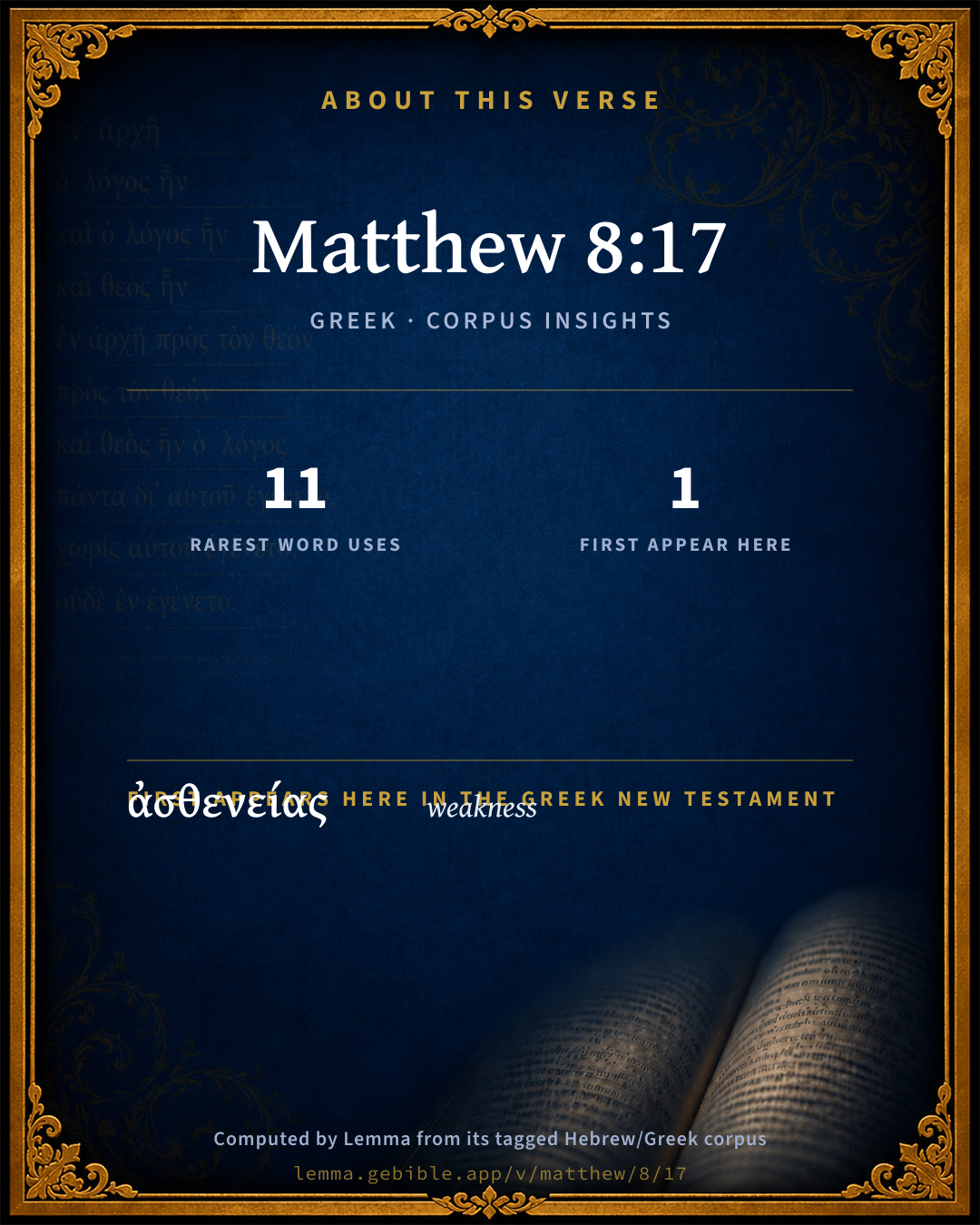
Matthew 8:17

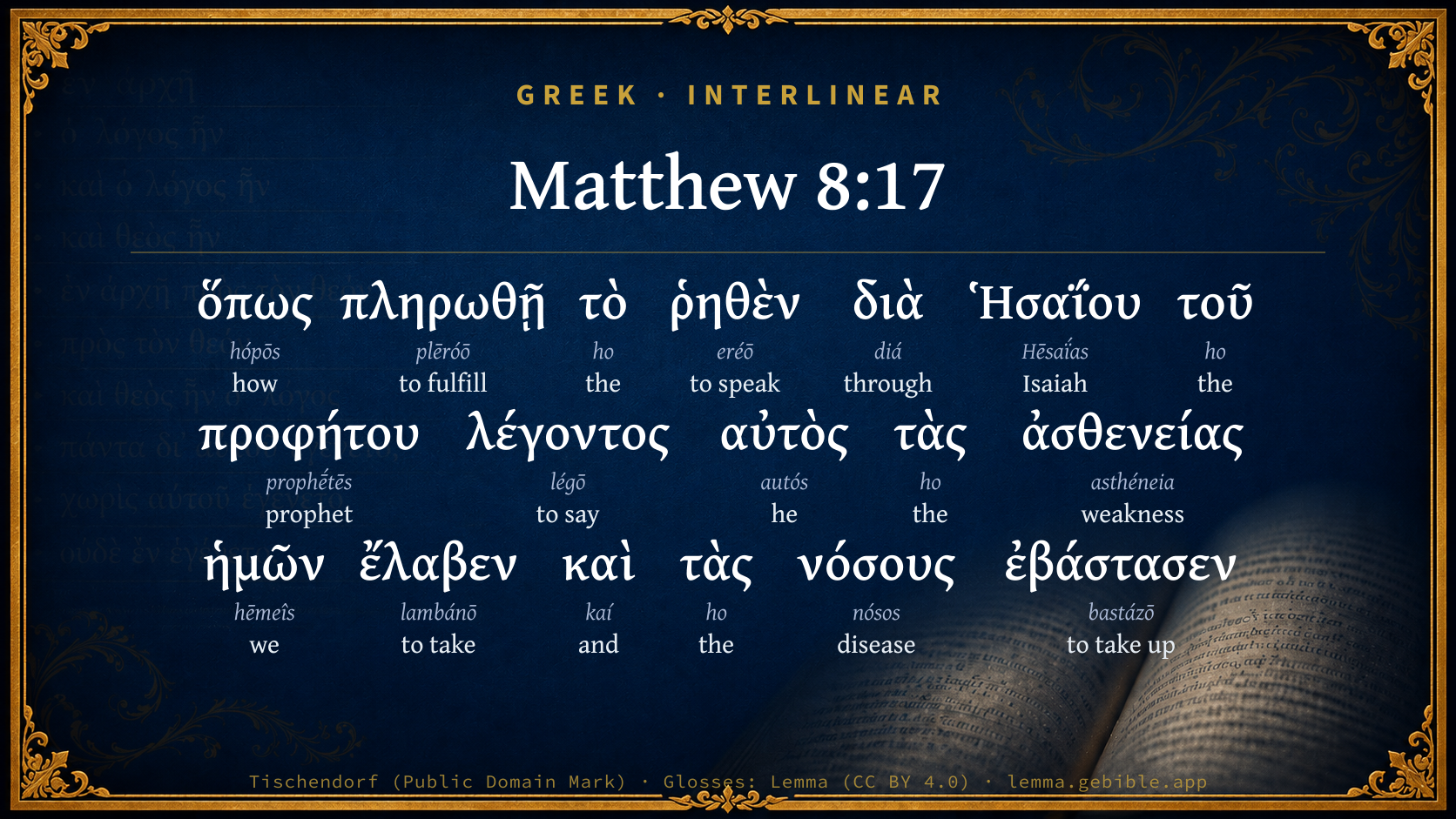
Greek (Tischendorf 8th ed.) Matthew 8:17 appears in the Greek New Testament. The text above is from the Tischendorf 8th edition. Each word links to its Strong’s number and a concise gloss. Click any word for its full Thayer’s Greek Lexicon entry.
Download image
Cite this verse

Matthew 8:17 (World English Bible). Public Domain. Lemma interlinear Bible study tool, https://lemma.gebible.app/v/matthew/8/17.

Show BibTeX & RIS
BibTeX
RIS
English Translation
that it might be fulfilled which was spoken through Isaiah the prophet, saying: "He took our infirmities, and bore our diseases."
World English Bible · Public Domain
Highlights
  • 1 first appearance in the Greek New Testament
Full analysis ↓
Download a study sheet

One document with this verse’s original text, its word-by-word gloss line, the meaning frame, cross-references with their text, attributed commentary, and full source and license credits — printable, and it pastes into notes with its structure intact.

This verse Autodidact and up

Study sheet (.html) Plain text (.txt)

A passage Seminary Student

Up to 50 verses in one chapter. A passage sheet keeps up to 6 commentary sources and 12 cross-references per verse, in the order this page ranks them, and says so on the sheet whenever that leaves anything out. Ask for a single verse and you get the Autodidact verse sheet above.

Everything on this page stays free to read, with no account — the sheet is a download of what is already on screen, not access to it.

Want to remove ads? Support Godless Engineer
Compare translations 3

The same verse in 3 English versions, stacked beneath the original-language interlinear above. Click any original word for its lexicon entry.

Each is an independent rendering of the whole verse — the interlinear is not word-aligned to these translations.

Highlighted words mark where these versions differ — a whole-verse word diff, not a word-by-word alignment.

  • World English Bible Public Domain
    that it might be fulfilled which was spoken through Isaiah the prophet, saying: "He took our infirmities, and bore our diseases."
  • King James Version Public Domain
    That it might be fulfilled which was spoken by Esaias the prophet, saying, Himself took our infirmities, and bare our sicknesses.
  • unfoldingWord Literal Text CC BY-SA 4.0
    so that might be fulfilled that which had been spoken by Isaiah the prophet, saying, “He himself took our sicknesses and bore our diseases.”

unfoldingWord Literal Text — © unfoldingWord, licensed CC BY-SA 4.0. Word-aligned USFM3 via Door43 (git.door43.org/unfoldingWord/en_ult).

Versions to compare (up to 4)

3 of 4 selected

Show all 19 translations

Every available English version of this verse, each an independent rendering of the whole verse.

  • World English Bible Public Domain
    that it might be fulfilled which was spoken through Isaiah the prophet, saying: "He took our infirmities, and bore our diseases."
  • Berean Standard Bible Public Domain
    This was to fulfill what was spoken through the prophet Isaiah: “He took on our infirmities and carried our diseases.”
  • Majority Standard Bible Public Domain
    This was to fulfill what was spoken through the prophet Isaiah: “He took up our infirmities and carried our diseases.”
  • King James Version Public Domain
    That it might be fulfilled which was spoken by Esaias the prophet, saying, Himself took our infirmities, and bare our sicknesses.
  • American Standard Version (1901) Public Domain
    that it might be fulfilled which was spoken through Isaiah the prophet, saying: Himself took our infirmities, and bare our diseases.
  • Revised Version (1885) Public Domain
    that it might be fulfilled which was spoken by Isaiah the prophet, saying, Himself took our infirmities, and bare our diseases.
  • Geneva Bible (1599) Public Domain
    That it might be fulfilled, which was spoken by Esaias the Prophet, saying, He tooke our infirmities, and bare our sickenesses.
  • Douay-Rheims (1899) Public Domain
    That it might be fulfilled, which was spoken by the prophet Isaias, saying: He took our infirmities, and bore our diseases.
  • Young's Literal Translation Public Domain
    that it might be fulfilled that was spoken through Isaiah the prophet, saying, `Himself took our infirmities, and the sicknesses he did bear.'
  • Literal Standard Version CC BY-SA 4.0
    that it might be fulfilled that was spoken through Isaiah the prophet, saying, “He took our sicknesses Himself, and bore the diseases.”
  • Unlocked Literal Bible CC BY-SA 4.0
    In this way was fulfilled that which had been spoken by Isaiah the prophet, saying, “He himself took our sickness and bore our diseases.”
  • unfoldingWord Literal Text CC BY-SA 4.0
    so that might be fulfilled that which had been spoken by Isaiah the prophet, saying, “He himself took our sicknesses and bore our diseases.”
  • Darby Bible Public Domain
    so that that should be fulfilled which was spoken through Esaias the prophet, saying, Himself took our infirmities and bore our diseases.
  • World Messianic Bible Public Domain
    that it might be fulfilled which was spoken through Isaiah the prophet, saying, “He took our infirmities and bore our diseases.”
  • Webster's Bible Public Domain
    That it might be fulfilled which was spoken by Isaiah the prophet, saying, He himself took our infirmities, and bore our sicknesses.
  • Free Bible Version CC BY-SA 4.0
    This fulfilled what the prophet Isaiah said: “He healed our diseases, and freed us from our illnesses.”
  • Bible in Basic English Public Domain
    So that the word of Isaiah the prophet might come true: He himself took our pains and our diseases.
  • Text-Critical English NT CC BY 4.0
    This was to fulfill what had been spoken by the prophet Isaiah: “He took our infirmities and bore our diseases.”
  • Tyndale New Testament (1534) Public Domain
    to fulfill that which was spoke by Esayas the Prophet sayinge. He toke on him oure infirmities and bare oure sickneses

Literal Standard Version (2020), Covenant Press — licensed CC BY-SA 4.0. Text via the HelloAO Bible API (eBible.org). Unlocked Literal Bible (unfoldingWord) — licensed CC BY-SA 4.0. Text via the HelloAO Bible API (eBible.org). unfoldingWord Literal Text — © unfoldingWord, licensed CC BY-SA 4.0. Word-aligned USFM3 via Door43 (git.door43.org/unfoldingWord/en_ult). Free Bible Version, Dr. Jonathan Gallagher — licensed CC BY-SA 4.0. Text via the HelloAO Bible API (eBible.org).

Word by word

More ways to search: Search by grammar → Find every occurrence → Compare this word →

Practice this passage: Drill this verse → Learn its vocabulary →

νόσους
nósos
G3554
“disease”
Noun, Accusative, Plural, Feminine
Part of Speech
Noun
Case
Accusative
Number
Plural
Gender
Feminine
Full Thayer's Definition

Origin: of uncertain affinity

TDNT: 22:11,7

1. disease, sickness
  1. ὅπως hópōs G3704 “how” Adverb
  2. πληρωθῇ plēróō G4137 “to fulfill” Verb, Aorist, Passive, Subjunctive, 3rd person, Singular
  3. τὸ ho G3588 “the” Article, Nominative, Singular, Neuter
  4. ῥηθὲν eréō G2046 “to speak” Verb, Aorist, Passive, Participle, Nominative, Singular, Neuter
  5. διὰ diá G1223 “through” Preposition
  6. Ἡσαΐου Hēsaḯas G2268 “Isaiah” Noun, Genitive, Singular, Masculine
  7. τοῦ ho G3588 “the” Article, Genitive, Singular, Masculine
  8. προφήτου prophḗtēs G4396 “prophet” Noun, Genitive, Singular, Masculine
  9. λέγοντος légō G3004 “to say” Verb, Present, Active, Participle, Genitive, Singular, Masculine
  10. αὐτὸς autós G846 “he” Personal pronoun, Nominative, Singular, Masculine
  11. τὰς ho G3588 “the” Article, Accusative, Plural, Feminine
  12. ἀσθενείας asthéneia G769 “weakness” Noun, Accusative, Plural, Feminine
  13. ἡμῶν hēmeîs G2249 “we” Personal pronoun, 1st person, Genitive, Plural
  14. ἔλαβεν lambánō G2983 “to take” Verb, Aorist, Active, Indicative, 3rd person, Singular
  15. καὶ kaí G2532 “and” Conjunction
  16. τὰς ho G3588 “the” Article, Accusative, Plural, Feminine
  17. ἐβάστασεν bastázō G941 “to take up” Verb, Aorist, Active, Indicative, 3rd person, Singular

About this verse

These counts appear in no published source. They are computed here, from the morphology-tagged text and Lemma’s own curated glosses. What Lemma adds →

18
words
15
distinct lemmas
Gospels
section

Notable vocabulary

The rarest word here is νόσους disease G3554 — appearing just 11 times in the whole Greek New Testament.

First appearance in Scripture

This word makes its first canonical appearance in the Greek New Testament here:

  • ἀσθενείας weakness G769

Shared distinctive vocabulary

νόσους disease G3554 occurs in 11 verses of the Greek New Testament. Also found in:

Repetition

A word recurs within this verse:

Cross-references

3

Topical passages linked to Matthew 8:17 in the Treasury of Scripture Knowledge — connected by theme and wording, ordered by reader-vote popularity; previews shown in the World English Bible.

  • Isaiah 53:4 Surely he has borne our sickness, and carried our suffering; yet we considered him plagued, struck by God, and afflicted.
  • 1 Peter 2:24 who his own self bore our sins in his body on the tree, that we, having died to sins, might live to righteousness; by whose stripes you were healed.
  • Matthew 1:22 Now all this has happened, that it might be fulfilled which was spoken by the Lord through the prophet, saying,

Cross-references courtesy of OpenBible.info (CC BY 4.0).

Commentary

Notes on Matthew 8:17 from classic Christian and Jewish commentators (each source and its license shown beneath its notes). The classic Christian expositions comment on the surrounding passage and are grouped to its opening verse, so a note may address several verses; the Jewish commentaries on the Tanakh (Rashi and others) are per-verse, so they appear only where the commentator wrote on this verse.

Lemma curates 59 commentaries, every one of them public domain or Creative Commons licensed, each selected and text-cleaned for this edition rather than reprinted as found. About our sources →

The Biblical Illustrator

Joseph S. Exell

Mat_8:17

Himself took our infirmities.

The preciousness of Christs sympathy with our infirmities

Our Lords union with our nature was actual and personal, etc. In this point of light, the truth of Christs sympathy with our infirmities presents itself with an actuality and vividness the most realizing and personal. The proper discussion of our subject suggests the consideration of;

I. The infirmities which appertain to our humanity. Physical-as the consequence of sin, and not in themselves sinful: New Testament illustrations. May become occasions of sin. But Christs sympathy extends to all the infirmities to which His people are subject-the inbeing of sin; constitutional infirmities-varied; sufferings and persecutions, provocations, trials and temptations; proneness to look to the dark providences of God, rather than to His power, faithfulness to live in the providence, etc.

II. Our Lords personal participation in those infirmities. It was a personal act; by His assumption of our humanity; by taking upon Him our sins.

III. The preciousness of His sympathy with the varied infirmities of His people. Fitted to sympathize-touched, etc. Let us be patient and sympathizing towards the infirmities of our fellow Christians. (Dr. O. Winslow.)

Christs identity and sympathy with His people

I. The completeness of Christs identity with his people.

1. Our true nature.

2. In its entirety.

3. In our trials.

II. The closeness of his sympathy. Identity is the source of sympathy. Christ had sympathy with His followers. (H. Stowell, M. A.)

The sympathy of Jesus

The miracles which Christ had wrought.

I. A revelation of Christ-of the sympathetic heart of Jesus. The working of healing miracles not with Jesus a matter of calculation, rather the spontaneous forth-putting of endowment, in response to need; a revelation of the grace in Himself. They show His love even more than His power.

II. A prophecy of better days for the world. They are signs that disease does not belong to the true order of nature; a prophecy that the true order shall be restored.

III. An inspiration to all who honour the name of Christ and cherish the spirit of Christ. We cannot do as Christ did; but we may adopt His aim, and work for it according to our ability. (A. A. Bruce, D. D.)

The Biblical Illustrator, edited by Joseph S. Exell (c. 1880s–1900s) — public domain. Text from a community e-Sword module.

Tyndale Open Study Notes

Tyndale Open Resources

8:17 He took our sicknesses and removed our diseases: When he took the sins of humanity, the Messiah also took our sickness. Sickness exists because sin is in the world, and one of the effects of Jesus’ taking our sin on the cross is physical healing (1 Pet 2:24). Jesus’ healings and exorcisms demonstrated, in fulfillment of Scripture, that he is the Messiah (see Matt 11:2-6; 12:28; 1 Cor 11:29-30; Jas 5:13-16).

Tyndale Open Study Notes — © Tyndale Open Resources, licensed CC BY-SA 4.0. Text via the HelloAO Bible API.

Bengel's Gnomon

Johann Albrecht Bengel

Mat 8:17. Ὅπως πληρωθῇ, that it might be fulfilled) It behoved that the Physician of the soul should also remove bodily complaints from those who came in His way.[376] In this manner also, therefore, was fulfilled the prophecy of Isaiah. Body and soul together form one man: the corrupting principle of both soul and body is one [namely sin]; one and the same aid was given to both by this great Physician, as the case required.—ἔλαβε, took) i.e. removed from us.

[376] And of whom the extraordinary numbers are from time to time noticed, Mat 4:23; Mat 9:35-36 (Luk 4:21), Mat 12:15, Mat 15:30, Mat 21:14.—Harm, p. 259.

Bengel's Gnomon of the New Testament — English translation (T&T Clark, Edinburgh, 1860) — public domain. Text from a community e-Sword module.

Meyer's Critical & Exegetical Commentary

Heinrich August Wilhelm Meyer

Mat_8:17. This expelling of demons and healing of diseases were intended, in pursuance of the divine purposes, to be a fulfilment of the prediction in Isa_53:4. Observe that this prophecy is fulfilled by Jesus in another sense also, viz. by His atoning death (Joh_1:29; 1Pe_2:24).

The passage is quoted from the original (Hebrew) text, but not according to the historical meaning of that original, which would involve the necessity of representing the Messiah, in the present instance, as the atoning sin-bearer (see Kleinert in d. Stud. u. Krit. 1862, p. 723 f.), which, however, is not suited to the connectionbut rather according to that special typical reference, which also seems to have been contemplated by that prediction when read in the light of the acts of healing performed by Jesus. At the same time, λαμβάνειν and βαστάζειν must not be taken in a sense contrary to that of נָשָׁא and סָבַל, to take away, to remove (de Wette, Bleek, Grimm); but when their ailments are taken away from the diseased, the marvellous compassionate one who does this stands forth as he who carries them away, and, as it were, bears the burden lifted from the shoulders of others. The idea is plastic, poetical, and not to be understood as meaning an actual personal feeling of the diseases thus removed.

Meyer — Critical and Exegetical Commentary on the New Testament — English translation by Peter Christie, edited by Frederick Crombie (T&T Clark, 1880) — public domain. Text from a community e-Sword module.

Expositor's Greek Testament

ed. W. Robertson Nicoll

Mat 8:17 . rophetic citation, apposite, felicitous; setting Christ’s healing ministry in a true light; giving prominence not to the thaumaturgic but to the sympathetic aspect; from the Hebrew original, the Sept [53] making the text (Isa 53:4 ) refer to sin. The Hebrew refers to sicknesses and pains. It is useless to discuss the precise meaning of ἔλαβεν and ἐβάστασεν : took and bore, or took and bore away ; subjective or objective? The evangelist would note, not merely that Jesus actually did remove diseases, but that He was minded to do so: such was His bent.

[53] Septuagint.

The Expositor's Greek Testament, edited by W. Robertson Nicoll (1897–1910) — public domain. Text from a community e-Sword module.

Adam Clarke's Commentary

Verse 17. Himself took our infirmities] The quotation is taken from Isa 53:4, where the verb nasa signifies to bear sin, so as to make atonement for it. And the rabbins understand this place to speak of the sufferings of the Messiah for the sins of Israel; and say that all the diseases, all the griefs, and all the punishments due to Israel shall be borne by him. See Synopsis Sohar. Christ fulfils the prophecies in all respects, and is himself the completion and truth of them, as being the lamb and victim of God, which, bears and takes away the sin of the world. The text in Isaiah refers properly to the taking away of sin; and this in the evangelist, to the removal of corporeal afflictions: but, as the diseases of the body are the emblems of the sin of the soul, Matthew, referring to the prediction of the prophet, considered the miraculous healing of the body as an emblem of the soul's salvation by Christ Jesus.

Adam Clarke's Commentary on the Bible (1810–1826) — public domain. Text from a community e-Sword/MySword module.

Ellicott's Commentary for English Readers

(17) Himself took our infirmities.—The citation is interesting as showing St. Matthew’s way of dealing with Messianic prophecies. We see in Isaiah 53 throughout a picture of our Lord’s spiritual work of redemption, and the words quoted are almost the cardinal text for the special view of the atonement, which sees in the sufferings of Christ the freely accepted penalty that was due for the transgressions of mankind. The Evangelist, with the memory of that evening present to his mind, saw them fulfilled in this removal of the “infirmities” and “sicknesses” that oppressed the bodies of men. It was not merely that He came, as one of boundless wealth, who might scatter alms broadcast, but that He Himself “took” and “bore” the sufferings which He removed. He suffered with those He saw suffer. The power to heal was intimately connected with the intensity of His sympathy, and so was followed (as analogous works of love are followed in those who are most Christ-like in their lives) by weariness and physical exhaustion. What is related by St. Mark and St. Luke of our Lord’s seeking out the refuge of solitude at the earliest dawn of the day that followed, is entirely in harmony with the view thus suggested.

A Bible Commentary for English Readers, edited by Charles John Ellicott (1878–1897) — public domain. Text from a community e-Sword module.

The Cambridge Bible for Schools and Colleges

gen. ed. J. J. S. Perowne

17. Isa_53:4.

The Cambridge Bible for Schools and Colleges (gen. ed. J. J. S. Perowne; Cambridge University Press, 1878–1918) — public domain. Text from a community e-Sword module.

John Gill's Exposition

Now when Jesus saw great multitudes about him,.... Who got together, partly out of novelty to see his person, of whom they had heard so much; and partly to see the miracles he wrought: some came to have their bodily diseases healed; few, if any, to hear the Gospel preached by him, and for the good of their immortal souls: the most part came with some sinister, selfish, and carnal views, wherefore

he gave commandment to depart unto the other side. Different were the reasons, which at certain times moved Christ to depart from the multitude; as that he might have an opportunity of private prayer, or to preach, to others, or to show he sought not popular applause, and to avoid seditions: his reasons here seem to be with respect to himself, that being wearied as man, with the work of the day, he might have an opportunity of refreshing himself with sleep; with respect to his disciples, that he might have a trial of their faith, when in danger at sea; and with respect to the multitude, because of their carnality, and sole concern for their temporal, and worldly good. The persons he gave commandment to, must be either the multitude, or the disciples; not the former, because he studiously avoided their company, and his concern was to be rid of them; but the latter, and so the Vulgate Latin and Munster's Hebrew Gospel read, "he commanded his disciples". The place he would have them go to was, the other side of the lake of Tiberias, or Genesareth; not over the river Euphrates, as says the author of the old Nizzachon (y).

(y) Pesikta in Abkath Rochel, l. 1. par. 2. p. 205. Ed. Huls.

John Gill's Exposition of the Whole Bible (1746–1763) — public domain (CC PDM 1.0). Text via the HelloAO Bible API.

Trapp's Complete Commentary

John Trapp

17 That it might be fulfilled which was spoken by Esaias the prophet, saying, Himself took our infirmities, and bare our sicknesses.

Ver. 17. Himself took our infirmities] The prophet speaketh of spiritual infirmities, the evangelist applieth it to corporal. And not unfitly; for these are the proper effects of those. We may thank our sins for our sicknesses, Rev 2:22. She had stretched herself upon a bed of security, she shall be cast, another while, upon a bed of sickness. Asa had laid the prophet by the heels; and now God lays him by the heels, diseasing him in his feet, 2Ch 16:12. Sin is a universal sickness, Isa 1:5-6; like those diseases which the physicians say are corruptio totius substantiae. And our lives are fuller of sins than the firmament of stars or the furnace of sparks. Hence all our bodily distempers, which when we groan and labour under, let us reflect and revenge upon sin as the mother of all misery. And when we are made whole, "sin no more, lest a worse thing come upon us."

John Trapp, A Commentary or Exposition upon All the Books of the Old and New Testament (1647–1656) — public domain. Text from a community e-Sword module.

Albert Barnes' Notes on the Bible

That it might be fulfilled ... - This passage is found in Isa 53:4. Our English translation of that important passage is, “Surely he hath borne our griefs and carried our sorrows.” The Greek in Matthew is an exact translation of the Hebrew, and the same translation should have been made in both places. In Isa 53:1-12, Isaiah fully states the doctrine of the atonement, or that the Messiah was to suffer for sin. In the verse quoted here, however, he states the very truth which Matthew declares. The word translated “griefs” in Isaiah, and “infirmities” in Matthew, means properly, in the Hebrew and Greek, “diseases of the body.” In neither does it refer to the disease of the mind, or to sin. To bear those griefs is clearly to bear them away, or to remove them. This was done by his miraculous power in healing the sick. The word rendered “sorrows” in Isaiah, and “sicknesses” in Matthew, means “pain, grief, or anguish of mind.” To “carry” these is to sympathize with the sufferers; to make provision for alleviating those sorrows, and to take them away. This he did by his precepts and by his example; and the cause of all sorrows - “sin” - he removed by the atonement. The passage in Isaiah and Matthew, therefore, mean precisely the same thing. See “Magee on Atonement,” and the notes at Isaiah, Isa. 53.

Albert Barnes' Notes on the Bible (1834–1885) — public domain. Text from a community e-Sword/MySword module.

Haydock's Catholic Bible Commentary

In the Greek of the seventy-two interpreters, for infirmities we have Greek: amartias, sins; but the evangelist refers this to our bodily infirmities, because, as St. John Chrysostom observes, diseases are the punishment of sins, and frequently arrive from the diseases of the soul. (Menochius) --- The text of Isaias here quoted, regards the Messias literally. (Bible de Vence) --- He took our infirmities. The words signify both the distempers of the body and the infirmities of the soul, for Christ cured both. (Witham)

George Leo Haydock (1774–1849), Haydock's Catholic Family Bible and Commentary, 1859 edition — public domain. Excludes Psalms (Douay-Rheims chapter numbering differs from Protestant) and Deuterocanonical books (Catholic canon only).

Whedon's Commentary on the Bible

Daniel D. Whedon

17. That it might be fulfilled — It can, in a true sense, be said that the prophetic Scriptures must be fulfilled. And in a subordinate sense, it can be truly said that things were done that the Scriptures might be fulfilled; and this without either saying that such was the intention of the doers, or that they could not do otherwise. They freely acted to fulfil prophecy, because prophecy foretold what they would freely do. Esaias — Isa_53:4. Took our infirmities, and bare our sicknesses — Sickness, mortality, temporal death, are as truly a part of the great penalty of sin, as the very pains of hell itself. All these were borne by the Saviour in the form of atoning sufferings on the cross. It was by this substitutional suffering in our stead, that the man Christ Jesus was entitled to redeem us from hell and relieve us from even the earthly part of our woes. He healed sicknesses, therefore, by bearing even them in his own body on the tree.

Daniel D. Whedon (gen. ed.), Commentary on the Old and New Testaments (1874–1909) — public domain. Text from a community e-Sword module.

The Pulpit Commentary

Matthew only. A summary statement of Christ"s relation to diseases. That it might be fulfilled (opwv plhrwyh); Mat_2:23, note. Which was spoken by Esaias the prophet, saying, Himself took our infirmities, and bare our sicknesses; diseases (Revised Version); Isa_54:4, from the Hebrew. Took (elaben) regards the transference, the assumption; bare (ebastasen), the oppressiveness; infirmities, negative; diseases, positive. St. Matthew in this verse calls attention to two points. First, that prophecy had foretold that Christ would heal the sick. For this he might have adduced Isa_35:5, Isa_35:6, and similar passages; but as one verse will serve his double purpose, he prefers it. Secondly, that the method by which Christ did this was specially noteworthy. He did not perform miracles by magic (as is commonly asserted of him in the Talmud; cf. Laible, "Jesus Christ in Talmud," p. 44: Berlin, 1891), nor by the power of God exerted as it were externally on his behalf, nor by his own inherent Divine power, but by himself bearing the sicknesses that he removed. He wrought his miracles at his own expense,and that expense the greatest. The thought is far-reaching, and implies both that he bore the ultimate cause of sickness, the sin of the world, (Joh_1:29) and also that each miracle of healing meant for him a fresh realization of what bearing the sin of the world included. In other words, the passage in Isaiah, as interpreted by St. Matthew, refers, not only to the Passion as such, but also to Christ"s suffering an earnest and a foretaste of it at each miracle. May not this have been in part the cause of his sigh at one miracle, (Mar_7:34) and his deep emotion at another? (Joh_11:33) Observe that this may be the complementary side of his experience recorded in Mar_5:30 (parallel passage: Luk_8:46), that "power" went out of him. A miracle of healing, though performed in momentary unconsciousness of what was taking place, still necessitated personal contact with sin, which to Christ"s whole nature meant moral effort. The utterance recorded by Origen, "For those that are sick! was sick, and" for those that hunger I suffered hunger, and for those that thirst I suffered thirst" (Bishop Westcott, "Introd.," Appendix C; Resch, "Agmpha," Log. 47), probably expresses the same thought as our verse, though in the language of Mat_25:35, Mat_25:36. A similar idea seems to underlie the well-known saying of Talm. Bab., "Sanh.," 98b, with reference to Messiah, "The Leper of the house of Rabbi is his name; for it is said, "Surely he hath berne our griefs, and carried our sorrows. On this and on Raymund Martini"s false reading, "the Sick One," vide Dalman ("Leid. Mess.," p. 36: 1888).

Bearing others" woes by sympathy.

"Himself took our infirmities, anti bare our sicknesses." The evangelist is here pointing out that our Lord actually suffered with those who suffered. His power to heal was directly connected with his power to sympathize; and such sympathizing was necessarily followed by extreme weariness and physical exhaustion. If we can get a true and worthy idea of the way in which our Lord bore the sufferings which he removed, we shall be in a fair way to understand how he could bear the sins from which he came to deliver us. This passage, quoted from Isa_53:4, "does not mean that Christ literally took into his body and bore himself all the fevers, pains, lamenesses, blindnesses, leprosies, he healed, but simply that he took them upon his sympathy, bore them as a burden upon his com passionate love. In that sense exactly he assumed and bore the sins of the world; not that he became the sinner, and suffered the due punishment himself, but that he took them on his love, and put himself, by mighty throes of feeling and sacrifice and mortal passion, to the working out of their deliverance. The sins were never his, the deserved pains never touched him as being deserved, but they were upon his feeling in so heavy a burden as to make him sigh, "My soul is exceeding sorrowful." And just because the world in sin took hold of his feeling in this manner, was he able in turn to get hold of the feeling of the world, and become its true Deliverer and Saviour. In this fact lay bosomed the everlasting, gospel" (Bushnell).

I HUMAN SYMPATHY BEARING THE WOES OF OTHERS. Take illustrative cases, such as the mother, who bears the disabilities, or sufferings, of her child. Let it be a cripple-child, see how sympathy finds expression in tireless ministries. Or take the doctor, whose sympathy leads him to take his patient up into thought, study, anxiety, and sets him upon every effort to preserve life, or relieve pain. In what a full and true sense the pain we take up by sympathy becomes ours! Yet more striking is a mother"s sympathy when her boy brings on himself sufferings through his sins. Then her bearing means effort to get him delivered from both sufferings and sins.

II DIVINE SYMPATHY BEARING THE WOES OF OTHERS. We may learn of God from our best selves. But this we may confidently say, if God takes up our woes, he will be most concerned about the sins which are the real causes of all the woes. R.T.

The Pulpit Commentary (1880–1919), ed. H.D.M. Spence-Jones & Joseph S. Exell — public domain. Text from a community e-Sword module.

John Wesley's Explanatory Notes

Whereby was fulfilled what was spoken by the Prophet Isaiah - He spoke it in a more exalted sense. The evangelist here only alludes to those words, as being capable of this lower meaning also. Such instances are frequent in the sacred writings, and are elegancies rather than imperfections. He fulfilled these words in the highest sense, by bearing our sins in his own body on the tree: in a lower sense, by sympathizing with us in our sorrows, and healing us of the diseases which were the fruit of sin. Isaiah liii, 4.

John Wesley, Explanatory Notes Upon the Whole Bible (1754–1765) — public domain. Text via the GEBible commentary corpus.

The People's New Testament

B. W. Johnson

17. Spoken by Isaiah. In the beautiful picture of the Messiah in chapter 53.

B. W. Johnson's The People's New Testament with Notes (1889–1891) — public domain. Electronic text from the Christian Classics Ethereal Library (CCEL) ThML edition.

Cambridge Greek Testament for Schools and Colleges

17. Isa 53:4.

Cambridge Greek Testament for Schools and Colleges (Cambridge University Press, 1896; 21 vols, various authors incl. Carr, Maclear, Plummer, Farrar, Lumby, Moule, M. R. James, Simcox) — public domain. Text from a community e-Sword module.

Alford’s Greek Testament

Henry Alford

17.] This is a version of the prophecy differing from the LXX, which has οὗτος τὰς ἁμαρτίας ἡμῶν φέρει, καὶ περὶ ἡμῶν ὀδυνᾶται. The exact sense in which these words are quoted is matter of difficulty. Some understand ἔλαβεν and ἐβάστασεν as merely ‘took away,’ and ‘healed.’ But besides this being a very harsh interpretation of both words, it entirely destroys the force of αὐτός, and makes it expletive. Others suppose it to refer to the personal fatigue, (or even the spiritual exhaustion, (Olshausen,) which perhaps is hardly consistent with sound doctrine,) which our Lord felt by these cures being long protracted into the evening. But I believe the true relevancy of the prophecy is to be sought by regarding the miracles generally to have been, as we know so many of them were, lesser and typical outshewings of the great work of bearing the sin of the world, which He came to accomplish; just as diseases themselves, on which those miracles operated, are all so many testimonies to the existence, and types of the effect, of sin. Moreover in these His deeds of mercy, He was ‘touched with the feeling of our infirmities:’ witness His tears at the grave of Lazarus, and His sighing over the deaf and dumb man, Mar 7:34. The very act of compassion is (as the name imports) a suffering with its object; and if this be true between man and man, how much more strictly so in His case who had taken upon Him the whole burden of the sin of the world, with all its sad train of sorrow and suffering.

Henry Alford, The Greek Testament (1849–1861) — public domain. Text from a community e-Sword module.

International Critical Commentary

17. The editor closes his first series of miracles with a quotation from Isa 53:4, which seems to be an independent translation of the Hebrew. The LXX is quite different (οὗτος τὰς ἁμαρτίας ἡμων φέρει καὶ περὶ ἡμῶν ὀδυνᾶται), and would hardly have been applicable here. We need not ask as to the exact signification of the verbs. The translator’s thought was centred on the nouns “weaknesses and diseases.” Christ healed these, as the three illustrations of leprosy, paralysis, and fever just given show. In so doing, He “bore and carried” them in any sense in which these verbs can be predicated of a physician. The translator therefore chooses two colourless Greek verbs—λαμβάνειν, βαστάζειν—to represent the Hebrew originals, giving us no clue whether the thought in his mind was that Christ “took away” and “carried away” disease from the sufferer, or rather that He took upon Himself and carried in His own person these ailments in the weariness which such work caused Him. Cf. Deissm. Bib. Stud. 102 f.

(2) Three miracles of power, 8:18-9:17

International Critical Commentary — older volumes (1896–1929), various authors — public domain. Text from a community e-Sword module.

Vincent's Word Studies in the New Testament

Marvin R. Vincent

Bare [εβαστασεν] . This translation is correct. The word does not mean "he took away," but "he bore," as a burden laid upon him. This passage is the corner - stone of the faith - cure theory, which claims that the atonement of Christ includes provision for bodily no less than for spiritual healing, and therefore insists on translating "took away." Matthew may be presumed to have understood the sense of the passage he was citing from Isaiah, and he could have used no word more inadequate to express his meaning, if that meaning had been that Christ took away infirmities.

Marvin R. Vincent, Word Studies in the New Testament (1887–1900) — public domain. Text from a community e-Sword/MySword module.

Lesson kit

Teaching starters — assembled from the data on this page, not authored interpretation. Every prompt links to the verse data it draws on. Edit before teaching.

Matthew, in the Gospels, opens this verse with 18 words (15 distinct Greek lemmas). Its most distinctive word is nósos (“disease”). A historical commentator’s framing appears above. Read the whole chapter for the surrounding context.

Discussion questions

  1. How does “disease” (nósos) shape what this verse is saying?
  2. The word “weakness” first appears here in Scripture. What is being introduced at this debut?
  3. Matthew 4:23 shares the word «disease» with this verse. How do the two illuminate each other?
  4. “the” occurs 4× in this one verse. What is the effect of the repetition?
  5. These translations render this verse differently. What is at stake in choosing one wording over another?
  6. Reading how The Biblical Illustrator and Tyndale Open Study Notes read this verse, where do the two commentators agree and where do they part?

Things to notice

  • 1 word makes its first canonical appearance in Scripture here.
  • These translations choose different wording for 11 words in this verse.
  • “the” occurs 4× in this single verse.
  • 15 distinct Greek lemmas span 18 words in this verse.

Reading settings

Reading text

Shown beneath each verse's original-language words.

Old Testament
Old Testament edition

Read the OT as the Masoretic Hebrew (MT) or the Greek Septuagint (LXX).

English shown for the Greek Septuagint (in the Hebrew ↔ Greek comparison).

Comparing translations? Open the Compare panel on any verse page to stack up to four side by side.