1 Corinthians 2:12

Greek (Tischendorf 8th ed.) 1 Corinthians 2:12 appears in the Greek New Testament. The text above is from the Tischendorf 8th edition. Each word links to its Strong’s number and a concise gloss. Click any word for its full Thayer’s Greek Lexicon entry.
Download image
Cite this verse

1 Corinthians 2:12 (World English Bible). Public Domain. Lemma interlinear Bible study tool, https://lemma.gebible.app/v/1-corinthians/2/12.

Show BibTeX & RIS
BibTeX
RIS
English Translation
But we received, not the spirit of the world, but the Spirit which is from God, that we might know the things that were freely given to us by God.
World English Bible · Public Domain
Download a study sheet

One document with this verse’s original text, its word-by-word gloss line, the meaning frame, cross-references with their text, attributed commentary, and full source and license credits — printable, and it pastes into notes with its structure intact.

This verse Autodidact and up

Study sheet (.html) Plain text (.txt)

A passage Seminary Student

Up to 50 verses in one chapter. A passage sheet keeps up to 6 commentary sources and 12 cross-references per verse, in the order this page ranks them, and says so on the sheet whenever that leaves anything out. Ask for a single verse and you get the Autodidact verse sheet above.

Everything on this page stays free to read, with no account — the sheet is a download of what is already on screen, not access to it.

Want to remove ads? Support Godless Engineer
Compare translations 3

The same verse in 3 English versions, stacked beneath the original-language interlinear above. Click any original word for its lexicon entry.

Each is an independent rendering of the whole verse — the interlinear is not word-aligned to these translations.

Highlighted words mark where these versions differ — a whole-verse word diff, not a word-by-word alignment.

  • World English Bible Public Domain
    But we received, not the spirit of the world, but the Spirit which is from God, that we might know the things that were freely given to us by God.
  • King James Version Public Domain
    Now we have received, not the spirit of the world, but the spirit which is of God; that we might know the things that are freely given to us of God.
  • unfoldingWord Literal Text CC BY-SA 4.0
    But we did not receive the spirit of the world, but the Spirit from God, so that we might know the things freely given to us by God.

unfoldingWord Literal Text — © unfoldingWord, licensed CC BY-SA 4.0. Word-aligned USFM3 via Door43 (git.door43.org/unfoldingWord/en_ult).

Versions to compare (up to 4)

3 of 4 selected

Show all 19 translations

Every available English version of this verse, each an independent rendering of the whole verse.

  • World English Bible Public Domain
    But we received, not the spirit of the world, but the Spirit which is from God, that we might know the things that were freely given to us by God.
  • Berean Standard Bible Public Domain
    We have not received the spirit of the world, but the Spirit who is from God, that we may understand what God has freely given us.
  • Majority Standard Bible Public Domain
    We have not received the spirit of the world, but the Spirit who is from God, that we may understand what God has freely given us.
  • King James Version Public Domain
    Now we have received, not the spirit of the world, but the spirit which is of God; that we might know the things that are freely given to us of God.
  • American Standard Version (1901) Public Domain
    But we received, not the spirit of the world, but the spirit which is from God; that we might know the things that were freely given to us of God.
  • Revised Version (1885) Public Domain
    But we received, not the spirit of the world, but the spirit which is of God; that we might know the things that are freely given to us by God.
  • Geneva Bible (1599) Public Domain
    Nowe we haue receiued not the spirit of the world, but the Spirit, which is of God, that we might knowe the thinges that are giuen to vs of God.
  • Douay-Rheims (1899) Public Domain
    Now we have received not the spirit of this world, but the Spirit that is of God; that we may know the things that are given us from God.
  • Young's Literal Translation Public Domain
    And we the spirit of the world did not receive, but the Spirit that `is' of God, that we may know the things conferred by God on us,
  • Literal Standard Version CC BY-SA 4.0
    And we did not receive the spirit of the world, but the Spirit that [is] of God, that we may know the things conferred by God on us,
  • Unlocked Literal Bible CC BY-SA 4.0
    But we did not receive the spirit of the world, but the Spirit who is from God, so that we might know the things freely given to us by God.
  • unfoldingWord Literal Text CC BY-SA 4.0
    But we did not receive the spirit of the world, but the Spirit from God, so that we might know the things freely given to us by God.
  • Darby Bible Public Domain
    But *we* have received, not the spirit of the world, but the Spirit which [is] of God, that we may know the things which have been freely given to us of God:
  • World Messianic Bible Public Domain
    But we received not the spirit of the world, but the Spirit which is from God, that we might know the things that were freely given to us by God.
  • Webster's Bible Public Domain
    Now we have received, not the spirit of the world, but the spirit which is from God; that we may know the things that are freely given to us by God.
  • Free Bible Version CC BY-SA 4.0
    For we have received the Spirit from God, not the spirit of this world, so that we could understand what God so generously gave us.
  • Bible in Basic English Public Domain
    But we have not the spirit of the world, but the Spirit which comes from God, so that we may have knowledge of the things which are freely given to us by God.
  • Text-Critical English NT CC BY 4.0
    Now we did not receive the spirit of the world, but the Spirit who is from God, so that we might understand what God has freely given us.
  • Tyndale New Testament (1534) Public Domain
    And we have not receaved the sprete of the worlde: but the sprete which cometh of god for to knowe the thinges that are geve to vs of god

Literal Standard Version (2020), Covenant Press — licensed CC BY-SA 4.0. Text via the HelloAO Bible API (eBible.org). Unlocked Literal Bible (unfoldingWord) — licensed CC BY-SA 4.0. Text via the HelloAO Bible API (eBible.org). unfoldingWord Literal Text — © unfoldingWord, licensed CC BY-SA 4.0. Word-aligned USFM3 via Door43 (git.door43.org/unfoldingWord/en_ult). Free Bible Version, Dr. Jonathan Gallagher — licensed CC BY-SA 4.0. Text via the HelloAO Bible API (eBible.org).

Word by word

More ways to search: Search by grammar → Find every occurrence → Compare this word →

Practice this passage: Drill this verse → Learn its vocabulary →

χαρισθέντα
charízomai
G5483
“to favor”
Verb, Aorist, Passive, Participle, Accusative, Plural, Neuter
Part of Speech
Verb
Tense
Aorist
Voice
Passive
Mood
Participle
Case
Accusative
Number
Plural
Gender
Neuter
Full Thayer's Definition

Origin: middle voice from G5485

TDNT: 15:12,1

1. to do something pleasant or agreeable (to one), to do a favour to, gratify a. to show one's self gracious, kind, benevolent b. to grant forgiveness, to pardon c. to give graciously, give freely, bestow 1. to forgive 2. graciously to restore one to another 3. to preserve for one a person in peril
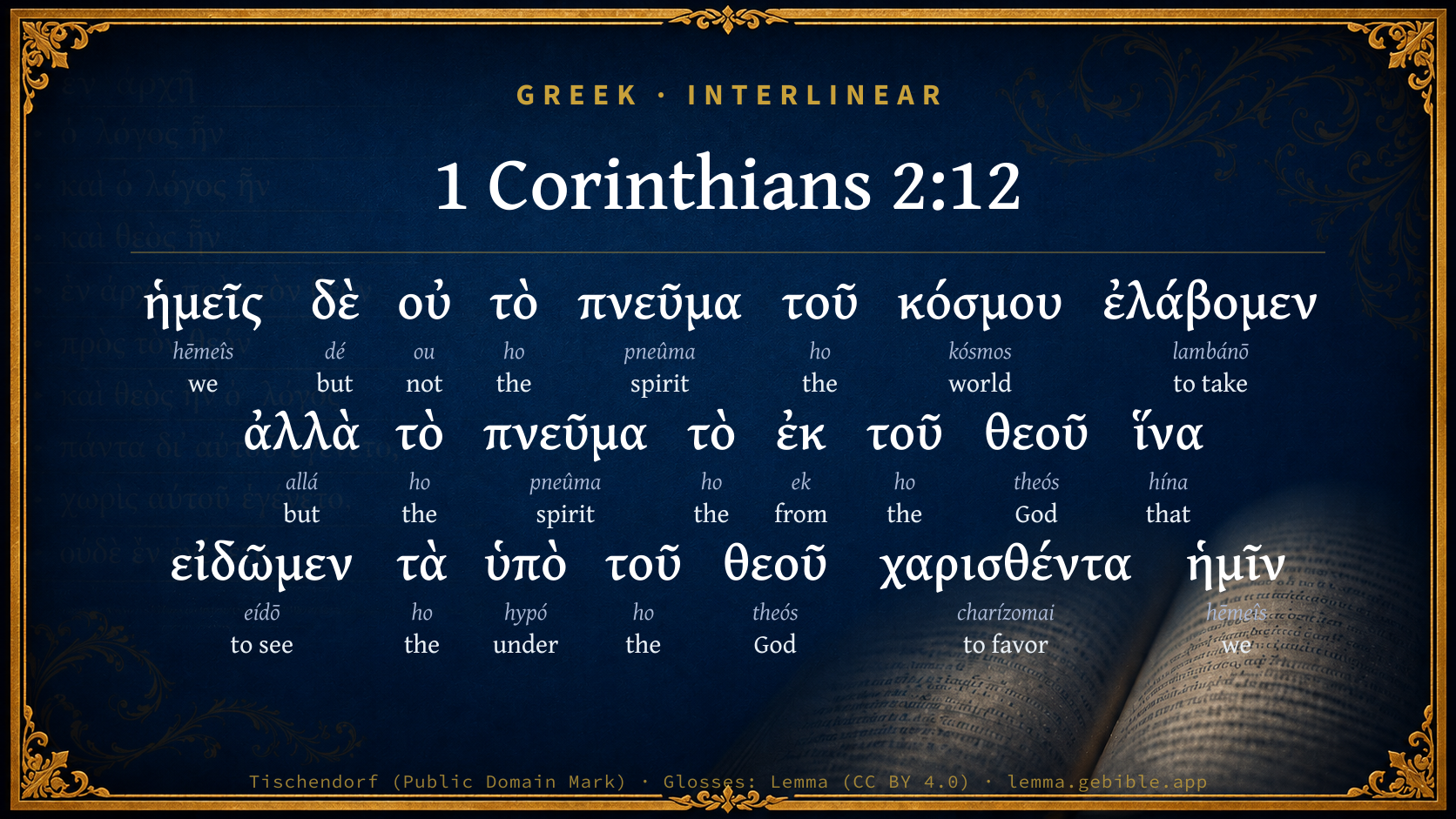
  1. ἡμεῖς hēmeîs G2249 “we” Personal pronoun, 1st person, Nominative, Plural
  2. δὲ dé G1161 “but” Conjunction
  3. οὐ ou G3756 “not” Particle, Negative
  4. τὸ ho G3588 “the” Article, Accusative, Singular, Neuter
  5. πνεῦμα pneûma G4151 “spirit” Noun, Accusative, Singular, Neuter
  6. τοῦ ho G3588 “the” Article, Genitive, Singular, Masculine
  7. κόσμου kósmos G2889 “world” Noun, Genitive, Singular, Masculine
  8. ἐλάβομεν lambánō G2983 “to take” Verb, Aorist, Active, Indicative, 1st person, Plural
  9. ἀλλὰ allá G235 “but” Conjunction
  10. τὸ ho G3588 “the” Article, Accusative, Singular, Neuter
  11. πνεῦμα pneûma G4151 “spirit” Noun, Accusative, Singular, Neuter
  12. τὸ ho G3588 “the” Article, Accusative, Singular, Neuter
  13. ἐκ ek G1537 “from” Preposition
  14. τοῦ ho G3588 “the” Article, Genitive, Singular, Masculine
  15. θεοῦ theós G2316 “God” Noun, Genitive, Singular, Masculine
  16. ἵνα hína G2443 “that” Conjunction
  17. εἰδῶμεν eídō G1492 “to see” Verb, Perfect, Active, Subjunctive, 1st person, Plural
  18. τὰ ho G3588 “the” Article, Accusative, Plural, Neuter
  19. ὑπὸ hypó G5259 “under” Preposition
  20. τοῦ ho G3588 “the” Article, Genitive, Singular, Masculine
  21. θεοῦ theós G2316 “God” Noun, Genitive, Singular, Masculine
  22. ἡμῖν hēmeîs G2249 “we” Personal pronoun, 1st person, Dative, Plural

About this verse

These counts appear in no published source. They are computed here, from the morphology-tagged text and Lemma’s own curated glosses. What Lemma adds →

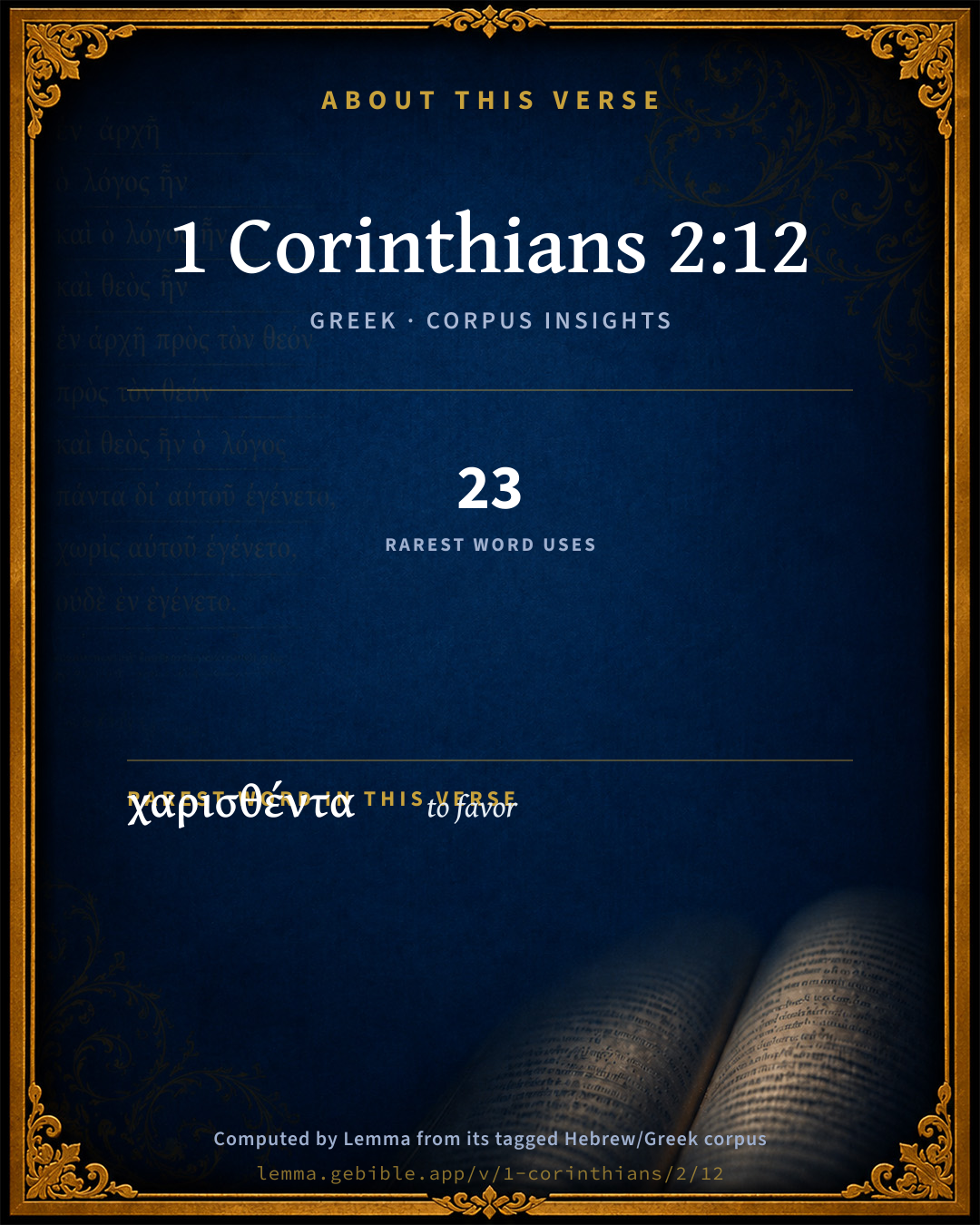
23
words
14
distinct lemmas
Pauline Epistles
section

Notable vocabulary

The rarest word here is χαρισθέντα to favor G5483 — appearing just 23 times in the whole Greek New Testament.

Shared distinctive vocabulary

χαρισθέντα to favor G5483 occurs in 19 verses of the Greek New Testament. Also found in:

Repetition

Words recur within this verse:

  • πνεῦμα spirit G4151 ×2
  • θεοῦ God G2316 ×2
  • τὸ the G3588 ×7
  • ἡμεῖς we G2249 ×2

Cross-references

16

Topical passages linked to 1 Corinthians 2:12 in the Treasury of Scripture Knowledge — connected by theme and wording, ordered by reader-vote popularity; previews shown in the World English Bible.

  • 1 John 2:27 As for you, the anointing which you received from him remains in you, and you don't need for anyone to teach you. But as his anointing teaches you concerning all things, and is true, and is no lie, and even as it taught you, you will remain in him.
  • Romans 8:5–6 For those who live according to the flesh set their minds on the things of the flesh, but those who live according to the Spirit, the things of the Spirit.
  • 1 John 2:20 You have an anointing from the Holy One, and you know the truth.
  • 1 John 5:19–20 We know that we are of God, and the whole world lies in the power of the evil one.
  • 1 John 4:4–5 You are of God, little children, and have overcome them; because greater is he who is in you than he who is in the world.
  • John 16:14–15 He will glorify me, for he will take from what is mine, and will declare it to you.
  • Romans 8:15–16 For you didn't receive the spirit of bondage again to fear, but you received the Spirit of adoption, by whom we cry, "Abba! Father!"
  • Romans 8:1 There is therefore now no condemnation to those who are in Christ Jesus, who don't walk according to the flesh, but according to the Spirit.
  • 2 Corinthians 4:4 in whom the god of this world has blinded the minds of the unbelieving, that the light of the Gospel of the glory of Christ, who is the image of God, should not dawn on them.
  • Romans 8:32 He who didn't spare his own Son, but delivered him up for us all, how would he not also with him freely give us all things?
  • James 4:5 Or do you think that the Scripture says in vain, "The Spirit who lives in us yearns jealously"?
  • 1 Corinthians 3:22 whether Paul, or Apollos, or Cephas, or the world, or life, or death, or things present, or things to come. All are yours,
  • Ephesians 2:2 in which you once walked according to the course of this world, according to the prince of the powers of the air, the spirit who now works in the children of disobedience;
  • Revelation 22:6 He said to me, "These words are faithful and true. The Lord God of the spirits of the prophets sent his angel to show to his bondservants the things which must happen soon."
  • 1 Corinthians 2:6 We speak wisdom, however, among those who are full grown; yet a wisdom not of this world, nor of the rulers of this world, who are coming to nothing.
  • 1 Corinthians 1:27 but God chose the foolish things of the world that he might put to shame those who are wise. God chose the weak things of the world, that he might put to shame the things that are strong;

Cross-references courtesy of OpenBible.info (CC BY 4.0).

Commentary

Notes on 1 Corinthians 2:12 from classic Christian and Jewish commentators (each source and its license shown beneath its notes). The classic Christian expositions comment on the surrounding passage and are grouped to its opening verse, so a note may address several verses; the Jewish commentaries on the Tanakh (Rashi and others) are per-verse, so they appear only where the commentator wrote on this verse.

Lemma curates 59 commentaries, every one of them public domain or Creative Commons licensed, each selected and text-cleaned for this edition rather than reprinted as found. About our sources →

Joseph Benson's Commentary

1Co 2:12-13. Now we have received, not the spirit of the world — Which suggests worldly wisdom; the spirit that is in worldly, carnal people, and which guides and governs them; a spirit which is earthly, sensual, and devilish. This spirit is not, properly speaking, received, for the carnal and unregenerate always had it; but true believers properly receive the Spirit of God, which before they had not. That we might know — Might discern, understand, form just ideas of, and be experimentally acquainted with; the things freely given to us of God — Which, without that Spirit, it is as impossible we should know, as it is that the inferior creatures should know the things belonging to man. Which things also we speak — Make it our business to communicate to others; not in the words which man’s wisdom teacheth — To excite men’s curiosity, amuse their imaginations, or gain their applause; but which the Holy Ghost teacheth — And consequently must be best adapted to convey such ideas as he would impart; and to impress the hearts and consciences of men with a reverent and deep sense of those holy mysteries: comparing spiritual things with spiritual — Or rather, as the apostle seems to mean, explaining spiritual things by spiritual words; or, adapting spiritual words to spiritual things; being taught by the Spirit to express the things of the Spirit. The original word, συγκρινοντες, is rightly translated interpreting, or explaining, being used by the LXX. to denote the interpretation of dreams, Gen 40:16; Gen 40:22; Gen 41:12-13; Gen 41:15; Dan 2:4; Dan 5:7; Dan 5:12. Pearce translates the clause, explaining spiritual things to spiritual men; a sense which the original will doubtless bear; but it does not agree so well with the first part of the verse, where words taught by the Holy Spirit are mentioned. This language of the apostle, as Doddridge justly observes, “may certainly convince us of the great regard which we ought always to maintain to the words of Scripture; and may especially teach ministers how attentively they should study its beauties, and how careful they should be to make it the support of their discourses.” Indeed, “this language, in which the doctrines of the gospel were revealed to the apostles, and in which they delivered these doctrines to the world, is what Paul calls the form of sound words, which Timothy had heard from him, and was to hold fast, 2Ti 1:13. Every one, therefore, ought to beware of altering or wresting the inspired language of Scripture, in their expositions of the articles of the Christian faith. Taylor, in the sixth chapter of his Key, explains the verse under consideration thus: Which things we speak, not in philosophical terms of human invention, but which the Spirit teacheth in the writings of the Old Testament; and contends that the apostle’s meaning is, that he expressed the Christian privileges in the very same words and phrases by which the Spirit expressed the privileges of the Jewish Church, in the writings of the Old Testament. But if the Spirit suggested these words and phrases to the Jewish prophets, why might not he suggest to the apostles the words and phrases in which they communicated the gospel revelation to the world? especially as there are many discoveries in the gospel, which could not be expressed clearly, if at all, in the words by which the prophets expressed the privileges of the Jewish Church. Besides, it is evident, that when the apostles introduce into their writings the words and phrases of the Jewish prophets, they explain them in other words and phrases, which no doubt were suggested to them by the Spirit.” — See Macknight, and 2Ti 3:16.

Joseph Benson's Commentary on the Old and New Testaments (1811–1818) — public domain. Text from a community e-Sword module.

Bengel's Gnomon

Johann Albrecht Bengel

1Co 2:12. Τὸ πνεῦμα τοῦ κόσμου, the spirit of the world) Eph 2:2.—ἐλάβομεν) The spirit of the world is not received; but they are always under its influence, who are of the world. We have received the Spirit of God.—ἐκ, from [God]) an antithesis to in [him, man], 1Co 2:11.

Bengel's Gnomon of the New Testament — English translation (T&T Clark, Edinburgh, 1860) — public domain. Text from a community e-Sword module.

Meyer's Critical & Exegetical Commentary

Heinrich August Wilhelm Meyer

1Co_2:12. Δέ] leading on to the second half of the demonstration which began with τὸ γὰρ πνεῦμα in 1Co_2:10 (see on 1Co_2:10).

ἡμεῖς] as ἡμῖν in 1Co_2:10.

τὸ πνεῦμα τοῦ κόσμου] i.e. the spirit which unbelieving mankind has. This spirit is the diabolic πνεῦμα, that is, the spirit proceeding forth from the devil, under whose power the κόσμος lies, and whose sphere of action it is. See 2Co_4:4; Eph_6:11-12; Eph_2:2. Comp Joh_12:31; 1Jn_4:3; 1Jn_5:19. Had we received this spirit,and here Paul glances back at the ἄρχοντες τοῦ αἰῶνος τούτου in 1Co_2:6; 1Co_2:8,then assuredly the knowledge of the blessings of eternity would have remained closed for us, and (see 1Co_2:13) instead of utterances taught by the Spirit we should use the language of the human wisdom of the schools. It is indeed the πνεῦμα τῆς πλάνης as contrasted with the πνεῦμα τῆς ἀληθείας, 1Jn_4:6. Most commentators take τὸ πνεῦμα in the sense of mode of thought and view, so that the meaning would be: Non sumus instituti sapientia mundana et saeculari, Estius. So Theophylact, and after him Beza, Calvin, Grotius, and many others, including Morus, Rosenmüller, Flatt, Heydenreich, de Wette, Maier, and similarly Pott. But, according to 1Co_2:10, τὸ πνεῦμα must denote, in keeping with the context, the objective spirit opposed to the Spirit of God; and that is, according to the decided dualistic view of the apostle (comp esp. Eph_2:2), the diabolic πνεῦμα, which has blinded the understanding of the unbelievers, 2Co_4:4. Billroths explanation: that it is the non-absolute spirit, the finite, in so far as it persists for itself and does not resolve itself into the divine, is a modern un-Pauline importation; and this holds, too, of Hofmanns exposition: that it is the spirit, in virtue of which the world is conscious of itself, knowing itself, however, only in that way in which alone its sinful estrangement from God leaves it possible for it to do so, not in God, namely, but out of God. If that is not to be taken as the diabolic spirit, then the conception is simply an un-Pauline fabrication, artificially worded so as to explain away the diabolic character. Lastly, Rückerts view, that Paul meant: we have received our πνεῦμα not from the world, but from God, cannot even be reconciled with the words of the passage.

τὸ ἐκ τ. Θεοῦ] The ἐκ is employed by Paul here not in order to avoid the appearance of making this πνεῦμα the principle that determines the action of God (so Kling in the Stud. u. Krit. 1839, p. 435), which were a needless precaution, but because this form of expression has a significant adaptation to the ἵνα εἰδῶμεν κ.τ.λ[396]; there can be no doubt about this knowing, if it proceeds from the Spirit which is from God (which has gone forth upon believers; comp 1Co_2:11, ΤῸ ἘΝ ΑὐΤῷ), Joh_15:26.

ἽΝΑ ΕἸΔῶΜΕΝ Κ.Τ.Λ[398]] the divine purpose in imparting the Spirit which proceeded forth from God. This clause, expressive of design, containing the object of the ἀπεκάλυψεν in 1Co_2:10, completely winds up the adducing of proof for the ἡμῖν δὲ ἀπεκάλ. ὁ Θ. διὰ τ. πν. αὐτ.

τὰ ὑπὸ τ. Θεοῦ χαρ. ἡμῖν] are the blessings of the Messianic kingdom, the possession of which is bestowed by divine grace on the Christians (ἡμῖν), not, indeed, before the Parousia as an actual possession, but as an ideal one to be certainly entered upon hereafter (Rom_8:24; Rom_8:30; Col_3:3-4); comp Rom_6:23; Eph_2:8-9. That to take it ideally in this way is correct (in opposition to Hofmann), is clear from the consideration that τὰ χαρισθέντα must be identical with ἃ ἡτοίμασεν ὁ Θεὸς κ.τ.λ[400] in 1Co_2:9, and with the ΔΌΞΑ ἩΜ. in 1Co_2:7.

[396] .τ.λ. καὶ τὰ λοιπά.

[398] .τ.λ. καὶ τὰ λοιπά.

[400] .τ.λ. καὶ τὰ λοιπά.

Meyer — Critical and Exegetical Commentary on the New Testament — English translation by Peter Christie, edited by Frederick Crombie (T&T Clark, 1880) — public domain. Text from a community e-Sword module.

Expositor's Greek Testament

ed. W. Robertson Nicoll

1Co 2:12 . ἡμεῖς δέ , “But we ”: cf. the emphatic ἡμῖν of 1Co 2:10 (see note) and the ἡμεῖς δὲ of 1Co 1:23 , standing in contrast with the σοφοὶ and δυνατοὶ of the world. The κόσμος whose “spirit” the App. “did not receive,” is that whose “wisdom God has reduced to folly” (1Co 1:20 f.), whose “rulers crucified the Lord” (1Co 2:8 ), its spirit is broadly conceived as the power animating the world in its antipathy to God ( cf. 2Co 4:4 , Eph 2:2 , Joh 12:31 , etc., 1Jn 4:1-6 ). Others (Est., Cv [385] , Bz [386] , Hn [387] , Sm [388] ) read the phrase in a more abstract perhaps too modern sense, “sapientia mundana et sæcularis,” or “the world-consciousness” (Hf [389] ), or “l’esprit de l’humanité … ce que les Païens appellent la muse et qui se concentre dans les génies” (Gd [390] ). “(Not the spirit of the world we received), but the Spirit which is from (issues from: ἐκ , antitheton ἐν , Bg [391] ) God” (compare ὡς ἐκ Θεοῦ , 2Co 2:17 ); the phrase recalls the teaching of Jesus in Joh 14:26 ; Joh 15:26 ; see also Rom 5:5 , Gal 4:6 . “The spirit of the world” breathes in men who are a part of the world; “the Spirit that is from God” visits us from another sphere, bringing knowledge of things removed from natural apprehension (see Isa 55:9 ). ἐλάβομεν implies actual, objective receiving ( taking ), as in 1Co 3:8 , 1Co 11:23 , etc. ἵνα εἰδῶμεν κ . τ . λ . (see note on οἶδα , 1Co 2:11 ; and cf. the emphatic οἶδα of 2Co 5:1 , 2Ti 1:12 ) a bold word here “that we may know ( certo scire , Cv [392] ) the things that by God were bestowed in His grace upon us”. τὰ χαρισθέντα , aor [393] ptp [394] , points to the historic gifts of God to men in Christ, which would have been idle boons without the Spirit enabling us to “know” them: cf. Eph 1:17 ff., ἵνα δωῇ … πνεῦμα … εἰς τ . εἰδέναι . χαρίζομαι ( to deal in χάρις : see note on χάρισμα , 7), to grant by way of grace, in unmerited favour ( cf. esp. Rom 8:32 , Gal 3:18 ).

[385] Calvin’s In Nov. Testamentum Commentarii .

[386] Beza’s Nov. Testamentum: Interpretatio et Annotationes (Cantab., 1642).

[387] C. F. G. Heinrici’s Erklärung der Korintherbriefe (1880), or 1 Korinther in Meyer’s krit.-exegetisches Kommentar (1896).

[388] P. Schmiedel, in Handcommentar zum N.T. (1893).

[389] J. C. K. von Hofmann’s Die heilige Schrift N.T. untersucht , ii. 2 (2te Auflage, 1874).

[390] F. Godet’s Commentaire sur la prem. Ép. aux Corinthiens (Eng. Trans.).

[391] Bengel’s Gnomon Novi Testamenti.

[392] Calvin’s In Nov. Testamentum Commentarii .

[393] aorist tense.

[394] participle

The Expositor's Greek Testament, edited by W. Robertson Nicoll (1897–1910) — public domain. Text from a community e-Sword module.

Hodge's Commentary on Romans, Ephesians & First Corinthians

Charles Hodge

1Co_2:12

Now we have received, not the Spirit of the world, but the Spirit which is of God; that we might know the things that are freely given to us of God.

The apostle had set forth two sources of knowledge, the one, human; the other, divine; the one, the informing principle which is in man; the other, the informing principle which is of God. And he asserts that the source of that wisdom or knowledge which he communicated, was not the former, but the latter. It was not human reason, but the Spirit of God. The Spirit of the world does not here mean a worldly disposition or temper; but Spirit is that which knows and teaches. The Spirit of the world is therefore a periphrase for reason, which is the principle of knowledge in men. When Paul says he had not received that Spirit, he means that human reason was not the source of the knowledge which he communicated. The Spirit which is of God, is the Holy Spirit as proceeding from him and sent by him as the instructor of men. To receive the Spirit is to be the subject of his influence. It, therefore, depends upon the context and on the nature of the influences spoken of, who are intended by those who receive the Spirit. Here the whole connection shows that the apostle is speaking of revelation and inspiration; and therefore must mean we apostles, (or Paul himself,) and not we Christians.

That, i.e. in order that, we might know the things freely given to us of God, i.e. the things graciously revealed by God. This clause does not refer to inward spiritual blessings now enjoyed by believers, nor to the future blessedness of the saints, except so far as these are included in the general subject of Pauls preaching. The connection is with 1Co_2:10. What human reason could not discover, God hath revealed to us apostles, in order that we might know what he has thus graciously communicated. The subject is the wisdom of God, the gospel, as distinguished from the wisdom of the world. This is clear both from what precedes and from what follows.

Charles Hodge — Commentary on Romans (1835), First Corinthians (1857), and Ephesians (1856) — public domain. Text from a community e-Sword module.

Geneva Bible (1599)

Geneva Bible translators

That which he spake generally, he restraineth now to those things which God hath opened unto us of our salvation in Christ: lest that any man should separate the Spirit from the preaching of the word and Christ: or should think that those fantastical men are governed by the Spirit of God, which wandering besides the word, thrust upon us their vain imaginations for the secrets of God.

The Spirit which we have received, doth not teach us things of this world, but lifteth us up to God, and this place teacheth us against the Papists, what faith is, from whence it cometh, and what force it is of.

This word (know) is taken here in his proper sense, for true knowledge, which the Spirit of God worketh in us.

Geneva Bible (1599) marginal notes — public domain. Text via Bolls.life.

Jamieson, Fausset & Brown

Robert Jamieson, A. R. Fausset & David Brown

we . . . received, not . . . spirit of . . . world--the personal evil "spirit that now worketh in the children of disobedience" (Eph 2:2). This spirit is natural in the unregenerate, and needs not to be received.

Spirit which is of God--that is, which comes from God. We have received it only by the gift of God, whose Spirit it is, whereas our own spirit is the spirit that is in us men (Co1 2:11).

that we might know . . . things . . . freely given . . . of God--present experimental knowledge, to our unspeakable comfort, of His deep mysteries of wisdom, and of our future possession of the good "things which God hath prepared for them that love Him" (Co1 2:9).

Jamieson, Fausset & Brown — Commentary Critical and Explanatory on the Whole Bible (1871) — public domain (CC PDM 1.0). Text via the HelloAO Bible API.

Adam Clarke's Commentary

Verse 12. Now we have received, not the spirit of the world] We, who are the genuine apostles of Christ, have received this Spirit of God, by which we know the deep things of God; and, through the teaching of that Spirit, we preach Christ crucified. We have not therefore received the spirit of the world-of the Jewish teachers, who are all looking for a worldly kingdom and a worldly Messiah, and interpret all the scriptures of the Old Testament which relate to Him in a carnal and worldly sense.

That we might know the things] We receive this teaching that we may know what those supereminently excellent things are which God has purposed freely to give to mankind. It is evident that, as the apostle means by princes of the world the rulers of the Jews, 1Co 2:6-8, so by spirit of the world he here means Jewish wisdom, or their carnal mode of interpreting the sacred oracles, and their carnal expectation of a worldly kingdom under the Messiah.

Adam Clarke's Commentary on the Bible (1810–1826) — public domain. Text from a community e-Sword/MySword module.

John Calvin's Commentaries

12. Now we have received, not the spirit of the world He heightens by contrast the certainty of which he had made mention. “The Spirit of revelation,” says he, “which we have received, is not of the world, so as to be merely creeping upon the ground, so as to be subject to vanity, or be in suspense, or vary or fluctuate, or hold us in doubt and perplexity. On the contrary, it is from God, and hence it is above all heavens, of solid and unvarying truth, and placed above all risk of doubt.”

It is a passage that is most abundantly clear, for refuting that diabolical doctrine of the Sophists as to a constant hesitancy on the part of believers. For they require all believers to be in doubt, whether they are in the grace of God or not, and allow of no assurance of salvation, but what hangs on moral or probable conjecture. In this, however, they overthrow faith in two respects: for first they would have us be in doubt, whether we are in a state of grace, and then afterwards they suggest a second occasion of doubt — as to final perseverance. Here, however, the Apostle declares in general terms, that the elect have the Spirit given them, by whose testimony they are assured that they have been adopted to the hope of eternal salvation. Undoubtedly, if they would maintain their doctrine, they must of necessity either take away the Spirit of God from the elect, or make even the Spirit himself subject to uncertainty. Both of these things are openly at variance with Paul’s doctrine. Hence we may know the nature of faith to be this, that conscience has from the Holy Spirit a sure testimony of the good-will of God towards it, so that, resting upon this, it does not hesitate to invoke God as a Father. Thus Paul lifts up our faith above the world, that it may look down with lofty disdain upon all the pride of the flesh; for otherwise it will be always timid and wavering, because we see how boldly human ingenuity exalts itself, the haughtiness of which requires to be trodden under foot by the sons of God through means of an opposing haughtiness of heroical magnanimity.

That we may know the things that are given us by Christ. The word know is made use of to express more fully the assurance of confidence. Let us observe, however, that it is not acquired in a natural way, and is not attained by the mental capacity, but depends entirely on the revelation of the Spirit. The things that he makes mention of as given by Christ are the blessings that we obtain through his death and resurrection — that being reconciled to God, and having obtained remission of sins, we know that we have been adopted to the hope of eternal life, and that, being sanctified by the Spirit of regeneration, we are made new creatures, that we may live to God. In Ephesians 1:18, he says what amounts to the same thing —

“That ye may know what is the hope of your calling.”

John Calvin's Commentaries (1540-1563) — public domain. Text from the Calvin Translation Society English edition (1840s-50s) via the Christian Classics Ethereal Library (ccel.org). Calvin's coverage is partial (roughly two-thirds of the Bible); uncommented books and verses are honest gaps, never fabricated. The 19th-century editor's footnotes and remarks are omitted so the notes are faithfully Calvin's own voice.

Ellicott's Commentary for English Readers

(12) We.—This must not be confined to the Apostles exclusively. Though referring primarily to them, it includes all the members of the Christian Church as one with its teachers and rulers. The “things freely given us of God” mean all spiritual things.

A Bible Commentary for English Readers, edited by Charles John Ellicott (1878–1897) — public domain. Text from a community e-Sword module.

The Cambridge Bible for Schools and Colleges

gen. ed. J. J. S. Perowne

12. Now we have received] Literally, we received, i.e. when we became disciples.

that we might know] The word here signifies to perceive, rather than to gather by the exercise of the reason. Such things as the Spirit reveals to us are discerned as clearly by our spirits as the things visible to sense are discerned by the eye.

The Cambridge Bible for Schools and Colleges (gen. ed. J. J. S. Perowne; Cambridge University Press, 1878–1918) — public domain. Text from a community e-Sword module.

John Gill's Exposition

Which things also we speak,.... Namely, the things which have not been seen by the eye, heard by the ear, or understood by the heart of man; the things God has prepared for his people; the deep things of God; the things of God which are only known to the Spirit; the things that are freely given to them of God, and made known to them by the Spirit of God: these things are spoken out, preached, and declared to the sons of men,

not in the words which man's wisdom teacheth; which are learned in the schools of the philosophers, put together by human art, and "in the taught words of human wisdom", as the clause may be rendered; such as are taught and acquired by human learning, so artificially formed in their order and structure as to work upon the affections of men, captivate the mind, and persuade to an assent.

But which the Holy Ghost teacheth; or "in the taught" words "of the Holy Ghost"; in the language of the Scriptures, edited by the Spirit of God; or such as the Holy Spirit taught them, suggested to them, directed them to the use of; for he not only supplied them with matter, but furnished them with words, with proper and spiritual oratory:

comparing spiritual things with spiritual; the things of the Spirit of God, the doctrines of the Gospel, with the spiritual writings of the Old Testament, whereby their truth and harmony are demonstrated; speaking as the oracles of God, and prophesying or preaching according to the analogy of faith; and adapting spiritual words to spiritual truths, clothing them with a language suitable and convenient to them, not foreign and flourishing, but pure, simple, and native; or accommodating and communicating spiritual things, as to matter and form, to spiritual men; which sense the Arabic version favours and confirms, such being only capable of them; and with these there is no need to use the eloquence, oratory, wisdom, and words of men.

John Gill's Exposition of the Whole Bible (1746–1763) — public domain (CC PDM 1.0). Text via the HelloAO Bible API.

Trapp's Complete Commentary

John Trapp

12 Now we have received, not the spirit of the world, but the spirit which is of God; that we might know the things that are freely given to us of God.

Ver. 12. Not the spirit of the world] The world lieth down in that unclean one, and is under the power and vassalage of that spirit that worketh in the children of disobedience, as a smith in his forge, 1Jn 5:19; Eph 2:2. It is wholly "set upon wickedness," as Aaron saith of the people, Exo 32:22.

That we might know] A sweet mercy; the cormorants of the world will not let their heirs know what they will do for them till they die. But God assures his of heaven beforehand. Thus we have not received of the spirit of this world: we cannot shift and plot as they can; but we have received a better thing, and have no reason to repine.

John Trapp, A Commentary or Exposition upon All the Books of the Old and New Testament (1647–1656) — public domain. Text from a community e-Sword module.

Albert Barnes' Notes on the Bible

Now we have received - We who are Christians; and especially we, the apostles. The following verse shows that he had himself and the other apostles chiefly in view; though it is true of all Christians that they have received, not the spirit of this world, but the spirit which is of God.

Not the spirit of this world - Not the wisdom and knowledge which this world can give - not the learning and philosophy which were so much valued in Greece. The views of truth which we have, are not such as this world gives, but are such as are communicated by the Spirit of God.

But the Spirit which is of God - We are under the teaching’s and influence of the Holy Spirit.

That we might know - That we might fully understand and appreciate. The Spirit is given to us in order that we might fully understand the favors which God has conferred on us in the gospel. It was not only necessary that God should grant the blessings of redemption by the gift of His Son, but, such was the hardness and blindness of the human heart, it was needful that he should grant His Holy Spirit also, so that people might be brought fully to see and appreciate the value of those favors. For people do not see them by nature; neither does anyone see them who is not enlightened by the Holy Spirit of God.

The things that are freely given us - That are conferred on us as a matter of grace or favor. He here refers to the blessings of redemption - the pardon of sin, justification, sanctification, the divine favor and protection, and the hope of eternal life - These things we Know; they are not matters of conjecture; but are surely and certainly confirmed to us by the Holy Spirit. It is possible for all Christians to know and be fully assured of the truth of those things, and of their interest in them.

Albert Barnes' Notes on the Bible (1834–1885) — public domain. Text from a community e-Sword/MySword module.

Matthew Poole's English Annotations

By the spirit of the world some understand the devil, that evil spirit which is in the world, and ruleth those that are worldly, carnal men: others understand a mere human spirit, by which men understand and comprehend mere worldly things. The sense certainly is, we have not a mere worldly instruction and tutoring, we are not taught and instructed from the world; (so the spirit is put for the effects of the spirit of the world); but we are taught and instructed by the Holy Spirit, by which we are taught and

know the things that are freely given to us of God, whether they be Divine mysteries, or Divine benefits, both what God hath done for us, and what God hath wrought in us.

Matthew Poole's English Annotations on the Holy Bible (1683–1685) — public domain. Text from a community e-Sword/MySword module.

Whedon's Commentary on the Bible

Daniel D. Whedon

12. The spirit of the world—As every man has an individual spirit, so the world has a collective spirit, a common moral tone and temper; and that spirit is at variance with the divine Spirit. As the wisdom of man is antithetical to the wisdom of God, so the spirit of the world is antithetical to the Spirit of God.

That we might know—By blessed experience.

Things… given—Namely, (1Co_2:9,) the things which God hath prepared for them that love him.

Daniel D. Whedon (gen. ed.), Commentary on the Old and New Testaments (1874–1909) — public domain. Text from a community e-Sword module.

The Pulpit Commentary

The spirit of the world. The heathen world in its heathen aspect is regarded as under the power of the devil. (2Co_4:4; Eph_6:11, Eph_6:12) Freely given to us by God. The word "freely" is here involved in the verb (carisqenta) "graciously bestowed." It is different from the phrase used in "Freely ye have received," which is gratuitously. (dwrean Mat_10:8) All God"s gifts are "without money and without price", (Isa_55:1) and not "to be bought with money". (Act_18:20)

Vers. 12-14.

Speech in the power of the Spirit.

The personal references in St. Paul"s Epistles are suitable to the epistolary style of correspondence, and necessary as the vindication of a man who was seriously attacked and slandered. Generally his allusions arc more or less directed to his claim as an apostle. Because this did not take precisely the same grounds as the claims of the earlier apostles, it was easy for his enemies to question and even deny his rights. St. Paul"s chief argument is that the "signs of an apostle were wrought by him," and here, in our text, he urges that his teaching was manifestly inspired and sealed by the Holy Spirit, and that his apostolic claim was fully recognized by all "spiritual men." Wickliffe skilfully renders the last clause of ver. 13, Maken a liknesse of spyritual things to goostli men.

I THE DIVINE PREPARATION FOR APOSTOLIC TEACHING.

1. The apostle must have received the Spirit of God. Personal experience of regeneration, and personal openness to the Divine incoming, are

2. absolute essentials to all Christian service as teachers, in older days and now, in the lesser spheres as well as the greater. Judas can teach nobody; only as "converted" can St. Peter "strengthen the brethren" or "feed the lambs.

1. He must know the things of God through the Spirit"s teaching. Here the adequacy of the Spirit to be the renewed man"s Teacher may be shown.

1. He knows God.

2. He knows man.

3. He has access to man"s mind and heart, and an adaptation to each individual can be assured.

The operations of the Divine Spirit as the renewed man"s Teacher also require consideration. Generally it may be said that he unfolds the redemption mystery in its practical details and applications.

Our Lord"s division of his work is that he teaches

(1) of sin;

(2) of righteousness;

(3) of judgment.

The true preparation for teaching is an inner spiritual life, a Divine indwelling and endowment, and these finding expression through the natural powers and relations. There is a full sense in which the true Christian teacher has still an inspired and sanctified speech, and therefore all the authority which the Divine Spirit can give.

II THE MINISTRY OF APOSTLESHIP IN HUMAN LANGUAGE. "Which things we speak." Speech is almost our best force for the communication of truth and for the impression of duty. It works by persuasion, not force. It has no physical, but wholly moral power. Yet history declares, in repeated instances, how human words can sway emotion and arouse to action; e.g. the Crusades. But man"s words may be mere words, incapable of producing more than limited effects upon passion, sentiment, etc. They may have a Divine life in them, and so be mighty to break stubborn hearts, bow the wicked to penitence, draw men to God, and change the whole character of the life. Words which the Holy Ghost teacheth are mighty to pull down strongholds. By the "foolishness of preaching" men are saved and blessed. But the sphere of apostolic speech is clearly defined. Such a teacher speaks spiritual things; and it is indicated that he will speak in vain, save as men are receptive, spiritually toned, having the spiritual sensibility quickened. The merely natural man cannot receive God inspired teachings. So there is at once a preparation of the teacher, and a preparation of those to whom his words are addressed. The practical duty of culturing Christian life and feeling, in order to gain the best blessing from our pastors and teachers, may be made the subject of an earnest and effective conclusion. R.T.

The Pulpit Commentary (1880–1919), ed. H.D.M. Spence-Jones & Joseph S. Exell — public domain. Text from a community e-Sword module.

John Wesley's Explanatory Notes

Now we have received, not the spirit of the world - This spirit is not properly received; for the men of the world always had it. But Christians receive the Spirit of God, which before they had not.

John Wesley, Explanatory Notes Upon the Whole Bible (1754–1765) — public domain. Text via the GEBible commentary corpus.

Scofield Reference Notes

C. I. Scofield

world

kosmos = world-system. 1Co 7:31; 1Co 7:33; Joh 7:7. (See Scofield "Rev 13:8").

The Scofield Reference Bible (1917 edition), notes by C. I. Scofield — public domain. Text from a community e-Sword module.

Burkitt's Expository Notes on the New Testament

William Burkitt

Observe here, 1. The apostle declares what spirit they had not received, namely, the spirit they had not received, namely, the spirit of the world: We have not received the spirit of the world: that is, the spirit which suggests worldly wisdom, and savours only of worldly things: which acts and influences only worldly men. In the whole generation of worldly men there is the same worldly spirit, and this spirit of the world is an earthly spirit, it is a low, a little, and a narrow spirit: earthly things which are present and visible, such a soul gapes after, and grasps hard; but future and invisible things, which are far off and out of sight, are neither believed nor sought after.

Observe, 2. The apostle declares what spirit they had received, namely, the spirit which is of God, and of what use that Holy Spirit is unto them: it teaches them to know the things which are freely given them of God: that is, the Holy Spirit showeth us both what God is, and what the things of God are; we are enlightened with the knowledge of that grace and goodness of God which is discovered to us in the gospel, we know both divine mysteries and divine mercies, both what God hath done for us, and what he hath wrought in us, which are the things that are freely given us of God.

Observe, 3. The apostle declares how he preached these spiritual things after a spiritual manner, not in the words which man’s wisdom teacheth, but which the Holy Ghost teacheth: that is, not in the words and after the manner now counted by the Gentile philosophers to be learned and wise, but in the very words, and after the very manner, which the Spirit of God teacheth us.

Where learn, That the holy apostles spake and wrote by the immediate inspiration of the Holy Ghost, as well as the prophets of old time, and delivered nothing as from God but what God revealed to them by his Holy Spirit: and accordingly some interpret those words, comparing spiritual things with spiritual, that is, say they, comparing the things which were written by the Spirit in and under the Old Testament, with what is now revealed to us under the New.

William Burkitt's Expository Notes on the New Testament (1700–1703) — public domain. Text from a community e-Sword module.

Godbey's Commentary on the New Testament

William B. Godbey

12-13. “But we have not received the spirit of the world, but the Spirit who is from God, in order that we may perceive the things which have been graciously conferred upon us of God. Which things indeed we speak not in the instructing words of human wisdom, but in the instructing words of the Spirit, expounding spiritual things to spiritual people.” Verily, our expositions of spiritual things are available only to spiritual people; who are so few in proportion to the population that out of a whole city we do well if we find a band of a few dozen who are spiritual enough to receive the Word of God, appreciate and utilize it, and profit thereby. It is in vain to expound these deep spiritual truths to the wicked, from the simple fact that a dead man will not eat his dinner; meanwhile we have but little encouragement with unsanctified Christians, from the simple fact that toothless babes can not feast on the “fatted calf.” We observe a most deplorable phenomenon in the churches relative to this great truth. An ex-India missionary said in my Bible readings in Seattle, Washington, that the heathens of India know more about the Bible than the Christians of America, from the simple fact that the missionaries conduct a Bible school daily, which the natives attend and receive instructions from the precious Word expository of the redemptive scheme, while in America they have nothing but the poor little degospelized Sunday sermonettes, so diluted with everything except the gospel that the people who are dependent on them literally famish for the “bread of life.” Suppose a city pastor of five hundred members should announce on Sunday a daily Bible school. I trow he would find himself teaching to empty walls and naked seats. The only chance is to begin at the foundation, use his membership as a missionary population and get them saved, proceeding after the apostolic manner with the school of Christ, daily feeding them on the “bread of life,” and building them up in the “deep things of God.” In that case he must of necessity lop off that routine of unscriptural institutions, invented by a fallen church in the vain attempt to substitute the Holy Ghost, who has been grieved away because they disobeyed Him and took the meetings out of His hands. These carnal institutions, worshipping paltry pelf, as if our God were poor, have taken all the time which God has given the people to study and be taught His precious Word, and to dive down into the deep things of God. Why will we not all lop them off, since they are not only useless, but injurious, and return to New Testament simplicity, and all delight ourselves in the school of Christ, studying God’s precious and wonderful truth, and sinking deeper and deeper into the “deep things of God”?

William B. Godbey, Commentary on the New Testament (1896–1900) — public domain. Text from a community e-Sword module.

McGarvey & Pendleton's Commentaries

J. W. McGarvey

But we received, not the spirit of the world, but the spirit which is from God; that we might know the things that were freely given to us of God . [As a man alone knows himself, so God alone knows himself. As the thoughts and intentions of a man are best known by his own spirit, so also are the divine counsels of God best known by the Spirit of God. If a man's knowledge of himself surpasses that of his neighbor who knows him well, much more must the revelation of the unseen God by his Spirit far surpass all the speculations of mankind with regard to him. But this revelation of God the apostles enjoyed, through the Spirit of God, who guided them into all truth ( Joh_16:13 ). How superior, then, was their knowledge to that of worldly philosophy, even if it embraced the collective knowledge of all men.]

J. W. McGarvey (with Philip Y. Pendleton), Commentaries on the New Testament (The Fourfold Gospel, 1914; Acts; and the epistles) — public domain. Text from a community e-Sword/MySword module.

The People's New Testament

B. W. Johnson

12. Now we have received, etc. We apostles. The Spirit received by all the apostles was not the spirit of the world, but the Holy Spirit which Christ promised them as a guide into all truth. Hence they were enabled to know what God imparted freely to them.

B. W. Johnson's The People's New Testament with Notes (1889–1891) — public domain. Electronic text from the Christian Classics Ethereal Library (CCEL) ThML edition.

unfoldingWord translationNotes

Door43 World Missions Community

General Information:

Here the word "we" includes both Paul and his audience. (See: Inclusive "We")

freely given to us by God

This can be stated in active form. AT: "that God freely gave to us" or "that God has kindly given us" (See: Active or Passive)

The Spirit interprets spiritual words with spiritual wisdom

The Holy Spirit communicates God's truth to believers in the Spirit's own words and gives them his own wisdom.

The Spirit interprets spiritual words with spiritual wisdom

"The Spirit explains uses his own spiritual wisdom to explain spiritual words"

translationWords

world

Holy Spirit

know

word

wise

unfoldingWord translationNotes — © Distant Shores Media and the Door43 World Missions Community, licensed CC BY-SA 4.0. Source: git.door43.org/Door43/en_tn.

Cambridge Greek Testament for Schools and Colleges

12. ἐλάβομεν. We cannot press the strict sense of the aorist here. See note on 1Co 2:16. The gift of the Spirit is not a single, but a continuous act. Yet it is not a completed act, which would be denoted by the perfect. See an article by the General Editor in the Expositor, 1st Series, Vol. vii. p. 258. ‘The aggressive tendency of the aorist appears in the fact that, at the present day, while the ancient perfect and pluperfect have no existence, the ancient aorist remains intact in the daily speech of the Greek race.’ Clyde, Synt. p. 70. This tendency was already in operation in St Paul’s day. Observe that ἐκ and ὑπό in this verse are both translated ‘of’ in the A.V.

εἰδῶμεν. This knowledge (see note on last verse) is the result rather of intuition than observation. The reason why the Spirit was given was that we might perceive the things outside the world of sense which God has freely given us (χαρισθέντα). See 1Co 2:9-10. We need not neglect the use of our reason, but we should not forget that in regard to the spiritual world we are endowed with a faculty whereby the conclusions of the reason may be tested and guided.

Cambridge Greek Testament for Schools and Colleges (Cambridge University Press, 1896; 21 vols, various authors incl. Carr, Maclear, Plummer, Farrar, Lumby, Moule, M. R. James, Simcox) — public domain. Text from a community e-Sword module.

Alford’s Greek Testament

Henry Alford

12.] ἡμεῖς δέ carries on the ἡμῖν δέ of ver. 10.

τὸ πν. τ. κόσμ.] Not merely, the mind and sentiments of unregenerate mankind, ‘sapientia mundana et sæcularis,’ as Estius, al., but the Spirit (personally and objectively taken) of the world, = τὸ πνεῦμα τὸ νῦν ἐνεργοῦν ἐν τοῖς υἱοῖς τῆς ἀπειθείας, Eph 2:2, where it is strictly personal.

τὸ πν. τὸ ἐκ τ. θ.] Not only, ‘the Spirit of God,’ but the Spirit which is from God,—to shew that we have received it only by the will and imparting of Him whose Spirit it is. And this expression prepares the way for the purpose which God has in imparting to us His Spirit, that we may know the things freely given to us by God, i.e. the treasures of wisdom and of felicity which are the free gifts of the gospel dispensation, = ὅσα ἡτοίμασεν ὁ θεὸς τοῖς ἀγαπῶσιν αὐτόν, ver. 9.

Henry Alford, The Greek Testament (1849–1861) — public domain. Text from a community e-Sword module.

International Critical Commentary

12. ήμεῖς δέ. See on ἠμῖν in v. 10: ‘we Christians.’ οὐ τὸ πνεῦμα τοῦ κόμου … ἀλλά. An interjected negative clause, added to give more force to the positive statement that follows, as in Rom 8:15. What does St Paul mean by ‘the spirit of the world’?

(1) Meyer, Evans, Edwards, and others understand it of Satan, or the spirit of Satan, the κόσμος being “a system of organized evil, with its own principles and its own laws” (Evans): see Eph 2:2, Eph 2:6:11; Joh 12:31; 1Jn 4:3, 1Jn 4:5:19; and possibly 2Co 4:4. But this goes beyond the requirements of the passage: indeed, it seems to go beyond the analogy of N.T. language, in which κόσμος has not per se a bad sense. Nor is ‘the wisdom of the world’ Satanical. It is human, not divine; but it is evil only in so far as ‘the flesh’ is sinful: i.e. it is not inherently evil, but only when ruled by sin, instead of being subjected to the Spirit. See Gifford’s discussion of the subject in his Comm. on Romans, viii. 15.

(2) Heinrici, Lightfoot, and others understand of the temper of the world, “the spirit of human wisdom, of the world as alienated from God”: non sumus instituli sapientia mundi (Est.). On this view it is practically identical with the ἀνθρωπίνη σοφία of v. 13, and homogeneous with the φρόνημα τῆς σαρκός of Rom 8:6, Rom 8:7: indeed, it may be said to be identical with it in substance, though not in aspect. In both places in this verse, therefore, πνεῦμα would be impersonal, and almost attributive, as in Rom 8:15; but there the absence of the article makes a difference. Compare the πνεῦμα ἕτερον ὃ αὐκ ἐλάβετε in 2Co 11:4. On the whole, this second explanation of ‘the spirit of the world’ seems to be the better.

ἐλάβομεν. Like ἀπεκάλυψεν (v. 10), this aorist refers to a definite time when the gift was received. “St Paul regards the gift as ideally summed up when he and they were ideally included in the Christian church, though it is true that the Spirit is received constantly” (Lightfoot). Cf. 12:13.

τὸ πνεῦμα τὸ ἐκ τοῦ Θεοῦ. The gift rather than the Person of the Spirit, although here, as not infrequently in Paul, the distinction between the Personal Spirit of God (v. 11), dwelling in man (Rom 8:11), and the spirit (in the sense of the higher element of man’s nature), inhabited and quickened by the Holy Spirit, is subtle and difficult to fix with accuracy. The Person is in the gift, and the activity of the recipient is the work of the Divine Indweller.

ἵνα εἰδῶμεν. This is the result to which vv. 10-12 lead up. The words reproduce, under a different aspect, the thought in ἠμῖν ἀπεκάλυψεν ὁ Θεος, and give the foundation for v. 13, ἃ καὶ λαλοῦμεν.

τὰ … χαρισφέντα ἠμῖν. The same blessings appear successively as δόξαν ἡμῶν (v. 7), ὅσα ἡτοίμασεν κ.τ.λ. (v. 9), and τὰ Χαρισθέντα (v. 12). The last perhaps includes “a little more of present reference” (Ellicott). The connexion of thought in the passage may be shown by treating vv. 11 and 12 as expanding the thought of v. 10 into a kind of syllogism;—major premiss, None knows the things of God, but only the Spirit of God; minor premiss, We received the Spirit which is of God; conclusion, So that we know what is given us by God. The possession of the gift of the Spirit of God is a sort of middle term which enables the Apostle to claim the power to know, and to utter, the deep things of God.

After τοῦ κόσμον, D E F G, Vulg. Copt. Arm. add τούτου. א A B C L P, Syrr. Aeth. omit.

International Critical Commentary — older volumes (1896–1929), various authors — public domain. Text from a community e-Sword module.

Vincent's Word Studies in the New Testament

Marvin R. Vincent

The spirit of the world [το πνευμα του κοσμου] . For this use of pneuma, see on Rom 8:4, under 7. Kosmov world, is used with the ethical sense. See on Joh 1:9, under 4, e, The phrase means the principle of evil which animates the unregenerate world; not the personal spirit of evil or Satan, since Paul does not use pneuma spirit, elsewhere in the personal sense of an evil spirit. See note on Eph 2:2.

Of God [εκ του θεου] . Lit., from God : proceeding forth from Him. "God in us reveals God in our nature" (Edwards).

Marvin R. Vincent, Word Studies in the New Testament (1887–1900) — public domain. Text from a community e-Sword/MySword module.

Godet's Commentaries

Frédéric Louis Godet

Vv. 12. “Now we have received, not the spirit of the world, but the Spirit which is of God, that we might know the things that are freely given to us of God:”

This verse is the development of the word by the Spirit (1Co 2:10).

The Divine Spirit is contrasted with another, which also has the power of making revelations of another nature, that of the world. Beet understands thereby, “the spirit which worketh in the children of disobedience” (Eph 2:2); Meyer: the spirit which animates unbelieving mankind, the diabolical spirit. Does the expression used authorize us to go so far? Man, at the time of his creation, received a πνεῦμα; for he participates in the spiritual nature and power which are the essence of God (Gen 2:7; Joh 4:24). With the Fall, this endowment was not withdrawn from humanity. By its separation from God, the spirit of man became profane, worldly; but it remained in man, as a collective being, as a principle of knowledge and invention, enthusiasm and exaltation. This it is which Pagans called the Muse, and which is concentrated in philosophical and artistic geniuses, communicating to them marvellous insight and words of wondrous power, by which they give tone to their age. And hence the apostle does not scruple himself to quote sayings of the Greek poets, and to designate one of them by the name of prophet (Act 17:28; Tit 1:12). But to whatever degree of power this spirit of the world may rise, it cannot give man the knowledge of the Divine plans, nor make an apostle even of the greatest genius. The expression οὐκ ἐλάβομεν, we have not received, signifies, “The spiritual power which has made us what we are, is not that.” Comp. an analogous form, Rom 8:15.

With this spirit which rises, so to speak, from the heart of the κόσμος, the apostle contrasts the Divine Spirit, literally, the Spirit which proceeds (ἐκ) from God. This form emphasizes the transcendent character of His inspiring breath. He was in God, and He proceeds from Him to enter into man; comp. Rom 5:5. This is something different from human inspiration, even when raised to its highest power.

The art. τό, after πνεῦμα, was not strictly necessary (see on 1Co 2:7). But it is put here to remind us of the contrast to the other spirit, the cosmical spirit: “We are certainly neither Platos, nor Demostheneses, nor Homers; but if you would learn what are the thoughts of God toward you, listen to us! The Spirit proceeding from God Himself is He who has revealed them to us.”

There is a very marked contrast between the two terms, εἰδῶμεν, that we might know, and τὰ χαρισθέντα, the things which have been (freely) given to us. By this second term Paul understands the gracious blessings of salvation, the gift of the Son, the expiation accomplished by Him, and all the benefits flowing from them: justification, sanctification, final redemption (1Co 1:30). These blessings one may enjoy by simple faith, but without yet measuring all their greatness, because the εἰδέναι, knowing, is yet wanting in a certain degree. And hence the apostle asked for the Ephesians (1Co 3:18) that they might be able “to understand with all saints what is the breadth and length, the depth and height,” and for the Colossians (1Co 2:2-3), “that they might be brought unto all riches of the full assurance of understanding, to the acknowledgment of the mystery of God and of Christ; in whom are hid all the treasures of wisdom and knowledge.” Here, therefore, the εἰδέναι, knowing, denotes the account which the believer renders to himself of all that is contained in the τὰ χαρισθέντα, the facts of salvation wrought out for him. It is those higher lights the domain of which we have sought briefly to indicate (see on 1Co 2:6). Between faith in the simple facts of salvation and these more elevated views of the Divine work, there is all the distance which separates the preaching of the evangelist from the doctrine of the Christian teacher, or, if you will, all the difference which exists between the contents of the gospel history and the teaching of the Epistles.

To this teaching of Divine wisdom, the end of this whole deduction, Paul comes in 1Co 2:13.

Frédéric Louis Godet — Commentaries on Luke, John, Romans, and 1 Corinthians — English translation (T&T Clark, Edinburgh, 1870s–1890s) — public domain. Text from a community e-Sword module.

Lesson kit

Teaching starters — assembled from the data on this page, not authored interpretation. Every prompt links to the verse data it draws on. Edit before teaching.

1 Corinthians, in the Pauline Epistles, opens this verse with 23 words (14 distinct Greek lemmas). Its most distinctive word is charízomai (“to favor”). A historical commentator’s framing appears above. Read the whole chapter for the surrounding context.

Discussion questions

  1. The word charízomai carries the sense “to favor.” How does it shape the verse?
  2. Luke 7:21 shares the word «to favor» with this verse. How do the two illuminate each other?
  3. “spirit” occurs 2× in this one verse. What is the effect of the repetition?
  4. The translations on this page render this verse differently — a whole-verse word diff, not a word-by-word alignment. What might account for the different wordings?
  5. Reading how Joseph Benson's Commentary and Bengel's Gnomon read this verse, where do the two commentators agree and where do they part?

Things to notice

  • These translations choose different wording for 6 words in this verse.
  • “spirit” occurs 2× in this single verse.
  • 14 distinct Greek lemmas span 23 words in this verse.

Reading settings

Reading text

Shown beneath each verse's original-language words.

Old Testament
Old Testament edition

Read the OT as the Masoretic Hebrew (MT) or the Greek Septuagint (LXX).

English shown for the Greek Septuagint (in the Hebrew ↔ Greek comparison).

Comparing translations? Open the Compare panel on any verse page to stack up to four side by side.