John 1:12

Greek (Tischendorf 8th ed.) John 1:12 appears in the Greek New Testament. The text above is from the Tischendorf 8th edition. Each word links to its Strong’s number and a concise gloss. Click any word for its full Thayer’s Greek Lexicon entry.
Download image
Cite this verse

John 1:12 (World English Bible). Public Domain. Lemma interlinear Bible study tool, https://lemma.gebible.app/v/john/1/12.

Show BibTeX & RIS
BibTeX
RIS
English Translation
But as many as received him, to them he gave the right to become God's children, to those who believe in his name:
World English Bible · Public Domain
Download a study sheet

One document with this verse’s original text, its word-by-word gloss line, the meaning frame, cross-references with their text, attributed commentary, and full source and license credits — printable, and it pastes into notes with its structure intact.

This verse Autodidact and up

Study sheet (.html) Plain text (.txt)

A passage Seminary Student

Up to 50 verses in one chapter. A passage sheet keeps up to 6 commentary sources and 12 cross-references per verse, in the order this page ranks them, and says so on the sheet whenever that leaves anything out. Ask for a single verse and you get the Autodidact verse sheet above.

Everything on this page stays free to read, with no account — the sheet is a download of what is already on screen, not access to it.

Want to remove ads? Support Godless Engineer
Compare translations 3

The same verse in 3 English versions, stacked beneath the original-language interlinear above. Click any original word for its lexicon entry.

Each is an independent rendering of the whole verse — the interlinear is not word-aligned to these translations.

Highlighted words mark where these versions differ — a whole-verse word diff, not a word-by-word alignment.

  • World English Bible Public Domain
    But as many as received him, to them he gave the right to become God's children, to those who believe in his name:
  • King James Version Public Domain
    But as many as received him, to them gave he power to become the sons of God, even to them that believe on his name:
  • unfoldingWord Literal Text CC BY-SA 4.0
    But as many as received him, he gave to them the authority to become children of God, to the ones believing in his name,

unfoldingWord Literal Text — © unfoldingWord, licensed CC BY-SA 4.0. Word-aligned USFM3 via Door43 (git.door43.org/unfoldingWord/en_ult).

Versions to compare (up to 4)

3 of 4 selected

Show all 19 translations

Every available English version of this verse, each an independent rendering of the whole verse.

  • World English Bible Public Domain
    But as many as received him, to them he gave the right to become God's children, to those who believe in his name:
  • Berean Standard Bible Public Domain
    But to all who did receive Him, to those who believed in His name, He gave the right to become children of God—
  • Majority Standard Bible Public Domain
    But to all who did receive Him, to those who believed in His name, He gave the right to become children of God—
  • King James Version Public Domain
    But as many as received him, to them gave he power to become the sons of God, even to them that believe on his name:
  • American Standard Version (1901) Public Domain
    But as many as received him, to them gave he the right to become children of God, `even' to them that believe on his name:
  • Revised Version (1885) Public Domain
    But as many as received him, to them gave he the right to become children of God, even to them that believe on his name:
  • Geneva Bible (1599) Public Domain
    But as many as receiued him, to them he gaue prerogatiue to be the sonnes of God, euen to them that beleeue in his Name.
  • Douay-Rheims (1899) Public Domain
    But as many as received him, he gave them power to be made the sons of God, to them that believe in his name.
  • Young's Literal Translation Public Domain
    but as many as did receive him to them he gave authority to become sons of God -- to those believing in his name,
  • Literal Standard Version CC BY-SA 4.0
    but as many as received Him, to them He gave authority to become sons of God—to those believing in His Name,
  • Unlocked Literal Bible CC BY-SA 4.0
    But to as many as received him, who believed in his name, he gave the right to become children of God.
  • unfoldingWord Literal Text CC BY-SA 4.0
    But as many as received him, he gave to them the authority to become children of God, to the ones believing in his name,
  • Darby Bible Public Domain
    but as many as received him, to them gave he [the] right to be children of God, to those that believe on his name;
  • World Messianic Bible Public Domain
    But as many as received him, to them he gave the right to become God’s children, to those who believe in his name:
  • Webster's Bible Public Domain
    But as many as received him, to them he gave power to become the sons of God, even to them that believe on his name:
  • Free Bible Version CC BY-SA 4.0
    But to all those who accepted him and trusted in him, he gave the right to become God's children.
  • Bible in Basic English Public Domain
    To all those who did so take him, however, he gave the right of becoming children of God--that is, to those who had faith in his name:
  • Text-Critical English NT CC BY 4.0
    But to all who did receive him, who believed in his name, he gave the right to become children of God,
  • Tyndale New Testament (1534) Public Domain
    But as meny as receaved him to them he gave power to be the sonnes of God in that they beleved on his name:

Literal Standard Version (2020), Covenant Press — licensed CC BY-SA 4.0. Text via the HelloAO Bible API (eBible.org). Unlocked Literal Bible (unfoldingWord) — licensed CC BY-SA 4.0. Text via the HelloAO Bible API (eBible.org). unfoldingWord Literal Text — © unfoldingWord, licensed CC BY-SA 4.0. Word-aligned USFM3 via Door43 (git.door43.org/unfoldingWord/en_ult). Free Bible Version, Dr. Jonathan Gallagher — licensed CC BY-SA 4.0. Text via the HelloAO Bible API (eBible.org).

Word by word

More ways to search: Search by grammar → Find every occurrence → Compare this word →

Practice this passage: Drill this verse → Learn its vocabulary →

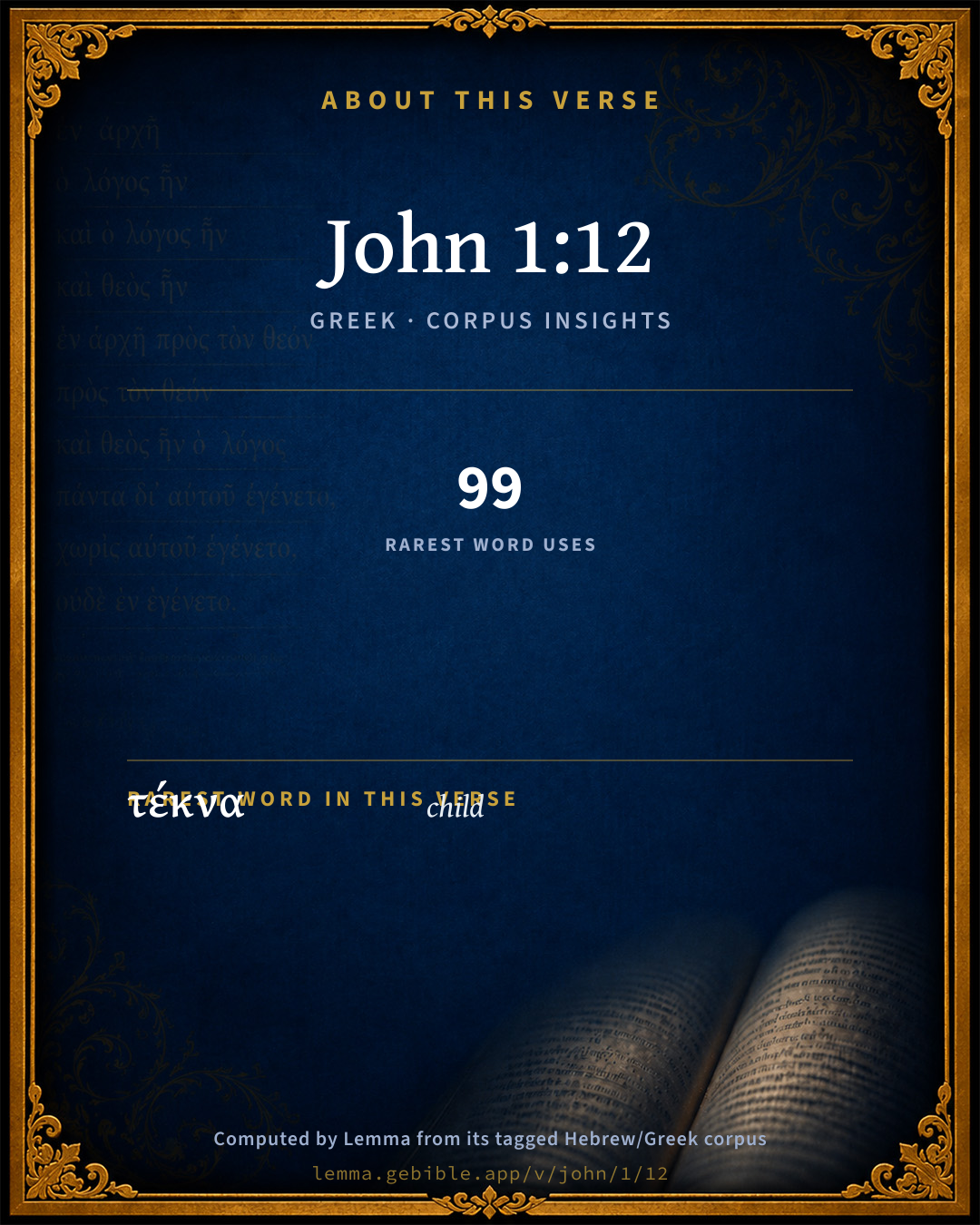
τέκνα
téknon
G5043
“child”
Noun, Nominative, Plural, Neuter
Part of Speech
Noun
Case
Nominative
Number
Plural
Gender
Neuter
Full Thayer's Definition

Origin: from the base of G5098

TDNT: 15:36,8

1. offspring, children a. child b. a male child, a son c. metaph. 1. the name transferred to that intimate and reciprocal relationship formed between men by the bonds of love, friendship, trust, just as between parents and children 2. in affectionate address, such as patrons, helpers, teachers and the like employ: my child 3. in the NT, pupils or disciples are called children of their teachers, because the latter by their instruction nourish the minds of their pupils and mould their characters 4. children of God: in the OT of "the people of Israel" as especially dear to God, in the NT, in Paul's writings, all who are led by the Spirit of God and thus closely related to God 5. children of the devil: those who in thought and action are prompted by the devil, and so reflect his character d. metaph. 1. of anything who depends upon it, is possessed by a desire or affection for it, is addicted to it 2. one who is liable to any fate 1c e. thus children of a city: it citizens and inhabitants 1. the votaries of wisdom, those souls who have, as it were, been nurtured and moulded by wisdom 2. cursed children, exposed to a curse and doomed to God's wrath or penalty
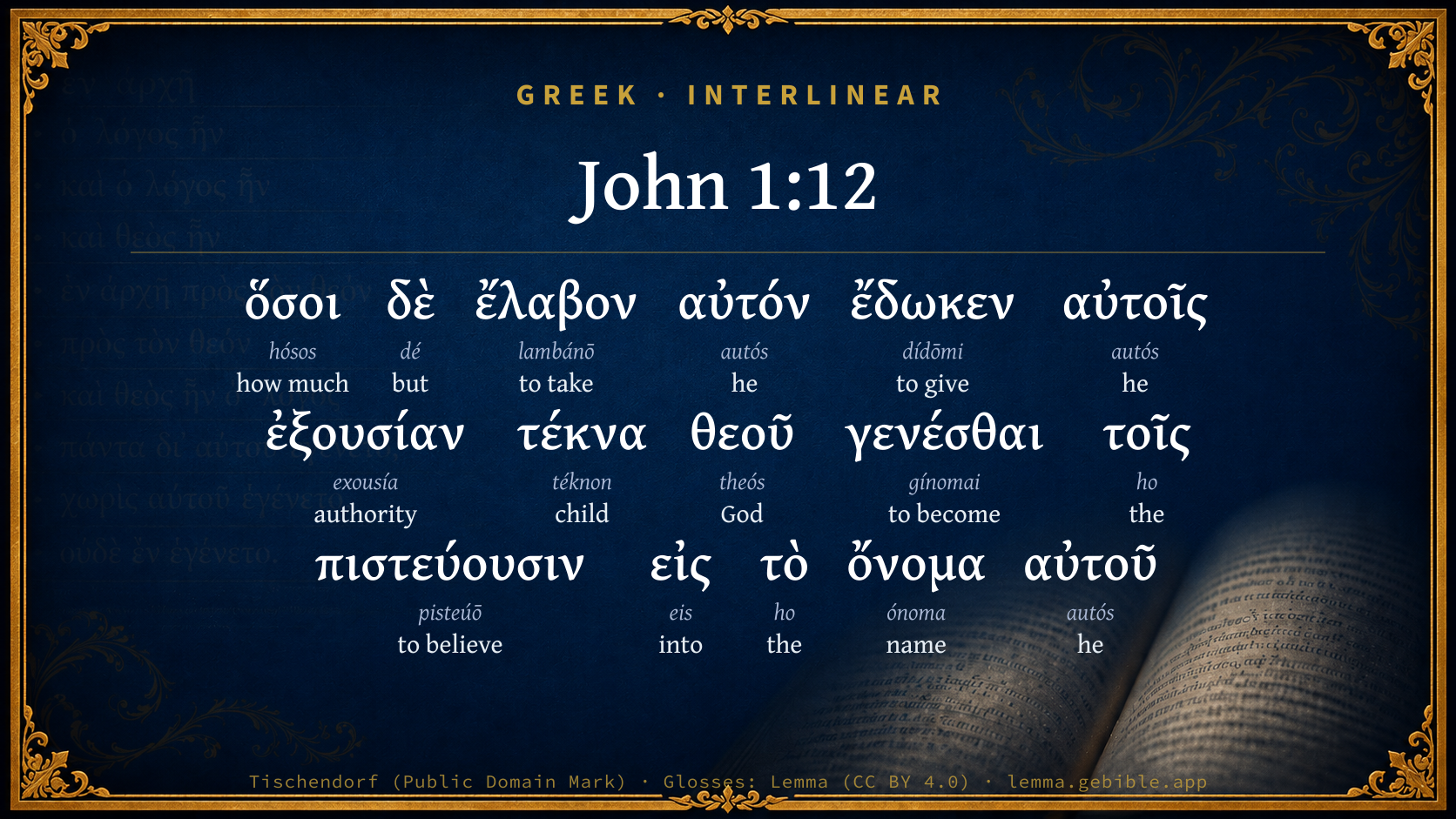
  1. ὅσοι hósos G3745 “how much” Correlative pronoun, Nominative, Plural, Masculine
  2. δὲ dé G1161 “but” Conjunction
  3. ἔλαβον lambánō G2983 “to take” Verb, Aorist, Active, Indicative, 3rd person, Plural
  4. αὐτόν autós G846 “he” Personal pronoun, Accusative, Singular, Masculine
  5. ἔδωκεν dídōmi G1325 “to give” Verb, Aorist, Active, Indicative, 3rd person, Singular
  6. αὐτοῖς autós G846 “he” Personal pronoun, Dative, Plural, Masculine
  7. ἐξουσίαν exousía G1849 “authority” Noun, Accusative, Singular, Feminine
  8. θεοῦ theós G2316 “God” Noun, Genitive, Singular, Masculine
  9. γενέσθαι gínomai G1096 “to become” Verb, Aorist, Middle deponent, Infinitive
  10. τοῖς ho G3588 “the” Article, Dative, Plural, Masculine
  11. πιστεύουσιν pisteúō G4100 “to believe” Verb, Present, Active, Participle, Dative, Plural, Masculine
  12. εἰς eis G1519 “into” Preposition
  13. τὸ ho G3588 “the” Article, Accusative, Singular, Neuter
  14. ὄνομα ónoma G3686 “name” Noun, Accusative, Singular, Neuter
  15. αὐτοῦ autós G846 “he” Personal pronoun, Genitive, Singular, Masculine

About this verse

These counts appear in no published source. They are computed here, from the morphology-tagged text and Lemma’s own curated glosses. What Lemma adds →

16
words
13
distinct lemmas
Gospels
section

Repetition

Words recur within this verse:

  • αὐτόν he G846 ×3
  • τοῖς the G3588 ×2

Cross-references

21

Topical passages linked to John 1:12 in the Treasury of Scripture Knowledge — connected by theme and wording, ordered by reader-vote popularity; previews shown in the World English Bible.

  • Galatians 3:26 For you are all children of God, through faith in Christ Jesus.
  • Romans 8:14 For as many as are led by the Spirit of God, these are children of God.
  • 1 John 3:1 Behold, how great a love the Father has bestowed on us, that we should be called children of God! For this cause the world doesn't know us, because it didn't know him.
  • 2 Corinthians 6:17–18 Therefore, "'Come out from among them, And be separate,' says the Lord, 'Touch no unclean thing. I will receive you.
  • Galatians 4:6 And because you are children, God sent out the Spirit of his Son into your hearts, crying, "Abba, Father!"
  • John 3:18 He who believes in him is not judged. He who doesn't believe has been judged already, because he has not believed in the name of the one and only Son of God.
  • Matthew 10:40 He who receives you receives me, and he who receives me receives him who sent me.
  • 1 John 5:12–13 He who has the Son has the life. He who doesn't have God's Son doesn't have the life.
  • Colossians 2:6 As therefore you received Christ Jesus, the Lord, walk in him,
  • Isaiah 56:5 To them will I give in my house and within my walls a memorial and a name better than of sons and of daughters; I will give them an everlasting name, that shall not be cut off.
  • John 20:31 but these are written, that you may believe that Jesus is the Christ, the Son of God, and that believing you may have life in his name.
  • 2 Peter 1:4 by which he has granted to us his precious and exceedingly great promises; that through these you may become partakers of the divine nature, having escaped from the corruption that is in the world by lust.
  • Hosea 1:10 Yet the number of the children of Israel will be as the sand of the sea, which can't be measured nor numbered; and it will come to pass that, in the place where it was said to them, 'You are not my people,' they will be called 'sons of the living God.'
  • Matthew 12:21 In his name, the Gentiles will hope."
  • Jeremiah 3:19 But I said, How I will put you among the children, and give you a pleasant land, a goodly heritage of the hosts of the nations! and I said, You shall call me My Father, and shall not turn away from following me.
  • 1 John 3:23 This is his commandment, that we should believe in the name of his Son, Jesus Christ, and love one another, even as he commanded.
  • John 11:52 and not for the nation only, but that he might also gather together into one the children of God who are scattered abroad.
  • Acts 3:16 By faith in his name has his name made this man strong, whom you see and know. Yes, the faith which is through him has given him this perfect soundness in the presence of you all.
  • John 1:7 The same came as a witness, that he might testify about the light, that all might believe through him.
  • Matthew 18:5 Whoever receives one such little child in my name receives me,
  • John 2:23 Now when he was in Jerusalem at the Passover, during the feast, many believed in his name, observing his signs which he did.

Cross-references courtesy of OpenBible.info (CC BY 4.0).

Commentary

Notes on John 1:12 from classic Christian and Jewish commentators (each source and its license shown beneath its notes). The classic Christian expositions comment on the surrounding passage and are grouped to its opening verse, so a note may address several verses; the Jewish commentaries on the Tanakh (Rashi and others) are per-verse, so they appear only where the commentator wrote on this verse.

Lemma curates 59 commentaries, every one of them public domain or Creative Commons licensed, each selected and text-cleaned for this edition rather than reprinted as found. About our sources →

John Calvin's Commentaries

12. But to as many as received him. That none may be retarded by this stumbling-block, that the Jews despised and rejected Christ, the Evangelist exalts above heaven the godly who believe in him; for he says that by faith they obtain this glory of being reckoned the sons of God. The universal term, as many, contains an implied contrast; for the Jews were carried away by a blind vaunting, as if they exclusively had God bound to themselves. The Evangelist declares that their condition is changed, because the Jews have been rejected, and their place, which had been left empty, is occupied by the Jews; for it is as if he transferred the right of adoption to strangers. This is what Paul says, that the destruction of one nation was the life of the whole world, (Romans 11:12;) for the Gospel, which might be said to have been banished from them, began to be spread far and wide throughout the whole world. They were thus deprived of the privilege which they enjoyed above others. But their impiety was no obstruction to Christ; for he erected elsewhere the throne of his kingdom, and called indiscriminately to the hope of salvation all nations which formerly appeared to have been rejected by God.

He gave them power. The word ἐξουσία here appears to me to mean a right, or claim; and it would be better to translate it so, in order to refute the false opinions of the Papists; for they wickedly pervert this passage by understanding it to mean, that nothing more than a choice is allowed to us, if we think fit to avail ourselves of this privilege. In this way they extract free-will from this phrase; but as well might they extract fire from water. There is some plausibility in this at first sight; for the Evangelist does not say that Christ makes them sons of God, but that he gives them power to become such. Hence they infer that it is this grace only that is offered to us, and that the liberty to enjoy or to reject it is placed at our disposal. But this frivolous attempt to catch at a single word is set aside by what immediately follows; for the Evangelist adds, that they become the sons of God, not by the will which belongs to the flesh, but when they are born of God. But if faith regenerates us, so that we are the sons of God, and if God breathes faith into us from heaven, it plainly appears that not by possibility only, but actually — as we say — is the grace of adoption offered to us by Christ. And, indeed, the Greek word, ἐξουσία is sometimes put for ἀξίωσις, (a claim,) a meaning which falls in admirably with this passage.

The circumlocution which the Evangelist has employed tends more to magnify the excellence of grace, than if he had said in a single word, that all who believe in Christ are made by him sons of God. For he speaks here of the unclean and profane, who, having been condemned to perpetual ignominy, lay in the darkness of death. Christ exhibited an astonishing instance of his grace in conferring this honor on such persons, so that they began, all at once, to be sons of God; and the greatness of this privilege is justly extolled by the Evangelist, as also by Paul, when he ascribes it to

God, who is rich in mercy, for his great love with which he loved us, (Ephesians 2:4.)

But if any person shall prefer to take the word power in its ordinary acceptation, still the Evangelist does not mean by it any intermediate faculty, or one which does not include the full and complete effect; but, on the contrary, means that Christ gave to the unclean and the uncircumcised what appeared to be impossible; for an incredible change took place when out of stones Christ raised up children to God, (Matthew 3:9.) The power, therefore, is that fitness (ἱκανότης) which Paul mentions, when he

gives thanks to God, who hath made us fit (or meet) to be partakers of the inheritance of the saints, (Colossians 1:12.)

Who believe in his name. He expresses briefly the manner of receiving Christ, that is, believing in him. Having been engrafted into Christ by faith, we obtain the right of adoption, so as to be the sons of God. And, indeed, as he is the only-begotten Son of God, it is only so far as we are members of him that this honor at all belongs to us. Here again the notion of the Papists about the word power is refuted. The Evangelist declares that this power is given to those who already believe. Now it is certain that such persons are in reality the sons of God. They detract too much from the value of faith who say that, by believing, a man obtains nothing more than that he may become a son of God, if he chooses; for instead of present effect they put a power which is held in uncertainty and suspense.

The contradiction appears still more glaring from what immediately follows. The Evangelist says that those who believe are already born of God It is not therefore, a mere liberty of choice that is offered, since they obtain the privilege itself that is in question. Although the Hebrew word, שם (Name) is sometimes used to denote power, yet here it denotes a relation to the doctrine of the Gospel; for when Christ is preached to us, then it is that we believe in him. I speak of the ordinary method by which the Lord leads us to faith; and this ought to be carefully observed, for there are many who foolishly contrive for themselves a confused faith, without any understanding of doctrine, as nothing is more common among the Papists than the word believe, though there is not among them any knowledge of Christ from hearing the Gospel. Christ, therefore, offers himself to us by the Gospel, and we receive him by faith.

13. Who were born not of blood Some think that an indirect reference is here made to the preposterous confidence of the Jews, and I willingly adopt that opinion. They had continually in their mouth the nobleness of their lineage, as if, because they were descended from a holy stock, they were naturally holy. And justly might they have gloried in their descent from Abraham, if they had been lawful sons, and not bastards; but the glowing of faith ascribes nothing whatever to carnal generation, but acknowledges its obligation to the grace of God alone for all that is good. John, therefore, says, that those among the formerly unclean Gentiles who believe in Christ are not born the sons of God from the womb, but are renewed by God, that they may begin to be his sons. The reason why he uses the word blood in the plural number appears to have been, that he might express more fully a long succession of lineage; for this was a part of the boasting among the Jews, that they could trace their descent, by an uninterrupted line, upwards to the patriarchs.

The will of the flesh and the will of man appear to me to mean the same thing; for I see no reason why flesh should be supposed to signify woman, as Augustine and many others explain it. On the contrary, the Evangelist repeats the same thing in a variety of words, in order to explain it more fully, and impress it more deeply on the minds of men. Though he refers directly to the Jews, who gloried in the flesh, yet from this passage a general doctrine may be obtained: that our being reckoned the sons of God does not belong to our nature, and does not proceed from us, but because God begat us willingly, (James 1:18,) that is, from undeserved love. Hence it follows, first, that faith does not proceed from ourselves, but is the fruit of spiritual regeneration; for the Evangelist affirms that no man can believe, unless he be begotten of God; and therefore faith is a heavenly gift. It follows, secondly, that faith is not bare or cold knowledge, since no man can believe who has not been renewed by the Spirit of God.

It may be thought that the Evangelist reverses the natural order by making regeneration to precede faith, whereas, on the contrary, it is an effect of faith, and therefore ought to be placed later. I reply, that both statements perfectly agree; because by faith we receive the incorruptible seed, (1 Peter 1:23,) by which we are born again to a new and divine life. And yet faith itself is a work of the Holy Spirit, who dwells in none but the children of God. So then, in various respects, faith is a part of our regeneration, and an entrance into the kingdom of God, that he may reckon us among his children. The illumination of our minds by the Holy Spirit belongs to our renewal, and thus faith flows from regeneration as from its source; but since it is by the same faith that we receive Christ, who sanctifies us by his Spirit, on that account it is said to be the beginning of our adoption.

Another solution, still more plain and easy, may be offered; for when the Lord breathes faith into us, he regenerates us by some method that is hidden and unknown to us; but after we have received faith, we perceive, by a lively feeling of conscience, not only the grace of adoption, but also newness of life and the other gifts of the Holy Spirit. For since faith, as we have said, receives Christ, it puts us in possession, so to speak, of all his blessings. Thus so far as respects our sense, it is only after having believed — that we begin to be the sons of God. But if the inheritance of eternal life is the fruit of adoption, we see how the Evangelist ascribes the whole of our salvation to the grace of Christ alone; and, indeed, how closely soever men examine themselves, they will find nothing that is worthy of the children of God, except what Christ has bestowed on them.

John Calvin's Commentaries (1540-1563) — public domain. Text from the Calvin Translation Society English edition (1840s-50s) via the Christian Classics Ethereal Library (ccel.org). Calvin's coverage is partial (roughly two-thirds of the Bible); uncommented books and verses are honest gaps, never fabricated. The 19th-century editor's footnotes and remarks are omitted so the notes are faithfully Calvin's own voice.

The Biblical Illustrator

Joseph S. Exell

Joh_1:12-14

As many as received Him, to them gave He power to become the sons of God

St.

Johns first view of Christ the key to his Gospel

I. These verses DESCRIBE THE SPIRITUAL EXPERIENCE OF ST. JOHN. In this point of view the order of time is different from the order of the statements. The several steps are these

1. The apprehension of the glory of Jesus,

2. The receiving Him and believing on His name.

3. The effect of the power to become sons of God.

This agrees with the actual experience of the evangelist.

1. He sees Jesus as pointed out by the Baptist. But where was the glory?

(1) That of the Lamb of God.

(2) The revelation of grace and truth in him. Gods infinite love, holiness, justice: His own self-sacrifice.

2. He goes home with Jesus and gave himself up to His gracious influences, believed on His name.

3. What followed we know. He became a son of God.

II. THIS EXPERIENCE DETERMINED THE STRUCTURE, SUBSTANCE, AND SPIRIT OF THE GOSPEL.

1. It serves to account for the subordinate place which miracles and Christs external life generally hold in it. Johns grand purpose, as marked by his own experience, was to illustrate the self-commending glory of Christ as the Word and only-begotten of the Father, that those who had never seen Him with the eye of sense might come to the blessedness of those who had not seen and yet had believed.

2. It serves to account for the prominent place which the inner life of Christ and the manifestation of His Sonship-glory occupies here. The two grand pivots on which the Gospel turns are Christ the LIGHT, and Christ the LIFE. Christ the Light, revealing the Father and all that concerns the Father; Christ the Life, communicating by the Spirit a new life to men so as to make them Gods sons. Its twofold purpose is to set forth Christ as the Incarnate Word and Only Begotten, full of grace and truth; and also the reception of Christ, the believing on His name as the commencement of the new life of sonship. Thus it is that so much prominence is given to Christs relation to the Father on the one hand, and to the fellowship of Christ with His people on the other.

3. From these considerations we see the groundlessness of the objections against the Johannian authorship of the Gospel. Given Johns conversion, as here shadowed forth, and his warm, fervid nature, his life of Jesus could not well have been any other than it is.

III. THE MORE GENERAL RELATIONS OF THE SUBJECT, as setting forth the essential glory of Christ and the glory communicated to all who, by receiving Him, become sons of God.

1. What is the connection between the two? That there is a connection is seen in the difference between John and his companions and the mass of the Jews. The one perceived His glory, the other saw it not. To the one He appeared a miserable pretender, to the other the Eternal Son. Moreover they recognized in Him the Saviour that taketh away the sins of the world. They received Him, and then the standing and spirit of sonship became theirs.

2. How is it that this view of Christs glory is followed by such effects?

(1) By such means we see our emptiness, guilt, and misery.

(2) But He invites us to Him, tells us of His fulness, pardon, grace, asks us to receive Him and let Him put forth His power.

(3) Must we not welcome Him? The blessed change is wrought in the very act of seeking it. (W. G. Blaikie, D. D.)

Receiving Christ and becoming sons

I. CHRIST WHO HAS COME INTO THE WORLD SEEKS ADMISSION TO THE HEART as a lawful and everlasting tenant. The Christ in the book, in the creed, in the church, effects but little for us. Christ in the heart becomes all our salvation and desire.

II. THE RECEPTION OF CHRIST IN THE HEART IS FOLLOWED BY SENSING.

1. There is a natural sonship pertaining to all men; for we are all His offspring.

2. There is a special, redemptive, restored sonship bestowed on those who receive Christ.

3. All that pertains to this sonship is supernatural. Adam was not a son by blood, nor by the will of the flesh, but by the will of God; and a restored son is as marvellous a creation as Adam.

III. THIS SONSHIP INVOLVES A NEW BIRTH AND ELEVATION TO THE HIGHEST POSSIBLE POSITION. There is nothing higher than being admitted to sonship with God. What we want is not some new spiritual dignity, but the recognition of this exalted condition.

IV. TRUE FAITH IS HERE DESCRIBED AND EVIDENCED.

1. Faith in receiving. Christ comes into the believer. Christ without does not save, but Christ within.

2. Faith is evidenced by the opening of the eyes to see the glory of Christ, and the affiliation to God which follows.

V. GOD HERE RECEIVES ALL THE PRAISE.

1. The power and the will are of God. Ascribe to Him the wisdom and the glory.

2. The Christ whom we receive is Gods unspeakable gift.

3. Faith and its attendant privileges are by power bestowed by God. (S. Martin.)

The connection between receiving Christ and becoming sons

I. These two things are connected IN RESPECT OF GOD; it is the will of God that all should believe in Christ, and He has appointed the mediation of Christ as the channel through which all should receive salvation, and all that is necessary for its attainment.

II. These things are connected IN RESPECT OF CHRIST: for, in consequence of what He has done, all may become the sons of God, and, may be enriched with all the blessings of His grace.

III. They are connected IN RESPECT OF MEN: all who would obtain salvation must receive Jesus Christ as the only Saviour. (C. C.Tittman, D. D.)

That act by which we do effectually apply Christ to our own souls

I. THE NATURE OF THIS RECEIVING OF CHRIST.

1. No man can do this in the darkness of natural ignorance. If we know not His nature and offices we do not take, we mistake Christ. The receiving act of faith, then, is guided by knowledge.

2. This receiving of Christ implies the assent of the understanding to the truths of Christ in the gospel--His Person, offices, incarnation, satisfaction--which assent, although it is not saving faith, is its groundwork. This is more than conjecture or opinion, it is belief.

3. This also implies hearty approbation, liking, and estimation; yea, the very acquiescence of our souls in Christ as the most excellent remedy for wants, sins, and dangers (1Pe_2:7). There are two things in Christ which must gain the approbation of the soul.

(1) That it can find nothing unsuitable to it in Christ as it does find in the best creatures--no weakness, pride, inconstancy, or passion. He is the altogether lovely.

(2) That it can find nothing wanting in Christ necessary or desirable. In Him is the fulness of wisdom, righteousness, sanctification, and redemption.

4. It consists in the consent and choice of the will; and this is the opening of the heart and stretching forth of the soul to receive Him (see Christs complaint, Joh_5:40, and Eph_1:19).

5. The respect that this act of acceptance has unto the terms upon which Christ is tendered to us in the Gospel. Faith answers the gospel offer, as the impress on the wax does the engraving on the seal (1Co_15:11). There is no receiving Christ but on His own terms.

(1) He is offered sincerely and really, and is received with a faith unfeigned 1Ti_1:5).

(2) He is offered entirely, and is received in all His offices as Christ Jesus the Lord (Act_16:13).

(3) He is offered exclusively, and the soul singly relies on Him (Ac 1Co_3:11), and not partly on His righteousness and our own.

(4) He is offered freely as the gift, not the sale of God (Joh_4:10;Isa_55:1.; Rev_22:17). So the believer comes to Him with an empty hand.

(5) He is offered orderly. First His Person, then His privileges (Rom_8:32), so the believer does not marry His portion first.

II. THIS IS THE JUSTIFYING AND SAVING ACT OF FAITH.

1. The faith which gives the soul right and title to spiritual adoption, with all the privileges and benefits thereof, is true saving faith.

2. That only is saving faith which is in all true believers, in none but true believers, and in all true believers at all times.

III. THE EXCELLENCY OF THIS ACT OF FAITH (2Pe_1:7; JmsJohn 6:29).

1. Considered qualitatively it has the same excellency that all other precious graces have. It is the fruit of the Spirit. It is singled out to receive Christ. As it is Christs glory to be the door of salvation, so it is faiths glory to be the golden key that opens that door.

(1) It is the bond of our union with Christ (Eph_3:17).

(2) It is the instrument of our justification (Rom_5:1).

(3) It is the spring of our spiritual peace and joy (Rom_5:1; 1Pe_1:8-9).

(4) It is the means of our spiritual livelihood and subsistence. Take away faith and all the others die (Gal_2:20).

(5) It is the great scope and drift of the Gospel to get men to believe. The urgent commands aim at this (1Jn_3:23; Mar_1:14-15; Joh_12:36). Hither, also, look the great promises and encouragements (Joh_6:35-37; Mar_16:16). The opposite sin of unbelief is everywhere threatened (Joh_16:8-9; Joh_3:18; Joh_3:35).

IV. APPLICATION:

1. For information: If there be life in receiving Christ, there must be death in rejecting Him.

2. If faith be accepting Christ, then there are fewer believers among professors than were thought to be, and more believers than dare conclude themselves such.

3. Those who have the least degree of saving faith, have cause for ever to admire the bounty of the grace of God to them therein (Eph_1:3).

4. For examination:

(1) The antecedents of faith--illumination (Act_26:18); conviction Mar_1:15); self-despair (Act_2:37); vehement and earnest cries to God for faith.

(2) The concomitants of faith--seriousness (Act_16:29); humiliation Eze_16:63; Luk_8:38); a weary condition (Mat_11:28); a longing condition.

(3) The consequents of faith--evangelical meltings (Zec_12:10); love to Christ, His ways, and His people (Gal_5:6); heart purity Act_15:9); obedience (Rom_16:26).

5. For exhortation:

(1) What is in Christ whom you are to receive?

(2) What is the offer of Christ by the gospel?

(3) What is in the rejecting of that offer? (J. Flavel.)

Reception of Christ our introduction into sonship

I. THE HONOUR. To become sons of God not merely by adoption, but by generation (Rom_8:16; 1Jn_3:1). On our side is sonship, on Gods Fatherhood. Sonship is

1. Higher;

2. Nearer;

3. More blessed;

4. More glorious than--creaturehood. There is sonship in the angels, in unfallen man; but this is beyond these. As

(1) Introducing us into a more intimate intercourse;

(2) Making us partakers of the Divine nature.

II. THE GIVER OF IT. Christ Himself; elsewhere it is the Father. All gifts are in Christs hands--living water and bread of life, Himself, sonship. This right or power of sonship He purchased for us; for those who had no right, or power, or title.

III. THE WAY OF ATTAINMENT.

1. Receiving Him--doing the reverse of what Israel had done; accepting and owning Him for all that God announced Him to be.

2. Believing on His name, i.e, Himself.

IV. THE PERSONAL CHANGE THROUGH WHICH THIS IS REACHED. Born:

1. Not of natural descent.

2. Not by natural generation.

3. Not by human adoption.

4. But of God (Jam_1:18). (H. Bonar, D. D.)

The grace of Christ to those who received Him

The grace appears in

I. HIS PREVAILING WITH MEN TO EMBRACE THE OFFER MADE TO THEM, and in what is implied in that.

1. Christ offers Himself, and we welcome and receive Him. The first acting of true faith is to accept Himself; not merely the special benefit He brings.

2. We exercise implicit confidence in Him. We have a right knowledge of Him; rejoice in His character; accept and hide Him in our hearts.

3. In the form in which Jesus is proclaimed in the Gospel, His saved ones receive and believe in Him. So we preach; so ye believed. There is a correspondence between the Gospel and faith of the same kind as that between the seal and the wax.

(1) Christ is offered sincerely, and He must be accepted with a faith unfeigned.

(2) He is offered exclusively, and must be accepted as the sole basis of our hope.

(3) He is offered as a gift; we must not attempt to merit Him.

4. The actual committing of our all to Christ When we receive Him. What is the saving act of faith?

(1) Not assent, although that must be a part of it.

(2) Not assurance, although that will follow it.

(3) But acceptance of Him and confidence in Him.

II. THE SPECIAL PRIVILEGE WHICH HE BESTOWS ON THOSE WHO RECEIVE HIM.

1. The saved are by nature the children of wrath; but in His person God is reconciled towards them.

2. Having reconciled them, He makes them sons--co-heirs with Himself.

3. Of Him also is the comfort and dignities of sonship.

III. THE CHANGE WROUGHT IN THEM WHO RECEIVE HIM, to which their accepting Him is ascribed.

1. A new form of existence--a new birth; all things have become new.

2. This change is

(1) not by natural inheritance;

(2) nor by the operation of the natural will;

(3) nor the fruit of superior endowment or acquisition;

(4) but of God, by the office and operation of the Spirit. (A. Beith, D. D.)

Mans part in the advent

I. THE RECEPTION. A true reception of Christ for every man alike is of three parts.

1. Belief that He is what He says He is. For any messenger the first condition of acceptance is that He be found to be what He claims to be--much more the Saviour of mankind.

2. Sympathy. A plenipotentiary, an agent, a purely mental operator does not need this. But the moment you include a moral purpose, spiritual influence, there must be common feeling and assimilation. Interests must be felt to be identical. Loyalty must bind the subject to his king. Enthusiasm must mount at the leaders name. If Christs purpose was to fill human hearts with love, we cannot be His without loving Him.

3. Service: not compulsory, but that which love disdains to call service. In the hungry, sick, ignorant, etc., the Lord makes new advent to your heart every week; and Christ will not be received till everybody within our reach is made, somehow, better by our faith in Him.

II. THE BLESSING. Servants and creatures we were before, and, in a sense--but not the full and glorious sense--children of God. Now sons ofGod, a royal line, conquerors, sufferers rejoicing in the midst of temptation. Born now, their immortal seed remained in them.

III. THOSE WHO BELIEVE IN CHRISTS NAME WILL SEEK TO RECEIVE HIM.

1. By giving up the dearest preference that hurts the simplicity and humility of their faith.

2. In the New Testament, Christian instruction, prayer, doing Gods will; and counting faith, not doubt, the glory, and power, and joy of man.

3. In the communion of His body and blood. (Bishop Huntington.)

A new years guest

The text in connection with Mat_25:35. Suggested by the motto on a new years card.

I. A STRANGER TAKEN IN. House-room is a larger gift than refreshment at the dour. We must not be satisfied with benefactions to His representatives. Notice three strange things.

1. That He was in the world and the Maker of it, and yet a stranger.

(1) When born in the Bethlehem of His father David, there was no room for Him in the inn.

(2) Soon there was no room in the village itself, whence He had to flee into Egypt, a stranger in a strange land.

(3) On His return, there was no room among the mass of the people. Jew and Gentile proved how truly He was a stranger. All this a sadly singular thing; and yet we need not wonder, for how should a wicked and selfish world know Jesus or receive Him.

2. That we should be able to receive the Lord Jesus as a stranger. He has gone to glory, but we can yet receive Him.

(1) By owning Him when and where believers are few and despised.

(2) By showing brotherly kindness to a poor saint.

(3) By holding fast His faithful Word when its doctrines are in ill-repute.

(4) By taking up our cross where Christs precepts are disregarded, His day forgotten, and His worship neglected.

(5) By receiving the gift of spiritual life. Profession is abundant, but the secret life is rare.

3. That Christ will deign to dwell in our hearts. This is a miracle of grace, yet the manner is simple enough.

(1) A humble, repenting faith opens the door, and Jesus enters.

(2) Love shuts to the door with the hand of penitence, and holy watchfulness keeps out intruders.

(3) Meditation, prayer, praise, and obedience, keep the house in order.

(4) And then follows the consecration of our whole life as His people.

II. THE STRANGER MAKING STRANGERS INTO SONS. The moment Christ enters the heart, we are no more strangers and foreigners, but of the household of God.

1. He adopts us and puts us among the children.

2. The designation of sons brings with it a birth, with the actual condition of sons.

3. Living, loving, lasting union seals our sonship.

4. This union creates in us a likeness to God. A small window will let in the great sun; much more will Jesus let in the life, light, and love of God into our souls, making us like God.

III. HAVING RECEIVED JESUS AS A STRANGER, WE FEEL A TENDERNESS HENCEFORTH TOWARDS ALL STRANGERS; for we see in their condition some resemblance to our own. When Christ is in us, we search out opportunities of bringing prodigals, strangers, and outcasts to the great Fathers house. (C. H.Spurgeon.)

Receivers and sons

I. BELIEVING IS A RECEIVING OF CHRIST.

1. Under what notion should we receive Christ? As our Mediator. Isa_61:3-4).

(1) Our Prophet, receiving His doctrine as delivered by Himself Heb_1:2; Heb_2:2-3); by His prophets and apostles (Heb_1:1; Mat_10:40); by His ministers (2Co_5:19-20; Heb_4:11-12).

(2) Our Priest (Heb_7:23-26); and so we must believe

(a) His satisfaction for our sins (2Co_5:21; Heb_9:28; 1Jn_2:2), to the justice and law of God Gal_3:13);

(b) His intercession for our souls (Rom_8:34; Heb_9:11-12; Heb_9:24).

(3) Our King (Psa_110:1-2): so we must

(a) acknowledge His sovereignty (Mat_28:18);

(b) obey His laws (Luk_6:46; Joh_14:15);

(c) submit to His penalties (Col_3:24-25).

2. How should we receive Him?

(1) Penitently (Act_2:36).

(2) Willingly (Psa_110:3).

(3) Affectionately (Luk_14:26).

(4) Constantly (Rev_2:26).

(5) Only (Act_4:12).

II. BELIEVERS ARE THE SONS OF GOD.

1. In what sense? Not by generation, but regeneration (Joh_3:31).

(1) Man lost the favour of God (Rom_5:19).

(2) The Son undertakes his redemption

(a) by becoming man;

(b) by dying, whereby He purchases all believers to Himself, to be members of His body (1Co_6:20; Tit_2:14);

(c) and so from Himself the dead conveys His own spirit unto them Tit_3:5-6).

(3) The Spirit regenerates and makes them new creatures (2Co_5:17).

(4) Being new creatures, they are received into the favour of God Rom_8:15), and made His sons (Rom_8:14).

2. With what privileges?

(1) Privative. They are freed from the slavery of sin (Rom_6:14); from., slavish fears (Rom_8:15); from the curse of the law (Galatians In. 13).

(2) Positive.

(a) They have access to God (Gal_4:6).

(b) They are interested in Gods providence (Rom_8:28; 2Co_6:18).

(c) They rejoice in God (Php_4:4).

(d) God rejoices over them (Zep_3:17).

(e) Their glorious inheritance is assured (Col_1:12; Col_1:18).

(f) This inheritance is witnessed to them here (Rom_8:16-17), and sealed (Eph_4:30), whereof they now have the pledge (Eph_1:13-14).

3. How known?

(1) By prayer (Gal_4:6).

(2) Obedience (1Pe_1:14-15).

(3) Parity (2Jn_3:9).

(4) Conformity to the Divine image (Rom_8:29).

(5) Faith (Son_3:26).

USES.

1. See the honour of believers.

2. Live like the sons of God.

(1) By despising the world.

(2) By patiently enduring all chastisements (Heb_12:6-9.

(3) By longing to come to your inheritance in heaven (Psa_42:1-2). (Bishop Beveridge.)

Faith and its attendant privileges

I. FAITH MAKES THE GRANDEST OF DISTINCTIONS AMONG MEN. He came to His own, and His own received Him not--that is one company; but as many as received Him--that is another.

1. There are many distinctions among men--rich and poor, governors and governed, teachers and taught. But these will pass away. The grand distinction, which will out-last all time, is that of faith or the want of faith.

2. This distinguishing faith is

(1) A receptive faith; one which accepts Christ by confiding, trusting, and depending on Him.

(2) Faith in His name, as

(a) The Word: receiving His messages from the Father.

(b) The Life: receiving His vitality in spirit.

(c) The Light: seeing all things in the light of Christ..

3. This distinction is one which obliterates all others. If a chimney-sweep receives Christ, he is a child of God; so is an emperor--but not the one more than the other.

II. FAITH OBTAINS THE GRANDEST OF ALL ENDOWMENTS. Sons of God.

1. There is a distinction here between son and servant. The believer ceases to be a slave, and becomes a child; and yet he becomes a servant. Christ was first His Fathers Son, and then His servant; so we, being sons, have the joy of serving our Father.

2. We are also sons by likeness--miniatures, and sometimes caricatures, yet resemblances.

3. We are sons, in having the privilege of free access to our Father.

III. FAITH IS THE EVIDENCE OF THE GRANDEST EXPERIENCE. Every believer is a regenerate man. It is of no use to attempt to mend the old nature. A man brought his gun to be repaired. The gunsmith told him it wanted a new stock, lock, and barrel. That looked like making a new one. You must begin de novo. Baptism cannot regenerate; nor blood, the natural way of birth; nor mans carnal will, nor his best will; but God, who, as the Creator, newcreates the soul.

IV. FAITH RAISES THE BELIEVER TO THE NOBLEST CONCEIVABLE CONDITION. He is fitted to be a child of God.

1. Notice the inconceivable honour. All others pale before it.

2. The safety.

3. The happiness.

4. The duties. There is an old French proverb which says, nobility obliges. There is an obligation on nobles. If you are a son of God, you must act like one. (C. H. Spurgeon.)

Faith is receiving

It is the empty cup placed under the flowing stream; the penniless hand held out for the heavenly alms. (C. H. Spurgeon.)

Sonship more than adoption

The sonship is not effected in virtue of a mere act of adoption on the part of God. A child may be taken out of the family to which he originally belonged, and be planted in another; he may get a new name; he may be trained to forget that he had other birth; he may be made heir to great estates; he may be as dearly loved and as tenderly cared for as if he were own child to those who have adopted him: but the fact remains that he is really the child of another, and nature may prove too strong for the new bonds, and he may pine for his native home, and at length go back to it. The sons of God, however, are sons by birth, for such is the significance of the word here used, having not only a new name and position, but also a new life. It is not simply that they are called sons; they are sons, partakers of the Divine nature, with a filial relationship, and a filial resemblance to the eternal God. The sonship is already established in fact and in principle, though it awaits its full manifestation hereafter (1Jn_3:1-2). (J. Calross, D. D.)

Comfort for the dying

When Philip Melanchthon was dying, he said aloud and distinctly to his surrounding friends, I have those words of John concerning the Son of God, my Lord Jesus Christ, before me continually: The world received Him not; but as many as received Him, to them gave He power to become the sons of God, even to them that believe on His name. (R. Besser, D. D.)

Receiving the light

Suppose you were in a dark room in the morning, the shutters closed and fastened, and only as much light coming through the chinks as made you aware it was day outside. And suppose you could say to a companion with you, Let us open the windows, and let in the light. What would you think if he replied, No, no; you must first put the darkness out, or the light will not enter? You would laugh at his absurdity. Just so we cannot put sin out of our hearts to prepare for Christs entering; we must open and take Him in, and sin will flee; fling the window open at once, and let Christ shine in. (J. Edmond, D. D.)

The honour of adoption

I have heard of some fine gentleman in London, dressed in all his best, walking out in the park. He had a poor old father who lived in the country, add who came up dressed in his rustic raiment to see his son. As the son was not at home when the father reached the house, he went into the park to find him. Now the fine gentleman did not absolutely disown his father, but he went out of the park at a pretty sharp trot, for fear anybody should say, Who is that country fellow you were talking with? He did not like to own his father, because he was a labourer. We could not thus wonder if the glorious Lord refused to own us. There is such a come-down from the loftiness of His holiness to the depth of our faultiness. But yet He has such love, such a manner of love, that He bestows upon as this honour, that we should be openly called the sons of God. (C. H. Spurgeon.)

The treasure unreceived

A nobleman once gave a celebrated actress a Bible, telling her at the same time that there was a treasure in it. She, thinking he meant religion, laid the Bible aside. She died, and all she had was sold. The person who bought the Bible, on turning over its leaves, found a £500 note in it. Poor creature! had she read the book, she might not only have found the note, but the pearl of great price. (Sunday School Chronicle.)

Christ must be received

There is dew in one flower and not in another, because one opens its cup and takes it in, while the other closes itself, and the drops run off. God rains His goodness and mercy as wide-spread as the dew, and if we lack them, it is because we will not open our hearts to receive them. (H. W. Beecher.)

Believing is receiving Christ

He comes to your door. He wants to get in. He knocks. He waits. Is not that wonderful? I was lately visiting that part of the country where our beloved Queen stays when she comes to Scotland. She visits among the poor. I saw some of the cottages to which she is in the habit of going. In the house of one of her servants I saw her own likeness, and the likenesses of several of her family--all gifts from themselves. You say, What kindness! what condescension! And so it is: But what would you think if I told you--what I am glad I cannot tell you, for it would not be true--that when they saw the Queen coming, they locked their doors and pretended to be out, and kept her standing knocking at the door, refusing to let her in, though she came to speak kindly to them and to do them good? You would say, Surely the people must not be in their right mind. And yet that is just what King Jesus does--Queen Vietorias King. He comes to your door to bless you, to save you. He says, Behold, I stand at the door and knock. Most people keep Him out, and will not have anything to do with Him. They say, Depart from us, for we desire not the knowledge of Thy ways. Opening the door to Him, saying, Come in, Lord Jesus, come in--taking Him to our heart, and only fearing lest He should ever go away again--is believing. The believing heart is the heart that has let in Jesus, and in which he dwells Eph_3:17). (J. H. Wilson.)

Privileges of adoption

By adoption, God gives us

1. A new name (Num_6:27; Rev_3:12).

2. A new nature (2Pe_1:4). Whom God adopts He anoints; whom He makes sons, He makes saints.

3. A new inheritance (Rom_8:17). When the Danish missionaries in India were translating a catechism, with some of the convetted natives by their side, and when they came to a part where it was said of Christians that they were the sons of God, one of the natives, startled at so bold a saying, as he thought it, said, It is too much; let us rather translate it: They shall be permitted to kiss His feet.

Adoption and justification

Justification is the act of God as a Judge, adoption as a Father. By the former we are discharged from condemnation, and accepted as righteous; by the latter, we are made the children of God and joint-heirs with Christ. By the one, we are taken into Gods favour; by the other, into His family. Adoption may be looked upon as an appendage to justification, for it is by our being justified that we come to a right to all the honours and privileges of adoption. (Dr. Guyse.)

Which were born

Three great negations

The children of God are born

I. NOT OF BLOOD. Grace does not run on the lines of nature. Many beautiful and graceful things do come by gentle and noble blood, but not this. It needs a very narrow field of observation to convince us that no parent, however pious, can command the conversion of his children. Else why should there be in this world that bitterest spectacle of a pious parents heart being broken by a wicked child!

II. NOT OF THE WILL OF THE FLESH. The expression relates to any desire which, ruling in a mans mind, might be supposed to lead him to some act whereby he should become a child of God, and the idea is utterly repelled. Every one who is a subject of the grace of God is so first passively, that afterwards he may be so actively. He is first acted upon by a will and power without him, and then he acts out that will and manifests that power.

III. Not of the will of man. Observe the steps. Not of parents, not of self, nor of any creature whatsoever. One man, indeed, may will the conversion of another; and if he clothe that will with prayer, if he offer that will with faith, and if he does all in his power to forward that will, God may give him that mans soul. But God never promises He will do this. A soul passes into the family of God and becomes an heir in the register of sons when he receives Christ, and only then. (J. Vaughan, M. A.)

The three negations illustrated

When it pleased God to bring Abraham and his family into covenant with Him, that family consisted of three classes of persons; first of all, there were his own children; secondly, there were those who were born of his men-servants and maid-servants; thirdly, there were those slaves, whom he purchased and adopted. All these three classes were admitted into covenant with God, by reason of their relation to Abraham. Abraham took Ishmael his son, and all that were born in his house, and all that were bought with his money, and circumcised them Gen_17:23). Of these classes, Ishmael was born of blood, as being his own flesh and blood, as we say; those born of the flesh were the other children born in his house, not his own; and those born of the will of man were those who, having no right to his protection, being yet bought of his free will, acquired a right by purchase and adoption. To these three classes were the benefits of the first covenant confined.… The truth, which St. John here announces, is that to all who received the message of the Lord Jesus, all who believed on His Name and submitted to His ordinances, to all those He gave the same power, even to become sons of God Gen_3:16-17; Rom_5:13). (G. Cornish.)

The being born of blood and of God considered

I. In their ANTAGONISM.

II. In their essential DISTINCTION.

III. In their congenial CONNECTION.

IV. In the MEDIATOR OF THEIR UNION. (Lange.)

The new, celestial, divine birth constitutes the true nobility of grace as contrasted with

I. The aristocracy of BIRTH.

II. The aristocracy of MONEY.

III. The aristocracy of MERIT.

IV. The aristocracy of FAME. (P. Schaff, D. D.)

Not of blood

The blood through which the chyle is distributed to the different parts of the body is the seat of life, hence the connection between child and parents is called blood relationship; and in classic usage also we have the expression to spring from the blood--that is, from the seed of any one (Act_17:26). (Tholuck.)

Not of the will of man

According to the teaching of some men, how is it? I am a minister of God--I am a man--as a man I may will to take a child and baptize it, and I may will to baptize it by a certain hour of the clock; and just as I am going to baptize it, I may will to put it off till to.morrow; and when to-morrow comes, I may will that I will not baptize that child at all--for if baptized, the child may die. And so, according to the caprice of my will, the child is baptized at this hour, or at that, to-day, or to-morrow, or it is not baptized at all; and therefore, following the caprice of my will, and just according to my will, the child is inevit ably a child of God at this time of the clock, or at that time of the clock--today, or to-morrow, or the next day, or never at all. What, I ask, is this but to be born of the will of man? (J. Vaughan, M. A.)

The simultaneity of faith and regeneration

We must be careful that we do not interpet the words which were born as if the new birth was a change which takes place in a man after he has believed in Christ, and is the next step after faith. Saving faith and regeneration are inseparable. The moment that a man really believes in Christ, however feebly, he is born of God. The weakness of his faith may make him unconscious of the change, just as a new-born infant knows little or nothing about itself. Bat where there is faith there is always new birth, and where there is no faith there is no regeneration. (Bishop Ryle.)

The spirituality of religion

This verse is most emphatically in the style of John. Never can he lose sight of the perfect spirituality of Jesus Christs work. John shows the very religiousness of religion. Christianity is to him more than a history, more than an argument, more than a theology--it is a spiritual revelation to the spiritual nature of man. On the part of man it is to be not an attitude, but a life--the very mystery of his spirit, too subtle for analysis, too strong for repression, too divine to be tolerant of corruption. (J. Parker, D. D.)

The higher generation

The result of receiving Him remains to be explained. How could they become sons of God? The word which has been used (Joh_1:12) excludes the idea of adoption, and asserts the natural relation of child to father. The nation claimed this through its descent from Abraham. But they are Abrahams children who are of Abrahams faith. There is a higher generation, which is spiritual, while they thought only of the lower, which is physical. The condition is the submissive receptivity of the human spirit. The origin of life is not of blood, nor of the will of the flesh, nor of the will of man, but of God. (H. W. Watkins, D. D.)

The Biblical Illustrator, edited by Joseph S. Exell (c. 1880s–1900s) — public domain. Text from a community e-Sword module.

Joseph Benson's Commentary

Joh 1:12-13. But as many as received him — As the true Messiah, and according to the various offices and characters which he sustains: learning of him, as a teacher, the infinitely important lessons of his grace; relying on him with penitent and believing hearts, as a mediator, that is, on his sacrifice and intercession, for acceptance with God; applying to him, in faith and prayer, as a Redeemer and Saviour, for the redemption and salvation which he has to bestow; as many as are subject to him as their King and Governor, and prepare to meet him as their Judge: to them — Whether Jews or Gentiles; gave he power — Or privilege, as εξουσιαν implies; to become the sons of God — To stand related to him, not merely as subjects to their king, or servants to their master, but as children to their father; being taken under his peculiar protection, direction, and care; being favoured with liberty of access to him, and intercourse with him, and constituted his heirs, and joint heirs with Christ of the heavenly inheritance: even to them that believe on his name — With their hearts unto righteousness, or with a faith working by love. Nor are they constituted his children merely by adoption, but they are made such also and especially by regeneration, being born, not of blood — Not by descent from Abraham; nor by the will of the flesh — By natural generation, or by the power of corrupt nature; nor by the will of man — Circumcising or baptizing them; but of God — By his Spirit creating them anew.

Joseph Benson's Commentary on the Old and New Testaments (1811–1818) — public domain. Text from a community e-Sword module.

Tyndale Open Study Notes

Tyndale Open Resources

1:12 Only through divine renewal can people follow the light and enter God’s family (3:1-17). • Individuals must believe in Christ to become children of God (12:35-36).

Tyndale Open Study Notes — © Tyndale Open Resources, licensed CC BY-SA 4.0. Text via the HelloAO Bible API.

Bengel's Gnomon

Johann Albrecht Bengel

Joh 1:12. Ὅσοι, as many as) even [including also] such as previously had not been ἴδιοι, His own.—ἔλαβον) This verb differs from καταλαμβάνειν, Joh 1:5, and from παραλαμβάνειν, Joh 1:11. Καταλαμβανω is applied to that which is close by: παραλαμβάνω, that which is offered: λαμβάνω, of my own accord. Παραλαμβάνειν was the part of the Jews, whom the Truth was appertaining to [spectabat]; λαμβάνειν is the part also of the Gentiles, whom grace appertaineth to [spectat]. In Joh 1:12-13 mere external differences are taken away most effectually. Gal 3:26, etc., “For ye are all the children of God by faith in Christ Jesus.”—ἔδωκεν, He gave) This is the Glory of Christ, the Only-begotten Son. It belongs to the Divine authority to make Sons OF GOD: as it belongs to the Light, to make sons of light, ch. Joh 12:36, “Believe in the Light, that ye may be the children of light.”—ἐξουσίαν, power) The power[17] does not precede the γένεσιν τέκνων or filiation, as if they were two distinct things: but the filiation itself is this power, or, in other words, dignity. A great fact! Joh 8:36.[18]—τέκνα Θεοῦ—τοῖς πιστεύουσιν,) sons OF GOD—to them that believe) Two weighty truths are set before us, of which the former is elucidated in Joh 1:13; the second in Joh 1:14, where the manifestation of the Word in the flesh is not so much recorded as it was accomplished, but rather as it was believed: which view the series of things down from Joh 1:6 proves.—γἐνεσθαι, to become) whereas Jesus is the Son of God.—ὄνομα, the name) The name of the Only-begotten. For to this is to be referred Joh 1:14. The connection is inferred from the kindred term τέκνα, children [sons].

[17] Potestas, legitimate power, authority; not mere δύναμις, potentia, might.—E. and T.

[18] If the Son, therefore, shall make you free, ye shall be free indeed. Comp. Gal 4:6.—E. and T.

Bengel's Gnomon of the New Testament — English translation (T&T Clark, Edinburgh, 1860) — public domain. Text from a community e-Sword module.

Meyer's Critical & Exegetical Commentary

Heinrich August Wilhelm Meyer

Joh_1:12. The mass of the Jews rejected Him, but still not all of them. Hence, in this fuller description of the relation of the manifested Logos to the world, the refreshing light is now (it is otherwise in Joh_1:5) joyfully recognised and placed over against the shadow.

ἔλαβον] He came, they received Him, did not reject Him. Comp. Joh_5:43; Soph. Phil. 667, ἰδών τε καὶ λαβὼν φίλον.

The nominative ὅσοι is emphatic, and continues independent of the construction that follows. See on Mat_7:24; Mat_10:14; Mat_13:12; Mat_23:16; Act_7:40.

ἐξονσίαν] neither dignity, nor advantage (Erasmus, Beza, Flacius, Rosenmüller, Semler, Kuinoel, Schott), nor even possibility (De Wette, Tholuck), nor capability (Hengstenberg, Brückner), fully comes up to the force of the word,[86] but He gave them full power (comp. Joh_5:27, Joh_17:2). The rejection of the Logos when He came in person, excluded from the attainment of that sacred condition of fitnessreceived through Himfor entering into the relationship of children of God, they only who received Him in faith obtained through Him this warrant, this title (ἐπιτροπὴ νόμου, Plato, Defin. p. 415 B). It is, however, an arrangement in the gracious decree of God; neither a claim of right on mans part, nor any internal ability (Lücke, who compares 1Jn_5:20; also Lange),a meaning which is not in the word itself, nor even in the connection, since the commencement of that filial relationship, which is the consummation of that highest theocratic ἐξουσία, is conceived as a being born, Joh_1:13, and therefore as passive (against B. Crusius).

τέκνα θεοῦ] Christ alone is the Son of God, manifested as such from His birth, the μονογενής. Believers, from their knowledge of God in Christ (Joh_17:3), become children of God, by being born of God (comp. Joh_3:3; 1Jn_3:9), i.e. through the moral transformation and renewal of their entire spiritual nature by the Holy Ghost; so that now the divine element of life rules in them, excludes all that is ungodly, and permanently determines the development of this moral fellowship of nature with God, onwards to its future glorious consummation (1Jn_3:2; Joh_17:24). See also 1Jn_3:9 and 1Pe_1:23. It is thus that John represents the idea of filial relationship to God, for which he always uses τέκνα from the point of view of a spiritual genesis;[87] while Paul apprehends it from the legal side (as adoption, Rom_8:15; Gal_4:5), regarding the spiritual renewal connected therewith (regeneration), the καινότης ζωῆς (Rom_6:4), as a new creation (2Co_5:17; Gal_6:15), a moral resurrection (Romans 6), and the like; while the Synoptics (comp. also Rom_8:23) make the υἱοθεσία appear as first commencing with the kingdom of the Messiah (see on Mat_5:9; Mat_5:45; Luk_6:35), as conditioned, however, by the moral character. There is no difference as to the thing itself, only in the manner of apprehending its various sides and stages.

τοῖς πιστεύουσιν, κ.τ.λ.] quippe qui credunt, is conceived as assigning the reason; for it is as believers that they have fulfilled the subjective condition of arriving at sonship, not only negatively, since they are no longer under the wrath of God and the condemnation of the law (Joh_3:36; Joh_3:16-17, Joh_5:45), but also positively, inasmuch as they now possess a capacity and susceptibility for the operation of the Spirit (Joh_7:38-39). John does not say πιστεύσασιν, but πιστεύουσιν, for the faith, the entrance of which brought about the ἔλαβον, is thenceforth their enduring habitus.

εἰς τὸ ὄνομα αὐτοῦ] not essentially different from εἰς αὐτόν, but characterizing it more fully; for the entire subject-matter of faith lies in the name of the person on whom we believe; the uttered name contains the whole confession of faith. Comp. Joh_2:23, Joh_3:18, 1Jn_3:23; 1Jn_5:13. The name itself, moreover, is no other than that of the historically manifested Logos

Jesus Christ, as is self-evident to the consciousness of the reader. Comp. Joh_1:17; 1Jn_5:1; 1Jn_2:22.

[86] Comp. Godet: il les a mis en position.

[87] Hilgenfeld, indeed, will have it that those spoken of are already regarded as originally τέκνα θεοῦ (comp. Joh_3:6, Joh_8:44, Joh_11:52), and attempts to escape the dilemma into which γενέσθαι brings him, by help of the interpretation: the power by which the man who is born of God realizes this, and actually becomes what he is in himself according to his nature! Thus we should have here the Gnostic semen arcanum electorum et spiritualium. See Hilgenfeld, Evangelien, p. 233. The reproach of tautology which he also brings against the ordinary explanation (in his Zeitschr. 1863, p. 110) is quite futile. The great conception of the τέκνα θεοῦ, which appears here for the first time, was in Johns eye important enough to be accompanied by a more detailed elucidation. Generally, against the anthropological dualism discovered in John by Hilgenfeld (also by Scholten), see Weiss, Lehrbegr. p. 128 ff.; also Weizsäcker in the Jahrb. f. D. Th. 1862, p. 680 f.; and even Baur, neutest. Theol. p. 359 ff.

Meyer — Critical and Exegetical Commentary on the New Testament — English translation by Peter Christie, edited by Frederick Crombie (T&T Clark, 1880) — public domain. Text from a community e-Sword module.

Expositor's Greek Testament

ed. W. Robertson Nicoll

Joh 1:12 . But not all rejected Him. ὅσοι δὲ ἕλαβον … ὄνομα αὐτοῦ . ὅσοι , as many as, as if they were a countable number (Holtzmann), or, rather, suggesting the individuality of exceptional action on the part of those who received Him. ἔδωκεν αὐτοῖς , to them (resuming ὅσοι by a common construction) He gave ἐξουσίαν , not equivalent to δύναμις , the inward capacity, nor just equivalent to saying that He made them sons of God, but He gave them title, warrant, or authorisation, carrying with it all needed powers. Cf. Joh 5:27 , Joh 10:18 , Joh 19:10 , Luk 9:1 , Mar 6:7 , where ἐξουσία includes and implies δύναμις . τέκνα θεοῦ γενέσθαι , to become children of God. Weiss ( Bibl. Theol. , § 150) says.: “To those who accept Him by faith Christ has given not sonship itself, but the power to become sons of God; the last and highest realisation of this ideal, a realisation for the present fathomless, lies only in the future consummation”. Rather, with Stevens, “to believe and to be begotten of God are two inseparable aspects of the same event or process” ( Johan. Theol. , p. 251). John uses τέκνα rather than the Pauline υἱοὺς τ . θ ., because Paul’s view of sonship was governed by the Roman legal process of adopting a son who was not one’s own child: while John’s view is mystical and physical, the begetting of a child by the communication of the very life of God (1 John, passim ). This distinction underlies the characteristic use of υἱός by the one writer and τέκνον by the other ( cf. Westcott, Epistles of St. John , p. 123). By the reception of Christ as the Incarnate Logos we are enabled to recognise God as our Father and to come into the closest possible relation to Him. Those who thus receive Him are further identified as τοῖς πιστεύουσιν εἰς τὸ ὄνομα αὐτοῦ , “those who believe (believers, present participle) in His name”. πιστεύειν εἴς τινα is the favourite construction with John, and emphasises the object on which the faith rests. Here that object is τὸ ὅνομα αὐτοῦ , the sum of all characteristic qualities which attach to the bearer of the name: “quippe qui credant esse eum id ipsum, quod nomen declarat” (Holtzmann). It is impossible to identify this “name” with the Logos, because Jesus never proclaimed Himself under this name. Other definite names, such as Son of God or Messiah, can here only be proleptic, and it is probably better to leave it indefinite, and understand it in a general sense of those who believed in the self-manifestation of Christ, and were characterised by that belief.

The Expositor's Greek Testament, edited by W. Robertson Nicoll (1897–1910) — public domain. Text from a community e-Sword module.

Godet's Commentaries

Frédéric Louis Godet

Third Section: Faith, 1:12-18.

[See also the "General Considerations on the Prologue" in the comments of Joh 1:18.]

The appearance of the Word, therefore, did not succeed in scattering the darkness of mankind and overcoming the resistance of Israel as a nation. Nevertheless, His mission could not fail. At the moment when the people which He had prepared for Himself turns away from Him, a family of believers, divinely begotten, appears and clusters about Him.

This is the contrast pointed out by Joh 1:12-13. Joh 1:14 a explains the regenerating power of this faith: it is that its object is nothing less than the absolutely unique fact of the incarnation of the Word. And the sequel proves that this fact, wonderful as it is, is nevertheless certain; certain, because He was beheld with rapture by eye-witnesses, to whose number the author belongs (Joh 1:14 b); —certain, because He was pointed out by adivine herald, who had received the mission to proclaim Him (Joh 1:15); certain, because He is an object of experience for the whole Church, which through all the heavenly gifts which it receives from this unique man, called Jesus Christ, verifies in Him all the characteristics of the Divine Logos (Joh 1:16-18). This triple testimony of eye-witnesses, of the official witness, and of the Church itself is the immovable foundation of faith.

This third part of the Prologue, then, is indeed the demonstration of the certainty and the riches of faith. The majority of the commentators make this third part begin only at Joh 1:14, with the words: “And the Word was made flesh.” But this way of separating the sections has two serious difficulties: 1, Joh 1:12-13 become a dragging appendage to the preceding section into which they do not enter logically, since the dominant idea of that section is the unbelief which the Logos encountered here on earth; and 2, this third mention of the coming of the Word (comp. Joh 1:5; Joh 1:11), not having any introduction, has somewhat of an abrupt and accidental character. It is quite otherwise when Joh 1:12-13 are joined with the following section, which treats of faith. They form the antithesis to Joh 1:11 and thus the transition from the first to the second section of the Prologue. Thus the third and principal mention of the fact of the incarnation is occasioned by the expression of the idea of faith in Joh 1:12-13. Joh 1:12. But, to all those who received Him, to them He gave the power of becoming children of God, to those who believe on His name. — Δέ, but, expresses not merely a gradation, but an opposition. This is confirmed by the antithesis of the verb ἔλαβον, received, to οὐ παρέλαβον, did not welcome (Joh 1:11); as well as by that of the subject ὅσοι (literally, as many as there are who), to οἱ ἴδιοι, His own (Joh 1:11). This last term designated the nation as a body; the pronoun ὅσοι indicates only individuals. By its official representatives, the nation, as such, refused to welcome Jesus; from that moment faith took on the character of a purely individual and, so to speak, sporadic act. This is expressed by the pronoun ὅσοι, all those who. But the ὅσοι are not, therefore, only the few members of the Jewish people who did not share the national unbelief; they are all believers (τοῖς πιστεύουσιν Joh 1:12 b), whether Jews or Greeks, whom John contemplates as united into one family of the children of God (ἡμεῖς πάντες, we all, Joh 1:16). Reuss (Hist. de la theol . chret . t. ii., p. 475) thinks that if the term His own (Joh 1:11), designates the Jews, and not men in general, we must also conclude from this fact that the believing ὅσοι are only Jews.

But John does not say ὅσοι ἐξ αὐτῶν, all those from among them, but: all those who, in general. When the Messiah is once rejected by unbelieving Israel, there is henceforth only humanity, and in it individual believers or unbelievers. This substitution of individual faith for the collective and national welcome of the chosen people, which was wanting, is precisely that which occasions, in this verse, the use of the simple verb ἔλαβον, received, instead of the compound παρέλαβον, welcomed (Joh 1:11). The compound had in it something grave and solemn, which was suited to an official reception, such as the Israelitish authorities should have given in the name of the entire theocratic nation joyously introducing its divine King into His palace, the temple at Jerusalem; while the simpleλαμβάνειν, which signifies to take, to seize in passing and, as it were, accidentally, is perfectly apposite to the notion of individual faith. In this verse, therefore, John substitutes, in the same manner as St. Paul does in all his epistles, the great idea of Christian individualism, with its universal and human character, for Jewish nationalism, with the narrow particularism in which it remained confined. By marking the contrast (δέ, but) between the unbelief of the Israelite nation and the faith of individual believers, whoever they may be, Jews or heathen, the apostle would succeed in making the greatness of the blessings understood of which the rebellious people were deprived, although they had been called first of all to enjoy them. Through rejecting the Word, they were deprived of a participation in the life of God which He brought in Himself. In fact, this divine guest, the Logos, conferred on those who received Him two privileges worthy of Himself: first, a new position in relation to God, and then, by reason of this position, the power to participate in His divine life.

The word ἐξουσία, authority, competency, denotes more than a simple possibility, and less than a power properly so called. What is meant is a new position, that of being reconciled, justified, which the believer gains through faith, and through this it is that he receives the power of asking for and receiving the Holy Spirit, by means of which he becomes a child of God. The expression τέκνον θεοῦ (child of God), which is used by John, includes more than υἱός (son), which is used by Paul. The meaning of this latter word does not go beyond the idea ofadoption (υἱοθεσία), the right of sonship which is accorded to the believer, while the word τέκνον (child), fromτίκτειν (to beget), implies the real communication of the divine life. Comp. Gal 4:6 : “Because ye are sons, God sent forth the Spirit of His Son into your hearts;” a sentence which is equivalent to saying: “Because you are sons (υἱοί)—by adoption—God has made you children (τέκνα) by regeneration.” This ὅτι (because), of Paul, expresses precisely the relation of the idea contained in the word ἐξουσία in John. How can Hilgenfeld venture, in the face of the wordγενέσθαι (become), to impute to John the dualistic system, according to which the children of God are such by nature, and before all faith in the historical Christ!

The idea of child of God, in the concrete sense in which it here appears, is foreign to the Old Testament. The words father and child, in the rare cases in which they are there employed (Psa 103:13; Isa 63:16; Jer 31:20; Hos 11:1), express only the sentiments of affection, tenderness, compassion. This observation is sufficient to set aside the opinion of the interpreters, who, like Lange, with the purpose of reserving the idea of the incarnation for Joh 1:14, refer these Joh 1:12-13 to the faithful ones of the Old Covenant. The expressions receive the Wordand become children of God are far too strong to be applied to the Israelitish saints and would be in flagrant contradiction to the declaration of Jesus (Mat 11:11-12); and to the reflections of John himself (Joh 1:17 and Joh 7:39).

The figurative, and consequently, somewhat vague, term receive, required to be explained, precisely defined; for the readers must know accurately the means by which they may place themselves among the number of the ὅσοι(all those who). Hence the appended phrase: τοῖς πιστεύουσιν .... (to those who believe on His name). To believe —this is the means of the λαμβάνειν, the mode of this individual reception. Only, instead of connecting this explanation with the verb, they received, the author unites it with the persons of the ὅσοι (to those who). “It is one of the peculiarities of John’s style,” Luthardt observes, to define the moral condition by means of which an act is accomplished, by an explanatory appendix added to one of the words which depend on the principal verb. As a point of style, this is perhaps heavy; but as an expression of thought, it is forcible. See the same construction in Joh 3:13;Joh 5:18; Joh 7:50, etc. We have sought to give the force of this turn in the translation. The relation between these two acts, to receive and to believe, is a close one; the first is accomplished by the very fact of the second. But why, then, is an act of faith necessary for the reception of the Word? Because His divine character is hidden from sight by the veil of the flesh which envelops it. It can only be discerned, therefore, by a perception of a moral nature. Made attentive by the testimony, the man fixes his gaze upon Christ, and, discerning in Him the divine stamp of holiness, he surrenders himself personally to Him. This is faith.

The object of faith, as here indicated, is not the Logos; it is His name. The name, the normal name of the being, is the true expression of His essence, the perfect revelation of His peculiar character. This name is thus the means which other beings have of knowing Him, of forming their idea of His person. Hence it is that this idea is sometimes called the name, in a relative and secondary sense, as in the prayer: Hallowed be thy name. In our passage, John means: those who believe in the revelation which He has given of Himself, as Logos, who have discerned under the veil of the flesh the manifestation of that divine being, the only-begotten Son (Joh 1:14; Joh 1:18), and have, because of this perception, surrendered themselves to Him. After having thus explained the term received, the apostle develops in Joh 1:13 the idea of the expression children of God.

Frédéric Louis Godet — Commentaries on Luke, John, Romans, and 1 Corinthians — English translation (T&T Clark, Edinburgh, 1870s–1890s) — public domain. Text from a community e-Sword module.

Geneva Bible (1599)

Geneva Bible translators

The Son being shut out of the most of his people, and acknowledged but of a few, doth regenerate them by his own virtue and power, and receiveth them into that honor which is common to all the children of God, that is to be the sons of God.

He vouchsafed to give them this prerogative to take them to be his children.

Geneva Bible (1599) marginal notes — public domain. Text via Bolls.life.

Jamieson, Fausset & Brown

Robert Jamieson, A. R. Fausset & David Brown

But as many--individuals, of the "disobedient and gainsaying people."

gave he power--The word signifies both authority and ability, and both are certainly meant here.

to become--Mark these words: Jesus is the Son of God; He is never said to have become such.

the sons--or more simply, "sons of God," in name and in nature.

believe on his name--a phrase never used in Scripture of any mere creature, to express the credit given to human testimony, even of prophets or apostles, inasmuch it carries with it the idea of trust proper only towards GOD. In this sense of supreme faith, as due to Him who "gives those that believe in Himself power to become sons of God," it is manifestly used here.

Jamieson, Fausset & Brown — Commentary Critical and Explanatory on the Whole Bible (1871) — public domain (CC PDM 1.0). Text via the HelloAO Bible API.

Adam Clarke's Commentary

Verse 12. Gave he power] εξουσιαν, Privilege, honour, dignity, or right. He who is made a child of God enjoys the greatest privilege which the Divine Being can confer on this side eternity. Those who accept Jesus Christ, as he is offered to them in the Gospel, have, through his blood, a right to this sonship; for by that sacrifice this blessing was purchased; and the fullest promises of God confirm it to all who believe. And those who are engrafted in the heavenly family have the highest honour and dignity to which it is possible for a human soul to arrive. What an astonishing thought is this! The sinner, who was an heir to all God's curses, has, through the sacrifice of Jesus, a claim on the mercy of the Most High, and a right to be saved! Even justice itself, on the ground of its holy and eternal nature, gives salvation to the vilest who take refuge in this atonement; for justice has nothing to grant, or Heaven to give, which the blood of the Son of God has not merited.

Adam Clarke's Commentary on the Bible (1810–1826) — public domain. Text from a community e-Sword/MySword module.

Ellicott's Commentary for English Readers

(12) Yet the light ever shineth, and the better things lie hidden.

As many as received him.—The words are less wide and yet more wide than “His own.” The nation as such rejected Him; individuals in it accepted Him; but not individuals of that nation only. All who according to their light and means accept Him, receive from Him an authority and in Him a moral power, which constitutes them members of the true none to which He came, and the true children of God. They receive in acceptance the right which others lost in rejection. (Comp. Romans 9-11) The word rendered “received” is not quite the same as the word so rendered in Joh_1:11. The latter is the welcome which may be expected as due from His own home. This is the reception given without a claim.

To them that believe on his name repeats the width of the condition, and at the same time explains what receiving Him means. It seems natural to understand the “name” of the only name which meets us in this context, that is, of the Logos or Word, the representation of the will, character, nature of God. (See on Joh_1:18.) To “believe on” is one of St. John’s characteristic words of fuller meaning. To believe is to accept as true; “devils believe and tremble” (Jas_2:19). To believe in is to trust in, confide in. To believe on, has the idea of motion to and rest upon: it is here the going forth of the soul upon, and its rest upon, the firm basis of the eternal love of the eternal Spirit revealed in the Word. (Comp. Pearson On the Creed, Art. 1, p. 16.)

A Bible Commentary for English Readers, edited by Charles John Ellicott (1878–1897) — public domain. Text from a community e-Sword module.

The Cambridge Bible for Schools and Colleges

gen. ed. J. J. S. Perowne

12. received] Not the same Greek word as before: this denotes the spontaneous acceptance of the Messiah by individuals, whether Jews or Gentiles. He was not specially offered to any individuals as He was to the Jewish nation.

power] i.e. right, liberty, authority. We are born with a capacity for becoming sons of God; that we have as men. He gives us a right to become such; that we receive as Christians. Comp. Joh_5:27, Joh_10:18.

to become] Christ is from all eternity the Son of God; men are empowered to become sons of God. Comp. Mat_5:45.

the sons of God] Omit ‘the:’ children of God. Both S. John and S. Paul insist on the fundamental fact that the relation of believers to God is a filial one. S. John gives us this fact on the human side; man ‘must be born again’ (Joh_3:3). S. Paul gives us the Divine side; God by ‘adoption’ makes us sons (Rom_8:16-17; Rom_8:21; Rom_8:23; Gal_4:5).

even to them that believe] Explains who are the sons of God. The test of a child of God is no longer descent from Abraham, but belief in God’s Son.

on his name] The construction ‘to believe on’ is characteristic of S. John: it occurs about 35 times in the Gospel and 3 times in the First Epistle; elsewhere in N.T. about 10 times. It expresses the very strongest belief; motion to and repose on the object of belief. ‘His Name’ is a frequent phrase in Jewish literature, both O. and N.T. It is not a mere periphrasis. Names were so often significant, given sometimes by God Himself, that a man’s name told not merely who he was, but what he was: it was an index of character. So ‘the Name of the Lord’ is not a mere periphrasis for ‘the Lord;’ it suggests His attributes and His relations to us as Lord. Perhaps the name of Logos is specially meant here; and the meaning would then be to give one’s entire adhesion to Him as the Incarnate Son, the expression of the Will and Nature of God. Comp. Joh_3:18, Joh_20:31.

The Cambridge Bible for Schools and Colleges (gen. ed. J. J. S. Perowne; Cambridge University Press, 1878–1918) — public domain. Text from a community e-Sword module.

John Gill's Exposition

But as many as received him,.... This is explained, in the latter part of the text, by believing in his name; for faith is a receiving him as the word, and Son of God, as the Messiah, Saviour, and Redeemer; a receiving grace out of his fulness, and every blessing from him, as a justifying righteousness, pardon of sin, and an inheritance among them that are sanctified; for though the generality rejected him, there were some few that received him:

to them gave he power to become the sons of God; as such were very early called, in distinction from the children of men, or of the world; see Gen 6:2. To be the sons of God is a very special favour, a great blessing, and high honour: saints indeed are not in so high a sense the sons of God as Christ is; nor in so low a sense as angels and men in common are; nor in such sense as civil magistrates; nor merely by profession of religion; much less by natural descent; but by adopting grace: and in this, Christ, the word, has a concern, as all the three divine persons have. The Father predestinated men to the adoption of children, secures this blessing for them in the covenant of his grace, and puts them among the children, and assigns them a goodly heritage: the Spirit, and who is therefore called the spirit of adoption, discovers and applies this blessing to them, and witnesses to their spirits that they are the children of God: and Christ, the word, or Son of God, not only espoused their persons, and in time assumed their nature, and by the redemption of them opened a way for their reception of the adoption of children; but actually bestows upon them the "power", as it is here called, of becoming the sons of God: by which is meant, not a power of free will to make themselves the sons of God, if they will make use of it; but it signifies the honour and dignity conferred on such persons: so Nonnus calls it, "the heavenly honour"; as indeed, what can be a greater? It is more honourable than to be a son or daughter of the greatest potentate on earth: and it is expressive of its being a privilege; for so it is an undeserved and distinguishing one, and is attended with many other privileges; for such are of God's household and family, and are provided for by him; have liberty of access unto him; are Christ's free men, and are heirs to an incorruptible inheritance. This is a privilege that excels all others, even justification and remission of sins; and is an everlasting one: and it also intends the open right which believers have unto this privilege, and their claim of it: hence it follows,

even to them that believe in his name; that is, in himself, in Christ, the word: the phrase is explanative of the former part of the verse, and is a descriptive and manifestative character of the sons of God; for though the elect of God, by virtue of electing grace, and the covenant of grace, are the children of God before faith; and were so considered in the gift of them to Christ, and when he came into the world to gather them together, and save them; and so, antecedent to the Spirit of God, being sent down into their hearts, to make this known to them; yet no man can know his adoption, nor enjoy the comfort of it, or claim his interest in it, until he believes.

John Gill's Exposition of the Whole Bible (1746–1763) — public domain (CC PDM 1.0). Text via the HelloAO Bible API.

Trapp's Complete Commentary

John Trapp

12 But as many as received him, to them gave he power to become the sons of God, even to them that believe on his name:

Ver. 12. To them he gave power] Or, privilege preferment, prerogative royal, heavenly honour, ουρανιαν τιμην, as Nonnus here rendereth it, and fitly. For if sons, then heirs, Rom 8:17. Hence that Ecce admirantis, 1Jn 3:1, and that "Who am I?" 2Sa 7:18; 2Sa 14:13-15. Kings can make their firstborn only heirs, as Jehoshaphat, 2Ch 21:3; but here all are heirs of God and co-heirs with Christ.

Even to them that believe in his name] Though with never so weak a faith, such as may seem to be rather unbelief than faith, Mar 9:24. The least bud draws sap from the root, as well as the greatest branch. The weakest hand may receive a ring. Credo languida fide, sed tamen fide, I believe by faint faith but yet by faith, said Dr Cruciger on his death bed. A weak faith is a joint possessor though no faith can he a joint purchaser of this precious privilege here specified. (Selneccer. paedag. Christ.)

John Trapp, A Commentary or Exposition upon All the Books of the Old and New Testament (1647–1656) — public domain. Text from a community e-Sword module.

Albert Barnes' Notes on the Bible

To as many as received him - The great mass; the people; the scribes and Pharisees rejected him. A few in his lifetime received him, and many more after his death. “To receive him,” here, means to “believe” on him. This is expressed at the end of the verse.

Gave he power - This is more appropriately rendered in the margin by the word “right” or “privilege.” Compare Act 1:7; Act 5:4; Rom 9:21; 1Co 7:37; 1Co 8:9; 1Co 9:4-5.

Sons of God - Children of God by adoption. See the notes at Mat 1:1. Christians are called sons of God:

Because they are “adopted” by Him, 1Jo 3:1. Because they are “like Him;” they resemble Him and have His spirit. They are united to the Lord Jesus, the Son of God, are regarded by Him as his brethren Mat 25:40, and are therefore regarded as the children of the Most High.

On his name - This is another way of saying believeth in “him.” The “name” of a person is often put for the person himself, Joh 2:23; Joh 3:18; 1Jo 5:13. From this verse we learn:

That to be a child of God is a privilege - far more so than to be the child of any human being, though in the highest degree rich, or learned, or honored. Christians are therefore more honored than any other persons. God gave them this privilege. It is not by their own works or deserts; it is because God chose to impart this blessing to them, Eph 2:8; Joh 15:16. This favor is given only to those who believe on him. All others are the children of the wicked one, and no one who has not “confidence in God” can be regarded as his child. No parent would acknowledge one for his child, or approve of him, who had no confidence in him, who doubted or denied all he said, and who despised his character. Yet the sinner constantly does this toward God, and he cannot, therefore, be called his Son.

Albert Barnes' Notes on the Bible (1834–1885) — public domain. Text from a community e-Sword/MySword module.

Haydock's Catholic Bible Commentary

He gave to them power to be made the adoptive sons of God, and heirs of the kingdom of heaven. They are made the children of God by believing and by a new spiritual birth in the sacrament of baptism, not of blood; (literally, no of bloods) not by the will, and desires of the flesh, not by the will of men, nor by human generation, as children are first born of their natural parents, but of God, by faith and divine grace. (Witham)

George Leo Haydock (1774–1849), Haydock's Catholic Family Bible and Commentary, 1859 edition — public domain. Excludes Psalms (Douay-Rheims chapter numbering differs from Protestant) and Deuterocanonical books (Catholic canon only).

Matthew Poole's English Annotations

But as many as received him; though the generality of those amongst whom Christ came received him not in the manner before expressed, yet some did own him, believed in him and submitted to him; and to as many as thus received him, not into their houses only, but into their hearts,

to them gave he power to become the sons of God; he gave a power, or a right, or privilege, not that they might if they would be, but to be actually, to become, or be, the sons of God by adoption; for believers are already the sons of God, Gal 3:26, though it doth not yet appear what they shall be in the adoption, mentioned Rom 8:23, which the apostle calls the redemption of our body, viz. in the resurrection; hence the children of God are called the children of the resurrection, Luk 20:36.

To them that believe on his name; this is the privilege of all that believe in the name of Christ; by which term he opens the former term of receiving: to receive Christ, and to believe in his name, are the same thing. To believe in his name, is either to believe in him, Act 3:16 or in the revelation of himself in the promises of the gospel. The proposition of God’s word is the object of faith of assent: but the person of the Mediator is the object of that faith which receiveth Christ; and those alone have a right to be the sons of God, and to the privileges peculiar to sons, who believe in Christ as revealed in the promises of the word of God, and there exhibited to men.

Matthew Poole's English Annotations on the Holy Bible (1683–1685) — public domain. Text from a community e-Sword/MySword module.

Whedon's Commentary on the Bible

Daniel D. Whedon

12. But—There were happy exceptions.

Power—Not so much ability as right, prerogative.

Sons—Rather, children. His name—Which stands for all that his name comprehends. Our faith must embrace Christ in his fulness. And with how transcendent a fulness does the Evangelist’s description endow him! To receive him is faith in act. It is not, as Olshausen says, a mere susceptibility, but an activity; an appropriation of Christ by a free putting forth of the will.

Daniel D. Whedon (gen. ed.), Commentary on the Old and New Testaments (1874–1909) — public domain. Text from a community e-Sword module.

The Pulpit Commentary

Vers. 12, 13. But before the apostle advances to the central statement of the entire proem, he stops to show that, though the whole world, though man as an organized mass, though Israel as a favoured and selected theocracy, have refused to know and confess his supreme claims, yet there has always been an election of grace. All have not perished in their unbelief. Some have received him. The twelfth and thirteenth verses do, indeed, in their full meaning, refer unmistakably to the entire ministry of the living Christ to the end of time; but surely every word of it applies primarily (though not exclusively) to the whole previous pleadings of the Light and Life to the ministry of the pre-existing and eternal Logos, and to the privileges and possibilities consequent thereupon. As many as received him. This phrase is subsequently explained as being identical with "believed in his Name." The simple verb elabon , is less definite than are its compounds with kata and para , used in the previous verses (5, 11). The acceptance is a positive idea, is broader, more manifold, less restricted as to manner of operation, than the negative rejection which took sharp and decisive form. The construction is irregular. We have a nominativus pendens followed by a clause in the dative; as much as if he had written, "There are, notwithstanding all the rejections, those who received him." To these, the evangelist says, however many or few they may be, who believe in his Name, he the subject of the previous sentencegave the authority and capability of becoming children of God. Believing in his Name is discriminated from believing him. The construction occurs thirty-five times in the Gospel, and three times in the First Epistle and the Name here especially present to the writer is the Logos, the full revelation of the essence, character, and activity, of God. John, writing in the close of his life, surveys a glorious company of individuals who, by realizing as true the sum of all the perfections of the manifested Word, by believing in his Name, have also received as a gift the sense of such union to the Son of God that they become alive to the fact that they too are the offspring of God. This realization of the Divine fatherhood, which had been so obscure before, is itself the origination within them of filial feeling. Thus a new life is begotten and supervenes upon the old life. This new life is a new humanity within the bosom or womb of the old, and so it corresponds with the Pauline doctrine of new creation and of resurrection. Exosia is more than opportunity, and less than ( dunamiv) power; it is rightful claim (which is itself the gift of God) to become what they were not before, seeing that a Divine generation has begotten them again. They are born from above. The Spirit of the Son has passed into them, and they cry, "Abba, Father." This Divine begetting is still further explained and differentiated from ordinary human life. The writer distinctly repudiates the idea that the condition he speaks of is a consequence of simple birth into this world. This is done in a very emphatic manner (oi here in the masculine, is the well known constructio ad sensum, and refers to tekna Yeou). Who were begotten from God, not from (or, of) blood. (The plural word aimatwn has been variously rendered by expositors: Augustine regarding it as a reference to the blending of the blood of both sexes in ordinary generation; Meyer, as not different from the singular in meaning, giving numerous passages in the classics where this or an equivalent usage of the plural for the singular occurs. The suggestion of Moulton is more satisfactory that it points to pride of race, common enough in Israel, but not peculiar to Jews.) John repudiates for this "generation" any connection with mere hereditary privilege. No twice-born Brahmin, no dignified race, no descendant of Abraham, can claim it as such, and the writer further discriminates it, as though he would leave no loophole for escape: Nor yet from the will of the flesh, nor even from the will of the man (androv not anyrwpou). Some, very erroneously, have supposed that "the flesh" here refers to "woman" in contradistinction to "man," and numerous efforts have been made to point out the threefold distinction. The simplest and most obvious interpretation is that "the will of the flesh" here means the human process of generation on its lower side, and "the will of the man" the higher purposes of the nobler side of human nature, which lead to the same end. Special dignity is conferred by being the son of a special father; but however honoured such might be, as in the case of an Abraham, a David, a Zacharias, such paternity has nothing to do with the sonship of which the evangelist is thinking. Doubtless this triumphant new beginning of humanity can only be found in the full revelation of the name of the incarnate Logos; but surely the primary application of the passage is to the fact that, notwithstanding the stiff-necked rejection of the Logos by the peculiar possession and people of his love, there were, from Abraham to Malachi and to John the Baptist, those who did recognize the Light and live in the love of God. The author of Ps 16,ps 17,ps 23,ps 25,ps 103,ps 119, and a multitude beyond calculation, discerned and received him, walked in the light of the Lord, were kept in perfect peace, found in the Lord their most exceeding joy. "Like as a father pitieth his children, so the Lord pitied them." He nourished and brought up children, and to the extent to which they appreciated his holy Name they therein received as a gift the capability and claim to call him their Father. This was not a question of human fatherhood or hereditary privilege at all, but of gracious exchanges of affection between these children of his love and the Eternal, who had fashioned them in his image and regenerated them by his Holy Spirit. To restrict any element of this passage to conscious faith in the Christ is to repudiate the activity of the Logos and Spirit before the Incarnation, and almost compels a Sabellian interpretation of the Godhead. Even now the grandeur of the biblical doctrine of the Trinity a doctrine which treats these relations as eternal and universal compels us to believe that whenever among the sons of men there is a soul which receives the Logos in this light, i.e. apart from the special revelation of the Logos in the flesh, to such a one he gives the capacity and claim of sonship. John certainly could not mean to imply that there had never been a regenerated soul until he and his fellow disciples accepted their Lord. Up to this point in his argument he has been disclosing the universal and the special operations of the Logos who in the beginning was with God and was God, the Source of all life, the Giver of all light, the veritable Light which shines upon every man, which does more even than that which made a long continued series of approaches to his own specially instructed and prepared people. Prophecy all through the ages has had a wondrous function to bear witness to the reality of this Light, that all might believe in it, that all might become sons by faith; but, alasdarkness, prejudice, depravity, corruption did not apprehend the nature, name, or mystery, of love. And so he proceeds to describe the greatest, the most surprising, supreme energy of the Eternal Logos that which illustrates, confirms, brings into the most forcible relief, the nature of his personality, and the extent of the obligation under which he has placed the human race; and proves in the most irresistible way, not only the character and nature of God, but the actual condition of humanity. The great extent of the literature and the imposing controversies which have accumulated over the entirely unique sentence that here fellows render any treatment of it difficult. A volume rather than a page or two is required to exhibit the significance of a verse which is probably the most important collocation, of words ever made.

Vers. 12, 13. The grace of adoption.

The Jews might boast themselves of being children of Abraham, but Christ gives his disciples the far higher privilege of being sons of God.

I THE NATURE OF THE RIGHT OR PRIVILEGE ENJOYED BY TRUE BELIEVERS. "As many as received him, to them gave he the right to become the children of God.

1. It is more than creation sonship. It is more than the relationship of God as a Father to all men as rational and moral creatures; that sonship belongs to all men by virtue of their birth.

2. It is more than the restoration to man of his original relation with God before the Fall.

3. It is a new relation, involving a new filial standing and a new filial character, and has for its blessings freedom of access to God, deep fellowship with him, a sure interest in his fatherly care and discipline, and a well grounded hope of enjoying the inheritance of sons.

4. It originates in the free grace of God; for we are "predestinated to the adoption of sons". (Eph_1:5) "Behold, what manner of love the Father hath bestowed upon us, that we should be called the sons of God". (1Jn_3:1, 1Jn_3:2) We are said to "receive the adoption of sons". (Gal_4:5)

II THE CONNECTION OF ADOPTION WITH THE PERSON AND MEDIATION OF JESUS CHRIST. Though the Father adopts, (1Jn_3:1) it is the Son through whom we become sons of God. In virtue of his Mediatorship he gives the right to it. God predestinates us "to the adoption of sons by Jesus Christ". (Eph_1:5, Eph_1:6)

III THE ADOPTION IS EFFECTED BY REGENERATION ON GOD"S SIDE, AND BY FAITH ON MAN"S SIDE. Faith is the first and immediate effect of regeneration. Faith may be mentioned before regeneration, because it is, so to speak, that element which is nearest to man, and that clement by which man has his first point of contact with Christ; but there can be no faith till it be given by God"s Spirit in regeneration. (Php_1:29)

1. Regeneration is necessarily connected with the entrance of sinners intoevangelical sonship. "Which were born, not of blood, nor of the will of the flesh, nor of the will of man, but of God." The Jews might believe that they were sons of God by descent from Abraham, or from human parents in direct descent from the patriarch. The apostle says that believers are born:

(1) "Not of blood." We speak of physical descent by this term, as blood is the seat of natural life.

(2) "Nor of the will of the flesh," as a factor in natural birth.

(3) "Nor of the will of man," as representing a will more independent of nature. All believers know that grace does not run in the blood, like the seeds of health or disease. Every godly parent who has ungodly children has sad knowledge of the fact. "That which is born of the flesh is flesh.

(4) "But of God." He is the true Author of regeneration. We are born of the Spirit. This is the first place in which the new birth is spoken of by name in Scripture. The apostle guards us against errors from different sides by showing what are not the sources of it, as well as what is its sole origin. It has no material origin; it springs not from human impulse or human will.

2. The evangelical sonship is effected on man"s part by faith in Christ. "Even to as many as believe in his Name." There are other testimonies to the fact. Believers become "children of God by faith in Christ Jesus". (Gal_3:26) "Whosoever believeth that Jesus is the Christ is born of God". (1Jn_5:1) There is no sonship to God without living faith in the Son of God.

(1) Consider the nature of faith.

(a) It is not a mere belief of the truth, though this is essentially implied in it.

(b) Nor is it a belief of the fact that "Christ died for me," or any such proposition.

(c) It is trusting in a Person. We believe on Christ for salvation.

(2) Consider the object of faith. "His Name." The name is not merely that by which a person is known; "it is the inmost essence of the being in opposition to external manifestations." The Name is here the Word, that is, the Manifestation of the will and love of God.

The Pulpit Commentary (1880–1919), ed. H.D.M. Spence-Jones & Joseph S. Exell — public domain. Text from a community e-Sword module.

John Wesley's Explanatory Notes

But as many as received him - Jews or Gentiles; that believe on his name - That is, on him. The moment they believe, they are sons; and because they are sons, God sendeth forth the Spirit of his Son into their hearts, crying, Abba, Father.

John Wesley, Explanatory Notes Upon the Whole Bible (1754–1765) — public domain. Text via the GEBible commentary corpus.

Burkitt's Expository Notes on the New Testament

William Burkitt

That is, although multitudes reject him, yet some received and owned him for the true Messias; and those that did so, he advanced to the high dignity of adoption and sonship, giving them power, that is, right or privilege, to become the sons of God.

Here note, 1. The nature of justifying faith declared, As many as received him.

Now this receiving of Christ implies these three things,

1. The assent of the understanding to that divine testimony which the scripture gives of Christ.

2. The consent of the will to submit to this Jesus as Lord and King.

3. The affiance and trust of the heart in Christ alone for salvation; for faith is not a bare credence, but a divine affiance, and such an affiance in Christ, and reliance upon him, as is the parent and principle of obedience to him.

Note, 2. That it is the high and honourable privilege of all such as receive Christ by faith, to become the sons of God by adoption. This is a precious privilege, a free privilege, and honourable privilege, an abiding privilege, and calls for all possible returns of gratitiude and thankfulness, of love and service, of duty and obedience, of submission and self resignation.

William Burkitt's Expository Notes on the New Testament (1700–1703) — public domain. Text from a community e-Sword module.

The People's New Testament

B. W. Johnson

12. But as many as received him, to them gave he power to become the sons of God. The Revision reads, “Children of God,” which is better. While the nation rejected him, some received him. To such as receive him in every age he gives power to become the children of God. The manner in which he is received is given: Even to them that believe on his name. It is not declared that they are made children by believing, but to the believer he gives the “power to become” a child. When one believes in Christ, his faith becomes a power to lead him to yield himself to God and to receive the Word into his heart.

B. W. Johnson's The People's New Testament with Notes (1889–1891) — public domain. Electronic text from the Christian Classics Ethereal Library (CCEL) ThML edition.

unfoldingWord translationNotes

Door43 World Missions Community

believed in his name

The word "name" is a metonym that stands for Jesus' identity and everything about him. AT: "believed in him" (See: Metonymy)

he gave the right

"he gave them the authority" or "he made it possible for them"

children of God

The word "children" is a metaphor that represents our relationship to God, which is like children to a father. (See: Metaphor)

translationWords

receive

believe

God

flesh

unfoldingWord translationNotes — © Distant Shores Media and the Door43 World Missions Community, licensed CC BY-SA 4.0. Source: git.door43.org/Door43/en_tn.

Cambridge Greek Testament for Schools and Colleges

12. ἔλαβον. As distinguished from παρέλαβον, denotes the spontaneous acceptance of individuals, Jews or Gentiles. The Messiah was not specially offered to any individuals as He was to the Jewish nation: παρέλαβον would have been less appropriate here.

ἐξουσίαν. This word (from ἔξεστι) means ‘right, liberty, authority’ to do anything; potestas. Δύναμις, which is sometimes coupled with it, is rather ‘capability, faculty’ for doing anything; potentia. Δύναμις is innate, an absence of internal obstacles; ἐξουσία comes from without, a removal of external restraints. We are born with a capacity for becoming the sons of God: that we have as men. He gives us the right to become such: that we receive as Christians.

τέκνα θεοῦ. Both S. John and S. Paul insist on this fundamental fact; that the relation of believers to God is a filial one. S. John gives us the human side, the ‘new birth’ (Joh 3:3); S. Paul the Divine side, ‘adoption’ (Rom 8:23; Gal 4:5). But τέκνα θεοῦ expresses a closer relationship than υἱοθεσία: the one is natural, the other is legal. Both place the universal character of Christianity in opposition to the exclusiveness of Judaism. Note γένεσθαι. Christ is from all eternity the Son of God; men are enabled to become sons of God.

τοῖς πιστ. εἰς. Epexegetic of αὐτοῖς; ‘namely, to those who believe on.’ Such epexegetic clauses are common in S. John; comp. Joh 3:13, Joh 5:18, Joh 7:50. The test of a child of God is no longer descent from Abraham, but belief in His Son. The construction πιστεύειν εἰς is characteristic of S. John; it occurs about 35 times in the Gospel and 3 times in the First Epistle; elsewhere in N.T. about 10 times. It expresses the very strongest belief; motion to and repose upon the object of belief. It corresponds to S. Paul’s πίστις, a word which S. John uses only once (1Jn 5:4), and S. Paul about 140 times. On the other hand S. Paul very rarely uses πιστεύειν εἰς. Πιστεύειν τινί without a preposition has a weaker meaning, ‘to give credence to,’ or ‘accept the statements of.’

τὸ ὄνομα αὐτοῦ. This is a frequent phrase in Jewish writings, both in the O. and N.T. It is not a mere periphrasis. Names were so often significant, given sometimes by God Himself, that a man’s name served not merely to tell who he was, but what he was: it was an index of character. So also of the Divine Name: τὸ ὄνομα τοῦ Κυρίου is not a mere periphrasis for ὁ Κύριος; it suggests His attributes and His relations to us as Lord. The ‘name’ specially meant here is perhaps that of Logos; and the full meaning would be to give entire adhesion to Him as the Incarnate Son, the expression of the Will and Nature of God.

Cambridge Greek Testament for Schools and Colleges (Cambridge University Press, 1896; 21 vols, various authors incl. Carr, Maclear, Plummer, Farrar, Lumby, Moule, M. R. James, Simcox) — public domain. Text from a community e-Sword module.

Alford’s Greek Testament

Henry Alford

12.] The ὅσοι … primarily refers to the ἐκλογή among the Jews who have just been spoken of: but also, by implication, being opposed to both ὁ κόσμος and οἱ ἴδιοι, the ἐκλογή in all the world.

ἔλαβον = παρέλαβον above—as many as recognized Him as that which He was—the Word of God and Light of men.

ἔδωκεν αὐτ. ἐξουσ.] ἐξουσ. is not merely capability = δύναμιν (Lücke),—still less privilege or prerogative (Chrysost. and others),—but power (De Wette); involving all the actions and states needful to their so becoming, and removing all the obstacles in their way (e.g. the wrath of God, and the guilt of sin).

τέκνα θ. γενέσθαι] The spiritual life owes its beginning to a birth from above, ch. 3:3-7. And this birth is owing to the Holy Spirit of God; so that this is equivalent to saying, ‘As many as received Him, to them gave He His Holy Spirit.’ And we find that it was so: see Act 10:44.

τέκνα θ. is a more comprehensive expression than υἱοὶ τ. θ., which brings out rather our adoption, and hope of inheritance (Rom 8:14 ff.), whereas the other involves the whole generation and process of our life in the Spirit, as being from and of God, and consequently our likeness to God, walking in light as He is in light (1Jn 1:5-7)—free from sin (ib. 3:9; 5:18) and death (ch. 8:51).

τοῖς πιστ. εἰς τ. ὄν. αὐτ.] τὸ ὄνομα αὐτ. is His manifestation as that which He has given Himself out to be, i.e. as a Saviour from sin: see Mat 1:21, καλέσεις τὸ ὄνομα αὐτοῦ Ἰησοῦν· αὐτὸς γὰρ σώσει τὸν λαὸν αὐτοῦ ἀπὸ τῶν ἁμαρτιῶν αὐτῶν.

Henry Alford, The Greek Testament (1849–1861) — public domain. Text from a community e-Sword module.

International Critical Commentary

12. “His own received Him not” might suggest that no Jew welcomed Him for what He was. Accordingly (cf. Introd., p. cxlv), the evangelist notes that there were some of whom this could not be said. ὅσοι δέ κτλ. = but (δέ must be given its full adversative force), at the same time, as many as received Him (and this would include Jews as well as Greeks) were endowed with the capacity and privilege of becoming children of God. For λαμβάνειν used of “receiving” Christ, cf. 5:43, 13:20.

ὅσοι δὲ ἔλαβον αὐτόν, ἔδωκεν αὐτοις κτλ. This is the first appearance of a constr. which is very frequent in Jn., viz. the reinforcement of a casus pendens by a pronoun. It is a common, if inelegant, form of anacoluthon, more often met with in colloquial than in literary Greek. Jn. employs it 27 times (as against 21 occurrences in all three Synoptists). Burney suggests that this is due to the Aramaic original which he finds behind Jn., the cases pendens being a favourite Semitic idiom.1

The Jews rejected Christ; but His message was addressed to all mankind. He gave to “as many as received Him” the right to become children of God. ἐξουσία occurs again 5:27, 10:18, 17:2, 19:10, 11; it stands for authority rather than power. The privilege and right of those who “receive” Christ, i.e. those who “believe on His Name,” is that they may become τέκνα θεοῦ; but this (Jn. suggests) is not an inherent human capacity.

The conception of the faithful as “children of God” has its roots deep in Jewish thought. Israel conceived of herself as in covenant with Yahweh (see on 3:29), and the prophets speak of her as Yahweh’s wife (Hos 1:2). “Thy sons whom thou hast borne to me” are words ascribed to Yahweh when addressing the nation (Eze 16:20). Thus the Jews were accustomed to think of themselves as peculiarly the children of God (see on 8:41). But the teaching of Jesus did not encourage any such exclusive claim of Judaism. He taught the doctrine of the Fatherhood of God as having a more catholic range. To enter the kingdom of God is to become the child of God and the possessor of eternal life (for all these phrases mean the same thing; cf. 3:3f.), and the gate of the kingdom is the gate of faith in Christ. This is the message of the Fourth Gospel (20:30), and it is addressed to all who will hear it. We have here (in vv. 12, 13) a summary of the teaching of c. 3 about the New Birth and Eternal Life.

The phrase τέκνα θεοῦ is not placed either by Synoptists or by Jn. in the mouth of Jesus Himself: He is represented as speaking of υἱοὶ θεοῦ (Mat 5:9); and this is also the title for believers generally used by Paul (Gal 3:26), who employs the notion of adoption, as recognised by Roman law, to bring out the relation of God to the faithful.2 But τέκνα θεοῦ is thoroughly Johannine (cf. 11:52 and 1Jn 3:1, 1Jn 3:2, 1Jn 3:10, 1Jn 3:5:2), and the phrase implies a community of life between God the Father and His children, which is described in v. 13 as due to the fact that they are “begotten” of God (cf. 3:3f.). τέκνον is from the root τεκ—,“to beget.”

The “children of God” are all who “believe in the Name” of Christ. The idea of the Fatherhood of God as extending to all mankind alike, heathen or Jewish, prior to belief in Christ, is not explicit in the Gospels (cf. Act 17:28), however close it may be to such a pronouncement as that of the Love of God for the world at large (3:16). But for Jn., the “children” are those who “believe.”

τοῖς πιστεύουσιν εἰς τὸ ὄνομα αὐτοῦ. The frequency of the verb πιστεύειν in Jn. has been already noted (1:7). Here we have to mark the form πιστεύειν εἰς … The phrase “to believe in Christ,” in Him as distinct from believing His words or being convinced of certain facts about Him, is, with one exception (Mat 18:6), not found in the Synoptists; but in Jn. we find πιστεύειν εἰς … 35 times,1 always referring to God or Christ, except εἰς τὴν μαρτυρίαν (1Jn 5:10). The phrase πιστεύειν εἰς τὸ ὄνομα αὐτοῦ occurs again 2:23, 3:18 (cf. 1Jn 5:13), but not in the speeches of Jesus Himself. In the O.T. the “Name” of Yahweh is often used as equivalent to His Character or Person, as He manifests Himself to men (cf. 2Sa 7:13, Isa 18:7; see on 5:43 below). It is possible that this usage of ὄνομα in the N.T. is an Aramaism. We have it several times in the expression βαπτίζειν εἰς τὸ ὄνομά τινος (cf. Mat 28:19).2 But, whether it is Aramaic or no, to believe in “the Name” of Jesus for Jn. is to believe “in Him” as the Son of God and the Christ.

International Critical Commentary — older volumes (1896–1929), various authors — public domain. Text from a community e-Sword module.

Lesson kit

Teaching starters — assembled from the data on this page, not authored interpretation. Every prompt links to the verse data it draws on. Edit before teaching.

John, in the Gospels, opens this verse with 16 words (13 distinct Greek lemmas). Its most distinctive word is téknon (“child”). A historical commentator’s framing appears above. Read the whole chapter for the surrounding context.

Discussion questions

  1. How does “child” (téknon) shape what this verse is saying?
  2. How does Galatians 3:26, which shares this passage’s theme, read alongside this verse?
  3. What does the repetition of “he” (3× in this one verse) do in this verse?
  4. These translations render this verse differently; the difference is in the English rendering, not the original. What questions does that raise?
  5. Compare how John Calvin's Commentaries and The Biblical Illustrator read this verse. Where do they agree or differ?

Things to notice

Reading settings

Reading text

Shown beneath each verse's original-language words.

Old Testament
Old Testament edition

Read the OT as the Masoretic Hebrew (MT) or the Greek Septuagint (LXX).

English shown for the Greek Septuagint (in the Hebrew ↔ Greek comparison).

Comparing translations? Open the Compare panel on any verse page to stack up to four side by side.