Galatians 3:14

Greek (Tischendorf 8th ed.) Galatians 3:14 appears in the Greek New Testament. The text above is from the Tischendorf 8th edition. Each word links to its Strong’s number and a concise gloss. Click any word for its full Thayer’s Greek Lexicon entry.

Download image
Cite this verse

Galatians 3:14 (World English Bible). Public Domain. Lemma interlinear Bible study tool, https://lemma.gebible.app/v/galatians/3/14.

Show BibTeX & RIS
BibTeX
RIS
English Translation
that the blessing of Abraham might come on the Gentiles through Christ Jesus; that we might receive the promise of the Spirit through faith.
World English Bible · Public Domain
Download a study sheet

One document with this verse’s original text, its word-by-word gloss line, the meaning frame, cross-references with their text, attributed commentary, and full source and license credits — printable, and it pastes into notes with its structure intact.

This verse Autodidact and up

Study sheet (.html) Plain text (.txt)

A passage Seminary Student

Up to 50 verses in one chapter. A passage sheet keeps up to 6 commentary sources and 12 cross-references per verse, in the order this page ranks them, and says so on the sheet whenever that leaves anything out. Ask for a single verse and you get the Autodidact verse sheet above.

Everything on this page stays free to read, with no account — the sheet is a download of what is already on screen, not access to it.

Want to remove ads? Support Godless Engineer
Compare translations 3

The same verse in 3 English versions, stacked beneath the original-language interlinear above. Click any original word for its lexicon entry.

Each is an independent rendering of the whole verse — the interlinear is not word-aligned to these translations.

Highlighted words mark where these versions differ — a whole-verse word diff, not a word-by-word alignment.

  • World English Bible Public Domain
    that the blessing of Abraham might come on the Gentiles through Christ Jesus; that we might receive the promise of the Spirit through faith.
  • King James Version Public Domain
    That the blessing of Abraham might come on the Gentiles through Jesus Christ; that we might receive the promise of the Spirit through faith.
  • unfoldingWord Literal Text CC BY-SA 4.0
    so that the blessing of Abraham might come to the Gentiles in Christ Jesus, so that through faith we might receive the promise of the Spirit.

unfoldingWord Literal Text — © unfoldingWord, licensed CC BY-SA 4.0. Word-aligned USFM3 via Door43 (git.door43.org/unfoldingWord/en_ult).

Versions to compare (up to 4)

3 of 4 selected

Show all 19 translations

Every available English version of this verse, each an independent rendering of the whole verse.

  • World English Bible Public Domain
    that the blessing of Abraham might come on the Gentiles through Christ Jesus; that we might receive the promise of the Spirit through faith.
  • Berean Standard Bible Public Domain
    He redeemed us in order that the blessing promised to Abraham would come to the Gentiles in Christ Jesus, so that by faith we might receive the promise of the Spirit.
  • Majority Standard Bible Public Domain
    He redeemed us in order that the blessing promised to Abraham would come to the Gentiles in Christ Jesus, so that by faith we might receive the promise of the Spirit.
  • King James Version Public Domain
    That the blessing of Abraham might come on the Gentiles through Jesus Christ; that we might receive the promise of the Spirit through faith.
  • American Standard Version (1901) Public Domain
    that upon the Gentiles might come the blessing of Abraham in Christ Jesus; that we might receive the promise of the Spirit through faith.
  • Revised Version (1885) Public Domain
    that upon the Gentiles might come the blessing of Abraham in Christ Jesus; that we might receive the promise of the Spirit through faith.
  • Geneva Bible (1599) Public Domain
    That the blessing of Abraham might come on the Gentiles through Christ Iesus, that wee might receiue the promise of the Spirite through faith.
  • Douay-Rheims (1899) Public Domain
    That the blessing of Abraham might come on the Gentiles through Christ Jesus: that we may receive the promise of the Spirit by faith.
  • Young's Literal Translation Public Domain
    that to the nations the blessing of Abraham may come in Christ Jesus, that the promise of the Spirit we may receive through the faith.
  • Literal Standard Version CC BY-SA 4.0
    that the blessing of Abraham may come to the nations in Christ Jesus, that we may receive the promise of the Spirit through faith.
  • Unlocked Literal Bible CC BY-SA 4.0
    so that the blessing of Abraham might come to the Gentiles in Christ Jesus, so that by faith we might receive the promise of the Spirit.
  • unfoldingWord Literal Text CC BY-SA 4.0
    so that the blessing of Abraham might come to the Gentiles in Christ Jesus, so that through faith we might receive the promise of the Spirit.
  • Darby Bible Public Domain
    that the blessing of Abraham might come to the nations in Christ Jesus, that we might receive the promise of the Spirit through faith.
  • World Messianic Bible Public Domain
    that the blessing of Abraham might come on the Gentiles through Messiah Yeshua, that we might receive the promise of the Spirit through faith.
  • Webster's Bible Public Domain
    That the blessing of Abraham might come on the Gentiles through Jesus Christ; that we might receive the promise of the Spirit through faith.
  • Free Bible Version CC BY-SA 4.0
    so that through Christ Jesus the blessing of Abraham could come to the foreigners as well, and we could receive the promise of the Spirit by trusting God.
  • Bible in Basic English Public Domain
    So that on the Gentiles might come the blessing of Abraham in Christ Jesus; in order that we through faith might have the Spirit which God had undertaken to give.
  • Text-Critical English NT CC BY 4.0
    He redeemed us so that the blessing of Abraham would come to the Gentiles in Christ Jesus, so that we could receive the promise of the Spirit through faith.
  • Tyndale New Testament (1534) Public Domain
    that the blessynge of Abraham might come on the getyls thorow Iesus Christ and that we might receave the promes of the sprete thorow fayth.

Literal Standard Version (2020), Covenant Press — licensed CC BY-SA 4.0. Text via the HelloAO Bible API (eBible.org). Unlocked Literal Bible (unfoldingWord) — licensed CC BY-SA 4.0. Text via the HelloAO Bible API (eBible.org). unfoldingWord Literal Text — © unfoldingWord, licensed CC BY-SA 4.0. Word-aligned USFM3 via Door43 (git.door43.org/unfoldingWord/en_ult). Free Bible Version, Dr. Jonathan Gallagher — licensed CC BY-SA 4.0. Text via the HelloAO Bible API (eBible.org).

Word by word

More ways to search: Search by grammar → Find every occurrence → Compare this word →

Practice this passage: Drill this verse → Learn its vocabulary →

εὐλογία
eulogía
G2129
“praise”
Noun, Nominative, Singular, Feminine
Part of Speech
Noun
Case
Nominative
Number
Singular
Gender
Feminine
Full Thayer's Definition

Origin: from the same as G2127

TDNT: 14:34,3

1. praise, laudation, panegyric: of Christ or God 2. fine discourse, polished language a. in a bad sense, language artfully adapted to captivate the hearer: fair speaking, fine speeches 3. an invocation of blessing, benediction 4. consecration 5. a (concrete) blessing, benefit
  1. ἵνα hína G2443 “that” Conjunction
  2. εἰς eis G1519 “into” Preposition
  3. τὰ ho G3588 “the” Article, Accusative, Plural, Neuter
  4. ἔθνη éthnos G1484 “nation” Noun, Accusative, Plural, Neuter
  5. ἡ ho G3588 “the” Article, Nominative, Singular, Feminine
  6. τοῦ ho G3588 “the” Article, Genitive, Singular, Masculine
  7. Ἀβραὰμ Abraám G11 “Abraham” Noun, Proper, indeclinable
  8. γένηται gínomai G1096 “to become” Verb, Aorist, Middle deponent, Subjunctive, 3rd person, Singular
  9. ἐν en G1722 “in” Preposition
  10. Χριστῷ Christós G5547 “Christ” Noun, Dative, Singular, Masculine
  11. Ἰησοῦ Iēsoûs G2424 “Jesus” Noun, Dative, Singular, Masculine
  12. ἵνα hína G2443 “that” Conjunction
  13. τὴν ho G3588 “the” Article, Accusative, Singular, Feminine
  14. ἐπαγγελίαν epangelía G1860 “announcement” Noun, Accusative, Singular, Feminine
  15. τοῦ ho G3588 “the” Article, Genitive, Singular, Neuter
  16. πνεύματος pneûma G4151 “spirit” Noun, Genitive, Singular, Neuter
  17. λάβωμεν lambánō G2983 “to take” Verb, Aorist, Active, Subjunctive, 1st person, Plural
  18. διὰ diá G1223 “through” Preposition
  19. τῆς ho G3588 “the” Article, Genitive, Singular, Feminine
  20. πίστεως pístis G4102 “faith” Noun, Genitive, Singular, Feminine

About this verse

These counts appear in no published source. They are computed here, from the morphology-tagged text and Lemma’s own curated glosses. What Lemma adds →

21
words
15
distinct lemmas
Pauline Epistles
section

Notable vocabulary

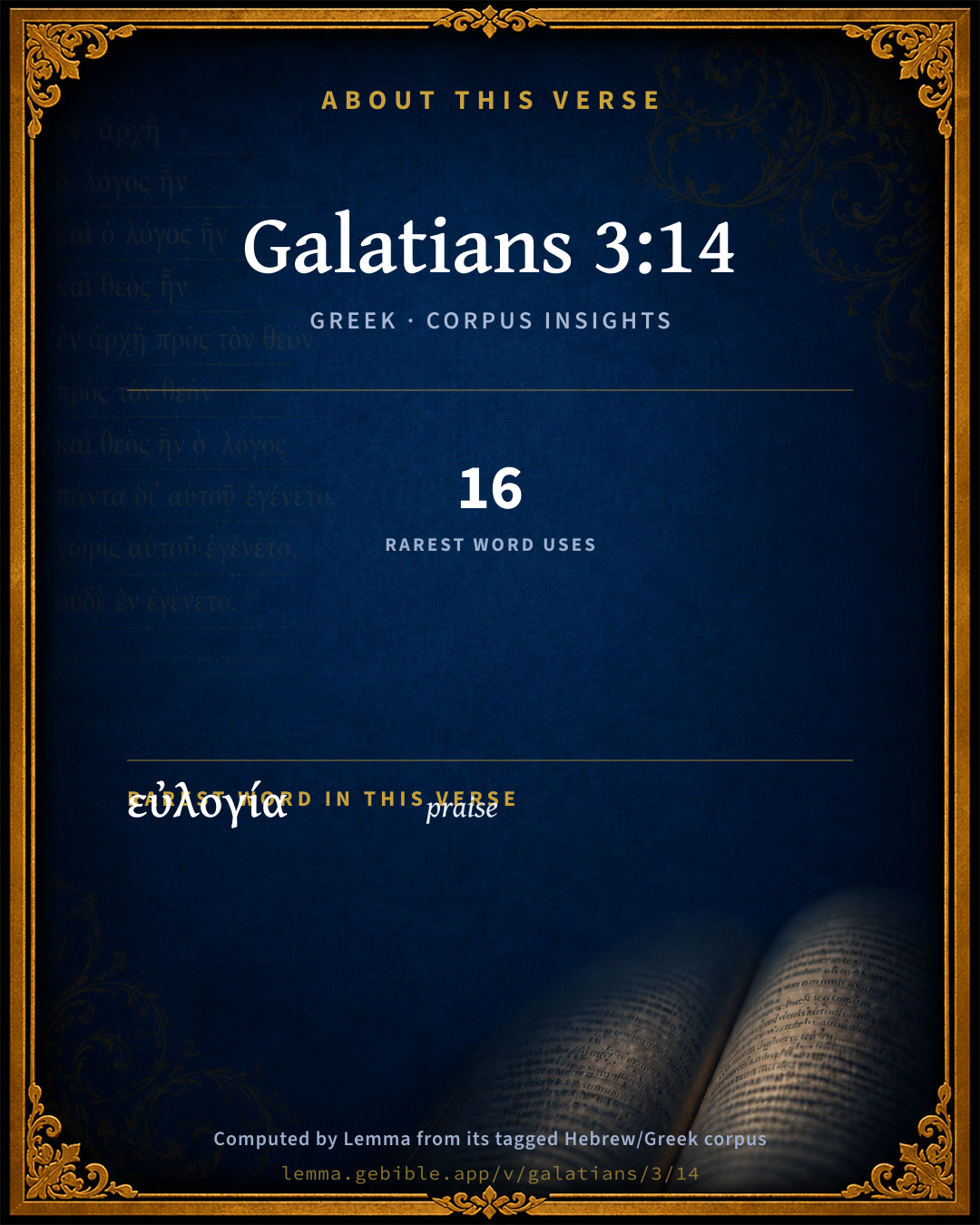
The rarest word here is εὐλογία praise G2129 — appearing just 16 times in the whole Greek New Testament.

Shared distinctive vocabulary

εὐλογία praise G2129 occurs in 14 verses of the Greek New Testament. Also found in:

Repetition

Words recur within this verse:

Cross-references

47

Topical passages linked to Galatians 3:14 in the Treasury of Scripture Knowledge — connected by theme and wording, ordered by reader-vote popularity; previews shown in the World English Bible.

  • Galatians 3:28–29 There is neither Jew nor Greek, there is neither slave nor free man, there is neither male nor female; for you are all one in Christ Jesus.
  • 1 Corinthians 12:13 For in one Spirit we were all baptized into one body, whether Jews or Greeks, whether bond or free; and were all given to drink into one Spirit.
  • Ephesians 2:18 For through him we both have our access in one Spirit to the Father.
  • Ezekiel 36:26–27 A new heart also will I give you, and a new spirit will I put within you; and I will take away the stony heart out of your flesh, and I will give you a heart of flesh.
  • Galatians 3:2 I just want to learn this from you. Did you receive the Spirit by the works of the law, or by hearing of faith?
  • Ezekiel 11:19 I will give them one heart, and I will put a new spirit within you; and I will take the stony heart out of their flesh, and will give them a heart of flesh;
  • Acts 2:33 Being therefore exalted by the right hand of God, and having received from the Father the promise of the Holy Spirit, he has poured out this, which you now see and hear.
  • Romans 8:26–27 In the same way, the Spirit also helps our weaknesses, for we don't know how to pray as we ought. But the Spirit himself makes intercession for us with groanings which can't be uttered.
  • Genesis 12:2–3 I will make of you a great nation. I will bless you, and make your name great. You will be a blessing.
  • 1 Timothy 2:4–6 who desires all people to be saved and come to full knowledge of the truth.
  • 1 Peter 1:22 Seeing you have purified your souls in your obedience to the truth through the Spirit in sincere brotherly affection, love one another from the heart fervently:
  • Isaiah 32:15 until the Spirit be poured on us from on high, and the wilderness become a fruitful field, and the fruitful field be esteemed as a forest.
  • John 7:39 But he said this about the Spirit, which those believing in him were to receive. For the Holy Spirit was not yet given, because Jesus wasn't yet glorified.
  • Acts 10:45–47 They of the circumcision who believed were amazed, as many as came with Peter, because the gift of the Holy Spirit was also poured out on the Gentiles.
  • Romans 4:3–17 For what does the Scripture say? "Abraham believed God, and it was accounted to him for righteousness."
  • Romans 8:9–16 But you are not in the flesh but in the Spirit, if it is so that the Spirit of God dwells in you. But if any man doesn't have the Spirit of Christ, he is not his.
  • Genesis 22:18 In your seed will all the nations of the earth be blessed, because you have obeyed my voice."
  • Isaiah 41:8 But you, Israel, my servant, Jacob whom I have chosen, the seed of Abraham my friend,
  • Isaiah 44:3–4 For I will pour water on him who is thirsty, and streams on the dry ground; I will pour my Spirit on your seed, and my blessing on your offspring:
  • Isaiah 49:6 yes, he says, It is too light a thing that you should be my servant to raise up the tribes of Jacob, and to restore the preserved of Israel: I will also give you for a light to the Gentiles, that you may be my salvation to the end of the earth.
  • Isaiah 51:2–3 Look to Abraham your father, and to Sarah who bore you; for when he was but one I called him, and I blessed him, and made him many.
  • Isaiah 52:10 Yahweh has made bare his holy arm in the eyes of all the nations; and all the ends of the earth have seen the salvation of our God.
  • Isaiah 59:19–21 So shall they fear the name of Yahweh from the west, and his glory from the rising of the sun; for he will come as a rushing stream, which the breath of Yahweh drives.
  • Jeremiah 31:33 But this is the covenant that I will make with the house of Israel after those days, says Yahweh: I will put my law in their inward parts, and in their heart will I write it; and I will be their God, and they shall be my people:
  • Jeremiah 32:40 and I will make an everlasting covenant with them, that I will not turn away from following them, to do them good; and I will put my fear in their hearts, that they may not depart from me.
  • Ezekiel 39:29 neither will I hide my face any more from them; for I have poured out my Spirit on the house of Israel, says the Lord Yahweh.
  • Joel 2:28–29 "It will happen afterward, that I will pour out my Spirit on all flesh; And your sons and your daughters will prophesy. Your old men will dream dreams. Your young men will see visions.
  • Zechariah 12:10 I will pour on the house of David, and on the inhabitants of Jerusalem, the spirit of grace and of supplication; and they will look to me whom they have pierced; and they shall mourn for him, as one mourns for his only son, and will grieve bitterly for him, as one grieves for his firstborn.
  • Luke 2:10–11 The angel said to them, "Don't be afraid, for behold, I bring you good news of great joy which will be to all the people.
  • Luke 11:13 If you then, being evil, know how to give good gifts to your children, how much more will your heavenly Father give the Holy Spirit to those who ask him?"
  • 2 Corinthians 1:22 who also sealed us, and gave us the down payment of the Spirit in our hearts.
  • Galatians 3:5–9 He therefore who supplies the Spirit to you, and works miracles among you, does he do it by the works of the law, or by hearing of faith?
  • Galatians 3:16 Now the promises were spoken to Abraham and to his seed. He doesn't say, "To seeds," as of many, but as of one, "To your seed," which is Christ.
  • Galatians 4:6 And because you are children, God sent out the Spirit of his Son into your hearts, crying, "Abba, Father!"
  • Ephesians 1:13–14 in whom you also, having heard the word of the truth, the Gospel of your salvation,--in whom, having also believed, you were sealed with the Holy Spirit of promise,
  • Ephesians 2:22 in whom you also are built together for a habitation of God in the Spirit.
  • Ephesians 3:16 that he would grant you, according to the riches of his glory, that you may be strengthened with power through his Spirit in the inward man;
  • Ephesians 4:30 Don't grieve the Holy Spirit of God, in whom you were sealed for the day of redemption.
  • Jude 1:19–20 These are they who cause divisions, and are sensual, not having the Spirit.
  • Luke 24:49 Behold, I send forth the promise of my Father on you. But wait in the city of Jerusalem until you are clothed with power from on high."
  • Acts 1:4–5 Being assembled together with them, he charged them, "Don't depart from Jerusalem, but wait for the promise of the Father, which you heard from me.
  • Acts 2:38–39 Peter said to them, "Repent, and be baptized, everyone of you, in the name of Jesus Christ for the forgiveness of sins, and you will receive the gift of the Holy Spirit.
  • Acts 3:25–26 You are the children of the prophets, and of the covenant which God made with our fathers, saying to Abraham, 'In your seed will all the families of the earth be blessed.'
  • Acts 4:12 There is salvation in none other, for neither is there any other name under heaven, that is given among men, by which we must be saved!"
  • Acts 5:32 We are His witnesses of these things; and so also is the Holy Spirit, whom God has given to those who obey him."
  • Acts 11:15–16 As I began to speak, the Holy Spirit fell on them, even as on us at the beginning.
  • Romans 10:9–15 that if you will confess with your mouth the Lord Jesus, and believe in your heart that God raised him from the dead, you will be saved.

Cross-references courtesy of OpenBible.info (CC BY 4.0).

Commentary

Notes on Galatians 3:14 from classic Christian and Jewish commentators (each source and its license shown beneath its notes). The classic Christian expositions comment on the surrounding passage and are grouped to its opening verse, so a note may address several verses; the Jewish commentaries on the Tanakh (Rashi and others) are per-verse, so they appear only where the commentator wrote on this verse.

Lemma curates 59 commentaries, every one of them public domain or Creative Commons licensed, each selected and text-cleaned for this edition rather than reprinted as found. About our sources →

The Biblical Illustrator

Joseph S. Exell

Gal_3:14

That the blessing of Abraham might come on the Gentiles through Jesus Christ.

The purpose of redemption

I. That the blessing of abraham might come upon the gentiles.

1. Whence comes this blessing? From the cursed death of Christ.

2. Where is it to be found? In Christ Jesus, who is

(1) the storehouse of Gods blessing;

(2) the dispenser thereof to all nations.

II. That we might receive the promise of the spirit through faith.

1. What is meant by the promise? (see Isa_44:3; Joe_2:28).

2. For what end do we receive the Spirit?

(1) For illumination (1Jn_2:27; 1Co_2:13).

(2) Regeneration, whereby the image of God is restored to us (Joh_3:5).

(3) For the government of our counsels, will, affections, actions (Isa_11:1; Rom_8:14).

(4) For union with Christ (1Co_6:17).

(5) For consolation (Rom_8:16).

(6) For the confirmation of our faith in every good duty (2Co_1:22). (W. Perkins)

.

The blessing of Abraham

I. The receivers of Gods blessing receive it not for themselves alone.

II. One is most blessed in being made a blessing to others. (J. Parker, D. D.)

The meek, the just, the pious, the devout souls are everywhere and in all ages of one religion; and when death hath taken off the mask they know one another, though the liveries they wear here make them strangers. (William Penn.)

Perpetuated blessings

It has been asked why the goodness of one man should extend to, and be rewarded in, successive generations, covering the remotest ages and reaching to the close of our present economy? But is it not a fact that in the world of providence the very same thing occurs? Has not, e.g., such a character as Howard left a mark upon the world that cannot be obliterated, and bequeathed influences that live long after he has gone up higher? Have not the victories of Wallington, secured at a dread price, left us years of prosperity and peace? Do not millions shine in the light, and are not thousands of hearts warmed by the fires, that were kindled by Luther, Ridley, Cranmer, Knox, Calvin, and others? And if you find this to be a fact in the world, you should not object to its being declared the law of Gods administration of the world. The discovery of printing, steam, the telegraph, are also illustrations all tending to show that beneficent discoveries made by fathers break in benedictions upon their children. (J. Cumming, D. D.)

The value and power of faith

Faith is the only sure and infallable good, the solace of life, the fulfilment of worthy hopes, barren of evil and fertile in good, the repudiation of the powers of evil, the confession of piety, the inheritance of happiness, the entire amelioration of the soul which leans for support on Him who is the cause of all things and willeth to do those things which are excellent. In the possession of this Abraham was thrice blessed indeed. (Philo.)

Blessing through Christs sufferings

When the prairie grass catches fire and the wind is strong and the flames hasten onward twenty feet high, what do the frontier men do when they see them coming? Knowing that they cannot outrun them--the fleetest horse cannot do that--they just take a match, says Mr. Moody, and light the grass around them, and let the fire sweep it, and then they get into the burnt district and stand safe. They hear the flames roar; they see death coming towards them; but they do not tremble, because the fire has passed over the place where they are and there is no danger; there is nothing for the fire to burn. There is one mountain peak that the wrath of God has swept: that is Mount Calvary, and that fire spent its fury upon the bosom of the Son of God. Take your stand here by the Cross, and you will be safe for time and for eternity.

The Biblical Illustrator, edited by Joseph S. Exell (c. 1880s–1900s) — public domain. Text from a community e-Sword module.

Tyndale Open Study Notes

Tyndale Open Resources

3:14 Christ Jesus has blessed the Gentiles with the same blessing . . . promised to Abraham, as described in 3:6-13. Paul equates this blessing with receiving the promised Holy Spirit (3:2-6; see also Rom 8:1-17, 23; Eph 1:13-14).

Tyndale Open Study Notes — © Tyndale Open Resources, licensed CC BY-SA 4.0. Text via the HelloAO Bible API.

Bengel's Gnomon

Johann Albrecht Bengel

Gal 3:14. Ἵνα—ἵνα, that—that) The first that corresponds to, being made (a curse), the last to, hath redeemed us; comp. that occurring twice, Gal 4:5, note.—εἰς τὰ ἔθνη) on the Gentiles, who were afar off, Gal 3:8.—τὴν ἐπαγγελίαν τοῦ πνεύματος, the promise of the Spirit) Luk 24:49, note.—λάβωμεν, we might receive) we Jews, nearly related in Christ to the blessing. The nature of faith is expressed by this word; the promise and faith stand in relation to each other.—διὰ τῆς πίστεως, by faith) not of works, for faith depends on the promise alone. “The Spirit from without kindles within us some spark of faith, whereby we lay hold of Christ, and even the Spirit Himself, that He may dwell within us.”—Flacius.

Bengel's Gnomon of the New Testament — English translation (T&T Clark, Edinburgh, 1860) — public domain. Text from a community e-Sword module.

Meyer's Critical & Exegetical Commentary

Heinrich August Wilhelm Meyer

Gal_3:14. Divine purpose in Christs redeeming us (the Jews) from the curse of the law; in order that the blessing promised to Abraham (justification; see on Gal_3:8) might be imparted in Christ Jesus to the Gentiles (not: to all peoples, as Olshausen and Baumgarten-Crusius, following the earlier expositors, take τὰ ἔθνη, in opposition to the context). So long, namely, as the curse of the law stood in force and consequently the Jews were still subject to this divine curse, the Gentiles could not be partakers of that blessing; for, according to that promise made to Abraham, it was implied in the preference which in the divine plan of salvation was granted to the Jews (Rom_1:17; Rom_15:8-9; Rom_3:1-2; Rom_9:1-5), that salvation should issue from them and pass over to the Gentiles (comp. Rom_15:27; Joh_4:22; Joh_11:52). Hence, when Christ by His atoning death redeemed the Jews from the curse of the divine law, God, in thus arranging His salvation, must necessarily have had the design that the Gentiles, who are expressly named in the promise made to Abraham (Gal_3:8), should share in the promised justification, and that not in some way through the law, as if they were to be subjected to this, but in Christ Jesus, through whom in fact the Jews had been made free from the curse of the law. The opposite of this liberation of the Jews could not exist in Gods purpose in regard to the Gentiles. Rückert takes a different view of the logical connection (as to which most expositors are silent), in the light of Eph_2:14 ff.: So long as the law continued, an impenetrable wall of partition was set up between the Jewish and the Gentile world; … and just as long it was simply impossible that the blessing should pass over to the Gentiles. But the context speaks not of the law itself as having been done away, but of the curse of the law, from which Jesus had redeemed the Jews; so that the idea of a partition-wall, formed by the law itself standing between Jew and Gentile, is not presented to the reader. Usteri thus states the connection: Christ by His vicarious death has redeemed us (Jews) from the curse of the law, in order that (justification henceforth being to be attained through faith) the Gentiles may become partakers in the blessings of Abraham, since now there is required for justification a condition possible for all,namely, faith. Comp. Chrysostom, Oecumenius, and Theophylact. But since the point of the possibility of the justification of the Gentiles is not dealt with in the context, this latter expedient is quite as arbitrarily resorted to, as is Schotts intermingling of the natural law, against the threatenings of which faith alone yields protection (Rom_2:12 ff; Rom_3:9 ff.).

εἰς τὰ ἔθνη] might reach to the Gentiles (Act_21:17; Act_25:15), that is, be imparted to them (Rev_16:2). Comp. on 2Co_8:13 f. Such was to be the course of the divine way of salvation, from Israel to the Gentiles. Observe, that Paul does not say καὶ εἰς τ. ἔθνη, as if the Gentiles were merely an accessory.

ἡ εὐλογία τοῦ Ἀβρ.] the blessing already spoken of, which was pre-announced to Abraham (Gal_3:8), the opposite of the κατάρα; not therefore life (Hofmann), the opposite of which would be θάνατος, but justificationby which is meant the benefit itself (Eph_1:3; Rom_15:29), and not the mere promise of it (Schott).

ἐν Χριστῷ Ἰησοῦ] so that this reception of the blessing depends, and is founded, on Christ (on His redeeming death). The διὰ τῆς πίστεως which follows expresses the matter from the point of view of the subjective medium, whilst ἐν Χριστῷ presents the objective state of the casethe two elements corresponding to each other at the close of the two sentences of purpose.

ἵνα τὴν ἐπαγγελίαν κ.τ.λ.] cannot be subordinated to the previous sentence of purpose (Rückert), for it contains no benefit specially accruing to the Gentiles (Paul must have written λάβωσι, which Chrysostom actually readevidently an alteration arising from misunderstanding). It is parallel to the first sentence of purpose by way of climax: comp. Rom_7:13; 2Co_9:3; Eph_6:19 f. After Paul had expressed the blessed aim which the redeeming death of Christ had in reference to the Gentiles,namely, that they should become partakers of the εὐλογία of Abraham,he raises his glance still higher, and sees the reception also of the Holy Spirit (the consequence of justification) as an aim of that redeeming death; but he cannot again express himself in the third person, because, after the justification of the Jews had been spoken of in Gal_3:13 and the justification of the Gentiles in Gal_3:14 (ἵνα εἰς τὰ ἔθνη … Ἰησοῦ), the statement now concerns the justified generally, Jews and Gentiles without distinction: hence the first person, λάβωμεν, is used, the subject of which must be the Christians, and not the Jewish Christians only (Beza, Bengel, Hofmann, and others). This by no means accidental emergence of the first person, after τὰ ἔθνη had been previously spoken of in the third, is incompatible with our taking the reception of the Spirit as part of the εὐλογία (Wieseler), or as essentially identical with it (Hofmann).

τὴν ἐπαγγελίαν τοῦ πνεῦματος] τὴν ἐπαγγελίαν λαμβάνειν means to become partakers in the realization of the promise (Heb_10:36; Luk_24:49; Act_1:4); but τοῦ πνεύματος may be either the genitive of the subject (that which is promised by the Spirit) or of the object (the promised Spirit). The latter interpretation (comp. Act_2:33; Eph_1:13) is the usual and correct one.[131] For if (with Winer) we should explain it, bona illa, quae a divino Spiritu promissa sunt (Luk_24:49; Act_1:4), then, in conformity with the context, this expression must refer back to Gal_3:8 (προϊδοῦσα ἡ γραφή κ.τ.λ. προευηγγελίσατο τῷ Ἀβρ. κ.τ.λ.); and to this the first person λάβωμεν would not be suitable, as Paul referred that promise given to Abraham in the Scripture (by the Holy Spirit) to the Gentiles. And if ΤῊΝ ἘΠΑΓΓΕΛΊΑΝ ΤΟῦ ΠΝΕΎΜΑΤΟς were essentially the same as the ΕὐΛΟΓΊΑ ΤΟῦ ἈΒΡ., it would be entirely devoid of the explanatory character of an epexegesis.

διὰ τ. πίστ.] For faith is the causa apprehendens both of justification and of the reception of the Spirit; comp. Gal_3:2-5; Gal_5:5.

[131] So that τὴν ἐπαγγελίαν is to be referred, to the O. T. promise of the communication of the Holy Spirit (Joel 3; Act_2:16),a promise well known to all the apostles readers. Hilgenfeld incorrectly holds that the promise given to Abraham is directly designated as an ἐπαγγελία τοῦ πνεύματος (a promise, the substance of which is the πνεῦμα).

Meyer — Critical and Exegetical Commentary on the New Testament — English translation by Peter Christie, edited by Frederick Crombie (T&T Clark, 1880) — public domain. Text from a community e-Sword module.

Expositor's Greek Testament

ed. W. Robertson Nicoll

Gal 3:14 . ἵνα … ἵνα … Two gracious purposes of the Redeemer are here coupled together: (1) the extension of the blessing to Gentiles as well as Jews; (2) the outpouring of the Spirit upon those that embraced the faith of Christ.

The Expositor's Greek Testament, edited by W. Robertson Nicoll (1897–1910) — public domain. Text from a community e-Sword module.

Geneva Bible (1599)

Geneva Bible translators

A conclusion of all that was said before in the handling of the fifth and sixth reasons, to wit, that both the Gentiles are made partakers of the free blessing of Abraham in Christ, and also that the Jews themselves, of whose number the Apostle counteth himself to be, cannot obtain that promised grace of the Gospel, which he calleth the Spirit, but only by faith. And the Apostle doth severally apply the conclusion, both to the one and the other, preparing himself a way, to the next argument, whereby he declareth, that the one only seed of Abraham, which is made of all peoples can no otherwise be joined and grow up together, but by faith in Christ.

Geneva Bible (1599) marginal notes — public domain. Text via Bolls.life.

Jamieson, Fausset & Brown

Robert Jamieson, A. R. Fausset & David Brown

The intent of "Christ becoming a curse for us"; "To the end that upon the Gentiles the blessing of Abraham (that is, promised to Abraham, namely, justification by faith) might come in Christ Jesus" (compare Gal 3:8).

that we might receive the promise of the Spirit--the promised Spirit (Joe 2:28-29; Luk 24:49). This clause follows not the clause immediately preceding (for our receiving the Spirit is not the result of the blessing of Abraham coming on the Gentiles), but "Christ hath redeemed us," &c.

through faith--not by works. Here he resumes the thought in Gal 3:2. "The Spirit from without, kindles within us some spark of faith Whereby we lay hold of Christ, and even of the Spirit Himself, that He may dwell within us" [FLACIUS].

Jamieson, Fausset & Brown — Commentary Critical and Explanatory on the Whole Bible (1871) — public domain (CC PDM 1.0). Text via the HelloAO Bible API.

Adam Clarke's Commentary

Verse 14. That the blessing of Abraham] That is, justification or the pardon of sin, with all other blessings consequent on it, such as peace with God, spiritual life, and eternal glory.

Might come on the Gentiles through Jesus Christ] So we find that he was made a curse for us, that the blessings promised to Abraham might be given to them who believe on him, as having been made a curse; i.e. an expiatory victim for them.

The promise of the Spirit] The spirit of adoption, sonship with God; and the Spirit of God to attest that sonship. And all this was through faith. Hence, from the beginning God had purposed that salvation should be through faith, and never expected that any soul of man should be justified by the works of the law; and only gave that law that the exceeding sinfulness of sin might appear, and that man might be prepared to welcome the Gospel, which proclaimed salvation to a lost world through the atoning passion and death of Christ.

Adam Clarke's Commentary on the Bible (1810–1826) — public domain. Text from a community e-Sword/MySword module.

John Calvin's Commentaries

14. That the blessing of Abraham. Having said that “Christ hath redeemed us from the curse of the law” he now applies that statement more closely to his purpose. The promised blessing of Abraham is founded on this, and flows from it to the Gentiles. If the Jews must be delivered from the law, in order to become the heirs of Abraham, what shall hinder the Gentiles from obtaining the same benefit? And if that blessing is found in Christ alone, it is faith in Christ which alone brings it into our possession.

The promise of the Spirit appears to me to mean, agreeably to a Hebrew idiom, a spiritual promise. Although that promise relates to the New Testament, “I will pour out my Spirit upon all flesh,” (Joel 2:28,) yet, in this passage, Paul refers to another subject. The spirit is here contrasted with all outward things, not with ceremonies merely, but with lineal descent, so as to leave no room for diversity of rank. From the nature of the promise, he proves that Jews differ nothing from Gentiles; because, if it is spiritual, it is received by faith alone.

John Calvin's Commentaries (1540-1563) — public domain. Text from the Calvin Translation Society English edition (1840s-50s) via the Christian Classics Ethereal Library (ccel.org). Calvin's coverage is partial (roughly two-thirds of the Bible); uncommented books and verses are honest gaps, never fabricated. The 19th-century editor's footnotes and remarks are omitted so the notes are faithfully Calvin's own voice.

Ellicott's Commentary for English Readers

(14) The abolition of the Law, consummated upon the cross, involved the doing away of all the old restrictions which confined the Messianic inheritance to the Jews. Henceforth this inheritance, and the promised outpouring of the Spirit which was to accompany it, was open equally to the Gentiles. The one condition now was faith, and that intimate relation to the Messiah which faith implied.

The blessing of Abraham.—That is, the blessing pronounced upon Abraham and to be fulfilled in his seed.

Through Jesus Christ.—Through the relation into which they enter with Christ by embracing Christianity.

We.—The Apostle and his readers, whether Jews or Gentiles.

Receive the promise of the Spirit.—A special outpouring of the Spirit was to be one of the characteristics of the great Messianic manifestation. (Comp. Joe_2:28-29; Act_2:16-21.) The promise is said to be “received” by the generation on which it is fulfilled, not by that to which it is given. The same phrase occurs in Act_2:33; Heb_9:15.

A Bible Commentary for English Readers, edited by Charles John Ellicott (1878–1897) — public domain. Text from a community e-Sword module.

The Cambridge Bible for Schools and Colleges

gen. ed. J. J. S. Perowne

14. The twofold result of our Lord’s obedience unto death, the justification of the Gentiles, and the gift of the Spirit, through faith.

Christ having satisfied the Law in its most minute demands, has abolished it as a condition of salvation, and has thus removed the wall of separation between Jew and Gentile. “They which are of faith are blessed with faithful Abraham”, Gal_3:9.

the blessing of Abraham] Justification by faith, Gal_3:9.

the promise of the Spirit] This takes us back to the question of Gal_3:2. The ‘promise’ is of course not the promise spoken, but the promise fulfilled. So in Act_1:4, where to wait for the promise is to await its fulfilment.

The Cambridge Bible for Schools and Colleges (gen. ed. J. J. S. Perowne; Cambridge University Press, 1878–1918) — public domain. Text from a community e-Sword module.

John Gill's Exposition

That the blessing of Abraham,.... The same blessing Abraham enjoyed, even justification by the righteousness of Christ; and what was promised to Abraham, that in him, his seed, that is Christ, the Gentiles should be blessed, or justified; for though this blessing may in general comprise every spiritual blessing, yet it chiefly regards that of justification; or a deliverance from the curse of the law, and which is the end of Christ's being made a curse, that this blessedness

might come on the Gentiles; the uncircumcision, as well as the circumcision; see Rom 4:9 that is, upon as many of them as were ordained unto eternal life, and in consequence of that believe in Christ; quite contrary to a Jewish notion, that

"no blessing dwells but upon an Israelite (a):''

now though this blessing, as all other spiritual ones, were laid up in the covenant of grace, put into the hands of Christ, and God's elect blessed therewith, as considered in him, yet the curse of the law for their transgressions stood in the way of their personal enjoyment of it, to their peace and comfort in their own souls; wherefore Christ is made a curse for them, to make way for the blessing to take place upon them; which is by an act of God's grace imputed to them, and is received by faith:

through Jesus Christ; or "in Jesus Christ", as the words may be read; meaning either, that this blessing comes upon the Gentiles that were in Christ, chosen in him, in union with him, and represented by him, both in the covenant and on the cross; or else that Christ is the Mediator, as from whom, so through whom, this, as every blessing of grace, comes to the children of God:

that we might receive the promise of the Spirit through faith; Beza puts the copulative and to this clause, reading it, "and that we", &c. as does the Ethiopic version; thereby more clearly pointing out this to be another end of Christ's being made a curse for us: by "the promise of the Spirit" may be meant, either by an "hypallage", the Spirit of promise, who opens and applies the promises; or the Spirit promised, not as a spirit of regeneration, conversion, and faith; for, as such, he cannot be received by faith; Since, antecedent to his being so, there can be no faith; but rather as a spirit of adoption, in respect to which he is said to be received, Rom 8:15 and this blessing of adoption, as in consequence of redemption from under the law, its curse and condemnation, Gal 4:4. Or else a spiritual promise, in distinction from the temporal promise of the land of Canaan, made to Abraham and his natural seed, and means the promise of eternal life and happiness in the world to come; which promise is now received by faith, and that in consequence of the sufferings and death of Christ the testator; see Heb 9:15.

(a) Zohar in Exod. fol. 51. 3.

John Gill's Exposition of the Whole Bible (1746–1763) — public domain (CC PDM 1.0). Text via the HelloAO Bible API.

Trapp's Complete Commentary

John Trapp

14 That the blessing of Abraham might come on the Gentiles through Jesus Christ; that we might receive the promise of the Spirit through faith.

Ver. 14. The promise of the Spirit] That is, the spiritual promise made to Abraham and his spiritual posterity.

John Trapp, A Commentary or Exposition upon All the Books of the Old and New Testament (1647–1656) — public domain. Text from a community e-Sword module.

Albert Barnes' Notes on the Bible

That the blessing of Abraham - The blessing which Abraham enjoyed, to wit, that of being justified by faith. “Might come on the Gentiles.” As well as on the Jews. Abraham was blessed in this manner before he was circumcised Rom 4:11, and the same blessing might be imparted to others also who were not circumcised; see this argument illustrated in the notes at Rom 4:10-12.

Through Jesus Christ - Since he has been made a curse for all, and since he had no exclusive reference to the Jews or to any other class of people, all may come and partake alike of the benefits of his salvation.

That we might receive the promise of the Spirit - That all we who are Christian converts. The promise of the Spirit, or the promised Spirit, is here put for all the blessings connected with the Christian religion. It includes evidently the miraculous agency of the Holy Spirit; and all his influences in renewing the heart, in sanctifying the soul, and in comforting the people of God. These influences had been obtained in virtue of the sufferings and death of the Lord Jesus in the place of sinners, and these influences were the sum of all the blessings promised by the prophets.

Albert Barnes' Notes on the Bible (1834–1885) — public domain. Text from a community e-Sword/MySword module.

Matthew Poole's English Annotations

The apostle, by the blessing of Abraham, here, understands those spiritual blessings of justification, reconciliation, and adoption, which came to Abraham upon his believing, and the imputation of righteousness thereupon unto him. Christ (he saith) was made a curse for us, that all those blessings through him might come on the Gentiles; and so all the nations of the earth might be blessed in him. Particularly, that the Gentiles

might receive the promise of the Spirit; which promise is not to be interpreted so narrowly, as only to signify its miraculous gifts, but to be extended to all those gifts and habits of grace which are the effects of the Holy Spirit in the hearts of believers, whether sanctifying or sealing them; which Holy Spirit is received upon persons’ believing: see Gal 4:6; Rom 8:13.

Matthew Poole's English Annotations on the Holy Bible (1683–1685) — public domain. Text from a community e-Sword/MySword module.

Whedon's Commentary on the Bible

Daniel D. Whedon

14. That—Depends upon redeemed in Gal_3:13.

The promise—That is, the blessing contained in the promise.

Daniel D. Whedon (gen. ed.), Commentary on the Old and New Testaments (1874–1909) — public domain. Text from a community e-Sword module.

The Pulpit Commentary

Two results are here stated as having flowed from the abrogation of the Mosaic Law which was effected by the crucifixion of Jesus: one, the participation of Gentiles in "Abraham"s blessing," to which they could not have been admitted as long as the Law was authorized to shut them out from God"s covenant as unclean; the other, the impartation to God"s people, upon their faith only, apart from acts of ceremonial obedience, of the promised gift of the Holy Spirit. Are these stated as coordinate results, in the same way as a repeated ina ("in order that") introduces co-ordinate results in Rom_7:13; 2Co_9:2; Eph_6:19, 20? Or is the second a consequence of the first? In favour of the first view, it may be said that, in point of fact, Gentiles, as such, were not admitted into a participation in Abraham"s blessing till some time after the day of Pentecost. But on the other hand, it may be urged

(1) that, though not as yet actually admitted, yet in the Divine purpose, and in the ordering of the conditions of the case, they might have come in, the door was open, though the threshold not actually crossed; and

(2) that their admissibility may be supposed to have been in the Divine counsels the prerequisite condition of the Holy Spirit being imparted, it not being fitting that the Spirit should be given so long as the Law was, so to speak, standing there, authorized to debar from this, the most essential portion of "Abraham"s blessing," any who were partakers of Abraham"s blessing. In the three passages referred to as favouring the construing of the two clauses as co-ordinate, we have not as here two different results, but one and the same, only in the second clause more fully described. The second view seems, therefore, the more probable one. That the blessing of Abraham might come on the Gentiles through Jesus Christ (ina eijv taa tou jAbraanhtai ejn Cristw jIhsou: so most recent editors read, in place of jIhsou Cristw); that upon the nations" might crone the blessing of Abraham in Christ Jesus. The phrase, eijv ta eqnh genhta, is illustrated by the use of gignesqai eijv, "arrive at," or "accrue to," in Act_21:17 Act_25:15; Rev_16:2. For the preposition eijv we may also comp. Rom_3:22, "Unto (eijv) all and upon (epi) all." By ta eqnh, as the whole context shows, the apostle means in particular "the Gentiles," the non-Jews, as such. At the same time, the phrase is evidently used, as found ready at hand in the passage cited by him in ver. 8, "In thee shall all the nations (eqnh) be blessed," which passage also suggested the notion of "the blessing of Abraham." It had therein been foretold that all the nations should, by exercising the faith of Abraham, obtain the same blessing; and (says the apostle) we see now by what method the benefit has been brought to them. "In Christ Jesus;" not merely by him; the blessing is, so to speak, immanent in Christ. both procured by him and obtained by the nations through their coming by faith into union with him. Comp. Eph_1:6, Eph_1:7, "His grace which he freely bestowed upon us in the Beloved; in whom we have our redemption;" Col_2:10, "In him ye are made full;" and the like. "The blessing of Abraham." The expression, being drawn from the passages in Genesis in which the Lord assures Abraham that "he would bless him," and that "in him all nations should be blessed," must be taken to import the Divine good will and whatever benefits would therefrom result. Men arrive at t is "benediction" by being justified; but justification is only the entrance into it, and not the whole blessing itself. It is styled Abraham"s blessing, as having been emphatically declared to have been possessed by the patriarch, "the father" of all who should thereafter receive it. That we might receive the promise of the Spirit through faith (ina than tou Pneumatov labwmen diastewv). The pronoun "we" points, not to the Israelites as such, nor to Israelite believers in particular, but to those who were viewed as God"s covenant people. These had hitherto been Abraham"s natural seed only; and had also hitherto been under the Law. But the time had come when they were to receive the full "adoption of sons," and therewith the Spirit of God"s Son; (Gal_4:5, Gal_4:6) which, however, could not come to pass until the Law, "the yoke of slavery," had been cleared out of the way, opening the gate to God"s benediction to all believers, whether Jews or Gentiles. The Law and the Spirit could not coexist. Where the Law had sway, there was tutor-ship (paidagwgia) and slavery. Such, it is true, was needed, so long as the Spirit was not there; for moral beings, forming a people of God"s, must be under some Law; and, if there was not a law written on the "fleshy tables of the heart" by God"s Spirit, there behoved to be one embodied in an outward code of ordinances, which should coerce men"s frowardness and keep them under discipline. But when this outward code had been taken out of the way," nailed to Christ"s cross," then the people of God could not be left without the Spirit the Spirit of holiness, as well as, or rather, because also, the Spirit of adoption; which accordingly was forthwith imparted, the sole condition of the bestowment being their living obedient faith, felt and by baptism professed, in Christ and in God. Comp. Eph_4:13-18, as containing a full presentment of these facts relative to the introduction of the new covenant, and in the same order of sequence. Thus the apostle has triumphantly returned to the thesis from which he had started in the two first verses of the chapter Christ crucified, and the receiving of the Spirit without works of the Law. "The promise of the Spirit" is the Spirit which had been promised; the word "promise" here denoting, not as in Heb_11:33, the word assuring a subsequent bestowment, but as in Luk_24:49 and Heb_11:39, the bestowment itself. The apostle points not merely to such passages of the Old Testament as had definitely fore-announced the outpouring of God"s Spirit (Joe_2:3-8; Isa_44:3; and the like) but the whole "kingdom of God," or "world to come," whose blessedness therewith came.

The Pulpit Commentary (1880–1919), ed. H.D.M. Spence-Jones & Joseph S. Exell — public domain. Text from a community e-Sword module.

John Wesley's Explanatory Notes

That the blessing of Abraham - The blessing promised to him. Might come on the gentiles - Also. That we - Who believe, whether Jews or gentiles. Might receive the promise of the Spirit - Which includes all the other promises. Through faith - Not by works; for faith looks wholly to the promise.

John Wesley, Explanatory Notes Upon the Whole Bible (1754–1765) — public domain. Text via the GEBible commentary corpus.

Luther on Galatians

Martin Luther

VERSE 14. That the blessing of Abraham might come, on the Gentiles through Jesus Christ.

Paul always keeps this text before him: "In thy seed shall all the nations of the earth be blessed." The blessing promised unto Abraham could come upon the Gentiles only by Christ, the seed of Abraham. To become a blessing unto all nations Christ had to be made a curse to take away the curse from the nations of the earth. The merit that we plead, and the work that we proffer is Christ who was made a curse for us.

Let us become expert in the art of transferring our sins, our death, and every evil from ourselves to Christ; and Christ’s righteousness and blessing from Christ to ourselves.

VERSE 14. That we might receive the promise of the Spirit through faith.

"The promise of the Spirit" is Hebrew for "the promised Spirit." The Spirit spells freedom from the Law, sin, death, the curse, hell, and the judgment of God. No merits are mentioned in connection with this promise of the Spirit and all the blessings that go with Him. This Spirit of many blessings is received by faith alone. Faith alone builds on the promises of God, as Paul says in this verse.

Long ago the prophets visualized the happy changes Christ would effect in all things. Despite the fact that the Jews had the Law of God they never ceased to look longingly for Christ. After Moses no prophet or king added a single law to the Book. Any changes or additions were deferred to the time of Christ’s coming. Moses told the people: "The Lord thy God will raise up unto thee a Prophet from the midst of thee, of thy brethren, like unto me; unto him ye shall hearken." (Deu 18:15.)

God’s people of old felt that the Law of Moses could not be improved upon until the Messiah would bring better things than the Law, i.e., grace and remission of sins.

Martin Luther — Commentary on the Epistle to the Galatians (1535), English translation by Theodore Graebner (Zondervan, 1939) — public domain (U.S. copyright not renewed). Text from a community e-Sword module.

Burkitt's Expository Notes on the New Testament

William Burkitt

Observe here, one special fruit of Christ’s sufferings, and being made a curse for us: namely, that the curse being abolished, the blessing of Abraham, that is, the blessing of justification, reconciliation, and adoption promised to Abraham upon his believing, might come upon all the believing Gentiles, through Christ, the promised seed: and that the Gentiles might receive the promises made by Christ, of the holy Spirit, both in its miraculous gifts and sanctifying graces, through their submission to the faith of Christ, or the doctrine of the gospel.

Learn hence, 1. That Christ, by submitting to the curse of the law did not only appease the wrath of God towards us, and deliver us from the curse of the law deserved by us, but purchased all spiritual blessings for us, such as grace here, and glory hereafter- Christ was made a curse, that the blessing of Abraham might come on the Gentiles. Oh wonderful grace, infinite love, and astonishing goodness of God, in that great work of our redemption, in bringing about one contrary by another! He giveth life by death, and the blessing by the curse: Christ was made a curse, that the blessing might come upon the Gentiles.

Learn, 2. That there was a promise of divers blessings made to Abraham: namely, that God would give him a son by Sarah, a son in his old age, and by that son a numerous issue; that that issue should become a mighty nation, and possess all the land of Canaan, wherein he then sojourned; and that he would settle his covenant, that is, his church, in that family and nation; and that in one person descending from his posterity, all nations should be blessed: and that this blessing, introduced by that one perosn, should abolish the curse brought upon all nations by the first person’s sin: That the blessing of Abraham might come on the Gentiles through Jesus Christ.

William Burkitt's Expository Notes on the New Testament (1700–1703) — public domain. Text from a community e-Sword module.

McGarvey & Pendleton's Commentaries

J. W. McGarvey

that upon the Gentiles might come the blessing of Abraham in Christ Jesus; that we might receive the promise of the Spirit through faith. [ Deu_21:23 . Compare Mat_20:28 ; 1Ti_2:6 ; 1Co_6:20 ; 1Co_7:23 ; Tit_2:14 ; etc. That the Galatians may realize the full meaning of their foolishness, Paul shows them that the condemnation to which they were returning, was the very thing from which the death of Christ redeemed them; for the law brought a curse upon men, but Jesus had delivered from the curse by taking it unto himself, as the Scripture proves; for it called all cursed who were crucified. And Jesus removed this obstructing law and curse, that in himself he might bring Abraham's blessing of justification upon the Gentiles, that all might receive the fulfillment of God's promise, that promise which agreed to give the Spirit to all who rendered the obedience of faith-- Act_2:38-39 ]

J. W. McGarvey (with Philip Y. Pendleton), Commentaries on the New Testament (The Fourfold Gospel, 1914; Acts; and the epistles) — public domain. Text from a community e-Sword/MySword module.

The People's New Testament

B. W. Johnson

14. That the blessing of Abraham. Christ took the curse upon himself that we might be blessed with the believing Abraham (verse 6). Hence Gentiles who believe have the promise of justification, and of the Spirit. Compare verses 2 and 5. There it is shown that the Spirit came by the faith, rather than by the law.

B. W. Johnson's The People's New Testament with Notes (1889–1891) — public domain. Electronic text from the Christian Classics Ethereal Library (CCEL) ThML edition.

Cambridge Greek Testament for Schools and Colleges

14. Ἰησοῦ Χριστῷ. W. H. margin gives Χριστῷ Ἰησοῦ.

τὴν ἐπαγγελίαν. D*G Marcion Ambrosiaster read τὴν εὐλογίαν, which Zahn prefers.

14. ἵνα. The redemption of the Jews was in order that the blessing of and in Abraham might also come on the Gentiles. For if Jews, Abraham’s seed, remained under the curse Gentiles could not be delivered.

There is no thought in the context of the destruction of the Law as a barrier between Jew and Gentile (Eph 2:14); nor even of the fact that Jews, and therefore Gentiles, were set free from the dominion of the Law (or they would have gone back again into the curse).

εἰς τὰ ἔθνη … γένηται, “might reach unto the Gentiles.” The dative would have been sufficient to say that the Gentiles got the blessing, Act 2:43. The stronger form probably suggests more difficulty in the process, or distance in the recipients. But the fact that “in modern Greek εἰς is the usual circumlocution for the lost dative” (Blass, Gram. § 39. 5) makes it possible that it is only a more vivid, and more emphatic, way of expressing transference. There seems to be no exact parallel to the usage here. The nearest is 2Co 8:14. Contrast 1Co 15:45.

ἡ εὐλογία. Vaughan on Rom 15:29 well summarises the use of this term, (a) Speaking good of another, especially as applied to the praise of God, Jas 3:10; Rev 7:12. (b) A benediction which fulfils itself in benefaction, either on the part of man, 2Co 9:5, or on that of God, Rom 15:29; Eph 1:3, and here.

τοῦ Ἀβραὰμ. He was blessed and others were to be blessed with him (Gal 3:9) and in him (Gal 3:8).

ἐν Ἰησοῦ Χριστῷ. See notes on Textual Criticism. Added to concentrate St Paul’s teaching. The order suggests first the historic Personality who suffered and rose, and secondly His eternal relation to believers.

ἴνα.… The reception of the promise of the Spirit is closely connected with the inclusion of the Gentiles (Gal 3:8 note), and here made dependent upon it logically.

τὴν ἐπαγγελίαν. See notes on Textual Criticism. The first use of a word that is very important in the following verses. It appears to have been already a technical term in Pharisaic circles for the privileges possessed by the true Israelite (see Hart, Ecclesiasticus, pp. 306 sqq.). St Paul here further defines it, and, in defining, raises it to a higher level.

τοῦ πνεύματος. The spirit was definitely promised in Joe 2:28; cf. Act 2:16 sqq. Here it is implied that the promise had run all through Israel’s history. In a sense this is true, for Moses’ words, Num 11:26-29, imply the possibility of all the LORD’s people being prophets, with the LORD’s spirit upon them.

λάβωμεν. St Paul reverts to Gal 3:2. But here, as often, St Paul hastens to identify himself with those to whom he writes. It means “we all,” Jewish and Gentile believers.

διὰ τῆς πίστεως, “by means of our faith.” Theodore, regarding the resurrection-life as already begun, is very good in his remarks on there being no place now left for the Law. “Superfluum et quidem ultra est; redditum est ei debitum a Christo, quod a nobis debebatur. Locum autem non habens, quoniam res non admittit eos qui semel transmigraverunt in futuram vitam praesentis vitae succumbere negotiis.”

Cambridge Greek Testament for Schools and Colleges (Cambridge University Press, 1896; 21 vols, various authors incl. Carr, Maclear, Plummer, Farrar, Lumby, Moule, M. R. James, Simcox) — public domain. Text from a community e-Sword module.

Alford’s Greek Testament

Henry Alford

14.] in order that (the intent of γενόμ. ὑπ. ἡμ. κατάρα) the blessing of Abraham (promised to Abraham: i.e. justification by faith; ver. 9) might be (come) upon the Gentiles (not, all nations, but strictly the Gentiles: see above on ver. 13) in (in and by, conditional element) Jesus the Christ, that (ἵνα, parallel with, not dependent on and included in, the former ἵνα: for this clause has no longer to do with τὰ ἔθνη, see below. We have a second ἵνα co-ordinate with a first in Rom 7:13; 2Co 9:3; Eph 6:19, Eph 6:20) we (not emphatic, nor is ἡμεῖς expressed: no longer the Jews, as Beza and Bengel, but all Christians: see Jowett’s note, which perhaps is too finely drawn) might receive (in full, as fulfilled, aor.) through the (or, but not so usually, our) faith (as the subjective medium: but rendered objective by the article, as so often by St. Paul: no stress on διὰ τ. π.) the promise of the Spirit (viz. that made Joe 2:28. See Act 2:17, Act 2:33; Luk 24:49,—the promise of the new covenant). The genitive τοῦ πν. is objective,—the Spirit being the thing promised. But let me guard tiros against the old absurdity, “ἐπαγγελία τοῦ πνεύματος pro τὸ πνεῦμα τὸ ἐπηγγελμένον,” which would destroy, here and every where else, the logical form of the sentence. This ‘receiving the promise of the Spirit’ distinctly refers back to ver. 2, where he asked them whether they received the Spirit by the works of the law, or by the hearing of faith? “Here is a pause, at which the indignant feeling of the Apostle softens, and he begins the new train of thought which follows with words of milder character, and proceeds more quietly with his argument.” Windischmann.

Henry Alford, The Greek Testament (1849–1861) — public domain. Text from a community e-Sword module.

International Critical Commentary

14. ἵνα εἰς τὰ ἔθνη ἡ εὐλογία τοῦ Ἀβραὰμ γένηται ἐν Ἰησοῦ Χριστῷ, “that upon the Gentiles might come the blessing of Abraham in Jesus Christ.” In this clause and the following one the apostle states the purpose not of any of the subordinate elements of v. 13, but of the whole fact, especially the principal element, ἐξηγόρασεν … τοῦ νόμου. By ἡ εὐλογία τοῦ Ἀβραάμ must be understood, in the light of vv. 8, 9, the blessing of justification by faith, which, according to Paul’s interpretation of Gen 12:3 (cf. Gen 28:4), was promised beforehand to the Gentiles, and which they shared with him. This blessing came to the Gentiles in Jesus Christ in that it was through him that the purpose of God to accept men by faith was revealed, and that through faith in him they enter into actual participation in the blessing.

εἰς is probably to be taken as marking its object as the destination of a movement. Cf. 1Th 1:5. In ἐν Ἰησοῦ Χριστῷ the preposition is doubtless used in its basal sense; cf. on 2:17.

Ἐν Ἰησοῦ Χριστῷ is the reading of אB Syr. (psh.) Aeth., most authorities reading ἐν Χ. Ἰ. The facts stated in the textual note on 2:16 with reference to the tendency of the mss., together with the high authority of אB, leave no room for doubt that ἐν Χριστῷ̔́ Ἰησοῦ is a corruption due to assimilation of the text to the usual form. Cf. the other instances of אB and secondary authorities against the other uncials in 3:7, 10, 4:10, 5:21, 6:10.

ἵνα τὴν ἐπαγγελίαν τοῦ πνεύματος λάβωμεν διὰ τῆς πίστεως. “that we might receive the promise of the Spirit through faith.” τὴν ἐπαγγελίαν τοῦ πνεύματος is a metonymic phrase meaning the promised Spirit. Cf. Luk 24:49, Act 1:4, Act 26:6, Heb 9:15 and especially Act 2:33. See also the similar cases of ἐλπίς meaning “that which is hoped for,” chap. 5:5, Col 1:5. This second ἵνα-clause is probably to be taken, not as dependent on the first, but as co-ordinate with it, and the implied subject ἡμεῖς as referring to Christians as such, rather than to believing Jews, as is probably the case in v. 13; for it is difficult to see how the reception of the Spirit by the Jews could be conditioned upon the Gentiles obtaining the blessing of Abraham; and if the two clauses referred to Gentiles and Jews respectively this antithesis would probably have been indicated by an expressed ἡμεῖς in the second clause. Obviously the latter can not refer to the Gentiles only. Christ’s redemption of us from the curse of the law had then as co-ordinate ends the opening of the door of faith and justification through faith apart from works of law, to the Gentile, and the bestowment of the promised Spirit on those that have faith. The adaptation of means to end as respects this second clause seems obviously to lie in the fact that the redemption of men from the curse of the law by their enlightenment as to God’s true attitude to them carries with it the revelation of faith as the means by which men become acceptable to God, and that through such faith they receive the Spirit. Cf. v. 2; also vv. 24-26 and 4:6. These final clauses, therefore, with their double statement of the purpose of Christ’s redemptive work, confirm the conclusion already reached that the redemption from the curse of the law was an epochal event, having its significance and its redemptive power in the revelation which it conveys of the true attitude of God towards men.

Whether in speaking of the promise of the Spirit the apostle has in mind the prophecy of Joe 2:28, Eze 36:27, or, being acquainted with the tradition underlying Act 1:5, refers to a promise of Jesus can not be stated with certainty. It is possible that the second final clause is to be taken as, to this extent, epexegetic of the first that the Holy Spirit is a definition of the blessing of Abraham. In that case the apostle refers to the promise to Abraham and has learned to interpret this as having reference to the gift of the Spirit. This possibility is in a measure favoured by the use of ἐπαγγελία in vv. 16, 17 of the promise to Abraham.

International Critical Commentary — older volumes (1896–1929), various authors — public domain. Text from a community e-Sword module.

Vincent's Word Studies in the New Testament

Marvin R. Vincent

That [ινα] Marking the purpose of Christ in redeeming from the curse of the law.

That we might receive, etc. The second ina is parallel with the first. The deliverance from the curse results not only in extending to the Gentiles the blessing promised to Abraham, but in the impartation of the Spirit to both Jews and Gentiles through faith. The eujlogia blessing is not God 's gift of justification as the opposite of the curse; for in vv. 10, 11, justification is not represented as the opposite of the curse, but as that by which the curse is removed and the blessing realized. The content of the curse is death, verse 13. The opposite of the curse is life. The subject of the promise is the life which comes through the Spirit. See Joh 7:39; Act 2:17, 38, 39; Act 10:45, 47; Act 14:7, 8; Rom 5:5; Rom 8:2, 4, 6, 11; Eph 1:13.

Marvin R. Vincent, Word Studies in the New Testament (1887–1900) — public domain. Text from a community e-Sword/MySword module.

Lesson kit

Teaching starters — assembled from the data on this page, not authored interpretation. Every prompt links to the verse data it draws on. Edit before teaching.

Galatians, in the Pauline Epistles, opens this verse with 21 words (15 distinct Greek lemmas). Its most distinctive word is eulogía (“praise”). A historical commentator’s framing appears above. Read the whole chapter for the surrounding context.

Discussion questions

  1. What does “praise” (eulogía) contribute to the verse as a whole?
  2. Romans 15:29 shares the word «praise» with this verse. How do the two illuminate each other?
  3. “the” occurs 6× in this one verse. What is the effect of the repetition?
  4. Reading how The Biblical Illustrator and Tyndale Open Study Notes read this verse, where do the two commentators agree and where do they part?

Things to notice

Reading settings

Reading text

Shown beneath each verse's original-language words.

Old Testament
Old Testament edition

Read the OT as the Masoretic Hebrew (MT) or the Greek Septuagint (LXX).

English shown for the Greek Septuagint (in the Hebrew ↔ Greek comparison).

Comparing translations? Open the Compare panel on any verse page to stack up to four side by side.