Matthew 10:8

Greek (Tischendorf 8th ed.) Matthew 10:8 appears in the Greek New Testament. The text above is from the Tischendorf 8th edition. Each word links to its Strong’s number and a concise gloss. Click any word for its full Thayer’s Greek Lexicon entry.
Download image
Cite this verse

Matthew 10:8 (World English Bible). Public Domain. Lemma interlinear Bible study tool, https://lemma.gebible.app/v/matthew/10/8.

Show BibTeX & RIS
BibTeX
RIS
English Translation
Heal the sick, cleanse the lepers, and cast out demons. Freely you received, so freely give.
World English Bible · Public Domain
Highlights
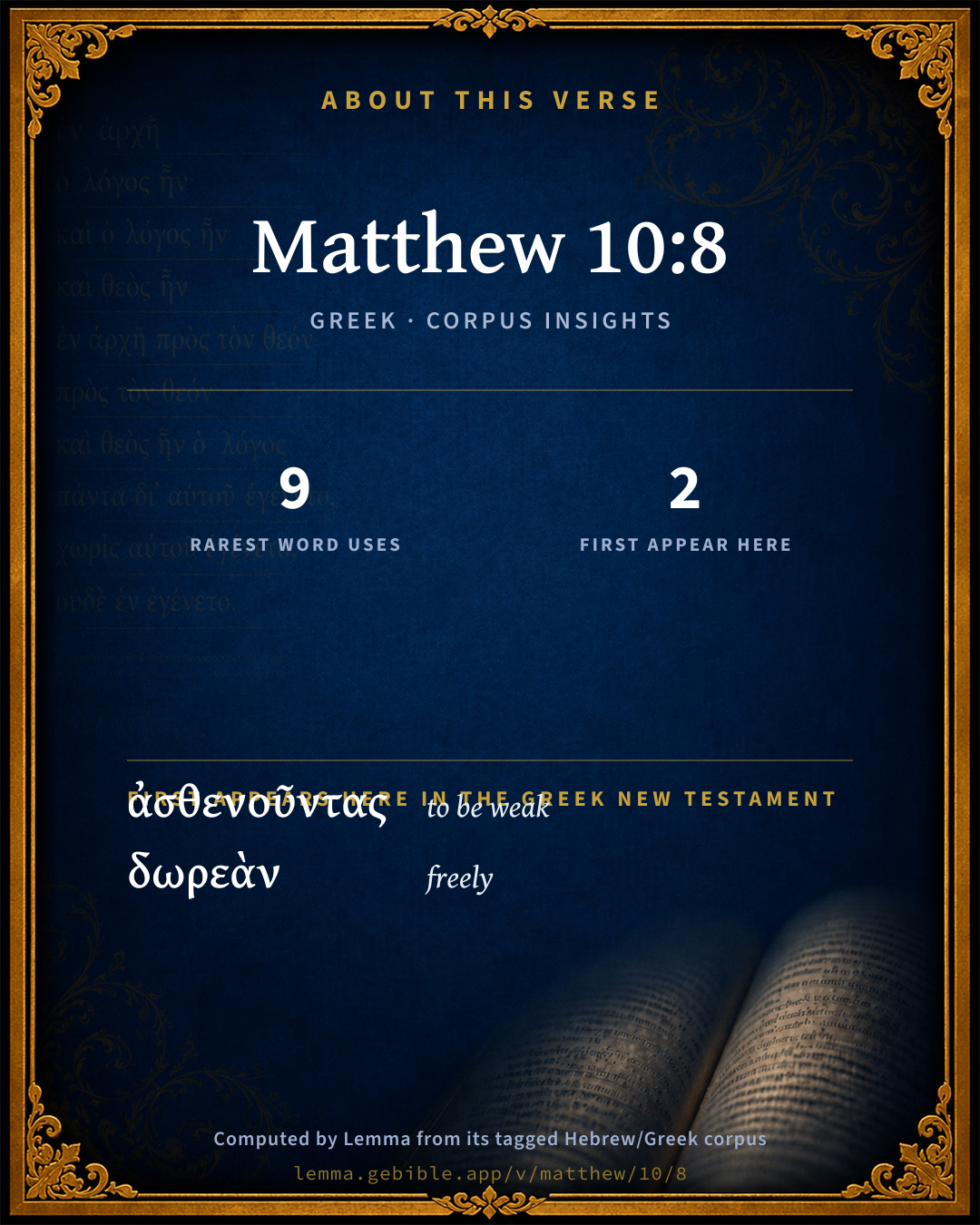
  • 2 first appearances in the Greek New Testament
Full analysis ↓
Download a study sheet

One document with this verse’s original text, its word-by-word gloss line, the meaning frame, cross-references with their text, attributed commentary, and full source and license credits — printable, and it pastes into notes with its structure intact.

This verse Autodidact and up

Study sheet (.html) Plain text (.txt)

A passage Seminary Student

Up to 50 verses in one chapter. A passage sheet keeps up to 6 commentary sources and 12 cross-references per verse, in the order this page ranks them, and says so on the sheet whenever that leaves anything out. Ask for a single verse and you get the Autodidact verse sheet above.

Everything on this page stays free to read, with no account — the sheet is a download of what is already on screen, not access to it.

Want to remove ads? Support Godless Engineer
Compare translations 3

The same verse in 3 English versions, stacked beneath the original-language interlinear above. Click any original word for its lexicon entry.

Each is an independent rendering of the whole verse — the interlinear is not word-aligned to these translations.

Highlighted words mark where these versions differ — a whole-verse word diff, not a word-by-word alignment.

  • World English Bible Public Domain
    Heal the sick, cleanse the lepers, and cast out demons. Freely you received, so freely give.
  • King James Version Public Domain
    Heal the sick, cleanse the lepers, raise the dead, cast out devils: freely ye have received, freely give.
  • unfoldingWord Literal Text CC BY-SA 4.0
    Heal the sick, raise the dead, cleanse the lepers, cast out demons. Freely you have received; freely give.

unfoldingWord Literal Text — © unfoldingWord, licensed CC BY-SA 4.0. Word-aligned USFM3 via Door43 (git.door43.org/unfoldingWord/en_ult).

Versions to compare (up to 4)

3 of 4 selected

Show all 19 translations

Every available English version of this verse, each an independent rendering of the whole verse.

  • World English Bible Public Domain
    Heal the sick, cleanse the lepers, and cast out demons. Freely you received, so freely give.
  • Berean Standard Bible Public Domain
    Heal the sick, raise the dead, cleanse the lepers, drive out demons. Freely you have received; freely give.
  • Majority Standard Bible Public Domain
    Heal the sick, cleanse the lepers, drive out demons. Freely you have received; freely give.
  • King James Version Public Domain
    Heal the sick, cleanse the lepers, raise the dead, cast out devils: freely ye have received, freely give.
  • American Standard Version (1901) Public Domain
    Heal the sick, raise the dead, cleanse the lepers, cast out demons: freely ye received, freely give.
  • Revised Version (1885) Public Domain
    Heal the sick, raise the dead, cleanse the lepers, cast out devils: freely ye received, freely give.
  • Geneva Bible (1599) Public Domain
    Heale the sicke: cleanse the lepers: raise vp the dead: cast out the deuils. Freely ye haue receiued, freely giue.
  • Douay-Rheims (1899) Public Domain
    Heal the sick, raise the dead, cleanse the lepers, cast out devils: freely have you received, freely give.
  • Young's Literal Translation Public Domain
    infirm ones be healing, lepers be cleansing, dead be raising, demons be casting out -- freely ye did receive, freely give.
  • Literal Standard Version CC BY-SA 4.0
    be healing [those] ailing, raising the dead, cleansing lepers, casting out demons—freely you received, freely give.
  • Unlocked Literal Bible CC BY-SA 4.0
    Heal the sick, raise the dead, cleanse the lepers, and cast out demons. Freely you have received, freely give.
  • unfoldingWord Literal Text CC BY-SA 4.0
    Heal the sick, raise the dead, cleanse the lepers, cast out demons. Freely you have received; freely give.
  • Darby Bible Public Domain
    Heal [the] infirm, [raise the dead], cleanse lepers, cast out demons: ye have received gratuitously, give gratuitously.
  • World Messianic Bible Public Domain
    Heal the sick, cleanse the lepers, and cast out demons. Freely you received, so freely give.
  • Webster's Bible Public Domain
    Heal the sick, cleanse the lepers, raise the dead, cast out demons: freely ye have received, freely give.
  • Free Bible Version CC BY-SA 4.0
    Heal those who are sick. Resurrect the dead. Cure the lepers. Drive out demons. You received freely, so give freely!
  • Bible in Basic English Public Domain
    Make well those who are ill, give life to the dead, make lepers clean, send evil spirits out of men; freely it has been given to you, freely give.
  • Text-Critical English NT CC BY 4.0
    Heal the sick, cleanse lepers, and cast out demons. Freely you have received; freely give.
  • Tyndale New Testament (1534) Public Domain
    Heale the sicke clense the lepers rayse the deed caste oute the devils. Frely ye have receved frely geve agayne.

Literal Standard Version (2020), Covenant Press — licensed CC BY-SA 4.0. Text via the HelloAO Bible API (eBible.org). Unlocked Literal Bible (unfoldingWord) — licensed CC BY-SA 4.0. Text via the HelloAO Bible API (eBible.org). unfoldingWord Literal Text — © unfoldingWord, licensed CC BY-SA 4.0. Word-aligned USFM3 via Door43 (git.door43.org/unfoldingWord/en_ult). Free Bible Version, Dr. Jonathan Gallagher — licensed CC BY-SA 4.0. Text via the HelloAO Bible API (eBible.org).

Word by word

More ways to search: Search by grammar → Find every occurrence → Compare this word →

Practice this passage: Drill this verse → Learn its vocabulary →

λεπροὺς
leprós
G3015
“leprous”
Adjective, Accusative, Plural, Masculine
Part of Speech
Adjective
Case
Accusative
Number
Plural
Gender
Masculine
Full Thayer's Definition

Origin: from the same as G3014

TDNT: 07:53,5

1. scaly, rough 2. leprous, affected with leprosy
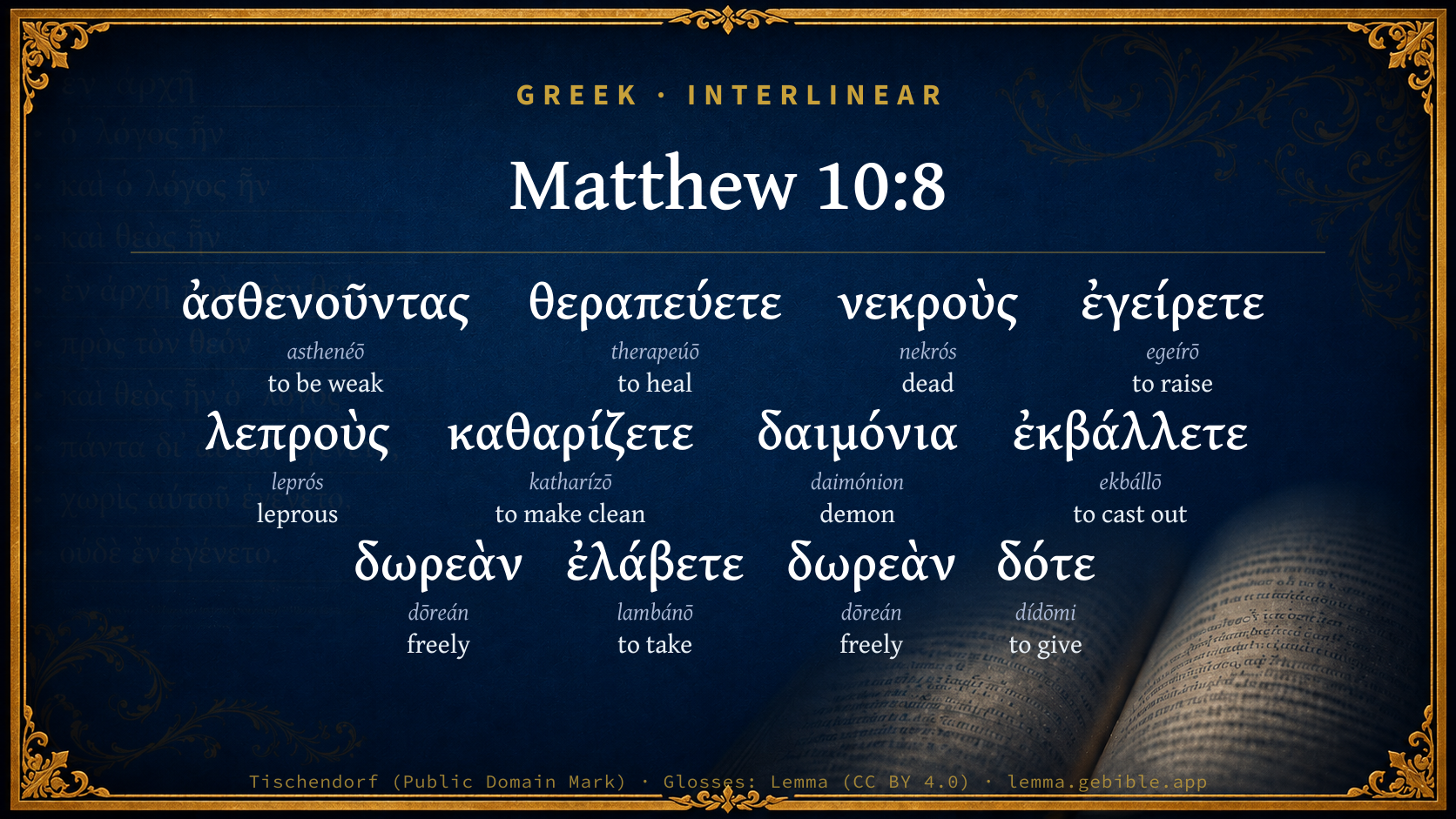
  1. ἀσθενοῦντας asthenéō G770 “to be weak” Verb, Present, Active, Participle, Accusative, Plural, Masculine
  2. θεραπεύετε therapeúō G2323 “to heal” Verb, Present, Active, Imperative, 2nd person, Plural
  3. νεκροὺς nekrós G3498 “dead” Adjective, Accusative, Plural, Masculine
  4. ἐγείρετε egeírō G1453 “to raise” Verb, Present, Active, Imperative, 2nd person, Plural
  5. καθαρίζετε katharízō G2511 “to make clean” Verb, Present, Active, Imperative, 2nd person, Plural
  6. δαιμόνια daimónion G1140 “demon” Noun, Accusative, Plural, Neuter
  7. ἐκβάλλετε ekbállō G1544 “to cast out” Verb, Present, Active, Imperative, 2nd person, Plural
  8. δωρεὰν dōreán G1432 “freely” Adverb
  9. ἐλάβετε lambánō G2983 “to take” Verb, Aorist, Active, Indicative, 2nd person, Plural
  10. δωρεὰν dōreán G1432 “freely” Adverb
  11. δότε dídōmi G1325 “to give” Verb, Aorist, Active, Imperative, 2nd person, Plural

About this verse

These counts appear in no published source. They are computed here, from the morphology-tagged text and Lemma’s own curated glosses. What Lemma adds →

12
words
11
distinct lemmas
Gospels
section

Notable vocabulary

The rarest word here is λεπροὺς leprous G3015 — appearing just 9 times in the whole Greek New Testament.

First appearance in Scripture

These words make their first canonical appearance in the Greek New Testament here:

  • ἀσθενοῦντας to be weak G770
  • δωρεὰν freely G1432

Shared distinctive vocabulary

λεπροὺς leprous G3015 occurs in 9 verses of the Greek New Testament. Also found in:

Repetition

A word recurs within this verse:

  • δωρεὰν freely G1432 ×2

Cross-references

11

Topical passages linked to Matthew 10:8 in the Treasury of Scripture Knowledge — connected by theme and wording, ordered by reader-vote popularity; previews shown in the World English Bible.

  • Acts 3:6 But Peter said, "Silver and gold have I none, but what I have, that I give you. In the name of Jesus Christ of Nazareth, get up and walk!"
  • Luke 10:9 Heal the sick who are therein, and tell them, 'The Kingdom of God has come near to you.'
  • Acts 4:30 while you stretch out your hand to heal; and that signs and wonders may be done through the name of your holy Servant Jesus."
  • Matthew 10:1 He called to himself his twelve disciples, and gave them authority over unclean spirits, to cast them out, and to heal every disease and every sickness.
  • Acts 20:33–35 I coveted no one's silver, or gold, or clothing.
  • Mark 16:18 they will take up serpents; and if they drink any deadly thing, it will in no way hurt them; they will lay hands on the sick, and they will recover."
  • 2 Kings 5:15–16 He returned to the man of God, he and all his company, and came, and stood before him; and he said, See now, I know that there is no God in all the earth, but in Israel: now therefore, please take a present from your servant.
  • Acts 5:12–15 By the hands of the apostles many signs and wonders were done among the people. They were all with one accord in Solomon's porch.
  • Acts 8:18–23 Now when Simon saw that the Holy Spirit was given through the laying on of the apostles' hands, he offered them money,
  • Acts 4:9–10 if we are examined today concerning a good deed done to a crippled man, by what means this man has been healed,
  • 2 Kings 5:20–27 But Gehazi the servant of Elisha the man of God, said, Behold, my master has spared this Naaman the Syrian, in not receiving at his hands that which he brought: as Yahweh lives, I will run after him, and take somewhat of him.

Cross-references courtesy of OpenBible.info (CC BY 4.0).

Commentary

Notes on Matthew 10:8 from classic Christian and Jewish commentators (each source and its license shown beneath its notes). The classic Christian expositions comment on the surrounding passage and are grouped to its opening verse, so a note may address several verses; the Jewish commentaries on the Tanakh (Rashi and others) are per-verse, so they appear only where the commentator wrote on this verse.

Lemma curates 59 commentaries, every one of them public domain or Creative Commons licensed, each selected and text-cleaned for this edition rather than reprinted as found. About our sources →

The Biblical Illustrator

Joseph S. Exell

Mat_10:8

Heal the sick.

Heal the sick

I. A confirmation of our sincerity.

II. An illustration of the completeness Of Christianity.

1. Its concern with the whole nature of man.

2. Its care for the individual.

III. A revelation Of the Spirit of the Lord.

IV. An undoubted mode of serving the Christ Himself. (U. R. Thomas.)

Cleanse the lepers.-

History of leprosy

Leprosy is a disease with which we are happily so little acquainted in Western lauds that the miraculous power exerted by our Lord and His apostles in connection with it does not strike us with the wonder and admiration it must have occasioned in early times, It is, in the passage before us, distinguished from sickness-Heal the sick and Cleanse the lepers, being distinct commands. For leprosy was the special disease of Palestine; was looked upon as a type of sin, was in most cases incurable, and was one that necessitated separation, as indeed it does at the present day, though what is now termed leprosy, Elephantiasis Groecorum, is distinct from the Lepra Mosaics to which the Israelites from the period of their bondage in Egypt to the time of our Lord, were subject. But the former disease, like the latter, is of Eastern origin, and is thought to have been brought into Europe by the Crusaders, while others affirm that it was introduced in the tenth and eleventh centuries by the Moors and Arabs, who not only conquered the larger part of Spain, but penetrated much further into Europe than is generally known, reaching, it is believed, even as far as Switzerland. Its frequency in various parts of Europe through the Middle Ages is shown by the word Lazar, for hospital, which referred to Lazarus, because he was full of sores, and these hospitals were intended primarily for lepers. Most great towns in England had their St. Giless Gate, outside which these wretched beings were housed to avoid infection, St. Giles being the patron saint of lepers. This was generally a particularly low and wretched part of the town-St. Giless Church in London and the Gilligate at Durham are instances. The laws to prevent the spread of leprosy were very stringent, sometimes even cruel. At Edinburgh, for instance, there was at one time a statute that if any person harboured a leper in their house, he was, among other penalties, to be branded in the cheek. There is only one country in Northern Europe in which this dire disease is still frequent, Norway. From want of vigorous measures to stamp it out leprosy is common in that country, and there is a large leper hospital at Christiania, the capital. In England isolated instances are met with-for instance, at Marazide, in Cornwall, there lived some years ago a person most grievously afflicted with Elephantiasis Groecorum, a form of the disease in which the extremities swell to a great size, and sometimes fall off. In the Holy Land, at the present day, as well as in Greece and Spain, this form of leprosy is far from uncommon. Ewald gives a thrilling account of a village near Jerusalem which is exclusively inhabited by lepers-about one hundred in number at the time he visited it. This unfortunate and pitiable race, he says, are compelled to live separate from all. The malady appears generally when they are about twelve or fourteen years old, and increases every year, till they lose literally one limb after the other. As they grow older their sight fails, their throat and lungs become infected, till death ends their protracted sufferings. They live upon the alms which they receive from pilgrims and others. In South Africa the disease is very frequent, more especially among the negroes and Hottentots. Very little care was taken to tend or isolate these unfortunate sufferers while the Dutch were in possession of Cape Colony, since they mostly belonged to the despised black race, but when the English came into power in 1810 a settlement was appointed for the lepers at a place called by the Dutch Hemel en Aaede (Heaven on Earth), which seems a most inappropriate name, but that the devoted labours of the Moravian missionary Lehmann sweetened the lot of these unhappy ones. In 1845 the settlement was removed to Robber Island, nearly opposite Cape Town, where the lepers, it was thought, would be more completely isolated, and would enjoy the benefit of sea-air. There the devoted Lehmann continued his ministrations, having under his spiritual charge a motley assemblage of English, Germans, Frenchmen, Malays, Swedes, Africans, only alike in their misfortune.

Freely ye have received, freely give.-

Freely ye have received, freely give

I. A very profitable recollection. Have you received at all? How have we received? Freely.

1. Look at your own personal salvation.

2. Look at the abundance of grace given you.

3. Look at the treasures set before you.

II. The constraining obligation-Freely give.

1. Think what you have to give, give your own selves, your substance, your prayers.

2. How you are to give. (C. Bridges, M. A.)

I. Consider the privileges which have been so freely bestowed upon us. The value of the gospel seen-

1. From our Lords commission to His disciples.

2. The labours attendant on the execution of that commission.

II. The duty resulting from these privileges.

1. Freely give your money, influence, and ability.

2. Freely give your friends and relatives to engage in this great missionary work.

3. Freely give yourselves, your lives to this great work.

4. Freely give your prayers. (J. B. Sumpter, M. A.)

The philosophy of benevolence

I. Giving is an act of consecration.

II. It is an act of grace.

III. It is an act of communion.

IV. It is a privilege. (W. M. Taylor, D. D.)

Freely ye have received

1. Manifested in creation.

2. Redemption.

3. Assurance.

4. All these blessings come freely.

5. The favourable administrations of providence. (R. Alliott.)

The best place for a fortune

When a gentleman, who had been accustomed to give away some thousands, was supposed to be at the point of death, his presumptive heir inquired where his fortune was to be found. To whom he answered, that it was in the pockets of the indigent.

The gospel gratis

In The Indian Female Evangelist for September of this year, we meet with rather a pleasing illustration of this verse, in the report given by a native Bible-woman, who accompanied the missionary, Mr. Harding and his wife, on an evangelizing tour of 180 miles in the Bombay Presidency, in a bullock-cart. At one place they came to, she says, We had so many openings in the town here to-day. There were several of us who went, and at times we divided into two companies. We must have gone to six places. One interesting-looking lad followed us around, waiting patiently for his time to come, when we could follow him to his home. We gladly did so, and had a large company in front of his mothers house and yard. He tried to slip a few coppers into our hands but we refused, for as we have received freely, we are glad to give freely. But the boys offer was gratifying, as showing how the work was appreciated. Freely … St. Helanon healed very many sick persons, but would not receive any gifts from them, not so much as a morsel of bread; for he was wont to say, Gratis ye have received, gratis give. He replied to a certain nobleman whom he had delivered from a legion of devils, and who urgently pressed him to receive a gift, at least that he might distribute it among the poor, Be not grieved, my son at what I do, for I do it for thy sake as well as my own. If I should receive this I should offend God, and the legion would return to thee.

The Biblical Illustrator, edited by Joseph S. Exell (c. 1880s–1900s) — public domain. Text from a community e-Sword module.

Tyndale Open Study Notes

Tyndale Open Resources

10:8 Give as freely as you have received! While remuneration is not improper (1 Cor 9:3-19; Gal 6:6; 1 Tim 5:17), Jesus urged the apostles to avoid accusations of greed (see Acts 8:20; 20:33).

Tyndale Open Study Notes — © Tyndale Open Resources, licensed CC BY-SA 4.0. Text via the HelloAO Bible API.

Bengel's Gnomon

Johann Albrecht Bengel

Mat 10:8. Ἀσθενοῦντας—δαιμόνια, sick—devils) An ascending gradation: cf. Mat 10:1, where the highest grade is put first.—δωρεὰν, gratuitously) This is not inconsistent with the conclusion of Mat 10:10. Hire is due for labour, but miracles and gifts of grace ought not to be sold.

Bengel's Gnomon of the New Testament — English translation (T&T Clark, Edinburgh, 1860) — public domain. Text from a community e-Sword module.

Meyer's Critical & Exegetical Commentary

Heinrich August Wilhelm Meyer

Mat_10:8-9. Δωρεὰν … δότε] with reference to the miraculous gifts just mentioned, not to the teaching, for which, as a matter of course, nothing was to be asked in return except the bare necessaries of life, Mat_10:10 (1Co_9:4 ff.).

ἐλάβετε] refers back to Mat_10:1.

μὴ κτήσησθε] you must not provide for yourselves.

The girdle, which holds together the loose upper robe, served the double purpose of keeping money as well, the different kinds of which are, in the order of their value, denoted by χρυσόν, ἄργυρον, χαλκόν. Rosenmüller, Morgenl. V. p. 53 f. Therefore εἰς τ. ζ. ὑ.: in your girdles, is depending on κτής.

Meyer — Critical and Exegetical Commentary on the New Testament — English translation by Peter Christie, edited by Frederick Crombie (T&T Clark, 1880) — public domain. Text from a community e-Sword module.

Expositor's Greek Testament

ed. W. Robertson Nicoll

Mat 10:8 . νεκροὺς ἐγείρετε . This clause is wanting in several Codd., including L [58] , so often associated with [59] [60] in good readings. It is, however, too well attested to be omitted. It must either have found a place in the autograph, or it must have crept in as a gloss at a very early period. The evangelist’s aim seems to be to represent Christ as empowering the disciples to do the works He is reported to have done Himself in chaps. 8, 9. That purpose demands the inclusion of raising the dead as the crowning miracle of the group (raising of daughter of Jairus). Yet it is hard to believe that Jesus would give power to the disciples to do, as an ordinary part of their mission, what He Himself did only on one or two exceptional occasions. The alternatives seem to be either an early gloss introduced into the text, or an inaccuracy on the part of the evangelist. Meyer takes the former view, Weiss apparently the latter. We cannot take the phrase in a spiritual sense, the other clauses all pointing to physical miracles. This clause is not in the accounts of Mark and Luke. The seventy on their return (Luk 10:17 ) make no mention of raising the dead.

[58]Codex Regius--eighth century, represents an ancient text, and is often in agreement with א and B.

[59] Codex Sinaiticus (sæc. iv.), now at St. Petersburg, published in facsimile type by its discoverer, Tischendorf, in 1862.

[60] Codex Vaticanus (sæc. iv.), published in photographic facsimile in 1889 under the care of the Abbate Cozza-Luzi.

The Expositor's Greek Testament, edited by W. Robertson Nicoll (1897–1910) — public domain. Text from a community e-Sword module.

Geneva Bible (1599)

Geneva Bible translators

Miracles are dependences of the word.

Geneva Bible (1599) marginal notes — public domain. Text via Bolls.life.

Jamieson, Fausset & Brown

Robert Jamieson, A. R. Fausset & David Brown

Heal the sick, cleanse the lepers, raise the dead, cast out devils--(The italicizedd clause--"raise the dead"--is wanting in many manuscripts). Here we have the first communication of supernatural power by Christ Himself to His followers--thus anticipating the gifts of Pentecost. And right royally does He dispense it.

freely ye have received, freely give--Divine saying, divinely said! (Compare Deu 15:10-11; Act 3:6) --an apple of gold in a setting of silver (Pro 25:11). It reminds us of that other golden saying of our Lord, rescued from oblivion by Paul, "It is more blessed to give than to receive" (Act 20:35). Who can estimate what the world owes to such sayings, and with what beautiful foliage and rich fruit such seeds have covered, and will yet cover, this earth!

Jamieson, Fausset & Brown — Commentary Critical and Explanatory on the Whole Bible (1871) — public domain (CC PDM 1.0). Text via the HelloAO Bible API.

Adam Clarke's Commentary

Verse 8. Raise the dead] This is wanting in the MSS. marked EKLMS of Griesbach, and in those marked BHV of Mathai, and in upwards of one hundred others. It is also wanting in the Syriac, (Vienna edition,) latter Persic, Sahidic, Armenian, Sclavonic, and in one copy of the Itala; also in Athanasius, Basil, and Chrysostom. There is no evidence that the disciples raised any dead person previously to the resurrection of Christ. The words should certainly be omitted, unless we could suppose that the authority now given respected not only their present mission, but comprehended also their future conduct. But that our blessed Lord did not give this power to his disciples at this time, is, I think, pretty evident from Mt 10:1, and from Lu 9:6; Lu 9:10; Lu 10:19-20, where, if any such power had been given, or exercised, it would doubtless have been mentioned. Wetstein has rejected it, and so did Griesbach in his first edition; but in the second (1796) he has left it in the text, with a note of doubtfulness.

Freely ye have received, freely give.] A rule very necessary, and of great extent. A minister or labourer in the Gospel vineyard, though worthy of his comfortable support while in the work, should never preach for hire, or make a secular traffic of a spiritual work. What a scandal is it for a man to traffic with gifts which he pretends, at least, to have received from the Holy Ghost, of which he is not the master, but the dispenser. He who preaches to get a living, or to make a fortune, is guilty of the most infamous sacrilege.

Adam Clarke's Commentary on the Bible (1810–1826) — public domain. Text from a community e-Sword/MySword module.

Ellicott's Commentary for English Readers

(8) Raise the dead.—The words are omitted by the best MSS., and their absence is more in accordance with the facts of the Gospel history, which records no instance of that highest form of miracle as wrought by the disciples during our Lord’s ministry. That was reserved for His own immediate act. The insertion of the words was probably due to a wish to make the command cover such instances of power as that shown in the instances of Dorcas (Act_9:40) and Eutychus (Act_20:9-12).

Freely ye have received.—The English hardly suggests more than giving liberally. The Greek is much stronger, “Give as a free gift—give gratis” They had paid Him nothing. They were not in this their first mission to require payment from others. When the kingdom had been established, the necessities of the case might require the application of the principle that “the labourer is worthy of his hire” in an organised system of stipend and the like (1Ti_5:18); but the principle of “giving freely” in this sense is always applicable in proportion as the work of the ministers of Christ has the character of a mission. They must proclaim the kingdom till the sense of the blessing it has brought shows itself in the thank-offerings of gratitude. The like principle of gratuitous teaching had been asserted before by some of the nobler of the Jewish Rabbis.

A Bible Commentary for English Readers, edited by Charles John Ellicott (1878–1897) — public domain. Text from a community e-Sword module.

The Cambridge Bible for Schools and Colleges

gen. ed. J. J. S. Perowne

8. cleanse the lepers] Leprosy is not classed with the other diseases. As especially symbolical of a sin-stricken man, the leper requires cleansing or purification.

raise the dead] These words are omitted in a large number of important MSS. but not in the two most ancient Codices.

The Cambridge Bible for Schools and Colleges (gen. ed. J. J. S. Perowne; Cambridge University Press, 1878–1918) — public domain. Text from a community e-Sword module.

John Gill's Exposition

Provide neither gold, nor silver, nor brass,.... That is, not any sort of "money", as both Mark and Luke express it: for money was then coined, as now, of these three sorts of metals, and which include all kind of money; so that they were not to provide, get, prepare, or take along with them for their journey, as not gold, nor silver, or any parcel of this sort of money, which might be of considerable importance, and lasting consequence to them; so neither brass money, as, halfpence, and farthings, the least, and most inconsiderable: they were forbidden to carry any of either sort

in your purses: or, as it may be rendered, "in", or "within your girdles"; in which travellers, among the Jews, used to carry their money; and who, in their travelling dress, might not go into the temple, and are thus described (h);

"a man may not go into the mountain of the house with his staff, or with his shoes on, nor "with his girdle".''

The "phunda", Maimonides says (i), is an inner garment, wore to keep off sweat from other garments, to which were sewed hollow things like purses, in which a man put what he pleased; though other (k) interpreters say it is , "a hollow girdle, in which they put their money": and so the Romans (l) had used to do; and so do the Turks (m) to this day; to which practice the allusion is here.

(h) Misn. Beracot, c. 9. sect. 5. (i) In ib. & Celim. c. 29. 1. & Sabbat, c. 10. 3. (k) Bartenora & Yom Tob in ib. Gloss in T. Bab. Beracot, fol. 62. 2. & in Sabbat. fol. 92. 1. & 113. 1. & 120. 1. & Nedarim, fol. 55. 2. (l) Gracchus apud A. Gell. Noct. Attic. 1. 15. c. 12. Sueton. in Vita Vitellii, c. 16. (m) Bobovius de Peregr. Meccan. p. 14.

John Gill's Exposition of the Whole Bible (1746–1763) — public domain (CC PDM 1.0). Text via the HelloAO Bible API.

Trapp's Complete Commentary

John Trapp

8 Heal the sick, cleanse the lepers, raise the dead, cast out devils: freely ye have received, freely give.

Ver. 8. Heal the sick] God glorifies himself by the fruits of our sin and the effects of his own wrath. This great Alchemist knows how to extract good out of evil. He can make golden afflictions, 1Pe 1:7, medicinal sicknesses, fetch his own honour out of the depths of our sufferings, as wine draws a nourishing virtue from the flesh of vipers, and as scarlet pulls out the viper’s teeth.

Freely ye have received] And so have we in some sort, and in some sense; since no pains we take, no cost we are at, can possibly countervail so great a treasure as is concredited unto us.

John Trapp, A Commentary or Exposition upon All the Books of the Old and New Testament (1647–1656) — public domain. Text from a community e-Sword module.

Albert Barnes' Notes on the Bible

Freely ye have received, freely give - That is, they were not to sell their favors of healing, preaching, etc. They were not to make a money-making business of it, to bargain specifically to heal for so much, and to cast out devils for so much. This, however, neither then nor afterward precluded them from receiving a competent support. See Luk 10:7; 1Co 9:8-14; 1Ti 5:18.

Albert Barnes' Notes on the Bible (1834–1885) — public domain. Text from a community e-Sword/MySword module.

Haydock's Catholic Bible Commentary

Heal the sick, &c. This verse contains the third observation respecting the mission of the apostles: Christ not only gave them power to preach, but also to work miracles, in order, says St. Gregory, that works might give force and efficacy to their words, that as their doctrine was new, so their works might be new, and such as were before unheard of. St. Jerome also says, men would never have given any credit to the apostles, unlearned and illiterate as they were, had they not been able to work miracles in proof of the great promises they made to them of heaven. It was necessary that the greatness of their work should confirm the greatness of their promises. (St. Jerome) --- Gratis you have received. Here our Saviour admonishes his apostles not to work for the sake of lucre; but having themselves received gratuitously the light of faith, they should in the same manner communicate it to others. (St. Jerome) --- St. Aquinas also observes on this passage, that our Saviour probably wished to repress the avarice of Judas, who as he kept the common purse, might be tempted to increase their stock, by receiving pecuniary rewards for their labours. (St. Thomas Aquinas) --- St. Chrysostom says, that the apostles were warned by this admonition of our Saviour against two vices, to which they might be tempted on account of the great favours and graces they had received from heaven, viz. pride and avarice: 1st. Against pride, gratis you have received; i.e. whatever you have received is the gift of God, without any merit of yours: 2ndly. Against avarice, gratis give; that is, since every thing you have received has been given you gratuitously; so if you make use of the same gifts for the good of others, act also gratuitously, without expecting any temporal reward from them. (St. John Chrysostom, hom. xxxiii.)

George Leo Haydock (1774–1849), Haydock's Catholic Family Bible and Commentary, 1859 edition — public domain. Excludes Psalms (Douay-Rheims chapter numbering differs from Protestant) and Deuterocanonical books (Catholic canon only).

Whedon's Commentary on the Bible

Daniel D. Whedon

8. Heal the sick — The preaching was to be confirmed by the miracle. The miraculous powers were a foretaste and premonition of the nature of that kingdom. They were the first rays of its manifestation; and the powers of that kingdom, exercised by these apostles, prove them its true heralds. The four evils which these miracles removed, namely, sickness, leprosy, death, and devils, were all tokens and products of the reign of hell. Raise the dead — This clause, being omitted by some manuscripts of the New Testament, is suspected by some able critics to be an interpolation. The absence of any account of such miracle by them performed, does, indeed, prove nothing; for no account is given, of any performances during this mission. But the supposition of so great a miracle stands opposed to the general analogy of that state of pupilage in which the apostles remained during the Saviour’s life. Freely give — Sell no miracles; sell no Gospel. As the apostleship, the Gospel, and the power were received by you unbought, so give that Gospel unsold. All this freeness, however, presupposes that the gratitude of those whom you freely bless will, not, indeed, pay you, but freely give you all your needs require. The miracle by which you save other’s lives and souls, must not sustain your own. You are not to live by miracle.

Daniel D. Whedon (gen. ed.), Commentary on the Old and New Testaments (1874–1909) — public domain. Text from a community e-Sword module.

The Pulpit Commentary

We have here the details of the orders summarized in ver. 1. The details are not given in Luk_9:1, 2 or Luk_10:9. Heal the sick, etc. According to the true order of these commands, solely physical ills are mentioned first in their partial (sick) and in their final effect (dead); then physical and ceremonial pollution (lepers), which forms a transition to the mention of ills primarily spiritual, even though they ultimately affect the body (devils). On the good that might be expected from their performing these miracles, cf. Thomas Scott (in Ford), "Men will never believe that we really intend the good of their souls, if they do not find that we endeavour to do them good, disinterestedly, in temporal things." (Joh_4:15) Freely (vide infra) ye have (omit "have," with Revised Version) received. Blessings of the kingdom, but especially authority and power for this work (ver. 1). Freely give. All that is needed to carry that authority into effect whatever toil and energy in soul and body the occasion may demand.The clause comes in Matthew only, but comp. Act_20:35. Observe, Christ"s recognition of the tendency of human nature to traffic in the holiest things. Did Judas take the warning at all to heart? (For the thought, cf. RAPC Wis 7:13 Lev_25:37, Lev_25:38) Freely. Gratuitously (dwrean); comp. Rev_21:6 Rev_22:17 Rom_3:24 (on God"s side); 2Co_11:7 2Th_3:8 (on man"s side).

The free use of freely given powers.

"Freely ye have received, freely give." Some of our Lord"s directions were suitable only for the occasion, and only after much forcing can they be made illustrative of permanent principles; but our text gives succinctly the absolute law on which Christian work must be done and always done. We are monuments of mercy; we must be dispensers of mercy. We are saved by grace; we must be ready to save and help others, "hoping for nothing again," "without money and without price." St. Paul is the most striking after-instance of this law. He was, if we may so say, jealous, in quite an exaggerated way, of the freeness of his gospel service. It was with difficulty he could be persuaded to receive a gift; he never did receive a payment. And our Lord most resolute! refused to associate his acts of grace and power with money matters. Foreshadowings of this feeling may be found in Elisha, who utterly refused to take any acknowledgment of his cure from grateful Naaman. It is not necessary to controvert the doctrine that "the labourer is worthy of his hire," or that "they who preach the gospel should live of the gospel," or that they "who are ministered unto in spiritual things should minister in carnal things." The point is that if a man becomes conscious of any gift or power unto edification which has come to him by sovereign grace, that man will find his true joy in using his gift freely, "not seeking a reward.

I OUR GIFTS ARE NOT OURS. This is the point which needs to be brought home to us. Men have no possession in their abilities. They have no right to trade with them for their own benefit. Our gifts are trusts. We trade with them for our Master, and the products of the trading should be such spiritual things as honour him. "What hast thou that thou hast not received?

II OUR GIFTS COST US NOTHING. Reference is to spiritual gifts. God distributeth to every man severally as he will. One talent, two, or ten, according as he pleases. No man can purchase, or earn, or win, a spiritual gift. This Simon Magus learned by a most severe rebuke.

III OUR GIFTS MUST BE USED FOR NOTHING. Our characteristic spiritual power, to help, heal, inspire, or comfort others must never be sold. R.T.

The Pulpit Commentary (1880–1919), ed. H.D.M. Spence-Jones & Joseph S. Exell — public domain. Text from a community e-Sword module.

John Wesley's Explanatory Notes

Cast out devils - It is a great relief to the spirits of an infidel, sinking under a dread, that possibly the Gospel may be true, to find it observed by a learned brother, that the diseases therein ascribed to the operation of the devil have the very same symptoms with the natural diseases of lunacy, epilepsy, or convulsions; whence he readily and very willingly concludes, that the devil had no hand in them. But it were well to stop and consider a little. Suppose God should suffer an evil spirit to usurp the same power over a man's body, as the man himself has naturally; and suppose him actually to exercise that power; could we conclude the devil had no hand therein, because his body was bent in the very same manner wherein the man himself might have bent it naturally? And suppose God gives an evil spirit a greater power, to effect immediately the organ of the nerves in the brain, by irritating them to produce violent motions, or so relaxing them that they can produce little or no motion; still the symptoms will be those of over tense nerves, as in madness, epilepsies, convulsions; or of relaxed nerves, as in paralytic cases. But could we conclude thence that the devil had no hand in them? Will any man affirm that God cannot or will not, on any occasion whatever, give such a power to an evil spirit? Or that effects, the like of which may be produced by natural causes, cannot possibly be produced by preternatural? If this be possible, then he who affirms it was so, in any particular case, cannot be justly charged with falsehood, merely for affirming the reality of a possible thing. Yet in this manner are the evangelists treated by those unhappy men, who above all things dread the truth of the Gospel, because, if it is true, they are of all men the most miserable. Freely ye have received - All things; in particular the power of working miracles; freely give - Exert that power wherever you come. Mark vi, 7; Luke ix, 2.

John Wesley, Explanatory Notes Upon the Whole Bible (1754–1765) — public domain. Text via the GEBible commentary corpus.

Scofield Reference Notes

C. I. Scofield

devils

demons. (See Scofield "Mat 7:22").

The Scofield Reference Bible (1917 edition), notes by C. I. Scofield — public domain. Text from a community e-Sword module.

Burkitt's Expository Notes on the New Testament

William Burkitt

Here our Saviour empowers his apostles to work miracles for the confirmation of their doctrine; but gives them a charge to work them freely, without making any private advantage to themselves.

Where observe, 1. How beneficial the miracles were (which Christ and his apostles wrought) to mankind. Moses’ miracles were as great judgments as wonders; but these were beneficent, they delivered men from miseries, from bodily diseases, from the power and malice of evil spirits; they healed the sick, and cast out devils.

Observe, 2. That Jesus Christ, to show himself a free Saviour, and that whatever came from him was the effect of free grace, gave his apostles a charge to dispense their power in working miracles freely, without money, and without price.

William Burkitt's Expository Notes on the New Testament (1700–1703) — public domain. Text from a community e-Sword module.

The People's New Testament

B. W. Johnson

8. Heal the sick, etc. Not only in order to do a beneficent work, but to demonstrate that they had the Lord's commission.

B. W. Johnson's The People's New Testament with Notes (1889–1891) — public domain. Electronic text from the Christian Classics Ethereal Library (CCEL) ThML edition.

unfoldingWord translationNotes

Door43 World Missions Community

Connecting Statement:

Jesus continues to instruct his disciples about what they should do when they go to preach.

you ... your

These are plural and refer to the twelve apostles. (See: Forms of You)

raise the dead

This is an idiom. AT: "cause the dead to live again" (See: Idiom)

Freely you have received, freely give

Jesus did not state what the disciples had received or were to give. Some languages may require this information in the sentence. Here "freely" means that there was no payment. AT: "Freely you have received these things, freely give them to others" or "You received these things without paying, so give them to others without making them pay" (See: Ellipsis)

Freely you have received, freely give

Here "received" is a metaphor that represents being made able to do things, and "give" is a metaphor that represents doing things for others. AT: "Freely you have received the ability to do these things, freely do them for others" or "Freely I have made you able to do these things, freely do them for others" (See: Metaphor)

gold, silver, or copper

These are metals out of which coins were made. This list is a metonym for money, so if the metals are unknown in your area, translate the list as "money." (See: Metonymy)

purses

This means "belts" or "money belts," but it can refer to whatever might be used to carry money. A belt is a long strip of cloth or leather worn around the waist. It was often wide enough that it could be folded and used to carry money.

traveling bag

This could either be any bag used to carry things on a journey, or a bag used by someone to collect food or money.

an extra tunic

Use the same word you used for "tunic" in Matthew 5:40.

laborer

worker

his food

Here "food" refers to anything a person needs. AT: "what he needs" (See: Synecdoche)

translationWords

cure

raise

die

clean

leper

cast out

demon

gold

silver

tunic

sandal

staff

labor

unfoldingWord translationNotes — © Distant Shores Media and the Door43 World Missions Community, licensed CC BY-SA 4.0. Source: git.door43.org/Door43/en_tn.

Cambridge Greek Testament for Schools and Colleges

8. νεκροὺς ἐγείρετε (א B C D), omitted in most of the later uncials and by many cursives and versions. Tischendorf has replaced the words in his text, ed. 8.

8. λεπροὺς καθαρίζετε. Leprosy is not classed with the other diseases. As especially symbolical of a sin-stricken man, the leper requires cleansing or purification.

Cambridge Greek Testament for Schools and Colleges (Cambridge University Press, 1896; 21 vols, various authors incl. Carr, Maclear, Plummer, Farrar, Lumby, Moule, M. R. James, Simcox) — public domain. Text from a community e-Sword module.

Alford’s Greek Testament

Henry Alford

8. δωρεὰν ἐλ., δωρεὰν δ.] See Act 8:18-20.

Henry Alford, The Greek Testament (1849–1861) — public domain. Text from a community e-Sword module.

International Critical Commentary

(L) 8. Heal sick people, raise the dead, cleanse lepers, cast out demons. Freely ye received, freely give.] For καθαρίζειν, see on 8:2.—ἀσθενοῦντας] cf. ἰατρὸν τὸν θεραπεύσοντα τοὺς ἀσθενοῦντας, Ditt. Syll. 503. 16.

International Critical Commentary — older volumes (1896–1929), various authors — public domain. Text from a community e-Sword module.

Lesson kit

Teaching starters — assembled from the data on this page, not authored interpretation. Every prompt links to the verse data it draws on. Edit before teaching.

Matthew, in the Gospels, opens this verse with 12 words (11 distinct Greek lemmas). Its most distinctive word is leprós (“leprous”). A historical commentator’s framing appears above. Read the whole chapter for the surrounding context.

Discussion questions

  1. How does “leprous” (leprós) shape what this verse is saying?
  2. 2 words make their first appearance in Scripture here. What does this debut establish?
  3. How does Matthew 8:2, which shares the word «leprous», read alongside this verse?
  4. What does the repetition of “freely” (2× in this one verse) do in this verse?
  5. These translations render this verse differently; the difference is in the English rendering, not the original. What questions does that raise?
  6. Compare how The Biblical Illustrator and Tyndale Open Study Notes read this verse. Where do they agree or differ?

Things to notice

  • 2 words make their first canonical appearance in Scripture here.
  • These translations choose different wording for 6 words in this verse.
  • “freely” occurs 2× in this single verse.
  • 11 distinct Greek lemmas span 12 words in this verse.

Reading settings

Reading text

Shown beneath each verse's original-language words.

Old Testament
Old Testament edition

Read the OT as the Masoretic Hebrew (MT) or the Greek Septuagint (LXX).

English shown for the Greek Septuagint (in the Hebrew ↔ Greek comparison).

Comparing translations? Open the Compare panel on any verse page to stack up to four side by side.