

Colossians 4:10
Greek (Tischendorf 8th ed.) Colossians 4:10 appears in the Greek New Testament. The text above is from the Tischendorf 8th edition. Each word links to its Strong’s number and a concise gloss. Click any word for its full Thayer’s Greek Lexicon entry.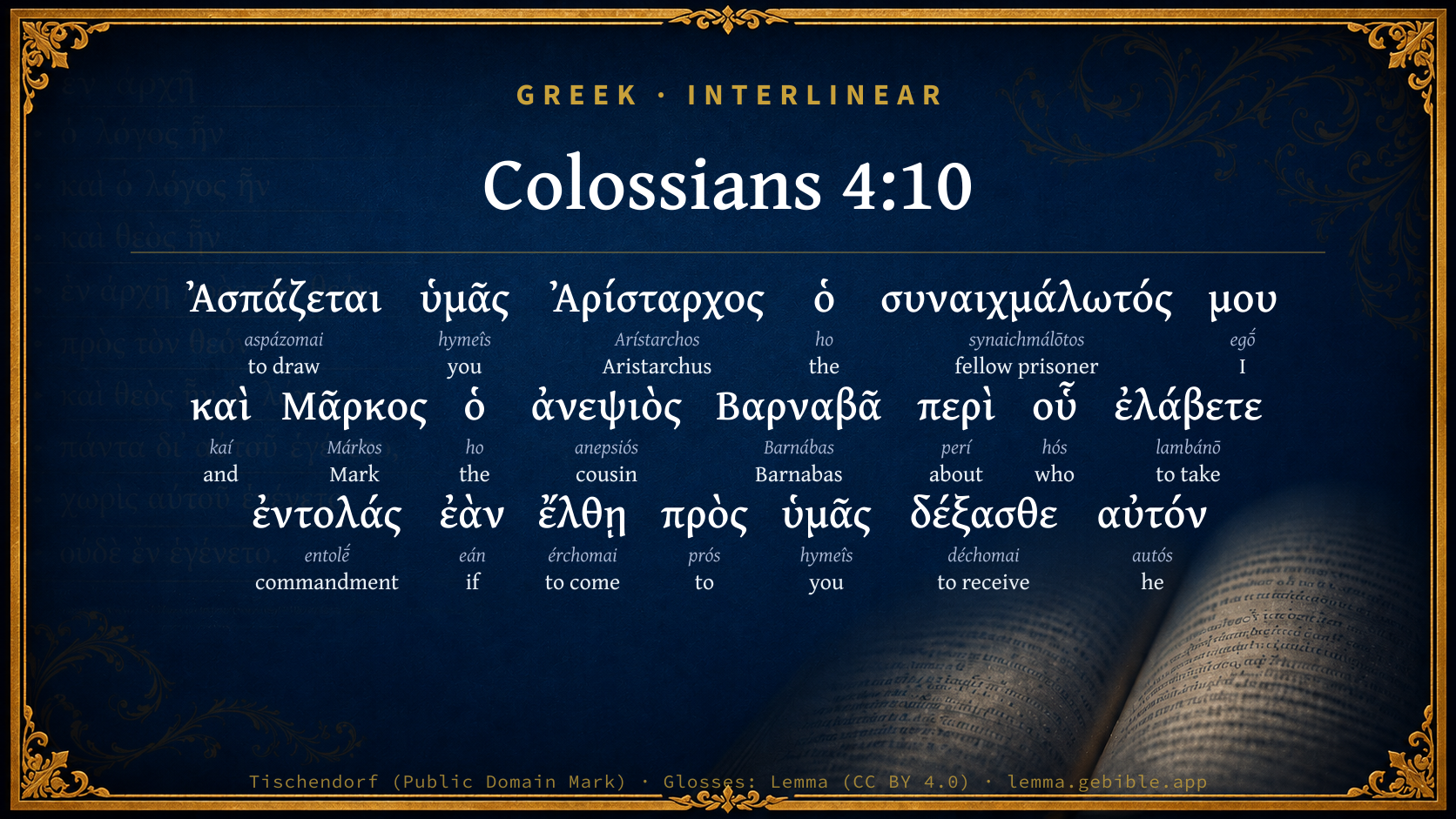
Aristarchus, my fellow prisoner greets you, and Mark, the cousin of Barnabas (concerning whom you received commandments, "if he comes to you, receive him"),
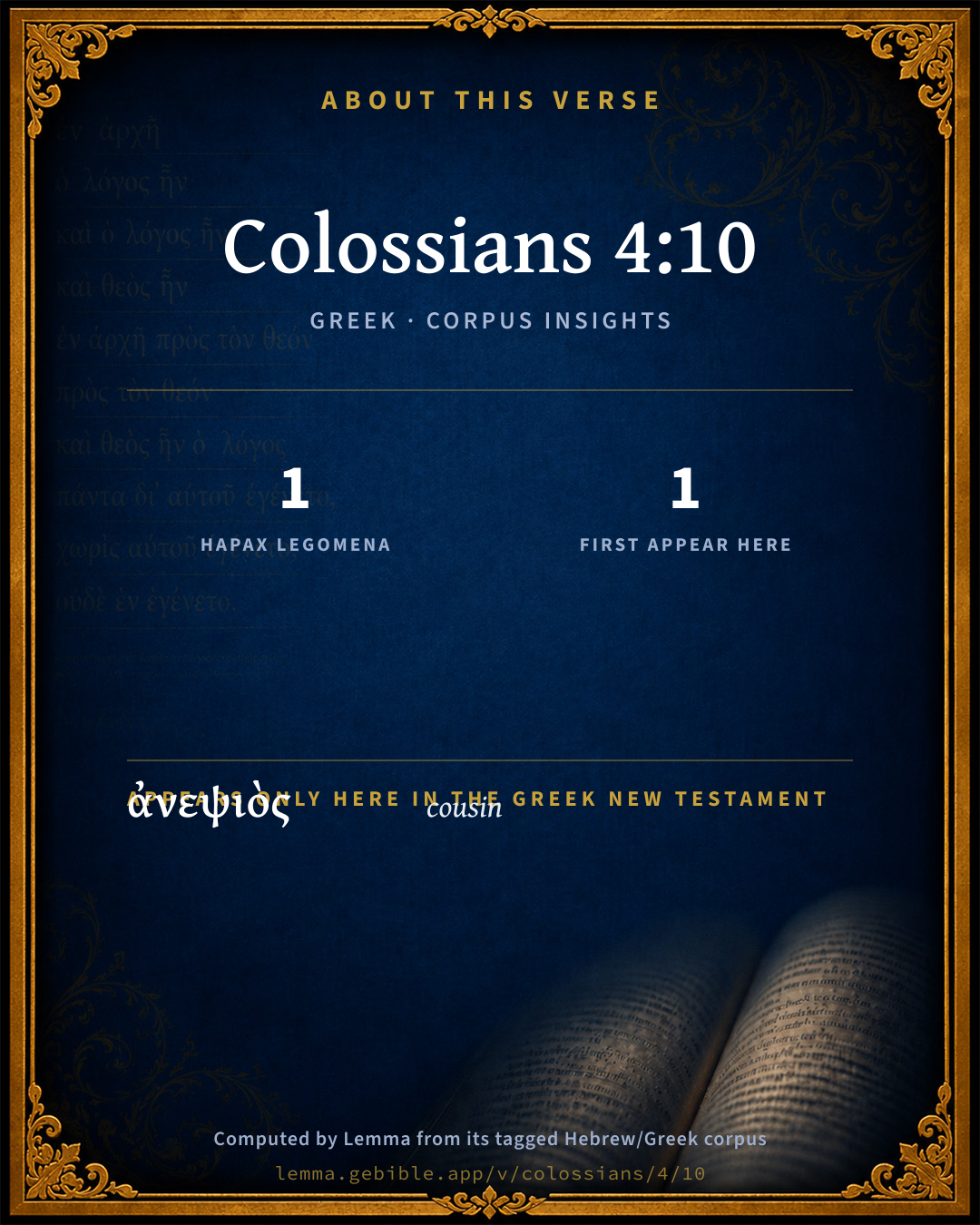
- 1 hapax legomenon — only here in the Greek New Testament
- 1 first appearance in the Greek New Testament
Download a study sheet
One document with this verse’s original text, its word-by-word gloss line, the meaning frame, cross-references with their text, attributed commentary, and full source and license credits — printable, and it pastes into notes with its structure intact.
This verse Autodidact and up
A passage Seminary Student
Up to 50 verses in one chapter. A passage sheet keeps up to 6 commentary sources and 12 cross-references per verse, in the order this page ranks them, and says so on the sheet whenever that leaves anything out. Ask for a single verse and you get the Autodidact verse sheet above.
Everything on this page stays free to read, with no account — the sheet is a download of what is already on screen, not access to it.
Compare translations 3
The same verse in 3 English versions, stacked beneath the original-language interlinear above. Click any original word for its lexicon entry.
Each is an independent rendering of the whole verse — the interlinear is not word-aligned to these translations.
Highlighted words mark where these versions differ — a whole-verse word diff, not a word-by-word alignment.
-
World English Bible Public Domain
Aristarchus, my fellow prisoner greets you, and Mark, the cousin of Barnabas (concerning whom you received commandments, "if he comes to you, receive him"),
-
King James Version Public Domain
Aristarchus my fellowprisoner saluteth you, and Marcus, sister's son to Barnabas, (touching whom ye received commandments: if he come unto you, receive him;)
-
unfoldingWord Literal Text CC BY-SA 4.0
Aristarchus, my fellow prisoner, greets you, and Mark, the cousin of Barnabas (about whom you received orders; if he may come to you, receive him),
unfoldingWord Literal Text — © unfoldingWord, licensed CC BY-SA 4.0. Word-aligned USFM3 via Door43 (git.door43.org/unfoldingWord/en_ult).
Show all 19 translations
Every available English version of this verse, each an independent rendering of the whole verse.
-
World English Bible Public Domain
Aristarchus, my fellow prisoner greets you, and Mark, the cousin of Barnabas (concerning whom you received commandments, "if he comes to you, receive him"),
-
Berean Standard Bible Public Domain
My fellow prisoner Aristarchus sends you greetings, as does Mark the cousin of Barnabas. You have already received instructions about him: If he comes to you, welcome him.
-
Majority Standard Bible Public Domain
My fellow prisoner Aristarchus sends you greetings, as does Mark the cousin of Barnabas. You have already received instructions about him: If he comes to you, welcome him.
-
King James Version Public Domain
Aristarchus my fellowprisoner saluteth you, and Marcus, sister's son to Barnabas, (touching whom ye received commandments: if he come unto you, receive him;)
-
American Standard Version (1901) Public Domain
Aristarchus my fellow-prisoner saluteth you, and Mark, the cousin of Barnabas (touching whom ye received commandments; if he come unto you, receive him),
-
Revised Version (1885) Public Domain
Aristarchus my fellow-prisoner saluteth you, and Mark, the cousin of Barnabas (touching whom ye received commandments; if he come unto you, receive him),
-
Geneva Bible (1599) Public Domain
Aristarchus my prison fellow saluteth you, and Marcus, Barnabas cousin (touching whom ye receiued commandements. If he come vnto you, receiue him)
-
Douay-Rheims (1899) Public Domain
Aristarchus, my fellow prisoner, saluteth you, and Mark, the cousin german of Barnabus, touching whom you have received commandments; if he come unto you, receive him:
-
Young's Literal Translation Public Domain
Salute you doth Aristarchus, my fellow-captive, and Marcus, the nephew of Barnabas, (concerning whom ye did receive commands -- if he may come unto you receive him,)
-
Literal Standard Version CC BY-SA 4.0
Aristarchus greets you, my fellow-captive, and Marcus, the nephew of Barnabas (concerning whom you received commands—if he may come to you, receive him),
-
Unlocked Literal Bible CC BY-SA 4.0
Aristarchus, my fellow prisoner, greets you, as well as Mark, the cousin of Barnabas (about whom you received orders; if he comes to you, receive him),
-
unfoldingWord Literal Text CC BY-SA 4.0
Aristarchus, my fellow prisoner, greets you, and Mark, the cousin of Barnabas (about whom you received orders; if he may come to you, receive him),
-
Darby Bible Public Domain
Aristarchus my fellow-captive salutes you, and Mark, Barnabas's cousin, concerning whom ye have received orders, (if he come to you, receive him,)
-
World Messianic Bible Public Domain
Aristarchus, my fellow prisoner, greets you, and Mark the cousin of Barnabas (concerning whom you received instructions, “if he comes to you, receive him”),
-
Webster's Bible Public Domain
Aristarchus, my fellow-prisoner, saluteth you; and Marcus, sister's son to Barnabas, (concerning whom ye received commandments: if he should come to you, receive him;)
-
Free Bible Version CC BY-SA 4.0
Aristarchus who's with me here in prison sends his best wishes; likewise Mark, Barnabas' cousin (you've already had instructions to welcome him if he visits you),
-
Bible in Basic English Public Domain
Aristarchus, my brother-prisoner, sends his love to you, and Mark, a relation of Barnabas (about whom you have been given orders: if he comes to you, be kind to him),
-
Text-Critical English NT CC BY 4.0
Aristarchus, my fellow prisoner, greets you, and so does Mark the cousin of Barnabas (about whom you have received instructions: if he comes to you, welcome him).
-
Tyndale New Testament (1534) Public Domain
Aristarchus my preson felowe saluteth you and Marcus Barnabassis systers sonne: touchinge whom ye receaved commaundementes. Yf he come vnto you receave him:
Literal Standard Version (2020), Covenant Press — licensed CC BY-SA 4.0. Text via the HelloAO Bible API (eBible.org). Unlocked Literal Bible (unfoldingWord) — licensed CC BY-SA 4.0. Text via the HelloAO Bible API (eBible.org). unfoldingWord Literal Text — © unfoldingWord, licensed CC BY-SA 4.0. Word-aligned USFM3 via Door43 (git.door43.org/unfoldingWord/en_ult). Free Bible Version, Dr. Jonathan Gallagher — licensed CC BY-SA 4.0. Text via the HelloAO Bible API (eBible.org).
Word by word
More ways to search: Search by grammar → Find every occurrence → Compare this word →
Practice this passage: Drill this verse → Learn its vocabulary →
- Appears 1× in the Greek New Testament
- First appears here
- Part of Speech
- Noun
- Case
- Nominative
- Number
- Singular
- Gender
- Masculine
Full Thayer's Definition
- Ἀσπάζεται aspázomai G782 “to draw” Verb, Present, Middle or Passive deponent, Indicative, 3rd person, Singular
- ὑμᾶς hymeîs G5210 “you” Personal pronoun, 2nd person, Accusative, Plural
- Ἀρίσταρχος Arístarchos G708 “Aristarchus” Noun, Nominative, Singular, Masculine
- ὁ ho G3588 “the” Article, Nominative, Singular, Masculine
- συναιχμάλωτός synaichmálōtos G4869 “fellow prisoner” Adjective, Nominative, Singular, Masculine
- μου egṓ G1473 “I” Personal pronoun, 1st person, Genitive, Singular
- καὶ kaí G2532 “and” Conjunction
- Μᾶρκος Márkos G3138 “Mark” Noun, Nominative, Singular, Masculine
- ὁ ho G3588 “the” Article, Nominative, Singular, Masculine
- ἀνεψιὸς anepsiós G431 “cousin” Noun, Nominative, Singular, Masculine
- Βαρναβᾶ Barnábas G921 “Barnabas” Noun, Genitive, Singular, Masculine
- περὶ perí G4012 “about” Preposition
- οὗ hós G3739 “who” Relative pronoun, Genitive, Singular, Masculine
- ἐλάβετε lambánō G2983 “to take” Verb, Aorist, Active, Indicative, 2nd person, Plural
- ἐντολάς entolḗ G1785 “commandment” Noun, Accusative, Plural, Feminine
- ἐὰν eán G1437 “if” Conditional
- ἔλθῃ érchomai G2064 “to come” Verb, Aorist, Active, Subjunctive, 3rd person, Singular
- πρὸς prós G4314 “to” Preposition
- ὑμᾶς hymeîs G5210 “you” Personal pronoun, 2nd person, Accusative, Plural
- δέξασθε déchomai G1209 “to receive” Verb, Aorist, Middle deponent, Imperative, 2nd person, Plural
- αὐτόν autós G846 “he” Personal pronoun, Accusative, Singular, Masculine
About this verse
These counts appear in no published source. They are computed here, from the morphology-tagged text and Lemma’s own curated glosses. What Lemma adds →
- 21
- words
- 19
- distinct lemmas
- Pauline Epistles
- section
Notable vocabulary
1 hapax legomenon — a word that appears only here in the entire Greek New Testament:
- ἀνεψιὸς cousin G431
First appearance in Scripture
This word makes its first canonical appearance in the Greek New Testament here:
- ἀνεψιὸς cousin G431
Shared distinctive vocabulary
συναιχμάλωτός fellow prisoner G4869 occurs in 3 verses of the Greek New Testament. Also found in:
Cross-references
15Topical passages linked to Colossians 4:10 in the Treasury of Scripture Knowledge — connected by theme and wording, ordered by reader-vote popularity; previews shown in the World English Bible.
- Acts 19:29 The whole city was filled with confusion, and they rushed with one accord into the theater, having seized Gaius and Aristarchus, men of Macedonia, Paul's companions in travel.
- 2 Timothy 4:11 Only Luke is with me. Take Mark, and bring him with you, for he is useful to me for ministering.
- Philemon 1:24 as do Mark, Aristarchus, Demas, and Luke, my fellow workers.
- Acts 12:12 Thinking about that, he came to the house of Mary, the mother of John whose surname was Mark, where many were gathered together and were praying.
- Acts 15:37–39 Barnabas planned to take John, who was called Mark, with them also.
- Acts 20:4 These accompanied him as far as Asia: Sopater of Beroea; Aristarchus and Secundus of the Thessalonians; Gaius of Derbe; Timothy; and Tychicus and Trophimus of Asia.
- Acts 27:2 Embarking in a ship of Adramyttium, which was about to sail to places on the coast of Asia, we put to sea; Aristarchus, a Macedonian of Thessalonica, being with us.
- Acts 4:36 Joses, who by the apostles was surnamed Barnabas (which is, being interpreted, Son of Encouragement), a Levite, a man of Cyprus by race,
- Acts 13:13 Now Paul and his company set sail from Paphos, and came to Perga in Pamphylia. John departed from them and returned to Jerusalem.
- Romans 16:2 that you receive her in the Lord, in a way worthy of the saints, and that you assist her in whatever matter she may need from you, for she herself also has been a helper of many, and of my own self.
- Romans 16:7 Greet Andronicus and Junias, my relatives and my fellow prisoners, who are notable among the apostles, who also were in Christ before me.
- Romans 16:21–23 Timothy, my fellow worker, greets you, as do Lucius, Jason, and Sosipater, my relatives.
- 1 Peter 5:13 She who is in Babylon, chosen together with you, greets you; and so does Mark, my son.
- Acts 13:5 When they were at Salamis, they proclaimed the word of God in the synagogues of the Jews. They had also John as their attendant.
- 2 John 1:8–9 Watch yourselves, that we don't lose the things which we have accomplished, but that we receive a full reward.
Cross-references courtesy of OpenBible.info (CC BY 4.0).
Lesson kit
Teaching starters — assembled from the data on this page, not authored interpretation. Every prompt links to the verse data it draws on. Edit before teaching.
Colossians, in the Pauline Epistles, opens this verse with 21 words (19 distinct Greek lemmas). Its most distinctive word is anepsiós (“cousin”). A historical commentator’s framing appears above. Read the whole chapter for the surrounding context.
Discussion questions
- The word anepsiós carries the sense “cousin.” How does it shape the verse?
- 1 word here appears nowhere else in the Greek New Testament. Why might the author reach for such rare wording?
- This is the first place “cousin” appears in Scripture (first appears here). What does its debut here establish?
- How does Romans 16:7, which shares the word «fellow prisoner», read alongside this verse?
- What does the repetition of “you” (2× in this one verse) do in this verse?
- These translations render this verse differently; the difference is in the English rendering, not the original. What questions does that raise?
- Compare how The Biblical Illustrator and Joseph Benson's Commentary read this verse. Where do they agree or differ?
Things to notice
- 1 word in this verse appears nowhere else in the Greek New Testament.
- 1 word makes its first canonical appearance in Scripture here.
- These translations choose different wording for 18 words in this verse.
- “you” occurs 2× in this single verse.
- 19 distinct Greek lemmas span 21 words in this verse.
Commentary
Notes on Colossians 4:10 from classic Christian and Jewish commentators (each source and its license shown beneath its notes). The classic Christian expositions comment on the surrounding passage and are grouped to its opening verse, so a note may address several verses; the Jewish commentaries on the Tanakh (Rashi and others) are per-verse, so they appear only where the commentator wrote on this verse.
Lemma curates 59 commentaries, every one of them public domain or Creative Commons licensed, each selected and text-cleaned for this edition rather than reprinted as found. About our sources →
The Biblical Illustrator
Joseph S. Exell
The Biblical Illustrator, edited by Joseph S. Exell (c. 1880s–1900s) — public domain. Text from a community e-Sword module.
Joseph Benson's Commentary
Joseph Benson's Commentary on the Old and New Testaments (1811–1818) — public domain. Text from a community e-Sword module.
Lange's Commentary on the Holy Scriptures
Lange's Commentary on the Holy Scriptures (Critical, Doctrinal, and Homiletical), ed. John Peter Lange, English translation edited by Philip Schaff (1864–1880) — public domain. Text from a community e-Sword module.
Kretzmann's Popular Commentary
Paul E. Kretzmann
Paul E. Kretzmann, Popular Commentary of the Bible (1921–1924) — public domain. Text from a community e-Sword module.
The Expositor's Bible
William Robertson Nicoll, ed., The Expositor's Bible (London: Hodder & Stoughton, 1887–1910) — public domain. 65 of 66 books (1 Corinthians is not separately keyed, as that volume carries no machine-parseable verse references); section-level commentary keyed to the opening verse. Introductory and overview sections not keyed to a specific passage are excluded.
Tyndale Open Study Notes
Tyndale Open Resources
Tyndale Open Study Notes — © Tyndale Open Resources, licensed CC BY-SA 4.0. Text via the HelloAO Bible API.
Bengel's Gnomon
Johann Albrecht Bengel
Bengel's Gnomon of the New Testament — English translation (T&T Clark, Edinburgh, 1860) — public domain. Text from a community e-Sword module.
Meyer's Critical & Exegetical Commentary
Heinrich August Wilhelm Meyer
Meyer — Critical and Exegetical Commentary on the New Testament — English translation by Peter Christie, edited by Frederick Crombie (T&T Clark, 1880) — public domain. Text from a community e-Sword module.
Expositor's Greek Testament
ed. W. Robertson Nicoll
The Expositor's Greek Testament, edited by W. Robertson Nicoll (1897–1910) — public domain. Text from a community e-Sword module.
Cambridge Greek Testament for Schools and Colleges
Cambridge Greek Testament for Schools and Colleges (Cambridge University Press, 1896; 21 vols, various authors incl. Carr, Maclear, Plummer, Farrar, Lumby, Moule, M. R. James, Simcox) — public domain. Text from a community e-Sword module.
Jamieson, Fausset & Brown
Robert Jamieson, A. R. Fausset & David Brown
Jamieson, Fausset & Brown — Commentary Critical and Explanatory on the Whole Bible (1871) — public domain (CC PDM 1.0). Text via the HelloAO Bible API.
Adam Clarke's Commentary
Adam Clarke's Commentary on the Bible (1810–1826) — public domain. Text from a community e-Sword/MySword module.
John Calvin's Commentaries
John Calvin's Commentaries (1540-1563) — public domain. Text from the Calvin Translation Society English edition (1840s-50s) via the Christian Classics Ethereal Library (ccel.org). Calvin's coverage is partial (roughly two-thirds of the Bible); uncommented books and verses are honest gaps, never fabricated. The 19th-century editor's footnotes and remarks are omitted so the notes are faithfully Calvin's own voice.
Ellicott's Commentary for English Readers
A Bible Commentary for English Readers, edited by Charles John Ellicott (1878–1897) — public domain. Text from a community e-Sword module.
The Cambridge Bible for Schools and Colleges
gen. ed. J. J. S. Perowne
The Cambridge Bible for Schools and Colleges (gen. ed. J. J. S. Perowne; Cambridge University Press, 1878–1918) — public domain. Text from a community e-Sword module.
John Gill's Exposition
John Gill's Exposition of the Whole Bible (1746–1763) — public domain (CC PDM 1.0). Text via the HelloAO Bible API.
Trapp's Complete Commentary
John Trapp
John Trapp, A Commentary or Exposition upon All the Books of the Old and New Testament (1647–1656) — public domain. Text from a community e-Sword module.
Albert Barnes' Notes on the Bible
Albert Barnes' Notes on the Bible (1834–1885) — public domain. Text from a community e-Sword/MySword module.
Haydock's Catholic Bible Commentary
George Leo Haydock (1774–1849), Haydock's Catholic Family Bible and Commentary, 1859 edition — public domain. Excludes Psalms (Douay-Rheims chapter numbering differs from Protestant) and Deuterocanonical books (Catholic canon only).
Matthew Poole's English Annotations
Matthew Poole's English Annotations on the Holy Bible (1683–1685) — public domain. Text from a community e-Sword/MySword module.
Whedon's Commentary on the Bible
Daniel D. Whedon
Daniel D. Whedon (gen. ed.), Commentary on the Old and New Testaments (1874–1909) — public domain. Text from a community e-Sword module.
The Pulpit Commentary
The Pulpit Commentary (1880–1919), ed. H.D.M. Spence-Jones & Joseph S. Exell — public domain. Text from a community e-Sword module.
John Wesley's Explanatory Notes
John Wesley, Explanatory Notes Upon the Whole Bible (1754–1765) — public domain. Text via the GEBible commentary corpus.
Burkitt's Expository Notes on the New Testament
William Burkitt
William Burkitt's Expository Notes on the New Testament (1700–1703) — public domain. Text from a community e-Sword module.
The People's New Testament
B. W. Johnson
B. W. Johnson's The People's New Testament with Notes (1889–1891) — public domain. Electronic text from the Christian Classics Ethereal Library (CCEL) ThML edition.
unfoldingWord translationNotes
Door43 World Missions Community
unfoldingWord translationNotes — © Distant Shores Media and the Door43 World Missions Community, licensed CC BY-SA 4.0. Source: git.door43.org/Door43/en_tn.
Alford’s Greek Testament
Henry Alford
Henry Alford, The Greek Testament (1849–1861) — public domain. Text from a community e-Sword module.
Vincent's Word Studies in the New Testament
Marvin R. Vincent
Marvin R. Vincent, Word Studies in the New Testament (1887–1900) — public domain. Text from a community e-Sword/MySword module.
Lightfoot's Colossians and Philemon
J. B. Lightfoot
J. B. Lightfoot, St Paul's Epistles to the Colossians and Philemon: a revised text with introductions, notes and dissertations (London: Macmillan, 1875) — public domain. Electronic text from Project Gutenberg (ebook #50857). Covers Colossians and Philemon only (the verse-by-verse notes; introductions and dissertations are omitted); Lightfoot's companion Galatians and Philippians volumes are not included, as the available public-domain scans carry garbled Greek that cannot be faithfully reproduced.