1 Corinthians 3:14

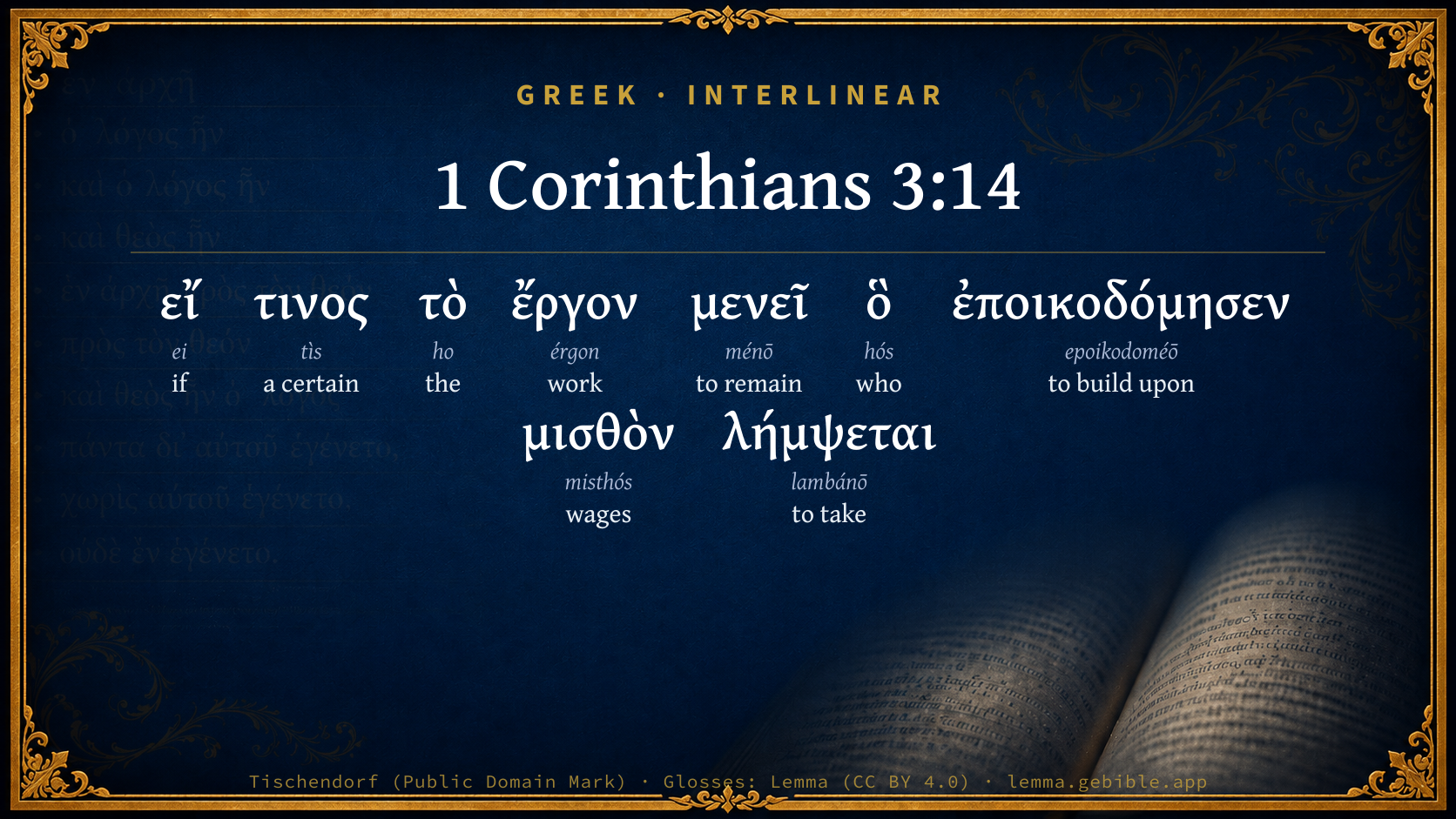
Greek (Tischendorf 8th ed.) 1 Corinthians 3:14 appears in the Greek New Testament. The text above is from the Tischendorf 8th edition. Each word links to its Strong’s number and a concise gloss. Click any word for its full Thayer’s Greek Lexicon entry.
Download image
Cite this verse

1 Corinthians 3:14 (World English Bible). Public Domain. Lemma interlinear Bible study tool, https://lemma.gebible.app/v/1-corinthians/3/14.

Show BibTeX & RIS
BibTeX
RIS
English Translation
If any man's work remains which he built on it, he will receive a reward.
World English Bible · Public Domain
Download a study sheet

One document with this verse’s original text, its word-by-word gloss line, the meaning frame, cross-references with their text, attributed commentary, and full source and license credits — printable, and it pastes into notes with its structure intact.

This verse Autodidact and up

Study sheet (.html) Plain text (.txt)

A passage Seminary Student

Up to 50 verses in one chapter. A passage sheet keeps up to 6 commentary sources and 12 cross-references per verse, in the order this page ranks them, and says so on the sheet whenever that leaves anything out. Ask for a single verse and you get the Autodidact verse sheet above.

Everything on this page stays free to read, with no account — the sheet is a download of what is already on screen, not access to it.

Want to remove ads? Support Godless Engineer
Compare translations 3

The same verse in 3 English versions, stacked beneath the original-language interlinear above. Click any original word for its lexicon entry.

Each is an independent rendering of the whole verse — the interlinear is not word-aligned to these translations.

Highlighted words mark where these versions differ — a whole-verse word diff, not a word-by-word alignment.

  • World English Bible Public Domain
    If any man's work remains which he built on it, he will receive a reward.
  • King James Version Public Domain
    If any man's work abide which he hath built thereupon, he shall receive a reward.
  • unfoldingWord Literal Text CC BY-SA 4.0
    If anyone’s work that he built will remain, he will receive a reward;

unfoldingWord Literal Text — © unfoldingWord, licensed CC BY-SA 4.0. Word-aligned USFM3 via Door43 (git.door43.org/unfoldingWord/en_ult).

Versions to compare (up to 4)

3 of 4 selected

Show all 19 translations

Every available English version of this verse, each an independent rendering of the whole verse.

  • World English Bible Public Domain
    If any man's work remains which he built on it, he will receive a reward.
  • Berean Standard Bible Public Domain
    If what he has built survives, he will receive a reward.
  • Majority Standard Bible Public Domain
    If what he has built survives, he will receive a reward.
  • King James Version Public Domain
    If any man's work abide which he hath built thereupon, he shall receive a reward.
  • American Standard Version (1901) Public Domain
    If any man's work shall abide which he built thereon, he shall receive a reward.
  • Revised Version (1885) Public Domain
    If any man’s work shall abide which he built thereon, he shall receive a reward.
  • Geneva Bible (1599) Public Domain
    If any mans worke, that he hath built vpon, abide, he shall receiue wages.
  • Douay-Rheims (1899) Public Domain
    If any man's work abide, which he hath built thereupon, he shall receive a reward.
  • Young's Literal Translation Public Domain
    if of any one the work doth remain that he built on `it', a wage he shall receive;
  • Literal Standard Version CC BY-SA 4.0
    if the work of anyone remains that he built on [it], he will receive a wage;
  • Unlocked Literal Bible CC BY-SA 4.0
    If anyone's work remains, he will receive a reward;
  • unfoldingWord Literal Text CC BY-SA 4.0
    If anyone’s work that he built will remain, he will receive a reward;
  • Darby Bible Public Domain
    If the work of any one which he has built upon [the foundation] shall abide, he shall receive a reward.
  • World Messianic Bible Public Domain
    If any man’s work remains which he built on it, he will receive a reward.
  • Webster's Bible Public Domain
    If any man's work abideth which he hath built upon it, he shall receive a reward.
  • Free Bible Version CC BY-SA 4.0
    Those whose building survives will be rewarded.
  • Bible in Basic English Public Domain
    If any man's work comes through the test, he will have a reward.
  • Text-Critical English NT CC BY 4.0
    If the work that anyone has built remains, he will receive a reward.
  • Tyndale New Testament (1534) Public Domain
    Yf eny mannes worke that he hath bylt apon byde he shall receave a rewarde.

Literal Standard Version (2020), Covenant Press — licensed CC BY-SA 4.0. Text via the HelloAO Bible API (eBible.org). Unlocked Literal Bible (unfoldingWord) — licensed CC BY-SA 4.0. Text via the HelloAO Bible API (eBible.org). unfoldingWord Literal Text — © unfoldingWord, licensed CC BY-SA 4.0. Word-aligned USFM3 via Door43 (git.door43.org/unfoldingWord/en_ult). Free Bible Version, Dr. Jonathan Gallagher — licensed CC BY-SA 4.0. Text via the HelloAO Bible API (eBible.org).

Word by word

More ways to search: Search by grammar → Find every occurrence → Compare this word →

Practice this passage: Drill this verse → Learn its vocabulary →

About this verse

These counts appear in no published source. They are computed here, from the morphology-tagged text and Lemma’s own curated glosses. What Lemma adds →

9
words
9
distinct lemmas
Pauline Epistles
section

Notable vocabulary

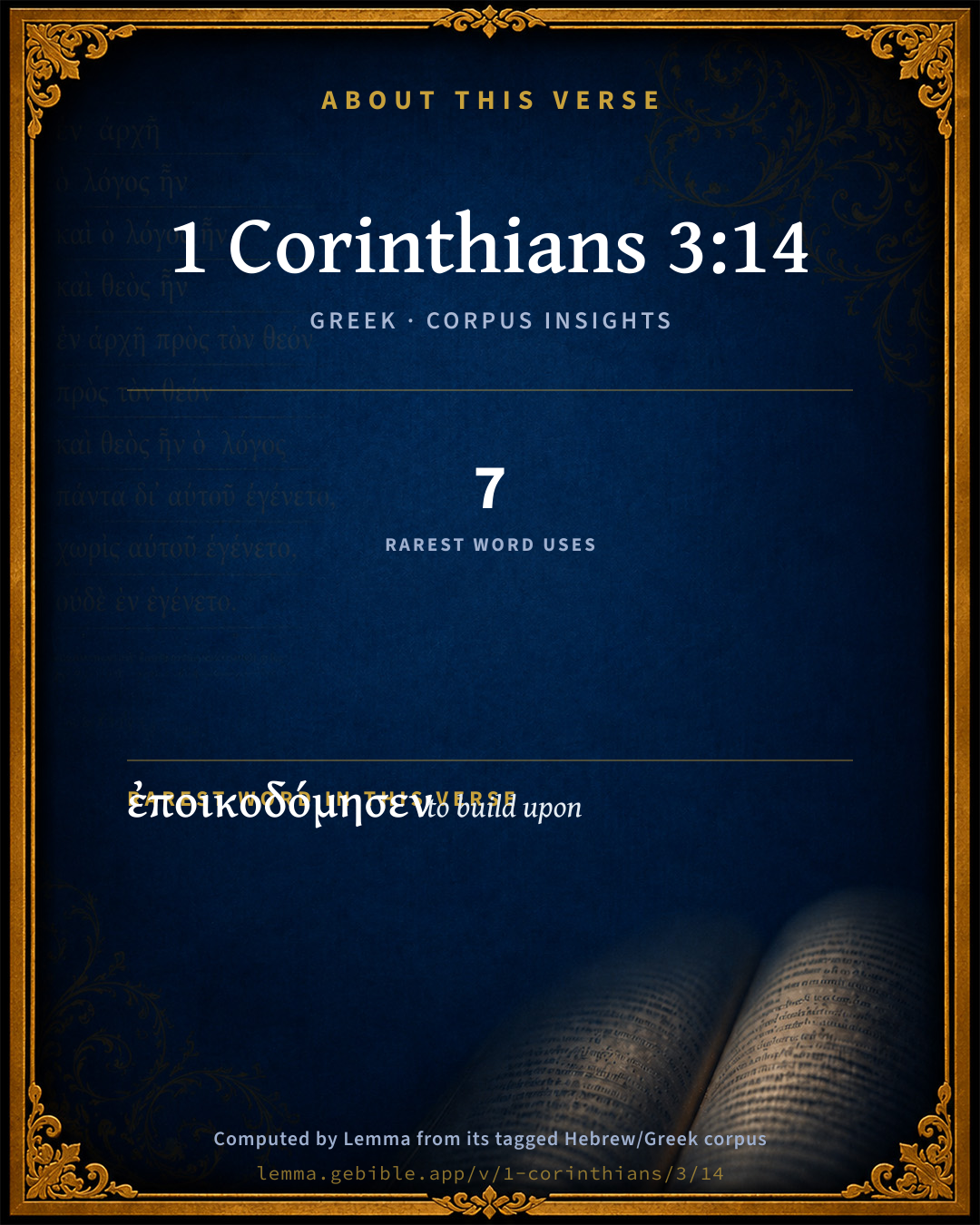
The rarest word here is ἐποικοδόμησεν to build upon G2026 — appearing just 7 times in the whole Greek New Testament.

Shared distinctive vocabulary

ἐποικοδόμησεν to build upon G2026 occurs in 6 verses of the Greek New Testament. Also found in:

Cross-references

10

Topical passages linked to 1 Corinthians 3:14 in the Treasury of Scripture Knowledge — connected by theme and wording, ordered by reader-vote popularity; previews shown in the World English Bible.

  • 1 Corinthians 3:8 Now he who plants and he who waters are the same, but each will receive his own reward according to his own labor.
  • Matthew 25:21–23 "His lord said to him, 'Well done, good and faithful servant. You have been faithful over a few things, I will set you over many things. Enter into the joy of your lord.'
  • Matthew 24:45–47 "Who then is the faithful and wise servant, whom his lord has set over his household, to give them their food in due season?
  • 1 Corinthians 4:5 Therefore judge nothing before the time, until the Lord comes, who will both bring to light the hidden things of darkness, and reveal the counsels of the hearts. Then each man will get his praise from God.
  • Daniel 12:3 Those who are wise shall shine as the brightness of the expanse; and those who turn many to righteousness as the stars forever and ever.
  • 1 Thessalonians 2:19 For what is our hope, or joy, or crown of rejoicing? Isn't it even you, before our Lord Jesus at his coming?
  • 1 Peter 5:1 I exhort the elders among you, as a fellow elder, and a witness of the sufferings of Christ, and who will also share in the glory that will be revealed.
  • 1 Peter 5:4 When the chief Shepherd is revealed, you will receive the crown of glory that doesn't fade away.
  • Revelation 2:8–11 "To the angel of the assembly in Smyrna write: "The first and the last, who was dead, and has come to life says these things:
  • 2 Timothy 4:7 I have fought the good fight. I have finished the course. I have kept the faith.

Cross-references courtesy of OpenBible.info (CC BY 4.0).

Commentary

Notes on 1 Corinthians 3:14 from classic Christian and Jewish commentators (each source and its license shown beneath its notes). The classic Christian expositions comment on the surrounding passage and are grouped to its opening verse, so a note may address several verses; the Jewish commentaries on the Tanakh (Rashi and others) are per-verse, so they appear only where the commentator wrote on this verse.

Lemma curates 59 commentaries, every one of them public domain or Creative Commons licensed, each selected and text-cleaned for this edition rather than reprinted as found. About our sources →

Joseph Benson's Commentary

1Co 3:14-15. If any maws work abide which he hath built, &c. — If the superstructure which any minister of Christ raises on the true foundation, if the doctrines which he preaches can bear the test by which they shall be tried at that day, as being true, important, and adapted to the state of his hearers; and the converts which he makes by preaching these doctrines, be of the right kind, truly regenerated and holy persons, he shall receive a reward — In proportion to his labours. If any man’s work shall be burned — If the doctrines which any minister preaches cannot bear the test of the great day, as being false or trivial, or not calculated to convert and edify his hearers; or if the converts which he makes by preaching such doctrines be only converts to some particular opinion, or mode of worship, or form of church government, or to a certain sect or party, and not converts to Christ and true Christianity, to the power as well as the form of godliness, to the experience and practice, as well as to the theory of true religion, and therefore cannot stand in that awful judgment, he shall suffer loss — Shall lose his labour and expectation, and the future reward he might have received, if he had built with proper materials; as a man suffers loss who bestows his time and labour on the erection of a fabric of wood, hay, and stubble, which is afterward consumed. But he himself — That preacher himself; shall be saved — Supposing he himself be a true disciple of Christ, built up in faith and holiness on the true foundation; yet so as by fire — As narrowly as a man escapes through the fire, when his house is all in flames about him: or rather, if so be that his own religion, his personal faith and holiness, can bear both the fiery trial which he may be called to pass through on earth, whether of reproach and persecution, or of pain and affliction, or any other trouble, and also the decisive trial of the last day. Let it not be supposed by any that the apostle is here putting a case that never occurs, or can occur: such cases, there is reason to believe, have often occurred, and still do and will occur; in which ministers, who are themselves real partakers of the grace of Christ, and truly pious, yet, through error of judgment, attachment to certain opinions, or a particular party, or under the influence of peculiar prejudices, waste their time, and that of their hearers, in building wood, hay, and stubble, when they should be labouring to raise an edifice of gold, silver, and precious stones; employ themselves in inculcating unessential or unimportant, if not even false doctrines, when they ought to be testifying with sincerity, zeal, and diligence, the genuine gospel of the grace of God. Dr. Macknight, who considers the apostle as speaking in these verses, not of the foundation and superstructure of a system of doctrines, “but of the building or temple of God, consisting of all who profess to believe the gospel,” gives us the following commentary on the passage: “Other foundation of God’s temple, no teacher, if he teaches faithfully, can lay, except what is laid by me, which is Jesus, the Christ, promised in the Scriptures. Now if any teacher build on the foundation, Christ, sincere disciples, represented in this similitude by gold, silver, valuable stones; or if he buildeth hypocrites, represented by wood, hay, stubble, every teacher’s disciples shall be made manifest in their true characters; for the day of persecution, which is coming on them, will make every one’s character plain, because it is of such a nature as to be revealed by the fire of persecution: and so that fire, falling on the temple of God, will try every teacher’s disciples, of what sort they are. If the disciples, which any teacher has introduced into the church, endure persecution for the gospel without apostatizing, such a teacher shall receive the reward promised to them who turn others to righteousness, Dan 12:3. If the disciples of any teacher shall, in time of persecution, fall away, through the want of proper instruction, he will lose his reward; he himself, however, having in general acted sincerely, shall be saved; yet, with such difficulty, as one is saved who runs through a fire.” But, as by the foundation, which he says he had laid, the apostle undoubtedly meant the doctrine concerning Christ, and salvation through him, it seems more consistent with his design to interpret what refers to the superstructure attempted to be raised by different builders, of doctrines also, and not of persons introduced by them into the Christian Church: and to understand him as cautioning the Corinthians against disfiguring and destroying the beautiful edifice, by inculcating tenets which were heretical, and pernicious to the souls of men, and would not stand the test of the approaching fiery trial. Thus what follows.

Joseph Benson's Commentary on the Old and New Testaments (1811–1818) — public domain. Text from a community e-Sword module.

Scofield Reference Notes

C. I. Scofield

reward

God, in the N.T. Scriptures, offers to the lost, salvation, and, for the faithful service of the saved, rewards. The passages are easily distinguished by remembering that salvation is invariably spoken of as a free gift (e.g.) Joh 4:10; Rom 6:23; Eph 2:8; Eph 2:9 while rewards are earned by works; Mat 10:42; Luk 19:17; 1Co 9:24; 1Co 9:25; 2Ti 4:7; 2Ti 4:8; Rev 2:10; Rev 22:12.

A further distinction is that salvation is a present possession Luk 7:50; Joh 3:36; Joh 5:24; Joh 6:47, while rewards are a future attainment, to be given at the coming of the Lord; Mat 16:27; 2Ti 4:8; Rev 22:12.

reward 1Co 9:17; Dan 12:3; 1Co 3:14

The Scofield Reference Bible (1917 edition), notes by C. I. Scofield — public domain. Text from a community e-Sword module.

Bengel's Gnomon

Johann Albrecht Bengel

1Co 3:14. Εἰ τινος, if any man’s) Hence Paul is accustomed to promise glory to himself from the constancy of his brethren [hence also to derive exhortations], 2Co 1:14; Php 2:16; 1Th 2:19.

Bengel's Gnomon of the New Testament — English translation (T&T Clark, Edinburgh, 1860) — public domain. Text from a community e-Sword module.

Meyer's Critical & Exegetical Commentary

Heinrich August Wilhelm Meyer

1Co_3:14-15. Manner and result of this δοκιμάσει.

μενεῖ] will remain unharmed; not μένει (Text. recept.) for κατακαήσεται, in 1Co_3:15, corresponds to it.

μισθὸν λήψ.] namely, for his work at the building (without figure: teachers recompense), from God, at whose οἰκοδομή he has laboured. Rückert holds that Paul steps decidedly out of his figure here; for the builder is not paid only after his work has stood the test of fire uninjured. But the building is still being worked at until the Parousia, so that before that event no recompense can be given. The fire of the Parousia seizes upon the building still in process of being completed, and now he alone receives recompense whose work, which has been carried on hitherto, shows itself proof against the fire.

As regards the form κατακαήσεται, shall be burned down (comp 2Pe_3:10), instead of the Attic κατακαυθήσεται, see Thom. M. p. 511.

ζημιωθήσεται] sc[534] τὸν μισθόν, i.e. frustrabitur praemio. Comp on ζημιοῦσθαί τι, to suffer loss of anything, Mat_16:26; Luk_9:25; Php_3:8. See also Valckenaer, a[536] Herod. vii. 39. The thought is: He will, as a punishment, not receive the recompense which he would otherwise have received as a teacher. We are not to think of deposition from office (Grotius), seeing that it is the time of the Parousia that is spoken of. To take the ζημ., with the Vulgate, et al[537]: without object, so that the sense would be: he shall have loss from it (Hofmann), gives too indefinite a conception, and one which would require first of all to have its meaning defined more precisely from the antithesis of μισθ. λήψεται.

αὐτὸς δὲ σωθήσεται, οὕτω δὲ ὡς διὰ πυρός] In order not to be misunderstood, as if by his ζημιωθήσεται he were denying to such teachers share in the future Messianic salvation at all, whereas he is only refusing to assign to them the higher rank of blessedness, blessedness as teachers, Paul adds: Yet he himself shall be saved, but so as through fire. Αὐτός refers to the τὸν μισθόν, which is to be supplied as the object of ζημ.: although he will lose his recompense, yet he himself, etc. Rückert is wrong in thinking that the builder is now regarded as the inhabitant of the house. Paul does not handle his figure in this confused way, but has before his mind the builder as still busied in the house with the work which he has been carrying on: all at once the fire seizes the house; he flees and yet finds safety, but not otherwise than as a man is saved through and from the midst of fire. Such an escape is wont to be coupled with fear and painful injury; hence the idea of this figurative representation is: He himself, however, shall obtain the Messianic σωτηρία,[538] yet still only in such a way that the catastrophe of the Parousia will be fraught with the highest anxiety for him, and will not elapse without sensibly impairing his inheritance of blessing. He shall obtain the σωτηρία, but only a lower grade of it, so that he will belong to those whom Jesus calls the last (Mat_20:16; Mar_10:31). The main point in this interpretation, namely, that σωθήσ. refers to the Messianic σωτηρία, is accepted by most expositors; but several, such as Rosenmüller and Flatt, take the future as indicating the possibility (a view which the very fact of the two preceding futures should have sufficed to preclude), and Grotius[539] has foisted in a problematical sense into the word (equally against the definitely assertive sense of those futures): In summo erit salutis suae periculo. Etsi eam adipiscetur (quod boni ominis causa sperare mavult apostolus) non fiet id sine gravi moestitia ac dolore. It is a common mistake to understand ὡς διὰ πυρός in the sense of a proverb (by a hairs-breadth, see Grotius and Wetstein in loc[540]; Valckenaer, p. 157; and comp Amo_4:11; Zec_3:2; Jud_1:23), because the passage, looking back to 1Co_3:13, really sets before us a conflagration (ὡς, as in Joh_1:14). It may be added that there is no ground for bringing into the conception the fire of the wrath of God (Hofmann), since, according to the text, it is the selfsame fire which seizes upon the work of the one and of the other, in the one case, however, proving it to be abiding, and in the other consuming it. Bengel illustrates the matter well by the instance of a shipwrecked man: ut mercator naufragus amissa merce et lucro servatur per undas. Other commentators, again (Chrysostom, Oecumenius, Theophylact), understand it to mean: He shall be preserved, but so only as one is preserved through the fire of hell, that is to say, eternally tormented therein. So too of late, in substance, Maier. But the interpretation is decidedly erroneous; first, because, according to 1Co_3:13, πῦρ cannot be allowed to have any reference to the fire of hell; secondly, because ΣΏΖΕΣΘΑΙ, which is the standing expression for being saved with the salvation of the Messiah, can least of all be used to denote anything else in a picture representing the decision of the Parousia.[542] This last consideration tells also against Schotts explanation (l.c[543] p. 17): He himself shall indeed not be utterly destroyed on that account; he remains, but it is as one who has passed through flaming fire (seriously injured), by which is denoted the divine award of punishment which awaits such a teacher at the day of judgment. It may also be urged against the view in question, that the sentence of punishment, since it dooms to the fire, cannot be depicted in the figure as a having passed through the fire.

[534] c. scilicet.

[536] d refers to the note of the commentator or editor named on the particular passage.

[537] t al. and others; and other passages; and other editions.

[538] For he has after all held to the foundation. The Messianic salvation is the gift of grace to those who believe in Christ as such; while the teachers blessedness, as μισθός (which the general σωτηρία in and by itself is not), must be some specially high grade of blessing in the Messiahs kingdom. Comp. Dan_12:3; Mat_19:28.

[539] So before him Theodore of Mopsuestia: ἀλλὰ καὶ ἂν σώζηται διά τινα ἑτέραν αἰτίαν σώζειν αὐτὸν δυναμένην.

[540] n loc. refers to the note of the commentator or editor named on the particular passage.

[542] Hence, also, it will not do to refer αὐτός, with Otto, Pastoralbr. p. 144 f., to the θεμέλιος, which will remain safe, but covered over with refuse, ashes, and the like, which he holds to be indicated by ὡς διὰ πυρός.

[543] .c. loco citato or laudato.

Meyer — Critical and Exegetical Commentary on the New Testament — English translation by Peter Christie, edited by Frederick Crombie (T&T Clark, 1880) — public domain. Text from a community e-Sword module.

Expositor's Greek Testament

ed. W. Robertson Nicoll

1Co 3:14-15 . The opp [570] issues of the fiery assay are stated under parl [571] hypotheses: εἴ τινος τὸ ἔργον … μενεῖ … εἴ τινος τὸ ἔργον κατακαήσεται , “If any one’s work shall abide … shall be burned up”. The double ind [572] with εἰ balances the contrasted suppositions, without signifying likelihood either way: for the opposed vbs., cf. 1Co 13:8 ; 1Co 13:13 ; μενεῖ recalls ὑπομενεῖ of Mal 3:2 . ὃ ἐποικοδόμησεν (wanting augment: usage varies in this vb [573] ; Wr [574] , p. 83) reminds us that the work examined was built on the one foundation (1Co 3:10 ff.). μισθὸν λήμψεται and ζημιωθήσεται are the corresponding apodoses, μισθὸν being carried over to the second of the parl [575] clauses (Mr [576] , Gd [577] , Lt [578] , Ed [579] ): “He will get a reward … will be mulcted (of it)”. ζημιόω retains in pass [580] its acc [581] of thing , as a vb [582] taking double acc [583] ; derived from ζημία (opp [584] of κέρδος : cf. Phi 3:7 ), it signifies to fine, inflict forfeit (in pass [585] , suffer forfeit ) of what one possessed, or might have possessed. “ αὐτὸς δέ opposed to μισθός : his reward shall be lost, but his person saved” (Lt [586] ); αὐτὸς is nearly syn [587] with the ψυχὴ of Mat 16:25 f., etc. The man built on the foundation, though his work proves culpably defective: σωθήσεται promises him the σωτηρία of Christ’s heavenly kingdom (see 1Co 1:18 , and other parls.). Such a minister saves himself, but not his hearers: the opp [588] result to that of 1Co 9:27 , etc. αὐτὸς δὲ σωθήσεται , οὕτως δὲ ὡς διὰ πυρός ( δὲ correcting δέ , as in 1Co 2:6 ) “yet so (saved) as through fire,” like Lot fleeing from Sodom; his salvation is reduced to a minimum: “He rushes out through the flame, leaving behind the ruin of his work … for which, proved to be worthless, he receives no pay” (Bt [589] ), getting through “scorched and with the marks of the flame” upon him (Lt [590] ); “s’il est sauvé, ce ne peut être qu’en échappant àtravers les flammes, et grâce àla solidité du fondement” (Gd [591] ); to change the figure, “ut naufragus mercator, amissa merce et lucro, servatus per undas” (Bg [592] ). For the prp [593] , in local sense, see Gm [594] , and Wr [595] , p. 473; διὰ πυρός , proverbial for a hairbreadth escape (see Lt [596] ad loc [597] ; Eurip., Andr. , 487; Elec. , 1182, and LXX parls.). The διὰ has been read instrumentally , “by means of fire,” sc. the fire of purgatory (see Lt [598] ); an idea foreign to this scene. Cm [599] , by a dreadful inversion of the meaning, reads the διὰ as ἐν πυρί “will be preserved in fire! ” ( σώζω nowhere has this sense of τηρέω ): εἰπὼν Σωθήσεται , οὐδὲν ἕτερον ἢ τὴν ἐπίτασιν τῆς τιμωρίας ᾐνίξατο . For other interpretations, see Mr [600]

[570] opposite, opposition.

[571] parallel.

[572] indicative mood.

[573] verb

[574] Winer-Moulton’s Grammar of N.T. Greek (8th ed., 1877).

[575] parallel.

[576] Meyer’s Critical and Exegetical Commentary (Eng. Trans.).

[577] F. Godet’s Commentaire sur la prem. Ép. aux Corinthiens (Eng. Trans.).

[578] J. B. Lightfoot’s (posthumous) Notes on Epp. of St. Paul (1895).

[579] T. C. Edwards’ Commentary on the First Ep. to the Corinthians . 2

[580] passive voice.

[581] accusative case.

[582] verb

[583] accusative case.

[584] opposite, opposition.

[585] passive voice.

[586] J. B. Lightfoot’s (posthumous) Notes on Epp. of St. Paul (1895).

[587] synonym, synonymous.

[588] opposite, opposition.

[589] J. A. Beet’s St. Paul’s Epp. to the Corinthians (1882).

[590] J. B. Lightfoot’s (posthumous) Notes on Epp. of St. Paul (1895).

[591] F. Godet’s Commentaire sur la prem. Ép. aux Corinthiens (Eng. Trans.).

[592] Bengel’s Gnomon Novi Testamenti.

[593] preposition.

[594] Grimm-Thayer’s Greek-English Lexicon of the N.T.

[595] Winer-Moulton’s Grammar of N.T. Greek (8th ed., 1877).

[596] J. B. Lightfoot’s (posthumous) Notes on Epp. of St. Paul (1895).

[597] ad locum , on this passage.

[598] J. B. Lightfoot’s (posthumous) Notes on Epp. of St. Paul (1895).

[599] John Chrysostom’s Homiliœ († 407).

[600] Meyer’s Critical and Exegetical Commentary (Eng. Trans.).

The Expositor's Greek Testament, edited by W. Robertson Nicoll (1897–1910) — public domain. Text from a community e-Sword module.

Hodge's Commentary on Romans, Ephesians & First Corinthians

Charles Hodge

1Co_3:14, 1Co_3:15

If any mans work abide which he hath built thereupon, he shall receive a reward. If any mans work shall be burned, he shall suffer loss: but he himself shall be saved; yet so as by fire.

This is an amplification of what precedes. If the materials employed by a spiritual builder stand the test of the day of judgment, he shall receive the reward of a faithful servant. Which he hath built thereupon, i.e. upon the foundation. Comp. 1Co_3:12. If any mans work shall be burned (κατακαήσεται for κατακαυθήσεται); that is, if the materials used by any builder shall not stand the test of that day, he shall suffer loss (ζημιωθήσεται see 2Co_7:9; Phi_3:8). That is, he will lose his reward.

But he himself shall be saved. Just as a man who has built his house of combustible materials, though he may escape when the fire comes, his property is lost, and all his labor comes to nothing. The apostle is here speaking of those teachers who, although they retain the fundamental doctrines of the gospel, yet combine them with error. This is plain from 1Co_3:12, If any man shall build on this foundation. It is not enough, therefore, that a minister hold fast to fundamental truth; he must take heed what he teaches in connection with that truth. If he mingles with it the wood, hay and stubble of his own philosophy, he will find himself a loser on the day of judgment. Many of the Fathers understand σωθήσεται here in the sense of shall be preserved. His work shall be consumed, but he himself shall be kept alive in the midst of the fire. It is not then the salvation, but the final perdition of the false teacher that the passage teaches. This, however, is contrary to the uniform meaning of the word in the New Testament. The common interpretation is therefore to be preferred.

Yet so as by fire, i.e. with difficulty. Comp. 1Pe_3:20; Jud_1:23; Zec_3:2. He will just escape with his life, as a man is rescued from a burning building. His salvation will not only be effected with difficulty, but it will be attended with great loss. He will occupy a lower place in the kingdom of heaven than he would have done. Romanists found their doctrine of purgatory on tradition rather than on Scripture. They are glad, however, to avail themselves of any semblance of scriptural support, and therefore appeal to this passage to prove that men are saved through fire. But,

1. Paul is here speaking of ministers and of their doctrines, and not of believers in general.

2. The fire of which he speaks is not a state of trial preceding the judgment, but the judgment itself.

3. The fire is that in the midst of which Jesus Christ is to appear.

4. Paul does not say, the man is to be saved by being purified by fire, but simply with difficulty, as the expression so as by fire familiarly means.

Charles Hodge — Commentary on Romans (1835), First Corinthians (1857), and Ephesians (1856) — public domain. Text from a community e-Sword module.

Jamieson, Fausset & Brown

Robert Jamieson, A. R. Fausset & David Brown

abide--abide the testing fire (Mat 3:11-12).

which he hath built thereupon--which he built on the foundation.

reward--wages, as a builder, that is, teacher. His converts built on Christ the foundation, through his faithful teaching, shall be his "crown of rejoicing" (Co2 1:14; Phi 2:16; Th1 2:19).

Jamieson, Fausset & Brown — Commentary Critical and Explanatory on the Whole Bible (1871) — public domain (CC PDM 1.0). Text via the HelloAO Bible API.

Adam Clarke's Commentary

Verse 14. If any man's work abide] Perhaps there is here an allusion to the purifying of different sorts of vessels under the law. All that could stand the fire were to be purified by the fire; and those which could not resist the action of the fire were to be purified by water, Nu 31:23. The gold, silver, and precious stones, could stand the fire; but the wood, hay, and stubble, must be necessarily consumed. So, in that great and terrible day of the Lord, all false doctrine, as well as the system that was to pass away, should be made sufficiently manifest; and God would then show that the Gospel, and that alone, was that system of doctrine which he should bless and protect, and none other.

He shall receive a reward.] He has not only preached the truth, but he has laboured in the word and doctrine. And the reward is to be according to the labour. See note on 1Co 3:8.

Adam Clarke's Commentary on the Bible (1810–1826) — public domain. Text from a community e-Sword/MySword module.

John Calvin's Commentaries

14. If any man’s work remains, he will receive a reward. His meaning is, that those are fools who depend on man’s estimation, so as to reckon it enough to be approved by men, for then only will the work have praise and recompense — when it has stood the test of the day of the Lord Hence he exhorts His true ministers to have an eye to that day. For by the word remains, he intimates that doctrines fly about as it were in an unsettled state, nay more, like empty bubbles, they glitter for the moment, until they have come to be thoroughly tested. Hence it follows, that we must reckon as nothing all the applauses of the world, the emptiness of which will in a very little be exposed by heaven’s judgment.

John Calvin's Commentaries (1540-1563) — public domain. Text from the Calvin Translation Society English edition (1840s-50s) via the Christian Classics Ethereal Library (ccel.org). Calvin's coverage is partial (roughly two-thirds of the Bible); uncommented books and verses are honest gaps, never fabricated. The 19th-century editor's footnotes and remarks are omitted so the notes are faithfully Calvin's own voice.

Ellicott's Commentary for English Readers

(14) This is the general application to Christian teachers of what has gone before. Those who have built well shall have their reward in their work having survived the trial of the fire; those who have built otherwise shall lose everything—their work, which should have remained as their reward, will perish in the fire—and they themselves will be as men who only make good their escape by rushing through a conflagration, leaving all that was theirs to be destroyed. (See Mar_9:49.)

A Bible Commentary for English Readers, edited by Charles John Ellicott (1878–1897) — public domain. Text from a community e-Sword module.

John Gill's Exposition

If any man's work abide,.... That is, if any minister's doctrine will bear the test of daylight, to be looked into, and abide the fire of the word; as gold, silver, and precious stones will, or such doctrines as are comparable to them, which will shine the brighter for being tried by this fire:

which he hath built thereupon; upon the foundation Christ, in entire consistence with, and proportion to it, and highly becoming it:

he shall receive a reward; either from the churches of Christ here, who shall honour and respect him for his faithful labours in the ministry; or from Christ hereafter, who will say, well done, good and faithful servant, enter thou into the joy of thy Lord.

John Gill's Exposition of the Whole Bible (1746–1763) — public domain (CC PDM 1.0). Text via the HelloAO Bible API.

Trapp's Complete Commentary

John Trapp

14 If any man’s work abide which he hath built thereupon, he shall receive a reward.

Ver. 14. If any man’s work abide] Error as glass is bright, but brittle, and cannot endure the hammer or fire, as gold can, which, though rubbed or melted, remains firm and orient.

John Trapp, A Commentary or Exposition upon All the Books of the Old and New Testament (1647–1656) — public domain. Text from a community e-Sword module.

Albert Barnes' Notes on the Bible

If any man’s work abide ... - If it shall appear that he hast taught the true doctrines of Christianity, and inculcated right practices and views of piety, and himself cherished right feelings: if the trial of the great Day, when the real qualities of all objects shall be known, shall show this.

He shall receive a reward - According to the nature of his work. See the note on 1Co 3:8. This refers, I suppose, to the proper rewards on the Day of Judgment, and not to the honors and the recompense which he may receive in this world. If all that he has taught and done shall be proved to have been genuine and pure, then his reward shall be in proportion.

Albert Barnes' Notes on the Bible (1834–1885) — public domain. Text from a community e-Sword/MySword module.

Matthew Poole's English Annotations

If any preacher keeps the foundation, and the doctrine which he hath built upon the true foundation prove consonant to the will of Christ, God will reward him for his labour: he shall hear the voice saying: Well done, good and faithful servant, enter thou into the joy of thy Lord.

Matthew Poole's English Annotations on the Holy Bible (1683–1685) — public domain. Text from a community e-Sword/MySword module.

Whedon's Commentary on the Bible

Daniel D. Whedon

14. Abide—Unconsumed.

Built thereupon—Upon Christ, the true foundation; for those who build not on Christ but reject him, will not only suffer loss but be lost.

A reward—For him whom Christ is the foundation, good works are an investment with God. See note on Rom_3:27.

Daniel D. Whedon (gen. ed.), Commentary on the Old and New Testaments (1874–1909) — public domain. Text from a community e-Sword module.

The Pulpit Commentary

If any man"s work shall abide. St. Paul is speaking primarily of teachers, though, of course, his words apply by analogy to all believers. He shall receive a reward. One of the teacher"s rewards will be his converts, (1Th_2:19) who will be "his joy and crown of glorying"; (Php_2:16) another will be "a crown of glory that fadeth not away" (1Pe_5:2, 1Pe_5:4; Dan_12:3) yet another will be fresh opportunities for higher labour. (Mat_25:23)

The Pulpit Commentary (1880–1919), ed. H.D.M. Spence-Jones & Joseph S. Exell — public domain. Text from a community e-Sword module.

John Wesley's Explanatory Notes

He shall receive a reward - A peculiar degree of glory. Some degree even the other will receive, seeing he held the foundation; though through ignorance he built thereon what would not abide the fire.

John Wesley, Explanatory Notes Upon the Whole Bible (1754–1765) — public domain. Text via the GEBible commentary corpus.

Godbey's Commentary on the New Testament

William B. Godbey

14. “If the work of any one which he has built upon it abides, he shall receive a reward.” You see here that regeneration is the foundation; neither of these representative characters becomes an apostate, because in that case the foundation would be destroyed, which is not true in the transaction here described. On the contrary, the foundation of each one abides, the difference being in the superstructure built on it. The one builds a superstructure consisting of gold, silver and precious stones, which are fire-proof and competent to endure all the seventies of God’s castigatory and scrutinizing judgments, not only in this life, but at the last day. While the other having the same foundation and hence just as good substratum on which to build as his neighbor, instead of using fire-proof materials, builds a house consisting of wood, hay and stubble, all of which are not only very evanescent, but exceedingly combustible. Therefore, in times of fiery trial, he finds his superstructure utterly incompetent to resist the flames. Hence it must go down in ashes, utterly incompetent to endure the seventies of the Divine judgments.

William B. Godbey, Commentary on the New Testament (1896–1900) — public domain. Text from a community e-Sword module.

McGarvey & Pendleton's Commentaries

J. W. McGarvey

If any man's work shall abide which he built thereon, he shall receive a reward .

J. W. McGarvey (with Philip Y. Pendleton), Commentaries on the New Testament (The Fourfold Gospel, 1914; Acts; and the epistles) — public domain. Text from a community e-Sword/MySword module.

The People's New Testament

B. W. Johnson

14. If any man's work shall abide. Shall stand the test of trial. Such a builder will be rewarded. There shall be stars in his crown.

B. W. Johnson's The People's New Testament with Notes (1889–1891) — public domain. Electronic text from the Christian Classics Ethereal Library (CCEL) ThML edition.

unfoldingWord translationNotes

Door43 World Missions Community

General Information:

The terms "a person" and "anyone's" and "he" and "himself" refer to believers.

work remains

"work lasts" or "work survives"

if anyone's work is burned up

This can be stated in active form. AT: "if the fire destroys anyone's work" or "if the fire ruins anyone's work" (See: Active or Passive)

he will suffer loss

The abstract noun "loss" can be expressed with the verb "lose." AT: "he will lose his reward" (See: Abstract Nouns)

but he himself will be saved

This can be stated in active form. AT: "but God will save him" (See: Active or Passive)

translationWords

works

reward

suffer

save

fire

unfoldingWord translationNotes — © Distant Shores Media and the Door43 World Missions Community, licensed CC BY-SA 4.0. Source: git.door43.org/Door43/en_tn.

Cambridge Greek Testament for Schools and Colleges

14. μένει. Tischendorf and Westcott and Hort read μενεῖ, with the Vetus Lat. and the Peshito.

ἐποικοδόμησεν אABD. C only supports the rec. reading ἐπῳκοδόμησεν. Winer (Pt II. § 12) remarks that authority preponderates in favour of the augment in the tenses of the simple verb. But he omits to notice the fact that in its compounds the practice is the contrary.

Cambridge Greek Testament for Schools and Colleges (Cambridge University Press, 1896; 21 vols, various authors incl. Carr, Maclear, Plummer, Farrar, Lumby, Moule, M. R. James, Simcox) — public domain. Text from a community e-Sword module.

Alford’s Greek Testament

Henry Alford

14.] If any man’s work shall remain (i.e. stand the fire,—being of inconsumable materials. μενεῖ fut. (so latt syrr coptt), is better than the pres. of rec., as answering to εἰ … κατακαήσεται below), which he built on the foundation,—he shall receive wages (as a builder;—i.e. ‘shall be rewarded for his faithful and effectual work as a teacher’):

Henry Alford, The Greek Testament (1849–1861) — public domain. Text from a community e-Sword module.

International Critical Commentary

14. μενεῖ. It is doubtful, and not very important, whether we should accent this word as a future, to agree with κατακαήσεται and other verbs which are future, or μένει, as a present, which harmonizes better with the idea of permanence: cf. μένει in 13:13.

μισθόν. Compare v. 8 and Mat 20:8: in 9:17, 18 the reference is quite different. The nature of the reward is not stated, but it is certainly not eternal salvation, which may be won by those whose work perishes (v. 15). Something corresponding to the ‘ten cities’ and ‘five cities’ in the parable may be meant; opportunities of higher service.

International Critical Commentary — older volumes (1896–1929), various authors — public domain. Text from a community e-Sword module.

Godet's Commentaries

Frédéric Louis Godet

Vv. 14, 15. “If any man’s work shall abide which he hath built thereupon, he shall receive the reward; 15. if any man’s work shall be burned, he shall suffer loss [of reward]; but he himself shall be saved, yet so as through fire.”

Μενει is generally taken as a future (μενεῖ, shall abide), because of the future which follows κατακαήσεται, shall be burned. But there is no force in this reason; the act of burning is instantaneous; hence the future, which refers to a definite time, while that which abides, abides always: the thought expressed by the present μένει. The μισθὸν λήψεται, shall receive the reward, might be rendered in this everyday form: When it shall have been recognised that the work was of good quality, his cheque will be paid to him. This reward cannot be salvation; for the faithful workman was already in possession of this supreme blessing when he was labouring. We have to think then of more particular privileges, such as the joy of being the object of the Master’s satisfaction: “Good and faithful servant!” then the happiness of seeing invested with glory the souls whom a faithful ministry has contributed to sanctify; finally, the possession of a glorious position in the new state of things established by the Lord at His Parousia: “Thou hast gained ten pounds; receive power over ten cities” (Luk 19:17).

Frédéric Louis Godet — Commentaries on Luke, John, Romans, and 1 Corinthians — English translation (T&T Clark, Edinburgh, 1870s–1890s) — public domain. Text from a community e-Sword module.

Lesson kit

Teaching starters — assembled from the data on this page, not authored interpretation. Every prompt links to the verse data it draws on. Edit before teaching.

1 Corinthians, in the Pauline Epistles, opens this verse with 9 words (9 distinct Greek lemmas). Its most distinctive word is epoikodoméō (“to build upon”). A historical commentator’s framing appears above. Read the whole chapter for the surrounding context.

Discussion questions

  1. The word epoikodoméō carries the sense “to build upon.” How does it shape the verse?
  2. How does 1 Corinthians 3:10, which shares the word «to build upon», read alongside this verse?
  3. These translations render this verse differently; the difference is in the English rendering, not the original. What questions does that raise?
  4. Compare how Joseph Benson's Commentary and Scofield Reference Notes read this verse. Where do they agree or differ?

Things to notice

Reading settings

Reading text

Shown beneath each verse's original-language words.

Old Testament
Old Testament edition

Read the OT as the Masoretic Hebrew (MT) or the Greek Septuagint (LXX).

English shown for the Greek Septuagint (in the Hebrew ↔ Greek comparison).

Comparing translations? Open the Compare panel on any verse page to stack up to four side by side.