John 5:41

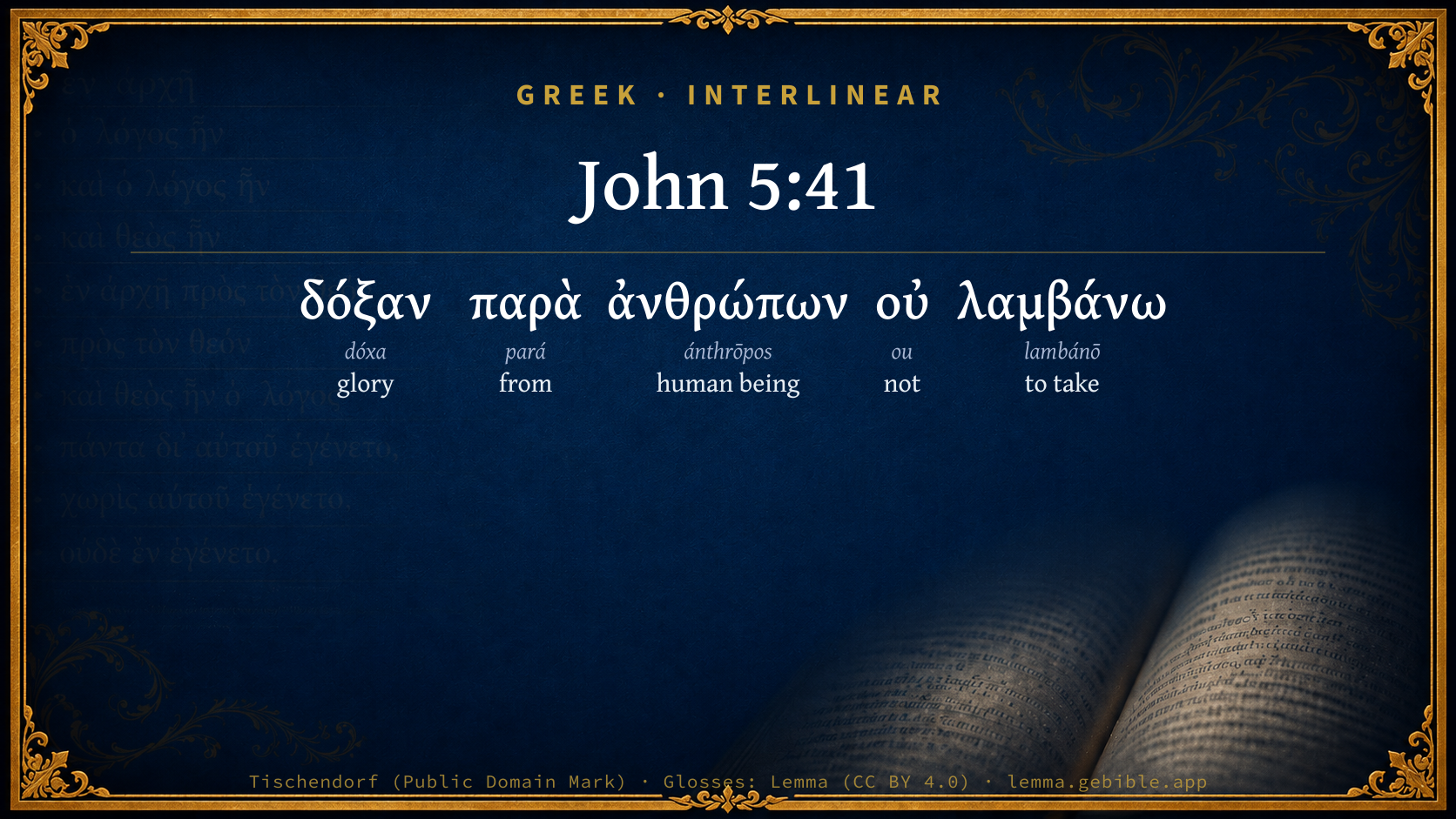
Greek (Tischendorf 8th ed.) John 5:41 appears in the Greek New Testament. The text above is from the Tischendorf 8th edition. Each word links to its Strong’s number and a concise gloss. Click any word for its full Thayer’s Greek Lexicon entry.
Download image
Cite this verse

John 5:41 (World English Bible). Public Domain. Lemma interlinear Bible study tool, https://lemma.gebible.app/v/john/5/41.

Show BibTeX & RIS
BibTeX
RIS
English Translation
I don't receive glory from men.
World English Bible · Public Domain
Download a study sheet

One document with this verse’s original text, its word-by-word gloss line, the meaning frame, cross-references with their text, attributed commentary, and full source and license credits — printable, and it pastes into notes with its structure intact.

This verse Autodidact and up

Study sheet (.html) Plain text (.txt)

A passage Seminary Student

Up to 50 verses in one chapter. A passage sheet keeps up to 6 commentary sources and 12 cross-references per verse, in the order this page ranks them, and says so on the sheet whenever that leaves anything out. Ask for a single verse and you get the Autodidact verse sheet above.

Everything on this page stays free to read, with no account — the sheet is a download of what is already on screen, not access to it.

Want to remove ads? Support Godless Engineer
Compare translations 3

The same verse in 3 English versions, stacked beneath the original-language interlinear above. Click any original word for its lexicon entry.

Each is an independent rendering of the whole verse — the interlinear is not word-aligned to these translations.

Highlighted words mark where these versions differ — a whole-verse word diff, not a word-by-word alignment.

  • World English Bible Public Domain
    I don't receive glory from men.
  • King James Version Public Domain
    I receive not honour from men.
  • unfoldingWord Literal Text CC BY-SA 4.0
    I do not receive glory from men,

unfoldingWord Literal Text — © unfoldingWord, licensed CC BY-SA 4.0. Word-aligned USFM3 via Door43 (git.door43.org/unfoldingWord/en_ult).

Versions to compare (up to 4)

3 of 4 selected

Show all 19 translations

Every available English version of this verse, each an independent rendering of the whole verse.

  • World English Bible Public Domain
    I don't receive glory from men.
  • Berean Standard Bible Public Domain
    I do not accept glory from men,
  • Majority Standard Bible Public Domain
    I do not accept glory from men,
  • King James Version Public Domain
    I receive not honour from men.
  • American Standard Version (1901) Public Domain
    I receive not glory from men.
  • Revised Version (1885) Public Domain
    I receive not glory from men.
  • Geneva Bible (1599) Public Domain
    I receiue not the prayse of men.
  • Douay-Rheims (1899) Public Domain
    I receive glory not from men.
  • Young's Literal Translation Public Domain
    glory from man I do not receive,
  • Literal Standard Version CC BY-SA 4.0
    I do not receive glory from man,
  • Unlocked Literal Bible CC BY-SA 4.0
    I do not receive praise from men,
  • unfoldingWord Literal Text CC BY-SA 4.0
    I do not receive glory from men,
  • Darby Bible Public Domain
    I do not receive glory from men,
  • World Messianic Bible Public Domain
    I don’t receive glory from men.
  • Webster's Bible Public Domain
    I receive not honor from men.
  • Free Bible Version CC BY-SA 4.0
    I'm not looking for human approval
  • Bible in Basic English Public Domain
    I do not take honour from men;
  • Text-Critical English NT CC BY 4.0
    I do not receive glory from men.
  • Tyndale New Testament (1534) Public Domain
    I receave not prayse of men.

Literal Standard Version (2020), Covenant Press — licensed CC BY-SA 4.0. Text via the HelloAO Bible API (eBible.org). Unlocked Literal Bible (unfoldingWord) — licensed CC BY-SA 4.0. Text via the HelloAO Bible API (eBible.org). unfoldingWord Literal Text — © unfoldingWord, licensed CC BY-SA 4.0. Word-aligned USFM3 via Door43 (git.door43.org/unfoldingWord/en_ult). Free Bible Version, Dr. Jonathan Gallagher — licensed CC BY-SA 4.0. Text via the HelloAO Bible API (eBible.org).

Word by word

More ways to search: Search by grammar → Find every occurrence → Compare this word →

Practice this passage: Drill this verse → Learn its vocabulary →

δόξαν
dóxa
G1391
“glory”
Noun, Accusative, Singular, Feminine
Part of Speech
Noun
Case
Accusative
Number
Singular
Gender
Feminine
Full Thayer's Definition

Origin: from the base of G1380

TDNT: 05:53,2

1. opinion, judgment, view 2. opinion, estimate, whether good or bad concerning someone a. in the NT always a good opinion concerning one, resulting in praise, honour, and glory 3. splendour, brightness a. of the moon, sun, stars b. magnificence, excellence, preeminence, dignity, grace c. majesty 1. a thing belonging to God 2. the kingly majesty which belongs to him as supreme ruler, majesty in the sense of the absolute perfection of the deity 3. a thing belonging to Christ 3c d. the kingly majesty of the Messiah 3c e. the absolutely perfect inward or personal excellency of Christ; the majesty 1. of the angels 3c f. as apparent in their exterior brightness 4. a most glorious condition, most exalted state a. of that condition with God the Father in heaven to which Christ was raised after he had achieved his work on earth b. the glorious condition of blessedness into which is appointed and promised that true Christians shall enter after their Saviour's return from heaven
  1. παρὰ pará G3844 “from” Preposition
  2. ἀνθρώπων ánthrōpos G444 “human being” Noun, Genitive, Plural, Masculine
  3. οὐ ou G3756 “not” Particle, Negative
  4. λαμβάνω lambánō G2983 “to take” Verb, Present, Active, Indicative, 1st person, Singular

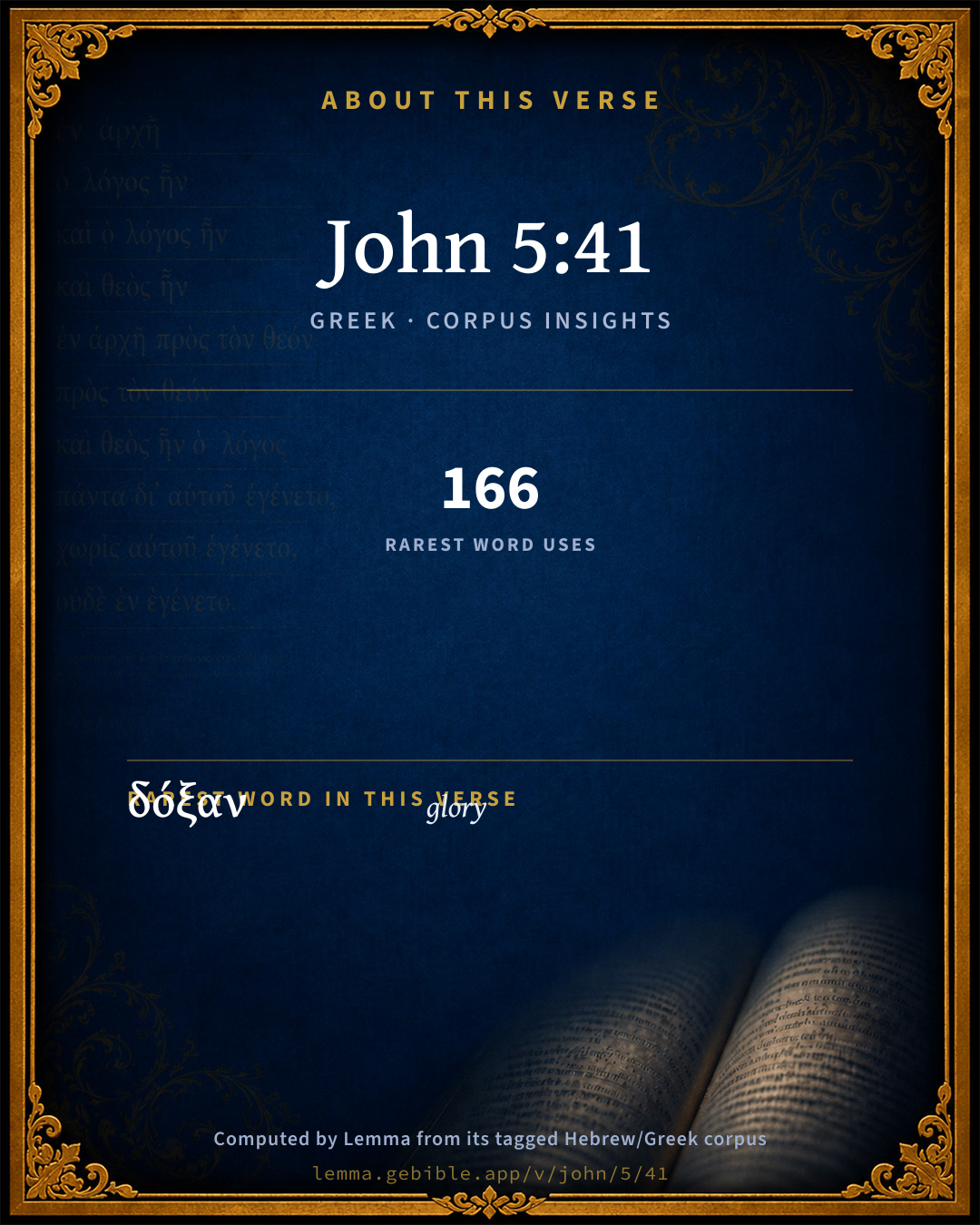
About this verse

These counts appear in no published source. They are computed here, from the morphology-tagged text and Lemma’s own curated glosses. What Lemma adds →

5
words
5
distinct lemmas
Gospels
section

Cross-references

9

Topical passages linked to John 5:41 in the Treasury of Scripture Knowledge — connected by theme and wording, ordered by reader-vote popularity; previews shown in the World English Bible.

  • John 7:18 He who speaks from himself seeks his own glory, but he who seeks the glory of him who sent him, the same is true, and no unrighteousness is in him.
  • John 5:34 But the testimony which I receive is not from man. However, I say these things that you may be saved.
  • John 8:50 But I don't seek my own glory. There is one who seeks and judges.
  • 1 Thessalonians 2:6 nor seeking glory from men (neither from you nor from others), when we might have claimed authority as apostles of Christ.
  • John 5:44 How can you believe, who receive glory from one another, and you don't seek the glory that comes from the only God?
  • John 8:54 Jesus answered, "If I glorify myself, my glory is nothing. It is my Father who glorifies me, of whom you say that he is our God.
  • John 6:15 Jesus therefore, perceiving that they were about to come and take him by force, to make him king, withdrew again to the mountain by himself.
  • 1 Peter 2:21 For to this you were called, because Christ also suffered for us, leaving you an example, that you should follow his steps,
  • 2 Peter 1:17 For he received from God the Father honor and glory, when the voice came to him from the Majestic Glory, "This is my beloved Son, in whom I am well pleased."

Cross-references courtesy of OpenBible.info (CC BY 4.0).

Commentary

Notes on John 5:41 from classic Christian and Jewish commentators (each source and its license shown beneath its notes). The classic Christian expositions comment on the surrounding passage and are grouped to its opening verse, so a note may address several verses; the Jewish commentaries on the Tanakh (Rashi and others) are per-verse, so they appear only where the commentator wrote on this verse.

Lemma curates 59 commentaries, every one of them public domain or Creative Commons licensed, each selected and text-cleaned for this edition rather than reprinted as found. About our sources →

Ellicott's Commentary for English Readers

(41) I receive not honour.—The word is better rendered glory here, and in Joh_5:44. Jesus continues to dwell, in the remainder of the discourse (Joh_5:41-47), on the true cause of their incredulity. “Ye will not come to Me,” is the central thought. But were they, then, to follow this young Teacher, while they themselves had schools and disciples who held their teaching sacred, and their persons in honour, and addressed them as “Rabbi?” No! this is not the true coming to Him. They seek glory from men. He does not receive it (Joh_5:34).

A Bible Commentary for English Readers, edited by Charles John Ellicott (1878–1897) — public domain. Text from a community e-Sword module.

The Biblical Illustrator

Joseph S. Exell

Joh_5:41

I receive not honour from men.

Lest they should think that in commending Himself and challenging them He was hunting after vainglory, as false teachers do, Christ obviates that mistake, and showeth that He was seeking no such thing, nor was capable of any addition of honour from the creature. Whence learn

1. Christ is so omniscient that He knoweth and marketh the thoughts of every one that He dealeth with; so much doth His obviating their thoughts teach.

2. It is the usual fault of men that they have but low and base thoughts of Christ, and that they measure and judge of Him and His followers by themselves, for this suspicion of Christ imported that they looked on Him as a mere man, and as they were themselves ambitious (Joh_5:44), so did they judge of Him, and so are His servants judged of.

3. Christ was no hunter after vainglory, nor is He capable of any addition of honour by mens acknowledging of Him; nor ought men to think that He seeks them because He hath any need of them, or that they add anything to Him, when He makes them somewhat; for albeit men are bound to manifest and declare His super-excellent glory; and men by sin do what they can to dishonour Him, as who would cast dirt or spit against the sun? Yet His infinite glory is neither capable of addition nor diminution from the creature; for I receive not honour from men. (G. Hutcheson.)

Vanity of worldly honours

The subjects of Charlemagne, after his death, set his corpse on a throne in a sepulchre, and put a sceptre in his stiff hand and a crown on his bloodless temples; but long ago he came down to a prostrate condition. At the Tuileries, in Paris, during the revolution of July, when the mob broke in, a boy, wounded to death, was laid on the emperors throne, and his blood gave deeper crimson to the imperial upholstery ;but, after all, he came down into the dust where we must all lie. (Dr. Talmage.)

Worldly honours delusive and dangerous

Heliogabalus, the Roman emperor, being jealous of the power of the senate, invited the senators to a great feast. When they were overcome with wine, Heliogabalus left the hall. The doors were fastened without; yet the carousal continued. The emperor shouted to them from a glass door in the ceiling, that, as they were ever aspiring after fresh laurels, they should now be satisfied. Wreaths and flowers began to rain upon them. The senators cried, Enough, enough! but the rain continued. Terror seized them. They flew to the doors; but they were immovable. Escape was impossible. The relentless storm continued till all were buried and suffocated beneath the murderous sea of flowers. (E. Foster.)

The Biblical Illustrator, edited by Joseph S. Exell (c. 1880s–1900s) — public domain. Text from a community e-Sword module.

Joseph Benson's Commentary

Joh 5:41-43. I receive not honour from men — I need it not; I seek it not from you for my own sake. As if he had said, Though I speak of your coming to me as necessary in order to your salvation, it is not out of an ambition of drawing multitudes after me, who may approve and applaud my teaching; for the whole of my conduct proves that I seek not the praise of men. But I say it out of a tender regard for your salvation and reformation; for I know you — I am fully acquainted with the state of your minds, and the conduct of your lives; that ye have not the love of God in you — That, notwithstanding the distinguished profession of piety which you make, you are destitute of that great and only principle of true religion, the love of God: For I am come in my Father’s name — With evident credentials from him; and yet ye receive me not — Which, if you had really loved him, you would undoubtedly have done: if another shall come in his own name — Without such credentials, and without any commission from God; him ye will receive — Provided he assume the majesty of a king, and promise you temporal wealth, power, and glory. Of this infatuation the Jews gave many proofs during their wars with the Romans, and a little before the destruction of Jerusalem. For then many impostors arose, pretending to be the Messiah, and promising them deliverance, by which, although they wrought no miracles, yet they drew great multitudes after them, as their own historian, Josephus, informs us; and met with a much better reception, even from the Pharisees and rulers, than Christ did, notwithstanding all his miracles. And no doubt Christ meant to include these, and all who appeared while the sanhedrim existed.

Joseph Benson's Commentary on the Old and New Testaments (1811–1818) — public domain. Text from a community e-Sword module.

Whedon's Commentary on the Bible

Daniel D. Whedon

The cause of all this unbelief—their desire for human honour, Joh_5:41-44.

The true Messiah seeks the divine glory, and honour from God alone. The Jews seek human power and honour, and desire Messiahs after their own heart. The true Messiah is spiritual, holy, and divine; their false Messiah, like themselves, is political, self-seeking, and ready for the mutual exchange of honours.

41. I receive not—He rejects the crown of secular Messiahship; he receives not the testimony of even John and the prophets as the endorsement of even those great MEN. His commissioner and endorser is God alone.

Daniel D. Whedon (gen. ed.), Commentary on the Old and New Testaments (1874–1909) — public domain. Text from a community e-Sword module.

Tyndale Open Study Notes

Tyndale Open Resources

5:41-47 Jewish trials sought to discover the truth. Falsely accused defendants could not only prove their innocence but also prosecute their accusers, which Jesus did here.

Tyndale Open Study Notes — © Tyndale Open Resources, licensed CC BY-SA 4.0. Text via the HelloAO Bible API.

Bengel's Gnomon

Johann Albrecht Bengel

Joh 5:41.[110] Παρὰ ἀνθρώπων, from men) even from those by whom the Scripture was written: comp. Joh 5:34, “Ye sent unto John, and he bare witness unto the truth, but I receive not testimony from man,” concerning John, who was greater than the prophets; and yet Jesus did not receive testimony even from him.

[110] δόξαν, glory [honour]) Jesus in this passage had spoken great things concerning Himself. Now he states why He does so; namely, that He might bring poor souls to the blessed knowledge and love of GOD.—V. g.

Bengel's Gnomon of the New Testament — English translation (T&T Clark, Edinburgh, 1860) — public domain. Text from a community e-Sword module.

Expositor's Greek Testament

ed. W. Robertson Nicoll

Joh 5:41 . Δόξαν παρὰ ἀνθρώπων οὐ λαμβάνω , not “glory from men I am not receiving,” not quite “glory from men I do not seek,” but rather, that which is in my judgment glory, I do not receive from men: not what men yield me is my glory. Ambition is not my motive in making these claims.

The Expositor's Greek Testament, edited by W. Robertson Nicoll (1897–1910) — public domain. Text from a community e-Sword module.

Godet's Commentaries

Frédéric Louis Godet

III. The condemnation of Jewish Unbelief: Joh 5:41-47.

In Joh 5:41-44, Jesus unfolds the cause of the moral antipathy which keeps them away from Him; in Joh 5:45-47, the terrible consequences of this refusal to believe.

Vv. 41-44. “I receive not my glory from men. 42. But I know you, [and I know] that ye have not the love of God in yourselves. 43. I am come in my Father’s name, and ye receive me not; if another shall come in his own name, him ye will receive. 44. How can ye believe, ye who receive your glory from one another, and seek not the glory which cometh from God only.”

On one side, a Messiah who has no care for the good opinion of men and the homage of the multitude, and on the other, men who place their supreme good in public consideration, in an unblemished reputation for orthodoxy, in a high renown for Scriptural erudition and for fidelity to legal observances (comp. the description of the Pharisees, Mat 6:1-18; Mat 23:1-12): how could this opposition in tendency fail to put an obstacle in the way of the birth of faith in these latter? Weiss thinks that, if this were the sense of Joh 5:41, an ἐγώ,I, would be necessary, in contrast with you (Joh 5:42). In the same manner with Westcott, he understands in this way: Do not think that I am speaking thus “in order to glorify myself in your eyes” (Weiss); or: “as the result of spite which my disappointed hopes cause me” (Westcott). But the ἐγώ would be necessary only if the case of Jesus were placed second. If Jesus had meant to reply to such a supposition on the part of His adversaries, He would, no doubt, have said: μὴ δοκεῖτε, “think not that I seek.....”—The perfect ἔγνωκα means: “I have studied you, and I know you.” Jesus had penetrated the depth of vanity which these fine exteriors so much admired among the rulers covered.— The love of God denotes the inward aspiration towards God which may be found in the Jew and even in the sincere Gentile. Rom 2:7 : “Those who seek for honor, glory and immortality.” (Comp. Joh 5:44.) This divine aspiration it is, which leads to faith, as the absence of it to unbelief. Jesus states precisely here the thought which is expressed in an indefinite way in Joh 3:19-21. In yourselves: not only on the lips, but in the heart.

ADDITIONAL NOTES BY THE AMERICAN EDITOR.

XXX.

Vv. 41-44. The reason of their failure to accept the evidence presented to them is set forth, in these verses, in two forms. The first and fundamental reason is the absence of the true love of God in their hearts. The second reason, into which the first developed itself in its special manifestation, is the unwillingness to accept a Messiah who did not come in the line of earthly glory. The views of a temporal kingdom, as they held them, were connected with the selfish desire of exaltation. They were ready to receive one who came to them with no testimony but his own, and in his own name, if he only met these earthly views. But to the Divine testimony, whether in the sacred writings, or in the wonderful works, or in the words of the forerunner, they were unwilling to listen, because the one to whom all this witness was borne appeared among them simply as the messenger of God to tell the Divine truth, and by making known the true eternal life, to bring all who heard Him to personal righteousness and the possession of the kingdom of heaven within themselves through believing on the Son of God.

Frédéric Louis Godet — Commentaries on Luke, John, Romans, and 1 Corinthians — English translation (T&T Clark, Edinburgh, 1870s–1890s) — public domain. Text from a community e-Sword module.

Jamieson, Fausset & Brown

Robert Jamieson, A. R. Fausset & David Brown

I receive not honour from men--contrasting His own end with theirs, which was to obtain human applause.

Jamieson, Fausset & Brown — Commentary Critical and Explanatory on the Whole Bible (1871) — public domain (CC PDM 1.0). Text via the HelloAO Bible API.

Adam Clarke's Commentary

Verse 41. I receive not honour from men.] I do not stand in need of you or your testimony. I act neither through self-interest nor vanity. Your salvation can add nothing to me, nor can your destruction injure me: I speak only through my love for your souls, that ye may be saved.

Adam Clarke's Commentary on the Bible (1810–1826) — public domain. Text from a community e-Sword/MySword module.

John Calvin's Commentaries

41. I receive not glory from men. He proceeds in his reproof; but that he may not be suspected of pleading his own cause, he begins by saying that he does not care for the glory of men, and that it gives him no concern or uneasiness to see himself despised; and, indeed, he is too great to depend on the opinions of men, for the malignity of the whole world can take nothing from him, or make the slightest infringement on his high rank. He is so eager to refute their calumny that he exalts himself above men. Afterwards, he enters freely into invectives against them, and charges them with contempt and hatred of God. And though, in regard to honorable rank, there is an immense distance between Christ and us, still we ought boldly to despise the opinions of men. We ought, at least, to guard most zealously against being excited to anger, when we are, despised; but, on the contrary, let us learn never to kindle into indignation, except when men do not render to God the honor due to Him. Let our souls be burned and tortured by this holy jealousy, whenever we see that the world is so ungrateful as to reject God.

John Calvin's Commentaries (1540-1563) — public domain. Text from the Calvin Translation Society English edition (1840s-50s) via the Christian Classics Ethereal Library (ccel.org). Calvin's coverage is partial (roughly two-thirds of the Bible); uncommented books and verses are honest gaps, never fabricated. The 19th-century editor's footnotes and remarks are omitted so the notes are faithfully Calvin's own voice.

The Cambridge Bible for Schools and Colleges

gen. ed. J. J. S. Perowne

41. I receive not honour] It is nothing to Me; I have no need of it, and refuse it: comp. Joh_5:34. Glory would perhaps be better than ‘honour’ both here and in Joh_5:44, and than ‘praise’ in Joh_9:24 and Joh_12:43; see notes there. Christ is anticipating an objection, and at the same time shewing what is the real cause of their unbelief. ‘Glory from men is not what I seek; think not the want of that is the cause of My complaint. The desire of glory from men is what blinds your eyes to the truth.’

41–44. Not that I seek glory from men; had I done so, you would have received Me. Your worldliness prevents you from receiving One whose motives are not worldly.

The Cambridge Bible for Schools and Colleges (gen. ed. J. J. S. Perowne; Cambridge University Press, 1878–1918) — public domain. Text from a community e-Sword module.

John Gill's Exposition

I receive not honour from men. Not but that honour from men was due to Christ; and it becomes all men to honour him, as they do the Father; and he does receive honour and glory, and blessing from his saints, by their praying to him, praising him, believing in him, and serving him; but his sense is, that in asserting his equality with the Father, and in producing the testimonies he did, in proof of it, his view was not to obtain honour and applause among men, but to vindicate himself, and glorify his Father: nor did he say what he had just now said, about men's coming to him, with any such intention, to gather a party to him, to set up himself as a temporal king, in great pomp and splendour, and receive worldly homage and honour from men, as his subjects; for his kingdom was not of this world, and coming and subjection to him were things of a spiritual nature.

I receive not honour from men. Not but that honour from men was due to Christ; and it becomes all men to honour him, as they do the Father; and he does receive honour and glory, and blessing from his saints, by their praying to him, praising him, believing in him, and serving him; but his sense is, that in asserting his equality with the Father, and in producing the testimonies he did, in proof of it, his view was not to obtain honour and applause among men, but to vindicate himself, and glorify his Father: nor did he say what he had just now said, about men's coming to him, with any such intention, to gather a party to him, to set up himself as a temporal king, in great pomp and splendour, and receive worldly homage and honour from men, as his subjects; for his kingdom was not of this world, and coming and subjection to him were things of a spiritual nature.

John 5:42

joh 5:42

joh 5:42

joh 5:42But I know you,.... Being the omniscient God, he knew not only their persons, but their hearts, the thoughts of their hearts; what was in them, and what was wanting in them: particularly,

that ye have not the love of God in you; and which is not in any man's heart naturally; for the carnal mind is enmity to God; and men, by nature, are haters of him, and enemies in their minds to him, till this grace, which is a fruit of the Spirit, is implanted in them, in regeneration: love to God, is one of the weightier matters of the law, the Jews passed over; without which, all the actions of men signify nothing: this they made great pretensions to, and would have had it thought, that it was from love to God, that they sought to kill Jesus, for his violation of the sabbath, and making himself equal with God; but it was not from a delight in the sabbath, or from love to the Lord of it, but out of ill will to Christ, that they expressed such dissembled piety and false zeal: they were lovers of themselves, and not God; they were covetous men, and loved the world, and the things in it, which is inconsistent with the love of the Father; and besides, if they had loved him, they would have loved him that was begotten of him, and not sought to have killed him.

John Gill's Exposition of the Whole Bible (1746–1763) — public domain (CC PDM 1.0). Text via the HelloAO Bible API.

Trapp's Complete Commentary

John Trapp

41 I receive not honour from men.

Ver. 41. I receive not honour from men] q.d. I need you not, though I complain you come not to me. It is for your sakes that I seek to you. Christ could be happy, though all men should miscarry: as the sun would shine, though all the world were blind. He seeks not ours, but us.

John Trapp, A Commentary or Exposition upon All the Books of the Old and New Testament (1647–1656) — public domain. Text from a community e-Sword module.

Albert Barnes' Notes on the Bible

I receive not honour ... - “I do not say these things because I am desirous of human applause, but to account for the fact that you do not believe on me. The reason is, that you have not the love of God in you.” In this passage we see:

That we should not seek for human applause. It is of very little value, and it often keeps men from the approbation of God, Joh 5:44. They who will not believe on Jesus Christ give evidence that they have no love for God. The reason why they do not believe on him is because they have no regard for his character, wishes, or law.

Love of God - Love to God.

In you - In your hearts. You do not love God.

Albert Barnes' Notes on the Bible (1834–1885) — public domain. Text from a community e-Sword/MySword module.

Matthew Poole's English Annotations

I depend not upon the single testimony of men; or, I seek not, nor hunt after, the honour of men, nor regard what they think or say of me.

Matthew Poole's English Annotations on the Holy Bible (1683–1685) — public domain. Text from a community e-Sword/MySword module.

The Pulpit Commentary

Vers. 41-47. (d) The effect of the revelation of the Son upon the Jews.

Vers. 41, 42. This appeal to the will of man was apparently entirely misunderstood, and ended for the time in failure. "They would not come." Everything was prepared, but none were ready or willing to accept even so rich a blessing as life itself. This is the refrain of the whole Bible: "Ye will not; .... Ye would not;" "What could have been done more to my vineyard, that I have not done in it?" "I called, and ye refused;" "I wrote the great things of my Law; ye have counted them as strange things." Our Lord proceeds in the closing words to account in some respects for this unwillingness. I receive not glory from men, but I know you (egnwka , I have come by experience or intuition to such knowledge of you), that you have not the love of God in you. The love of God is the principle of all obedience; and Christ elsewhere declares it to be the first and great commandment of the Law. But love is the principle of all knowledge. "He that loveth not knoweth not." This principle reaches its fullest expression when we learn the greater truth that "God is love." It is true of all objects of love, the highest kind of knowledge is not possible without love. This is pre-eminently the case when we think of knowing God. Since God is essential Love, without experiencing love we cannot realize that Divine essence. Again, there is an elementary faith that precedes elementary love, but when love is once awakened, faith again deepens, and love grows by what it feeds upon, until the faith becomes vision and the love rapture. But why the opening words, I receive not glory from men? Probably they intimate opposition and questioning to some such effect as this: "Thou hast declared thyself the Giver of life and resurrection, and charged our lack of spiritual life upon our unwillingness to believe these claims and to submit ourselves to these exalted assumptions or to go to thee for life. Thou art eager, after all, for our approval and glory." To this Christ replied, Glory from men I receive not. It is not for my sake, but for yours, I say, "Come unto me and live;" but, alas! having searched you through and through, I discern no love, none of the spirit out of which the forces of faith can be evolved. The reason why you are unwilling to come to me for life is that you are measuring me by yourselves, and have not that self-emptying and abnegation and distrust out of which faith and love, love and faith, must ever spring.

Vers. 41-47. The cause and the end of Jewish unbelief.

Jesus has just declared that the Jews will not come to him, and now he reveals its cause.

I THE CAUSE OF THEIR UNBELIEF. "I know that ye have not the love of God in you.

1. This love would oblige them to seek honour only from God, and thus appreciate the glory the Father has given to the Son.

2. Jesus has no concern for mans praise or report, for the Father"s testimony is all-sufficient. "I receive not honour from men.

3. The Jews could not receive this testimony, because human considerations had blinded their eyes. "How can ye believe, who receive honour one of another, and seek not the honour which cometh from God only?

4. Mark the readiness of the Jews to receive false Messiahs. "If another shall come in his own name, him ye will receive." Sixty-four false Messiahs have appeared at various periods to receive the temporary homage of the Jews.

II THE END OF JEWISH UNBELIEF CONDEMNATION THROUGH MOSES HIMSELF.

1. The true accuser of the Jews.

(1) Not Jesus, for he is Judge, not accuser. "Do not suppose that I will accuse you.

(2) But Moses, their liberator and advocate. "There is one that accuseth you, even Moses, on whom ye have set your hope.

2. The connection between faith in Jesus and faith in Moses. "For had ye believed Moses, ye would have believed me: for he wrote of me.

(1) Our Lord implies that Moses was the writer of the Pentateuch.

(2) He implies that the whole system promises, types, symbolic institutions of the Law, as presented in the Mosaic writings found their true fulfilment in himself. Moses truly wrote of Jesus in the memorable prophecy, "I will raise them up a Prophet like unto thee". (Deu_18:18)

(3) Disbelief in Moses carried with it a necessary disbelief in Christ. "If ye believe not his writings, how shall ye believe my words?

(a) The writings of Moses might be regarded as possessing greater weight, because they were contained in a book, than mere words of mouth.

(b) They had all the prestige of age and usage. If, therefore, they were rejected in their true import, how could the Jews be expected to receive the oral teaching of him to whom the writings bore witness?

The Pulpit Commentary (1880–1919), ed. H.D.M. Spence-Jones & Joseph S. Exell — public domain. Text from a community e-Sword module.

John Wesley's Explanatory Notes

I receive not honour from men - I need it not. I seek it not from you for my own sake.

John Wesley, Explanatory Notes Upon the Whole Bible (1754–1765) — public domain. Text via the GEBible commentary corpus.

Burkitt's Expository Notes on the New Testament

William Burkitt

Here observe, 1. How little our Saviour sought the approbation and vain-glorious estimation of men, I receive not honour from men. The same should all his disciples and followers do; rest satisfied in the secret testimony and silent applause of their own consciences, without pumping for popular applause.

Observe, 2. The dreadful sin which Christ charges upon the Jews, as the cause why they rejected him, I know that ye have not the love of God in you. Oh! deplorable state and case, to be void of all true love to God! Love being the spring of all action, and the root of all true obedience, he that loves God, will not only sweat at his work, but bleed at his work too, if his work cannot be carried on without bleeding. But where love of God is wanting, and no care to please God is found, his authority is despised, his Son rejected: as the Jews here would not come to Christ, that they might have life, because they had not the love of God in them.

Observe, 3. The high affront which the Jews offered to the Son of God in preferring any seducers or impostors before him, who came in their own names; whilst he was rejected, who came in the name of his Father.

Learn hence, That though Christ was the great Ambassador of his Father, not a servant, but a son, and had his mission, his approbation, and his testimony from heaven, yet so far did the perverseness and prejudices of the Jews prevail, that he was rejected, whilst impostors and deceivers, false Christs and anti-christs, without any evidence and authority from God (because promising them a temporal kingdom) were embraced and entertained; I am come in my Father’s name, and ye receive me not; but if another (a seducer) should come in his own name, him ye will receive.

As if Christ had said, You are incredulous to none but me: every cheat, that has but wit or wickedness to tell you, "The Lord hath sent him," is believed by you; but though I come in my Father’s name, shewing a commission signed and sealed by him, and doing those works that none but a God can do, yet you receive me not. O unreasonable infidelity!

William Burkitt's Expository Notes on the New Testament (1700–1703) — public domain. Text from a community e-Sword module.

unfoldingWord translationNotes

Door43 World Missions Community

receive

accept

you do not have the love of God in yourselves

This can mean 1) "you really do not love God" or 2) "you have really not received God's love."

translationWords

receive

praise

love

God

unfoldingWord translationNotes — © Distant Shores Media and the Door43 World Missions Community, licensed CC BY-SA 4.0. Source: git.door43.org/Door43/en_tn.

Cambridge Greek Testament for Schools and Colleges

41–44. Not that I seek glory from men; had I done so, you would have received Me. Your worldliness prevents you from receiving One whose motives are not worldly.

41. οὐ λαμβ. It is nothing to Me; I have no need of it, and refuse it (Joh 5:34). Glory would perhaps be better than ‘honour’ both here and in Joh 5:44, and than ‘praise’ in Joh 9:24 and Joh 12:43; see notes there. Christ is anticipating an objection, and at the same time shewing what is the real cause of their unbelief. ‘Glory from men is not what I seek; think not the want of that is the cause of My complaint. The desire of glory from men is what blinds your eyes to the truth.’

Cambridge Greek Testament for Schools and Colleges (Cambridge University Press, 1896; 21 vols, various authors incl. Carr, Maclear, Plummer, Farrar, Lumby, Moule, M. R. James, Simcox) — public domain. Text from a community e-Sword module.

Alford’s Greek Testament

Henry Alford

41-44.] The connexion seems to be;—the standing-points of our Lord and of the Jews were not only different, but were inconsistent with and exclusive of one another. He sought not glory from below, from man’s praise or report: the Father testified to Him, in all the ways which have been specified; but this testimony they could not receive, nor discover Him in their Scriptures, because human regards and ambition and intrigue had blinded their eyes, and they had not the love of God (the very first command in their law, Deu 6:4, Deu 6:5) in their hearts.

41.] οὐ λαμβ., not merely, ‘I do not desire,’ ‘non capto;’—but, ‘I do not receive;’—‘no such praise nor testimony accrues to Me, nor has in Me that on which it can lay hold.’ ‘My glory is altogether from another source.’

Henry Alford, The Greek Testament (1849–1861) — public domain. Text from a community e-Sword module.

International Critical Commentary

41. Verses 41-47 are an exposure of the source of the Jews’ unbelief. It is this, that they do not love God, and so they do not appreciate Him who came in God’s Name. They are concerned rather with the approval of their fellows, than with God’s approval. Nevertheless, Jesus says that He will not accuse them to God. Moses will be their accuser: he wrote of Messiah, and the Jews did not appreciate what he wrote. It is not to be expected, if they reject the written teaching of Moses, that they should accept the verbal teaching of Jesus.

δόξαν παρὰ ἀνθρώπων οὐ λαμβάνω. His words of rebuke do not spring from any wounded pride because they did not accept His claims. Their approval is of no weight with Him (8:50; cf. the similar repudiation made by Paul, 1Th 2:6). That the honour (δόξα) which is bestowed by men on their fellows is not to be greatly prized is not a peculiarly Johannine doctrine (5:44, 7:18, 12:43), but appears in Mat 6:1, Mat 6:2 and elsewhere. Cf. “The good inclination receiveth not glory or dishonour from men” (Test. of XII. Patriarchs, Benj. vi. 4). For δόξα, see on 1:14.

International Critical Commentary — older volumes (1896–1929), various authors — public domain. Text from a community e-Sword module.

Vincent's Word Studies in the New Testament

Marvin R. Vincent

I receive not honor from men. The Greek order is : glory from men I receive not. Compare ver. 34. His glory consists in his loving fellowship with God. Men who do not love God are not in sympathy with Him.

Marvin R. Vincent, Word Studies in the New Testament (1887–1900) — public domain. Text from a community e-Sword/MySword module.

Lesson kit

Teaching starters — assembled from the data on this page, not authored interpretation. Every prompt links to the verse data it draws on. Edit before teaching.

John, in the Gospels, opens this verse with 5 words (5 distinct Greek lemmas). Its most distinctive word is dóxa (“glory”). A historical commentator’s framing appears above. Read the whole chapter for the surrounding context.

Discussion questions

  1. What does “glory” (dóxa) contribute to the verse as a whole?
  2. How does John 7:18, which shares this passage’s theme, read alongside this verse?
  3. These translations render this verse differently. What is at stake in choosing one wording over another?
  4. Compare how Ellicott's Commentary for English Readers and The Biblical Illustrator read this verse. Where do they agree or differ?

Things to notice

Reading settings

Reading text

Shown beneath each verse's original-language words.

Old Testament
Old Testament edition

Read the OT as the Masoretic Hebrew (MT) or the Greek Septuagint (LXX).

English shown for the Greek Septuagint (in the Hebrew ↔ Greek comparison).

Comparing translations? Open the Compare panel on any verse page to stack up to four side by side.