
Romans 5:17

Greek (Tischendorf 8th ed.) Romans 5:17 appears in the Greek New Testament. The text above is from the Tischendorf 8th edition. Each word links to its Strong’s number and a concise gloss. Click any word for its full Thayer’s Greek Lexicon entry.
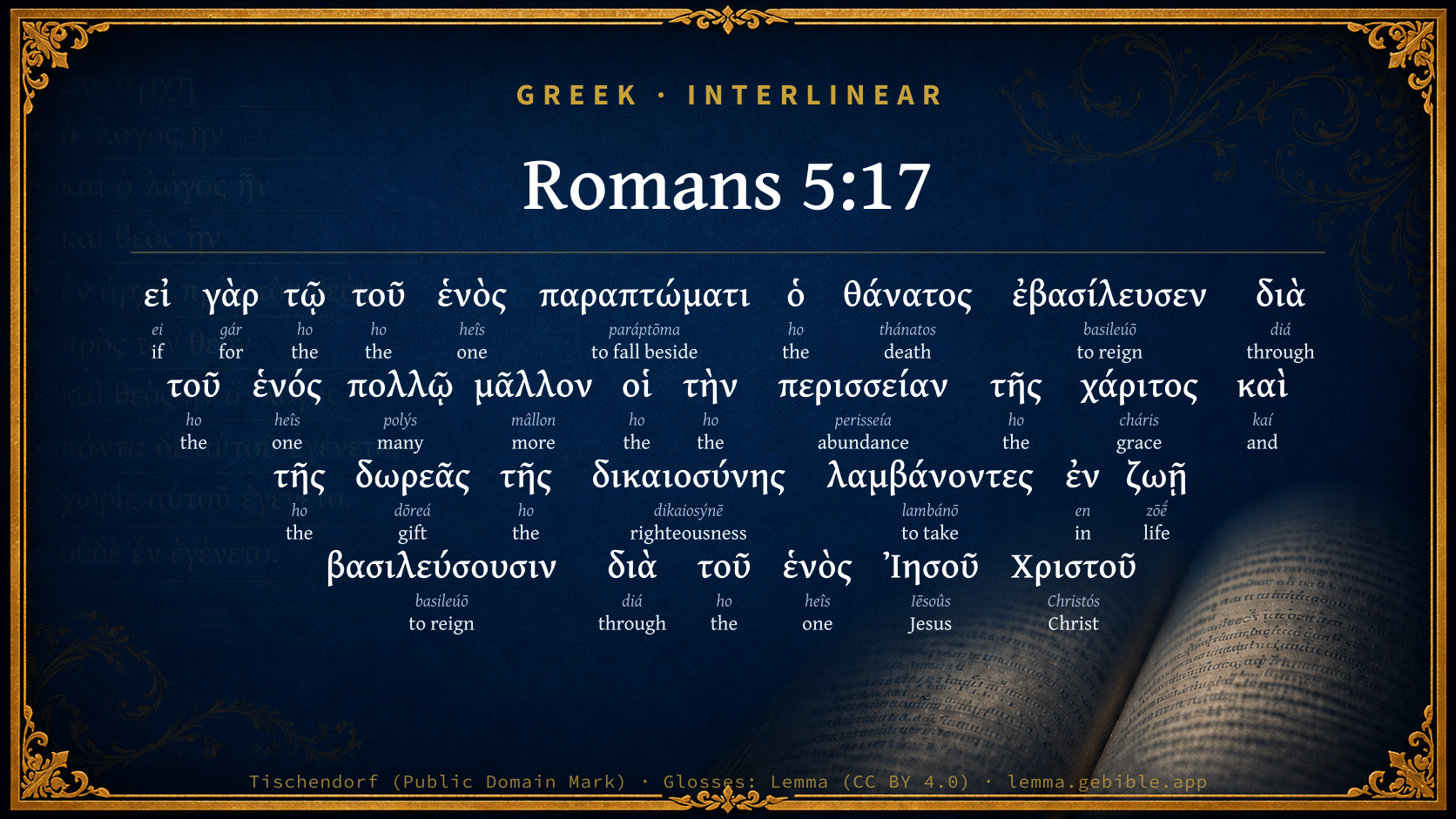
Download image
Cite this verse

Romans 5:17 (World English Bible). Public Domain. Lemma interlinear Bible study tool, https://lemma.gebible.app/v/romans/5/17.

Show BibTeX & RIS
BibTeX
RIS
English Translation
For if by the trespass of the one, death reigned through the one; so much more will those who receive the abundance of grace and of the gift of righteousness reign in life through the one, Jesus Christ.
World English Bible · Public Domain
Highlights
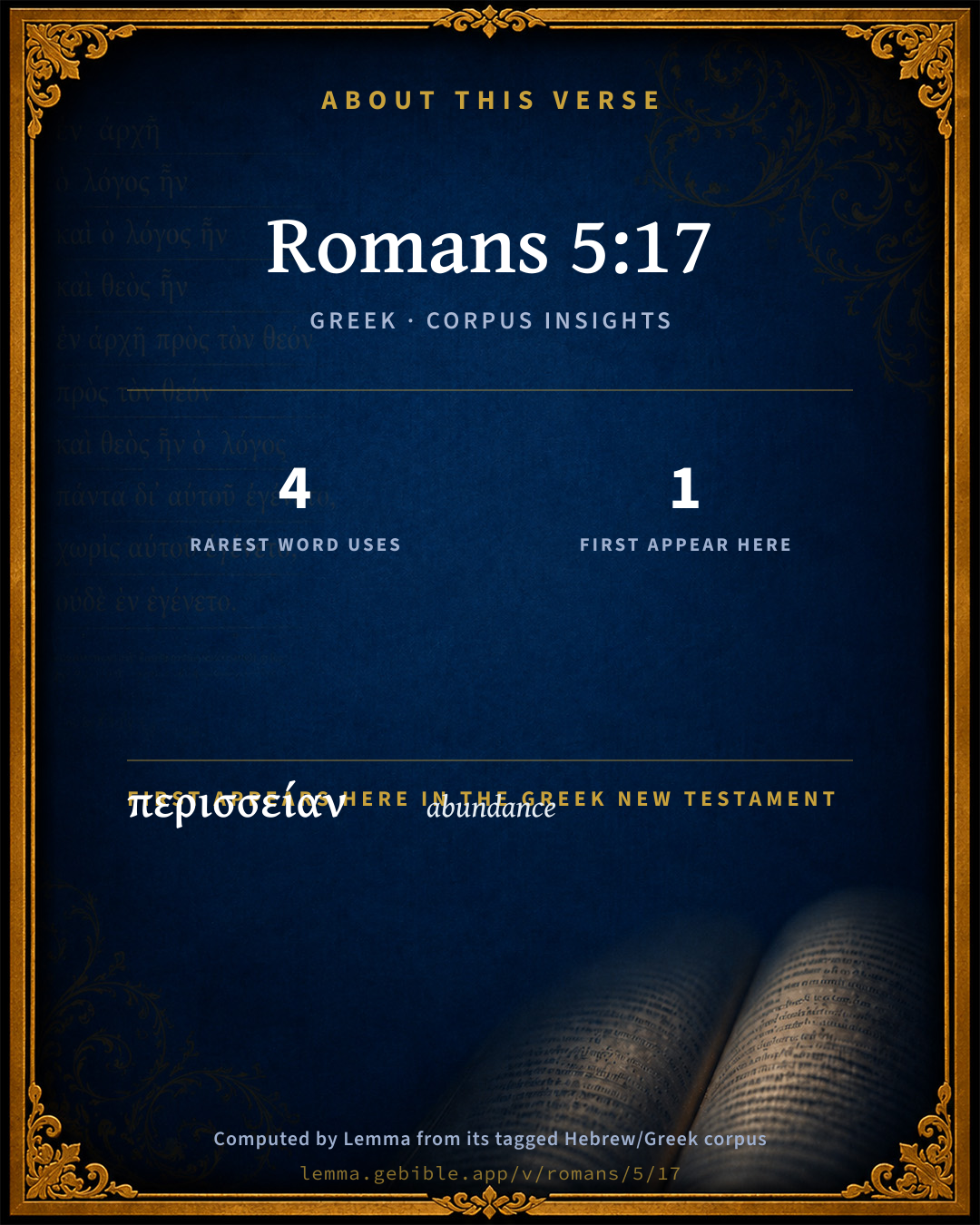
  • 1 first appearance in the Greek New Testament
Full analysis ↓
Download a study sheet

One document with this verse’s original text, its word-by-word gloss line, the meaning frame, cross-references with their text, attributed commentary, and full source and license credits — printable, and it pastes into notes with its structure intact.

This verse Autodidact and up

Study sheet (.html) Plain text (.txt)

A passage Seminary Student

Up to 50 verses in one chapter. A passage sheet keeps up to 6 commentary sources and 12 cross-references per verse, in the order this page ranks them, and says so on the sheet whenever that leaves anything out. Ask for a single verse and you get the Autodidact verse sheet above.

Everything on this page stays free to read, with no account — the sheet is a download of what is already on screen, not access to it.

Want to remove ads? Support Godless Engineer
Compare translations 3

The same verse in 3 English versions, stacked beneath the original-language interlinear above. Click any original word for its lexicon entry.

Each is an independent rendering of the whole verse — the interlinear is not word-aligned to these translations.

Highlighted words mark where these versions differ — a whole-verse word diff, not a word-by-word alignment.

  • World English Bible Public Domain
    For if by the trespass of the one, death reigned through the one; so much more will those who receive the abundance of grace and of the gift of righteousness reign in life through the one, Jesus Christ.
  • King James Version Public Domain
    For if by one man's offence death reigned by one; much more they which receive abundance of grace and of the gift of righteousness shall reign in life by one, Jesus Christ.)
  • unfoldingWord Literal Text CC BY-SA 4.0
    For if, by the trespass of the one, death ruled through the one, how much more will the ones receiving the abundance of the grace and the gift of the righteousness rule in life through the one, Jesus Christ.

unfoldingWord Literal Text — © unfoldingWord, licensed CC BY-SA 4.0. Word-aligned USFM3 via Door43 (git.door43.org/unfoldingWord/en_ult).

Versions to compare (up to 4)

3 of 4 selected

Show all 19 translations

Every available English version of this verse, each an independent rendering of the whole verse.

  • World English Bible Public Domain
    For if by the trespass of the one, death reigned through the one; so much more will those who receive the abundance of grace and of the gift of righteousness reign in life through the one, Jesus Christ.
  • Berean Standard Bible Public Domain
    For if, by the trespass of the one man, death reigned through that one man, how much more will those who receive an abundance of grace and of the gift of righteousness reign in life through the one man, Jesus Christ!
  • Majority Standard Bible Public Domain
    For if, by the trespass of the one man, death reigned through that one man, how much more will those who receive the abundance of grace and of the gift of righteousness reign in life through the one man, Jesus Christ!
  • King James Version Public Domain
    For if by one man's offence death reigned by one; much more they which receive abundance of grace and of the gift of righteousness shall reign in life by one, Jesus Christ.)
  • American Standard Version (1901) Public Domain
    For if, by the trespass of the one, death reigned through the one; much more shall they that receive the abundance of grace and of the gift of righteousness reign in life through the one, `even' Jesus Christ.
  • Revised Version (1885) Public Domain
    For if, by the trespass of the one, death reigned through the one; much more shall they that receive the abundance of grace and of the gift of righteousness reign in life through the one, even Jesus Christ.
  • Geneva Bible (1599) Public Domain
    For if by the offence of one, death reigned through one, much more shall they which receiue that abundance of grace, and of that gift of that righteousnesse, reigne in life through one, that is, Iesus Christ.
  • Douay-Rheims (1899) Public Domain
    For if by one man's offence death reigned through one; much more they who receive abundance of grace, and of the gift, and of justice, shall reign in life through one, Jesus Christ.
  • Young's Literal Translation Public Domain
    for if by the offence of the one the death did reign through the one, much more those, who the abundance of the grace and of the free gift of the righteousness are receiving, in life shall reign through the one -- Jesus Christ.
  • Literal Standard Version CC BY-SA 4.0
    for if by the offense of the one death reigned through the one, much more those who are receiving the abundance of grace and of the free gift of righteousness, in life will reign through the one—Jesus Christ.
  • Unlocked Literal Bible CC BY-SA 4.0
    For if, by the trespass of the one, death ruled through the one, how much more will those who receive the abundance of grace and the gift of righteousness reign in life through the one, Jesus Christ.
  • unfoldingWord Literal Text CC BY-SA 4.0
    For if, by the trespass of the one, death ruled through the one, how much more will the ones receiving the abundance of the grace and the gift of the righteousness rule in life through the one, Jesus Christ.
  • Darby Bible Public Domain
    For if by the offence of the one death reigned by the one, much rather shall those who receive the abundance of grace, and of the free gift of righteousness, reign in life by the one Jesus Christ:)
  • World Messianic Bible Public Domain
    For if by the trespass of the one, death reigned through the one; so much more will those who receive the abundance of grace and of the gift of righteousness reign in life through the one, Yeshua the Messiah.
  • Webster's Bible Public Domain
    For if by one man's offense death reigned by one; much more they who receive abundance of grace, and of the gift of righteousness, shall reign in life by one, Jesus Christ.
  • Free Bible Version CC BY-SA 4.0
    As a result of one man's sin, death ruled because of him. But God's grace is so much greater and his gift sets us right, for everyone who receives it will rule in life through the person of Jesus Christ!
  • Bible in Basic English Public Domain
    For, if by the wrongdoing of one, death was ruling through the one, much more will those to whom has come the wealth of grace and the giving of righteousness, be ruling in life through the one, even Jesus Christ.
  • Text-Critical English NT CC BY 4.0
    For if, by the trespass of the one man, death reigned through the one man, how much more will those who receive the abundance of grace and the gift of righteousness reign in life through the one man Jesus Christ!
  • Tyndale New Testament (1534) Public Domain
    For yf by the synne of one deeth raigned by the meanes of one moche more shall they which receave aboundance of grace and of the gyfte of rightewesnes raygne in lyfe by the meanes of one (that is to saye) Iesus Christ.

Literal Standard Version (2020), Covenant Press — licensed CC BY-SA 4.0. Text via the HelloAO Bible API (eBible.org). Unlocked Literal Bible (unfoldingWord) — licensed CC BY-SA 4.0. Text via the HelloAO Bible API (eBible.org). unfoldingWord Literal Text — © unfoldingWord, licensed CC BY-SA 4.0. Word-aligned USFM3 via Door43 (git.door43.org/unfoldingWord/en_ult). Free Bible Version, Dr. Jonathan Gallagher — licensed CC BY-SA 4.0. Text via the HelloAO Bible API (eBible.org).

Word by word

More ways to search: Search by grammar → Find every occurrence → Compare this word →

Practice this passage: Drill this verse → Learn its vocabulary →

περισσείαν
perisseía
G4050
“abundance”
Noun, Accusative, Singular, Feminine
Part of Speech
Noun
Case
Accusative
Number
Singular
Gender
Feminine
Full Thayer's Definition

Origin: from G4052

TDNT: 07:03,8

1. abundance, superabundantly, superfluously 2. superiority, preference, pre-eminence 3. gain, profit 4. residue, remains: the wickedness remaining over in a Christian from his state prior to conversion Used by the Greeks to describe the excess wax in their ears.
  1. εἰ ei G1487 “if” Conditional
  2. γὰρ gár G1063 “for” Conjunction
  3. τῷ ho G3588 “the” Article, Dative, Singular, Neuter
  4. τοῦ ho G3588 “the” Article, Genitive, Singular, Masculine
  5. ἑνὸς heîs G1520 “one” Adjective, Genitive, Singular, Masculine
  6. παραπτώματι paráptōma G3900 “to fall beside” Noun, Dative, Singular, Neuter
  7. ὁ ho G3588 “the” Article, Nominative, Singular, Masculine
  8. θάνατος thánatos G2288 “death” Noun, Nominative, Singular, Masculine
  9. ἐβασίλευσεν basileúō G936 “to reign” Verb, Aorist, Active, Indicative, 3rd person, Singular
  10. διὰ diá G1223 “through” Preposition
  11. τοῦ ho G3588 “the” Article, Genitive, Singular, Masculine
  12. ἑνός heîs G1520 “one” Adjective, Genitive, Singular, Masculine
  13. πολλῷ polýs G4183 “many” Adjective, Dative, Singular, Neuter
  14. μᾶλλον mâllon G3123 “more” Adverb
  15. οἱ ho G3588 “the” Article, Nominative, Plural, Masculine
  16. τὴν ho G3588 “the” Article, Accusative, Singular, Feminine
  17. τῆς ho G3588 “the” Article, Genitive, Singular, Feminine
  18. χάριτος cháris G5485 “grace” Noun, Genitive, Singular, Feminine
  19. καὶ kaí G2532 “and” Conjunction
  20. τῆς ho G3588 “the” Article, Genitive, Singular, Feminine
  21. δωρεᾶς dōreá G1431 “gift” Noun, Genitive, Singular, Feminine
  22. τῆς ho G3588 “the” Article, Genitive, Singular, Feminine
  23. δικαιοσύνης dikaiosýnē G1343 “righteousness” Noun, Genitive, Singular, Feminine
  24. λαμβάνοντες lambánō G2983 “to take” Verb, Present, Active, Participle, Nominative, Plural, Masculine
  25. ἐν en G1722 “in” Preposition
  26. ζωῇ zōḗ G2222 “life” Noun, Dative, Singular, Feminine
  27. βασιλεύσουσιν basileúō G936 “to reign” Verb, Future, Active, Indicative, 3rd person, Plural
  28. διὰ diá G1223 “through” Preposition
  29. τοῦ ho G3588 “the” Article, Genitive, Singular, Masculine
  30. ἑνὸς heîs G1520 “one” Adjective, Genitive, Singular, Masculine
  31. Ἰησοῦ Iēsoûs G2424 “Jesus” Noun, Genitive, Singular, Masculine
  32. Χριστοῦ Christós G5547 “Christ” Noun, Genitive, Singular, Masculine

About this verse

These counts appear in no published source. They are computed here, from the morphology-tagged text and Lemma’s own curated glosses. What Lemma adds →

33
words
20
distinct lemmas
Pauline Epistles
section

Notable vocabulary

The rarest word here is περισσείαν abundance G4050 — appearing just 4 times in the whole Greek New Testament.

First appearance in Scripture

This word makes its first canonical appearance in the Greek New Testament here:

  • περισσείαν abundance G4050

Shared distinctive vocabulary

περισσείαν abundance G4050 occurs in 4 verses of the Greek New Testament. Also found in:
Repetition

Words recur within this verse:

  • ἑνὸς one G1520 ×3
  • ἐβασίλευσεν to reign G936 ×2
  • διὰ through G1223 ×2
  • τῷ the G3588 ×10

Cross-references

23

Topical passages linked to Romans 5:17 in the Treasury of Scripture Knowledge — connected by theme and wording, ordered by reader-vote popularity; previews shown in the World English Bible.

  • 1 Corinthians 15:21–22 For since death came by man, the resurrection of the dead also came by man.
  • Romans 5:12 Therefore, as sin entered into the world through one man, and death through sin; and so death passed to all men, because all sinned.
  • 1 Corinthians 15:49 As we have borne the image of those made of dust, let's also bear the image of the heavenly.
  • John 10:10 The thief only comes to steal, kill, and destroy. I came that they may have life, and may have it abundantly.
  • 2 Timothy 2:12 If we endure, We will also reign with him. If we deny him, He also will deny us.
  • Revelation 22:5 There will be no night, and they need no lamp light; for the Lord God will illuminate them. They will reign forever and ever.
  • Genesis 3:6 When the woman saw that the tree was good for food, and that it was a delight to the eyes, and that the tree was to be desired to make one wise, she took of the fruit of it, and ate; and she gave some to her husband with her, and he ate.
  • Revelation 20:4 I saw thrones, and they sat on them, and judgment was given to them. I saw the souls of those who had been beheaded for the testimony of Jesus, and for the word of God, and such as didn't worship the beast nor his image, and didn't receive the mark on their forehead and on their hand. They lived, and reigned with Christ for the thousand years.
  • Revelation 20:6 Blessed and holy is he who has part in the first resurrection. Over these, the second death has no power, but they will be priests of God and of Christ, and will reign with him one thousand years.
  • Philippians 3:9 and be found in him, not having a righteousness of my own, that which is of the law, but that which is through faith in Christ, the righteousness which is from God by faith;
  • Revelation 3:21 He who overcomes, I will give to him to sit down with me on my throne, as I also overcame, and sat down with my Father on his throne.
  • Isaiah 61:10 I will greatly rejoice in Yahweh, my soul shall be joyful in my God; for he has clothed me with the garments of salvation, he has covered me with the robe of righteousness, as a bridegroom decks himself with a garland, and as a bride adorns herself with her jewels.
  • 1 Timothy 1:14 The grace of our Lord abounded exceedingly with faith and love which is in Christ Jesus.
  • 1 Peter 2:9 But you are a chosen race, a royal priesthood, a holy nation, a people for God's own possession, that you may show forth the excellencies of him who called you out of darkness into his marvelous light:
  • Revelation 5:9–10 They sang a new song, saying, "You are worthy to take the book, And to open its seals: For you were killed, And bought us for God with your blood, Out of every tribe, language, people, and nation,
  • Matthew 25:34 Then the King will tell those on his right hand, 'Come, blessed of my Father, inherit the Kingdom prepared for you from the foundation of the world;
  • Romans 5:20 The law came in besides, that the trespass might abound; but where sin abounded, grace did abound more exceedingly;
  • Romans 6:23 For the wages of sin is death, but the free gift of God is eternal life in Christ Jesus our Lord.
  • James 2:5 Listen, my beloved brothers. Didn't God choose those who are poor in this world to be rich in faith, and heirs of the Kingdom which he promised to those who love him?
  • 1 Corinthians 4:8 You are already filled. You have already become rich. You have come to reign without us. Yes, and I wish that you did reign, that we also might reign with you.
  • Revelation 1:6 and he made us to be a Kingdom, priests to his God and Father; to him be the glory and the dominion forever and ever. Amen.
  • Genesis 3:19 By the sweat of your face will you eat bread until you return to the ground, for out of it you were taken. For you are dust, and to dust you shall return."
  • Romans 8:39 nor height, nor depth, nor any other created thing, will be able to separate us from the love of God, which is in Christ Jesus our Lord.

Cross-references courtesy of OpenBible.info (CC BY 4.0).

Commentary

Notes on Romans 5:17 from classic Christian and Jewish commentators (each source and its license shown beneath its notes). The classic Christian expositions comment on the surrounding passage and are grouped to its opening verse, so a note may address several verses; the Jewish commentaries on the Tanakh (Rashi and others) are per-verse, so they appear only where the commentator wrote on this verse.

Lemma curates 59 commentaries, every one of them public domain or Creative Commons licensed, each selected and text-cleaned for this edition rather than reprinted as found. About our sources →

Adam Clarke's Commentary

Verse 17. Death reigned by one] Death is here personified, and is represented as reigning over the human race; and death, of course, reigns unto death; he is known as reigning, by the destruction of his subjects.

Shall reign in life] Those who receive, retain, and improve the abundant grace offered by Jesus Christ, shall be redeemed from the empire of death, and exalted to the throne of God, to live and reign with him ever, world without end. See Re 1:5, Re 1:6; Re 2:7, Re 2:10, Re 2:11; Re 3:21.

If we carefully compare Ro 5:15 with Ro 5:17, we shall find that there is a correspondence between περισσειαν, the abounding, Ro 5:17, and επερισευσε hath abounded, Ro 5:15; between της δωρεας της δικαιοσυνης, the gift of righteousness, i.e. justification, Ro 5:17, and η δωρεα εν χαριτι, the gift by grace, Ro 5:15; therefore, if we understand the abounding of grace, and the gift of justification, Ro 5:17, we shall understand the grace of God, and the gift by grace which hath abounded unto the many, Ro 5:15. But the abounding of grace, and the gift of justification, Ro 5:17, is that grace and gift which is RECEIVED by those who shall reign in eternal life. Reigning in life is the consequence of receiving the grace and gift. Therefore, receiving the grace is a necessary qualification on our part for reigning in life; and this necessarily implies our believing in Christ Jesus, as having died for our offences, receiving the grace so freely offered us; using the means in order to get more grace, and bringing forth the fruits of the Spirit. Receive must here have the same sense as in Mt 13:20: He heareth the word, and anon with joy RECEIVETH it. Joh 1:12: But as many as RECEIVED him, to them gave he power to become the sons of God. Joh 3:11: Ye RECEIVE not our witness. - See also Joh 3:32, Joh 3:33. Joh 5:43 : I am come in my Father's name, and ye RECEIVE me not. Joh 12:48: He that RECEIVETH not my words. Joh 13:20: He that receiveth whomsoever I send, RECEIVETH me. Joh 14:17: The Spirit of truth; whom the world cannot RECEIVE. Joh 17:8: I have given them the words which thou gavest me; and they have RECEIVED them. In all these passages it is evident that receiving and not receiving imply improving or not improving.

Adam Clarke's Commentary on the Bible (1810–1826) — public domain. Text from a community e-Sword/MySword module.

The Biblical Illustrator

Joseph S. Exell

Rom_5:17

For if by one mans offence death reigned by one.

The reign of death and the reign in life

I. The reign of death

1. Established by one mans sin.

2. Universal.

3. Irresistible.

II. The reign in life.

1. Effected through grace.

2. Glorious.

3. Eternal. (J. Lyth, D. D.)

The reign of death and the reign in life

When the empty vessel of the human heart has once become filled with the fulness of grace and righteousness, the sinner is raised to the place of a king in life--an antithesis to death reigned. But the apostle has too lively a conviction of spiritual realities to say here life shall reign. Death reigns: it is a tyrant. But life does not reign; it makes kings. Instead of a sombre state of things which bears sway as a reign of death, it is here the individuals themselves who, having personally appropriated righteousness, reign personally in the luminous domain of life. Compare on this reign what Paul said (Rom_4:13), of the inheritance of this world; then the glorying (Rom_5:11); finally, Rom_8:17. In life does not denote a period--i.e., eternal life, but the mode or nature of the reign of believers. A new, holy, inexhaustible and victorious vitality will pervade those receivers of righteousness, and make them so many kings. If the collective condemnation could make each of them a subject of death, the conclusion therefrom should be that their individual justification will make each of them a king in life. (Prof. Godet.)

The reign of death and the reign in life

I. The evil introduced into the world by Adam. The reign of death. There was a time when Death was a stranger in the world. It was sin which brought him here. But the consequences did not end here. Sin gave to death a fearful dominion over the whole globe on which man dwelt. Hence he is represented as a monarch. Men love him not and are daily resisting his power, but he laughs to scorn their efforts, and the contest ends in their lying down in the dust. The wide world is his only kingdom. Into heaven he never entered, and in hell he cannot destroy. The soul, too, is brought under his dominion. There is not one of us who is not by nature dead in trespasses and sins.

II. The blessing introduced by Christ. A reign in life.

1. Life is here opposed to death, and expresses a state of spiritual existence. But they who have received this precious benefit not only live, they reign in life. This implies--

(1) Power. They have overcome their enemies, as well as escaped from them; not merely freed themselves from their tyranny, but attained a dominion over them.

(a) They were once the subjects of Satan, they now bruise him underneath their feet.

(b) The world once held them in thraldom, but the world also is overcome.

(c) Once, too, they were governed by lawless passions, but now they reign as lords over their own soul. They mortify the deeds of the body, they crucify the flesh with the affections and lusts. Not that their victory is complete. Their throne is secure, but it is surrounded by rebels who incessantly disturb its peace. Satan still assails, the world still tempts, sin still rages.

(2) Dignity. And what so truly great and noble as to be masters of ourselves? What so base as to be the slaves of sin?

(3) Heaven. There the Christian will indeed live and reign. He will have attained a complete triumph over all his enemies. To him that overcometh will I grant to sit with Me on My throne, etc. He who once suffered with Christ, shall be glorified together with Him. What a glorious change is this, that the feeble mortals who were once the trembling victims of death, should thus reign in life.

2. And to whom are they indebted for this wondrous change? To themselves? The dead cannot raise themselves to life. To the father who ruined them? He made them the children of wretchedness, and then he went away and left them to their misery. To legions of angels? All their mighty hosts could not reanimate one lifeless body, much less quicken and glorify a ruined soul. One Being only was able to accomplish this glorious change, but He was the very Being who seemed the least likely to accomplish it, for it was His righteous vengeance which had sent death into the world, and His voice which proclaimed Him its king. By Him, however, was death dethroned; by Him to the utter exclusion of all others, to the utter rejection of all oar claims to any part of the honour of the work.

III. Who are the persons for whom this great blessing is designed? All the human race? Clearly not. The ungodly lives of thousands around us would at once disprove such an assertion. All men indeed, in consequence of the interference of Christ, are under a dispensation of mercy; a free and full salvation is offered them, and they are invited to accept it. But men will not accept it. Those who have received this salvation are the men for whom the kingdom is prepared. They are described as--

1. Receiving abundance of grace.

(1) Grace is that free favour which God has manifested towards His sinful children, providing a sacrifice for their iniquities, sending them the glad tidings of salvation, and making them actually partakers of its blessings.

(2) Abundance of grace signifies not only a sufficiency, but grace enough and to spare. And look at what part we may of the mystery of redemption, we discover at once the propriety of the term. The wisdom which planned and the power which executed this stupendous scheme, and the love which called this power and this wisdom into exercise, are all infinite. The glory of the salvation treasured up for sinners in Christ, the freedom with which it is communicated, the characters of those on whom it is bestowed, all bear witness to the boundless extent of the Divine mercy.

2. The gift of righteousness.

(1) This may possibly mean that renewal of the heart unto holiness, which the redeemed sinner receives from the free bounty of his Saviour. But the apostle seems rather to refer here to the same righteousness of which he speaks in the following verse, the obedience or righteousness of Christ. It is this which enables the Lord to pour out the abundance of His grace on His apostate children. He imputes to them the merits of His dear Son, and then He pardons, accepts, and rewards them, without weakening His authority or tarnishing His glory.

(2) The apostle calls it a gift, because it is by an act of mercy that it is transferred to us; he speaks of it as an abundant gift, because it completely satisfies the demands of Gods unalterable law. Its merit is infinite. It is a robe so pure, that he who wears it, stands before God without spot or blemish; so splendid, that it covers all his shame; so freely offered, that all the naked may array themselves in it, and all rejoice in it as the garment of salvation.

IV. The certainty of their receiving it. The apostle may mean--

1. That the efficacy of the righteousness of Christ to procure life is greater than that of the offence of Adam to cause death; that the salvation of the Christians soul is even more certain than the death of his body, secured to him by more numerous and solemn declarations, and involving in it the honour of more of the Divine perfections. Justice and faithfulness demand his body for corruption, but mercy unites with faithfulness and justice in raising his soul to the kingdom of life.

2. That the righteousness of Christ is more than sufficient to repair the destructive consequences of Adams transgression. It does not place the believer in the state in which he would have been had Adam never fallen; it does more; it places him in a more secure and far more exalted state. In other words, we may gain more by Christ than we lost by Adam. The one made an honourable temple a mournful heap of ruins; the other can not only raise up the temple again out of its ruins, but can make the latter house far more glorious than the former. When man was first created God looked on him and pronounced him good; but when His beloved Son redeems him, He calls him His inheritance and portion; he comes and dwells in Him, and loves Him more than all the creatures of His hand. (C. Bradley, M. A.)

Believers receive in Christ more than they lost in Adam

I. Better righteousness.

II. Firmer standing.

III. Higher glory. (T. Robinson, D. D.)

Abundance of grace.

Overflowing kindness and blessing

All fulness of grace in Christ (Col_1:19; Eph_3:8). Justifying grace, sanctifying grace, glorifying grace (Rom_8:29-30). Grace for grace (Joh_1:16), or grace upon grace (Php_2:27). He gives more grace (Jam_4:6); and makes all grace to abound (2Co_9:8). He gives His sheep not only life, but life more abundantly (Joh_10:10). Ezekiels river realised (Eze_47:1-5; cf. Eph_3:19). (T. Robinson, D. D.)

Individual influence

No warlike host delivered the children of Israel from the bondage of Egypt, but one man--Moses. No senate of statesmen raised Israel to a pitch of greatness that proclaimed to the world the glory and safety of a theocratic nation, but one man--David. No school of divines gave to England the Bible in the mother tongue, but one man--Wycliffe. No learned society discovered America, but one man--Columbus. No association of science revealed the clue to interpret the laws of the heavenly bodies, but one man--Galileo. No parliament saved English liberties, but one man--Pyre. No assembly of theologians wrote the book which, next to the Bible, has had the most potent influence on the English language and on English hearts, but one man--Bunyan. No confederate nations rescued Scotland from her political and ecclesiastical enemies, but one man--Knox. And the same might be said of almost every great step since in the progress of the race. Doubtless these men found their coadjutors; but all through the ages God has put immense honour upon individuals. (J. Guest.)

The Biblical Illustrator, edited by Joseph S. Exell (c. 1880s–1900s) — public domain. Text from a community e-Sword module.

Joseph Benson's Commentary

Rom 5:17. For, &c. — Here he shows the difference in respect of the consequence of those acts, or the different nature of the effects, that death came from one, life from the other; as if he had said, Moreover, there is another important article, in which the grace of the gospel exceeds the seeming severity which attended the imputation of guilt from our first father, Adam, namely, that, if by one man’s offence death reigned by one — Over all his posterity, as we observed above; they who receive — By faith, Joh 1:12; abundance of grace — An abundant measure of God’s love, of the influences of his Spirit, and the gift of righteousness, exhibited in the gospel; namely, those benefits which Christ, by his obedience unto death, has purchased for us; shall much more reign in life, by one — The great restorer and recoverer of his seed; Jesus Christ — That is, believers shall by him be brought to a much nobler and more excellent life than that from which Adam fell, and which they lost in him.

Joseph Benson's Commentary on the Old and New Testaments (1811–1818) — public domain. Text from a community e-Sword module.

Scofield Reference Notes

C. I. Scofield

offence Sin. (See Scofield "Rom 3:23").

righteousness See Rom 5:17; Rom 5:18; Rom 5:21. (See Scofield "Rom 3:21").

The Scofield Reference Bible (1917 edition), notes by C. I. Scofield — public domain. Text from a community e-Sword module.

Tyndale Open Study Notes

Tyndale Open Resources

5:17 Both Adam and Jesus Christ committed a single act whose influence extends to all the people that they represent. Adam represents all people. People must receive the gift of righteousness to be represented by Christ.

Tyndale Open Study Notes — © Tyndale Open Resources, licensed CC BY-SA 4.0. Text via the HelloAO Bible API.

Bengel's Gnomon

Johann Albrecht Bengel

Rom 5:17. Τοῦ ἑνὸς—διὰ τοῦ ἑνὸς, of the one man, by the one) A very significant repetition; lest the sins committed by individuals should seem rather [than the offence of the one man] to have produced death.—ἐβασίλευσε, reigned) The word in the preterite tense looks back from the economy of grace to the economy of sin; as presently after the expression shall reign, in the future, looks forward from the economy of sin, to the economy of grace and eternal life; so Rom 5:19.—τὴν περισσείαν) Πλεονάζειν, and περισσεύειν differ, as much in the positive, and more in the comparative, Rom 5:20. Abundance of grace, is put in opposition to the one offence.—λαμβάνοντες, receiving) Λαμβάνειν may be rendered either as a neuter-passive verb, empfangen, erlangen, kriegen to receive, to acquire, to get; or actively, annehmen, to take. The former is the better sense; still the relation to δωρεὰν a gift, is more suitable to the act of taking. In justification, man does something; but the act of taking, so far as it is an act, does not justify, but that which is taken or laid hold of. The gift and taking, are correlatives. Furthermore, this verb is not used, when we are speaking of sin; and it is for the same reason, owing to which it happens that we are not said to reign in death, but death reigned; but life reigns in us, 2Co 4:12, and we in life. Christ, in this passage, is King of them that reign. Life and reigning are mentioned in connection also, in Rev 20:4. The term life is repeated from ch. Rom 1:17, and often recurs, presently after, in Rom 5:18; Rom 5:21, and in the following chapters.

Bengel's Gnomon of the New Testament — English translation (T&T Clark, Edinburgh, 1860) — public domain. Text from a community e-Sword module.

Meyer's Critical & Exegetical Commentary

Heinrich August Wilhelm Meyer

Rom_5:17. The τὸ δὲ χάρισμα ἐκ πολλ. παραπτ. εἰς δικαίωμα, just asserted in contrast to the κατάκριμα proceeding from One, has now the seal of confirmation (γάρ) impressed on it through the triumphant certainty of the reign of life, which must belong to the recipients of the δικαίωμα in the approaching completion of the kingdom through the One Jesus Christ all the more undoubtedly, since the παράπτωμα of the One Adam brought death to reign. The effect of the second One (the Adam μέλλων) in the direction of salvation cannot in fact remain behind the effect which proceeded from the first One in the direction of destruction. On this rests the evidence of the blissful assurance, which with πολλῷ μᾶλλον stands forth as it were from the gloom of the death previously described (comp Rom_5:15; Rom_5:9). The view that Rom_5:17 adduces the proof of the first half of Rom_5:16 being really proved by its second half (Hofmann), is to be rejected for this very reason, that the demonstration in Rom_5:16 is so full and clear in itself, especially after Rom_5:15, that there is no longer any necessity for receiving proof of its probative power, and no reader could expect this. It is quite arbitrary in Rothe, especially looking to the regular continuation by γάρ, to take Rom_5:16 as a parenthesis, and to attach Rom_5:17 to Rom_5:15. For other views of the connection see Dietzsch, who, in accordance with his own unsuitable rendering of ΔΙΚΑΊΩΜΑ, finds here the inner righteous condition of life verified by the final reign of life as its outward manifestation.

ΔΙᾺ ΤΟῦ ἙΝΌς] through the medium of the One, is added, although ἐν ἑνὶ παραπτώματι had been already said (see the critical remarks), in order to prepare the way with due emphasis for the ΔΙᾺ ΤΟῦ ἙΝῸς ἸΗΣΟῦ ΧΡΙΣΤΟῦ of the apodosis. Comp on 2Co_12:7.

ΠΟΛΛῷ ΜᾶΛΛΟΝ] Here also, as in Rom_5:15, the logical plus, the far greater certainty and evidence.

οἱ λαμβάνοντες] not those who believingly accept (Bengel, Rothe, van Hengel, and others), but simply the recipients. The present participle denotes the presence of the time of grace introduced by Christ, which stands in the middle between the former reign of death and the reign of life in the blissful future and determines the subjects of the latter; comp Rom_5:11.

ΤῊΝ ΠΕΡΙΣΣΕΊΑΝ] the abundant fulness (comp Rom_2:4) of grace, referring to ἘΠΕΡΊΣΣΕΥΣΕ in Rom_5:15.

Τῆς ΧΆΡ. Κ. Τ. ΔΩΡΕᾶς] distinguished, as in Rom_5:15. But the emphasis of the description, climactic in the enthusiasm of victory, lies in the first instance on ΧΆΡΙΤΟς, and then, as it advances, on ΔΙΚΑΙΟΣΎΝΗς, in contrast to the former tragic ΠΑΡΆΠΤΩΜΑ.

Τῆς ΔΙΚΑΙΟΣ.] is that, in which the ΔΩΡΕΆ consists. The whole characteristic description of the subjects by ΟἹ.… ΛΑΜΒΆΝΟΝΤΕς already implies the certainty with which one may reckon in the case of those, who are honoured to receive such abundance, on the final ΒΑΣΙΛΕΎΕΙΝ ἘΝ ΖΩῇ through Christ.

ἘΝ ΖΕῇ ΒΑΣΙΛΕΎΣΟΥΣΙ] The word ΒΑΣΙΛ. itself, and more especially the future, renders it certain that the future Messianic ζωή is here meant; in which, as the opposite of the ΘΆΝΑΤΟς, the pardoned and justified shall have the joint-dominion of the new world (Rom_8:21), the ΚΛΗΡΟΝΟΜΊΑ and its ΔΌΞΑ (Rom_8:17), under Christ the Head (1Co_4:8; 1Co_6:2; 2Ti_2:12), in whose final manifestation their life shall be gloriously manifested (Col_3:3 f.). Observe, further, that in the apodosis Paul does not say Ἡ ΖΩΉ ΒΑΣΙΛΕΎΣΕΙ ἘΠῚ ΤΟῪς.… ΛΑΜΒΆΝΟΝΤΑς in accordance with the protasis, but appropriately, and in harmony with the active nature of the relation, i.e. of the future glorious liberty of the children of God, places the subjects actively in the foreground, and affirms of them the reigning in life.

The Ἰησοῦ Χριστοῦ is added as if in triumph, in contradistinction to the unnamed but well-known εἷς, who occasioned the dominion of death. Finally, we should not fail to notice how in this passage the glance proceeds from the status gratiae (λαμβάνοντες) backward to the status irae (ἐβασίλευσε), and forward to the status gloriae (βασιλεύσουσι).

Meyer — Critical and Exegetical Commentary on the New Testament — English translation by Peter Christie, edited by Frederick Crombie (T&T Clark, 1880) — public domain. Text from a community e-Sword module.

Expositor's Greek Testament

ed. W. Robertson Nicoll

Rom 5:17 . This verse confirms the preceding. The argument is the same in kind as in Rom 5:15 . The effects of the Fall are indubitable: still less open to doubt are the effects of the work of Christ. With οἱ τὴν περισσείαν τῆς χάριτος καὶ [ τῆς δωρεᾶς ] τῆς δικαιοσύνης λαμβάνοντες we again touch experience, and an empirical condition is attached to the abstract universality suggested by Rom 5:12 . The abundance of the grace and of (the gift which consists in) righteousness has to be received by faith. But when by faith a connection is formed with Christ, the consequences of that connection, as more agreeable to what we know of God’s nature, can be more surely counted upon than the consequences of our natural connection with Adam. Part of the contrast is marked by the change from “death reigned” to “ we shall reign in life ,” not “life shall reign in or over us”. The future in βασιλεύσουσιν is no doubt logical, but it refers nevertheless to the consummation of redemption in the Messianic kingdom in the world to come. Cf. Rom 8:17 ; Rom 8:21 , Col 3:3 f., 2Ti 2:12 .

The Expositor's Greek Testament, edited by W. Robertson Nicoll (1897–1910) — public domain. Text from a community e-Sword module.

Hodge's Commentary on Romans, Ephesians & First Corinthians

Charles Hodge

Rom_5:17

For if by one mans offense, etc. The connection of this verse, as indicated by for, is with Rom_5:16 : We are justified by Christ not only from the guilt of Adams first sin, but from our own innumerable transgressions; for if death reigned over us for one offense, much more shall life reign through one who is none other and no less than Jesus Christ. It is doubtful, however, whether this verse is a mere amplification of the idea of Rom_5:15, which, in import and structure, it so much resembles; or whether the stress is to be laid on the last clause, reigning in life; so that the point of the difference between Adam and Christ, as here indicated, is, Christ not only delivers from death, but bestows eternal life; or, finally, whether the emphasis is to be laid on the word receive. The idea would then be, If we are thus subject to death for an offense, in which we had no personal concern, how much more shall we be saved by a righteousness which we voluntarily embrace. This appears to be Calvins view, who says: Ut miseria peccati haereditate potiaris, satis est esse hominem, residet enim in carne et sanguine; ut Christi justitia fruaris, fidelem esse, necessarium est, quia fide acquiritur ejus consortium. The decision of these questions is not at all material to the general interpretation of the passage. Both of the ideas contained in the two latter views of the verse are probably to be included. By one mans offense, τῷ τοῦ ἐνὸς παραπτῶματι, by the offense of the one (viz. Adam) death reigned, i.e., triumphed over all men, by one. Here again the dative παραπτώματι has a causal force, and the assertion of the apostle is, that the offense of Adam was the cause of death coming on all men. His sin was not the cause of death by any physical efficiency; nor as the mere occasion of leading men to incur by their own act the penalty of death; nor by corrupting the nature of man, which corruption is the ground of the inflicted curse; but, as is asserted in the preceding verse, because his sin was the ground of the judicial condemnation, tὸ κρίμα εἰς κατάκριμα, which passed on all mankind. If that is so, much more, says the apostle, shall they which receive; οἱ λαμβάνοντες may be taken substantively, the receivers; or the present participle, those receiving, is used to express the condition on which the enjoyment of the blessing is suspended. The abundance of grace, the abounding grace, the grace which, in Rom_5:15, is said (ἐπερίσσευσε) hath abounded towards us. This grace is the unmerited love of God, which is the source of the gift of righteousness, δωρεὰ τῆς δικαιοσύνης, i.e., righteousness is the gift offered and received. That righteousness here does not mean holiness, is evident from the constant use of the word by Paul in a different sense in this epistle; from the fact that it is pardon, justification, justifying righteousness, not sanctification, that Paul in the context represents as the blessing received from Christ; and because it is in this verse opposed to the reigning of death, or state of condemnation on account of the offense of Adam. Professor Stuart, therefore, in accordance with the great majority of commentators, very correctly states the sentiment of the verse thus: For if all are in a state of condemnation by reason of the offense of one, much more shall those towards whom abundance of mercy and pardoning grace are shown, be redeemed from a state of condemnation, and advanced to a state of happiness. The general sentiment of the verse is thus correctly exhibited; but some of the more prominent terms do not appear to have their full force assigned to them. They which receive the abundant grace, expresses more than that this grace is manifested to them; all such do not reign in life. This phrase evidently implies the voluntary reception of the offered boon. The gift of righteousness, too, is something more than pardoning grace. It is that which is expressed in Rom_5:15, by the free gift; and in Rom_5:16, by the free gift unto justification. It is, therefore, the gift of justification; or what is but another method of stating the same idea, it is the righteousness of Christ by which we are justified, since the gift of justification includes the gift of Christs righteousness. The meaning of the verse consequently is, If on account of the offense of one man we are condemned, much more shall those who receive the righteousness graciously offered to them in the gospel, not only be delivered from condemnation, but also reign in life by one, Jesus Christ; that is, be gloriously exalted in the participation of that life of holiness and communion with God which is the end of our being.

By one, Jesus Christ. As it was by one man, antecedently to any concurrence of our own, that we were brought into a state of condemnation, go it is by one man, without any merit of our own, that we are delivered from this state. If the one event has happened, much more may we expect the other to occur. If we are thus involved in the condemnation of a sin in which we had no personal concern, much more shall we, who voluntarily receive the gift of righteousness, be not only saved from the consequences of the fall, but be made partakers of eternal life.

Charles Hodge — Commentary on Romans (1835), First Corinthians (1857), and Ephesians (1856) — public domain. Text from a community e-Sword module.

Geneva Bible (1599)

Geneva Bible translators

The third difference is, that the righteousness of Christ being imputed unto us by grace, is of greater power to bring life, than the offense of Adam is to addict his posterity to death.

Be partakers of true and everlasting life.

Geneva Bible (1599) marginal notes — public domain. Text via Bolls.life.

Jamieson, Fausset & Brown

Robert Jamieson, A. R. Fausset & David Brown

For if by--"the"

one man's offence death reigned by one--"through the one."

much more shall they which receive--"the"

abundance of grace and of the gift of--justifying

righteousness . . . reign in life by one Jesus Christ--"through the one." We have here the two ideas of Rom 5:15 and Rom 5:16 sublimely combined into one, as if the subject had grown upon the apostle as he advanced in his comparison of the two cases. Here, for the first time in this section, he speaks of that LIFE which springs out of justification, in contrast with the death which springs from sin and follows condemnation. The proper idea of it therefore is, "Right to live"--"Righteous life"--life possessed and enjoyed with the good will, and in conformity with the eternal law, of "Him that sitteth on the Throne"; life therefore in its widest sense--life in the whole man and throughout the whole duration of human existence, the life of blissful and loving relationship to God in soul and body, for ever and ever. It is worthy of note, too, that while he says death "reigned over" us through Adam, he does not say Life "reigns over us" through Christ; lest he should seem to invest this new life with the very attribute of death--that of fell and malignant tyranny, of which we were the hapless victims. Nor does he say Life reigns in us, which would have been a scriptural enough idea; but, which is much more pregnant, "We shall reign in life." While freedom and might are implied in the figure of "reigning," "life" is represented as the glorious territory or atmosphere of that reign. And by recurring to the idea of Rom 5:16, as to the "many offenses" whose complete pardon shows "the abundance of grace and of the gift of righteousness," the whole statement is to this effect: "If one man's one offense let loose against us the tyrant power of Death, to hold us as its victims in helpless bondage, 'much more,' when we stand forth enriched with God's 'abounding grace' and in the beauty of a complete absolution from countless offenses, shall we expatiate in a life divinely owned and legally secured, 'reigning' in exultant freedom and unchallenged might, through that other matchless 'One,' Jesus Christ!" (On the import of the future tense in this last clause, see on Rom 5:19, and Rom 6:5).

Jamieson, Fausset & Brown — Commentary Critical and Explanatory on the Whole Bible (1871) — public domain (CC PDM 1.0). Text via the HelloAO Bible API.

John Calvin's Commentaries

17. For if the offense of one, etc. He again subjoins a general explanation, on which he dwells still further; for it was by no means his purpose to explain every part of the subject, but to state the main points. He had before declared, that the power of grace had surpassed that of sin: and by this he consoles and strengthens the faithful, and, at the same time, stimulates and encourages them to meditate on the benignity of God. Indeed the design of so studious a repetition was, — that the grace of God might be worthily set forth, that men might be led from self-confidence to trust in Christ, that having obtained his grace they might enjoy full assurance; and hence at length arises gratitude. The sum of the whole is this — that Christ surpasses Adam; the sin of one is overcome by the righteousness of the other; the curse of one is effaced by the grace of the other; from one, death has proceeded, which is absorbed by the life which the other bestows.

But the parts of this comparison do not correspond; instead of adding, “the gift of life shall more fully reign and flourish through the exuberance of grace,” he says, that “the faithful shall reign;” which amounts to the same thing; for the reign of the faithful is in life, and the reign of life is in the faithful.

It may further be useful to notice here the difference between Christ and Adam, which the Apostle omitted, not because he deemed it of no importance, but unconnected with his present subject.

The first is, that by Adam’s sin we are not condemned through imputation alone, as though we were punished only for the sin of another; but we suffer his punishment, because we also ourselves are guilty; for as our nature is vitiated in him, it is regarded by God as having committed sin. But through the righteousness of Christ we are restored in a different way to salvation; for it is not said to be accepted for us, because it is in us, but because we possess Christ himself with all his blessings, as given to us through the bountiful kindness of the Father. Hence the gift of righteousness is not a quality with which God endows us, as some absurdly explain it, but a gratuitous imputation of righteousness; for the Apostle plainly declares what he understood by the word grace. The other difference is, that the benefit of Christ does not come to all men, while Adam has involved his whole race in condemnation; and the reason of this is indeed evident; for as the curse we derive from Adam is conveyed to us by nature, it is no wonder that it includes the whole mass; but that we may come to a participation of the grace of Christ, we must be ingrafted in him by faith. Hence, in order to partake of the miserable inheritance of sin, it is enough for thee to be man, for it dwells in flesh and blood; but in order to enjoy the righteousness of Christ it is necessary for thee to be a believer; for a participation of him is attained only by faith. He is communicated to infants in a peculiar way; for they have by covenant the right of adoption, by which they pass over unto a participation of Christ. Of the children of the godly I speak, to whom the promise of grace is addressed; for others are by no means exempted from the common lot.

John Calvin's Commentaries (1540-1563) — public domain. Text from the Calvin Translation Society English edition (1840s-50s) via the Christian Classics Ethereal Library (ccel.org). Calvin's coverage is partial (roughly two-thirds of the Bible); uncommented books and verses are honest gaps, never fabricated. The 19th-century editor's footnotes and remarks are omitted so the notes are faithfully Calvin's own voice.

Ellicott's Commentary for English Readers

(17) Further confirmation of the contrast between the effect of Adam’s sin and the atonement of Christ. The one produced a reign of death, the other shall produce a reign of life.

A Bible Commentary for English Readers, edited by Charles John Ellicott (1878–1897) — public domain. Text from a community e-Sword module.

The Cambridge Bible for Schools and Colleges

gen. ed. J. J. S. Perowne

17. For, &c.] “For” refers mainly to the last clause of Rom_5:16. The contrast of “one” and “many” is now dropped, but we find another contrast; that between the legal results of evil and the overflowing results of Divine goodness, the goodness which grants acquittal to the “ungodly.” Q. d., “The free gift is a gift indeed, liberal and glorious: for if the result of Adam’s one sin was the reign of death, far more amply shall the result of God’s grace be the reign of the justified in life!”—In this verse the “glory to be revealed,” as a necessary sequel of justification, first distinctly appears.

by one man’s offence] A better reading gives in one offence. The First Sin was the occasion “in” (or on) which death acquired its tyranny over man.

by one] Lit. through, or by, the one. So just below. See on Rom_5:15.

they which receive] From time to time; a continuous process, as regards successive generations.

abundance] The word implies the necessary fulness of a gift of Divine love. Justification, with its sequel, is always “abundant,” both in itself and as to its recipients.

grace] Lit. the grace; i.e. that in question; acceptance for Christ’s sake.

the gift of righteousness] i.e. here, practically, Justification. What is “given” is a standing of acceptance in the eye of the Law. And the Law, as such, accepts only on the ground of “righteousness,” freedom from guilt. How such freedom from guilt is attained is another question: in the present case, it is attained as “a gift,” given by “the Justifier of him that believeth in Jesus.”

shall reign in life] Amply reversing the “reign” of death over them. Probably the chief idea is of a triumph, full and lasting, over death. Cp. 1Co_15:55-57, an instructive parallel. But no doubt the words refer beyond this to all the majesty of the coming “glory” of the justified, figured elsewhere by the “crown” of life, righteousness, or glory; and by the “throne.” See the marvellous union of service and royalty, Rev_22:3; Rev_22:5.—“Life” is here the future, heavenly life; life in its full sense. Cp. Mat_18:8-9; Mat_19:17.

by one, &c.] Lit. through the One, Jesus Christ. Here is the secret of the “much more.” The surpassing glory of Him who is the Cause accounts for the Divine quality of the Result.

The Cambridge Bible for Schools and Colleges (gen. ed. J. J. S. Perowne; Cambridge University Press, 1878–1918) — public domain. Text from a community e-Sword module.

John Gill's Exposition

For if by one man's offence death reigned by one,.... It may be rendered, "by one offence death reigned by one"; for it was the single sin of Adam, the first sin that was committed by him, which gave death its reigning power over the sons of men:

"Adam, say (f) the Jewish doctors, transgressed, , one commandment of the law,''

and was the cause of death to himself, and to all the world. These words are a repetition, with a further explanation, of Rom 5:15; there it is said, "through the offence of one many be dead"; here "by one man's offence", or "by one offence, death reigned by one"; in which death is represented as a mighty monarch, a powerful king; and designs not only corporeal death, which has mounted the throne by sin, and is supported in its dominion by an ordinance of heaven; but also a moral or spiritual death, which has seized on all mankind, and reigns in every power and faculty of the soul of man; and likewise an eternal one, which will have power over all those, who have no part in the first resurrection: in Rom 5:15, "the grace of God, and the gift by grace", are said to "abound unto many"; here they are said to

receive abundance of grace, and of the gift of righteousness: by abundance of grace is designed, either something distinct from the justifying righteousness of Christ; such as the abundant grace and mercy of God, in regeneration and conversion; the various graces of the Spirit then implanted; the many things then wrought in the heart; the large discoveries! of pardoning grace, and the abundance of the love of God shed abroad in the soul by the Spirit: or rather the same with "the gift of righteousness", because of the large display of the grace of God in it; by which "righteousness" is meant, not righteousness or holiness infused into us; but the righteousness of Christ, which is a free grace gift, and is enjoyed in a way of receiving; which denotes the act of faith, and supposes giving; and hence there is no room for boasting, but great reason for thankfulness: now such persons who have received this abundant grace and free gift,

shall reign in life by one, Jesus Christ; in corporeal life, they are not now subject to death as a penal evil, as other persons are, and though they die this death, they will triumph over it in the resurrection morn, they will rise again to everlasting life; they reign now in spiritual life over sin, Satan, and the world; and they will reign in eternal life, they will sit on thrones, wear crowns, and possess a kingdom of glory for ever and ever; and all by and through one, Jesus Christ, and not on account of any works, or merits of theirs.

(f) Zohar in Num. fol. 52. 1. Vid. Caphtor, fol. 102. 1. supra citat.

John Gill's Exposition of the Whole Bible (1746–1763) — public domain (CC PDM 1.0). Text via the HelloAO Bible API.

Trapp's Complete Commentary

John Trapp

17 For if by one man’s offence death reigned by one; much more they which receive abundance of grace and of the gift of righteousness shall reign in life by one, Jesus Christ.)

Ver. 17. Abundance] That is, abundant grace.

John Trapp, A Commentary or Exposition upon All the Books of the Old and New Testament (1647–1656) — public domain. Text from a community e-Sword module.

Albert Barnes' Notes on the Bible

For if - This verse contains the same idea as before presented, but in a varied form. It is condensing the whole subject, and presenting it in a single view.

By one man’s offence - Or, by one offence. Margin. The reading of the text is the more correct. “If, under the administration of a just and merciful Being, it has occurred, that by the offence of one, death hath exerted so wide a dominion; we have reason much more to expect under that administration, that they who are brought under his plan of saving mercy shall be brought under a dispensation of life.”

Death reigned - Note, Rom 5:14.

By one - By means of one man.

Much more - We have much more reason to expect it. It evidently accords much more with the administration of a Being of infinite goodness.

They which receive abundance of grace - The abundant favor; the mercy that shall counterbalance and surpass the evils introduced by the sin of Adam. That favor shall be more than sufficient to counterbalance all those evils. This is particularly true of the redeemed, of whom the apostle in this verse is speaking. The evils which they suffer in consequence of the sin of Adam bear no comparison with the mercies of eternal life that shall flow to them from the work of the Saviour.

The gift of righteousness - This stands opposed to the evils introduced by Adam. As the effect of his sin was to produce condemnation, so here the gift of righteousness refers to the opposite, to pardon, to justification, to acceptance with God. To show that people were thus justified by the gospel, was the leading design of the apostle; and the argument here is, that if by one man’s sin, death reigned over those who were under condemnation in consequence of it, we have much more reason to suppose that they who are delivered from sin by the death of Christ, and accepted of God, shall reign with him in life.

Shall reign - The word “reign” is often applied to the condition of saints in heaven, 2Ti 2:12, “If we suffer, we shall also reign with him;” Rev 5:10; Rev 20:6; Rev 22:5. It means that they shall be exalted to a glorious state of happiness in heaven; that they shall be triumphant over all their enemies; shall gain an ultimate victory; and shall partake with the Captain of their salvation in the splendors of his dominion above, Rev 3:21; Luk 22:30.

In life - This stands opposed to the death that reigned as the consequence of the sin of Adam. It denotes complete freedom from condemnation; from temporal death; from sickness, pain, and sin. It is the usual expression to denote the complete bliss of the saints in glory; Note, Joh 3:36.

By one, Jesus Christ - As the consequence of his work. The apostle here does not state the mode or manner in which this was done; nor does he say that it was perfectly parallel in the mode with the effects of the sin of Adam. He is comparing the results or consequences of the sin of the one and of the work of the other. There is a similarity in the consequences. The way in which the work of Christ had contributed to this he had stated in Rom 3:24, Rom 3:28.

Albert Barnes' Notes on the Bible (1834–1885) — public domain. Text from a community e-Sword/MySword module.

Matthew Poole's English Annotations

Here he shows the difference in respect of the effects and consequents of their acts. If by means of one man and his one offence death had power over all mankind, then much more shall the grace and gift of righteousness, which is by Jesus Christ alone, obtain eternal life for all that have received abundant grace and mercy from him.

Matthew Poole's English Annotations on the Holy Bible (1683–1685) — public domain. Text from a community e-Sword/MySword module.

Whedon's Commentary on the Bible

Daniel D. Whedon

17. Death reigned… reign in life—Contrast in RESULTS, the death-reign and the life-reign.

Receive—Voluntarily and freely. Where, indeed, the being is not a free-agent, as an infant or idiot, the grace and gift are unconditional. This entire paragraph presents the divine idea of redemption as offered to man’s acceptance. Nothing but man’s voluntary rejection of the offer can prevent the idea from becoming realized, and resulting in his salvation.

Daniel D. Whedon (gen. ed.), Commentary on the Old and New Testaments (1874–1909) — public domain. Text from a community e-Sword module.

John Wesley's Explanatory Notes

There is a difference between grace and the gift. Grace is opposed to the offense; the gift, to death, being the gift of life.

John Wesley, Explanatory Notes Upon the Whole Bible (1754–1765) — public domain. Text via the GEBible commentary corpus.

Godbey's Commentary on the New Testament

William B. Godbey

17. “For if through the offense of one death reigned through one, how much more shall those receiving abundance of grace and the gift of righteousness reign in life through the one Jesus Christ.” Through Adam the First death swept the world; through Adam the Second we not only have the full restitution, but an infinitely better state than before the Fall.

William B. Godbey, Commentary on the New Testament (1896–1900) — public domain. Text from a community e-Sword module.

McGarvey & Pendleton's Commentaries

J. W. McGarvey

For if, by the trespass of the one, death reigned through the one; much more shall they that receive the abundance of grace and of the gift of righteousness reign in life through the one, even Jesus Christ . [The apostle now undertakes to show wherein the results of Christ's act are more certain than those of Adam's act. By the use of "receive," which is active, and not passive, Paul makes it plain that the results of Christ's act, of which he now speaks, are conditioned upon an acceptance of the act on the part of mankind. For if, says he, by the trespass of one man, death reigned upon all, through the sin of one, much more surely (because of the nature of God the Father, and the august personality of his Son) shall they that accept and receive to themselves the abundance of grace offered through Christ, and the abundance of the gift of righteousness (or justification), reign in that ineffable future of life through one, even through Jesus Christ. The Son of God is a greater personage than Adam, and the positive power of his righteousness is greater than the negative power of Adam's sin; therefore, if Adam's act has insured, and still insures, the reign of death in the world, much more does Christ's act insure the reign of life in the future world. The word "abundance," found in this verse, is very significant. All shall have the ordinary grace and righteousness in Christ which result in the resurrection--gracious result, which equals and nullifies the ungracious workings of the sin of Adam; but only those who "receive" it by faith shall have that surplus or "abundance" of the act of Christ which exceeds the act of Adam, and results in a reign of life, not a mere resurrection.]

J. W. McGarvey (with Philip Y. Pendleton), Commentaries on the New Testament (The Fourfold Gospel, 1914; Acts; and the epistles) — public domain. Text from a community e-Sword/MySword module.

The People's New Testament

B. W. Johnson

17. For if by one man's offence. The superabounding grace of Christ is still further shown. As a result of Adam's one offence, death reigned over men. So, on the other hand, those who accept Christ's grace, and enjoy his righteousness, shall, through him, reign in life. The life spoken of is the resurrection from the grave, and the privilege, not the guarantee, of eternal life that is offered through the gospel.

B. W. Johnson's The People's New Testament with Notes (1889–1891) — public domain. Electronic text from the Christian Classics Ethereal Library (CCEL) ThML edition.

Cambridge Greek Testament for Schools and Colleges

17. τῷ παραπτώματι. παραπτ. is used throughout of the actual fall, whether of Adam, or as repeated in his descendants, Rom 5:20.

ἐβασίλευσεν, ‘ingressive,’ gained its sovereignty: τῷ—παραπτ., the instrument; διὰ τοῦ, the agent. The one was the agent, his fall the instrument by which death entered and established its sovereignty: repeats 12a.

πολλῷ μᾶλλον. The idea seems to be that the state of those who receive GOD’s gift is far more than a mere deliverance from death; it is a new life and actual sovereignty.

οἱ … λαμβάνοντες. Here is expressed the condition for realising GOD’s gift, its reception by faith, parallel to the (unexpressed) condition of the extended sovereignty of death, the sin of each man.

τῆς δωρεᾶς τῆς δικαιοσύνης = righteousness as offered in Christ. Here again the excess of GOD’s love finds expression: it is not merely justification (δικαιοῦν, δικαἰωσις), acquittal, which is given; but positive righteousness under the operation of the new life of Christ in men.

ἐν ζωῇ. The antithesis of 1Co 15:22.

βασιλεύσουσιν. An exact antithesis would be ἡ ζωὴ βασιλεύσει; but this abstract expression would not represent the vivid thought of the condition of those who receive, etc., as sharing not only the life but the sovereignty of the Lord; cf. Eph 2:5-6. The future is used because of the hypothesis implied in οἱ λαμβάνοντες; it includes not only the future glorified state of the redeemed but their present share in the Lord’s already established sovereignty.

διὰ τοῦ ἑνὸς Ἰ. Χρ. It is not necessary again to emphasise the Human Nature by repeating ἀνθρώπου; it is understood. N. that Ἰ. Χρ. means Jesus as Ascended Christ. He is the Agent through whom GOD’s gift comes to men.

Cambridge Greek Testament for Schools and Colleges (Cambridge University Press, 1896; 21 vols, various authors incl. Carr, Maclear, Plummer, Farrar, Lumby, Moule, M. R. James, Simcox) — public domain. Text from a community e-Sword module.

Alford’s Greek Testament

Henry Alford

17.] Distinction the third, also in kind; that which came in by the one sinner, was the reign of death: that which shall come in by the One, Jesus Christ, will be a reigning in life. For (carrying on the argument from ver. 15, but not so as to make parenthetical (Röthe) ver. 16—for δικαιοσύνης presupposes δικαίωμα) if by the transgression of the one (man; the reading ἐν (τῷ) ἑνὶ παραπτώματι goes with ἁμαρτήματος for ἁμαρτήσαντος in ver. 16: both have evidently been corrections) death reigned by means of the one (man), much more (logical—a fortiori) shall they who receive the abundance of the grace and of the gift of righteousness (ver. 15: beware of the shallow and weakening notion, that it is “for τῆς δικαιοσύνης δεδωρημένης”) reign in life (eternal) by means of the one (Man) Jesus Christ.

περισσεία answers to ἐπερίσσευσεν, ver. 15: τῆς χάριτος, to ἡ χ. τοῦ θεοῦ; only here, as at ch. 1:5, the word signifies not only the grace flowing from God, but the same grace implanted and working in man:—δωρεᾶς, to δωρεά there, but qualified by τῆ δικαιοσύνης, answering to δικαίωμα in ver. 16.

The present λαμβάνοντες, instead of λαβόντες, is not merely used in a substantive sense, receptores (as Fritz. and Meyer), but signifies that the reception is not one act merely, but a continued process by which the περισσεία is imparted. (So Röthe, De W., Thol.)

ἐν ζωῇ βας.] “Antithesis to ὁ θάνατος ἐβας. We should expect ἡ ζωὴ βασιλεύσει, but Paul designedly changes the form of expression that he may bring more prominently forward the idea of free personality. ζωή is not only corporeal (the resurrection), but also spiritual and moral,—as also in θάνατος we must include διὰ τῆς ἁμαρτίας ver. 12. βασιλεύσουσιν is brought in by the antithesis: but it is elsewhere used (see reff.) to signify the state of blessedness, partly in an objective theocratic import (of the reign of the saints with Christ), partly in a subjective moral one,—because reigning is the highest development of freedom, and the highest satisfaction of all desires.” De Wette.

Henry Alford, The Greek Testament (1849–1861) — public domain. Text from a community e-Sword module.

International Critical Commentary

17. πολλῷ μᾶλλον. Here the a fortiori argument lies in the nature of the two contrasted forces: God’s grace must be more powerful in its working than man’s sin.

τὴν περισσείαν … τῆς δωρεᾶς τῆς δικαιοσύνης λαμβάνοντες. Every term here points to that gift of righteousness here described as something objective and external to the man himself, not wrought within him but coming to him, imputed not infused. It has its source in the overflow of God’s free favour; it is a gift which man receives: see pp. 25, 30 f., 36 above.

βασιλεύσουσι. The metaphor is present to St. Paul’s mind; and having used it just before of the prevalence of Death, he naturally recurs to it in the sense more familiar to a Christian of his share in the Messianic blessings, of which the foremost was a heightened and glorified vitality, that ‘eternal life’ which is his already in germ.

διὰ τοῦ ἑνὸς Ἰησοῦ Χριστοῦ. The διά here covers the whole mediation of the Son in reference to man: it is through His Death that the sinner on embracing Christianity enters upon the state of righteousness, and through the union with Him which follows that his whole being is vitalized and transfigured through time into eternity.

International Critical Commentary — older volumes (1896–1929), various authors — public domain. Text from a community e-Sword module.

Vincent's Word Studies in the New Testament

Marvin R. Vincent

Reigned. The emphatic point of the comparison. The effect of the second Adam cannot fall behind that of the first. If death reigned, there must be a reign of life.

They which receive [οι λαμβανοντες] . Not believingly accept, but simply the recipients.

Abundance of grace. Note the articles, the abundance of the grace.

Marvin R. Vincent, Word Studies in the New Testament (1887–1900) — public domain. Text from a community e-Sword/MySword module.

Lesson kit

Teaching starters — assembled from the data on this page, not authored interpretation. Every prompt links to the verse data it draws on. Edit before teaching.

Romans, in the Pauline Epistles, opens this verse with 33 words (20 distinct Greek lemmas). Its most distinctive word is perisseía (“abundance”). A historical commentator’s framing appears above. Read the whole chapter for the surrounding context.

Discussion questions

  1. How does “abundance” (perisseía) shape what this verse is saying?
  2. This is the first place “abundance” appears in Scripture (first appears here). What does its debut here establish?
  3. How does 2 Corinthians 8:2, which shares the word «abundance», read alongside this verse?
  4. What does the repetition of “one” (3× in this one verse) do in this verse?
  5. These translations render this verse differently. What is at stake in choosing one wording over another?
  6. Compare how Adam Clarke's Commentary and The Biblical Illustrator read this verse. Where do they agree or differ?

Things to notice

  • 1 word makes its first canonical appearance in Scripture here.
  • These translations choose different wording for 16 words in this verse.
  • “one” occurs 3× in this single verse.
  • 20 distinct Greek lemmas span 33 words in this verse.

Reading settings

Reading text

Shown beneath each verse's original-language words.

Old Testament
Old Testament edition

Read the OT as the Masoretic Hebrew (MT) or the Greek Septuagint (LXX).

English shown for the Greek Septuagint (in the Hebrew ↔ Greek comparison).

Comparing translations? Open the Compare panel on any verse page to stack up to four side by side.