
1 Samuel 2:14

Hebrew (Westminster Leningrad Codex) 1 Samuel 2:14 appears in the Hebrew Old Testament. The text above is from the Westminster Leningrad Codex. Each word links to its Strong’s number, a concise gloss, and parsing drawn from the Open Scriptures Hebrew Bible morphology. Click any word for its full Brown-Driver-Briggs (BDB) entry.
Download image
Cite this verse

1 Samuel 2:14 (World English Bible). Public Domain. Lemma interlinear Bible study tool, https://lemma.gebible.app/v/1-samuel/2/14.

Show BibTeX & RIS
BibTeX
RIS
English Translation
and he struck it into the pan, or kettle, or caldron, or pot; all that the flesh-hook brought up the priest took therewith. So they did in Shiloh to all the Israelites who came there.
World English Bible · Public Domain
Highlights
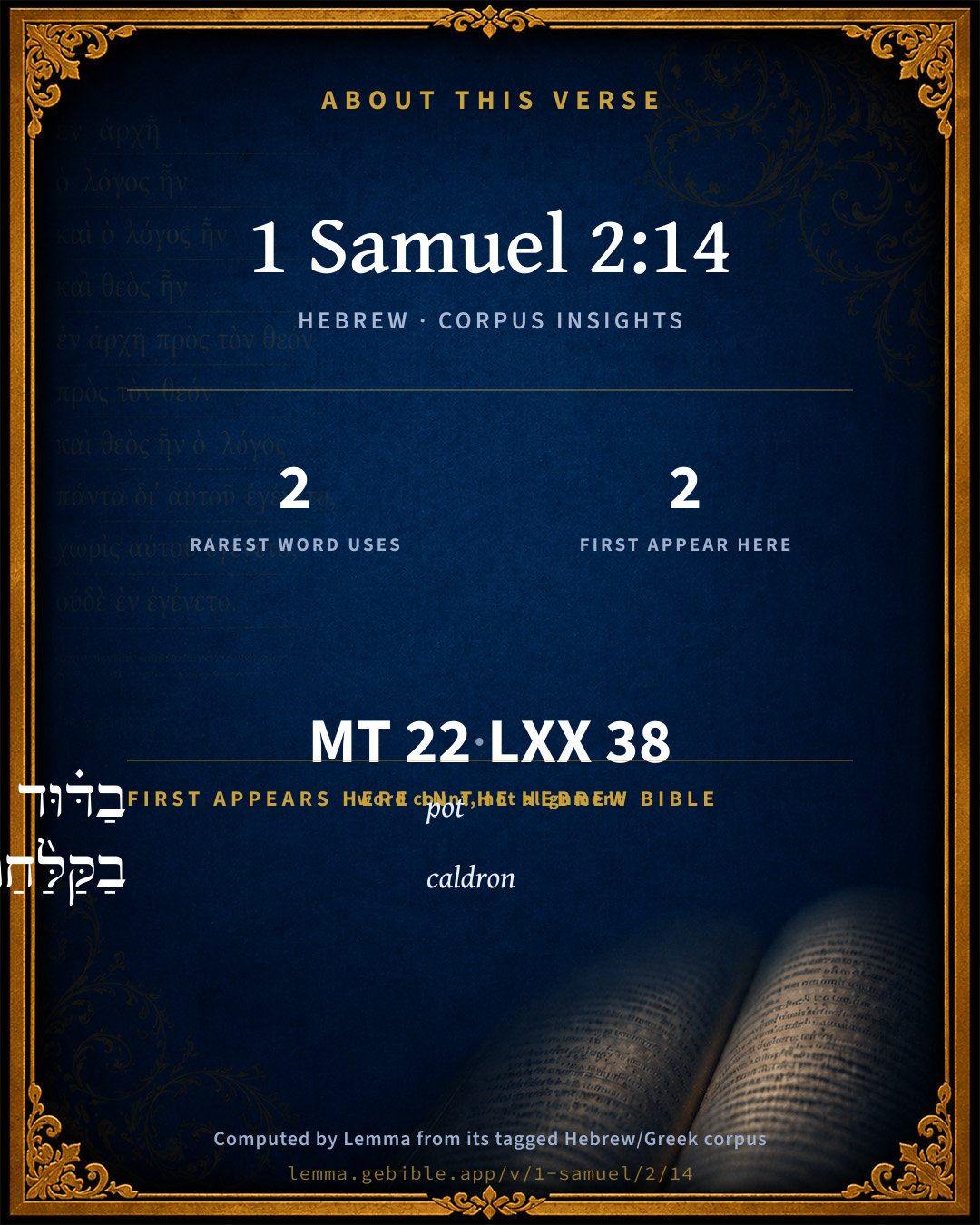
  • 2 first appearances in the Hebrew Bible
Full analysis ↓
Download a study sheet

One document with this verse’s original text, its word-by-word gloss line, the meaning frame, cross-references with their text, attributed commentary, and full source and license credits — printable, and it pastes into notes with its structure intact.

This verse Autodidact and up

Study sheet (.html) Plain text (.txt)

A passage Seminary Student

Up to 50 verses in one chapter. A passage sheet keeps up to 6 commentary sources and 12 cross-references per verse, in the order this page ranks them, and says so on the sheet whenever that leaves anything out. Ask for a single verse and you get the Autodidact verse sheet above.

Everything on this page stays free to read, with no account — the sheet is a download of what is already on screen, not access to it.

Want to remove ads? Support Godless Engineer
Compare translations 3

The same verse in 3 English versions, stacked beneath the original-language interlinear above. Click any original word for its lexicon entry.

Each is an independent rendering of the whole verse — the interlinear is not word-aligned to these translations.

Highlighted words mark where these versions differ — a whole-verse word diff, not a word-by-word alignment.

  • World English Bible Public Domain
    and he struck it into the pan, or kettle, or caldron, or pot; all that the flesh-hook brought up the priest took therewith. So they did in Shiloh to all the Israelites who came there.
  • King James Version Public Domain
    And he struck it into the pan, or kettle, or caldron, or pot; all that the fleshhook brought up the priest took for himself. So they did in Shiloh unto all the Israelites that came thither.
  • unfoldingWord Literal Text CC BY-SA 4.0
    and he would thrust into the pan or into the kettle or into the cauldron or into the pot. All that the fork brought up, the priest would take with him. Thus they did to all of Israel, the ones coming there at Shiloh.

unfoldingWord Literal Text — © unfoldingWord, licensed CC BY-SA 4.0. Word-aligned USFM3 via Door43 (git.door43.org/unfoldingWord/en_ult).

Versions to compare (up to 4)

3 of 4 selected

Show all 18 translations

Every available English version of this verse, each an independent rendering of the whole verse.

  • World English Bible Public Domain
    and he struck it into the pan, or kettle, or caldron, or pot; all that the flesh-hook brought up the priest took therewith. So they did in Shiloh to all the Israelites who came there.
  • Berean Standard Bible Public Domain
    and plunge it into the pan or kettle or cauldron or cooking pot. And the priest would claim for himself whatever the meat fork brought up. This is how they treated all the Israelites who came to Shiloh.
  • Majority Standard Bible Public Domain
    and plunge it into the pan or kettle or cauldron or cooking pot. And the priest would claim for himself whatever the meat fork brought up. This is how they treated all the Israelites who came to Shiloh.
  • King James Version Public Domain
    And he struck it into the pan, or kettle, or caldron, or pot; all that the fleshhook brought up the priest took for himself. So they did in Shiloh unto all the Israelites that came thither.
  • American Standard Version (1901) Public Domain
    and he struck it into the pan, or kettle, or caldron, or pot; all that the flesh-hook brought up the priest took therewith. So they did in Shiloh unto all the Israelites that came thither.
  • Revised Version (1885) Public Domain
    and he struck it into the pan, or kettle, or caldron, or pot; all that the fleshhook brought up the priest took therewith. So they did in Shiloh unto all the Israelites that came thither.
  • Geneva Bible (1599) Public Domain
    And thrust it into the kettle, or into the caldron, or into the panne, or into the potte: all that the fleshhooke brought vp, the Priest tooke for himselfe: thus they did vnto all the Israelites, that came thither to Shiloh.
  • Douay-Rheims (1899) Public Domain
    And thrust it into the kettle, or into the caldron, or into the pot, or into the pan: and all that the fleshhook brought up, the priest took to himself. Thus did they to all Israel that came to Silo.
  • Young's Literal Translation Public Domain
    and hath struck `it' into the pan, or kettle, or caldron, or pot; all that the hook bringeth up doth the priest take for himself; thus they do to all Israel who are coming in, there, in Shiloh.
  • Literal Standard Version CC BY-SA 4.0
    and has struck [it] into the pan, or kettle, or cauldron, or pot; all that the hook brings up the priest takes for himself; thus they do to all Israel who are coming in there in Shiloh.
  • Unlocked Literal Bible CC BY-SA 4.0
    He would stick it into the pan, or kettle, or cauldron, or pot. All that the fork brought up the priest would take for himself. They did this in Shiloh with all the Israelites that came there.
  • unfoldingWord Literal Text CC BY-SA 4.0
    and he would thrust into the pan or into the kettle or into the cauldron or into the pot. All that the fork brought up, the priest would take with him. Thus they did to all of Israel, the ones coming there at Shiloh.
  • Darby Bible Public Domain
    and he struck it into the pan, or kettle, or cauldron, or pot; the priest took of it all that the flesh-hook brought up. So they did in Shiloh to all the Israelites that came there.
  • World Messianic Bible Public Domain
    and he stabbed it into the pan, or kettle, or cauldron, or pot. The priest took all that the fork brought up for himself. They did this to all the Israelites who came there to Shiloh.
  • Webster's Bible Public Domain
    And he struck it into the pan, or kettle, or caldron, or pot; all that the flesh-hook brought up the priest took for himself. So they did in Shiloh to all the Israelites that came thither.
  • Free Bible Version CC BY-SA 4.0
    The servant would stick the fork into the pot while the meat from the sacrifice was being boiled, and would take whatever meat came up on the fork to Eli's sons. This is how they treated all the Israelites who came to Shiloh.
  • Bible in Basic English Public Domain
    This he put into the pot, and everything which came up on the hook the priest took for himself. This they did in Shiloh to all the Israelites who came there.
  • JPS Tanakh (1917) Public Domain
    and he struck it into the pan, or kettle, or caldron, or pot; all that the flesh-hook brought up the priest took therewith. So they did unto all the Israelites that came thither in Shiloh.

Literal Standard Version (2020), Covenant Press — licensed CC BY-SA 4.0. Text via the HelloAO Bible API (eBible.org). Unlocked Literal Bible (unfoldingWord) — licensed CC BY-SA 4.0. Text via the HelloAO Bible API (eBible.org). unfoldingWord Literal Text — © unfoldingWord, licensed CC BY-SA 4.0. Word-aligned USFM3 via Door43 (git.door43.org/unfoldingWord/en_ult). Free Bible Version, Dr. Jonathan Gallagher — licensed CC BY-SA 4.0. Text via the HelloAO Bible API (eBible.org).

Word by word

More ways to search: Search by grammar → Find every occurrence → Compare this word →

Practice this passage: Drill this verse → Learn its vocabulary →

בַקַּלַּ֨חַת֙
qallachath
H7037
“in/at the · caldron”
Preposition, Determined + Noun, Common, Feminine, Singular, Absolute
Part of Speech
Preposition + Noun
Type
Common
Gender
Feminine
Number
Singular
State
Absolute
Full BDB Definition

Origin: apparently but a form for H6747

TWOT: 2025

caldron, pot, kettle
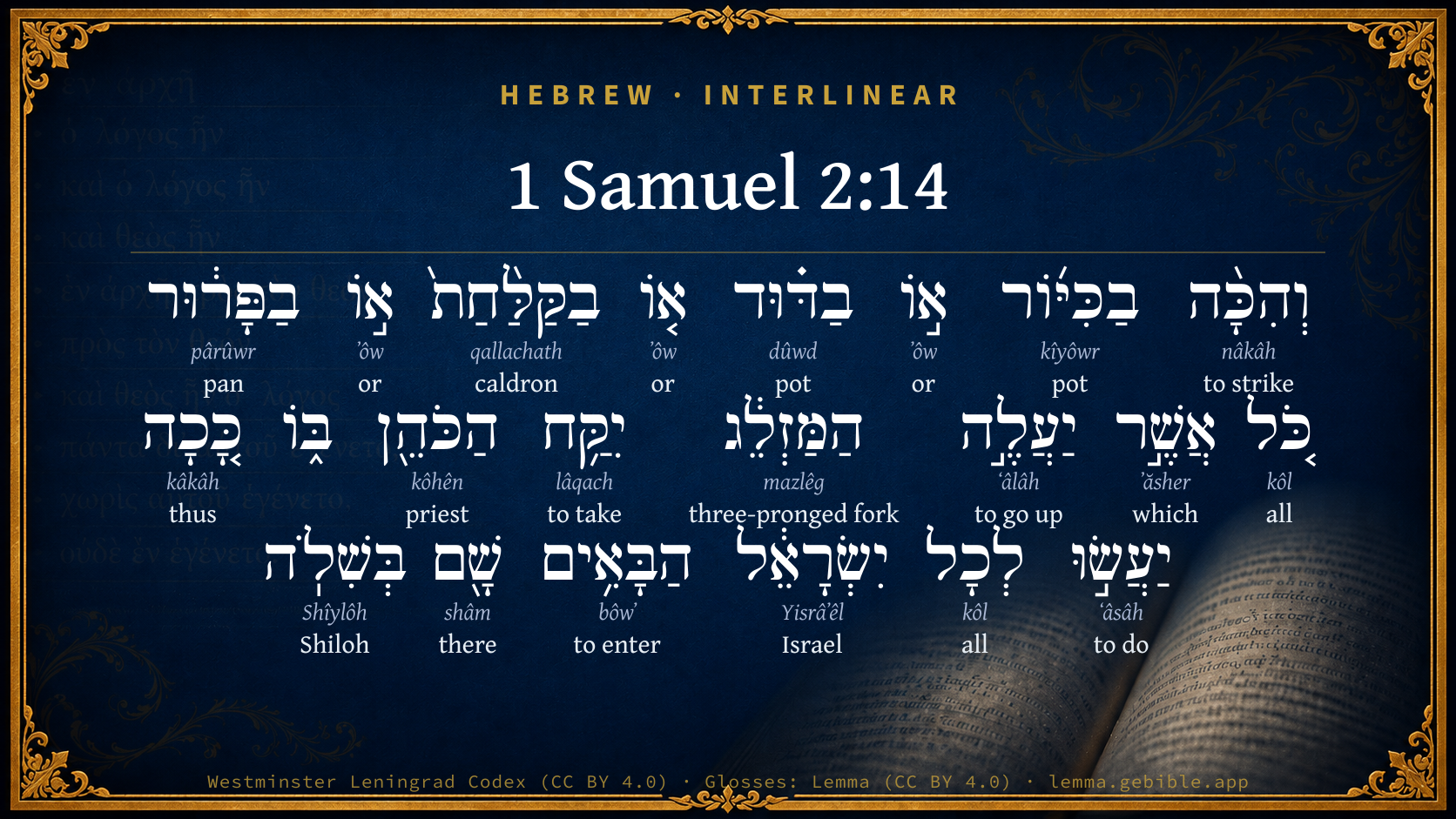
  1. וְהִכָּ֨ה nâkâh H5221 “and · to strike” Conjunction + Verb, Hiphil, Sequential Perfect, 3rd Person, Masculine, Singular
  2. בַכִּיּ֜וֹר kîyôwr H3595 “in/at the · pot” Preposition, Determined + Noun, Common, Masculine, Singular, Absolute
  3. א֣וֹ ʼôw H176 “or” Conjunction
  4. בַדּ֗וּד dûwd H1731 “in/at the · pot” Preposition, Determined + Noun, Common, Masculine, Singular, Absolute
  5. א֤וֹ ʼôw H176 “or” Conjunction
  6. א֣וֹ ʼôw H176 “or” Conjunction
  7. בַפָּר֔וּר pârûwr H6517 “in/at the · pan” Preposition, Determined + Noun, Common, Masculine, Singular, Absolute
  8. כֹּ֚ל kôl H3605 “all” Noun, Common, Masculine, Singular, Absolute
  9. אֲשֶׁ֣ר ʼăsher H834 “which” Particle, Relative
  10. יַעֲלֶ֣ה ʻâlâh H5927 “to go up” Verb, Hiphil, Imperfect, 3rd Person, Masculine, Singular
  11. הַמַּזְלֵ֔ג mazlêg H4207 “the · three-pronged fork” Particle, Definite Article + Noun, Common, Masculine, Singular, Absolute
  12. יִקַּ֥ח lâqach H3947 “to take” Verb, Qal, Imperfect, 3rd Person, Masculine, Singular
  13. הַכֹּהֵ֖ן kôhên H3548 “the · priest” Particle, Definite Article + Noun, Common, Masculine, Singular, Absolute
  14. כָּ֚כָה kâkâh H3602 “thus” Adverb
  15. יַעֲשׂ֣וּ ʻâsâh H6213 “to do” Verb, Qal, Imperfect, 3rd Person, Masculine, Plural
  16. לְכָל kôl H3605 “to/for · all of” Preposition + Noun, Common, Masculine, Singular, Construct
  17. יִשְׂרָאֵ֔ל Yisrâʼêl H3478 “Israel” Noun, Proper
  18. הַבָּאִ֥ים bôwʼ H935 “the · entering” Particle, Definite Article + Verb, Qal, Participle Active, Masculine, Plural, Absolute
  19. שָׁ֖ם shâm H8033 “there” Adverb
  20. בְּשִׁלֹֽה Shîylôh H7887 “in/at · Shiloh” Preposition + Noun, Proper

About this verse

These counts appear in no published source. They are computed here, from the morphology-tagged text and Lemma’s own curated glosses. What Lemma adds →

22
words
18
distinct lemmas
Historical
section

Notable vocabulary

The rarest word here is בַקַּלַּ֨חַת֙ caldron H7037 — appearing just 2 times in the whole Hebrew Bible.

First appearance in Scripture

These words make their first canonical appearance in the Hebrew Bible here:

  • בַדּ֗וּד pot H1731
  • בַקַּלַּ֨חַת֙ caldron H7037

Shared distinctive vocabulary

בַקַּלַּ֨חַת֙ caldron H7037 occurs in 2 verses of the Hebrew Bible. Also found in:

Grammatical profile

  • 5 verbs
  • 10 nouns
  • 1 preposition
  • 3 conjunctions
  • 2 adverbs
  • 1 particle

Verb forms

  • וְהִכָּ֨ה Hiphil · Sequential Perfect
  • יַעֲלֶ֣ה Hiphil · Imperfect
  • יִקַּ֥ח Qal · Imperfect
  • יַעֲשׂ֣וּ Qal · Imperfect
  • הַבָּאִ֥ים Qal · Participle Active

Repetition

Words recur within this verse — often emphatic in Hebrew:

  • כֹּ֚ל all H3605 ×2
  • א֣וֹ or H176 ×3

Hebrew & Septuagint length

In English translation the verse runs 35 words from the Hebrew and 44 from the Septuagint (LXX English) — closely comparable.

A rough comparison of the two English renderings, which tokenize alike — not a word-level alignment.

Word counts can differ between the Hebrew and the Greek without any difference in meaning — e.g. the Hebrew direct-object marker אֵת has no separate Greek word, and Greek often adds the article ὁ.

In the original languages it is 22 Hebrew tokens and 38 Greek tokens — but the two are counted differently (Hebrew bundles its prefixes and suffixes into one token; the Greek is in lemma form), so that isn’t a like-for-like length.

Cross-references

6

Topical passages linked to 1 Samuel 2:14 in the Treasury of Scripture Knowledge — connected by theme and wording, ordered by reader-vote popularity; previews shown in the World English Bible.

  • Exodus 29:27–28 You shall sanctify the breast of the wave-offering, and the thigh of the heave-offering, which is waved, and which is heaved up, of the ram of consecration, even of that which is for Aaron, and of that which is for his sons:
  • 1 Samuel 2:29 Why kick you at my sacrifice and at my offering, which I have commanded in [my] habitation, and honor your sons above me, to make yourselves fat with the best of all the offerings of Israel my people?
  • Isaiah 56:11 Yes, the dogs are greedy, they can never have enough; and these are shepherds who can't understand: they have all turned to their own way, each one to his gain, from every quarter.
  • Leviticus 7:34 For the waved breast and the heaved thigh I have taken from the children of Israel out of the sacrifices of their peace offerings, and have given them to Aaron the priest and to his sons as their portion forever from the children of Israel.'"
  • Malachi 1:10 "Oh that there were one among you who would shut the doors, that you might not kindle fire on my altar in vain! I have no pleasure in you," says Yahweh of hosts, "neither will I accept an offering at your hand.
  • 2 Peter 2:13–15 receiving the wages of unrighteousness; people who count it pleasure to revel in the day-time, spots and blemishes, reveling in their deceit while they feast with you;

Cross-references courtesy of OpenBible.info (CC BY 4.0).

Hebrew and Greek witnesses Masoretic Hebrew ↔ Greek Septuagint

The same verse in the two great witnesses to the Old Testament, shown verse-for-verse.

These are two independent witnesses, not word-aligned to each other, and the Septuagint is shown in lemma (dictionary) form.

Hebrew 1 Samuel 2:14 Masoretic · Westminster Leningrad Codex

וְהִכָּ֨ה בַכִּיּ֜וֹר א֣וֹ בַדּ֗וּד א֤וֹ בַקַּלַּ֨חַת֙ א֣וֹ בַפָּר֔וּר כֹּ֚ל אֲשֶׁ֣ר יַעֲלֶ֣ה הַמַּזְלֵ֔ג יִקַּ֥ח הַכֹּהֵ֖ן בּ֑וֹ כָּ֚כָה יַעֲשׂ֣וּ לְכָל יִשְׂרָאֵ֔ל הַבָּאִ֥ים שָׁ֖ם בְּשִׁלֹֽה

and he struck it into the pan, or kettle, or caldron, or pot; all that the flesh-hook brought up the priest took therewith. So they did in Shiloh to all the Israelites who came there.

World English Bible · Public Domain

Greek LXX 1 Samuel 2:14 Septuagint · lemma form

καί πατάσσω αὐτός εἰς ὁ λέβης ὁ μέγας ἤ εἰς ὁ χαλκίον ἤ εἰς ὁ κύθρα πᾶς ὅς ἐάν ἀναβαίνω ἐν ὁ κρεάγρα λαμβάνω ἑαυτοῦ ὁ ἱερεύς κατά ὅδε ποιέω πᾶς ἰσραήλ ὁ ἔρχομαι θύω κύριος ἐν σηλωμ

And he struck it into the great caldron, or into the brazen vessel, or into the pot, and whatever came up with the flesh-hook, the priest took for himself: so they did to all Israel that came to sacrifice to the Lord in Selom.

LXX2012 (modern English Septuagint) · Public Domain

Hebrew: Westminster Leningrad Codex (CC BY 4.0). Greek: Septuagint (public domain); English from LXX2012 (modern English Septuagint) (Public Domain). How the Septuagint differs from the Hebrew →

Targum (Aramaic paraphrase)

1

The Targum is the ancient Jewish Aramaic paraphrase of the Hebrew Scriptures — an interpretive translation, not the Hebrew text itself. Onkelos (literal) and Pseudo-Jonathan (expansive) render the Torah, and Jonathan the Prophets. Coverage is partial: where no permissively-licensed English translation exists for a verse, only the Aramaic is shown. This is verse-level text, not a word-by-word alignment to the Hebrew.

  1. Targum Jonathan Prophets (Joshua–Malachi)
    וּקְבַע לֵיהּ בְּכִיוֹרָא אוֹ בְדוּדָא אוֹ בִקְדֵירָא אוֹ בְמִלֵיסָא כֹּל דְמַסִיק מַשִׁלְיָא נְסִיב כַּהֲנָא לְנַפְשֵׁיהּ כְּדֵין עָבְדִין לְכָל יִשְׂרָאֵל דְאָתָן לְדַבָּחָא תַּמָן בְּשִׁלֹה:

    (no public-domain English translation for this verse)

    Targum Jonathan — Aramaic: “Mikraot Gedolot” (public domain). English: “Sefaria Community Translation” (CC0 1.0 (public-domain dedication)); “London "Chaldee Paraphrase," 1871” (public domain). Text via Sefaria.

Commentary

Notes on 1 Samuel 2:14 from classic Christian and Jewish commentators (each source and its license shown beneath its notes). The classic Christian expositions comment on the surrounding passage and are grouped to its opening verse, so a note may address several verses; the Jewish commentaries on the Tanakh (Rashi and others) are per-verse, so they appear only where the commentator wrote on this verse.

Lemma curates 59 commentaries, every one of them public domain or Creative Commons licensed, each selected and text-cleaned for this edition rather than reprinted as found. About our sources →

Trapp's Complete Commentary

John Trapp

1Sa 2:14 And he struck [it] into the pan, or kettle, or caldron, or pot; all that the fleshhook brought up the priest took for himself. So they did in Shiloh unto all the Israelites that came thither.

Ver. 14. All that the flesh hook brought up the priest took for himself.] Whether it were his part appointed him by the law or not. See Lev 7:21-22. Commonly a wanton tooth is the harbinger to luxurious wantonness. Gluttony is the gallery that lechery walketh through.

So they did in Shiloh.] In that holy place, which should have struck shame into them, since it was in God’s eye, and to his face, that they committed these abominable villanies.

John Trapp, A Commentary or Exposition upon All the Books of the Old and New Testament (1647–1656) — public domain. Text from a community e-Sword module.

Joseph Benson's Commentary

1Sa 2:14-15. All that the flesh-hook brought up, &c. — This was a new custom, which they had profanely introduced. For, not content with the breast and right shoulder, allowed them by God, they took also part of the offerers’ share; besides which, they snatched their part before it was heaved and waved, contrary to Lev 7:34. Also before they burnt the fat — Which entirely belonged to God with the other parts that were to be burned with it. The priest’s servant came, &c. — This was a high and profane contempt of God, and an additional injury; for they took such parts as they liked best while it was raw, and before that which belonged to God had been offered to him.

Joseph Benson's Commentary on the Old and New Testaments (1811–1818) — public domain. Text from a community e-Sword module.

Geneva Bible (1599)

Geneva Bible translators

Transgressing the order appointed in the Law, Lev. 7:31, for their belly’s sake.

Geneva Bible (1599) marginal notes — public domain. Text via Bolls.life.

Adam Clarke's Commentary

Verse 14. Kettle - caldron, or pot] We know not what these were, nor of what capacity; nor is it of any consequence.

Adam Clarke's Commentary on the Bible (1810–1826) — public domain. Text from a community e-Sword/MySword module.

The Cambridge Bible for Schools and Colleges

gen. ed. J. J. S. Perowne

14. strooke] An old form of struck, Cp. Milton’s Ode on the Nativity,

“Such music sweet

As never was by mortal finger strook.”

The Cambridge Bible for Schools and Colleges (gen. ed. J. J. S. Perowne; Cambridge University Press, 1878–1918) — public domain. Text from a community e-Sword module.

John Gill's Exposition

Also before they burnt the fat,.... Which belonged to the Lord, and was to be offered to him by fire, in the first place, as it ought to be; and the order of sacrificing required that he should have his part first before the priest or the owner: but so impious were the priests become, that

the priest's servant came, and said to the man that sacrificed; not to the priest that offered, but to the man that brought his sacrifice to be offered by the priest:

give flesh to roast for the priest; meaning, not what was his by law, as the breast and shoulder, though for these he ought to have stayed until the fat was offered to the Lord; but other parts of the peace offering, which he had no right unto, for roasting or boiling, and yet in an imperious manner demanded it by his servant:

for he will not have sodden flesh of thee, but raw though this was not the only reason of this demand, because they liked roast meat better than boiled; but because the three forked flesh hook did not always bring up the best pieces out of the boiling pot; and therefore he resolved to have flesh raw, that he might have the best, as well as dress it to his own liking.

John Gill's Exposition of the Whole Bible (1746–1763) — public domain (CC PDM 1.0). Text via the HelloAO Bible API.

Haydock's Catholic Bible Commentary

Pan. Hebrew has also four terms, but their precise meaning cannot be determined. The vessels were of different forms, or intended for various uses.

George Leo Haydock (1774–1849), Haydock's Catholic Family Bible and Commentary, 1859 edition — public domain. Excludes Psalms (Douay-Rheims chapter numbering differs from Protestant) and Deuterocanonical books (Catholic canon only).

Matthew Poole's English Annotations

All that the flesh-hook brought up the priest took for himself; not contented with the breast and shoulder which were allotted them by God, Exo 29:27,28; Le 7:31, they took also part of the offerer’s share; and besides, they snatched their part before it was heaved and waved, contrary to Lev 7:34.

Matthew Poole's English Annotations on the Holy Bible (1683–1685) — public domain. Text from a community e-Sword/MySword module.

John Wesley's Explanatory Notes

Took - Not contented with the breast and shoulder which were allotted them by God, they took also part of the offerer's share; besides which they snatched their part before it was heaved and waved; contrary to Levit vii, 34.

John Wesley, Explanatory Notes Upon the Whole Bible (1754–1765) — public domain. Text via the GEBible commentary corpus.

Rashi

Rabbi Shlomo Yitzchaki (Rashi)

Pot. Fire pot.

Pan. Cauldron.

Bowl. Pan.

Rashi on the Tanakh — English translations: “The Judaica Press complete Tanach with Rashi, translated by A. J. Rosenberg” (CC BY 4.0); “Pentateuch with Rashi's commentary by M. Rosenbaum and A.M. Silbermann, 1929-1934” (public domain); “The Metsudah Tanach series, Lakewood, N.J” (CC BY 4.0); and “The Book of Joshua, Metsudah Publications, 1997” (CC BY 4.0). Text via Sefaria.

Lesson kit

Teaching starters — assembled from the data on this page, not authored interpretation. Every prompt links to the verse data it draws on. Edit before teaching.

1 Samuel, in the Historical, opens this verse with 22 words (18 distinct Hebrew lemmas). Its most distinctive word is qallachath (“caldron”). A historical commentator’s framing appears above. Read the whole chapter for the surrounding context.

Discussion questions

  1. How does “caldron” (qallachath) shape what this verse is saying?
  2. 2 words make their first appearance in Scripture here. What does this debut establish?
  3. How does Micah 3:3, which shares the word «caldron», read alongside this verse?
  4. What does the repetition of “all” (2× in this one verse) do in this verse?
  5. These translations render this verse differently. What is at stake in choosing one wording over another?
  6. «וְהִכָּ֨ה» is a Hiphil Sequential Perfect verb. How does that grammatical form shape the action described?
  7. Compare how Trapp's Complete Commentary and Joseph Benson's Commentary read this verse. Where do they agree or differ?

Things to notice

Reading settings

Reading text

Shown beneath each verse's original-language words.

Old Testament
Old Testament edition

Read the OT as the Masoretic Hebrew (MT) or the Greek Septuagint (LXX).

English shown for the Greek Septuagint (in the Hebrew ↔ Greek comparison).

Comparing translations? Open the Compare panel on any verse page to stack up to four side by side.