
Acts 7:53

Greek (Tischendorf 8th ed.) Acts 7:53 appears in the Greek New Testament. The text above is from the Tischendorf 8th edition. Each word links to its Strong’s number and a concise gloss. Click any word for its full Thayer’s Greek Lexicon entry.
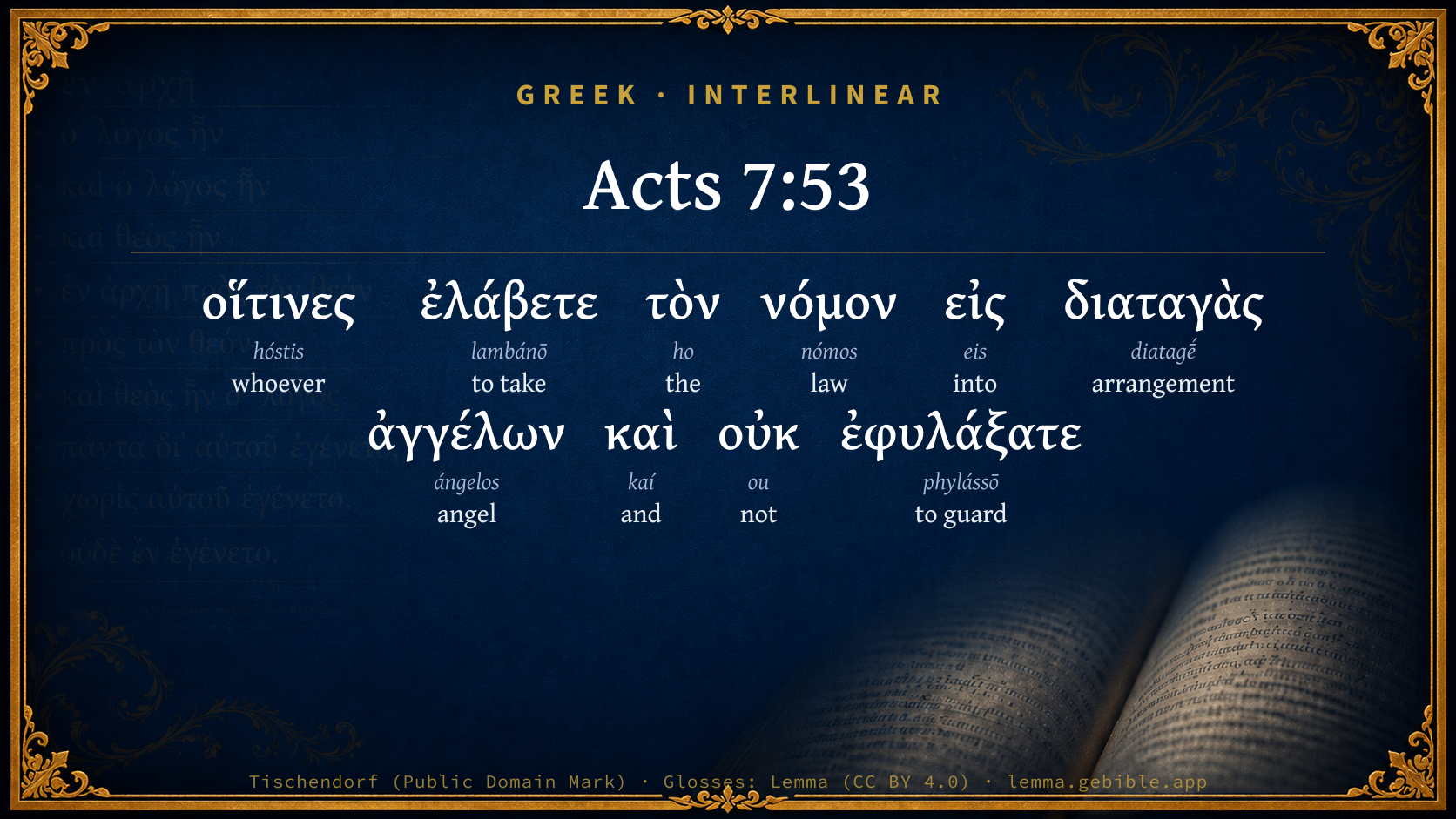
Download image
Cite this verse

Acts 7:53 (World English Bible). Public Domain. Lemma interlinear Bible study tool, https://lemma.gebible.app/v/acts/7/53.

Show BibTeX & RIS
BibTeX
RIS
English Translation
You received the law as it was ordained by angels, and didn't keep it!"
World English Bible · Public Domain
Highlights
  • 1 first appearance in the Greek New Testament
Full analysis ↓
Download a study sheet

One document with this verse’s original text, its word-by-word gloss line, the meaning frame, cross-references with their text, attributed commentary, and full source and license credits — printable, and it pastes into notes with its structure intact.

This verse Autodidact and up

Study sheet (.html) Plain text (.txt)

A passage Seminary Student

Up to 50 verses in one chapter. A passage sheet keeps up to 6 commentary sources and 12 cross-references per verse, in the order this page ranks them, and says so on the sheet whenever that leaves anything out. Ask for a single verse and you get the Autodidact verse sheet above.

Everything on this page stays free to read, with no account — the sheet is a download of what is already on screen, not access to it.

Want to remove ads? Support Godless Engineer
Compare translations 3

The same verse in 3 English versions, stacked beneath the original-language interlinear above. Click any original word for its lexicon entry.

Each is an independent rendering of the whole verse — the interlinear is not word-aligned to these translations.

Highlighted words mark where these versions differ — a whole-verse word diff, not a word-by-word alignment.

  • World English Bible Public Domain
    You received the law as it was ordained by angels, and didn't keep it!"
  • King James Version Public Domain
    Who have received the law by the disposition of angels, and have not kept it.
  • unfoldingWord Literal Text CC BY-SA 4.0
    who received the law by directions of angels, but did not keep it.”

unfoldingWord Literal Text — © unfoldingWord, licensed CC BY-SA 4.0. Word-aligned USFM3 via Door43 (git.door43.org/unfoldingWord/en_ult).

Versions to compare (up to 4)

3 of 4 selected

Show all 19 translations

Every available English version of this verse, each an independent rendering of the whole verse.

  • World English Bible Public Domain
    You received the law as it was ordained by angels, and didn't keep it!"
  • Berean Standard Bible Public Domain
    you who received the law ordained by angels, yet have not kept it.”
  • Majority Standard Bible Public Domain
    you who received the law ordained by angels, yet have not kept it.”
  • King James Version Public Domain
    Who have received the law by the disposition of angels, and have not kept it.
  • American Standard Version (1901) Public Domain
    ye who received the law as it was ordained by angels, and kept it not.
  • Revised Version (1885) Public Domain
    ye who received the law as it was ordained by angels, and kept it not.
  • Geneva Bible (1599) Public Domain
    Which haue receiued the Lawe by the ordinance of Angels, and haue not kept it.
  • Douay-Rheims (1899) Public Domain
    Who have received the law by the disposition of angels, and have not kept it.
  • Young's Literal Translation Public Domain
    who received the law by arrangement of messengers, and did not keep `it'.'
  • Literal Standard Version CC BY-SA 4.0
    who received the Law by arrangement of messengers, and did not keep [it].”
  • Unlocked Literal Bible CC BY-SA 4.0
    you people who received the law that angels had established, but you did not keep it.”
  • unfoldingWord Literal Text CC BY-SA 4.0
    who received the law by directions of angels, but did not keep it.”
  • Darby Bible Public Domain
    who have received the law as ordained by [the] ministry of angels, and have not kept [it].
  • World Messianic Bible Public Domain
    You received the Torah as it was ordained by angels, and didn’t keep it!”
  • Webster's Bible Public Domain
    Who have received the law by the disposition of angels, and have not kept it.
  • Free Bible Version CC BY-SA 4.0
    you who received the law by means of the angels, but refused to keep it.”
  • Bible in Basic English Public Domain
    You, to whom the law was given as it was ordered by angels, and who have not kept it.
  • Text-Critical English NT CC BY 4.0
    you who received the law as ordained by angels yet have not kept it.”
  • Tyndale New Testament (1534) Public Domain
    And ye also have receaved a lawe by the ordinaunce of angels and have not kept it.

Literal Standard Version (2020), Covenant Press — licensed CC BY-SA 4.0. Text via the HelloAO Bible API (eBible.org). Unlocked Literal Bible (unfoldingWord) — licensed CC BY-SA 4.0. Text via the HelloAO Bible API (eBible.org). unfoldingWord Literal Text — © unfoldingWord, licensed CC BY-SA 4.0. Word-aligned USFM3 via Door43 (git.door43.org/unfoldingWord/en_ult). Free Bible Version, Dr. Jonathan Gallagher — licensed CC BY-SA 4.0. Text via the HelloAO Bible API (eBible.org).

Word by word

More ways to search: Search by grammar → Find every occurrence → Compare this word →

Practice this passage: Drill this verse → Learn its vocabulary →

About this verse

These counts appear in no published source. They are computed here, from the morphology-tagged text and Lemma’s own curated glosses. What Lemma adds →

10
words
10
distinct lemmas
Acts
section

Notable vocabulary

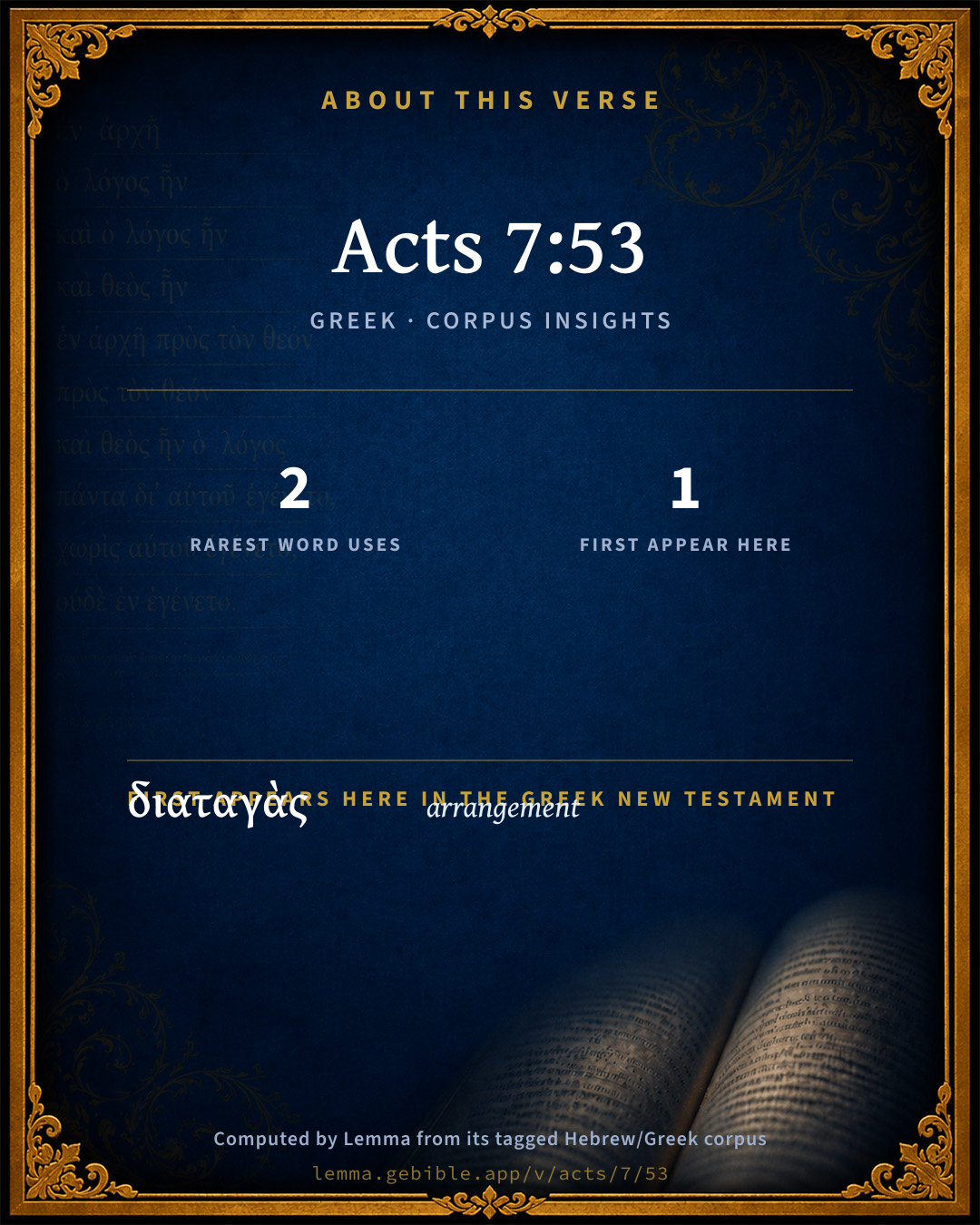
The rarest word here is διαταγὰς arrangement G1296 — appearing just 2 times in the whole Greek New Testament.

First appearance in Scripture

This word makes its first canonical appearance in the Greek New Testament here:

  • διαταγὰς arrangement G1296

Shared distinctive vocabulary

διαταγὰς arrangement G1296 occurs in 2 verses of the Greek New Testament. Also found in:
Cross-references

10

Topical passages linked to Acts 7:53 in the Treasury of Scripture Knowledge — connected by theme and wording, ordered by reader-vote popularity; previews shown in the World English Bible.

  • Hebrews 2:2 For if the word spoken through angels proved steadfast, and every transgression and disobedience received a just recompense;
  • Galatians 3:19 What then is the law? It was added because of transgressions, until the seed should come to whom the promise has been made. It was ordained through angels by the hand of a mediator.
  • Acts 7:38 This is he who was in the assembly in the wilderness with the angel that spoke to him on Mount Sinai, and with our fathers, who received living oracles to give to us,
  • Deuteronomy 33:2 He said, Yahweh came from Sinai, Rose from Seir to them; He shined forth from Mount Paran, He came from the ten thousands of holy ones: At his right hand was a fiery law for them.
  • John 7:19 Didn't Moses give you the law, and yet none of you keeps the law? Why do you seek to kill me?"
  • Galatians 6:13 For even they who receive circumcision don't keep the law themselves, but they desire to have you circumcised, that they may boast in your flesh.
  • Ezekiel 20:18–21 I said to their children in the wilderness, Don't you walk in the statutes of your fathers, neither observe their ordinances, nor defile yourselves with their idols.
  • Romans 2:23–25 You who glory in the law, through your disobedience of the law do you dishonor God?
  • Psalms 68:17 The chariots of God are tens of thousands and thousands of thousands. The Lord is among them, from Sinai, into the sanctuary.
  • Exodus 19:1–20 In the third month after the children of Israel had gone forth out of the land of Egypt, on that same day they came into the wilderness of Sinai.

Cross-references courtesy of OpenBible.info (CC BY 4.0).

Commentary

Notes on Acts 7:53 from classic Christian and Jewish commentators (each source and its license shown beneath its notes). The classic Christian expositions comment on the surrounding passage and are grouped to its opening verse, so a note may address several verses; the Jewish commentaries on the Tanakh (Rashi and others) are per-verse, so they appear only where the commentator wrote on this verse.

Lemma curates 59 commentaries, every one of them public domain or Creative Commons licensed, each selected and text-cleaned for this edition rather than reprinted as found. About our sources →

Bengel's Gnomon

Johann Albrecht Bengel

Act 7:53. Οἵτινες, who) He proves, from the deed which they had perpetrated upon the Christ, that they had not kept the law. Comp. Joh 7:19.—ἐλάβετε, have received) with subjection, in the first instance.—εἰς διαταγὰς ἀγγέλων, into, as to [by] the dispositions of angels) [as being the ordinances established by angels]. This indicates the majesty of the law: Gal 4:14, “Ye received me as an angel of God.” The angels on Sinai appeared under the appearance of a flame. Comp. Gal 3:19 (διαταγεὶς δἰ ἀγγέλων), Heb 2:2. Εἰς, at, in respect to, or by reason of, as in Rom 4:20 (εἰς τὴν ἐπαγγελίαν: he staggered not at it in unbelief, as being the promise of God). The Jews received the law as that which was to be regarded in the light that angelical ordinances would deserve to be regarded; namely, with the highest reverence. God has the angels for His ministers. Hence, what is angelic, is certainly also divine.—οὐκ ἐφυλάξατε, have not kept it) with all your phylacteries [alluding to the verb ἐφύλαξατε]. He who believes on Christ, establishes the law: he who sets aside Christ, sets aside the law. Reason would think that these last words of Stephen ought to have been suppressed by him, because he had by this time completed his defence. But in the state of one making confession of the truth, all things ought to be said, which the glory of GOD and the salvation of the hearers demand.

Bengel's Gnomon of the New Testament — English translation (T&T Clark, Edinburgh, 1860) — public domain. Text from a community e-Sword module.

Meyer's Critical & Exegetical Commentary

Heinrich August Wilhelm Meyer

Act_7:53. Οἵτινες] quippe qui. Stephen desires, namely, now to give the character, through which the foregoing οὗ νῦν ὑμεῖς προδόται κ.τ.λ., as founded on their actually manifested conduct, receives its explanation.

ἐλάβετε] ye have received, placed first with emphasis.

εἰς διαταγὰς ἀγγέλων] upon arrangements of angels, i.e. so that the arrangements made by angels (the direct servants of God), which accompanied the promulgation of the law,[212] made you perceive the obligation to recognise and observe the received law (comp. the contrast, κ. οὐκ ἐφυλάξ.) as the ethical aspect of your ἐλάβετε. Briefly, therefore: Ye received the law with reference to arrangements of angels, which could not leave you doubtful that you ought to submit obediently to the divine institution.

εἰς denotes, as often in Greek writers and in the N. T. (Winer, p. 371 [E. T. 496]), the direction of the mind, in view of. Comp. here especially, Mat_12:41; Rom_4:20.

διαταγή is arrangement, regulation, as in Rom_13:2, with Greek writers διάταξις. Comp. also Ezr_4:11; and see Suicer, Thes. I. p. 886. On the subject-matter, comp. Gal_3:19; Heb_2:2; Delitzsch on Heb. p. 49. At variance with linguistic usage, Beza, Calvin, Piscator, Elsner, Hammond, Wolf, Krause, Heinrichs, Kuinoel, and others, taking διαταγή in the above signification, render: accepistis legem ab angelis promulgatam, as if εἰς stood for ἐν. Others (Grotius, Calovius, Er. Schmid, Valckenaer, and others) explain διαταγή as agmen dispositum, because διατάσσειν is often (also in the classics) used of the drawing up of armies (2Ma_12:20), and διάταξις of the divisions of an army (Jdt_1:4; Jdt_8:36), and translate praesentibus angelorum ordinibus, so that εἰς is likewise taken for ἐν. But against this view (with which, moreover, εἰς would have to be taken as respectu) there is the decisive fact, that there is no evidence of the use of διαταγή in the sense assumed; and therefore the supposition that διαταγή = διάταξις in this signification is arbitrary, as well as at variance with the manifest similarity of the thought with Gal_3:19. Bengel (comp. Hackett, F. Nitzsch, also Winer doubtfully, and Buttmann) renders: Ye received the law for commands of angels, i.e. as commands of angels, so that εἰς is to be understood as in Act_7:21; comp. Heb_11:8. But the Israelites did not receive the law as the commands of angels, but as the commands of God, in which character it was made known to them διʼ ἀγγέλων. Comp. Joseph. Antt. xv. 5. 3 : ἡμῶν τὰ κάλλιστα τῶν δογμάτων καὶ τὰ ὁσιώτατα τῶν ἐν τοῖς νόμοις διʼ ἀγγέλων παρὰ τοῦ Θεοῦ μαθόντων; and see Krebs in loc.

Moreover, the mediating action of the angels not admitting of more precise definition, which is here adverted to, is not contained in Exodus 19, but rests on tradition, which is imported already by the LXX. into Deu_33:2. Comp. on Gal_3:19. For Rabbinical passages (Jalkut Rubeni f. 107, 3, al.), see Schoettgen and Wetstein, ad Gal_3:19. It was a mistaken attempt at harmonizing, when earlier expositors sought to understand by the angels either Moses and the prophets (Heinrichs, Lightfoot) or the seniores populi (Surenhusius, καταλλ. p. 419); indeed, Chrysostom even discovers here again the angel in the bush.

[212] Angels were the arrangers of the act of divine majesty, as arrangers of a festival (διατάσσοντες), dispositores.

Meyer — Critical and Exegetical Commentary on the New Testament — English translation by Peter Christie, edited by Frederick Crombie (T&T Clark, 1880) — public domain. Text from a community e-Sword module.

Expositor's Greek Testament

ed. W. Robertson Nicoll

Act 7:53 . οἴτινες , quippe qui (“ye who,” R.V.), as often in Acts and Epistles not simply for identification, but when as here the conduct of the persons already mentioned is further enlarged upon (Alford), cf. Act 8:15 , Act 9:35 , Act 10:41 ; Act 10:47 , and Winer-Schmiedel, p. 235, but see also Blass, Grammatik , p. 169. εἰς διαταγὰς ἀγγέλων : “as it was ordained by angels,” R.V. εἰς : at the appointment of, cf. its use in Mat 12:41 , or better εἰς as in Act 7:21 = received the law as ordinances of angels ( νόμον being regarded as an aggregate of single acts and so with plural “ordinances”), so Rendall, who takes εἰς = ὡς , and Page, cf. Heb 11:8 , i.e. , it was no human ordinance. But see on the other hand Wendt’s note, p. 192, where he points out that the law was not received as commands given by angels but by God. This was undoubtedly the case, but St. Stephen was here probably referring to the current tradition in Philo and Josephus, and LXX, Deu 33:2 . ἐκ δεξιῶν αὐτοῦ ἄγγελοι μετʼ αὐτοῦ , cf. Ps. 67:17; Philo, De Somn. , p. 642 Mang., so Jos., Ant. , xv., 5, 3, and also Book of Jubilees , chap. i. (see Wetstein and Lightfoot (J. B.) on Gal 3:19 ). Others again take εἰς = ἐν , “accepistis legem ab angelis promulgatam” = διατασσόντων ἀγγέλων , so Blass. Certainly it does not seem possible to take διαταγή = διάταξις = agmen dispositium ( cf. Jdt 1:4 ; Jdt 8:36 ), and to render “præsentibus angelorum ordinibus,” so that here also εἰς = ἐν (Meyer and others). Lightfoot (J.) takes the “angels” as = Moses and the Prophets; Surenhusius as = the elders of the people, whilst St. Chrysostom sees a reference to the angel of the burning bush. It must not be thought that St. Stephen is here depreciating the Law. From a Christian standpoint it might of course be urged that as Christ was superior to the angels, so the introduction of angels showed the inferiority of the Law to the Gospel ( cf. Heb 2:2 , Gal 3:19 ), but St. Stephen’s point is that although the Law had been given with such notable sanctions, yet his hearers had not kept it, and that therefore they, not he, were the real law-breakers. οὐκ ἐφύλαξατε : “cum omnibus phylacteriis vestris,” Bengel. Note the rhetorical power of the words cf. Act 7:25 (Page).

The Expositor's Greek Testament, edited by W. Robertson Nicoll (1897–1910) — public domain. Text from a community e-Sword module.

Geneva Bible (1599)

Geneva Bible translators

By the ministry of Angels.

Geneva Bible (1599) marginal notes — public domain. Text via Bolls.life.

Jamieson, Fausset & Brown

Robert Jamieson, A. R. Fausset & David Brown

Who have received the law by the disposition--"at the appointment" or "ordination," that is, by the ministry.

of angels, and have not kept it--This closing word is designed to shut up those idolizers of the law under the guilt of high disobedience to it, aggravated by the august manner in which they had received it.

Jamieson, Fausset & Brown — Commentary Critical and Explanatory on the Whole Bible (1871) — public domain (CC PDM 1.0). Text via the HelloAO Bible API.

Adam Clarke's Commentary

Verse 53. By the disposition of angels] εις διαταγας αγγελων. After all that has been said on this difficult passage, perhaps the simple meaning is, that there were ranks, διαταγαι, of angels attending on the Divine Majesty when he gave the law: a circumstance which must have added greatly to the grandeur and solemnity of the occasion; and to this Ps 68:17 seems to me most evidently to allude: The chariots of God are twenty thousand, even many thousands of angels: the Lord is among them as in SINAI, in the holy place. It was not then by the mouths nor by the hands of angels, as prime agents, that Moses, and through him the people, received the law; but God himself gave it, accompanied with many thousands of those glorious beings. As it is probable they might be assisting in this most glorious solemnity, therefore St. Paul might say, Ga 3:19, that it was ordained by angels, διαταγεις δι αγγελων, in the hand of a Mediator. And as they were the only persons that could appear, for no man hath seen God at any time, therefore the apostle might say farther, (if indeed he refers to the same transaction, see the note there,) the word spoken by angels was steadfast, Heb 2:2. But the circumstances of this case are not sufficiently plain to lead to the knowledge of what was done by the angels in this most wonderful transaction; only we learn, from the use made of this circumstance by St. Stephen, that it added much to the enormity of their transgression, that they did not keep a law, in dispensing of which the ministry of angels had been employed. Some think Moses, Aaron, and Joshua are the angels here intended; and others think that the fire, light, darkness, cloud and thick darkness were the angels which Jehovah used on this occasion, and to which St. Stephen refers; but neither of these senses appears sufficiently natural, and particularly the latter.

Adam Clarke's Commentary on the Bible (1810–1826) — public domain. Text from a community e-Sword/MySword module.

John Calvin's Commentaries

53. Who have received the law. They called that fury wherewith they raged against Stephen zeal of the law, as if he had been a forsaker of the law, and a revolt and had enforced others to fall away in like sort. Although he was determined to clear himself of this false accusation, yet he did not go through with his answer. For he could not be heard, and it was to no end to speak to deaf men. Therefore, he is content, at a word, to take from them their false color and pretense. It is evident, saith he, that you lie, when you pretend the zeal of the law, which you transgress and break without ceasing; and as he objected unto them in the words next going before, the treacherous murder of the Just, so now he upbraideth unto them their revolting from the law. Some man will say that Stephen’s cause is no whit bettered hereby, because the Jews break the law. But as we have already said, Stephen doth not so chide them, as if his defense did principally consist in this issue, but that they may not flatter themselves in their false boasting. For hypocrites must be handled thus, who will, notwithstanding, seem to be most earnest defenders of God’s glory, though indeed they condemn him carelessly. And here is also a fit antistrophe, because they made semblance that they received the law which was committed to them, which was, notwithstanding, reproachfully despised by them.

In the dispositions of angels It is word for word, into the dispositions, but it is all one. Furthermore, we need not seek any other interpreter of this saying than Paul, who saith that the law was disposed or ordained by angels, (Galatians 3:16;) for he useth the participle there whereof this noun is derived. And his meaning is, that the angels were the messengers of God, and his witnesses in publishing the law, that the authority thereof might be firm and stable.

Therefore, forasmuch as God did call the angels to be, as it were, solemn witnesses when he gave the Jews his law, the same angels shall be witnesses of their unfaithfulness. And to this end doth Stephen make mention of the angels, that he may accuse the Jews in presence of them, and prove them guilty, because they have transgressed the law. Hereby we may gather what shall become of the despisers of the gospel, which doth so far excel the law, that it doth, after a sort, darken the glory thereof, as Paul teacheth, (2 Corinthians 3.)

John Calvin's Commentaries (1540-1563) — public domain. Text from the Calvin Translation Society English edition (1840s-50s) via the Christian Classics Ethereal Library (ccel.org). Calvin's coverage is partial (roughly two-thirds of the Bible); uncommented books and verses are honest gaps, never fabricated. The 19th-century editor's footnotes and remarks are omitted so the notes are faithfully Calvin's own voice.

Ellicott's Commentary for English Readers

(53) Who have received . . .—More accurately, who received.

By the disposition of angels.—Better, as ordained of angels; or, more literally, as ordinances of angels. The Greek preposition cannot possibly have the meaning of “by.” The phrase expressed the current Jewish belief that angels were the intermediate agents through whom Israel received the Law; that it was their voice that was heard on Sinai. Here also St. Paul, in speaking of the Law as “ordained by angels” (Gal_3:19), reproduced St. Stephen. Comp. also Heb_2:2 and Jos. Ant. xv. 4, § 3, for like statements. The idea rested mainly on the LXX. version of Deu_33:2, “on His right hand were angels with Him” and “the thousands of angels” as connected with Sinai in Psa_68:17.

A Bible Commentary for English Readers, edited by Charles John Ellicott (1878–1897) — public domain. Text from a community e-Sword module.

The Cambridge Bible for Schools and Colleges

gen. ed. J. J. S. Perowne

53. who have received] Better, ye who received the Law from Sinai.

by the disposition of angels] Better, at the ministration of angels. St Paul (Gal_3:19) has the same expression concerning the Law, that it was “ministered by angels.” The LXX. have in Deu_33:2, speaking of the giving of the Law, “On his right hand were angels,” and Josephus (Antiq. xv. 5. 3) represents the same tradition, “We have learned from God the most excellent of our doctrines and the most holy part of our Law by angels.” So Pesikta Rabbathi, par. 21, “There came down with the Holy One to Sinai twenty-two thousand ministering angels like the camp of the Levites.”

and have not kept it] Read, and kept it not. Stephen here points back along the whole history of the Jews, and shews how the Law, which was intended to lead men to Christ, had not been guarded in its best sense, the spirit having been sacrificed to the letter, and so the result had been that they rejected and slew Him of whom the whole Law was speaking. The Law, given by angels, was the glory of Israel, the perverse use of it had turned to their shame and destruction.

The Cambridge Bible for Schools and Colleges (gen. ed. J. J. S. Perowne; Cambridge University Press, 1878–1918) — public domain. Text from a community e-Sword module.

John Gill's Exposition

But he being full of the Holy Ghost,.... That is, Stephen, as Beza's ancient copy, and some others express it; and so the Ethiopic version; the Syriac version reads, "full of faith, and of the Holy Ghost", as in Act 6:5 and so some copies; being under the influences of the Spirit of God, and filled with his divine comforts, and strong in the faith of Jesus Christ, and having a holy boldness, courage, and intrepidity of mind; instead of being discouraged and dejected, of being cast down in his spirits, and looking down upon the ground, he

looked up steadfastly to heaven; where he desired to be, and hoped and believed he should be; and from whence he knew his help came, and which he might now implore, as well as forgiveness for his enemies.

And saw the glory of God; not the essential glory of God, but some extraordinary light and brightness, which was a token and representation of him:

and Jesus standing on the right hand of God; of that glory which was a Symbol of him: Jesus being risen from the dead, and ascended on high, was set at the right hand of God, in human nature, and so was visible to the corporeal eye of Stephen; whose visual faculty was so extraordinarily enlarged and assisted, as to reach the body of Christ in the third heavens; where he was seen by him standing, to denote his readiness to assist him, and his indignation at his enemies.

John Gill's Exposition of the Whole Bible (1746–1763) — public domain (CC PDM 1.0). Text via the HelloAO Bible API.

Trapp's Complete Commentary

John Trapp

53 Who have received the law by the disposition of angels, and have not kept it.

Ver. 53. And have not kept it] The Jews were so far from being a law to themselves, αυτονομοι (as the Thracians are said to be), that (more like the Athenians) whereas they had excellent laws, but naughty natures, Moribus suis quam legibus uti mallent, they lived not by their laws, but by their lusts rather. (Val. Max.)

John Trapp, A Commentary or Exposition upon All the Books of the Old and New Testament (1647–1656) — public domain. Text from a community e-Sword module.

Albert Barnes' Notes on the Bible

Who have received the law - The Law of Moses, given on Mount Sinai.

By the disposition of angels - There has been much diversity of opinion in regard to this phrase, εἰς διαταγὰς ἀγγέλων eis diatagas angelōn. The word translated “disposition” does not occur elsewhere in the New Testament. It properly means the “constituting” or “arranging” of an army; disposing it into ranks and proper divisions. Hence, it has been supposed to mean that the Law was given “amidst” the various ranks of angels, being present to witness its promulgation. Others suppose that the angels were employed as agents or instruments to communicate the Law. All that the expression fairly implies is the former; that the Law was given amidst the attending ranks of angels, as if they were summoned to witness the pomp and ceremony of giving “law” to an entire people, and through them to an entire world. It should be added, moreover, that the Jews applied the word “angels” to any messengers of God; to fire, and tempest, and wind, etc. And all that Stephen means here may be to express the common Jewish opinion that God was attended on this occasion by the heavenly hosts, and by the symbols of his presence, fire, and smoke, and tempest. Compare Psa 104:4; Psa 68:17. Other places declare that the Law was spoken by an angel, one eminent above all attending angels, the special messenger of God. See the notes on Act 7:38. It is plain that Stephen spoke only the common sentiment of the Jews. Thus, Herod is introduced by Josephus (Antiq., book 15, chapter 5, section 3) as saying, “We have learned in God the most excellent of our doctrines, and the most holy part of our Law by angels,” etc. In the eyes of the Jews, it justly gave increased majesty and solemnity to the Law, that it had been given in so grand and imposing circumstances. It greatly aggravated their guilt that, notwithstanding this, they had not kept it.

Albert Barnes' Notes on the Bible (1834–1885) — public domain. Text from a community e-Sword/MySword module.

Matthew Poole's English Annotations

The disposition of angels: or ministry of angels; the commandments were published from them ministerially; or the Son of God, (called an Angel, Act 7:35), accompanied with the militia of heaven, (for it is a military metaphor), did in the midst of that glorious retinue give the law, Deu 33:2; Psa 68:8; Gal 3:13,19.

And have not kept it; they transgressed the law, though so gloriously delivered by angels; and therefore it was no wonder if they despised the gospel, that was published by so mean and contemptible ministers.

Matthew Poole's English Annotations on the Holy Bible (1683–1685) — public domain. Text from a community e-Sword/MySword module.

Whedon's Commentary on the Bible

Daniel D. Whedon

53. Law… angels—We have intimated on Act_7:38 that, according to Scripture, the law on Sinai was given by the Angel-Jehovah; but here the law is said to have been given at the dispensation or disposition of angels, in the plural. We understand this plural to be parallel to the plural of the name for God in Hebrew, Elohim. This plural grammarians explain by what they call the plural of excellence, or majesty, such as when a king styles himself We. We prefer to think it arises from the infinite variety and manifoldness of God, as when we call him the Heavenly Powers. So the Angel-Jehovah of Sinai is angels, from the manifoldness of his manifestations on that memorable occasion. Thus for the Hebrew phrase, (Deu_33:2, describing the same scene,) “From his right hand went a fiery law for them,” the Septuagint reads, “On his right hand angels were with him,” where the plural angels is their rendering for the singular fiery law. In this same sense (Heb_2:2) we have the word spoken by angels as being inferior to the utterances of the Son—the visible fiery symbol being less than the living reality, Christ. So, also, “ordained by angels,” (Gal_3:19,) used in the same sense.

There is, indeed, nothing requiring us to deny that God was attended by angels on mount Sinai; but there should be more precise proof than we have that the law, or word, was spoken even instrumentally by personal angels before we can adopt that view. The former point is confirmed by several passages. Thus in Deu_33:2, “He shined from Paran, and he came with holy myriads,” (as it should be rendered,) the word myriads probably denotes myriads of angels. Josephus says, “Our best doctrines and holiest laws have been learned from God through angels.” And Philo says, (on the Decalogue,) “There were present at the giving of the law voices visible, flames of fire, spirits, trumpets, and divine men running hither and thither to publish the law.”

This uninspired testimony is over fanciful. Admitting, in deference to Deu_33:2, that Jehovah was attended by personal angels, we doubt that the law was GIVEN by angels in any other sense than the plural of the Angel-Jehovah, unfolding himself by his multitudinous manifestations on the mount.

Have not kept it—Though the Angel-Jehovah, amid angel ranks and with manifold unfoldings of his own power, had given the law, these Jews had not kept it.

Daniel D. Whedon (gen. ed.), Commentary on the Old and New Testaments (1874–1909) — public domain. Text from a community e-Sword module.

The Pulpit Commentary

Ye who received for who have received, A.V.; as it was ordained by angels for by the disposition of angels, A.V.; kept it not for hove not kept it, A.V. Ordained by angels. This phrase, thus differently rendered (eijv diatagalwn), is one of extreme difficulty: diatagh means properly appointment," or "ordinance," as in Rom_13:2; and eijv, which has a great variety of uses in the Greek of the New Testament, means "at," or "upon," or "on the occasion of," as Mat_12:41, "At the preaching of Jonah." So here they received the Law "at" or "on the occasion of," the "ordering" or "appointing" of angels. When the angels, who were commissioned by God and spoke in his Name, gave the Law, the Israelites so received it. The A.V., "by the disposition of angels" very nearly ex- presses the true sense. Another sense of eijv view of comes to nearly the same thing. St. Paul speaks of the part taken by the angels in the giving of the Law, and in language strikingly resembling the text. He says of it, that it was "ordained through "by," A.V. angels" God ordained or appointed the Law, but the angels were the instruments or ministers of its promulgation. And it is also distinctly referred to in Deu_33:2, where the LXX read, "On his right hand the angels were with him." In the foregoing verses the application which Stephen had all through been contemplating is hurled with accumulated force at the consciences of his hearers, and cuts them to the heart, but does not bring them to repentance.

The Pulpit Commentary (1880–1919), ed. H.D.M. Spence-Jones & Joseph S. Exell — public domain. Text from a community e-Sword module.

John Wesley's Explanatory Notes

Who have received the law by the administration of angels - God, when he gave the law on Mount Sinai, was attended with thousands of his angels, Gal. iii, 19; Psalm lxviii, 17.

John Wesley, Explanatory Notes Upon the Whole Bible (1754–1765) — public domain. Text via the GEBible commentary corpus.

Scofield Reference Notes

C. I. Scofield

angels

(See Scofield "Heb 1:4").

The Scofield Reference Bible (1917 edition), notes by C. I. Scofield — public domain. Text from a community e-Sword module.

McGarvey & Pendleton's Commentaries

J. W. McGarvey

See notes on verse 51

J. W. McGarvey (with Philip Y. Pendleton), Commentaries on the New Testament (The Fourfold Gospel, 1914; Acts; and the epistles) — public domain. Text from a community e-Sword/MySword module.

Cambridge Greek Testament for Schools and Colleges

53. οἵτινες κ.τ.λ., ye who received the Law, from Sinai.

εἰς διαταγὰς ἀγγέλων. Literally, ‘unto ordinances of angels,’ which signifies ‘at the ministration of angels’ or ‘as it was ordained by angels.’ St Paul (Gal 3:19) has the same expression concerning the Law, that it was ‘ministered by angels.’ The LXX. have in Deu 33:2, speaking of the giving of the Law, ἐκ δεξιῶν αὐτοῦ ἄγγελοι μετ’ αὐτοῦ, and Josephus (Ant. XV. 5. 3) represents the same tradition, ‘We have learned from God the most excellent of our doctrines and the most holy part of our Law by angels.’ So Pesikta Rabbathi, par. xxi., ‘There came down with the Holy One to Sinai twenty-two thousand ministering angels, like the camp of the Levites.’

καὶ οὐκ ἐφυλάξατε, and ye kept it not. Stephen here points back along the whole history of the Jews, and shews how the Law, which was intended to lead men to Christ, had not been guarded in its best sense, the spirit having been sacrificed to the letter, and so the result had been that they rejected and slew Him of whom the whole Law was speaking. The Law, given by angels, was the glory of Israel, the perverse use of it had proved their shame and destruction.

Cambridge Greek Testament for Schools and Colleges (Cambridge University Press, 1896; 21 vols, various authors incl. Carr, Maclear, Plummer, Farrar, Lumby, Moule, M. R. James, Simcox) — public domain. Text from a community e-Sword module.

Alford’s Greek Testament

Henry Alford

53.] The use of οἵτινες, instead of οἱ, so very frequent in the Acts and Epistles, occurs when the clause introduced by it contains a further explanation of the position or classification of the person or persons alluded to, and not when the relative serves for simple identification. See Rom 1:25, Rom 1:32.

εἰς διαταγὰς ἀγγέλων] Many explanations have been given. Chrys. διαταχθέντα νόμον λέγει, τὸν ἐγχειρισθέντα αὐτῷ διʼ ἄγγελον τὸν ὀφθέντα αὐτῷ ἐν τῷ βάτῳ: and Œ νόμον λαβόντας διατάξεις ἔχοντα, αἵτινες ἰσάγγελον ἐποίουν πολιτείαν ἔχειν τοὺς τελοῦντας αὐτόν. Heinsius and Lightfoot understand by ἀγγέλ. the prophets: Grot., Calov., and Krebs, ‘præsentibus angelorum ordinibus,’ taking διαταγάς = διατάξεις in the sense of divisions of an army (Judith 8:36), in which it never occurs,—not to say that εἰς will not bear this: Beza, Calv., Pisc., Elsn., Hamm., Kuin., &c., ‘ab angelis promulgatum,’ which εἰς will not bear (ἐν): Winer, Gr., edn. 6, § 32. 4, b, ‘as commands of angels’ (but see below), which, however, was not the fact (Mey., who refers to Jos. Antt. xv. 5. 3, ἡμῶν τὰ κάλλιστα τῶν δογμάτων καὶ τὰ ὁσιώτατα τῶν ἐν τοῖς νόμοις διʼ ἀγγέλων παρὰ τοῦ θεοῦ μαθόντων):—the Syriac version, ‘per mandatum angelorum:’—Vulg. and Calv., ‘in dispositione (or -onibus) angelorum:’ Schöttg., ‘per ministerium angelorum.’ These three last are precluded by the foregoing remarks. The key to the right rendering seems to be the similar expression in ref. Gal., ὁ νόμος διαταγεὶς διʼ ἀγγέλων. The law was given by God, but announced by angels. The people received God’s law then, εἰς διαταγὰς ἀγγέλων, at the injunction (a sense of διατ. amply justified, see Palm and Rost’s lex. διάταξις, and Polyb. iv. 19. 10; 87. 5: and preferred by Winer in his last edn., ut supra) of angels. So Mat 12:41, μετενόησαν εἰς τὸ κήρυγμα Ἰῶνα, ‘they repented at the preaching of Jonas.’ The only other legitimate rendering, ‘as the injunctions of angels,’ comes under the objections made to Winer’s former view, above.

Henry Alford, The Greek Testament (1849–1861) — public domain. Text from a community e-Sword module.

Vincent's Word Studies in the New Testament

Marvin R. Vincent

Who [οιτινες] . Stronger than the simple relative who, and emphasizing their sin by contrast with their privileges : inasmuch as ye were those who received, etc.

By the disposition of angels [εις διαταγας αγγελων] . Lit., unto ordinances of angels. Eijv means with reference to. Disposition [διαταγη] is used by A. V. in the sense of arrangement, as we say a general disposed his troops. The word occurs only here and Rom 13:2, where it is rendered ordinance. The kindred verb diatassw occurs often, mostly in the sense of command or appoint. See Mt 11:1; Luk 3:13. In 1Co 11:34, it is translated set in order. The reference is most probably to the Jewish tradition that the law was given through the agency of angels. See Deu 32:2. Compare Psa 68:17. Paul expressly says that the law was administered by the medium of angels (Gal 3:19). Compare the word spoken by angels (Heb 2:2). Render, therefore, as Rev., as it was ordained by angels.

Marvin R. Vincent, Word Studies in the New Testament (1887–1900) — public domain. Text from a community e-Sword/MySword module.

Lesson kit

Teaching starters — assembled from the data on this page, not authored interpretation. Every prompt links to the verse data it draws on. Edit before teaching.

Acts, in the Acts, opens this verse with 10 words (10 distinct Greek lemmas). Its most distinctive word is diatagḗ (“arrangement”). A historical commentator’s framing appears above. Read the whole chapter for the surrounding context.

Discussion questions

  1. How does “arrangement” (diatagḗ) shape what this verse is saying?
  2. The word “arrangement” first appears here in Scripture. What is being introduced at this debut?
  3. Romans 13:2 shares the word «arrangement» with this verse. How do the two illuminate each other?
  4. These translations render this verse differently. What is at stake in choosing one wording over another?
  5. Reading how Bengel's Gnomon and Meyer's Critical & Exegetical Commentary read this verse, where do the two commentators agree and where do they part?

Things to notice

  • 1 word makes its first canonical appearance in Scripture here.
  • These translations choose different wording for 10 words in this verse.
  • 10 distinct Greek lemmas span 10 words in this verse.

Reading settings

Reading text

Shown beneath each verse's original-language words.

Old Testament
Old Testament edition

Read the OT as the Masoretic Hebrew (MT) or the Greek Septuagint (LXX).

English shown for the Greek Septuagint (in the Hebrew ↔ Greek comparison).

Comparing translations? Open the Compare panel on any verse page to stack up to four side by side.